1 / 115
CoreHard 2018 Minsk
(small) embeded system?
use C++ !
Wouter van Ooijen MSc (ir)
Hogeschool Utrecht, Netherlands,
senior lecturer Computer Engineering
SG14 member
wouter.vanooijen@hu.nl
2 / 115
A detour …..
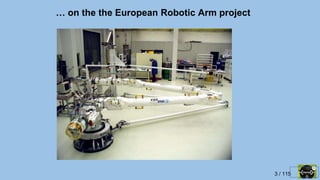
Some 20 years ago I worked for a small Dutch space company
3 / 115
… on the the European Robotic Arm project
4 / 115
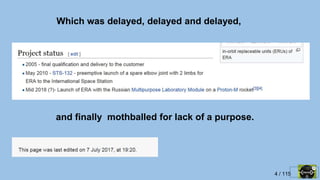
Which was delayed, delayed and delayed,
and finally mothballed for lack of a purpose.
5 / 115
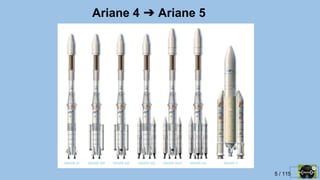
Ariane 4 ➔ Ariane 5
6 / 115
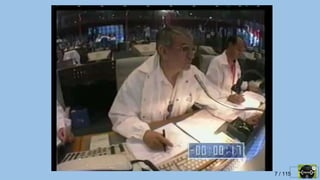
Big day
Ariane 5 maiden flight
Payment!
7 / 115
8 / 115
9 / 115
10 / 115
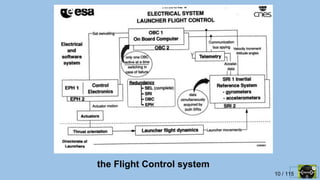
the Flight Control system
11 / 115
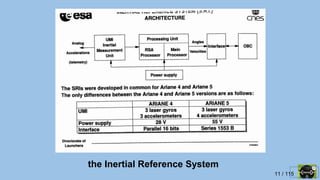
the Inertial Reference System
12 / 115
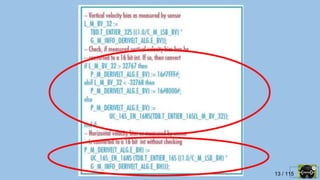
• Requirement: CPU load at launch must be < 80%
• IRS CPU load is too high
• Analysis: physically HVB can’t be out of range
• Agreed solution: remove the checks for HVB
Design process…
13 / 115
14 / 115
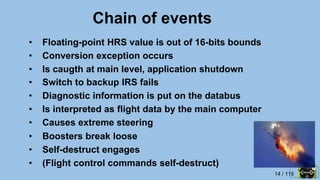
• Floating-point HRS value is out of 16-bits bounds
• Conversion exception occurs
• Is caugth at main level, application shutdown
• Switch to backup IRS fails
• Diagnostic information is put on the databus
• Is interpreted as flight data by the main computer
• Causes extreme steering
• Boosters break loose
• Self-destruct engages
• (Flight control commands self-destruct)
Chain of events
15 / 115
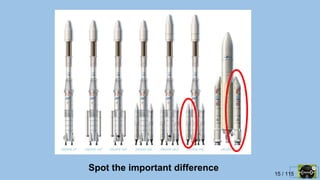
Spot the important difference
16 / 115
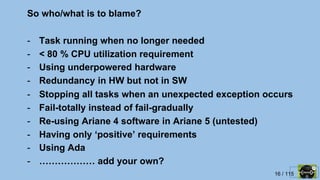
So who/what is to blame?
- Task running when no longer needed
- < 80 % CPU utilization requirement
- Using underpowered hardware
- Redundancy in HW but not in SW
- Stopping all tasks when an unexpected exception occurs
- Fail-totally instead of fail-gradually
- Re-using Ariane 4 software in Ariane 5 (untested)
- Having only ‘positive’ requirements
- Using Ada
- ……………… add your own?
17 / 115
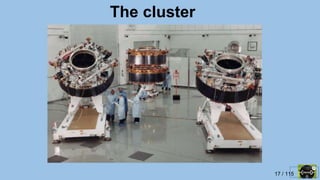
The cluster
18 / 115
Welcome to the embedded world – where things can go kaboom!
19 / 115
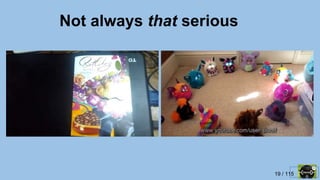
Not always that serious
20 / 115
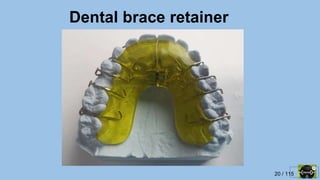
Dental brace retainer
21 / 115
Airbag
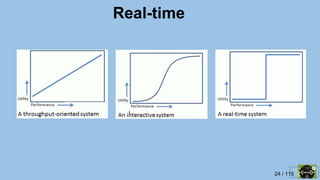
Late might even be worse than not at all…
22 / 115
Wide span of seriousness
23 / 115
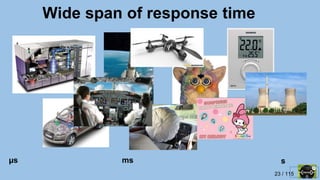
Wide span of response time
µs ms s
24 / 115
Real-time
25 / 115
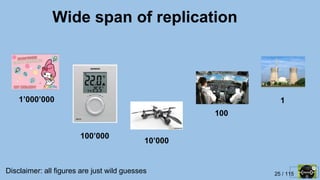
Wide span of replication
1
Disclaimer: all figures are just wild guesses
100’000
10’000
100
1’000’000
26 / 115
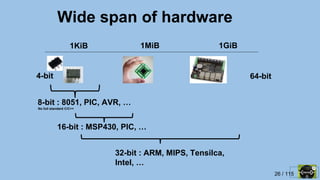
1MiB 1GiB1KiB
4-bit
8-bit : 8051, PIC, AVR, …
16-bit : MSP430, PIC, …
64-bit
No full standard C/C++
32-bit : ARM, MIPS, Tensilca,
Intel, …
Wide span of hardware
27 / 115
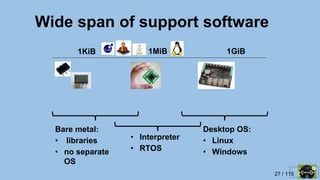
Wide span of support software
Bare metal:
• libraries
• no separate
OS
1MiB 1GiB1KiB
Desktop OS:
• Linux
• Windows
• Interpreter
• RTOS
28 / 115
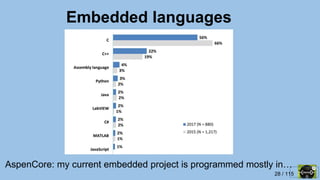
Embedded languages
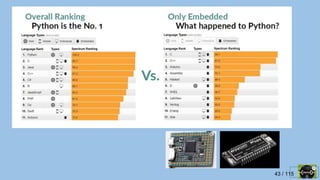
AspenCore: my current embedded project is programmed mostly in…
29 / 115
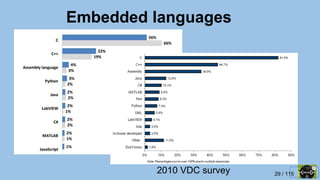
Embedded languages
2010 VDC survey
30 / 115
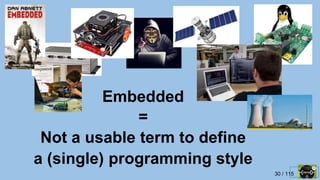
=
Not a usable term to define
a (single) programming style
Embedded
31 / 115
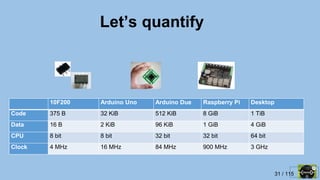
Let’s quantify
10F200 Arduino Uno Arduino Due Raspberry Pi Desktop
Code 375 B 32 KiB 512 KiB 8 GiB 1 TiB
Data 16 B 2 KiB 96 KiB 1 GiB 4 GiB
CPU 8 bit 8 bit 32 bit 32 bit 64 bit
Clock 4 MHz 16 MHz 84 MHz 900 MHz 3 GHz
32 / 115
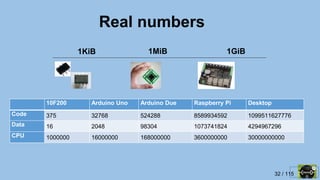
Real numbers
1MiB 1GiB1KiB
10F200 Arduino Uno Arduino Due Raspberry Pi Desktop
Code 375 32768 524288 8589934592 1099511627776
Data 16 2048 98304 1073741824 4294967296
CPU 1000000 16000000 168000000 3600000000 30000000000
33 / 115
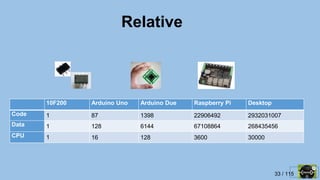
Relative
10F200 Arduino Uno Arduino Due Raspberry Pi Desktop
Code 1 87 1398 22906492 2932031007
Data 1 128 6144 67108864 268435456
CPU 1 16 128 3600 30000
34 / 115
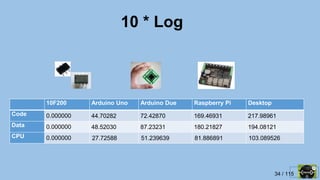
10 * Log
10F200 Arduino Uno Arduino Due Raspberry Pi Desktop
Code 0.000000 44.70282 72.42870 169.46931 217.98961
Data 0.000000 48.52030 87.23231 180.21827 194.08121
CPU 0.000000 27.72588 51.239639 81.886891 103.089526
35 / 115
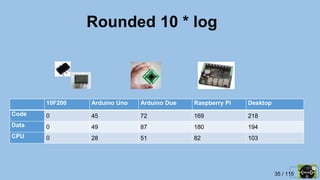
Rounded 10 * log
10F200 Arduino Uno Arduino Due Raspberry Pi Desktop
Code 0 45 72 169 218
Data 0 49 87 180 194
CPU 0 28 51 82 103
36 / 115
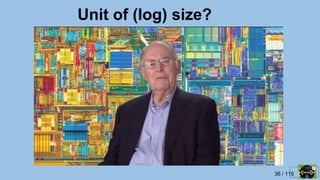
Unit of (log) size?
37 / 115
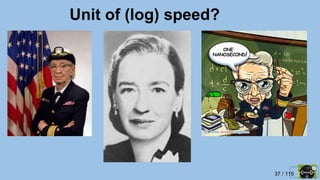
Unit of (log) speed?
38 / 115
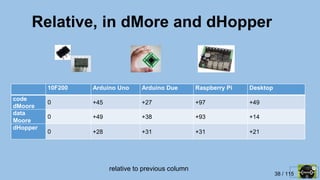
Relative, in dMore and dHopper
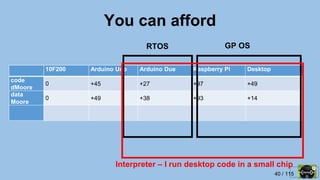
10F200 Arduino Uno Arduino Due Raspberry Pi Desktop
code
dMoore
0 +45 +27 +97 +49
data
Moore
0 +49 +38 +93 +14
dHopper
0 +28 +31 +31 +21
relative to previous column
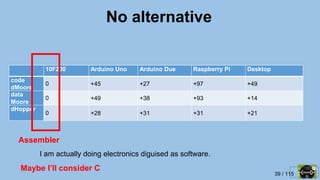
39 / 115
10F200 Arduino Uno Arduino Due Raspberry Pi Desktop
code
dMoore
0 +45 +27 +97 +49
data
Moore
0 +49 +38 +93 +14
dHopper
0 +28 +31 +31 +21
Assembler
No alternative
I am actually doing electronics diguised as software.
Maybe I’ll consider C
40 / 115
10F200 Arduino Uno Arduino Due Raspberry Pi Desktop
code
dMoore
0 +45 +27 +97 +49
data
Moore
0 +49 +38 +93 +14
RTOS GP OS
Interpreter – I run desktop code in a small chip
You can afford
41 / 115
10F200 Arduino Uno Arduino Due Raspberry Pi Desktop
code
dMoore
0 +45 +27 +97 +49
data
Moore
0 +49 +38 +93 +14
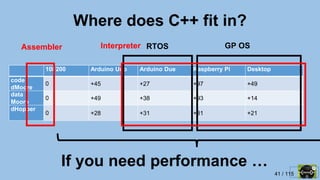
dHopper
0 +28 +31 +31 +21
RTOS GP OSInterpreter
Where does C++ fit in?
Assembler
If you need performance …
42 / 115
Otherwise
43 / 115
44 / 115
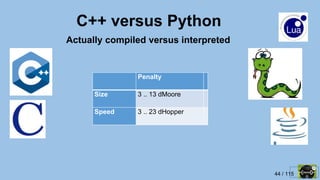
C++ versus Python
Actually compiled versus interpreted
Penalty
Size 3 .. 13 dMoore
Speed 3 .. 23 dHopper
45 / 115
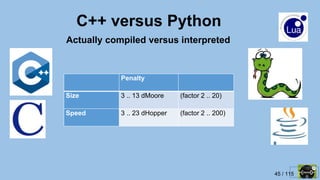
C++ versus Python
Actually compiled versus interpreted
Penalty
Size 3 .. 13 dMoore (factor 2 .. 20)
Speed 3 .. 23 dHopper (factor 2 .. 200)
46 / 115
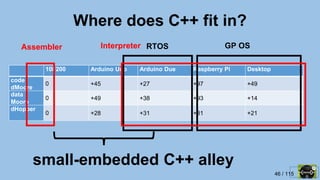
10F200 Arduino Uno Arduino Due Raspberry Pi Desktop
code
dMoore
0 +45 +27 +97 +49
data
Moore
0 +49 +38 +93 +14
dHopper
0 +28 +31 +31 +21
RTOS GP OSInterpreter
Where does C++ fit in?
Assembler
small-embedded C++ alley
47 / 115
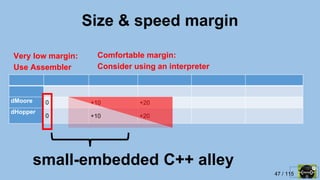
dMoore 0 +10 +20
dHopper
0 +10 +20
Size & speed margin
Very low margin:
Use Assembler
Comfortable margin:
Consider using an interpreter
small-embedded C++ alley
48 / 115
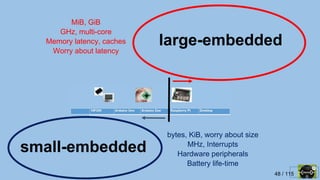
large-embedded
small-embedded
MiB, GiB
GHz, multi-core
Memory latency, caches
Worry about latency
bytes, KiB, worry about size
MHz, Interrupts
Hardware peripherals
Battery life-time
49 / 115
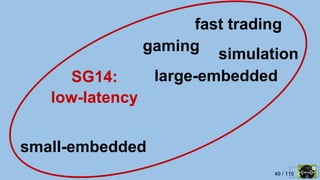
large-embedded
small-embedded
fast trading
gaming
simulation
SG14:
low-latency
50 / 115
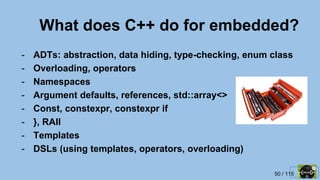
What does C++ do for embedded?
- ADTs: abstraction, data hiding, type-checking, enum class
- Overloading, operators
- Namespaces
- Argument defaults, references, std::array<>
- Const, constexpr, constexpr if
- }, RAII
- Templates
- DSLs (using templates, operators, overloading)
51 / 115
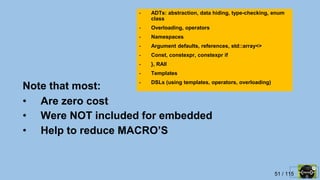
Note that most:
• Are zero cost
• Were NOT included for embedded
• Help to reduce MACRO’S
- ADTs: abstraction, data hiding, type-checking, enum
class
- Overloading, operators
- Namespaces
- Argument defaults, references, std::array<>
- Const, constexpr, constexpr if
- }, RAII
- Templates
- DSLs (using templates, operators, overloading)
52 / 115
Less usefull?
- Heap : (small-) embedded is often ‘mission-critical’
- Exceptions : idem
- Classic OO : not free
- Bit-fields : not enough control, and can be done adequately
(and encapsulated!) with other means
- The libraries (large - but unspecified! - parts can’t be used)
53 / 115
Annoying
All (library) assumptions that are hard-coded
- Extra space is allocated on the heap
- Integer calculations are done using int
- Floating-point calculations are done using double
- Special situations are reported by exceptions
- This function must be fast / small
- Caching determines speed, so avoid linked lists
- All that matters is amortized complexity
54 / 115
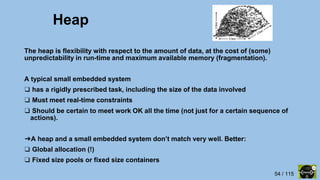
Heap
The heap is flexibility with respect to the amount of data, at the cost of (some)
unpredictability in run-time and maximum available memory (fragmentation).
A typical small embedded system
❑ has a rigidly prescribed task, including the size of the data involved
❑ Must meet real-time constraints
❑ Should be certain to meet work OK all the time (not just for a certain sequence of
actions).
➔A heap and a small embedded system don’t match very well. Better:
❑ Global allocation (!)
❑ Fixed size pools or fixed size containers
55 / 115
Exceptions
Exceptions are great to handle a local problem that requires a (more) global response.
❑ A small system often has a rather simple, rigidly defined task
➔there are no exceptions, only different situations.
❑ No heap ➔ one reason less to use exceptions.
❑ Exception implementation often uses the heap….
Straw man: exceptions are slow and have unpredictable timing.
56 / 115
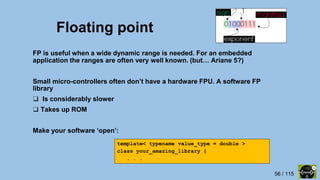
Floating point
FP is useful when a wide dynamic range is needed. For an embedded
application the ranges are often very well known. (but… Ariane 5?)
Small micro-controllers often don’t have a hardware FPU. A software FP
library
❑ Is considerably slower
❑ Takes up ROM
Make your software ‘open’:
template< typename value_type = double >
class your_amazing_library {
. . .
57 / 115
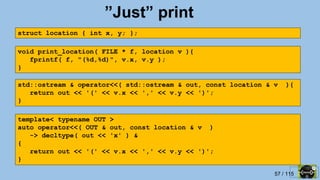
”Just” print
struct location { int x, y; };
void print_location( FILE * f, location v ){
fprintf( f, "(%d,%d)", v.x, v.y );
}
std::ostream & operator<<( std::ostream & out, const location & v ){
return out << '(' << v.x << ',' << v.y << ')';
}
template< typename OUT >
auto operator<<( OUT & out, const location & v )
-> decltype( out << 'x' ) &
{
return out << '(' << v.x << ',' << v.y << ')';
}
58 / 115
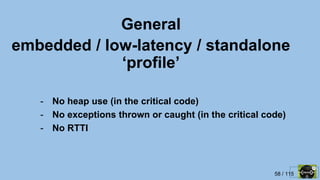
General
embedded / low-latency / standalone
‘profile’
- No heap use (in the critical code)
- No exceptions thrown or caught (in the critical code)
- No RTTI
59 / 115
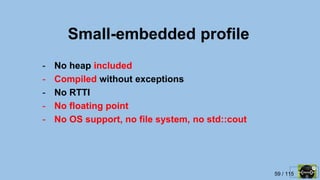
Small-embedded profile
- No heap included
- Compiled without exceptions
- No RTTI
- No floating point
- No OS support, no file system, no std::cout
60 / 115
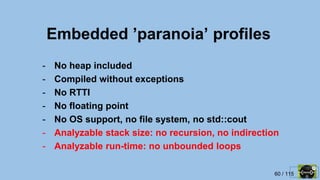
Embedded ’paranoia’ profiles
- No heap included
- Compiled without exceptions
- No RTTI
- No floating point
- No OS support, no file system, no std::cout
- Analyzable stack size: no recursion, no indirection
- Analyzable run-time: no unbounded loops
61 / 115
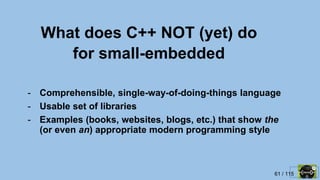
What does C++ NOT (yet) do
for small-embedded
- Comprehensible, single-way-of-doing-things language
- Usable set of libraries
- Examples (books, websites, blogs, etc.) that show the
(or even an) appropriate modern programming style
62 / 115
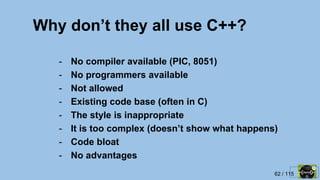
Why don’t they all use C++?
- No compiler available (PIC, 8051)
- No programmers available
- Not allowed
- Existing code base (often in C)
- The style is inappropriate
- It is too complex (doesn’t show what happens)
- Code bloat
- No advantages
63 / 115
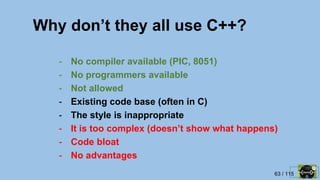
Why don’t they all use C++?
- No compiler available (PIC, 8051)
- No programmers available
- Not allowed
- Existing code base (often in C)
- The style is inappropriate
- It is too complex (doesn’t show what happens)
- Code bloat
- No advantages
64 / 115
Remark from The Embedded Muse (salary) survey:
http://www.ganssle.com/tem/tem347.html
At my job we are developing embedded software using C++11 and there
are exceedingly few resources on how to develop embedded systems
using modern C++. We try to stick to industry best practices, but a lot of
the time there is a lack of standards (or even discussion) regarding parts
of C++ that are now 7+ years old. I would love to see more discussion
and use of modern C++ in the embedded community.
65 / 115
What’s in the pipeline
- Concepts
- Class types in non-type template parameters
- Freestanding
- Ranges
66 / 115
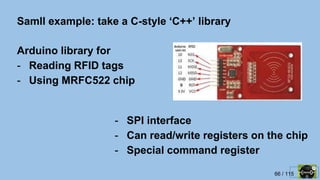
Samll example: take a C-style ‘C++’ library
Arduino library for
- Reading RFID tags
- Using MRFC522 chip
- SPI interface
- Can read/write registers on the chip
- Special command register
67 / 115
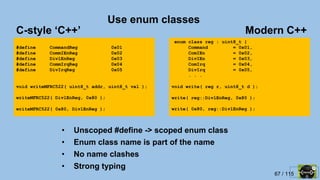
Use enum classes
#define CommandReg 0x01
#define CommIEnReg 0x02
#define DivlEnReg 0x03
#define CommIrqReg 0x04
#define DivIrqReg 0x05
void writeMFRC522( uint8_t addr, uint8_t val );
writeMFRC522( DivlEnReg, 0x80 );
writeMFRC522( 0x80, DivlEnReg );
enum class reg : uint8_t {
Command = 0x01,
ComIEn = 0x02,
DivIEn = 0x03,
ComIrq = 0x04,
DivIrq = 0x05,
. . .
void write( reg r, uint8_t d );
write( reg::DivlEnReg, 0x80 );
write( 0x80, reg::DivlEnReg );
• Unscoped #define -> scoped enum class
• Enum class name is part of the name
• No name clashes
• Strong typing
C-style ‘C++’ Modern C++
68 / 115
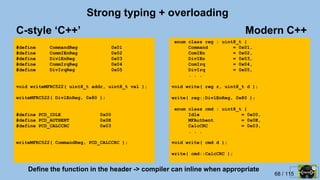
Strong typing + overloading
#define CommandReg 0x01
#define CommIEnReg 0x02
#define DivlEnReg 0x03
#define CommIrqReg 0x04
#define DivIrqReg 0x05
void writeMFRC522( uint8_t addr, uint8_t val );
writeMFRC522( DivlEnReg, 0x80 );
#define PCD_IDLE 0x00
#define PCD_AUTHENT 0x0E
#define PCD_CALCCRC 0x03
writeMFRC522( CommandReg, PCD_CALCCRC );
enum class reg : uint8_t {
Command = 0x01,
ComIEn = 0x02,
DivIEn = 0x03,
ComIrq = 0x04,
DivIrq = 0x05,
. . .
void write( reg r, uint8_t d );
write( reg::DivlEnReg, 0x80 );
enum class cmd : uint8_t {
Idle = 0x00,
MFAuthent = 0x0E,
CalcCRC = 0x03,
. . .
void write( cmd d );
write( cmd::CalcCRC );
Modern C++C-style ‘C++’
Define the function in the header -> compiler can inline when appropriate
69 / 115
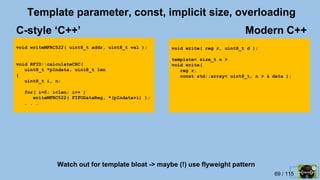
Template parameter, const, implicit size, overloading
void writeMFRC522( uint8_t addr, uint8_t val );
void RFID::calculateCRC(
uint8_t *pIndata, uint8_t len
{
uint8_t i, n;
for( i=0; i<len; i++ )
writeMFRC522( FIFODataReg, *(pIndata+i) );
. . .
void write( reg r, uint8_t d );
template< size_t n >
void write(
reg r,
const std::array< uint8_t, n > & data );
Modern C++C-style ‘C++’
Watch out for template bloat -> maybe (!) use flyweight pattern
70 / 115
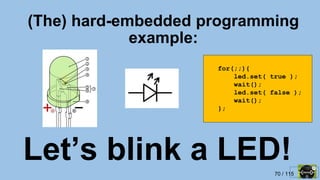
(The) hard-embedded programming
example:
Let’s blink a LED!
for(;;){
led.set( true );
wait();
led.set( false );
wait();
};
71 / 115
In this case, take the blue pill
72 / 115
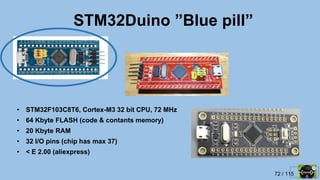
STM32Duino ”Blue pill”
• STM32F103C8T6, Cortex-M3 32 bit CPU, 72 MHz
• 64 Kbyte FLASH (code & contants memory)
• 20 Kbyte RAM
• 32 I/O pins (chip has max 37)
• < E 2.00 (aliexpress)
73 / 115
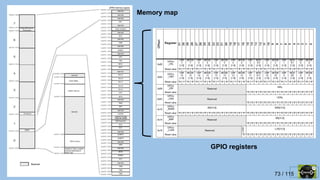
Memory map
GPIO registers
74 / 115
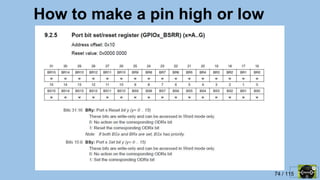
How to make a pin high or low
75 / 115
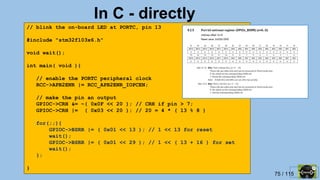
In C - directly
// blink the on-board LED at PORTC, pin 13
#include "stm32f103x6.h"
void wait();
int main( void ){
// enable the PORTC peripheral clock
RCC->APB2ENR |= RCC_APB2ENR_IOPCEN;
// make the pin an output
GPIOC->CRH &= ~( 0x0F << 20 ); // CRH if pin > 7;
GPIOC->CRH |= ( 0x03 << 20 ); // 20 = 4 * ( 13 % 8 )
for(;;){
GPIOC->BSRR |= ( 0x01 << 13 ); // 1 << 13 for reset
wait();
GPIOC->BSRR |= ( 0x01 << 29 ); // 1 << ( 13 + 16 ) for set
wait();
};
}
76 / 115
In C - directly
for(;;){
GPIOC->BSRR = ( 0x01 << 13 );
wait();
GPIOC->BSRR = ( 0x01 << 29 );
wait();
};
mov r6, #8192
mov r5, #536870912
ldr r4, .L3+4
. . .
.L2:
str r6, [r4, #16]
bl _Z4waitv
str r5, [r4, #16]
bl _Z4waitv
b .L2
. . .
.L3:
.word 1073876992
.word 1073811456
gcc 6.2.0, -mcpu=cortex-m3 -Os -std=c11
http://www.github.com/wovo/2017-berlin
Instructions Direct
Call 1*
Library -
77 / 115
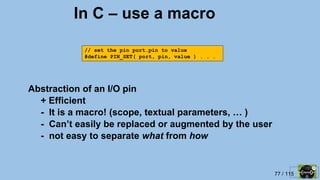
In C – use a macro
Abstraction of an I/O pin
+ Efficient
- It is a macro! (scope, textual parameters, … )
- Can’t easily be replaced or augmented by the user
- not easy to separate what from how
// set the pin port.pin to value
#define PIN_SET( port, pin, value ) . . .
78 / 115
In C - functions
// blink the on-board LED at PORTC, pin 13
#include "stm32f103x6.h"
void wait();
void pin_set( int, bool );
int main( void ){
RCC->APB2ENR |= RCC_APB2ENR_IOPCEN;
GPIOC->CRH &= ~( 0x0F << 20 ); // CRH if pin > 7
GPIOC->CRH |= ( 0x03 << 20 ); // 20 = 4 * ( 13 % 8 )
for(;;){
pin_set( 77, true );
wait();
pin_set( 77, false );
wait();
};
}
#include "stm32f103x6.h"
GPIO_TypeDef * port_registers[] = {
GPIOA, GPIOB, GPIOC, GPIOD };
// pin == 32 * port + pin
void pin_set( int pin, bool value ){
port_registers[ pin / 32 ]->BSRR =
0x01 << ( ( pin % 16 ) + ( value ? 0 : 16 ) );
}
79 / 115
In C - functions
#include "stm32f103x6.h"
GPIO_TypeDef * port_registers[] = {
GPIOA, GPIOB, GPIOC, GPIOD };
// pin == 32 * port + pin
void pin_set( int pin, bool value ){
port_registers[ pin / 32 ]->BSRR =
0x01 << ( ( pin % 16 ) + ( value ? 0 : 16 ) );
}
80 / 115
In C - functions
for(;;){
pin_set( 77, true );
wait();
pin_set( 77, false );
wait();
};
.L2:
movs r1, #1
movs r0, #77
bl _Z7pin_setib
bl _Z4waitv
movs r1, #0
movs r0, #77
bl _Z7pin_setib
bl _Z4waitv
b .L2
_Z7pin_setib:
movs r3, #32
sdiv r3, r0, r3
ldr r2, .L4
ldr r2, [r2, r3, lsl #2]
rsbs r3, r0, #0
and r3, r3, #15
and r0, r0, #15
it pl
rsbpl r0, r3, #0
cmp r1, #0
ite ne
movne r3, #0
moveq r3, #16
add r3, r3, r0
movs r0, #1
lsls r0, r0, r3
str r0, [r2, #16]
bx lr
void pin_set( int pin, bool value ){
port_registers[ pin / 32 ]->BSRR =
0x01 << ( ( pin % 16 ) + ( value ? 0 : 16 ) );
}
Instructions Direct Function
Call 1* 3
Library - 18
81 / 115
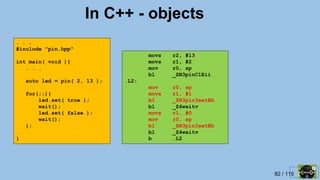
In C++ - objects
. . .
#include "pin.hpp"
int main( void ){
. . .
auto led = pin( 2, 13 );
for(;;){
led.set( true );
wait();
led.set( false );
wait();
};
}
// pin.cpp
#include "stm32f103x6.h"
#include "pin.hpp"
GPIO_TypeDef * port_registers[] = {
GPIOA, GPIOB, GPIOC, GPIOD };
pin::pin( int port, int num ):
port( port ), num( num ){}
void pin::set( bool value ){
port_registers[ port ]->BSRR =
0x01 << ( ( num % 16 ) + ( value ? 0 : 16 ) );
}
// pin.hpp
class pin {
private:
int port, num;
public:
pin( int port, int num );
void set( bool value );
};
82 / 115
In C++ - objects
. . .
#include "pin.hpp"
int main( void ){
. . .
auto led = pin( 2, 13 );
for(;;){
led.set( true );
wait();
led.set( false );
wait();
};
}
movs r2, #13
movs r1, #2
mov r0, sp
bl _ZN3pinC1Eii
.L2:
mov r0, sp
movs r1, #1
bl _ZN3pin3setEb
bl _Z4waitv
movs r1, #0
mov r0, sp
bl _ZN3pin3setEb
bl _Z4waitv
b .L2
83 / 115
In C++ - objects
void pin::set( bool value ){
port_registers[ port ]->BSRR =
0x01 << ( ( num % 16 ) + ( value ? 0 : 16 ) );
}
_ZN3pin3setEb:
ldr r2, [r0]
ldr r3, .L5
push {r4, lr}
ldr r4, [r3, r2, lsl #2]
ldr r3, [r0, #4]
rsbs r2, r3, #0
and r2, r2, #15
and r3, r3, #15
it pl
rsbpl r3, r2, #0
cmp r1, #0
ite ne
movne r2, #0
moveq r2, #16
add r2, r2, r3
movs r3, #1
lsls r3, r3, r2
str r3, [r4, #16]
pop {r4, pc}
Instructions Direct Function OO
Call 1* 3 3*
Library - 18 19
84 / 115
…… Well, in some situations.
85 / 115
In C++ - class templates
. . .
#include "pin.hpp"
int main( void ){
. . .
using led = gpio< 2, 13 >;
for(;;){
led::set( true );
wait();
led::set( false );
wait();
};
}
// pin.hpp
#include "stm32f103x6.h"
GPIO_TypeDef * port_registers[] = {
GPIOA, GPIOB, GPIOC, GPIOD };
template< int port, int pin >
class gpio {
public:
static void set( bool value ){
port_registers[ port ]->BSRR =
0x01 << ( ( pin % 16 ) + ( value ? 0 : 16 ) );
}
};
86 / 115
In C++ - class templates
. . .
#include "pin.hpp"
int main( void ){
. . .
using led = gpio< 2, 13 >;
for(;;){
led::set( true );
wait();
led::set( false );
wait();
};
}
mov r6, #8192
mov r5, #536870912
ldr r4, .L3+4
. . .
.L2:
ldr r3, [r4, #8]
str r6, [r3, #16]
bl _Z4waitv
ldr r3, [r4, #8]
str r5, [r3, #16]
bl _Z4waitv
b .L2
. . .
.L3:
.word 1073876992
.word .LANCHOR0
.word 1073811456
Instructions Direct Function OO Template
Call 1* 3 3* 2*
Library - 18 19 -
87 / 115
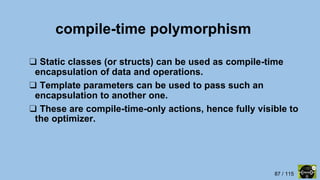
compile-time polymorphism
❑ Static classes (or structs) can be used as compile-time
encapsulation of data and operations.
❑ Template parameters can be used to pass such an
encapsulation to another one.
❑ These are compile-time-only actions, hence fully visible to
the optimizer.
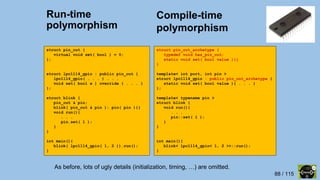
88 / 115
Run-time
polymorphism
struct pin_out {
virtual void set( bool ) = 0;
};
struct lpc1114_gpio : public pin_out {
lpc1114_gpio( . . . ) . . .
void set( bool x ) override { . . . }
};
struct blink {
pin_out & pin;
blink( pin_out & pin ): pin( pin ){}
void run(){
. . .
pin.set( 1 );
}
}
int main(){
blink( lpc1114_gpio( 1, 2 )).run();
}
template< int port, int pin >
struct lpc1114_gpio {
static void set( bool value ){ . . . }
};
template< typename pin >
struct blink {
void run(){
. . .
pin::set( 1 );
}
}
int main(){
blink< lpc1114_gpio< 1, 2 >>::run();
}
As before, lots of ugly details (initialization, timing, …) are omitted.
Compile-time
polymorphism
struct pin_out_archetype {
typedef void has_pin_out;
static void set( bool value ){}
}
template< int port, int pin >
struct lpc1114_gpio : public pin_out_archetype {
static void set( bool value ){ . . . }
};
template< typename pin >
struct blink {
void run(){
. . .
pin::set( 1 );
}
}
int main(){
blink< lpc1114_gpio< 1, 2 >>::run();
}
89 / 115
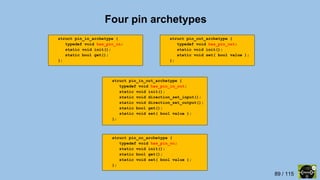
struct pin_oc_archetype {
typedef void has_pin_oc;
static void init();
static bool get();
static void set( bool value );
};
struct pin_out_archetype {
typedef void has_pin_out;
static void init();
static void set( bool value );
};
struct pin_in_out_archetype {
typedef void has_pin_in_out;
static void init();
static void direction_set_input();
static void direction_set_output();
static bool get();
static void set( bool value );
};
Four pin archetypes
struct pin_in_archetype {
typedef void has_pin_in;
static void init();
static bool get();
};
90 / 115
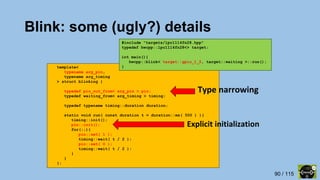
#include "targets/lpc1114fn28.hpp"
typedef hwcpp::lpc1114fn28<> target;
int main(){
hwcpp::blink< target::gpio_0_0, target::waiting >::run();
}
template<
typename arg_pin,
typename arg_timing
> struct blinking {
typedef pin_out_from< arg_pin > pin;
typedef waiting_from< arg_timing > timing;
typedef typename timing::duration duration;
static void run( const duration t = duration::ms( 500 ) ){
timing::init();
pin::init();
for(;;){
pin::set( 1 );
timing::wait( t / 2 );
pin::set( 0 );
timing::wait( t / 2 );
}
}
};
Blink: some (ugly?) details
#include "targets/lpc1114fn28.hpp"
typedef hwcpp::lpc1114fn28<> target;
int main(){
hwcpp::blink< target::gpio_1_2, target::waiting >::run();
}
Type narrowing
Explicit initialization
91 / 115
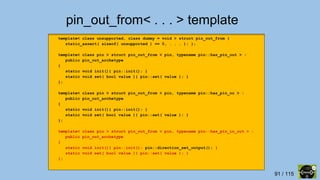
template< class unsupported, class dummy = void > struct pin_out_from {
static_assert( sizeof( unsupported ) == 0, . . . ); };
pin_out_from< . . . > template
template< class unsupported, class dummy = void > struct pin_out_from {
static_assert( sizeof( unsupported ) == 0, . . . ); };
template< class pin > struct pin_out_from < pin, typename pin::has_pin_out > :
public pin_out_archetype
{
static void init(){ pin::init(); }
static void set( bool value ){ pin::set( value ); }
};
template< class pin > struct pin_out_from < pin, typename pin::has_pin_oc > :
public pin_out_archetype
{
static void init(){ pin::init(); }
static void set( bool value ){ pin::set( value ); }
};
template< class unsupported, class dummy = void > struct pin_out_from {
static_assert( sizeof( unsupported ) == 0, . . . ); };
template< class pin > struct pin_out_from < pin, typename pin::has_pin_out > :
public pin_out_archetype
{
static void init(){ pin::init(); }
static void set( bool value ){ pin::set( value ); }
};
template< class pin > struct pin_out_from < pin, typename pin::has_pin_oc > :
public pin_out_archetype
{
static void init(){ pin::init(); }
static void set( bool value ){ pin::set( value ); }
};
template< class pin > struct pin_out_from < pin, typename pin::has_pin_in_out > :
public pin_out_archetype
{
static void init(){ pin::init(); pin::direction_set_output(); }
static void set( bool value ){ pin::set( value ); }
};
92 / 115
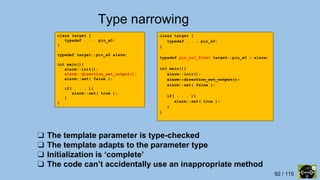
Type narrowing
class target {
typedef . . . pin_a0;
}
typedef target::pin_a0 alarm;
int main(){
alarm::init();
alarm::direction_set_output();
alarm::set( false );
if( . . . ){
alarm::set( true );
}
}
class target {
typedef . . . pin_a0;
}
typedef pin_out_from< target::pin_a0 > alarm;
int main(){
alarm::init();
alarm::direction_set_output();
alarm::set( false );
if( . . . ){
alarm::set( true );
}
}
❑ The template parameter is type-checked
❑ The template adapts to the parameter type
❑ Initialization is ‘complete’
❑ The code can’t accidentally use an inappropriate method
93 / 115
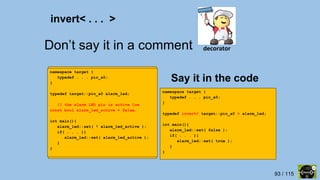
Don’t say it in a comment
namespace target {
typedef . . . pin_a0;
}
typedef target::pin_a0 alarm_led;
int main(){
alarm_led::set( false );
if( . . . ){
alarm_led::set( true );
}
}
namespace target {
typedef . . . pin_a0;
}
typedef invert< target::pin_a0 > alarm_led;
int main(){
alarm_led::set( false );
if( . . . ){
alarm_led::set( true );
}
}
Say it in the code
invert< . . . >
decorator
namespace target {
typedef . . . pin_a0;
}
typedef target::pin_a0 alarm_led;
// the alarm LED pin is active low
const bool alarm_led_active = false;
int main(){
alarm_led::set( ! alarm_led_active );
if( . . . ){
alarm_led::set( alarm_led_active );
}
}
94 / 115
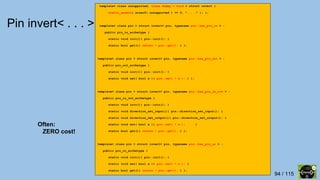
Pin invert< . . . >
template< class unsupported, class dummy = void > struct invert {
static_assert( sizeof( unsupported ) == 0, ". . ." ); };
template< class pin > struct invert< pin, typename pin::has_pin_in > :
public pin_in_archetype {
static void init(){ pin::init(); }
static bool get(){ return ! pin::get(); } };
template< class pin > struct invert< pin, typename pin::has_pin_out > :
public pin_out_archetype {
static void init(){ pin::init(); }
static void set( bool x ){ pin::set( ! x ); } };
template< class pin > struct invert< pin, typename pin::has_pin_in_out > :
public pin_in_out_archetype {
static void init(){ pin::init(); }
static void direction_set_input(){ pin::direction_set_input(); }
static void direction_set_output(){ pin::direction_set_output(); }
static void set( bool x ){ pin::set( ! x ); }
static bool get(){ return ! pin::get(); } };
template< class pin > struct invert< pin, typename pin::has_pin_oc > :
public pin_oc_archetype {
static void init(){ pin::init(); }
static void set( bool x ){ pin::set( ! x ); }
static bool get(){ return ! pin::get(); } };
Often:
ZERO cost!
95 / 115
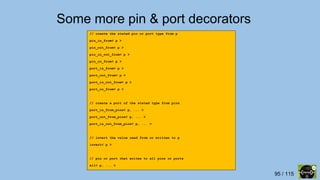
Some more pin & port decorators
// create the stated pin or port type from p
pin_in_from< p >
pin_out_from< p >
pin_in_out_from< p >
pin_oc_from< p >
port_in_from< p >
port_out_from< p >
port_in_out_from< p >
port_oc_from< p >
// create a port of the stated type from pins
port_in_from_pins< p, ... >
port_out_from_pins< p, ... >
port_in_out_from_pins< p, ... >
// invert the value read from or written to p
invert< p >
// pin or port that writes to all pins or ports
all< p, ... >
96 / 115
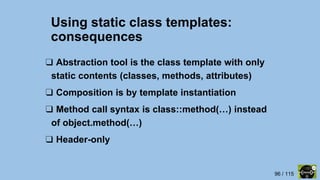
Using static class templates:
consequences
❑ Abstraction tool is the class template with only
static contents (classes, methods, attributes)
❑ Composition is by template instantiation
❑ Method call syntax is class::method(…) instead
of object.method(…)
❑ Header-only
97 / 115
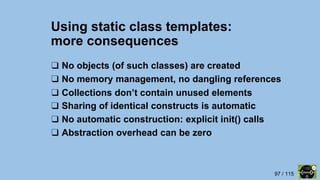
Using static class templates:
more consequences
❑ No objects (of such classes) are created
❑ No memory management, no dangling references
❑ Collections don’t contain unused elements
❑ Sharing of identical constructs is automatic
❑ No automatic construction: explicit init() calls
❑ Abstraction overhead can be zero
98 / 115
What does a
programming language
want?
99 / 115
“Give me just one generation of youth,
and I'll transform the whole world.”
100 / 115
What motivates the next generation of
programmers?
• Websites : (that isn’t real programming)
• Mobile : mostly Android, Java, Java-frameworks
• Easy power : RaspberryPi, Python
• (Micro Bit, Lego) : graphic programming
• Cheap, low-energy, hardware interfacing : Arduino
101 / 115
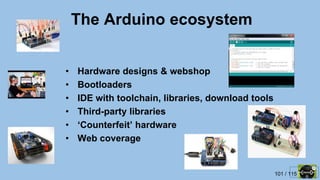
The Arduino ecosystem
• Hardware designs & webshop
• Bootloaders
• IDE with toolchain, libraries, download tools
• Third-party libraries
• ‘Counterfeit’ hardware
• Web coverage
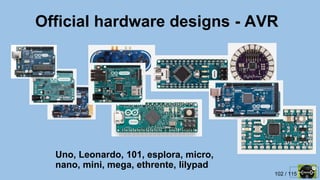
102 / 115
Official hardware designs - AVR
Uno, Leonardo, 101, esplora, micro,
nano, mini, mega, ethrente, lilypad
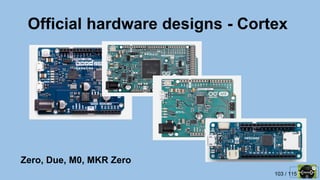
103 / 115
Official hardware designs - Cortex
Zero, Due, M0, MKR Zero
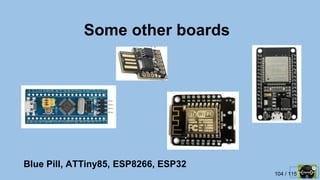
104 / 115
Some other boards
Blue Pill, ATTiny85, ESP8266, ESP32
105 / 115
Arduino software
- Crappy IDE, but it works quite reliably
- Some behind-the-scenes magic
- Uses C++ compiler, but almost no C++ features
- Lots of overlapping third-party libraries
- Configuration is often by editing the library source
(each LCD driver has its own graphics library)
- And yet: tremendously popular!
106 / 115
Opportunities!
- Lots of black magic & cargo-cult beliefs
- Lots of duplicate efforts (overlapping libraries)
- Lack of leverage (no component-based culture)
A well-structured set of C++ libraries, books, websites,
clubs, etc. could make these folks love C++ for their
life!
107 / 115
Target audience?
- Kids
- Professional C++ programmers in their spare time
- non-EE/CE professionals (artists!)
108 / 115
and don’t let them escape!
Grab the next generation
109 / 115
Takaways
- Embedded? Please be more specific!
- The C++ is the language for (small-) embedded
- but ’they’ don’t know that yet ☹
- and we don’t yet agree on how to use it
- C++ libraries could be more embedded-friendly

Objects? No thanks!

  • 1.
    1 / 115 CoreHard2018 Minsk (small) embeded system? use C++ ! Wouter van Ooijen MSc (ir) Hogeschool Utrecht, Netherlands, senior lecturer Computer Engineering SG14 member wouter.vanooijen@hu.nl
  • 2.
    2 / 115 Adetour ….. Some 20 years ago I worked for a small Dutch space company
  • 3.
    3 / 115 …on the the European Robotic Arm project
  • 4.
    4 / 115 Whichwas delayed, delayed and delayed, and finally mothballed for lack of a purpose.
  • 5.
    5 / 115 Ariane4 ➔ Ariane 5
  • 6.
    6 / 115 Bigday Ariane 5 maiden flight Payment!
  • 7.
  • 8.
  • 9.
  • 10.
    10 / 115 theFlight Control system
  • 11.
    11 / 115 theInertial Reference System
  • 12.
    12 / 115 •Requirement: CPU load at launch must be < 80% • IRS CPU load is too high • Analysis: physically HVB can’t be out of range • Agreed solution: remove the checks for HVB Design process…
  • 13.
  • 14.
    14 / 115 •Floating-point HRS value is out of 16-bits bounds • Conversion exception occurs • Is caugth at main level, application shutdown • Switch to backup IRS fails • Diagnostic information is put on the databus • Is interpreted as flight data by the main computer • Causes extreme steering • Boosters break loose • Self-destruct engages • (Flight control commands self-destruct) Chain of events
  • 15.
    15 / 115 Spotthe important difference
  • 16.
    16 / 115 Sowho/what is to blame? - Task running when no longer needed - < 80 % CPU utilization requirement - Using underpowered hardware - Redundancy in HW but not in SW - Stopping all tasks when an unexpected exception occurs - Fail-totally instead of fail-gradually - Re-using Ariane 4 software in Ariane 5 (untested) - Having only ‘positive’ requirements - Using Ada - ……………… add your own?
  • 17.
    17 / 115 Thecluster
  • 18.
    18 / 115 Welcometo the embedded world – where things can go kaboom!
  • 19.
    19 / 115 Notalways that serious
  • 20.
    20 / 115 Dentalbrace retainer
  • 21.
    21 / 115 Airbag Latemight even be worse than not at all…
  • 22.
    22 / 115 Widespan of seriousness
  • 23.
    23 / 115 Widespan of response time µs ms s
  • 24.
  • 25.
    25 / 115 Widespan of replication 1 Disclaimer: all figures are just wild guesses 100’000 10’000 100 1’000’000
  • 26.
    26 / 115 1MiB1GiB1KiB 4-bit 8-bit : 8051, PIC, AVR, … 16-bit : MSP430, PIC, … 64-bit No full standard C/C++ 32-bit : ARM, MIPS, Tensilca, Intel, … Wide span of hardware
  • 27.
    27 / 115 Widespan of support software Bare metal: • libraries • no separate OS 1MiB 1GiB1KiB Desktop OS: • Linux • Windows • Interpreter • RTOS
  • 28.
    28 / 115 Embeddedlanguages AspenCore: my current embedded project is programmed mostly in…
  • 29.
    29 / 115 Embeddedlanguages 2010 VDC survey
  • 30.
    30 / 115 = Nota usable term to define a (single) programming style Embedded
  • 31.
    31 / 115 Let’squantify 10F200 Arduino Uno Arduino Due Raspberry Pi Desktop Code 375 B 32 KiB 512 KiB 8 GiB 1 TiB Data 16 B 2 KiB 96 KiB 1 GiB 4 GiB CPU 8 bit 8 bit 32 bit 32 bit 64 bit Clock 4 MHz 16 MHz 84 MHz 900 MHz 3 GHz
  • 32.
    32 / 115 Realnumbers 1MiB 1GiB1KiB 10F200 Arduino Uno Arduino Due Raspberry Pi Desktop Code 375 32768 524288 8589934592 1099511627776 Data 16 2048 98304 1073741824 4294967296 CPU 1000000 16000000 168000000 3600000000 30000000000
  • 33.
    33 / 115 Relative 10F200Arduino Uno Arduino Due Raspberry Pi Desktop Code 1 87 1398 22906492 2932031007 Data 1 128 6144 67108864 268435456 CPU 1 16 128 3600 30000
  • 34.
    34 / 115 10* Log 10F200 Arduino Uno Arduino Due Raspberry Pi Desktop Code 0.000000 44.70282 72.42870 169.46931 217.98961 Data 0.000000 48.52030 87.23231 180.21827 194.08121 CPU 0.000000 27.72588 51.239639 81.886891 103.089526
  • 35.
    35 / 115 Rounded10 * log 10F200 Arduino Uno Arduino Due Raspberry Pi Desktop Code 0 45 72 169 218 Data 0 49 87 180 194 CPU 0 28 51 82 103
  • 36.
    36 / 115 Unitof (log) size?
  • 37.
    37 / 115 Unitof (log) speed?
  • 38.
    38 / 115 Relative,in dMore and dHopper 10F200 Arduino Uno Arduino Due Raspberry Pi Desktop code dMoore 0 +45 +27 +97 +49 data Moore 0 +49 +38 +93 +14 dHopper 0 +28 +31 +31 +21 relative to previous column
  • 39.
    39 / 115 10F200Arduino Uno Arduino Due Raspberry Pi Desktop code dMoore 0 +45 +27 +97 +49 data Moore 0 +49 +38 +93 +14 dHopper 0 +28 +31 +31 +21 Assembler No alternative I am actually doing electronics diguised as software. Maybe I’ll consider C
  • 40.
    40 / 115 10F200Arduino Uno Arduino Due Raspberry Pi Desktop code dMoore 0 +45 +27 +97 +49 data Moore 0 +49 +38 +93 +14 RTOS GP OS Interpreter – I run desktop code in a small chip You can afford
  • 41.
    41 / 115 10F200Arduino Uno Arduino Due Raspberry Pi Desktop code dMoore 0 +45 +27 +97 +49 data Moore 0 +49 +38 +93 +14 dHopper 0 +28 +31 +31 +21 RTOS GP OSInterpreter Where does C++ fit in? Assembler If you need performance …
  • 42.
  • 43.
  • 44.
    44 / 115 C++versus Python Actually compiled versus interpreted Penalty Size 3 .. 13 dMoore Speed 3 .. 23 dHopper
  • 45.
    45 / 115 C++versus Python Actually compiled versus interpreted Penalty Size 3 .. 13 dMoore (factor 2 .. 20) Speed 3 .. 23 dHopper (factor 2 .. 200)
  • 46.
    46 / 115 10F200Arduino Uno Arduino Due Raspberry Pi Desktop code dMoore 0 +45 +27 +97 +49 data Moore 0 +49 +38 +93 +14 dHopper 0 +28 +31 +31 +21 RTOS GP OSInterpreter Where does C++ fit in? Assembler small-embedded C++ alley
  • 47.
    47 / 115 dMoore0 +10 +20 dHopper 0 +10 +20 Size & speed margin Very low margin: Use Assembler Comfortable margin: Consider using an interpreter small-embedded C++ alley
  • 48.
    48 / 115 large-embedded small-embedded MiB,GiB GHz, multi-core Memory latency, caches Worry about latency bytes, KiB, worry about size MHz, Interrupts Hardware peripherals Battery life-time
  • 49.
    49 / 115 large-embedded small-embedded fasttrading gaming simulation SG14: low-latency
  • 50.
    50 / 115 Whatdoes C++ do for embedded? - ADTs: abstraction, data hiding, type-checking, enum class - Overloading, operators - Namespaces - Argument defaults, references, std::array<> - Const, constexpr, constexpr if - }, RAII - Templates - DSLs (using templates, operators, overloading)
  • 51.
    51 / 115 Notethat most: • Are zero cost • Were NOT included for embedded • Help to reduce MACRO’S - ADTs: abstraction, data hiding, type-checking, enum class - Overloading, operators - Namespaces - Argument defaults, references, std::array<> - Const, constexpr, constexpr if - }, RAII - Templates - DSLs (using templates, operators, overloading)
  • 52.
    52 / 115 Lessusefull? - Heap : (small-) embedded is often ‘mission-critical’ - Exceptions : idem - Classic OO : not free - Bit-fields : not enough control, and can be done adequately (and encapsulated!) with other means - The libraries (large - but unspecified! - parts can’t be used)
  • 53.
    53 / 115 Annoying All(library) assumptions that are hard-coded - Extra space is allocated on the heap - Integer calculations are done using int - Floating-point calculations are done using double - Special situations are reported by exceptions - This function must be fast / small - Caching determines speed, so avoid linked lists - All that matters is amortized complexity
  • 54.
    54 / 115 Heap Theheap is flexibility with respect to the amount of data, at the cost of (some) unpredictability in run-time and maximum available memory (fragmentation). A typical small embedded system ❑ has a rigidly prescribed task, including the size of the data involved ❑ Must meet real-time constraints ❑ Should be certain to meet work OK all the time (not just for a certain sequence of actions). ➔A heap and a small embedded system don’t match very well. Better: ❑ Global allocation (!) ❑ Fixed size pools or fixed size containers
  • 55.
    55 / 115 Exceptions Exceptionsare great to handle a local problem that requires a (more) global response. ❑ A small system often has a rather simple, rigidly defined task ➔there are no exceptions, only different situations. ❑ No heap ➔ one reason less to use exceptions. ❑ Exception implementation often uses the heap…. Straw man: exceptions are slow and have unpredictable timing.
  • 56.
    56 / 115 Floatingpoint FP is useful when a wide dynamic range is needed. For an embedded application the ranges are often very well known. (but… Ariane 5?) Small micro-controllers often don’t have a hardware FPU. A software FP library ❑ Is considerably slower ❑ Takes up ROM Make your software ‘open’: template< typename value_type = double > class your_amazing_library { . . .
  • 57.
    57 / 115 ”Just”print struct location { int x, y; }; void print_location( FILE * f, location v ){ fprintf( f, "(%d,%d)", v.x, v.y ); } std::ostream & operator<<( std::ostream & out, const location & v ){ return out << '(' << v.x << ',' << v.y << ')'; } template< typename OUT > auto operator<<( OUT & out, const location & v ) -> decltype( out << 'x' ) & { return out << '(' << v.x << ',' << v.y << ')'; }
  • 58.
    58 / 115 General embedded/ low-latency / standalone ‘profile’ - No heap use (in the critical code) - No exceptions thrown or caught (in the critical code) - No RTTI
  • 59.
    59 / 115 Small-embeddedprofile - No heap included - Compiled without exceptions - No RTTI - No floating point - No OS support, no file system, no std::cout
  • 60.
    60 / 115 Embedded’paranoia’ profiles - No heap included - Compiled without exceptions - No RTTI - No floating point - No OS support, no file system, no std::cout - Analyzable stack size: no recursion, no indirection - Analyzable run-time: no unbounded loops
  • 61.
    61 / 115 Whatdoes C++ NOT (yet) do for small-embedded - Comprehensible, single-way-of-doing-things language - Usable set of libraries - Examples (books, websites, blogs, etc.) that show the (or even an) appropriate modern programming style
  • 62.
    62 / 115 Whydon’t they all use C++? - No compiler available (PIC, 8051) - No programmers available - Not allowed - Existing code base (often in C) - The style is inappropriate - It is too complex (doesn’t show what happens) - Code bloat - No advantages
  • 63.
    63 / 115 Whydon’t they all use C++? - No compiler available (PIC, 8051) - No programmers available - Not allowed - Existing code base (often in C) - The style is inappropriate - It is too complex (doesn’t show what happens) - Code bloat - No advantages
  • 64.
    64 / 115 Remarkfrom The Embedded Muse (salary) survey: http://www.ganssle.com/tem/tem347.html At my job we are developing embedded software using C++11 and there are exceedingly few resources on how to develop embedded systems using modern C++. We try to stick to industry best practices, but a lot of the time there is a lack of standards (or even discussion) regarding parts of C++ that are now 7+ years old. I would love to see more discussion and use of modern C++ in the embedded community.
  • 65.
    65 / 115 What’sin the pipeline - Concepts - Class types in non-type template parameters - Freestanding - Ranges
  • 66.
    66 / 115 Samllexample: take a C-style ‘C++’ library Arduino library for - Reading RFID tags - Using MRFC522 chip - SPI interface - Can read/write registers on the chip - Special command register
  • 67.
    67 / 115 Useenum classes #define CommandReg 0x01 #define CommIEnReg 0x02 #define DivlEnReg 0x03 #define CommIrqReg 0x04 #define DivIrqReg 0x05 void writeMFRC522( uint8_t addr, uint8_t val ); writeMFRC522( DivlEnReg, 0x80 ); writeMFRC522( 0x80, DivlEnReg ); enum class reg : uint8_t { Command = 0x01, ComIEn = 0x02, DivIEn = 0x03, ComIrq = 0x04, DivIrq = 0x05, . . . void write( reg r, uint8_t d ); write( reg::DivlEnReg, 0x80 ); write( 0x80, reg::DivlEnReg ); • Unscoped #define -> scoped enum class • Enum class name is part of the name • No name clashes • Strong typing C-style ‘C++’ Modern C++
  • 68.
    68 / 115 Strongtyping + overloading #define CommandReg 0x01 #define CommIEnReg 0x02 #define DivlEnReg 0x03 #define CommIrqReg 0x04 #define DivIrqReg 0x05 void writeMFRC522( uint8_t addr, uint8_t val ); writeMFRC522( DivlEnReg, 0x80 ); #define PCD_IDLE 0x00 #define PCD_AUTHENT 0x0E #define PCD_CALCCRC 0x03 writeMFRC522( CommandReg, PCD_CALCCRC ); enum class reg : uint8_t { Command = 0x01, ComIEn = 0x02, DivIEn = 0x03, ComIrq = 0x04, DivIrq = 0x05, . . . void write( reg r, uint8_t d ); write( reg::DivlEnReg, 0x80 ); enum class cmd : uint8_t { Idle = 0x00, MFAuthent = 0x0E, CalcCRC = 0x03, . . . void write( cmd d ); write( cmd::CalcCRC ); Modern C++C-style ‘C++’ Define the function in the header -> compiler can inline when appropriate
  • 69.
    69 / 115 Templateparameter, const, implicit size, overloading void writeMFRC522( uint8_t addr, uint8_t val ); void RFID::calculateCRC( uint8_t *pIndata, uint8_t len { uint8_t i, n; for( i=0; i<len; i++ ) writeMFRC522( FIFODataReg, *(pIndata+i) ); . . . void write( reg r, uint8_t d ); template< size_t n > void write( reg r, const std::array< uint8_t, n > & data ); Modern C++C-style ‘C++’ Watch out for template bloat -> maybe (!) use flyweight pattern
  • 70.
    70 / 115 (The)hard-embedded programming example: Let’s blink a LED! for(;;){ led.set( true ); wait(); led.set( false ); wait(); };
  • 71.
    71 / 115 Inthis case, take the blue pill
  • 72.
    72 / 115 STM32Duino”Blue pill” • STM32F103C8T6, Cortex-M3 32 bit CPU, 72 MHz • 64 Kbyte FLASH (code & contants memory) • 20 Kbyte RAM • 32 I/O pins (chip has max 37) • < E 2.00 (aliexpress)
  • 73.
    73 / 115 Memorymap GPIO registers
  • 74.
    74 / 115 Howto make a pin high or low
  • 75.
    75 / 115 InC - directly // blink the on-board LED at PORTC, pin 13 #include "stm32f103x6.h" void wait(); int main( void ){ // enable the PORTC peripheral clock RCC->APB2ENR |= RCC_APB2ENR_IOPCEN; // make the pin an output GPIOC->CRH &= ~( 0x0F << 20 ); // CRH if pin > 7; GPIOC->CRH |= ( 0x03 << 20 ); // 20 = 4 * ( 13 % 8 ) for(;;){ GPIOC->BSRR |= ( 0x01 << 13 ); // 1 << 13 for reset wait(); GPIOC->BSRR |= ( 0x01 << 29 ); // 1 << ( 13 + 16 ) for set wait(); }; }
  • 76.
    76 / 115 InC - directly for(;;){ GPIOC->BSRR = ( 0x01 << 13 ); wait(); GPIOC->BSRR = ( 0x01 << 29 ); wait(); }; mov r6, #8192 mov r5, #536870912 ldr r4, .L3+4 . . . .L2: str r6, [r4, #16] bl _Z4waitv str r5, [r4, #16] bl _Z4waitv b .L2 . . . .L3: .word 1073876992 .word 1073811456 gcc 6.2.0, -mcpu=cortex-m3 -Os -std=c11 http://www.github.com/wovo/2017-berlin Instructions Direct Call 1* Library -
  • 77.
    77 / 115 InC – use a macro Abstraction of an I/O pin + Efficient - It is a macro! (scope, textual parameters, … ) - Can’t easily be replaced or augmented by the user - not easy to separate what from how // set the pin port.pin to value #define PIN_SET( port, pin, value ) . . .
  • 78.
    78 / 115 InC - functions // blink the on-board LED at PORTC, pin 13 #include "stm32f103x6.h" void wait(); void pin_set( int, bool ); int main( void ){ RCC->APB2ENR |= RCC_APB2ENR_IOPCEN; GPIOC->CRH &= ~( 0x0F << 20 ); // CRH if pin > 7 GPIOC->CRH |= ( 0x03 << 20 ); // 20 = 4 * ( 13 % 8 ) for(;;){ pin_set( 77, true ); wait(); pin_set( 77, false ); wait(); }; } #include "stm32f103x6.h" GPIO_TypeDef * port_registers[] = { GPIOA, GPIOB, GPIOC, GPIOD }; // pin == 32 * port + pin void pin_set( int pin, bool value ){ port_registers[ pin / 32 ]->BSRR = 0x01 << ( ( pin % 16 ) + ( value ? 0 : 16 ) ); }
  • 79.
    79 / 115 InC - functions #include "stm32f103x6.h" GPIO_TypeDef * port_registers[] = { GPIOA, GPIOB, GPIOC, GPIOD }; // pin == 32 * port + pin void pin_set( int pin, bool value ){ port_registers[ pin / 32 ]->BSRR = 0x01 << ( ( pin % 16 ) + ( value ? 0 : 16 ) ); }
  • 80.
    80 / 115 InC - functions for(;;){ pin_set( 77, true ); wait(); pin_set( 77, false ); wait(); }; .L2: movs r1, #1 movs r0, #77 bl _Z7pin_setib bl _Z4waitv movs r1, #0 movs r0, #77 bl _Z7pin_setib bl _Z4waitv b .L2 _Z7pin_setib: movs r3, #32 sdiv r3, r0, r3 ldr r2, .L4 ldr r2, [r2, r3, lsl #2] rsbs r3, r0, #0 and r3, r3, #15 and r0, r0, #15 it pl rsbpl r0, r3, #0 cmp r1, #0 ite ne movne r3, #0 moveq r3, #16 add r3, r3, r0 movs r0, #1 lsls r0, r0, r3 str r0, [r2, #16] bx lr void pin_set( int pin, bool value ){ port_registers[ pin / 32 ]->BSRR = 0x01 << ( ( pin % 16 ) + ( value ? 0 : 16 ) ); } Instructions Direct Function Call 1* 3 Library - 18
  • 81.
    81 / 115 InC++ - objects . . . #include "pin.hpp" int main( void ){ . . . auto led = pin( 2, 13 ); for(;;){ led.set( true ); wait(); led.set( false ); wait(); }; } // pin.cpp #include "stm32f103x6.h" #include "pin.hpp" GPIO_TypeDef * port_registers[] = { GPIOA, GPIOB, GPIOC, GPIOD }; pin::pin( int port, int num ): port( port ), num( num ){} void pin::set( bool value ){ port_registers[ port ]->BSRR = 0x01 << ( ( num % 16 ) + ( value ? 0 : 16 ) ); } // pin.hpp class pin { private: int port, num; public: pin( int port, int num ); void set( bool value ); };
  • 82.
    82 / 115 InC++ - objects . . . #include "pin.hpp" int main( void ){ . . . auto led = pin( 2, 13 ); for(;;){ led.set( true ); wait(); led.set( false ); wait(); }; } movs r2, #13 movs r1, #2 mov r0, sp bl _ZN3pinC1Eii .L2: mov r0, sp movs r1, #1 bl _ZN3pin3setEb bl _Z4waitv movs r1, #0 mov r0, sp bl _ZN3pin3setEb bl _Z4waitv b .L2
  • 83.
    83 / 115 InC++ - objects void pin::set( bool value ){ port_registers[ port ]->BSRR = 0x01 << ( ( num % 16 ) + ( value ? 0 : 16 ) ); } _ZN3pin3setEb: ldr r2, [r0] ldr r3, .L5 push {r4, lr} ldr r4, [r3, r2, lsl #2] ldr r3, [r0, #4] rsbs r2, r3, #0 and r2, r2, #15 and r3, r3, #15 it pl rsbpl r3, r2, #0 cmp r1, #0 ite ne movne r2, #0 moveq r2, #16 add r2, r2, r3 movs r3, #1 lsls r3, r3, r2 str r3, [r4, #16] pop {r4, pc} Instructions Direct Function OO Call 1* 3 3* Library - 18 19
  • 84.
    84 / 115 ……Well, in some situations.
  • 85.
    85 / 115 InC++ - class templates . . . #include "pin.hpp" int main( void ){ . . . using led = gpio< 2, 13 >; for(;;){ led::set( true ); wait(); led::set( false ); wait(); }; } // pin.hpp #include "stm32f103x6.h" GPIO_TypeDef * port_registers[] = { GPIOA, GPIOB, GPIOC, GPIOD }; template< int port, int pin > class gpio { public: static void set( bool value ){ port_registers[ port ]->BSRR = 0x01 << ( ( pin % 16 ) + ( value ? 0 : 16 ) ); } };
  • 86.
    86 / 115 InC++ - class templates . . . #include "pin.hpp" int main( void ){ . . . using led = gpio< 2, 13 >; for(;;){ led::set( true ); wait(); led::set( false ); wait(); }; } mov r6, #8192 mov r5, #536870912 ldr r4, .L3+4 . . . .L2: ldr r3, [r4, #8] str r6, [r3, #16] bl _Z4waitv ldr r3, [r4, #8] str r5, [r3, #16] bl _Z4waitv b .L2 . . . .L3: .word 1073876992 .word .LANCHOR0 .word 1073811456 Instructions Direct Function OO Template Call 1* 3 3* 2* Library - 18 19 -
  • 87.
    87 / 115 compile-timepolymorphism ❑ Static classes (or structs) can be used as compile-time encapsulation of data and operations. ❑ Template parameters can be used to pass such an encapsulation to another one. ❑ These are compile-time-only actions, hence fully visible to the optimizer.
  • 88.
    88 / 115 Run-time polymorphism structpin_out { virtual void set( bool ) = 0; }; struct lpc1114_gpio : public pin_out { lpc1114_gpio( . . . ) . . . void set( bool x ) override { . . . } }; struct blink { pin_out & pin; blink( pin_out & pin ): pin( pin ){} void run(){ . . . pin.set( 1 ); } } int main(){ blink( lpc1114_gpio( 1, 2 )).run(); } template< int port, int pin > struct lpc1114_gpio { static void set( bool value ){ . . . } }; template< typename pin > struct blink { void run(){ . . . pin::set( 1 ); } } int main(){ blink< lpc1114_gpio< 1, 2 >>::run(); } As before, lots of ugly details (initialization, timing, …) are omitted. Compile-time polymorphism struct pin_out_archetype { typedef void has_pin_out; static void set( bool value ){} } template< int port, int pin > struct lpc1114_gpio : public pin_out_archetype { static void set( bool value ){ . . . } }; template< typename pin > struct blink { void run(){ . . . pin::set( 1 ); } } int main(){ blink< lpc1114_gpio< 1, 2 >>::run(); }
  • 89.
    89 / 115 structpin_oc_archetype { typedef void has_pin_oc; static void init(); static bool get(); static void set( bool value ); }; struct pin_out_archetype { typedef void has_pin_out; static void init(); static void set( bool value ); }; struct pin_in_out_archetype { typedef void has_pin_in_out; static void init(); static void direction_set_input(); static void direction_set_output(); static bool get(); static void set( bool value ); }; Four pin archetypes struct pin_in_archetype { typedef void has_pin_in; static void init(); static bool get(); };
  • 90.
    90 / 115 #include"targets/lpc1114fn28.hpp" typedef hwcpp::lpc1114fn28<> target; int main(){ hwcpp::blink< target::gpio_0_0, target::waiting >::run(); } template< typename arg_pin, typename arg_timing > struct blinking { typedef pin_out_from< arg_pin > pin; typedef waiting_from< arg_timing > timing; typedef typename timing::duration duration; static void run( const duration t = duration::ms( 500 ) ){ timing::init(); pin::init(); for(;;){ pin::set( 1 ); timing::wait( t / 2 ); pin::set( 0 ); timing::wait( t / 2 ); } } }; Blink: some (ugly?) details #include "targets/lpc1114fn28.hpp" typedef hwcpp::lpc1114fn28<> target; int main(){ hwcpp::blink< target::gpio_1_2, target::waiting >::run(); } Type narrowing Explicit initialization
  • 91.
    91 / 115 template<class unsupported, class dummy = void > struct pin_out_from { static_assert( sizeof( unsupported ) == 0, . . . ); }; pin_out_from< . . . > template template< class unsupported, class dummy = void > struct pin_out_from { static_assert( sizeof( unsupported ) == 0, . . . ); }; template< class pin > struct pin_out_from < pin, typename pin::has_pin_out > : public pin_out_archetype { static void init(){ pin::init(); } static void set( bool value ){ pin::set( value ); } }; template< class pin > struct pin_out_from < pin, typename pin::has_pin_oc > : public pin_out_archetype { static void init(){ pin::init(); } static void set( bool value ){ pin::set( value ); } }; template< class unsupported, class dummy = void > struct pin_out_from { static_assert( sizeof( unsupported ) == 0, . . . ); }; template< class pin > struct pin_out_from < pin, typename pin::has_pin_out > : public pin_out_archetype { static void init(){ pin::init(); } static void set( bool value ){ pin::set( value ); } }; template< class pin > struct pin_out_from < pin, typename pin::has_pin_oc > : public pin_out_archetype { static void init(){ pin::init(); } static void set( bool value ){ pin::set( value ); } }; template< class pin > struct pin_out_from < pin, typename pin::has_pin_in_out > : public pin_out_archetype { static void init(){ pin::init(); pin::direction_set_output(); } static void set( bool value ){ pin::set( value ); } };
  • 92.
    92 / 115 Typenarrowing class target { typedef . . . pin_a0; } typedef target::pin_a0 alarm; int main(){ alarm::init(); alarm::direction_set_output(); alarm::set( false ); if( . . . ){ alarm::set( true ); } } class target { typedef . . . pin_a0; } typedef pin_out_from< target::pin_a0 > alarm; int main(){ alarm::init(); alarm::direction_set_output(); alarm::set( false ); if( . . . ){ alarm::set( true ); } } ❑ The template parameter is type-checked ❑ The template adapts to the parameter type ❑ Initialization is ‘complete’ ❑ The code can’t accidentally use an inappropriate method
  • 93.
    93 / 115 Don’tsay it in a comment namespace target { typedef . . . pin_a0; } typedef target::pin_a0 alarm_led; int main(){ alarm_led::set( false ); if( . . . ){ alarm_led::set( true ); } } namespace target { typedef . . . pin_a0; } typedef invert< target::pin_a0 > alarm_led; int main(){ alarm_led::set( false ); if( . . . ){ alarm_led::set( true ); } } Say it in the code invert< . . . > decorator namespace target { typedef . . . pin_a0; } typedef target::pin_a0 alarm_led; // the alarm LED pin is active low const bool alarm_led_active = false; int main(){ alarm_led::set( ! alarm_led_active ); if( . . . ){ alarm_led::set( alarm_led_active ); } }
  • 94.
    94 / 115 Pininvert< . . . > template< class unsupported, class dummy = void > struct invert { static_assert( sizeof( unsupported ) == 0, ". . ." ); }; template< class pin > struct invert< pin, typename pin::has_pin_in > : public pin_in_archetype { static void init(){ pin::init(); } static bool get(){ return ! pin::get(); } }; template< class pin > struct invert< pin, typename pin::has_pin_out > : public pin_out_archetype { static void init(){ pin::init(); } static void set( bool x ){ pin::set( ! x ); } }; template< class pin > struct invert< pin, typename pin::has_pin_in_out > : public pin_in_out_archetype { static void init(){ pin::init(); } static void direction_set_input(){ pin::direction_set_input(); } static void direction_set_output(){ pin::direction_set_output(); } static void set( bool x ){ pin::set( ! x ); } static bool get(){ return ! pin::get(); } }; template< class pin > struct invert< pin, typename pin::has_pin_oc > : public pin_oc_archetype { static void init(){ pin::init(); } static void set( bool x ){ pin::set( ! x ); } static bool get(){ return ! pin::get(); } }; Often: ZERO cost!
  • 95.
    95 / 115 Somemore pin & port decorators // create the stated pin or port type from p pin_in_from< p > pin_out_from< p > pin_in_out_from< p > pin_oc_from< p > port_in_from< p > port_out_from< p > port_in_out_from< p > port_oc_from< p > // create a port of the stated type from pins port_in_from_pins< p, ... > port_out_from_pins< p, ... > port_in_out_from_pins< p, ... > // invert the value read from or written to p invert< p > // pin or port that writes to all pins or ports all< p, ... >
  • 96.
    96 / 115 Usingstatic class templates: consequences ❑ Abstraction tool is the class template with only static contents (classes, methods, attributes) ❑ Composition is by template instantiation ❑ Method call syntax is class::method(…) instead of object.method(…) ❑ Header-only
  • 97.
    97 / 115 Usingstatic class templates: more consequences ❑ No objects (of such classes) are created ❑ No memory management, no dangling references ❑ Collections don’t contain unused elements ❑ Sharing of identical constructs is automatic ❑ No automatic construction: explicit init() calls ❑ Abstraction overhead can be zero
  • 98.
    98 / 115 Whatdoes a programming language want?
  • 99.
    99 / 115 “Giveme just one generation of youth, and I'll transform the whole world.”
  • 100.
    100 / 115 Whatmotivates the next generation of programmers? • Websites : (that isn’t real programming) • Mobile : mostly Android, Java, Java-frameworks • Easy power : RaspberryPi, Python • (Micro Bit, Lego) : graphic programming • Cheap, low-energy, hardware interfacing : Arduino
  • 101.
    101 / 115 TheArduino ecosystem • Hardware designs & webshop • Bootloaders • IDE with toolchain, libraries, download tools • Third-party libraries • ‘Counterfeit’ hardware • Web coverage
  • 102.
    102 / 115 Officialhardware designs - AVR Uno, Leonardo, 101, esplora, micro, nano, mini, mega, ethrente, lilypad
  • 103.
    103 / 115 Officialhardware designs - Cortex Zero, Due, M0, MKR Zero
  • 104.
    104 / 115 Someother boards Blue Pill, ATTiny85, ESP8266, ESP32
  • 105.
    105 / 115 Arduinosoftware - Crappy IDE, but it works quite reliably - Some behind-the-scenes magic - Uses C++ compiler, but almost no C++ features - Lots of overlapping third-party libraries - Configuration is often by editing the library source (each LCD driver has its own graphics library) - And yet: tremendously popular!
  • 106.
    106 / 115 Opportunities! -Lots of black magic & cargo-cult beliefs - Lots of duplicate efforts (overlapping libraries) - Lack of leverage (no component-based culture) A well-structured set of C++ libraries, books, websites, clubs, etc. could make these folks love C++ for their life!
  • 107.
    107 / 115 Targetaudience? - Kids - Professional C++ programmers in their spare time - non-EE/CE professionals (artists!)
  • 108.
    108 / 115 anddon’t let them escape! Grab the next generation
  • 109.
    109 / 115 Takaways -Embedded? Please be more specific! - The C++ is the language for (small-) embedded - but ’they’ don’t know that yet ☹ - and we don’t yet agree on how to use it - C++ libraries could be more embedded-friendly