Concurrency and
Parallelism with
C++17 and
C++20/23
Rainer Grimm
Training, Coaching and,
Technology Consulting
www.ModernesCpp.de
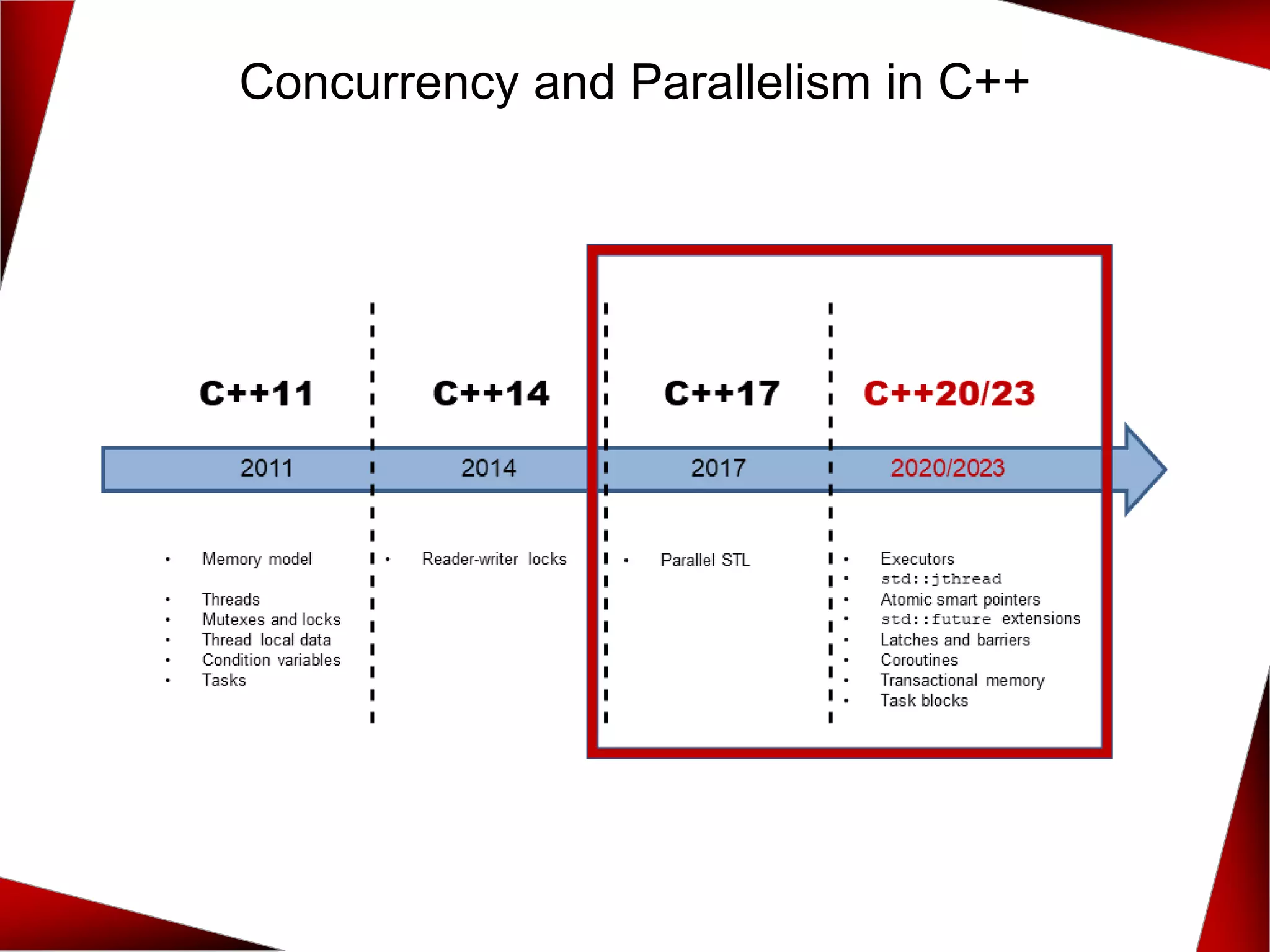
Concurrency and Parallelism in C++
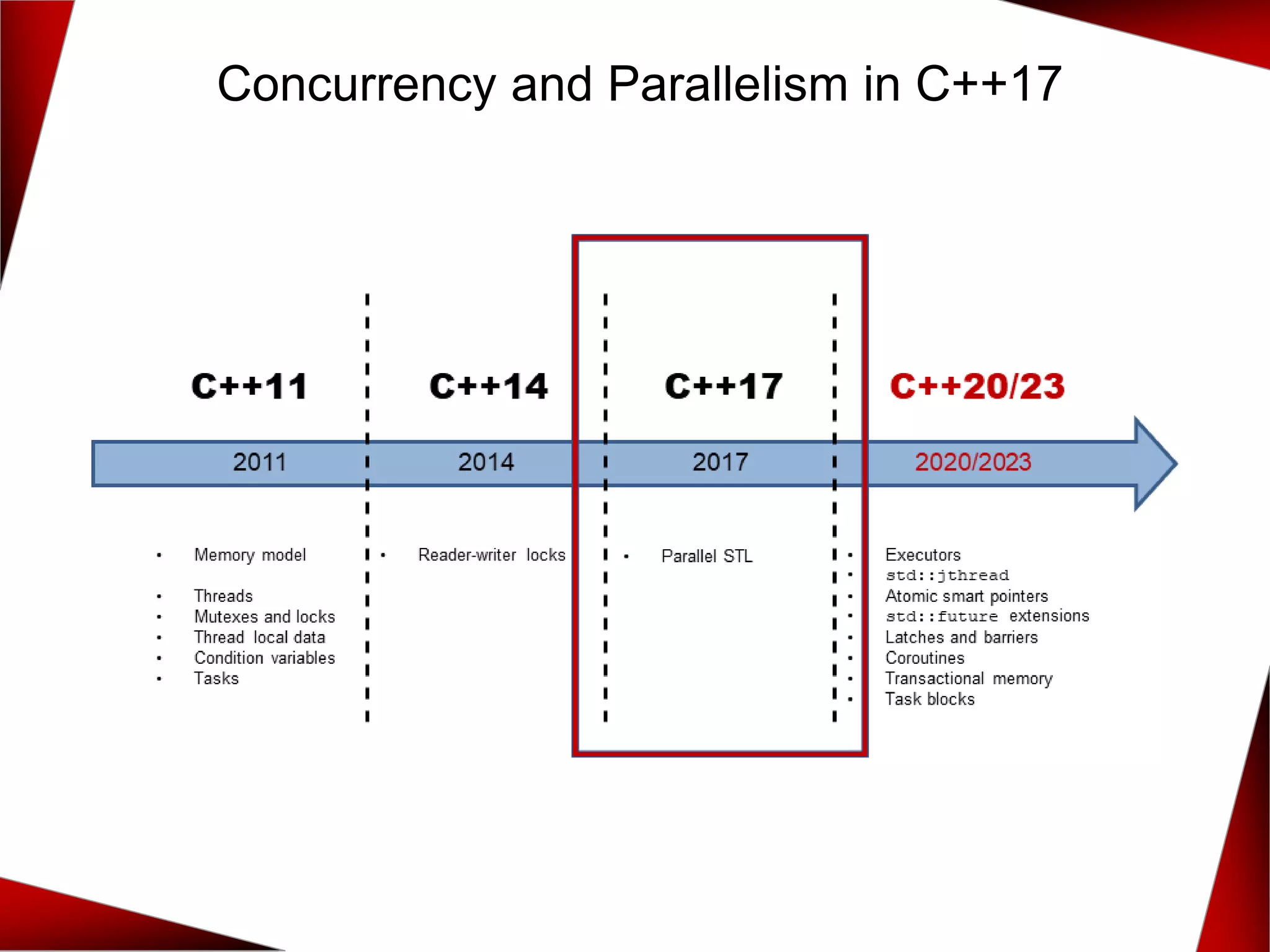
Concurrency and Parallelism in C++17
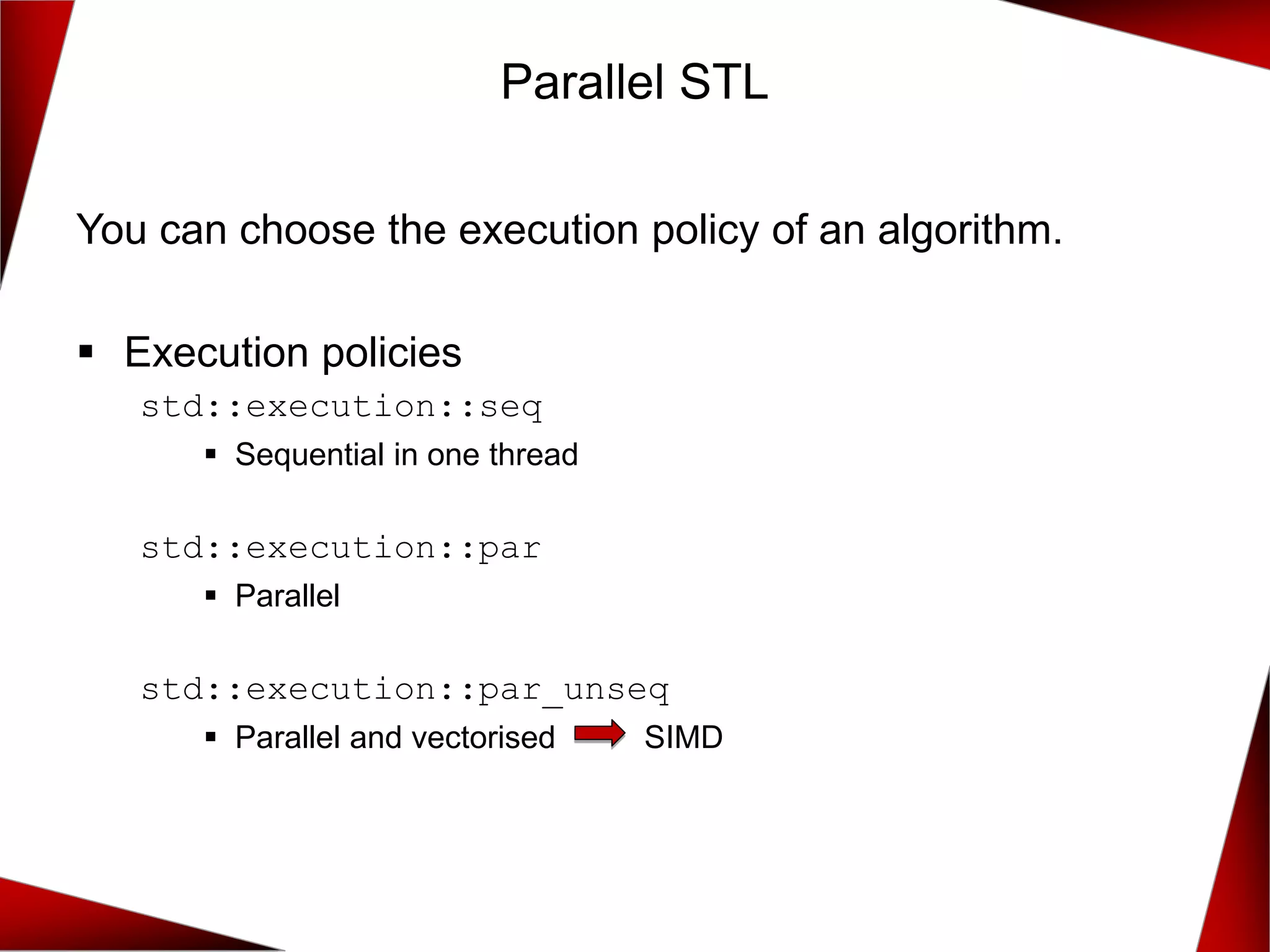
You can choose the execution policy of an algorithm.
▪ Execution policies
std::execution::seq
▪ Sequential in one thread
std::execution::par
▪ Parallel
std::execution::par_unseq
▪ Parallel and vectorised SIMD
Parallel STL
Parallel STL
Not vectorised Vectorised
const int SIZE = 8;
int vec[]={1, 2 , 3, 4, 5, 6, 7, 8};
int res[SIZE] = {0,};
int main(){
for (int i= 0; i < SIZE; ++i){
res[i] = vec[i] + 5;
}
}
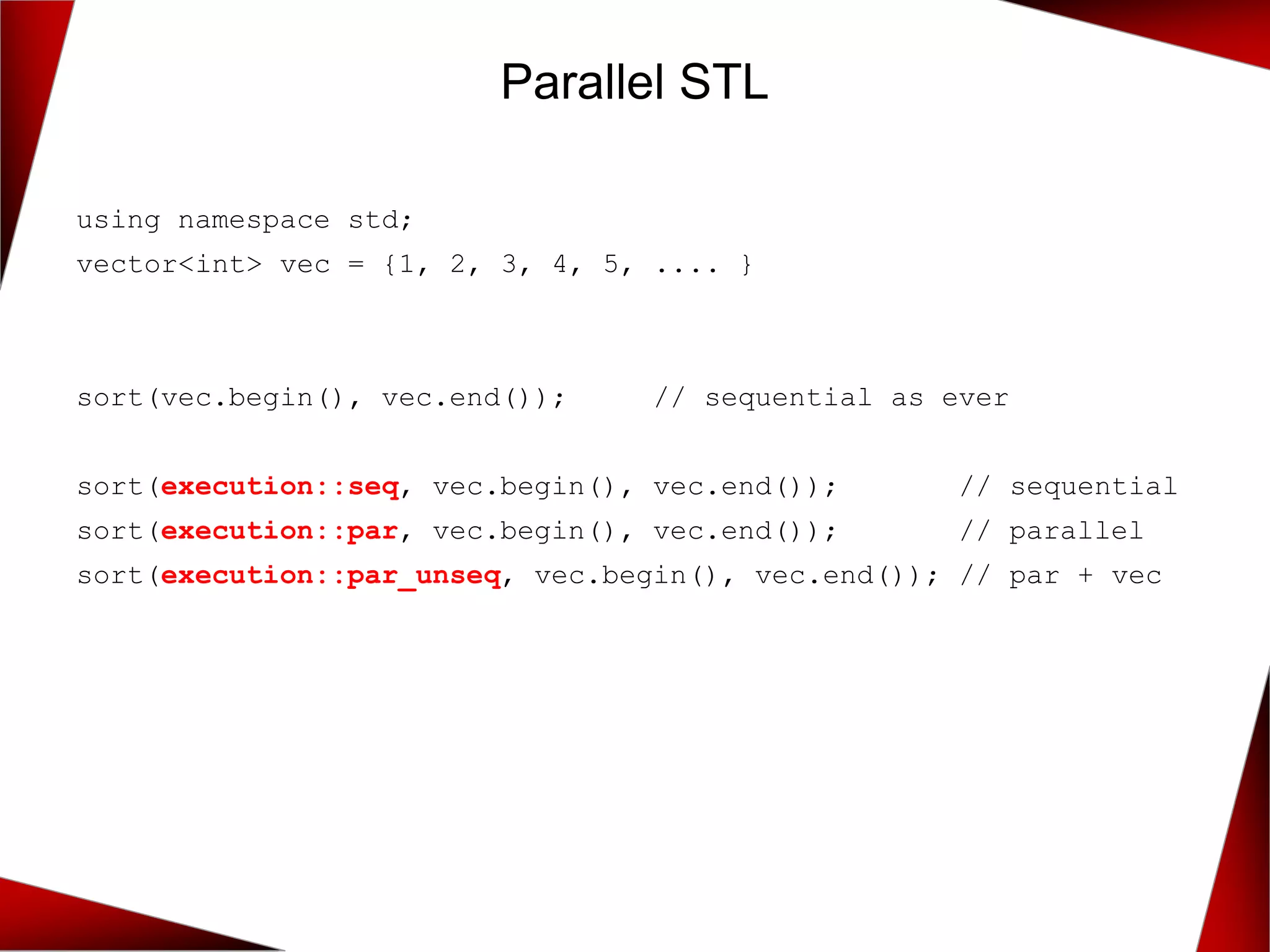
using namespace std;
vector<int> vec = {1, 2, 3, 4, 5, .... }
sort(vec.begin(), vec.end()); // sequential as ever
sort(execution::seq, vec.begin(), vec.end()); // sequential
sort(execution::par, vec.begin(), vec.end()); // parallel
sort(execution::par_unseq, vec.begin(), vec.end()); // par + vec
Parallel STL
Parallel STL
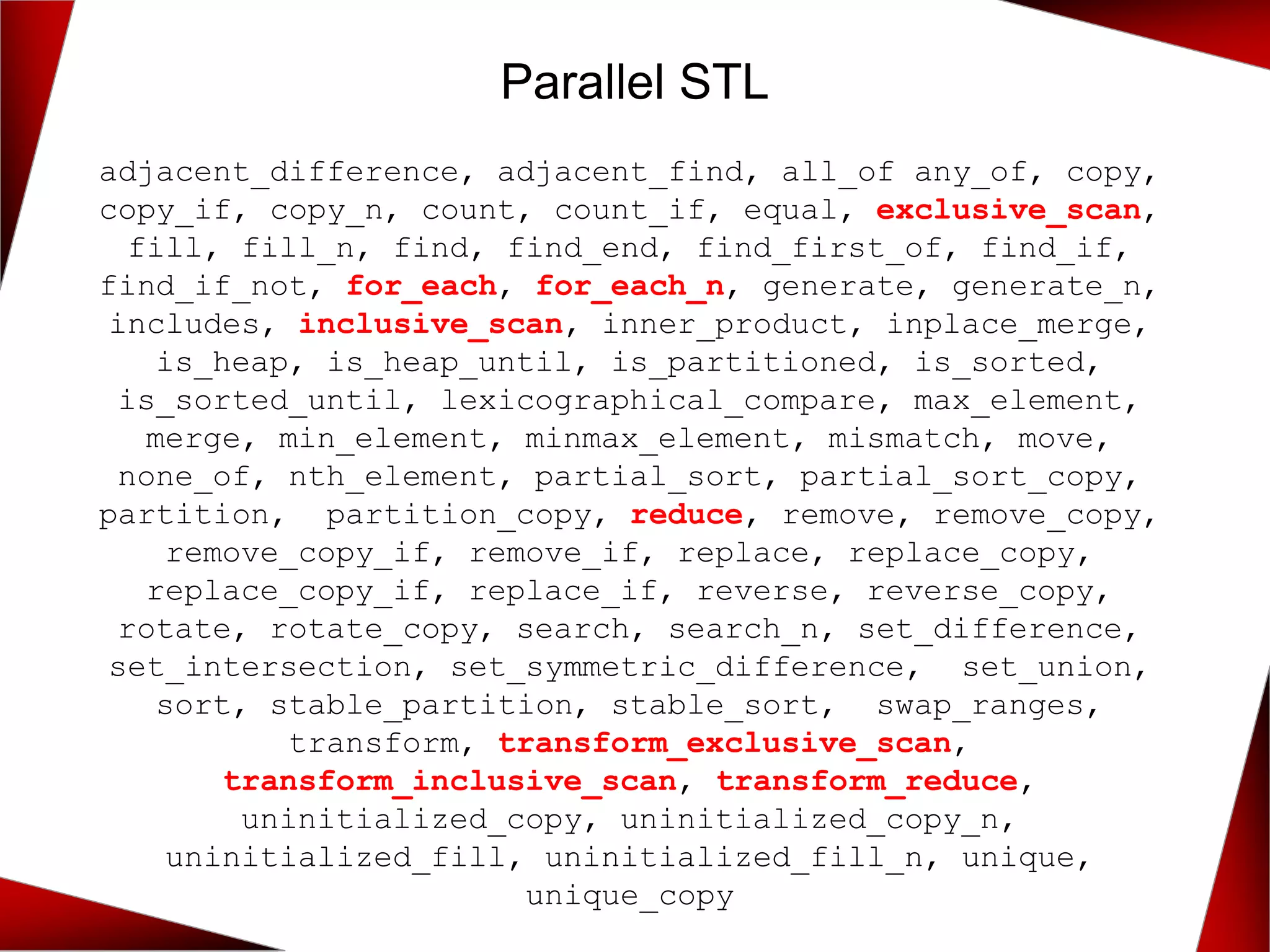
adjacent_difference, adjacent_find, all_of any_of, copy,
copy_if, copy_n, count, count_if, equal, exclusive_scan,
fill, fill_n, find, find_end, find_first_of, find_if,
find_if_not, for_each, for_each_n, generate, generate_n,
includes, inclusive_scan, inner_product, inplace_merge,
is_heap, is_heap_until, is_partitioned, is_sorted,
is_sorted_until, lexicographical_compare, max_element,
merge, min_element, minmax_element, mismatch, move,
none_of, nth_element, partial_sort, partial_sort_copy,
partition, partition_copy, reduce, remove, remove_copy,
remove_copy_if, remove_if, replace, replace_copy,
replace_copy_if, replace_if, reverse, reverse_copy,
rotate, rotate_copy, search, search_n, set_difference,
set_intersection, set_symmetric_difference, set_union,
sort, stable_partition, stable_sort, swap_ranges,
transform, transform_exclusive_scan,
transform_inclusive_scan, transform_reduce,
uninitialized_copy, uninitialized_copy_n,
uninitialized_fill, uninitialized_fill_n, unique,
unique_copy
Parallel STL
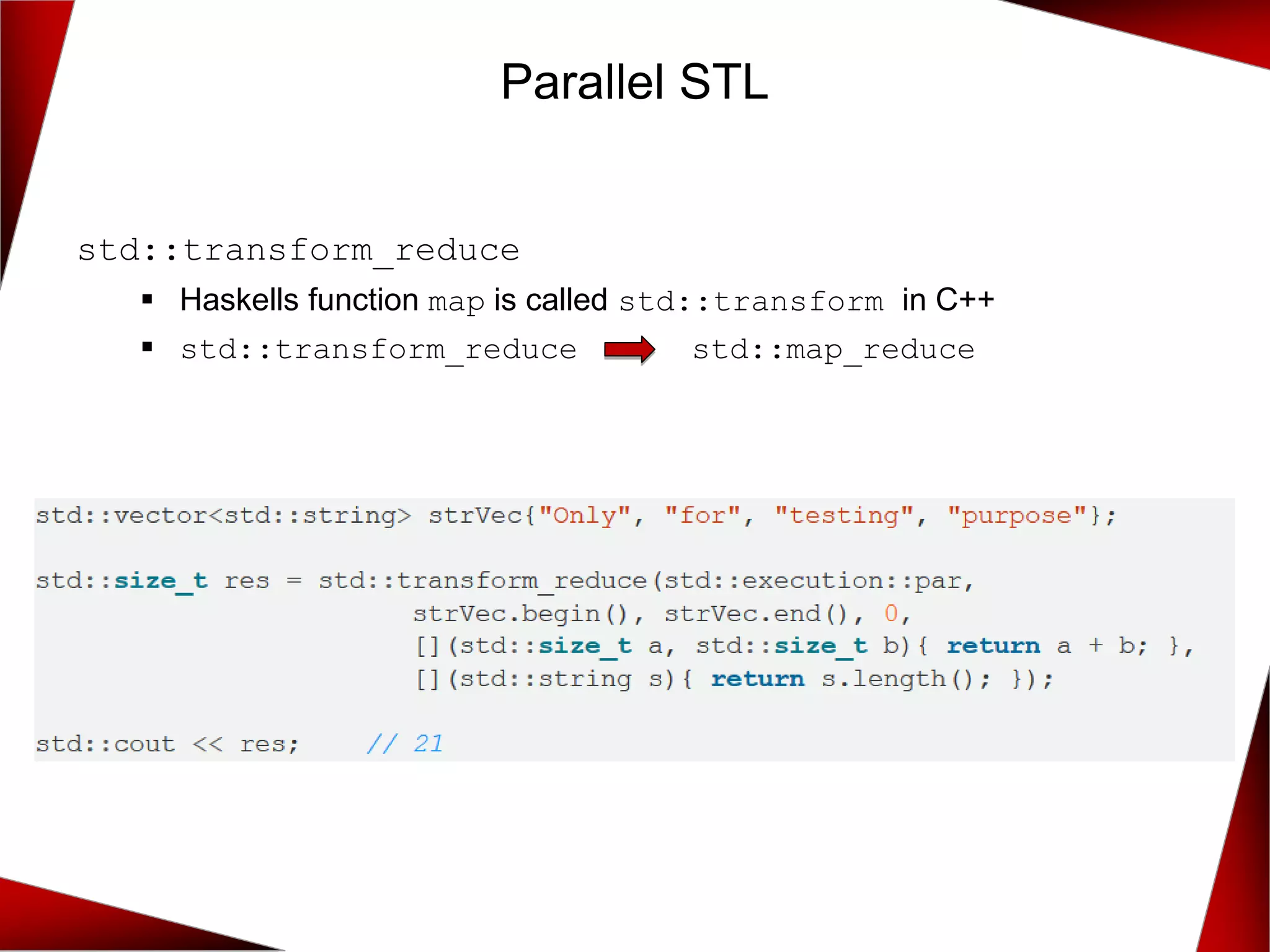
std::transform_reduce
▪ Haskells function map is called std::transform in C++
▪ std::transform_reduce std::map_reduce
Parallel STL
▪ Danger of data races or deadlocks
The access to numComp has to be atomic.
int numComp = 0;
vector<int> vec = {1, 3, 8, 9, 10};
sort(execution::par, vec.begin(), vec.end(),
[&numComp](int fir, int sec){ numComp++; return fir < sec; }
);
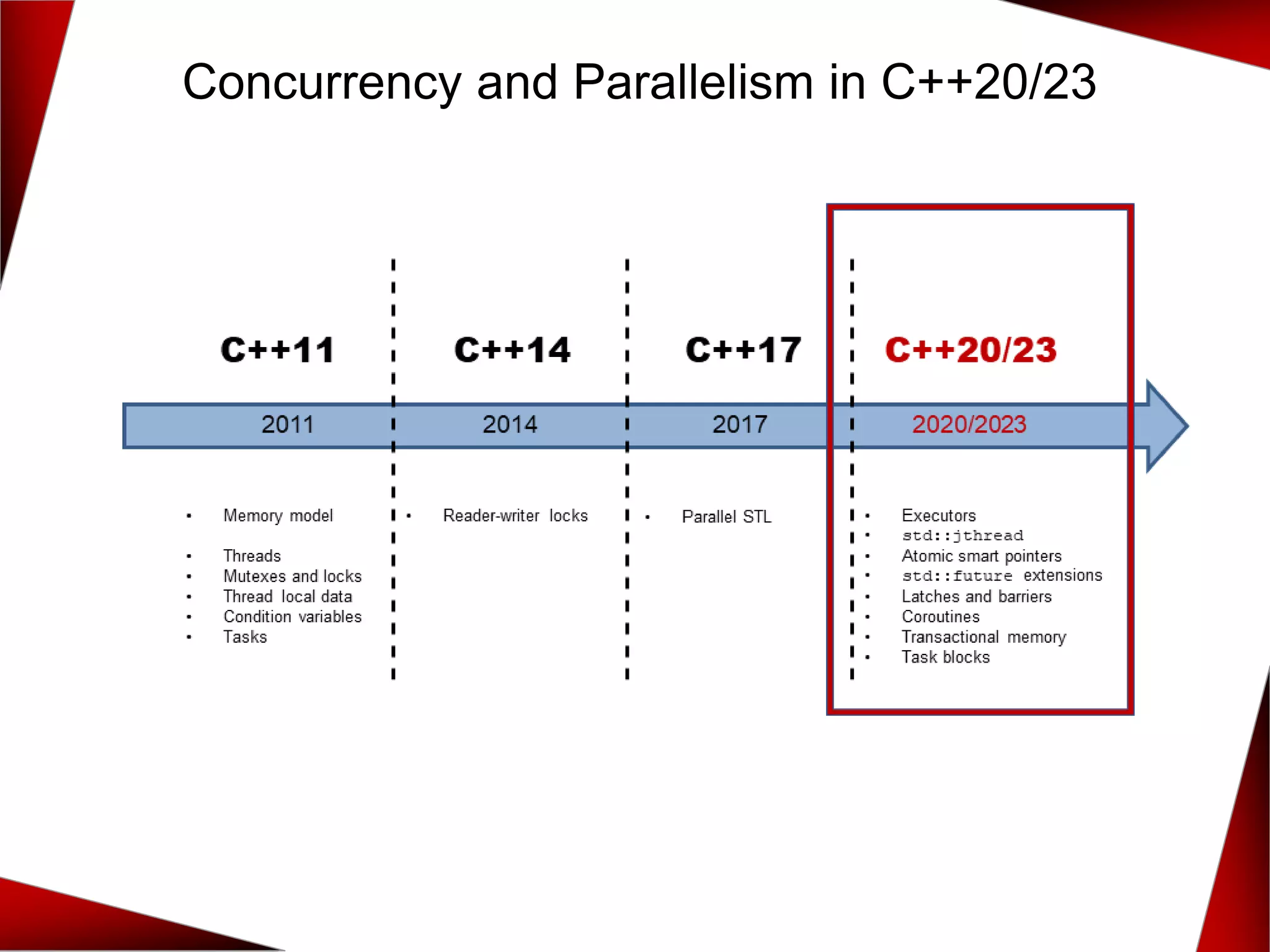
Concurrency and Parallelism in C++20/23
Executors
Executors are the basic building block for execution in C++.
▪ They fulfil a similar role for execution such as allocators for
allocation.
An executor consists of a set of rules for a callables:
▪ Where: run on a internal or external processor
▪ When: run immediately or later
▪ How: run on a CPU or GPU
Executors
▪ Using an executor
my_executor_type my_executor = ... ;
auto future = std::async(my_executor, []{
std::cout << "Hello world " << std::endl; }
);
std::for_each(std::execution::par.on(my_executor),
data.begin(), data.end(), func);
▪ Obtaining an executor
static_thread_pool pool(4);
auto exec = pool.executor();
task1 = long_running_task(exec);
Executors
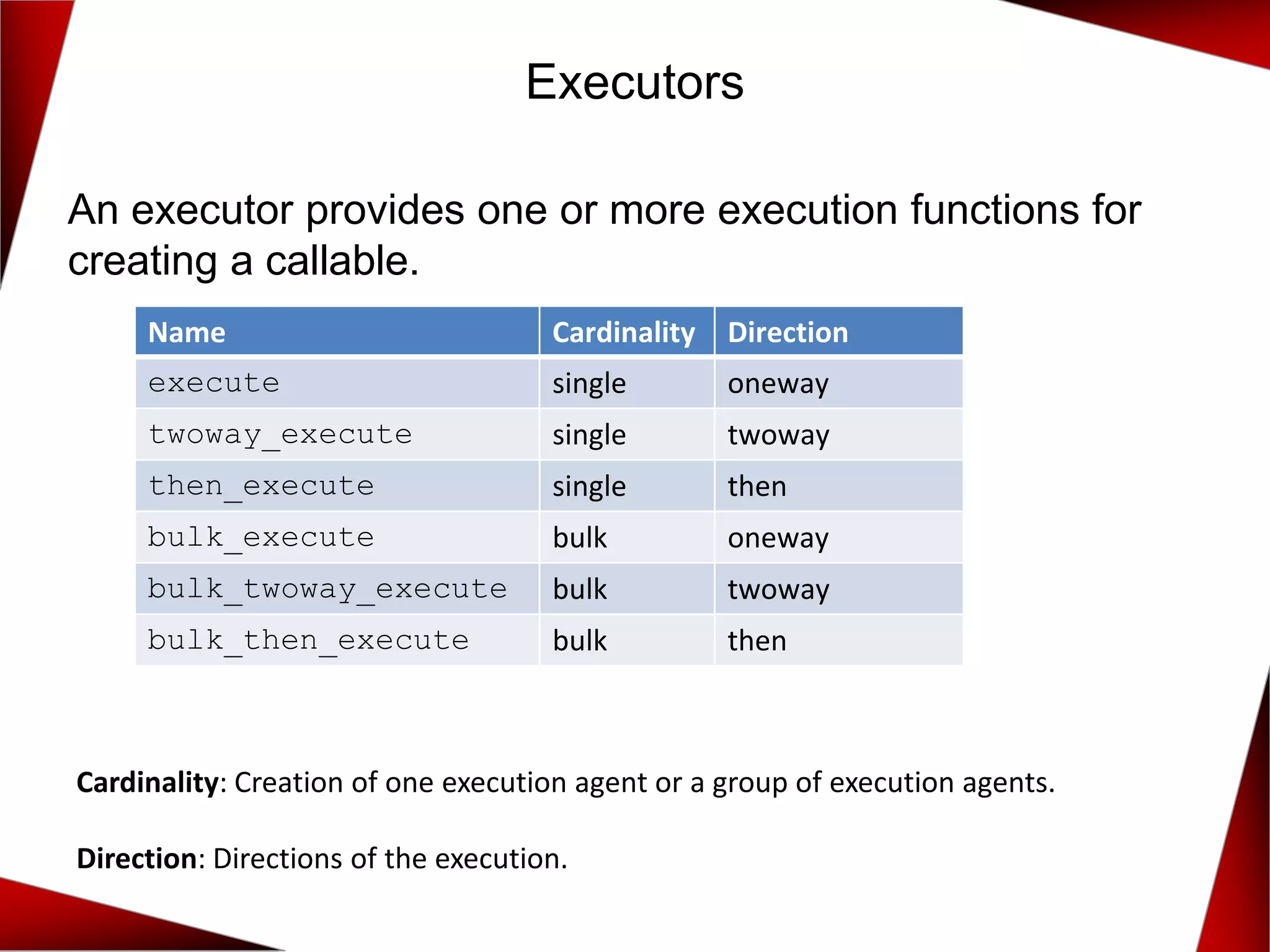
An executor provides one or more execution functions for
creating a callable.
Name Cardinality Direction
execute single oneway
twoway_execute single twoway
then_execute single then
bulk_execute bulk oneway
bulk_twoway_execute bulk twoway
bulk_then_execute bulk then
Cardinality: Creation of one execution agent or a group of execution agents.
Direction: Directions of the execution.
std::jthread
Problem: std::thread throws std::terminate in its
destructor if still joinable.
std::thread t{[]{ std::cout << "New thread"; }};
std::cout << "t.joinable(): " << t.joinable();
std::jthread
Solution: std::jthread joins automatically at the end of
its scope.
std::jthread t{[]{ std::cout << "New thread"; }};
std::cout << "t.joinable(): " << t.joinable();
std::jthread
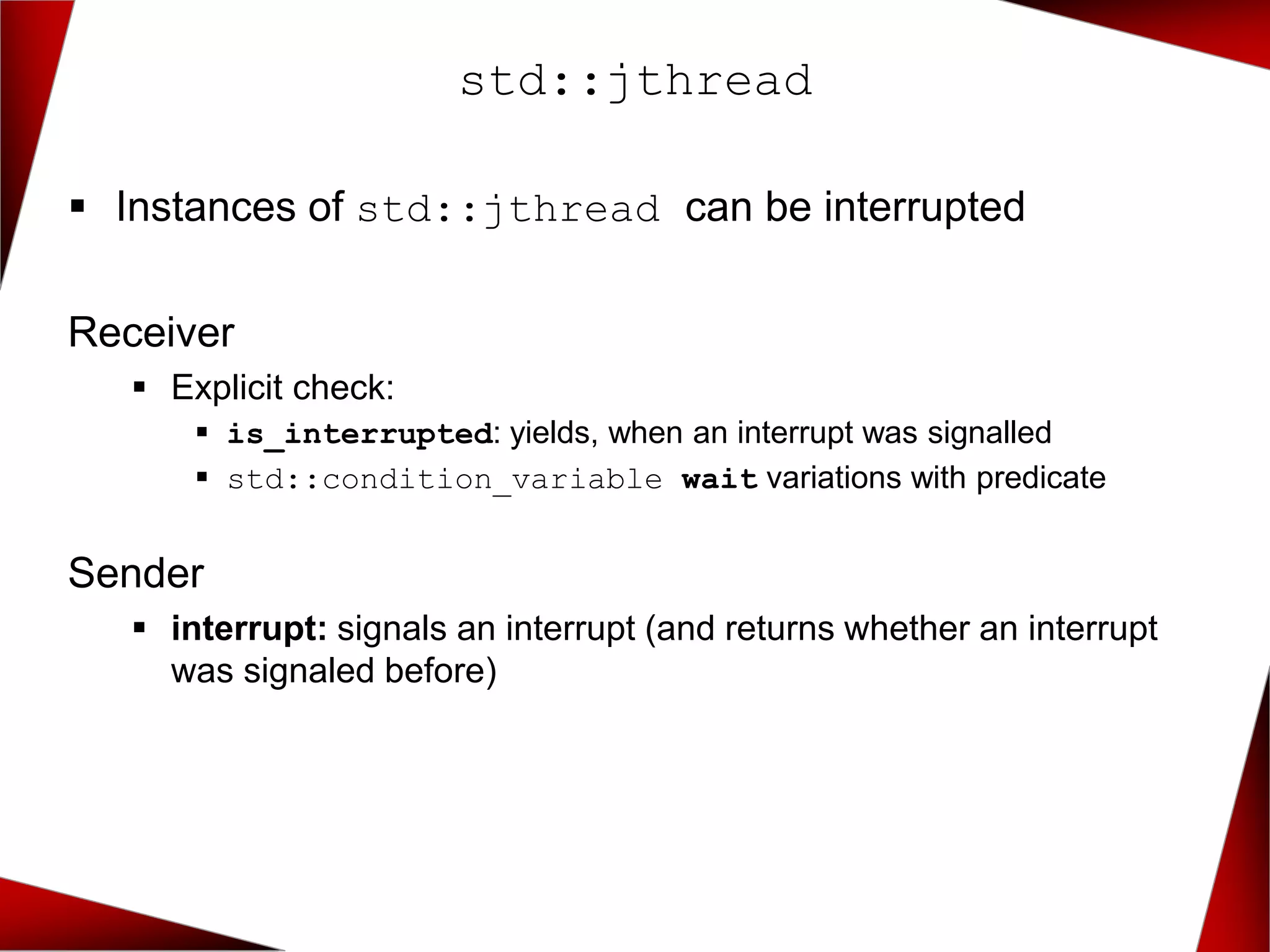
▪ Instances of std::jthread can be interrupted
Receiver
▪ Explicit check:
▪ is_interrupted: yields, when an interrupt was signalled
▪ std::condition_variable wait variations with predicate
Sender
▪ interrupt: signals an interrupt (and returns whether an interrupt
was signaled before)
std::jthread
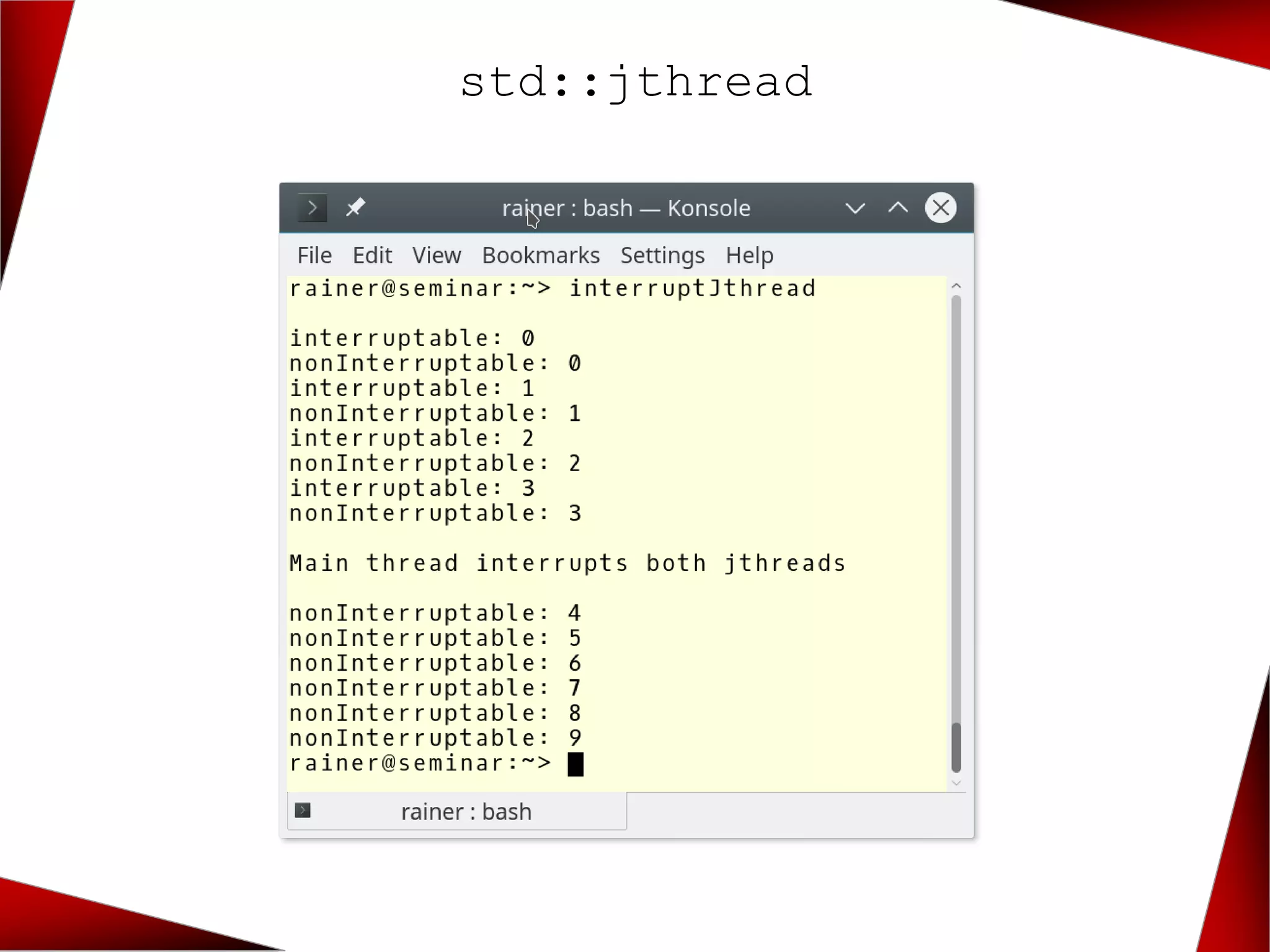
jthread nonInterruptable([]{
int counter{0};
while (counter < 10){
this_thread::sleep_for(0.2s);
cerr << "nonInterruptable: "
<< counter << endl;
++counter;
}
});
jthread interruptable([](interrupt_token
itoken){
int counter{0};
while (counter < 10){
this_thread::sleep_for(0.2s);
if (itoken.is_interrupted()) return;
cerr << "interruptable: "
<< counter << endl;
++counter;
}
});
this_thread::sleep_for(1s);
cerr << endl;
cerr << "Main thread interrupts both jthreads" << endl;
nonInterruptable.interrupt();
interruptable.interrupt();
cout << endl;
std::jthread
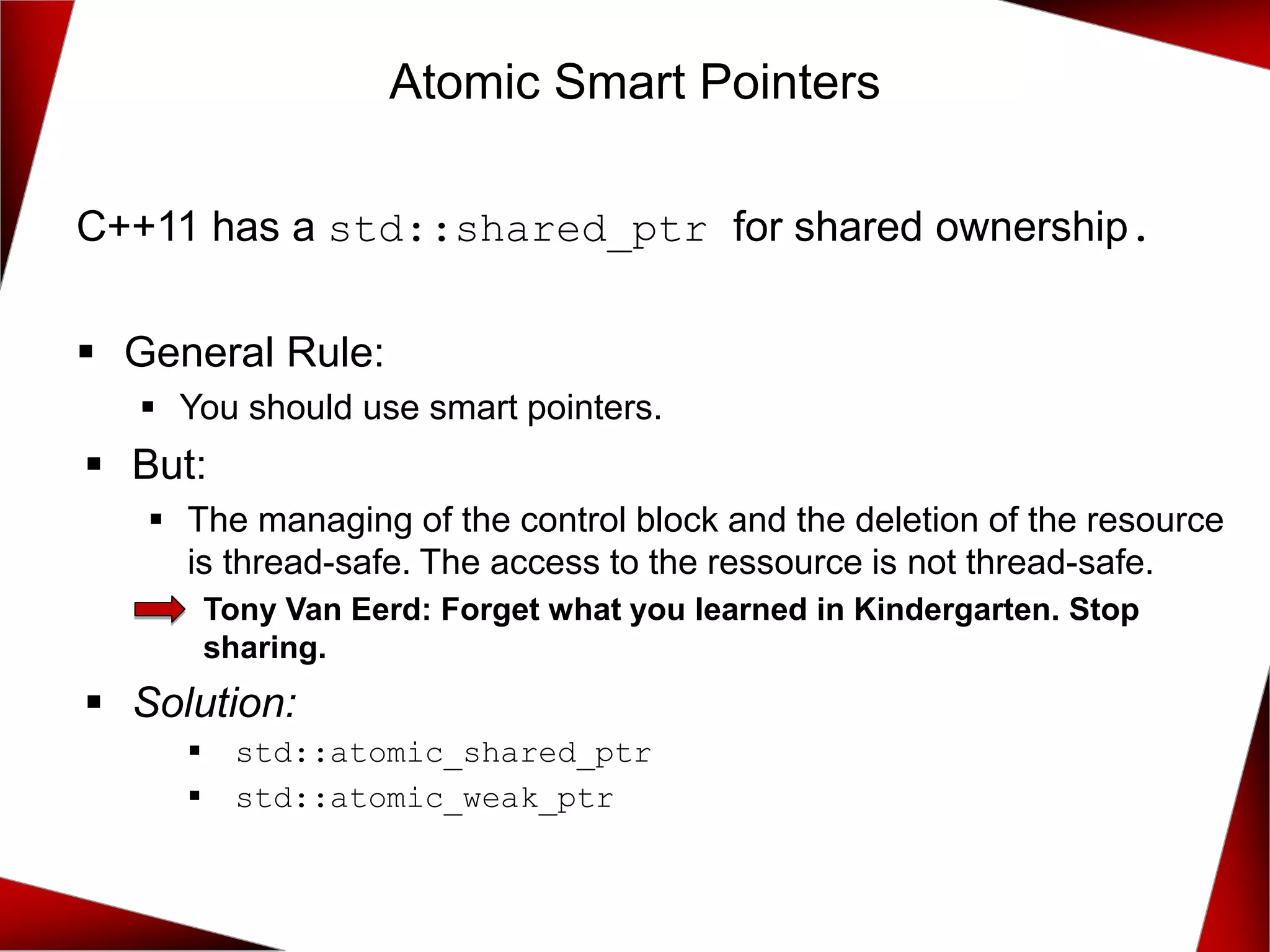
C++11 has a std::shared_ptr for shared ownership.
▪ General Rule:
▪ You should use smart pointers.
▪ But:
▪ The managing of the control block and the deletion of the resource
is thread-safe. The access to the ressource is not thread-safe.
Tony Van Eerd: Forget what you learned in Kindergarten. Stop
sharing.
▪ Solution:
▪ std::atomic_shared_ptr
▪ std::atomic_weak_ptr
Atomic Smart Pointers
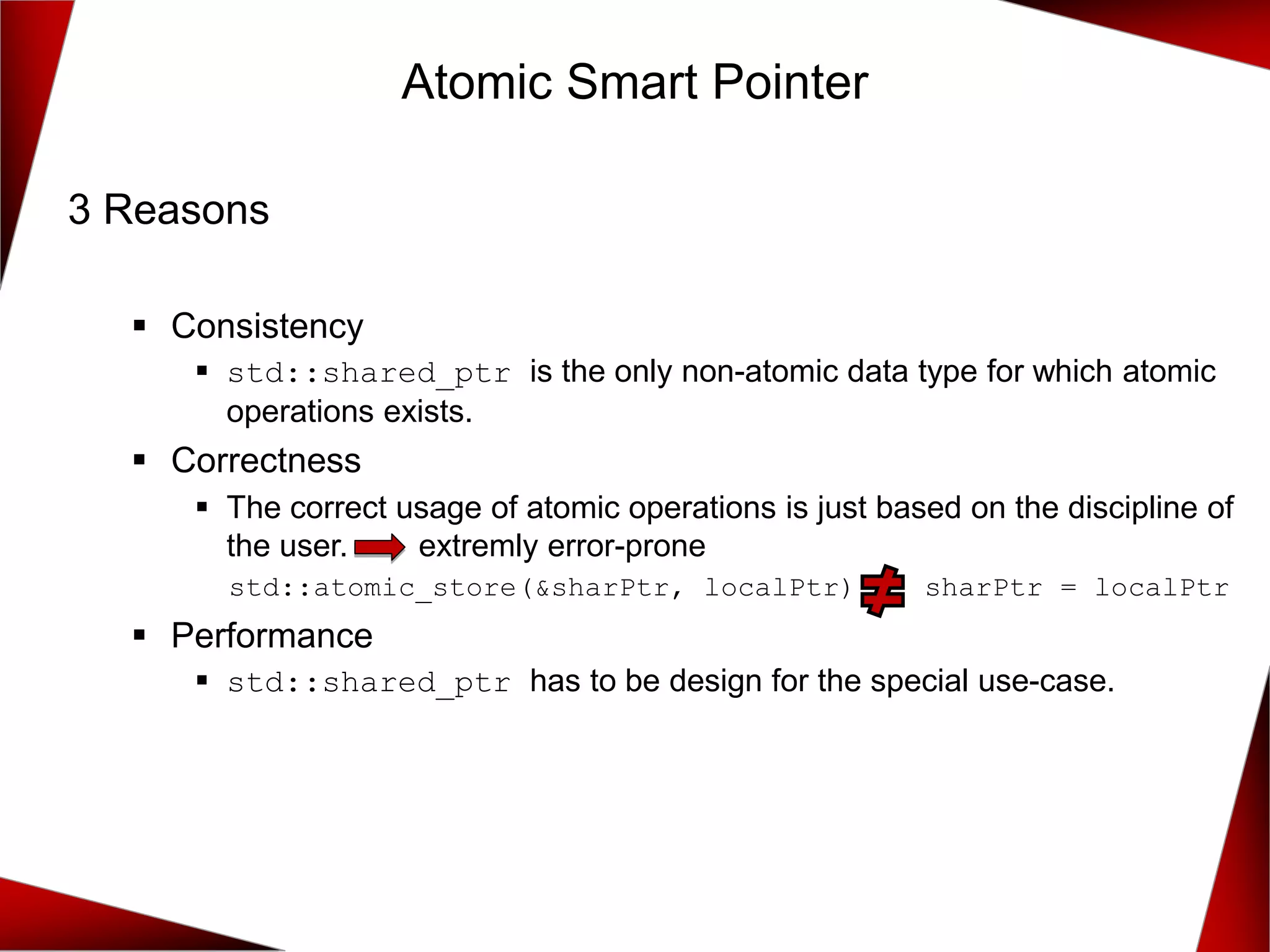
Atomic Smart Pointer
3 Reasons
▪ Consistency
▪ std::shared_ptr is the only non-atomic data type for which atomic
operations exists.
▪ Correctness
▪ The correct usage of atomic operations is just based on the discipline of
the user. extremly error-prone
std::atomic_store(&sharPtr, localPtr) sharPtr = localPtr
▪ Performance
▪ std::shared_ptr has to be design for the special use-case.
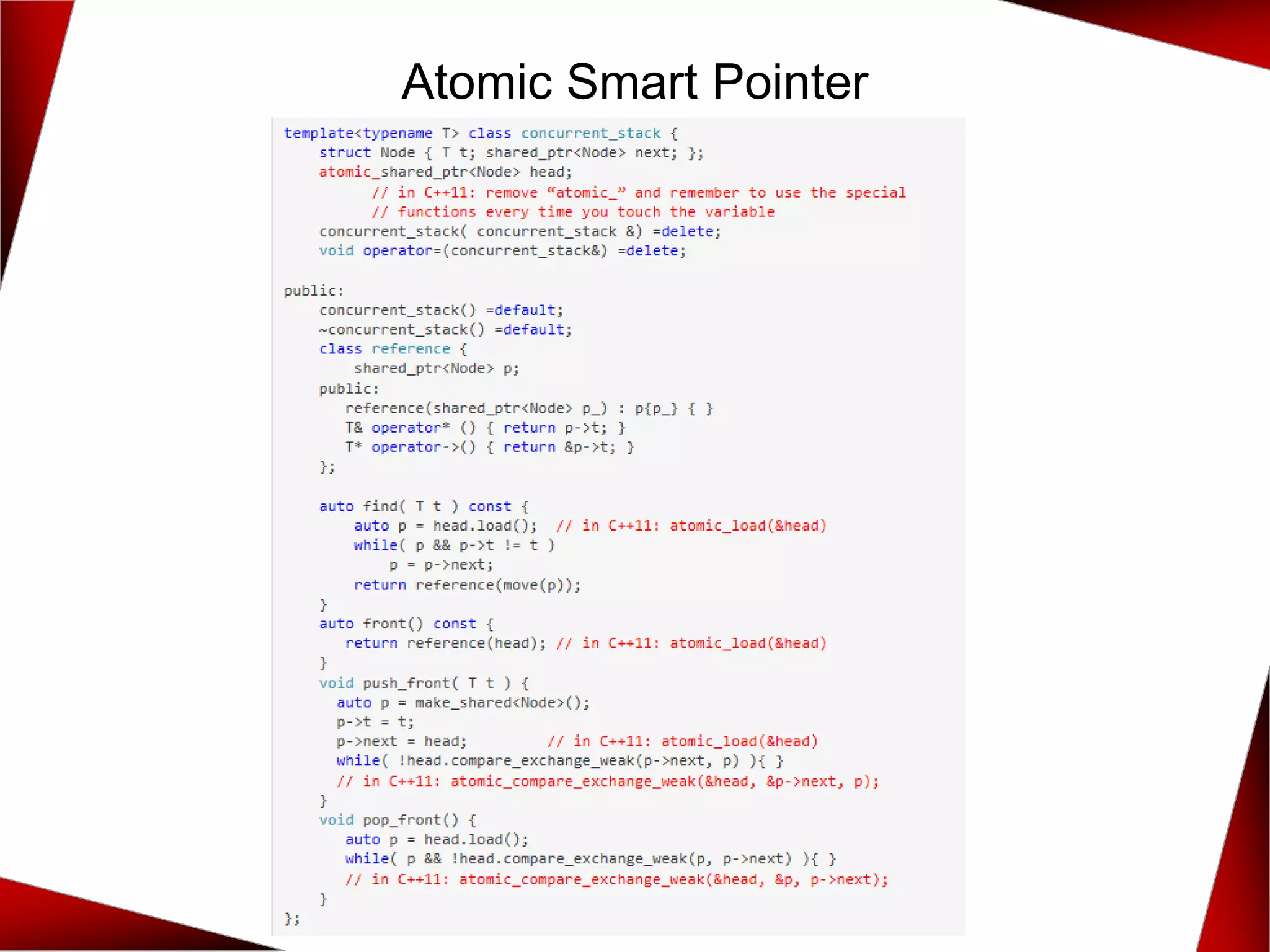
Atomic Smart Pointer
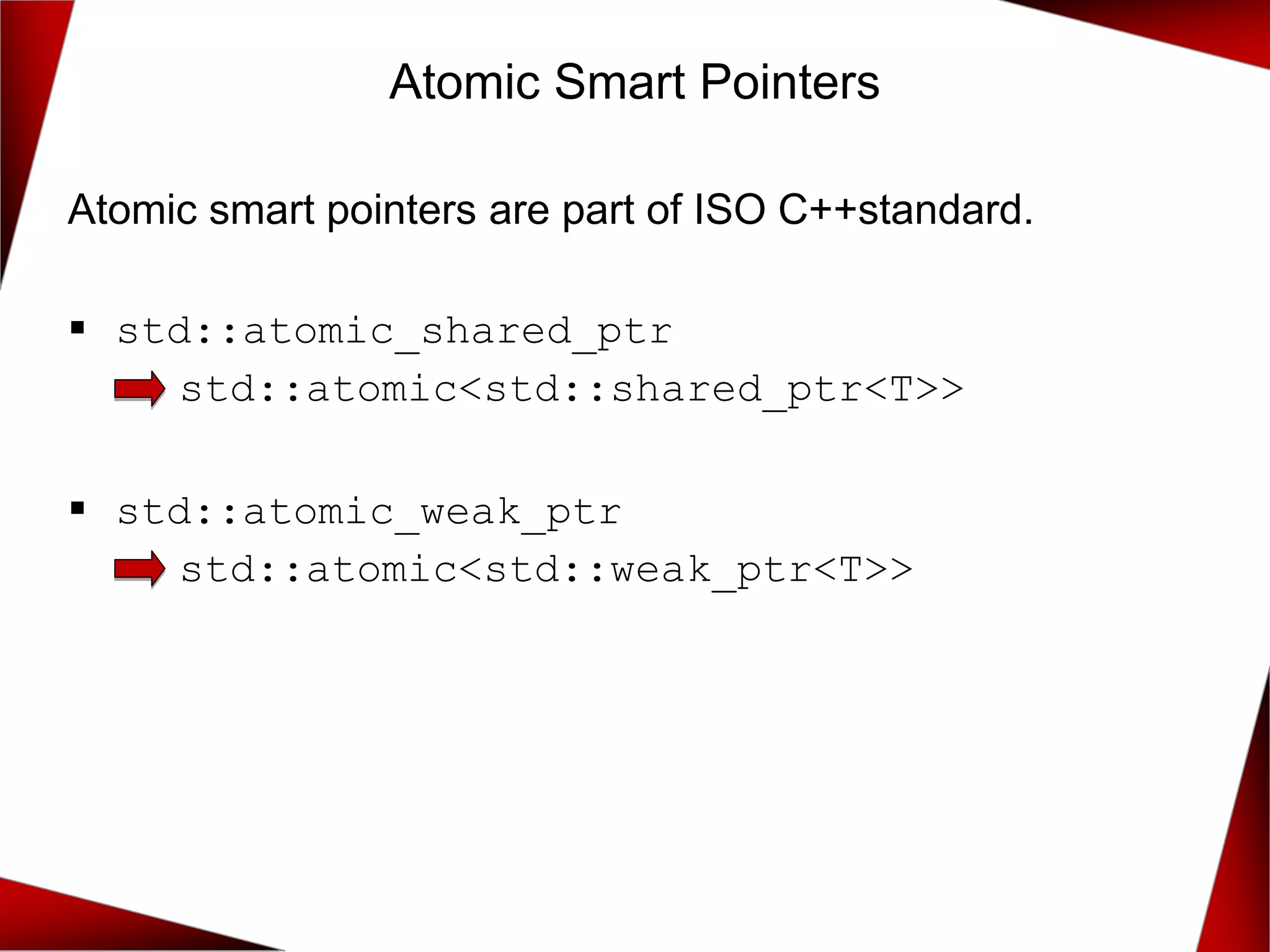
Atomic Smart Pointers
Atomic smart pointers are part of ISO C++standard.
▪ std::atomic_shared_ptr
std::atomic<std::shared_ptr<T>>
▪ std::atomic_weak_ptr
std::atomic<std::weak_ptr<T>>
std::future doesn't support composition
▪ std::future Improvement Continuation
▪ then: execute the next future if the previous one is done
future<int> f1 = async([](){ return 123; });
future<string> f2 = f1.then([](future<int> f){
return to_string(f.get() ); // non-blocking
});
auto myResult = f2.get(); // blocking
std::future Extensions
▪ when_all: execute the future if all futures are done
▪ when_any: execute the future if one of the futures is done
std::future Extensions
future<int> futures[] = { async([]() { return intResult(125); }),
async([]() { return intResult(456); })};
future<vector<future<int>>> all_f = when_all(begin(futures), end(futures));
vector<future<int>> myResult = all_f.get();
for (auto fut: myResult): fut.get();
future<int> futures[] = {async([]() { return intResult(125); }),
async([]() { return intResult(456); })};
when_any_result<vector<future<int>>> any_f = when_any(begin(futures),
end(futures));
future<int> myResult = any_f.futures[any_f.index];
auto myResult = myResult.get();
std::future Extensions
▪ Disadvantages of the extended futures
▪ Futures and promises are coupled to std::thread.
▪ Where are .then continuations are invoked?
▪ Passing futures to .then continuation is too verbose.
std::future f1 = std::async([]{ return 123; });
std::future f2 = f1.then([](std::future f){
return std::to_string(f.get()); }
);
std::future f2 = f1.then(std::to_string);
▪ Future blocks in its destructor.
▪ Futures und values should be easily composable.
bool f(std::string, double, int);
std::future<std::string> a = /* ... */;
std::future<int> c = /* ... */;
std::future<bool> d2 = when_all(a, 3.14, c).then(f);
// f(a.get(), 3.14, c.get())
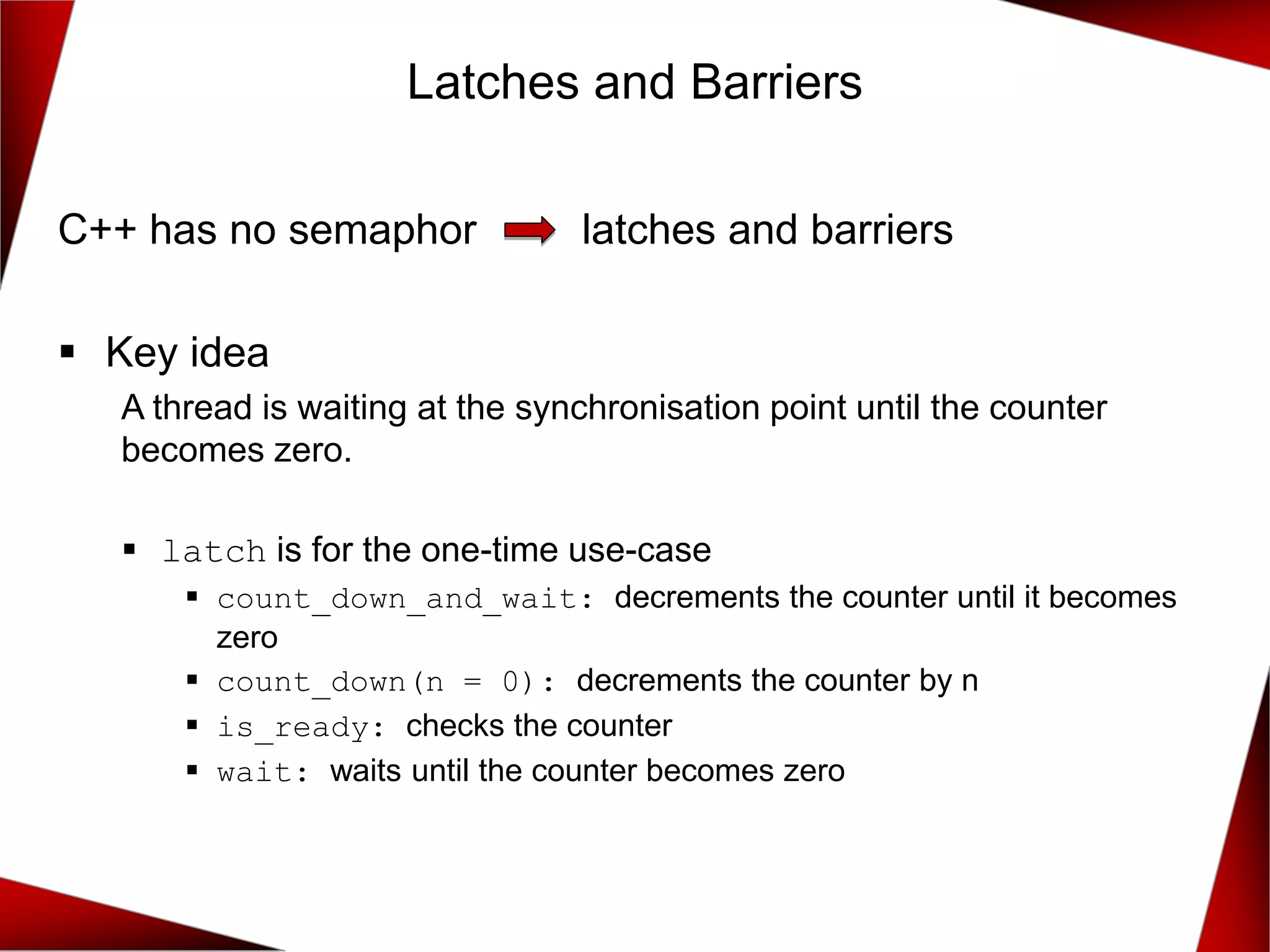
C++ has no semaphor latches and barriers
▪ Key idea
A thread is waiting at the synchronisation point until the counter
becomes zero.
▪ latch is for the one-time use-case
▪ count_down_and_wait: decrements the counter until it becomes
zero
▪ count_down(n = 0): decrements the counter by n
▪ is_ready: checks the counter
▪ wait: waits until the counter becomes zero
Latches and Barriers
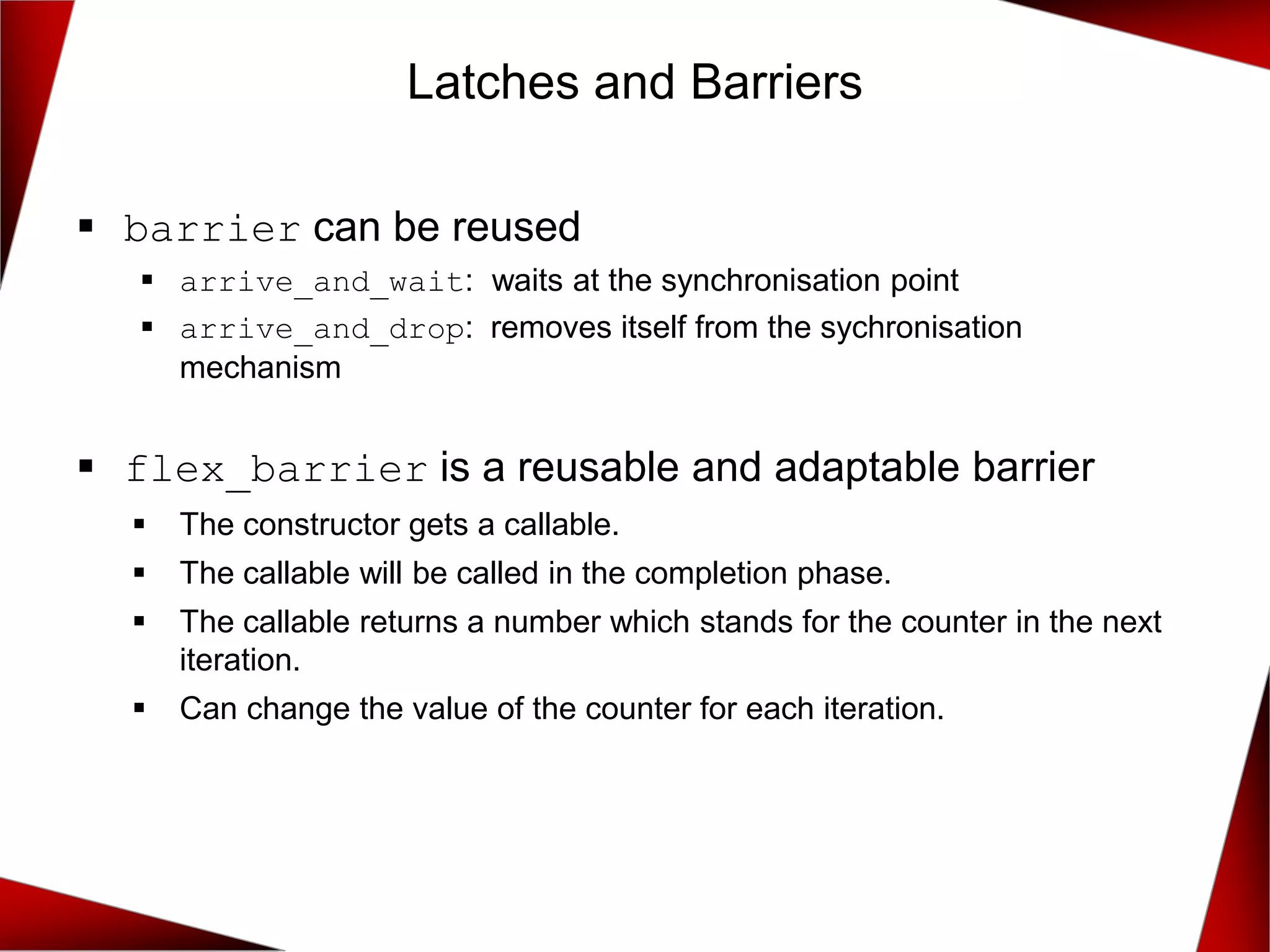
▪ barrier can be reused
▪ arrive_and_wait: waits at the synchronisation point
▪ arrive_and_drop: removes itself from the sychronisation
mechanism
▪ flex_barrier is a reusable and adaptable barrier
▪ The constructor gets a callable.
▪ The callable will be called in the completion phase.
▪ The callable returns a number which stands for the counter in the next
iteration.
▪ Can change the value of the counter for each iteration.
Latches and Barriers
void doWork(threadpool* pool) {
latch completion_latch(NUMBER_TASKS);
for (int i = 0; i < NUMBER_TASKS; ++i) {
pool->add_task([&] {
// perform the work
...
completion_latch.count_down();
}));
}
// block until all tasks are done
completion_latch.wait();
}
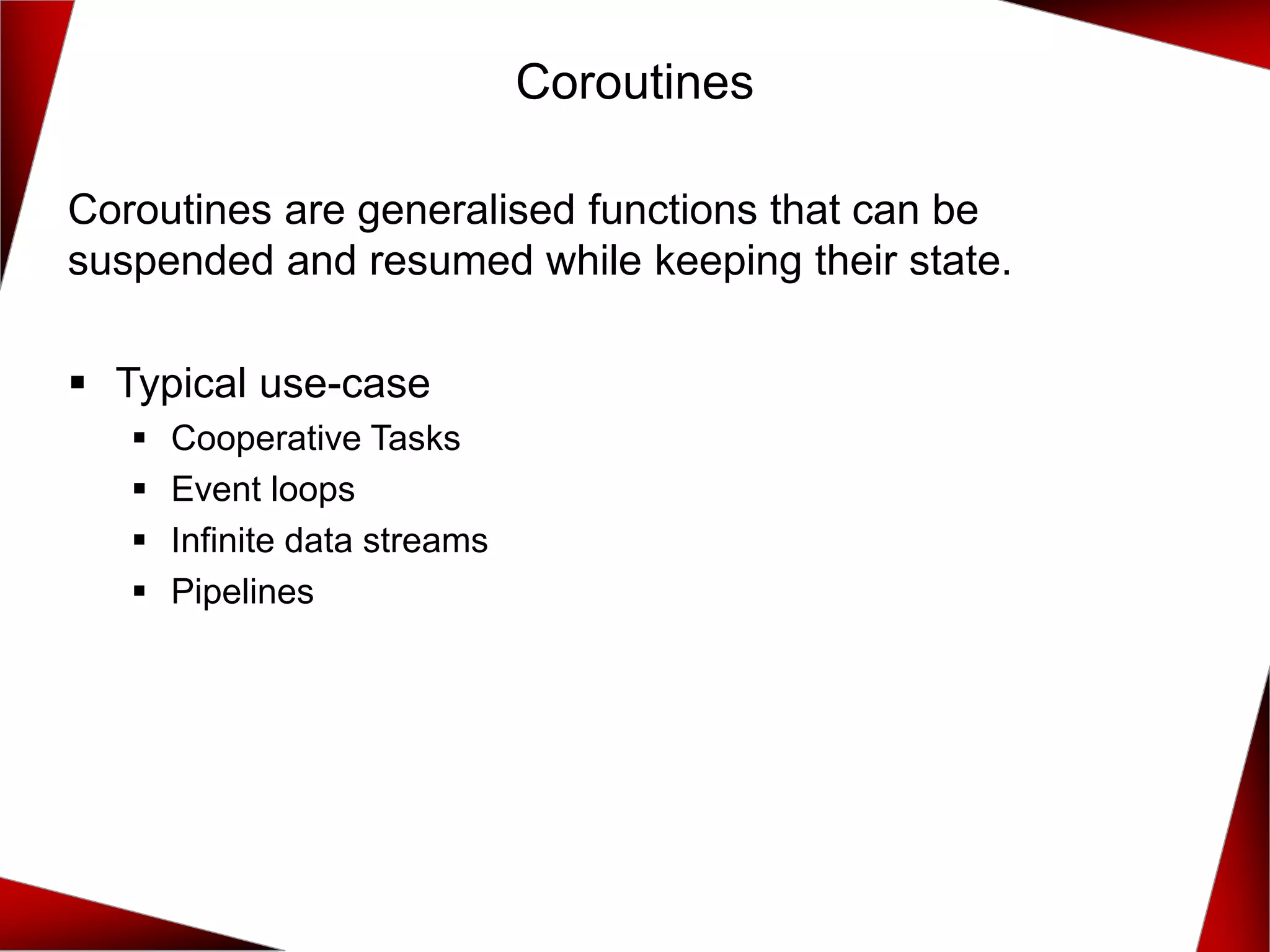
Coroutines
Coroutines are generalised functions that can be
suspended and resumed while keeping their state.
▪ Typical use-case
▪ Cooperative Tasks
▪ Event loops
▪ Infinite data streams
▪ Pipelines
Coroutines
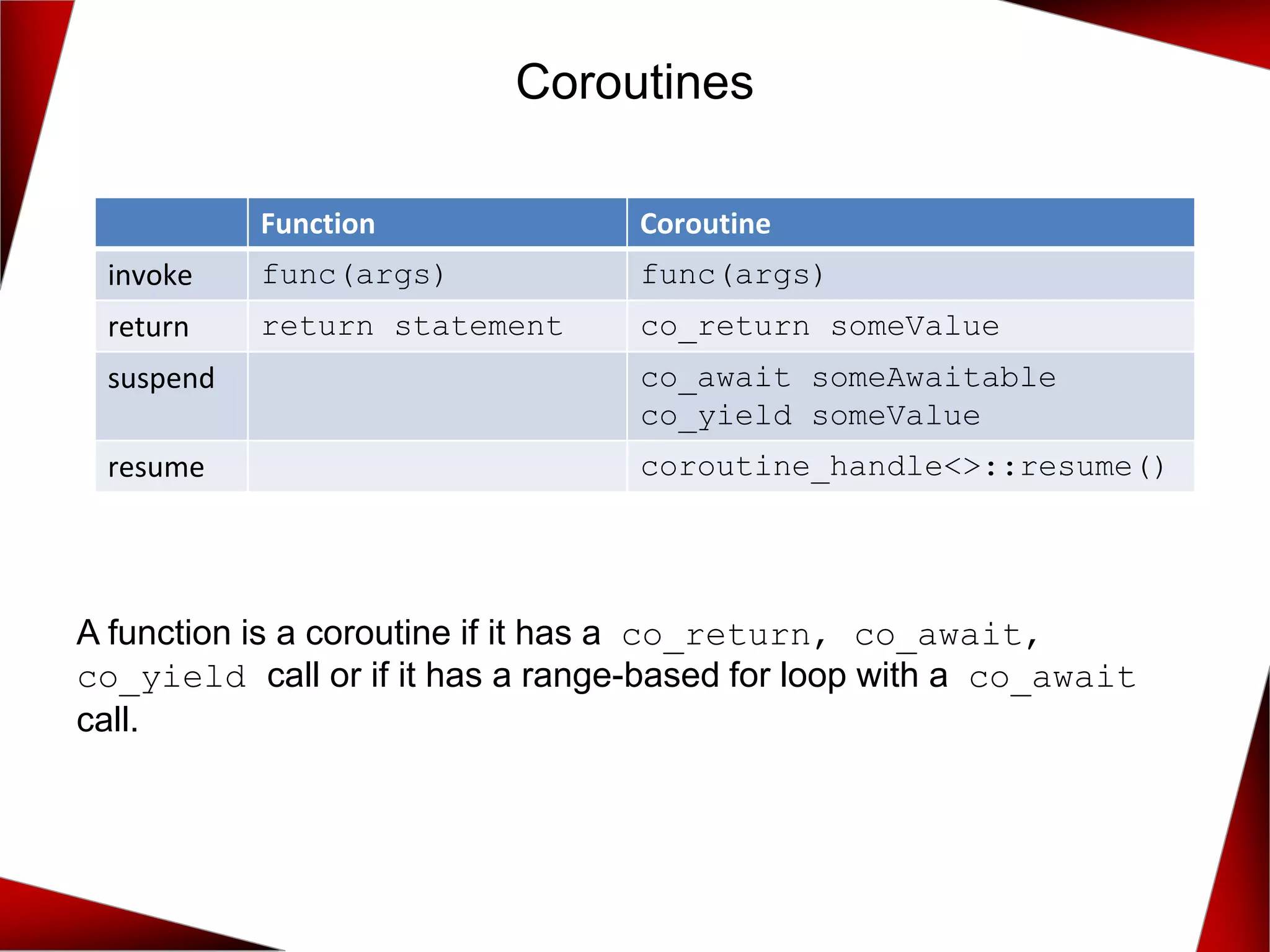
A function is a coroutine if it has a co_return, co_await,
co_yield call or if it has a range-based for loop with a co_await
call.
Function Coroutine
invoke func(args) func(args)
return return statement co_return someValue
suspend co_await someAwaitable
co_yield someValue
resume coroutine_handle<>::resume()
Coroutines
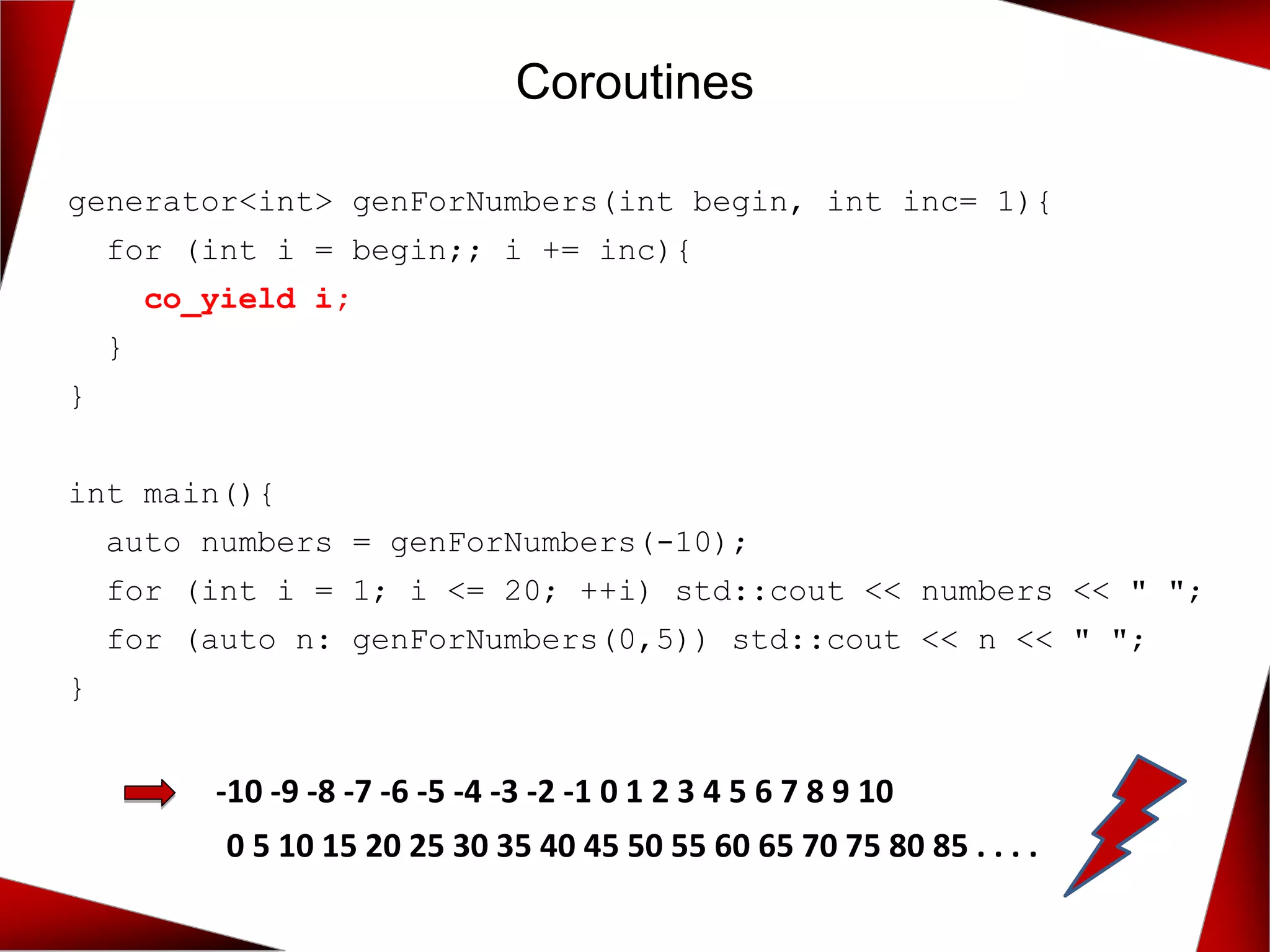
generator<int> genForNumbers(int begin, int inc= 1){
for (int i = begin;; i += inc){
co_yield i;
}
}
int main(){
auto numbers = genForNumbers(-10);
for (int i = 1; i <= 20; ++i) std::cout << numbers << " ";
for (auto n: genForNumbers(0,5)) std::cout << n << " ";
}
-10 -9 -8 -7 -6 -5 -4 -3 -2 -1 0 1 2 3 4 5 6 7 8 9 10
0 5 10 15 20 25 30 35 40 45 50 55 60 65 70 75 80 85 . . . .
Coroutines
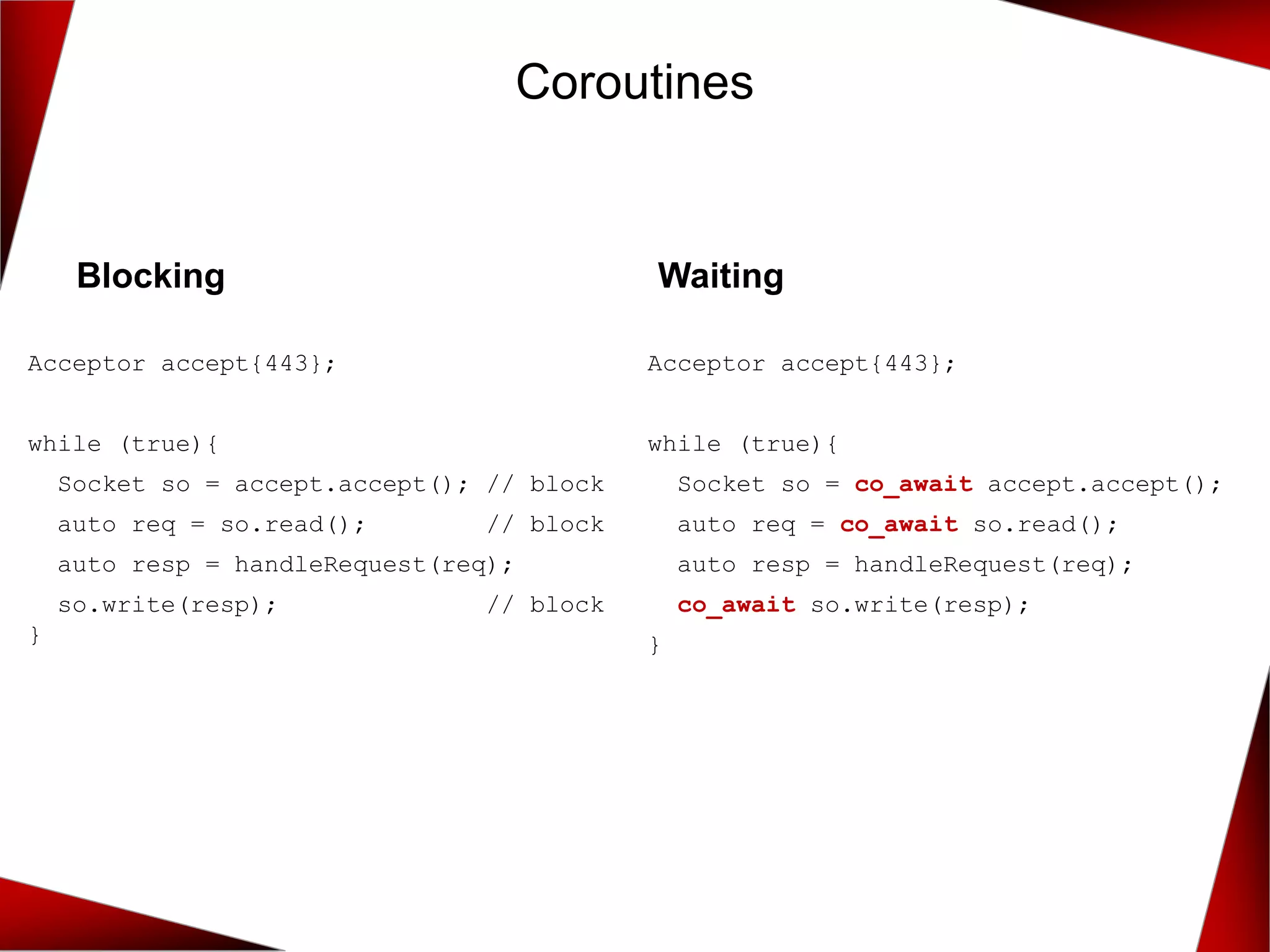
Blocking
Acceptor accept{443};
while (true){
Socket so = accept.accept(); // block
auto req = so.read(); // block
auto resp = handleRequest(req);
so.write(resp); // block
}
Waiting
Acceptor accept{443};
while (true){
Socket so = co_await accept.accept();
auto req = co_await so.read();
auto resp = handleRequest(req);
co_await so.write(resp);
}
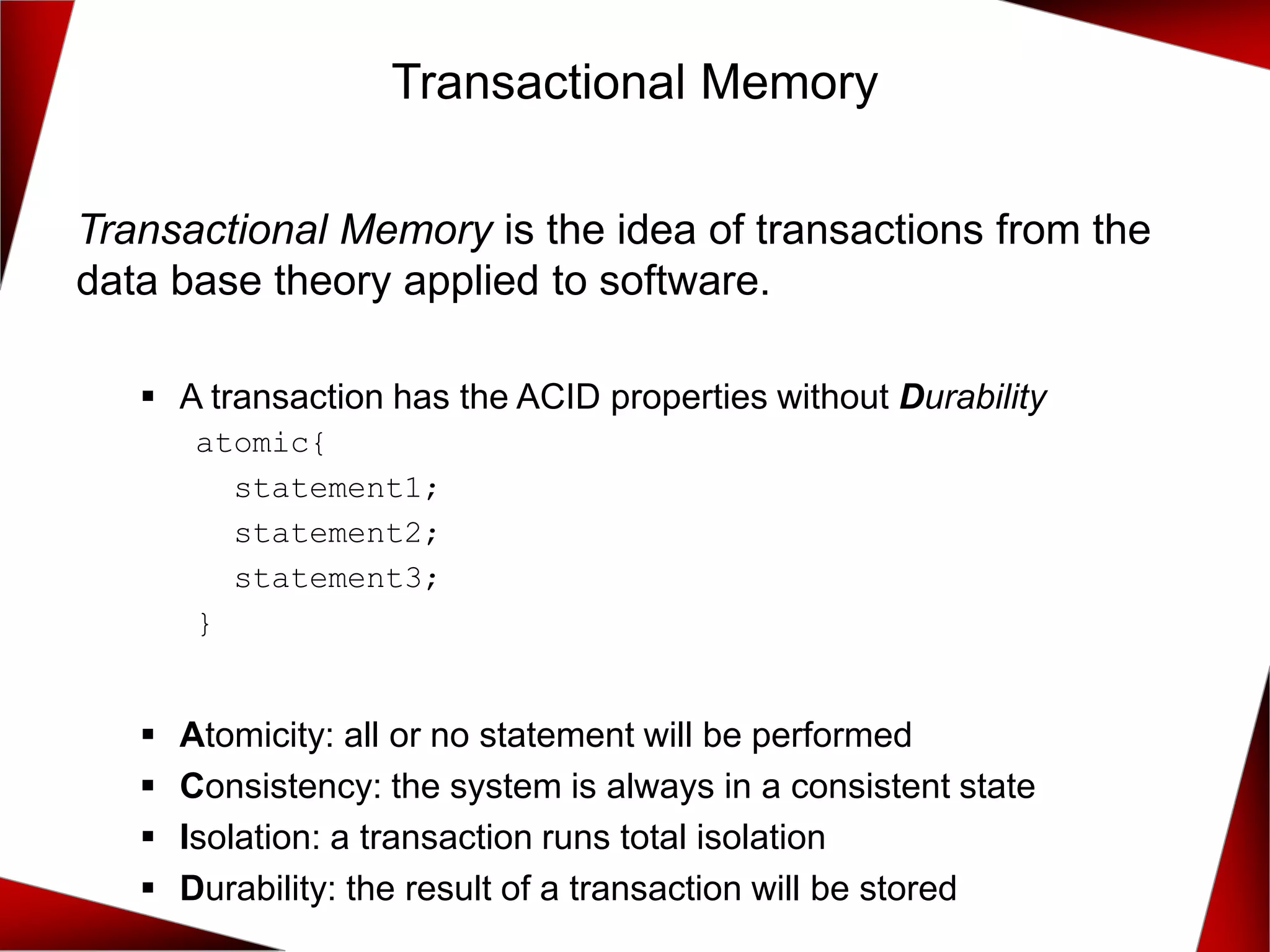
Transactional Memory is the idea of transactions from the
data base theory applied to software.
▪ A transaction has the ACID properties without Durability
atomic{
statement1;
statement2;
statement3;
}
▪ Atomicity: all or no statement will be performed
▪ Consistency: the system is always in a consistent state
▪ Isolation: a transaction runs total isolation
▪ Durability: the result of a transaction will be stored
Transactional Memory
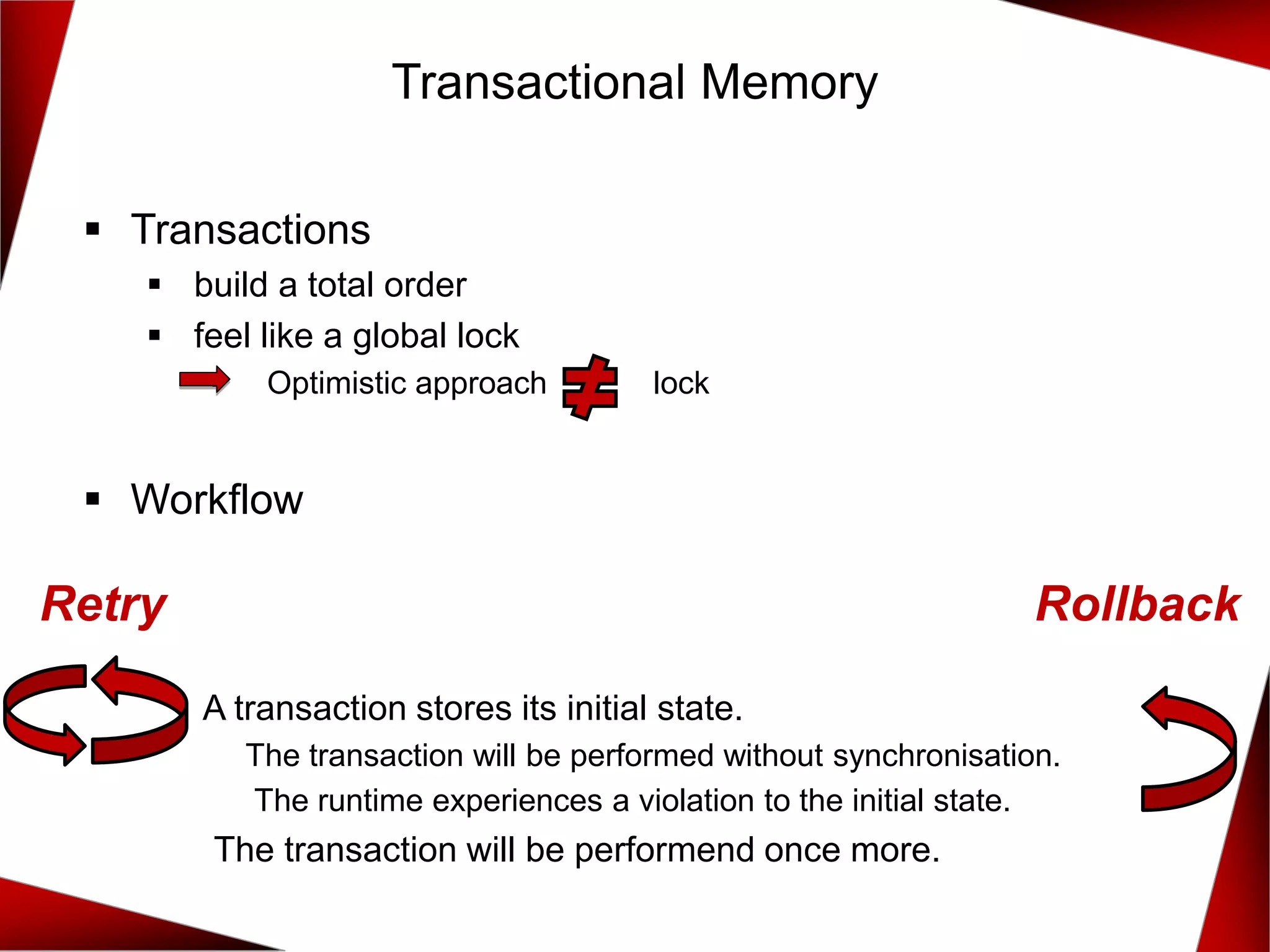
▪ Transactions
▪ build a total order
▪ feel like a global lock
▪ Optimistic approach lock
▪ Workflow
A transaction stores its initial state.
The transaction will be performed without synchronisation.
The runtime experiences a violation to the initial state.
The transaction will be performend once more.
Transactional Memory
Retry Rollback
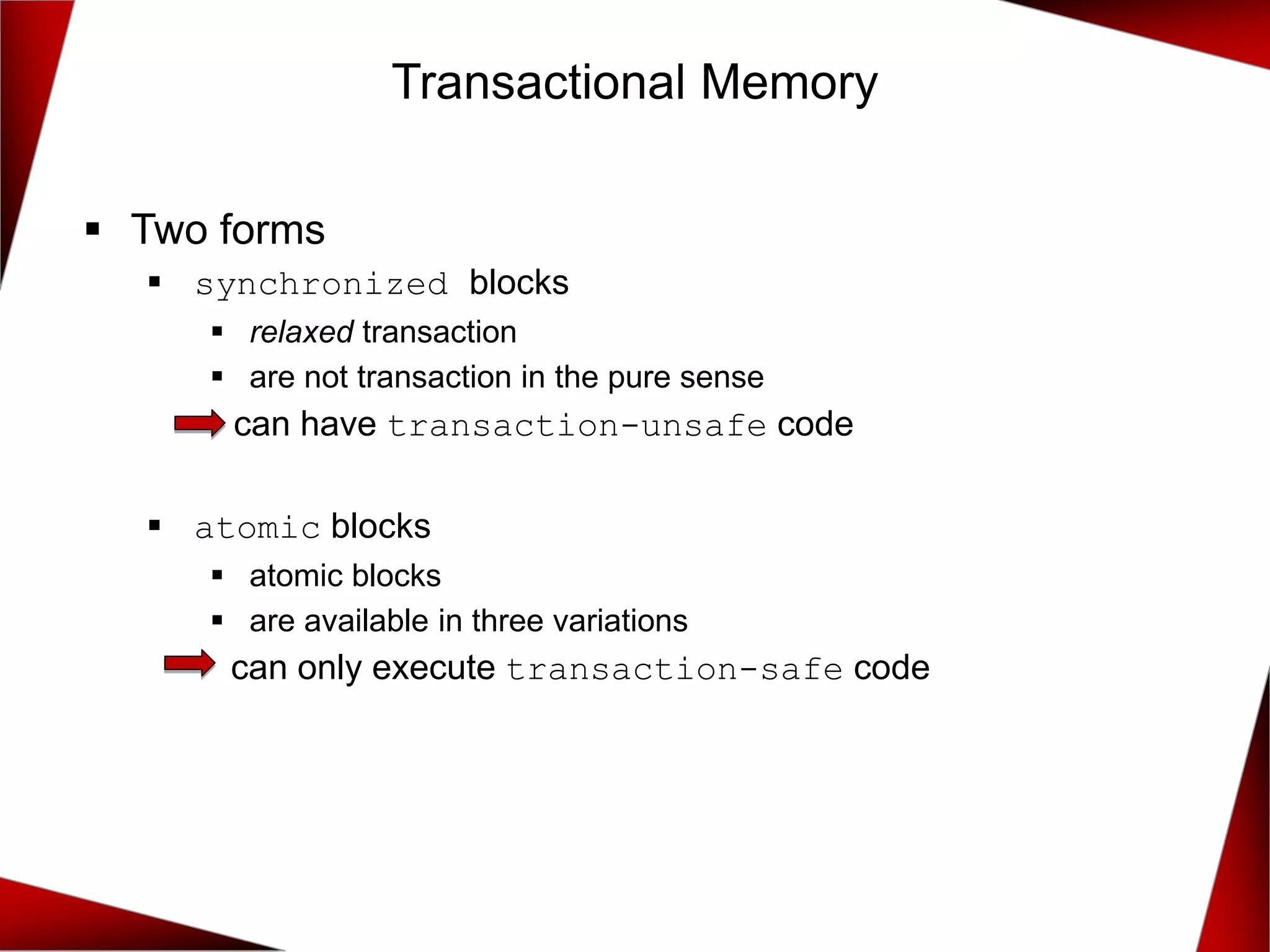
▪ Two forms
▪ synchronized blocks
▪ relaxed transaction
▪ are not transaction in the pure sense
can have transaction-unsafe code
▪ atomic blocks
▪ atomic blocks
▪ are available in three variations
can only execute transaction-safe code
Transactional Memory
int i = 0;
void inc() {
synchronized{
cout << ++i << " ,";
}
}
vector<thread> vecSyn(10);
for(auto& t: vecSyn)
t = thread([]{ for(int n = 0; n < 10; ++n) inc(); });
Transactional Memory
void inc() {
synchronized{
std::cout << ++i << " ,";
this_thead::sleep_for(1ns);
}
}
vector<thread> vecSyn(10), vecUnsyn(10);
for(auto& t: vecSyn)
t= thread[]{ for(int n = 0; n < 10; ++n) inc(); });
for(auto& t: vecUnsyn)
t= thread[]{ for(int n = 0; n < 10; ++n) cout << ++i << " ,"; });
Task Blocks
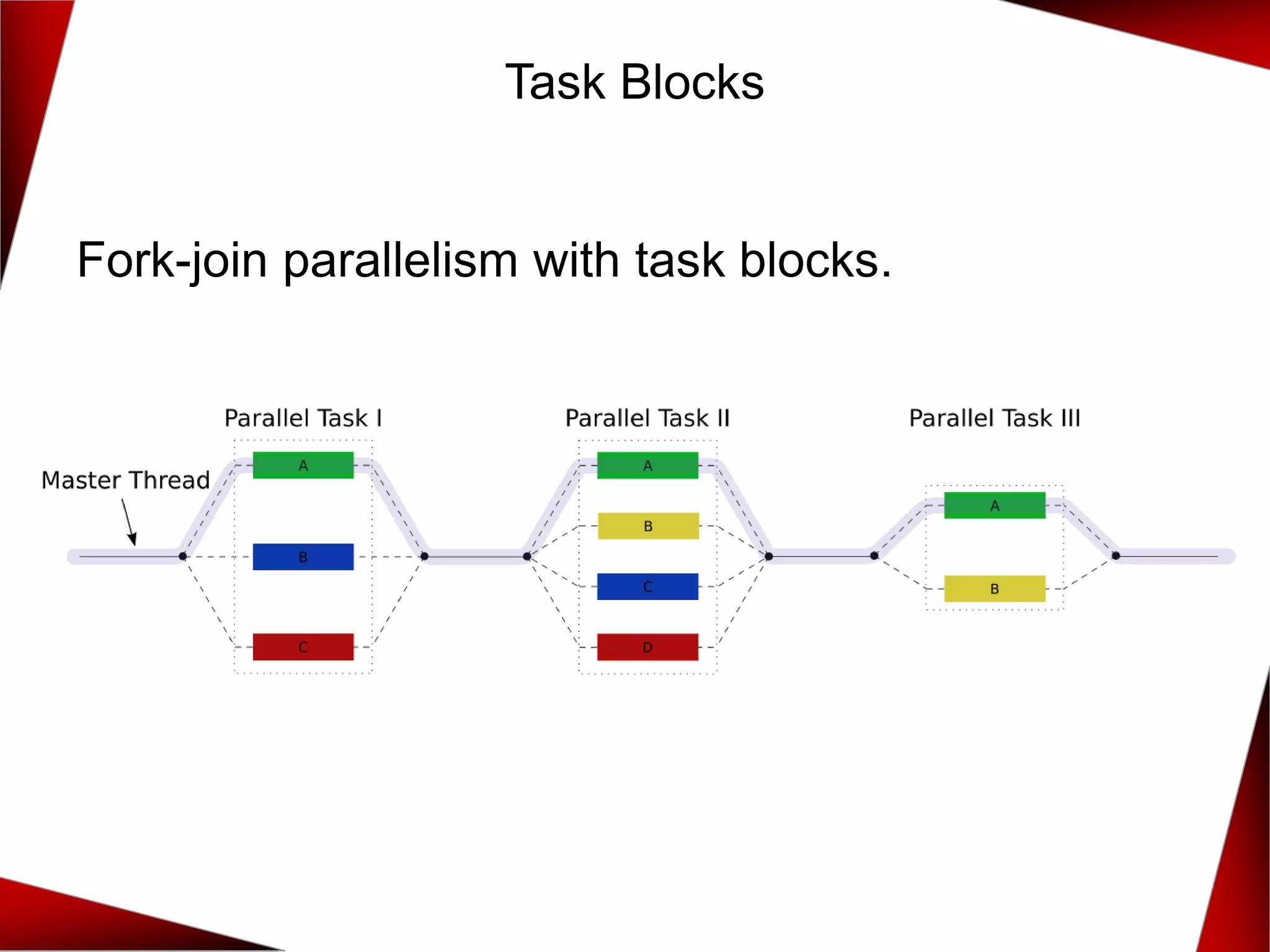
Fork-join parallelism with task blocks.
Task Blocks
template <typename Func>
int traverse(node& n, Func && f){
int left = 0, right = 0;
define_task_block(
[&](task_block& tb){
if (n.left) tb.run([&]{ left = traverse(*n.left, f); });
if (n.right) tb.run([&]{ right = traverse(*n.right, f); });
}
);
return f(n) + left + right;
}
▪ define_task_block
▪ tasks can be perfomed
▪ tasks will be synchronised at the end of the task block
▪ run: starts a task
Concurrency and Parallelism in C++
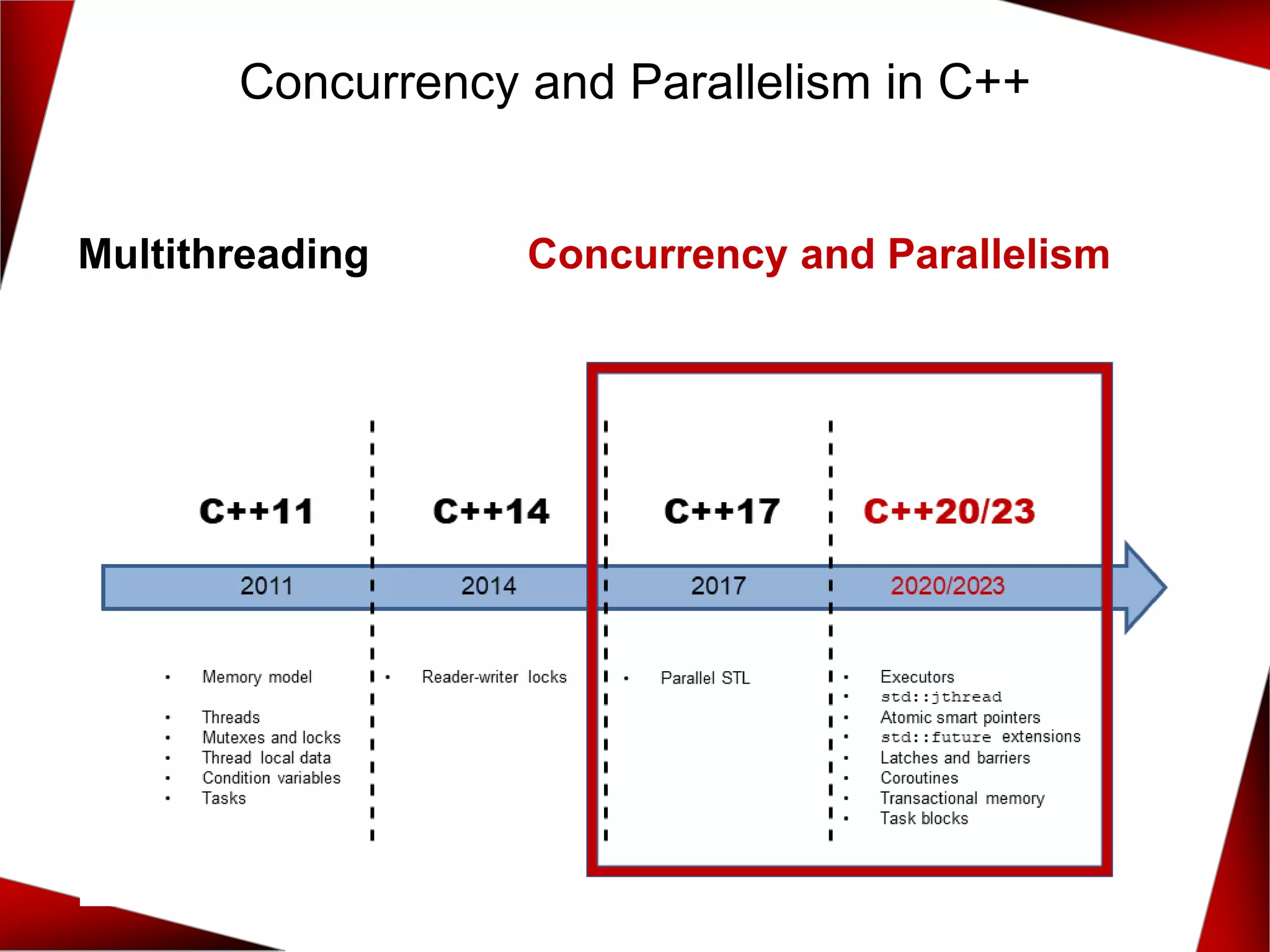
Multithreading Concurrency and Parallelism
Concurrency and Parallelism in C++
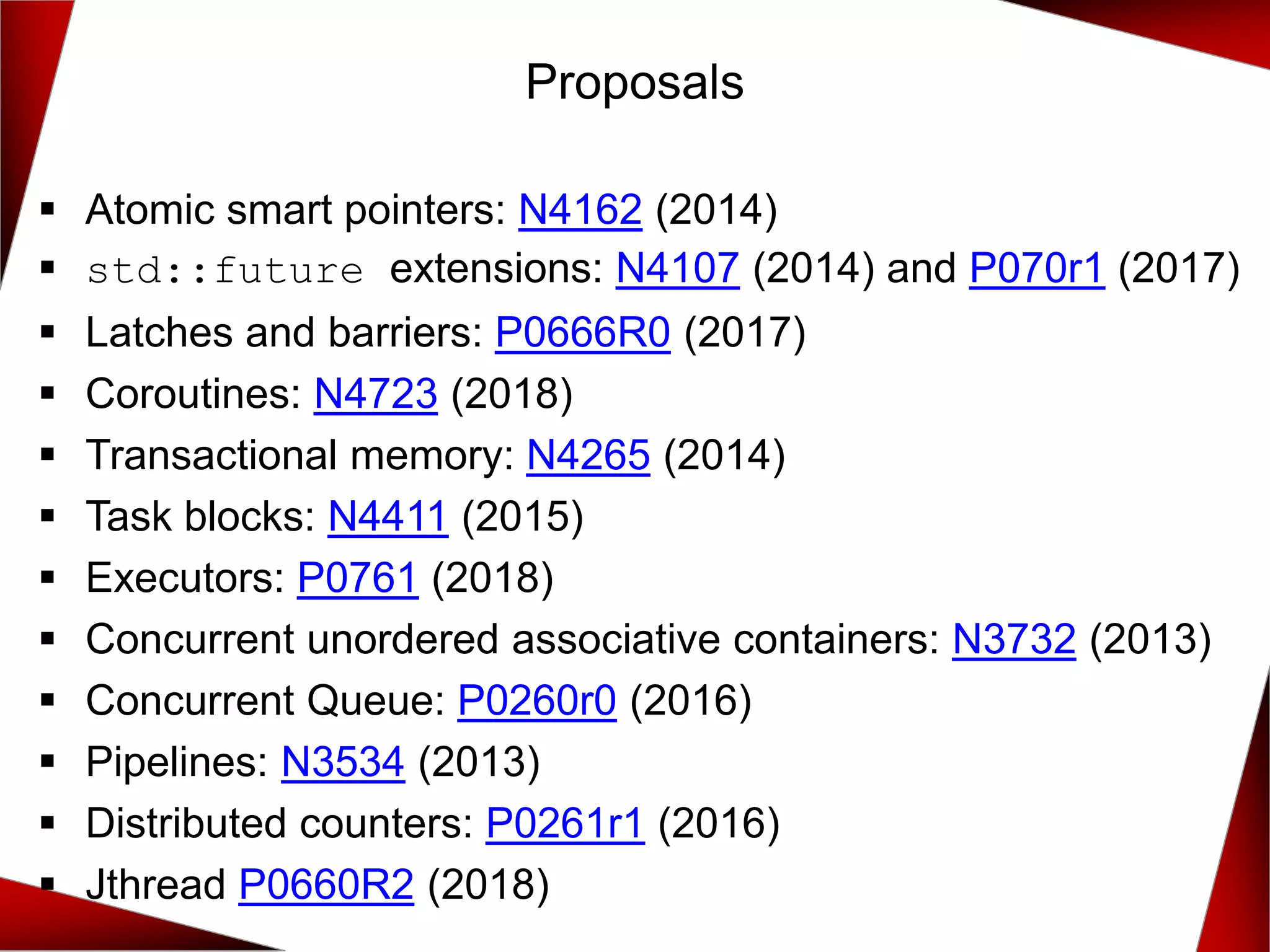
Proposals
▪ Atomic smart pointers: N4162 (2014)
▪ std::future extensions: N4107 (2014) and P070r1 (2017)
▪ Latches and barriers: P0666R0 (2017)
▪ Coroutines: N4723 (2018)
▪ Transactional memory: N4265 (2014)
▪ Task blocks: N4411 (2015)
▪ Executors: P0761 (2018)
▪ Concurrent unordered associative containers: N3732 (2013)
▪ Concurrent Queue: P0260r0 (2016)
▪ Pipelines: N3534 (2013)
▪ Distributed counters: P0261r1 (2016)
▪ Jthread P0660R2 (2018)
Rainer Grimm
Training, Coaching, and
Technology Consulting
www.ModernesCpp.de
Blogs
www.grimm-jaud.de [De]
www.ModernesCpp.com [En]

C++ CoreHard Autumn 2018. Concurrency and Parallelism in C++17 and C++20/23 - Rainer Grimm

  • 1.
    Concurrency and Parallelism with C++17and C++20/23 Rainer Grimm Training, Coaching and, Technology Consulting www.ModernesCpp.de
  • 2.
  • 3.
  • 4.
    You can choosethe execution policy of an algorithm. ▪ Execution policies std::execution::seq ▪ Sequential in one thread std::execution::par ▪ Parallel std::execution::par_unseq ▪ Parallel and vectorised SIMD Parallel STL
  • 5.
    Parallel STL Not vectorisedVectorised const int SIZE = 8; int vec[]={1, 2 , 3, 4, 5, 6, 7, 8}; int res[SIZE] = {0,}; int main(){ for (int i= 0; i < SIZE; ++i){ res[i] = vec[i] + 5; } }
  • 6.
    using namespace std; vector<int>vec = {1, 2, 3, 4, 5, .... } sort(vec.begin(), vec.end()); // sequential as ever sort(execution::seq, vec.begin(), vec.end()); // sequential sort(execution::par, vec.begin(), vec.end()); // parallel sort(execution::par_unseq, vec.begin(), vec.end()); // par + vec Parallel STL
  • 7.
    Parallel STL adjacent_difference, adjacent_find,all_of any_of, copy, copy_if, copy_n, count, count_if, equal, exclusive_scan, fill, fill_n, find, find_end, find_first_of, find_if, find_if_not, for_each, for_each_n, generate, generate_n, includes, inclusive_scan, inner_product, inplace_merge, is_heap, is_heap_until, is_partitioned, is_sorted, is_sorted_until, lexicographical_compare, max_element, merge, min_element, minmax_element, mismatch, move, none_of, nth_element, partial_sort, partial_sort_copy, partition, partition_copy, reduce, remove, remove_copy, remove_copy_if, remove_if, replace, replace_copy, replace_copy_if, replace_if, reverse, reverse_copy, rotate, rotate_copy, search, search_n, set_difference, set_intersection, set_symmetric_difference, set_union, sort, stable_partition, stable_sort, swap_ranges, transform, transform_exclusive_scan, transform_inclusive_scan, transform_reduce, uninitialized_copy, uninitialized_copy_n, uninitialized_fill, uninitialized_fill_n, unique, unique_copy
  • 8.
    Parallel STL std::transform_reduce ▪ Haskellsfunction map is called std::transform in C++ ▪ std::transform_reduce std::map_reduce
  • 9.
    Parallel STL ▪ Dangerof data races or deadlocks The access to numComp has to be atomic. int numComp = 0; vector<int> vec = {1, 3, 8, 9, 10}; sort(execution::par, vec.begin(), vec.end(), [&numComp](int fir, int sec){ numComp++; return fir < sec; } );
  • 10.
  • 11.
    Executors Executors are thebasic building block for execution in C++. ▪ They fulfil a similar role for execution such as allocators for allocation. An executor consists of a set of rules for a callables: ▪ Where: run on a internal or external processor ▪ When: run immediately or later ▪ How: run on a CPU or GPU
  • 12.
    Executors ▪ Using anexecutor my_executor_type my_executor = ... ; auto future = std::async(my_executor, []{ std::cout << "Hello world " << std::endl; } ); std::for_each(std::execution::par.on(my_executor), data.begin(), data.end(), func); ▪ Obtaining an executor static_thread_pool pool(4); auto exec = pool.executor(); task1 = long_running_task(exec);
  • 13.
    Executors An executor providesone or more execution functions for creating a callable. Name Cardinality Direction execute single oneway twoway_execute single twoway then_execute single then bulk_execute bulk oneway bulk_twoway_execute bulk twoway bulk_then_execute bulk then Cardinality: Creation of one execution agent or a group of execution agents. Direction: Directions of the execution.
  • 14.
    std::jthread Problem: std::thread throwsstd::terminate in its destructor if still joinable. std::thread t{[]{ std::cout << "New thread"; }}; std::cout << "t.joinable(): " << t.joinable();
  • 15.
    std::jthread Solution: std::jthread joinsautomatically at the end of its scope. std::jthread t{[]{ std::cout << "New thread"; }}; std::cout << "t.joinable(): " << t.joinable();
  • 16.
    std::jthread ▪ Instances ofstd::jthread can be interrupted Receiver ▪ Explicit check: ▪ is_interrupted: yields, when an interrupt was signalled ▪ std::condition_variable wait variations with predicate Sender ▪ interrupt: signals an interrupt (and returns whether an interrupt was signaled before)
  • 17.
    std::jthread jthread nonInterruptable([]{ int counter{0}; while(counter < 10){ this_thread::sleep_for(0.2s); cerr << "nonInterruptable: " << counter << endl; ++counter; } }); jthread interruptable([](interrupt_token itoken){ int counter{0}; while (counter < 10){ this_thread::sleep_for(0.2s); if (itoken.is_interrupted()) return; cerr << "interruptable: " << counter << endl; ++counter; } }); this_thread::sleep_for(1s); cerr << endl; cerr << "Main thread interrupts both jthreads" << endl; nonInterruptable.interrupt(); interruptable.interrupt(); cout << endl;
  • 18.
  • 19.
    C++11 has astd::shared_ptr for shared ownership. ▪ General Rule: ▪ You should use smart pointers. ▪ But: ▪ The managing of the control block and the deletion of the resource is thread-safe. The access to the ressource is not thread-safe. Tony Van Eerd: Forget what you learned in Kindergarten. Stop sharing. ▪ Solution: ▪ std::atomic_shared_ptr ▪ std::atomic_weak_ptr Atomic Smart Pointers
  • 20.
    Atomic Smart Pointer 3Reasons ▪ Consistency ▪ std::shared_ptr is the only non-atomic data type for which atomic operations exists. ▪ Correctness ▪ The correct usage of atomic operations is just based on the discipline of the user. extremly error-prone std::atomic_store(&sharPtr, localPtr) sharPtr = localPtr ▪ Performance ▪ std::shared_ptr has to be design for the special use-case.
  • 21.
  • 22.
    Atomic Smart Pointers Atomicsmart pointers are part of ISO C++standard. ▪ std::atomic_shared_ptr std::atomic<std::shared_ptr<T>> ▪ std::atomic_weak_ptr std::atomic<std::weak_ptr<T>>
  • 23.
    std::future doesn't supportcomposition ▪ std::future Improvement Continuation ▪ then: execute the next future if the previous one is done future<int> f1 = async([](){ return 123; }); future<string> f2 = f1.then([](future<int> f){ return to_string(f.get() ); // non-blocking }); auto myResult = f2.get(); // blocking std::future Extensions
  • 24.
    ▪ when_all: executethe future if all futures are done ▪ when_any: execute the future if one of the futures is done std::future Extensions future<int> futures[] = { async([]() { return intResult(125); }), async([]() { return intResult(456); })}; future<vector<future<int>>> all_f = when_all(begin(futures), end(futures)); vector<future<int>> myResult = all_f.get(); for (auto fut: myResult): fut.get(); future<int> futures[] = {async([]() { return intResult(125); }), async([]() { return intResult(456); })}; when_any_result<vector<future<int>>> any_f = when_any(begin(futures), end(futures)); future<int> myResult = any_f.futures[any_f.index]; auto myResult = myResult.get();
  • 25.
    std::future Extensions ▪ Disadvantagesof the extended futures ▪ Futures and promises are coupled to std::thread. ▪ Where are .then continuations are invoked? ▪ Passing futures to .then continuation is too verbose. std::future f1 = std::async([]{ return 123; }); std::future f2 = f1.then([](std::future f){ return std::to_string(f.get()); } ); std::future f2 = f1.then(std::to_string); ▪ Future blocks in its destructor. ▪ Futures und values should be easily composable. bool f(std::string, double, int); std::future<std::string> a = /* ... */; std::future<int> c = /* ... */; std::future<bool> d2 = when_all(a, 3.14, c).then(f); // f(a.get(), 3.14, c.get())
  • 26.
    C++ has nosemaphor latches and barriers ▪ Key idea A thread is waiting at the synchronisation point until the counter becomes zero. ▪ latch is for the one-time use-case ▪ count_down_and_wait: decrements the counter until it becomes zero ▪ count_down(n = 0): decrements the counter by n ▪ is_ready: checks the counter ▪ wait: waits until the counter becomes zero Latches and Barriers
  • 27.
    ▪ barrier canbe reused ▪ arrive_and_wait: waits at the synchronisation point ▪ arrive_and_drop: removes itself from the sychronisation mechanism ▪ flex_barrier is a reusable and adaptable barrier ▪ The constructor gets a callable. ▪ The callable will be called in the completion phase. ▪ The callable returns a number which stands for the counter in the next iteration. ▪ Can change the value of the counter for each iteration. Latches and Barriers
  • 28.
    Latches and Barriers voiddoWork(threadpool* pool) { latch completion_latch(NUMBER_TASKS); for (int i = 0; i < NUMBER_TASKS; ++i) { pool->add_task([&] { // perform the work ... completion_latch.count_down(); })); } // block until all tasks are done completion_latch.wait(); }
  • 29.
    Coroutines Coroutines are generalisedfunctions that can be suspended and resumed while keeping their state. ▪ Typical use-case ▪ Cooperative Tasks ▪ Event loops ▪ Infinite data streams ▪ Pipelines
  • 30.
    Coroutines A function isa coroutine if it has a co_return, co_await, co_yield call or if it has a range-based for loop with a co_await call. Function Coroutine invoke func(args) func(args) return return statement co_return someValue suspend co_await someAwaitable co_yield someValue resume coroutine_handle<>::resume()
  • 31.
    Coroutines generator<int> genForNumbers(int begin,int inc= 1){ for (int i = begin;; i += inc){ co_yield i; } } int main(){ auto numbers = genForNumbers(-10); for (int i = 1; i <= 20; ++i) std::cout << numbers << " "; for (auto n: genForNumbers(0,5)) std::cout << n << " "; } -10 -9 -8 -7 -6 -5 -4 -3 -2 -1 0 1 2 3 4 5 6 7 8 9 10 0 5 10 15 20 25 30 35 40 45 50 55 60 65 70 75 80 85 . . . .
  • 32.
    Coroutines Blocking Acceptor accept{443}; while (true){ Socketso = accept.accept(); // block auto req = so.read(); // block auto resp = handleRequest(req); so.write(resp); // block } Waiting Acceptor accept{443}; while (true){ Socket so = co_await accept.accept(); auto req = co_await so.read(); auto resp = handleRequest(req); co_await so.write(resp); }
  • 33.
    Transactional Memory isthe idea of transactions from the data base theory applied to software. ▪ A transaction has the ACID properties without Durability atomic{ statement1; statement2; statement3; } ▪ Atomicity: all or no statement will be performed ▪ Consistency: the system is always in a consistent state ▪ Isolation: a transaction runs total isolation ▪ Durability: the result of a transaction will be stored Transactional Memory
  • 34.
    ▪ Transactions ▪ builda total order ▪ feel like a global lock ▪ Optimistic approach lock ▪ Workflow A transaction stores its initial state. The transaction will be performed without synchronisation. The runtime experiences a violation to the initial state. The transaction will be performend once more. Transactional Memory Retry Rollback
  • 35.
    ▪ Two forms ▪synchronized blocks ▪ relaxed transaction ▪ are not transaction in the pure sense can have transaction-unsafe code ▪ atomic blocks ▪ atomic blocks ▪ are available in three variations can only execute transaction-safe code Transactional Memory
  • 36.
    Transactional Memory int i= 0; void inc() { synchronized{ cout << ++i << " ,"; } } vector<thread> vecSyn(10); for(auto& t: vecSyn) t = thread([]{ for(int n = 0; n < 10; ++n) inc(); });
  • 37.
    Transactional Memory void inc(){ synchronized{ std::cout << ++i << " ,"; this_thead::sleep_for(1ns); } } vector<thread> vecSyn(10), vecUnsyn(10); for(auto& t: vecSyn) t= thread[]{ for(int n = 0; n < 10; ++n) inc(); }); for(auto& t: vecUnsyn) t= thread[]{ for(int n = 0; n < 10; ++n) cout << ++i << " ,"; });
  • 38.
  • 39.
    Task Blocks template <typenameFunc> int traverse(node& n, Func && f){ int left = 0, right = 0; define_task_block( [&](task_block& tb){ if (n.left) tb.run([&]{ left = traverse(*n.left, f); }); if (n.right) tb.run([&]{ right = traverse(*n.right, f); }); } ); return f(n) + left + right; } ▪ define_task_block ▪ tasks can be perfomed ▪ tasks will be synchronised at the end of the task block ▪ run: starts a task
  • 40.
    Concurrency and Parallelismin C++ Multithreading Concurrency and Parallelism
  • 41.
  • 42.
    Proposals ▪ Atomic smartpointers: N4162 (2014) ▪ std::future extensions: N4107 (2014) and P070r1 (2017) ▪ Latches and barriers: P0666R0 (2017) ▪ Coroutines: N4723 (2018) ▪ Transactional memory: N4265 (2014) ▪ Task blocks: N4411 (2015) ▪ Executors: P0761 (2018) ▪ Concurrent unordered associative containers: N3732 (2013) ▪ Concurrent Queue: P0260r0 (2016) ▪ Pipelines: N3534 (2013) ▪ Distributed counters: P0261r1 (2016) ▪ Jthread P0660R2 (2018)
  • 43.
    Rainer Grimm Training, Coaching,and Technology Consulting www.ModernesCpp.de Blogs www.grimm-jaud.de [De] www.ModernesCpp.com [En]