Debug C++
Without Running
Anastasia Kazakova
JetBrains
@anastasiak2512
C++ CoreHard Autumn 2018
Agenda
—
1. Why this talk? Tricky C++.
2. Classic solution: debugger, static/dynamic analyzer.
3. How an IDE can help?
Agenda
—
1. Why this talk? Tricky C++.
2. Classic solution: debugger, static/dynamic analyzer.
3. How an IDE can help?
Time for a quote
—
“C makes it easy to shoot yourself in the foot;
C++ makes it harder, but when you do it blows your whole leg off”
- Bjarne Stroustrup
http://www.stroustrup.com/bs_faq.html#really-say-that
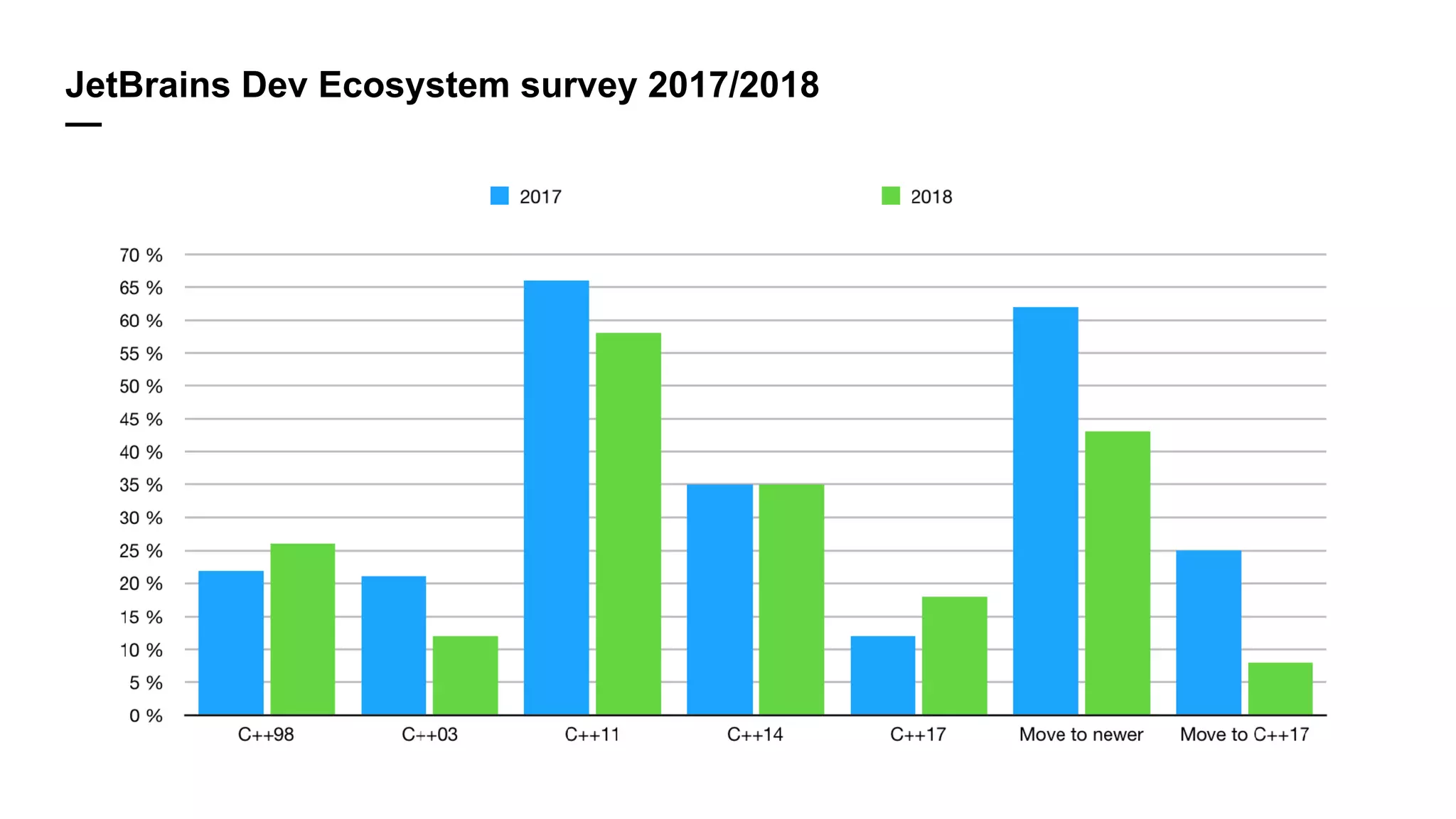
JetBrains Dev Ecosystem survey 2017/2018
—
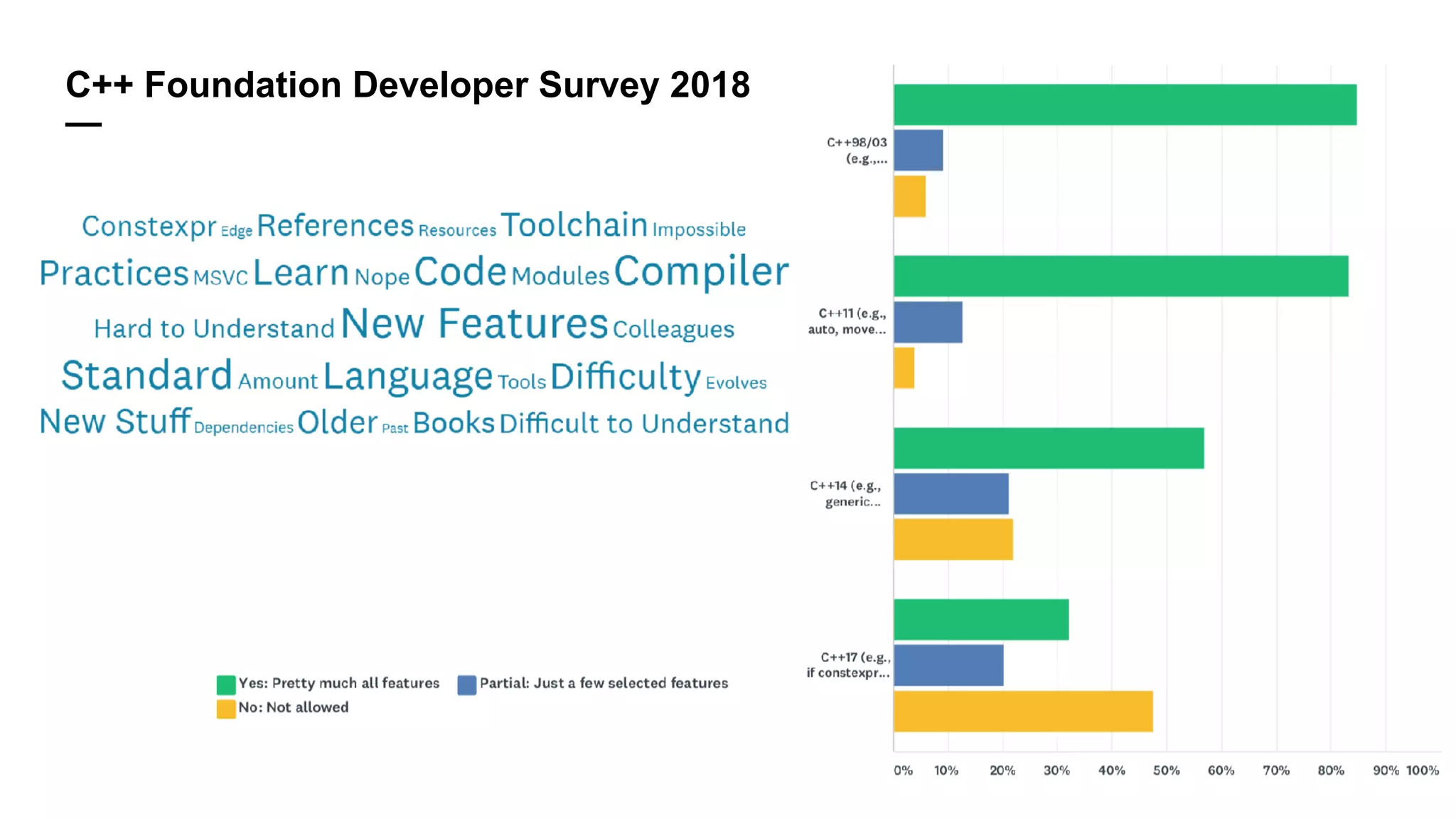
C++ Foundation Developer Survey 2018
—
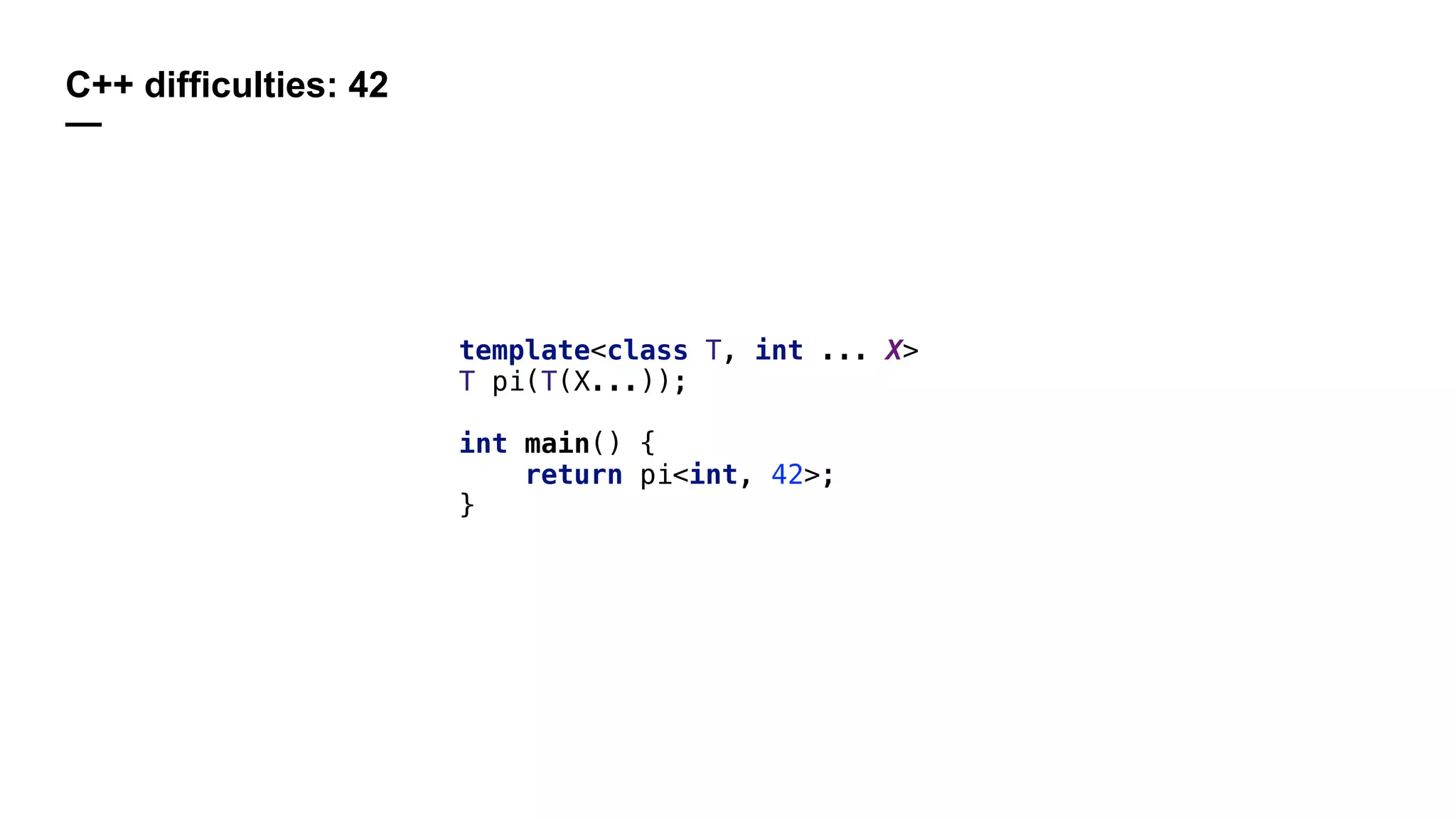
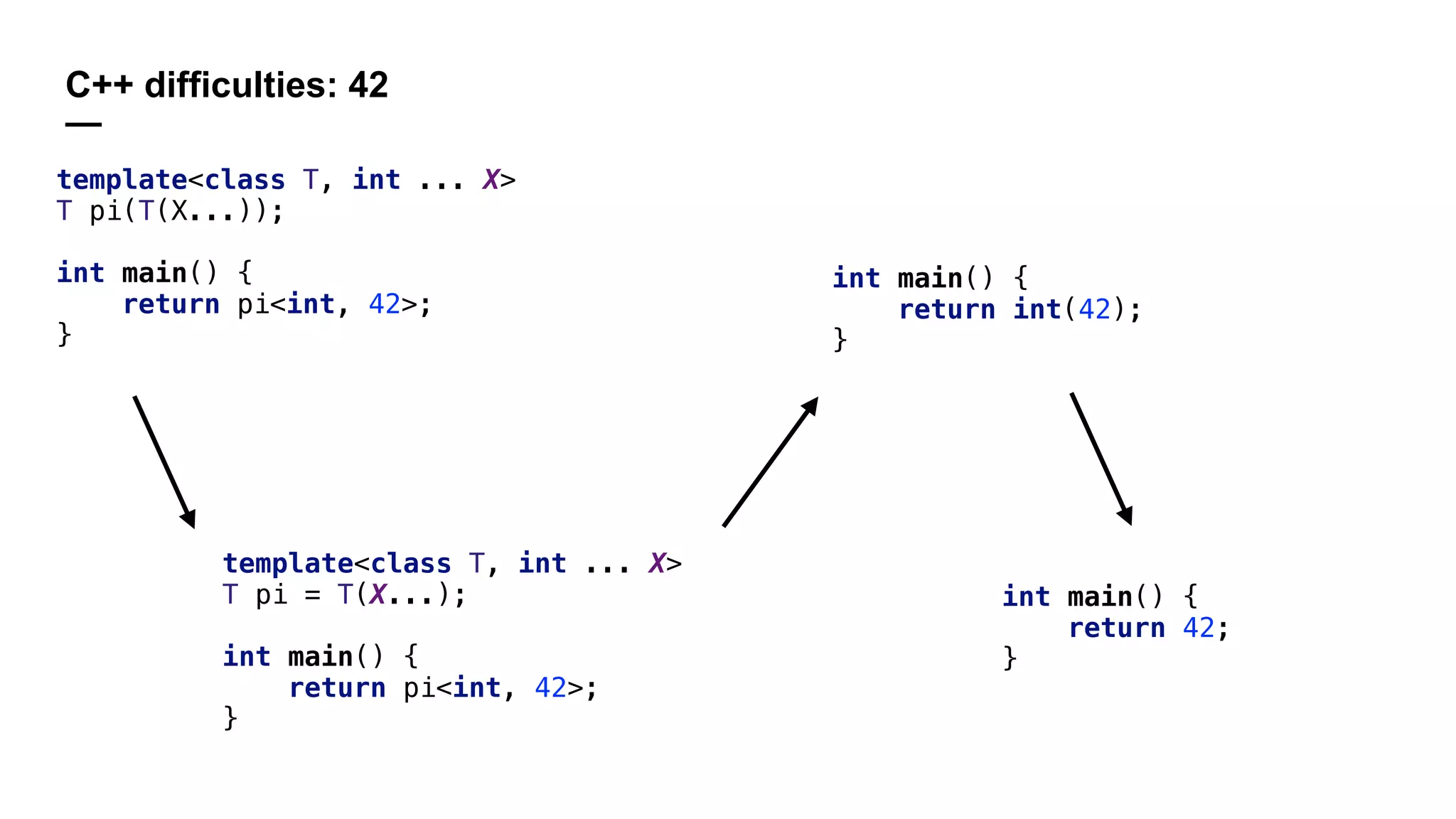
C++ difficulties: 42
—
template<class T, int ... X>
T pi(T(X...));
int main() {
return pi<int, 42>;
}
template<class T, int ... X>
T pi(T(X...));
int main() {
return pi<int, 42>;
}
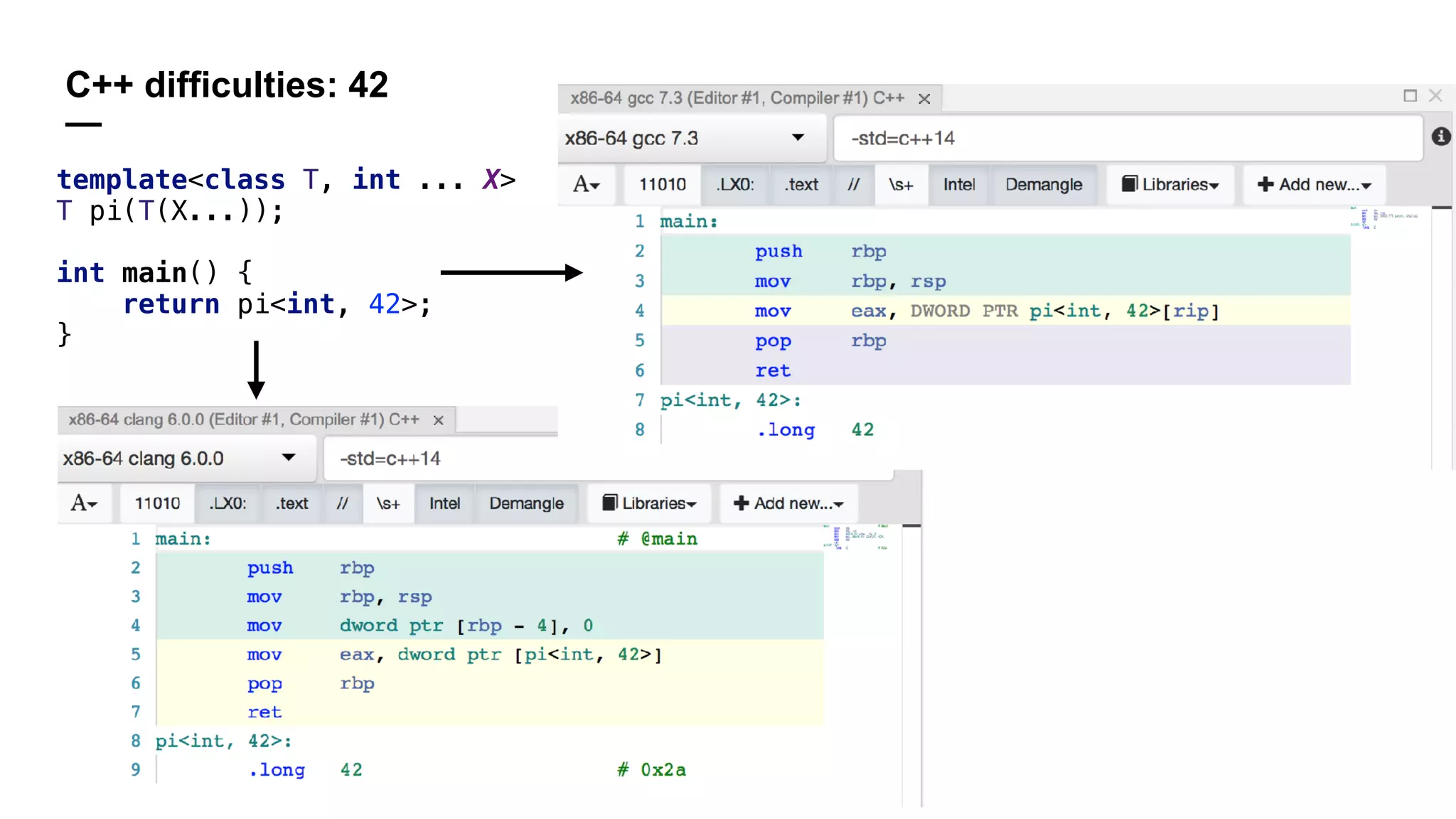
C++ difficulties: 42
—
template<class T, int ... X>
T pi(T(X...));
int main() {
return pi<int, 42>;
}
int main() {
return int(42);
}
C++ difficulties: 42
—
template<class T, int ... X>
T pi = T(X...);
int main() {
return pi<int, 42>;
}
int main() {
return 42;
}
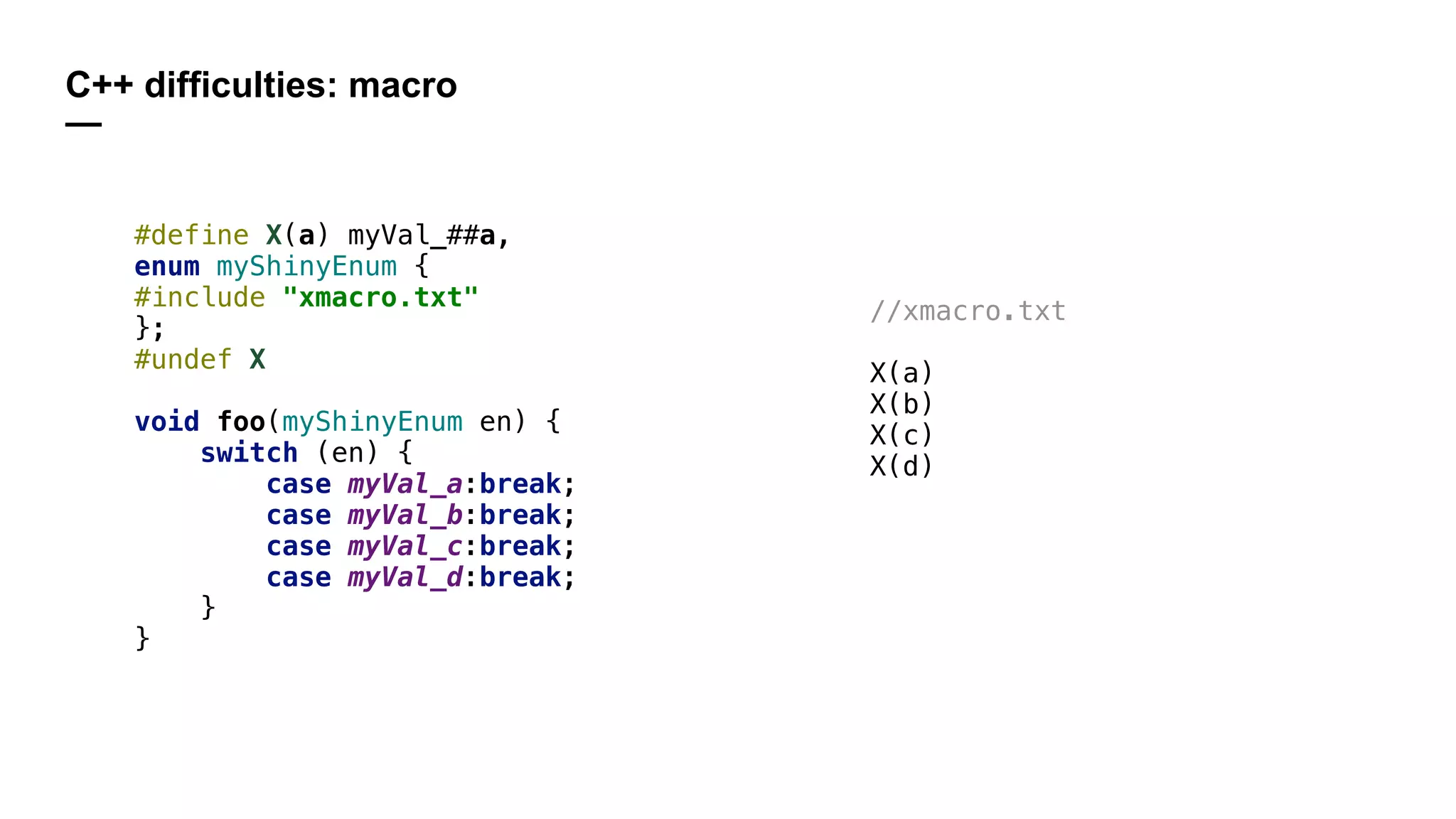
C++ difficulties: macro
—
#define X(a) myVal_##a,
enum myShinyEnum {
#include "xmacro.txt"
};
#undef X
void foo(myShinyEnum en) {
switch (en) {
case myVal_a:break;
case myVal_b:break;
case myVal_c:break;
case myVal_d:break;
}
}
//xmacro.txt
X(a)
X(b)
X(c)
X(d)
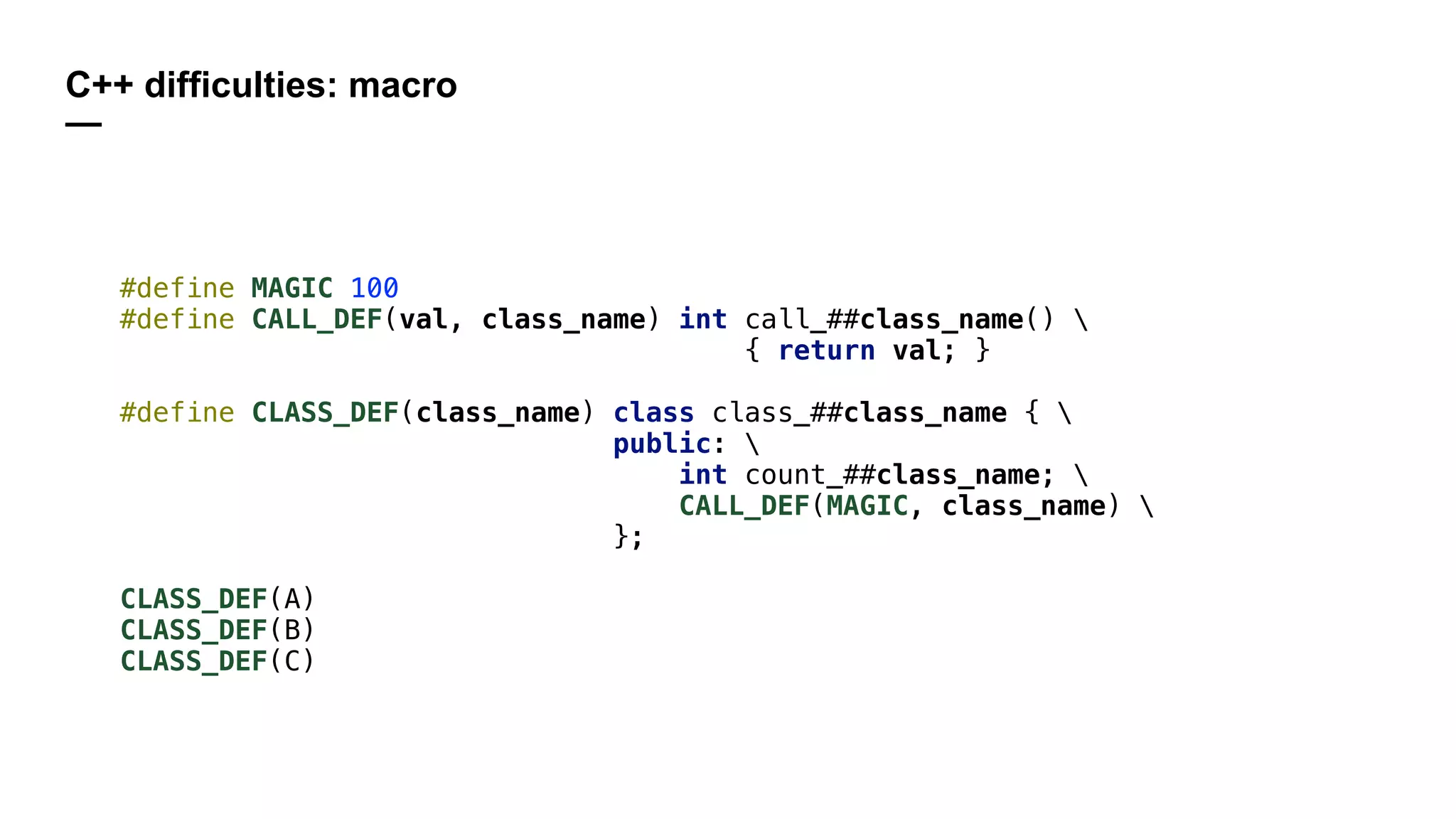
C++ difficulties: macro
—
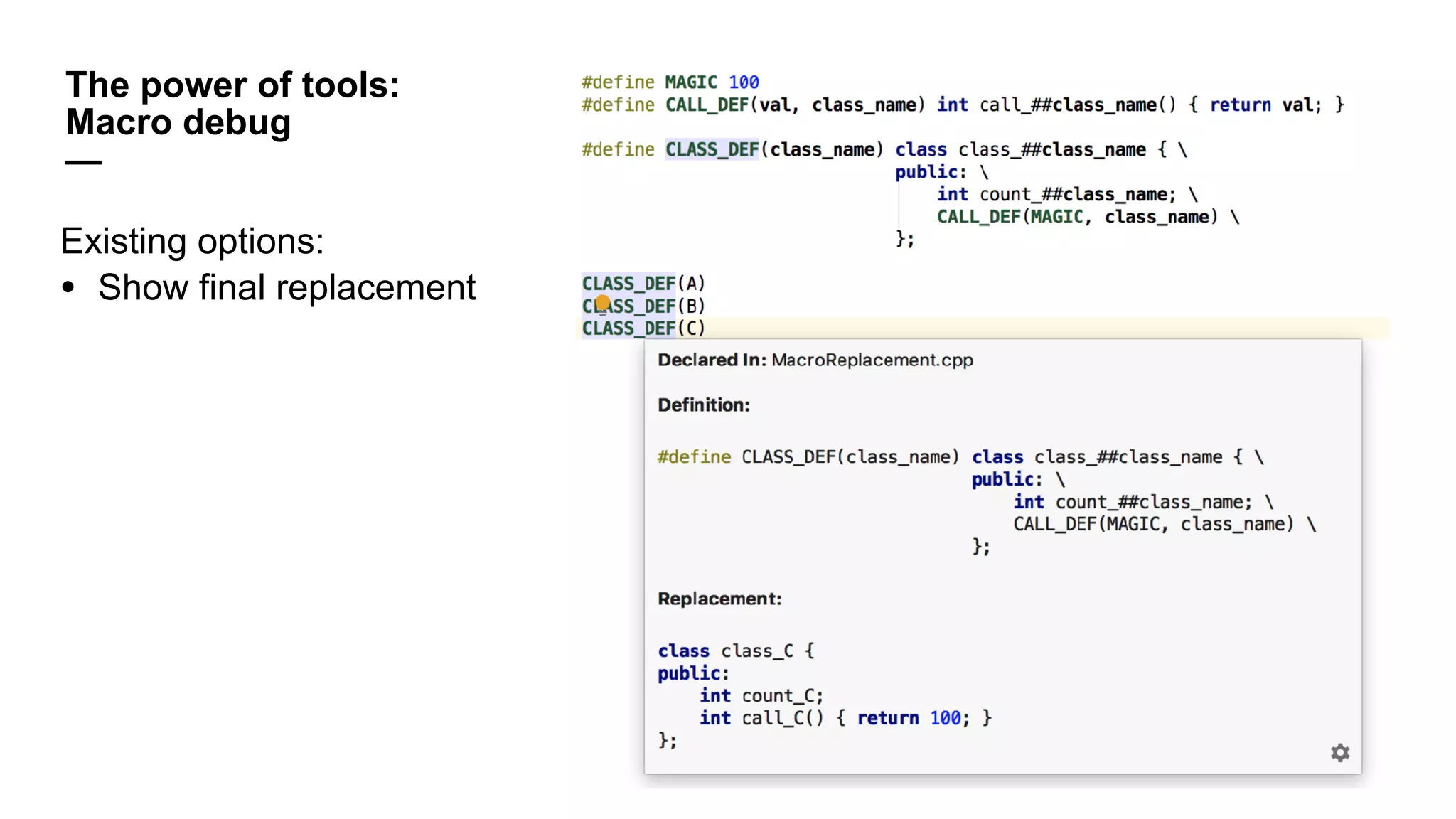
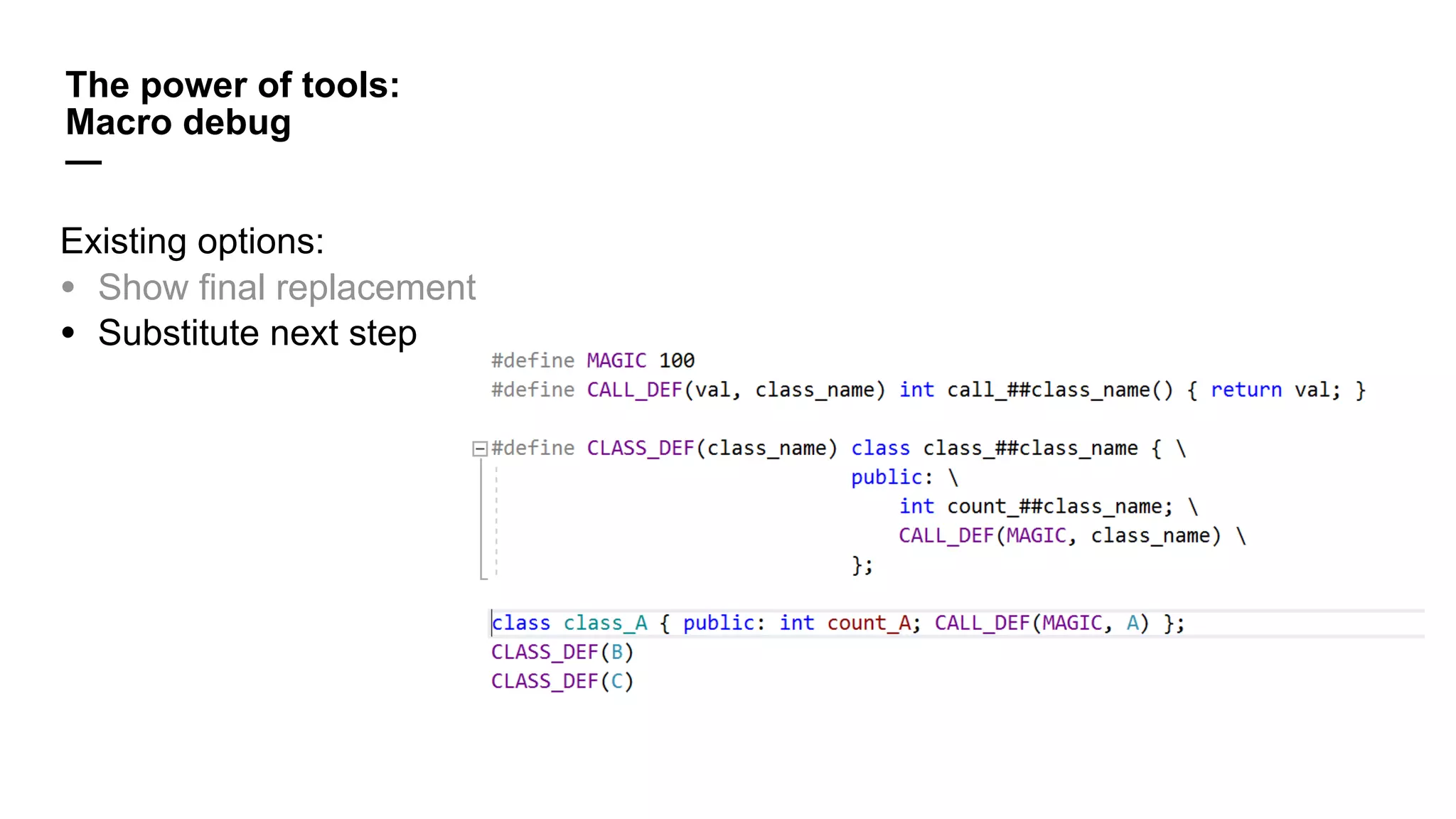
#define MAGIC 100
#define CALL_DEF(val, class_name) int call_##class_name() 
{ return val; }
#define CLASS_DEF(class_name) class class_##class_name { 
public: 
int count_##class_name; 
CALL_DEF(MAGIC, class_name) 
};
CLASS_DEF(A)
CLASS_DEF(B)
CLASS_DEF(C)
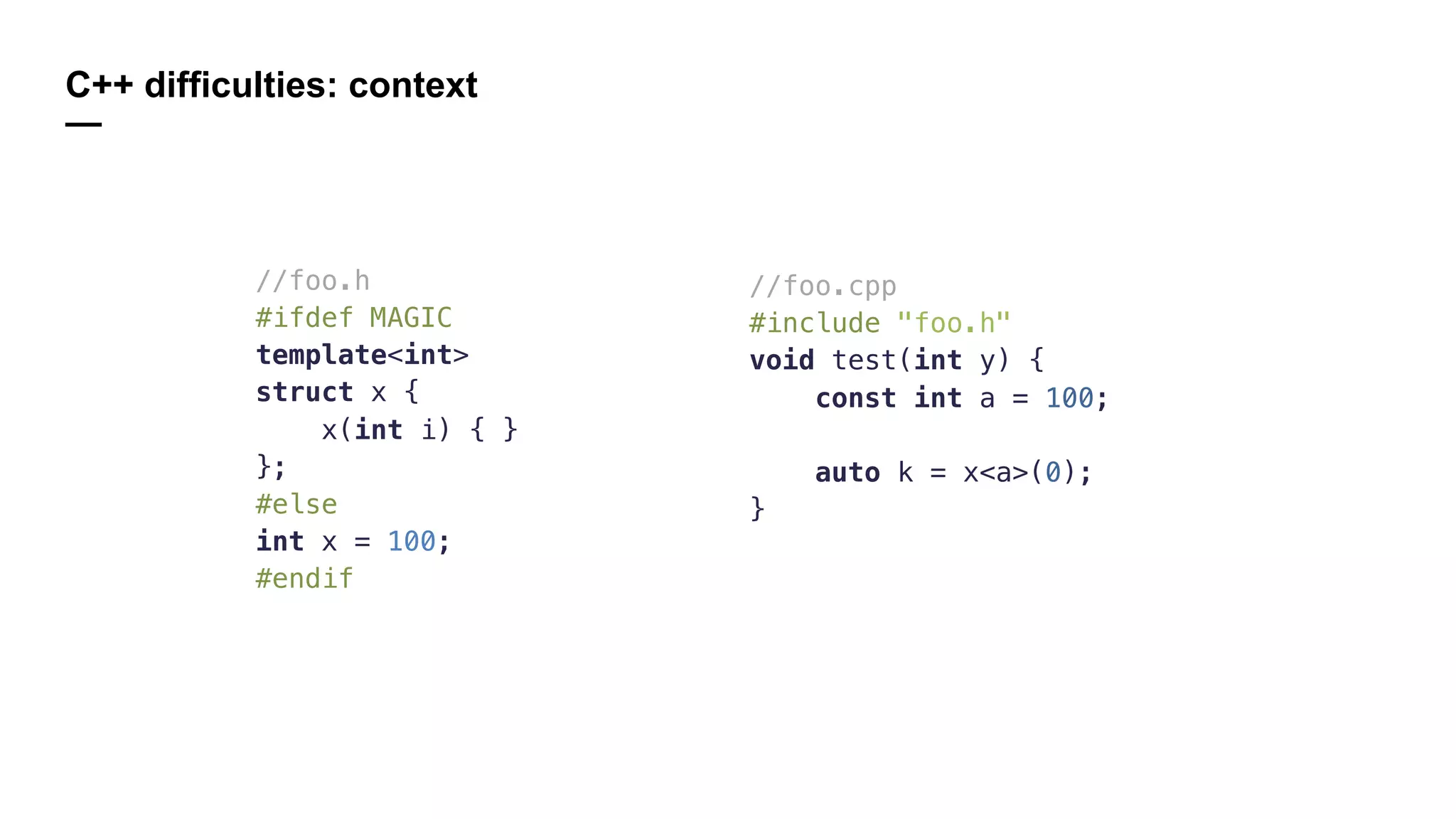
C++ difficulties: context
—
//foo.h
#ifdef MAGIC
template<int>
struct x {
x(int i) { }
};
#else
int x = 100;
#endif
//foo.cpp
#include "foo.h"
void test(int y) {
const int a = 100;
auto k = x<a>(0);
}
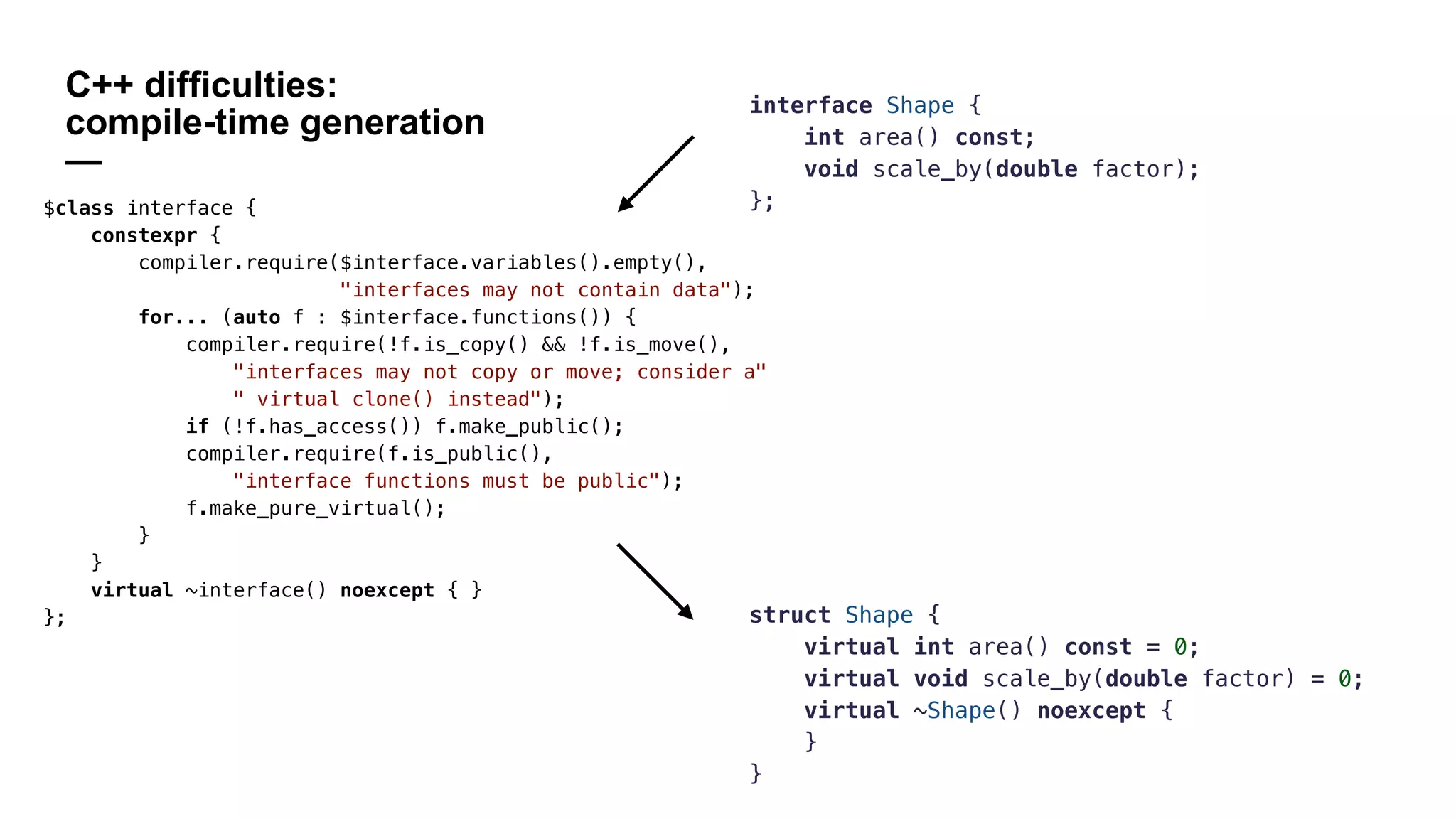
C++ difficulties:
compile-time generation
—
interface Shape {
int area() const;
void scale_by(double factor);
};
struct Shape {
virtual int area() const = 0;
virtual void scale_by(double factor) = 0;
virtual ~Shape() noexcept {
}
}
$class interface {
constexpr {
compiler.require($interface.variables().empty(),
"interfaces may not contain data");
for... (auto f : $interface.functions()) {
compiler.require(!f.is_copy() && !f.is_move(),
"interfaces may not copy or move; consider a"
" virtual clone() instead");
if (!f.has_access()) f.make_public();
compiler.require(f.is_public(),
"interface functions must be public");
f.make_pure_virtual();
}
}
virtual ~interface() noexcept { }
};
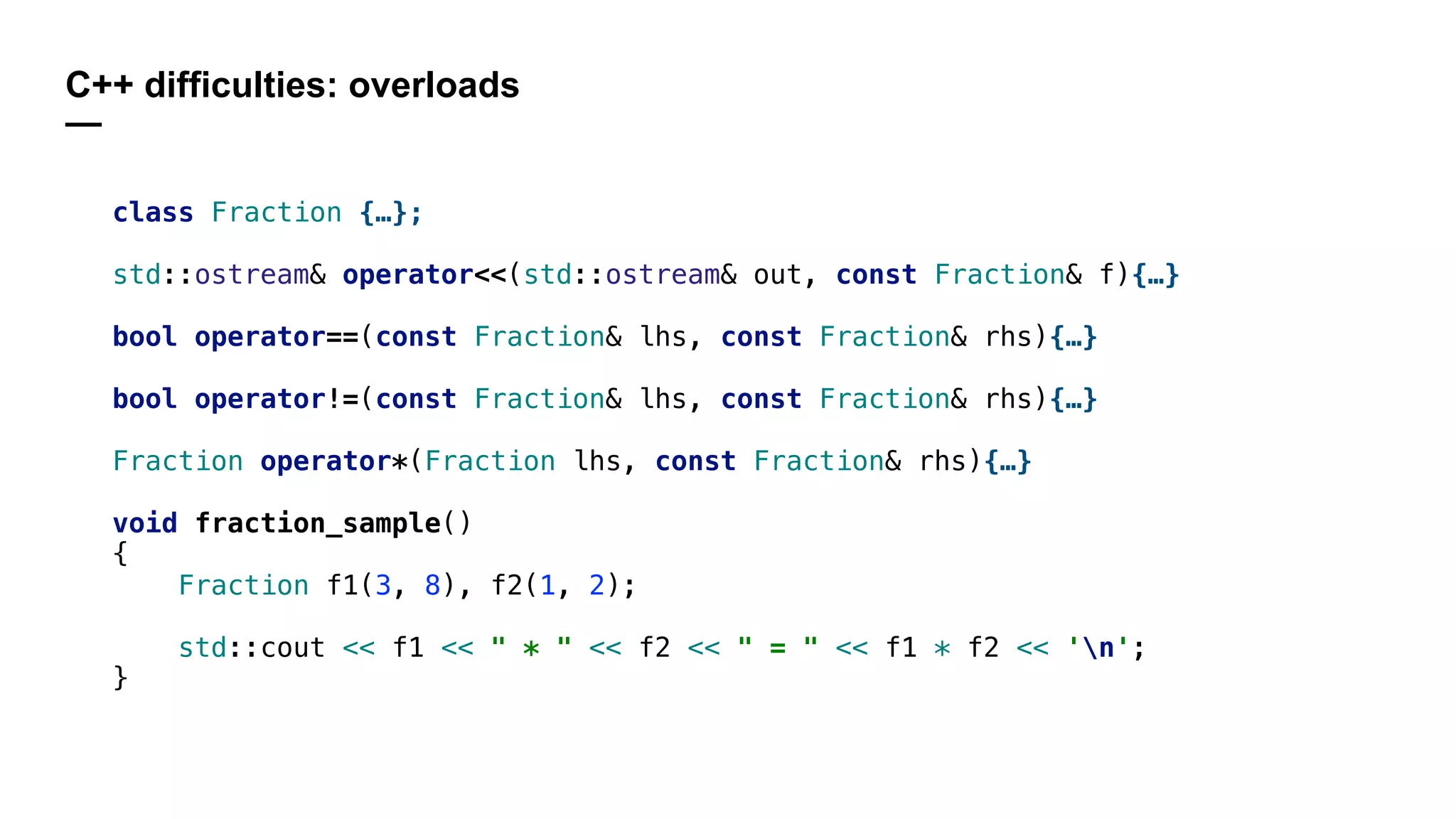
C++ difficulties: overloads
—
class Fraction {…};
std::ostream& operator<<(std::ostream& out, const Fraction& f){…}
bool operator==(const Fraction& lhs, const Fraction& rhs){…}
bool operator!=(const Fraction& lhs, const Fraction& rhs){…}
Fraction operator*(Fraction lhs, const Fraction& rhs){…}
void fraction_sample()
{
Fraction f1(3, 8), f2(1, 2);
std::cout << f1 << " * " << f2 << " = " << f1 * f2 << 'n';
}
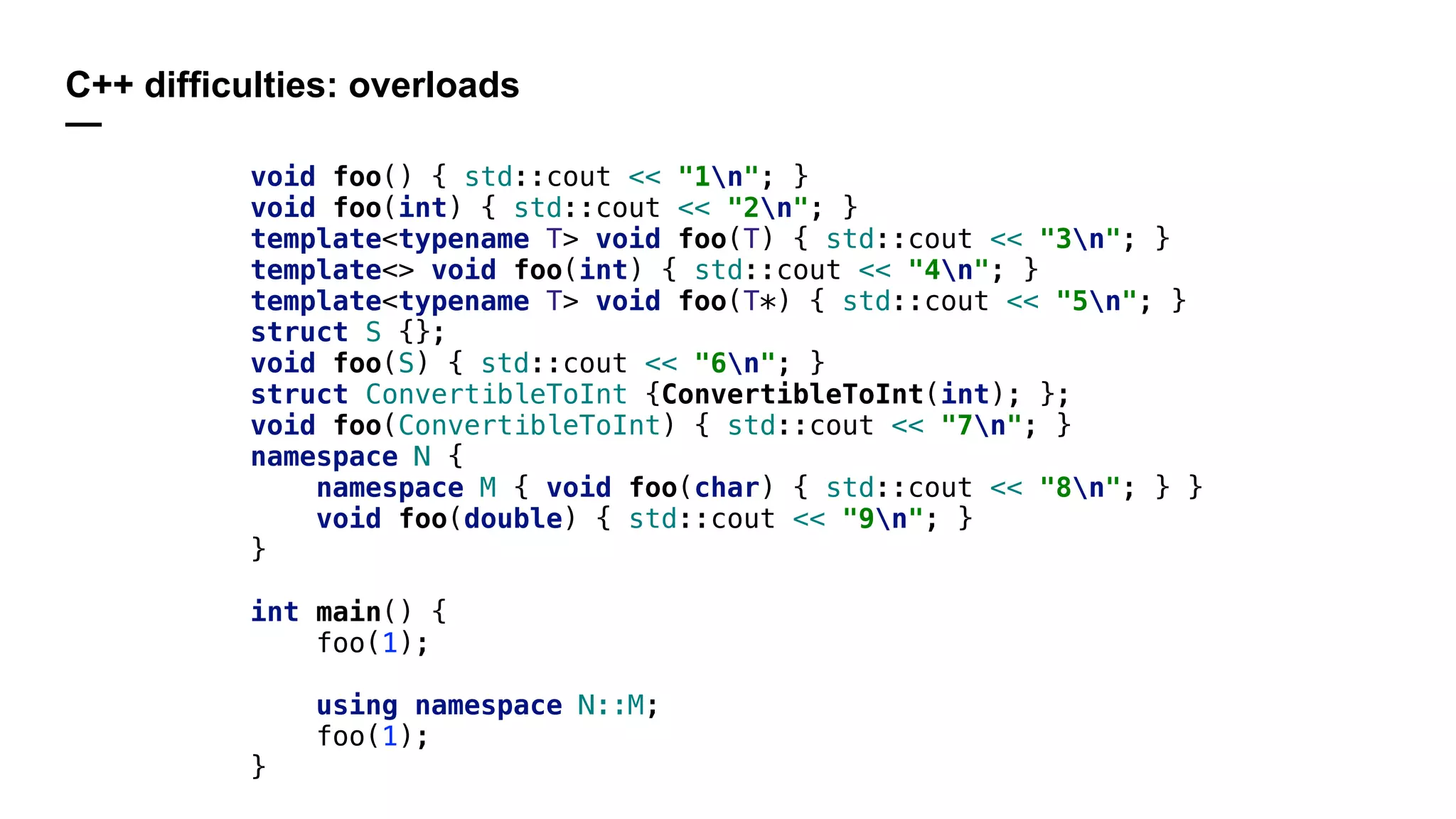
C++ difficulties: overloads
—
void foo() { std::cout << "1n"; }
void foo(int) { std::cout << "2n"; }
template<typename T> void foo(T) { std::cout << "3n"; }
template<> void foo(int) { std::cout << "4n"; }
template<typename T> void foo(T*) { std::cout << "5n"; }
struct S {};
void foo(S) { std::cout << "6n"; }
struct ConvertibleToInt {ConvertibleToInt(int); };
void foo(ConvertibleToInt) { std::cout << "7n"; }
namespace N {
namespace M { void foo(char) { std::cout << "8n"; } }
void foo(double) { std::cout << "9n"; }
}
int main() {
foo(1);
using namespace N::M;
foo(1);
}
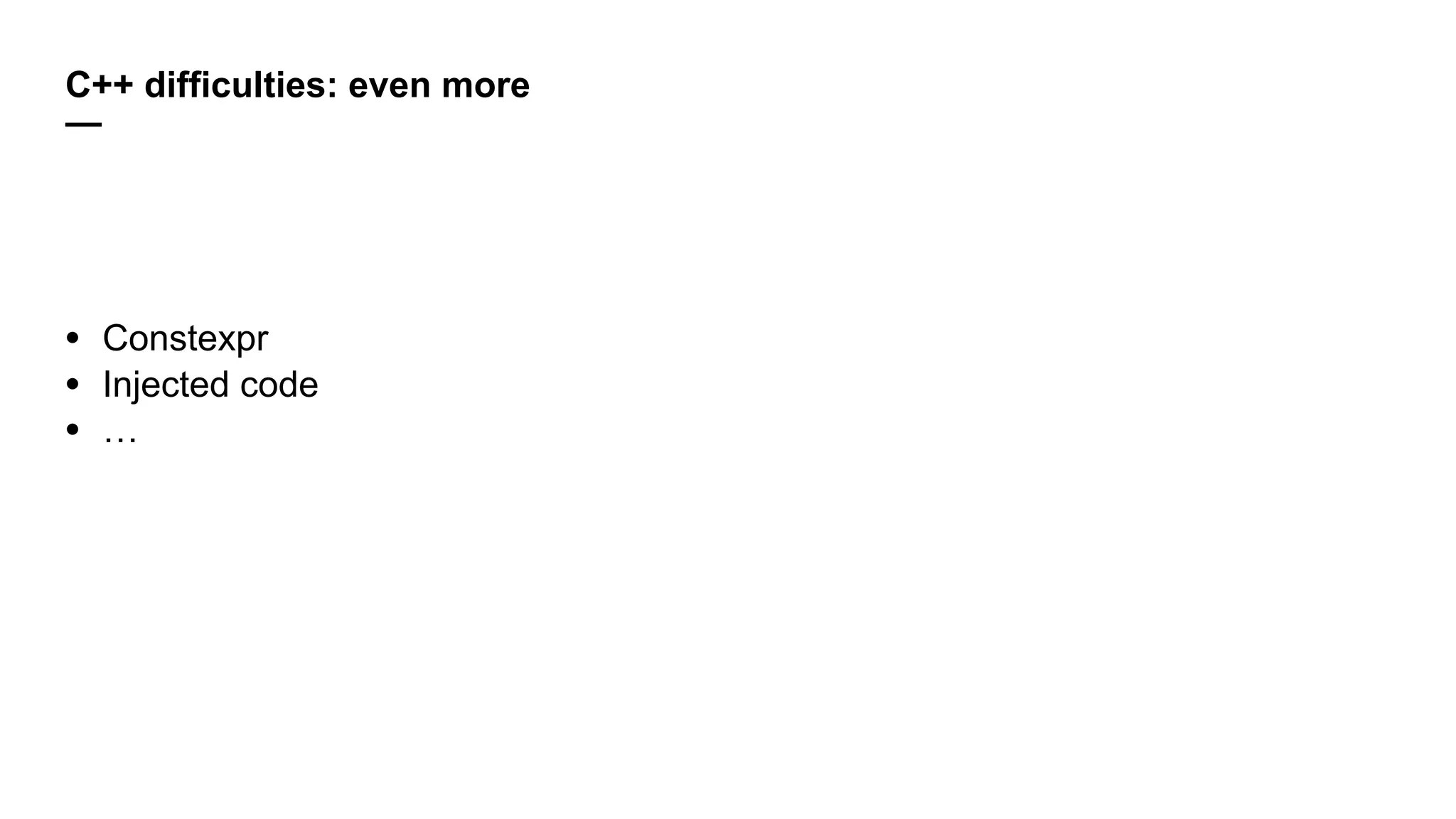
C++ difficulties: even more
—
• Constexpr
• Injected code
• …
Agenda
—
1. Why this talk? Tricky C++.
2. Classic solution: debugger, static/dynamic analyzer.
3. How an IDE can help?
Do these help?
—
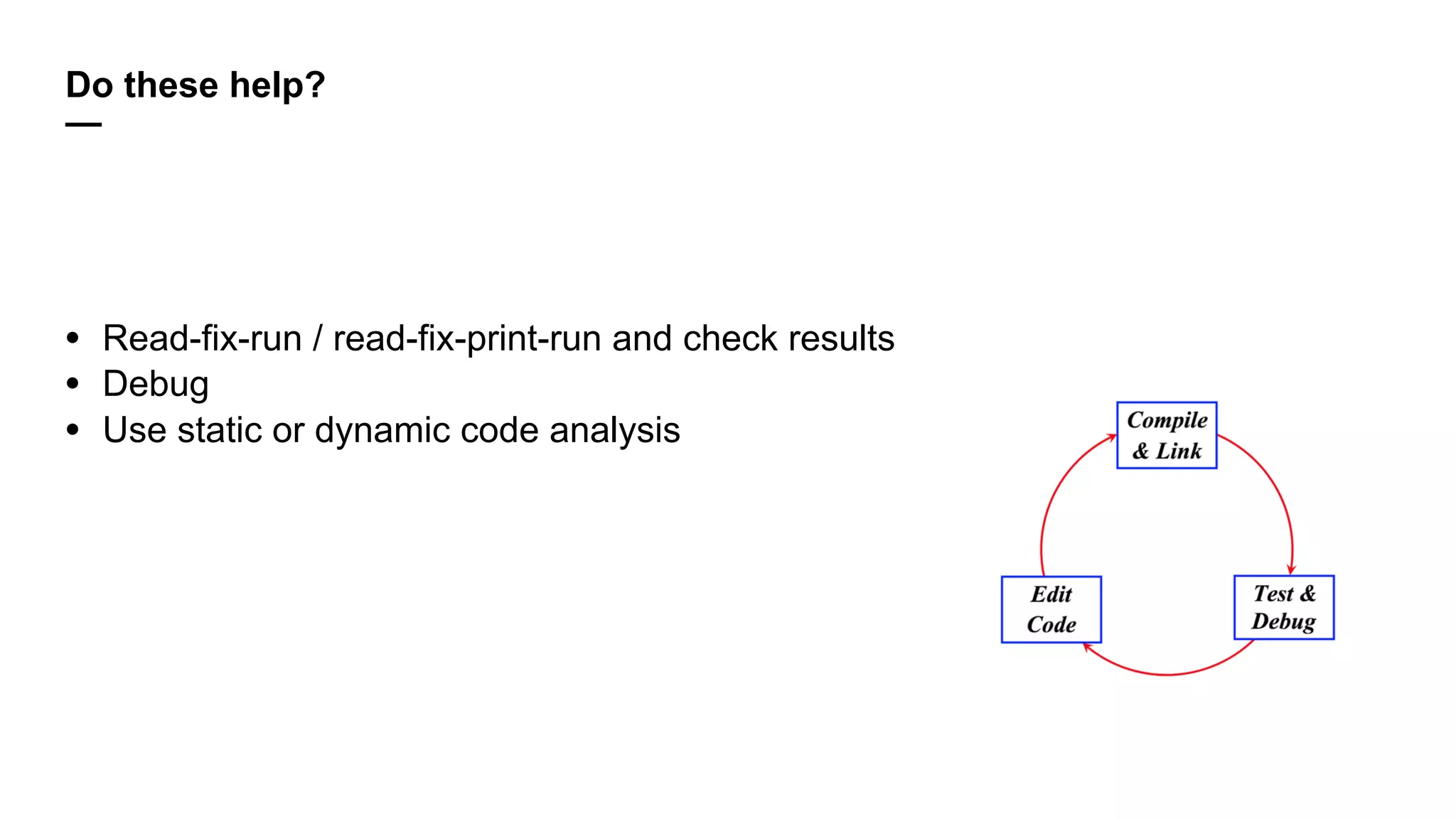
• Read-fix-run / read-fix-print-run and check results
• Debug
• Use static or dynamic code analysis
Do these help?
—
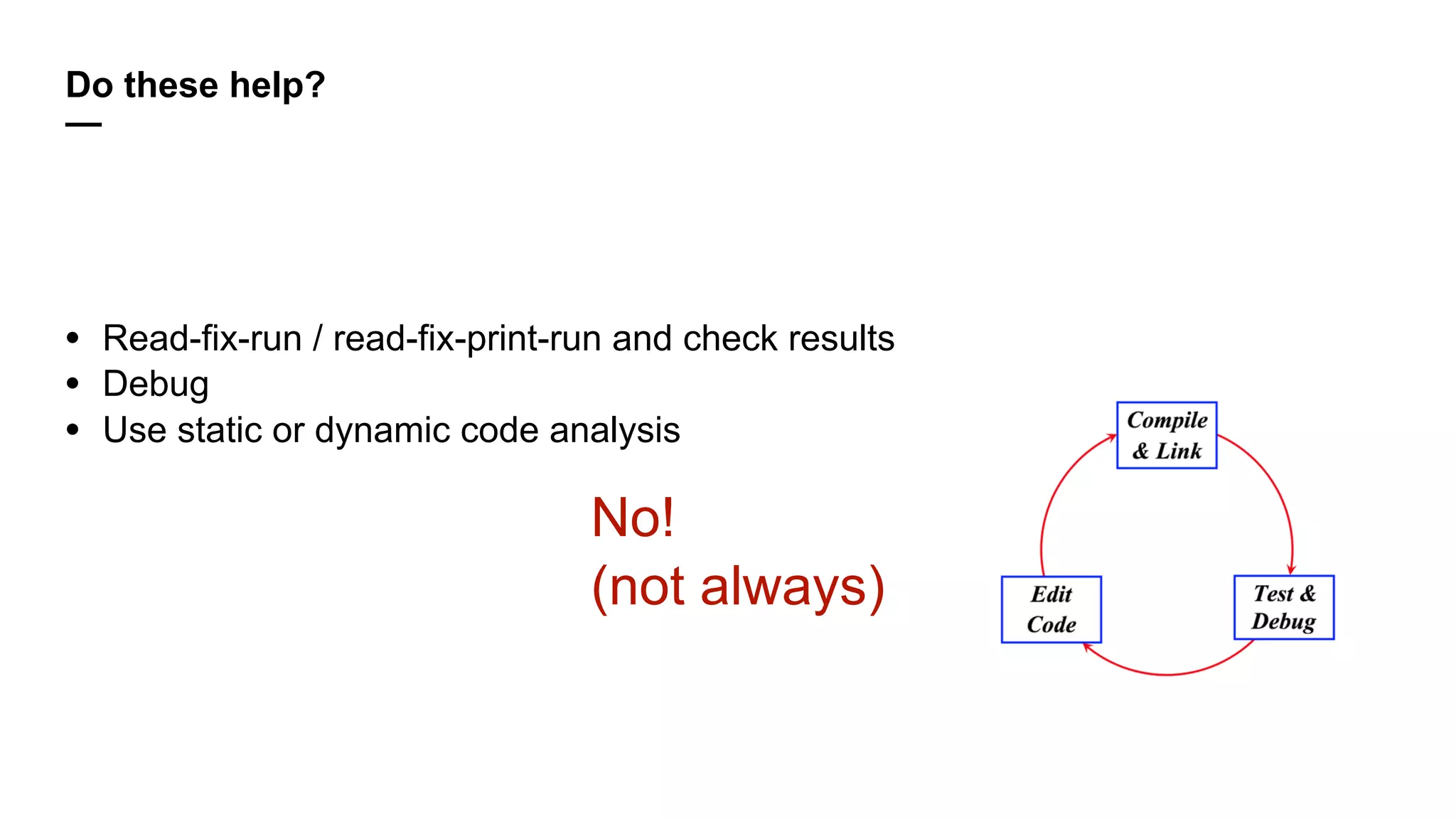
• Read-fix-run / read-fix-print-run and check results
• Debug
• Use static or dynamic code analysis
No!

(not always)
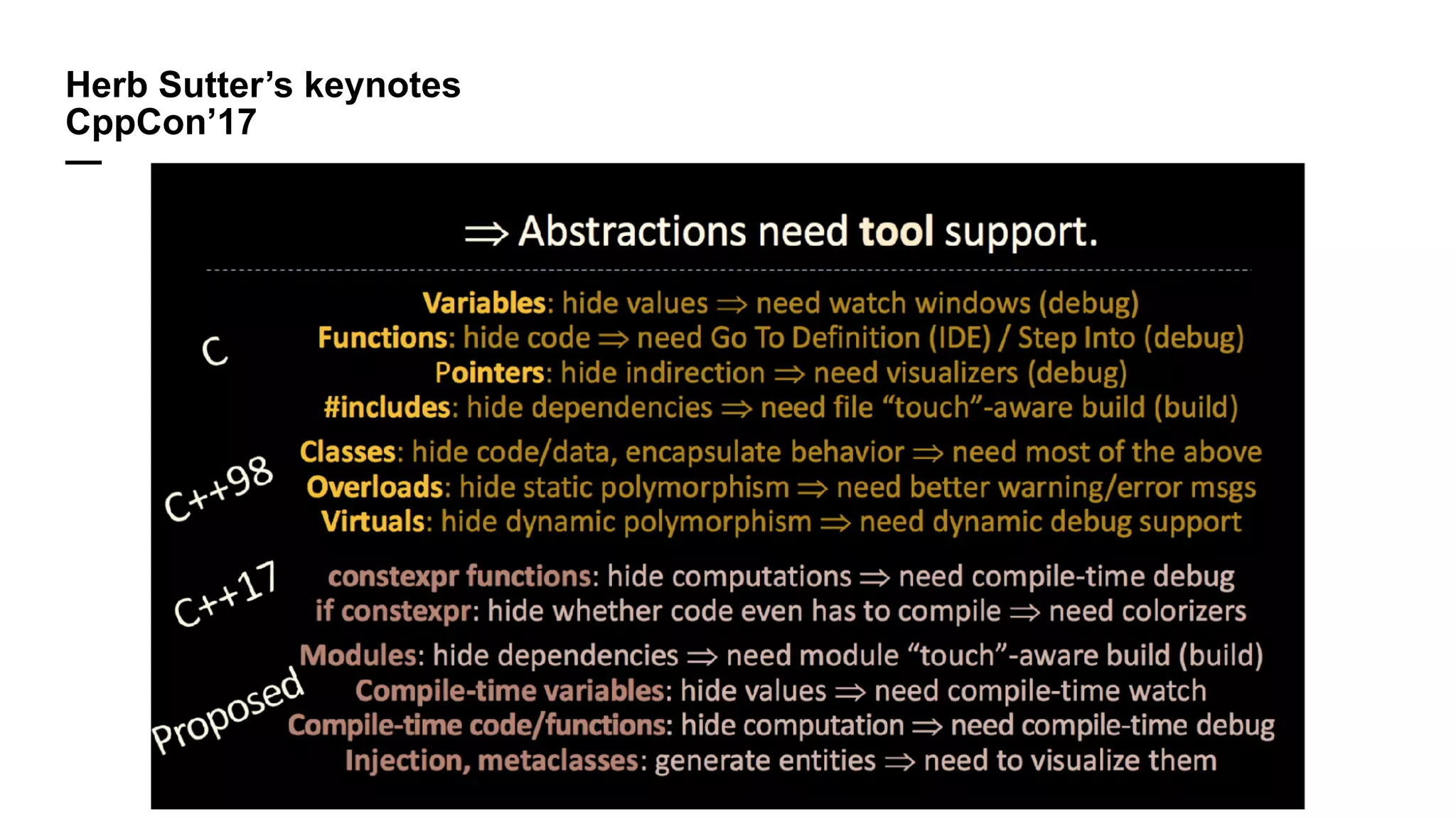
Herb Sutter’s keynotes
CppCon’17
—
Meta - Thoughts on Generative C++
• Abstractions are hiders
• Abstractions need tool support
• Good abstractions do need to be toolable
Herb Sutter’s keynotes
CppCon’17
—
Agenda
—
1. Why this talk? Tricky C++.
2. Classic solution: debugger, static/dynamic analyzer.
3. How an IDE can help?
The power of tools:
Macro debug
—
Goal – understand the substitution w/o running the preprocessor
The power of tools:
Macro debug
—
Existing options:
• Show final replacement
The power of tools:
Macro debug
—
Existing options:
• Show final replacement
• Substitute next step
The power of tools:
Macro debug
—
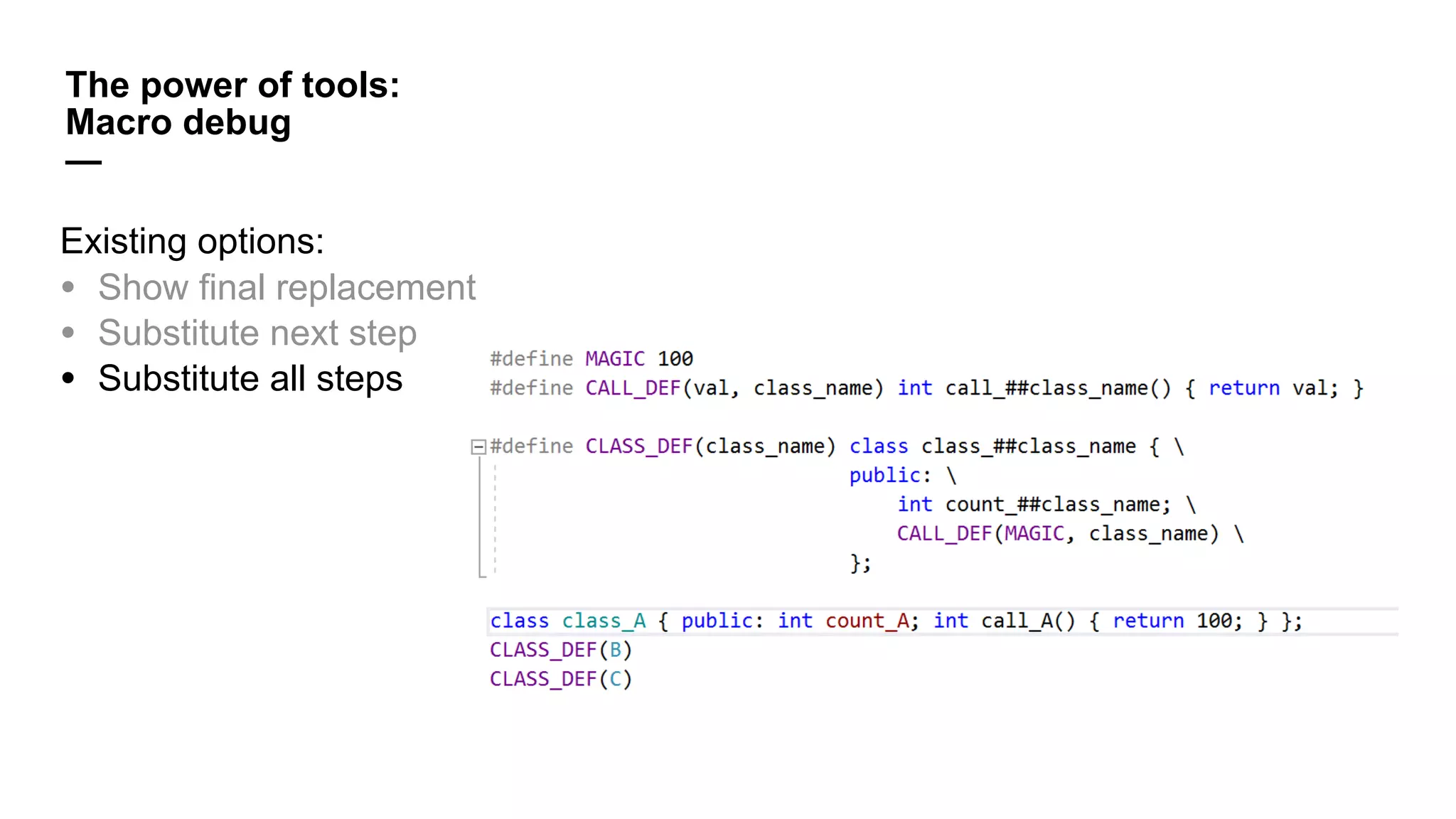
Existing options:
• Show final replacement
• Substitute next step
• Substitute all steps
The power of tools:
Macro debug
—
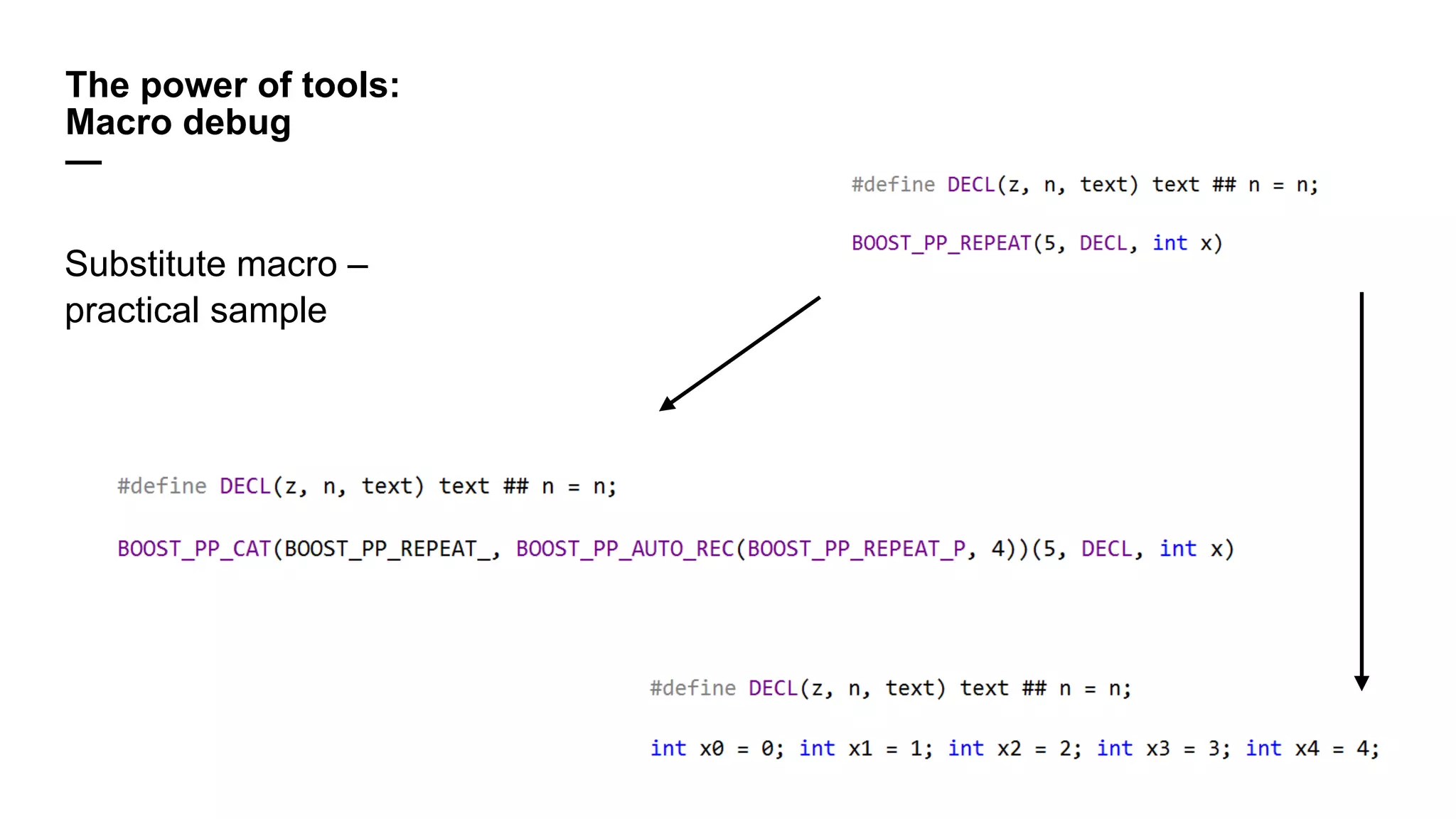
Substitute macro –
practical sample
The power of tools:
Macro debug
—
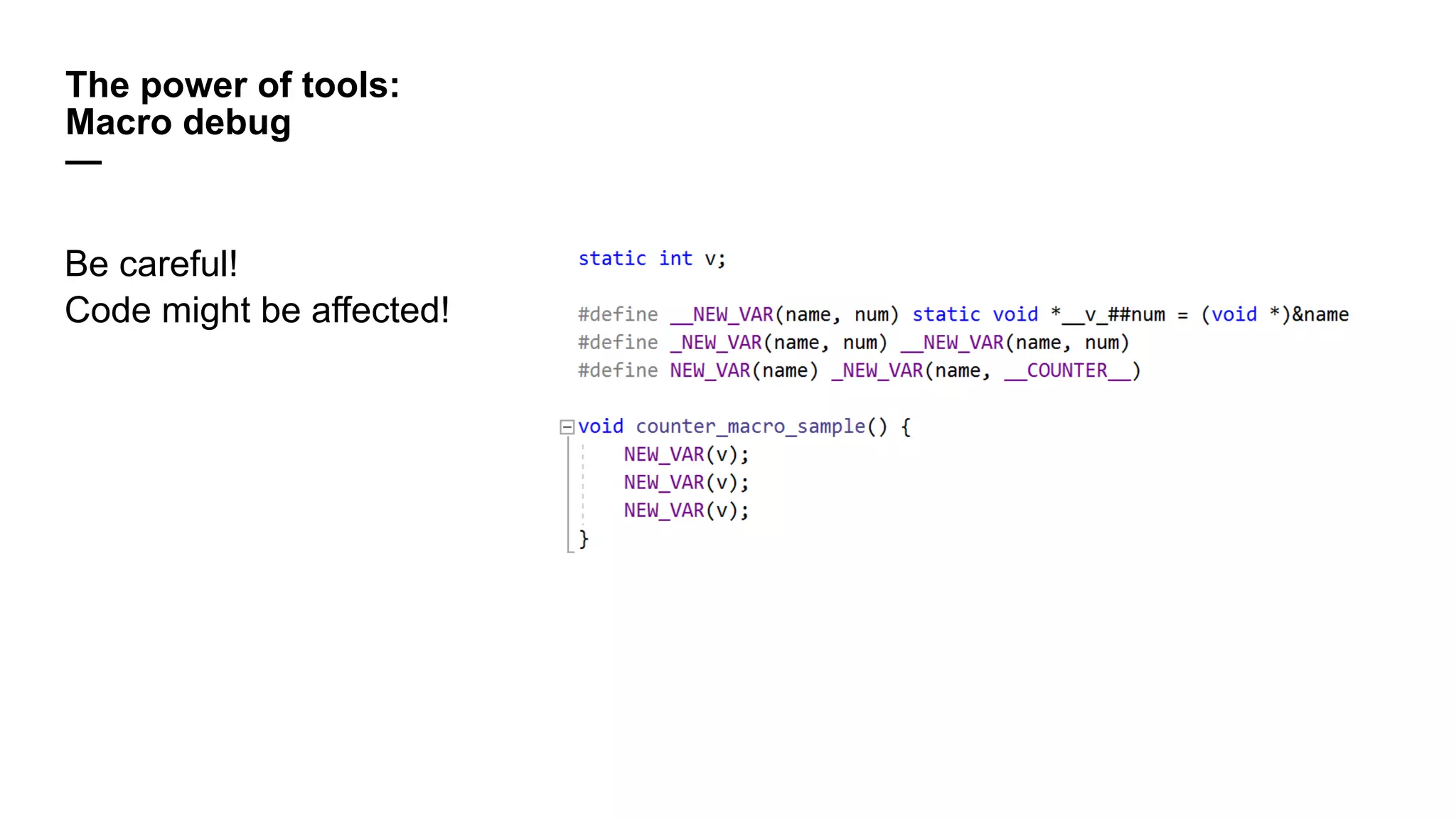
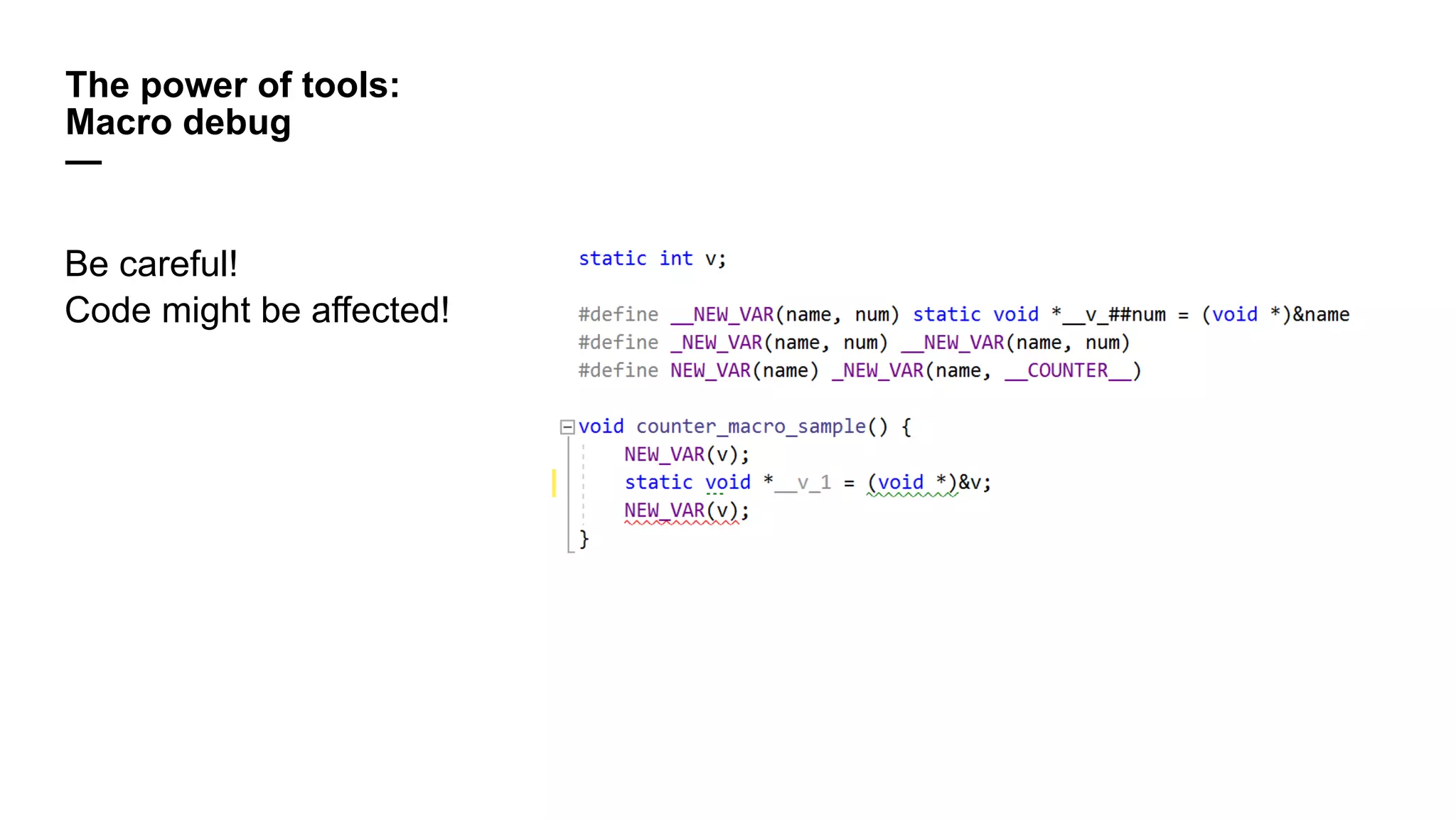
Be careful!
Code might be affected!
The power of tools:
Macro debug
—
Be careful!
Code might be affected!
The power of tools:
Macro debug
—
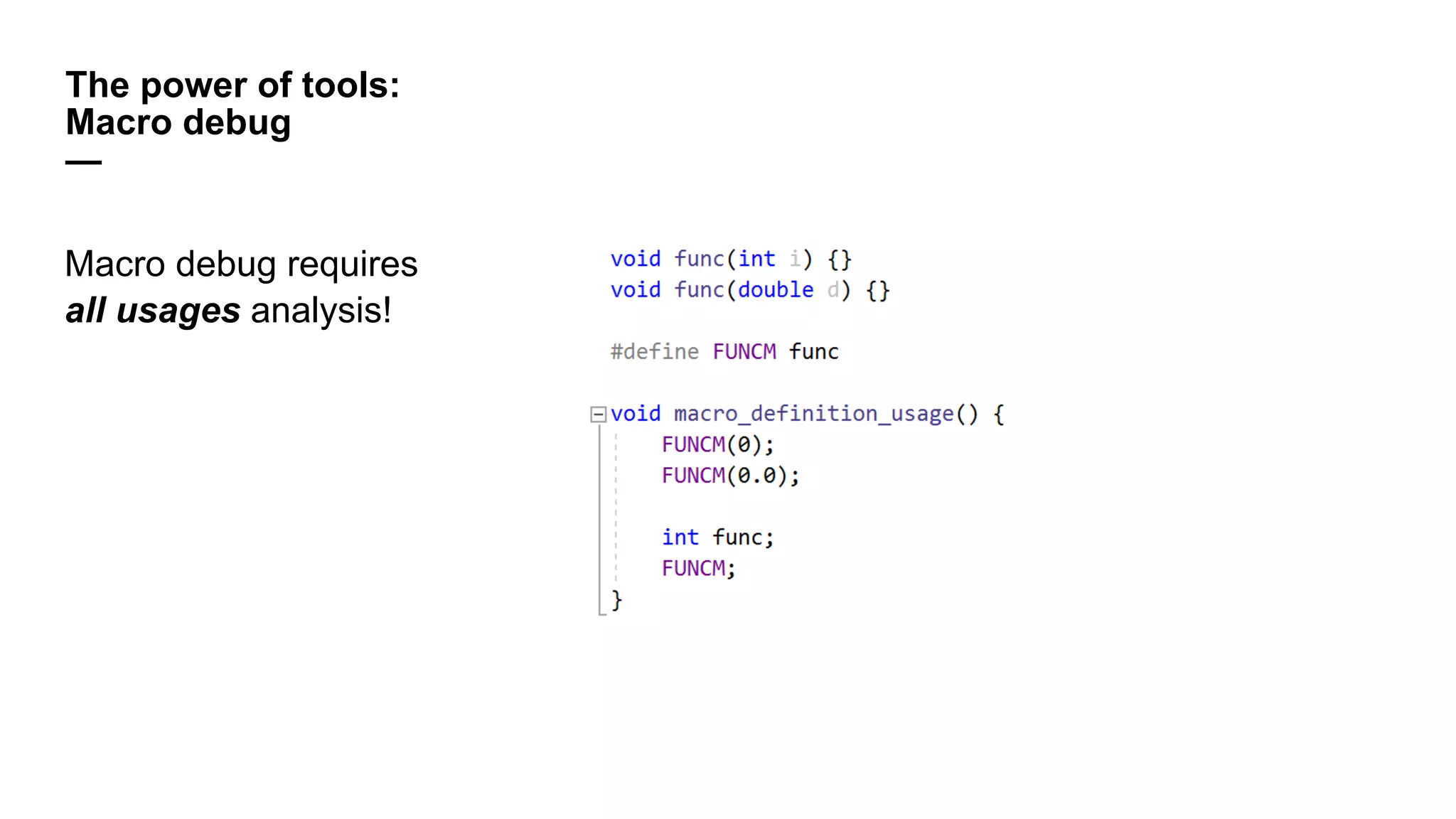
Macro debug requires
all usages analysis!
The power of tools:
Macro debug
—
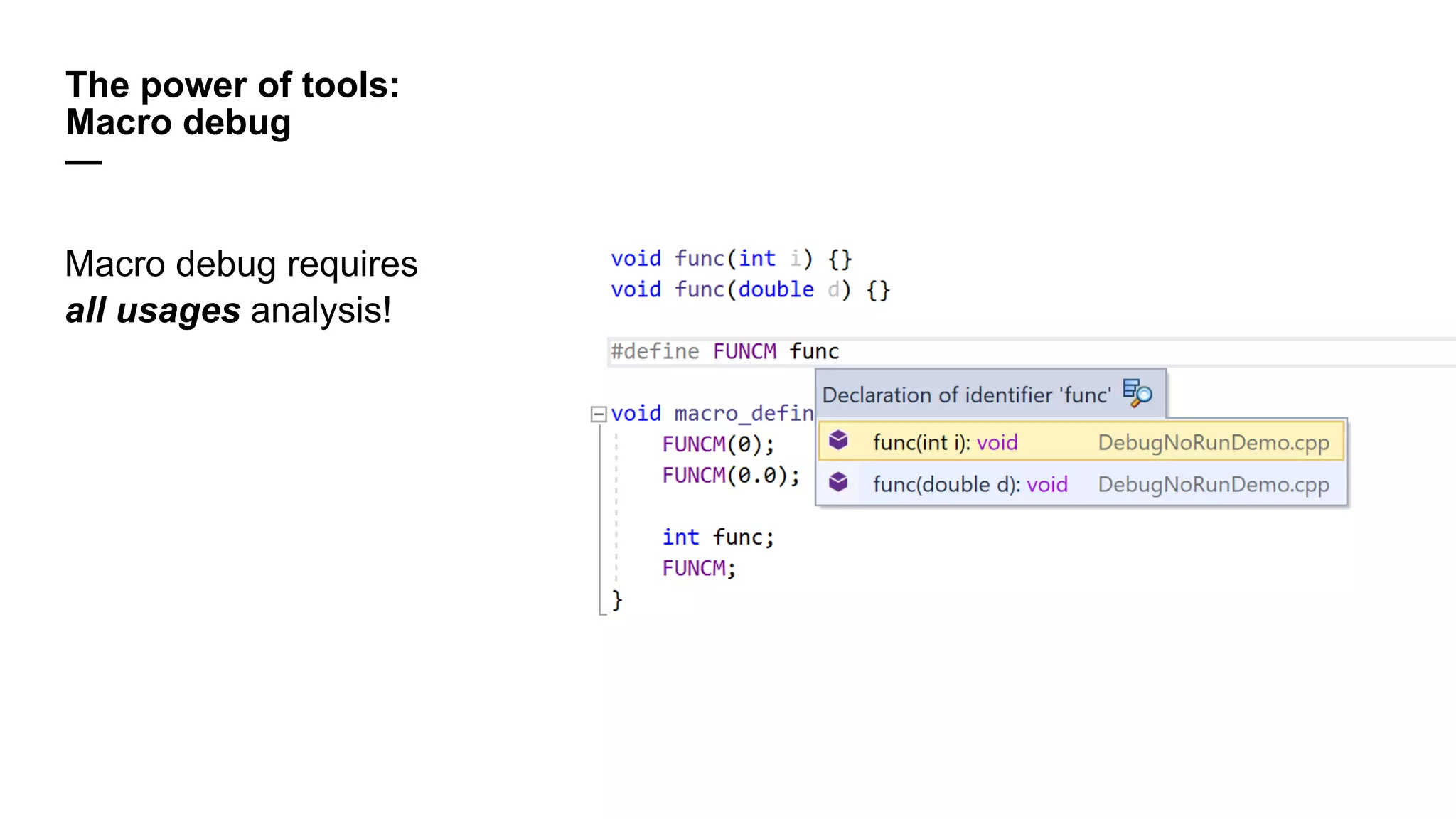
Macro debug requires
all usages analysis!
The power of tools:
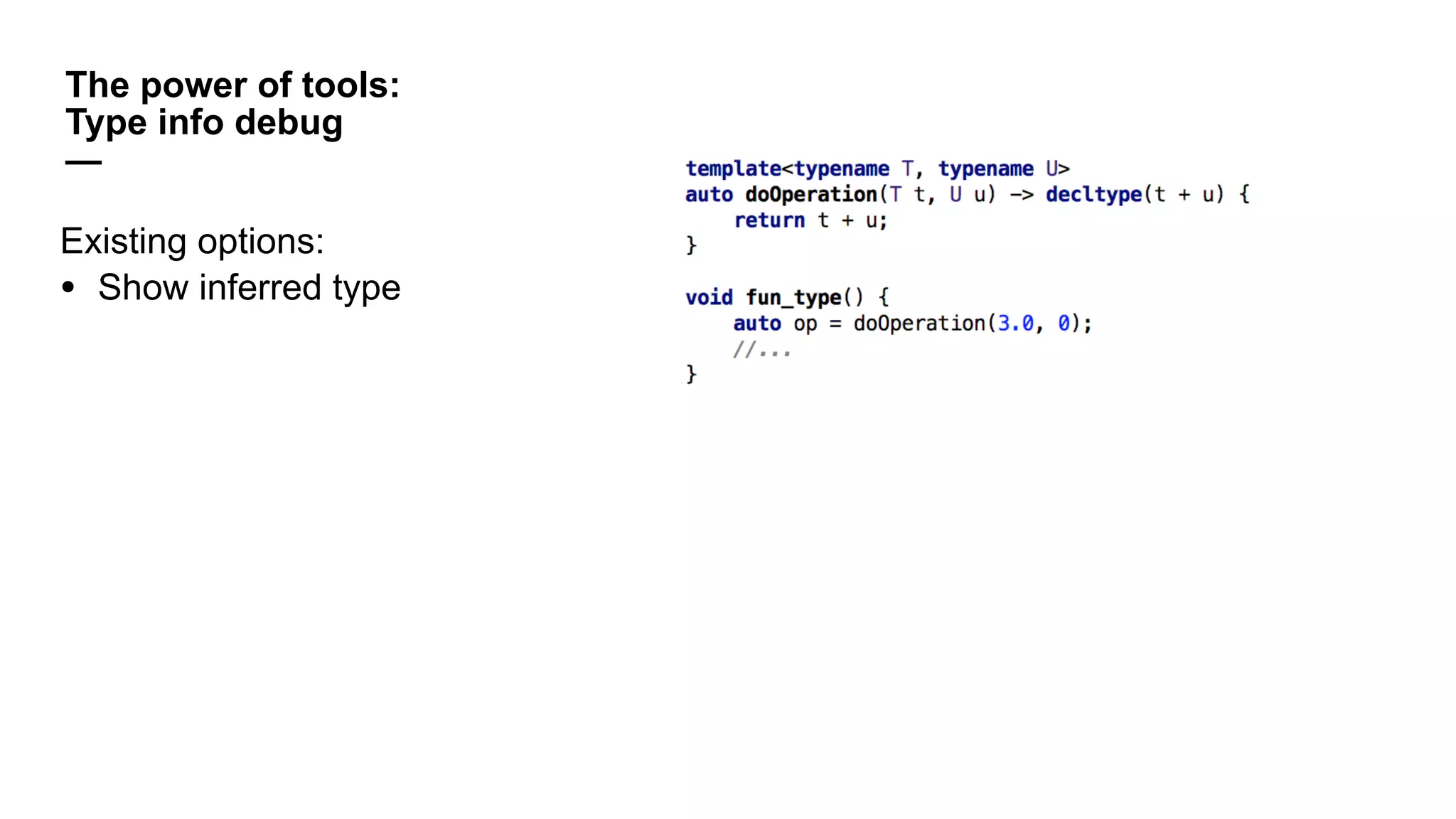
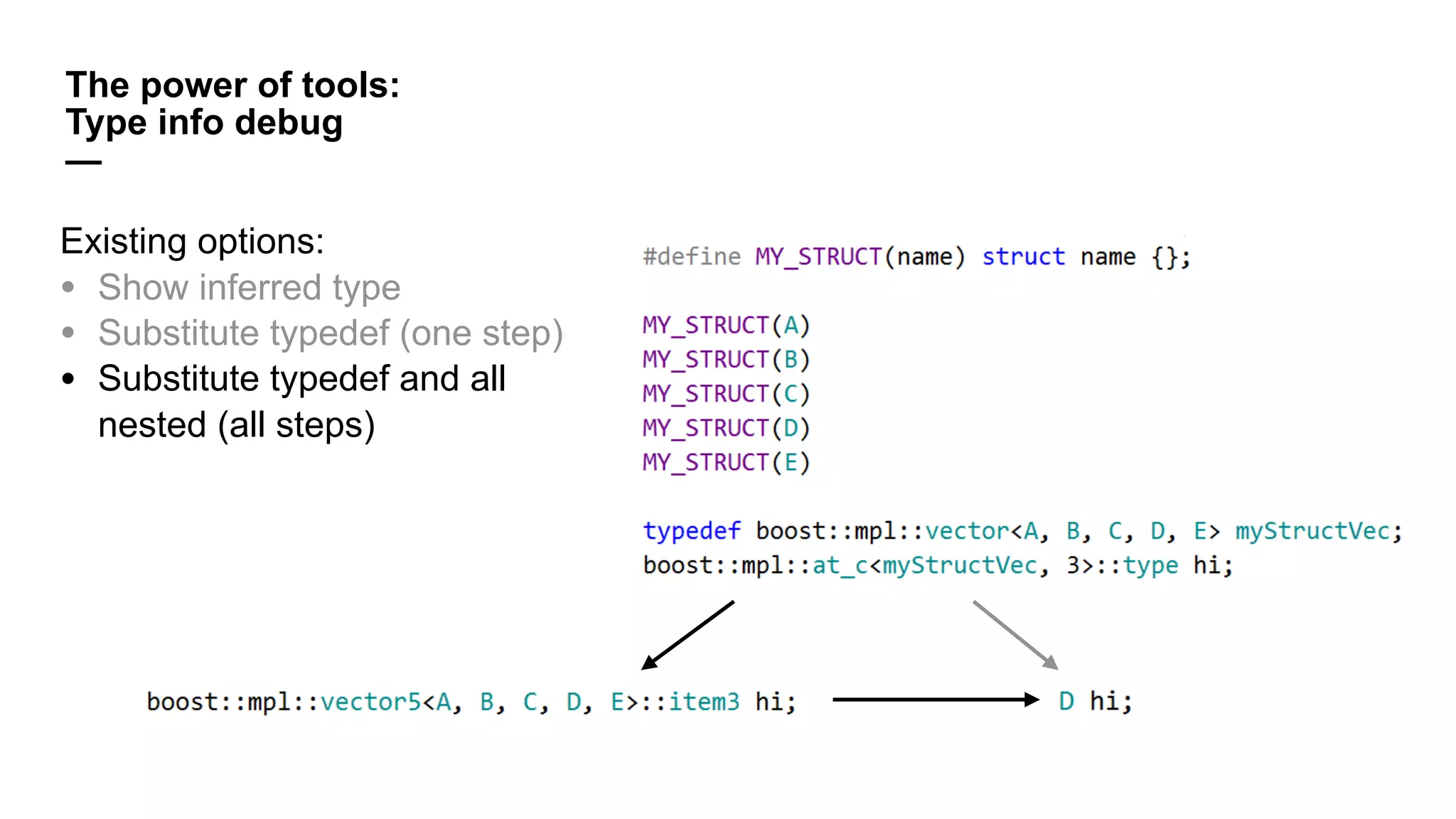
Type info debug
—
Goal – understand the final type
The power of tools:
Type info debug
—
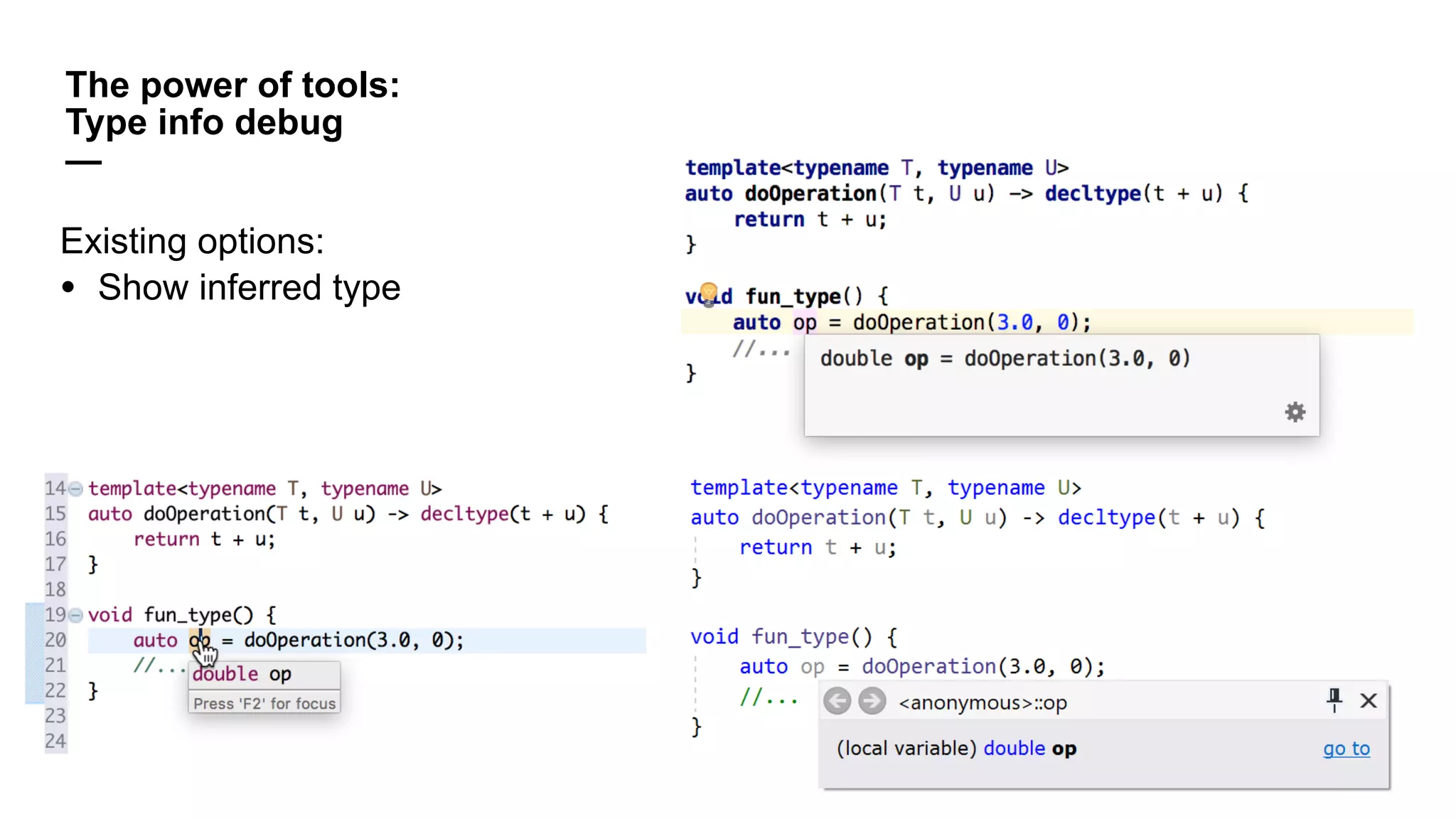
Existing options:
• Show inferred type
The power of tools:
Type info debug
—
Existing options:
• Show inferred type
The power of tools:
Type info debug
—
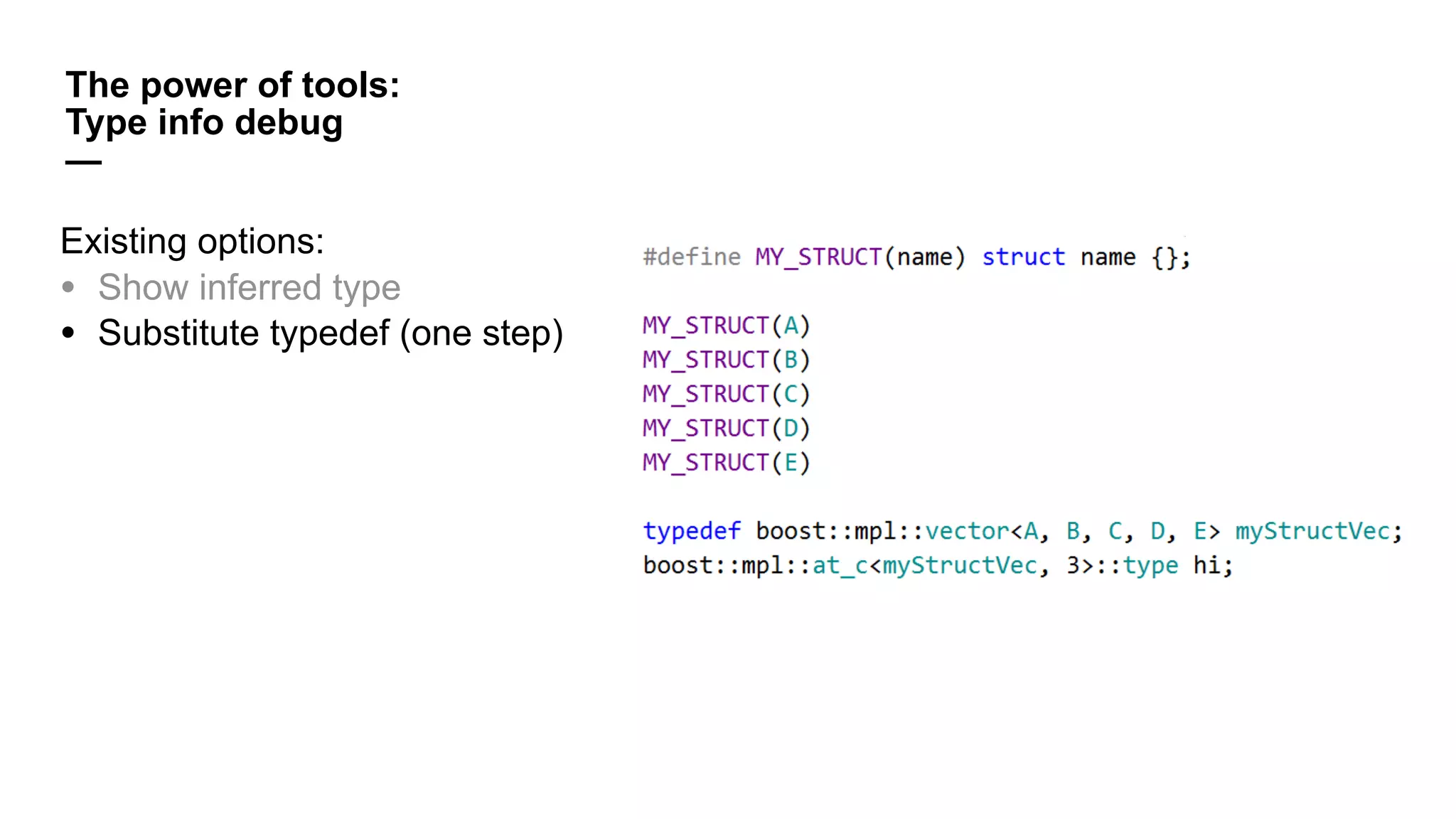
Existing options:
• Show inferred type
• Substitute typedef (one step)
The power of tools:
Type info debug
—
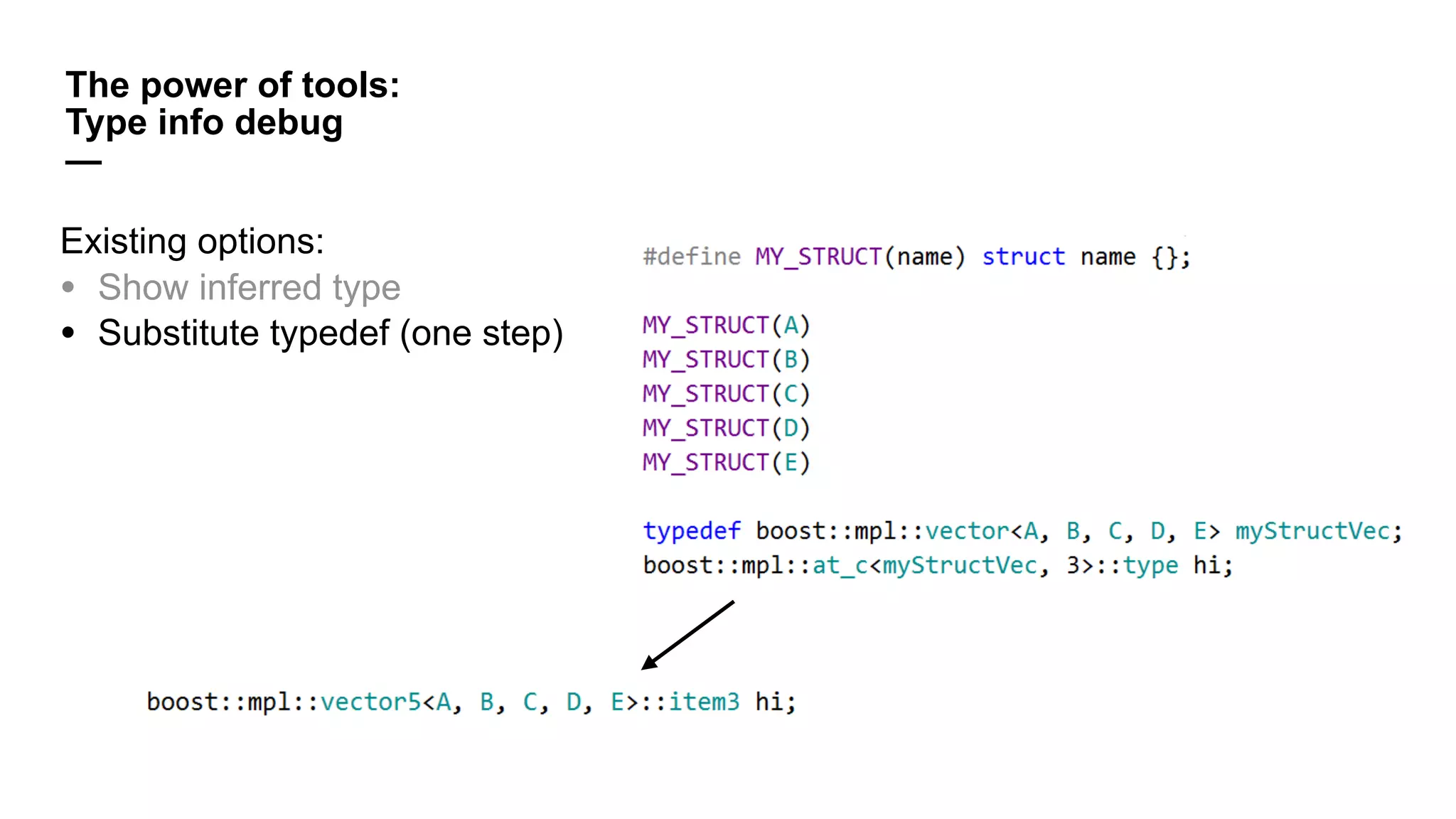
Existing options:
• Show inferred type
• Substitute typedef (one step)
The power of tools:
Type info debug
—
Existing options:
• Show inferred type
• Substitute typedef (one step)
• Substitute typedef and all 

nested (all steps)
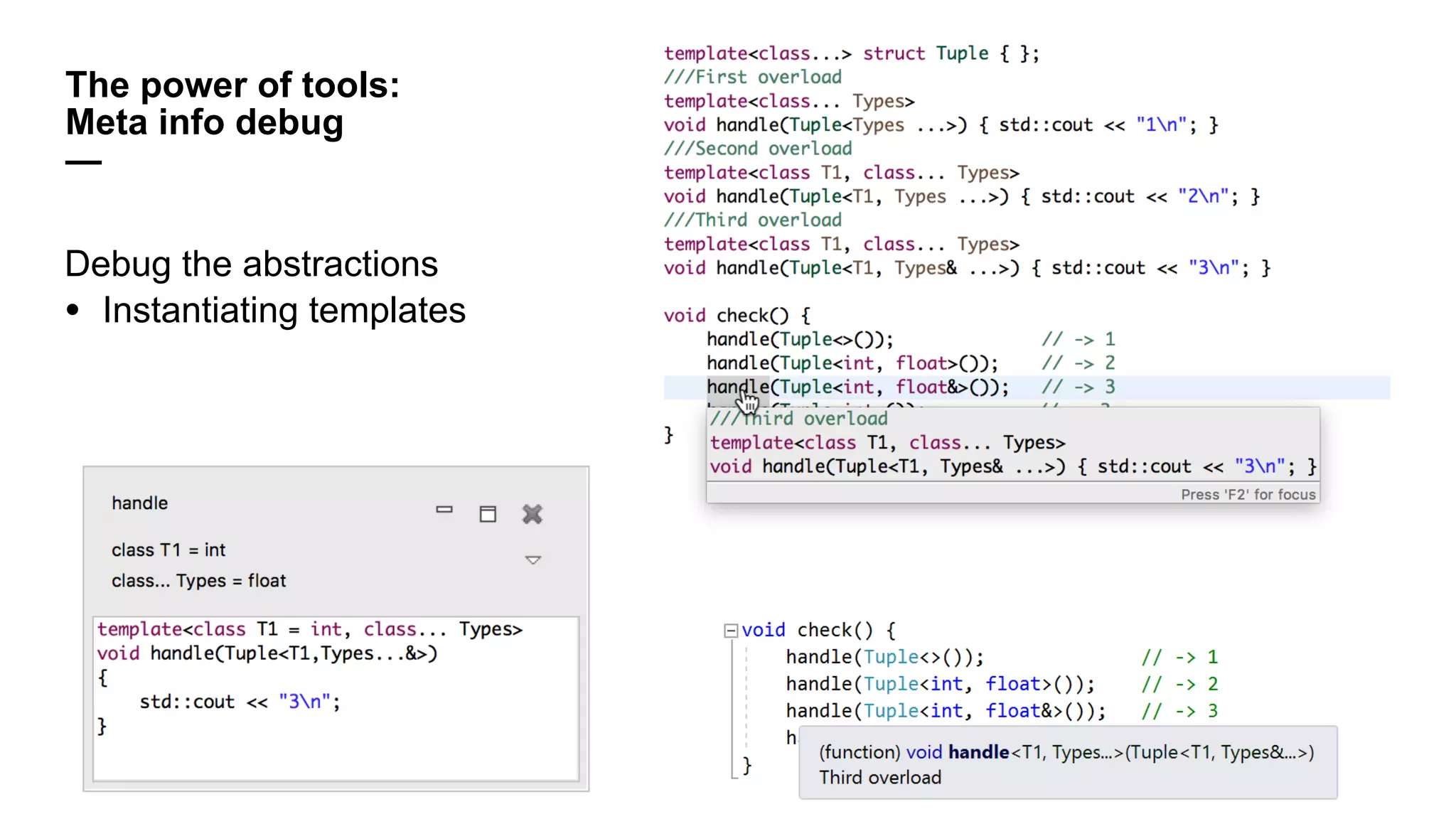
The power of tools:
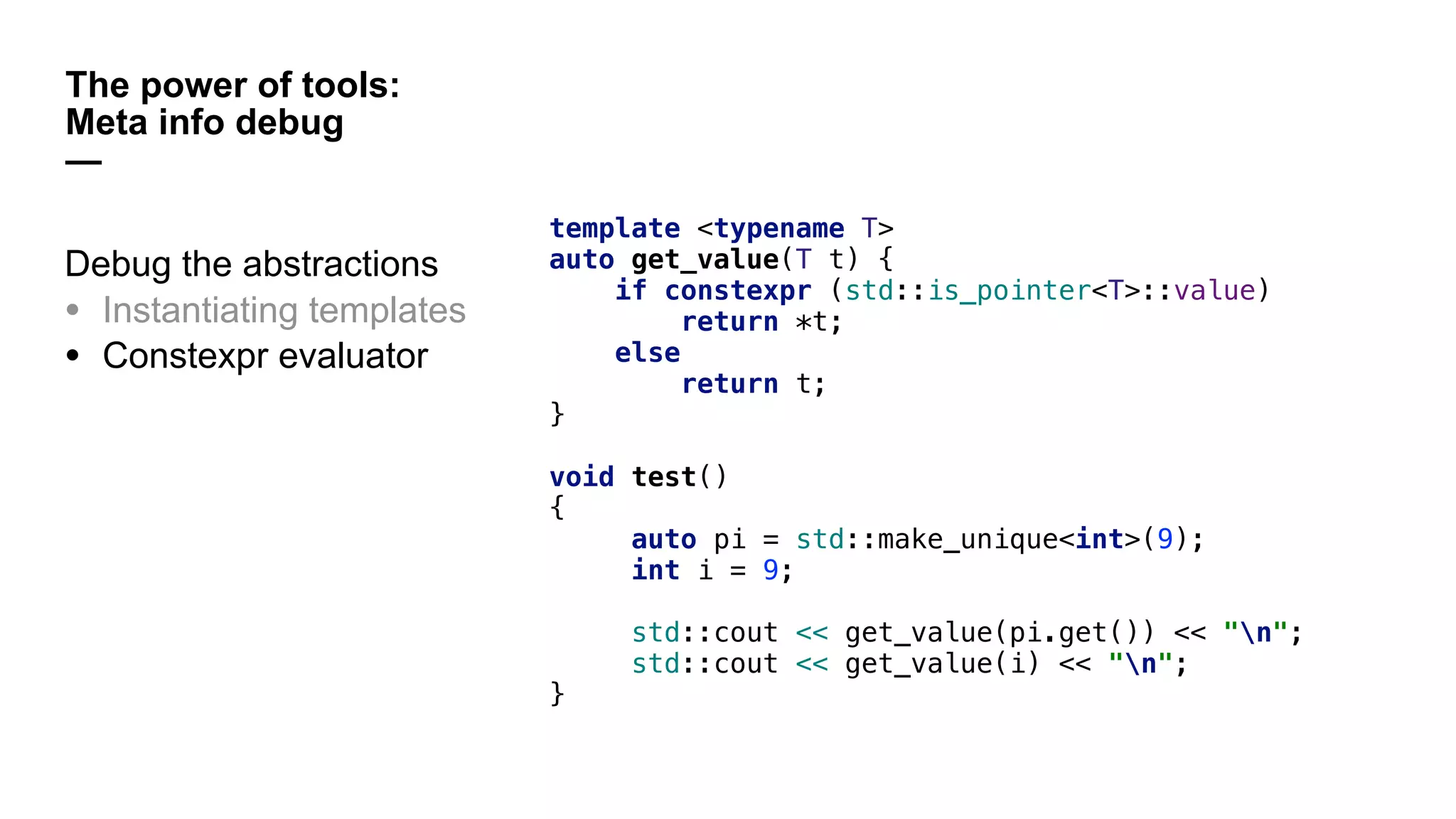
Meta info debug
—
Debug the abstractions
• Instantiating templates
The power of tools:
Meta info debug
—
template <typename T>
auto get_value(T t) {
if constexpr (std::is_pointer<T>::value)
return *t;
else
return t;
}
void test()
{
auto pi = std::make_unique<int>(9);
int i = 9;
std::cout << get_value(pi.get()) << "n";
std::cout << get_value(i) << "n";
}
Debug the abstractions
• Instantiating templates
• Constexpr evaluator
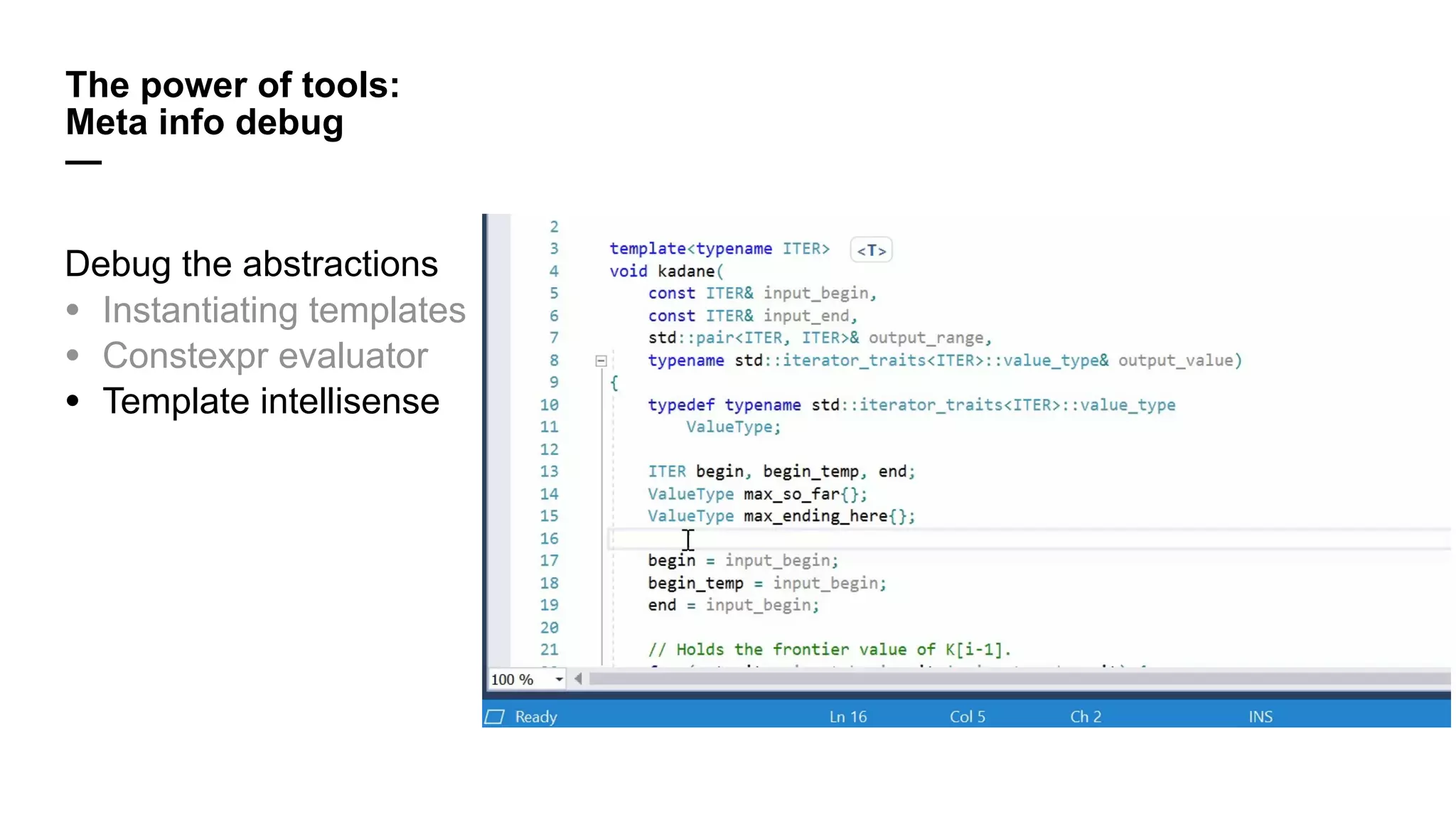
The power of tools:
Meta info debug
—
Debug the abstractions
• Instantiating templates
• Constexpr evaluator
• Template intellisense
The power of tools:
Overloads debug
—
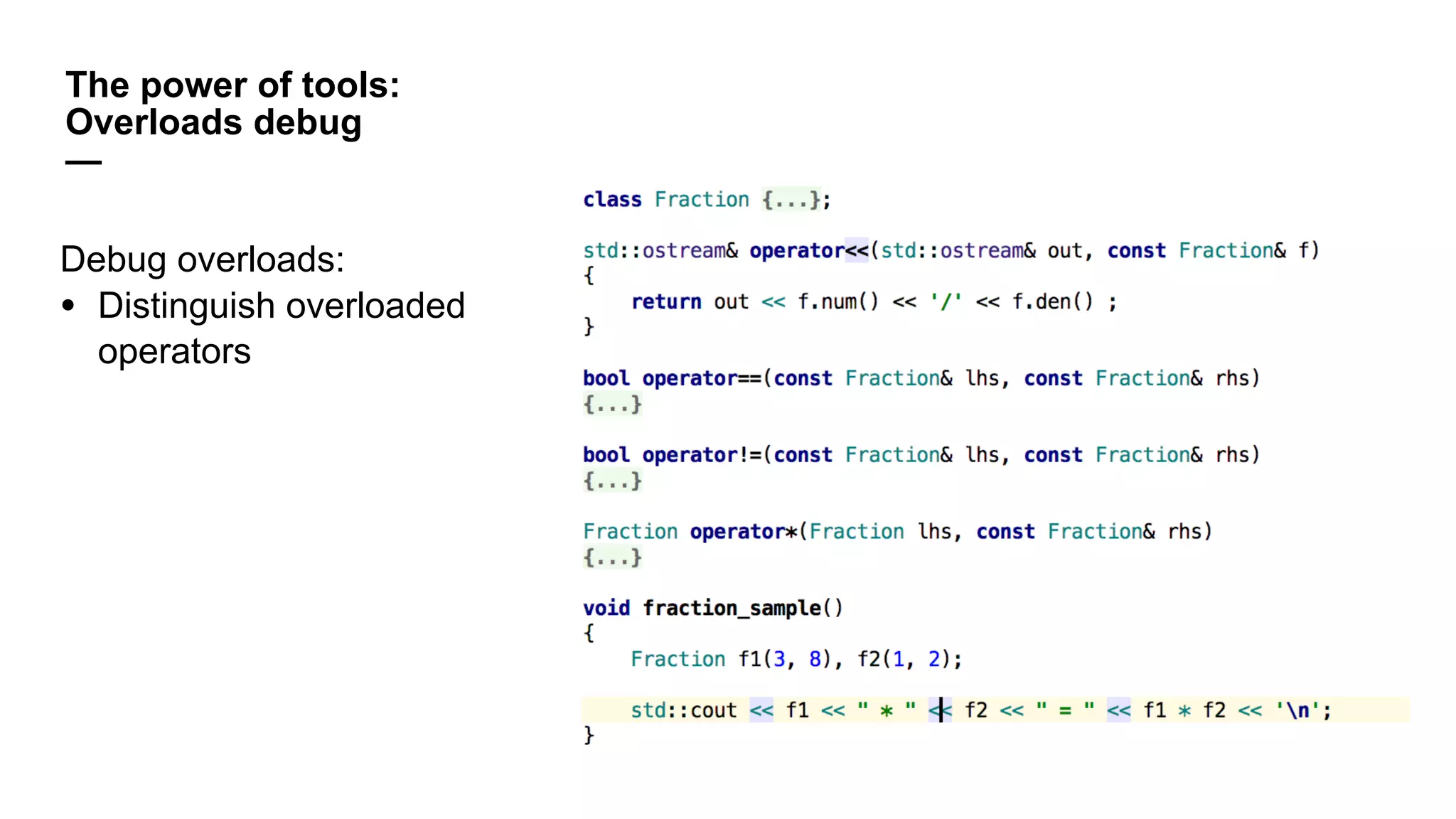
Debug functions and operators overload
The power of tools:
Overloads debug
—
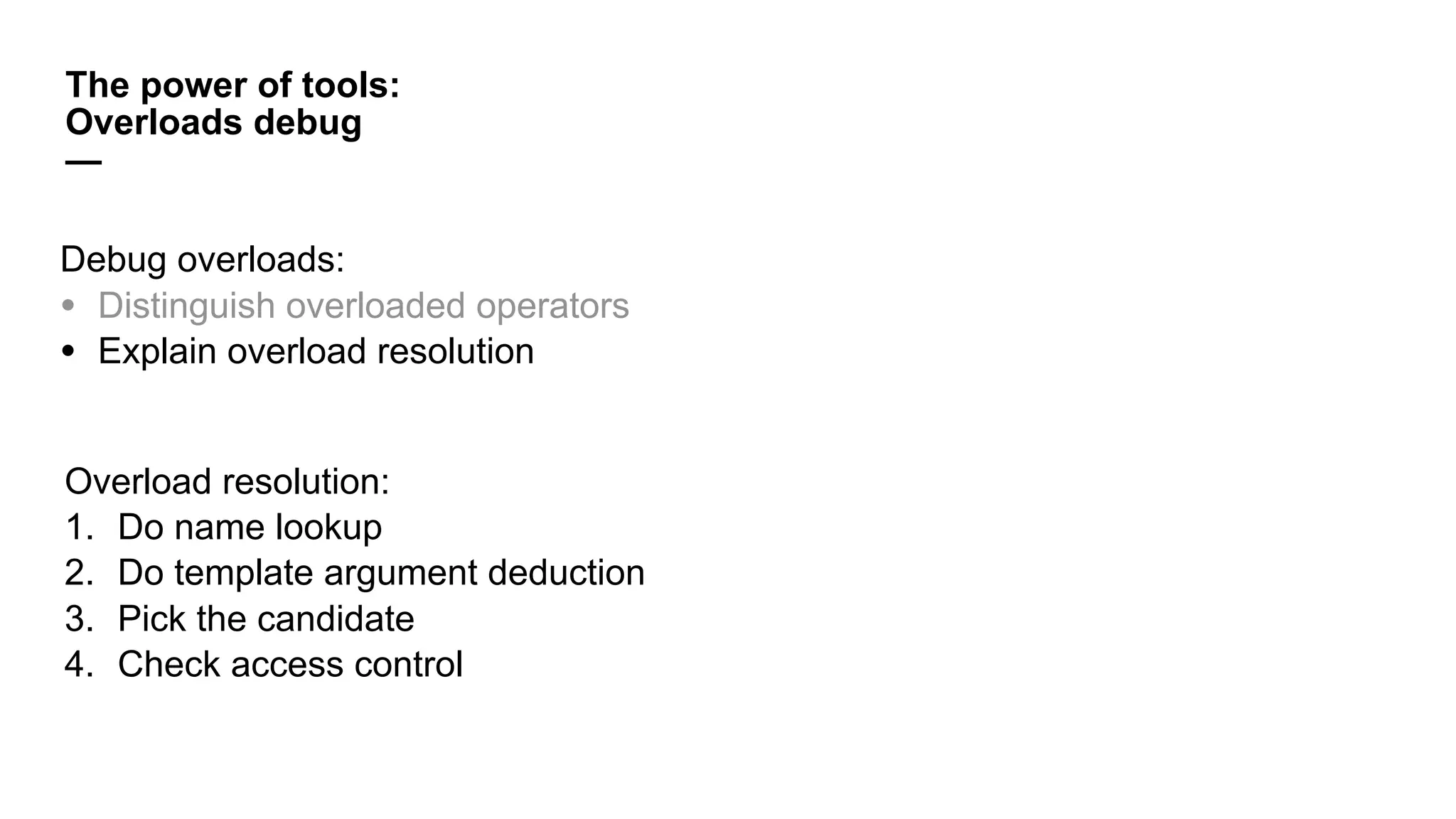
Debug overloads:
• Distinguish overloaded
operators
Overload resolution:
1. Do name lookup
2. Do template argument deduction
3. Pick the candidate
4. Check access control
The power of tools:
Overloads debug
—
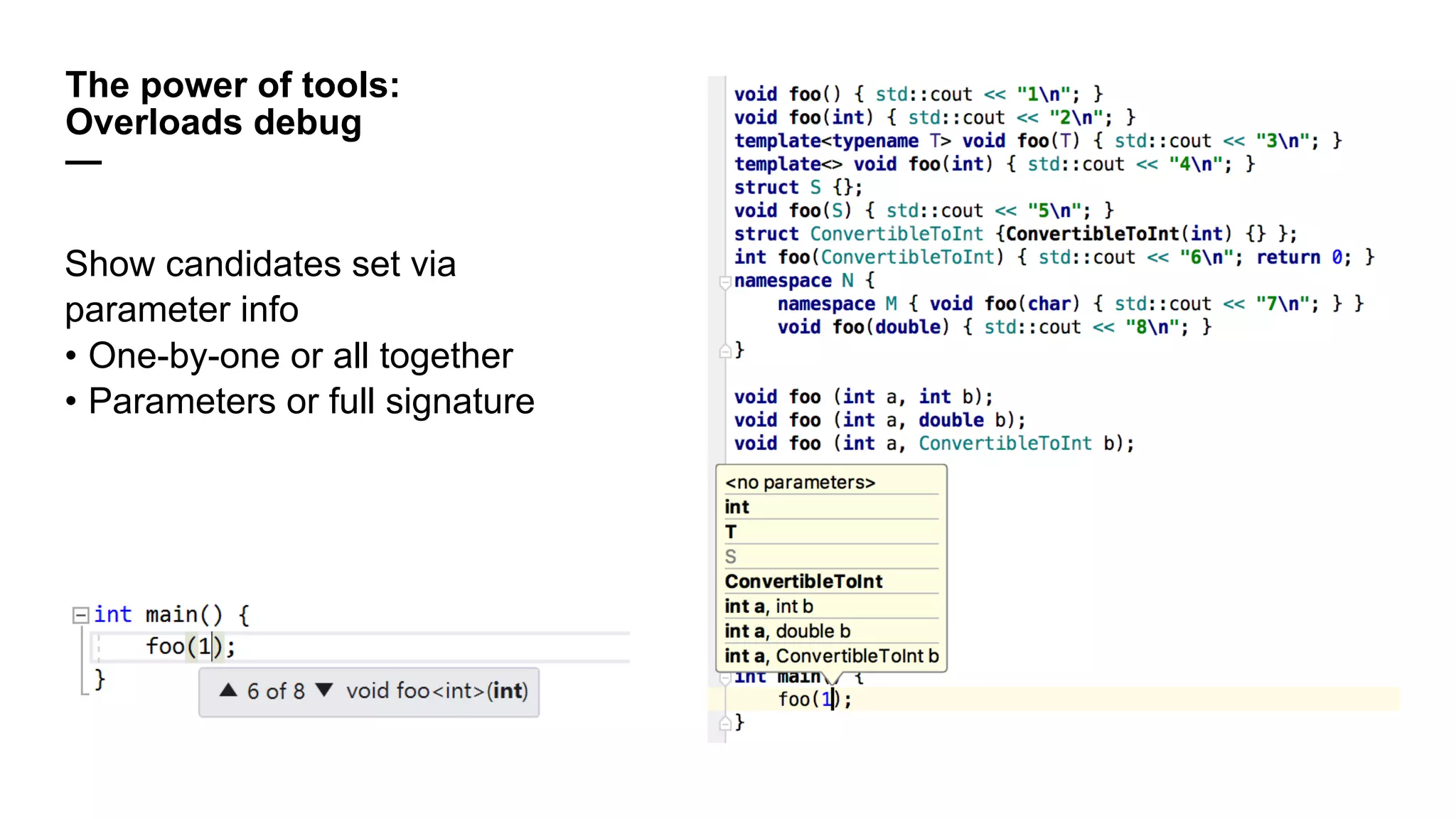
Debug overloads:
• Distinguish overloaded operators
• Explain overload resolution
Show candidates set via
parameter info
• One-by-one or all together
• Parameters or full signature
The power of tools:
Overloads debug
—
The power of tools:
Overloads debug
—
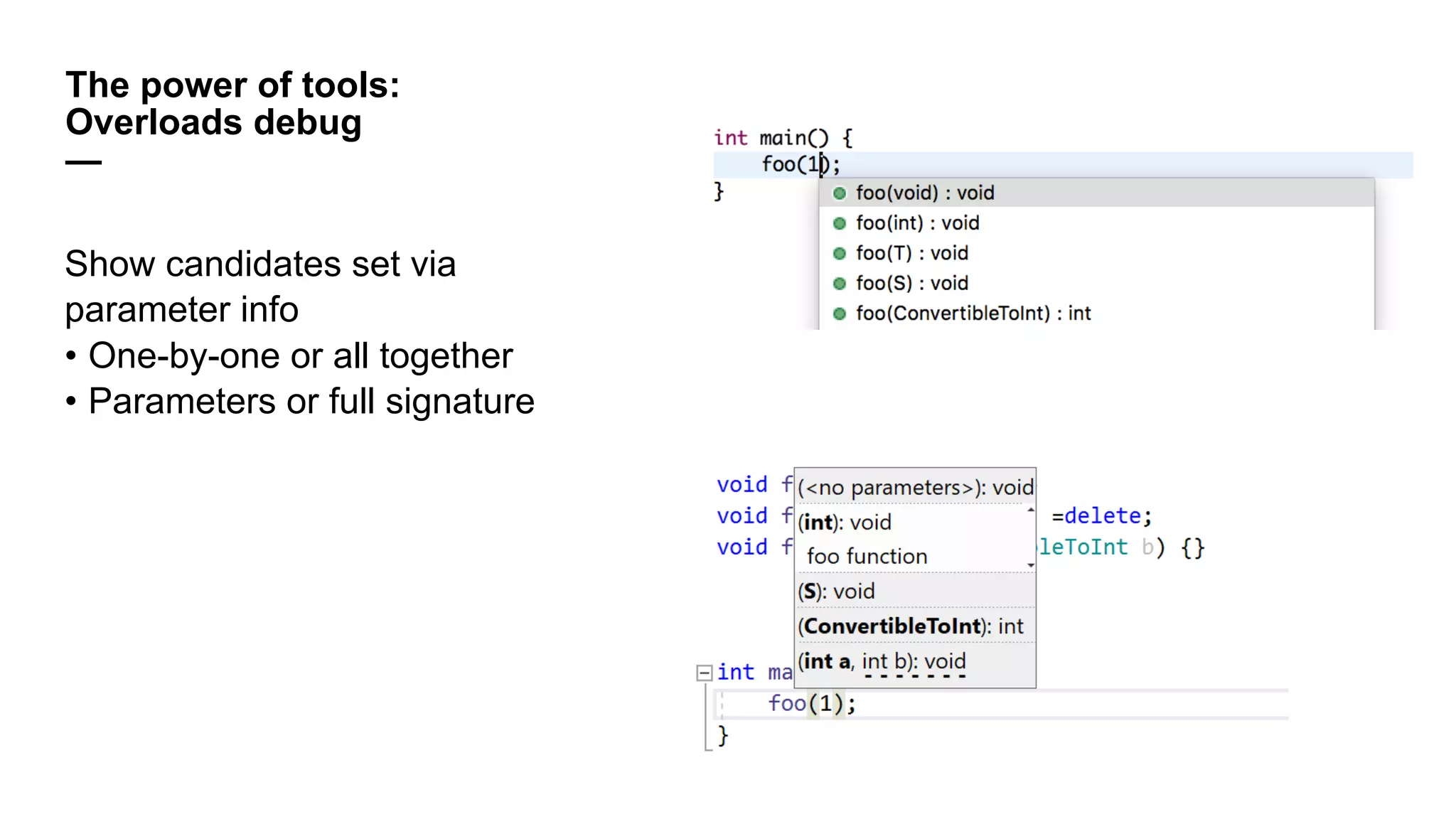
Show candidates set via
parameter info
• One-by-one or all together
• Parameters or full signature
• Show candidates set
• Show explanations
The power of tools:
Overloads debug
—
?
The power of tools:
Overloads debug
—
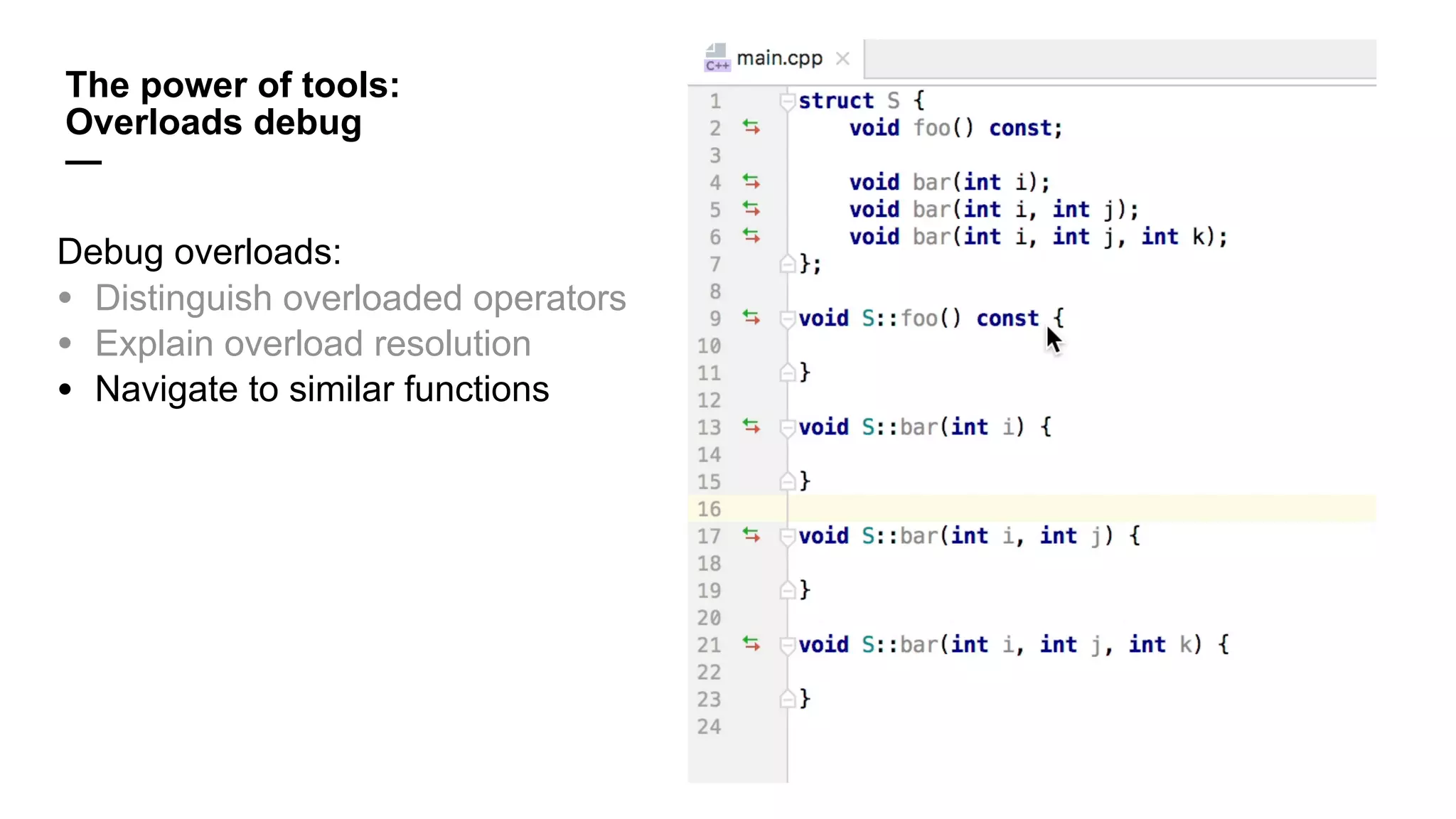
Debug overloads:
• Distinguish overloaded operators
• Explain overload resolution
• Navigate to similar functions
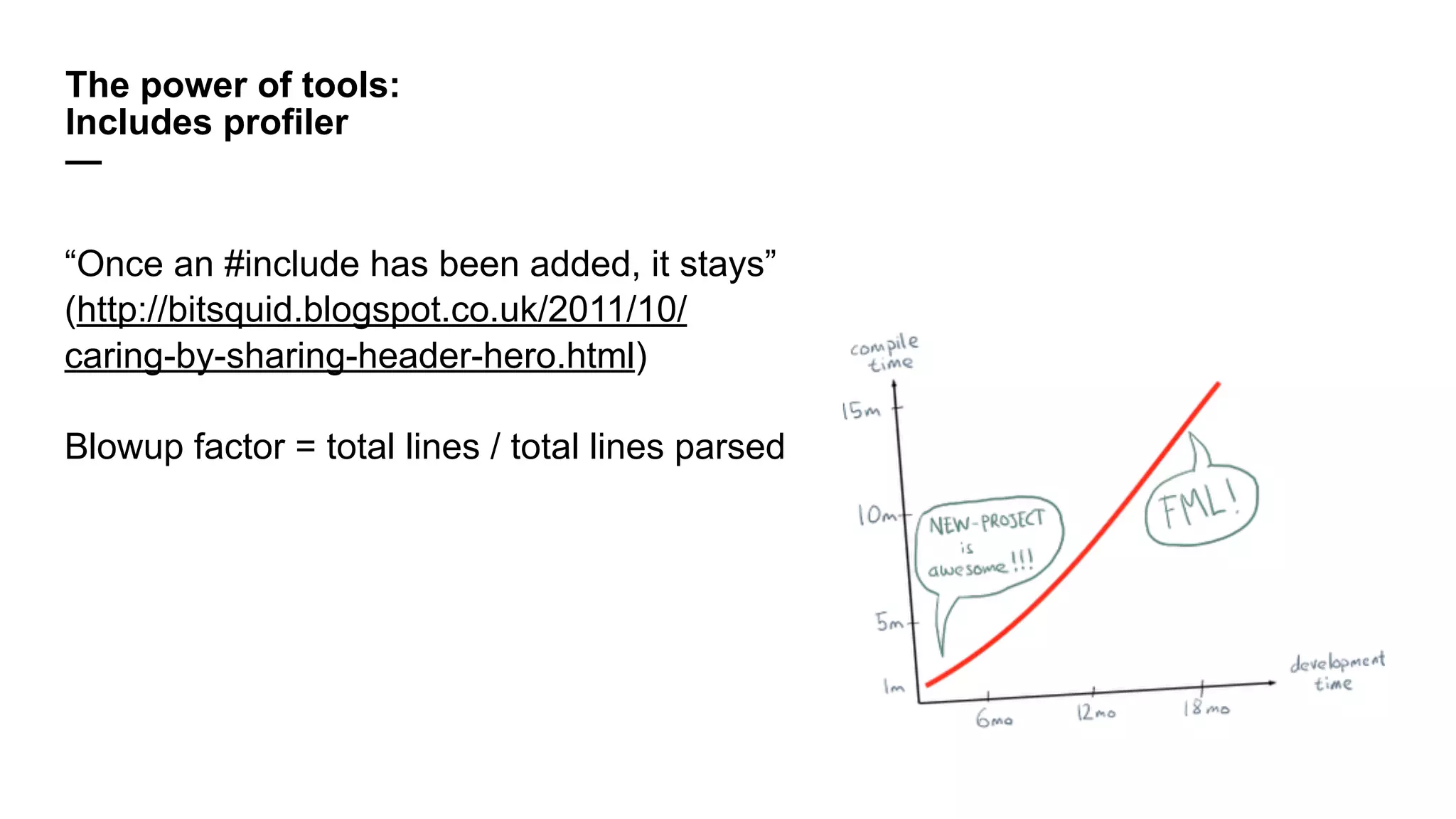
“Once an #include has been added, it stays”
(http://bitsquid.blogspot.co.uk/2011/10/
caring-by-sharing-header-hero.html)
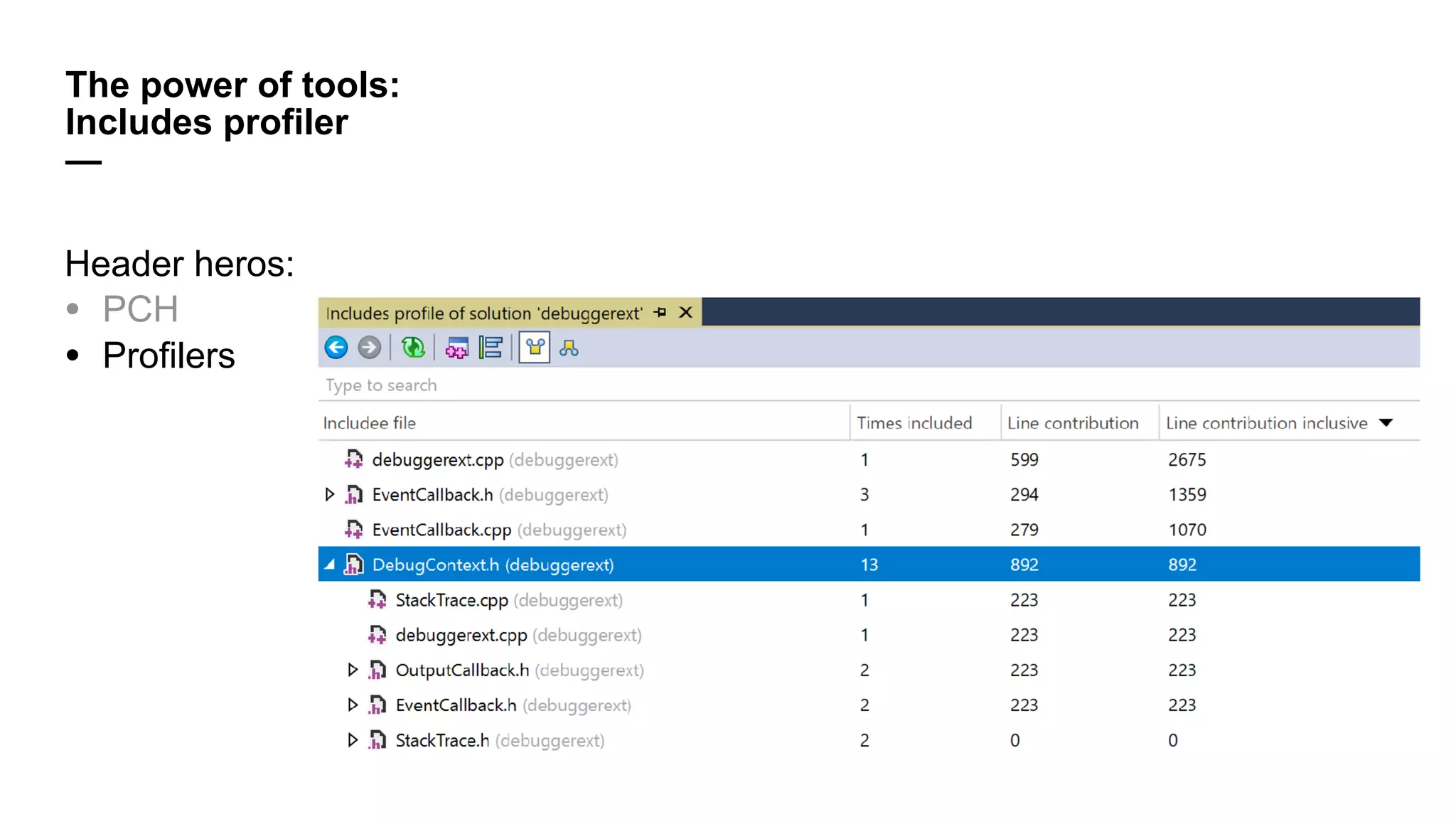
Blowup factor = total lines / total lines parsed
The power of tools:
Includes profiler
—
Header heros:
• PCH
The power of tools:
Includes profiler
—
Header heros:
• PCH
• Profilers
The power of tools:
Includes profiler
—
Header heros:
• PCH
• Profilers
• Optimizers
• Unused include check
• Include what you use ( and don't include what you don't use)
• Includator
The power of tools:
Includes profiler
—
References
—
• Herb Sutter, Meta - Thoughts on Generative C++
• [CppCon 2017] https://www.youtube.com/watch?v=4AfRAVcThyA
• Niklas, bitsquid blog, Caring by Sharing: Header Hero
• [2011] http://bitsquid.blogspot.co.uk/2011/10/caring-by-sharing-header-hero.html
• C++ Foundation Developer Survey
• [2018-2] https://isocpp.org/files/papers/CppDevSurvey-2018-02-summary.pdf
• The State of Developer Ecosystem Survey
• [2017] https://www.jetbrains.com/research/devecosystem-2017/cpp/
• [2018] https://www.jetbrains.com/research/devecosystem-2018/cpp/
Thank you
for your attention
—
Questions?

C++ CoreHard Autumn 2018. Debug C++ Without Running - Anastasia Kazakova

  • 1.
    Debug C++ Without Running AnastasiaKazakova JetBrains @anastasiak2512 C++ CoreHard Autumn 2018
  • 2.
    Agenda — 1. Why thistalk? Tricky C++. 2. Classic solution: debugger, static/dynamic analyzer. 3. How an IDE can help?
  • 3.
    Agenda — 1. Why thistalk? Tricky C++. 2. Classic solution: debugger, static/dynamic analyzer. 3. How an IDE can help?
  • 4.
    Time for aquote — “C makes it easy to shoot yourself in the foot; C++ makes it harder, but when you do it blows your whole leg off” - Bjarne Stroustrup http://www.stroustrup.com/bs_faq.html#really-say-that
  • 5.
    JetBrains Dev Ecosystemsurvey 2017/2018 —
  • 6.
    C++ Foundation DeveloperSurvey 2018 —
  • 7.
    C++ difficulties: 42 — template<classT, int ... X> T pi(T(X...)); int main() { return pi<int, 42>; }
  • 8.
    template<class T, int... X> T pi(T(X...)); int main() { return pi<int, 42>; } C++ difficulties: 42 —
  • 9.
    template<class T, int... X> T pi(T(X...)); int main() { return pi<int, 42>; } int main() { return int(42); } C++ difficulties: 42 — template<class T, int ... X> T pi = T(X...); int main() { return pi<int, 42>; } int main() { return 42; }
  • 10.
    C++ difficulties: macro — #defineX(a) myVal_##a, enum myShinyEnum { #include "xmacro.txt" }; #undef X void foo(myShinyEnum en) { switch (en) { case myVal_a:break; case myVal_b:break; case myVal_c:break; case myVal_d:break; } } //xmacro.txt X(a) X(b) X(c) X(d)
  • 11.
    C++ difficulties: macro — #defineMAGIC 100 #define CALL_DEF(val, class_name) int call_##class_name() { return val; } #define CLASS_DEF(class_name) class class_##class_name { public: int count_##class_name; CALL_DEF(MAGIC, class_name) }; CLASS_DEF(A) CLASS_DEF(B) CLASS_DEF(C)
  • 12.
    C++ difficulties: context — //foo.h #ifdefMAGIC template<int> struct x { x(int i) { } }; #else int x = 100; #endif //foo.cpp #include "foo.h" void test(int y) { const int a = 100; auto k = x<a>(0); }
  • 13.
    C++ difficulties: compile-time generation — interfaceShape { int area() const; void scale_by(double factor); }; struct Shape { virtual int area() const = 0; virtual void scale_by(double factor) = 0; virtual ~Shape() noexcept { } } $class interface { constexpr { compiler.require($interface.variables().empty(), "interfaces may not contain data"); for... (auto f : $interface.functions()) { compiler.require(!f.is_copy() && !f.is_move(), "interfaces may not copy or move; consider a" " virtual clone() instead"); if (!f.has_access()) f.make_public(); compiler.require(f.is_public(), "interface functions must be public"); f.make_pure_virtual(); } } virtual ~interface() noexcept { } };
  • 14.
    C++ difficulties: overloads — classFraction {…}; std::ostream& operator<<(std::ostream& out, const Fraction& f){…} bool operator==(const Fraction& lhs, const Fraction& rhs){…} bool operator!=(const Fraction& lhs, const Fraction& rhs){…} Fraction operator*(Fraction lhs, const Fraction& rhs){…} void fraction_sample() { Fraction f1(3, 8), f2(1, 2); std::cout << f1 << " * " << f2 << " = " << f1 * f2 << 'n'; }
  • 15.
    C++ difficulties: overloads — voidfoo() { std::cout << "1n"; } void foo(int) { std::cout << "2n"; } template<typename T> void foo(T) { std::cout << "3n"; } template<> void foo(int) { std::cout << "4n"; } template<typename T> void foo(T*) { std::cout << "5n"; } struct S {}; void foo(S) { std::cout << "6n"; } struct ConvertibleToInt {ConvertibleToInt(int); }; void foo(ConvertibleToInt) { std::cout << "7n"; } namespace N { namespace M { void foo(char) { std::cout << "8n"; } } void foo(double) { std::cout << "9n"; } } int main() { foo(1); using namespace N::M; foo(1); }
  • 16.
    C++ difficulties: evenmore — • Constexpr • Injected code • …
  • 17.
    Agenda — 1. Why thistalk? Tricky C++. 2. Classic solution: debugger, static/dynamic analyzer. 3. How an IDE can help?
  • 18.
    Do these help? — •Read-fix-run / read-fix-print-run and check results • Debug • Use static or dynamic code analysis
  • 19.
    Do these help? — •Read-fix-run / read-fix-print-run and check results • Debug • Use static or dynamic code analysis No!
 (not always)
  • 20.
    Herb Sutter’s keynotes CppCon’17 — Meta- Thoughts on Generative C++ • Abstractions are hiders • Abstractions need tool support • Good abstractions do need to be toolable
  • 21.
  • 22.
    Agenda — 1. Why thistalk? Tricky C++. 2. Classic solution: debugger, static/dynamic analyzer. 3. How an IDE can help?
  • 23.
    The power oftools: Macro debug — Goal – understand the substitution w/o running the preprocessor
  • 24.
    The power oftools: Macro debug — Existing options: • Show final replacement
  • 25.
    The power oftools: Macro debug — Existing options: • Show final replacement • Substitute next step
  • 26.
    The power oftools: Macro debug — Existing options: • Show final replacement • Substitute next step • Substitute all steps
  • 27.
    The power oftools: Macro debug — Substitute macro – practical sample
  • 28.
    The power oftools: Macro debug — Be careful! Code might be affected!
  • 29.
    The power oftools: Macro debug — Be careful! Code might be affected!
  • 30.
    The power oftools: Macro debug — Macro debug requires all usages analysis!
  • 31.
    The power oftools: Macro debug — Macro debug requires all usages analysis!
  • 32.
    The power oftools: Type info debug — Goal – understand the final type
  • 33.
    The power oftools: Type info debug — Existing options: • Show inferred type
  • 34.
    The power oftools: Type info debug — Existing options: • Show inferred type
  • 35.
    The power oftools: Type info debug — Existing options: • Show inferred type • Substitute typedef (one step)
  • 36.
    The power oftools: Type info debug — Existing options: • Show inferred type • Substitute typedef (one step)
  • 37.
    The power oftools: Type info debug — Existing options: • Show inferred type • Substitute typedef (one step) • Substitute typedef and all 
 nested (all steps)
  • 38.
    The power oftools: Meta info debug — Debug the abstractions • Instantiating templates
  • 39.
    The power oftools: Meta info debug — template <typename T> auto get_value(T t) { if constexpr (std::is_pointer<T>::value) return *t; else return t; } void test() { auto pi = std::make_unique<int>(9); int i = 9; std::cout << get_value(pi.get()) << "n"; std::cout << get_value(i) << "n"; } Debug the abstractions • Instantiating templates • Constexpr evaluator
  • 40.
    The power oftools: Meta info debug — Debug the abstractions • Instantiating templates • Constexpr evaluator • Template intellisense
  • 41.
    The power oftools: Overloads debug — Debug functions and operators overload
  • 42.
    The power oftools: Overloads debug — Debug overloads: • Distinguish overloaded operators
  • 43.
    Overload resolution: 1. Doname lookup 2. Do template argument deduction 3. Pick the candidate 4. Check access control The power of tools: Overloads debug — Debug overloads: • Distinguish overloaded operators • Explain overload resolution
  • 44.
    Show candidates setvia parameter info • One-by-one or all together • Parameters or full signature The power of tools: Overloads debug —
  • 45.
    The power oftools: Overloads debug — Show candidates set via parameter info • One-by-one or all together • Parameters or full signature
  • 46.
    • Show candidatesset • Show explanations The power of tools: Overloads debug — ?
  • 47.
    The power oftools: Overloads debug — Debug overloads: • Distinguish overloaded operators • Explain overload resolution • Navigate to similar functions
  • 48.
    “Once an #includehas been added, it stays” (http://bitsquid.blogspot.co.uk/2011/10/ caring-by-sharing-header-hero.html) Blowup factor = total lines / total lines parsed The power of tools: Includes profiler —
  • 49.
    Header heros: • PCH Thepower of tools: Includes profiler —
  • 50.
    Header heros: • PCH •Profilers The power of tools: Includes profiler —
  • 51.
    Header heros: • PCH •Profilers • Optimizers • Unused include check • Include what you use ( and don't include what you don't use) • Includator The power of tools: Includes profiler —
  • 52.
    References — • Herb Sutter,Meta - Thoughts on Generative C++ • [CppCon 2017] https://www.youtube.com/watch?v=4AfRAVcThyA • Niklas, bitsquid blog, Caring by Sharing: Header Hero • [2011] http://bitsquid.blogspot.co.uk/2011/10/caring-by-sharing-header-hero.html • C++ Foundation Developer Survey • [2018-2] https://isocpp.org/files/papers/CppDevSurvey-2018-02-summary.pdf • The State of Developer Ecosystem Survey • [2017] https://www.jetbrains.com/research/devecosystem-2017/cpp/ • [2018] https://www.jetbrains.com/research/devecosystem-2018/cpp/
  • 53.
    Thank you for yourattention — Questions?