ADOK: a Minimal Object Oriented Real-Time Operating
System in C++∗
Salvatore Benedetto
Scuola Superiore Sant’Anna
salvatore.benedetto@gmail.com
Giuseppe Lipari
Scuola Superiore Sant’Anna and LSV - ENS
Cachan
giuseppe.lipari@lsv.ens-cachan.fr
ABSTRACT
Most embedded software is currently developed using the C
programming language, even though its low level of abstrac-
tion requires a lot of effort to the programmer. The C++
language is a better choice because: it raises the level of
abstraction; it is strongly typed, so it prevents many com-
mon programming mistakes; it can be made as efficient as C
through fine-grained customisation of memory mechanisms;
it can be easily adapted to domain-specific needs. In ad-
dition, recent compilers have grown in maturity and per-
formance, and the new standard considerably improves the
language by introducing new concepts and an easier syntax.
In this paper we present ADOK, a minimal Real-Time
Operating System entirely written in C++ with the excep-
tion of a few lines of assembler code. It directly offers a C++
interface to the developer, and it provides a flexible schedul-
ing framework which allows the developer to customise the
scheduling to its needs. In particular, we implement a two-
level scheduler based on Earliest Deadline First, the Stack
Resource Policy protocol for sharing resources and support
for mode changes. We demonstrate through examples and
a small case-study that ADOK can substantially improve
productivity without sacrificing on performance.
Categories and Subject Descriptors
H.4 [Information Systems Applications]: Miscellaneous;
D.2.8 [Software Engineering]: Metrics—complexity mea-
sures, performance measures
General Terms
Systems
1. INTRODUCTION
∗
The research leading to these results has received funding
from the European Community’s Seventh Framework Pro-
gramme FP7 under grant agreement n. 246556, “RBUCE-
UP”
EWiLi’13, August 26-27, 2013, Toulouse, FRANCE.
Copyright retained by the authors..
Software for embedded systems has traditionally been de-
veloped in C. According to a recent study [15], in 2013 60%
of embedded software was programmed in C, and only 20%
in C++. There are two main reasons for this dominance:
the first one is that the C language is very close to machine
code, thus the programmer can easily access hardware reg-
isters. The second reason is efficiency: being so close to the
machine, C compilers usually generated very fast an mem-
ory efficient code, and this is very important in resource
constrained embedded systems.
However, C is a low-level language and it may not be
always adequate for developing complex and large applica-
tions. In particular, C lacks many abstractions and features
that make the life of the programmer easier. We would like
to mention, among the others, the absence of namespaces;
the weak type semantic; the absence of object oriented con-
cepts; the lack of a strongly typed template mechanism; the
abuse of pointers for dynamic programming techniques; etc.
These limitations are serious especially in safety-critical
embedded systems, where it is necessary to verify and certify
the correctness of the code. For this reason, many companies
enforce restrictions on the use of the C language. For exam-
ple, MISRA C [12] is a standard for developing software in
C that limits the use of constructs that could lead to unde-
fined behaviour, and it is widely adopted by the aerospace
and the automotive industries.
To support object oriented programming, many years ago
Bjarne Stroustrup proposed the C++ language which was
initially thought as an extension of the C language. How-
ever, C++ actually brings in many more features than just
objects. In facts, it is considered as a very flexible language in
which many modern programming techniques can be easily
expressed, from template meta-programming [7, 1], to func-
tional programming [11]. The new ISO/IEC standard [8]
extends the language along several direction, improving the
usability and adding many more features.
Given the premises, one would expect C++ to be the
obvious preferred choice of embedded systems developers.
However, C++ has often been dismissed because of its com-
plexity and steep learning curve. Another reason is a preju-
dice about its efficiency: many features of the language are
regarded as sources of inefficiency, like the use of dynamic
binding and polymorphism.
In our opinion, such prejudice has little practical basis.
Modern compilers are now very efficient, and the introduc-
tion of the new C++11 standard has made programming
in C++ simpler and more effective. Also, we believe that,
by applying specific idioms and restricting the most unpre-
dictable features of C++, it is possible to generate very ef-
ficient and predictable code from C++ programs. It is now
time to give C++ another chance.
Contributions of this paper. In this paper we present
ADOK, a minimal real-time operating systems for embed-
ded software development. ADOK is written almost entirely
in C++ and directly offers a C++ interface to the developer.
The RTOS has been designed for supporting minimal em-
bedded programs, of the same class as the ones supported by
the OSEK standard [13] for automotive systems. In particu-
lar, we will make the assumption that all tasks are statically
created at boot time, and no task can be dynamically cre-
ated or killed during the system lifetime. ADOK provides a
two-level scheduler based on Earliest Deadline First [9] for
real-time tasks and Round-Robin for non real-time tasks;
the Stack Resource Policy [3] protocol for sharing resources;
support for mode changes [14].
Our goal is to demonstrate that it is possible to use a
subset of the C++ language and obtain very efficient code
(comparable to the one produced by C) in a safer and simpler
way.
2. RELATED WORK
There are many RTOSs available on the market and as
open-source academic projects, too many to be cited here.
The great majority of these are kernels implemented in C
and they provide a C-like API. Among the minimal RTOS
for the automotive domain and wireless sensor networks,
we would like to mention ERIKA Enterprise [6] and Con-
tiki [4], as they are closer to the architecture and objectives
of ADOK.
Not many C++-based operating systems have been pro-
posed until now. The Embedded Parallel Operating System
(EPOS) [5] is the one that most resembles our approach: all
kernel structures are implemented as template classes that
can be customised in variety of ways, for example for se-
lecting the scheduling algorithm or the task model. The
main difference is that EPOS was conceived as a medium
sized RTOS and supports more general features as dynamic
creation of objects, whereas our ADOK kernel is expressly
dedicated to small embedded systems with minimal memory
requirements, and hence it does not support dynamic task
creation.
3. C++ FOR EMBEDDED SYSTEMS
In this section we discuss the features of the C++ lan-
guage that are relevant to embedded system development.
Polymorphism. In embedded systems, polymorphism should
be avoided because it is less predictable (difficult to anal-
yse the worst-care response time of polymorphic code) and
it generally requires additional memory. Also, the lack of
polymorphism is not seen as a disadvantage, because in a
typical safety-critical embedded systems all objects must be
known at design time.
Consider polymorphism as implemented in many object
oriented languages. In Java, for example, every class method
is polymorphic, and reflection is enabled for all classes. As
a consequences, the overhead of these features is always
present even if no class in our program needs polymorphic
behaviour. This simplifies the object model at the expenses
of increased overhead.
In C++ polymorphism can be completely eliminated. In
fact, a class method is polymorphic only if it is declared as
virtual. If all methods of a class and of its base classes are
non-virtual, the C++ compiler will not produce any virtual
table and will not generate dynamic binding. The memory
layout of a non-virtual class will resemble that of simple C
structure, and Run-Time Type Identification (RTTI) will
not be possible for that class.
Of course, even if our ADOK RTOS does not use poly-
morphism (see Section 4), the developer may decide to use
polymorphism in its program. In such a case, she will in-
deed introduce some possible extra overhead in the program,
but only limited to the polymorphic class hierarchy, without
compromising the predictability of the rest of the system.
In some cases, it is possible to use the Curiously Recurring
Template Pattern [2] to mimic polymorphism at the cost of
one extra function call (that can be optimised by function
in-lining).
Exceptions. Another feature that should be eliminated
is the support for exceptions, again because it introduces
unpredictability and overhead. In C++ it is possible to
completely disable the exception mechanism.
Type Check. Due to the lack of inheritance and tem-
plates, generic libraries written in C often require function
parameters to be pointers to void. Consider, as an example,
function qsort() available in the stdlib to sort an array of
elements. Since we do not know what type of elements are
contained in the array, qsort() can only accept a pointer to
void and a function for comparing elements that takes two
pointers to void. This function is cumbersome and ineffi-
cient (because it requires many unnecessary indirections),
and if not used properly can cause many strange run-time
errors leading to memory corruptions.
In contrast, by using C++ strong typing together with
templates, it is possible to perform many static checks at
compile time. Static type checking may reveal common
programming mistakes at compile time. For example, the
std::sort() function provided by the C++ standard library is
templatised with respect to the type contained in the array,
so it is type safe. Also, if applied to an array of incompara-
ble elements, the compiler will raise an error. This approach
is also efficient since the template mechanism will generate
only the code that is needed to implement the function. In-
deed, idiomatic use of C++ restricts the use of pointers to
a few cases.
Memory allocation. In C++, it is possible to overload
the the new/delete operators for customising dynamic mem-
ory. This technique pays off in embedded systems where
the standard memory allocation may be very inefficient; for
example, it would be possible to write custom memory al-
location strategy for small classes; or to implement memory
allocation strategies expressly designed for embedded sys-
tems [10]. While similar strategies can also be used in C,
in C++ the mechanisms of operator overloading permits to
easily change the policy without changing the rest of the
program. Policy-based design [2] has been advocated as one
of the most effective programming techniques in C++.
In the following we show how we applied some of these
techniques to the design of a C++ Real-Time Operating
System.
4. ADOK
ADOK is the name of an innovative object-oriented RTOS
we developed at Scuola Superiore Sant’Anna of Pisa as part
1 uint16_t samples[3];
2 void sensorReader()
3 {
4 int local_var = 0;
5 sensor<BMA180>::read(samples);
6 ...
7 }
8 TASK_PERIODMS(sensorReader, 20);
Figure 1: An example of task in ADOK.
of one of the authors’ Master Thesis. The name is not an
acronym, but its pronunciation is similar to the Latin words
ad hoc that, according to the Oxford Dictionary, can be
translated as “created or done for a particular purpose as
necessary”. In fact, one of our objectives is to let the pro-
grammer customise the kernel to its own needs without in-
troducing extra overhead, as it were created in an ad hoc
manner.
Other objectives of ADOK are:
• Automatise code generation and customisation; it must
be possible, for the user and for the kernel developer,
to change the kernel policies without requiring any ma-
jor change neither in the user code, nor in the rest of
the kernel code;
• Minimise and simplify user interface; a simpler API
has many advantages, among which less possibility for
programming errors, increased code readability, porta-
bility and maintainability.
• To introduce the embedded system programmer to the
C++ language in a gentle way.
The system is entirely written in C++03 (with the excep-
tion of a few parts which use some limited features of the new
C++11 standard), and using template meta-programming
for customising code.
Figure 1 shows an example of all that is needed to create
a periodic task to be executed every 20 milliseconds. The
task uses a global array to store samples which are read
every instance using the sensor<T>::read() function (line
5). The task is created at system start-up using the macro
at line 8, which requires the body of the task and period
in milliseconds. The task has a run-to-completion semantic,
in the sense that at each instance the task body function is
called and every local variable is recreated on the stack.
4.1 Architecture
4.1.1 Tasks
ADOK has been designed from the scratch as a modular
RTOS which can easily support different types of tasks and
schedulers. Different schedulers need different task param-
eters, so it is not efficient to prepare a task structure that
will encompass all possible conceivable task parameters.
The solution adopted for ADOK consists in providing a
base structure, called TaskBase, which contains all data com-
mon to every type of task, and a separate structure that
contains specific data for each specific task type. This re-
sembles the inheritance mechanism provided by any object-
oriented programming language, where all the common data
1 struct TaskBase {
2 adokport::stack_t stackTop;
3 adokport::entryPoint_t entryPoint;
4 uint16_t stackSize;
5 taskType_t type;
6 uint8_t id;
7 taskState_t currentStatus;
8 Application::eState_t executeOnState;
9 };
10 struct TaskPeriodic {
11 uint16_t periodMS; // Period
12 uint16_t startAfterMS; // Offset
13 uint16_t nextActivationInTicks;
14 uint16_t deadlineInTicks;
15 }
16
17 template<taskType_t type> struct TaskData;
18 template<>
19 struct TaskData<taskType_t::ePeriodic> {
20 typedef TaskPeriodic extraData;
21 };
22
23 template<taskType_t taskType, ... >
24 class TaskBuilder {
25 ...
26 private:
27 TaskBase _task;
28 typename TaskData<taskType>::extraData _data;
29 };
Figure 2: Template-based structure to be specialised
for each type of task.
and common functionality are grouped in a base class, while
the rest of the data is grouped in different classes, one for
each sub-type.
Despite of that, the inheritance mechanism provided by
C++ has not been used because the C++ standard does
not define how the data within an hierarchy of classes is
lay out. Therefore, since the scheduler relies on the fact
that the base data is followed by the specific task type data
for performance reasons, and in order not to rely on the
compiler implementation, we decided to use an alternative
mechanism based on template meta-programming.
The mechanism is shown in Figure 2. First TaskBase de-
fines the structure containing the common data to all tasks
regardless of the type. Then, the type-specific data is de-
fined. In the figure we show the content of the TaskPeriodic
structure which contains the task period and offset, and the
internal variables used by the scheduler. The TaskBuilder
class (shown in Figure 2) puts everything together. This al-
lows the system to be easily extended to support new task
types and thus new scheduling policies by simply specialising
the template-based structure TaskData.
A similar approach was taken for modelling the task body.
A real-time task is usually modelled by a while cycle. Ini-
tially a periodic timer is started with the specified period;
then task enters a while loop where, after performing some
computation, it blocks waiting for the next periodic activa-
tion. Sporadic and aperiodic tasks have a very similar struc-
ture, except that they do not need to initialise any timer,
1 template<typename S>
2 class Scheduler : public S { ... };
3
4 template<typename L>
5 class SchedImpEdf { ... }
6
7 class SchedImplRR { ... }
8
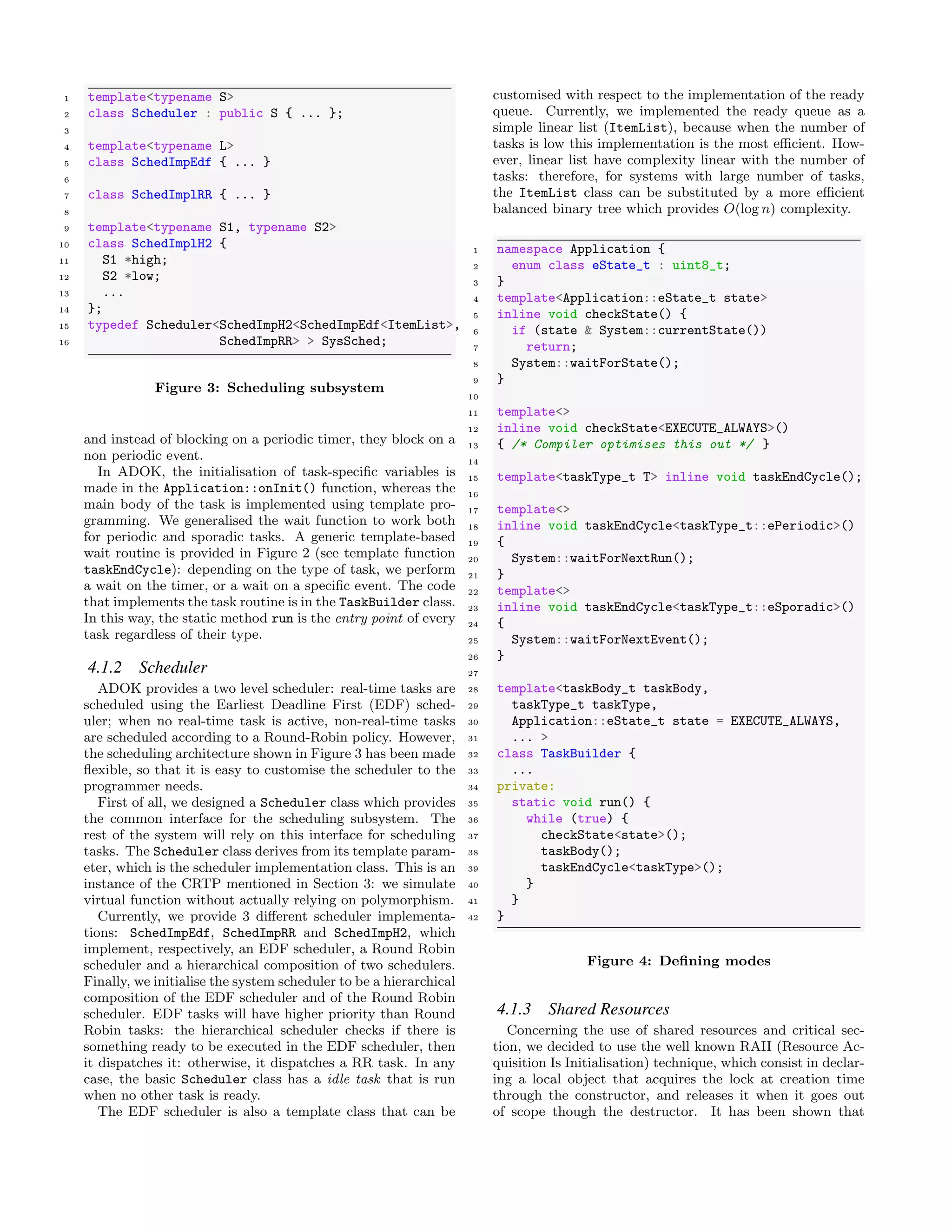
9 template<typename S1, typename S2>
10 class SchedImplH2 {
11 S1 *high;
12 S2 *low;
13 ...
14 };
15 typedef Scheduler<SchedImpH2<SchedImpEdf<ItemList>,
16 SchedImpRR> > SysSched;
Figure 3: Scheduling subsystem
and instead of blocking on a periodic timer, they block on a
non periodic event.
In ADOK, the initialisation of task-specific variables is
made in the Application::onInit() function, whereas the
main body of the task is implemented using template pro-
gramming. We generalised the wait function to work both
for periodic and sporadic tasks. A generic template-based
wait routine is provided in Figure 2 (see template function
taskEndCycle): depending on the type of task, we perform
a wait on the timer, or a wait on a specific event. The code
that implements the task routine is in the TaskBuilder class.
In this way, the static method run is the entry point of every
task regardless of their type.
4.1.2 Scheduler
ADOK provides a two level scheduler: real-time tasks are
scheduled using the Earliest Deadline First (EDF) sched-
uler; when no real-time task is active, non-real-time tasks
are scheduled according to a Round-Robin policy. However,
the scheduling architecture shown in Figure 3 has been made
flexible, so that it is easy to customise the scheduler to the
programmer needs.
First of all, we designed a Scheduler class which provides
the common interface for the scheduling subsystem. The
rest of the system will rely on this interface for scheduling
tasks. The Scheduler class derives from its template param-
eter, which is the scheduler implementation class. This is an
instance of the CRTP mentioned in Section 3: we simulate
virtual function without actually relying on polymorphism.
Currently, we provide 3 different scheduler implementa-
tions: SchedImpEdf, SchedImpRR and SchedImpH2, which
implement, respectively, an EDF scheduler, a Round Robin
scheduler and a hierarchical composition of two schedulers.
Finally, we initialise the system scheduler to be a hierarchical
composition of the EDF scheduler and of the Round Robin
scheduler. EDF tasks will have higher priority than Round
Robin tasks: the hierarchical scheduler checks if there is
something ready to be executed in the EDF scheduler, then
it dispatches it: otherwise, it dispatches a RR task. In any
case, the basic Scheduler class has a idle task that is run
when no other task is ready.
The EDF scheduler is also a template class that can be
customised with respect to the implementation of the ready
queue. Currently, we implemented the ready queue as a
simple linear list (ItemList), because when the number of
tasks is low this implementation is the most efficient. How-
ever, linear list have complexity linear with the number of
tasks: therefore, for systems with large number of tasks,
the ItemList class can be substituted by a more efficient
balanced binary tree which provides O(log n) complexity.
1 namespace Application {
2 enum class eState_t : uint8_t;
3 }
4 template<Application::eState_t state>
5 inline void checkState() {
6 if (state & System::currentState())
7 return;
8 System::waitForState();
9 }
10
11 template<>
12 inline void checkState<EXECUTE_ALWAYS>()
13 { /* Compiler optimises this out */ }
14
15 template<taskType_t T> inline void taskEndCycle();
16
17 template<>
18 inline void taskEndCycle<taskType_t::ePeriodic>()
19 {
20 System::waitForNextRun();
21 }
22 template<>
23 inline void taskEndCycle<taskType_t::eSporadic>()
24 {
25 System::waitForNextEvent();
26 }
27
28 template<taskBody_t taskBody,
29 taskType_t taskType,
30 Application::eState_t state = EXECUTE_ALWAYS,
31 ... >
32 class TaskBuilder {
33 ...
34 private:
35 static void run() {
36 while (true) {
37 checkState<state>();
38 taskBody();
39 taskEndCycle<taskType>();
40 }
41 }
42 }
Figure 4: Defining modes
4.1.3 Shared Resources
Concerning the use of shared resources and critical sec-
tion, we decided to use the well known RAII (Resource Ac-
quisition Is Initialisation) technique, which consist in declar-
ing a local object that acquires the lock at creation time
through the constructor, and releases it when it goes out
of scope though the destructor. It has been shown that
this technique reduces the amount of programming errors
in taking locks, and it is now implemented in many C++
libraries. ADOK provide a MutexWithCeiling class that
uses the Stack Resource Policy protocol [3]. The user has
to specify the ceiling when the object is created at initial-
isation time, and then it uses it with a Lock object which
implements the RAII technique.
Other features of ADOK include a classical Semaphore
class, the MessageQueue class for communicating between
tasks, and functions for interrupt management and interac-
tion with I/O devices.
4.1.4 Mode change
Most embedded systems are modelled by finite state ma-
chines, that is, the behaviour of the system in response to a
certain event may be different based on the current state of
the system. For example, in a control system it is possible to
change the control algorithm based on the current operating
mode. One possibility is to have different tasks implement
the different control algorithms; and activate only the cor-
rect tasks when changing operating mode. However, chang-
ing mode is not trivial, as we have to ensure that all tasks
will meet the deadlines under all conditions, even during the
mode change. Many algorithms have been proposed in the
literature for performing mode changes [14]. In ADOK we
implemented the Idle Time Protocol.
To support mode changes, ADOK provides the possibility
to easily define a finite state machine and thus allows the
developer, through a very simple interface, to define the ex-
ecution of a task only when the system is in a given set of
states. The code is shown in Figure 4.
In order to define the application states, the developer
needs to define the enumeration declared in the Application
namespace called eState_t1
. Each bit can represent a dif-
ferent state, and each task can be run in one or more states.
It can even run in every state if the value EXECUTE_ALWAYS
is used, that is 0. This has been achieved with two more
template-based functions in the TaskBuilder class. In the
task body (method run of the TaskBuilder class), the task
checks the operating mode by calling the checkState that
are optimised by the compiler when the default behaviour
of EXECUTE_ALWAYS is specified.
Another important function is the onChangeState(eState
t) method which is called by ADOK on every transition,
with a parameter that defines the new state of the system.
Finally, a (hidden) task is used to perform the mode change
by waiting for all suspending tasks to suspend before the
new tasks are re-activated.
5. EXAMPLE OF APPLICATION
In this section we will show a demo application composed
of two tasks acquiring samples from a 3-axis gyroscope sen-
sor. The first task acquires data during the Init state for
calculating the zero-offset error, the second task acquires
data during the operational state and will correct the sam-
ples with the zero-offset value calculated during the Init
state. The code is shown in Figure 5.
We define the data we need within a namespace called
data. The task gyroscopeInit() will be executed every 200
milliseconds only during the Init state. Task gyroscope is
then executed during the Operative mode.
1
This forward declaration is possible only in C++11.
1 void gyroscopeInit() {
2 sensor<L3G4200D>::read(data::samples);
3 for (uint8_t i = 0; i < 3; ++i)
4 data::accumulator[i] += data::samples[i];
5 ++zeroSamplesAcquired;
6 }
7 TASK_PERIODMS_STATE(gyroscopeInit, 200,
8 Application::eState_t::Init);
9 void gyroscope() {
10 sensor<L3G4200D>::read(data::samples);
11 for (auto sample : data::samples)
12 sample -= data::zeroOffset;
13 }
14 TASK_PERIOD_STATE(gyroscope, 200,
15 Application::eState_t::Operative);
16
17 namespace Application {
18 enum class eState_t : uint8_t {
19 Init = 1, Operative
20 };
21 void onInit() {
22 sensor<L3G4200D>::init();
23 System::setState(Application::eState_t::Init);
24 }
25 void onChangeState(eState_t newState) {
26 using namespace data;
27 if (newState & eState_t::Operative) {
28 for (uint8_t i = 0; i < 3; ++i)
29 zeroOffset[i] = accumulator[i] /
30 zeroSamplesAcquired;
31 } else for (auto x : accumulator) x = 0;
32 }
33 }
Figure 5: Demo: mode changes
As it is possible to see, the code is very readable and
compact. The use of templates and macros makes it easy
to change the structure of the application, for example by
adding a new state, or by changing the tasks to be executed
in each operating mode.
We measured the footprint of this application when com-
piled along with the kernel in number of bytes, and the
results are shown in Table 1. Unfortunately, we cannot
show here a direct comparison with a similar application im-
plemented with another RTOS, however these numbers are
in line with similar numbers obtained by OSEK compliant
RTOS like ERIKA2
.
6. PERFORMANCE
We implemented ADOK for an embedded board with a
STM32H103FB micro-controller from the STM32 family of
ST-Microelectronics. It is a System-on-Chip with a 32bit
ARM Cortex M3 core. It has 128KB of embedded non-
volatile flash memory where the ADOK image can be stored.
It also contains various controllers on board which facili-
tate the interaction with external hardware. The micro-
controller also contains 20KB of SRAM memory for running
2
Benchmarks for the ERIKA RTOS are available at
http://erika.tuxfamily.org/wiki/.
text data bss
standard 21044 592 7924
-ffunction-sections
-fdata-sections
-Wl,-gc-sections
15340 592 7920
-ffunction-sections
-fdata-sections
-Wl,-gc-sections
-Os
8872 572 7940
Table 1: Footprint of the demo application
the application, and a JTAG controller which made the de-
bugging process during the development very easy.
For testing the overhead of the context switch, we devel-
oped executed an application with a variable number of tasks
(3, 5, 7 and 9 tasks) with different periods and the same off-
set. The tasks in the application toggle the same GPIO pin
state causing a train of impulses to be observed with an os-
cilloscope. The amount of time for switching from one task
to the next has been measured to be always between 10 and
13µsec. As an indirect comparison, ERIKA on a Cortex M4
takes approximately 20µsec for a context switch with two
tasks3
As it is possible to see, the overhead is low. More-
over, we believe there is some more space for optimising the
code and further reduce the overhead. We plan to conduct
more experiments for measuring the overhead of other ker-
nel primitives in different operating conditions and compare
with other RTOS running on the same processor.
7. CONCLUSIONS AND FUTURE WORKS
In this paper we presented ADOK, a minimal RTOS de-
veloped entirely in C++. The goal of this work is to demon-
strate that it is indeed possible to use C++ as a language
for embedded system programming. The resulting applica-
tion code is compact and efficient; at the same time, C++
is a much safer language than C because it provides strong
type checking; and much powerful because it provides many
high-level features.
In the future we plan to expand ADOK by providing the
implementation of other scheduling algorithms (like fixed
priority and table-based scheduling). Similarly with what we
did with the mode-chance component of ADOK, we also plan
to provide libraries for supporting fault-tolerance, energy-
aware scheduling and adaptive scheduling.
8. REFERENCES
[1] David Abrahams and Aleksey Gurtovoy. C++
template metaprogramming: concepts, tools, and
techniques from Boost and beyond. Addison-Wesley
Professional, 2004.
[2] Andrei Alecandrescu. Modern C++ Design: Generic
Programming and Design Patterns Applied. Addison
Wesley, 2001.
[3] T. P. Baker. A Stack-Based Allocation Policy for
Realtime Processes. In Proceedings of the IEEE Real
Time Systems Symposium, december 1990.
3
See http://erika.tuxfamily.org/wiki/index.php?title=
Erika Enterprise Benchmark for Cortex M4 for a complete
benchmark.
[4] Adam Dunkels, Oliver Schmidt, Thiemo Voigt, and
Muneeb Ali. Protothreads: Simplifying event-driven
programming of memory-constrained embedded
systems. In Proceedings of the 4th International
Conference on Embedded Networked Sensor Systems,
SenSys ’06, pages 29–42, New York, NY, USA, 2006.
ACM.
[5] Antˆonio Augusto Medeiros Fr¨ohlich. Application
Oriented Operating Systems, volume 1.
GMD-forschungszentrum informationstechnik, 2001.
[6] Paolo Gai, Giuseppe Lipari, Luca Abeni, Marco
di Natale, and Enrico Bini. Architecture for a Portable
Open Source Real-Time Kernel Environment. In
Proceedings of the Second Real-Time Linux Workshop
and Hand’s on Real-Time Linux Tutorial, November
2000.
[7] Davide De Gennaro. Advanced C++
Metaprogramming. CreateSpace Independent
Publishing Platform, 2012.
[8] The C++ programming language, 2011.
[9] C.L. Liu and J.W. Layland. Scheduling Algorithms for
Multiprogramming in a Hard-Real-Time Environment.
Journal of the Association for Computing Machinery,
20(1):46–61, January 1973.
[10] Miguel Masmano, Ismael Ripoll, Alfons Crespo, and
Jorge Real. TLSF: A new dynamic memory allocator
for real-time systems. In Real-Time Systems, 2004.
ECRTS 2004. Proceedings. 16th Euromicro Conference
on, pages 79–88. Ieee, 2004.
[11] Brian McNamara and Yannis Smaragdakis. Functional
programming in C++. ACM SIGPLAN Notices,
35(9):118–129, 2000.
[12] MIRA Ltd. MISRA-C:2004 Guidelines for the use of
the C language in Critical Systems. MIRA, Oct 2004.
[13] OSEK. OSEK/VDX Operating System Specification
2.2.1. OSEK Group, http://www.osek-vdx.org, 2003.
[14] Jorge Real and Alfons Crespo. Mode Change Protocols
for Real-Time Systems: A Survey and a New
Proposal. Real-Time Systems, 26(2):161–197, 2004.
[15] UBM Tech. 2013 Embedded Market Study. Technical
report, EETimes, 2013.

ewili13_submission_14

  • 1.
    ADOK: a MinimalObject Oriented Real-Time Operating System in C++∗ Salvatore Benedetto Scuola Superiore Sant’Anna salvatore.benedetto@gmail.com Giuseppe Lipari Scuola Superiore Sant’Anna and LSV - ENS Cachan giuseppe.lipari@lsv.ens-cachan.fr ABSTRACT Most embedded software is currently developed using the C programming language, even though its low level of abstrac- tion requires a lot of effort to the programmer. The C++ language is a better choice because: it raises the level of abstraction; it is strongly typed, so it prevents many com- mon programming mistakes; it can be made as efficient as C through fine-grained customisation of memory mechanisms; it can be easily adapted to domain-specific needs. In ad- dition, recent compilers have grown in maturity and per- formance, and the new standard considerably improves the language by introducing new concepts and an easier syntax. In this paper we present ADOK, a minimal Real-Time Operating System entirely written in C++ with the excep- tion of a few lines of assembler code. It directly offers a C++ interface to the developer, and it provides a flexible schedul- ing framework which allows the developer to customise the scheduling to its needs. In particular, we implement a two- level scheduler based on Earliest Deadline First, the Stack Resource Policy protocol for sharing resources and support for mode changes. We demonstrate through examples and a small case-study that ADOK can substantially improve productivity without sacrificing on performance. Categories and Subject Descriptors H.4 [Information Systems Applications]: Miscellaneous; D.2.8 [Software Engineering]: Metrics—complexity mea- sures, performance measures General Terms Systems 1. INTRODUCTION ∗ The research leading to these results has received funding from the European Community’s Seventh Framework Pro- gramme FP7 under grant agreement n. 246556, “RBUCE- UP” EWiLi’13, August 26-27, 2013, Toulouse, FRANCE. Copyright retained by the authors.. Software for embedded systems has traditionally been de- veloped in C. According to a recent study [15], in 2013 60% of embedded software was programmed in C, and only 20% in C++. There are two main reasons for this dominance: the first one is that the C language is very close to machine code, thus the programmer can easily access hardware reg- isters. The second reason is efficiency: being so close to the machine, C compilers usually generated very fast an mem- ory efficient code, and this is very important in resource constrained embedded systems. However, C is a low-level language and it may not be always adequate for developing complex and large applica- tions. In particular, C lacks many abstractions and features that make the life of the programmer easier. We would like to mention, among the others, the absence of namespaces; the weak type semantic; the absence of object oriented con- cepts; the lack of a strongly typed template mechanism; the abuse of pointers for dynamic programming techniques; etc. These limitations are serious especially in safety-critical embedded systems, where it is necessary to verify and certify the correctness of the code. For this reason, many companies enforce restrictions on the use of the C language. For exam- ple, MISRA C [12] is a standard for developing software in C that limits the use of constructs that could lead to unde- fined behaviour, and it is widely adopted by the aerospace and the automotive industries. To support object oriented programming, many years ago Bjarne Stroustrup proposed the C++ language which was initially thought as an extension of the C language. How- ever, C++ actually brings in many more features than just objects. In facts, it is considered as a very flexible language in which many modern programming techniques can be easily expressed, from template meta-programming [7, 1], to func- tional programming [11]. The new ISO/IEC standard [8] extends the language along several direction, improving the usability and adding many more features. Given the premises, one would expect C++ to be the obvious preferred choice of embedded systems developers. However, C++ has often been dismissed because of its com- plexity and steep learning curve. Another reason is a preju- dice about its efficiency: many features of the language are regarded as sources of inefficiency, like the use of dynamic binding and polymorphism. In our opinion, such prejudice has little practical basis. Modern compilers are now very efficient, and the introduc- tion of the new C++11 standard has made programming in C++ simpler and more effective. Also, we believe that, by applying specific idioms and restricting the most unpre-
  • 2.
    dictable features ofC++, it is possible to generate very ef- ficient and predictable code from C++ programs. It is now time to give C++ another chance. Contributions of this paper. In this paper we present ADOK, a minimal real-time operating systems for embed- ded software development. ADOK is written almost entirely in C++ and directly offers a C++ interface to the developer. The RTOS has been designed for supporting minimal em- bedded programs, of the same class as the ones supported by the OSEK standard [13] for automotive systems. In particu- lar, we will make the assumption that all tasks are statically created at boot time, and no task can be dynamically cre- ated or killed during the system lifetime. ADOK provides a two-level scheduler based on Earliest Deadline First [9] for real-time tasks and Round-Robin for non real-time tasks; the Stack Resource Policy [3] protocol for sharing resources; support for mode changes [14]. Our goal is to demonstrate that it is possible to use a subset of the C++ language and obtain very efficient code (comparable to the one produced by C) in a safer and simpler way. 2. RELATED WORK There are many RTOSs available on the market and as open-source academic projects, too many to be cited here. The great majority of these are kernels implemented in C and they provide a C-like API. Among the minimal RTOS for the automotive domain and wireless sensor networks, we would like to mention ERIKA Enterprise [6] and Con- tiki [4], as they are closer to the architecture and objectives of ADOK. Not many C++-based operating systems have been pro- posed until now. The Embedded Parallel Operating System (EPOS) [5] is the one that most resembles our approach: all kernel structures are implemented as template classes that can be customised in variety of ways, for example for se- lecting the scheduling algorithm or the task model. The main difference is that EPOS was conceived as a medium sized RTOS and supports more general features as dynamic creation of objects, whereas our ADOK kernel is expressly dedicated to small embedded systems with minimal memory requirements, and hence it does not support dynamic task creation. 3. C++ FOR EMBEDDED SYSTEMS In this section we discuss the features of the C++ lan- guage that are relevant to embedded system development. Polymorphism. In embedded systems, polymorphism should be avoided because it is less predictable (difficult to anal- yse the worst-care response time of polymorphic code) and it generally requires additional memory. Also, the lack of polymorphism is not seen as a disadvantage, because in a typical safety-critical embedded systems all objects must be known at design time. Consider polymorphism as implemented in many object oriented languages. In Java, for example, every class method is polymorphic, and reflection is enabled for all classes. As a consequences, the overhead of these features is always present even if no class in our program needs polymorphic behaviour. This simplifies the object model at the expenses of increased overhead. In C++ polymorphism can be completely eliminated. In fact, a class method is polymorphic only if it is declared as virtual. If all methods of a class and of its base classes are non-virtual, the C++ compiler will not produce any virtual table and will not generate dynamic binding. The memory layout of a non-virtual class will resemble that of simple C structure, and Run-Time Type Identification (RTTI) will not be possible for that class. Of course, even if our ADOK RTOS does not use poly- morphism (see Section 4), the developer may decide to use polymorphism in its program. In such a case, she will in- deed introduce some possible extra overhead in the program, but only limited to the polymorphic class hierarchy, without compromising the predictability of the rest of the system. In some cases, it is possible to use the Curiously Recurring Template Pattern [2] to mimic polymorphism at the cost of one extra function call (that can be optimised by function in-lining). Exceptions. Another feature that should be eliminated is the support for exceptions, again because it introduces unpredictability and overhead. In C++ it is possible to completely disable the exception mechanism. Type Check. Due to the lack of inheritance and tem- plates, generic libraries written in C often require function parameters to be pointers to void. Consider, as an example, function qsort() available in the stdlib to sort an array of elements. Since we do not know what type of elements are contained in the array, qsort() can only accept a pointer to void and a function for comparing elements that takes two pointers to void. This function is cumbersome and ineffi- cient (because it requires many unnecessary indirections), and if not used properly can cause many strange run-time errors leading to memory corruptions. In contrast, by using C++ strong typing together with templates, it is possible to perform many static checks at compile time. Static type checking may reveal common programming mistakes at compile time. For example, the std::sort() function provided by the C++ standard library is templatised with respect to the type contained in the array, so it is type safe. Also, if applied to an array of incompara- ble elements, the compiler will raise an error. This approach is also efficient since the template mechanism will generate only the code that is needed to implement the function. In- deed, idiomatic use of C++ restricts the use of pointers to a few cases. Memory allocation. In C++, it is possible to overload the the new/delete operators for customising dynamic mem- ory. This technique pays off in embedded systems where the standard memory allocation may be very inefficient; for example, it would be possible to write custom memory al- location strategy for small classes; or to implement memory allocation strategies expressly designed for embedded sys- tems [10]. While similar strategies can also be used in C, in C++ the mechanisms of operator overloading permits to easily change the policy without changing the rest of the program. Policy-based design [2] has been advocated as one of the most effective programming techniques in C++. In the following we show how we applied some of these techniques to the design of a C++ Real-Time Operating System. 4. ADOK ADOK is the name of an innovative object-oriented RTOS we developed at Scuola Superiore Sant’Anna of Pisa as part
  • 3.
    1 uint16_t samples[3]; 2void sensorReader() 3 { 4 int local_var = 0; 5 sensor<BMA180>::read(samples); 6 ... 7 } 8 TASK_PERIODMS(sensorReader, 20); Figure 1: An example of task in ADOK. of one of the authors’ Master Thesis. The name is not an acronym, but its pronunciation is similar to the Latin words ad hoc that, according to the Oxford Dictionary, can be translated as “created or done for a particular purpose as necessary”. In fact, one of our objectives is to let the pro- grammer customise the kernel to its own needs without in- troducing extra overhead, as it were created in an ad hoc manner. Other objectives of ADOK are: • Automatise code generation and customisation; it must be possible, for the user and for the kernel developer, to change the kernel policies without requiring any ma- jor change neither in the user code, nor in the rest of the kernel code; • Minimise and simplify user interface; a simpler API has many advantages, among which less possibility for programming errors, increased code readability, porta- bility and maintainability. • To introduce the embedded system programmer to the C++ language in a gentle way. The system is entirely written in C++03 (with the excep- tion of a few parts which use some limited features of the new C++11 standard), and using template meta-programming for customising code. Figure 1 shows an example of all that is needed to create a periodic task to be executed every 20 milliseconds. The task uses a global array to store samples which are read every instance using the sensor<T>::read() function (line 5). The task is created at system start-up using the macro at line 8, which requires the body of the task and period in milliseconds. The task has a run-to-completion semantic, in the sense that at each instance the task body function is called and every local variable is recreated on the stack. 4.1 Architecture 4.1.1 Tasks ADOK has been designed from the scratch as a modular RTOS which can easily support different types of tasks and schedulers. Different schedulers need different task param- eters, so it is not efficient to prepare a task structure that will encompass all possible conceivable task parameters. The solution adopted for ADOK consists in providing a base structure, called TaskBase, which contains all data com- mon to every type of task, and a separate structure that contains specific data for each specific task type. This re- sembles the inheritance mechanism provided by any object- oriented programming language, where all the common data 1 struct TaskBase { 2 adokport::stack_t stackTop; 3 adokport::entryPoint_t entryPoint; 4 uint16_t stackSize; 5 taskType_t type; 6 uint8_t id; 7 taskState_t currentStatus; 8 Application::eState_t executeOnState; 9 }; 10 struct TaskPeriodic { 11 uint16_t periodMS; // Period 12 uint16_t startAfterMS; // Offset 13 uint16_t nextActivationInTicks; 14 uint16_t deadlineInTicks; 15 } 16 17 template<taskType_t type> struct TaskData; 18 template<> 19 struct TaskData<taskType_t::ePeriodic> { 20 typedef TaskPeriodic extraData; 21 }; 22 23 template<taskType_t taskType, ... > 24 class TaskBuilder { 25 ... 26 private: 27 TaskBase _task; 28 typename TaskData<taskType>::extraData _data; 29 }; Figure 2: Template-based structure to be specialised for each type of task. and common functionality are grouped in a base class, while the rest of the data is grouped in different classes, one for each sub-type. Despite of that, the inheritance mechanism provided by C++ has not been used because the C++ standard does not define how the data within an hierarchy of classes is lay out. Therefore, since the scheduler relies on the fact that the base data is followed by the specific task type data for performance reasons, and in order not to rely on the compiler implementation, we decided to use an alternative mechanism based on template meta-programming. The mechanism is shown in Figure 2. First TaskBase de- fines the structure containing the common data to all tasks regardless of the type. Then, the type-specific data is de- fined. In the figure we show the content of the TaskPeriodic structure which contains the task period and offset, and the internal variables used by the scheduler. The TaskBuilder class (shown in Figure 2) puts everything together. This al- lows the system to be easily extended to support new task types and thus new scheduling policies by simply specialising the template-based structure TaskData. A similar approach was taken for modelling the task body. A real-time task is usually modelled by a while cycle. Ini- tially a periodic timer is started with the specified period; then task enters a while loop where, after performing some computation, it blocks waiting for the next periodic activa- tion. Sporadic and aperiodic tasks have a very similar struc- ture, except that they do not need to initialise any timer,
  • 4.
    1 template<typename S> 2class Scheduler : public S { ... }; 3 4 template<typename L> 5 class SchedImpEdf { ... } 6 7 class SchedImplRR { ... } 8 9 template<typename S1, typename S2> 10 class SchedImplH2 { 11 S1 *high; 12 S2 *low; 13 ... 14 }; 15 typedef Scheduler<SchedImpH2<SchedImpEdf<ItemList>, 16 SchedImpRR> > SysSched; Figure 3: Scheduling subsystem and instead of blocking on a periodic timer, they block on a non periodic event. In ADOK, the initialisation of task-specific variables is made in the Application::onInit() function, whereas the main body of the task is implemented using template pro- gramming. We generalised the wait function to work both for periodic and sporadic tasks. A generic template-based wait routine is provided in Figure 2 (see template function taskEndCycle): depending on the type of task, we perform a wait on the timer, or a wait on a specific event. The code that implements the task routine is in the TaskBuilder class. In this way, the static method run is the entry point of every task regardless of their type. 4.1.2 Scheduler ADOK provides a two level scheduler: real-time tasks are scheduled using the Earliest Deadline First (EDF) sched- uler; when no real-time task is active, non-real-time tasks are scheduled according to a Round-Robin policy. However, the scheduling architecture shown in Figure 3 has been made flexible, so that it is easy to customise the scheduler to the programmer needs. First of all, we designed a Scheduler class which provides the common interface for the scheduling subsystem. The rest of the system will rely on this interface for scheduling tasks. The Scheduler class derives from its template param- eter, which is the scheduler implementation class. This is an instance of the CRTP mentioned in Section 3: we simulate virtual function without actually relying on polymorphism. Currently, we provide 3 different scheduler implementa- tions: SchedImpEdf, SchedImpRR and SchedImpH2, which implement, respectively, an EDF scheduler, a Round Robin scheduler and a hierarchical composition of two schedulers. Finally, we initialise the system scheduler to be a hierarchical composition of the EDF scheduler and of the Round Robin scheduler. EDF tasks will have higher priority than Round Robin tasks: the hierarchical scheduler checks if there is something ready to be executed in the EDF scheduler, then it dispatches it: otherwise, it dispatches a RR task. In any case, the basic Scheduler class has a idle task that is run when no other task is ready. The EDF scheduler is also a template class that can be customised with respect to the implementation of the ready queue. Currently, we implemented the ready queue as a simple linear list (ItemList), because when the number of tasks is low this implementation is the most efficient. How- ever, linear list have complexity linear with the number of tasks: therefore, for systems with large number of tasks, the ItemList class can be substituted by a more efficient balanced binary tree which provides O(log n) complexity. 1 namespace Application { 2 enum class eState_t : uint8_t; 3 } 4 template<Application::eState_t state> 5 inline void checkState() { 6 if (state & System::currentState()) 7 return; 8 System::waitForState(); 9 } 10 11 template<> 12 inline void checkState<EXECUTE_ALWAYS>() 13 { /* Compiler optimises this out */ } 14 15 template<taskType_t T> inline void taskEndCycle(); 16 17 template<> 18 inline void taskEndCycle<taskType_t::ePeriodic>() 19 { 20 System::waitForNextRun(); 21 } 22 template<> 23 inline void taskEndCycle<taskType_t::eSporadic>() 24 { 25 System::waitForNextEvent(); 26 } 27 28 template<taskBody_t taskBody, 29 taskType_t taskType, 30 Application::eState_t state = EXECUTE_ALWAYS, 31 ... > 32 class TaskBuilder { 33 ... 34 private: 35 static void run() { 36 while (true) { 37 checkState<state>(); 38 taskBody(); 39 taskEndCycle<taskType>(); 40 } 41 } 42 } Figure 4: Defining modes 4.1.3 Shared Resources Concerning the use of shared resources and critical sec- tion, we decided to use the well known RAII (Resource Ac- quisition Is Initialisation) technique, which consist in declar- ing a local object that acquires the lock at creation time through the constructor, and releases it when it goes out of scope though the destructor. It has been shown that
  • 5.
    this technique reducesthe amount of programming errors in taking locks, and it is now implemented in many C++ libraries. ADOK provide a MutexWithCeiling class that uses the Stack Resource Policy protocol [3]. The user has to specify the ceiling when the object is created at initial- isation time, and then it uses it with a Lock object which implements the RAII technique. Other features of ADOK include a classical Semaphore class, the MessageQueue class for communicating between tasks, and functions for interrupt management and interac- tion with I/O devices. 4.1.4 Mode change Most embedded systems are modelled by finite state ma- chines, that is, the behaviour of the system in response to a certain event may be different based on the current state of the system. For example, in a control system it is possible to change the control algorithm based on the current operating mode. One possibility is to have different tasks implement the different control algorithms; and activate only the cor- rect tasks when changing operating mode. However, chang- ing mode is not trivial, as we have to ensure that all tasks will meet the deadlines under all conditions, even during the mode change. Many algorithms have been proposed in the literature for performing mode changes [14]. In ADOK we implemented the Idle Time Protocol. To support mode changes, ADOK provides the possibility to easily define a finite state machine and thus allows the developer, through a very simple interface, to define the ex- ecution of a task only when the system is in a given set of states. The code is shown in Figure 4. In order to define the application states, the developer needs to define the enumeration declared in the Application namespace called eState_t1 . Each bit can represent a dif- ferent state, and each task can be run in one or more states. It can even run in every state if the value EXECUTE_ALWAYS is used, that is 0. This has been achieved with two more template-based functions in the TaskBuilder class. In the task body (method run of the TaskBuilder class), the task checks the operating mode by calling the checkState that are optimised by the compiler when the default behaviour of EXECUTE_ALWAYS is specified. Another important function is the onChangeState(eState t) method which is called by ADOK on every transition, with a parameter that defines the new state of the system. Finally, a (hidden) task is used to perform the mode change by waiting for all suspending tasks to suspend before the new tasks are re-activated. 5. EXAMPLE OF APPLICATION In this section we will show a demo application composed of two tasks acquiring samples from a 3-axis gyroscope sen- sor. The first task acquires data during the Init state for calculating the zero-offset error, the second task acquires data during the operational state and will correct the sam- ples with the zero-offset value calculated during the Init state. The code is shown in Figure 5. We define the data we need within a namespace called data. The task gyroscopeInit() will be executed every 200 milliseconds only during the Init state. Task gyroscope is then executed during the Operative mode. 1 This forward declaration is possible only in C++11. 1 void gyroscopeInit() { 2 sensor<L3G4200D>::read(data::samples); 3 for (uint8_t i = 0; i < 3; ++i) 4 data::accumulator[i] += data::samples[i]; 5 ++zeroSamplesAcquired; 6 } 7 TASK_PERIODMS_STATE(gyroscopeInit, 200, 8 Application::eState_t::Init); 9 void gyroscope() { 10 sensor<L3G4200D>::read(data::samples); 11 for (auto sample : data::samples) 12 sample -= data::zeroOffset; 13 } 14 TASK_PERIOD_STATE(gyroscope, 200, 15 Application::eState_t::Operative); 16 17 namespace Application { 18 enum class eState_t : uint8_t { 19 Init = 1, Operative 20 }; 21 void onInit() { 22 sensor<L3G4200D>::init(); 23 System::setState(Application::eState_t::Init); 24 } 25 void onChangeState(eState_t newState) { 26 using namespace data; 27 if (newState & eState_t::Operative) { 28 for (uint8_t i = 0; i < 3; ++i) 29 zeroOffset[i] = accumulator[i] / 30 zeroSamplesAcquired; 31 } else for (auto x : accumulator) x = 0; 32 } 33 } Figure 5: Demo: mode changes As it is possible to see, the code is very readable and compact. The use of templates and macros makes it easy to change the structure of the application, for example by adding a new state, or by changing the tasks to be executed in each operating mode. We measured the footprint of this application when com- piled along with the kernel in number of bytes, and the results are shown in Table 1. Unfortunately, we cannot show here a direct comparison with a similar application im- plemented with another RTOS, however these numbers are in line with similar numbers obtained by OSEK compliant RTOS like ERIKA2 . 6. PERFORMANCE We implemented ADOK for an embedded board with a STM32H103FB micro-controller from the STM32 family of ST-Microelectronics. It is a System-on-Chip with a 32bit ARM Cortex M3 core. It has 128KB of embedded non- volatile flash memory where the ADOK image can be stored. It also contains various controllers on board which facili- tate the interaction with external hardware. The micro- controller also contains 20KB of SRAM memory for running 2 Benchmarks for the ERIKA RTOS are available at http://erika.tuxfamily.org/wiki/.
  • 6.
    text data bss standard21044 592 7924 -ffunction-sections -fdata-sections -Wl,-gc-sections 15340 592 7920 -ffunction-sections -fdata-sections -Wl,-gc-sections -Os 8872 572 7940 Table 1: Footprint of the demo application the application, and a JTAG controller which made the de- bugging process during the development very easy. For testing the overhead of the context switch, we devel- oped executed an application with a variable number of tasks (3, 5, 7 and 9 tasks) with different periods and the same off- set. The tasks in the application toggle the same GPIO pin state causing a train of impulses to be observed with an os- cilloscope. The amount of time for switching from one task to the next has been measured to be always between 10 and 13µsec. As an indirect comparison, ERIKA on a Cortex M4 takes approximately 20µsec for a context switch with two tasks3 As it is possible to see, the overhead is low. More- over, we believe there is some more space for optimising the code and further reduce the overhead. We plan to conduct more experiments for measuring the overhead of other ker- nel primitives in different operating conditions and compare with other RTOS running on the same processor. 7. CONCLUSIONS AND FUTURE WORKS In this paper we presented ADOK, a minimal RTOS de- veloped entirely in C++. The goal of this work is to demon- strate that it is indeed possible to use C++ as a language for embedded system programming. The resulting applica- tion code is compact and efficient; at the same time, C++ is a much safer language than C because it provides strong type checking; and much powerful because it provides many high-level features. In the future we plan to expand ADOK by providing the implementation of other scheduling algorithms (like fixed priority and table-based scheduling). Similarly with what we did with the mode-chance component of ADOK, we also plan to provide libraries for supporting fault-tolerance, energy- aware scheduling and adaptive scheduling. 8. REFERENCES [1] David Abrahams and Aleksey Gurtovoy. C++ template metaprogramming: concepts, tools, and techniques from Boost and beyond. Addison-Wesley Professional, 2004. [2] Andrei Alecandrescu. Modern C++ Design: Generic Programming and Design Patterns Applied. Addison Wesley, 2001. [3] T. P. Baker. A Stack-Based Allocation Policy for Realtime Processes. In Proceedings of the IEEE Real Time Systems Symposium, december 1990. 3 See http://erika.tuxfamily.org/wiki/index.php?title= Erika Enterprise Benchmark for Cortex M4 for a complete benchmark. [4] Adam Dunkels, Oliver Schmidt, Thiemo Voigt, and Muneeb Ali. Protothreads: Simplifying event-driven programming of memory-constrained embedded systems. In Proceedings of the 4th International Conference on Embedded Networked Sensor Systems, SenSys ’06, pages 29–42, New York, NY, USA, 2006. ACM. [5] Antˆonio Augusto Medeiros Fr¨ohlich. Application Oriented Operating Systems, volume 1. GMD-forschungszentrum informationstechnik, 2001. [6] Paolo Gai, Giuseppe Lipari, Luca Abeni, Marco di Natale, and Enrico Bini. Architecture for a Portable Open Source Real-Time Kernel Environment. In Proceedings of the Second Real-Time Linux Workshop and Hand’s on Real-Time Linux Tutorial, November 2000. [7] Davide De Gennaro. Advanced C++ Metaprogramming. CreateSpace Independent Publishing Platform, 2012. [8] The C++ programming language, 2011. [9] C.L. Liu and J.W. Layland. Scheduling Algorithms for Multiprogramming in a Hard-Real-Time Environment. Journal of the Association for Computing Machinery, 20(1):46–61, January 1973. [10] Miguel Masmano, Ismael Ripoll, Alfons Crespo, and Jorge Real. TLSF: A new dynamic memory allocator for real-time systems. In Real-Time Systems, 2004. ECRTS 2004. Proceedings. 16th Euromicro Conference on, pages 79–88. Ieee, 2004. [11] Brian McNamara and Yannis Smaragdakis. Functional programming in C++. ACM SIGPLAN Notices, 35(9):118–129, 2000. [12] MIRA Ltd. MISRA-C:2004 Guidelines for the use of the C language in Critical Systems. MIRA, Oct 2004. [13] OSEK. OSEK/VDX Operating System Specification 2.2.1. OSEK Group, http://www.osek-vdx.org, 2003. [14] Jorge Real and Alfons Crespo. Mode Change Protocols for Real-Time Systems: A Survey and a New Proposal. Real-Time Systems, 26(2):161–197, 2004. [15] UBM Tech. 2013 Embedded Market Study. Technical report, EETimes, 2013.