Train with Python,
predict with C++
Pavel Filonov
+
+ +
+
+
+
+
About me
Pavel Filonov
Research Development Team Lead at
Kaspersky Lab
01
CoreHard. Train with Python, predict with C++
Machine Learning everywhere!
02
CoreHard. Train with Python, predict with C++
• Mobile
• Embedded
• Automotive
• Desktops
• Games
• Finance
• Etc.
Image from [1]
Machine Learning face the real world
03
CoreHard. Train with Python, predict with C++
Image from [2]
CRISP-DM
04
CoreHard. Train with Python, predict with C++
Image from [3]
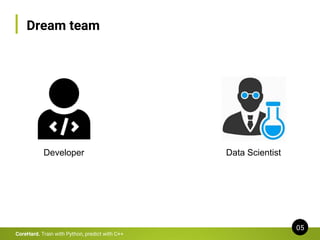
Dream team
05
CoreHard. Train with Python, predict with C++
Developer Data Scientist
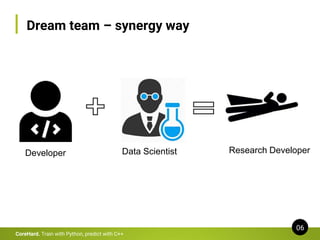
Dream team – synergy way
06
CoreHard. Train with Python, predict with C++
Developer Data Scientist Research Developer
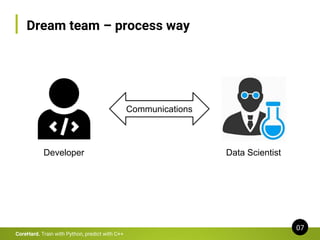
Dream team – process way
07
CoreHard. Train with Python, predict with C++
Developer Data Scientist
Communications
Machine learning sample cases
08
CoreHard. Train with Python, predict with C++
1. Energy efficiency prediction
2. Intrusion detection system
3. Image classification
Buildings Energy Efficiency
09
CoreHard. Train with Python, predict with C++
ref: [4]
● Input attributes
○ Relative Compactness
○ Surface Area
○ Wall Area
○ etc.
● Outcomes
○ Heating Load
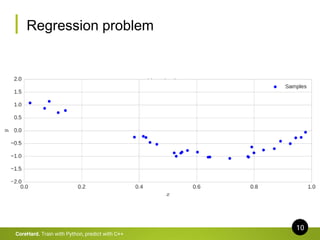
Regression problem
10
CoreHard. Train with Python, predict with C++
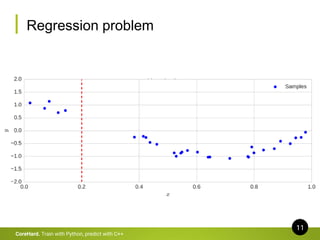
Regression problem
11
CoreHard. Train with Python, predict with C++
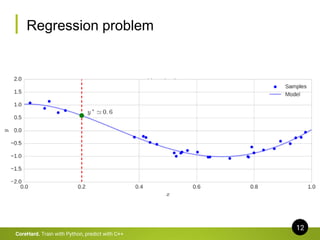
Regression problem
12
CoreHard. Train with Python, predict with C++
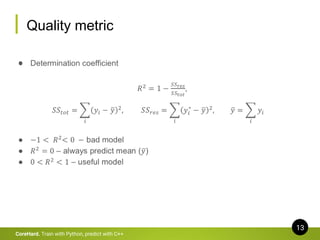
Quality metric
13
CoreHard. Train with Python, predict with C++
●
Baseline model
14
CoreHard. Train with Python, predict with C++
●
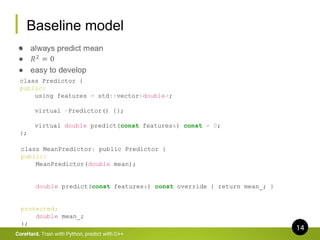
class Predictor {
public:
using features = std::vector<double>;
virtual ~Predictor() {};
virtual double predict(const features&) const = 0;
};
class MeanPredictor: public Predictor {
public:
MeanPredictor(double mean);
double predict(const features&) const override { return mean_; }
protected:
double mean_;
};
Linear regression
15
CoreHard. Train with Python, predict with C++
●
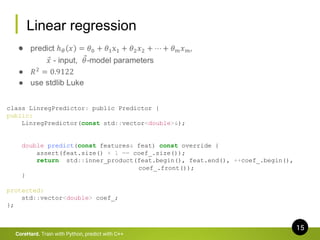
class LinregPredictor: public Predictor {
public:
LinregPredictor(const std::vector<double>&);
double predict(const features& feat) const override {
assert(feat.size() + 1 == coef_.size());
return std::inner_product(feat.begin(), feat.end(), ++coef_.begin(),
coef_.front());
}
protected:
std::vector<double> coef_;
};
Polynomial regression
16
CoreHard. Train with Python, predict with C++
●
class PolyPredictor: public LinregPredictor {
public:
using LinregPredictor::LinregPredictor;
double predict(const features& feat) const override {
features poly_feat{feat};
const auto m = feat.size();
poly_feat.reserve(m*(m+1)/2);
for (size_t i = 0; i < m; ++i) {
for (size_t j = i; j < m; ++j) {
poly_feat.push_back(feat[i]*feat[j]);
}
}
return LinregPredictor::predict(poly_feat);
}
};
Integration testing
17
CoreHard. Train with Python, predict with C++
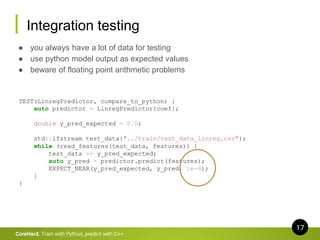
● you always have a lot of data for testing
● use python model output as expected values
● beware of floating point arithmetic problems
TEST(LinregPredictor, compare_to_python) {
auto predictor = LinregPredictor{coef};
double y_pred_expected = 0.0;
std::ifstream test_data{"../train/test_data_linreg.csv"};
while (read_features(test_data, features)) {
test_data >> y_pred_expected;
auto y_pred = predictor.predict(features);
EXPECT_NEAR(y_pred_expected, y_pred, 1e-4);
}
}
Intrusion detection system
18
CoreHard. Train with Python, predict with C++
● input - network traffic features
○ protocol_type
○ connection duration
○ src_bytes
○ dst_bytes
○ etc.
● Output
○ normal
○ network attack
ref: [5]
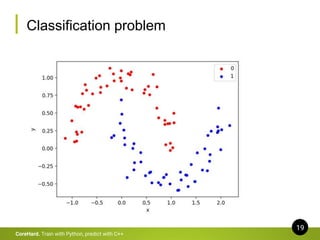
Classification problem
19
CoreHard. Train with Python, predict with C++
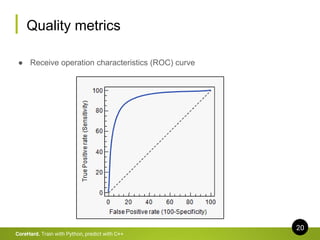
Quality metrics
20
CoreHard. Train with Python, predict with C++
● Receive operation characteristics (ROC) curve
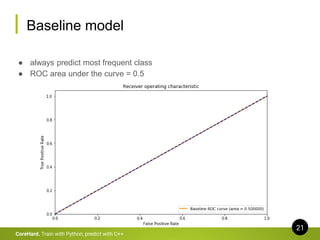
Baseline model
21
CoreHard. Train with Python, predict with C++
● always predict most frequent class
● ROC area under the curve = 0.5
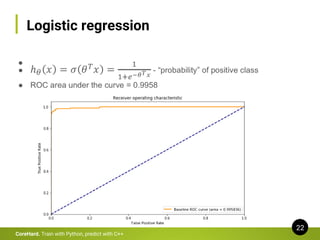
Logistic regression
22
CoreHard. Train with Python, predict with C++
●
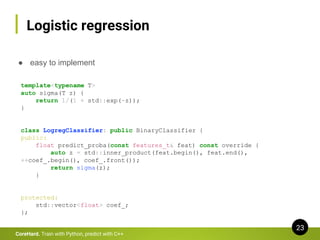
Logistic regression
23
CoreHard. Train with Python, predict with C++
● easy to implement
template<typename T>
auto sigma(T z) {
return 1/(1 + std::exp(-z));
}
class LogregClassifier: public BinaryClassifier {
public:
float predict_proba(const features_t& feat) const override {
auto z = std::inner_product(feat.begin(), feat.end(),
++coef_.begin(), coef_.front());
return sigma(z);
}
protected:
std::vector<float> coef_;
};
Gradient boosting
24
CoreHard. Train with Python, predict with C++
● de facto standard universal method
● multiple well known C++ implementations with python bindings
○ XGBoost
○ LigthGBM
○ CatBoost
● each implementation has its own custom model format
CatBoost
25
CoreHard. Train with Python, predict with C++
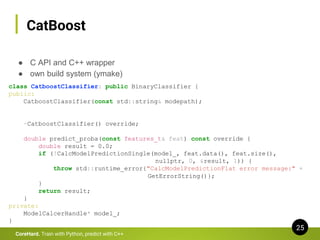
● C API and C++ wrapper
● own build system (ymake)
class CatboostClassifier: public BinaryClassifier {
public:
CatboostClassifier(const std::string& modepath);
~CatboostClassifier() override;
double predict_proba(const features_t& feat) const override {
double result = 0.0;
if (!CalcModelPredictionSingle(model_, feat.data(), feat.size(),
nullptr, 0, &result, 1)) {
throw std::runtime_error{"CalcModelPredictionFlat error message:" +
GetErrorString()};
}
return result;
}
private:
ModelCalcerHandle* model_;
}
CatBoost
26
CoreHard. Train with Python, predict with C++
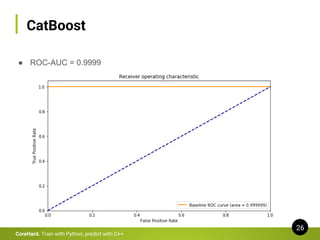
● ROC-AUC = 0.9999
Image classification
27
CoreHard. Train with Python, predict with C++
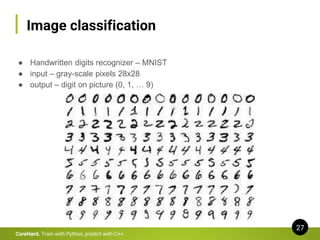
● Handwritten digits recognizer – MNIST
● input – gray-scale pixels 28x28
● output – digit on picture (0, 1, … 9)
Multilayer perceptron
28
CoreHard. Train with Python, predict with C++
Image from: [6]
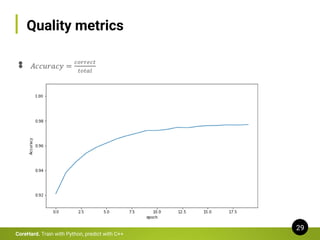
Quality metrics
29
CoreHard. Train with Python, predict with C++
●
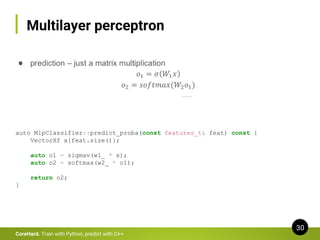
Multilayer perceptron
30
CoreHard. Train with Python, predict with C++
●
auto MlpClassifier::predict_proba(const features_t& feat) const {
VectorXf x{feat.size()};
auto o1 = sigmav(w1_ * x);
auto o2 = softmax(w2_ * o1);
return o2;
}
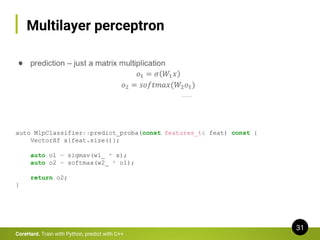
Multilayer perceptron
31
CoreHard. Train with Python, predict with C++
●
auto MlpClassifier::predict_proba(const features_t& feat) const {
VectorXf x{feat.size()};
auto o1 = sigmav(w1_ * x);
auto o2 = softmax(w2_ * o1);
return o2;
}
Convolutional networks
31
CoreHard. Train with Python, predict with C++
● State of the Art algorithms in image processing
● a lot of C++ implementation with python bindings
○ TensorFlow
○ Caffe
○ MXNet
○ CNTK
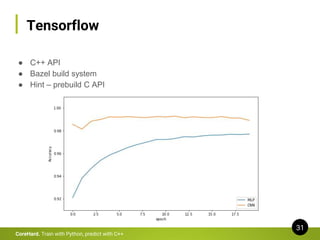
Tensorflow
31
CoreHard. Train with Python, predict with C++
● C++ API
● Bazel build system
● Hint – prebuild C API
Conclusion
31
CoreHard. Train with Python, predict with C++
● Don’t be fear of the ML
● Try simpler things first
● Get benefits from different languages
References
02
CoreHard. Train with Python, predict with C++
1. Andrew Ng, Machine Learning – coursera
2. How to Get the Right Creative Requirements From Your Client
3. The Forgotten Step in CRISP-DM and ASUM-DM Methodologies
4. Energy efficiency Data Set
5. KDD Cup 1999
6. MNIST training with Multi Layer Perceptron
7. Code samples
+
+
+
+
+
+
+
Many thanks!
Let’s talk
Pavel Filonov Pavel.Filonov@kaspersky.com +7(966)077-32-80
+

C++ Corehard Autumn 2018. Обучаем на Python, применяем на C++ - Павел Филонов

  • 1.
    Train with Python, predictwith C++ Pavel Filonov + + + + + + +
  • 2.
    About me Pavel Filonov ResearchDevelopment Team Lead at Kaspersky Lab 01 CoreHard. Train with Python, predict with C++
  • 3.
    Machine Learning everywhere! 02 CoreHard.Train with Python, predict with C++ • Mobile • Embedded • Automotive • Desktops • Games • Finance • Etc. Image from [1]
  • 4.
    Machine Learning facethe real world 03 CoreHard. Train with Python, predict with C++ Image from [2]
  • 5.
    CRISP-DM 04 CoreHard. Train withPython, predict with C++ Image from [3]
  • 6.
    Dream team 05 CoreHard. Trainwith Python, predict with C++ Developer Data Scientist
  • 7.
    Dream team –synergy way 06 CoreHard. Train with Python, predict with C++ Developer Data Scientist Research Developer
  • 8.
    Dream team –process way 07 CoreHard. Train with Python, predict with C++ Developer Data Scientist Communications
  • 9.
    Machine learning samplecases 08 CoreHard. Train with Python, predict with C++ 1. Energy efficiency prediction 2. Intrusion detection system 3. Image classification
  • 10.
    Buildings Energy Efficiency 09 CoreHard.Train with Python, predict with C++ ref: [4] ● Input attributes ○ Relative Compactness ○ Surface Area ○ Wall Area ○ etc. ● Outcomes ○ Heating Load
  • 11.
    Regression problem 10 CoreHard. Trainwith Python, predict with C++
  • 12.
    Regression problem 11 CoreHard. Trainwith Python, predict with C++
  • 13.
    Regression problem 12 CoreHard. Trainwith Python, predict with C++
  • 14.
    Quality metric 13 CoreHard. Trainwith Python, predict with C++ ●
  • 15.
    Baseline model 14 CoreHard. Trainwith Python, predict with C++ ● class Predictor { public: using features = std::vector<double>; virtual ~Predictor() {}; virtual double predict(const features&) const = 0; }; class MeanPredictor: public Predictor { public: MeanPredictor(double mean); double predict(const features&) const override { return mean_; } protected: double mean_; };
  • 16.
    Linear regression 15 CoreHard. Trainwith Python, predict with C++ ● class LinregPredictor: public Predictor { public: LinregPredictor(const std::vector<double>&); double predict(const features& feat) const override { assert(feat.size() + 1 == coef_.size()); return std::inner_product(feat.begin(), feat.end(), ++coef_.begin(), coef_.front()); } protected: std::vector<double> coef_; };
  • 17.
    Polynomial regression 16 CoreHard. Trainwith Python, predict with C++ ● class PolyPredictor: public LinregPredictor { public: using LinregPredictor::LinregPredictor; double predict(const features& feat) const override { features poly_feat{feat}; const auto m = feat.size(); poly_feat.reserve(m*(m+1)/2); for (size_t i = 0; i < m; ++i) { for (size_t j = i; j < m; ++j) { poly_feat.push_back(feat[i]*feat[j]); } } return LinregPredictor::predict(poly_feat); } };
  • 18.
    Integration testing 17 CoreHard. Trainwith Python, predict with C++ ● you always have a lot of data for testing ● use python model output as expected values ● beware of floating point arithmetic problems TEST(LinregPredictor, compare_to_python) { auto predictor = LinregPredictor{coef}; double y_pred_expected = 0.0; std::ifstream test_data{"../train/test_data_linreg.csv"}; while (read_features(test_data, features)) { test_data >> y_pred_expected; auto y_pred = predictor.predict(features); EXPECT_NEAR(y_pred_expected, y_pred, 1e-4); } }
  • 19.
    Intrusion detection system 18 CoreHard.Train with Python, predict with C++ ● input - network traffic features ○ protocol_type ○ connection duration ○ src_bytes ○ dst_bytes ○ etc. ● Output ○ normal ○ network attack ref: [5]
  • 20.
    Classification problem 19 CoreHard. Trainwith Python, predict with C++
  • 21.
    Quality metrics 20 CoreHard. Trainwith Python, predict with C++ ● Receive operation characteristics (ROC) curve
  • 22.
    Baseline model 21 CoreHard. Trainwith Python, predict with C++ ● always predict most frequent class ● ROC area under the curve = 0.5
  • 23.
    Logistic regression 22 CoreHard. Trainwith Python, predict with C++ ●
  • 24.
    Logistic regression 23 CoreHard. Trainwith Python, predict with C++ ● easy to implement template<typename T> auto sigma(T z) { return 1/(1 + std::exp(-z)); } class LogregClassifier: public BinaryClassifier { public: float predict_proba(const features_t& feat) const override { auto z = std::inner_product(feat.begin(), feat.end(), ++coef_.begin(), coef_.front()); return sigma(z); } protected: std::vector<float> coef_; };
  • 25.
    Gradient boosting 24 CoreHard. Trainwith Python, predict with C++ ● de facto standard universal method ● multiple well known C++ implementations with python bindings ○ XGBoost ○ LigthGBM ○ CatBoost ● each implementation has its own custom model format
  • 26.
    CatBoost 25 CoreHard. Train withPython, predict with C++ ● C API and C++ wrapper ● own build system (ymake) class CatboostClassifier: public BinaryClassifier { public: CatboostClassifier(const std::string& modepath); ~CatboostClassifier() override; double predict_proba(const features_t& feat) const override { double result = 0.0; if (!CalcModelPredictionSingle(model_, feat.data(), feat.size(), nullptr, 0, &result, 1)) { throw std::runtime_error{"CalcModelPredictionFlat error message:" + GetErrorString()}; } return result; } private: ModelCalcerHandle* model_; }
  • 27.
    CatBoost 26 CoreHard. Train withPython, predict with C++ ● ROC-AUC = 0.9999
  • 28.
    Image classification 27 CoreHard. Trainwith Python, predict with C++ ● Handwritten digits recognizer – MNIST ● input – gray-scale pixels 28x28 ● output – digit on picture (0, 1, … 9)
  • 29.
    Multilayer perceptron 28 CoreHard. Trainwith Python, predict with C++ Image from: [6]
  • 30.
    Quality metrics 29 CoreHard. Trainwith Python, predict with C++ ●
  • 31.
    Multilayer perceptron 30 CoreHard. Trainwith Python, predict with C++ ● auto MlpClassifier::predict_proba(const features_t& feat) const { VectorXf x{feat.size()}; auto o1 = sigmav(w1_ * x); auto o2 = softmax(w2_ * o1); return o2; }
  • 32.
    Multilayer perceptron 31 CoreHard. Trainwith Python, predict with C++ ● auto MlpClassifier::predict_proba(const features_t& feat) const { VectorXf x{feat.size()}; auto o1 = sigmav(w1_ * x); auto o2 = softmax(w2_ * o1); return o2; }
  • 33.
    Convolutional networks 31 CoreHard. Trainwith Python, predict with C++ ● State of the Art algorithms in image processing ● a lot of C++ implementation with python bindings ○ TensorFlow ○ Caffe ○ MXNet ○ CNTK
  • 34.
    Tensorflow 31 CoreHard. Train withPython, predict with C++ ● C++ API ● Bazel build system ● Hint – prebuild C API
  • 35.
    Conclusion 31 CoreHard. Train withPython, predict with C++ ● Don’t be fear of the ML ● Try simpler things first ● Get benefits from different languages
  • 36.
    References 02 CoreHard. Train withPython, predict with C++ 1. Andrew Ng, Machine Learning – coursera 2. How to Get the Right Creative Requirements From Your Client 3. The Forgotten Step in CRISP-DM and ASUM-DM Methodologies 4. Energy efficiency Data Set 5. KDD Cup 1999 6. MNIST training with Multi Layer Perceptron 7. Code samples
  • 37.
    + + + + + + + Many thanks! Let’s talk PavelFilonov Pavel.Filonov@kaspersky.com +7(966)077-32-80 +