Getting good value from IT

 “What would Bill, Steve, or Sergey & Larry do?”


                    Philip Anthony/Co-Operative Systems
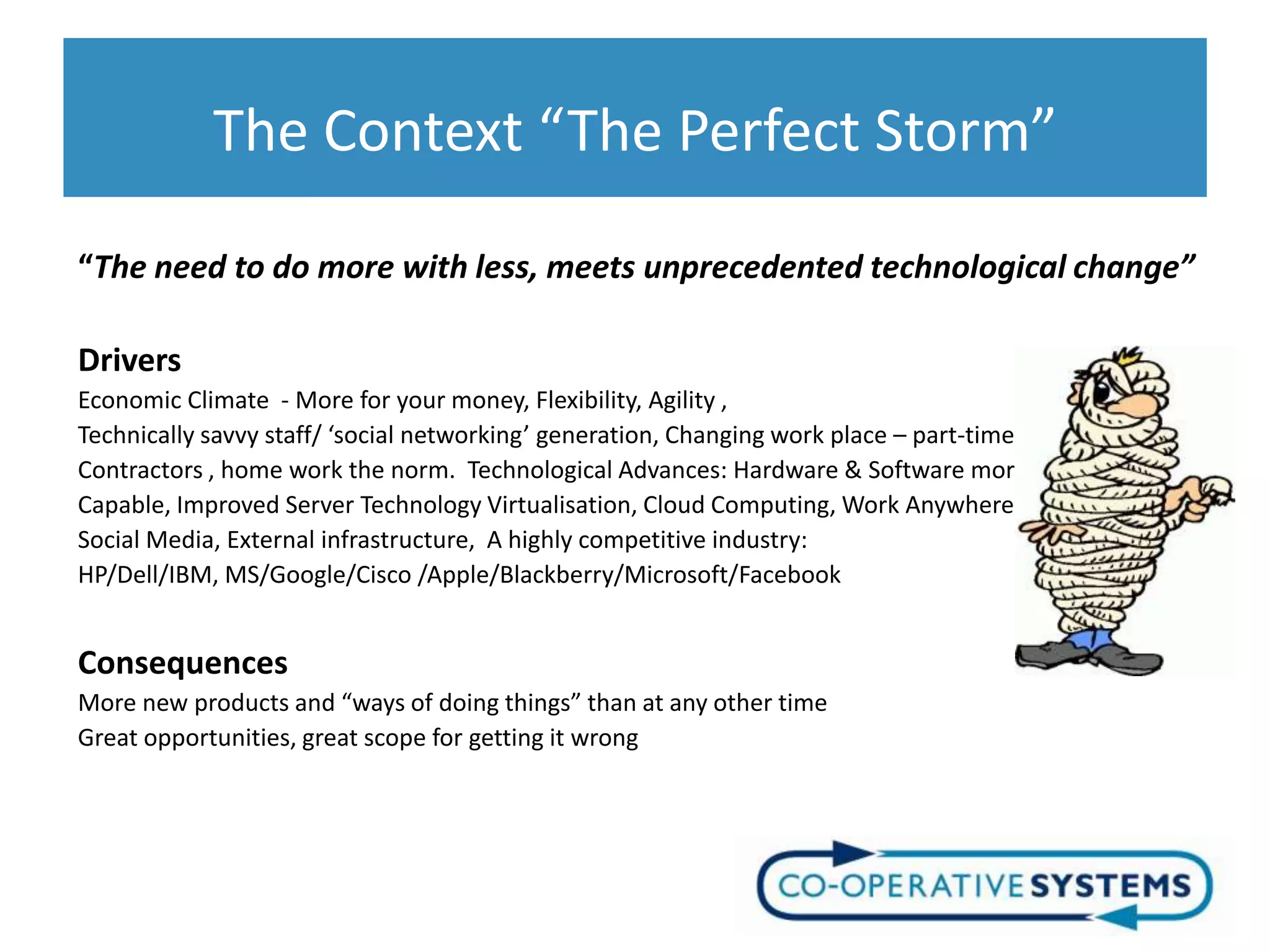
The Context “The Perfect Storm”

“The need to do more with less, meets unprecedented technological change”

Drivers
Economic Climate - More for your money, Flexibility, Agility ,
Technically savvy staff/ ‘social networking’ generation, Changing work place – part-time,
Contractors , home work the norm. Technological Advances: Hardware & Software more powerful,
Capable, Improved Server Technology Virtualisation, Cloud Computing, Work Anywhere
Social Media, External infrastructure, A highly competitive industry:
HP/Dell/IBM, MS/Google/Cisco /Apple/Blackberry/Microsoft/Facebook


Consequences
More new products and “ways of doing things” than at any other time
Great opportunities, great scope for getting it wrong
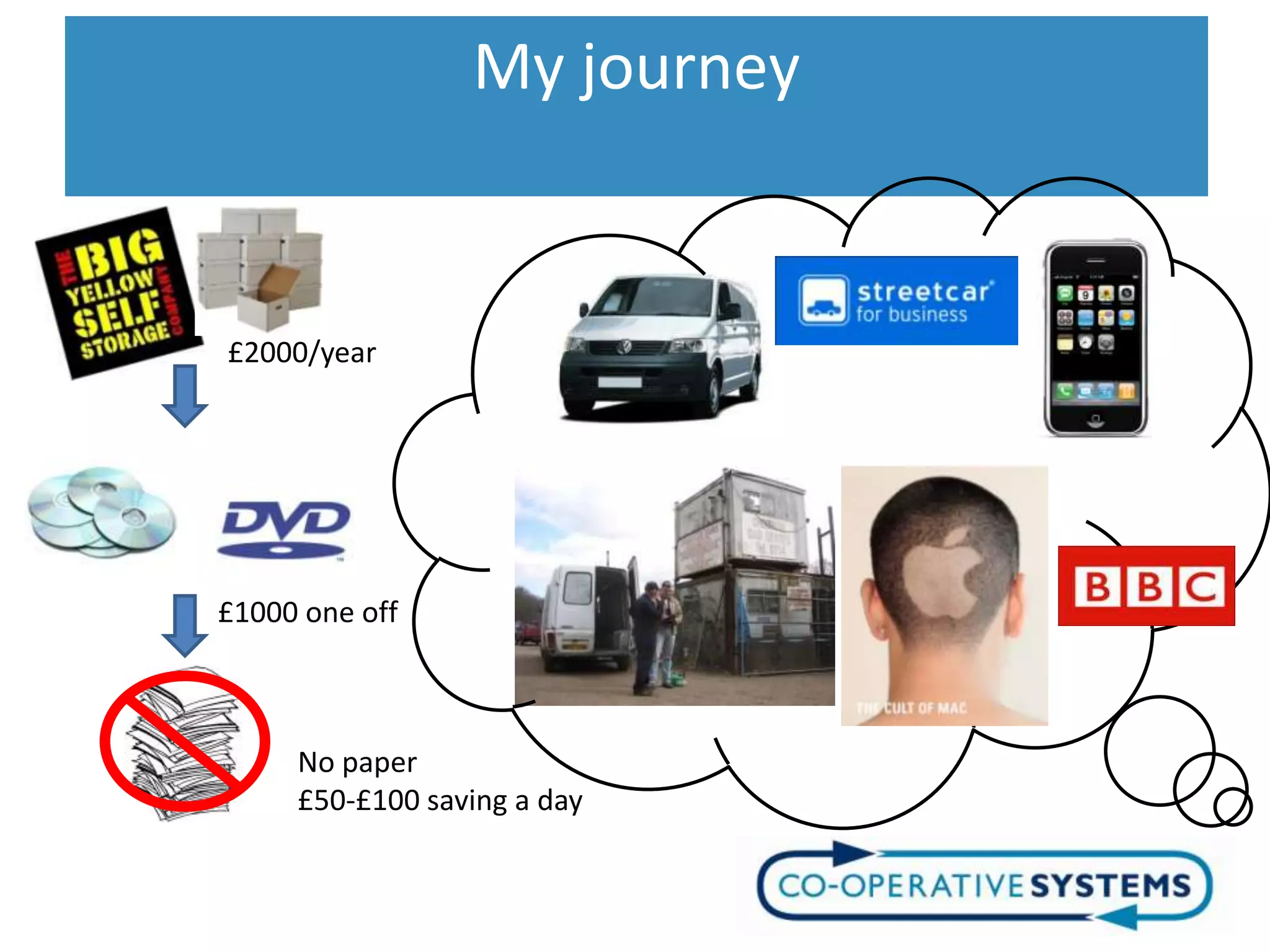
My journey


£2000/year


£1000 one off


     No paper
     £50-£100 saving a day
Content
                    Content

A look at things you can do to get better value out of IT

                      No magic bullet

          Get the mix right for your organisation
People,     Buildings   and IT


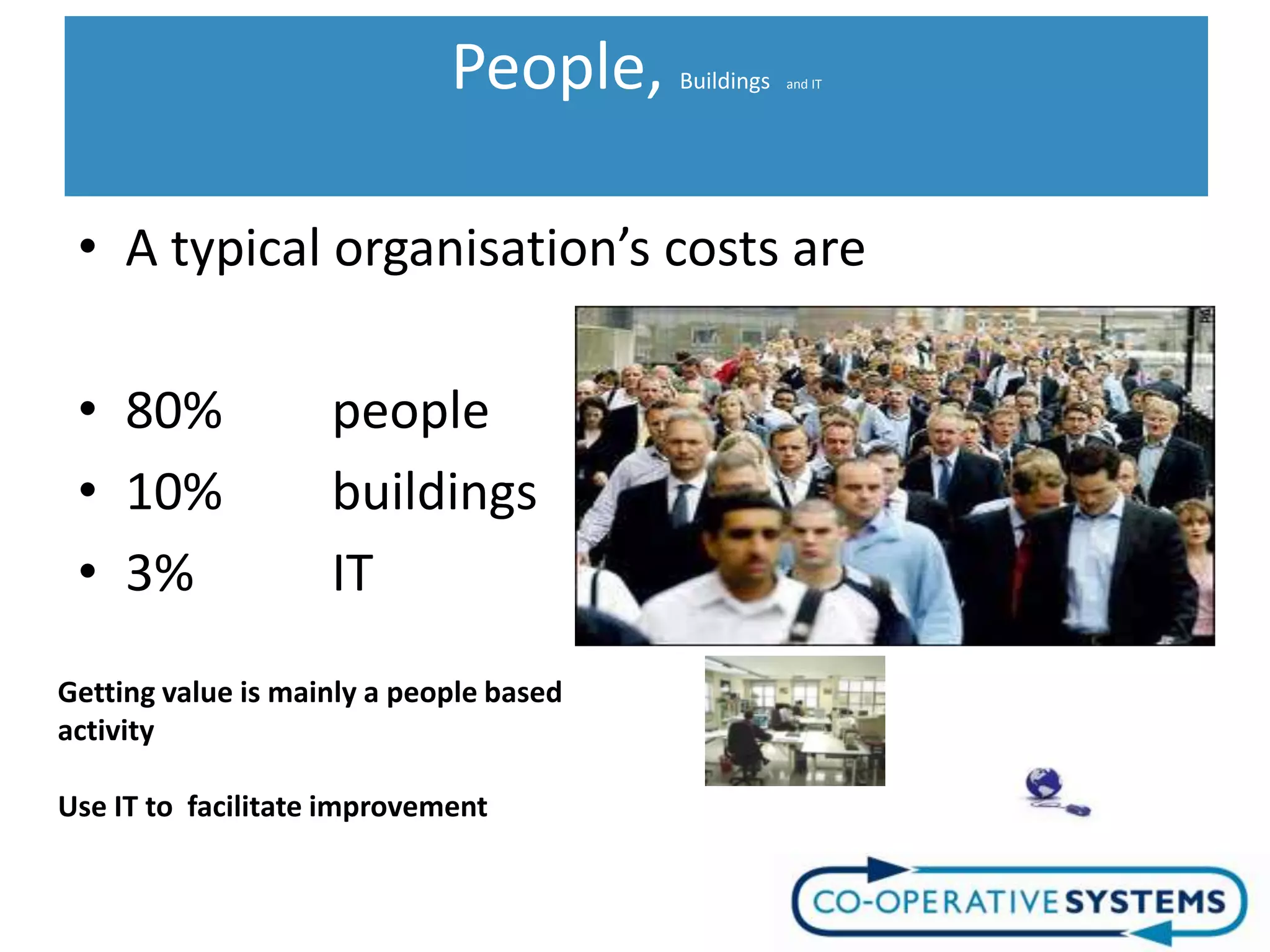
 • A typical organisation’s costs are

 • 80%              people
 • 10%              buildings
 • 3%               IT
Getting value is mainly a people based
activity

Use IT to facilitate improvement
Better, Faster, Cheaper?


A simple but very powerful way to assess any change

         Better+ Faster – (cost) >= Effort


                     Some Samples:

                     Mobile phones
                     Texting
                     Google Apps
                     Internet TV
                     I-mac vs PC?
‘All time’ guaranteed winners

•   Be professional
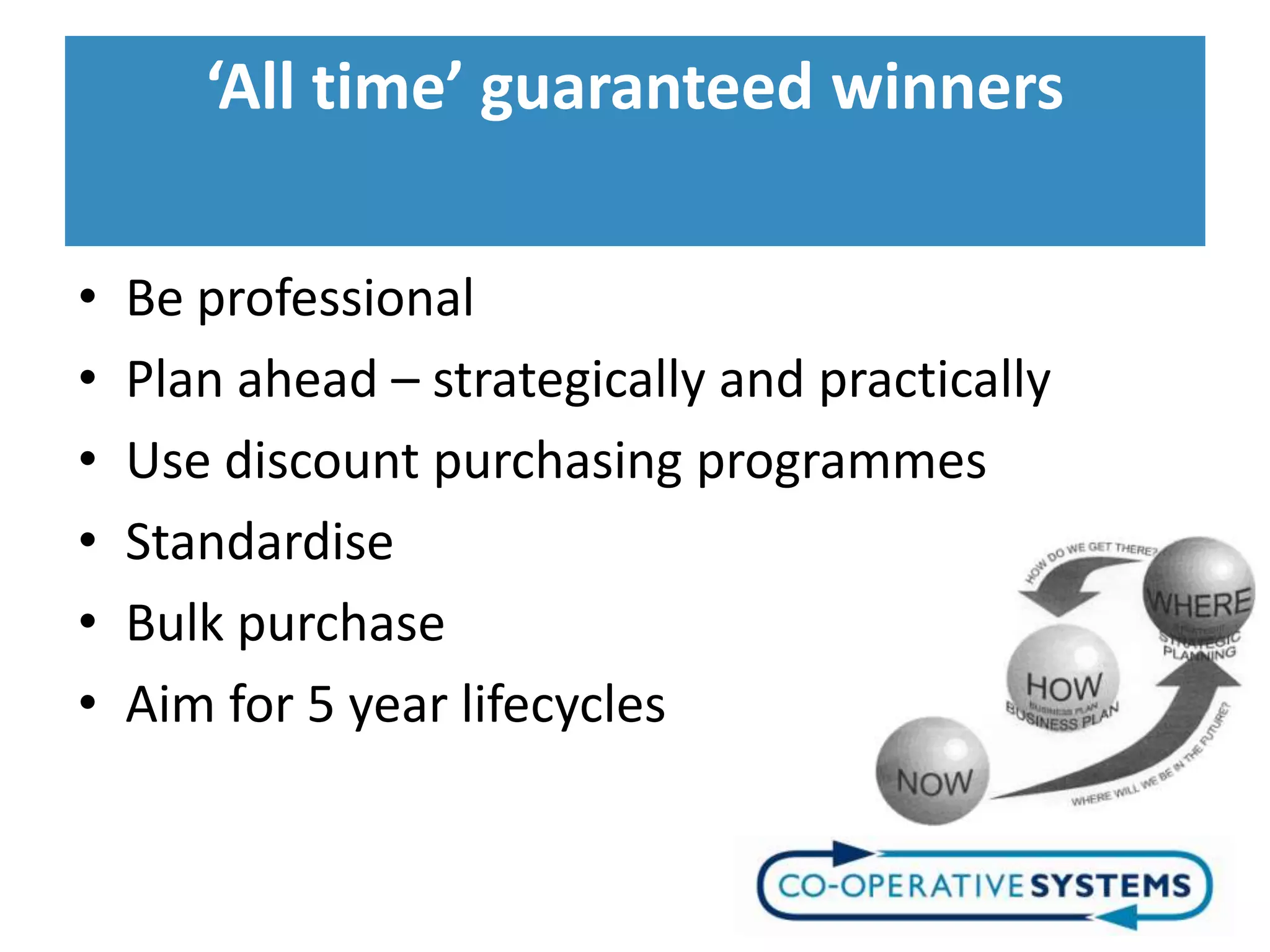
•   Plan ahead – strategically and practically
•   Use discount purchasing programmes
•   Standardise
•   Bulk purchase
•   Aim for 5 year lifecycles
Cloud
• Salvation at hand?
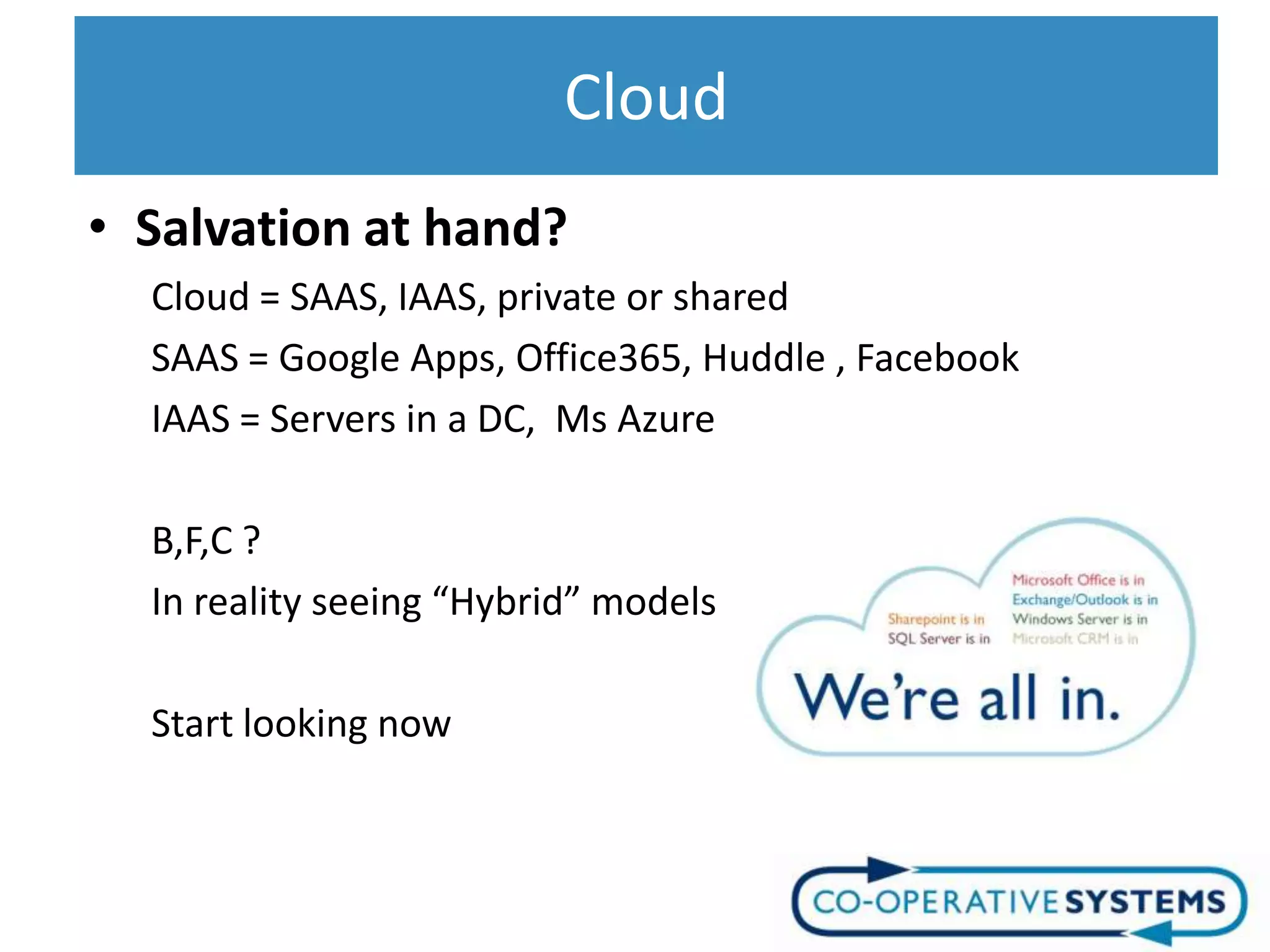
  Cloud = SAAS, IAAS, private or shared
  SAAS = Google Apps, Office365, Huddle , Facebook
  IAAS = Servers in a DC, Ms Azure

  B,F,C ?
  In reality seeing “Hybrid” models

  Start looking now
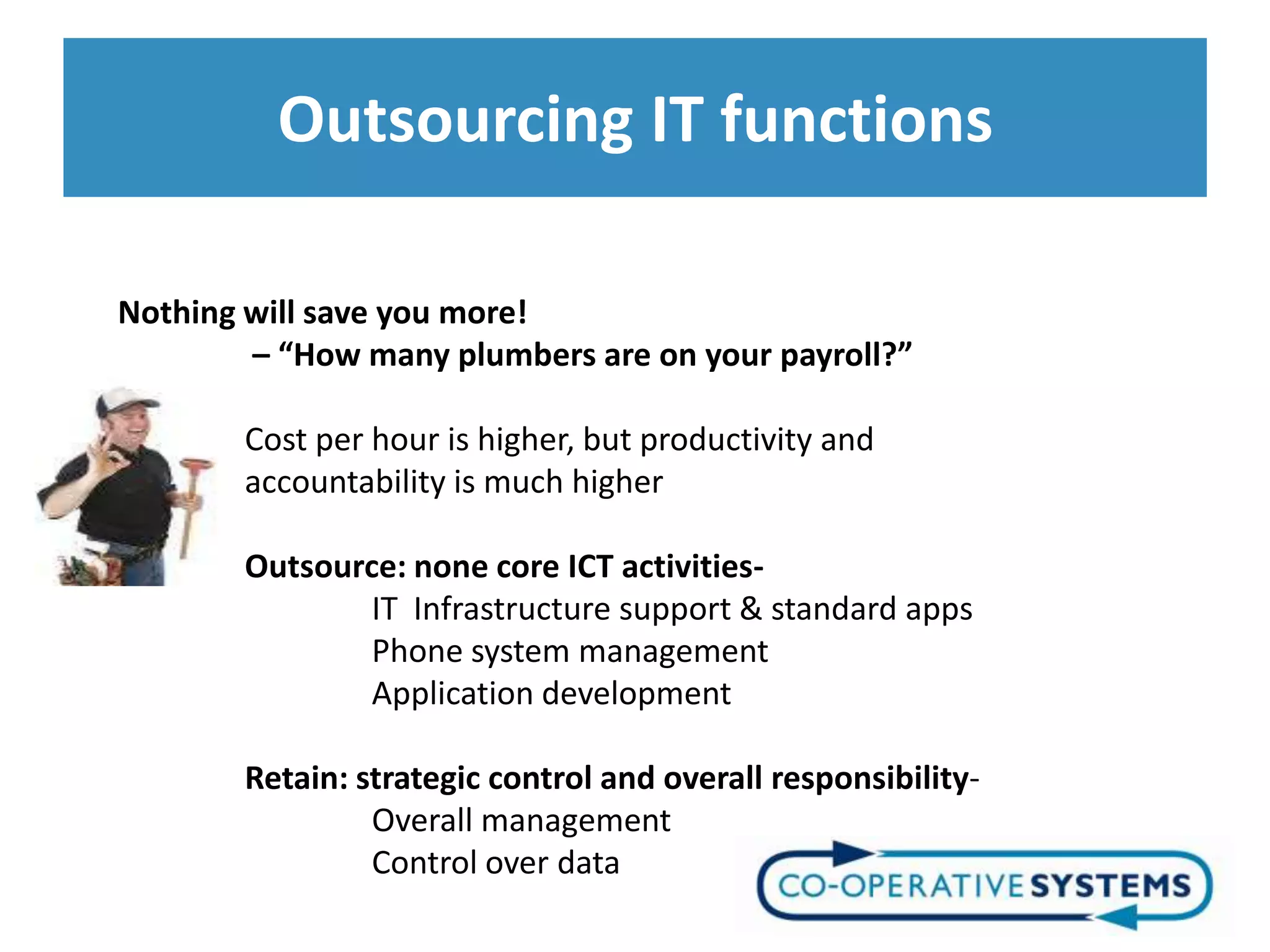
Outsourcing IT functions

Nothing will save you more!
        – “How many plumbers are on your payroll?”

       Cost per hour is higher, but productivity and
       accountability is much higher

       Outsource: none core ICT activities-
               IT Infrastructure support & standard apps
               Phone system management
               Application development

       Retain: strategic control and overall responsibility-
                Overall management
                Control over data
Look at the money - properly

What is the T.O.T.A.L cost over 5 years

What is the cost per user per day?

What is your lock in?

What are the alternatives ?
–eg Cloud Technologies - IAAS, SAAS

Should we move from ‘Capex to Opex’
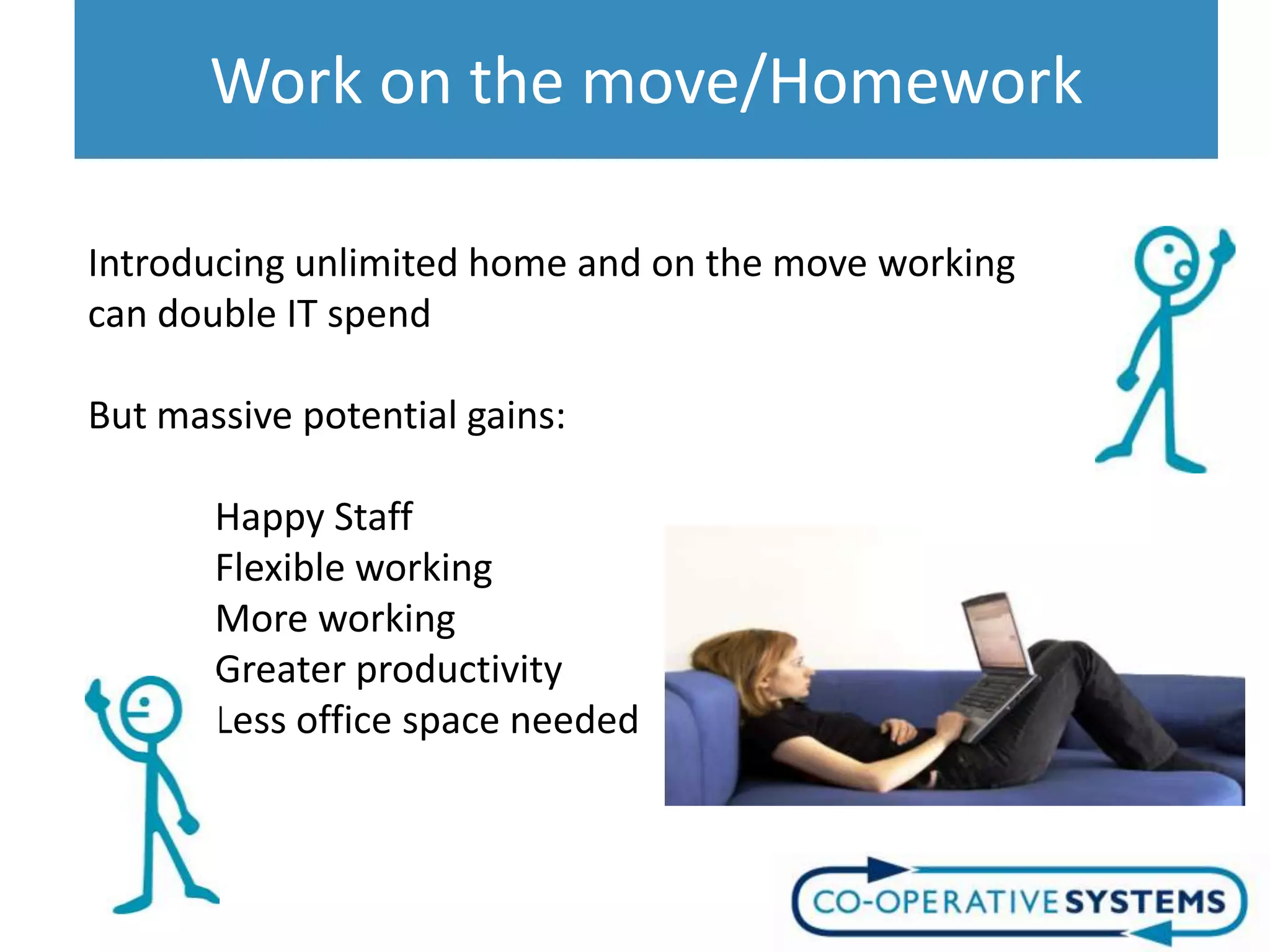
Work on the move/Homework

Introducing unlimited home and on the move working
can double IT spend

But massive potential gains:

       Happy Staff
       Flexible working
       More working
       Greater productivity
       Less office space needed
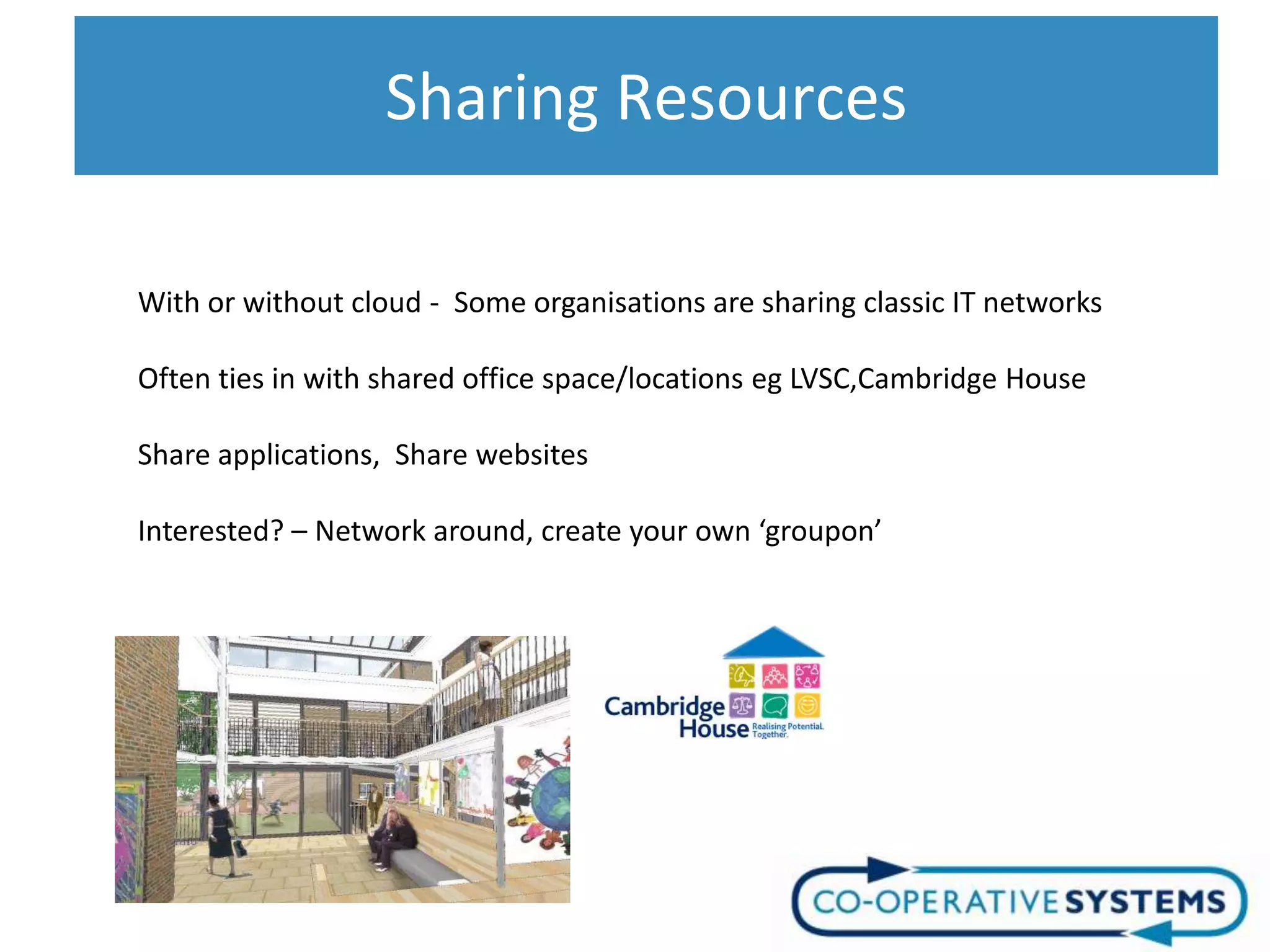
Sharing Resources

With or without cloud - Some organisations are sharing classic IT networks

Often ties in with shared office space/locations eg LVSC,Cambridge House

Share applications, Share websites

Interested? – Network around, create your own ‘groupon’
Try it Out
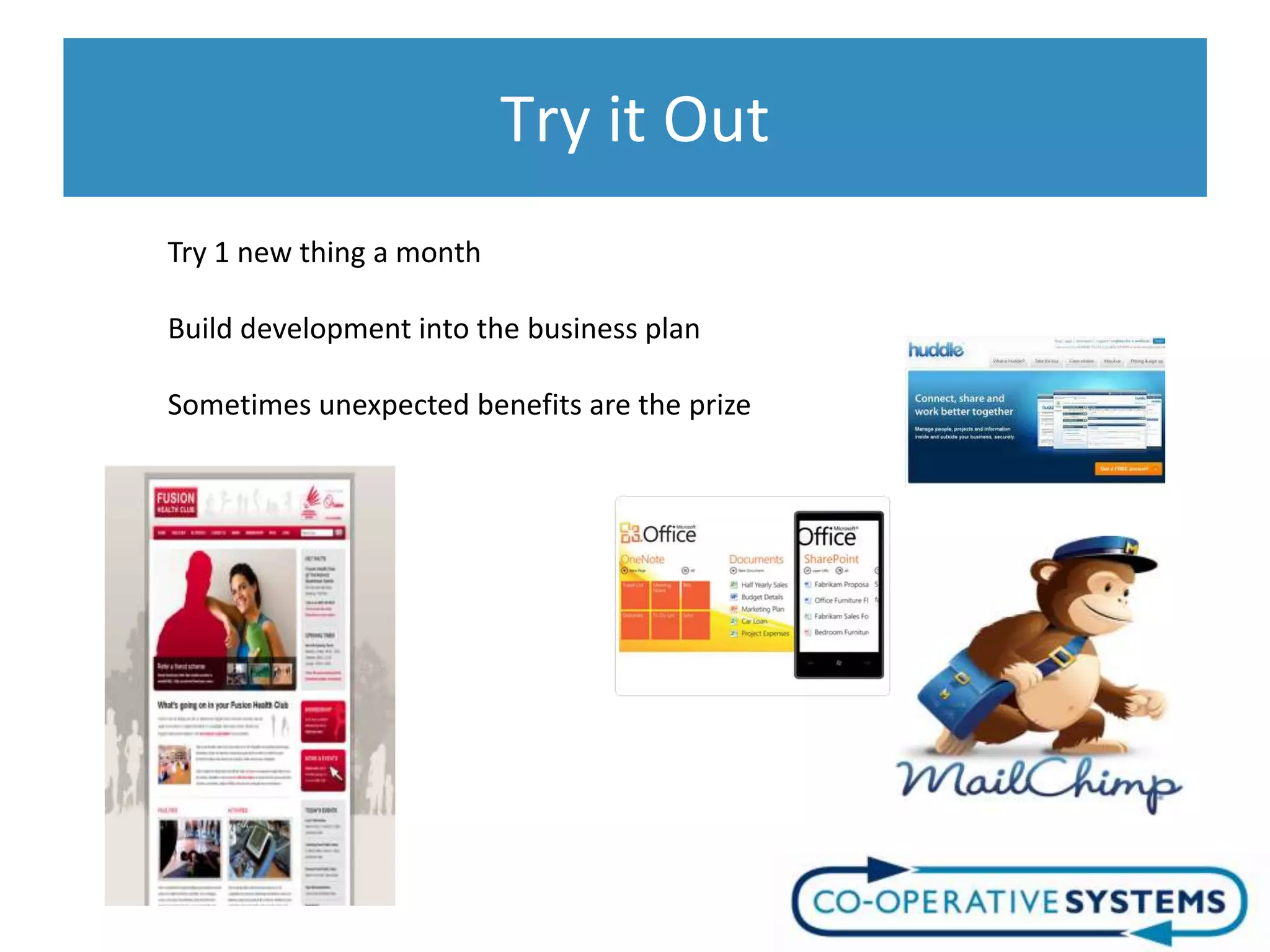
Try 1 new thing a month

Build development into the business plan

Sometimes unexpected benefits are the prize
Don’t have Disasters

Who has a plan? & …Who hasn’t got a plan?
     Complexity = Lots of ways things can go wrong

“Don’t be a fire-fighter, Remove the possibilities of fires”

                                   Remember ‘It could be you”
What causes most disruption?
No Backup
      • No media, never backed up, no second backup, no test restores (40% restores fail)

Internet Downtime
      • Your internet will be down two days per year , no plan B for email /web

Out of Space
      • Usually avoidable – out of storage space or email capacity

Human Error
      • “Inappropriate intervention”

Viral Malware Infection
      • AV subscription lapsed. No antispam protection

Windows Services Stopped
      • Updates or corruption

 Remember Downtime “costs”- typically £250 per user per day
Get rid of “Baggage”
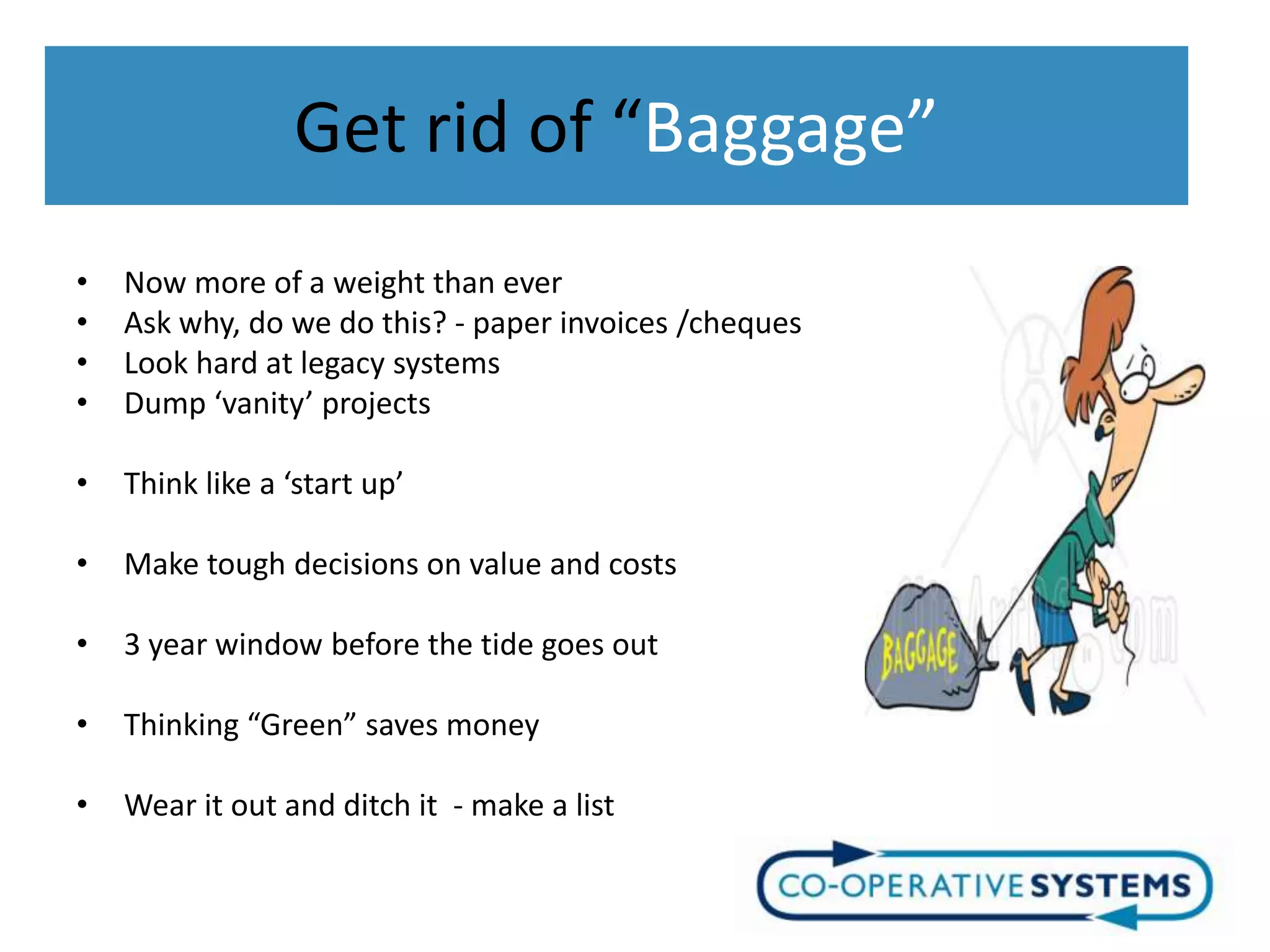
•   Now more of a weight than ever
•   Ask why, do we do this? - paper invoices /cheques
•   Look hard at legacy systems
•   Dump ‘vanity’ projects

•   Think like a ‘start up’

•   Make tough decisions on value and costs

•   3 year window before the tide goes out

•   Thinking “Green” saves money

•   Wear it out and ditch it - make a list
Beware Consumer Products

Be realistic on risks :

     Durability

     Level of support available

     Fit for purpose

     Legal

     Data-Loss
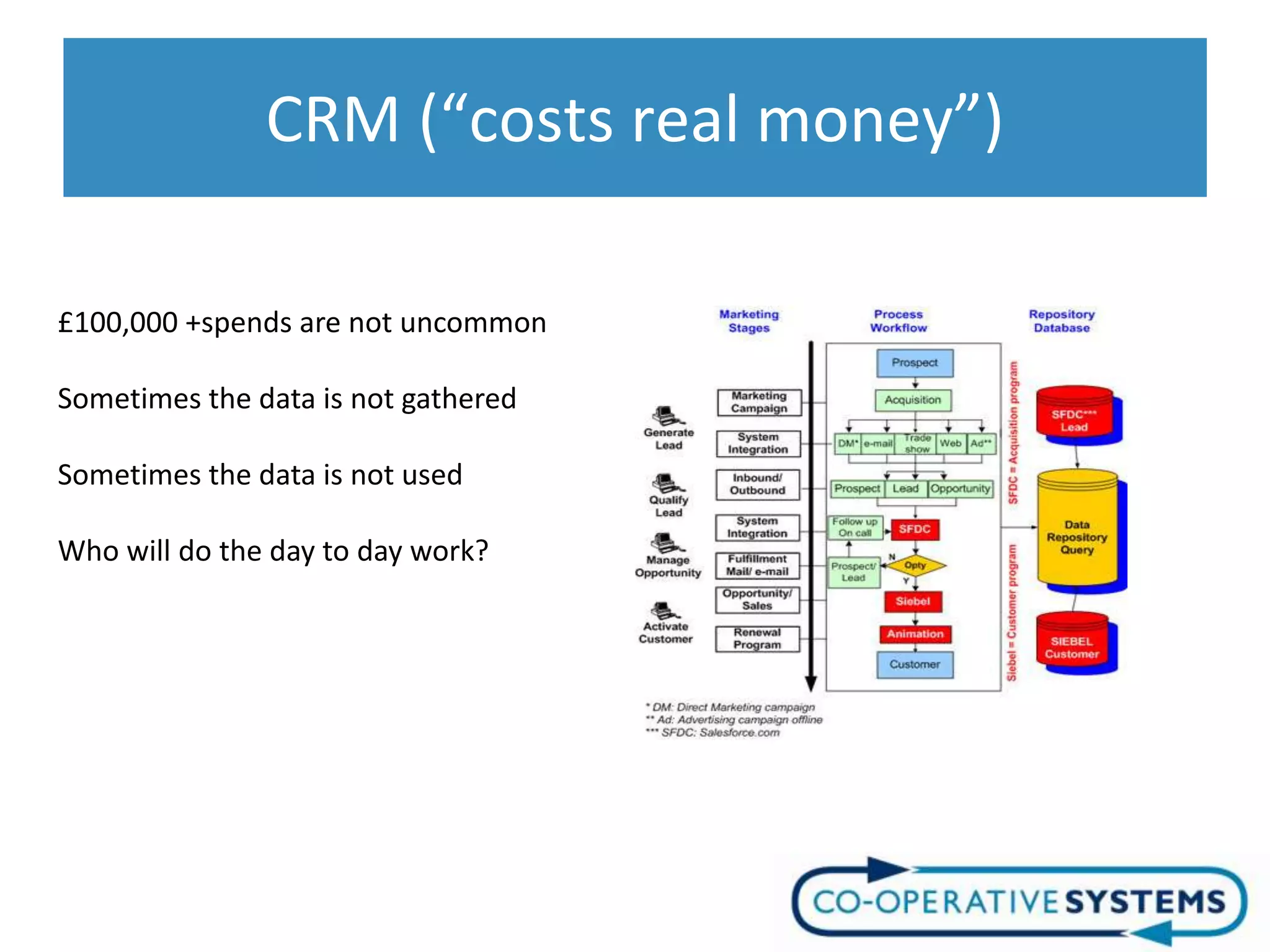
CRM (“costs real money”)

£100,000 +spends are not uncommon

Sometimes the data is not gathered

Sometimes the data is not used

Who will do the day to day work?
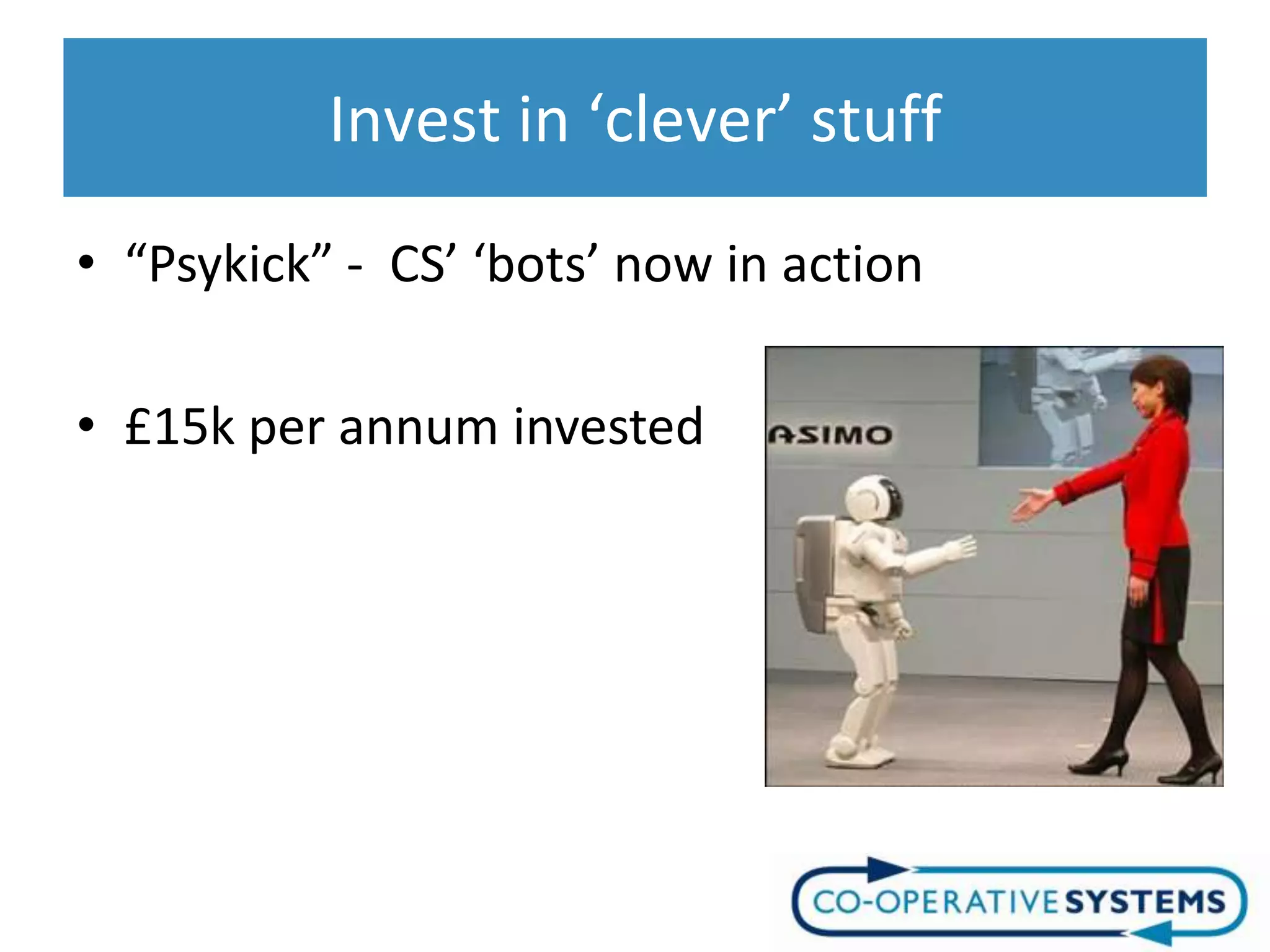
Invest in ‘clever’ stuff
• “Psykick” - CS’ ‘bots’ now in action

• £15k per annum invested
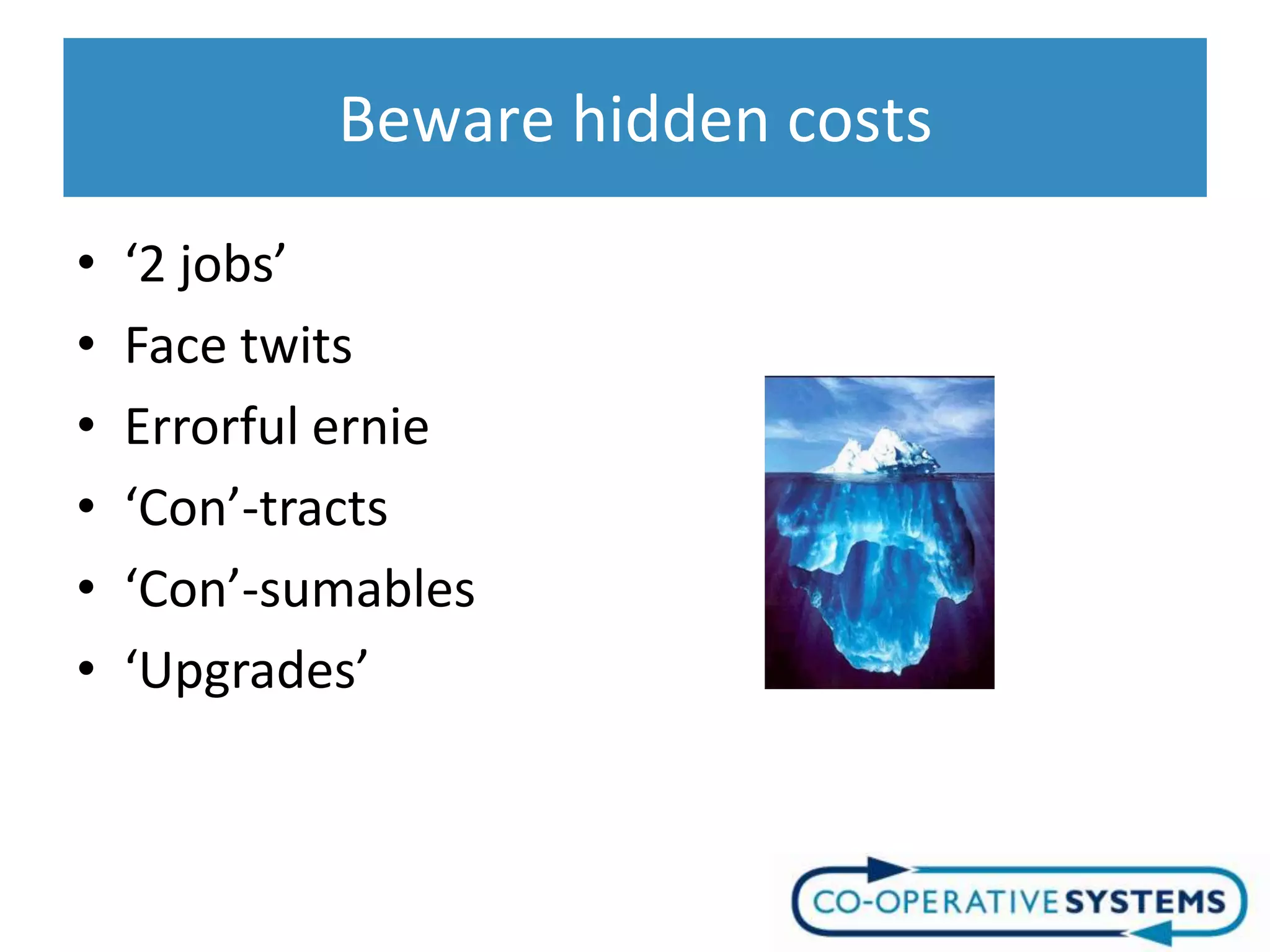
Beware hidden costs
•   ‘2 jobs’
•   Face twits
•   Errorful ernie
•   ‘Con’-tracts
•   ‘Con’-sumables
•   ‘Upgrades’
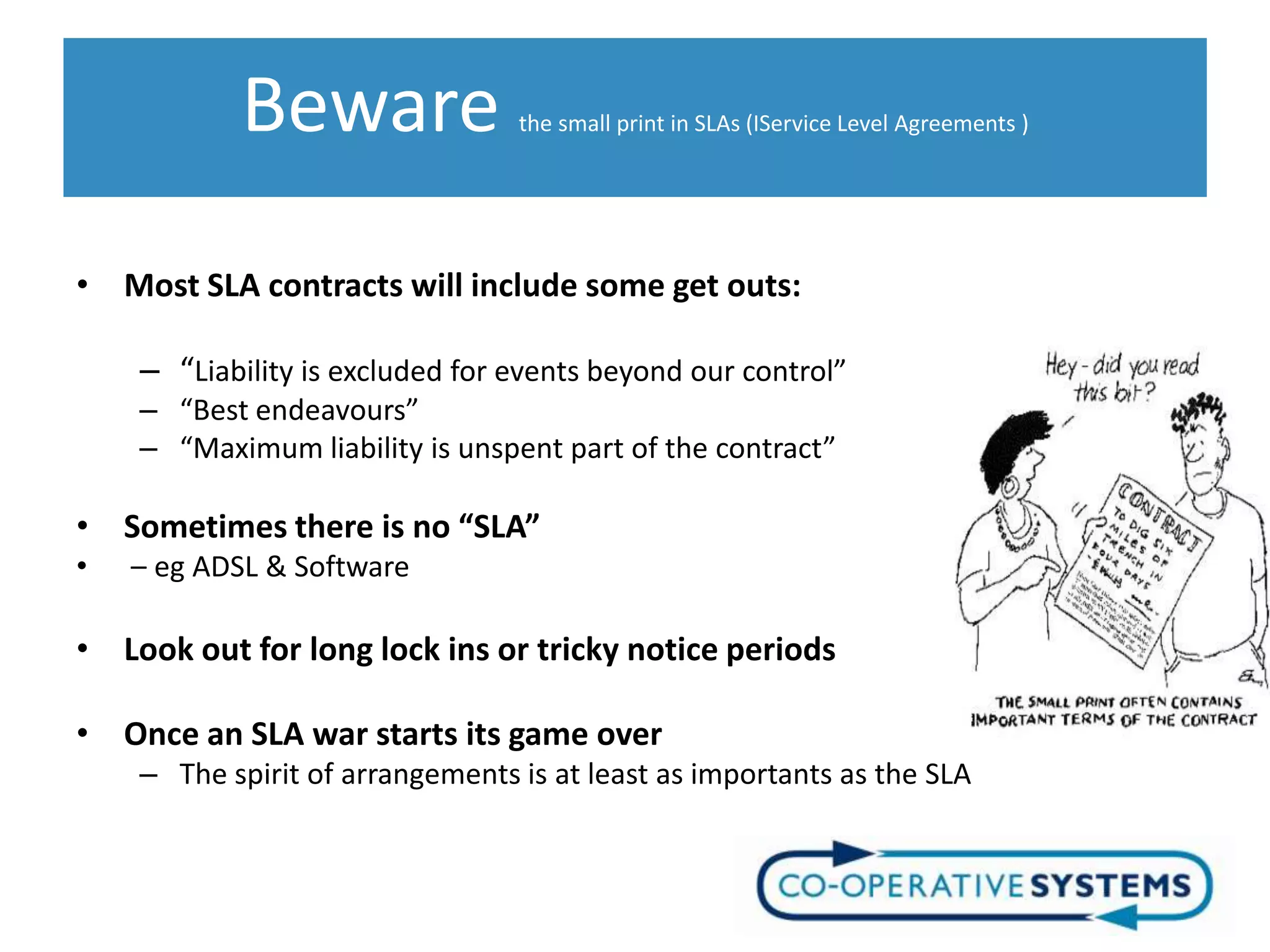
Beware                the small print in SLAs (IService Level Agreements )


• Most SLA contracts will include some get outs:

    – “Liability is excluded for events beyond our control”
    – “Best endeavours”
    – “Maximum liability is unspent part of the contract”

• Sometimes there is no “SLA”
•   – eg ADSL & Software

• Look out for long lock ins or tricky notice periods

• Once an SLA war starts its game over
    – The spirit of arrangements is at least as importants as the SLA
Benchmark ICT

• Look at aggregate spend and budget

• # issues per user per month

• Call satisfaction rates

• Talk to other people – how do they fare

• Mix and Match providers

• Mix and Match internal and external staff
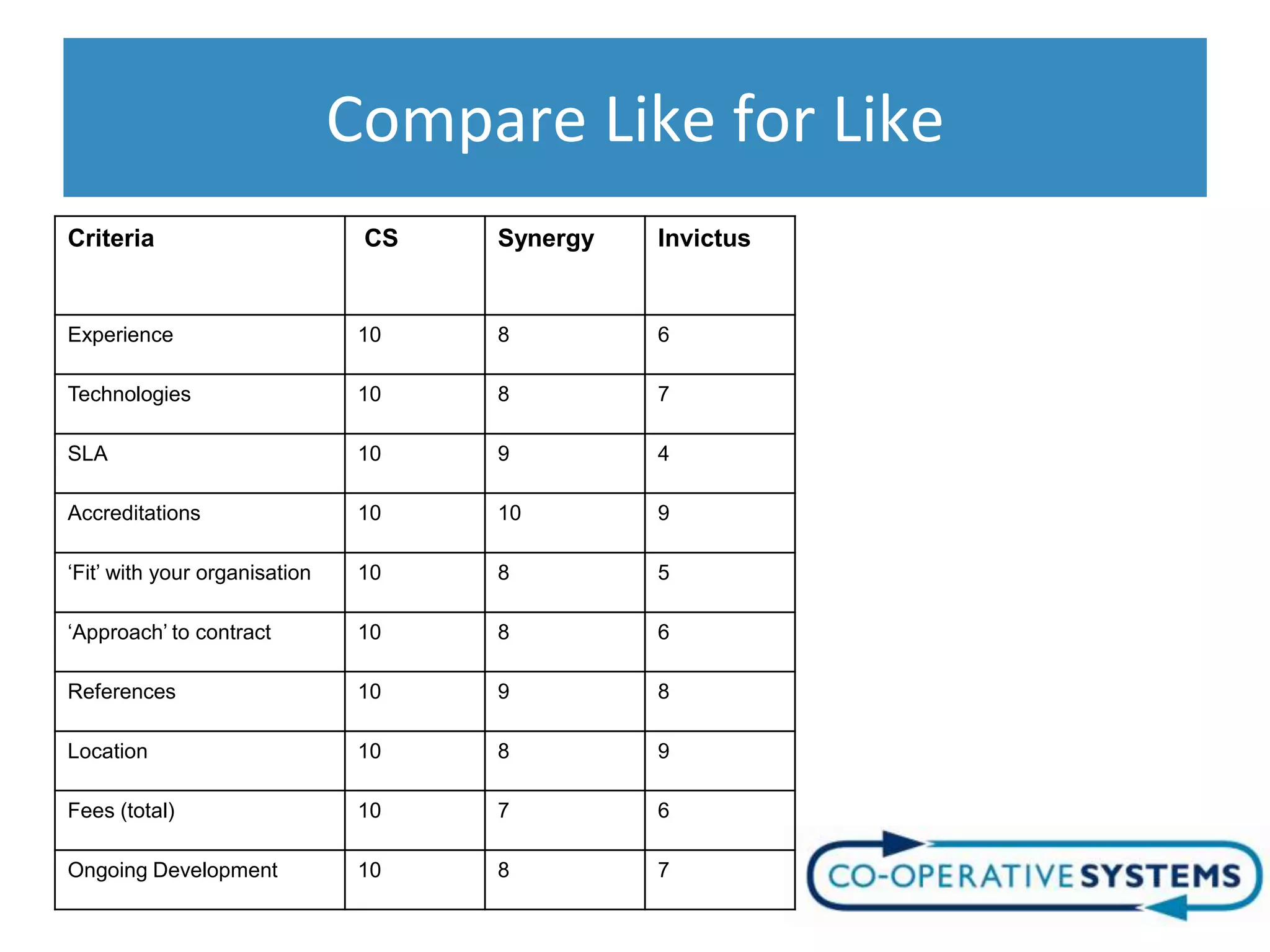
Compare Like for Like
Criteria                        CS   Synergy   Invictus


Experience                      10   8         6

Technologies                    10   8         7

SLA                             10   9         4

Accreditations                  10   10        9

‘Fit’ with your organisation    10   8         5

‘Approach’ to contract          10   8         6

References                      10   9         8

Location                        10   8         9

Fees (total)                    10   7         6

Ongoing Development             10   8         7
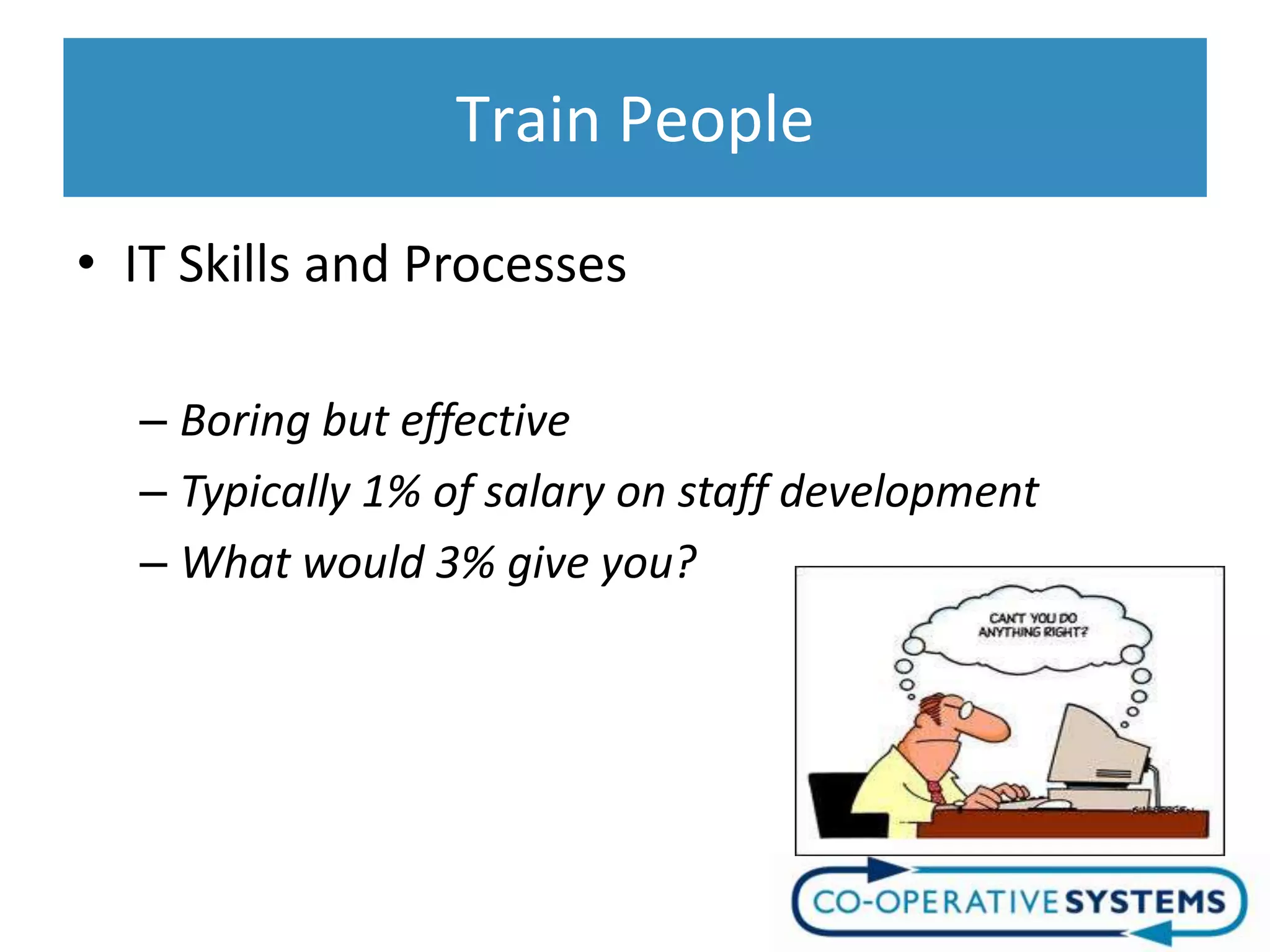
Train People
• IT Skills and Processes

  – Boring but effective
  – Typically 1% of salary on staff development
  – What would 3% give you?
Phil’s top 5 way to get good ICT value


       1.   Outsource - yes I would say that ;)
       2.   Get set up for full home and on the move working
       3.   Professional approach – an oldie but always true
       4.   Review your expensive baggage – eg CRM/Processes
       5.   Do clever stuff – what will give your organisation an edge?
Third Sector typical IT spend
• Species of IT spenders include:

  Make-do-n-mend – use Windows XP
  Minimalists – only use Google mail
  The ‘Focus’ group – use Win7, Office365
  To infinity and beyond – 20 staff, 5 servers, 3 IT staff
Third Sector typical IT spend

• IT Spend per user per annum - £600-1200 typically

• IT running costs per user per working day - £1-2 typically

• The more ‘aggressive’ the organisation the more it spends

• Spend is similar to private sector up to 20 staff

• Spend is less than similar sized private companies
  with 20+ staff
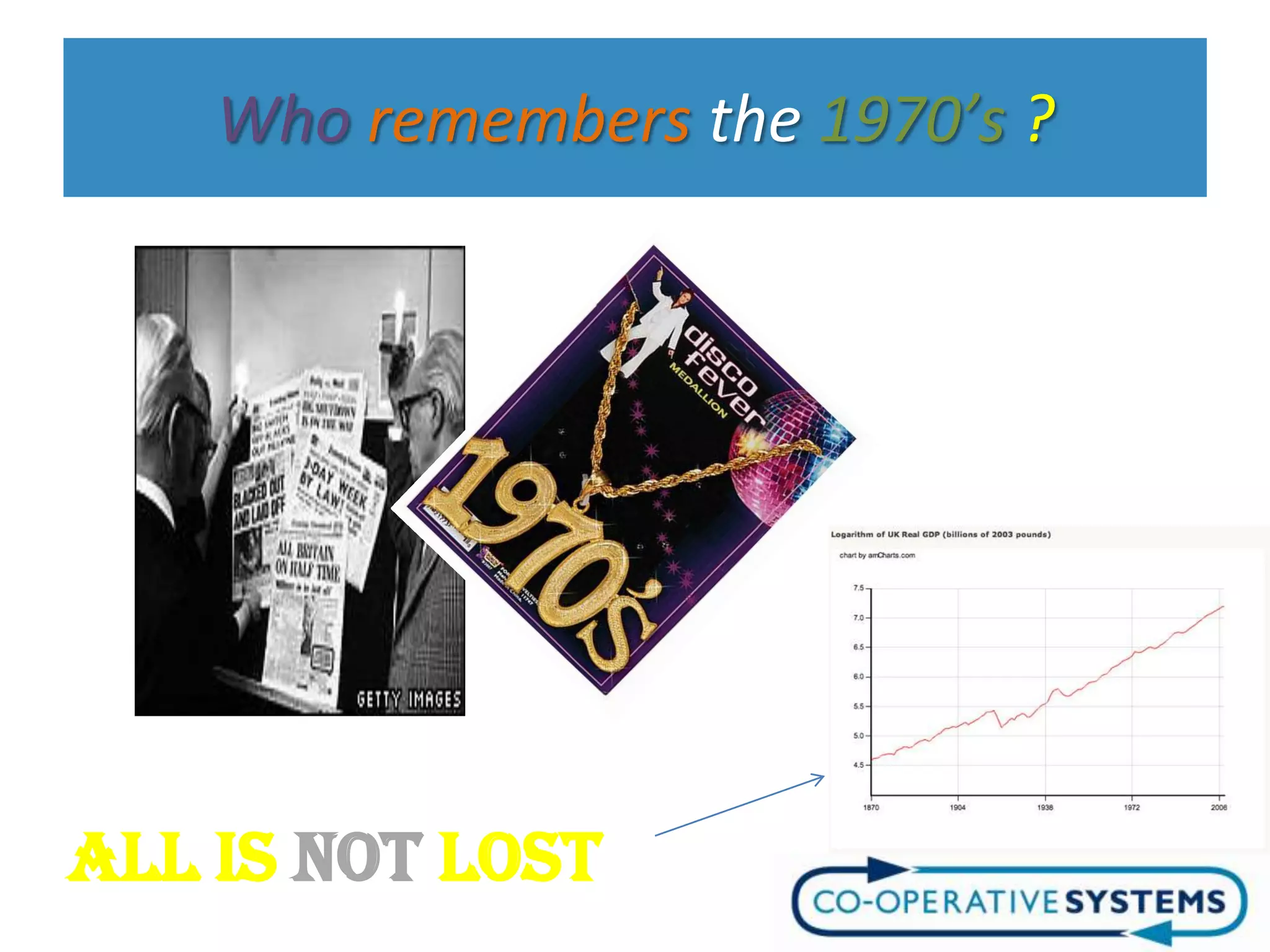
Who remembers the 1970’s ?


All is not lost
Q&A !
Thank You !
                  &
              Good Luck!

Philip Anthony/Co-Operative Systems

phil@coopsys.net
020 7793 0395

Getting good value from IT

  • 1.
    Getting good valuefrom IT “What would Bill, Steve, or Sergey & Larry do?” Philip Anthony/Co-Operative Systems
  • 2.
    The Context “ThePerfect Storm” “The need to do more with less, meets unprecedented technological change” Drivers Economic Climate - More for your money, Flexibility, Agility , Technically savvy staff/ ‘social networking’ generation, Changing work place – part-time, Contractors , home work the norm. Technological Advances: Hardware & Software more powerful, Capable, Improved Server Technology Virtualisation, Cloud Computing, Work Anywhere Social Media, External infrastructure, A highly competitive industry: HP/Dell/IBM, MS/Google/Cisco /Apple/Blackberry/Microsoft/Facebook Consequences More new products and “ways of doing things” than at any other time Great opportunities, great scope for getting it wrong
  • 3.
    My journey £2000/year £1000 oneoff No paper £50-£100 saving a day
  • 4.
    Content Content A look at things you can do to get better value out of IT No magic bullet Get the mix right for your organisation
  • 5.
    People, Buildings and IT • A typical organisation’s costs are • 80% people • 10% buildings • 3% IT Getting value is mainly a people based activity Use IT to facilitate improvement
  • 6.
    Better, Faster, Cheaper? Asimple but very powerful way to assess any change Better+ Faster – (cost) >= Effort Some Samples: Mobile phones Texting Google Apps Internet TV I-mac vs PC?
  • 7.
    ‘All time’ guaranteedwinners • Be professional • Plan ahead – strategically and practically • Use discount purchasing programmes • Standardise • Bulk purchase • Aim for 5 year lifecycles
  • 8.
    Cloud • Salvation athand? Cloud = SAAS, IAAS, private or shared SAAS = Google Apps, Office365, Huddle , Facebook IAAS = Servers in a DC, Ms Azure B,F,C ? In reality seeing “Hybrid” models Start looking now
  • 9.
    Outsourcing IT functions Nothingwill save you more! – “How many plumbers are on your payroll?” Cost per hour is higher, but productivity and accountability is much higher Outsource: none core ICT activities- IT Infrastructure support & standard apps Phone system management Application development Retain: strategic control and overall responsibility- Overall management Control over data
  • 10.
    Look at themoney - properly What is the T.O.T.A.L cost over 5 years What is the cost per user per day? What is your lock in? What are the alternatives ? –eg Cloud Technologies - IAAS, SAAS Should we move from ‘Capex to Opex’
  • 11.
    Work on themove/Homework Introducing unlimited home and on the move working can double IT spend But massive potential gains: Happy Staff Flexible working More working Greater productivity Less office space needed
  • 12.
    Sharing Resources With orwithout cloud - Some organisations are sharing classic IT networks Often ties in with shared office space/locations eg LVSC,Cambridge House Share applications, Share websites Interested? – Network around, create your own ‘groupon’
  • 13.
    Try it Out Try1 new thing a month Build development into the business plan Sometimes unexpected benefits are the prize
  • 14.
    Don’t have Disasters Whohas a plan? & …Who hasn’t got a plan? Complexity = Lots of ways things can go wrong “Don’t be a fire-fighter, Remove the possibilities of fires” Remember ‘It could be you”
  • 15.
    What causes mostdisruption? No Backup • No media, never backed up, no second backup, no test restores (40% restores fail) Internet Downtime • Your internet will be down two days per year , no plan B for email /web Out of Space • Usually avoidable – out of storage space or email capacity Human Error • “Inappropriate intervention” Viral Malware Infection • AV subscription lapsed. No antispam protection Windows Services Stopped • Updates or corruption Remember Downtime “costs”- typically £250 per user per day
  • 16.
    Get rid of“Baggage” • Now more of a weight than ever • Ask why, do we do this? - paper invoices /cheques • Look hard at legacy systems • Dump ‘vanity’ projects • Think like a ‘start up’ • Make tough decisions on value and costs • 3 year window before the tide goes out • Thinking “Green” saves money • Wear it out and ditch it - make a list
  • 17.
    Beware Consumer Products Berealistic on risks : Durability Level of support available Fit for purpose Legal Data-Loss
  • 18.
    CRM (“costs realmoney”) £100,000 +spends are not uncommon Sometimes the data is not gathered Sometimes the data is not used Who will do the day to day work?
  • 19.
    Invest in ‘clever’stuff • “Psykick” - CS’ ‘bots’ now in action • £15k per annum invested
  • 20.
    Beware hidden costs • ‘2 jobs’ • Face twits • Errorful ernie • ‘Con’-tracts • ‘Con’-sumables • ‘Upgrades’
  • 21.
    Beware the small print in SLAs (IService Level Agreements ) • Most SLA contracts will include some get outs: – “Liability is excluded for events beyond our control” – “Best endeavours” – “Maximum liability is unspent part of the contract” • Sometimes there is no “SLA” • – eg ADSL & Software • Look out for long lock ins or tricky notice periods • Once an SLA war starts its game over – The spirit of arrangements is at least as importants as the SLA
  • 22.
    Benchmark ICT • Lookat aggregate spend and budget • # issues per user per month • Call satisfaction rates • Talk to other people – how do they fare • Mix and Match providers • Mix and Match internal and external staff
  • 23.
    Compare Like forLike Criteria CS Synergy Invictus Experience 10 8 6 Technologies 10 8 7 SLA 10 9 4 Accreditations 10 10 9 ‘Fit’ with your organisation 10 8 5 ‘Approach’ to contract 10 8 6 References 10 9 8 Location 10 8 9 Fees (total) 10 7 6 Ongoing Development 10 8 7
  • 24.
    Train People • ITSkills and Processes – Boring but effective – Typically 1% of salary on staff development – What would 3% give you?
  • 25.
    Phil’s top 5way to get good ICT value 1. Outsource - yes I would say that ;) 2. Get set up for full home and on the move working 3. Professional approach – an oldie but always true 4. Review your expensive baggage – eg CRM/Processes 5. Do clever stuff – what will give your organisation an edge?
  • 26.
    Third Sector typicalIT spend • Species of IT spenders include: Make-do-n-mend – use Windows XP Minimalists – only use Google mail The ‘Focus’ group – use Win7, Office365 To infinity and beyond – 20 staff, 5 servers, 3 IT staff
  • 27.
    Third Sector typicalIT spend • IT Spend per user per annum - £600-1200 typically • IT running costs per user per working day - £1-2 typically • The more ‘aggressive’ the organisation the more it spends • Spend is similar to private sector up to 20 staff • Spend is less than similar sized private companies with 20+ staff
  • 28.
    Who remembers the1970’s ? All is not lost
  • 29.
  • 30.
    Thank You ! & Good Luck! Philip Anthony/Co-Operative Systems phil@coopsys.net 020 7793 0395

Editor's Notes

  • #2 http://pptfaq.com/FAQ00481.htmGood morning, thanks again for comingIt’s nice to seem some new and familiar faces. My name is Chris – CAMGoing to run through some of the current trends and technologies in the IT marketplaceThese are based on our experience and what organisations we work with are implementing and adopting and typical work we’ve undertaken, so gives you a good idea of what is going on in the sectorLots to cover, so I’m staying breif. We’ll have Q & A at the end, and some of the topics will be covered in more detail throughout the day.Equally, myself and anyone on my colleuqare will be more than happy to answer any questions you have, so do grab us at any point today.
  • #3 Technological Advances – Main reason for this. Hardware continues to increase in performance, and software in its capabilitiesIn terms of why people are adopting: Ecmonic climate Flexibilty StaffAll meaning more new way of doing thingsNew challengesBUT, of done correctly, the these developments can help build an IT infrastrure that will help you achive your ord goals
  • #4 Steady growth, gentle change, recession=major changeHow can we save money?Stored paperLess costly stored paperScanned paperNo more paper
  • #15 Now more important that ever to have a DR plan in place, with ever more reliance on IT.This does not have to be extremely complicated, but needs to show you have thought about what would happen in the event of a disaster and be happy with the amount of time it takes to get back up and running.