B. Education and Training as a Principle of
Cooperatives
➢ Best practices (Federation,
Union, Primaries)
➢ Adult Learning and Teaching
Module 1. Perspective Setting
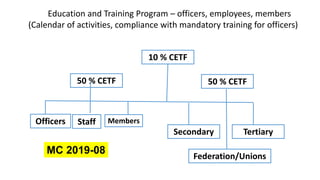
Education and Training Program – officers, employees, members
(Calendar of activities, compliance with mandatory training for officers)
10 % CETF
50 % CETF 50 % CETF
Officers Staff Members
Secondary Tertiary
Federation/Unions
MC 2019-08
MC 2020-01 Amending Sec 13, Transitory Provisions of MC No 2019-08 entitled “
{Policy Guidelines Governing the ALLOCATION, Utilization and remittance of CETF
of the Cooperative
Rule 7 of Revised IRR of RA 9520
and CDA MC 2015-09.
MC 2017-01 | CAPABILITY
BUILDING PROGRAM FOR MICRO
COOPERATIVES
MC 2015-09 | Revised Guidelines
Implementing the New Training
Requirements of Cooperative Officers
Training for Officers
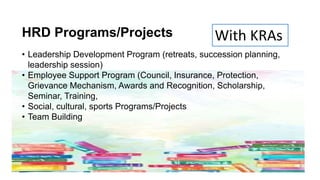
HRD Programs/Projects
• Leadership Development Program (retreats, succession planning,
leadership session)
• Employee Support Program (Council, Insurance, Protection,
Grievance Mechanism, Awards and Recognition, Scholarship,
Seminar, Training,
• Social, cultural, sports Programs/Projects
• Team Building
With KRAs
• Credit and Financial Services, Banking, Credit Surety Fund
and Insurance;
• Consumers, Marketing, Producers, and Logistics;
• Human Services: Health, Housing, Workers, and Labor
Service;
• Education and Advocacy;
• Agriculture, Agrarian, Aquaculture, Farmers, Dairy, and Fisher
folk; and
• Public Utilities: Electricity, Water, Communications, and
Transport.
Six Regional Clustered Organizations (RCOs) for every
region, as follows
Policy
• Policy on the utilization of the CETF and allocation for its
members, officers and employees. In no case shall the
allocation of the fund for officers and staff be higher than the
members (MC 2019-08).
• Policy requiring all officers to comply with the
mandatory trainings requirements (MC 2012-07)
Formal learning combined with informal learning from practical
experience remains essential in building successful co-operative
businesses today.
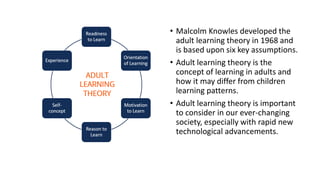
• Malcolm Knowles developed the
adult learning theory in 1968 and
is based upon six key assumptions.
• Adult learning theory is the
concept of learning in adults and
how it may differ from children
learning patterns.
• Adult learning theory is important
to consider in our ever-changing
society, especially with rapid new
technological advancements.
Adult learning was pioneered by Malcolm Knowles, an American practitioner and
theorists of adult education, who defines andragogy as “the art and science of helping
adults learn (Zmeyov 1998, Fidishun, 2000). With six key points or assumptions. The
assumptions are as follows
• Readiness to Learn – Adults who are ready to learn are usually spurred by a specific
reason, such as self-development and growth related to their work or career path.
• Orientation of Learning – Adults are more prone to learning when it is applicable to
everyday lives instead of general learning about certain subjects that are unrelated to our
lives. In general, adults will want to learn practical skills that will make their lives and work
more efficient.
• Motivation to Learn – Adults require their own motivations and reasons to learn new
things. As children, the reason for learning is simply because they are directed to learn;
however, adults need to develop their own motivation.
History of Adult Learning Theory
• Reason to Learn – Adults require a strong reason to learn, such as a
problem that they need to solve and an immediate application of new
knowledge.
• Self–concept – Adults’ learning is much more self-directed and
independent as they mature. It allows adults to decide when they want to
learn, what they want to learn, and how they want to learn. Such an
assumption shows that educators need to develop a plethora of choices
for adult learners, allowing them to design their own learning
environment.
• Experience – Adult learning, in contrast to children, includes a significant
amount of previous life experiences to rely upon to assist with new
learning experiences. The previous experiences can bring a unique
perspective that fosters discussions and are valuable learning resources.
However, they may also result in some biases and misinformation
Adult Learning Theory - Overview, History, How It Works (corporatefinanceinstitute.com)
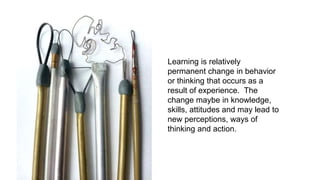
Learning is relatively
permanent change in behavior
or thinking that occurs as a
result of experience. The
change maybe in knowledge,
skills, attitudes and may lead to
new perceptions, ways of
thinking and action.
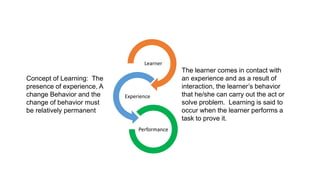
Learner
Experience
Performance
The learner comes in contact with
an experience and as a result of
interaction, the learner’s behavior
that he/she can carry out the act or
solve problem. Learning is said to
occur when the learner performs a
task to prove it.
Concept of Learning: The
presence of experience, A
change Behavior and the
change of behavior must
be relatively permanent
Knowles’ Five Assumptions About Adult Learners
• Self-Concept: Adults thrive in independent learning and training
scenarios.
• Experience: Adults learn experientially, meaning they learn from first-
hand observations and interactions.
• Readiness to Learn: Adults are attracted to learning most when they
know clear objectives.
• Orientation to Learning: Adults learn best when the topic is of
immediate value.
• Motivation to Learn: Adults are motivated by internal factors rather
than external pressures.
15 Top Strategies for Teaching Adult Learners [+ FAQs] –
University of San Diego - Professional & Continuing Education
Educators are encouraged to be mindful that adult students may have different learning
styles that connect to how they absorb and process information.
• Visual learners “prefer to be shown a lesson through graphs, diagrams, and illustrations.
They rely on what the instructor is doing and often sit in the front of the classroom to
avoid visual obstructions. The best form of communication is providing worksheets,
white boarding, and leveraging phrases such as, ‘Do you see how this works?’”
• Auditory learners “listen carefully to all sounds associated with the lesson. ‘Tell me’ is
their motto. They will pay close attention to the sound of your voice and all of its subtle
messages, and actively participate in discussions. You can best communicate with them
by speaking clearly, asking questions and using phrases like, ‘How does that sound to
you?’”
• Tactile learners, also called kinesthetic learners, “need to physically do something to
understand it. Their motto is ‘Let me do it.’” They trust their feelings and emotions about
what they’re learning and how you’re teaching it. Tactile learners are those students who
will get up and assist instructors with role-playing in the classroom.
Visual, Auditory, Read/Write, and Kinesthetic.
15 Strategies for Teaching Adult Learners
1) Keep your lessons relevant
2) Tell stories as you’re teaching
3) Break up the information to avoid cognitive overload
4) Get everyone involved
5) Keep them engaged
6) Focus on your learners’ life experience
7) Be mindful of different learning styles
8) Make your material visually stimulating
9) Let them explore on their own
10) Encourage questions and discussion
11) Provide feedback
12) Offer encouragement
13) Be flexible
14) Be passionate
15) Smile and have fun
• Knowledge – information, facts or figures
• Comprehension – understanding or ability
to change
• Application – Solving problem
• Analysis – Breaking down
• Synthesis – building up
• Evaluation – assess and pass judgment
Levels of Learning
The adage of
learning
• If I hear, I forget
• If I see, I
remember
• If I do, I know
• If I discover it, I
use it.
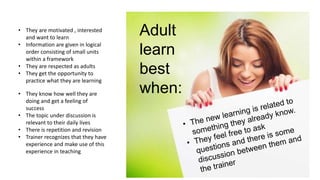
• They are motivated , interested
and want to learn
• Information are given in logical
order consisting of small units
within a framework
• They are respected as adults
• They get the opportunity to
practice what they are learning
Adult
learn
best
when:
• They know how well they are
doing and get a feeling of
success
• The topic under discussion is
relevant to their daily lives
• There is repetition and revision
• Trainer recognizes that they have
experience and make use of this
experience in teaching
© 2005 Prentice Hall Inc. All rights
reserved.
17–23
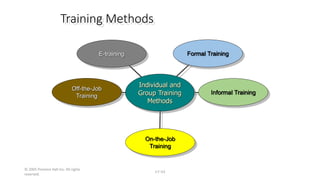
Training Methods
Individual and
Group Training
Methods
Formal Training
Informal Training
On-the-Job
Training
Off-the-Job
Training
E-training
© 2005 Prentice Hall Inc. All rights
reserved.
17–24
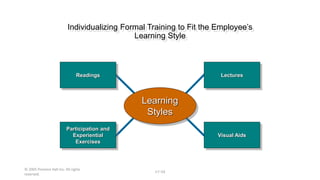
Individualizing Formal Training to Fit the Employee’s
Learning Style
Participation and
Experiential
Exercises
Readings Lectures
Visual Aids
Learning
Styles
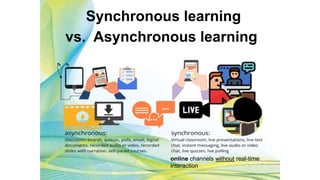
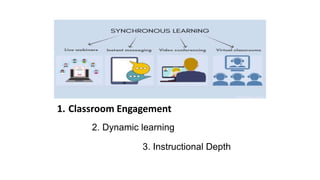
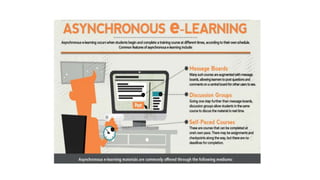
Synchronous learning
vs. Asynchronous learning
online channels without real-time
interaction
1. Classroom Engagement
2. Dynamic learning
3. Instructional Depth
DPA
MPA 209
MPA 207
MPA 208
✔active discussion
✔ immediate feedback
✔ personal familiarity
✔ real-time interaction
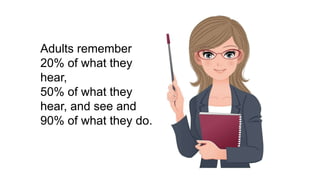
Adults remember
20% of what they
hear,
50% of what they
hear, and see and
90% of what they do.
6  Adult learning & teaching.pptx

6 Adult learning & teaching.pptx

  • 1.
    B. Education andTraining as a Principle of Cooperatives ➢ Best practices (Federation, Union, Primaries) ➢ Adult Learning and Teaching Module 1. Perspective Setting
  • 6.
    Education and TrainingProgram – officers, employees, members (Calendar of activities, compliance with mandatory training for officers) 10 % CETF 50 % CETF 50 % CETF Officers Staff Members Secondary Tertiary Federation/Unions MC 2019-08
  • 7.
    MC 2020-01 AmendingSec 13, Transitory Provisions of MC No 2019-08 entitled “ {Policy Guidelines Governing the ALLOCATION, Utilization and remittance of CETF of the Cooperative
  • 8.
    Rule 7 ofRevised IRR of RA 9520 and CDA MC 2015-09. MC 2017-01 | CAPABILITY BUILDING PROGRAM FOR MICRO COOPERATIVES MC 2015-09 | Revised Guidelines Implementing the New Training Requirements of Cooperative Officers Training for Officers
  • 9.
    HRD Programs/Projects • LeadershipDevelopment Program (retreats, succession planning, leadership session) • Employee Support Program (Council, Insurance, Protection, Grievance Mechanism, Awards and Recognition, Scholarship, Seminar, Training, • Social, cultural, sports Programs/Projects • Team Building With KRAs
  • 10.
    • Credit andFinancial Services, Banking, Credit Surety Fund and Insurance; • Consumers, Marketing, Producers, and Logistics; • Human Services: Health, Housing, Workers, and Labor Service; • Education and Advocacy; • Agriculture, Agrarian, Aquaculture, Farmers, Dairy, and Fisher folk; and • Public Utilities: Electricity, Water, Communications, and Transport. Six Regional Clustered Organizations (RCOs) for every region, as follows
  • 11.
    Policy • Policy onthe utilization of the CETF and allocation for its members, officers and employees. In no case shall the allocation of the fund for officers and staff be higher than the members (MC 2019-08). • Policy requiring all officers to comply with the mandatory trainings requirements (MC 2012-07)
  • 12.
    Formal learning combinedwith informal learning from practical experience remains essential in building successful co-operative businesses today.
  • 13.
    • Malcolm Knowlesdeveloped the adult learning theory in 1968 and is based upon six key assumptions. • Adult learning theory is the concept of learning in adults and how it may differ from children learning patterns. • Adult learning theory is important to consider in our ever-changing society, especially with rapid new technological advancements.
  • 14.
    Adult learning waspioneered by Malcolm Knowles, an American practitioner and theorists of adult education, who defines andragogy as “the art and science of helping adults learn (Zmeyov 1998, Fidishun, 2000). With six key points or assumptions. The assumptions are as follows • Readiness to Learn – Adults who are ready to learn are usually spurred by a specific reason, such as self-development and growth related to their work or career path. • Orientation of Learning – Adults are more prone to learning when it is applicable to everyday lives instead of general learning about certain subjects that are unrelated to our lives. In general, adults will want to learn practical skills that will make their lives and work more efficient. • Motivation to Learn – Adults require their own motivations and reasons to learn new things. As children, the reason for learning is simply because they are directed to learn; however, adults need to develop their own motivation. History of Adult Learning Theory
  • 15.
    • Reason toLearn – Adults require a strong reason to learn, such as a problem that they need to solve and an immediate application of new knowledge. • Self–concept – Adults’ learning is much more self-directed and independent as they mature. It allows adults to decide when they want to learn, what they want to learn, and how they want to learn. Such an assumption shows that educators need to develop a plethora of choices for adult learners, allowing them to design their own learning environment. • Experience – Adult learning, in contrast to children, includes a significant amount of previous life experiences to rely upon to assist with new learning experiences. The previous experiences can bring a unique perspective that fosters discussions and are valuable learning resources. However, they may also result in some biases and misinformation Adult Learning Theory - Overview, History, How It Works (corporatefinanceinstitute.com)
  • 16.
    Learning is relatively permanentchange in behavior or thinking that occurs as a result of experience. The change maybe in knowledge, skills, attitudes and may lead to new perceptions, ways of thinking and action.
  • 17.
    Learner Experience Performance The learner comesin contact with an experience and as a result of interaction, the learner’s behavior that he/she can carry out the act or solve problem. Learning is said to occur when the learner performs a task to prove it. Concept of Learning: The presence of experience, A change Behavior and the change of behavior must be relatively permanent
  • 18.
    Knowles’ Five AssumptionsAbout Adult Learners • Self-Concept: Adults thrive in independent learning and training scenarios. • Experience: Adults learn experientially, meaning they learn from first- hand observations and interactions. • Readiness to Learn: Adults are attracted to learning most when they know clear objectives. • Orientation to Learning: Adults learn best when the topic is of immediate value. • Motivation to Learn: Adults are motivated by internal factors rather than external pressures. 15 Top Strategies for Teaching Adult Learners [+ FAQs] – University of San Diego - Professional & Continuing Education
  • 19.
    Educators are encouragedto be mindful that adult students may have different learning styles that connect to how they absorb and process information. • Visual learners “prefer to be shown a lesson through graphs, diagrams, and illustrations. They rely on what the instructor is doing and often sit in the front of the classroom to avoid visual obstructions. The best form of communication is providing worksheets, white boarding, and leveraging phrases such as, ‘Do you see how this works?’” • Auditory learners “listen carefully to all sounds associated with the lesson. ‘Tell me’ is their motto. They will pay close attention to the sound of your voice and all of its subtle messages, and actively participate in discussions. You can best communicate with them by speaking clearly, asking questions and using phrases like, ‘How does that sound to you?’” • Tactile learners, also called kinesthetic learners, “need to physically do something to understand it. Their motto is ‘Let me do it.’” They trust their feelings and emotions about what they’re learning and how you’re teaching it. Tactile learners are those students who will get up and assist instructors with role-playing in the classroom. Visual, Auditory, Read/Write, and Kinesthetic.
  • 20.
    15 Strategies forTeaching Adult Learners 1) Keep your lessons relevant 2) Tell stories as you’re teaching 3) Break up the information to avoid cognitive overload 4) Get everyone involved 5) Keep them engaged 6) Focus on your learners’ life experience 7) Be mindful of different learning styles 8) Make your material visually stimulating 9) Let them explore on their own 10) Encourage questions and discussion 11) Provide feedback 12) Offer encouragement 13) Be flexible 14) Be passionate 15) Smile and have fun
  • 21.
    • Knowledge –information, facts or figures • Comprehension – understanding or ability to change • Application – Solving problem • Analysis – Breaking down • Synthesis – building up • Evaluation – assess and pass judgment Levels of Learning The adage of learning • If I hear, I forget • If I see, I remember • If I do, I know • If I discover it, I use it.
  • 22.
    • They aremotivated , interested and want to learn • Information are given in logical order consisting of small units within a framework • They are respected as adults • They get the opportunity to practice what they are learning Adult learn best when: • They know how well they are doing and get a feeling of success • The topic under discussion is relevant to their daily lives • There is repetition and revision • Trainer recognizes that they have experience and make use of this experience in teaching
  • 23.
    © 2005 PrenticeHall Inc. All rights reserved. 17–23 Training Methods Individual and Group Training Methods Formal Training Informal Training On-the-Job Training Off-the-Job Training E-training
  • 24.
    © 2005 PrenticeHall Inc. All rights reserved. 17–24 Individualizing Formal Training to Fit the Employee’s Learning Style Participation and Experiential Exercises Readings Lectures Visual Aids Learning Styles
  • 25.
    Synchronous learning vs. Asynchronouslearning online channels without real-time interaction
  • 26.
    1. Classroom Engagement 2.Dynamic learning 3. Instructional Depth
  • 27.
    DPA MPA 209 MPA 207 MPA208 ✔active discussion ✔ immediate feedback ✔ personal familiarity ✔ real-time interaction
  • 29.
    Adults remember 20% ofwhat they hear, 50% of what they hear, and see and 90% of what they do.