



PERFORMANCE
OBJECTIVE SETTING
(a tutorial)
01/31/15
Objective Setting
01/31/15
“If you do
not know
where you
are
going...how
will you
know when
you have
arrived?”
01/31/15
 REFRESHER ON KEY TERMS GENERIC TO
PERFORMANCE MANAGEMENT
 GOALS and OBJECTIVES
 SETTING OBJECTIVES
¤¤ Why should we write objectives?
¤¤ What is a SMART Objective?
¤¤ Evaluating an Objective
¤¤ Focus: PERFORMANCE OBJECTIVES
¤¤ SMARTER Performance Objectives
 SETTING PERFORMANCE STANDARDS
¤¤ Performance Indicators & Standards
 GFB BUSINESS PLAN 2006-2007
 PRACTICE TIME!!!
 CONCLUSION / Integration
ContentsContents
01/31/15
Refresher on Key Terms
(generic to PERFORMANCE
MANAGEMENT)
 Definitions (PMS)
 task, function, role, job, job description
 competencies
 domain
 results, measures, indicators, standards
 organizational goals
 aligning results
 weighting results
 performance plans
 observing, measurement and feedback
 performance gap, developmental plans
01/31/15
WARM UP
QUIZ!!!
01/31/15
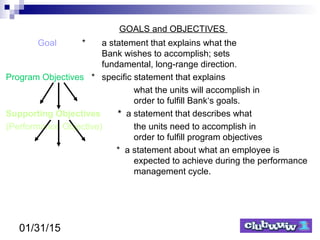
GOALS and OBJECTIVES
Goal * a statement that explains what the
Bank wishes to accomplish; sets
fundamental, long-range direction.
Program Objectives * specific statement that explains
what the units will accomplish in
order to fulfill Bank‘s goals.
Supporting Objectives * a statement that describes what
(Performance Objective) the units need to accomplish in
order to fulfill program objectives
* a statement about what an employee is
expected to achieve during the performance
management cycle.
01/31/15
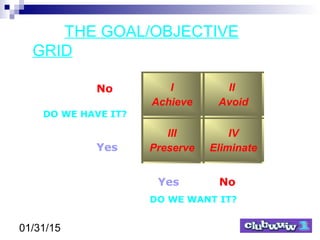
THE GOAL/OBJECTIVE
GRID
I
Achieve
II
Avoid
III
Preserve
IV
Eliminate
DO WE HAVE IT?
DO WE WANT IT?
No
Yes
NoYes
01/31/15
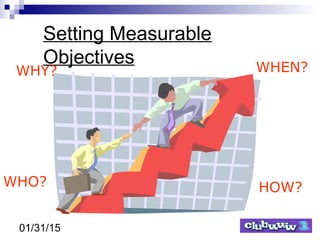
Setting Measurable
Objectives
WHY?
WHO?
WHEN?
HOW?
01/31/15
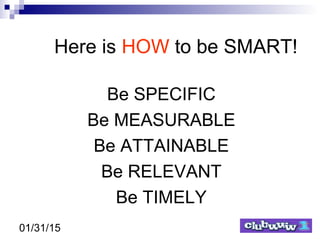
Here is HOW to be SMART!
Be SPECIFIC
Be MEASURABLE
Be ATTAINABLE
Be RELEVANT
Be TIMELY
01/31/15
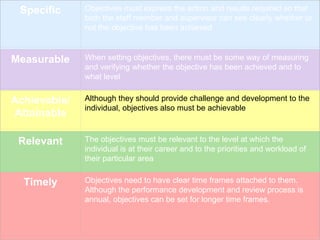
Specific Objectives must express the action and results required so that
both the staff member and supervisor can see clearly whether or
not the objective has been achieved
Measurable When setting objectives, there must be some way of measuring
and verifying whether the objective has been achieved and to
what level
Achievable/
Attainable
Although they should provide challenge and development to the
individual, objectives also must be achievable
Relevant The objectives must be relevant to the level at which the
individual is at their career and to the priorities and workload of
their particular area
Timely Objectives need to have clear time frames attached to them.
Although the performance development and review process is
annual, objectives can be set for longer time frames.
01/31/15
The SMART Objective
Framework
An objective to be SMART, it must answer
the following questions:
WHAT ?
HOW ?
WHY ?
WHEN ?
01/31/15
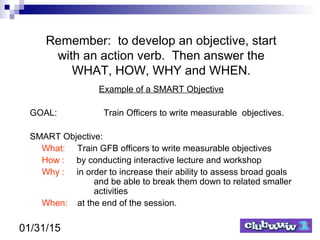
Remember: to develop an objective, start
with an action verb. Then answer the
WHAT, HOW, WHY and WHEN.
Example of a SMART Objective
GOAL: Train Officers to write measurable objectives.
SMART Objective:
What: Train GFB officers to write measurable objectives
How : by conducting interactive lecture and workshop
Why : in order to increase their ability to assess broad goals
and be able to break them down to related smaller
activities
When: at the end of the session.
01/31/15
Objective Setting Exercise
Think about...
 What
 How
 Why
 When
01/31/15
Focus … the EMPLOYEE
Why have performance
objectives?
How do I support my staff to
write effective POs?
01/31/15
PERFORMANCE OBJECTIVES
 A mutually understood agreement about what
an employee is expected to achieve during the
performance management cycle. It does not
cover all of the activities he must do. It is direct
link between work the employee does and the
Unit and Company‘s objectives.
01/31/15
AGREED Objectives - Example
 Objective #1 : Conducts TNA through interviews
with Group, Branch and Division Heads to
assess their priority developmental needs within
the 1st
quarter.
Objective #2 : Reduce training budget cost by
10% thru recycling of resources and materials at
the end of the 1st
semester.
01/31/15
Evaluating #1
 It is SMART… and your staff happy and
excited to do the job because maybe he
likes to hone his interviewing, writing
and teaching skills. He likes to be
creative. Yet, he also feels scared
because he is made accountable for it.
 He finds his objectives SMARTER
01/31/15
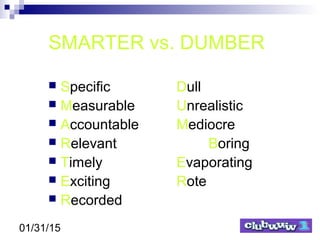
SMARTER vs. DUMBER
 Specific Dull
 Measurable Unrealistic
 Accountable Mediocre
 Relevant Boring
 Timely Evaporating
 Exciting Rote
 Recorded
01/31/15
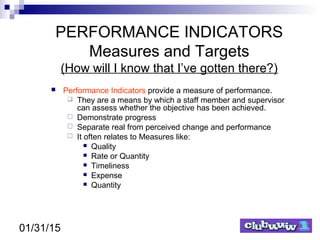
PERFORMANCE INDICATORS
Measures and Targets
(How will I know that I’ve gotten there?)
 Performance Indicators provide a measure of performance.
 They are a means by which a staff member and supervisor
can assess whether the objective has been achieved.
 Demonstrate progress
 Separate real from perceived change and performance
 It often relates to Measures like:
 Quality
 Rate or Quantity
 Timeliness
 Expense
 Quantity
01/31/15
ACTION PLANS
 ACTION PLANS answer the question ‘What do I need to
do to achieve this objective?’
 Action Planning aids achievement of objectives if they:
 Are developed by the employee
 Ensure early identification of requirements including
assistance needed from the supervisor, activities
involving others, skill needs, etc
 Facilitate monitoring of progress by the staff member
 Assist identification of why an objective is not achieved
 Most useful if reviewed and revised reqularly.
*Revisions of objectives must only be done if such are
beyond the control of the employee.
01/31/15
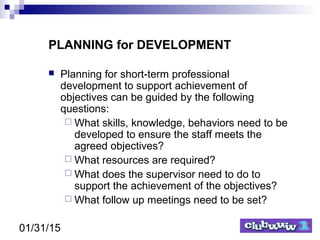
PLANNING for DEVELOPMENT
 Planning for short-term professional
development to support achievement of
objectives can be guided by the following
questions:
 What skills, knowledge, behaviors need to be
developed to ensure the staff meets the
agreed objectives?
 What resources are required?
 What does the supervisor need to do to
support the achievement of the objectives?
 What follow up meetings need to be set?
01/31/15
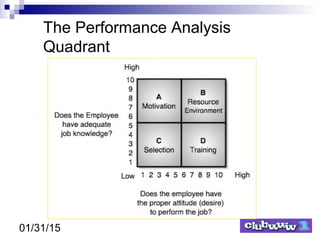
The Performance Analysis
Quadrant
INTEGRATION
GOAL-- OBJECTIVE
EXERCISE
01/31/15
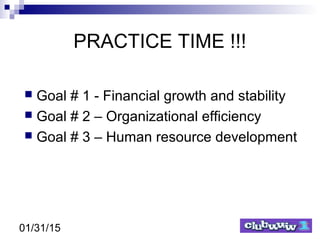
PRACTICE TIME !!!
 Goal # 1 - Financial growth and stability
 Goal # 2 – Organizational efficiency
 Goal # 3 – Human resource development
01/31/15

Objective Setting Workshop [1]

  • 1.
  • 2.
  • 3.
    01/31/15 “If you do notknow where you are going...how will you know when you have arrived?”
  • 4.
    01/31/15  REFRESHER ONKEY TERMS GENERIC TO PERFORMANCE MANAGEMENT  GOALS and OBJECTIVES  SETTING OBJECTIVES ¤¤ Why should we write objectives? ¤¤ What is a SMART Objective? ¤¤ Evaluating an Objective ¤¤ Focus: PERFORMANCE OBJECTIVES ¤¤ SMARTER Performance Objectives  SETTING PERFORMANCE STANDARDS ¤¤ Performance Indicators & Standards  GFB BUSINESS PLAN 2006-2007  PRACTICE TIME!!!  CONCLUSION / Integration ContentsContents
  • 5.
    01/31/15 Refresher on KeyTerms (generic to PERFORMANCE MANAGEMENT)  Definitions (PMS)  task, function, role, job, job description  competencies  domain  results, measures, indicators, standards  organizational goals  aligning results  weighting results  performance plans  observing, measurement and feedback  performance gap, developmental plans
  • 6.
  • 7.
    01/31/15 GOALS and OBJECTIVES Goal* a statement that explains what the Bank wishes to accomplish; sets fundamental, long-range direction. Program Objectives * specific statement that explains what the units will accomplish in order to fulfill Bank‘s goals. Supporting Objectives * a statement that describes what (Performance Objective) the units need to accomplish in order to fulfill program objectives * a statement about what an employee is expected to achieve during the performance management cycle.
  • 8.
  • 9.
  • 10.
    01/31/15 Here is HOWto be SMART! Be SPECIFIC Be MEASURABLE Be ATTAINABLE Be RELEVANT Be TIMELY
  • 11.
    01/31/15 Specific Objectives mustexpress the action and results required so that both the staff member and supervisor can see clearly whether or not the objective has been achieved Measurable When setting objectives, there must be some way of measuring and verifying whether the objective has been achieved and to what level Achievable/ Attainable Although they should provide challenge and development to the individual, objectives also must be achievable Relevant The objectives must be relevant to the level at which the individual is at their career and to the priorities and workload of their particular area Timely Objectives need to have clear time frames attached to them. Although the performance development and review process is annual, objectives can be set for longer time frames.
  • 12.
    01/31/15 The SMART Objective Framework Anobjective to be SMART, it must answer the following questions: WHAT ? HOW ? WHY ? WHEN ?
  • 13.
    01/31/15 Remember: to developan objective, start with an action verb. Then answer the WHAT, HOW, WHY and WHEN. Example of a SMART Objective GOAL: Train Officers to write measurable objectives. SMART Objective: What: Train GFB officers to write measurable objectives How : by conducting interactive lecture and workshop Why : in order to increase their ability to assess broad goals and be able to break them down to related smaller activities When: at the end of the session.
  • 14.
    01/31/15 Objective Setting Exercise Thinkabout...  What  How  Why  When
  • 15.
    01/31/15 Focus … theEMPLOYEE Why have performance objectives? How do I support my staff to write effective POs?
  • 16.
    01/31/15 PERFORMANCE OBJECTIVES  Amutually understood agreement about what an employee is expected to achieve during the performance management cycle. It does not cover all of the activities he must do. It is direct link between work the employee does and the Unit and Company‘s objectives.
  • 17.
    01/31/15 AGREED Objectives -Example  Objective #1 : Conducts TNA through interviews with Group, Branch and Division Heads to assess their priority developmental needs within the 1st quarter. Objective #2 : Reduce training budget cost by 10% thru recycling of resources and materials at the end of the 1st semester.
  • 18.
    01/31/15 Evaluating #1  Itis SMART… and your staff happy and excited to do the job because maybe he likes to hone his interviewing, writing and teaching skills. He likes to be creative. Yet, he also feels scared because he is made accountable for it.  He finds his objectives SMARTER
  • 19.
    01/31/15 SMARTER vs. DUMBER Specific Dull  Measurable Unrealistic  Accountable Mediocre  Relevant Boring  Timely Evaporating  Exciting Rote  Recorded
  • 20.
    01/31/15 PERFORMANCE INDICATORS Measures andTargets (How will I know that I’ve gotten there?)  Performance Indicators provide a measure of performance.  They are a means by which a staff member and supervisor can assess whether the objective has been achieved.  Demonstrate progress  Separate real from perceived change and performance  It often relates to Measures like:  Quality  Rate or Quantity  Timeliness  Expense  Quantity
  • 21.
    01/31/15 ACTION PLANS  ACTIONPLANS answer the question ‘What do I need to do to achieve this objective?’  Action Planning aids achievement of objectives if they:  Are developed by the employee  Ensure early identification of requirements including assistance needed from the supervisor, activities involving others, skill needs, etc  Facilitate monitoring of progress by the staff member  Assist identification of why an objective is not achieved  Most useful if reviewed and revised reqularly. *Revisions of objectives must only be done if such are beyond the control of the employee.
  • 22.
    01/31/15 PLANNING for DEVELOPMENT Planning for short-term professional development to support achievement of objectives can be guided by the following questions:  What skills, knowledge, behaviors need to be developed to ensure the staff meets the agreed objectives?  What resources are required?  What does the supervisor need to do to support the achievement of the objectives?  What follow up meetings need to be set?
  • 23.
  • 24.
  • 25.
  • 26.
    01/31/15 PRACTICE TIME !!! Goal # 1 - Financial growth and stability  Goal # 2 – Organizational efficiency  Goal # 3 – Human resource development
  • 27.