SESSION ID:
#RSAC
Dr. Anton Chuvakin
Demystifying Security Analytics:
Data, Methods, Use Cases
AIR-T09
@anton_chuvakin
Research VP
Gartner for Technical Professionals
#RSAC
Easy, Huh?
Security analytics is very easy:
1. Get data.
2. Process with algorithms.
3. Enjoy the insights!
#RSAC
1. Defining “SECURITY ANALYTICS”
2. Choosing your road to security analytics success
3. Tooling up for security analytics: myth and reality
4. Best practices for security analytics?
Outline
#RSAC
Detect threat better — and
detect "better" threats!
Decide what matters, prioritize
alerts and signals.
Triage alerts faster.
Solve (some) security
problems with less expert
labor.
A Little Motivation: Why Security Analytics?
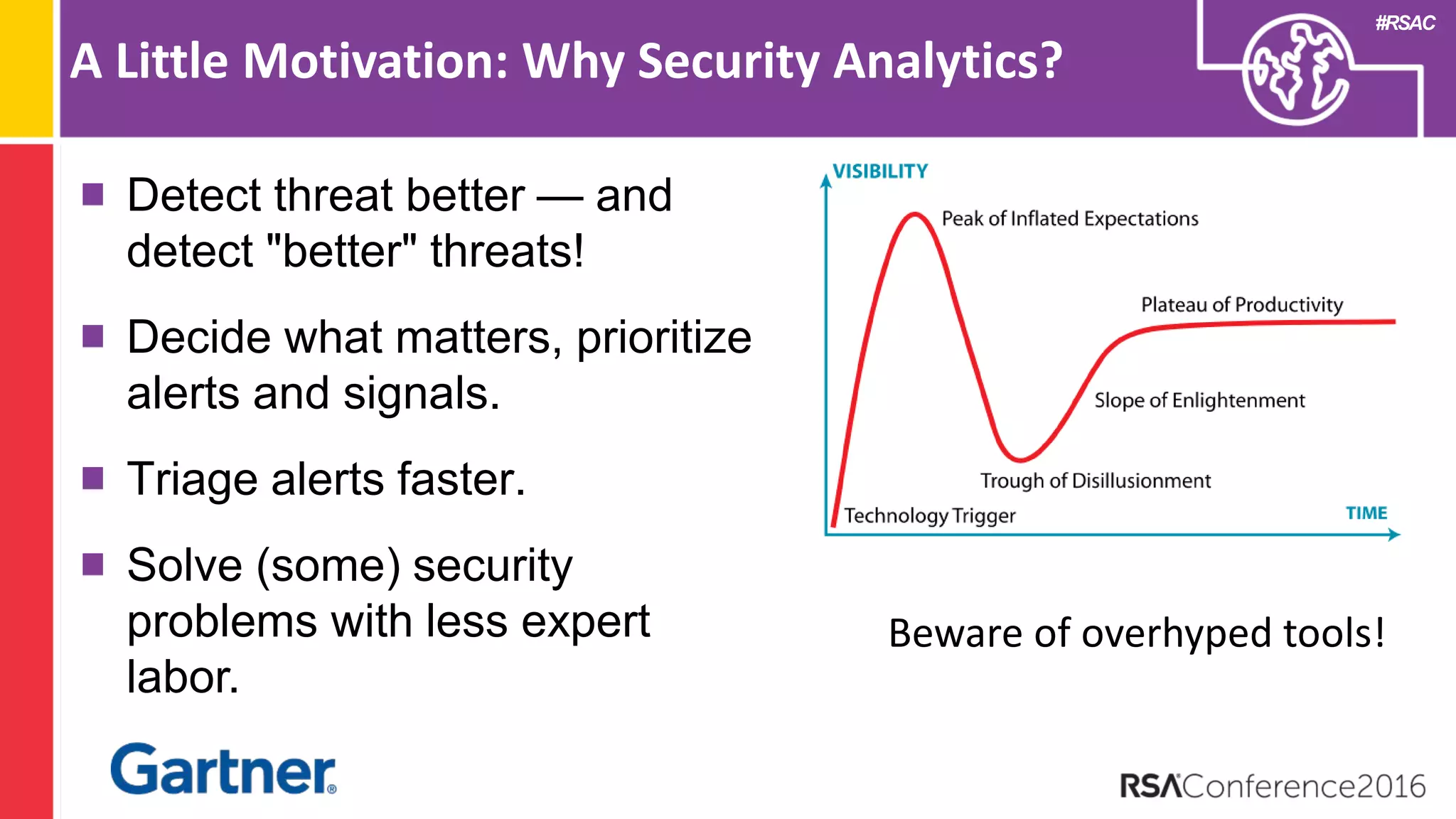
Beware of overhyped tools!
#RSAC
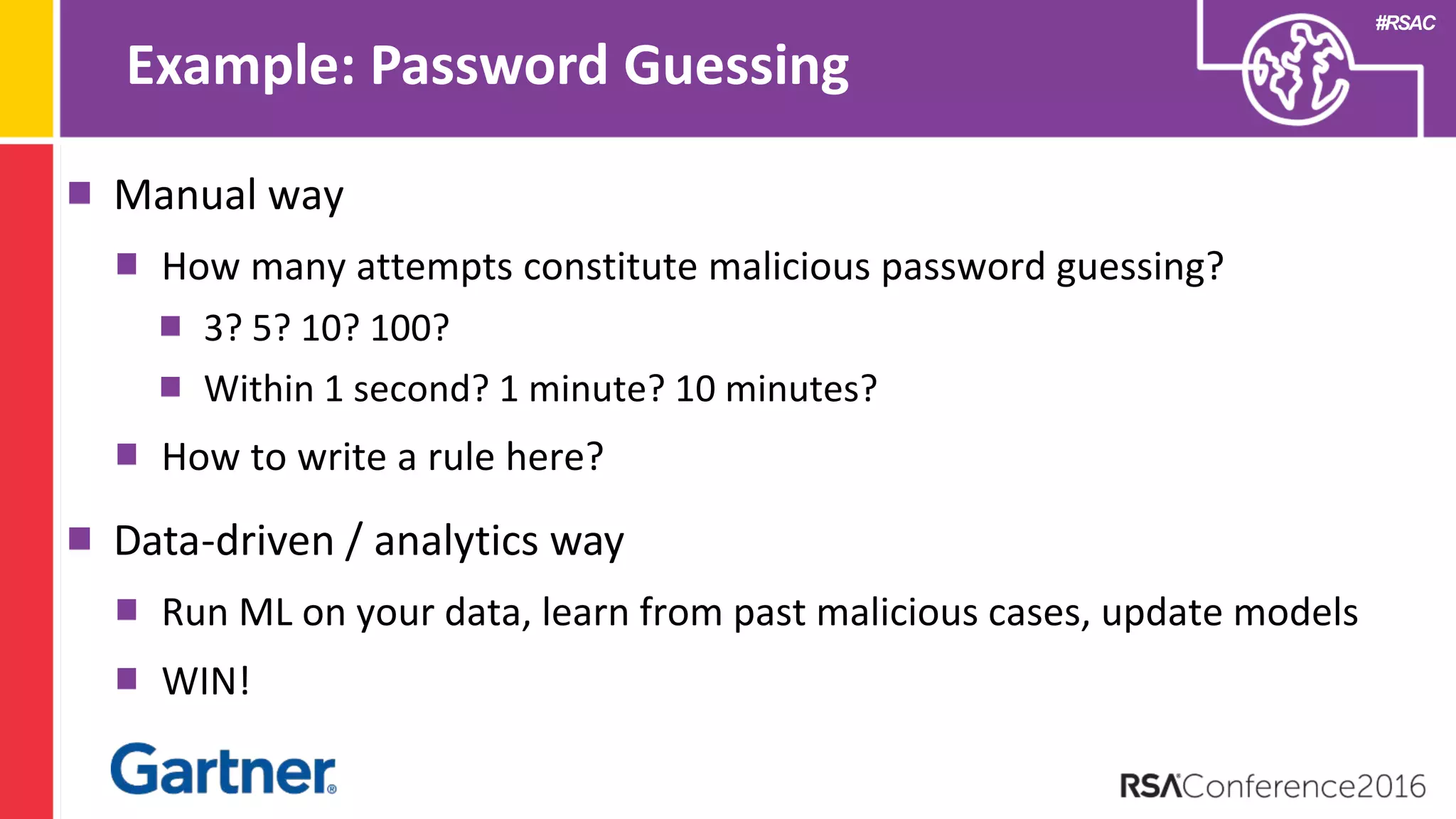
Manual way
How many attempts constitute malicious password guessing?
3? 5? 10? 100?
Within 1 second? 1 minute? 10 minutes?
How to write a rule here?
Data-driven / analytics way
Run ML on your data, learn from past malicious cases, update models
WIN!
Example: Password Guessing
#RSAC
What Is Security Analytics?
#RSAC
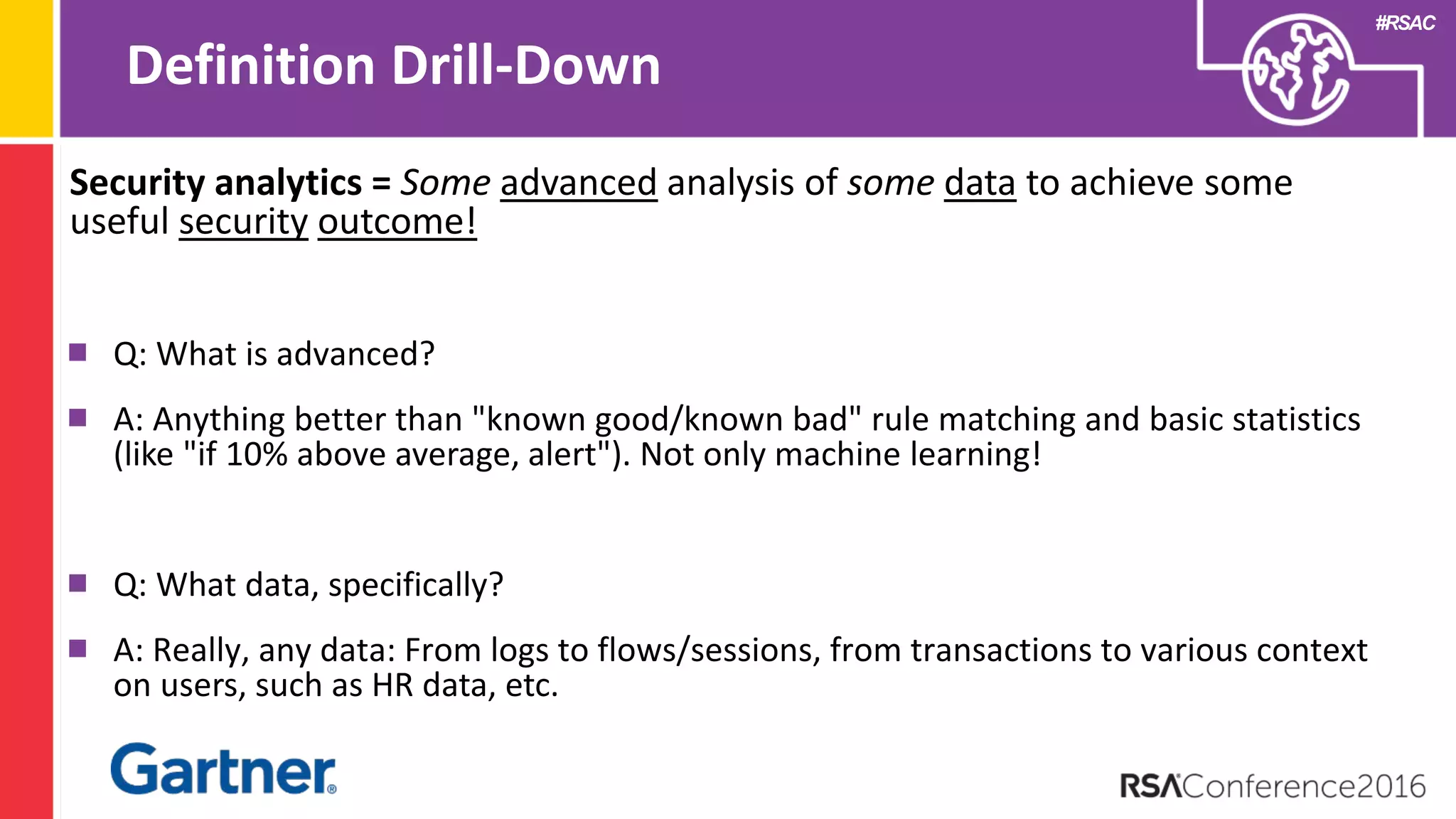
Security analytics = Some advanced analysis of some data to achieve some
useful security outcome!
Q: What is advanced?
A: Anything better than "known good/known bad" rule matching and basic statistics
(like "if 10% above average, alert"). Not only machine learning!
Q: What data, specifically?
A: Really, any data: From logs to flows/sessions, from transactions to various context
on users, such as HR data, etc.
Definition Drill-Down
#RSAC
Still Mystified?
#RSAC
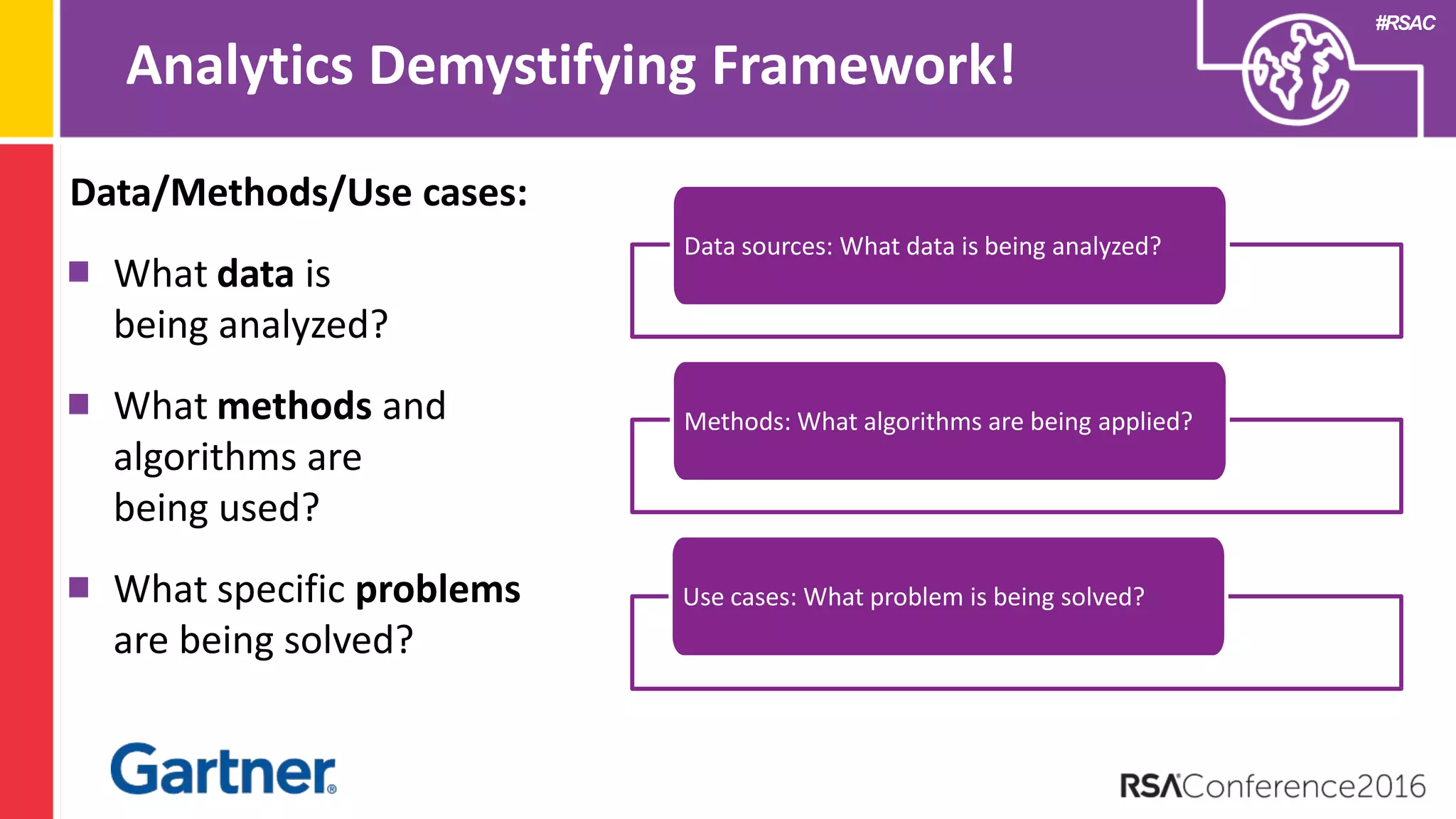
Data/Methods/Use cases:
What data is
being analyzed?
What methods and
algorithms are
being used?
What specific problems
are being solved?
Analytics Demystifying Framework!
Data sources: What data is being analyzed?
Methods: What algorithms are being applied?
Use cases: What problem is being solved?
#RSAC
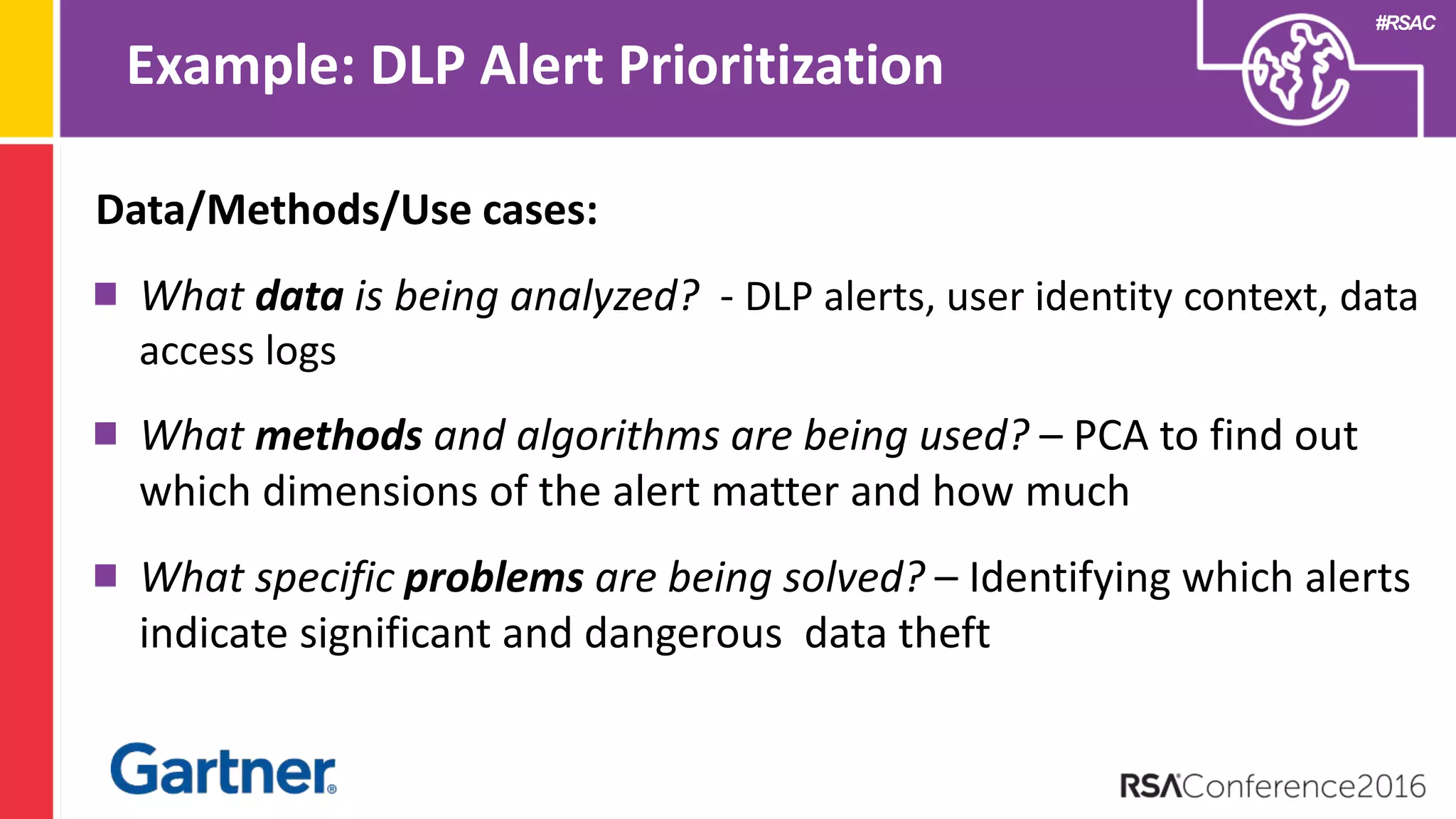
Example: DLP Alert Prioritization
Data/Methods/Use cases:
What data is being analyzed? - DLP alerts, user identity context, data
access logs
What methods and algorithms are being used? – PCA to find out
which dimensions of the alert matter and how much
What specific problems are being solved? – Identifying which alerts
indicate significant and dangerous data theft
#RSAC
Starting Your Security Analytics Journey
#RSAC
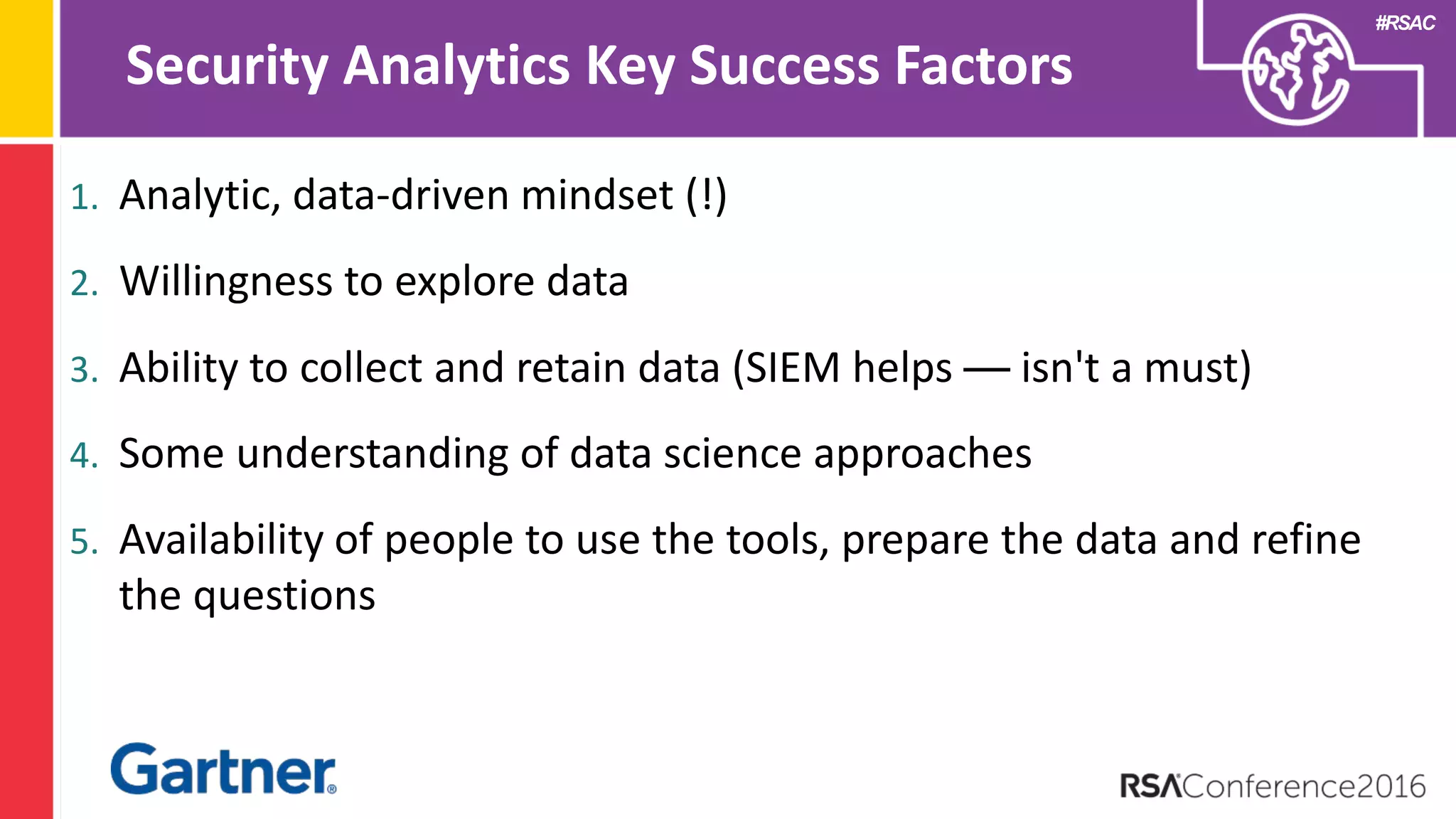
1. Analytic, data-driven mindset (!)
2. Willingness to explore data
3. Ability to collect and retain data (SIEM helps — isn't a must)
4. Some understanding of data science approaches
5. Availability of people to use the tools, prepare the data and refine
the questions
Security Analytics Key Success Factors
#RSAC
Analytic mindset seems to determine the success of analytics and big
data initiatives for security more than anything else!
Really, A Mindset??!
Are you a data explorer or an appliance buyer ("OOBster")?
Would you look at your data or at your vendor for answers?
Must you have out-of-the-box content (rules, signatures, etc.)
for everything?
Do you accept that data may have the answers, not the gut feel?
#RSAC
Products or People: Buy, Build, Partner
#RSAC
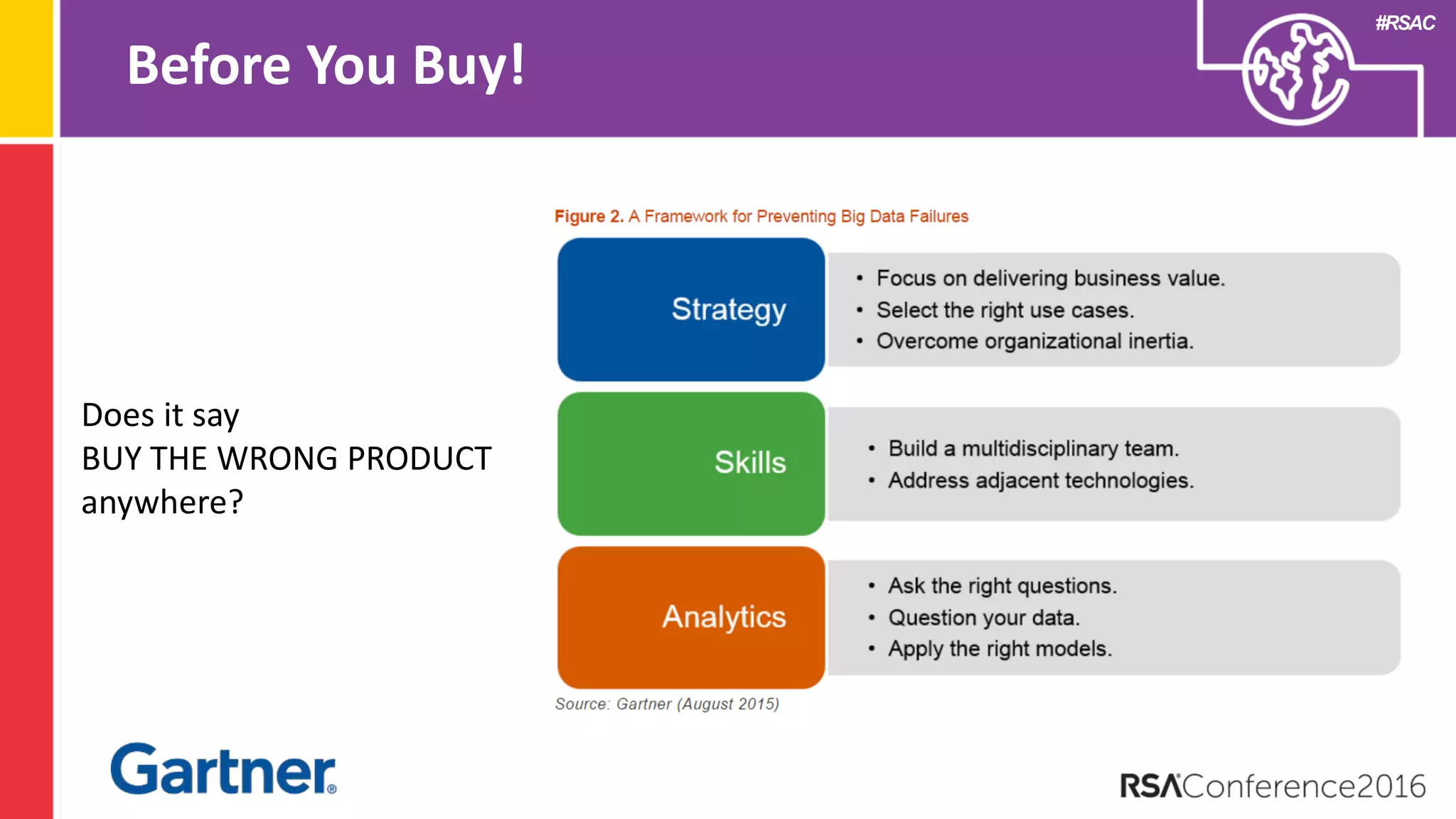
Before You Buy!
Does it say
BUY THE WRONG PRODUCT
anywhere?
#RSAC
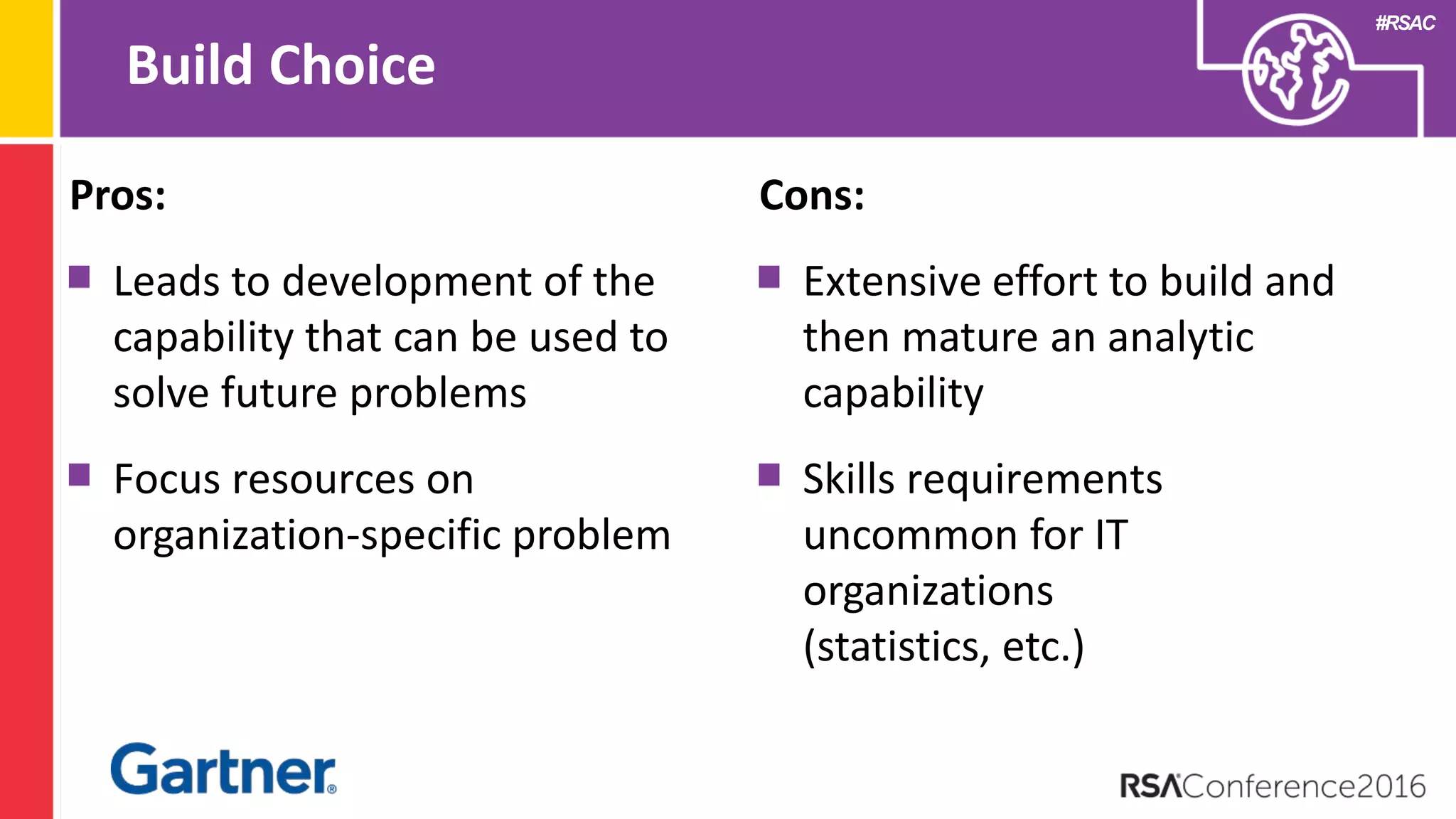
Pros:
Solve at least some problems
immediately upon installation
Solve select problems
automatically, without tuning
Cons:
Risk of limited applicability of
the tool beyond specific use
cases
Rely on vendor to pick and
solve problems
Buy Choice
#RSAC
Pros:
Leads to development of the
capability that can be used to
solve future problems
Focus resources on
organization-specific problem
Cons:
Extensive effort to build and
then mature an analytic
capability
Skills requirements
uncommon for IT
organizations
(statistics, etc.)
Build Choice
#RSAC
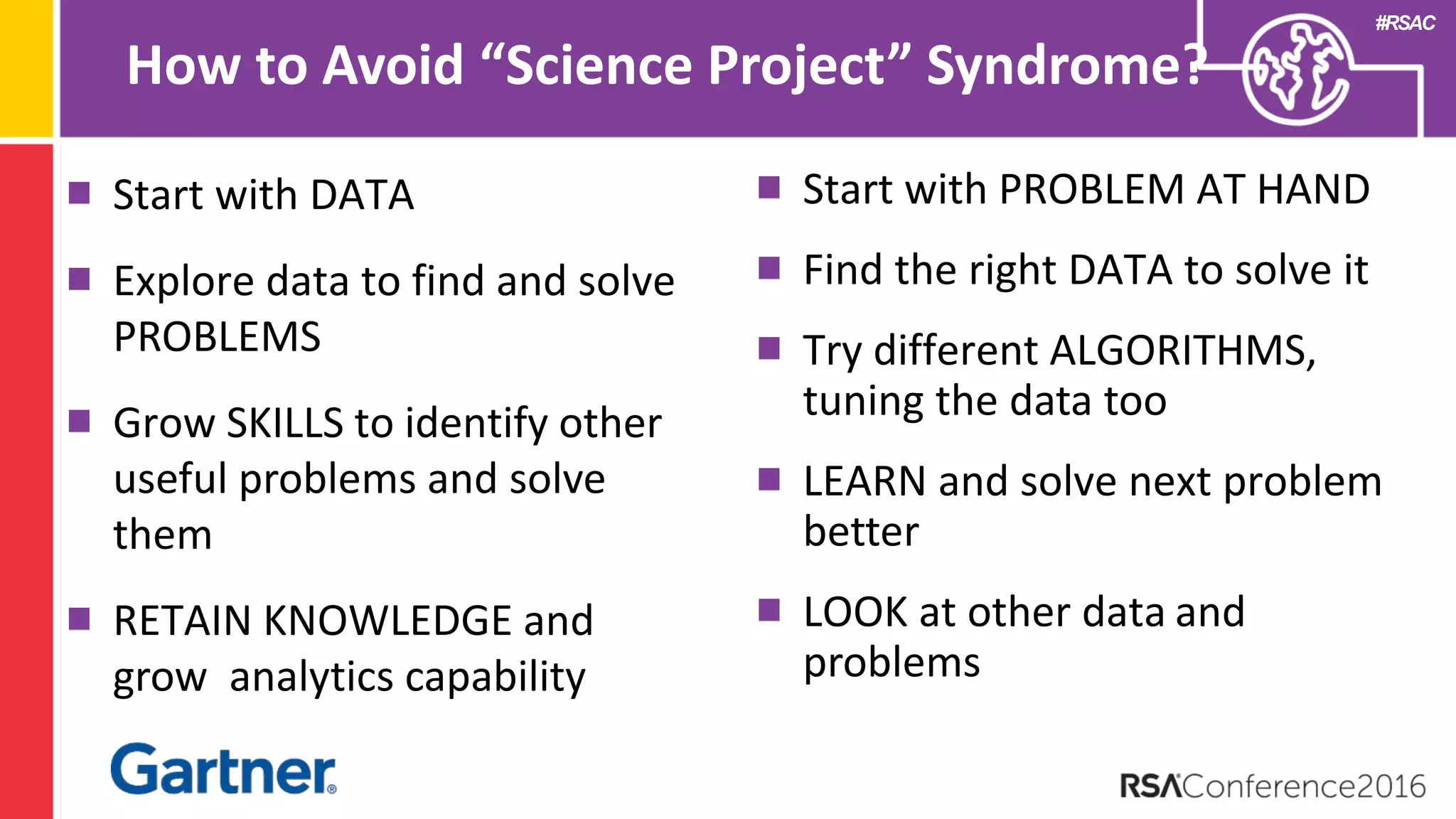
Start with DATA
Explore data to find and solve
PROBLEMS
Grow SKILLS to identify other
useful problems and solve
them
RETAIN KNOWLEDGE and
grow analytics capability
Start with PROBLEM AT HAND
Find the right DATA to solve it
Try different ALGORITHMS,
tuning the data too
LEARN and solve next problem
better
LOOK at other data and
problems
How to Avoid “Science Project” Syndrome?
#RSAC
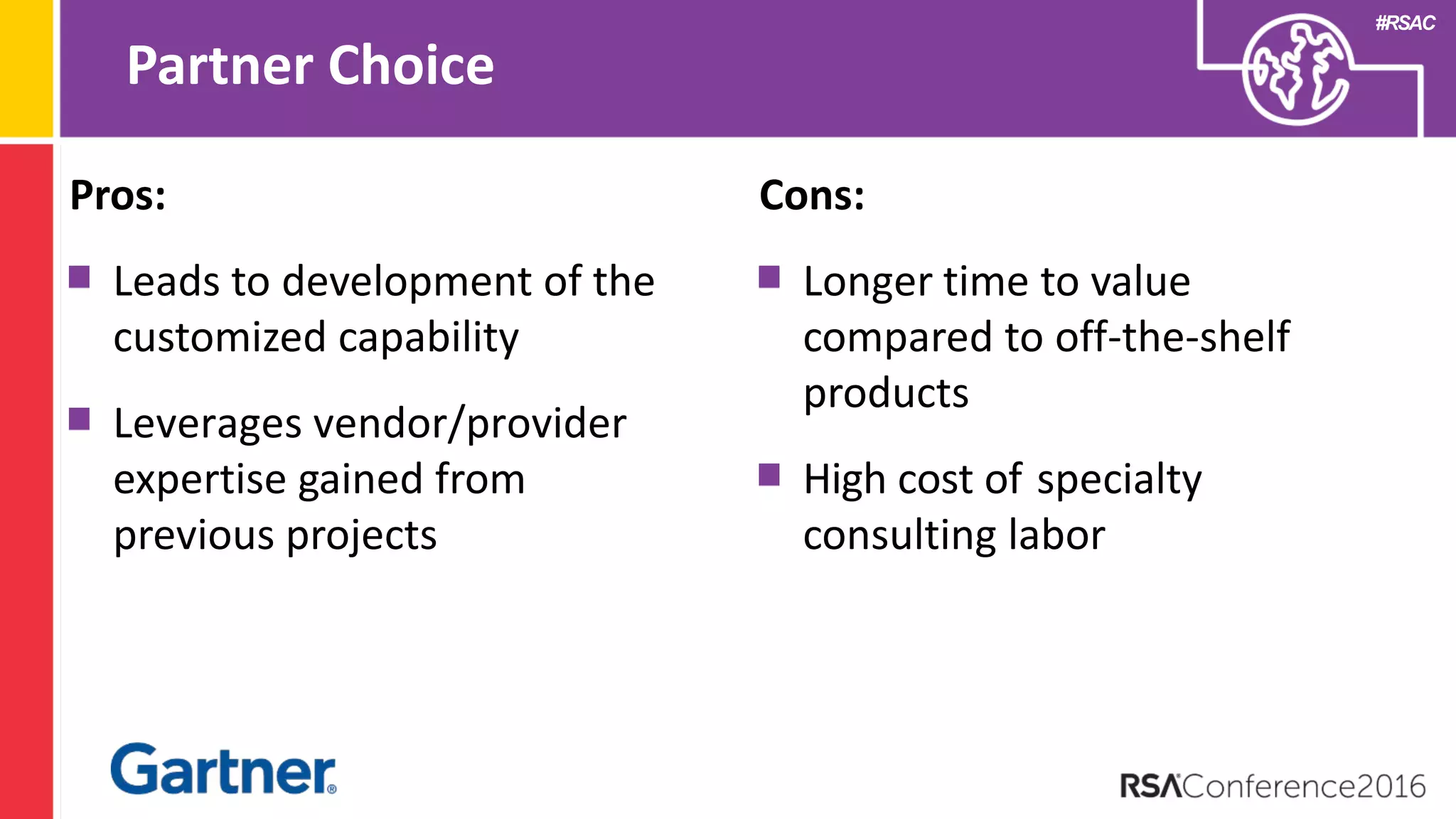
Pros:
Leads to development of the
customized capability
Leverages vendor/provider
expertise gained from
previous projects
Cons:
Longer time to value
compared to off-the-shelf
products
High cost of specialty
consulting labor
Partner Choice
#RSAC
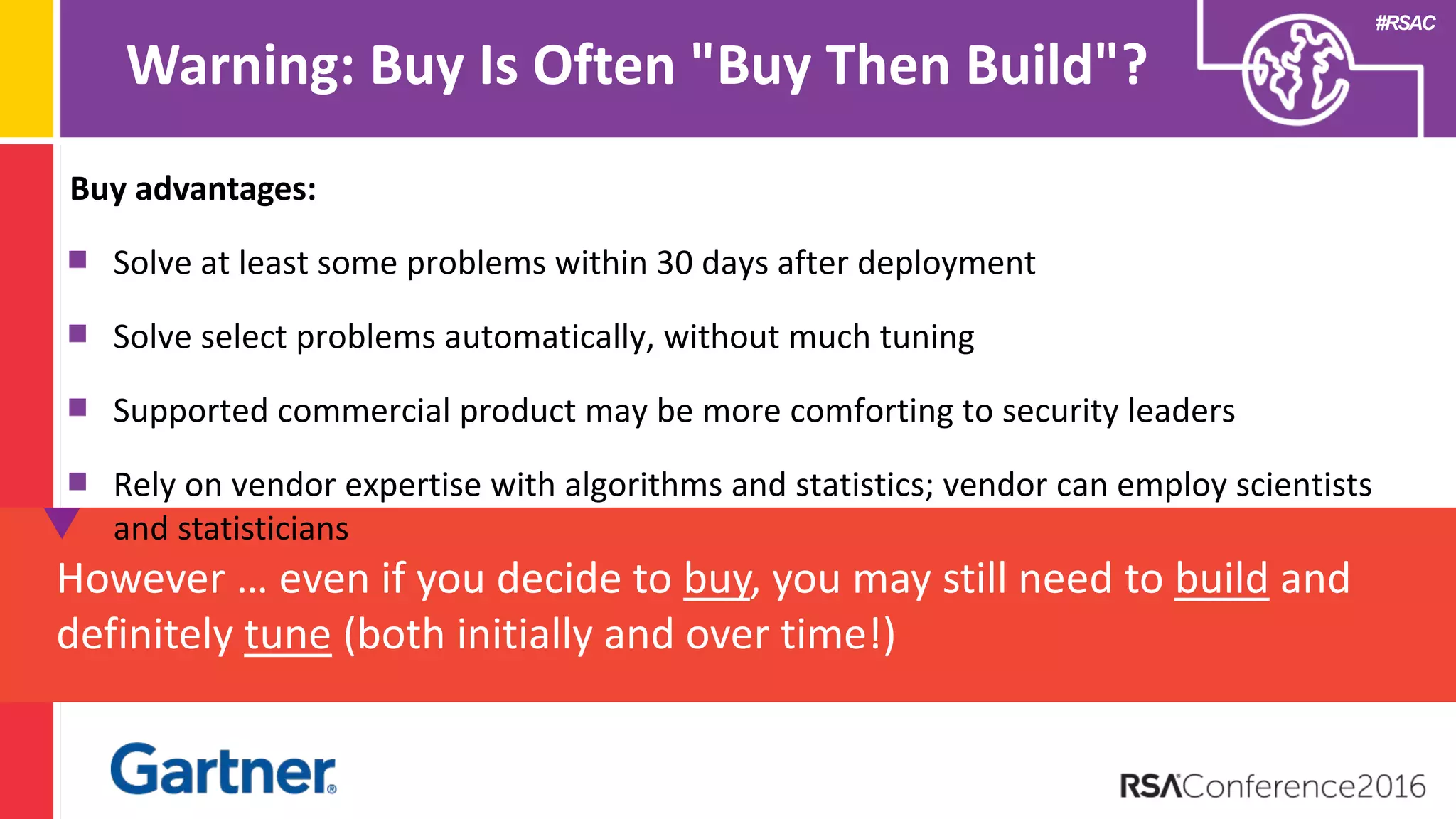
However … even if you decide to buy, you may still need to build and
definitely tune (both initially and over time!)
Warning: Buy Is Often "Buy Then Build"?
Buy advantages:
Solve at least some problems within 30 days after deployment
Solve select problems automatically, without much tuning
Supported commercial product may be more comforting to security leaders
Rely on vendor expertise with algorithms and statistics; vendor can employ scientists
and statisticians
#RSAC
Tooling Up
#RSAC
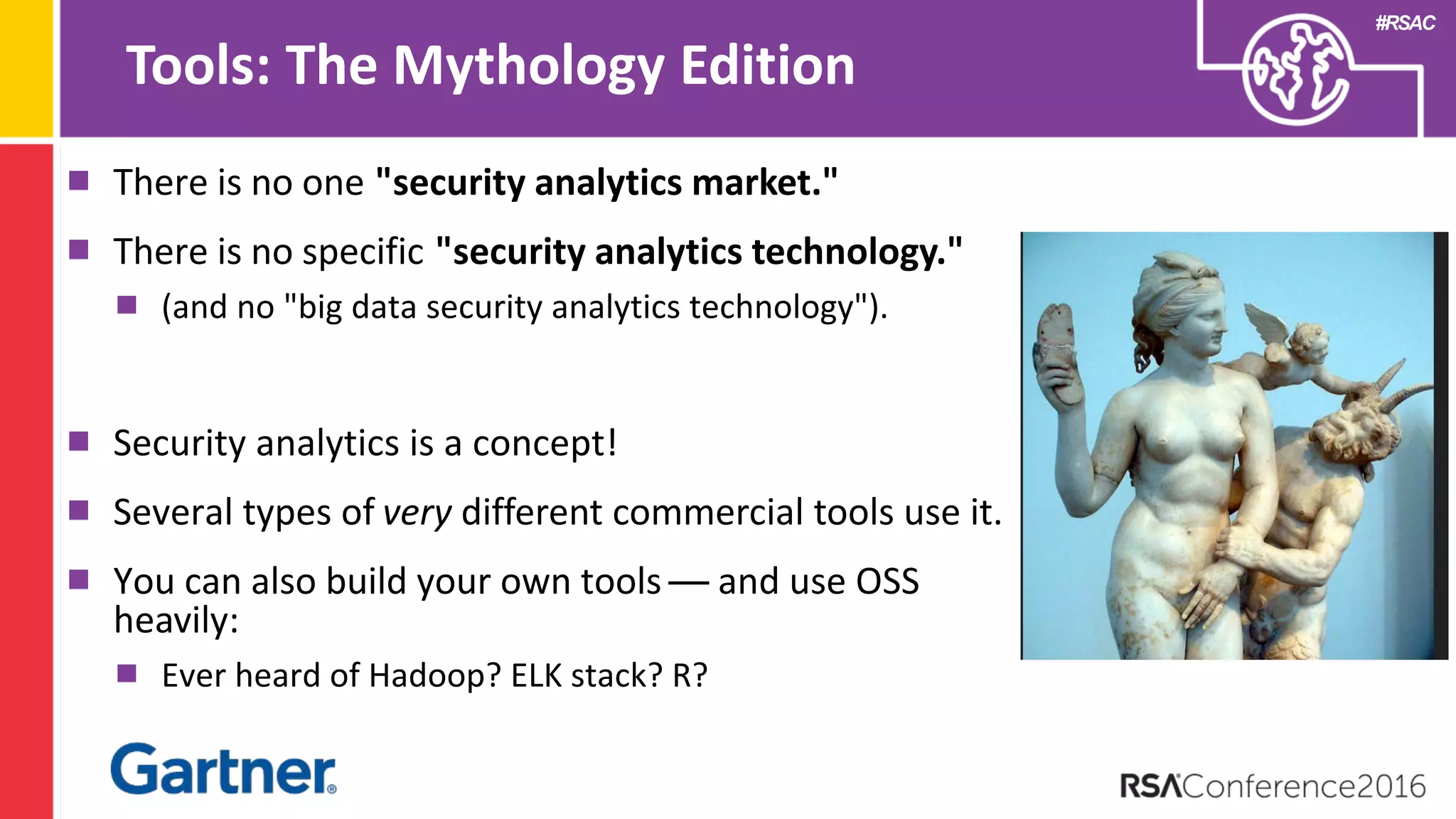
There is no one "security analytics market."
There is no specific "security analytics technology."
(and no "big data security analytics technology").
Security analytics is a concept!
Several types of very different commercial tools use it.
You can also build your own tools — and use OSS
heavily:
Ever heard of Hadoop? ELK stack? R?
Tools: The Mythology Edition
#RSAC
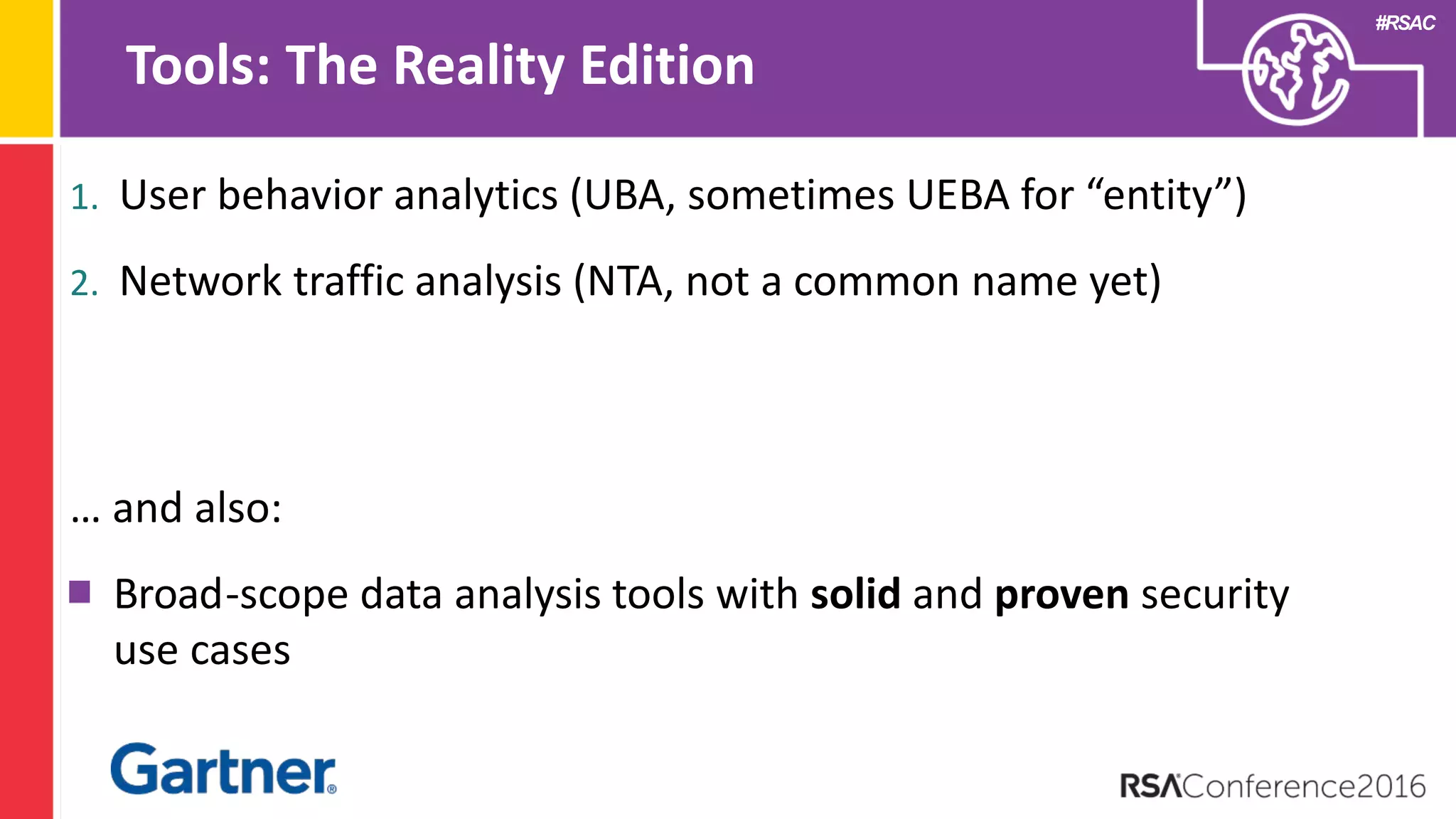
1. User behavior analytics (UBA, sometimes UEBA for “entity”)
2. Network traffic analysis (NTA, not a common name yet)
… and also:
Broad-scope data analysis tools with solid and proven security
use cases
Tools: The Reality Edition
#RSAC
But Wait … Where Is SIEM?
Source: Gartner (May 2015)
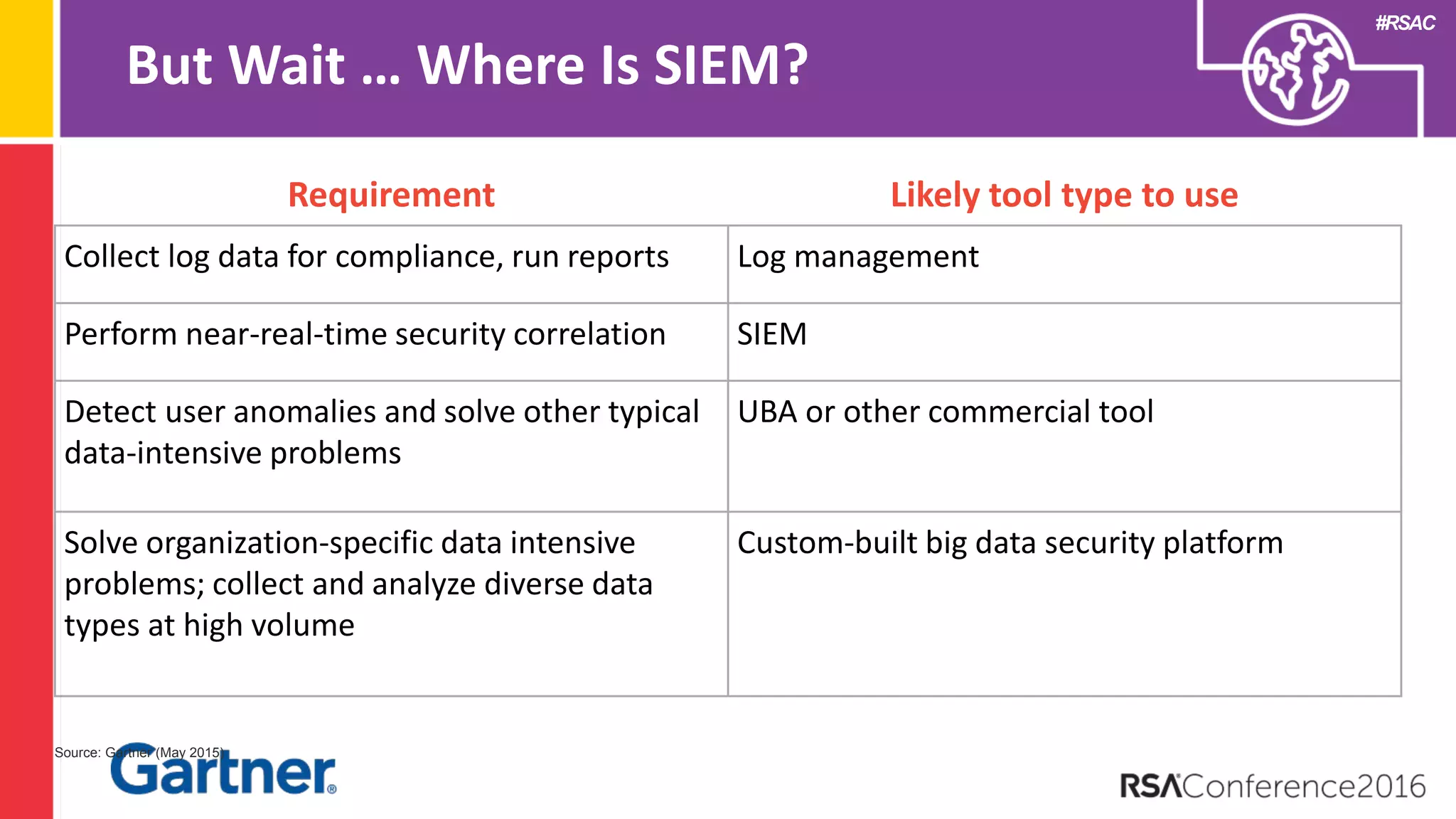
Requirement Likely tool type to use
Collect log data for compliance, run reports Log management
Perform near-real-time security correlation SIEM
Detect user anomalies and solve other typical
data-intensive problems
UBA or other commercial tool
Solve organization-specific data intensive
problems; collect and analyze diverse data
types at high volume
Custom-built big data security platform
#RSAC
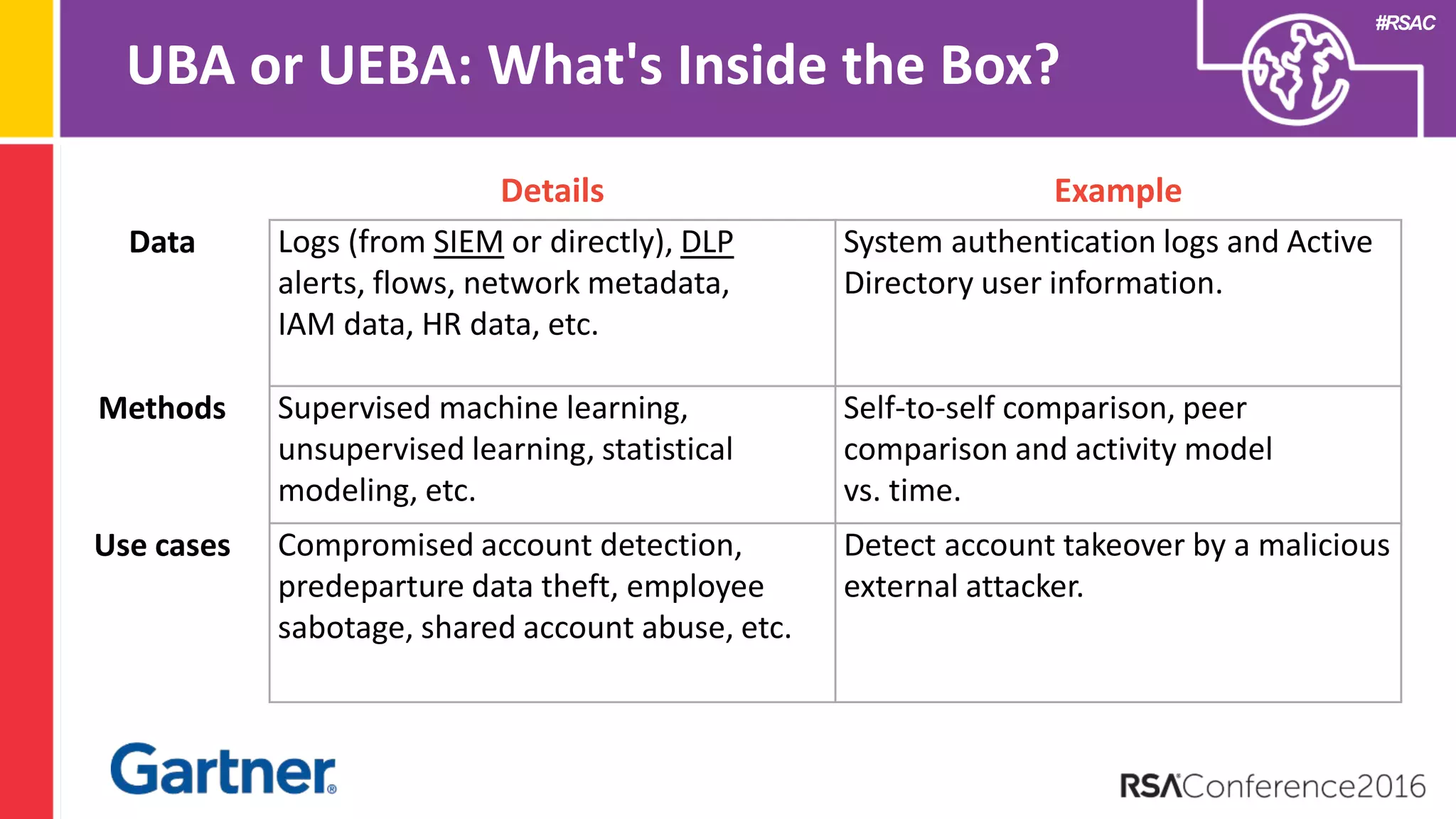
UBA or UEBA: What's Inside the Box?
Details Example
Data Logs (from SIEM or directly), DLP
alerts, flows, network metadata,
IAM data, HR data, etc.
System authentication logs and Active
Directory user information.
Methods Supervised machine learning,
unsupervised learning, statistical
modeling, etc.
Self-to-self comparison, peer
comparison and activity model
vs. time.
Use cases Compromised account detection,
predeparture data theft, employee
sabotage, shared account abuse, etc.
Detect account takeover by a malicious
external attacker.
#RSAC
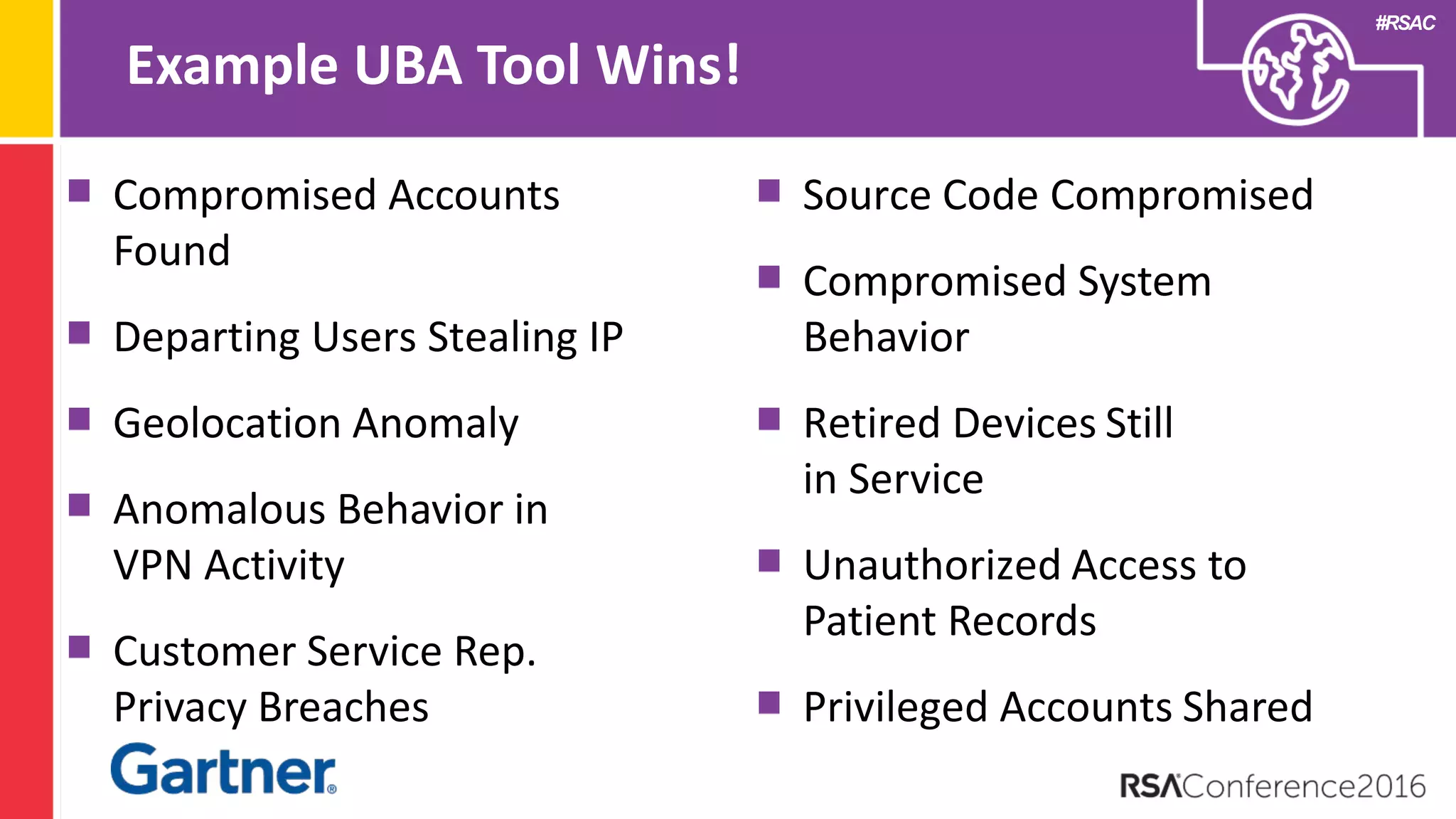
Compromised Accounts
Found
Departing Users Stealing IP
Geolocation Anomaly
Anomalous Behavior in
VPN Activity
Customer Service Rep.
Privacy Breaches
Source Code Compromised
Compromised System
Behavior
Retired Devices Still
in Service
Unauthorized Access to
Patient Records
Privileged Accounts Shared
Example UBA Tool Wins!
#RSAC
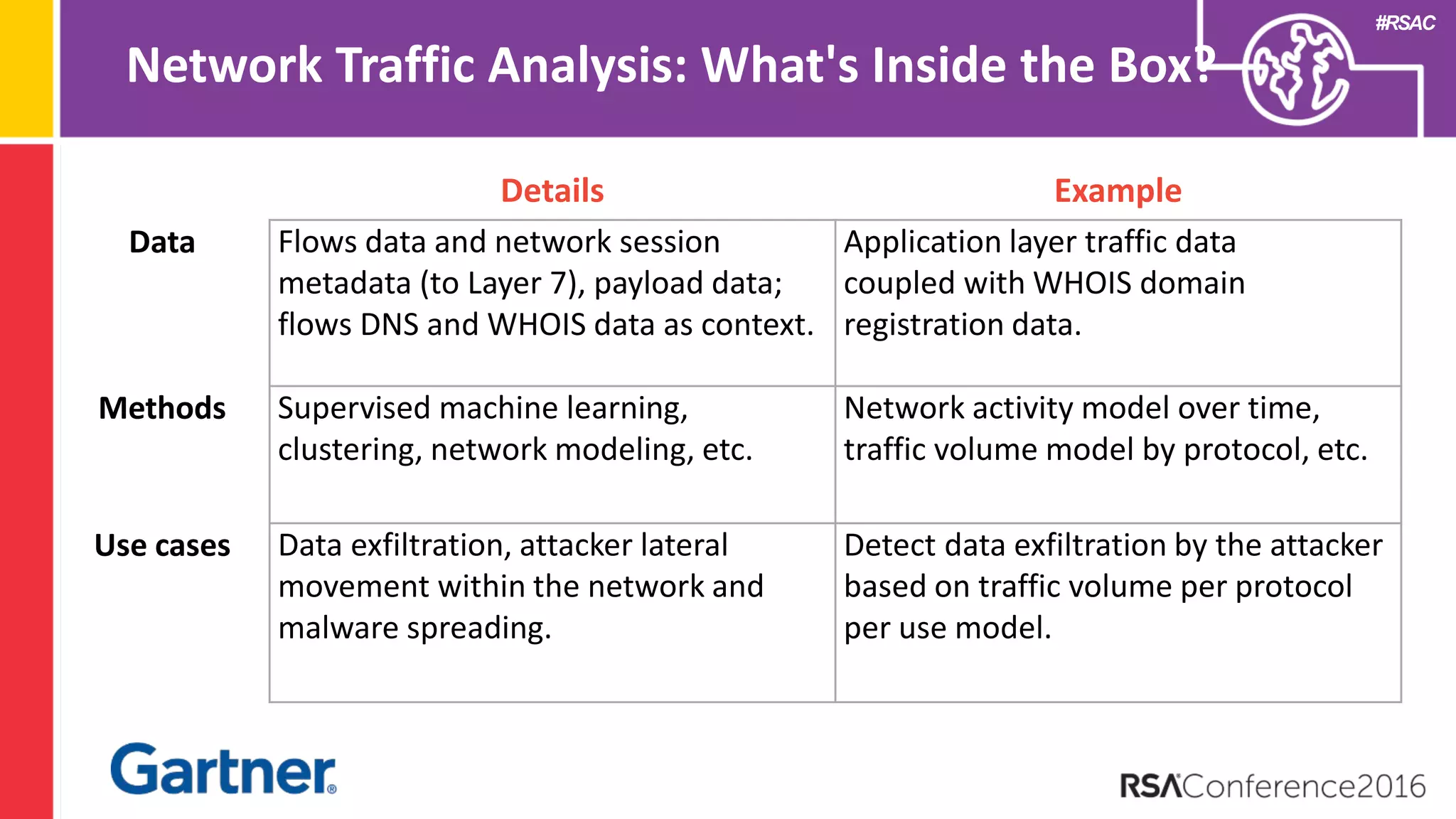
Network Traffic Analysis: What's Inside the Box?
Details Example
Data Flows data and network session
metadata (to Layer 7), payload data;
flows DNS and WHOIS data as context.
Application layer traffic data
coupled with WHOIS domain
registration data.
Methods Supervised machine learning,
clustering, network modeling, etc.
Network activity model over time,
traffic volume model by protocol, etc.
Use cases Data exfiltration, attacker lateral
movement within the network and
malware spreading.
Detect data exfiltration by the attacker
based on traffic volume per protocol
per use model.
#RSAC
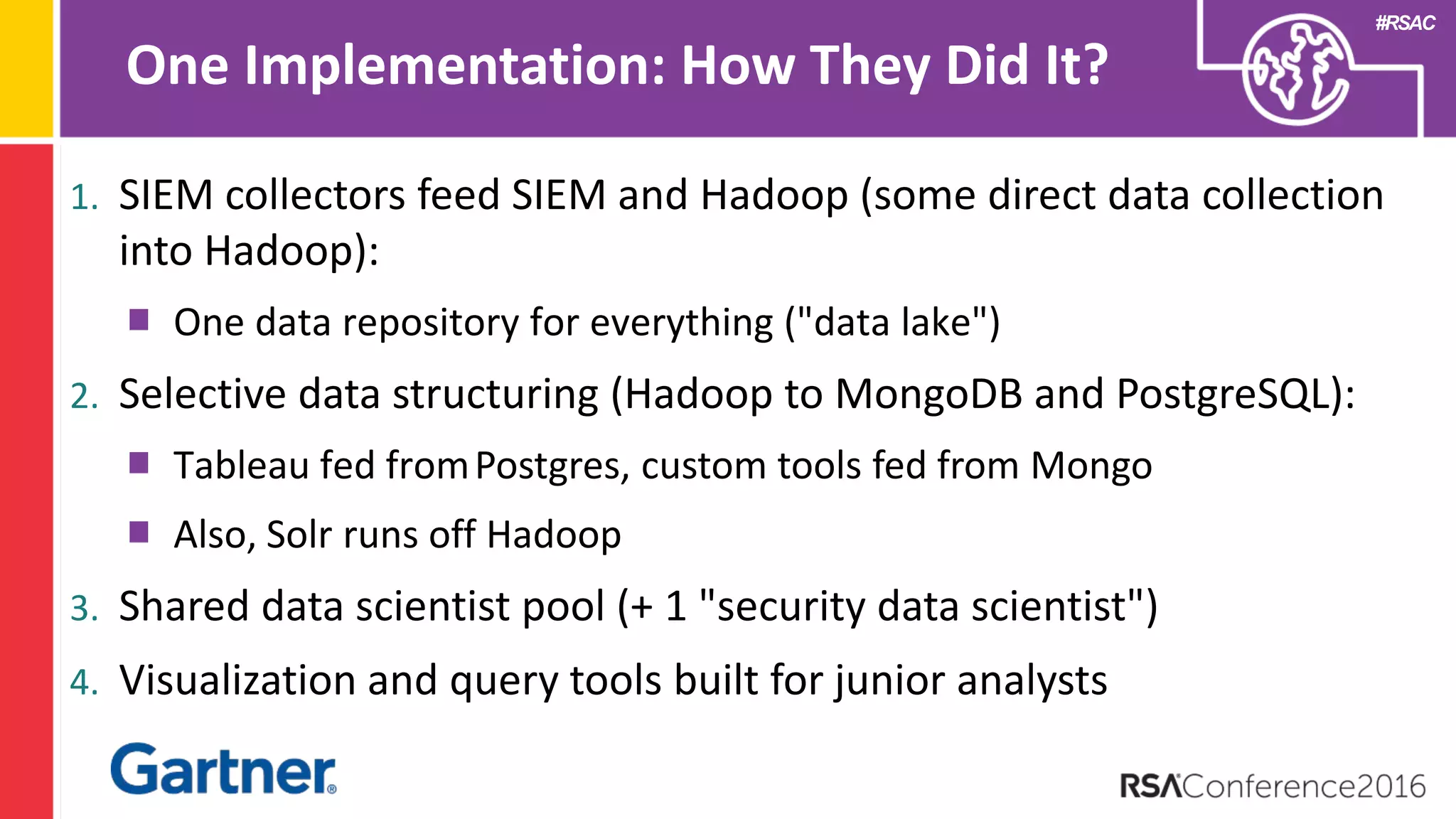
1. SIEM collectors feed SIEM and Hadoop (some direct data collection
into Hadoop):
One data repository for everything ("data lake")
2. Selective data structuring (Hadoop to MongoDB and PostgreSQL):
Tableau fed fromPostgres, custom tools fed from Mongo
Also, Solr runs off Hadoop
3. Shared data scientist pool (+ 1 "security data scientist")
4. Visualization and query tools built for junior analysts
One Implementation: How They Did It?
#RSAC
Not Yet!
#RSAC
 Given an early stage of these technologies, tool acquisition needs to be
targeted at specific problems because there are no "general security analytics
tools" on sale. (BUY route)
 There is not enough data on the comparative effectiveness of various analytic
approaches and algorithms (implemented in vendor tools) versus real-world
problems. (BUY route)
 Think of the problems first, target purchases at problems, do validate that the
vendor of choice has a record of solving such problems. (BUY route)
 Think of the data first, and start exploring, then bring tools and components as
needed (BUILD route)
Recommendations
#RSAC
 Make the commercial tools EASY TO TEST and PROVE VALUE
 Evolve analytics tools to ALGORITHM PORTABILITY
 Create CATALOGUE of USE CASES where various analytics tools
work well IN REAL WORLD
 Add more BRAINPOWER to all security tools!
INDUSTRY CALL TO ACTION!

Demystifying Security Analytics: Data, Methods, Use Cases

  • 1.
    SESSION ID: #RSAC Dr. AntonChuvakin Demystifying Security Analytics: Data, Methods, Use Cases AIR-T09 @anton_chuvakin Research VP Gartner for Technical Professionals
  • 2.
    #RSAC Easy, Huh? Security analyticsis very easy: 1. Get data. 2. Process with algorithms. 3. Enjoy the insights!
  • 3.
    #RSAC 1. Defining “SECURITYANALYTICS” 2. Choosing your road to security analytics success 3. Tooling up for security analytics: myth and reality 4. Best practices for security analytics? Outline
  • 4.
    #RSAC Detect threat better— and detect "better" threats! Decide what matters, prioritize alerts and signals. Triage alerts faster. Solve (some) security problems with less expert labor. A Little Motivation: Why Security Analytics? Beware of overhyped tools!
  • 5.
    #RSAC Manual way How manyattempts constitute malicious password guessing? 3? 5? 10? 100? Within 1 second? 1 minute? 10 minutes? How to write a rule here? Data-driven / analytics way Run ML on your data, learn from past malicious cases, update models WIN! Example: Password Guessing
  • 6.
  • 7.
    #RSAC Security analytics =Some advanced analysis of some data to achieve some useful security outcome! Q: What is advanced? A: Anything better than "known good/known bad" rule matching and basic statistics (like "if 10% above average, alert"). Not only machine learning! Q: What data, specifically? A: Really, any data: From logs to flows/sessions, from transactions to various context on users, such as HR data, etc. Definition Drill-Down
  • 8.
  • 9.
    #RSAC Data/Methods/Use cases: What datais being analyzed? What methods and algorithms are being used? What specific problems are being solved? Analytics Demystifying Framework! Data sources: What data is being analyzed? Methods: What algorithms are being applied? Use cases: What problem is being solved?
  • 10.
    #RSAC Example: DLP AlertPrioritization Data/Methods/Use cases: What data is being analyzed? - DLP alerts, user identity context, data access logs What methods and algorithms are being used? – PCA to find out which dimensions of the alert matter and how much What specific problems are being solved? – Identifying which alerts indicate significant and dangerous data theft
  • 11.
  • 12.
    #RSAC 1. Analytic, data-drivenmindset (!) 2. Willingness to explore data 3. Ability to collect and retain data (SIEM helps — isn't a must) 4. Some understanding of data science approaches 5. Availability of people to use the tools, prepare the data and refine the questions Security Analytics Key Success Factors
  • 13.
    #RSAC Analytic mindset seemsto determine the success of analytics and big data initiatives for security more than anything else! Really, A Mindset??! Are you a data explorer or an appliance buyer ("OOBster")? Would you look at your data or at your vendor for answers? Must you have out-of-the-box content (rules, signatures, etc.) for everything? Do you accept that data may have the answers, not the gut feel?
  • 14.
    #RSAC Products or People:Buy, Build, Partner
  • 15.
    #RSAC Before You Buy! Doesit say BUY THE WRONG PRODUCT anywhere?
  • 16.
    #RSAC Pros: Solve at leastsome problems immediately upon installation Solve select problems automatically, without tuning Cons: Risk of limited applicability of the tool beyond specific use cases Rely on vendor to pick and solve problems Buy Choice
  • 17.
    #RSAC Pros: Leads to developmentof the capability that can be used to solve future problems Focus resources on organization-specific problem Cons: Extensive effort to build and then mature an analytic capability Skills requirements uncommon for IT organizations (statistics, etc.) Build Choice
  • 18.
    #RSAC Start with DATA Exploredata to find and solve PROBLEMS Grow SKILLS to identify other useful problems and solve them RETAIN KNOWLEDGE and grow analytics capability Start with PROBLEM AT HAND Find the right DATA to solve it Try different ALGORITHMS, tuning the data too LEARN and solve next problem better LOOK at other data and problems How to Avoid “Science Project” Syndrome?
  • 19.
    #RSAC Pros: Leads to developmentof the customized capability Leverages vendor/provider expertise gained from previous projects Cons: Longer time to value compared to off-the-shelf products High cost of specialty consulting labor Partner Choice
  • 20.
    #RSAC However … evenif you decide to buy, you may still need to build and definitely tune (both initially and over time!) Warning: Buy Is Often "Buy Then Build"? Buy advantages: Solve at least some problems within 30 days after deployment Solve select problems automatically, without much tuning Supported commercial product may be more comforting to security leaders Rely on vendor expertise with algorithms and statistics; vendor can employ scientists and statisticians
  • 21.
  • 22.
    #RSAC There is noone "security analytics market." There is no specific "security analytics technology." (and no "big data security analytics technology"). Security analytics is a concept! Several types of very different commercial tools use it. You can also build your own tools — and use OSS heavily: Ever heard of Hadoop? ELK stack? R? Tools: The Mythology Edition
  • 23.
    #RSAC 1. User behavioranalytics (UBA, sometimes UEBA for “entity”) 2. Network traffic analysis (NTA, not a common name yet) … and also: Broad-scope data analysis tools with solid and proven security use cases Tools: The Reality Edition
  • 24.
    #RSAC But Wait …Where Is SIEM? Source: Gartner (May 2015) Requirement Likely tool type to use Collect log data for compliance, run reports Log management Perform near-real-time security correlation SIEM Detect user anomalies and solve other typical data-intensive problems UBA or other commercial tool Solve organization-specific data intensive problems; collect and analyze diverse data types at high volume Custom-built big data security platform
  • 25.
    #RSAC UBA or UEBA:What's Inside the Box? Details Example Data Logs (from SIEM or directly), DLP alerts, flows, network metadata, IAM data, HR data, etc. System authentication logs and Active Directory user information. Methods Supervised machine learning, unsupervised learning, statistical modeling, etc. Self-to-self comparison, peer comparison and activity model vs. time. Use cases Compromised account detection, predeparture data theft, employee sabotage, shared account abuse, etc. Detect account takeover by a malicious external attacker.
  • 26.
    #RSAC Compromised Accounts Found Departing UsersStealing IP Geolocation Anomaly Anomalous Behavior in VPN Activity Customer Service Rep. Privacy Breaches Source Code Compromised Compromised System Behavior Retired Devices Still in Service Unauthorized Access to Patient Records Privileged Accounts Shared Example UBA Tool Wins!
  • 27.
    #RSAC Network Traffic Analysis:What's Inside the Box? Details Example Data Flows data and network session metadata (to Layer 7), payload data; flows DNS and WHOIS data as context. Application layer traffic data coupled with WHOIS domain registration data. Methods Supervised machine learning, clustering, network modeling, etc. Network activity model over time, traffic volume model by protocol, etc. Use cases Data exfiltration, attacker lateral movement within the network and malware spreading. Detect data exfiltration by the attacker based on traffic volume per protocol per use model.
  • 28.
    #RSAC 1. SIEM collectorsfeed SIEM and Hadoop (some direct data collection into Hadoop): One data repository for everything ("data lake") 2. Selective data structuring (Hadoop to MongoDB and PostgreSQL): Tableau fed fromPostgres, custom tools fed from Mongo Also, Solr runs off Hadoop 3. Shared data scientist pool (+ 1 "security data scientist") 4. Visualization and query tools built for junior analysts One Implementation: How They Did It?
  • 29.
  • 30.
    #RSAC  Given anearly stage of these technologies, tool acquisition needs to be targeted at specific problems because there are no "general security analytics tools" on sale. (BUY route)  There is not enough data on the comparative effectiveness of various analytic approaches and algorithms (implemented in vendor tools) versus real-world problems. (BUY route)  Think of the problems first, target purchases at problems, do validate that the vendor of choice has a record of solving such problems. (BUY route)  Think of the data first, and start exploring, then bring tools and components as needed (BUILD route) Recommendations
  • 31.
    #RSAC  Make thecommercial tools EASY TO TEST and PROVE VALUE  Evolve analytics tools to ALGORITHM PORTABILITY  Create CATALOGUE of USE CASES where various analytics tools work well IN REAL WORLD  Add more BRAINPOWER to all security tools! INDUSTRY CALL TO ACTION!