Tuning Android for low RAM 
when 1 GiB is too much 
Chris Simmonds 
Tuning Android for low RAM 1 Copyright © 2011-2014, 2net Ltd
License 
These slides are available under a Creative Commons Attribution-ShareAlike 3.0 
license. You can read the full text of the license here 
http://creativecommons.org/licenses/by-sa/3.0/legalcode 
You are free to 
• copy, distribute, display, and perform the work 
• make derivative works 
• make commercial use of the work 
Under the following conditions 
• Attribution: you must give the original author credit 
• Share Alike: if you alter, transform, or build upon this work, you may distribute 
the resulting work only under a license identical to this one (i.e. include this 
page exactly as it is) 
• For any reuse or distribution, you must make clear to others the license terms of 
this work 
Tuning Android for low RAM 2 Copyright © 2011-2014, 2net Ltd
About Chris Simmonds 
• Consultant and trainer 
• Working with embedded Linux since 1999 
• Android since 2009 
• Speaker at many conferences and 
workshops 
"Looking after the Inner Penguin" blog at http://2net.co.uk/ 
https://uk.linkedin.com/in/chrisdsimmonds/ 
https://google.com/+chrissimmonds 
Tuning Android for low RAM 3 Copyright © 2011-2014, 2net Ltd
Overview 
• Project Svelte 
• How much RAM do you need? 
• Tuning Android 
• Global tuning knob: "ro.config.low_ram" 
• The Dalvik JIT cache 
• The OnTrimMemory application callback 
• Tuning the kernel 
• Kernel Samepage Merging (KSM) 
• Swap to compressed RAM 
Tuning Android for low RAM 4 Copyright © 2011-2014, 2net Ltd
The problem 
• Since Gingerbread minimum RAM has gone beyond 
512 MiB 
• Especially since "project Butter" (Jelly Bean 4.1) 
which improved graphics performance by adding 
more buffers (among other changes) 
• But there is still a desire to run Android on such 
"low-end" hardware 
• Cheap smartphones 
• Wearables: e.g. the current generation of 
smartwatches 
• "Embedded Android" 
Tuning Android for low RAM 5 Copyright © 2011-2014, 2net Ltd
Project Svelte 
• Kit Kat 4.4 introduced "project Svelte": Android on 
devices with 512 MiB RAM 
• Project Svelte consists of 
• Various memory-saving changes to Android 
framework 
• Tuning knobs for Android 
• Validated techniques for tuning Linux 
• Improved memory diagnostics 
• See source.android.com/devices/low-ram.html 
• Note: In many cases there is a trade-off between 
reducing memory use and increasing CPU load (and 
therefore increasing power requirements) 
Tuning Android for low RAM 6 Copyright © 2011-2014, 2net Ltd
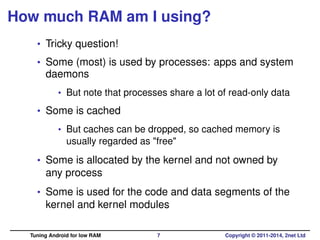
How much RAM am I using? 
• Tricky question! 
• Some (most) is used by processes: apps and system 
daemons 
• But note that processes share a lot of read-only data 
• Some is cached 
• But caches can be dropped, so cached memory is 
usually regarded as "free" 
• Some is allocated by the kernel and not owned by 
any process 
• Some is used for the code and data segments of the 
kernel and kernel modules 
Tuning Android for low RAM 7 Copyright © 2011-2014, 2net Ltd
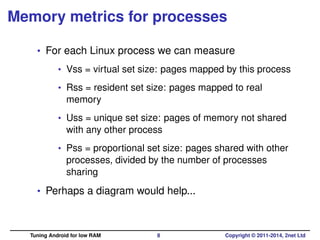
Memory metrics for processes 
• For each Linux process we can measure 
• Vss = virtual set size: pages mapped by this process 
• Rss = resident set size: pages mapped to real 
memory 
• Uss = unique set size: pages of memory not shared 
with any other process 
• Pss = proportional set size: pages shared with other 
processes, divided by the number of processes 
sharing 
• Perhaps a diagram would help... 
Tuning Android for low RAM 8 Copyright © 2011-2014, 2net Ltd
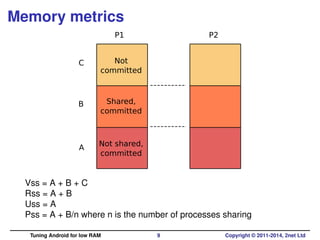
Memory metrics 
P1 P2 
Not 
committed 
Shared, 
committed 
Not shared, 
C 
B 
A committed 
Vss = A + B + C 
Rss = A + B 
Uss = A 
Pss = A + B/n where n is the number of processes sharing 
Tuning Android for low RAM 9 Copyright © 2011-2014, 2net Ltd
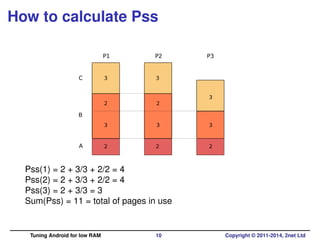
How to calculate Pss 
P1 
C 
B 
A 
P2 P3 
3 
2 
3 
2 
3 
2 
3 
2 
2 
3 3 
Pss(1) = 2 + 3/3 + 2/2 = 4 
Pss(2) = 2 + 3/3 + 2/2 = 4 
Pss(3) = 2 + 3/3 = 3 
Sum(Pss) = 11 = total of pages in use 
Tuning Android for low RAM 10 Copyright © 2011-2014, 2net Ltd
Tools: procrank 
Part of the Android tool set for a long time: ranks 
processes by Pss (default), type procrank -h for more 
options 
Example (edited): 
# procrank 
PID Vss Rss Pss Uss cmdline 
3351 1058776K 163952K 141197K 139596K com.google.earth 
2616 943156K 116020K 93360K 91724K com.android.vending 
539 990756K 112504K 91393K 89808K com.android.systemui 
4657 995760K 105964K 77829K 70776K com.rovio.angrybirds 
... 
119 31904K 7676K 6038K 5900K /system/bin/surfaceflinger 
122 27468K 3788K 3045K 2964K /system/bin/mediaserver 
... 
120 865084K 24308K 2263K 860K zygote 
... 
------ ------ ------ 
717098K 669272K TOTAL 
RAM: 1124832K total, 105528K free, 3808K buffers, 136624K cached, 
656K shmem, 23656K slab 
Tuning Android for low RAM 11 Copyright © 2011-2014, 2net Ltd
Tools: procmem 
Another tried and tested tool: shows Vss, Rss, etc for 
each mapping of a single process 
Example (edited): 
# procmem 119 
Vss Rss Pss Uss ShCl ShDi PrCl PrDi Name 
------- ------- ------- ------- ------- ------- ------- ------- 
4K 0K 0K 0K 0K 0K 0K 0K 
1012K 4K 4K 4K 0K 0K 4K 0K [stack:944] 
512K 512K 512K 512K 0K 0K 36K 476K /dev/mali0 
512K 512K 512K 512K 0K 0K 0K 512K /dev/mali0 
516K 12K 12K 12K 0K 0K 12K 0K [anon:libc_malloc] 
512K 512K 512K 512K 0K 0K 224K 288K /dev/mali0 
512K 512K 512K 512K 0K 0K 32K 480K /dev/mali0 
516K 12K 12K 12K 0K 0K 12K 0K [anon:libc_malloc] 
... 
2680K 2668K 2668K 2668K 0K 0K 2668K 0K [heap] 
132K 20K 20K 20K 0K 0K 20K 0K [stack] 
0K 0K 0K 0K 0K 0K 0K 0K [vectors] 
------- ------- ------- ------- ------- ------- ------- ------- 
31904K 7676K 6039K 5900K 1760K 16K 4144K 1760K TOTAL 
Tuning Android for low RAM 12 Copyright © 2011-2014, 2net Ltd
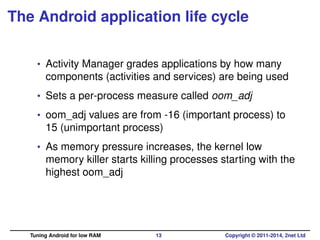
The Android application life cycle 
• Activity Manager grades applications by how many 
components (activities and services) are being used 
• Sets a per-process measure called oom_adj 
• oom_adj values are from -16 (important process) to 
15 (unimportant process) 
• As memory pressure increases, the kernel low 
memory killer starts killing processes starting with the 
highest oom_adj 
Tuning Android for low RAM 13 Copyright © 2011-2014, 2net Ltd
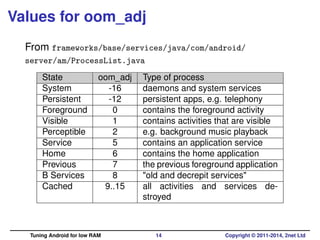
Values for oom_adj 
From frameworks/base/services/java/com/android/ 
server/am/ProcessList.java 
State oom_adj Type of process 
System -16 daemons and system services 
Persistent -12 persistent apps, e.g. telephony 
Foreground 0 contains the foreground activity 
Visible 1 contains activities that are visible 
Perceptible 2 e.g. background music playback 
Service 5 contains an application service 
Home 6 contains the home application 
Previous 7 the previous foreground application 
B Services 8 "old and decrepit services" 
Cached 9..15 all activities and services de-stroyed 
Tuning Android for low RAM 14 Copyright © 2011-2014, 2net Ltd
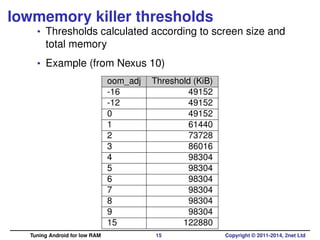
lowmemory killer thresholds 
• Thresholds calculated according to screen size and 
total memory 
• Example (from Nexus 10) 
oom_adj Threshold (KiB) 
-16 49152 
-12 49152 
0 49152 
1 61440 
2 73728 
3 86016 
4 98304 
5 98304 
6 98304 
7 98304 
8 98304 
9 98304 
15 122880 
Tuning Android for low RAM 15 Copyright © 2011-2014, 2net Ltd
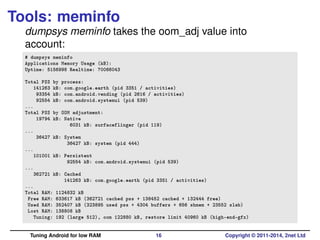
Tools: meminfo 
dumpsys meminfo takes the oom_adj value into 
account: 
# dumpsys meminfo 
Applications Memory Usage (kB): 
Uptime: 5156998 Realtime: 70066043 
Total PSS by process: 
141263 kB: com.google.earth (pid 3351 / activities) 
93354 kB: com.android.vending (pid 2616 / activities) 
92554 kB: com.android.systemui (pid 539) 
... 
Total PSS by OOM adjustment: 
19794 kB: Native 
6031 kB: surfaceflinger (pid 119) 
... 
36427 kB: System 
36427 kB: system (pid 444) 
... 
101001 kB: Persistent 
92554 kB: com.android.systemui (pid 539) 
... 
362721 kB: Cached 
141263 kB: com.google.earth (pid 3351 / activities) 
... 
Total RAM: 1124832 kB 
Free RAM: 633617 kB (362721 cached pss + 138452 cached + 132444 free) 
Used RAM: 352407 kB (323895 used pss + 4304 buffers + 656 shmem + 23552 slab) 
Lost RAM: 138808 kB 
Tuning: 192 (large 512), oom 122880 kB, restore limit 40960 kB (high-end-gfx) 
Tuning Android for low RAM 16 Copyright © 2011-2014, 2net Ltd
Tools: meminfo 
• In Kit Kat, dumpsys meminfo has been augmented to 
make the use of memory more clear 
• Processes with oom_adj >= 9 (CACHED_APP_MIN_ADJ) 
can be killed without the user noticing 
• So Free RAM includes apps that can be discarded 
("cached pss") and system buffers ("cached") 
Tuning Android for low RAM 17 Copyright © 2011-2014, 2net Ltd
Tools: procstats 
• procstats adds history to the measurement by 
integrating Pss over time 
• Use to identify persistent memory hogs 
• Typically shows up apps with long-running 
background services 
• procstats has a nice graphical interface, and can be 
run from the command line 
Tuning Android for low RAM 18 Copyright © 2011-2014, 2net Ltd
procstats 
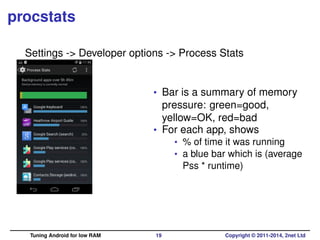
Settings -> Developer options -> Process Stats 
• Bar is a summary of memory 
pressure: green=good, 
yellow=OK, red=bad 
• For each app, shows 
• % of time it was running 
• a blue bar which is (average 
Pss * runtime) 
Tuning Android for low RAM 19 Copyright © 2011-2014, 2net Ltd
procstats 
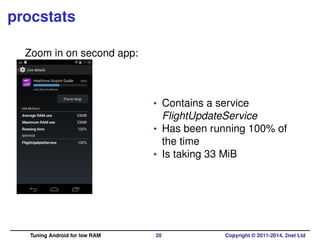
Zoom in on second app: 
• Contains a service 
FlightUpdateService 
• Has been running 100% of 
the time 
• Is taking 33 MiB 
Tuning Android for low RAM 20 Copyright © 2011-2014, 2net Ltd
procstats command-line 
• The raw data is available through system service 
procstats 
• Dump the data using 
# dumpsys procstats 
AGGREGATED OVER LAST 24 HOURS: 
* system / 1000: 
TOTAL: 100% (22MB-31MB-35MB/19MB-29MB-33MB over 89) 
Persistent: 100% (22MB-31MB-35MB/19MB-29MB-33MB over 89) 
* com.android.systemui / u0a6: 
TOTAL: 100% (36MB-59MB-99MB/34MB-57MB-97MB over 89) 
Persistent: 100% (36MB-59MB-99MB/34MB-57MB-97MB over 89) 
Imp Fg: 0.00% 
The memory numbers are 
minPss-avgPss-maxPss / minUss-avgUss-maxUss 
Tuning Android for low RAM 21 Copyright © 2011-2014, 2net Ltd
Tuning Android for low RAM 
What are the options? 
• Tune Activity manager 
• Tune Dalvik 
• Tune Apps 
Tuning Android for low RAM 22 Copyright © 2011-2014, 2net Ltd
Tuning Android for low RAM 
• Kit Kat has a global tuning parameter for low RAM 
ro.config.low_ram 
• If set to true: 
• Optimise allocations in Dalvik heap 
• Saves memory by reducing use of the GPU 
• New API ActivityManager.isLowRamDevice() returns 
true which apps can use as a hint that they should 
reduce memory usage: some Google apps are 
reportedly coded to make this check 
• Reduces the Dalvik total PSS by 10 - 15% on devices 
with large bitmaps (such as Nexus 7 or 10) 
Tuning Android for low RAM 23 Copyright © 2011-2014, 2net Ltd
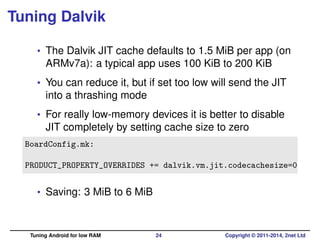
Tuning Dalvik 
• The Dalvik JIT cache defaults to 1.5 MiB per app (on 
ARMv7a): a typical app uses 100 KiB to 200 KiB 
• You can reduce it, but if set too low will send the JIT 
into a thrashing mode 
• For really low-memory devices it is better to disable 
JIT completely by setting cache size to zero 
BoardConfig.mk: 
PRODUCT_PROPERTY_OVERRIDES += dalvik.vm.jit.codecachesize=0 
• Saving: 3 MiB to 6 MiB 
Tuning Android for low RAM 24 Copyright © 2011-2014, 2net Ltd
Tuning applications 
• Generally, dereference objects that are not being 
used so they can be garbage-collected 
• Especially, implement void onTrimMemory (int level) 
and free memory as indicated 
• level is one of TRIM_MEMORY_COMPLETE, 
TRIM_MEMORY_MODERATE, TRIM_MEMORY_BACKGROUND, 
TRIM_MEMORY_UI_HIDDEN, 
TRIM_MEMORY_RUNNING_CRITICAL, 
TRIM_MEMORY_RUNNING_LOW, or 
TRIM_MEMORY_RUNNING_MODERATE 
Tuning Android for low RAM 25 Copyright © 2011-2014, 2net Ltd
Wallpaper 
• Ensure the default wallpaper setup on launcher is not 
live wallpaper 
• Do not pre-install any live wallpapers 
Tuning Android for low RAM 26 Copyright © 2011-2014, 2net Ltd
Tuning Linux for low RAM 
What are the options? 
• extra_free_kbytes 
• KSM 
• Swap to compressed RAM 
Tuning Android for low RAM 27 Copyright © 2011-2014, 2net Ltd
Linux memory reclaim 
• Background reclaim is done by the kswap daemon 
• Started when free memory drops below a threshold: 
2MB on a 2GB device and 636KB on a 512MB 
• Aims to keep some memory free by flushing dirty 
pages to disk (or invoking the low memory killer) 
• Direct reclaim happens when a process tries to 
allocate memory and there are no free pages 
• blocks the calling thread while pages are freed 
• Direct reclaim is bad because it can freeze the UI 
thread, leading to a poor UX 
Tuning Android for low RAM 28 Copyright © 2011-2014, 2net Ltd
extra_free_kbytes 
• Default kswapd threshold is rather low for Android 
devices 
• /proc/sys/vm/extra_free_kbytes is a tuneable added by 
Google to Linux 3.4 to modify the kswapd threshold 
• If set to 0 (default), Activity Manager will adjust it to 3 
x screen buffer 
• Can be configured in platform config.xml 
frameworks/base/core/res/res/values/config.xml 
• config_extraFreeKbytesAbsolute overrides the default 
chosen by Activity Manager: -1 keeps the default 
• config_extraFreeKbytesAdjust added (subtracted if 
negative) from the value chosen by Activity Manager 
Tuning Android for low RAM 29 Copyright © 2011-2014, 2net Ltd
Kernel Samepage Merging (KSM) 
• KSM is a kernel thread (ksmd) that runs in the 
background and compares pages in memory that 
have been marked MADV_MERGEABLE by 
user-space 
• If two pages are found to be the same, it merges 
them back to a single copy-on-write page 
• Balancing reduced memory usage vs more 
processing (greater power demand) 
• Benefit depends on workload 
Tuning Android for low RAM 30 Copyright © 2011-2014, 2net Ltd
KSM controls 
• Build kernel with CONFIG_KSM=y (Linux 2.6.32 or later) 
• Controlled by these files in /sys/kernel/mm/ksm 
File default Description 
run 0 Start ksmd thread if non-zero 
sleep_millisecs 500 ms between scans 
pages_to_scan 100 pages per scan 
• Typically you add lines to your init.[name].rc to set up 
KSM 
Tuning Android for low RAM 31 Copyright © 2011-2014, 2net Ltd
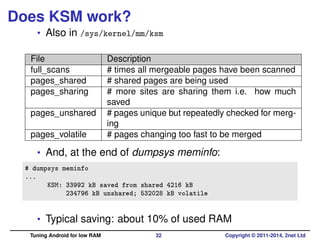
Does KSM work? 
• Also in /sys/kernel/mm/ksm 
File Description 
full_scans # times all mergeable pages have been scanned 
pages_shared # shared pages are being used 
pages_sharing # more sites are sharing them i.e. how much 
saved 
pages_unshared # pages unique but repeatedly checked for merg-ing 
pages_volatile # pages changing too fast to be merged 
• And, at the end of dumpsys meminfo: 
# dumpsys meminfo 
... 
KSM: 33992 kB saved from shared 4216 kB 
234796 kB unshared; 532028 kB volatile 
• Typical saving: about 10% of used RAM 
Tuning Android for low RAM 32 Copyright © 2011-2014, 2net Ltd
Compressed swap area 
• Use a compressed RAM swap area, zram, for swap 
• Unused dirty pages can be swapped out and 
compressed 
• Compression ratios in the 30-50% range are usually 
observed 
• Once again, you are balancing reduced memory 
usage vs more processing (greater power demand) 
Tuning Android for low RAM 33 Copyright © 2011-2014, 2net Ltd
Configuring zram 
• Add to kernel config 
CONFIG_SWAP 
CONFIG_CGROUP_MEM_RES_CTLR 
CONFIG_CGROUP_MEM_RES_CTLR_SWAP 
CONFIG_ZRAM 
• Add to /fstab.[product name]: 
/dev/block/zram0 none swap defaults 
zramsize=<size in bytes>,swapprio=<swap partition priority> 
• Add to /init.[product name].rc: 
swapon_all /fstab.[product name] 
Tuning Android for low RAM 34 Copyright © 2011-2014, 2net Ltd
• Questions? 
Slides on Slide Share: http://www.slideshare.net/ 
chrissimmonds/android-lowmemoryabs2014 
Tuning Android for low RAM 35 Copyright © 2011-2014, 2net Ltd

Tuning Android for low RAM

  • 1.
    Tuning Android forlow RAM when 1 GiB is too much Chris Simmonds Tuning Android for low RAM 1 Copyright © 2011-2014, 2net Ltd
  • 2.
    License These slidesare available under a Creative Commons Attribution-ShareAlike 3.0 license. You can read the full text of the license here http://creativecommons.org/licenses/by-sa/3.0/legalcode You are free to • copy, distribute, display, and perform the work • make derivative works • make commercial use of the work Under the following conditions • Attribution: you must give the original author credit • Share Alike: if you alter, transform, or build upon this work, you may distribute the resulting work only under a license identical to this one (i.e. include this page exactly as it is) • For any reuse or distribution, you must make clear to others the license terms of this work Tuning Android for low RAM 2 Copyright © 2011-2014, 2net Ltd
  • 3.
    About Chris Simmonds • Consultant and trainer • Working with embedded Linux since 1999 • Android since 2009 • Speaker at many conferences and workshops "Looking after the Inner Penguin" blog at http://2net.co.uk/ https://uk.linkedin.com/in/chrisdsimmonds/ https://google.com/+chrissimmonds Tuning Android for low RAM 3 Copyright © 2011-2014, 2net Ltd
  • 4.
    Overview • ProjectSvelte • How much RAM do you need? • Tuning Android • Global tuning knob: "ro.config.low_ram" • The Dalvik JIT cache • The OnTrimMemory application callback • Tuning the kernel • Kernel Samepage Merging (KSM) • Swap to compressed RAM Tuning Android for low RAM 4 Copyright © 2011-2014, 2net Ltd
  • 5.
    The problem •Since Gingerbread minimum RAM has gone beyond 512 MiB • Especially since "project Butter" (Jelly Bean 4.1) which improved graphics performance by adding more buffers (among other changes) • But there is still a desire to run Android on such "low-end" hardware • Cheap smartphones • Wearables: e.g. the current generation of smartwatches • "Embedded Android" Tuning Android for low RAM 5 Copyright © 2011-2014, 2net Ltd
  • 6.
    Project Svelte •Kit Kat 4.4 introduced "project Svelte": Android on devices with 512 MiB RAM • Project Svelte consists of • Various memory-saving changes to Android framework • Tuning knobs for Android • Validated techniques for tuning Linux • Improved memory diagnostics • See source.android.com/devices/low-ram.html • Note: In many cases there is a trade-off between reducing memory use and increasing CPU load (and therefore increasing power requirements) Tuning Android for low RAM 6 Copyright © 2011-2014, 2net Ltd
  • 7.
    How much RAMam I using? • Tricky question! • Some (most) is used by processes: apps and system daemons • But note that processes share a lot of read-only data • Some is cached • But caches can be dropped, so cached memory is usually regarded as "free" • Some is allocated by the kernel and not owned by any process • Some is used for the code and data segments of the kernel and kernel modules Tuning Android for low RAM 7 Copyright © 2011-2014, 2net Ltd
  • 8.
    Memory metrics forprocesses • For each Linux process we can measure • Vss = virtual set size: pages mapped by this process • Rss = resident set size: pages mapped to real memory • Uss = unique set size: pages of memory not shared with any other process • Pss = proportional set size: pages shared with other processes, divided by the number of processes sharing • Perhaps a diagram would help... Tuning Android for low RAM 8 Copyright © 2011-2014, 2net Ltd
  • 9.
    Memory metrics P1P2 Not committed Shared, committed Not shared, C B A committed Vss = A + B + C Rss = A + B Uss = A Pss = A + B/n where n is the number of processes sharing Tuning Android for low RAM 9 Copyright © 2011-2014, 2net Ltd
  • 10.
    How to calculatePss P1 C B A P2 P3 3 2 3 2 3 2 3 2 2 3 3 Pss(1) = 2 + 3/3 + 2/2 = 4 Pss(2) = 2 + 3/3 + 2/2 = 4 Pss(3) = 2 + 3/3 = 3 Sum(Pss) = 11 = total of pages in use Tuning Android for low RAM 10 Copyright © 2011-2014, 2net Ltd
  • 11.
    Tools: procrank Partof the Android tool set for a long time: ranks processes by Pss (default), type procrank -h for more options Example (edited): # procrank PID Vss Rss Pss Uss cmdline 3351 1058776K 163952K 141197K 139596K com.google.earth 2616 943156K 116020K 93360K 91724K com.android.vending 539 990756K 112504K 91393K 89808K com.android.systemui 4657 995760K 105964K 77829K 70776K com.rovio.angrybirds ... 119 31904K 7676K 6038K 5900K /system/bin/surfaceflinger 122 27468K 3788K 3045K 2964K /system/bin/mediaserver ... 120 865084K 24308K 2263K 860K zygote ... ------ ------ ------ 717098K 669272K TOTAL RAM: 1124832K total, 105528K free, 3808K buffers, 136624K cached, 656K shmem, 23656K slab Tuning Android for low RAM 11 Copyright © 2011-2014, 2net Ltd
  • 12.
    Tools: procmem Anothertried and tested tool: shows Vss, Rss, etc for each mapping of a single process Example (edited): # procmem 119 Vss Rss Pss Uss ShCl ShDi PrCl PrDi Name ------- ------- ------- ------- ------- ------- ------- ------- 4K 0K 0K 0K 0K 0K 0K 0K 1012K 4K 4K 4K 0K 0K 4K 0K [stack:944] 512K 512K 512K 512K 0K 0K 36K 476K /dev/mali0 512K 512K 512K 512K 0K 0K 0K 512K /dev/mali0 516K 12K 12K 12K 0K 0K 12K 0K [anon:libc_malloc] 512K 512K 512K 512K 0K 0K 224K 288K /dev/mali0 512K 512K 512K 512K 0K 0K 32K 480K /dev/mali0 516K 12K 12K 12K 0K 0K 12K 0K [anon:libc_malloc] ... 2680K 2668K 2668K 2668K 0K 0K 2668K 0K [heap] 132K 20K 20K 20K 0K 0K 20K 0K [stack] 0K 0K 0K 0K 0K 0K 0K 0K [vectors] ------- ------- ------- ------- ------- ------- ------- ------- 31904K 7676K 6039K 5900K 1760K 16K 4144K 1760K TOTAL Tuning Android for low RAM 12 Copyright © 2011-2014, 2net Ltd
  • 13.
    The Android applicationlife cycle • Activity Manager grades applications by how many components (activities and services) are being used • Sets a per-process measure called oom_adj • oom_adj values are from -16 (important process) to 15 (unimportant process) • As memory pressure increases, the kernel low memory killer starts killing processes starting with the highest oom_adj Tuning Android for low RAM 13 Copyright © 2011-2014, 2net Ltd
  • 14.
    Values for oom_adj From frameworks/base/services/java/com/android/ server/am/ProcessList.java State oom_adj Type of process System -16 daemons and system services Persistent -12 persistent apps, e.g. telephony Foreground 0 contains the foreground activity Visible 1 contains activities that are visible Perceptible 2 e.g. background music playback Service 5 contains an application service Home 6 contains the home application Previous 7 the previous foreground application B Services 8 "old and decrepit services" Cached 9..15 all activities and services de-stroyed Tuning Android for low RAM 14 Copyright © 2011-2014, 2net Ltd
  • 15.
    lowmemory killer thresholds • Thresholds calculated according to screen size and total memory • Example (from Nexus 10) oom_adj Threshold (KiB) -16 49152 -12 49152 0 49152 1 61440 2 73728 3 86016 4 98304 5 98304 6 98304 7 98304 8 98304 9 98304 15 122880 Tuning Android for low RAM 15 Copyright © 2011-2014, 2net Ltd
  • 16.
    Tools: meminfo dumpsysmeminfo takes the oom_adj value into account: # dumpsys meminfo Applications Memory Usage (kB): Uptime: 5156998 Realtime: 70066043 Total PSS by process: 141263 kB: com.google.earth (pid 3351 / activities) 93354 kB: com.android.vending (pid 2616 / activities) 92554 kB: com.android.systemui (pid 539) ... Total PSS by OOM adjustment: 19794 kB: Native 6031 kB: surfaceflinger (pid 119) ... 36427 kB: System 36427 kB: system (pid 444) ... 101001 kB: Persistent 92554 kB: com.android.systemui (pid 539) ... 362721 kB: Cached 141263 kB: com.google.earth (pid 3351 / activities) ... Total RAM: 1124832 kB Free RAM: 633617 kB (362721 cached pss + 138452 cached + 132444 free) Used RAM: 352407 kB (323895 used pss + 4304 buffers + 656 shmem + 23552 slab) Lost RAM: 138808 kB Tuning: 192 (large 512), oom 122880 kB, restore limit 40960 kB (high-end-gfx) Tuning Android for low RAM 16 Copyright © 2011-2014, 2net Ltd
  • 17.
    Tools: meminfo •In Kit Kat, dumpsys meminfo has been augmented to make the use of memory more clear • Processes with oom_adj >= 9 (CACHED_APP_MIN_ADJ) can be killed without the user noticing • So Free RAM includes apps that can be discarded ("cached pss") and system buffers ("cached") Tuning Android for low RAM 17 Copyright © 2011-2014, 2net Ltd
  • 18.
    Tools: procstats •procstats adds history to the measurement by integrating Pss over time • Use to identify persistent memory hogs • Typically shows up apps with long-running background services • procstats has a nice graphical interface, and can be run from the command line Tuning Android for low RAM 18 Copyright © 2011-2014, 2net Ltd
  • 19.
    procstats Settings ->Developer options -> Process Stats • Bar is a summary of memory pressure: green=good, yellow=OK, red=bad • For each app, shows • % of time it was running • a blue bar which is (average Pss * runtime) Tuning Android for low RAM 19 Copyright © 2011-2014, 2net Ltd
  • 20.
    procstats Zoom inon second app: • Contains a service FlightUpdateService • Has been running 100% of the time • Is taking 33 MiB Tuning Android for low RAM 20 Copyright © 2011-2014, 2net Ltd
  • 21.
    procstats command-line •The raw data is available through system service procstats • Dump the data using # dumpsys procstats AGGREGATED OVER LAST 24 HOURS: * system / 1000: TOTAL: 100% (22MB-31MB-35MB/19MB-29MB-33MB over 89) Persistent: 100% (22MB-31MB-35MB/19MB-29MB-33MB over 89) * com.android.systemui / u0a6: TOTAL: 100% (36MB-59MB-99MB/34MB-57MB-97MB over 89) Persistent: 100% (36MB-59MB-99MB/34MB-57MB-97MB over 89) Imp Fg: 0.00% The memory numbers are minPss-avgPss-maxPss / minUss-avgUss-maxUss Tuning Android for low RAM 21 Copyright © 2011-2014, 2net Ltd
  • 22.
    Tuning Android forlow RAM What are the options? • Tune Activity manager • Tune Dalvik • Tune Apps Tuning Android for low RAM 22 Copyright © 2011-2014, 2net Ltd
  • 23.
    Tuning Android forlow RAM • Kit Kat has a global tuning parameter for low RAM ro.config.low_ram • If set to true: • Optimise allocations in Dalvik heap • Saves memory by reducing use of the GPU • New API ActivityManager.isLowRamDevice() returns true which apps can use as a hint that they should reduce memory usage: some Google apps are reportedly coded to make this check • Reduces the Dalvik total PSS by 10 - 15% on devices with large bitmaps (such as Nexus 7 or 10) Tuning Android for low RAM 23 Copyright © 2011-2014, 2net Ltd
  • 24.
    Tuning Dalvik •The Dalvik JIT cache defaults to 1.5 MiB per app (on ARMv7a): a typical app uses 100 KiB to 200 KiB • You can reduce it, but if set too low will send the JIT into a thrashing mode • For really low-memory devices it is better to disable JIT completely by setting cache size to zero BoardConfig.mk: PRODUCT_PROPERTY_OVERRIDES += dalvik.vm.jit.codecachesize=0 • Saving: 3 MiB to 6 MiB Tuning Android for low RAM 24 Copyright © 2011-2014, 2net Ltd
  • 25.
    Tuning applications •Generally, dereference objects that are not being used so they can be garbage-collected • Especially, implement void onTrimMemory (int level) and free memory as indicated • level is one of TRIM_MEMORY_COMPLETE, TRIM_MEMORY_MODERATE, TRIM_MEMORY_BACKGROUND, TRIM_MEMORY_UI_HIDDEN, TRIM_MEMORY_RUNNING_CRITICAL, TRIM_MEMORY_RUNNING_LOW, or TRIM_MEMORY_RUNNING_MODERATE Tuning Android for low RAM 25 Copyright © 2011-2014, 2net Ltd
  • 26.
    Wallpaper • Ensurethe default wallpaper setup on launcher is not live wallpaper • Do not pre-install any live wallpapers Tuning Android for low RAM 26 Copyright © 2011-2014, 2net Ltd
  • 27.
    Tuning Linux forlow RAM What are the options? • extra_free_kbytes • KSM • Swap to compressed RAM Tuning Android for low RAM 27 Copyright © 2011-2014, 2net Ltd
  • 28.
    Linux memory reclaim • Background reclaim is done by the kswap daemon • Started when free memory drops below a threshold: 2MB on a 2GB device and 636KB on a 512MB • Aims to keep some memory free by flushing dirty pages to disk (or invoking the low memory killer) • Direct reclaim happens when a process tries to allocate memory and there are no free pages • blocks the calling thread while pages are freed • Direct reclaim is bad because it can freeze the UI thread, leading to a poor UX Tuning Android for low RAM 28 Copyright © 2011-2014, 2net Ltd
  • 29.
    extra_free_kbytes • Defaultkswapd threshold is rather low for Android devices • /proc/sys/vm/extra_free_kbytes is a tuneable added by Google to Linux 3.4 to modify the kswapd threshold • If set to 0 (default), Activity Manager will adjust it to 3 x screen buffer • Can be configured in platform config.xml frameworks/base/core/res/res/values/config.xml • config_extraFreeKbytesAbsolute overrides the default chosen by Activity Manager: -1 keeps the default • config_extraFreeKbytesAdjust added (subtracted if negative) from the value chosen by Activity Manager Tuning Android for low RAM 29 Copyright © 2011-2014, 2net Ltd
  • 30.
    Kernel Samepage Merging(KSM) • KSM is a kernel thread (ksmd) that runs in the background and compares pages in memory that have been marked MADV_MERGEABLE by user-space • If two pages are found to be the same, it merges them back to a single copy-on-write page • Balancing reduced memory usage vs more processing (greater power demand) • Benefit depends on workload Tuning Android for low RAM 30 Copyright © 2011-2014, 2net Ltd
  • 31.
    KSM controls •Build kernel with CONFIG_KSM=y (Linux 2.6.32 or later) • Controlled by these files in /sys/kernel/mm/ksm File default Description run 0 Start ksmd thread if non-zero sleep_millisecs 500 ms between scans pages_to_scan 100 pages per scan • Typically you add lines to your init.[name].rc to set up KSM Tuning Android for low RAM 31 Copyright © 2011-2014, 2net Ltd
  • 32.
    Does KSM work? • Also in /sys/kernel/mm/ksm File Description full_scans # times all mergeable pages have been scanned pages_shared # shared pages are being used pages_sharing # more sites are sharing them i.e. how much saved pages_unshared # pages unique but repeatedly checked for merg-ing pages_volatile # pages changing too fast to be merged • And, at the end of dumpsys meminfo: # dumpsys meminfo ... KSM: 33992 kB saved from shared 4216 kB 234796 kB unshared; 532028 kB volatile • Typical saving: about 10% of used RAM Tuning Android for low RAM 32 Copyright © 2011-2014, 2net Ltd
  • 33.
    Compressed swap area • Use a compressed RAM swap area, zram, for swap • Unused dirty pages can be swapped out and compressed • Compression ratios in the 30-50% range are usually observed • Once again, you are balancing reduced memory usage vs more processing (greater power demand) Tuning Android for low RAM 33 Copyright © 2011-2014, 2net Ltd
  • 34.
    Configuring zram •Add to kernel config CONFIG_SWAP CONFIG_CGROUP_MEM_RES_CTLR CONFIG_CGROUP_MEM_RES_CTLR_SWAP CONFIG_ZRAM • Add to /fstab.[product name]: /dev/block/zram0 none swap defaults zramsize=<size in bytes>,swapprio=<swap partition priority> • Add to /init.[product name].rc: swapon_all /fstab.[product name] Tuning Android for low RAM 34 Copyright © 2011-2014, 2net Ltd
  • 35.
    • Questions? Slideson Slide Share: http://www.slideshare.net/ chrissimmonds/android-lowmemoryabs2014 Tuning Android for low RAM 35 Copyright © 2011-2014, 2net Ltd