Elements of Computing Systems, Nisan & Schocken, MIT Press, www.nand2tetris.org , Chapter 3: Sequential Logic slide 1
www.nand2tetris.org
Building a Modern Computer From First Principles
Sequential Logic
Elements of Computing Systems, Nisan & Schocken, MIT Press, www.nand2tetris.org , Chapter 3: Sequential Logic slide 2
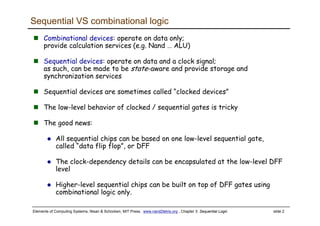
Sequential VS combinational logic
Combinational devices: operate on data only;
provide calculation services (e.g. Nand … ALU)
Sequential devices: operate on data and a clock signal;
as such, can be made to be state-aware and provide storage and
synchronization services
Sequential devices are sometimes called “clocked devices”
The low-level behavior of clocked / sequential gates is tricky
The good news:
All sequential chips can be based on one low-level sequential gate,
called “data flip flop”, or DFF
The clock-dependency details can be encapsulated at the low-level DFF
level
Higher-level sequential chips can be built on top of DFF gates using
combinational logic only.
Elements of Computing Systems, Nisan & Schocken, MIT Press, www.nand2tetris.org , Chapter 3: Sequential Logic slide 3
Lecture plan
Clock
A hierarchy of memory chips:
Flip-flop gates
Binary cells
Registers
RAM
Counters
Perspective.
Elements of Computing Systems, Nisan & Schocken, MIT Press, www.nand2tetris.org , Chapter 3: Sequential Logic slide 4
The Clock
clock
signal
cycle cycle cycle cycle
tick
tock
tick
tock
tick
tock
tick
tock
In our jargon, a clock cycle = tick-phase (low), followed by a
tock-phase (high)
In real hardware, the clock is implemented by an oscillator
In our hardware simulator, clock cycles can be simulated either
Manually, by the user, or
“Automatically,” by a test script.
HW
simulator
demo
Elements of Computing Systems, Nisan & Schocken, MIT Press, www.nand2tetris.org , Chapter 3: Sequential Logic slide 5
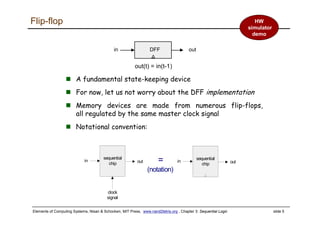
Flip-flop
A fundamental state-keeping device
For now, let us not worry about the DFF implementation
Memory devices are made from numerous flip-flops,
all regulated by the same master clock signal
Notational convention:
sequential
chip outin sequential
chip outin
clock
signal
=
(notation)
HW
simulator
demo
DFF outin
out(t) = in(t-1)
Elements of Computing Systems, Nisan & Schocken, MIT Press, www.nand2tetris.org , Chapter 3: Sequential Logic slide 6
1-bit register (we call it “Bit”)
DFF
out(t) = in(t-1)
Basic building block
in out
Objective: build a storage unit that can:
(a) Change its state to a given input
(b) Maintain its state over time (until changed)
DFF
out(t) = out(t-1) ?
out(t) = in(t-1) ?
Won’t work
in out
Bit out
load
in
if load(t-1) then out(t)=in(t-1)
else out(t)=out(t-1)
Elements of Computing Systems, Nisan & Schocken, MIT Press, www.nand2tetris.org , Chapter 3: Sequential Logic slide 7
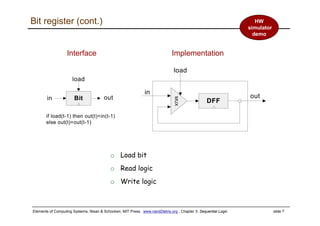
Bit register (cont.)
Bit out
load
in
if load(t-1) then out(t)=in(t-1)
else out(t)=out(t-1)
Interface
DFF
MUX
load
in
out
Implementation
HW
simulator
demo
o Load bit
o Read logic
o Write logic
Elements of Computing Systems, Nisan & Schocken, MIT Press, www.nand2tetris.org , Chapter 3: Sequential Logic slide 8
Multi-bit register
Bit out
load
in
if load(t-1) then out(t)=in(t-1)
else out(t)=out(t-1)
1-bit register
o Register’s width: a trivial parameter
o Read logic
o Write logic
. . .Bit
w-bit register
out
load
in
w w
if load(t-1) then out(t)=in(t-1)
else out(t)=out(t-1)
Bit Bit
HW
simulator
demo
Elements of Computing Systems, Nisan & Schocken, MIT Press, www.nand2tetris.org , Chapter 3: Sequential Logic slide 9
Aside: Hardware Simulation
Relevant topics from the HW simulator tutorial:
Clocked chips: When a clocked chip is loaded into the simulator, the
clock icon is enabled, allowing clock control
Built-in chips:
feature a standard HDL interface yet a Java implementation
Provide behavioral simulation services
May feature GUI effects (at the simulator level only).
HW
simulator
demo
Elements of Computing Systems, Nisan & Schocken, MIT Press, www.nand2tetris.org , Chapter 3: Sequential Logic slide 10
Random Access Memory (RAM)
o Read logic
o Write logic.
load
(0 to n-1)
Direct Access Logic
register 0
register 1
register n-1
RAM n
...
register 2
in out
(word) (word)
address
HW
simulator
demo
Elements of Computing Systems, Nisan & Schocken, MIT Press, www.nand2tetris.org , Chapter 3: Sequential Logic slide 11
RAM interface
address
load
out
in
16 bits
log 2 n
bits
RAMn
16 bits
Elements of Computing Systems, Nisan & Schocken, MIT Press, www.nand2tetris.org , Chapter 3: Sequential Logic slide 12
Bit Bit
Register
.. .Bit
RAM anatomy
register
RAM 8
8
register
...
register
RAM8
RAM 64
8
...
RAM8
. . .
Recursive ascent
Elements of Computing Systems, Nisan & Schocken, MIT Press, www.nand2tetris.org , Chapter 3: Sequential Logic slide 13
Counter
Typical function: program counter
Implementation: register chip + some combinational logic.
PC (counter)
w bits
outin
w bits
inc load reset
If reset(t-1) then out(t)=0
else if load(t-1) then out(t)=in(t-1)
else if inc(t-1) then out(t)=out(t-1)+1
else out(t)=out(t-1)
Needed: a storage device that can:
(a) set its state to some base value
(b) increment the state in every clock cycle
(c) maintain its state (stop incrementing) over clock cycles
(d) reset its state
Elements of Computing Systems, Nisan & Schocken, MIT Press, www.nand2tetris.org , Chapter 3: Sequential Logic slide 14
Recap: Sequential VS combinational logic
out = some function of (in)
Combinational chip
comb.
logic
in out
out(t) = some function of (in(t-1), out(t-1))
Sequential chip
comb.
logic
in out
DFF
gate(s)
comb.
logic
(optional) (optional)time delay
Elements of Computing Systems, Nisan & Schocken, MIT Press, www.nand2tetris.org , Chapter 3: Sequential Logic slide 15
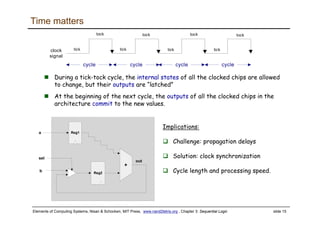
Time matters
Implications:
Challenge: propagation delays
Solution: clock synchronization
Cycle length and processing speed.
+
Reg2
a Reg1
b
out
sel
clock
signal
cycle cycle cycle cycle
tick
tock
tick
tock
tick
tock
tick
tock
During a tick-tock cycle, the internal states of all the clocked chips are allowed
to change, but their outputs are “latched”
At the beginning of the next cycle, the outputs of all the clocked chips in the
architecture commit to the new values.
Elements of Computing Systems, Nisan & Schocken, MIT Press, www.nand2tetris.org , Chapter 3: Sequential Logic slide 16
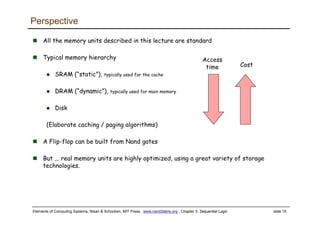
Perspective
All the memory units described in this lecture are standard
Typical memory hierarchy
SRAM (“static”), typically used for the cache
DRAM (“dynamic”), typically used for main memory
Disk
(Elaborate caching / paging algorithms)
A Flip-flop can be built from Nand gates
But ... real memory units are highly optimized, using a great variety of storage
technologies.
Access
time Cost
Elements of Computing Systems, Nisan & Schocken, MIT Press, www.nand2tetris.org , Chapter 3: Sequential Logic slide 17
End notes: some poetry about the limits of logic ...
There exists a field where things are neither true nor false;
I’ll meet you there. (Rumi)
In the place where we are always right
No flowers will bloom in springtime (Yehuda Amichai)
A mind all logic is like a knife all blade;
It makes the hand bleed that uses it.
(Rabindranath Tagor)

nand2tetris 舊版投影片 -- 第三章 循序邏輯

  • 1.
    Elements of ComputingSystems, Nisan & Schocken, MIT Press, www.nand2tetris.org , Chapter 3: Sequential Logic slide 1 www.nand2tetris.org Building a Modern Computer From First Principles Sequential Logic
  • 2.
    Elements of ComputingSystems, Nisan & Schocken, MIT Press, www.nand2tetris.org , Chapter 3: Sequential Logic slide 2 Sequential VS combinational logic Combinational devices: operate on data only; provide calculation services (e.g. Nand … ALU) Sequential devices: operate on data and a clock signal; as such, can be made to be state-aware and provide storage and synchronization services Sequential devices are sometimes called “clocked devices” The low-level behavior of clocked / sequential gates is tricky The good news: All sequential chips can be based on one low-level sequential gate, called “data flip flop”, or DFF The clock-dependency details can be encapsulated at the low-level DFF level Higher-level sequential chips can be built on top of DFF gates using combinational logic only.
  • 3.
    Elements of ComputingSystems, Nisan & Schocken, MIT Press, www.nand2tetris.org , Chapter 3: Sequential Logic slide 3 Lecture plan Clock A hierarchy of memory chips: Flip-flop gates Binary cells Registers RAM Counters Perspective.
  • 4.
    Elements of ComputingSystems, Nisan & Schocken, MIT Press, www.nand2tetris.org , Chapter 3: Sequential Logic slide 4 The Clock clock signal cycle cycle cycle cycle tick tock tick tock tick tock tick tock In our jargon, a clock cycle = tick-phase (low), followed by a tock-phase (high) In real hardware, the clock is implemented by an oscillator In our hardware simulator, clock cycles can be simulated either Manually, by the user, or “Automatically,” by a test script. HW simulator demo
  • 5.
    Elements of ComputingSystems, Nisan & Schocken, MIT Press, www.nand2tetris.org , Chapter 3: Sequential Logic slide 5 Flip-flop A fundamental state-keeping device For now, let us not worry about the DFF implementation Memory devices are made from numerous flip-flops, all regulated by the same master clock signal Notational convention: sequential chip outin sequential chip outin clock signal = (notation) HW simulator demo DFF outin out(t) = in(t-1)
  • 6.
    Elements of ComputingSystems, Nisan & Schocken, MIT Press, www.nand2tetris.org , Chapter 3: Sequential Logic slide 6 1-bit register (we call it “Bit”) DFF out(t) = in(t-1) Basic building block in out Objective: build a storage unit that can: (a) Change its state to a given input (b) Maintain its state over time (until changed) DFF out(t) = out(t-1) ? out(t) = in(t-1) ? Won’t work in out Bit out load in if load(t-1) then out(t)=in(t-1) else out(t)=out(t-1)
  • 7.
    Elements of ComputingSystems, Nisan & Schocken, MIT Press, www.nand2tetris.org , Chapter 3: Sequential Logic slide 7 Bit register (cont.) Bit out load in if load(t-1) then out(t)=in(t-1) else out(t)=out(t-1) Interface DFF MUX load in out Implementation HW simulator demo o Load bit o Read logic o Write logic
  • 8.
    Elements of ComputingSystems, Nisan & Schocken, MIT Press, www.nand2tetris.org , Chapter 3: Sequential Logic slide 8 Multi-bit register Bit out load in if load(t-1) then out(t)=in(t-1) else out(t)=out(t-1) 1-bit register o Register’s width: a trivial parameter o Read logic o Write logic . . .Bit w-bit register out load in w w if load(t-1) then out(t)=in(t-1) else out(t)=out(t-1) Bit Bit HW simulator demo
  • 9.
    Elements of ComputingSystems, Nisan & Schocken, MIT Press, www.nand2tetris.org , Chapter 3: Sequential Logic slide 9 Aside: Hardware Simulation Relevant topics from the HW simulator tutorial: Clocked chips: When a clocked chip is loaded into the simulator, the clock icon is enabled, allowing clock control Built-in chips: feature a standard HDL interface yet a Java implementation Provide behavioral simulation services May feature GUI effects (at the simulator level only). HW simulator demo
  • 10.
    Elements of ComputingSystems, Nisan & Schocken, MIT Press, www.nand2tetris.org , Chapter 3: Sequential Logic slide 10 Random Access Memory (RAM) o Read logic o Write logic. load (0 to n-1) Direct Access Logic register 0 register 1 register n-1 RAM n ... register 2 in out (word) (word) address HW simulator demo
  • 11.
    Elements of ComputingSystems, Nisan & Schocken, MIT Press, www.nand2tetris.org , Chapter 3: Sequential Logic slide 11 RAM interface address load out in 16 bits log 2 n bits RAMn 16 bits
  • 12.
    Elements of ComputingSystems, Nisan & Schocken, MIT Press, www.nand2tetris.org , Chapter 3: Sequential Logic slide 12 Bit Bit Register .. .Bit RAM anatomy register RAM 8 8 register ... register RAM8 RAM 64 8 ... RAM8 . . . Recursive ascent
  • 13.
    Elements of ComputingSystems, Nisan & Schocken, MIT Press, www.nand2tetris.org , Chapter 3: Sequential Logic slide 13 Counter Typical function: program counter Implementation: register chip + some combinational logic. PC (counter) w bits outin w bits inc load reset If reset(t-1) then out(t)=0 else if load(t-1) then out(t)=in(t-1) else if inc(t-1) then out(t)=out(t-1)+1 else out(t)=out(t-1) Needed: a storage device that can: (a) set its state to some base value (b) increment the state in every clock cycle (c) maintain its state (stop incrementing) over clock cycles (d) reset its state
  • 14.
    Elements of ComputingSystems, Nisan & Schocken, MIT Press, www.nand2tetris.org , Chapter 3: Sequential Logic slide 14 Recap: Sequential VS combinational logic out = some function of (in) Combinational chip comb. logic in out out(t) = some function of (in(t-1), out(t-1)) Sequential chip comb. logic in out DFF gate(s) comb. logic (optional) (optional)time delay
  • 15.
    Elements of ComputingSystems, Nisan & Schocken, MIT Press, www.nand2tetris.org , Chapter 3: Sequential Logic slide 15 Time matters Implications: Challenge: propagation delays Solution: clock synchronization Cycle length and processing speed. + Reg2 a Reg1 b out sel clock signal cycle cycle cycle cycle tick tock tick tock tick tock tick tock During a tick-tock cycle, the internal states of all the clocked chips are allowed to change, but their outputs are “latched” At the beginning of the next cycle, the outputs of all the clocked chips in the architecture commit to the new values.
  • 16.
    Elements of ComputingSystems, Nisan & Schocken, MIT Press, www.nand2tetris.org , Chapter 3: Sequential Logic slide 16 Perspective All the memory units described in this lecture are standard Typical memory hierarchy SRAM (“static”), typically used for the cache DRAM (“dynamic”), typically used for main memory Disk (Elaborate caching / paging algorithms) A Flip-flop can be built from Nand gates But ... real memory units are highly optimized, using a great variety of storage technologies. Access time Cost
  • 17.
    Elements of ComputingSystems, Nisan & Schocken, MIT Press, www.nand2tetris.org , Chapter 3: Sequential Logic slide 17 End notes: some poetry about the limits of logic ... There exists a field where things are neither true nor false; I’ll meet you there. (Rumi) In the place where we are always right No flowers will bloom in springtime (Yehuda Amichai) A mind all logic is like a knife all blade; It makes the hand bleed that uses it. (Rabindranath Tagor)