Landscape  Design & Principles
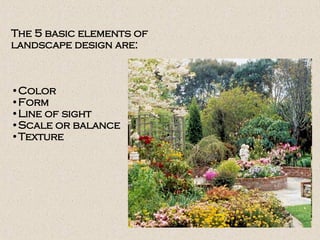
The 5 basic elements of landscape design are:  Color Form Line of sight Scale or balance Texture
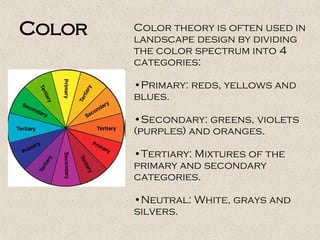
Color theory is often used in landscape design by dividing the color spectrum into 4 categories:  Primary: reds, yellows and blues. Secondary: greens, violets (purples) and oranges.  Tertiary: Mixtures of the primary and secondary categories.  Neutral: White, grays and silvers.  Color
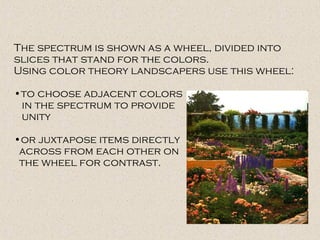
The spectrum is shown as a wheel, divided into slices that stand for the colors.  Using color theory landscapers use this wheel: to choose adjacent colors  in the spectrum to provide unity  or juxtapose items directly  across from each other on the wheel for contrast.
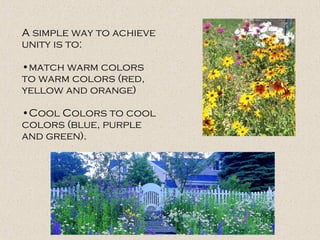
A simple way to achieve unity is to: match warm colors to warm colors (red, yellow and orange)  Cool Colors to cool colors (blue, purple and green).
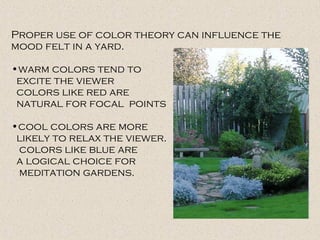
Proper use of color theory can influence the mood felt in a yard.  warm colors tend to  excite the viewer colors like red are  natural for focal  points cool colors are more  likely to relax the viewer.  colors like blue are  a logical choice for  meditation gardens.
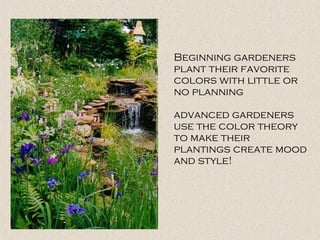
Beginning gardeners plant their favorite colors with little or no planning  advanced gardeners use the color theory to make their plantings create mood and style!
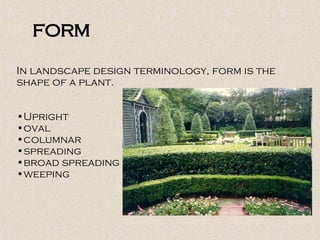
In landscape design terminology, form is the shape of a plant.  Upright  oval  columnar  spreading  broad spreading weeping  form
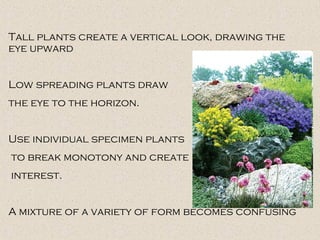
Tall plants create a vertical look, drawing the eye upward Low spreading plants draw  the eye to the horizon. Use individual specimen plants to break monotony and create interest.  A mixture of a variety of form becomes confusing
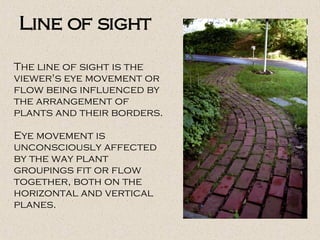
The line of sight is the viewer's eye movement or flow being influenced by the arrangement of plants and their borders.  Eye movement is unconsciously affected by the way plant groupings fit or flow together, both on the horizontal and vertical planes.   Line of sight
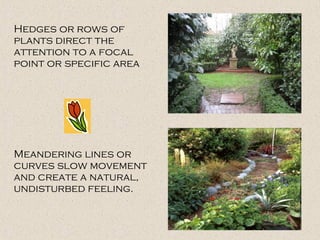
Hedges or rows of plants direct the attention to a focal point or specific area Meandering lines or curves slow movement and create a natural, undisturbed feeling.
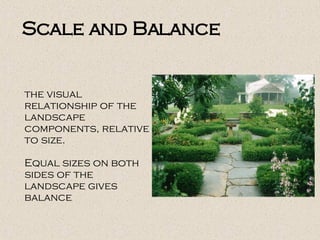
the visual relationship of the landscape components, relative to size. Equal sizes on both sides of the landscape gives balance Scale and Balance
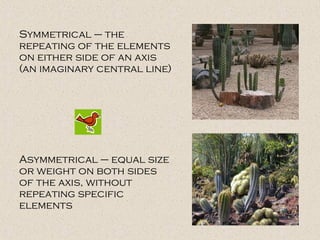
Symmetrical – the repeating of the elements on either side of an axis (an imaginary central line) Asymmetrical – equal size or weight on both sides of the axis, without repeating specific elements
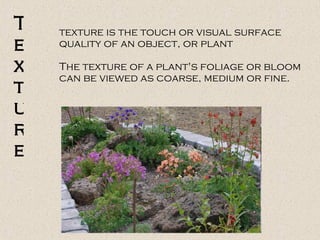
texture is the touch or visual surface quality of an object, or plant  The texture of a plant's foliage or bloom can be viewed as coarse, medium or fine.   Texture
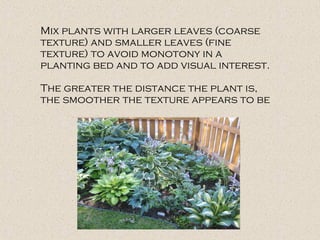
Mix plants with larger leaves (coarse texture) and smaller leaves (fine texture) to avoid monotony in a planting bed and to add visual interest. The greater the distance the plant is, the smoother the texture appears to be
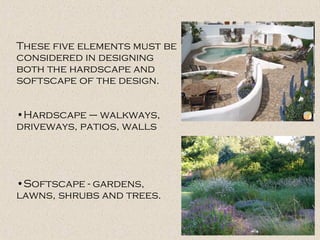
These five elements must be considered in designing both the hardscape and softscape of the design.  Hardscape – walkways, driveways, patios, walls Softscape - gardens, lawns, shrubs and trees.
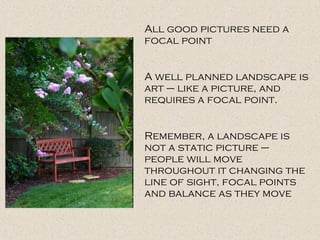
All good pictures need a focal point A well planned landscape is art – like a picture, and requires a focal point. Remember, a landscape is not a static picture – people will move throughout it changing the line of sight, focal points and balance as they move
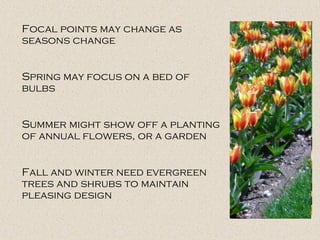
Focal points may change as seasons change Spring may focus on a bed of bulbs Summer might show off a planting of annual flowers, or a garden Fall and winter need evergreen trees and shrubs to maintain pleasing design
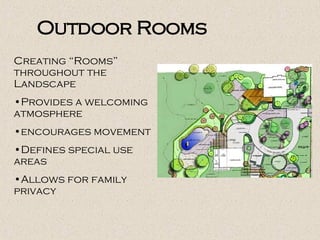
Creating “Rooms” throughout the Landscape  Provides a welcoming atmosphere encourages movement Defines special use areas Allows for family privacy Outdoor Rooms
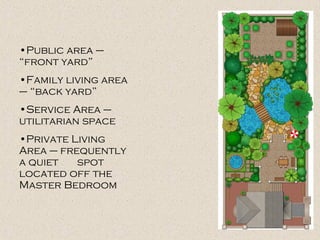
Public area – “front yard” Family living area – “back yard” Service Area – utilitarian space Private Living Area – frequently a quiet  spot located off the Master Bedroom
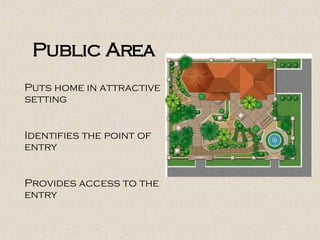
Public Area Puts home in attractive setting Identifies the point of entry Provides access to the entry
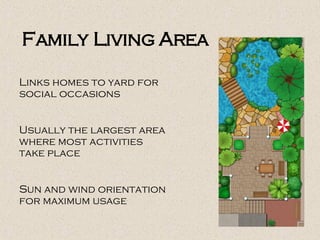
Family Living Area Links homes to yard for social occasions Usually the largest area where most activities take place Sun and wind orientation for maximum usage
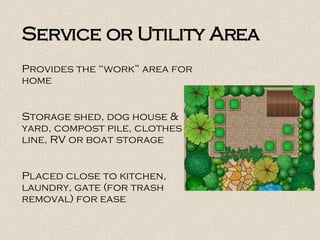
Service or Utility Area Provides the “work” area for home Storage shed, dog house & yard, compost pile, clothes line, RV or boat storage Placed close to kitchen, laundry, gate (for trash removal) for ease
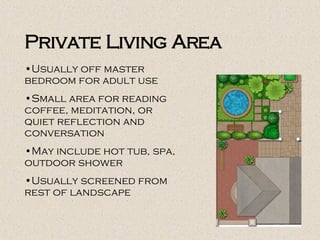
Private Living Area Usually off master bedroom for adult use Small area for reading coffee, meditation, or quiet reflection and conversation May include hot tub, spa, outdoor shower Usually screened from rest of landscape
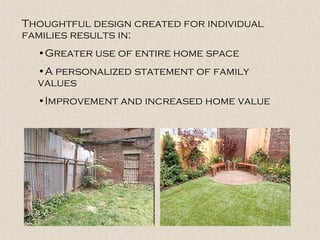
Thoughtful design created for individual families results in: Greater use of entire home space A personalized statement of family  values Improvement and increased home value
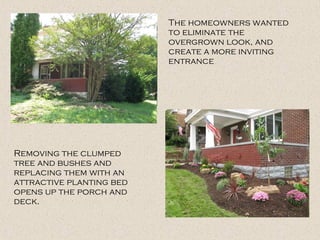
The homeowners wanted to eliminate the overgrown look, and create a more inviting entrance Removing the clumped tree and bushes and replacing them with an attractive planting bed opens up the porch and deck.
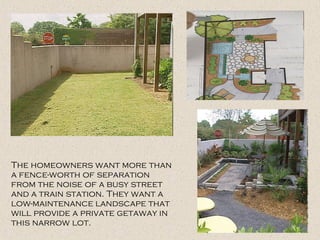
The homeowners want more than a fence-worth of separation from the noise of a busy street and a train station. They want a low-maintenance landscape that will provide a private getaway in this narrow lot.
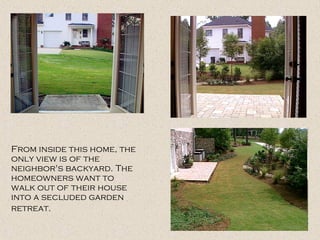
From inside this home, the only view is of the neighbor's backyard. The homeowners want to walk out of their house into a secluded garden retreat.
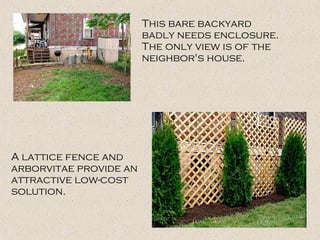
This bare backyard badly needs enclosure. The only view is of the neighbor's house.  A lattice fence and arborvitae provide an attractive low-cost solution.
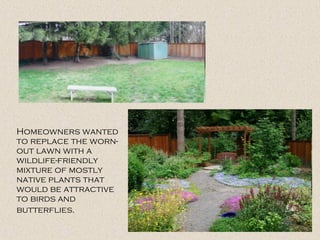
Homeowners wanted to replace the worn-out lawn with a wildlife-friendly mixture of mostly native plants that would be attractive to birds and butterflies.
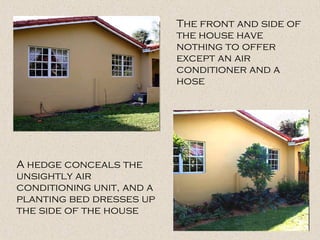
A hedge conceals the unsightly air conditioning unit, and a planting bed dresses up the side of the house   The front and side of the house have nothing to offer except an air conditioner and a hose
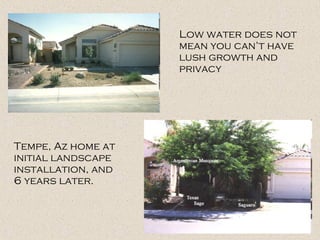
Low water does not mean you can’t have lush growth and privacy Tempe, Az home at initial landscape installation, and 6 years later.
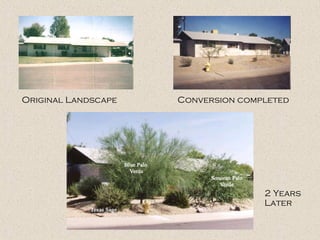
Original Landscape  Conversion completed 2 Years Later
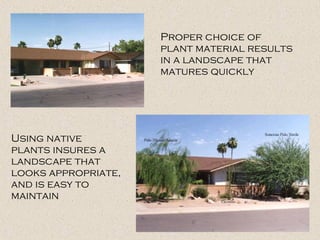
Proper choice of plant material results in a landscape that matures quickly Using native plants insures a landscape that looks appropriate, and is easy to maintain
 

Landscape Design and Principles

  • 1.
    Landscape Design& Principles
  • 2.
    The 5 basicelements of landscape design are: Color Form Line of sight Scale or balance Texture
  • 3.
    Color theory isoften used in landscape design by dividing the color spectrum into 4 categories: Primary: reds, yellows and blues. Secondary: greens, violets (purples) and oranges. Tertiary: Mixtures of the primary and secondary categories. Neutral: White, grays and silvers. Color
  • 4.
    The spectrum isshown as a wheel, divided into slices that stand for the colors. Using color theory landscapers use this wheel: to choose adjacent colors in the spectrum to provide unity or juxtapose items directly across from each other on the wheel for contrast.
  • 5.
    A simple wayto achieve unity is to: match warm colors to warm colors (red, yellow and orange) Cool Colors to cool colors (blue, purple and green).
  • 6.
    Proper use ofcolor theory can influence the mood felt in a yard. warm colors tend to excite the viewer colors like red are natural for focal points cool colors are more likely to relax the viewer. colors like blue are a logical choice for meditation gardens.
  • 7.
    Beginning gardeners planttheir favorite colors with little or no planning advanced gardeners use the color theory to make their plantings create mood and style!
  • 8.
    In landscape designterminology, form is the shape of a plant. Upright oval columnar spreading broad spreading weeping form
  • 9.
    Tall plants createa vertical look, drawing the eye upward Low spreading plants draw the eye to the horizon. Use individual specimen plants to break monotony and create interest. A mixture of a variety of form becomes confusing
  • 10.
    The line ofsight is the viewer's eye movement or flow being influenced by the arrangement of plants and their borders. Eye movement is unconsciously affected by the way plant groupings fit or flow together, both on the horizontal and vertical planes. Line of sight
  • 11.
    Hedges or rowsof plants direct the attention to a focal point or specific area Meandering lines or curves slow movement and create a natural, undisturbed feeling.
  • 12.
    the visual relationshipof the landscape components, relative to size. Equal sizes on both sides of the landscape gives balance Scale and Balance
  • 13.
    Symmetrical – therepeating of the elements on either side of an axis (an imaginary central line) Asymmetrical – equal size or weight on both sides of the axis, without repeating specific elements
  • 14.
    texture is thetouch or visual surface quality of an object, or plant The texture of a plant's foliage or bloom can be viewed as coarse, medium or fine. Texture
  • 15.
    Mix plants withlarger leaves (coarse texture) and smaller leaves (fine texture) to avoid monotony in a planting bed and to add visual interest. The greater the distance the plant is, the smoother the texture appears to be
  • 16.
    These five elementsmust be considered in designing both the hardscape and softscape of the design. Hardscape – walkways, driveways, patios, walls Softscape - gardens, lawns, shrubs and trees.
  • 17.
    All good picturesneed a focal point A well planned landscape is art – like a picture, and requires a focal point. Remember, a landscape is not a static picture – people will move throughout it changing the line of sight, focal points and balance as they move
  • 18.
    Focal points maychange as seasons change Spring may focus on a bed of bulbs Summer might show off a planting of annual flowers, or a garden Fall and winter need evergreen trees and shrubs to maintain pleasing design
  • 19.
    Creating “Rooms” throughoutthe Landscape Provides a welcoming atmosphere encourages movement Defines special use areas Allows for family privacy Outdoor Rooms
  • 20.
    Public area –“front yard” Family living area – “back yard” Service Area – utilitarian space Private Living Area – frequently a quiet spot located off the Master Bedroom
  • 21.
    Public Area Putshome in attractive setting Identifies the point of entry Provides access to the entry
  • 22.
    Family Living AreaLinks homes to yard for social occasions Usually the largest area where most activities take place Sun and wind orientation for maximum usage
  • 23.
    Service or UtilityArea Provides the “work” area for home Storage shed, dog house & yard, compost pile, clothes line, RV or boat storage Placed close to kitchen, laundry, gate (for trash removal) for ease
  • 24.
    Private Living AreaUsually off master bedroom for adult use Small area for reading coffee, meditation, or quiet reflection and conversation May include hot tub, spa, outdoor shower Usually screened from rest of landscape
  • 25.
    Thoughtful design createdfor individual families results in: Greater use of entire home space A personalized statement of family values Improvement and increased home value
  • 26.
    The homeowners wantedto eliminate the overgrown look, and create a more inviting entrance Removing the clumped tree and bushes and replacing them with an attractive planting bed opens up the porch and deck.
  • 27.
    The homeowners wantmore than a fence-worth of separation from the noise of a busy street and a train station. They want a low-maintenance landscape that will provide a private getaway in this narrow lot.
  • 28.
    From inside thishome, the only view is of the neighbor's backyard. The homeowners want to walk out of their house into a secluded garden retreat.
  • 29.
    This bare backyardbadly needs enclosure. The only view is of the neighbor's house. A lattice fence and arborvitae provide an attractive low-cost solution.
  • 30.
    Homeowners wanted toreplace the worn-out lawn with a wildlife-friendly mixture of mostly native plants that would be attractive to birds and butterflies.
  • 31.
    A hedge concealsthe unsightly air conditioning unit, and a planting bed dresses up the side of the house The front and side of the house have nothing to offer except an air conditioner and a hose
  • 32.
    Low water doesnot mean you can’t have lush growth and privacy Tempe, Az home at initial landscape installation, and 6 years later.
  • 33.
    Original Landscape Conversion completed 2 Years Later
  • 34.
    Proper choice ofplant material results in a landscape that matures quickly Using native plants insures a landscape that looks appropriate, and is easy to maintain
  • 35.