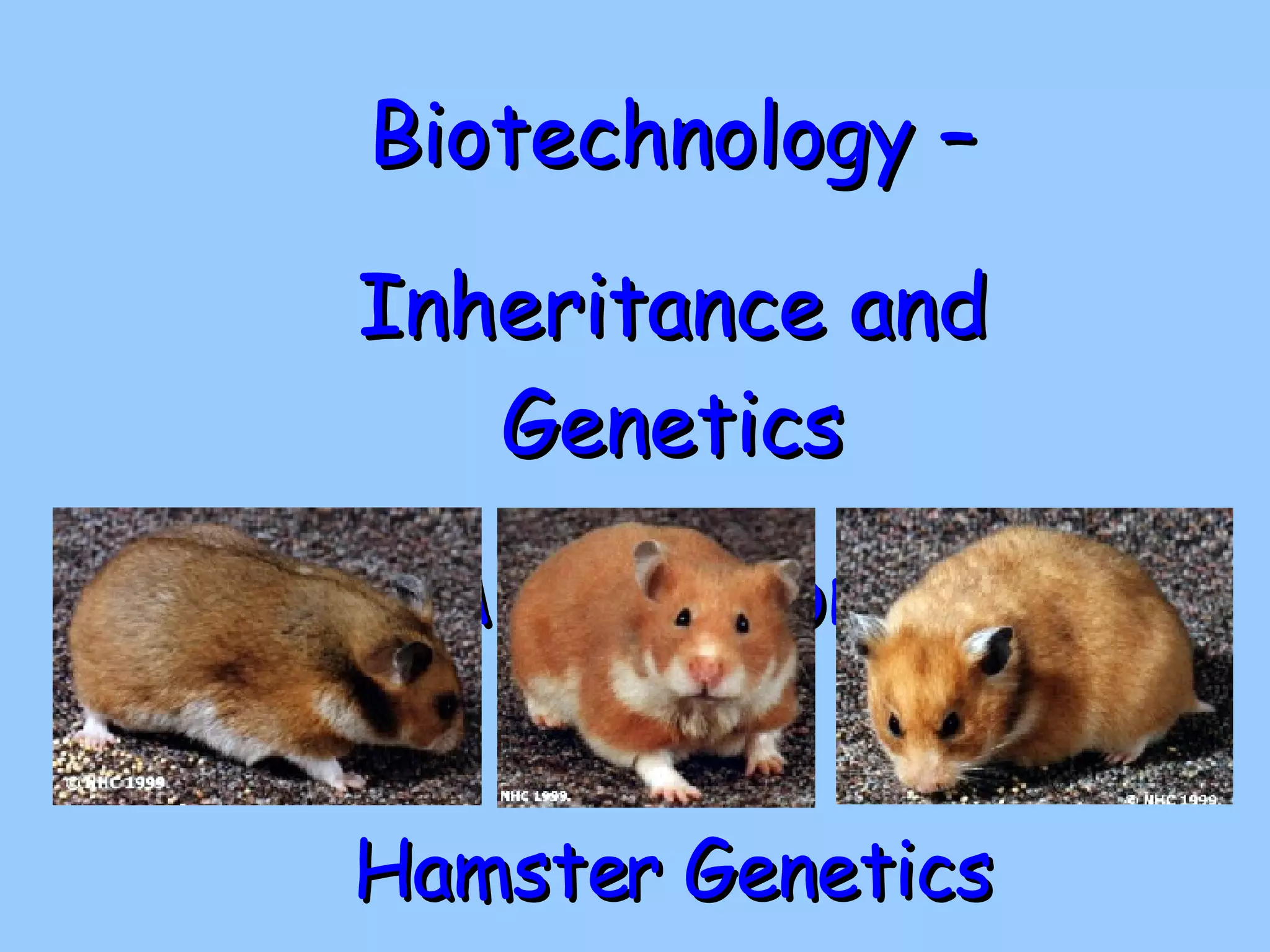
Hamster Genetics Biotechnology – Inheritance and Genetics Applications
Standards Addressed: 15.0 Animal Growth and Production 15.3 Reproduction 15.4 Biotechnology – 16.0 Using Scientific Processes to Analyze Data 16.1 Scientific Method 16.2, 16.3, 16.4 Scientific Research 16.6, 16.8 Communicating Results 17.0 Relationships Within Living Systems 17.2 Heredity 18.0 Bioethical Issues 18.3 Animal production
Objectives: In a Laboratory Environment Students will be able to: 1- Use the scientific method to hypothesize, predict  implement and report conclusions 2 – Illustrate patterns of inheritance using the principles of Mendel’s genetic theory 3 – Demonstrate respectful, and appropriate treatment of lab animals
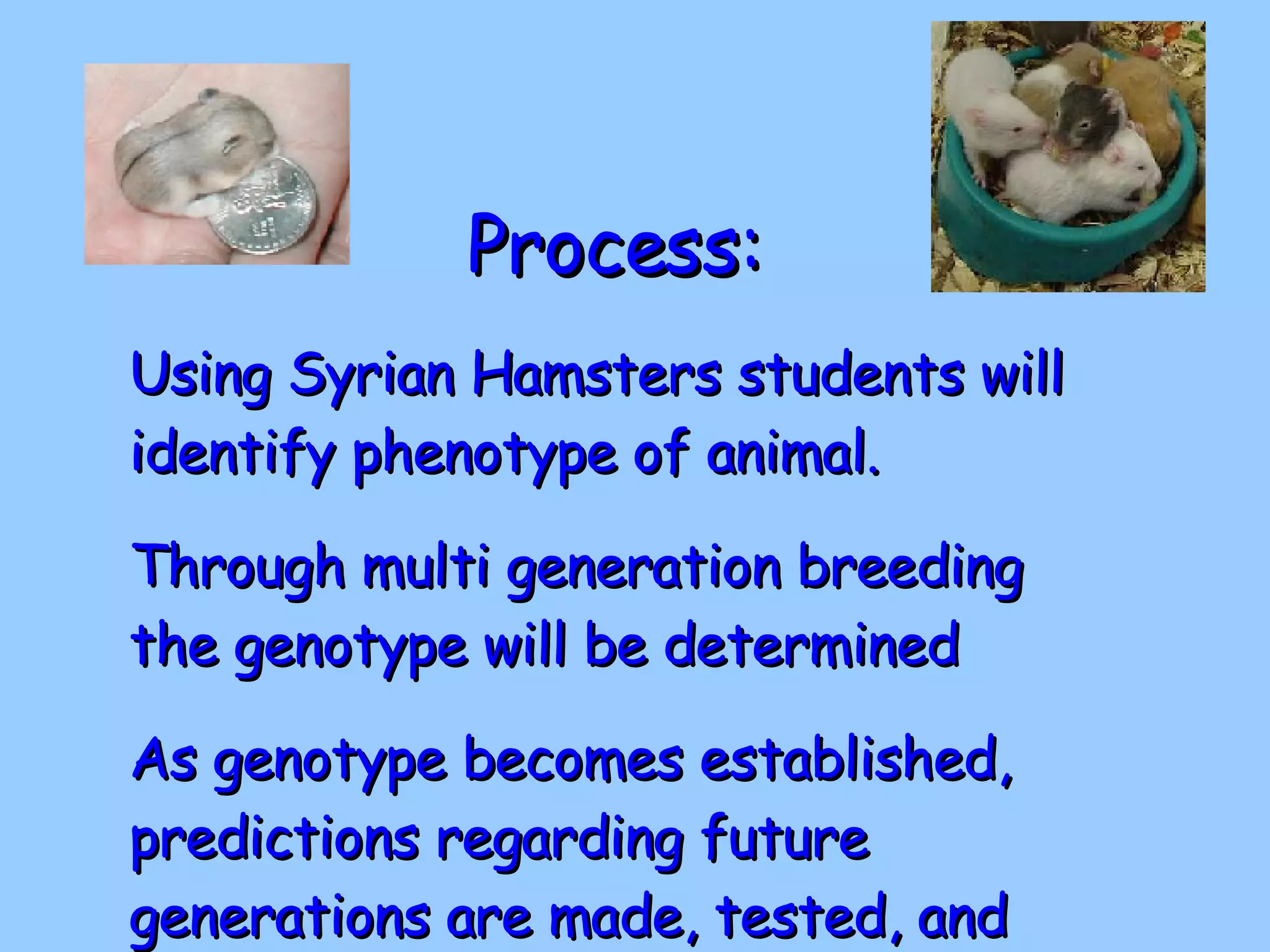
Process: Using Syrian Hamsters students will identify phenotype of animal. Through multi generation breeding the genotype will be determined As genotype becomes established, predictions regarding future generations are made, tested, and results reported
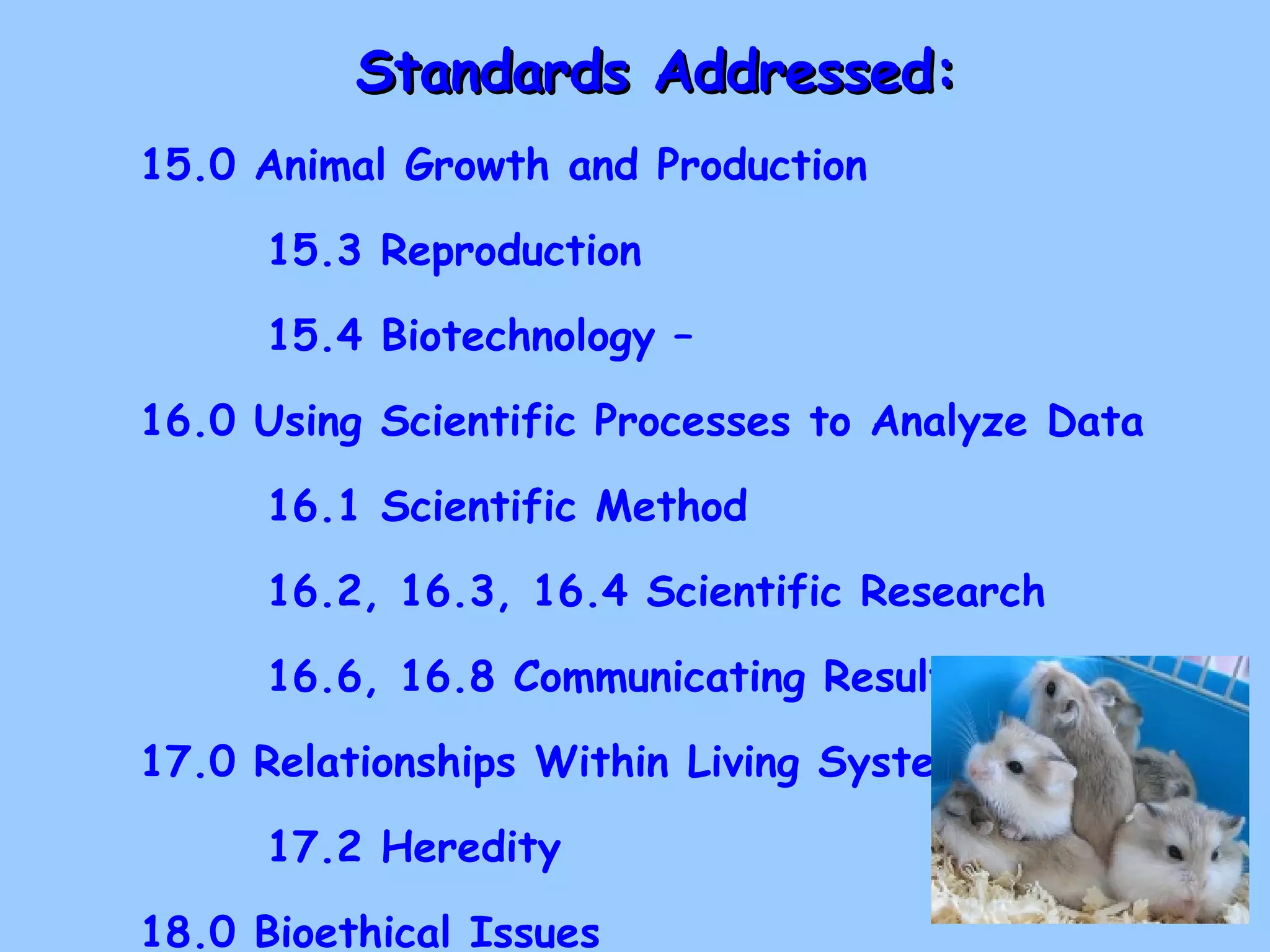
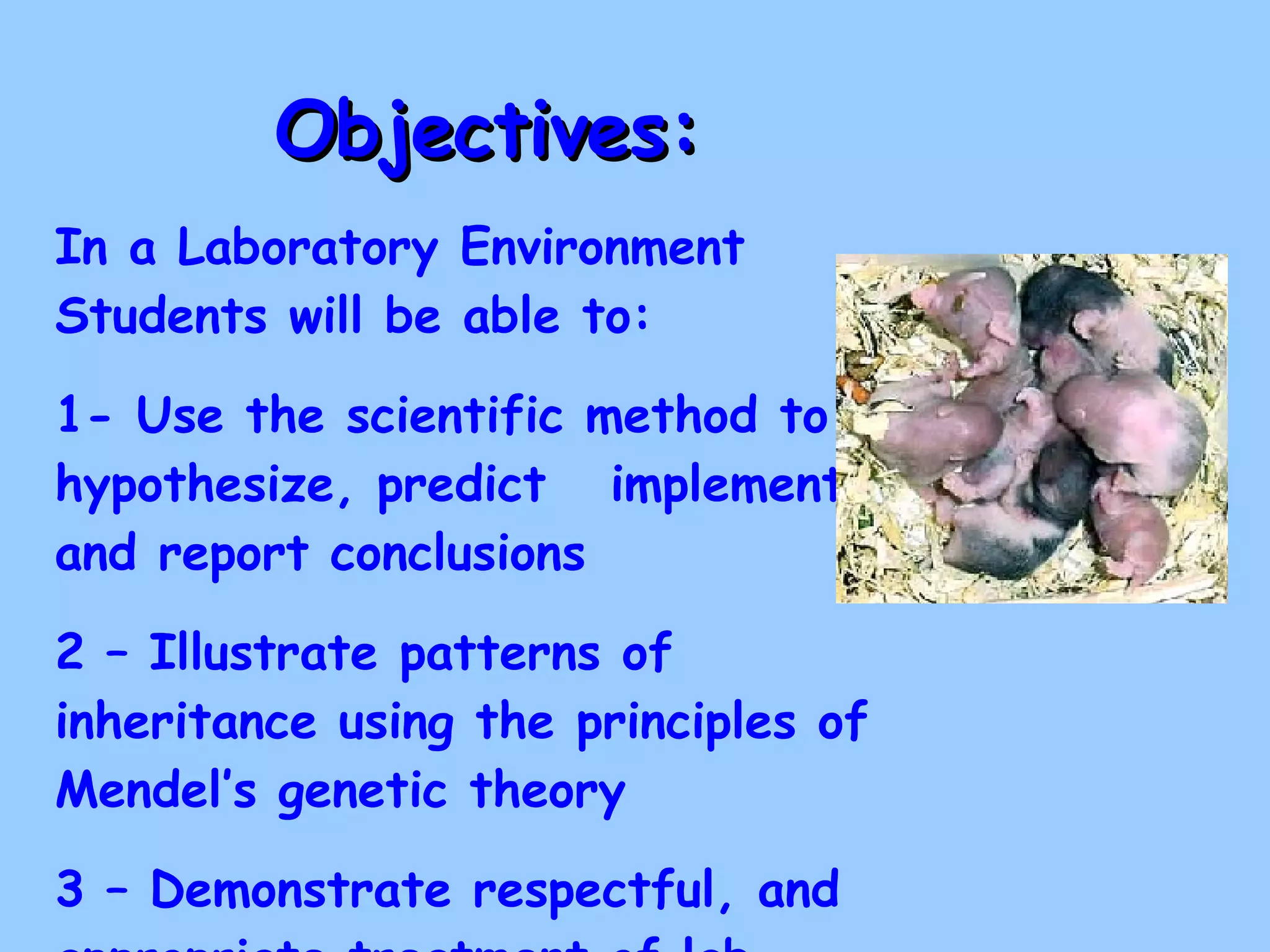
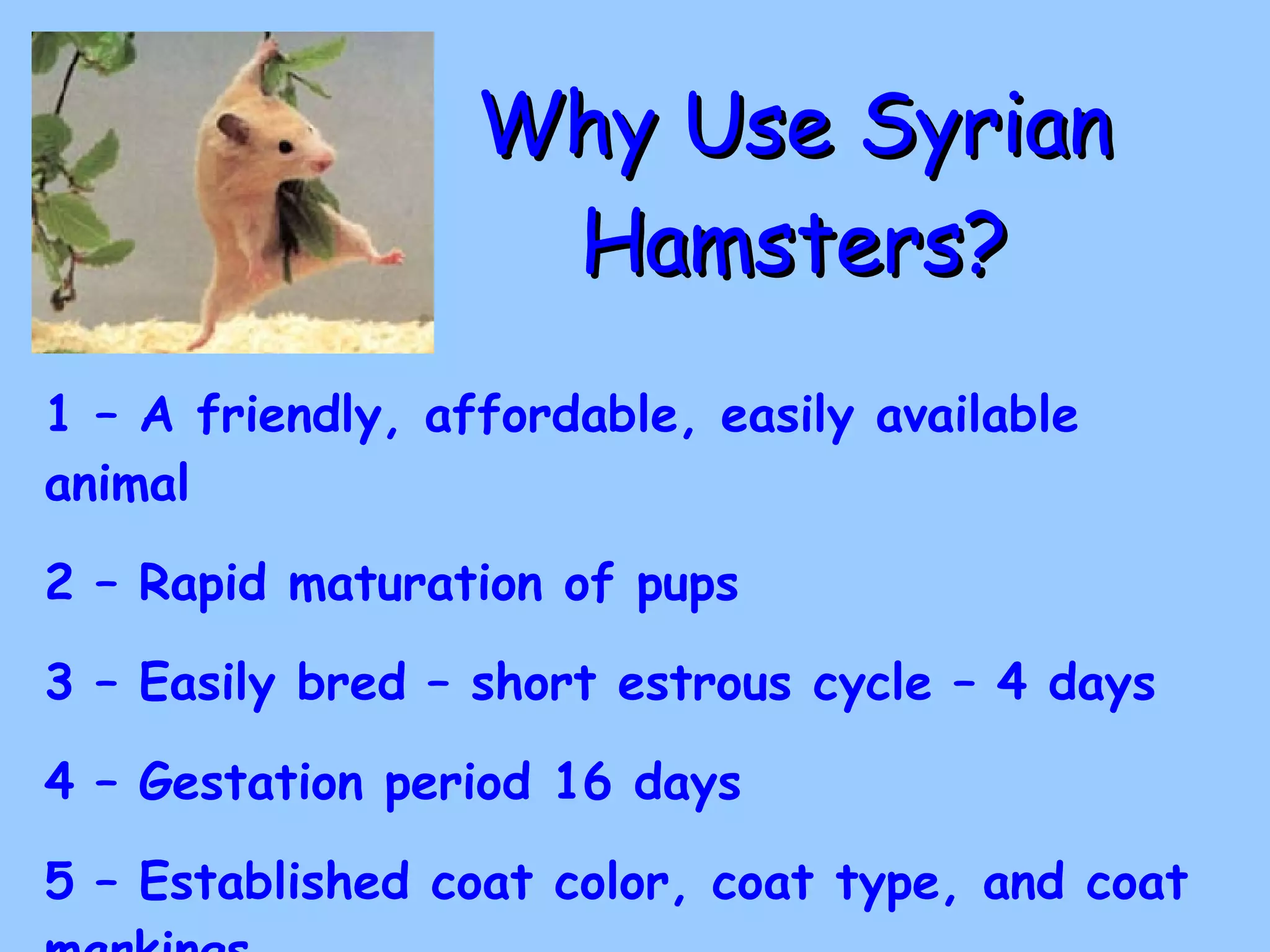
Why Use Syrian Hamsters? 1 – A friendly, affordable, easily available animal 2 – Rapid maturation of pups 3 – Easily bred – short estrous cycle – 4 days 4 – Gestation period 16 days 5 – Established coat color, coat type, and coat markings 4 – Monohybrid and dihybrid  crosses visible
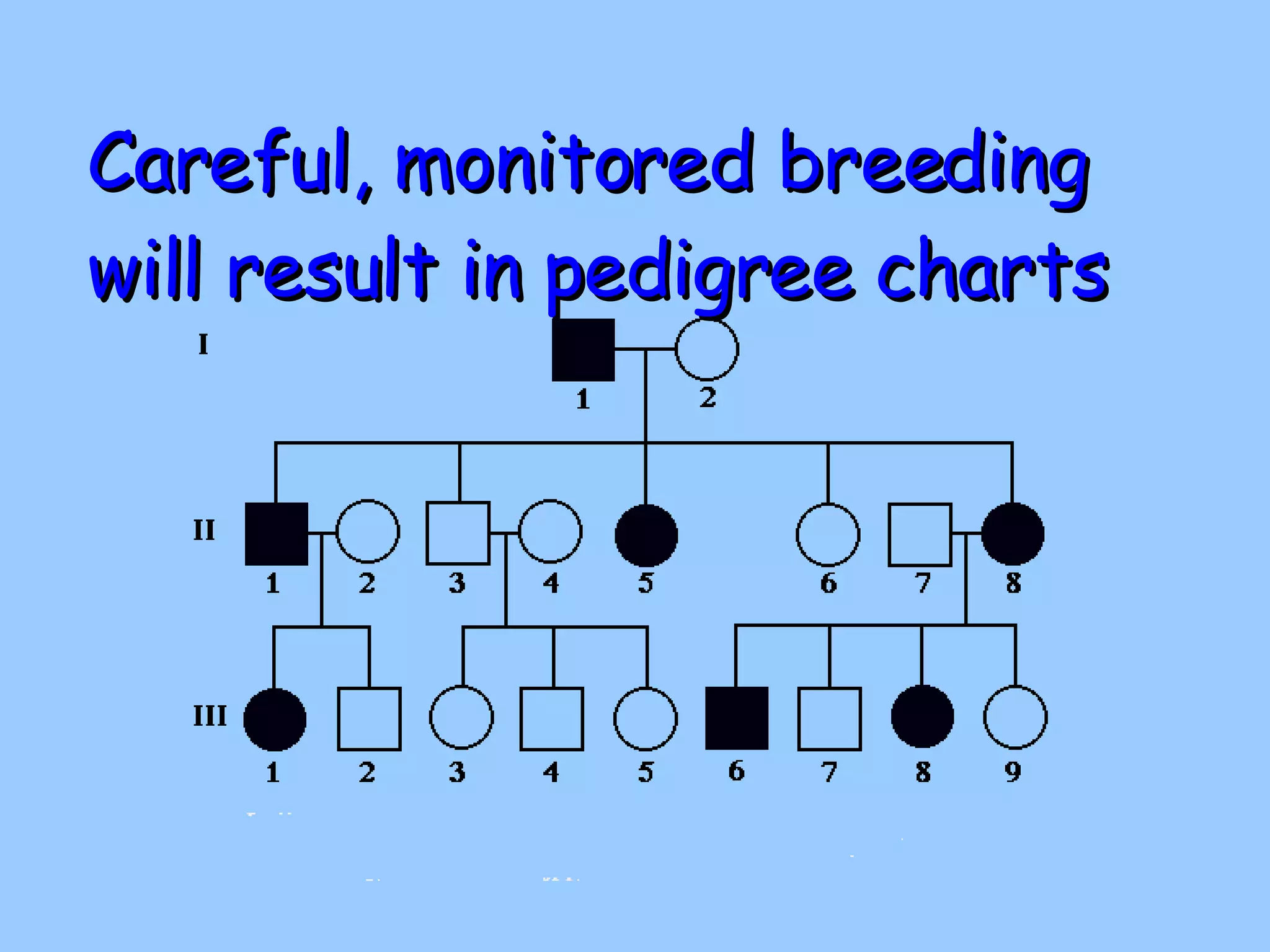
Careful, monitored breeding will result in pedigree charts
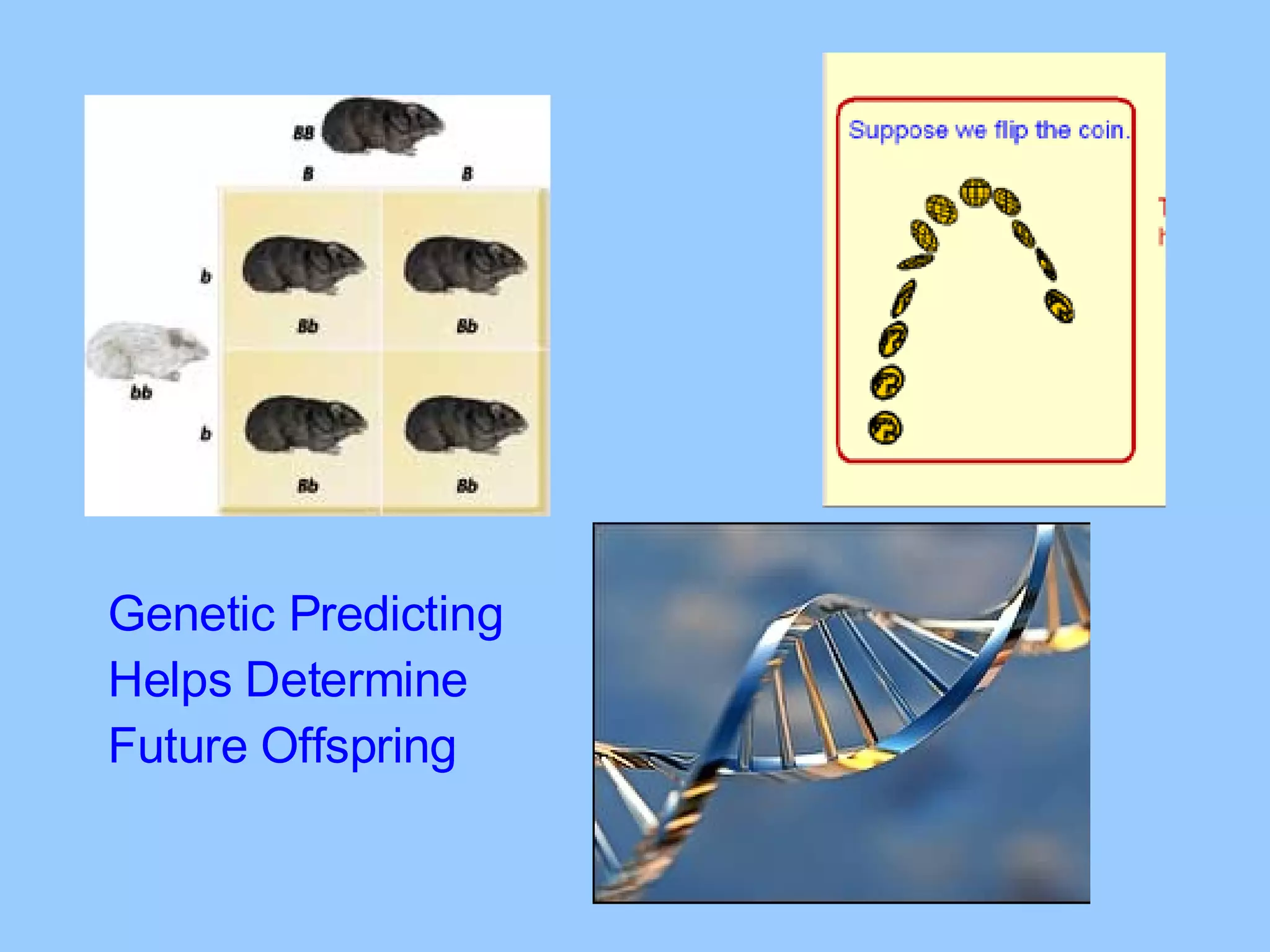
Genetic Predicting Helps Determine Future Offspring
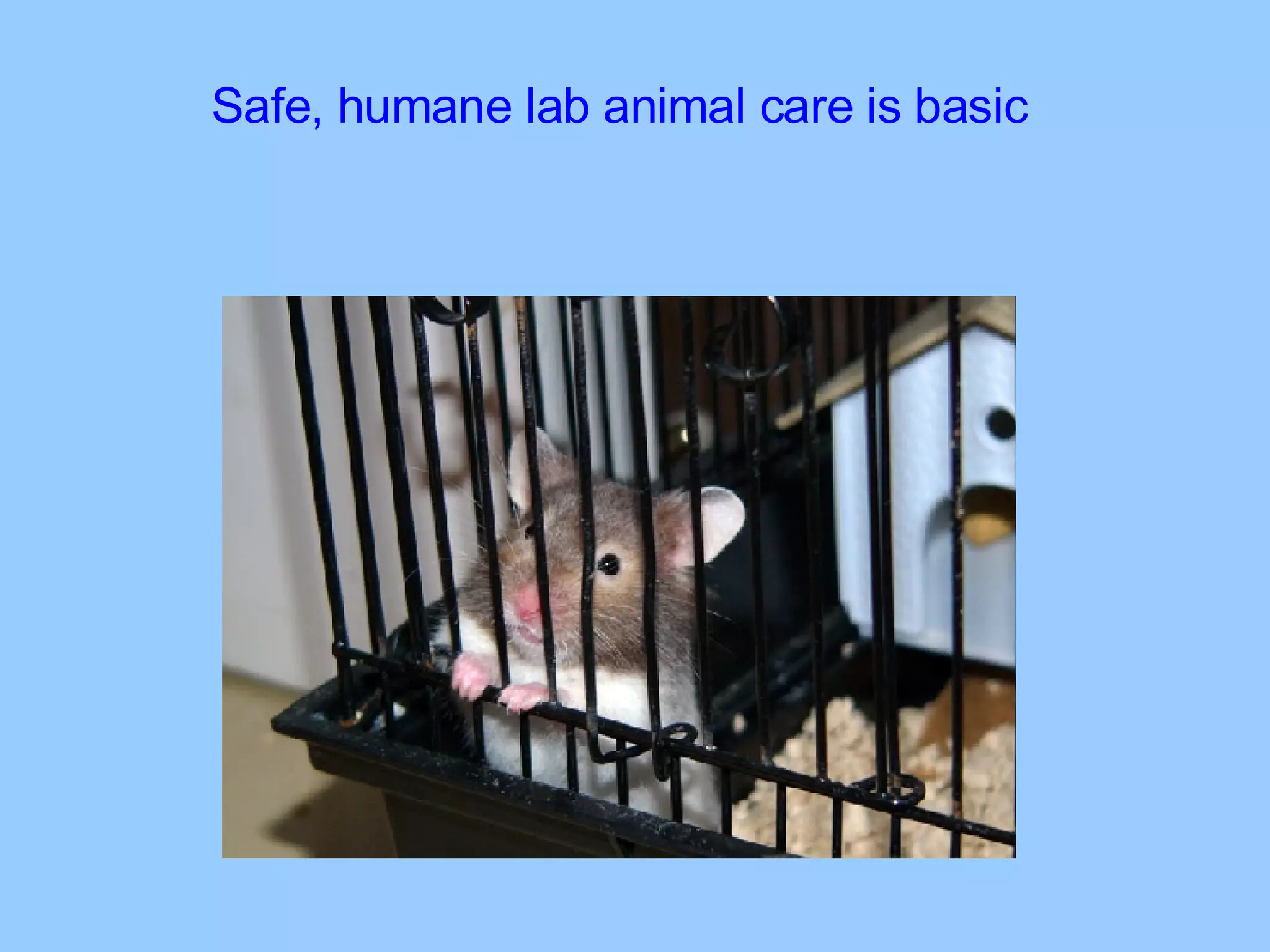
Safe, humane lab animal care is basic
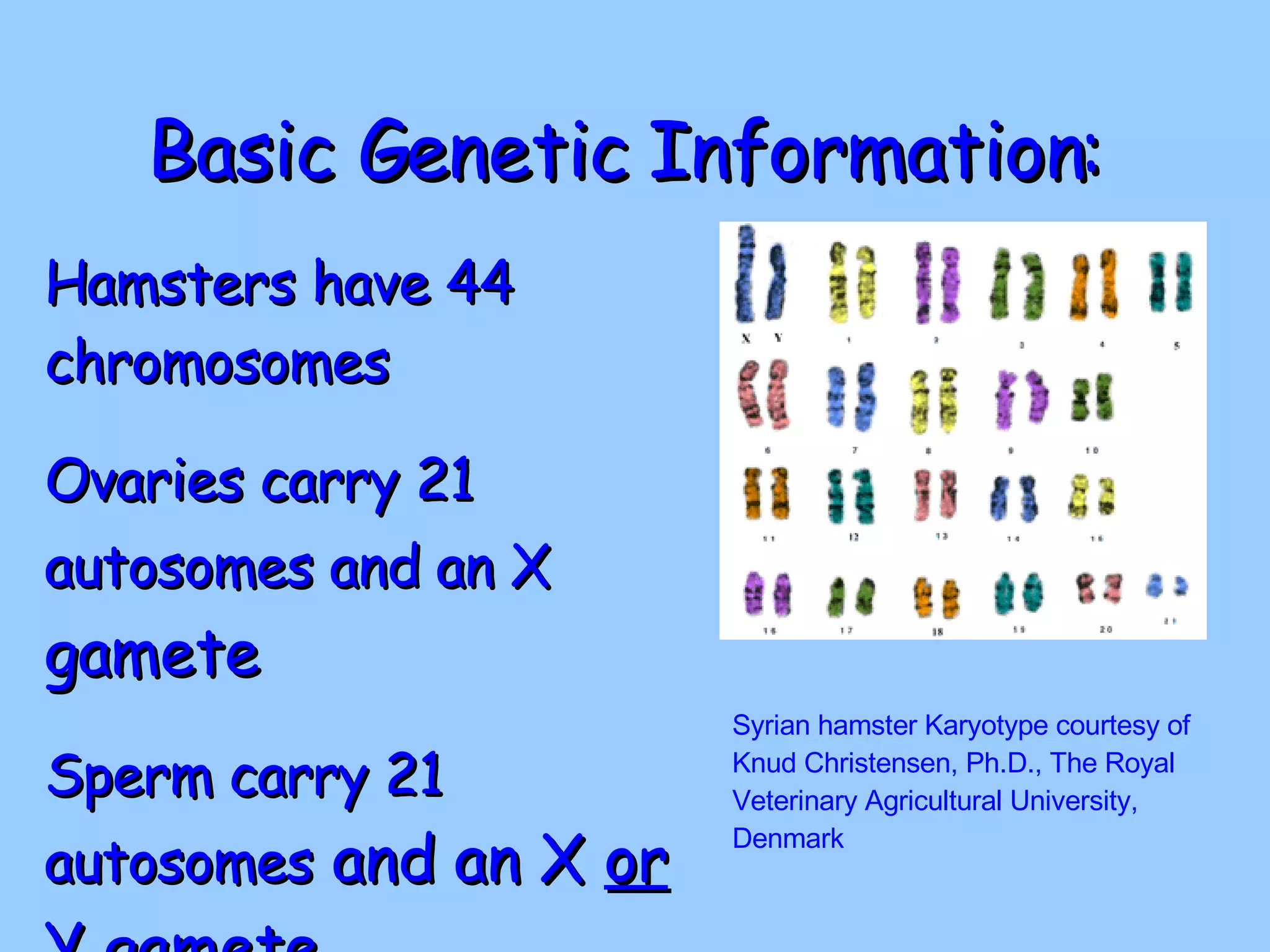
Basic Genetic Information: Hamsters have 44 chromosomes Ovaries carry 21 autosomes and an X  gamete Sperm carry 21 autosomes  and an X  or  Y gamete Syrian hamster Karyotype courtesy of Knud Christensen, Ph.D., The Royal Veterinary Agricultural University, Denmark
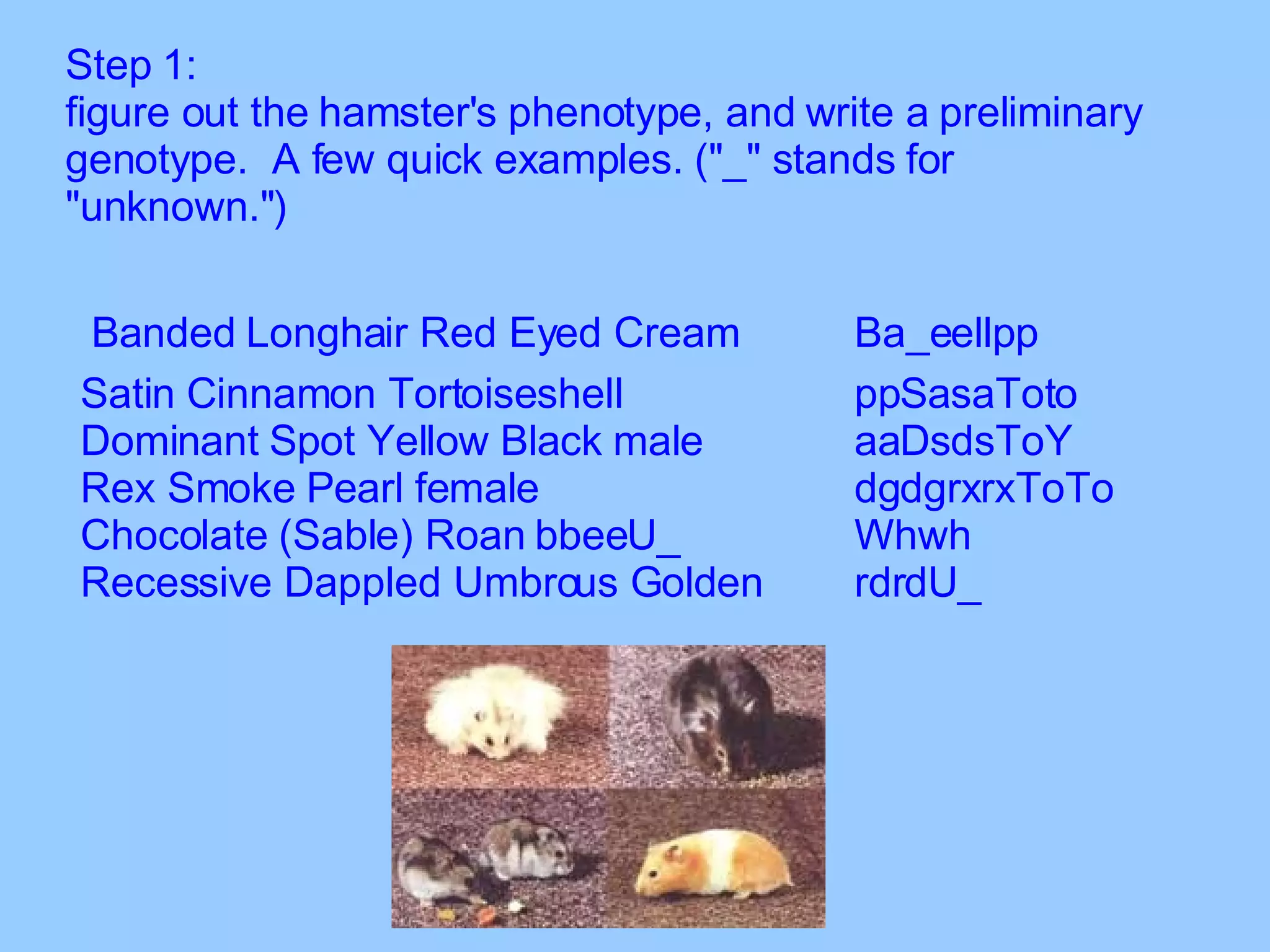
Step 1:  figure out the hamster's phenotype, and write a preliminary genotype.  A few quick examples. ("_" stands for "unknown.") Banded Longhair Red Eyed Cream    Ba_eellpp  Satin Cinnamon Tortoiseshell   ppSasaToto  Dominant Spot Yellow Black male    aaDsdsToY  Rex Smoke Pearl female   dgdgrxrxToTo  Chocolate (Sable) Roan bbeeU_   Whwh  Recessive Dappled Umbrous Golden    rdrdU_
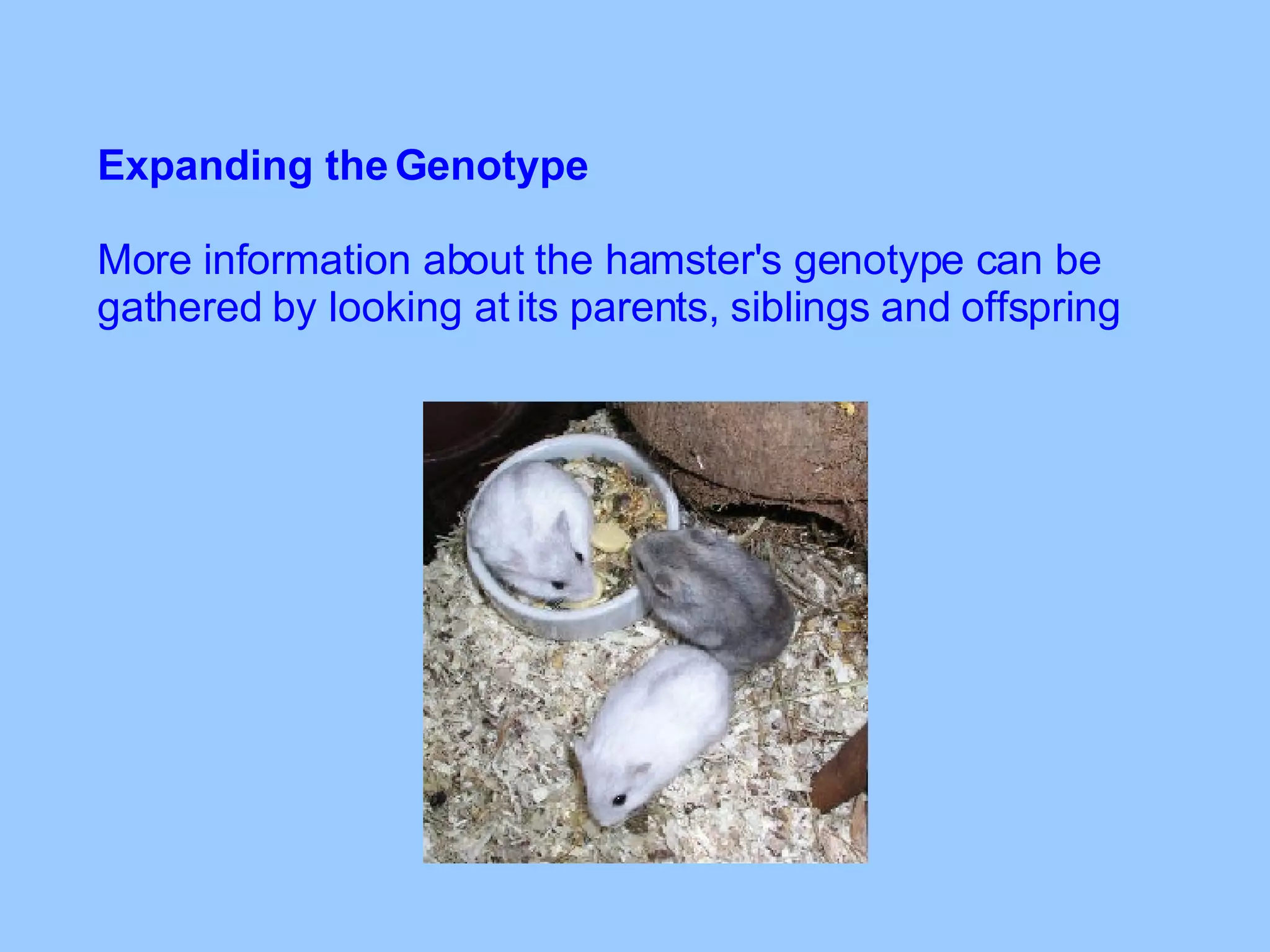
Expanding the Genotype More information about the hamster's genotype can be gathered by looking at its parents, siblings and offspring
Breeding an animal can provide more data about its genetic make-up.   It is especially useful as a tool to confirm suspicions of heterozygosity.   For any trait that may be heterozygous, breed to an animal that is homozygous recessive.
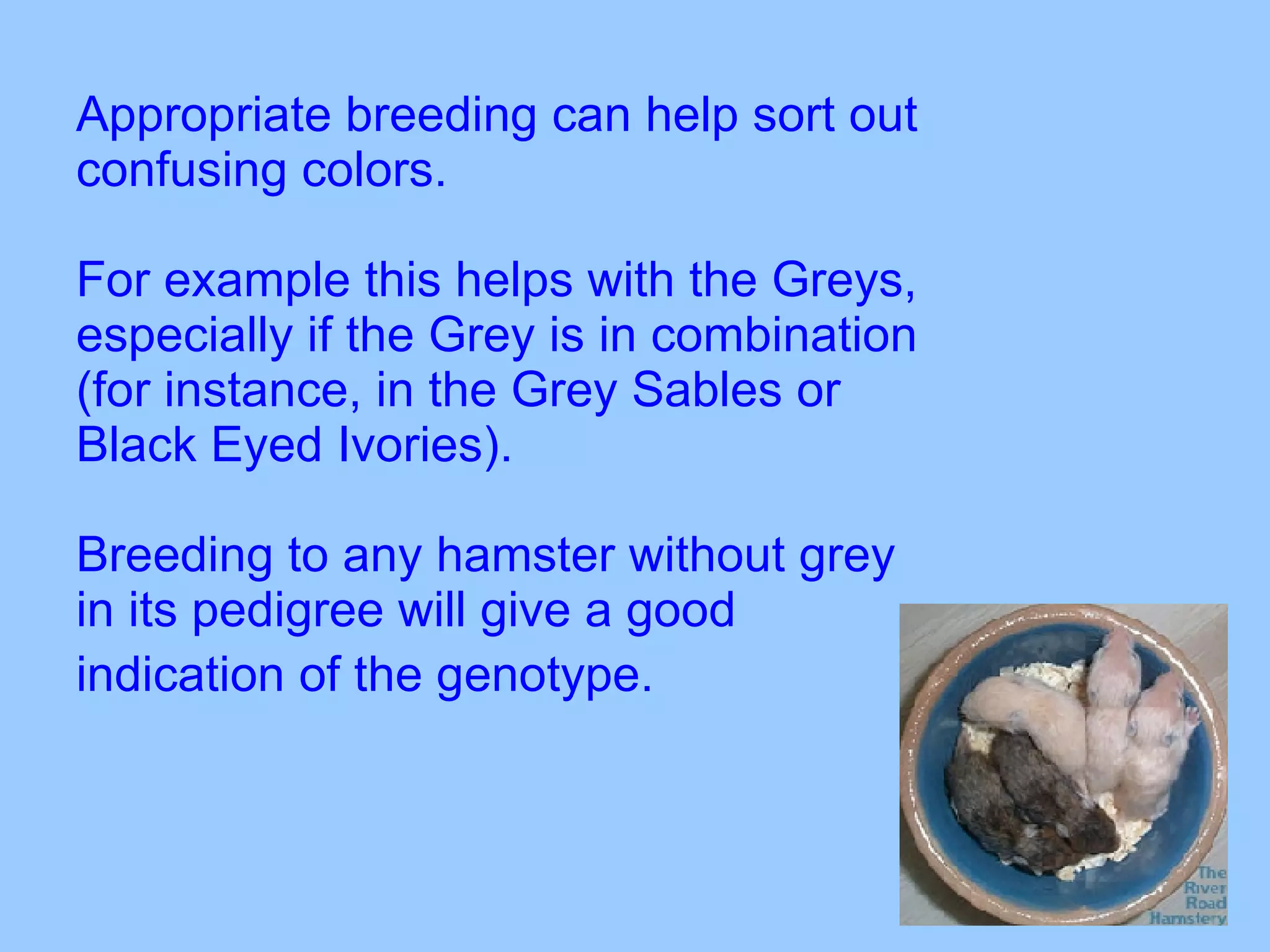
Appropriate breeding can help sort out confusing colors.  For example this helps with the Greys, especially if the Grey is in combination (for instance, in the Grey Sables or Black Eyed Ivories).   Breeding to any hamster without grey in its pedigree will give a good indication of the genotype.
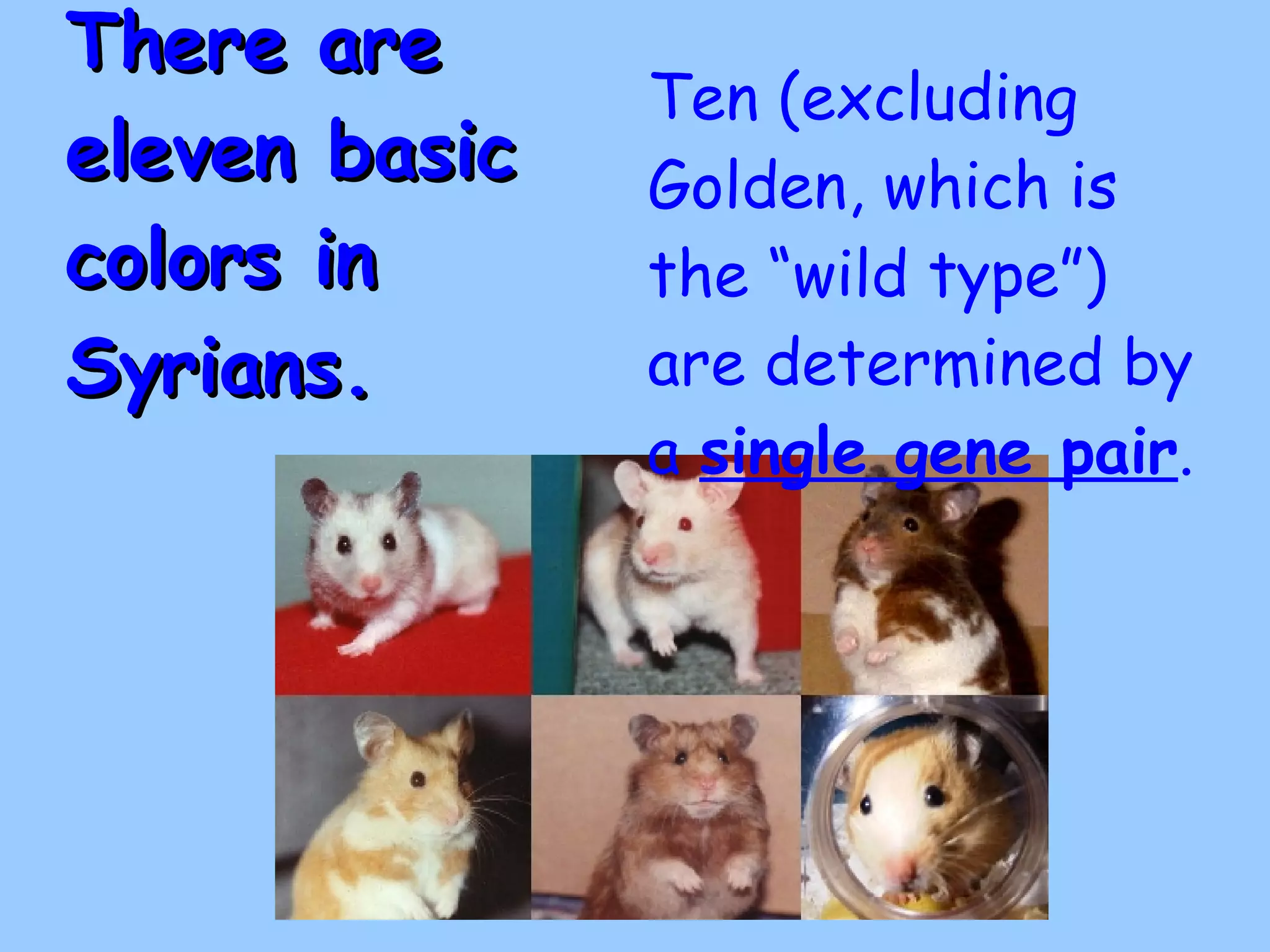
There are eleven basic colors in Syrians.    Ten (excluding Golden, which is the “wild type”) are determined by a  single gene pair .
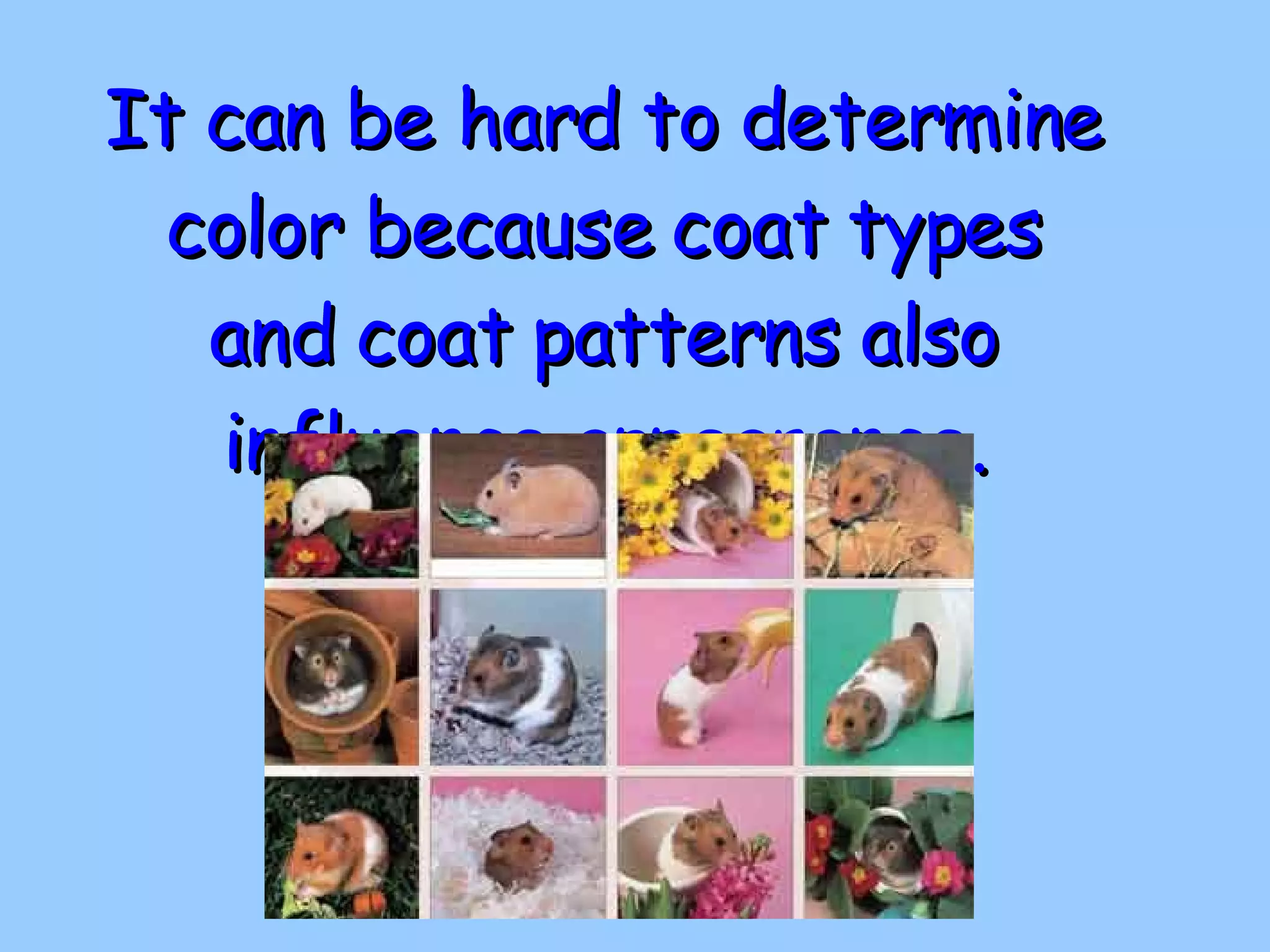
It can be hard to determine color because coat types and coat patterns also influence appearance.
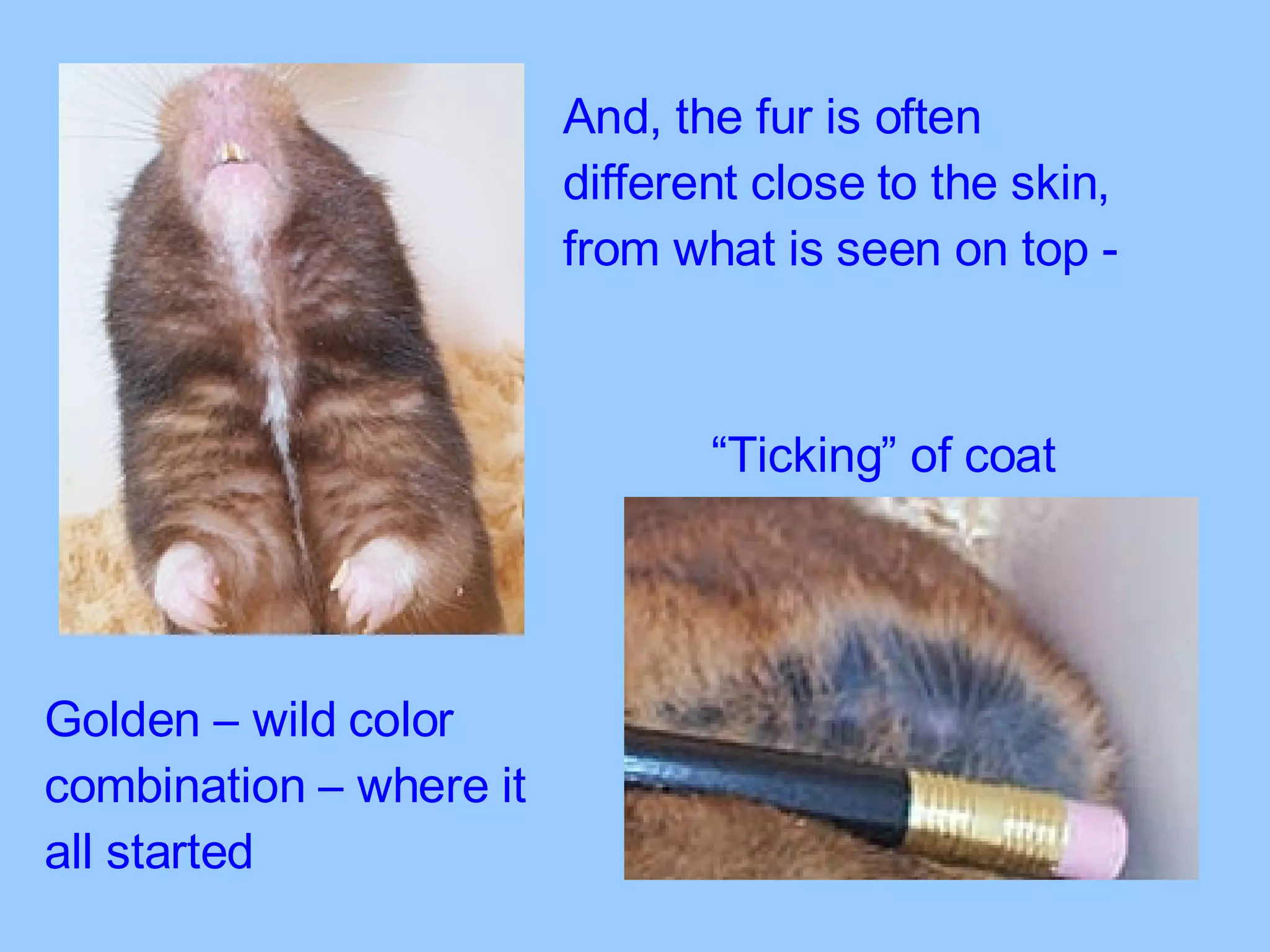
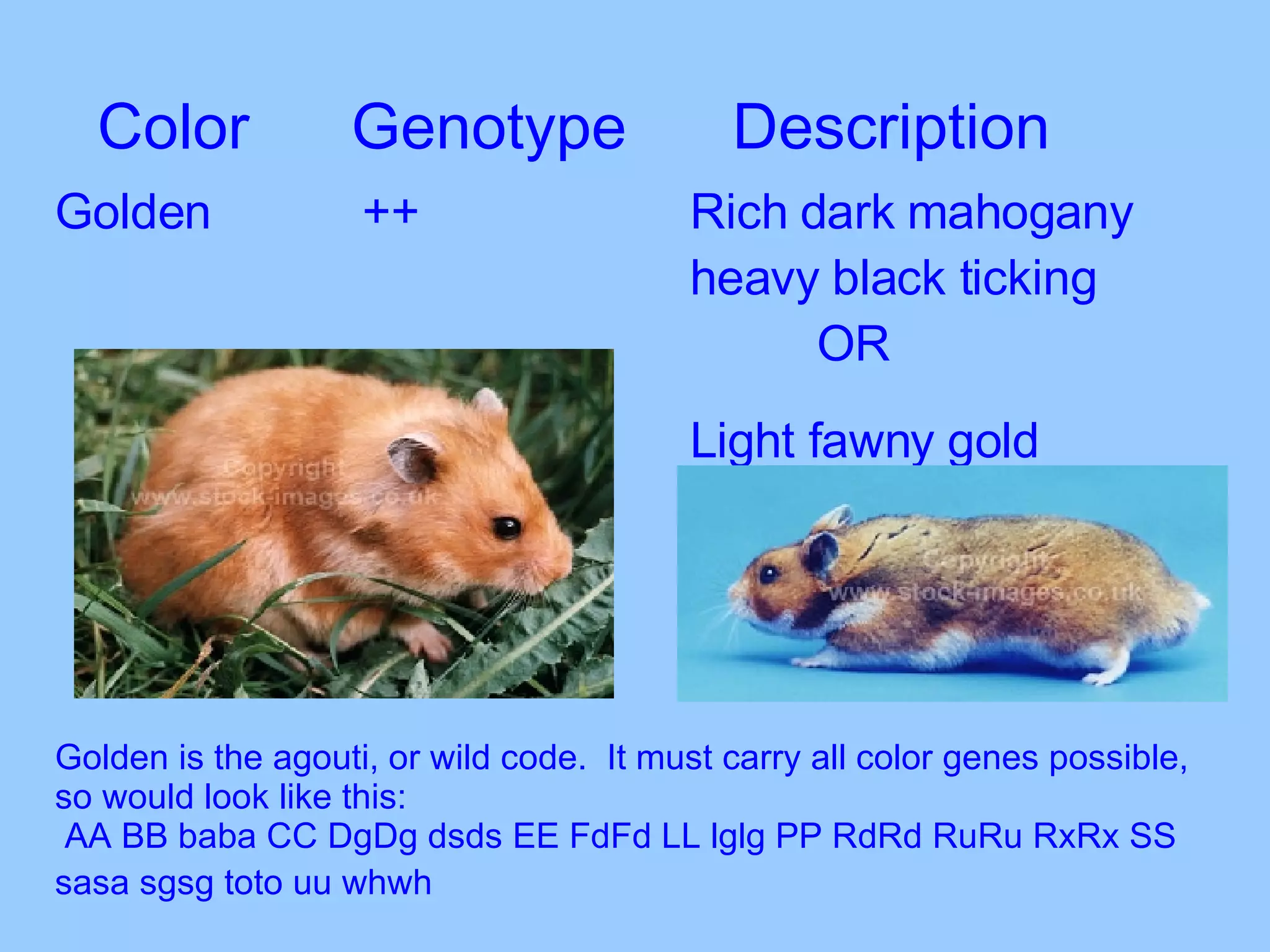
Golden – wild color combination – where it all started “ Ticking” of coat And, the fur is often different close to the skin, from what is seen on top -
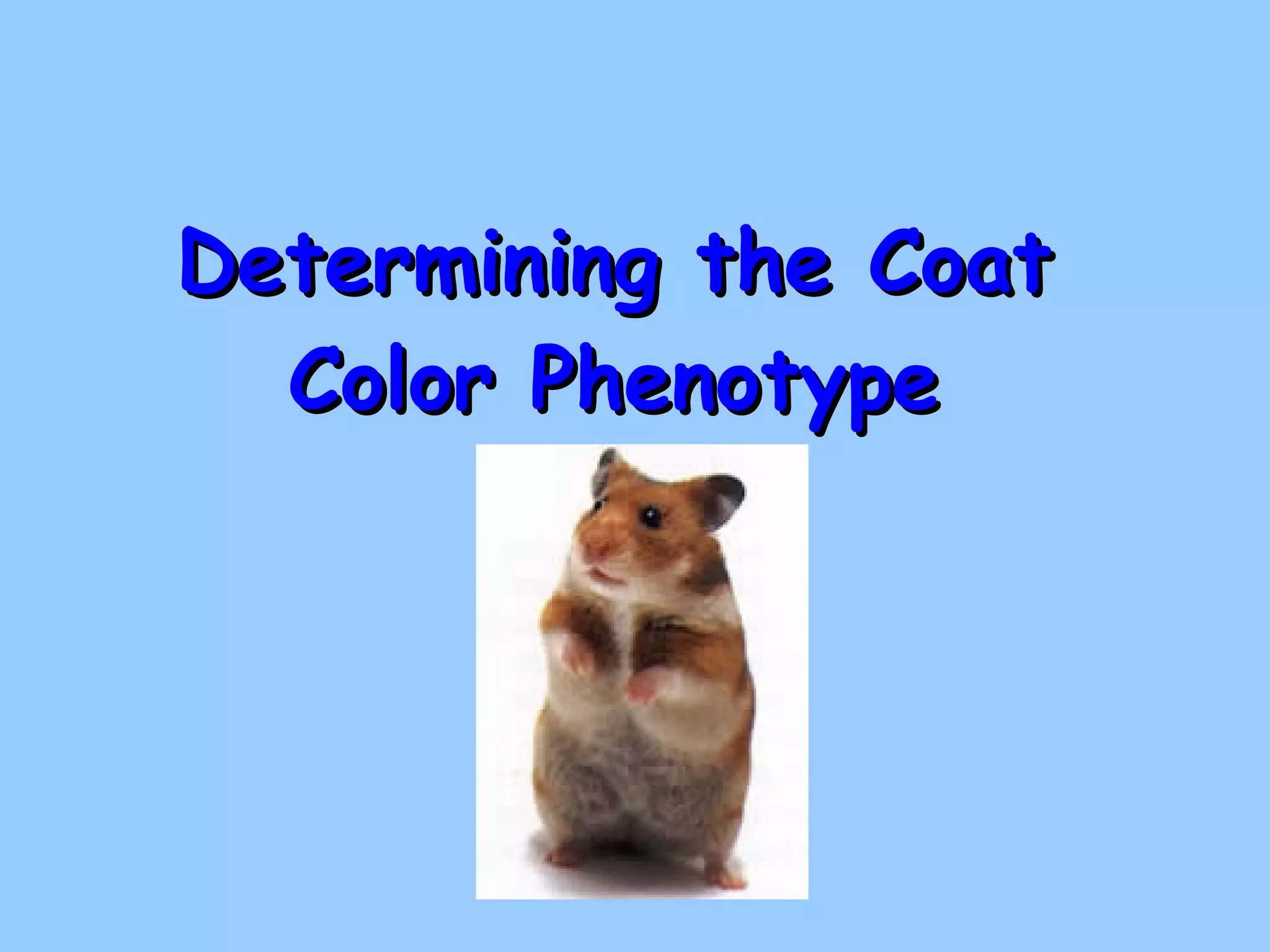
Determining the Coat Color Phenotype
Color Genotype Description Golden   ++ Rich dark mahogany  heavy black ticking  OR Light fawny gold Golden is the agouti, or wild code.  It must carry all color genes possible, so would look like this: AA BB baba CC DgDg dsds EE FdFd LL lglg PP RdRd RuRu RxRx SS sasa sgsg toto uu whwh
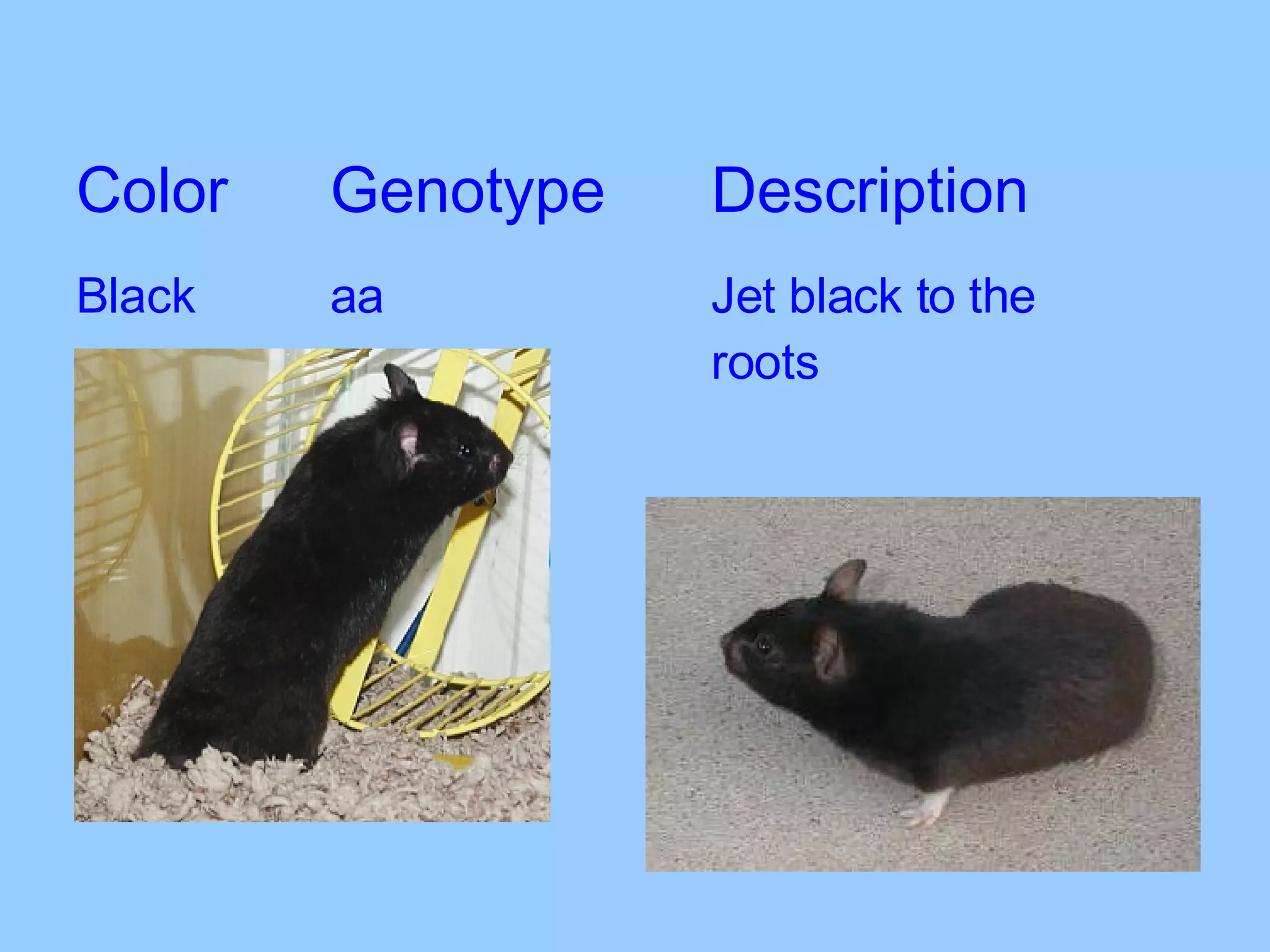
Color Genotype Description Black aa Jet black to the  roots
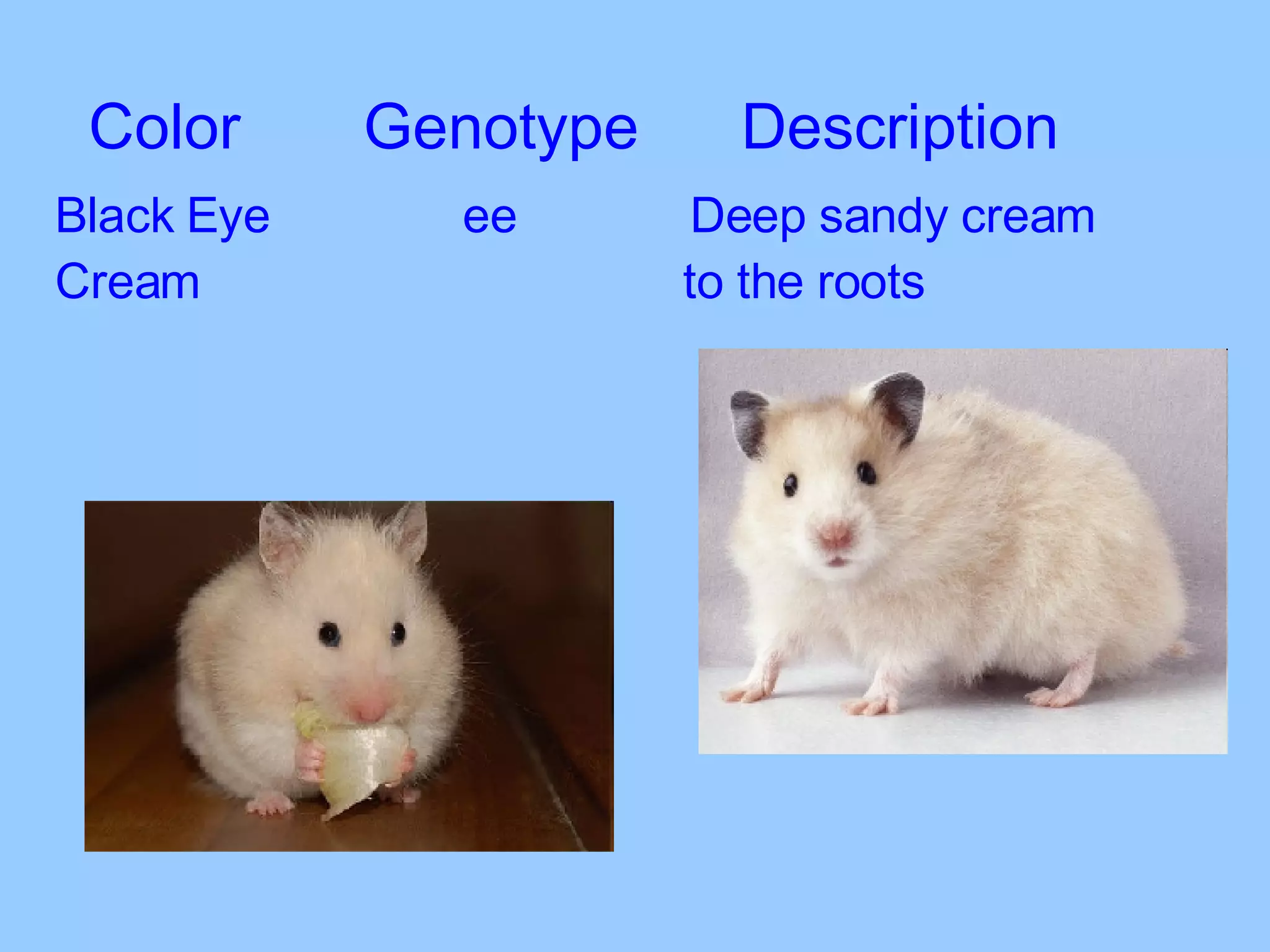
Black Eye   ee Deep sandy cream  Cream   to the roots Color  Genotype  Description
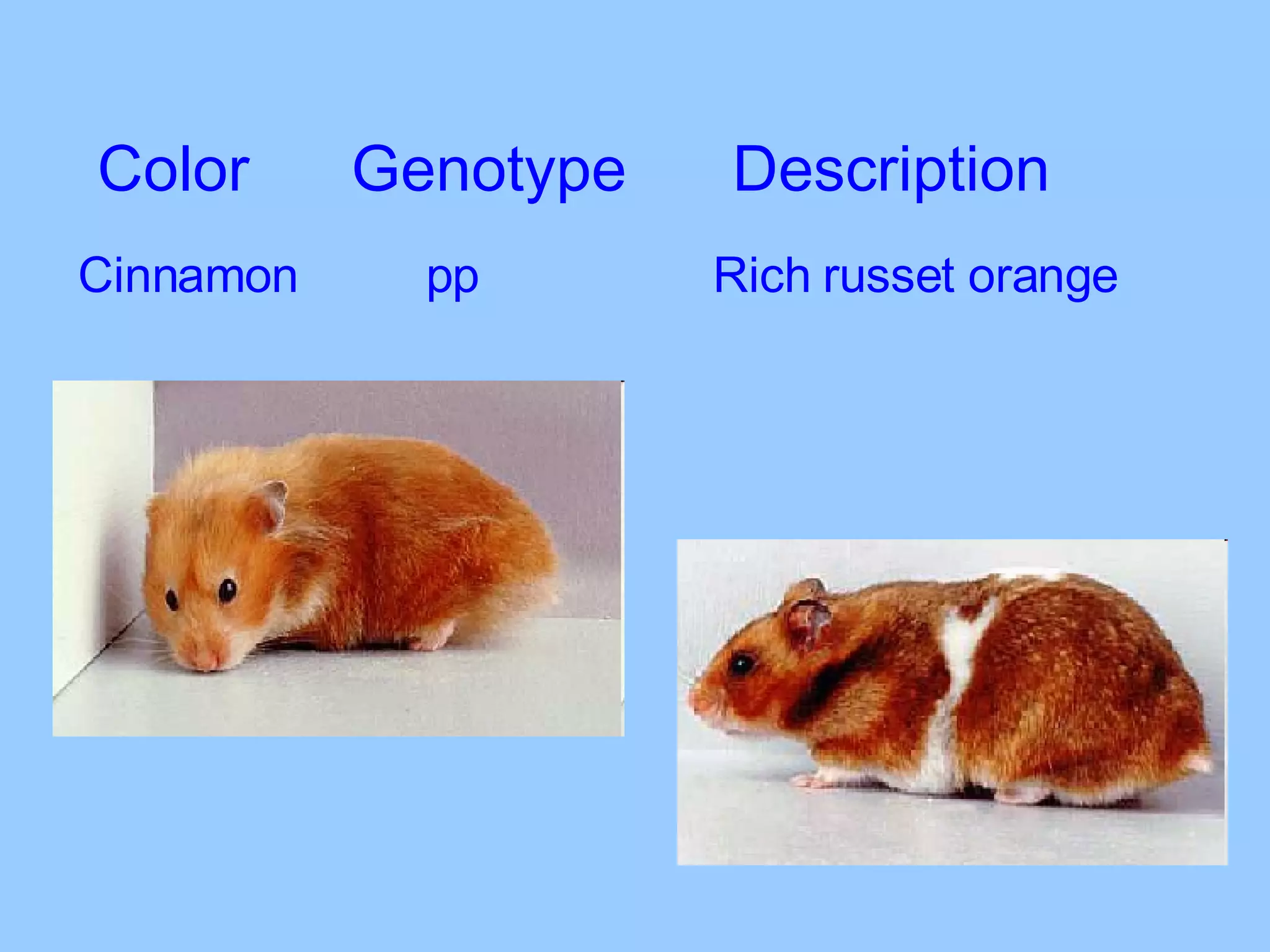
Color Genotype Description Cinnamon   pp Rich russet orange
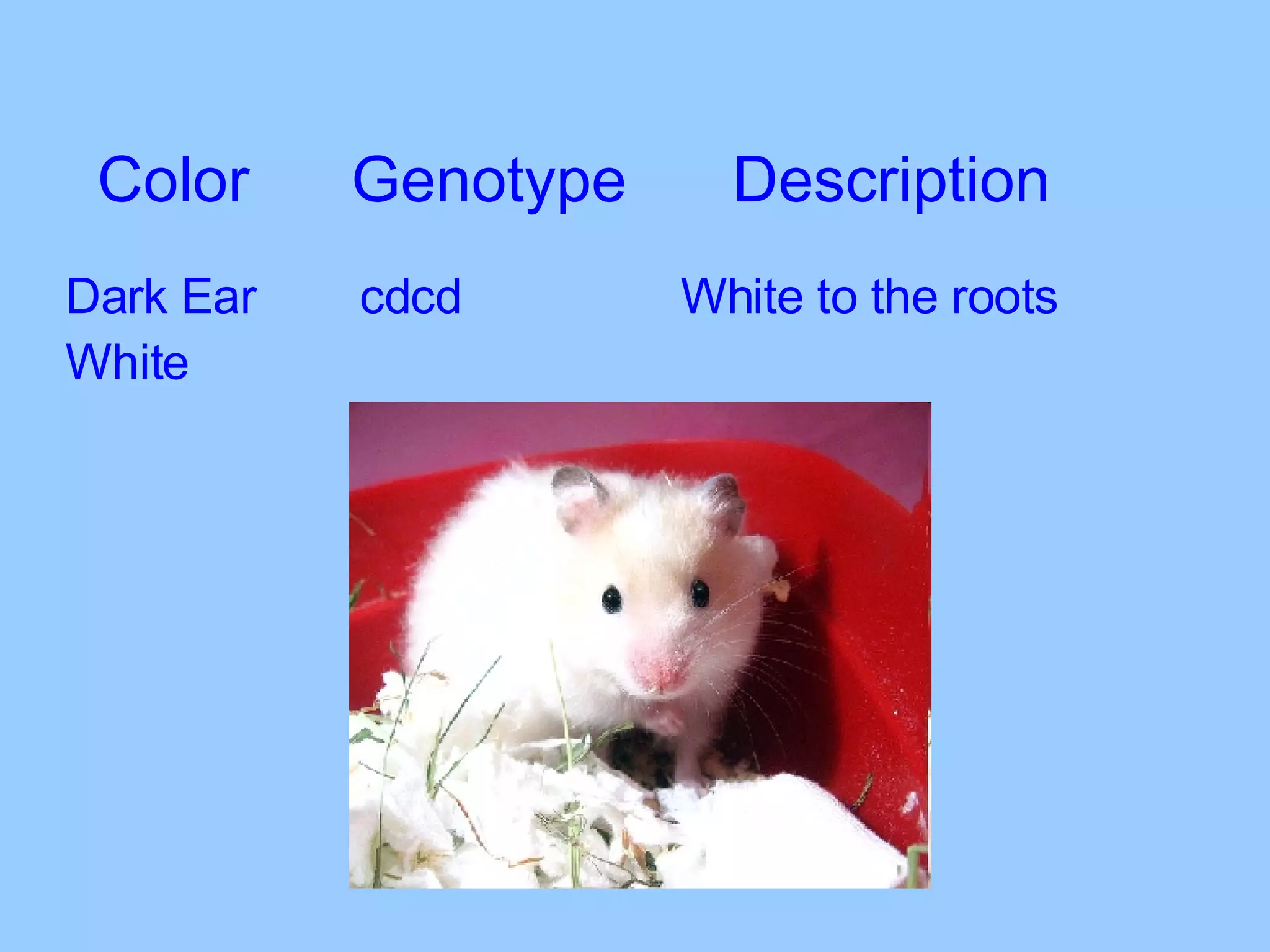
Color Genotype Description Dark Ear   cdcd   White to the roots White
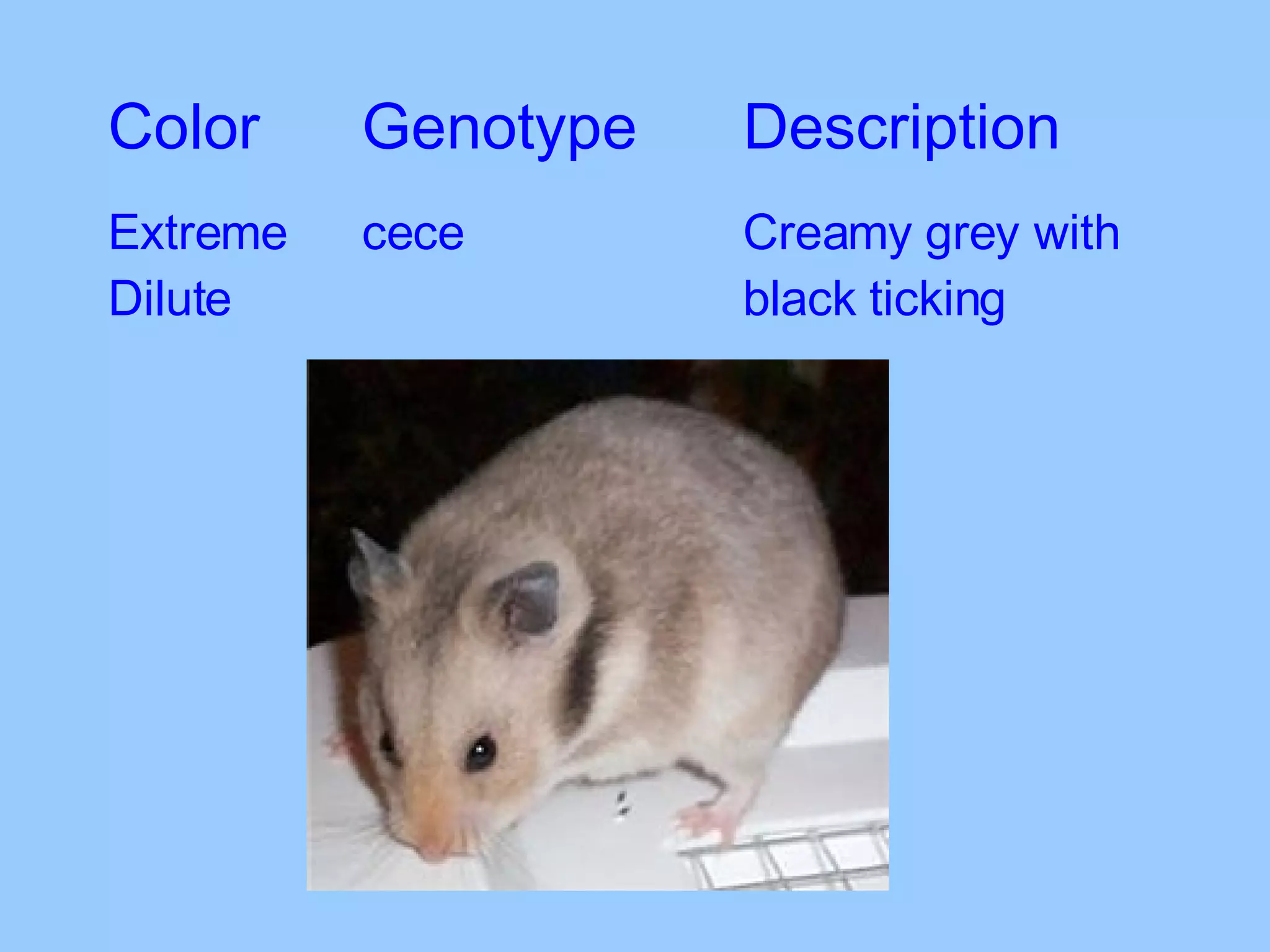
Color Genotype Description Extreme  cece Creamy grey with Dilute black ticking
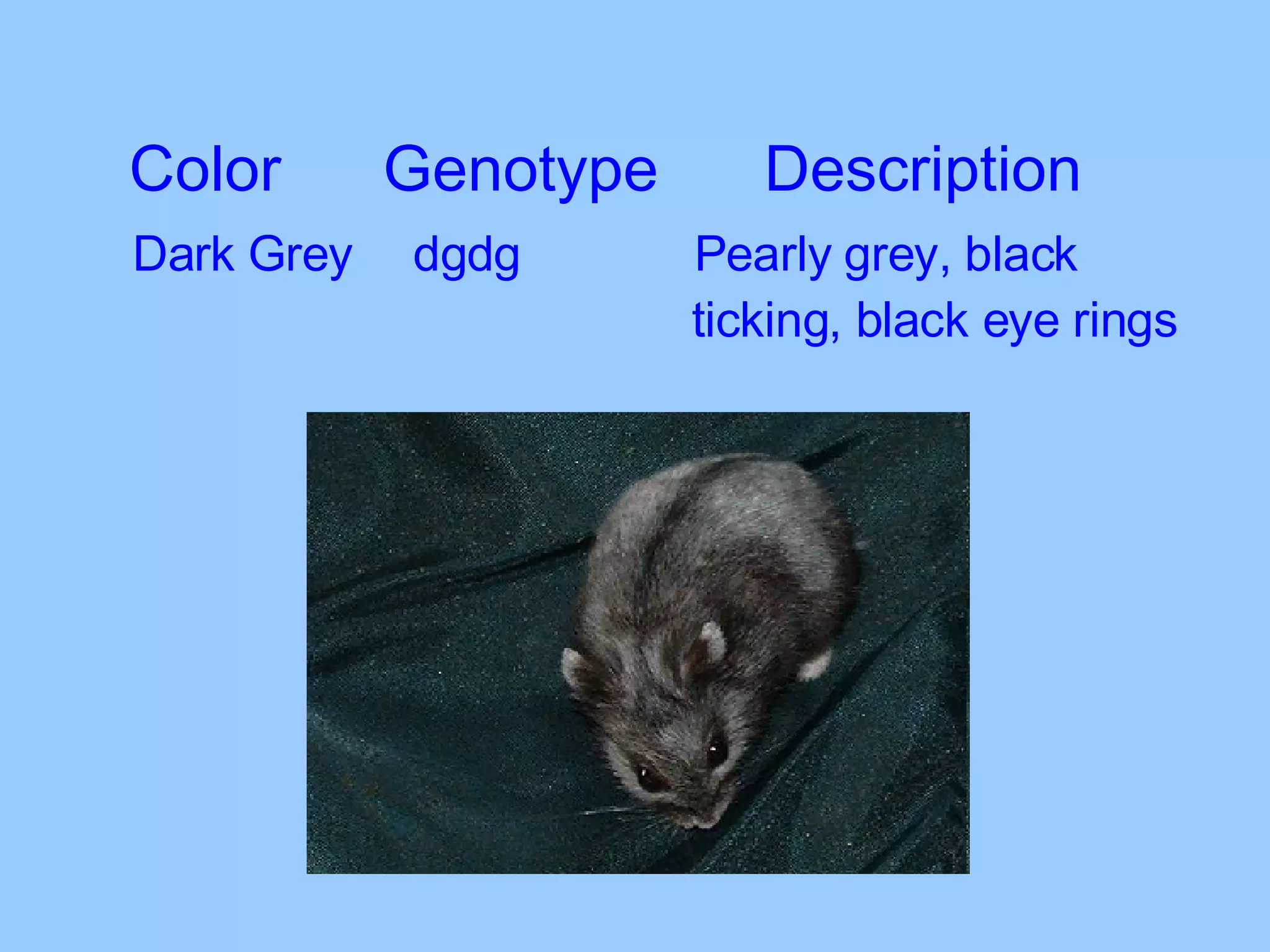
Color Genotype Description Dark Grey   dgdg   Pearly grey, black    ticking, black eye rings
Color Genotype Description Light Grey   Lglg Buttermilk grey dark  ticking
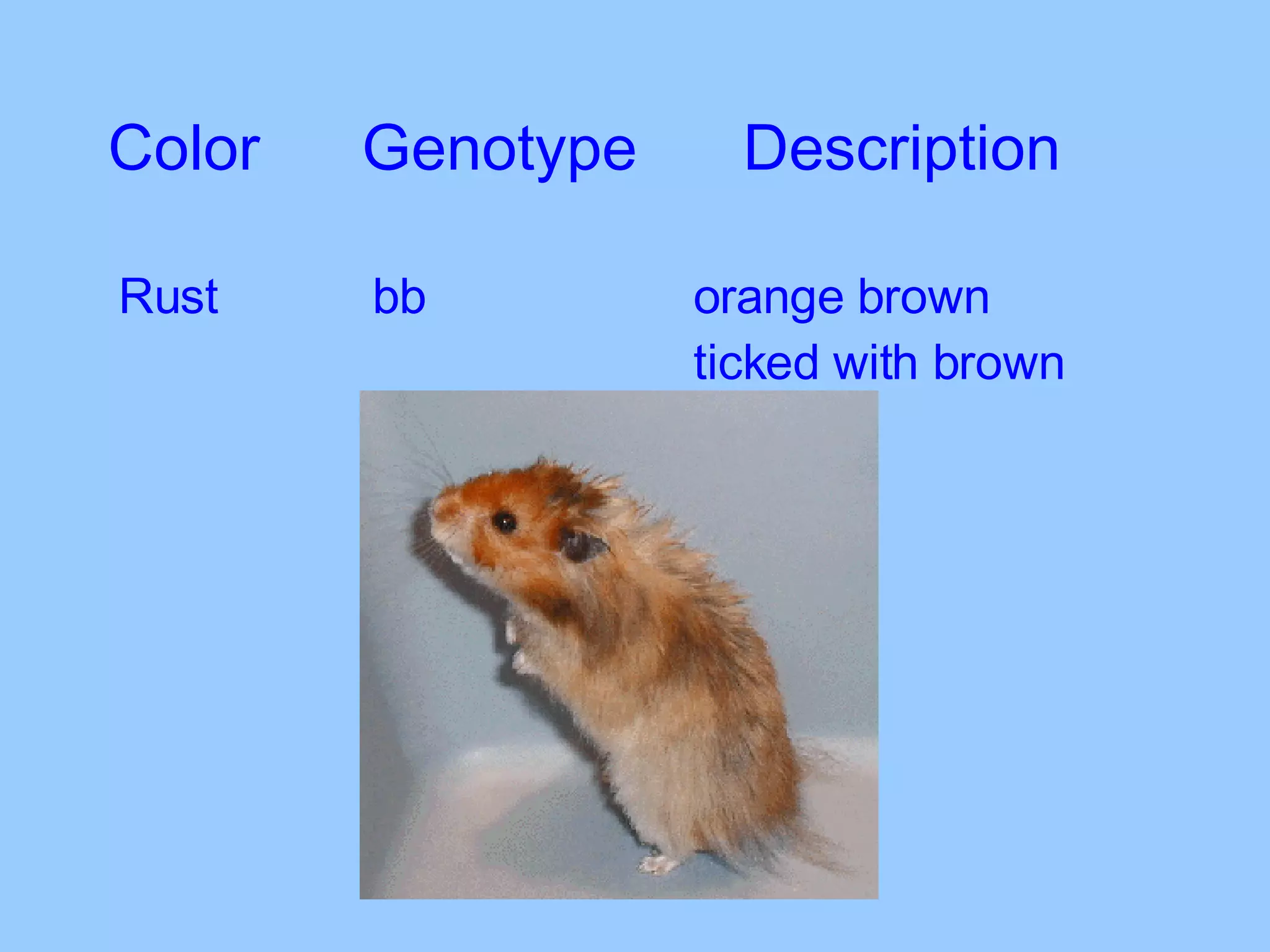
Color Genotype Description Rust bb   orange brown    ticked with brown
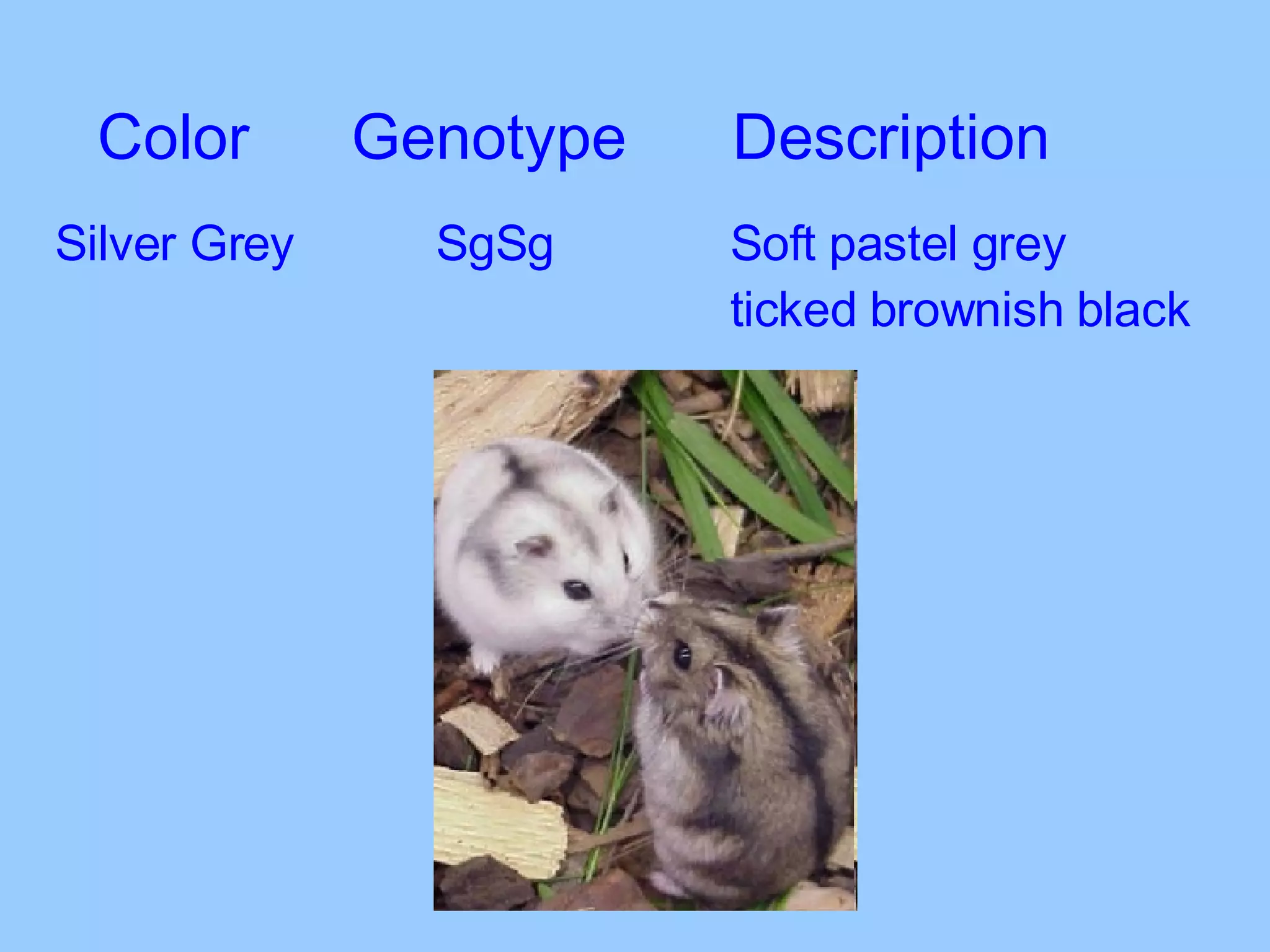
Color Genotype Description Silver Grey SgSg   Soft pastel grey    ticked brownish black
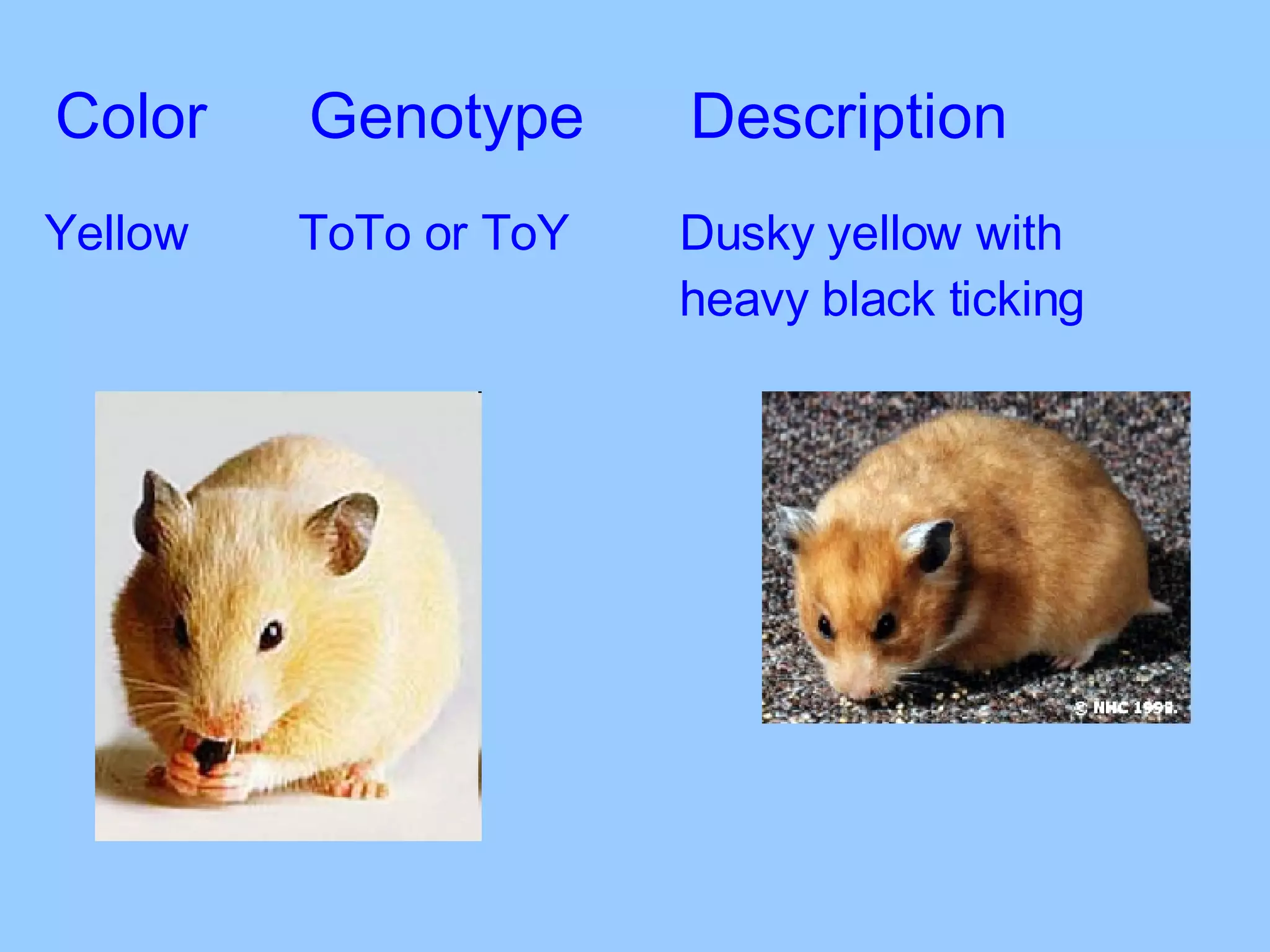
Color Genotype Description Yellow ToTo or ToY Dusky yellow with  heavy black ticking
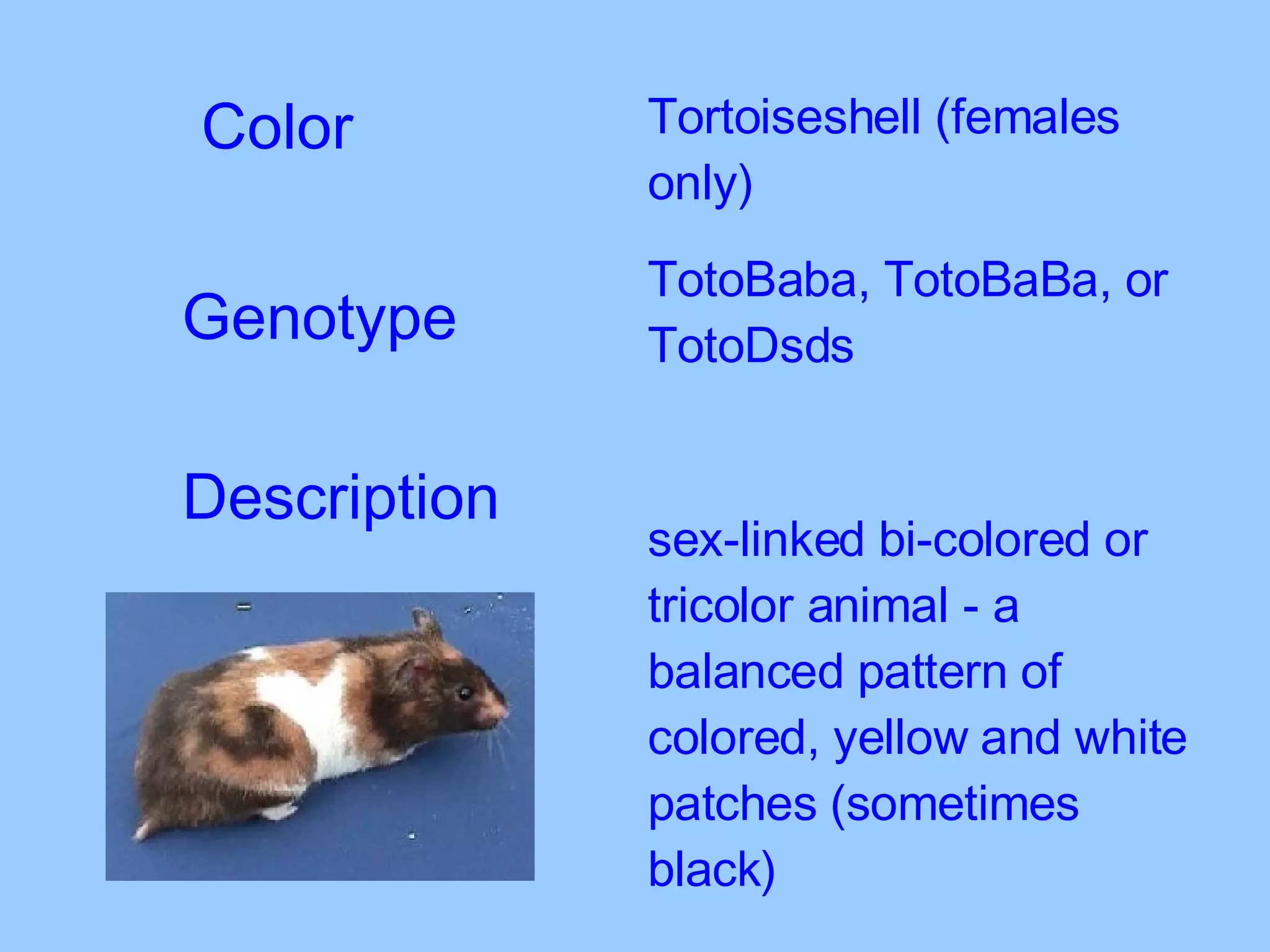
Color Tortoiseshell (females only) TotoBaba, TotoBaBa, or TotoDsds  sex-linked bi-colored or tricolor animal - a balanced pattern of colored, yellow and white patches (sometimes black) Genotype Description
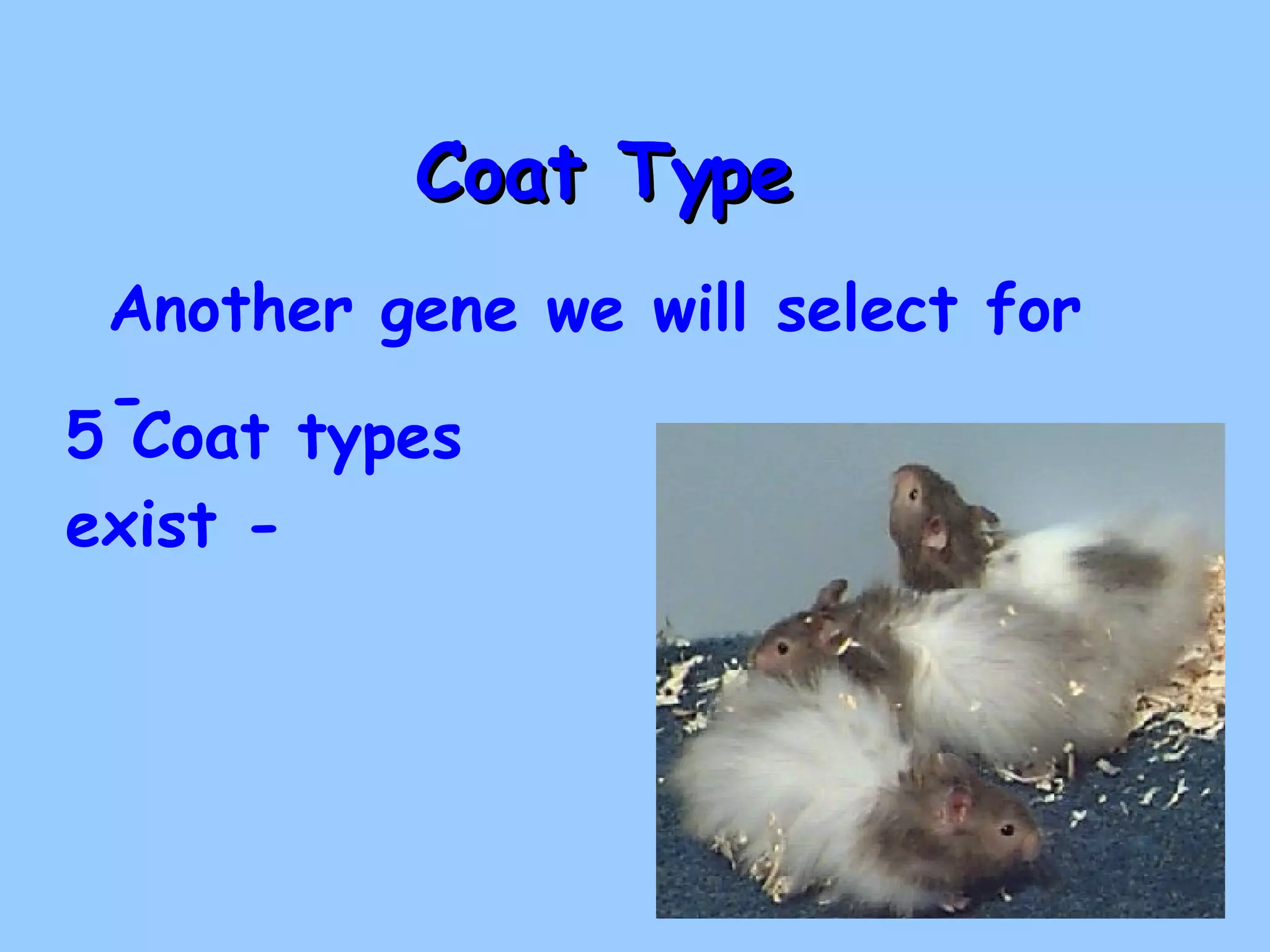
Coat Type Another gene we will select for - 5 Coat types exist -
Shorthair  ++   Wild type coat –  short, even dense
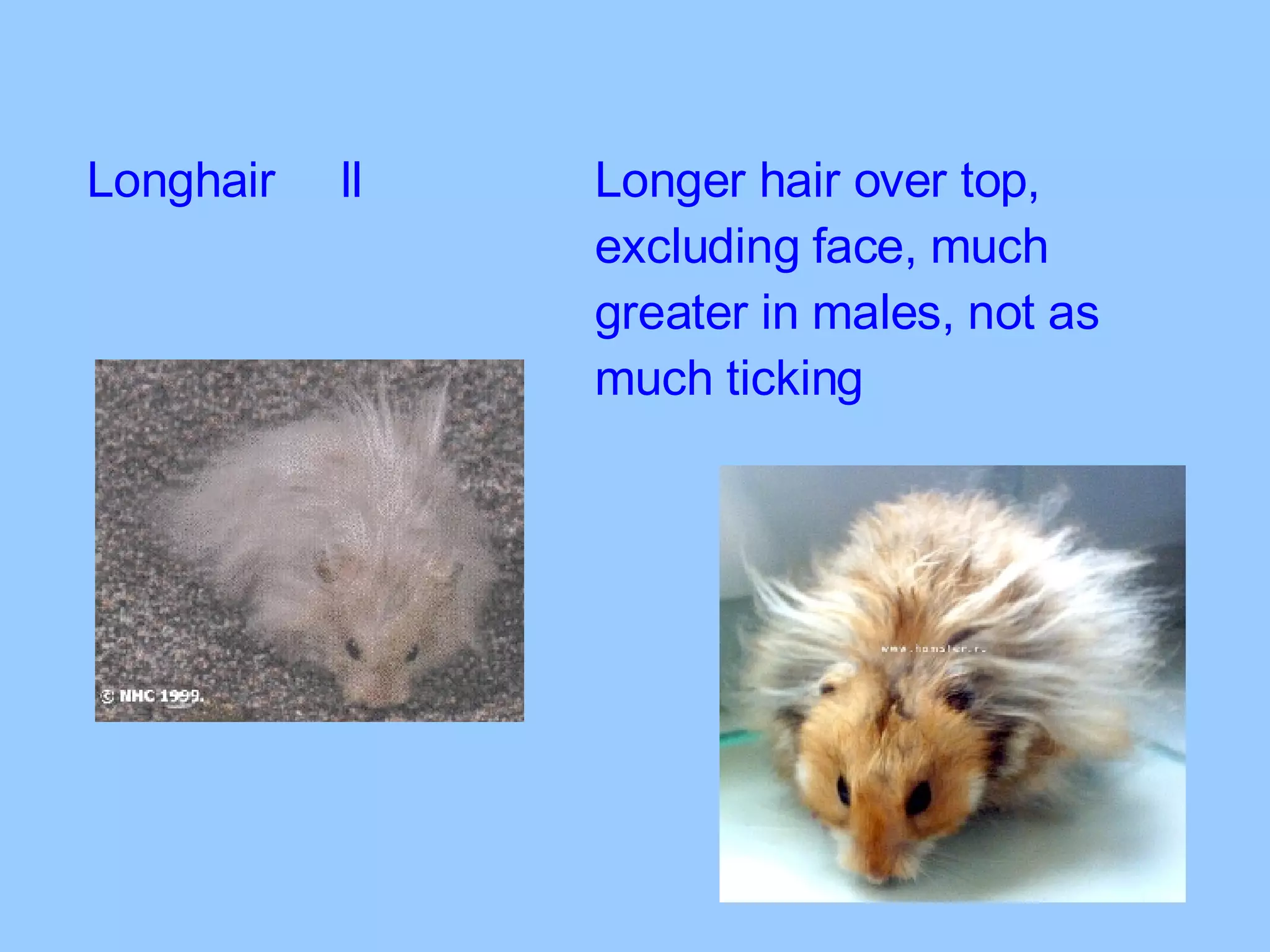
Longhair ll Longer hair over top,  excluding face, much  greater in males, not as  much ticking
Rex rxrx Wavy, frizzy, diluted  color, curly whiskers
Satin Sasa Glossy sheen,  shiny
Hairless hrhr No fur, may have  curly whiskers
Fur Patterns 8 Specific fur pattern types exist
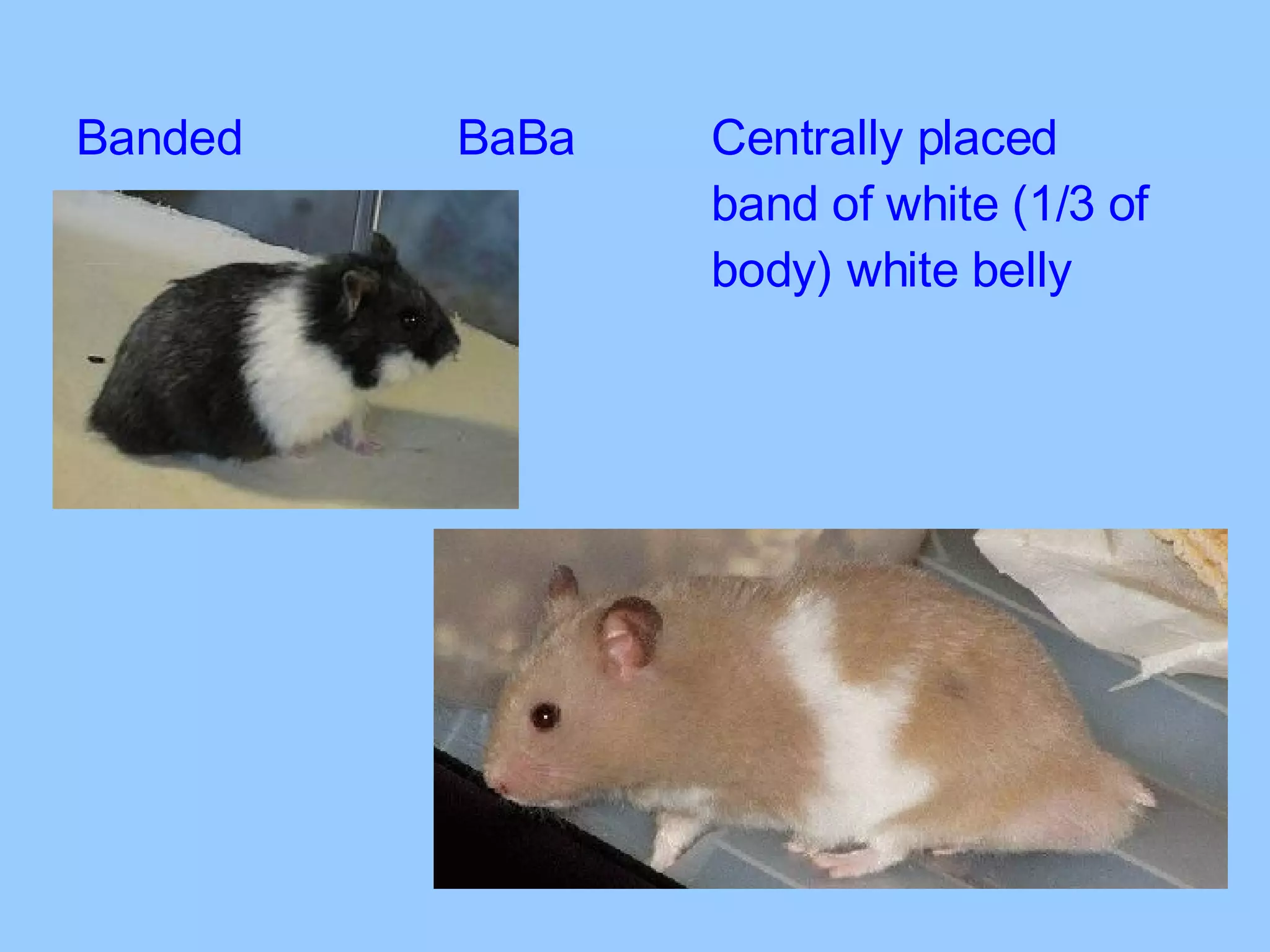
Banded BaBa Centrally placed  band of white (1/3 of  body) white belly
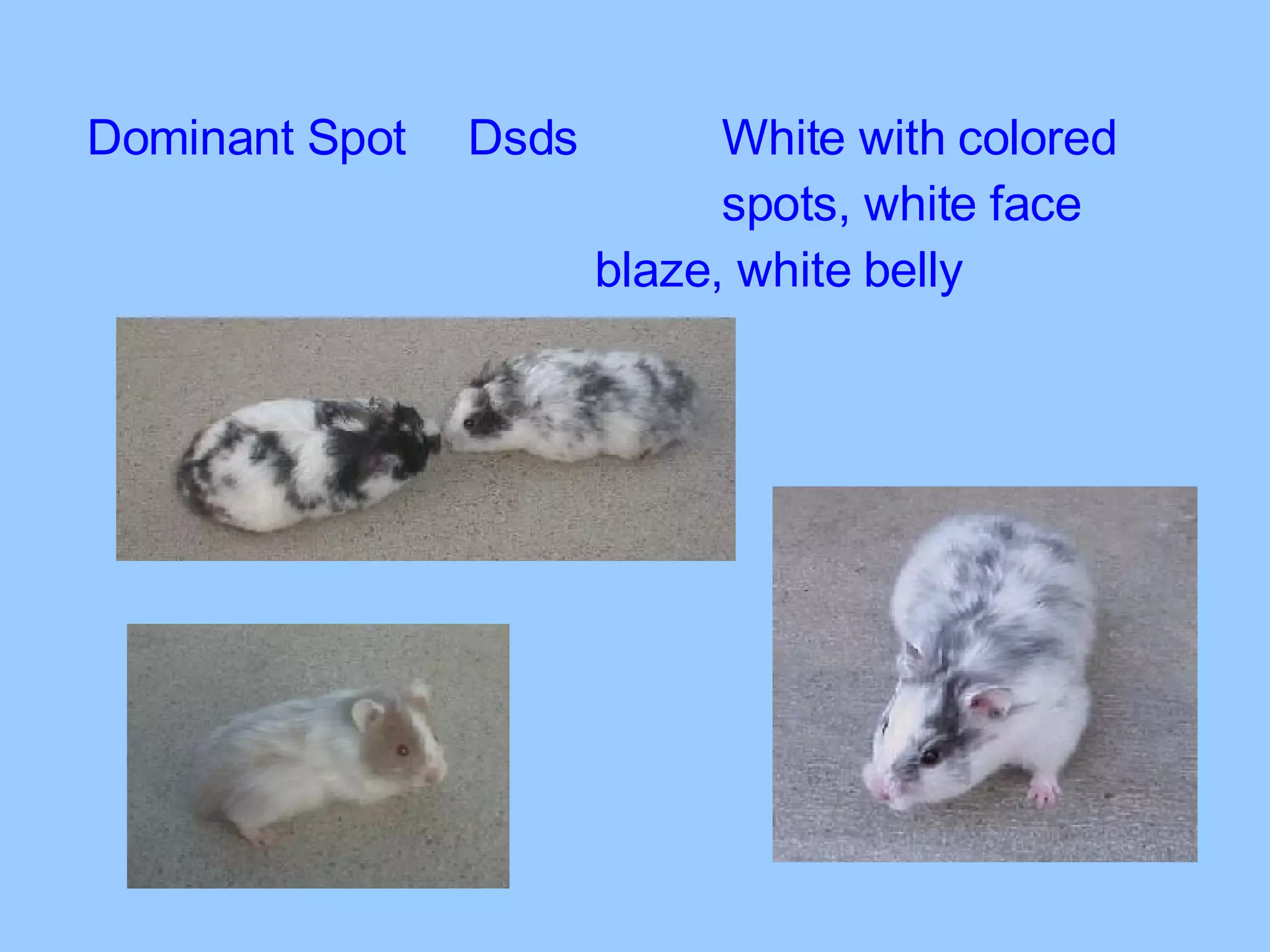
Dominant Spot Dsds White with colored  spots, white face  blaze, white belly
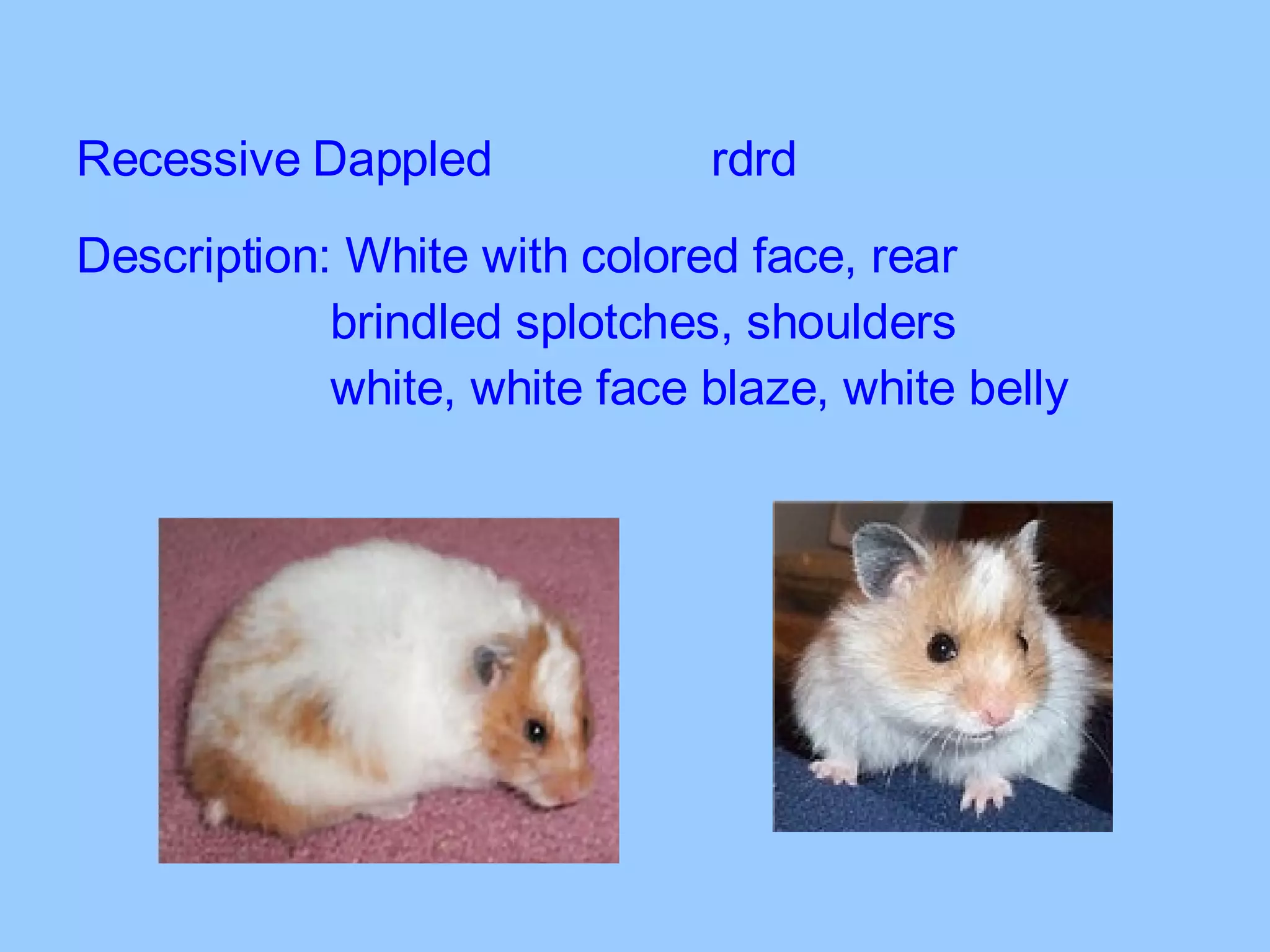
Recessive Dappled rdrd Description: White with colored face, rear  brindled splotches, shoulders  white, white face blaze, white belly
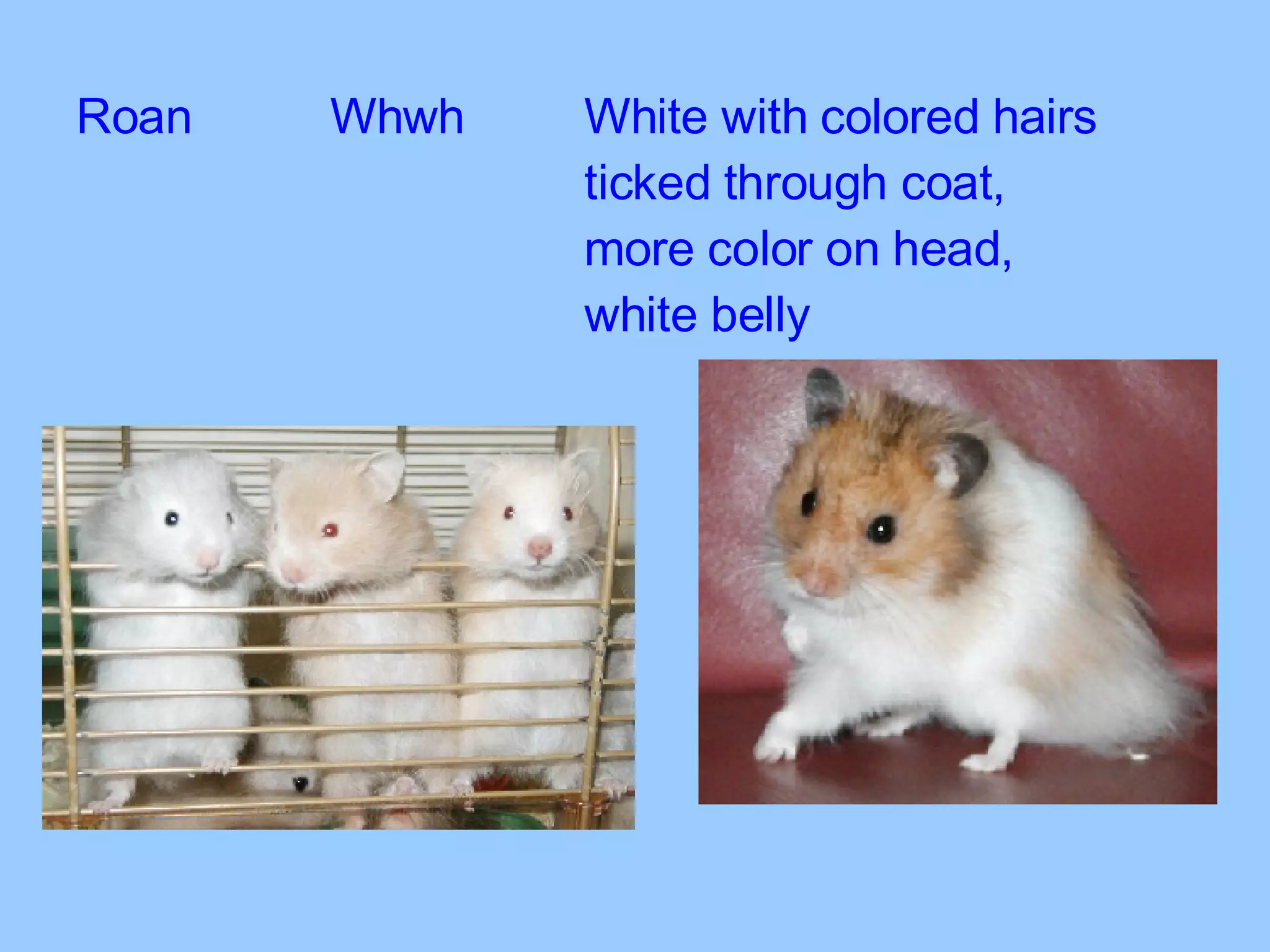
Roan Whwh White with colored hairs  ticked through coat,  more color on head,  white belly
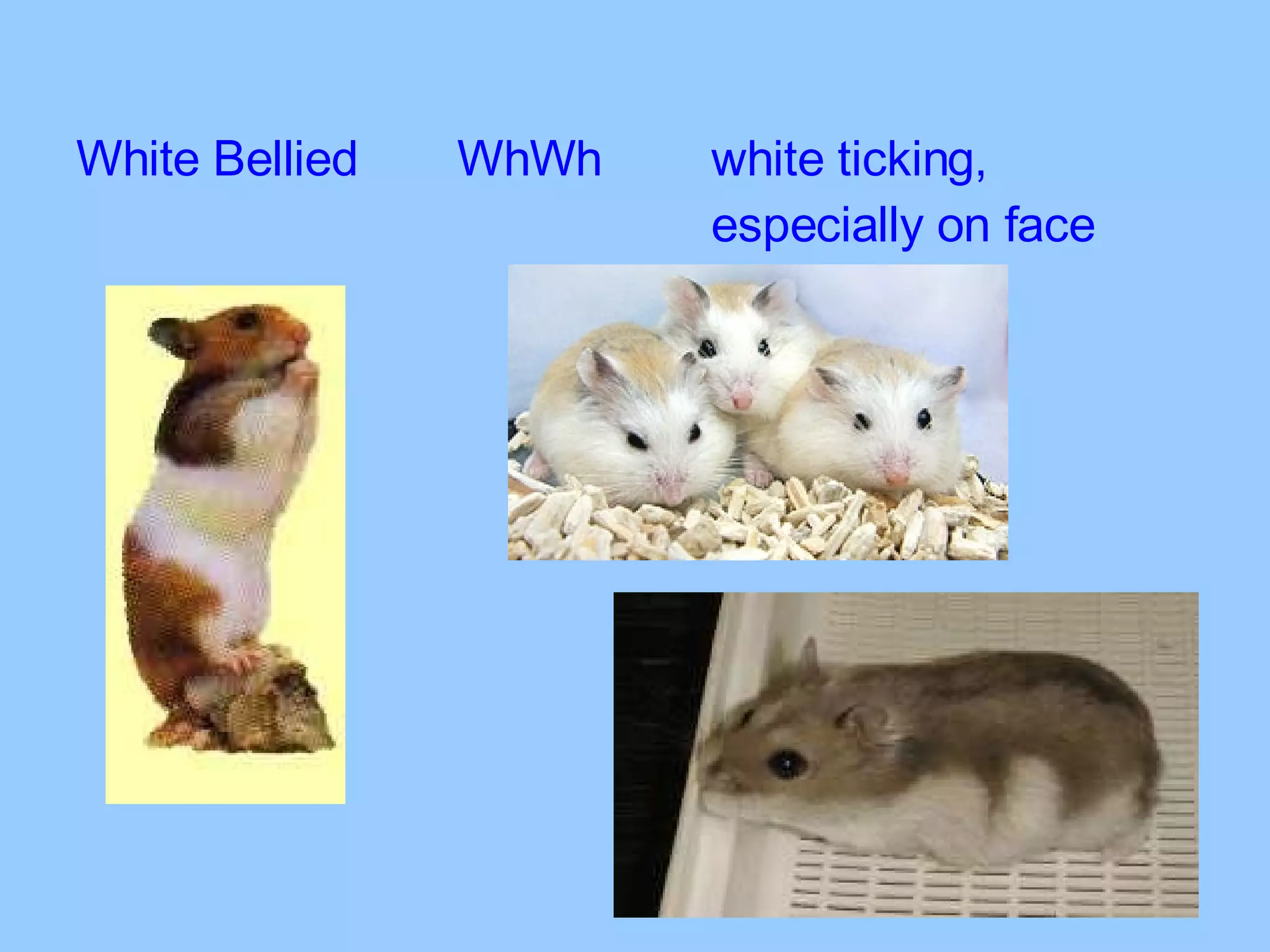
White Bellied WhWh white ticking,  especially on face
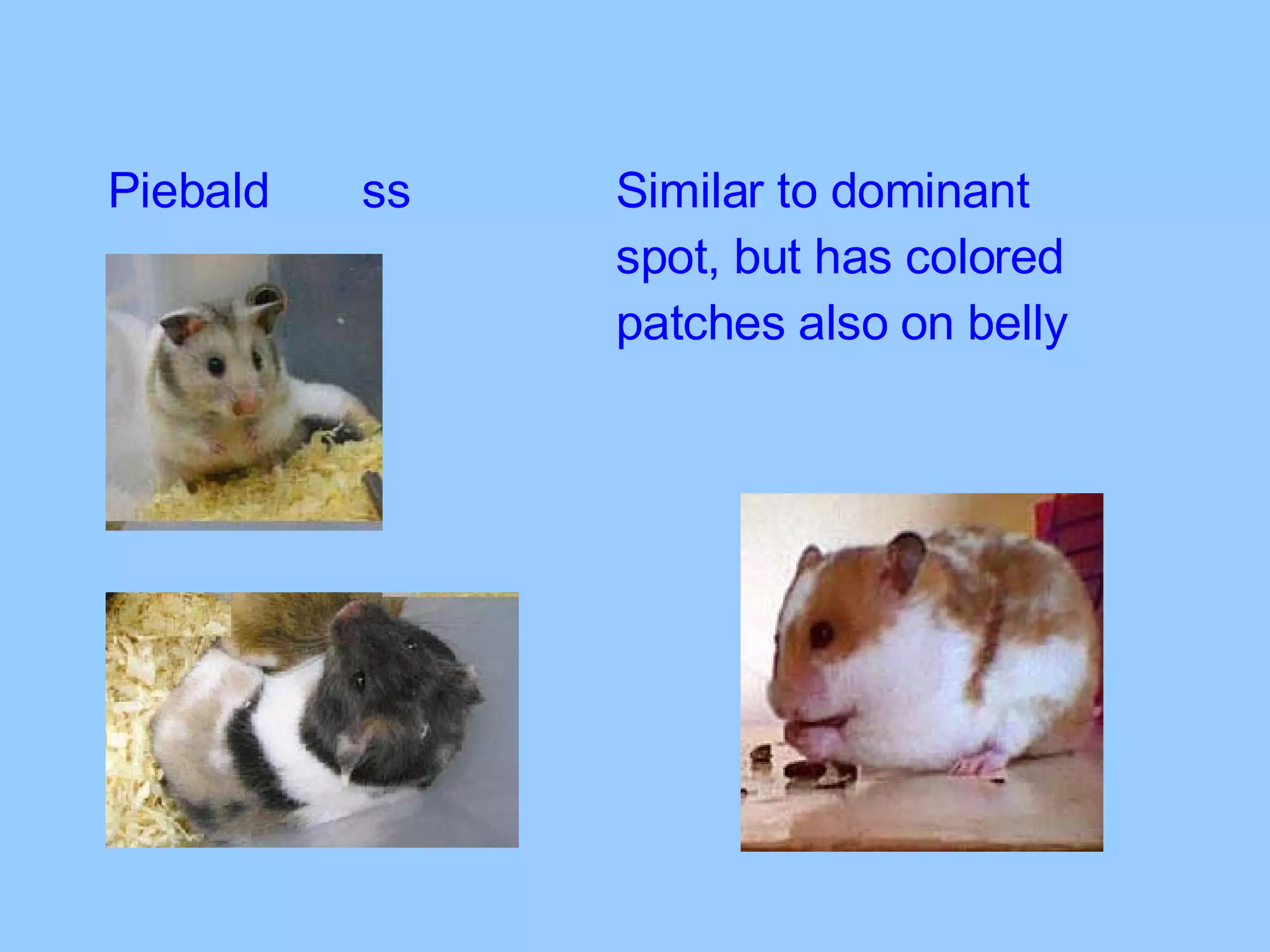
Piebald ss Similar to dominant  spot, but has colored  patches also on belly
Color Tortoiseshell (females only) TotoBaba, TotoBaBa, or TotoDsds  sex-linked bi-colored or tricolor animal - a balanced pattern of colored, yellow and white patches (sometimes black) Genotype Description
The yellow patches in Tortoiseshell are modified according to base color – Cinnamon becomes honey – Dark Grey becomes pearl – Lilac becomes lilac pearl Remember – this is a sex linked trait – only in females!
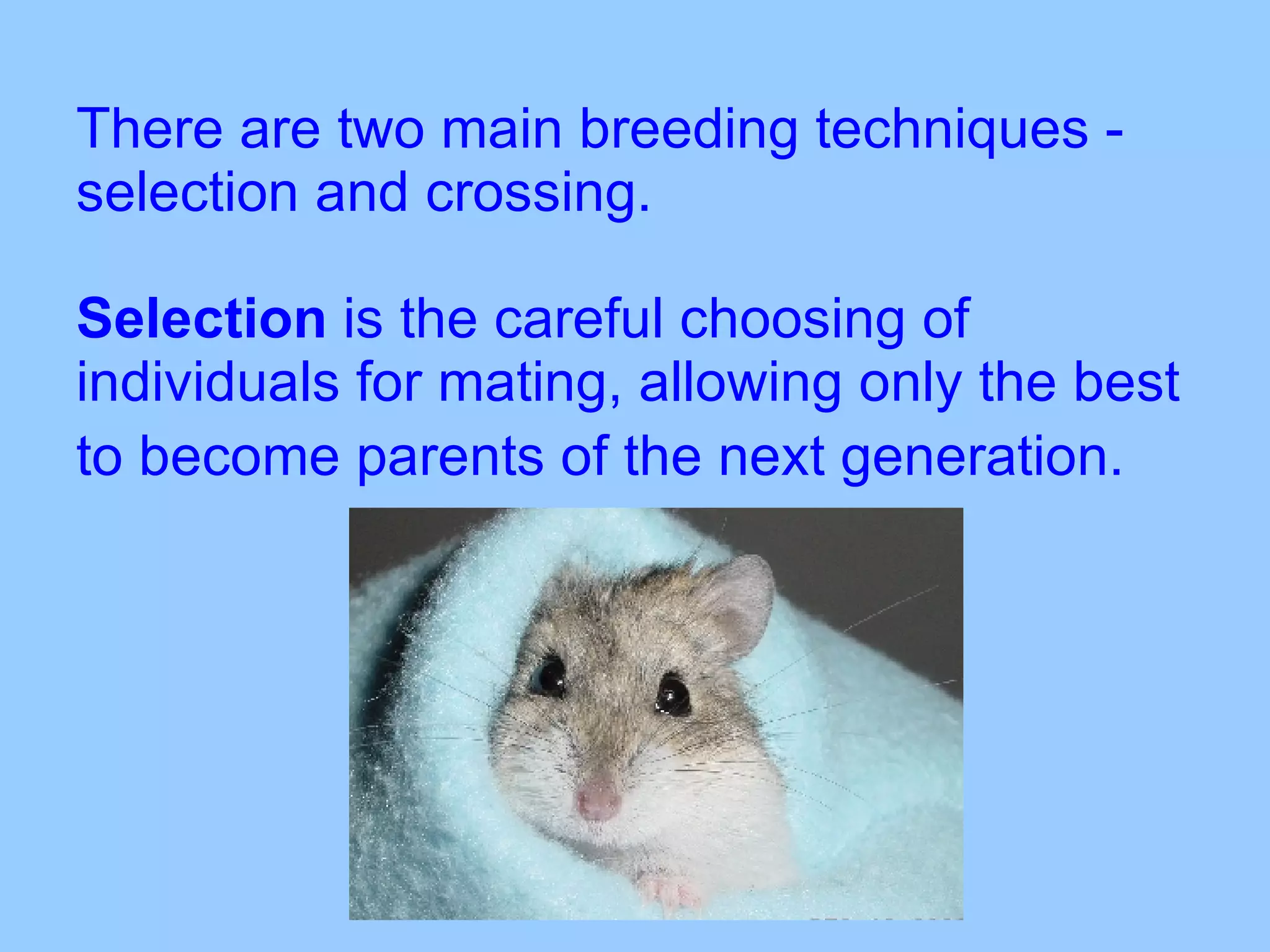
There are two main breeding techniques - selection and crossing.   Selection  is the careful choosing of individuals for mating, allowing only the best to become parents of the next generation.
Crossing , is the pairing of the selected individuals so that the best offspring possible can be produced.
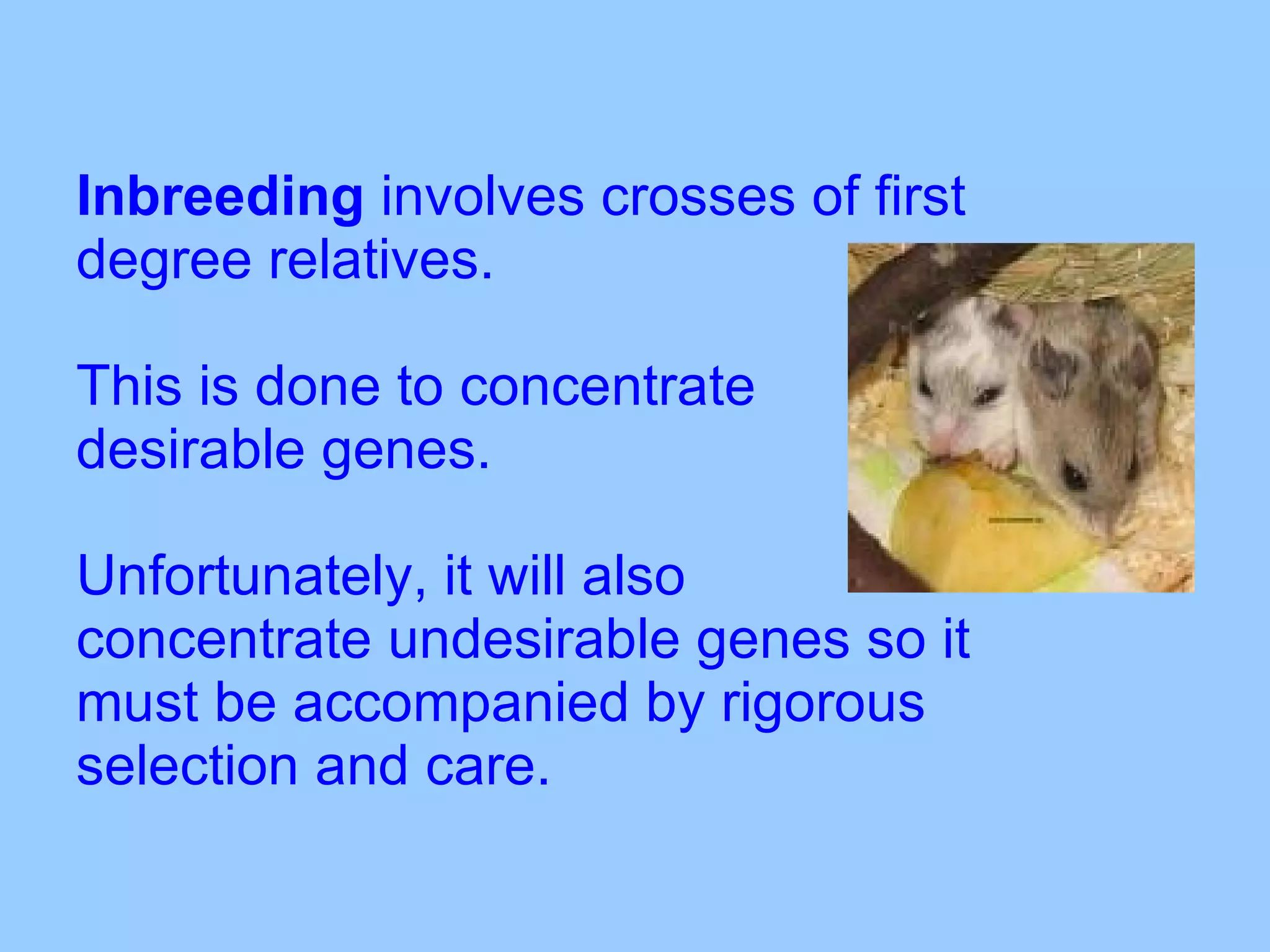
Inbreeding  involves crosses of first degree relatives.   This is done to concentrate desirable genes.   Unfortunately, it will also concentrate undesirable genes so it must be accompanied by rigorous selection and care.
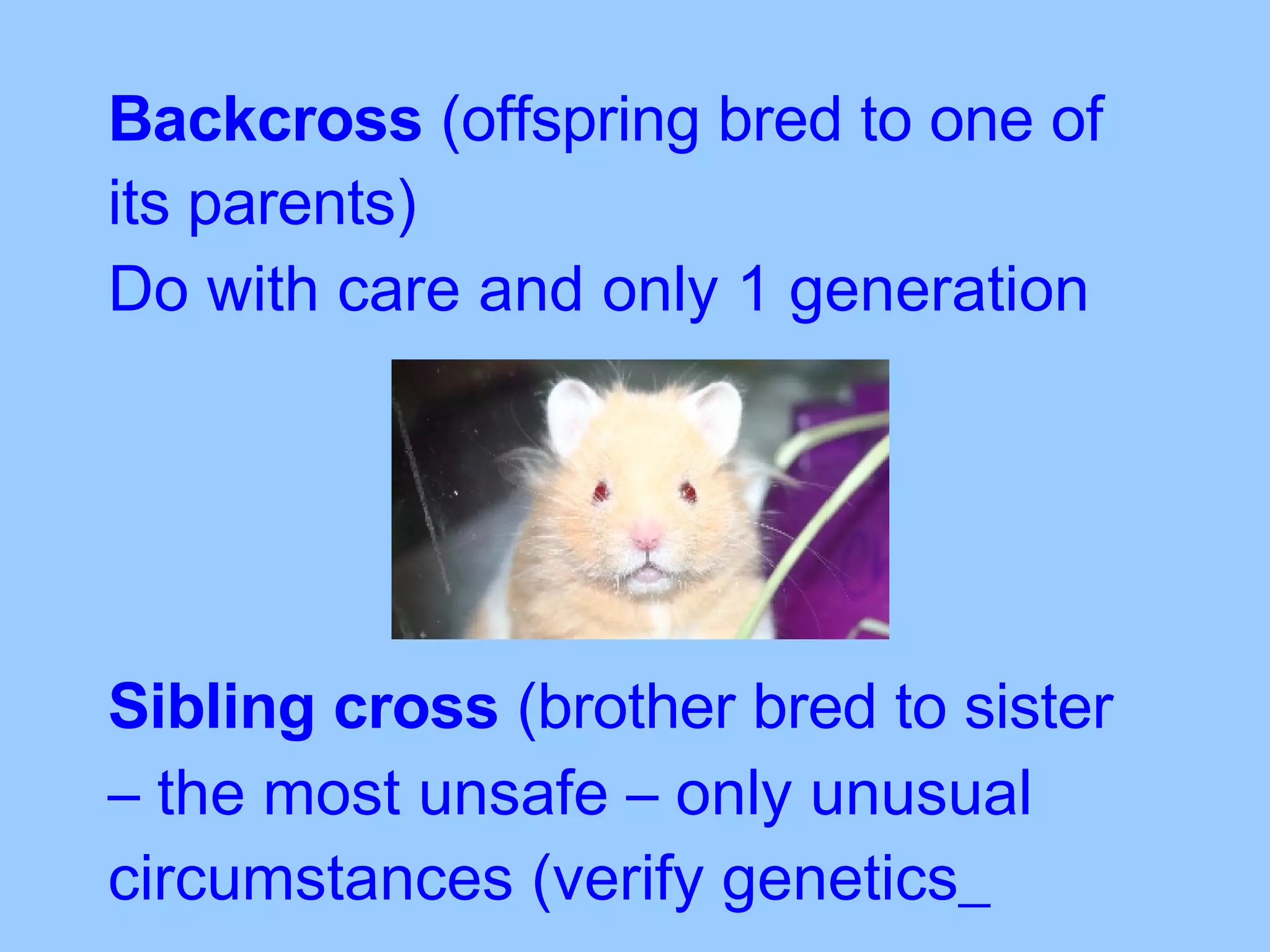
Backcross  (offspring bred to one of its parents)   Do with care and only 1 generation Sibling cross  (brother bred to sister   – the most unsafe – only unusual circumstances (verify genetics_
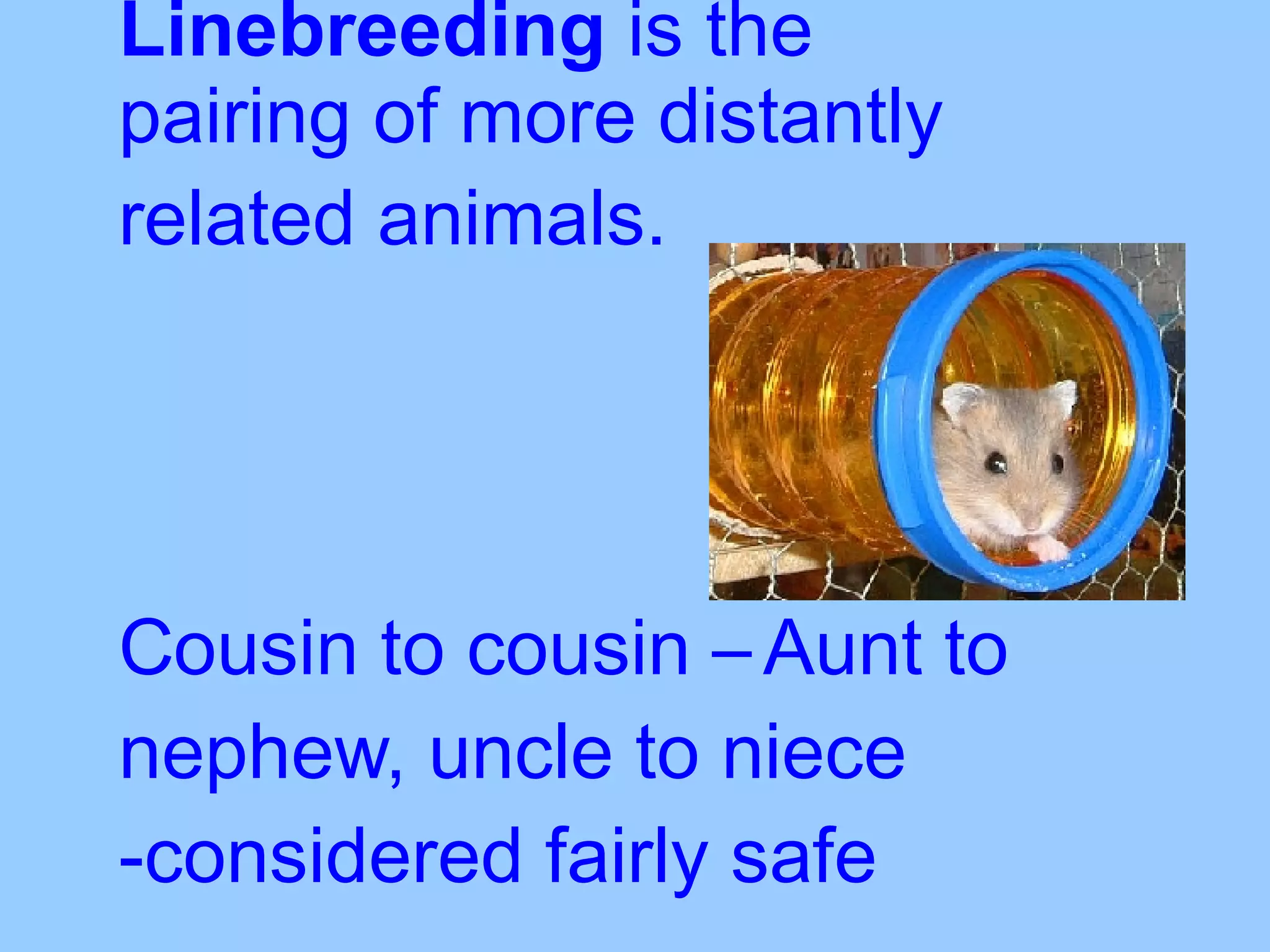
Linebreeding  is the pairing of more distantly related animals.   Cousin to cousin – Aunt to nephew, uncle to niece -considered fairly safe
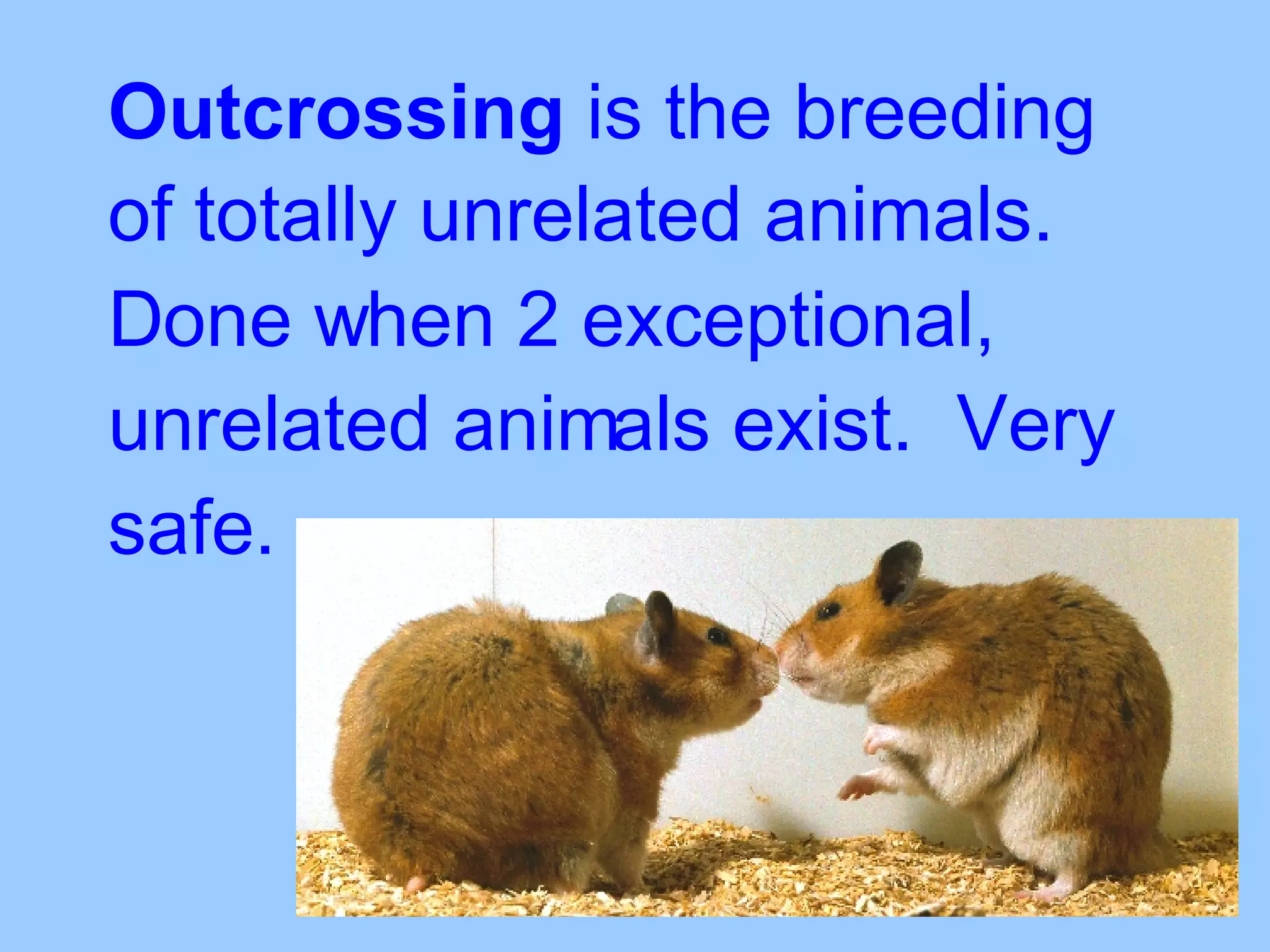
Outcrossing  is the breeding of totally unrelated animals.   Done when 2 exceptional, unrelated animals exist.  Very safe.
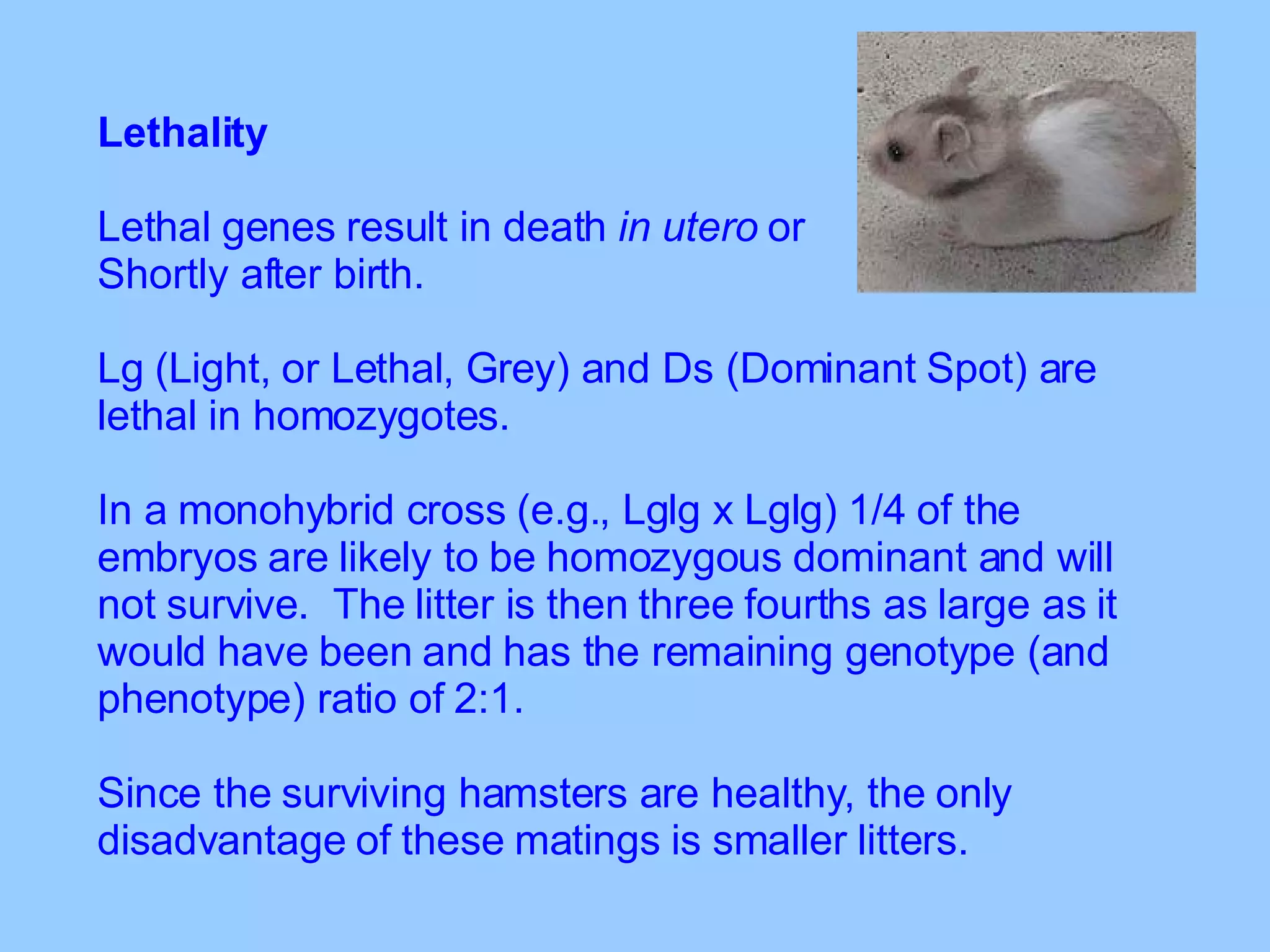
Lethality Lethal genes result in death  in utero  or  Shortly after birth.   Lg (Light, or Lethal, Grey) and Ds (Dominant Spot) are lethal in homozygotes.   In a monohybrid cross (e.g., Lglg x Lglg) 1/4 of the embryos are likely to be homozygous dominant and will not survive.  The litter is then three fourths as large as it would have been and has the remaining genotype (and phenotype) ratio of 2:1.   Since the surviving hamsters are healthy, the only disadvantage of these matings is smaller litters.
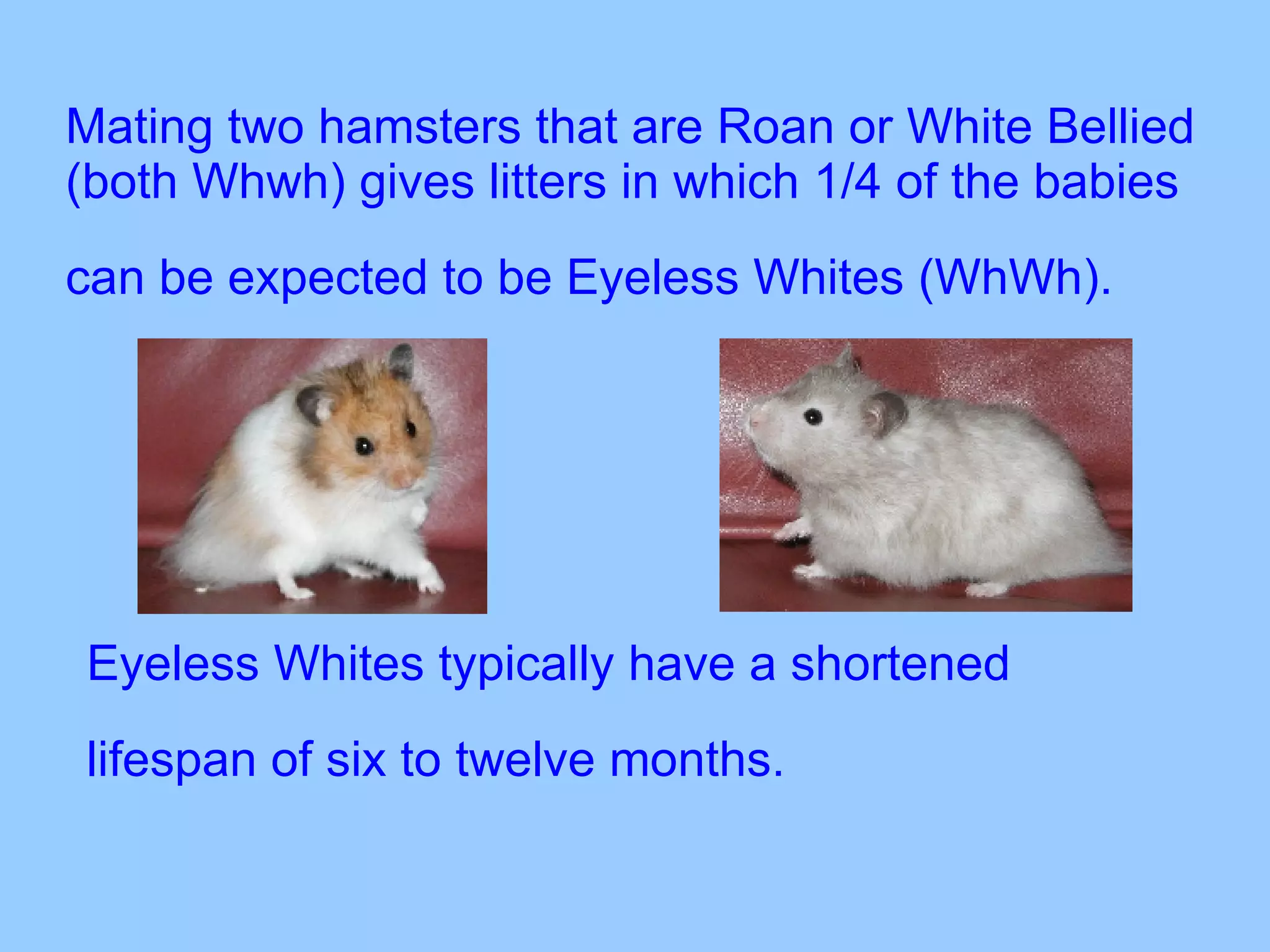
Mating two hamsters that are Roan or White Bellied (both Whwh) gives litters in which 1/4 of the babies can be expected to be Eyeless Whites (WhWh).   Eyeless Whites typically have a shortened lifespan of six to twelve months.
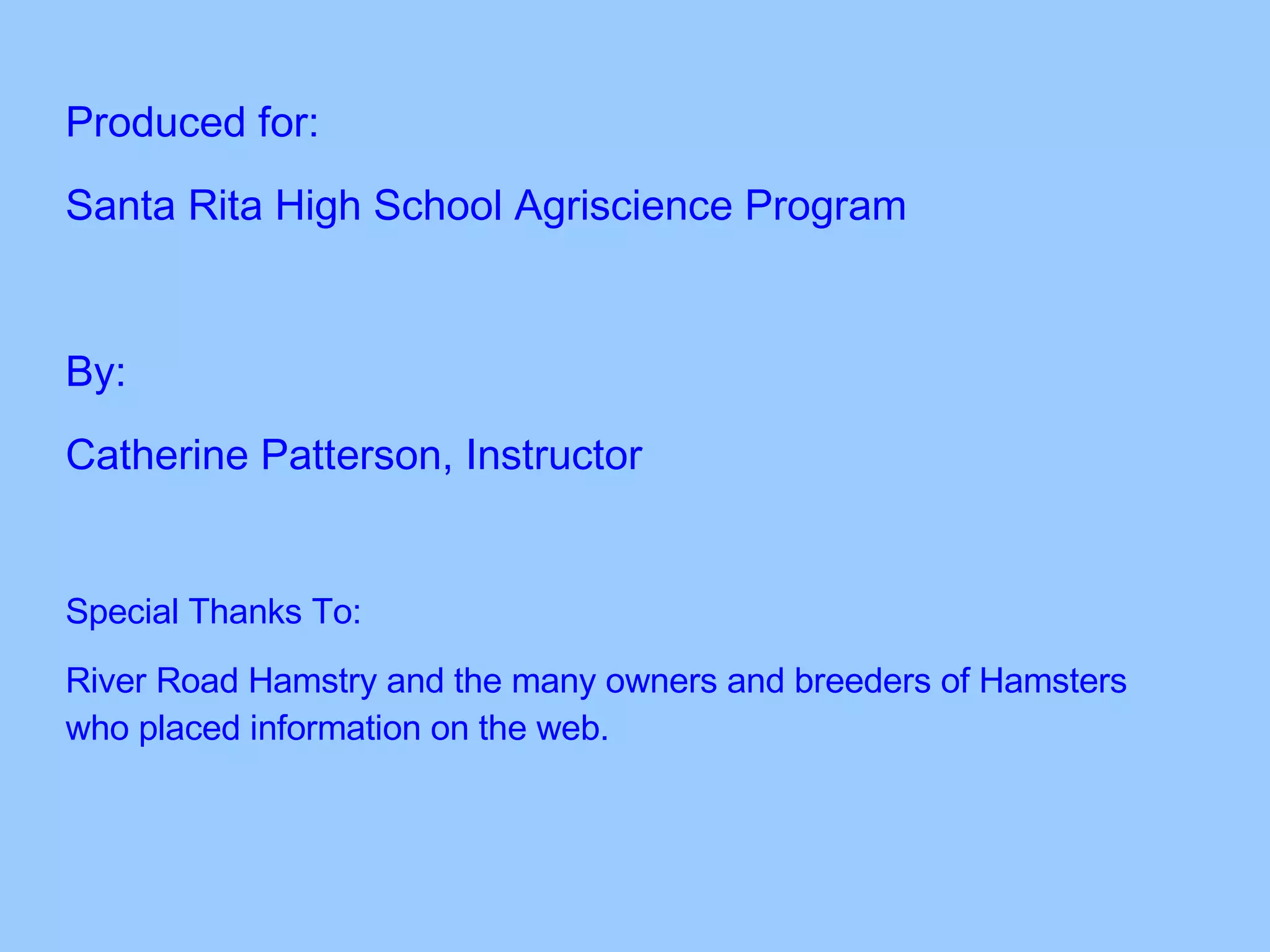
Principles: Careful Breeding Results  In Superior Animals! Breed for Fun, Knowledge, and Improved Species.
Produced for: Santa Rita High School Agriscience Program By: Catherine Patterson, Instructor Special Thanks To: River Road Hamstry and the many owners and breeders of Hamsters who placed information on the web.

Biotechnology - Inheritance and Breeding

  • 1.
    Hamster Genetics Biotechnology– Inheritance and Genetics Applications
  • 2.
    Standards Addressed: 15.0Animal Growth and Production 15.3 Reproduction 15.4 Biotechnology – 16.0 Using Scientific Processes to Analyze Data 16.1 Scientific Method 16.2, 16.3, 16.4 Scientific Research 16.6, 16.8 Communicating Results 17.0 Relationships Within Living Systems 17.2 Heredity 18.0 Bioethical Issues 18.3 Animal production
  • 3.
    Objectives: In aLaboratory Environment Students will be able to: 1- Use the scientific method to hypothesize, predict implement and report conclusions 2 – Illustrate patterns of inheritance using the principles of Mendel’s genetic theory 3 – Demonstrate respectful, and appropriate treatment of lab animals
  • 4.
    Process: Using SyrianHamsters students will identify phenotype of animal. Through multi generation breeding the genotype will be determined As genotype becomes established, predictions regarding future generations are made, tested, and results reported
  • 5.
    Why Use SyrianHamsters? 1 – A friendly, affordable, easily available animal 2 – Rapid maturation of pups 3 – Easily bred – short estrous cycle – 4 days 4 – Gestation period 16 days 5 – Established coat color, coat type, and coat markings 4 – Monohybrid and dihybrid crosses visible
  • 6.
    Careful, monitored breedingwill result in pedigree charts
  • 7.
    Genetic Predicting HelpsDetermine Future Offspring
  • 8.
    Safe, humane labanimal care is basic
  • 9.
    Basic Genetic Information:Hamsters have 44 chromosomes Ovaries carry 21 autosomes and an X gamete Sperm carry 21 autosomes and an X or Y gamete Syrian hamster Karyotype courtesy of Knud Christensen, Ph.D., The Royal Veterinary Agricultural University, Denmark
  • 10.
    Step 1: figure out the hamster's phenotype, and write a preliminary genotype.  A few quick examples. ("_" stands for "unknown.") Banded Longhair Red Eyed Cream Ba_eellpp Satin Cinnamon Tortoiseshell ppSasaToto Dominant Spot Yellow Black male aaDsdsToY Rex Smoke Pearl female dgdgrxrxToTo Chocolate (Sable) Roan bbeeU_ Whwh Recessive Dappled Umbrous Golden rdrdU_
  • 11.
    Expanding the GenotypeMore information about the hamster's genotype can be gathered by looking at its parents, siblings and offspring
  • 12.
    Breeding an animalcan provide more data about its genetic make-up.   It is especially useful as a tool to confirm suspicions of heterozygosity.   For any trait that may be heterozygous, breed to an animal that is homozygous recessive.
  • 13.
    Appropriate breeding canhelp sort out confusing colors. For example this helps with the Greys, especially if the Grey is in combination (for instance, in the Grey Sables or Black Eyed Ivories).   Breeding to any hamster without grey in its pedigree will give a good indication of the genotype.
  • 14.
    There are elevenbasic colors in Syrians.   Ten (excluding Golden, which is the “wild type”) are determined by a single gene pair .
  • 15.
    It can behard to determine color because coat types and coat patterns also influence appearance.
  • 16.
    Golden – wildcolor combination – where it all started “ Ticking” of coat And, the fur is often different close to the skin, from what is seen on top -
  • 17.
    Determining the CoatColor Phenotype
  • 18.
    Color Genotype DescriptionGolden ++ Rich dark mahogany heavy black ticking OR Light fawny gold Golden is the agouti, or wild code. It must carry all color genes possible, so would look like this: AA BB baba CC DgDg dsds EE FdFd LL lglg PP RdRd RuRu RxRx SS sasa sgsg toto uu whwh
  • 19.
    Color Genotype DescriptionBlack aa Jet black to the roots
  • 20.
    Black Eye ee Deep sandy cream Cream to the roots Color Genotype Description
  • 21.
    Color Genotype DescriptionCinnamon pp Rich russet orange
  • 22.
    Color Genotype DescriptionDark Ear cdcd White to the roots White
  • 23.
    Color Genotype DescriptionExtreme cece Creamy grey with Dilute black ticking
  • 24.
    Color Genotype DescriptionDark Grey dgdg Pearly grey, black ticking, black eye rings
  • 25.
    Color Genotype DescriptionLight Grey Lglg Buttermilk grey dark ticking
  • 26.
    Color Genotype DescriptionRust bb orange brown ticked with brown
  • 27.
    Color Genotype DescriptionSilver Grey SgSg Soft pastel grey ticked brownish black
  • 28.
    Color Genotype DescriptionYellow ToTo or ToY Dusky yellow with heavy black ticking
  • 29.
    Color Tortoiseshell (femalesonly) TotoBaba, TotoBaBa, or TotoDsds sex-linked bi-colored or tricolor animal - a balanced pattern of colored, yellow and white patches (sometimes black) Genotype Description
  • 30.
    Coat Type Anothergene we will select for - 5 Coat types exist -
  • 31.
    Shorthair ++ Wild type coat – short, even dense
  • 32.
    Longhair ll Longerhair over top, excluding face, much greater in males, not as much ticking
  • 33.
    Rex rxrx Wavy,frizzy, diluted color, curly whiskers
  • 34.
    Satin Sasa Glossysheen, shiny
  • 35.
    Hairless hrhr Nofur, may have curly whiskers
  • 36.
    Fur Patterns 8Specific fur pattern types exist
  • 37.
    Banded BaBa Centrallyplaced band of white (1/3 of body) white belly
  • 38.
    Dominant Spot DsdsWhite with colored spots, white face blaze, white belly
  • 39.
    Recessive Dappled rdrdDescription: White with colored face, rear brindled splotches, shoulders white, white face blaze, white belly
  • 40.
    Roan Whwh Whitewith colored hairs ticked through coat, more color on head, white belly
  • 41.
    White Bellied WhWhwhite ticking, especially on face
  • 42.
    Piebald ss Similarto dominant spot, but has colored patches also on belly
  • 43.
    Color Tortoiseshell (femalesonly) TotoBaba, TotoBaBa, or TotoDsds sex-linked bi-colored or tricolor animal - a balanced pattern of colored, yellow and white patches (sometimes black) Genotype Description
  • 44.
    The yellow patchesin Tortoiseshell are modified according to base color – Cinnamon becomes honey – Dark Grey becomes pearl – Lilac becomes lilac pearl Remember – this is a sex linked trait – only in females!
  • 45.
    There are twomain breeding techniques - selection and crossing.   Selection is the careful choosing of individuals for mating, allowing only the best to become parents of the next generation.
  • 46.
    Crossing , isthe pairing of the selected individuals so that the best offspring possible can be produced.
  • 47.
    Inbreeding involvescrosses of first degree relatives.   This is done to concentrate desirable genes.   Unfortunately, it will also concentrate undesirable genes so it must be accompanied by rigorous selection and care.
  • 48.
    Backcross (offspringbred to one of its parents) Do with care and only 1 generation Sibling cross (brother bred to sister – the most unsafe – only unusual circumstances (verify genetics_
  • 49.
    Linebreeding isthe pairing of more distantly related animals. Cousin to cousin – Aunt to nephew, uncle to niece -considered fairly safe
  • 50.
    Outcrossing isthe breeding of totally unrelated animals. Done when 2 exceptional, unrelated animals exist. Very safe.
  • 51.
    Lethality Lethal genesresult in death in utero or Shortly after birth.   Lg (Light, or Lethal, Grey) and Ds (Dominant Spot) are lethal in homozygotes.   In a monohybrid cross (e.g., Lglg x Lglg) 1/4 of the embryos are likely to be homozygous dominant and will not survive.  The litter is then three fourths as large as it would have been and has the remaining genotype (and phenotype) ratio of 2:1.   Since the surviving hamsters are healthy, the only disadvantage of these matings is smaller litters.
  • 52.
    Mating two hamstersthat are Roan or White Bellied (both Whwh) gives litters in which 1/4 of the babies can be expected to be Eyeless Whites (WhWh). Eyeless Whites typically have a shortened lifespan of six to twelve months.
  • 53.
    Principles: Careful BreedingResults In Superior Animals! Breed for Fun, Knowledge, and Improved Species.
  • 54.
    Produced for: SantaRita High School Agriscience Program By: Catherine Patterson, Instructor Special Thanks To: River Road Hamstry and the many owners and breeders of Hamsters who placed information on the web.