Introduction
Older peoples’ role in Australia’s community
aged care system is changing as part of
‘personalisation’. Personalisation is the
process of modifying public services to
meet the needs of people who use public
services and may include person centred
planning, self -directed supports and
individualised budgets (Needham, 2011).
The issue of choice and voice for people
who use services are key parts of the
personalisation agenda. On the one hand,
proponents of personalisation argue that it
provides more choice and control for older
people. Critics contend that too much
‘choice’ can challenge decision making
processes for people who use users
(Schwartz, 2004) and lead to the
marketization of public services (Clarke,
Newman, Smith, Vidler, & Westermarland,
2007) (Cortis, Meagher, Chan, Davidson, &
Fattore, 2013). Some contend that what
older people want is not ‘choice’ but more
voice in the delivery of support (Barnes &
Bennett, 1998).
Research Questions
 What are the risks of mechanisms
that promote choice for older
people who use community aged
care services in Australia?
 What are the risks of mechanisms
that promote the voice of older
people who use community aged
care services in Australia?
Methodology
This research paper is based on a
literature review completed as part
of a PhD project undertaken at the
University of Sydney in Australia in
2012/13.
Contact Me
Twitter@carriehayter
Slideshare Carriehayter
www.carriehayter.com
E:carriehayter@gmail.com
Key Findings
Australia’s Aged Care System
Australia’s aged care system is a mixed
economy of care including residential and
community care funded by the Federal
Government. Reflecting international trends,
the Australian Government mandated the
implementation of individualised budgets in
Home Care Packages (HCP) for older people
from 1 July 2015 (Department of Health and
Ageing, 2013).HCP’s provide in-home and
community supports for older people to live in
the community. In 2015 approximately $1.27
billion was allocated to HCPs which reflects a
tripling of expenditure on this program since
2005 (Productivity Commission, 2005, 2015).
Choice – A Political and
Contested Concept?
The concept of what choice means for service
users is debated. Some contend that because
of the power differentials between service
users and service providers it is very difficult
for service users to have real
‘choice’(Beresford, 2009). The lack of
alternative options combined with the
vulnerability of people who use public services
is such that people really don’t have much
choice (Barnes, 2009).This lack of power for
people who use public services can also be
reinforced by class, gender, race and ageism
(Glendinning, 2009).
The policy mechanisms implemented by
government in the guise of choice are not
politically neutral and can have a profound
impact on the people who use services (Clarke,
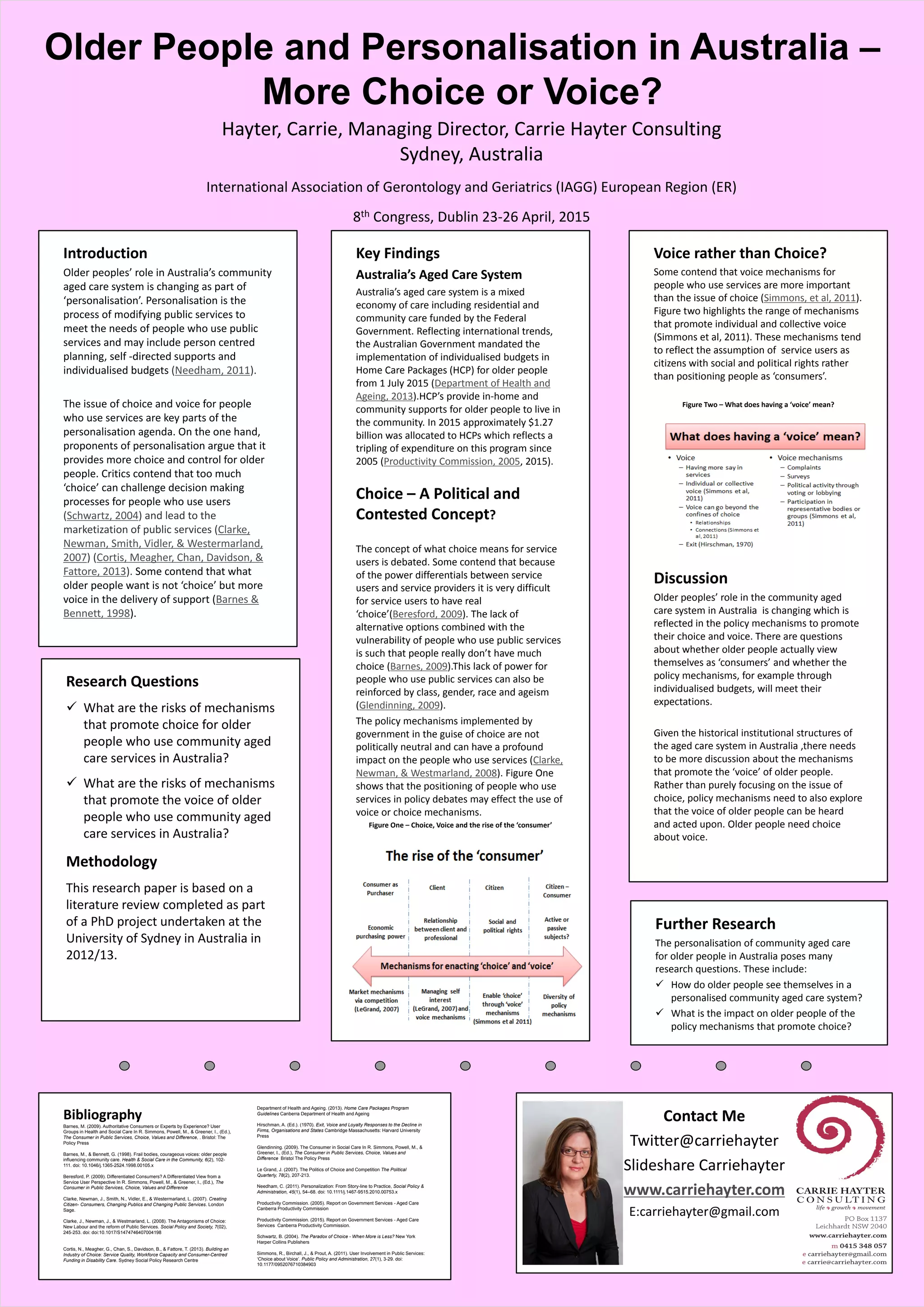
Newman, & Westmarland, 2008). Figure One
shows that the positioning of people who use
services in policy debates may effect the use of
voice or choice mechanisms.
Figure One – Choice, Voice and the rise of the ‘consumer’
Hayter, Carrie, Managing Director, Carrie Hayter Consulting
Sydney, Australia
International Association of Gerontology and Geriatrics (IAGG) European Region (ER)
8th Congress, Dublin 23-26 April, 2015
Bibliography
Barnes, M. (2009). Authoritative Consumers or Experts by Experience? User
Groups in Health and Social Care In R. Simmons, Powell, M., & Greener, I., (Ed.),
The Consumer in Public Services, Choice, Values and Difference, . Bristol: The
Policy Press
Barnes, M., & Bennett, G. (1998). Frail bodies, courageous voices: older people
influencing community care. Health & Social Care in the Community, 6(2), 102-
111. doi: 10.1046/j.1365-2524.1998.00105.x
Beresford, P. (2009). Differentiated Consumers? A Differentiated View from a
Service User Perspective In R. Simmons, Powell, M., & Greener, I., (Ed.), The
Consumer in Public Services, Choice, Values and Difference
Clarke, Newman, J., Smith, N., Vidler, E., & Westermarland, L. (2007). Creating
Citizen- Consumers, Changing Publics and Changing Public Services. London
Sage.
Clarke, J., Newman, J., & Westmarland, L. (2008). The Antagonisms of Choice:
New Labour and the reform of Public Services. Social Policy and Society, 7(02),
245-253. doi: doi:10.1017/S1474746407004198
Cortis, N., Meagher, G., Chan, S., Davidson, B., & Fattore, T. (2013). Building an
Industry of Choice: Service Quality, Workforce Capacity and Consumer-Centred
Funding in Disability Care. Sydney Social Policy Research Centre
Department of Health and Ageing. (2013). Home Care Packages Program
Guidelines Canberra Department of Health and Ageing
Hirschman, A. (Ed.). (1970). Exit, Voice and Loyalty Responses to the Decline in
Firms, Organisations and States Cambridge Massachusetts: Harvard University
Press
Glendinning. (2009). The Consumer in Social Care In R. Simmons, Powell, M., &
Greener, I., (Ed.), The Consumer in Public Services, Choice, Values and
Difference Bristol The Policy Press
Le Grand, J. (2007). The Politics of Choice and Competition The Political
Quarterly, 78(2), 207-213.
Needham, C. (2011). Personalization: From Story-line to Practice, Social Policy &
Administration, 45(1), 54–68. doi: 10.1111/j.1467-9515.2010.00753.x
Productivity Commission. (2005). Report on Government Services - Aged Care
Canberra Productivity Commission
Productivity Commission. (2015). Report on Government Services - Aged Care
Services Canberra Productivity Commission.
Schwartz, B. (2004). The Paradox of Choice - When More is Less? New York
Harper Collins Publishers
Simmons, R., Birchall, J., & Prout, A. (2011). User Involvement in Public Services:
‘Choice about Voice’. Public Policy and Administration, 27(1), 3-29. doi:
10.1177/0952076710384903
Further Research
The personalisation of community aged care
for older people in Australia poses many
research questions. These include:
 How do older people see themselves in a
personalised community aged care system?
 What is the impact on older people of the
policy mechanisms that promote choice?
Older People and Personalisation in Australia –
More Choice or Voice?
Voice rather than Choice?
Some contend that voice mechanisms for
people who use services are more important
than the issue of choice (Simmons, et al, 2011).
Figure two highlights the range of mechanisms
that promote individual and collective voice
(Simmons et al, 2011). These mechanisms tend
to reflect the assumption of service users as
citizens with social and political rights rather
than positioning people as ‘consumers’.
Figure Two – What does having a ‘voice’ mean?
Discussion
Older peoples’ role in the community aged
care system in Australia is changing which is
reflected in the policy mechanisms to promote
their choice and voice. There are questions
about whether older people actually view
themselves as ‘consumers’ and whether the
policy mechanisms, for example through
individualised budgets, will meet their
expectations.
Given the historical institutional structures of
the aged care system in Australia ,there needs
to be more discussion about the mechanisms
that promote the ‘voice’ of older people.
Rather than purely focusing on the issue of
choice, policy mechanisms need to also explore
that the voice of older people can be heard
and acted upon. Older people need choice
about voice.

Older People and Personalisation in Australia - More Choice and Voice?

  • 1.
    Introduction Older peoples’ rolein Australia’s community aged care system is changing as part of ‘personalisation’. Personalisation is the process of modifying public services to meet the needs of people who use public services and may include person centred planning, self -directed supports and individualised budgets (Needham, 2011). The issue of choice and voice for people who use services are key parts of the personalisation agenda. On the one hand, proponents of personalisation argue that it provides more choice and control for older people. Critics contend that too much ‘choice’ can challenge decision making processes for people who use users (Schwartz, 2004) and lead to the marketization of public services (Clarke, Newman, Smith, Vidler, & Westermarland, 2007) (Cortis, Meagher, Chan, Davidson, & Fattore, 2013). Some contend that what older people want is not ‘choice’ but more voice in the delivery of support (Barnes & Bennett, 1998). Research Questions  What are the risks of mechanisms that promote choice for older people who use community aged care services in Australia?  What are the risks of mechanisms that promote the voice of older people who use community aged care services in Australia? Methodology This research paper is based on a literature review completed as part of a PhD project undertaken at the University of Sydney in Australia in 2012/13. Contact Me Twitter@carriehayter Slideshare Carriehayter www.carriehayter.com E:carriehayter@gmail.com Key Findings Australia’s Aged Care System Australia’s aged care system is a mixed economy of care including residential and community care funded by the Federal Government. Reflecting international trends, the Australian Government mandated the implementation of individualised budgets in Home Care Packages (HCP) for older people from 1 July 2015 (Department of Health and Ageing, 2013).HCP’s provide in-home and community supports for older people to live in the community. In 2015 approximately $1.27 billion was allocated to HCPs which reflects a tripling of expenditure on this program since 2005 (Productivity Commission, 2005, 2015). Choice – A Political and Contested Concept? The concept of what choice means for service users is debated. Some contend that because of the power differentials between service users and service providers it is very difficult for service users to have real ‘choice’(Beresford, 2009). The lack of alternative options combined with the vulnerability of people who use public services is such that people really don’t have much choice (Barnes, 2009).This lack of power for people who use public services can also be reinforced by class, gender, race and ageism (Glendinning, 2009). The policy mechanisms implemented by government in the guise of choice are not politically neutral and can have a profound impact on the people who use services (Clarke, Newman, & Westmarland, 2008). Figure One shows that the positioning of people who use services in policy debates may effect the use of voice or choice mechanisms. Figure One – Choice, Voice and the rise of the ‘consumer’ Hayter, Carrie, Managing Director, Carrie Hayter Consulting Sydney, Australia International Association of Gerontology and Geriatrics (IAGG) European Region (ER) 8th Congress, Dublin 23-26 April, 2015 Bibliography Barnes, M. (2009). Authoritative Consumers or Experts by Experience? User Groups in Health and Social Care In R. Simmons, Powell, M., & Greener, I., (Ed.), The Consumer in Public Services, Choice, Values and Difference, . Bristol: The Policy Press Barnes, M., & Bennett, G. (1998). Frail bodies, courageous voices: older people influencing community care. Health & Social Care in the Community, 6(2), 102- 111. doi: 10.1046/j.1365-2524.1998.00105.x Beresford, P. (2009). Differentiated Consumers? A Differentiated View from a Service User Perspective In R. Simmons, Powell, M., & Greener, I., (Ed.), The Consumer in Public Services, Choice, Values and Difference Clarke, Newman, J., Smith, N., Vidler, E., & Westermarland, L. (2007). Creating Citizen- Consumers, Changing Publics and Changing Public Services. London Sage. Clarke, J., Newman, J., & Westmarland, L. (2008). The Antagonisms of Choice: New Labour and the reform of Public Services. Social Policy and Society, 7(02), 245-253. doi: doi:10.1017/S1474746407004198 Cortis, N., Meagher, G., Chan, S., Davidson, B., & Fattore, T. (2013). Building an Industry of Choice: Service Quality, Workforce Capacity and Consumer-Centred Funding in Disability Care. Sydney Social Policy Research Centre Department of Health and Ageing. (2013). Home Care Packages Program Guidelines Canberra Department of Health and Ageing Hirschman, A. (Ed.). (1970). Exit, Voice and Loyalty Responses to the Decline in Firms, Organisations and States Cambridge Massachusetts: Harvard University Press Glendinning. (2009). The Consumer in Social Care In R. Simmons, Powell, M., & Greener, I., (Ed.), The Consumer in Public Services, Choice, Values and Difference Bristol The Policy Press Le Grand, J. (2007). The Politics of Choice and Competition The Political Quarterly, 78(2), 207-213. Needham, C. (2011). Personalization: From Story-line to Practice, Social Policy & Administration, 45(1), 54–68. doi: 10.1111/j.1467-9515.2010.00753.x Productivity Commission. (2005). Report on Government Services - Aged Care Canberra Productivity Commission Productivity Commission. (2015). Report on Government Services - Aged Care Services Canberra Productivity Commission. Schwartz, B. (2004). The Paradox of Choice - When More is Less? New York Harper Collins Publishers Simmons, R., Birchall, J., & Prout, A. (2011). User Involvement in Public Services: ‘Choice about Voice’. Public Policy and Administration, 27(1), 3-29. doi: 10.1177/0952076710384903 Further Research The personalisation of community aged care for older people in Australia poses many research questions. These include:  How do older people see themselves in a personalised community aged care system?  What is the impact on older people of the policy mechanisms that promote choice? Older People and Personalisation in Australia – More Choice or Voice? Voice rather than Choice? Some contend that voice mechanisms for people who use services are more important than the issue of choice (Simmons, et al, 2011). Figure two highlights the range of mechanisms that promote individual and collective voice (Simmons et al, 2011). These mechanisms tend to reflect the assumption of service users as citizens with social and political rights rather than positioning people as ‘consumers’. Figure Two – What does having a ‘voice’ mean? Discussion Older peoples’ role in the community aged care system in Australia is changing which is reflected in the policy mechanisms to promote their choice and voice. There are questions about whether older people actually view themselves as ‘consumers’ and whether the policy mechanisms, for example through individualised budgets, will meet their expectations. Given the historical institutional structures of the aged care system in Australia ,there needs to be more discussion about the mechanisms that promote the ‘voice’ of older people. Rather than purely focusing on the issue of choice, policy mechanisms need to also explore that the voice of older people can be heard and acted upon. Older people need choice about voice.