Creative Support - lessons from 
self-directed support in the UK 
Workshop by Dr Simon Duffy for ACS in South Australia, 
2 December 2014 in Adelaide
Dr Simon Duffy 
I’ve worked at developing systems of self-directed support for 25 
years, working as a service provider and working with (and against) 
government. My training is in philosophy and my practice has 
involved an on-going effort to think about why we do what we do. 
After working on individualised funding in early 1990s I developed 
Inclusion Glasgow - an innovative service provider in 1996. In 2003 I 
led In Control and developed the model of self-directed support 
which was (to some extent) adopted by the English government. 
In 2009 I set up The Centre for Welfare Reform as hub for social 
international social innovation and a platform for challenging injustice. 
I am currently involved in various campaigning efforts in the UK to 
combat the way ’austerity’ is targeting people with disabilities and 
people in poverty.
• Overview of UK developments 
• Citizenship and individual service design 
• Practical issues for service providers 
• Power of peer and community support
Words 
are important
Origin of “Consumer” early 
15c., "one who squanders 
or wastes," agent noun from 
consume. In economic 
sense, "one who uses up 
goods or articles" (opposite 
of producer) from 1745. 
Origin of “Care” Old 
English caru (noun), carian 
(verb), of Germanic origin; 
related to Old High German 
chara 'grief, lament', 
charon 'grieve', and Old 
Norse kǫr 'sickbed'. 
• Is it helpful to think of ourselves as consumers? 
• Can you consume care? 
• Is care the kind of thing you can direct? 
• Is it helpful to convert community into a market?
brief history of self-direction 
• Began in California 
1960s (c. 50 yrs!) 
• Progress real, slow 
and patchy 
• Outcomes always 
positive 
• Efficiency & cost-control 
are variable 
• Design details really 
matter 
• Resistance to change 
high
Reform were not inspired 
by consumerism, neo-liberalism 
or the market.
People don’t shop for services they build 
stronger community.
It seems more fruitful to 
think about real wealth, 
citizenship and community.
Brief History 
• Post-war responsibilities 
split between NHS 
(bigger) local government 
(smaller) for services. 
• 1970s - Growth of 
‘disability benefits’ 
• 1980s - Creation of an 
open-ended ‘entitlement’ 
to residential care created 
bubble - capped by 
handing money to local 
government. 
• 1988 - Creation of 
Independent Living Fund. 
• 1990s - Pressure from 
families and professionals 
led to NHS closing 
institutional care. 
• 1996 - Direct Payments 
Act makes emerging 
practice legal. 
Progressively opened up 
to more groups. 
• 2007 - Putting People First 
marks intention of 
government to make 
personalisation universal. 
Progressively opening up 
to health, education etc.
The care home resident population for those aged 65 and over has 
remained almost stable since 2001 with an increase of 0.3%, despite 
growth of 11.0% in the overall population at this age. Fewer women but 
more men aged 65 and over, were living as residents of care homes in 
2011 compared to 2001; the population of women fell by around 9,000 
(-4.2%) while the population of men increased by around 10,000 
(15.2%). The gender gap in the older resident care home population 
has, therefore, narrowed since 2001. In 2011 there were around 2.8 
women for each man aged 65 and over compared to a ratio of 3.3 
women for each man in 2001. The resident care home population is 
ageing: in 2011, people aged 85 and over represented 59.2% of the 
older care home population compared to 56.5% in 2001. [Office of 
National Statistics. Part of 2011 Census Analysis, Changes in the Older 
Resident Care Home Population between 2001 and 2011 Release] 
The total number of people receiving services in 2013-14 was 1,267,000 
(down 5 per cent from 1,328,000 in 2012-13 and down 29 per cent from 
1,782,000 in 2008-09). Of these, 1,046,000 received community based 
services (a fall of 5 per cent from 2012-13), 204,000 received residential 
care (a fall of 3 per cent from 2012-13) and 84,000 received nursing 
care (which is 3 per cent down from 2011-12). [National Statistics. 
Community Care Statistics, Social Services Activity, England - 2013-14, 
Provisional release}
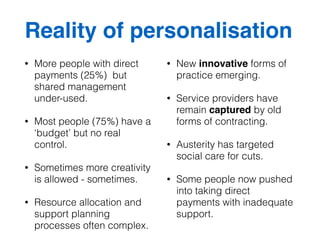
Reality of personalisation 
• More people with direct 
payments (25%) but 
shared management 
under-used. 
• Most people (75%) have a 
‘budget’ but no real 
control. 
• Sometimes more creativity 
is allowed - sometimes. 
• Resource allocation and 
support planning 
processes often complex. 
• New innovative forms of 
practice emerging. 
• Service providers have 
remain captured by old 
forms of contracting. 
• Austerity has targeted 
social care for cuts. 
• Some people now pushed 
into taking direct 
payments with inadequate 
support.
Strengths to build on 
• Clear up-front budgets 
that people can use 
flexibly 
• Flexibility around 
planning - use of peer 
support 
• Possibility of 
abandoning process 
control and shift to 
outcomes 
• Ability to add and 
develop existing roles - 
no fixed structural 
template 
• Extension sideways 
into health, education 
and other areas
Individualise Everything
My Money 
Funding from one 
or more sources 
[enables integration] 
€ 
Coordinator Admin 
Insurance Fund 
brokerage overheads unexpected costs 
Restricted Funding 
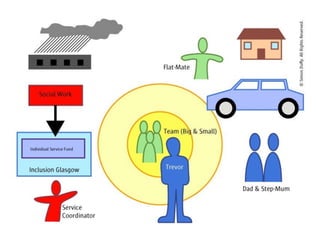
Individual Service Fund
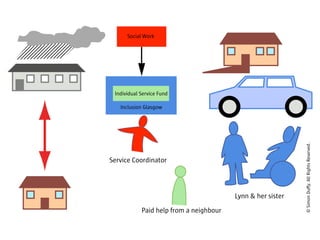
Social Work 
Individual Service Fund 
Inclusion Glasgow 
Service Coordinator 
Lynn & her sister 
Paid help from a neighbour 
© Simon Duffy. All Rights Reserved.
We make citizenship real by 
1. Finding our sense of purpose 
2. Having the freedom to pursue it 
3. Having enough money to be free 
4. Having a home where we belong 
5. Getting help from other people 
6. Making life in community 
7. Finding love
This protects our dignity 
1. Our life is seen to have meaning 
2. We are not on someone else’s control 
3. We can pay our way - we’re not unduly dependent 
4. We have a stake in the community 
5. We give others the chance to give 
6. We contribute to the community 
7. We are building the relationships that sustain community
How is greater 
efficiency possible?
• Better targeted support 
• Different kinds of support 
• Community connections 
• Teaching 
• Technology 
• Getting housing right 
• Lower management costs 
• (Lower salary costs… mmm)
What different roles 
can you play in CDC?
• Can you plan with people? 
• Can you give people their own money? 
• Can you keep people’s money sate for them (roll 
over)? 
• Can you let people use their money flexibly? 
• Are you part of the same community as the 
citizens?

Creative Support in Aged Care

  • 1.
    Creative Support -lessons from self-directed support in the UK Workshop by Dr Simon Duffy for ACS in South Australia, 2 December 2014 in Adelaide
  • 2.
    Dr Simon Duffy I’ve worked at developing systems of self-directed support for 25 years, working as a service provider and working with (and against) government. My training is in philosophy and my practice has involved an on-going effort to think about why we do what we do. After working on individualised funding in early 1990s I developed Inclusion Glasgow - an innovative service provider in 1996. In 2003 I led In Control and developed the model of self-directed support which was (to some extent) adopted by the English government. In 2009 I set up The Centre for Welfare Reform as hub for social international social innovation and a platform for challenging injustice. I am currently involved in various campaigning efforts in the UK to combat the way ’austerity’ is targeting people with disabilities and people in poverty.
  • 3.
    • Overview ofUK developments • Citizenship and individual service design • Practical issues for service providers • Power of peer and community support
  • 4.
  • 5.
    Origin of “Consumer”early 15c., "one who squanders or wastes," agent noun from consume. In economic sense, "one who uses up goods or articles" (opposite of producer) from 1745. Origin of “Care” Old English caru (noun), carian (verb), of Germanic origin; related to Old High German chara 'grief, lament', charon 'grieve', and Old Norse kǫr 'sickbed'. • Is it helpful to think of ourselves as consumers? • Can you consume care? • Is care the kind of thing you can direct? • Is it helpful to convert community into a market?
  • 7.
    brief history ofself-direction • Began in California 1960s (c. 50 yrs!) • Progress real, slow and patchy • Outcomes always positive • Efficiency & cost-control are variable • Design details really matter • Resistance to change high
  • 8.
    Reform were notinspired by consumerism, neo-liberalism or the market.
  • 12.
    People don’t shopfor services they build stronger community.
  • 14.
    It seems morefruitful to think about real wealth, citizenship and community.
  • 15.
    Brief History •Post-war responsibilities split between NHS (bigger) local government (smaller) for services. • 1970s - Growth of ‘disability benefits’ • 1980s - Creation of an open-ended ‘entitlement’ to residential care created bubble - capped by handing money to local government. • 1988 - Creation of Independent Living Fund. • 1990s - Pressure from families and professionals led to NHS closing institutional care. • 1996 - Direct Payments Act makes emerging practice legal. Progressively opened up to more groups. • 2007 - Putting People First marks intention of government to make personalisation universal. Progressively opening up to health, education etc.
  • 16.
    The care homeresident population for those aged 65 and over has remained almost stable since 2001 with an increase of 0.3%, despite growth of 11.0% in the overall population at this age. Fewer women but more men aged 65 and over, were living as residents of care homes in 2011 compared to 2001; the population of women fell by around 9,000 (-4.2%) while the population of men increased by around 10,000 (15.2%). The gender gap in the older resident care home population has, therefore, narrowed since 2001. In 2011 there were around 2.8 women for each man aged 65 and over compared to a ratio of 3.3 women for each man in 2001. The resident care home population is ageing: in 2011, people aged 85 and over represented 59.2% of the older care home population compared to 56.5% in 2001. [Office of National Statistics. Part of 2011 Census Analysis, Changes in the Older Resident Care Home Population between 2001 and 2011 Release] The total number of people receiving services in 2013-14 was 1,267,000 (down 5 per cent from 1,328,000 in 2012-13 and down 29 per cent from 1,782,000 in 2008-09). Of these, 1,046,000 received community based services (a fall of 5 per cent from 2012-13), 204,000 received residential care (a fall of 3 per cent from 2012-13) and 84,000 received nursing care (which is 3 per cent down from 2011-12). [National Statistics. Community Care Statistics, Social Services Activity, England - 2013-14, Provisional release}
  • 19.
    Reality of personalisation • More people with direct payments (25%) but shared management under-used. • Most people (75%) have a ‘budget’ but no real control. • Sometimes more creativity is allowed - sometimes. • Resource allocation and support planning processes often complex. • New innovative forms of practice emerging. • Service providers have remain captured by old forms of contracting. • Austerity has targeted social care for cuts. • Some people now pushed into taking direct payments with inadequate support.
  • 20.
    Strengths to buildon • Clear up-front budgets that people can use flexibly • Flexibility around planning - use of peer support • Possibility of abandoning process control and shift to outcomes • Ability to add and develop existing roles - no fixed structural template • Extension sideways into health, education and other areas
  • 22.
  • 23.
    My Money Fundingfrom one or more sources [enables integration] € Coordinator Admin Insurance Fund brokerage overheads unexpected costs Restricted Funding Individual Service Fund
  • 27.
    Social Work IndividualService Fund Inclusion Glasgow Service Coordinator Lynn & her sister Paid help from a neighbour © Simon Duffy. All Rights Reserved.
  • 31.
    We make citizenshipreal by 1. Finding our sense of purpose 2. Having the freedom to pursue it 3. Having enough money to be free 4. Having a home where we belong 5. Getting help from other people 6. Making life in community 7. Finding love
  • 32.
    This protects ourdignity 1. Our life is seen to have meaning 2. We are not on someone else’s control 3. We can pay our way - we’re not unduly dependent 4. We have a stake in the community 5. We give others the chance to give 6. We contribute to the community 7. We are building the relationships that sustain community
  • 44.
    How is greater efficiency possible?
  • 45.
    • Better targetedsupport • Different kinds of support • Community connections • Teaching • Technology • Getting housing right • Lower management costs • (Lower salary costs… mmm)
  • 46.
    What different roles can you play in CDC?
  • 50.
    • Can youplan with people? • Can you give people their own money? • Can you keep people’s money sate for them (roll over)? • Can you let people use their money flexibly? • Are you part of the same community as the citizens?