Project Communications – Tips and Best Practices

Presented by Bill Dow, PMP
© Copyright 2013 – B Dow, B Taylor
Today’s Topics

1. Understanding Project
Communications and Why
Projects Fail Survey(s)
2. Introduction to Project
Communication Planning
3. Top Communication Tools
© Copyright 2013 – B Dow, B Taylor
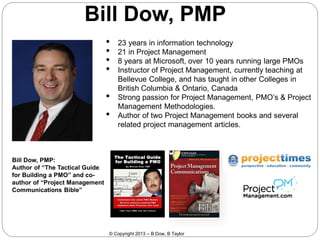
Bill Dow, PMP
•
•
•
•
•

•

23 years in information technology
21 in Project Management
8 years at Microsoft, over 10 years running large PMOs
Instructor of Project Management, currently teaching at
Bellevue College, and has taught in other Colleges in
British Columbia & Ontario, Canada
Strong passion for Project Management, PMO’s & Project
Management Methodologies.
Author of two Project Management books and several
related project management articles.

Bill Dow, PMP:
Author of “The Tactical Guide
for Building a PMO” and coauthor of “Project Management
Communications Bible”

© Copyright 2013 – B Dow, B Taylor
TOP REASON PROJECT’S FAIL….

© Copyright 2013 – B Dow, B Taylor
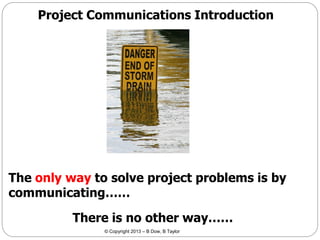
Project Communications Introduction

The only way to solve project problems is by
communicating……

There is no other way……
© Copyright 2013 – B Dow, B Taylor
28% of projects that fail, poor
communications is the # 1 reason
28%

Other Reasons for Failure

Project Communications
Failures
72%

That’s 1 out of 4 projects that fail – do so based on poor communications.
Results based on a Jan 2007 poll of 1,007 respondents
© Copyright 2013 – B Dow, B Taylor

(PMI Net July 2007 page 19)
Top 9 Causes for Project Failure
Survey Results

1.

Poor Communication

2.

Insufficient resource planning

3.

Unrealistic schedules

4.

Poor project requirements

9.8%

5.

Lack of stakeholders buy-in

6.7%

6.

Undefined success/closure criteria

5.2%

7.

Unrealistic budgets

4.8%

8.

Insufficient or no risk planning

4.4%

9.

Lack of control/change process

4.3%

Results based on a Jan 2007 poll of 1,007 respondents
© Copyright 2013 – B Dow, B Taylor

28.0%

18%
13.2%

(PMI Net July 2007 page 19)
Other Project Failure Survey's
Center for Project Management Study
 Mistaking half-baked ideas for projects
 Inadequate due diligence – is the project feasible?
 Poor sponsorship
 Under-skilled project managers
 Failing to deploy a robust project management

process
 Not monitoring the vital signs
 Absence of a well managed project portfolio.
© Copyright 2009 – B Dow, B Taylor
Other Project Failure Survey's
Penn State University Study
 Lack of corporate leadership

 Poorly communicated deliverables and goals
 Team-related weaknesses
 Poor project management

 Deviation from schedule or budget
 Notice that there is no mention of technical limits

Research from University of Karlsruhe
 Poor project management
 Uncontrolled “soft factors”
 Absence of change management
© Copyright 2013 – B Dow, B Taylor
Summary
 These 4 survey’s are pretty clear in showing you

that communications is a common theme as why
projects fail. Are you projects any different?

 90% of a project manager’s role is communications

so I can’t stress enough how important it is to be
successful at communicating your project status.

 Ensure you treat communications with high priority

throughout the life of the project.
© Copyright 2013 – B Dow, B Taylor
Introducing Project Communication
Planning
© Copyright 2013 – B Dow, B Taylor
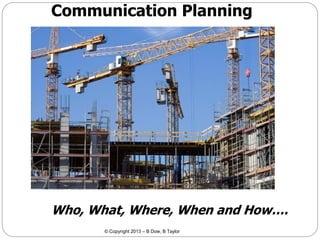
Communication Planning

Who, What, Where, When and How….
© Copyright 2013 – B Dow, B Taylor
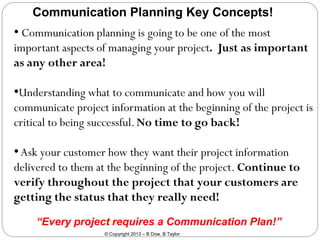
Communication Planning Key Concepts!

• Communication planning is going to be one of the most
important aspects of managing your project. Just as important
as any other area!

•Understanding what to communicate and how you will
communicate project information at the beginning of the project is
critical to being successful. No time to go back!

• Ask your customer how they want their project information
delivered to them at the beginning of the project. Continue to
verify throughout the project that your customers are
getting the status that they really need!
“Every project requires a Communication Plan!”
© Copyright 2013 – B Dow, B Taylor
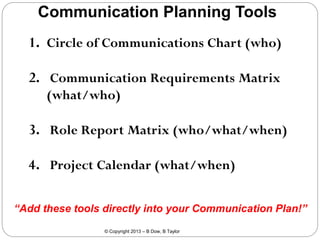
Communication Planning Tools
1. Circle of Communications Chart (who)
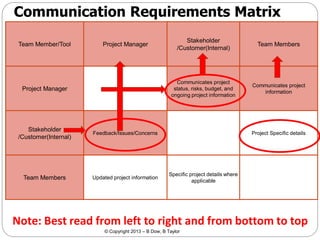
2. Communication Requirements Matrix
(what/who)

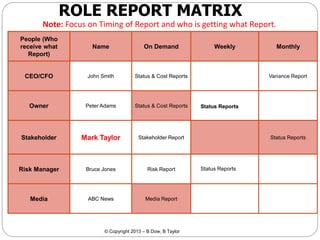
3. Role Report Matrix (who/what/when)

4. Project Calendar (what/when)
“Add these tools directly into your Communication Plan!”
© Copyright 2013 – B Dow, B Taylor
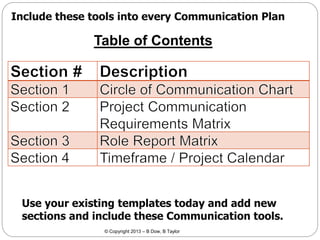
Include these tools into every Communication Plan

Table of Contents

Use your existing templates today and add new
sections and include these Communication tools.
© Copyright 2013 – B Dow, B Taylor
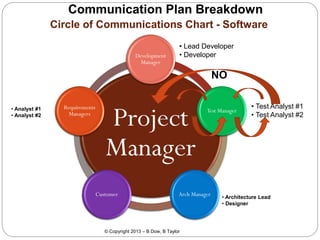
Communication Plan Breakdown
Circle of Communications Chart - Software
Development
Manager

• Lead Developer
• Developer

NO
• Analyst #1
• Analyst #2

Requirements
Managers

Project
Manager
Customer

Test Manager

Arch Manager

© Copyright 2013 – B Dow, B Taylor

• Test Analyst #1
• Test Analyst #2

• Architecture Lead
• Designer
Communication Requirements Matrix
Team Member/Tool

Project Manager

Stakeholder
/Customer(Internal)

Updated project information

Team Members

Communicates project
information

Feedback/Issues/Concerns

Team Members

Stakeholder
/Customer(Internal)

Communicates project
status, risks, budget, and
ongoing project information

Project Manager

Project Specific details

Specific project details where
applicable

Note: Best read from left to right and from bottom to top
© Copyright 2013 – B Dow, B Taylor
ROLE REPORT MATRIX
Note: Focus on Timing of Report and who is getting what Report.
People (Who
receive what
Report)

Name

On Demand

CEO/CFO

John Smith

Status & Cost Reports

Owner

Peter Adams

Status & Cost Reports

Stakeholder

Mark Taylor

Stakeholder Report

Risk Manager

Bruce Jones

Risk Report

Media

ABC News

Media Report

© Copyright 2013 – B Dow, B Taylor

Weekly

Monthly

Variance Report

Status Reports

Status Reports

Status Reports
Timeframe/Calendar
•Establishing a Rhythm/Cadence for reporting project
information.

•Such as how often does reports go out?

•How often is information gathered by your team

members? Did you work with your customers to
understand how often they want reports delivered?

Use the Role Report Matrix as your guide to creating
a Project Rhythm Calendar.
© Copyright 2013 – B Dow, B Taylor
Project Calendar
Monday

Wk1

Wk2

Wk3

Prepare Status
Material

Tuesday

Wednesday

Prepare Status
Material

Prepare Status
Material

Team Meeting,
gather
information for
Status Report

Prepare
Monthly
Newsletter

© Copyright 2013 – B Dow, B Taylor

Submit Final
Status Report

Customer
Status Meeting,
Finalize Status
Information

Team Meeting,
gather
information for
Status Report

Friday

Customer
Status Meeting,
Finalize Status
Information

Team Meeting,
gather
information for
Status Report

Thursday

Submit Final
Status Report

Customer
Status Meeting,
Finalize Status
Information

Submit Final
Status Report
Summary
 4 New Communication Planning tools we

believe will help you be successful.

 All of these tools will enhance your

communications and help you drive successful
project from a communication perspective.

 Ensure you add these tools to your

Communications Plan for all your projects.
TOP PROJECT COMMUNICATION TOOLS

© Copyright 2013 – B Dow, B Taylor
Project Communications Tools….

What tools do you use?
© Copyright 2013 – B Dow, B Taylor
ALL COMMUNICATION TOOLS

© Copyright 2013 – B Dow, B Taylor
Knowledge Breakdown Tools Chart

© Copyright 2013 – B Dow, B Taylor
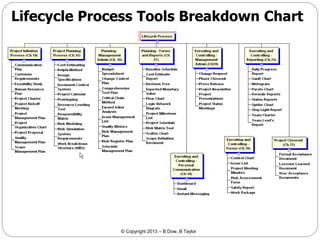
Lifecycle Process Tools Breakdown Chart

© Copyright 2013 – B Dow, B Taylor
Tool Name: Responsibility Matrix
Tool Value: Displays the task the team member is associated with. Some matrixes further identify the level of
authority assigned to a particular role.

© Copyright 2013 – B Dow, B Taylor

Page 304
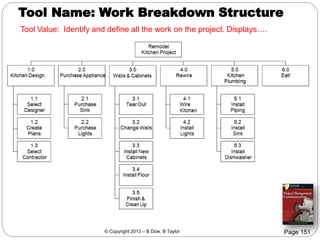
Tool Name: Work Breakdown Structure
Tool Value: Identify and define all the work on the project. Displays….

© Copyright 2013 – B Dow, B Taylor

Page 151
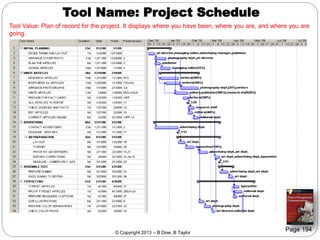
Tool Name: Project Schedule
Tool Value: Plan of record for the project. It displays where you have been, where you are, and where you are
going.

© Copyright 2013 – B Dow, B Taylor

Page 194
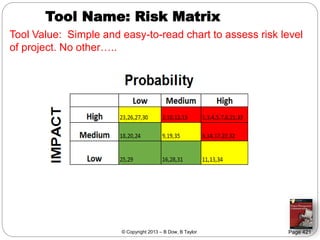
Tool Name: Risk Matrix
Tool Value: Simple and easy-to-read chart to assess risk level
of project. No other…..

© Copyright 2013 – B Dow, B Taylor

Page 421
SUMMARY

• Project Communications is the # 1 factor in
project success or failure

• Project manager must treat project

communications as a high priority when
managing their projects.

• Work with your customers and capture their
project communications needs. Understand
their decision points and adapt your
communications accordingly.

• Understand the various Communication Tools
that you can be using on your project.
© Copyright 2009 – B Dow, B Taylor
Thanks…….

© Copyright 2013 – B Dow, B Taylor
Thanks for your Time!
Bill Dow’s Contact Information:
Http://www.pmotactialguide.com
Email: billdow@pmotacticalguide.com

Social Networks:
Twitter: @billdow
Linkedin: Bill Dow, PMP
Facebook: Bill Dow
Articles @ Projecttimes.com and Projectmanagement.com
Find Both of Bill’s books on Amazon today:
1. “The Tactical Guide for Building a PMO” Published 2012
2. “The Project Management Communications Bible” Published 2008

Project communications presentations

  • 1.
    Project Communications –Tips and Best Practices Presented by Bill Dow, PMP © Copyright 2013 – B Dow, B Taylor
  • 2.
    Today’s Topics 1. UnderstandingProject Communications and Why Projects Fail Survey(s) 2. Introduction to Project Communication Planning 3. Top Communication Tools © Copyright 2013 – B Dow, B Taylor
  • 3.
    Bill Dow, PMP • • • • • • 23years in information technology 21 in Project Management 8 years at Microsoft, over 10 years running large PMOs Instructor of Project Management, currently teaching at Bellevue College, and has taught in other Colleges in British Columbia & Ontario, Canada Strong passion for Project Management, PMO’s & Project Management Methodologies. Author of two Project Management books and several related project management articles. Bill Dow, PMP: Author of “The Tactical Guide for Building a PMO” and coauthor of “Project Management Communications Bible” © Copyright 2013 – B Dow, B Taylor
  • 4.
    TOP REASON PROJECT’SFAIL…. © Copyright 2013 – B Dow, B Taylor
  • 5.
    Project Communications Introduction Theonly way to solve project problems is by communicating…… There is no other way…… © Copyright 2013 – B Dow, B Taylor
  • 6.
    28% of projectsthat fail, poor communications is the # 1 reason 28% Other Reasons for Failure Project Communications Failures 72% That’s 1 out of 4 projects that fail – do so based on poor communications. Results based on a Jan 2007 poll of 1,007 respondents © Copyright 2013 – B Dow, B Taylor (PMI Net July 2007 page 19)
  • 7.
    Top 9 Causesfor Project Failure Survey Results 1. Poor Communication 2. Insufficient resource planning 3. Unrealistic schedules 4. Poor project requirements 9.8% 5. Lack of stakeholders buy-in 6.7% 6. Undefined success/closure criteria 5.2% 7. Unrealistic budgets 4.8% 8. Insufficient or no risk planning 4.4% 9. Lack of control/change process 4.3% Results based on a Jan 2007 poll of 1,007 respondents © Copyright 2013 – B Dow, B Taylor 28.0% 18% 13.2% (PMI Net July 2007 page 19)
  • 8.
    Other Project FailureSurvey's Center for Project Management Study  Mistaking half-baked ideas for projects  Inadequate due diligence – is the project feasible?  Poor sponsorship  Under-skilled project managers  Failing to deploy a robust project management process  Not monitoring the vital signs  Absence of a well managed project portfolio. © Copyright 2009 – B Dow, B Taylor
  • 9.
    Other Project FailureSurvey's Penn State University Study  Lack of corporate leadership  Poorly communicated deliverables and goals  Team-related weaknesses  Poor project management  Deviation from schedule or budget  Notice that there is no mention of technical limits Research from University of Karlsruhe  Poor project management  Uncontrolled “soft factors”  Absence of change management © Copyright 2013 – B Dow, B Taylor
  • 10.
    Summary  These 4survey’s are pretty clear in showing you that communications is a common theme as why projects fail. Are you projects any different?  90% of a project manager’s role is communications so I can’t stress enough how important it is to be successful at communicating your project status.  Ensure you treat communications with high priority throughout the life of the project. © Copyright 2013 – B Dow, B Taylor
  • 11.
    Introducing Project Communication Planning ©Copyright 2013 – B Dow, B Taylor
  • 12.
    Communication Planning Who, What,Where, When and How…. © Copyright 2013 – B Dow, B Taylor
  • 13.
    Communication Planning KeyConcepts! • Communication planning is going to be one of the most important aspects of managing your project. Just as important as any other area! •Understanding what to communicate and how you will communicate project information at the beginning of the project is critical to being successful. No time to go back! • Ask your customer how they want their project information delivered to them at the beginning of the project. Continue to verify throughout the project that your customers are getting the status that they really need! “Every project requires a Communication Plan!” © Copyright 2013 – B Dow, B Taylor
  • 14.
    Communication Planning Tools 1.Circle of Communications Chart (who) 2. Communication Requirements Matrix (what/who) 3. Role Report Matrix (who/what/when) 4. Project Calendar (what/when) “Add these tools directly into your Communication Plan!” © Copyright 2013 – B Dow, B Taylor
  • 15.
    Include these toolsinto every Communication Plan Table of Contents Use your existing templates today and add new sections and include these Communication tools. © Copyright 2013 – B Dow, B Taylor
  • 16.
    Communication Plan Breakdown Circleof Communications Chart - Software Development Manager • Lead Developer • Developer NO • Analyst #1 • Analyst #2 Requirements Managers Project Manager Customer Test Manager Arch Manager © Copyright 2013 – B Dow, B Taylor • Test Analyst #1 • Test Analyst #2 • Architecture Lead • Designer
  • 17.
    Communication Requirements Matrix TeamMember/Tool Project Manager Stakeholder /Customer(Internal) Updated project information Team Members Communicates project information Feedback/Issues/Concerns Team Members Stakeholder /Customer(Internal) Communicates project status, risks, budget, and ongoing project information Project Manager Project Specific details Specific project details where applicable Note: Best read from left to right and from bottom to top © Copyright 2013 – B Dow, B Taylor
  • 18.
    ROLE REPORT MATRIX Note:Focus on Timing of Report and who is getting what Report. People (Who receive what Report) Name On Demand CEO/CFO John Smith Status & Cost Reports Owner Peter Adams Status & Cost Reports Stakeholder Mark Taylor Stakeholder Report Risk Manager Bruce Jones Risk Report Media ABC News Media Report © Copyright 2013 – B Dow, B Taylor Weekly Monthly Variance Report Status Reports Status Reports Status Reports
  • 19.
    Timeframe/Calendar •Establishing a Rhythm/Cadencefor reporting project information. •Such as how often does reports go out? •How often is information gathered by your team members? Did you work with your customers to understand how often they want reports delivered? Use the Role Report Matrix as your guide to creating a Project Rhythm Calendar. © Copyright 2013 – B Dow, B Taylor
  • 20.
    Project Calendar Monday Wk1 Wk2 Wk3 Prepare Status Material Tuesday Wednesday PrepareStatus Material Prepare Status Material Team Meeting, gather information for Status Report Prepare Monthly Newsletter © Copyright 2013 – B Dow, B Taylor Submit Final Status Report Customer Status Meeting, Finalize Status Information Team Meeting, gather information for Status Report Friday Customer Status Meeting, Finalize Status Information Team Meeting, gather information for Status Report Thursday Submit Final Status Report Customer Status Meeting, Finalize Status Information Submit Final Status Report
  • 21.
    Summary  4 NewCommunication Planning tools we believe will help you be successful.  All of these tools will enhance your communications and help you drive successful project from a communication perspective.  Ensure you add these tools to your Communications Plan for all your projects.
  • 22.
    TOP PROJECT COMMUNICATIONTOOLS © Copyright 2013 – B Dow, B Taylor
  • 23.
    Project Communications Tools…. Whattools do you use? © Copyright 2013 – B Dow, B Taylor
  • 24.
    ALL COMMUNICATION TOOLS ©Copyright 2013 – B Dow, B Taylor
  • 25.
    Knowledge Breakdown ToolsChart © Copyright 2013 – B Dow, B Taylor
  • 26.
    Lifecycle Process ToolsBreakdown Chart © Copyright 2013 – B Dow, B Taylor
  • 27.
    Tool Name: ResponsibilityMatrix Tool Value: Displays the task the team member is associated with. Some matrixes further identify the level of authority assigned to a particular role. © Copyright 2013 – B Dow, B Taylor Page 304
  • 28.
    Tool Name: WorkBreakdown Structure Tool Value: Identify and define all the work on the project. Displays…. © Copyright 2013 – B Dow, B Taylor Page 151
  • 29.
    Tool Name: ProjectSchedule Tool Value: Plan of record for the project. It displays where you have been, where you are, and where you are going. © Copyright 2013 – B Dow, B Taylor Page 194
  • 30.
    Tool Name: RiskMatrix Tool Value: Simple and easy-to-read chart to assess risk level of project. No other….. © Copyright 2013 – B Dow, B Taylor Page 421
  • 31.
    SUMMARY • Project Communicationsis the # 1 factor in project success or failure • Project manager must treat project communications as a high priority when managing their projects. • Work with your customers and capture their project communications needs. Understand their decision points and adapt your communications accordingly. • Understand the various Communication Tools that you can be using on your project. © Copyright 2009 – B Dow, B Taylor
  • 32.
  • 33.
    Thanks for yourTime! Bill Dow’s Contact Information: Http://www.pmotactialguide.com Email: billdow@pmotacticalguide.com Social Networks: Twitter: @billdow Linkedin: Bill Dow, PMP Facebook: Bill Dow Articles @ Projecttimes.com and Projectmanagement.com Find Both of Bill’s books on Amazon today: 1. “The Tactical Guide for Building a PMO” Published 2012 2. “The Project Management Communications Bible” Published 2008