Project Management to Project Governance , Knowledge Management & Productivity as Integral part of IT Governance "     Prof. K. Subramanian IT Adviser to CAG of India & Prof. & Director, Advanced center for Informatics & Innovative Learning, IGNOU 10th January 2009 Prof. KS@2009  ISACA Delhi Chapter lecture
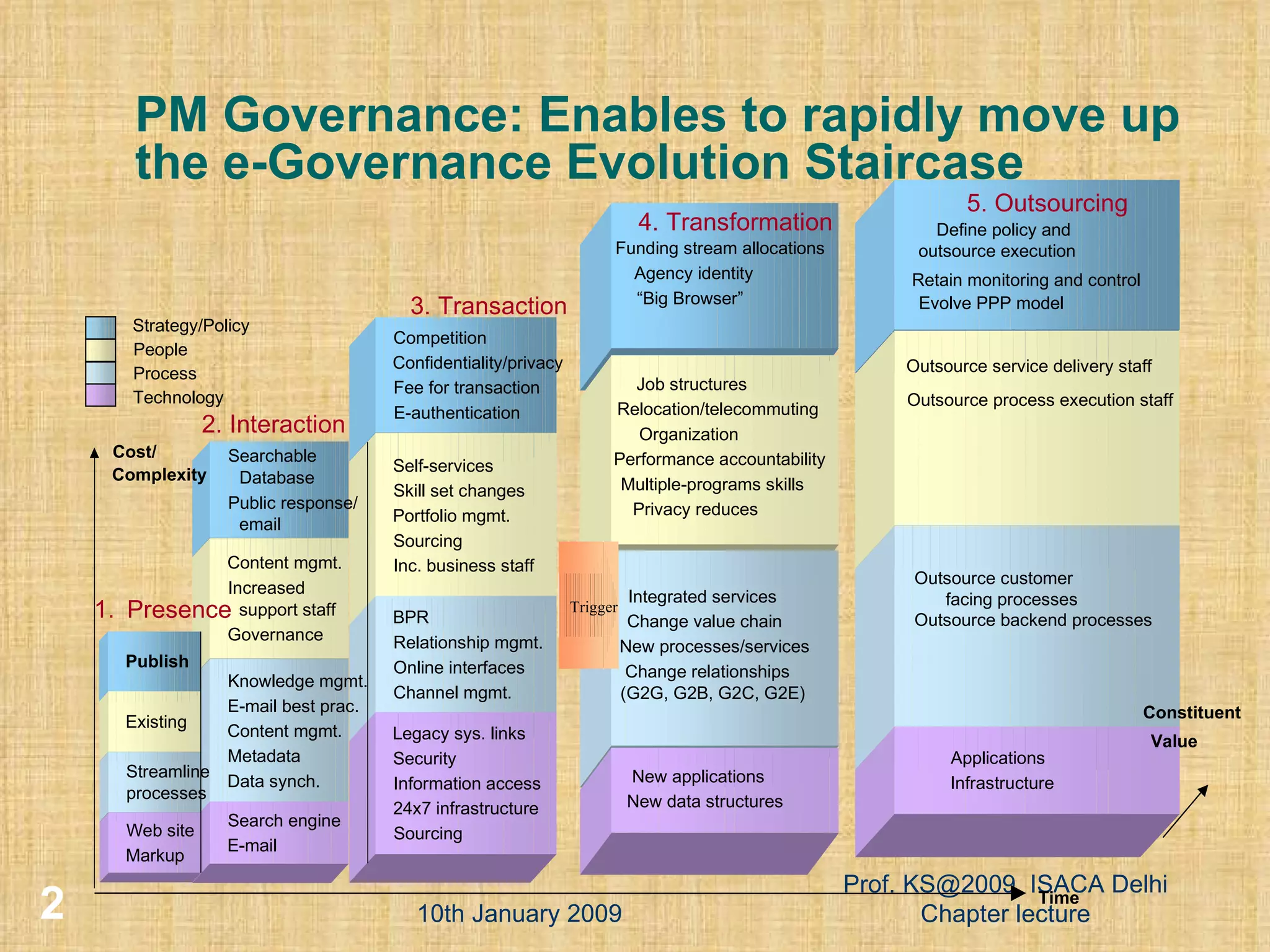
PM Governance: Enables to rapidly move up the e-Governance Evolution Staircase 10th January 2009 Prof. KS@2009  ISACA Delhi Chapter lecture Strategy/Policy People Process Technology 3. Transaction Competition Confidentiality/privacy Fee for transaction E-authentication Self-services Skill set changes Portfolio mgmt. Sourcing  Inc. business staff BPR Relationship mgmt. Online interfaces Channel mgmt. Legacy sys. links Security Information access 24x7 infrastructure Sourcing Funding stream allocations Agency identity “ Big Browser” Job structures Relocation/telecommuting Organization Performance accountability  Multiple-programs skills Privacy reduces Integrated services Change value chain New processes/services Change relationships (G2G, G2B, G2C, G2E) ‏ New applications New data structures Time 2. Interaction Searchable Database Public response/  email Content mgmt. Increased  support staff Governance Knowledge mgmt. E-mail best prac. Content mgmt. Metadata Data synch. Search engine E-mail 1. Presence Publish  Existing Streamline processes Web site Markup Trigger 4. Transformation Cost/ Complexity Define policy and  outsource execution Retain monitoring and control Outsource service delivery staff Outsource process execution staff Outsource customer  facing processes Outsource backend processes Applications Infrastructure Value 5. Outsourcing Constituent Evolve PPP model
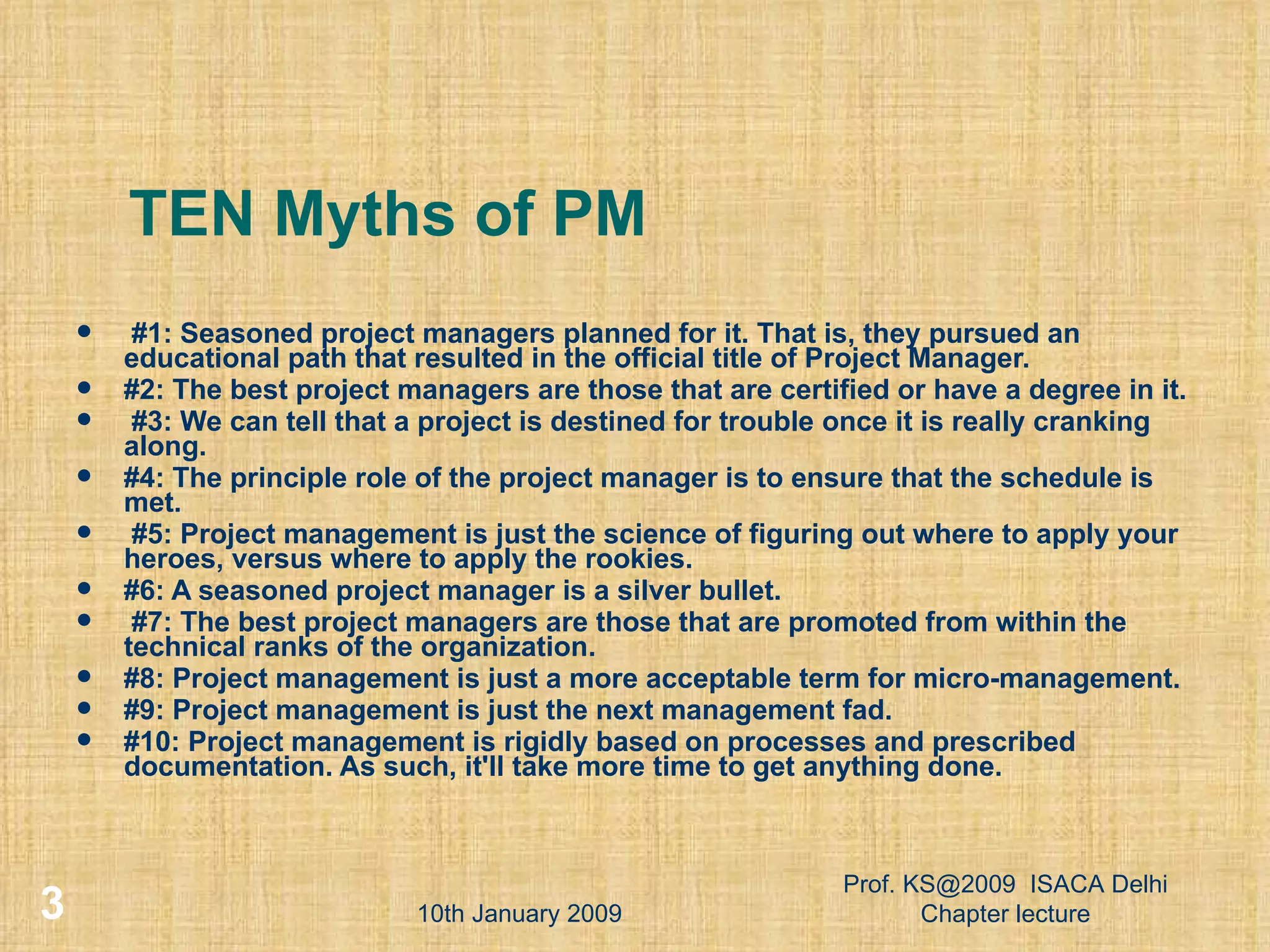
TEN Myths of PM #1: Seasoned project managers planned for it. That is, they pursued an educational path that resulted in the official title of Project Manager. #2: The best project managers are those that are certified or have a degree in it. #3: We can tell that a project is destined for trouble once it is really cranking along. #4: The principle role of the project manager is to ensure that the schedule is met. #5: Project management is just the science of figuring out where to apply your heroes, versus where to apply the rookies. #6: A seasoned project manager is a silver bullet. #7: The best project managers are those that are promoted from within the technical ranks of the organization. #8: Project management is just a more acceptable term for micro-management. #9: Project management is just the next management fad. #10: Project management is rigidly based on processes and prescribed documentation. As such, it'll take more time to get anything done.  10th January 2009 Prof. KS@2009  ISACA Delhi Chapter lecture
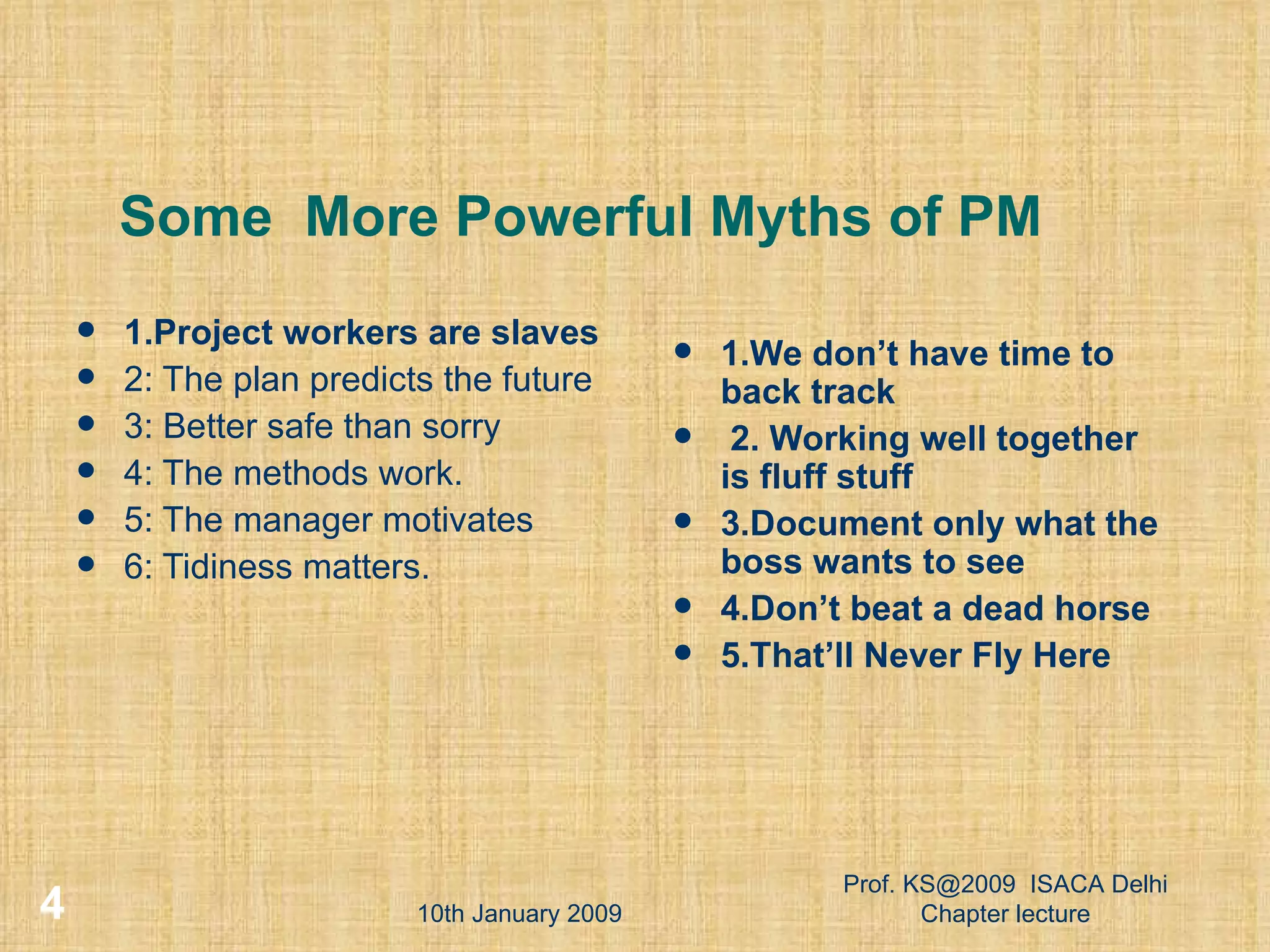
Some  More Powerful Myths of PM 1.Project workers are slaves 2: The plan predicts the future  3: Better safe than sorry  4: The methods work.  5: The manager motivates  6: Tidiness matters.  1.We don’t have time to back track 2. Working well together is fluff stuff 3.Document only what the boss wants to see 4.Don’t beat a dead horse 5.That’ll Never Fly Here 10th January 2009 Prof. KS@2009  ISACA Delhi Chapter lecture
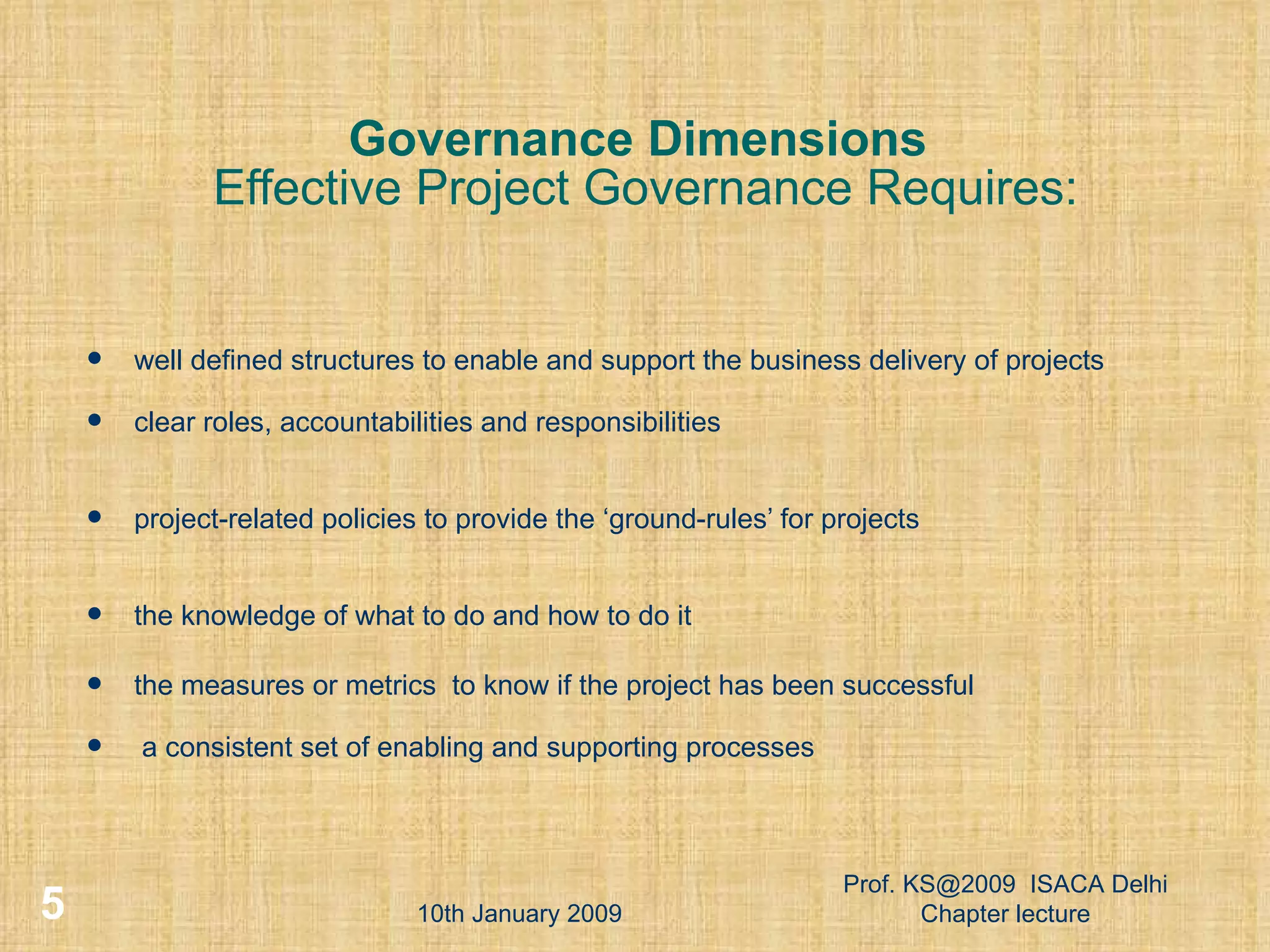
Governance Dimensions   Effective Project Governance Requires: well defined structures to enable and support the business delivery of projects clear roles, accountabilities and responsibilities project-related policies to provide the ‘ground-rules’ for projects the knowledge of what to do and how to do it the measures or metrics  to know if the project has been successful a consistent set of enabling and supporting processes 10th January 2009 Prof. KS@2009  ISACA Delhi Chapter lecture
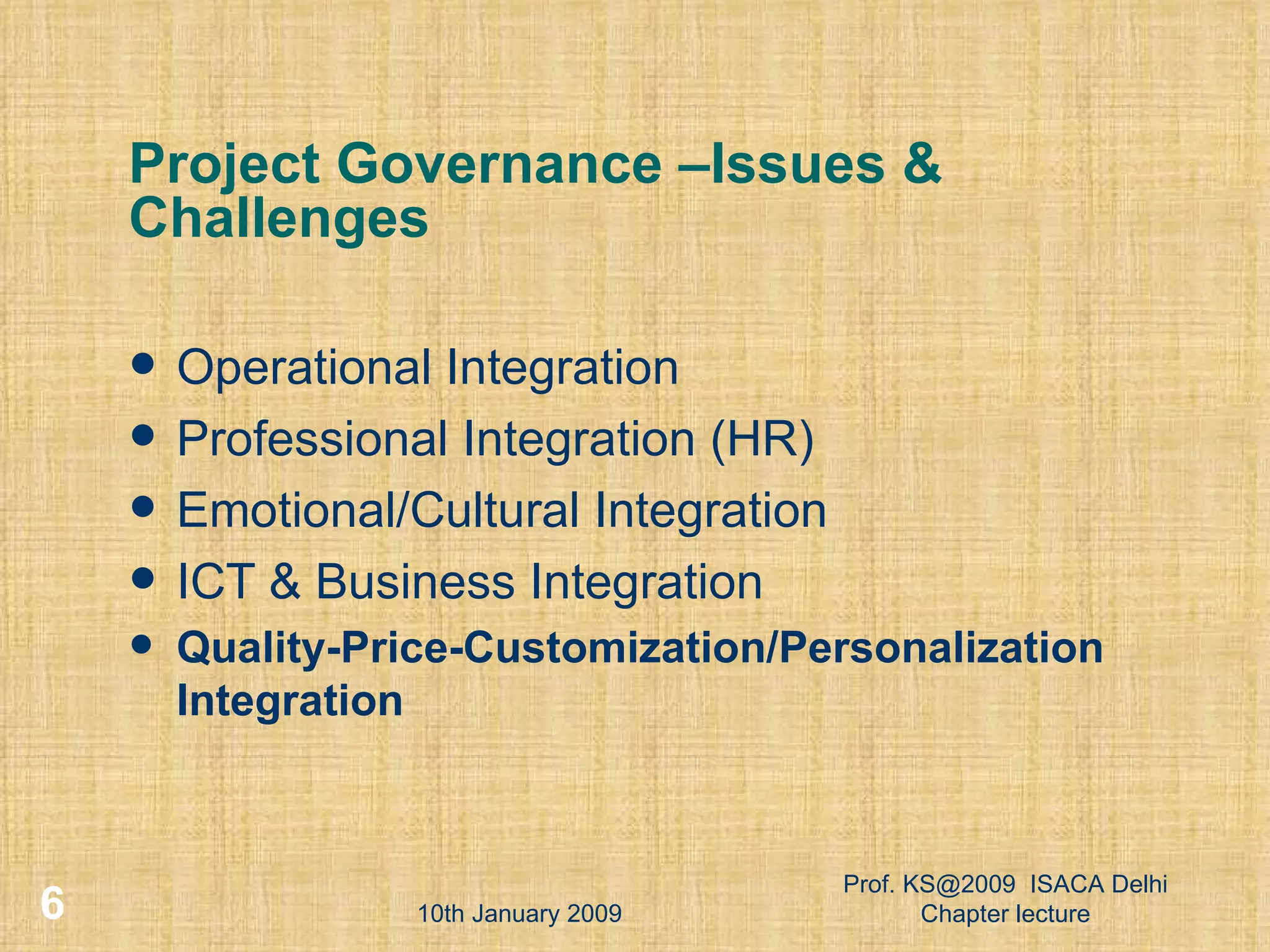
Project Governance –Issues & Challenges Operational Integration Professional Integration (HR) ‏ Emotional/Cultural Integration ICT & Business Integration Quality-Price-Customization/Personalization Integration 10th January 2009 Prof. KS@2009  ISACA Delhi Chapter lecture
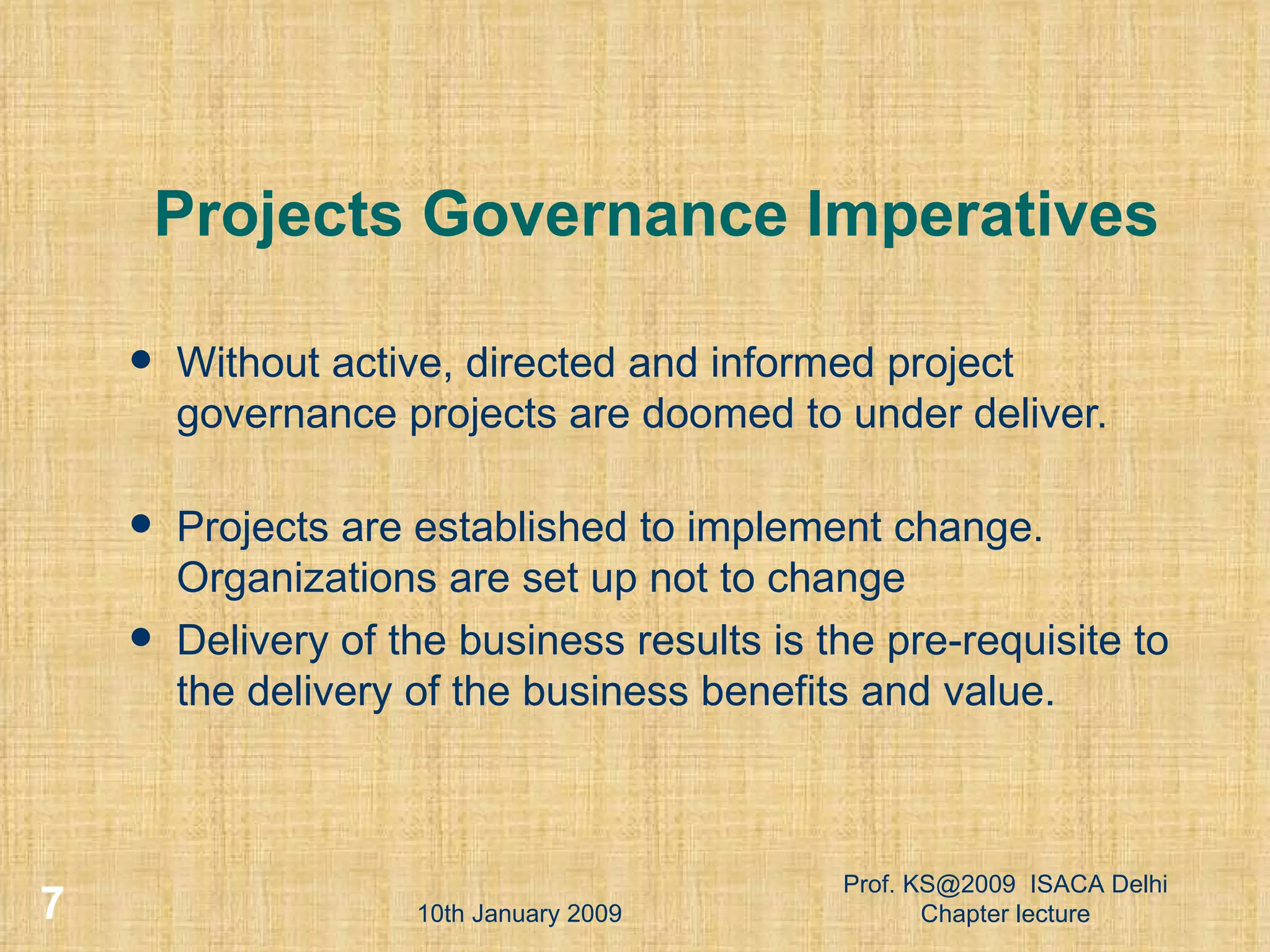
Projects Governance Imperatives Without active, directed and informed project governance projects are doomed to under deliver. Projects are established to implement change. Organizations are set up not to change  Delivery of the business results is the pre-requisite to the delivery of the business benefits and value.  10th January 2009 Prof. KS@2009  ISACA Delhi Chapter lecture
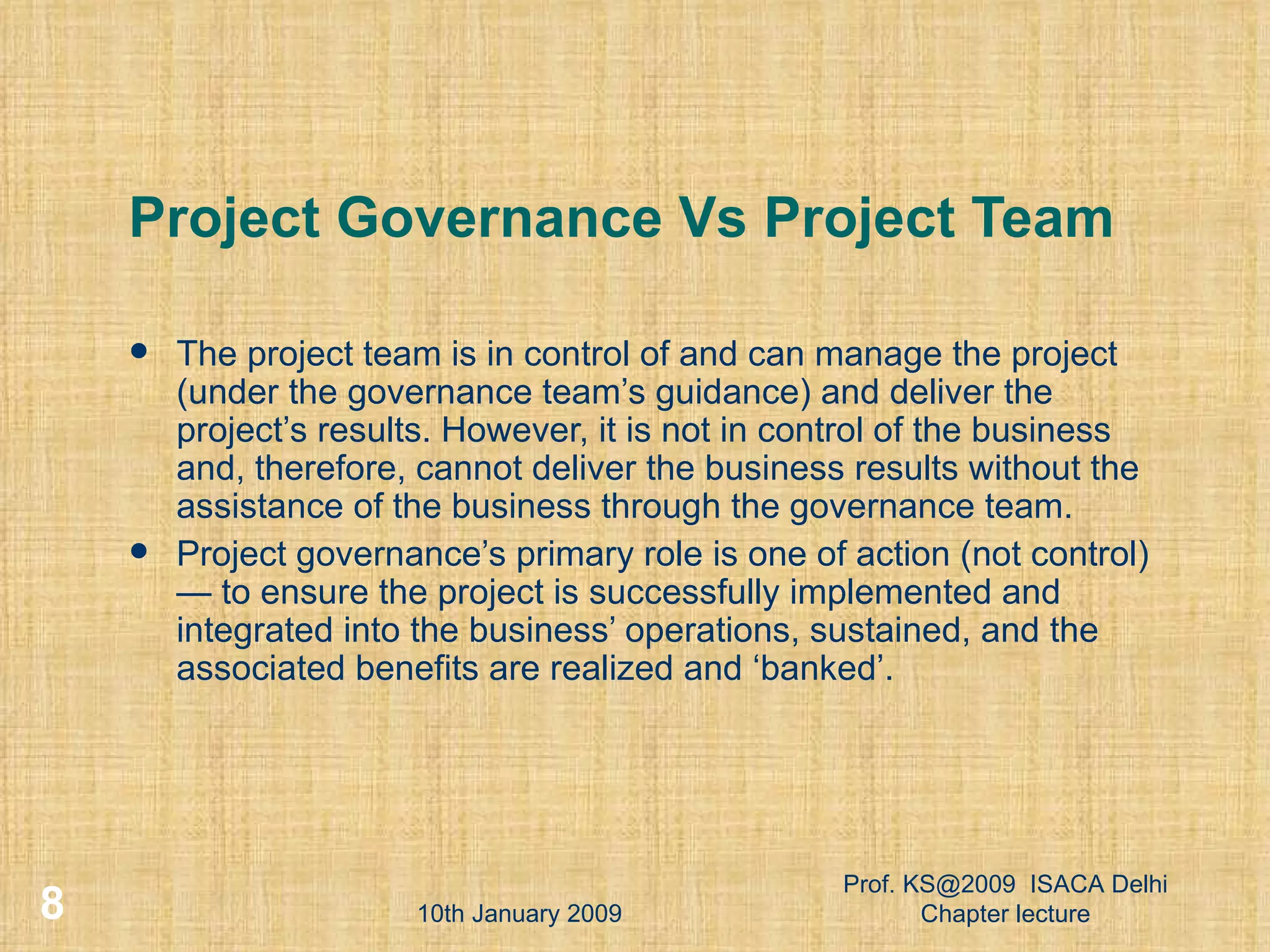
Project Governance Vs Project Team The project team is in control of and can manage the project (under the governance team’s guidance) and deliver the project’s results. However, it is not in control of the business and, therefore, cannot deliver the business results without the assistance of the business through the governance team. Project governance’s primary role is one of action (not control) — to ensure the project is successfully implemented and integrated into the business’ operations, sustained, and the associated benefits are realized and ‘banked’. 10th January 2009 Prof. KS@2009  ISACA Delhi Chapter lecture
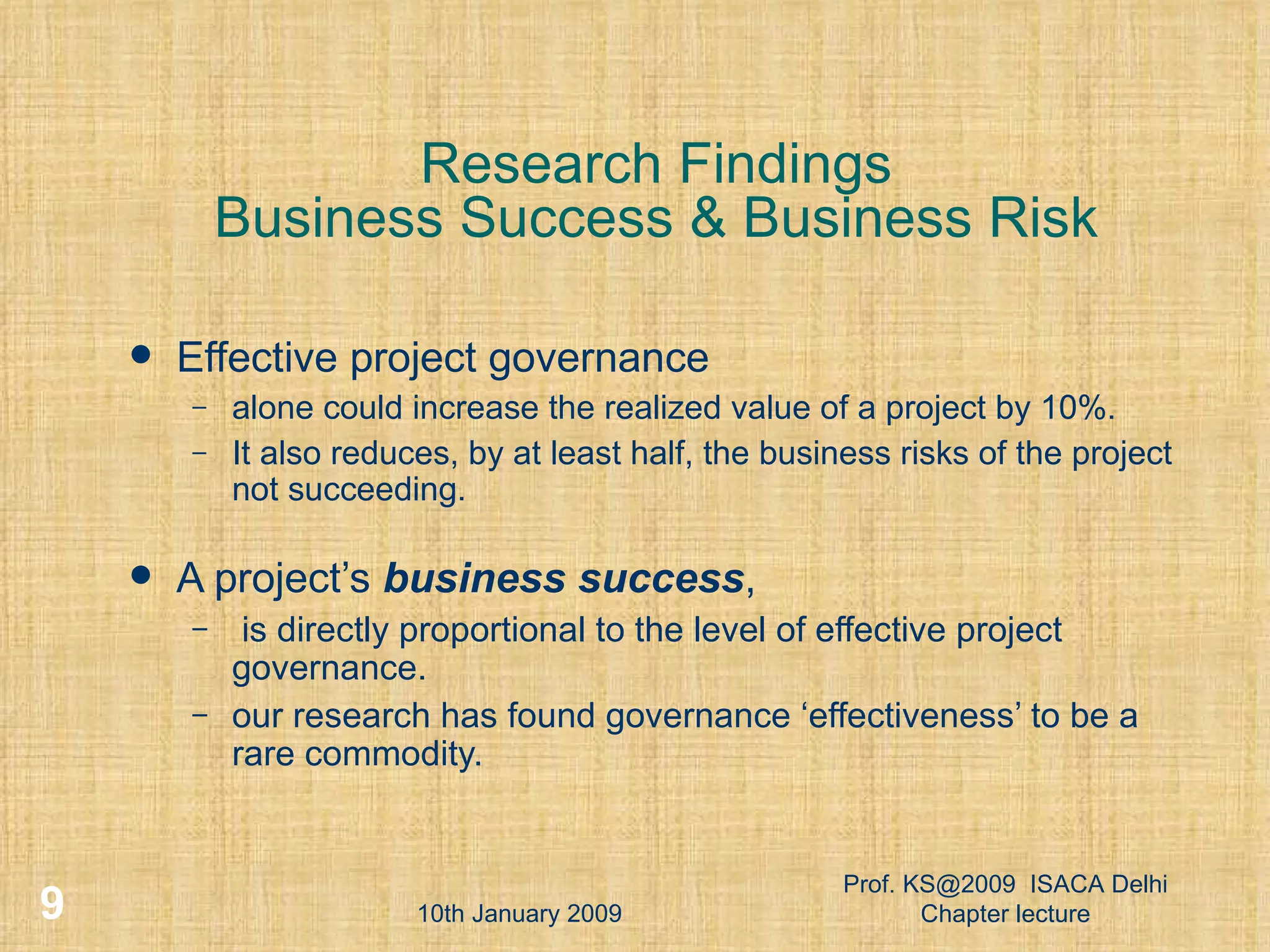
Research Findings Business Success & Business Risk Effective project governance  alone could increase the realized value of a project by 10%.  It also reduces, by at least half, the business risks of the project not succeeding. A project’s  business success , is directly proportional to the level of effective project governance. our research has found governance ‘effectiveness’ to be a rare commodity. 10th January 2009 Prof. KS@2009  ISACA Delhi Chapter lecture
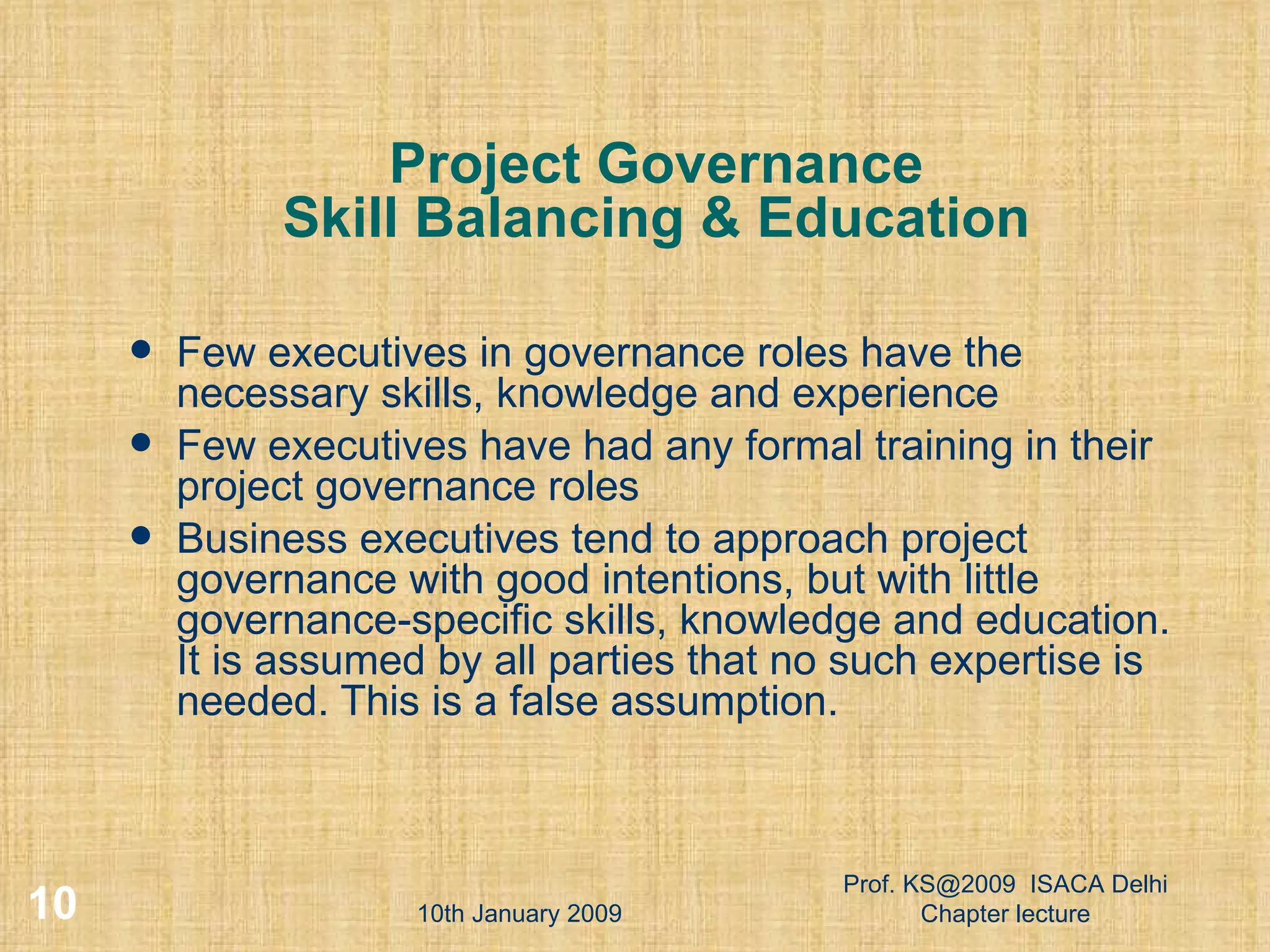
Project Governance Skill Balancing & Education Few executives in governance roles have the necessary skills, knowledge and experience  Few executives have had any formal training in their project governance roles  Business executives tend to approach project governance with good intentions, but with little governance-specific skills, knowledge and education. It is assumed by all parties that no such expertise is needed. This is a false assumption. 10th January 2009 Prof. KS@2009  ISACA Delhi Chapter lecture
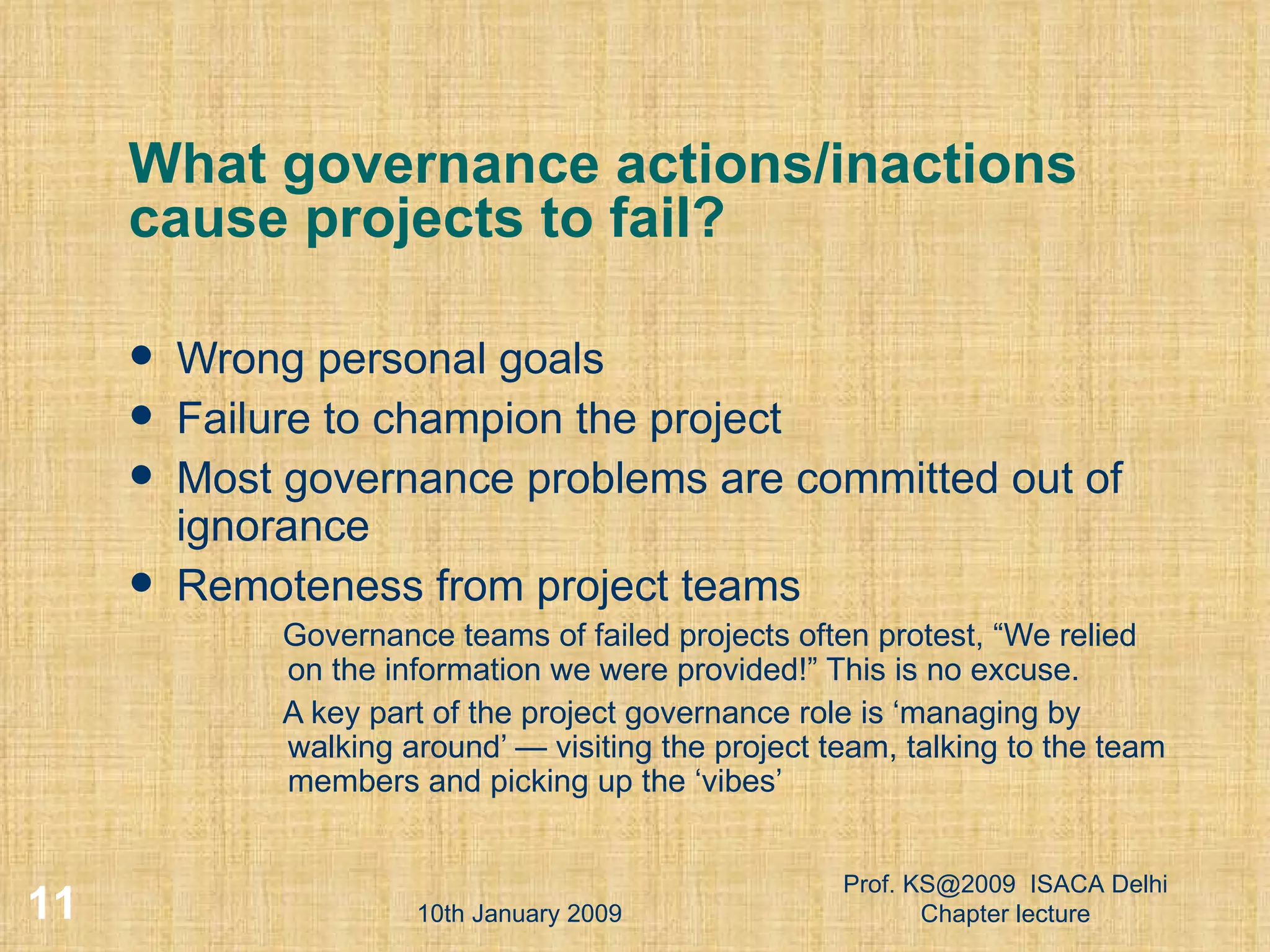
What governance actions/inactions cause projects to fail?  Wrong personal goals Failure to champion the project  Most governance problems are committed out of ignorance  Remoteness from project teams  Governance teams of failed projects often protest, “We relied on the information we were provided!” This is no excuse.  A key part of the project governance role is ‘managing by walking around’ — visiting the project team, talking to the team members and picking up the ‘vibes’  10th January 2009 Prof. KS@2009  ISACA Delhi Chapter lecture
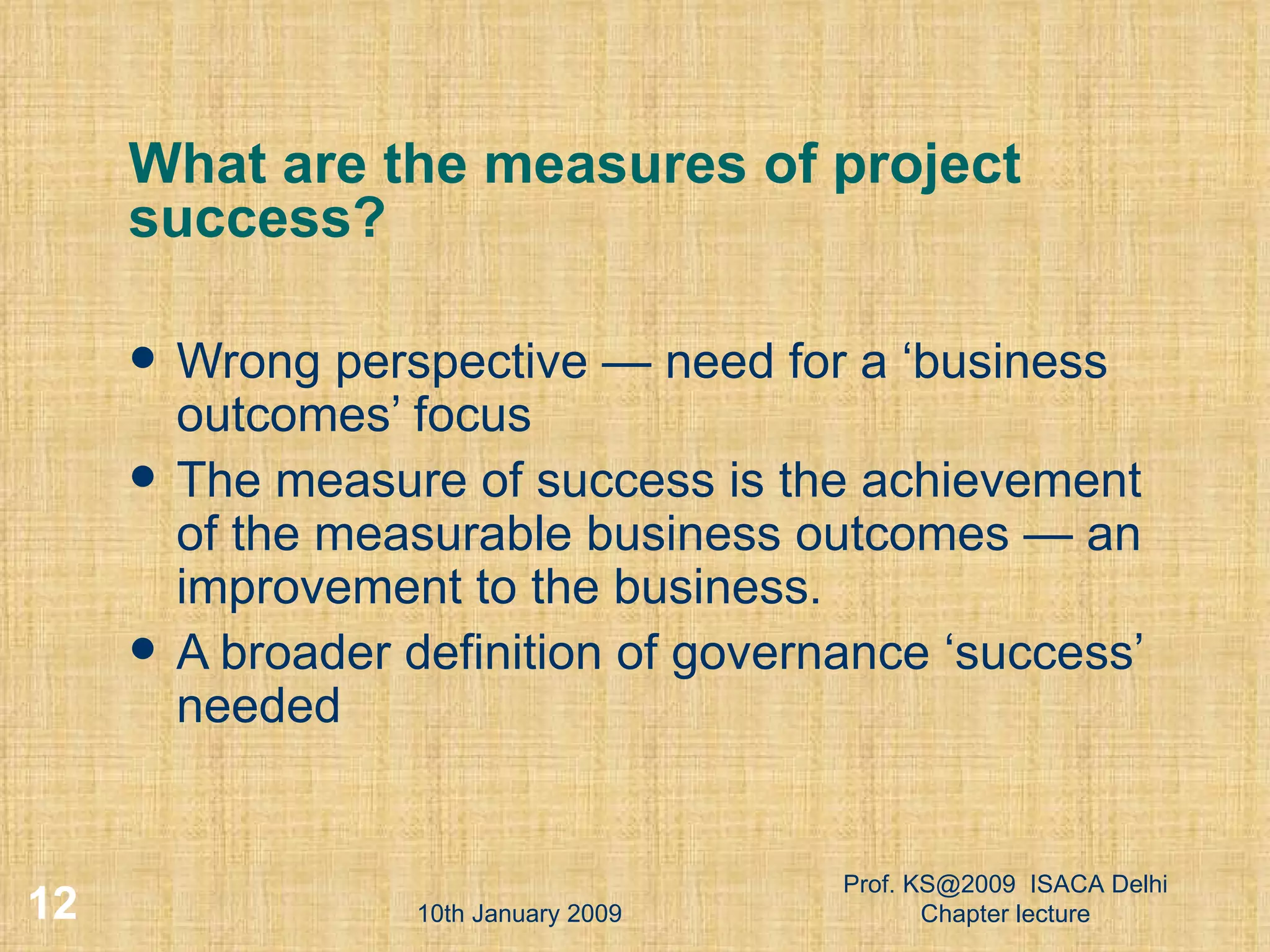
What are the measures of project success?  Wrong perspective — need for a ‘business outcomes’ focus  The measure of success is the achievement of the measurable business outcomes — an improvement to the business.  A broader definition of governance ‘success’ needed  10th January 2009 Prof. KS@2009  ISACA Delhi Chapter lecture
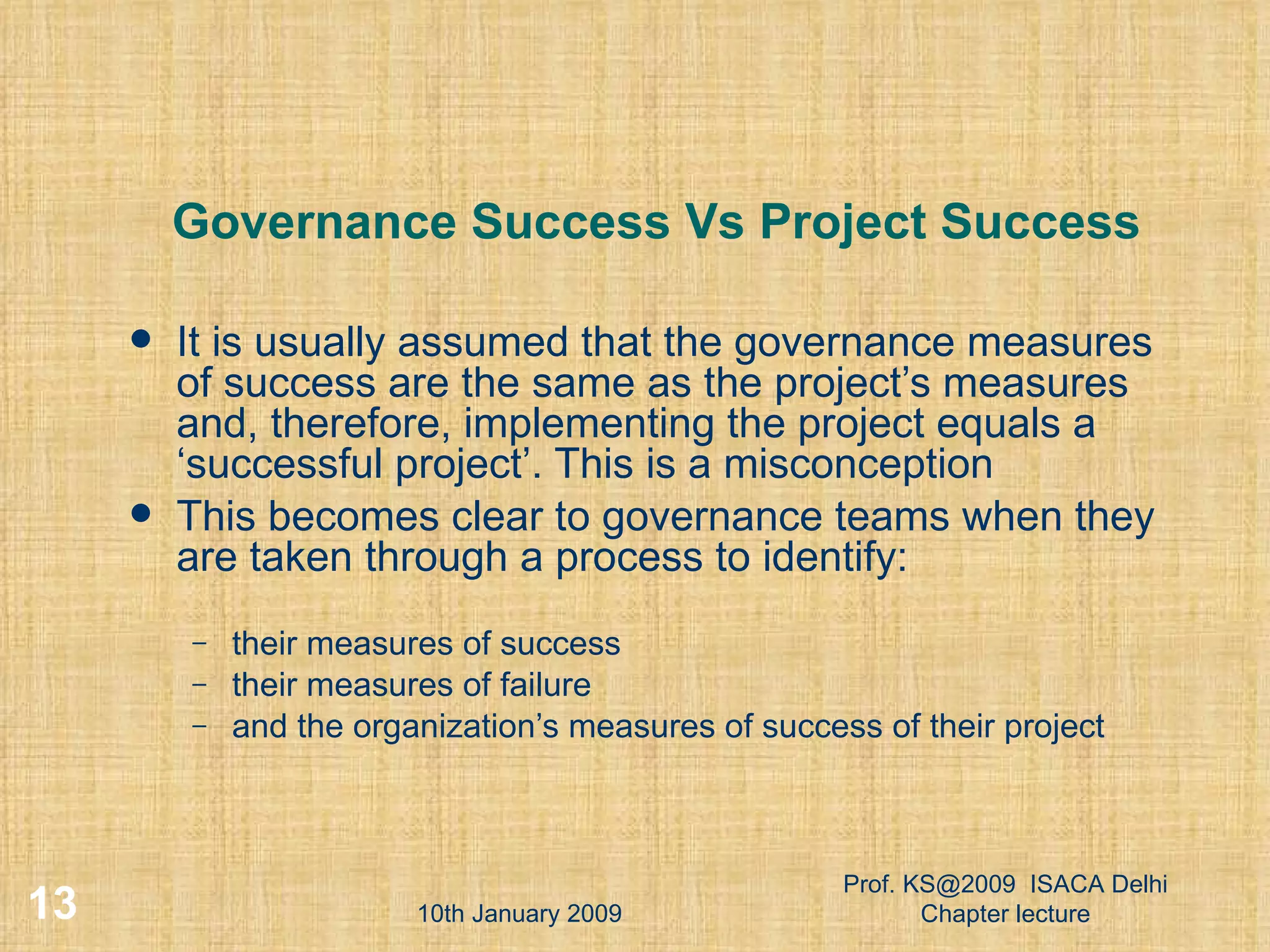
Governance Success Vs Project Success It is usually assumed that the governance measures of success are the same as the project’s measures and, therefore, implementing the project equals a ‘successful project’. This is a misconception  This becomes clear to governance teams when they are taken through a process to identify: their measures of success  their measures of failure  and the organization’s measures of success of their project  10th January 2009 Prof. KS@2009  ISACA Delhi Chapter lecture
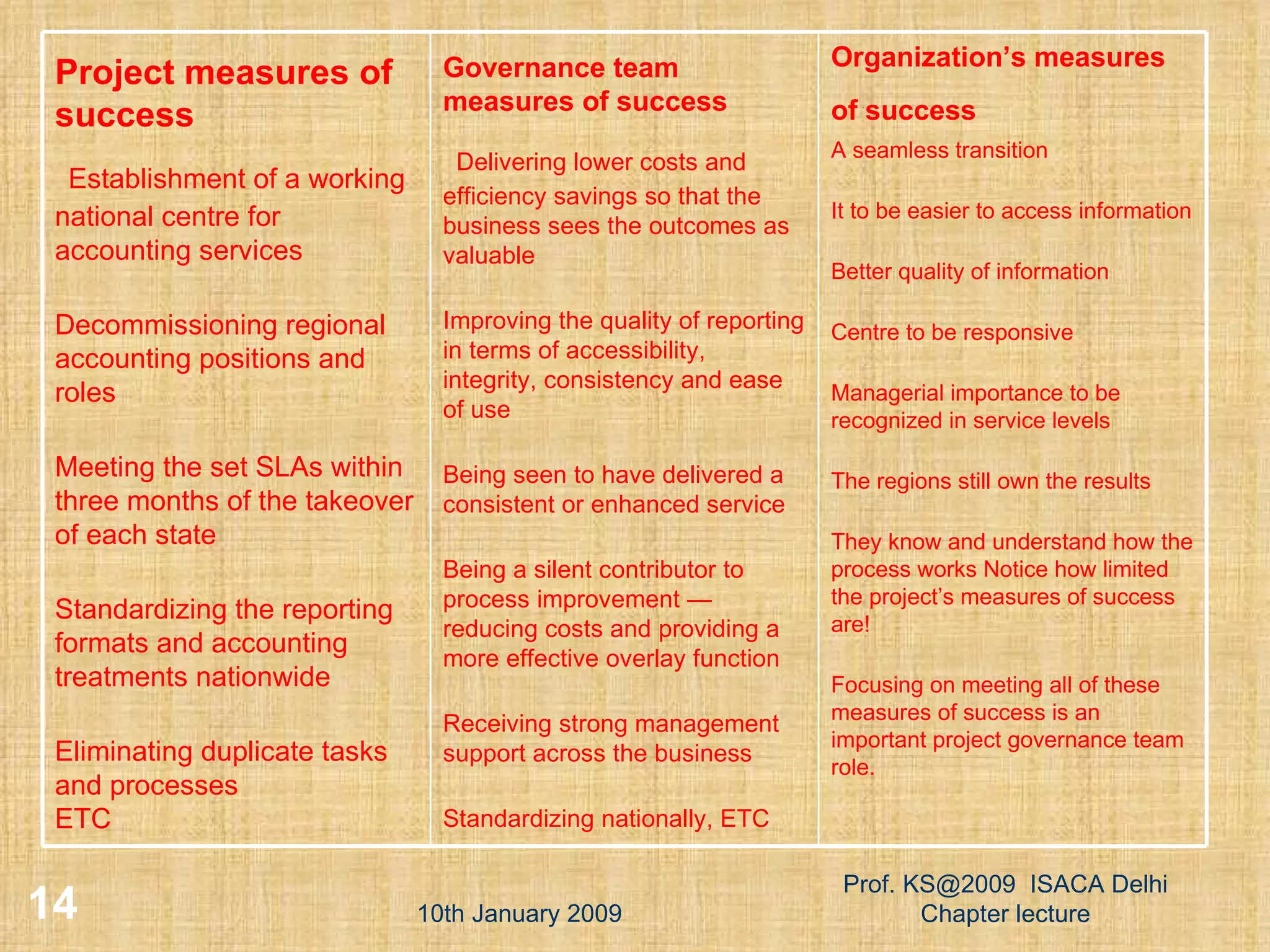
10th January 2009 Prof. KS@2009  ISACA Delhi Chapter lecture Organization’s measures of success   A seamless transition It to be easier to access information Better quality of information Centre to be responsive Managerial importance to be recognized in service levels The regions still own the results They know and understand how the process works Notice how limited the project’s measures of success are! Focusing on meeting all of these measures of success is an important project governance team role. Governance team measures of success Delivering lower costs and efficiency savings so that the business sees the outcomes as valuable Improving the quality of reporting in terms of accessibility, integrity, consistency and ease of use Being seen to have delivered a consistent or enhanced service Being a silent contributor to process improvement — reducing costs and providing a more effective overlay function Receiving strong management support across the business Standardizing nationally, ETC Project measures of success Establishment of a working national centre for accounting services Decommissioning regional accounting positions and roles Meeting the set SLAs within three months of the takeover of each state Standardizing the reporting formats and accounting treatments nationwide Eliminating duplicate tasks and processes ETC
Governance through Leadership Leadership is any behavior that develops or uses power to influence other peoples’ behavior.  It is used by management to achieve enthusiastic, willing, zealous participation of followers to accomplish the organization’s objectives 10th January 2009 Prof. KS@2009  ISACA Delhi Chapter lecture
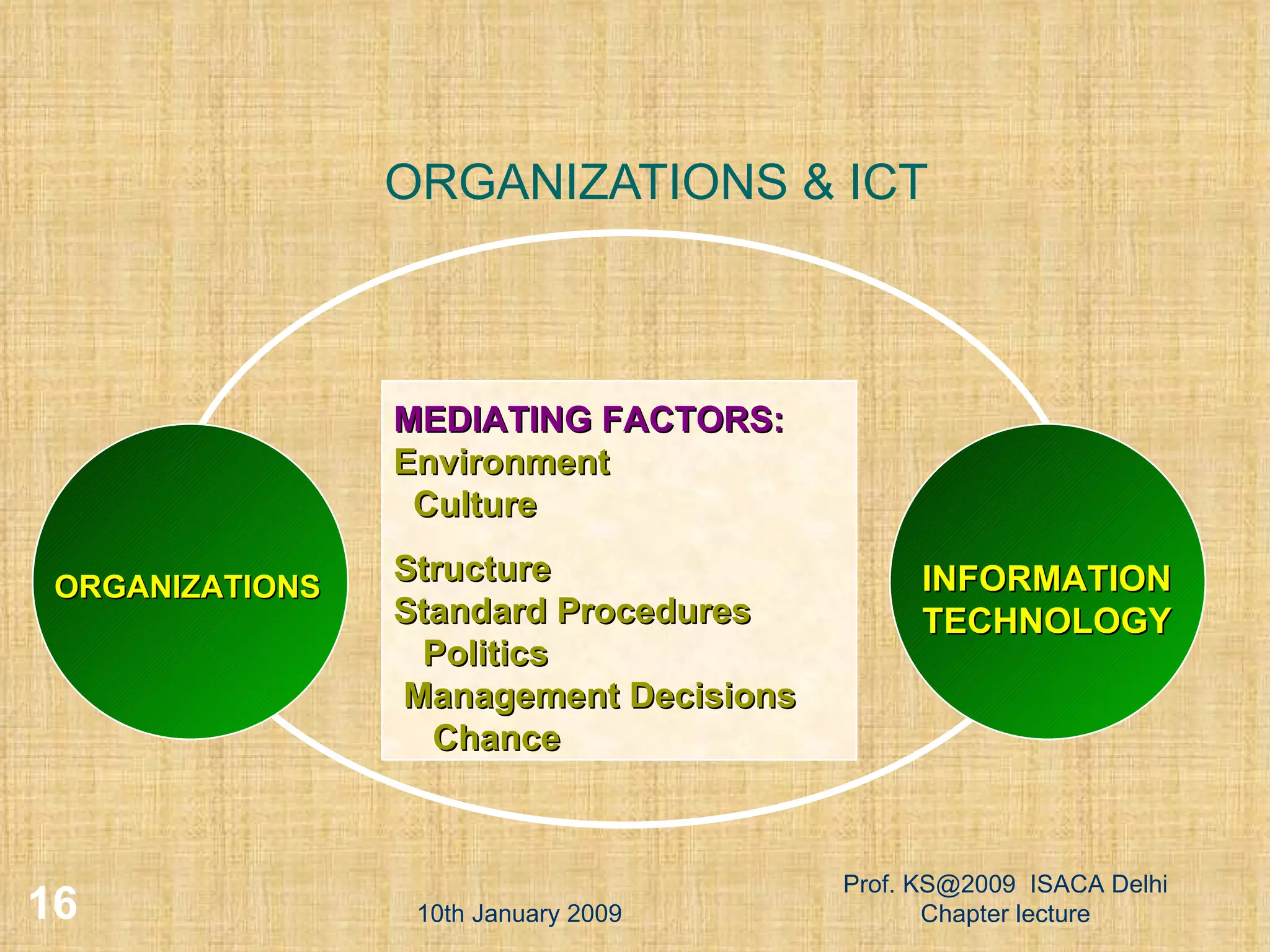
ORGANIZATIONS & ICT 10th January 2009 Prof. KS@2009  ISACA Delhi Chapter lecture MEDIATING FACTORS:   Environment  Culture Structure  Standard Procedures  Politics  Management Decisions  Chance ORGANIZATIONS INFORMATION TECHNOLOGY
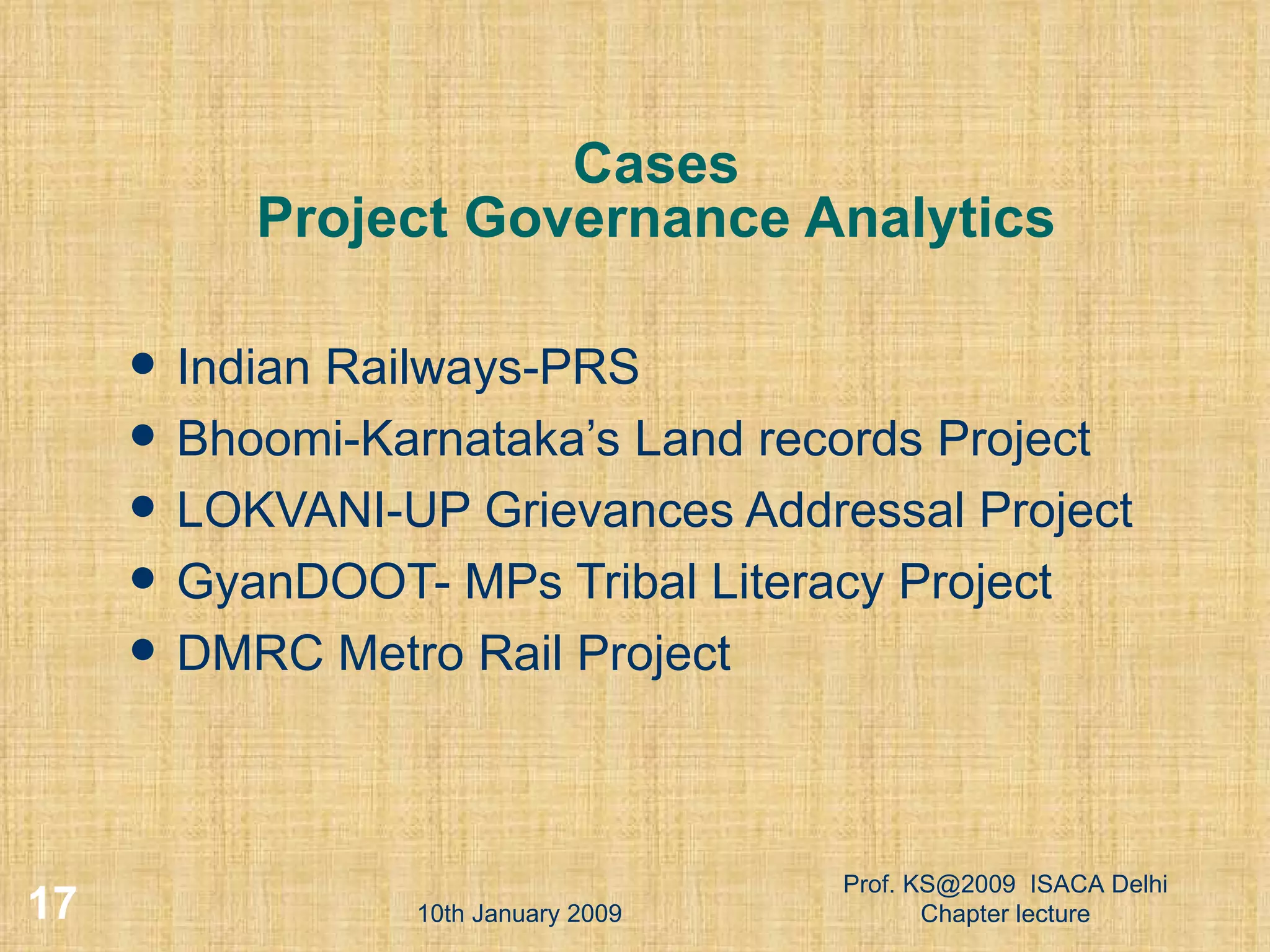
Cases Project Governance Analytics Indian Railways-PRS Bhoomi-Karnataka’s Land records Project LOKVANI-UP Grievances Addressal Project GyanDOOT- MPs Tribal Literacy Project DMRC Metro Rail Project 10th January 2009 Prof. KS@2009  ISACA Delhi Chapter lecture
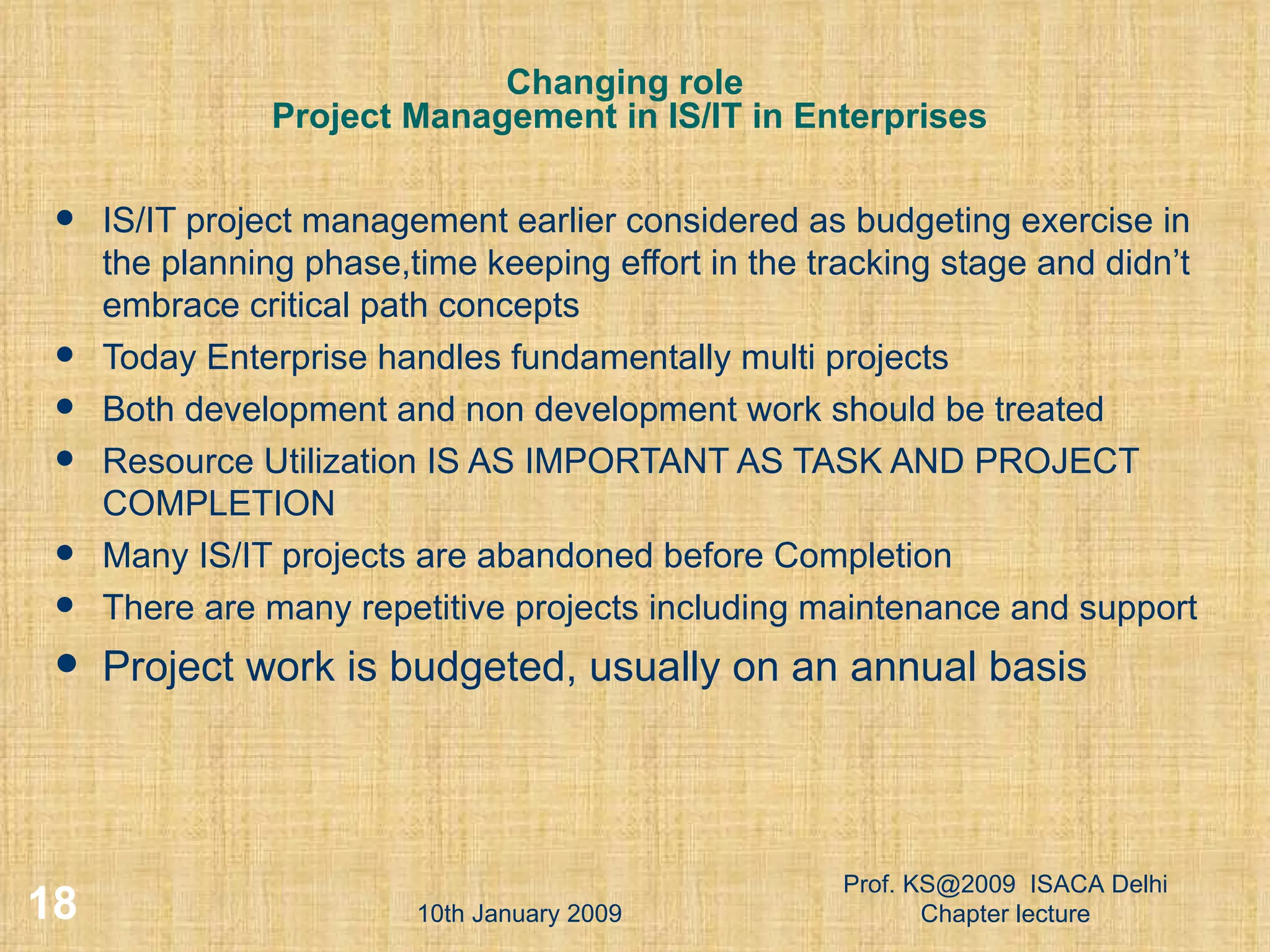
Changing role  Project Management in IS/IT in Enterprises IS/IT project management earlier considered as budgeting exercise in the planning phase,time keeping effort in the tracking stage and didn’t embrace critical path concepts Today Enterprise handles fundamentally multi projects Both development and non development work should be treated Resource Utilization IS AS IMPORTANT AS TASK AND PROJECT COMPLETION Many IS/IT projects are abandoned before Completion There are many repetitive projects including maintenance and support Project work is budgeted, usually on an annual basis 10th January 2009 Prof. KS@2009  ISACA Delhi Chapter lecture
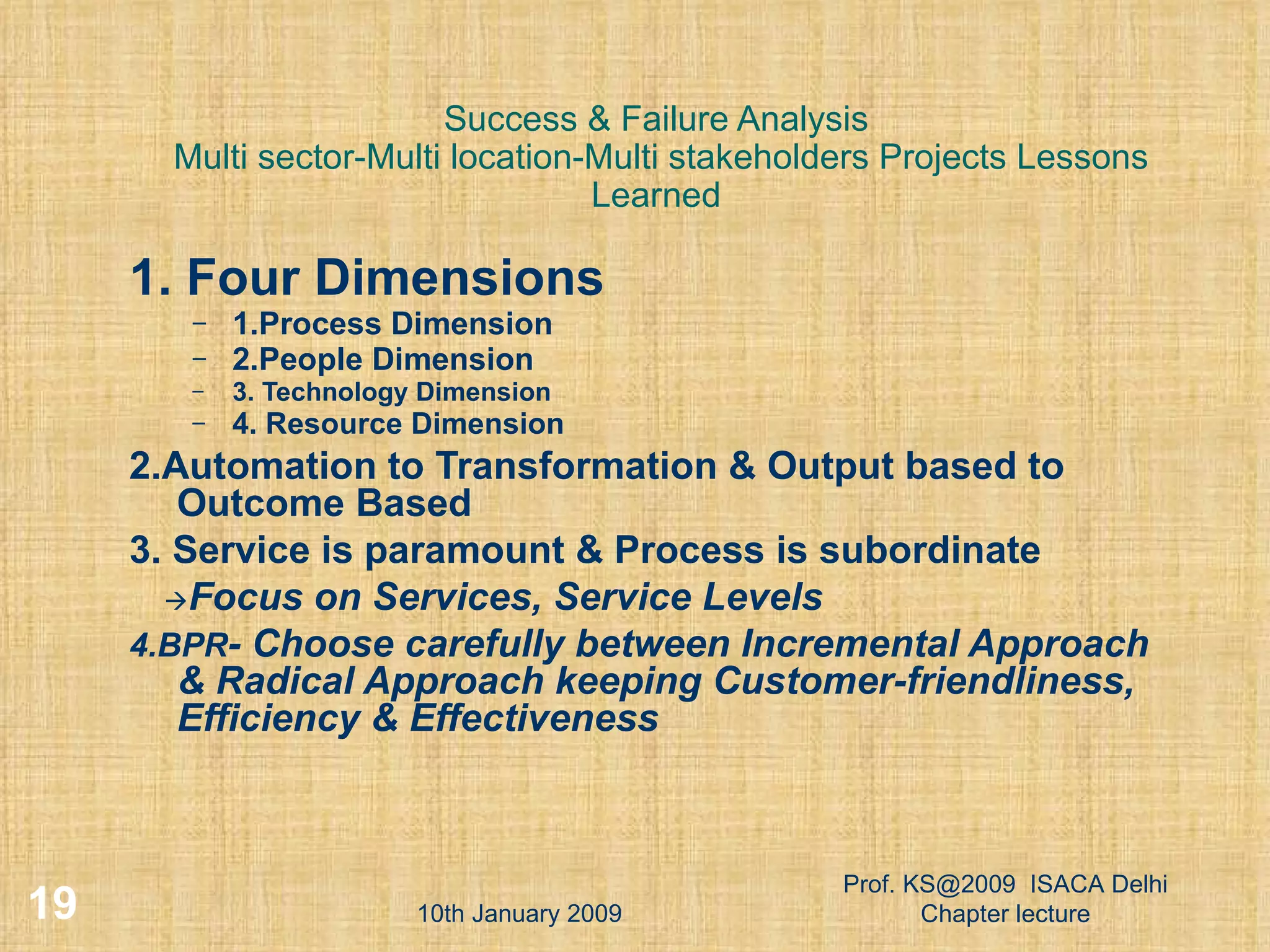
Success & Failure Analysis  Multi sector-Multi location-Multi stakeholders Projects Lessons Learned 1. Four Dimensions   1.Process Dimension 2.People Dimension 3. Technology Dimension 4. Resource Dimension 2.Automation to Transformation & Output based to Outcome Based 3. Service is paramount & Process is subordinate  Focus on Services, Service Levels 4.BPR - Choose carefully between Incremental Approach & Radical Approach keeping Customer-friendliness,  Efficiency & Effectiveness 10th January 2009 Prof. KS@2009  ISACA Delhi Chapter lecture
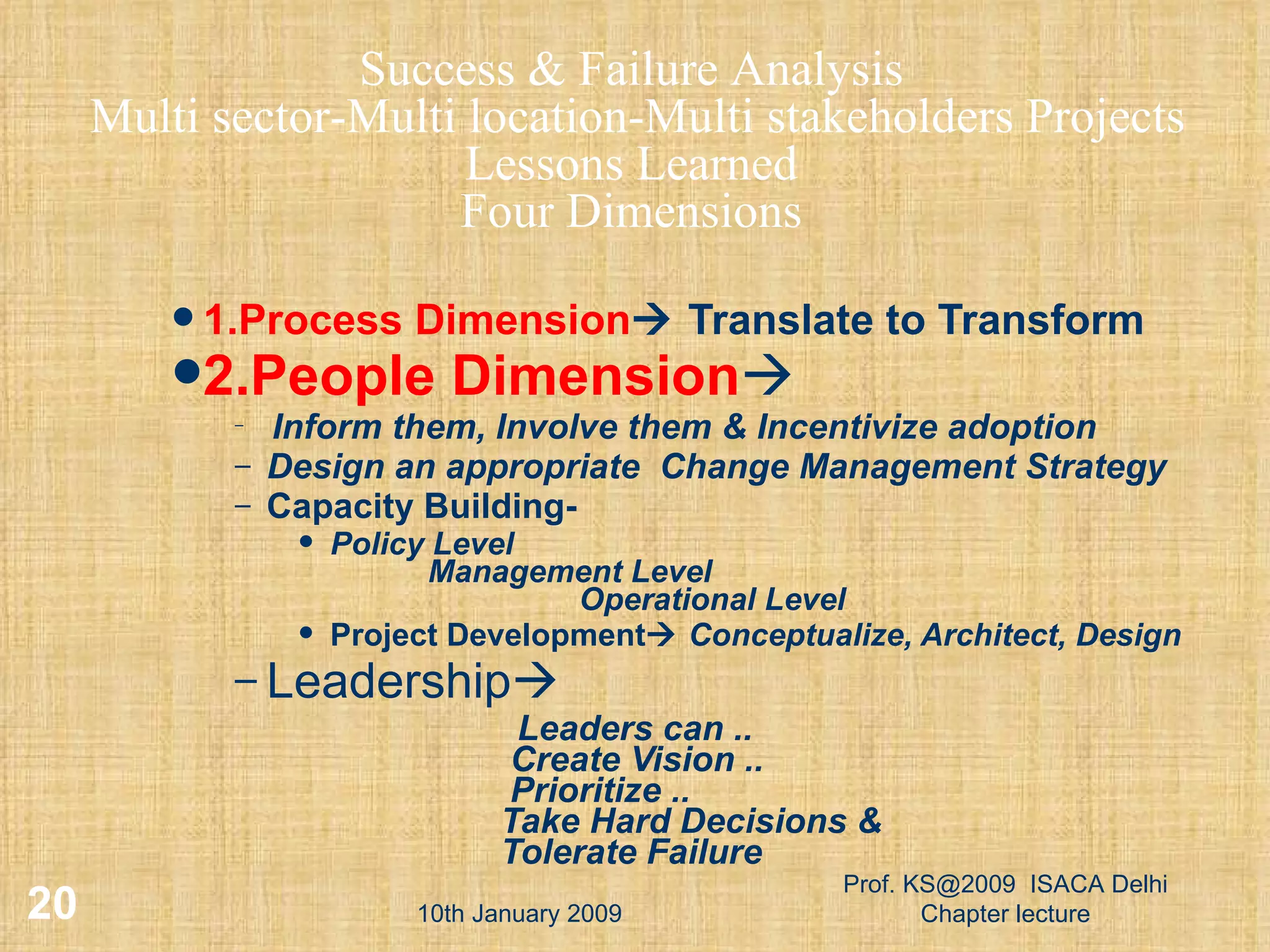
1.Process Dimension   Translate to Transform 2.People Dimension  Inform them, Involve them & Incentivize adoption Design an appropriate  Change Management Strategy Capacity Building-  Policy Level   Management Level   Operational Level Project Development    Conceptualize, Architect, Design Leadership  Leaders can ..   Create Vision ..   Prioritize ..   Take Hard Decisions &   Tolerate Failure 10th January 2009 Prof. KS@2009  ISACA Delhi Chapter lecture Success & Failure Analysis Multi sector-Multi location-Multi stakeholders Projects Lessons Learned Four Dimensions
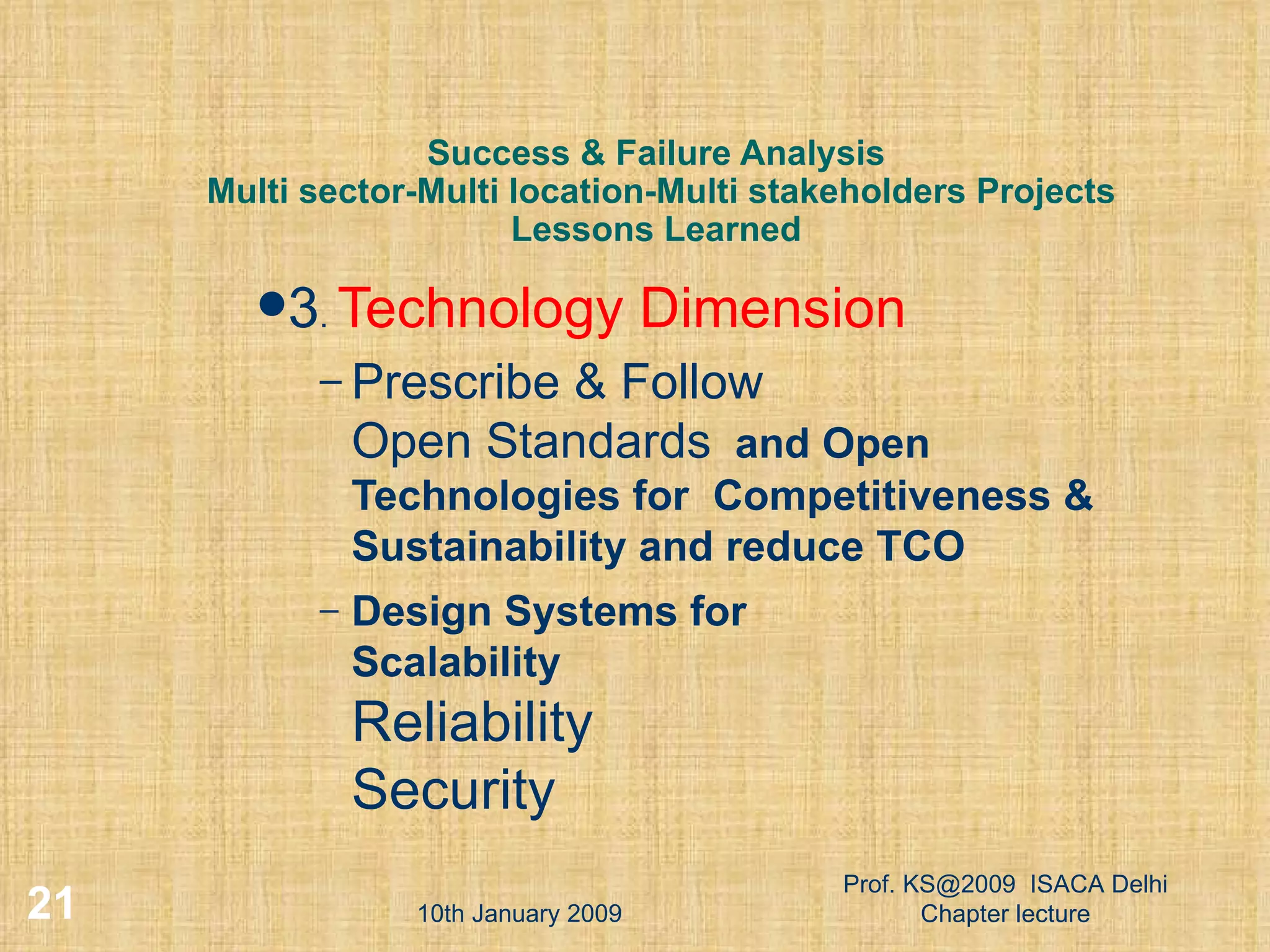
Success & Failure Analysis  Multi sector-Multi location-Multi stakeholders Projects Lessons Learned 3 .  Technology Dimension Prescribe & Follow  Open Standards   and Open Technologies for  Competitiveness & Sustainability and reduce TCO Design Systems for Scalability Reliability Security 10th January 2009 Prof. KS@2009  ISACA Delhi Chapter lecture
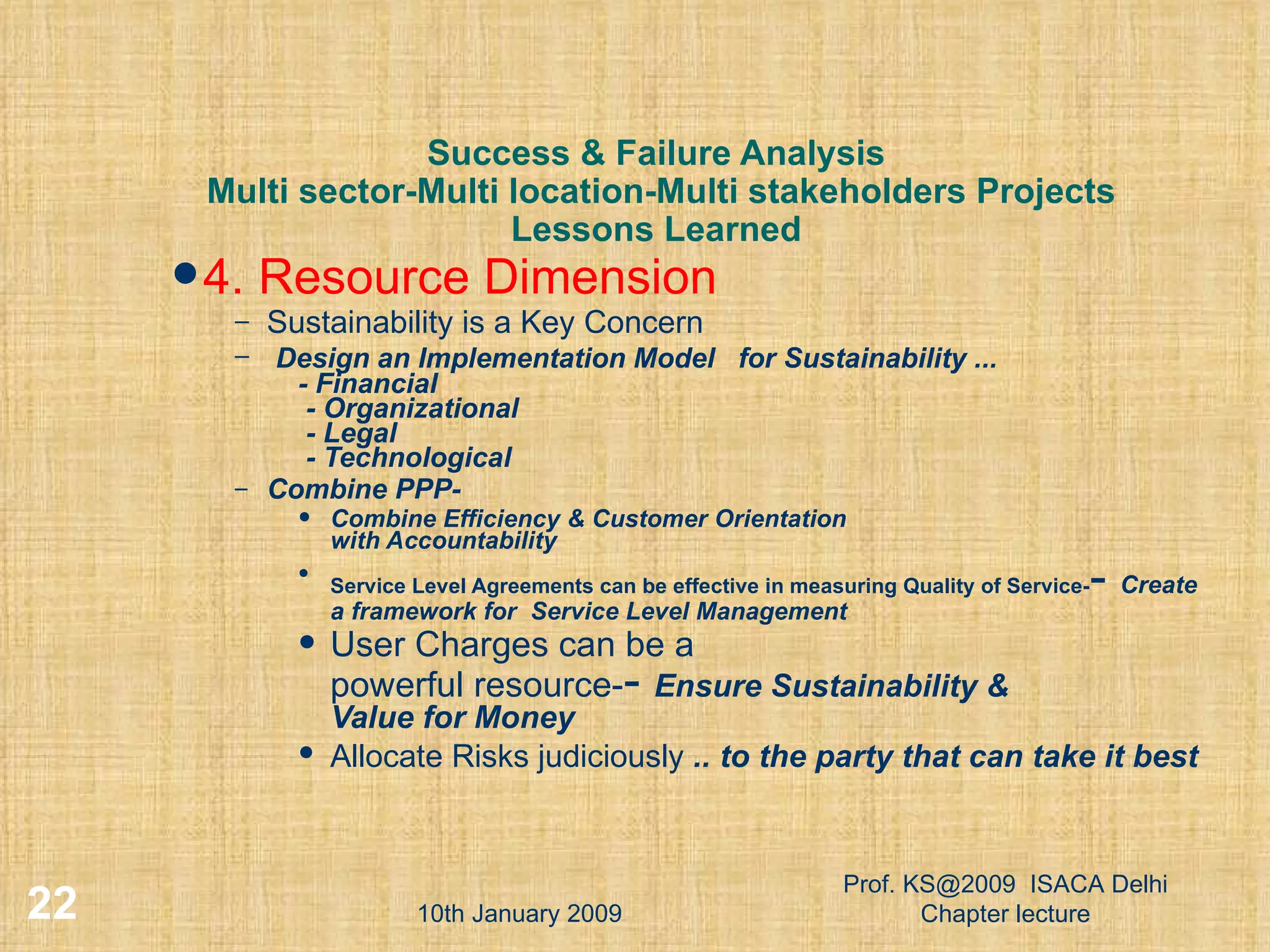
Success & Failure Analysis  Multi sector-Multi location-Multi stakeholders Projects Lessons Learned 4. Resource Dimension Sustainability is a Key Concern Design an Implementation Model  for Sustainability ...   - Financial   - Organizational   - Legal   - Technological Combine PPP-  Combine Efficiency & Customer Orientation with Accountability Service Level Agreements can be effective in measuring Quality of Service- -  Create a framework for  Service Level Management User Charges can be a  powerful resource- -  Ensure Sustainability & Value for Money Allocate Risks judiciously  .. to the party that can take it best   10th January 2009 Prof. KS@2009  ISACA Delhi Chapter lecture
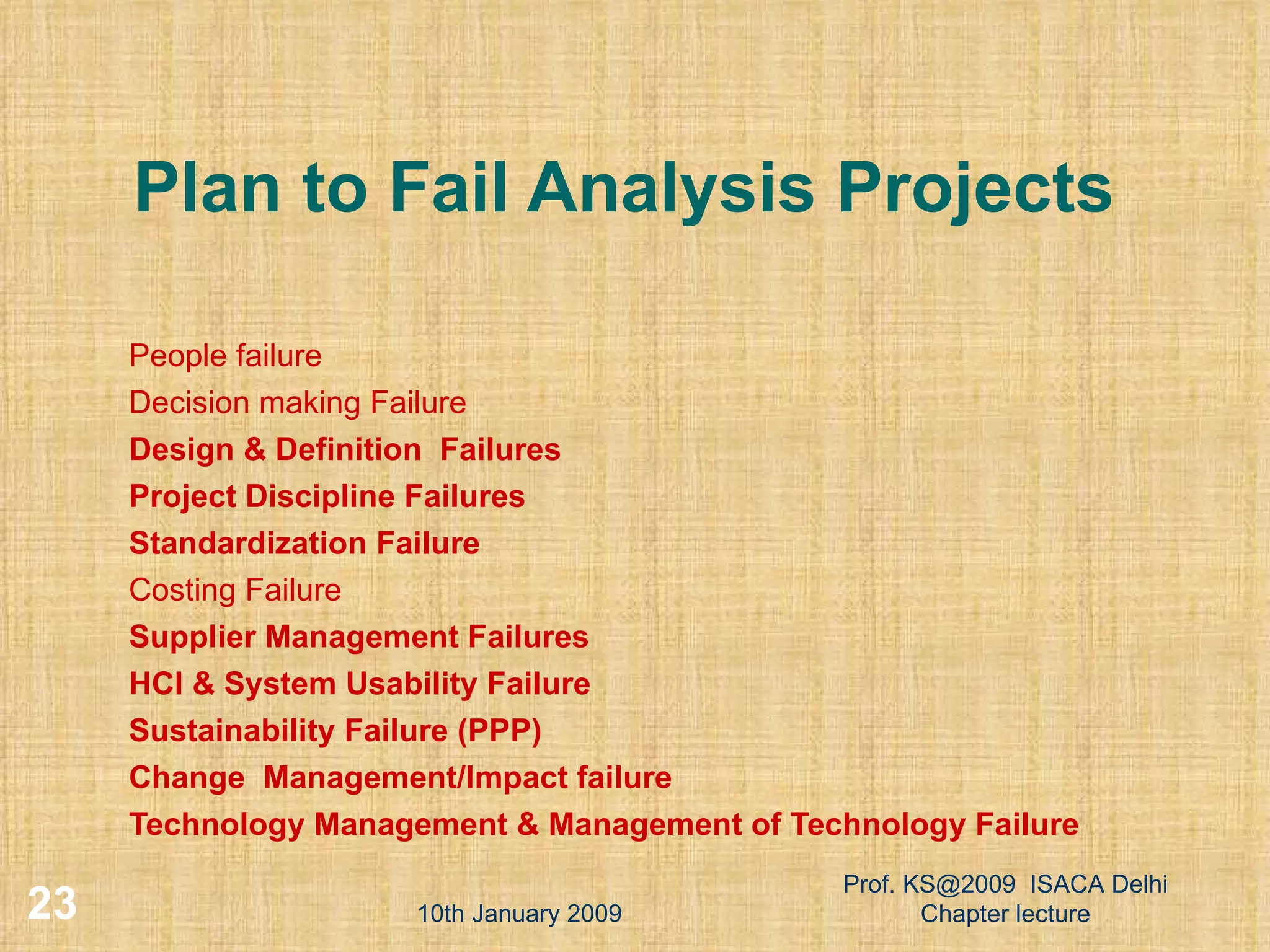
Plan to Fail Analysis Projects People failure Decision making Failure Design & Definition  Failures Project Discipline Failures Standardization Failure Costing Failure Supplier Management Failures HCI & System Usability Failure Sustainability Failure (PPP) ‏ Change  Management/Impact failure Technology Management & Management of Technology Failure 10th January 2009 Prof. KS@2009  ISACA Delhi Chapter lecture
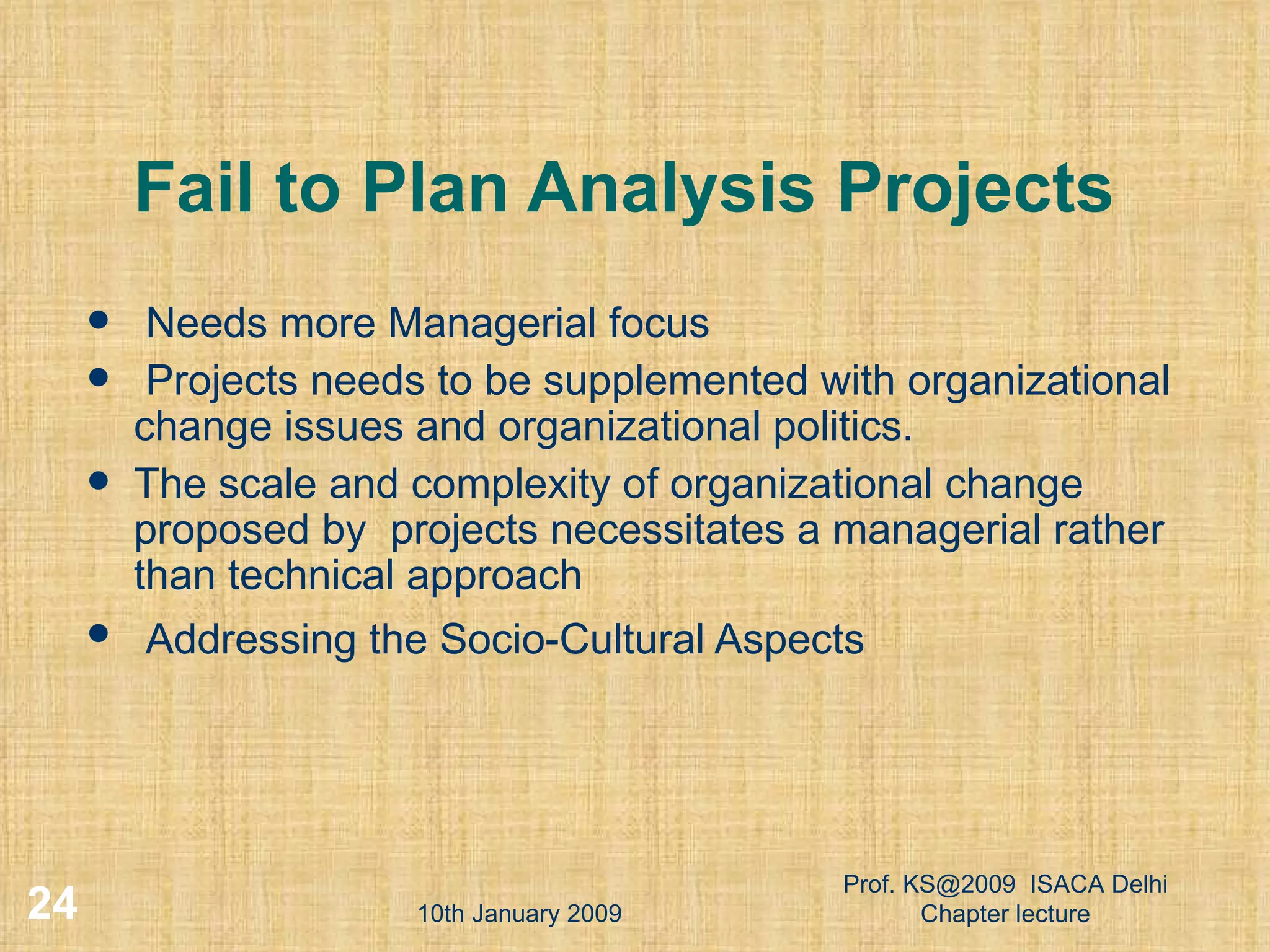
Fail to Plan Analysis Projects Needs more Managerial focus Projects needs to be supplemented with organizational change issues and organizational politics.  The scale and complexity of organizational change proposed by  projects necessitates a managerial rather than technical approach Addressing the Socio-Cultural Aspects   10th January 2009 Prof. KS@2009  ISACA Delhi Chapter lecture
Reasons of Failure of  Projects Supplier Management Failures Project Discipline Failures Design & Definition  Failures Decision Making Failures People Failure 10th January 2009 Prof. KS@2009  ISACA Delhi Chapter lecture
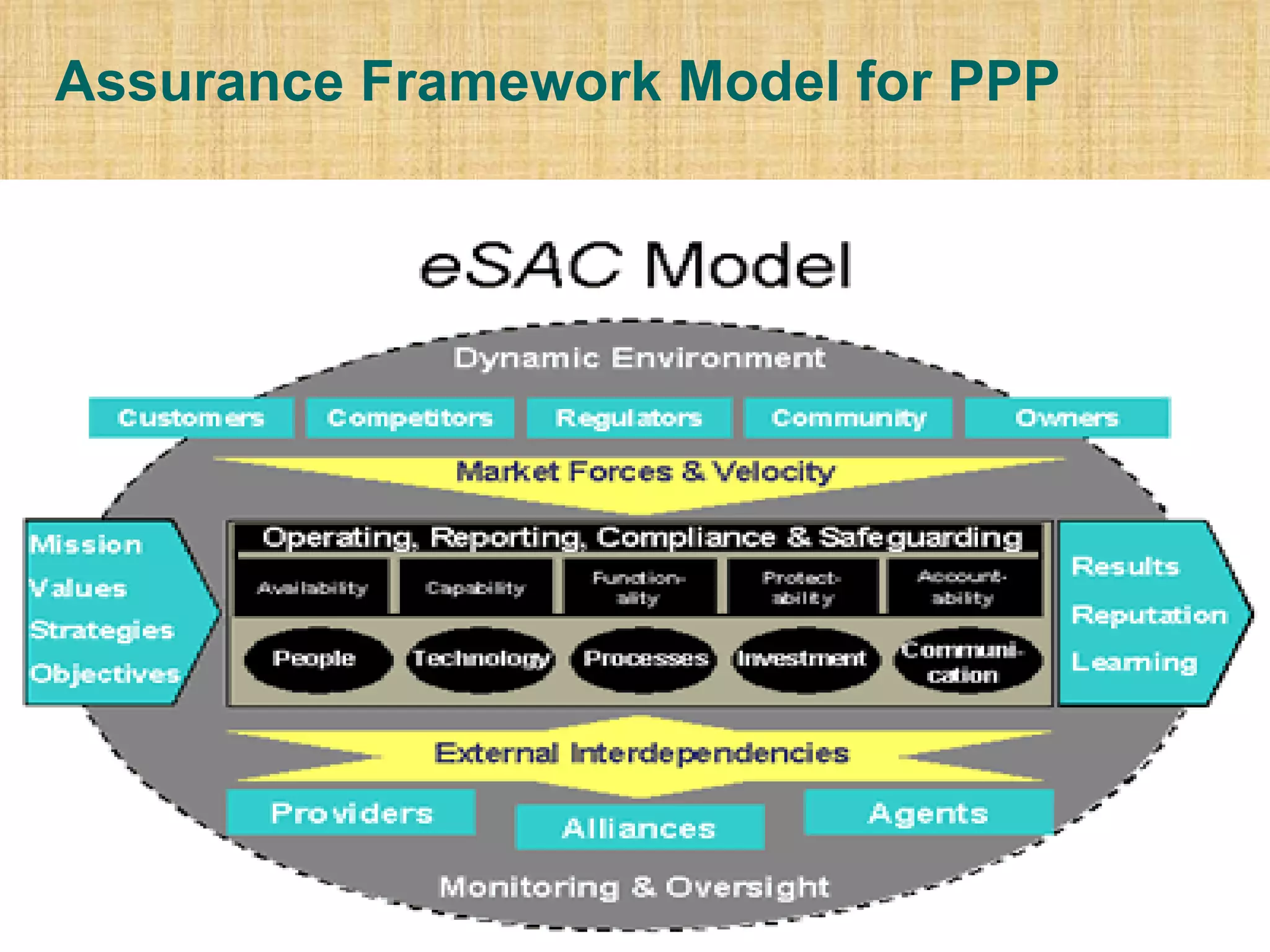
10th January 2009 Prof. KS@2009  ISACA Delhi Chapter lecture Assurance Framework Model for PPP
Managing  Project Interdependencies Critical in  (eServices) Infrastructure characteristics  (Organizational, operational, temporal, spatial)  Environment  (economic, legal /regulatory, technical, social/political) Coupling  and response behavior   (adaptive, inflexible, loose/tight, linear/complex) Type of failure  (common cause, cascading, escalating) Types of interdependencies   ( Physical, cyber, logical, geographic) State of operations   ( normal, stressed /disrupted, repair/restoration ) 10th January 2009 Prof. KS@2009  ISACA Delhi Chapter lecture
Knowledge Acquired, Lessons Learned & Future Directions-I Implementation Through  Committed Leadership (Integrating Polity and Bureaucracy) From Vision   Mission   Implementation-->Impact study->Improvisation  Create affordable robust ICT infrastructure and adapt System Usability concepts Adapt standards for interoperability and Integratability Sustainable and affordable solutions: Cost Effectiveness –> e- initiatives   should pay for themselves Information bases are to be integrated, auditable and verifiable and consistent and  information integrity to be assured as Government as One, cutting the barriers of Business of allocation 10th January 2009 Prof. KS@2009  ISACA Delhi Chapter lecture
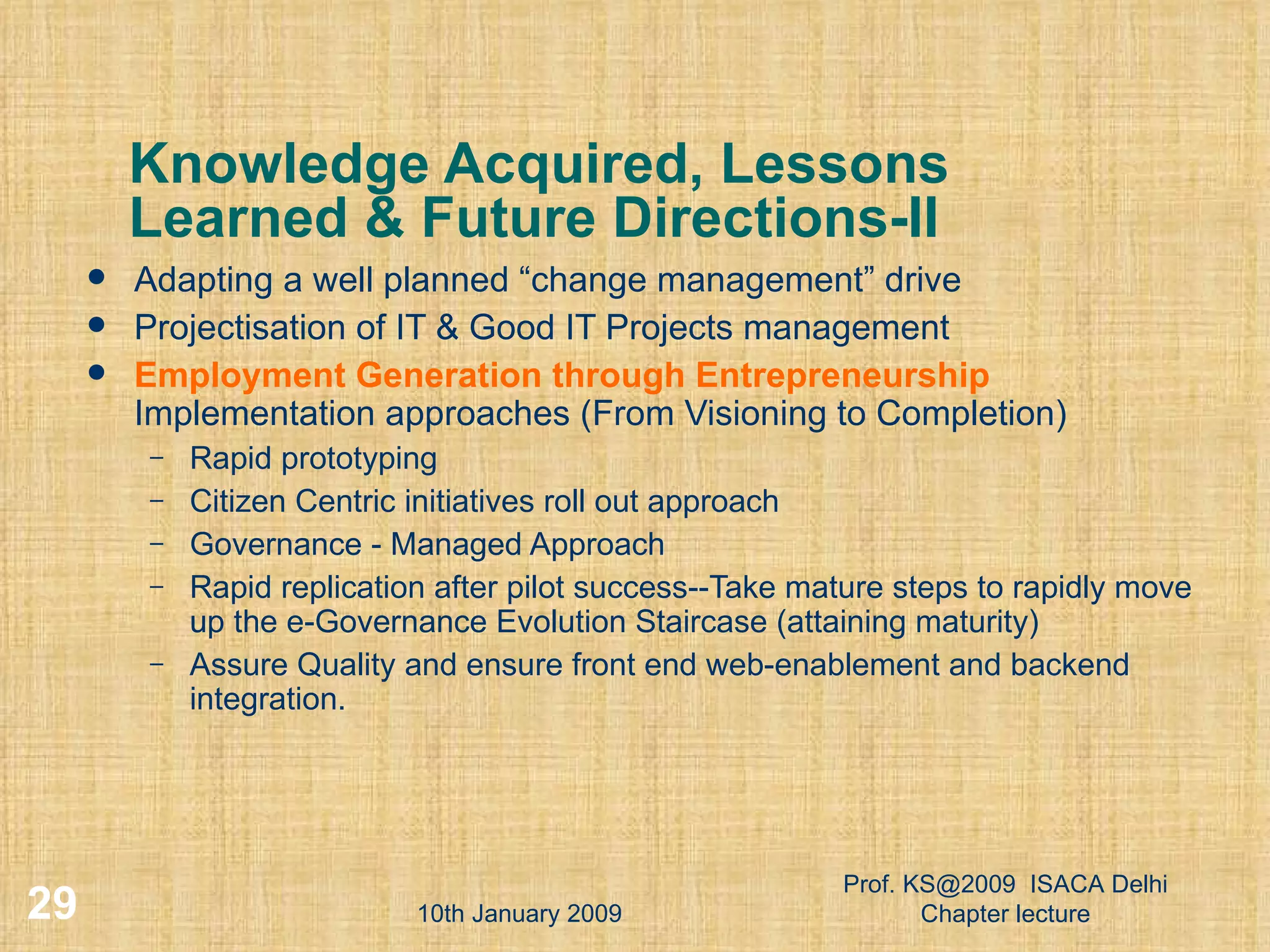
Knowledge Acquired, Lessons Learned & Future Directions-II Adapting a well planned “change management” drive Projectisation of IT & Good IT Projects management Employment Generation through Entrepreneurship  Implementation approaches (From Visioning to Completion) ‏ Rapid prototyping Citizen Centric initiatives roll out approach Governance - Managed Approach Rapid replication after pilot success--Take mature steps to rapidly move up the e-Governance Evolution Staircase (attaining maturity) ‏ Assure Quality and ensure front end web-enablement and backend integration. 10th January 2009 Prof. KS@2009  ISACA Delhi Chapter lecture
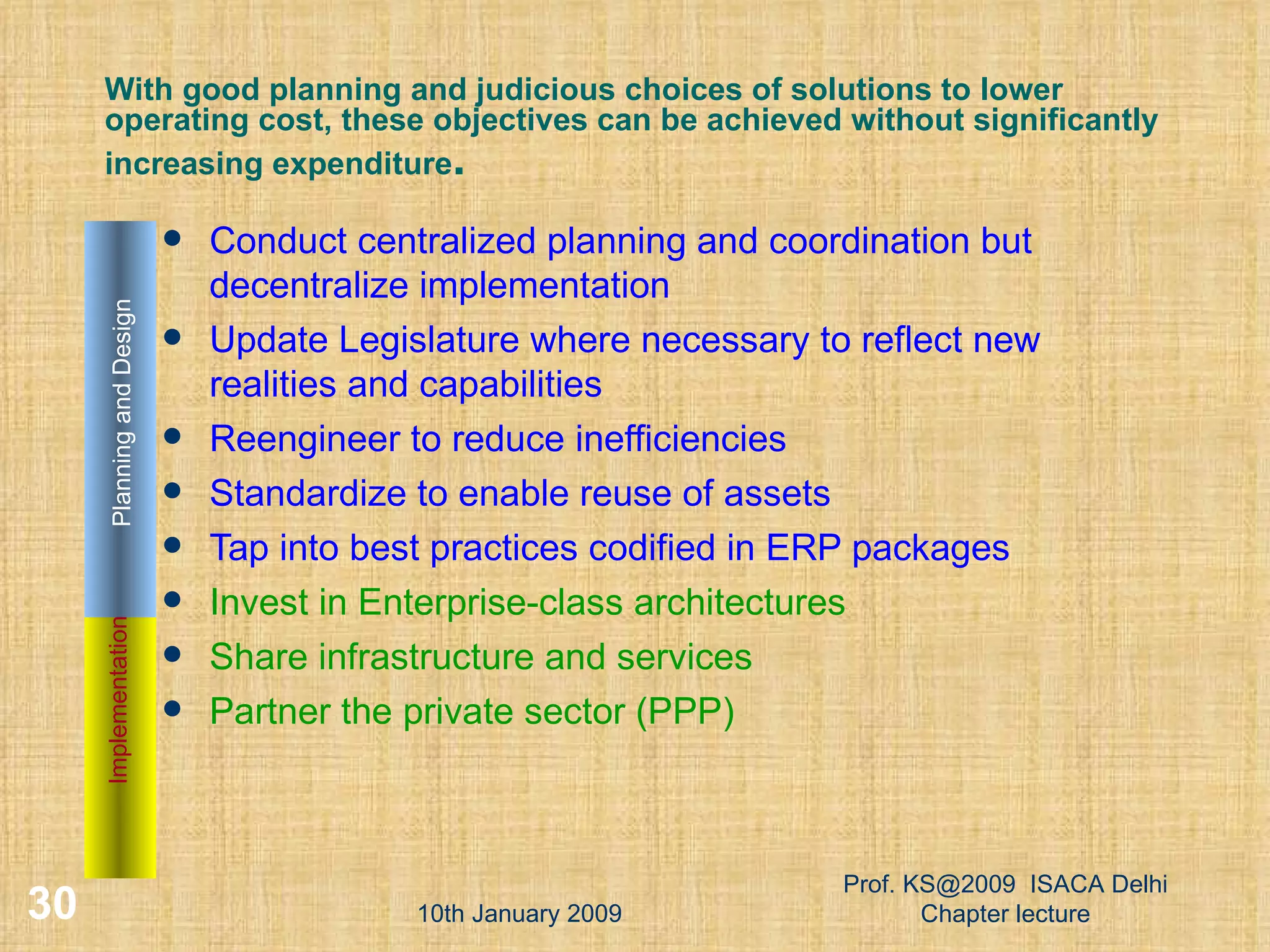
With good planning and judicious choices of solutions to lower operating cost, these objectives can be achieved without significantly increasing expenditure . Conduct centralized planning and coordination but decentralize implementation Update Legislature where necessary to reflect new realities and capabilities  Reengineer to reduce inefficiencies Standardize to enable reuse of assets  Tap into best practices codified in ERP packages Invest in Enterprise-class architectures  Share infrastructure and services Partner the private sector (PPP) ‏ 10th January 2009 Prof. KS@2009  ISACA Delhi Chapter lecture Implementation Planning and Design
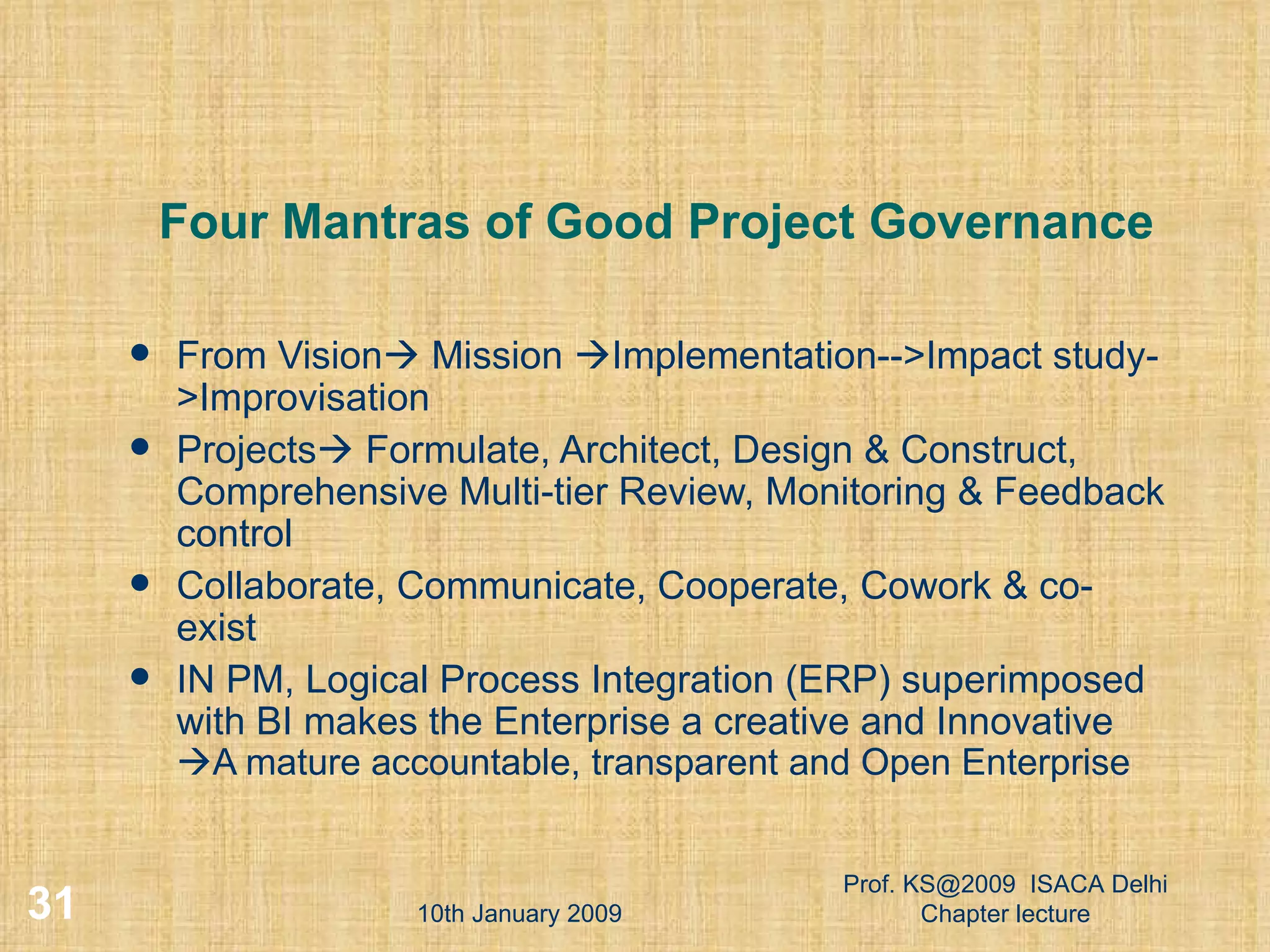
Four Mantras of Good Project Governance From Vision   Mission   Implementation-->Impact study->Improvisation Projects   Formulate, Architect, Design & Construct, Comprehensive Multi-tier Review, Monitoring & Feedback control Collaborate, Communicate, Cooperate, Cowork & co-exist IN PM, Logical Process Integration (ERP) superimposed  with BI makes the Enterprise a creative and Innovative   A mature accountable, transparent and Open Enterprise 10th January 2009 Prof. KS@2009  ISACA Delhi Chapter lecture
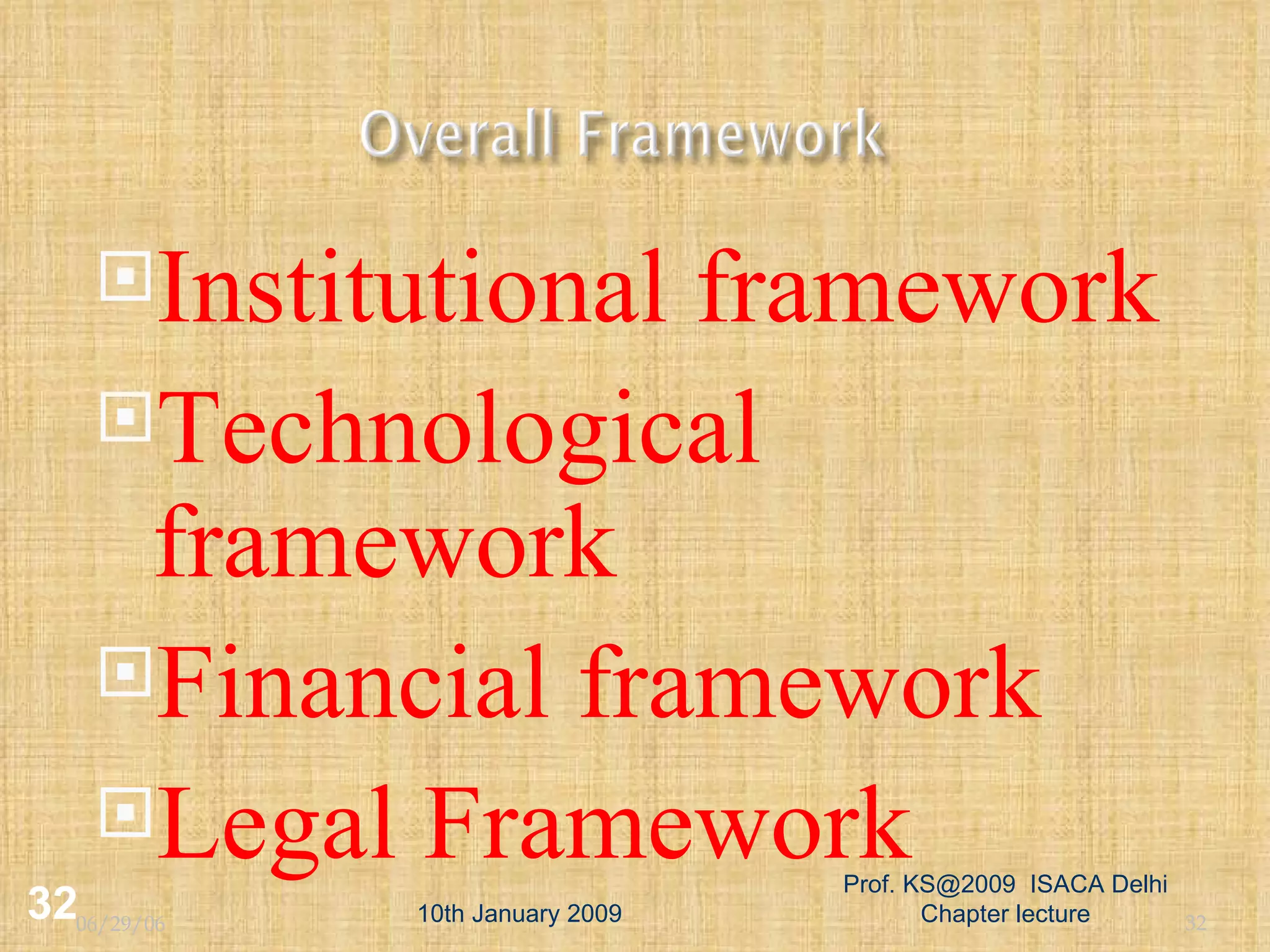
10th January 2009 Prof. KS@2009  ISACA Delhi Chapter lecture 06/29/06 Institutional framework Technological framework Financial framework Legal Framework
Ten Commandments for Survival Manage Knowledge Make decisions Be customer centric Manage Talents Manage Collaboration Build the right structure Manage Communications Set and adapt Global Standards Develop Leadership (to create wealth legally and ethically) ‏ 10th January 2009 Prof. KS@2009  ISACA Delhi Chapter lecture
Striving for Project Governance  Global Excellence  Using ICE Excellence is the result of Caring  more than others think is  Wise Risking  more than others think is  safe Dreaming  more than others think is  Practical Expecting  more than others think is  Possible Imagining the  Unimagined 10th January 2009 Prof. KS@2009  ISACA Delhi Chapter lecture
10th January 2009 Prof. KS@2009  ISACA Delhi Chapter lecture 06/29/06 NPC Sikkim  May 2006
Create a Brave  New World Where it is  "Not the leaders who Govern people but it is the people who let the Leaders Govern them.” 10th January 2009 Prof. KS@2009  ISACA Delhi Chapter lecture
Innovation, Knowledge Management & Productivity 10th January 2009 Prof. KS@2009  ISACA Delhi Chapter lecture
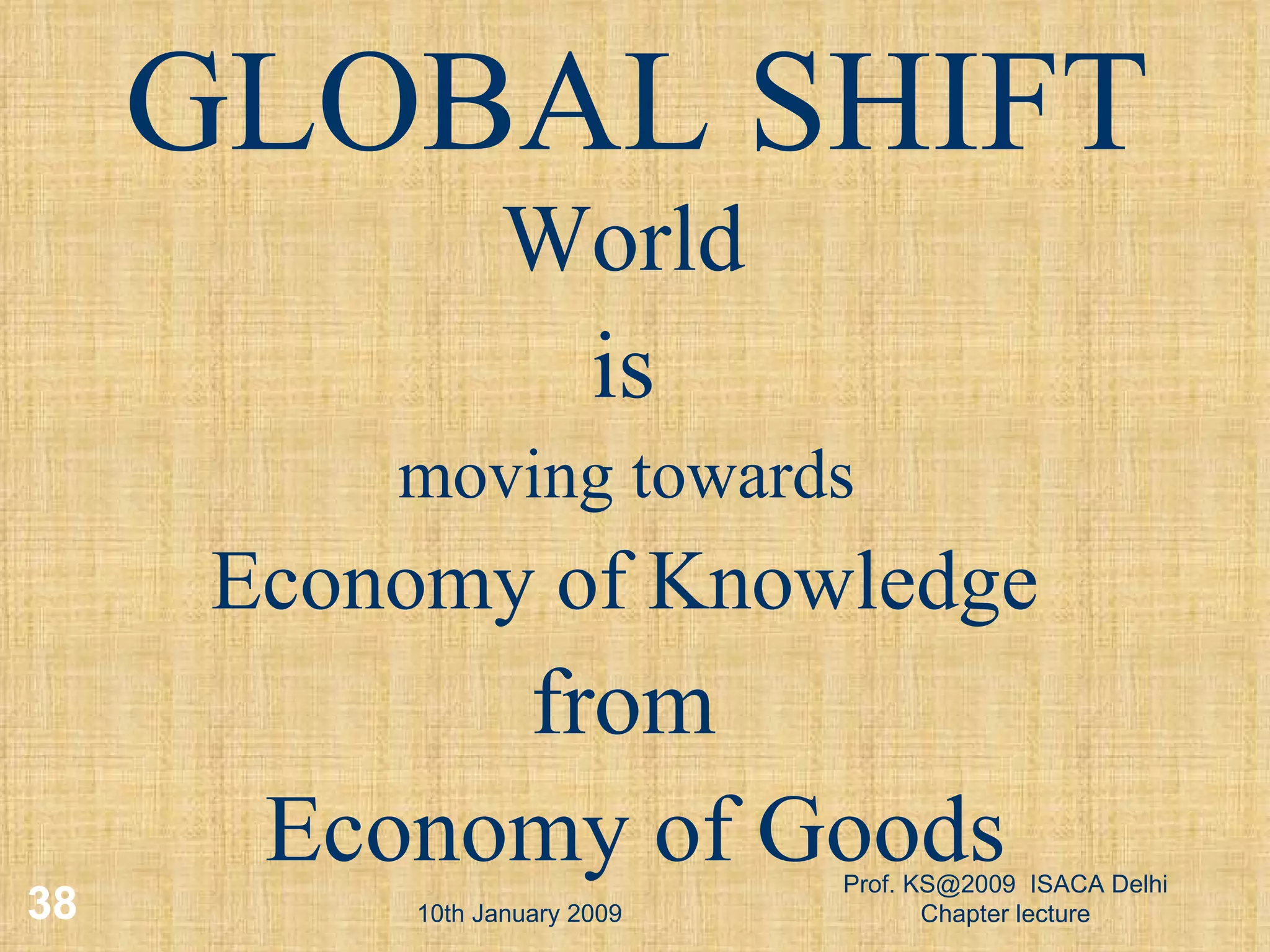
10th January 2009 Prof. KS@2009  ISACA Delhi Chapter lecture GLOBAL SHIFT World  is  moving towards  Economy of Knowledge  from  Economy of Goods
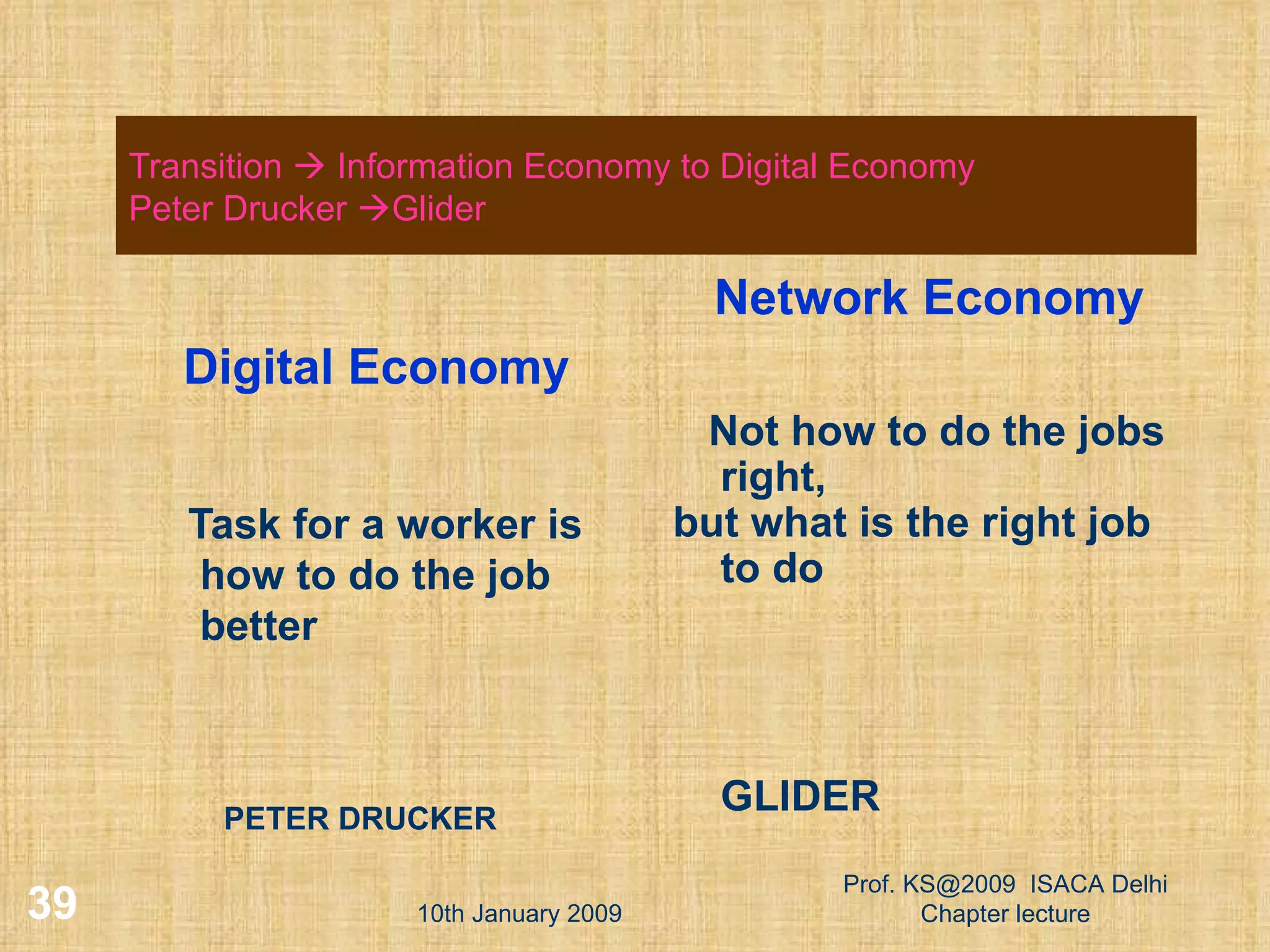
Transition    Information Economy to Digital Economy Peter Drucker   Glider Digital Economy Task for a worker is how to do the job better   PETER DRUCKER Network Economy Not how to do the jobs right,  but what is the right job to do GLIDER 10th January 2009 Prof. KS@2009  ISACA Delhi Chapter lecture
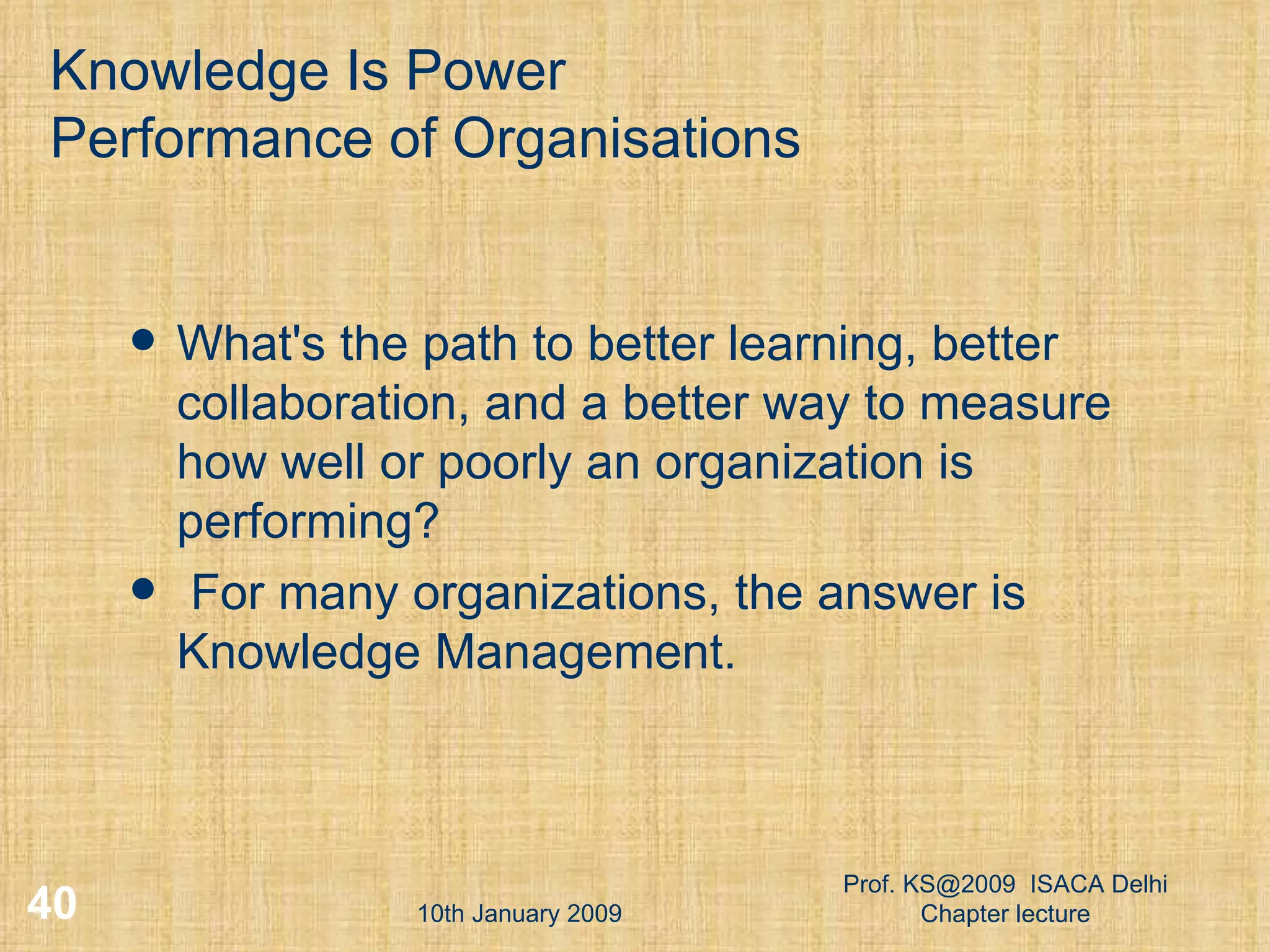
Knowledge Is Power Performance of Organisations What's the path to better learning, better collaboration, and a better way to measure how well or poorly an organization is performing? For many organizations, the answer is Knowledge Management. 10th January 2009 Prof. KS@2009  ISACA Delhi Chapter lecture
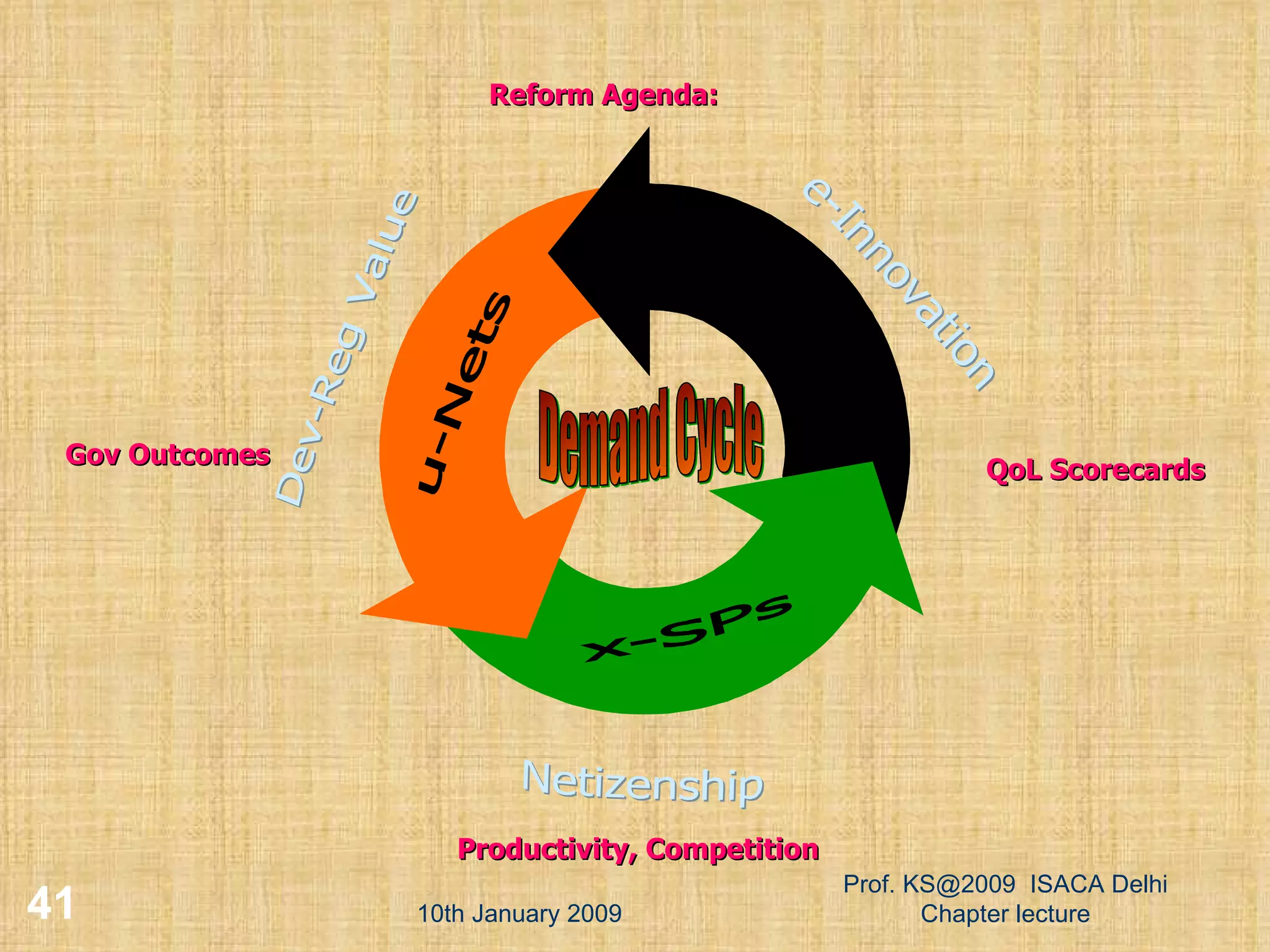
10th January 2009 Prof. KS@2009  ISACA Delhi Chapter lecture e-zones x-SPs u-Nets Dev-Reg Value e-Innovation Netizenship Demand Cycle Reform Agenda: QoL Scorecards  Productivity, Competition Gov Outcomes
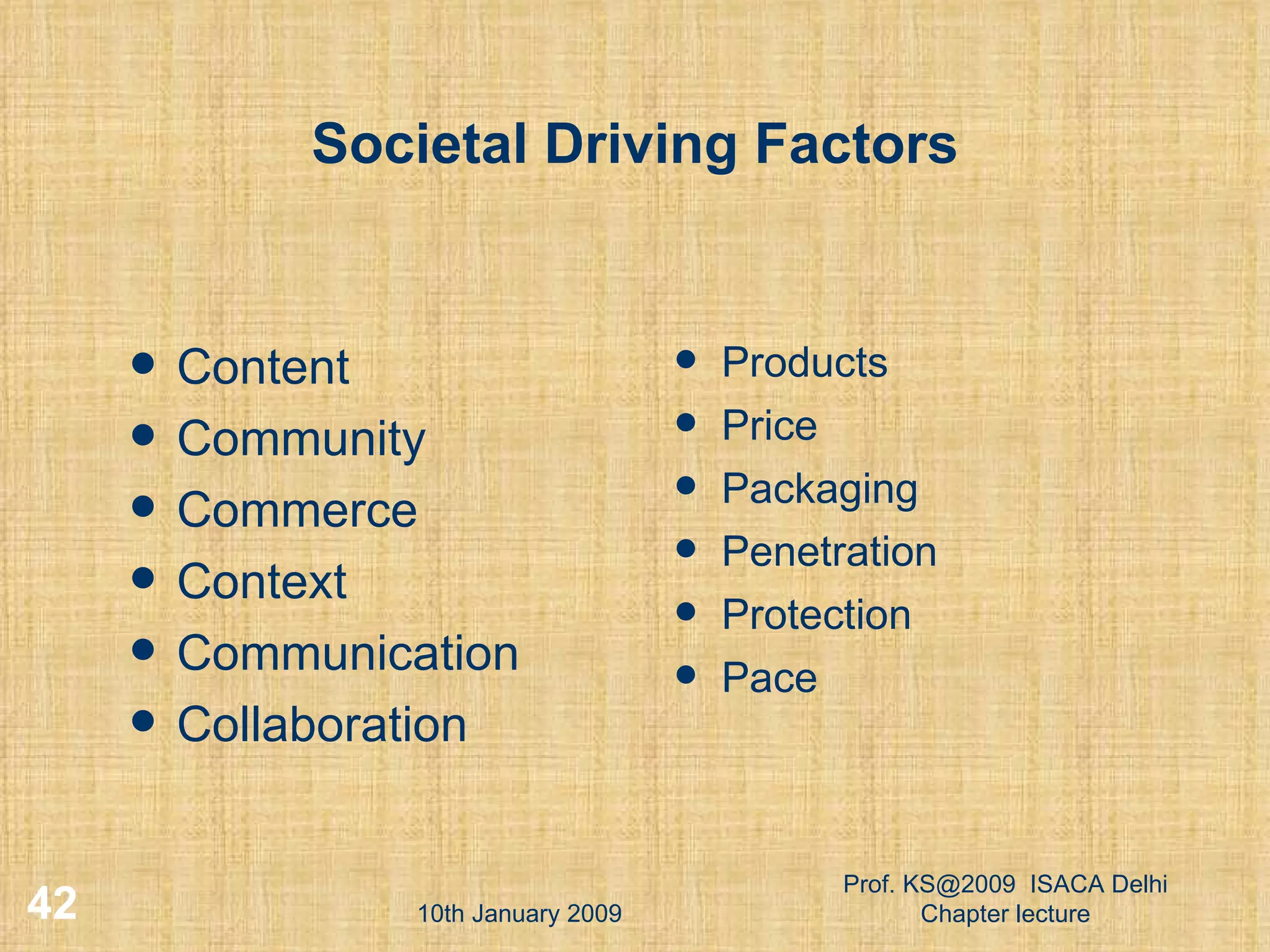
Societal Driving Factors Content Community Commerce Context Communication Collaboration Products Price Packaging Penetration Protection Pace 10th January 2009 Prof. KS@2009  ISACA Delhi Chapter lecture
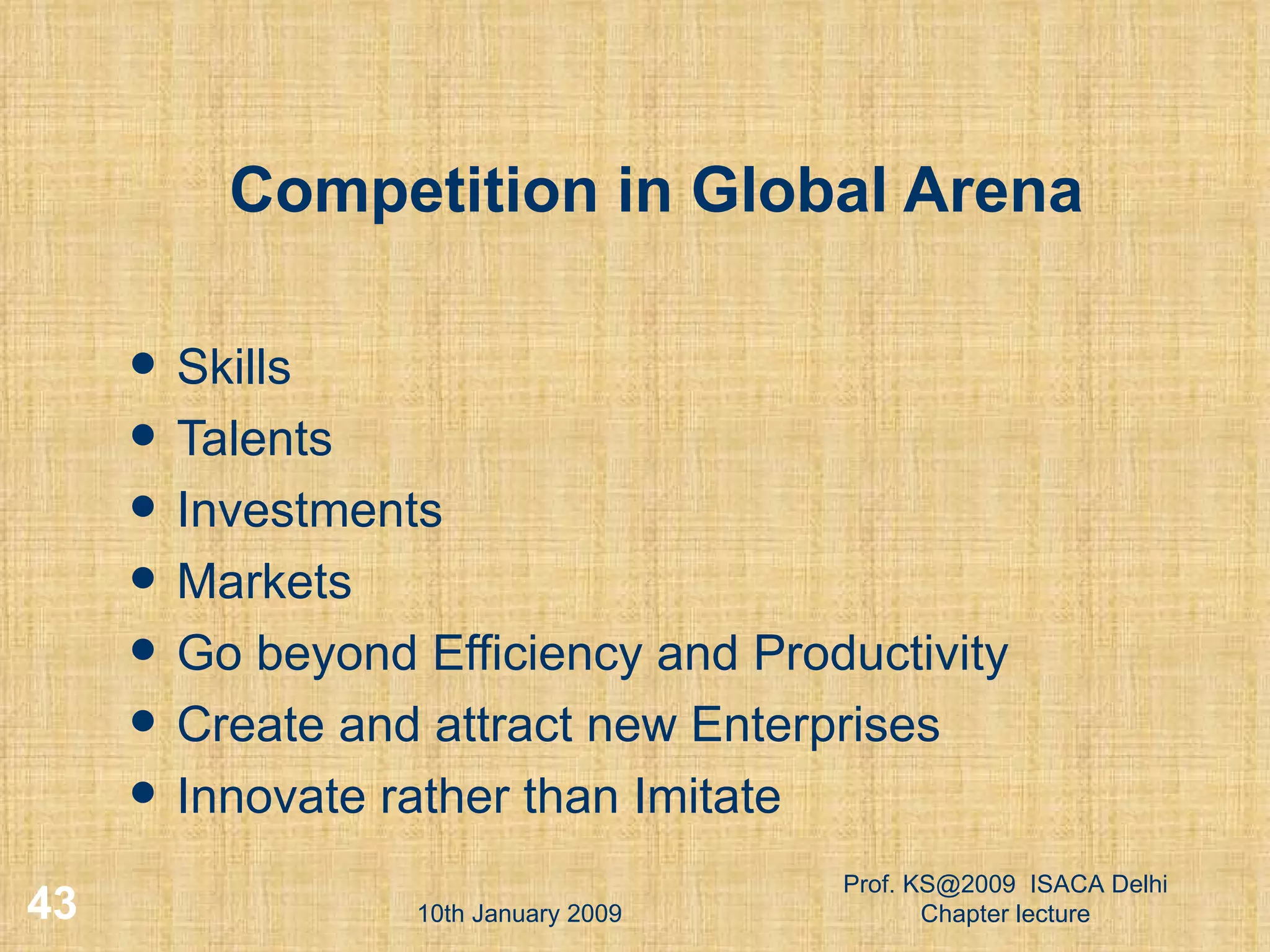
Competition in Global Arena Skills Talents Investments Markets Go beyond Efficiency and Productivity Create and attract new Enterprises Innovate rather than Imitate 10th January 2009 Prof. KS@2009  ISACA Delhi Chapter lecture
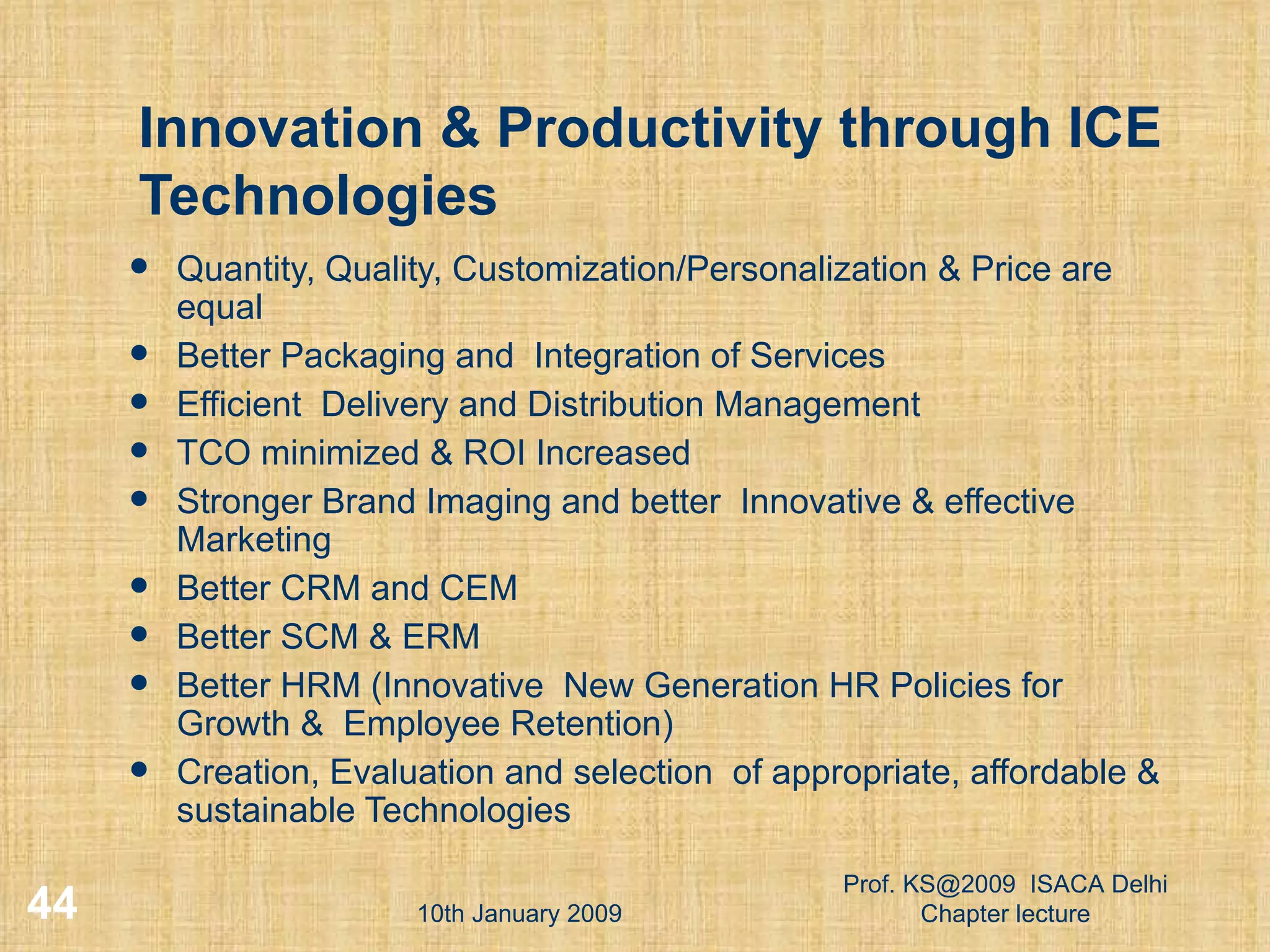
Innovation & Productivity through ICE Technologies Quantity, Quality, Customization/Personalization & Price are equal Better Packaging and  Integration of Services Efficient  Delivery and Distribution Management TCO minimized & ROI Increased Stronger Brand Imaging and better  Innovative & effective Marketing Better CRM and CEM Better SCM & ERM Better HRM (Innovative  New Generation HR Policies for Growth &  Employee Retention) Creation, Evaluation and selection  of appropriate, affordable & sustainable Technologies 10th January 2009 Prof. KS@2009  ISACA Delhi Chapter lecture
The Future  Win-Win Situation Needs Brain Talent Culture  Creativity Speed 10th January 2009 Prof. KS@2009  ISACA Delhi Chapter lecture
10th January 2009 Prof. KS@2009  ISACA Delhi Chapter lecture KNOWLEDGE WORK Should have Autonomy & Associated Responsibility Continuous Innovation should be built into the KW’s Job. Continuous Learning & Continuous Teaching should be part of the Job Judgments rather than Measures dominates KWs’ Productivity
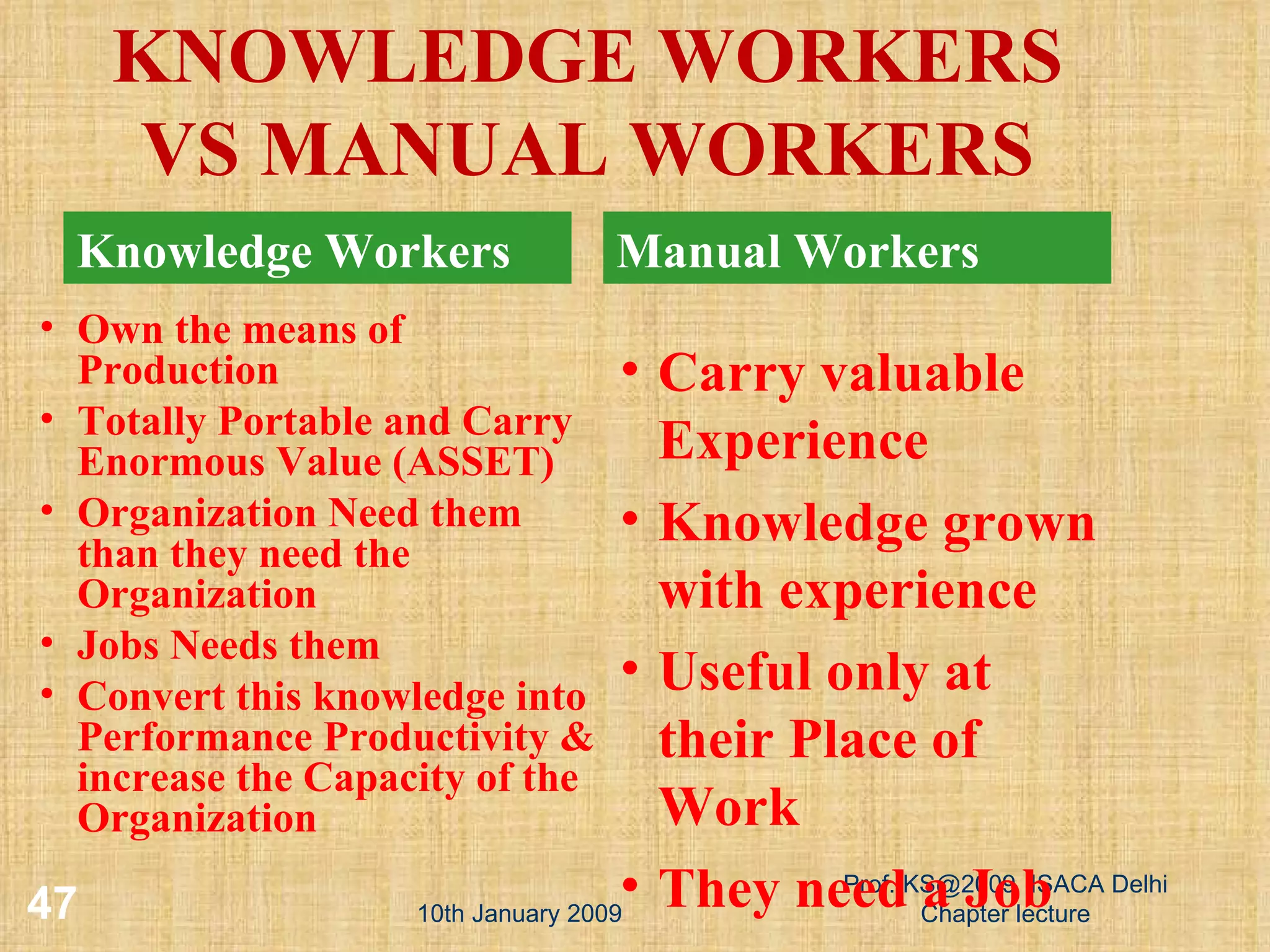
10th January 2009 Prof. KS@2009  ISACA Delhi Chapter lecture KNOWLEDGE WORKERS VS MANUAL WORKERS Own the means of Production Totally Portable and Carry Enormous Value (ASSET) Organization Need them than they need the Organization Jobs Needs them Convert this knowledge into Performance Productivity & increase the Capacity of the Organization Carry valuable Experience Knowledge grown with experience Useful only at their Place of Work They need a Job Knowledge Workers Manual Workers
A combination of technology, innovation, leadership and inspired workforce-Ingredients for India Development The economic strength is powered by competitiveness - The competitiveness is powered by knowledge power.  - The knowledge power is powered by Technology and Innovation.  - The Technology and Innovation is powered by Resource Investment.  - The Resource investment is powered by Revenue and Return on Investment.  - The Revenue is powered by Volume and repeat sales through Customer Loyalty.  - The customer loyalty is powered by Quality and value of products.  - Quality and value of products is powered by Employee Productivity and innovation.  - The Employee Productivity is powered by Employee Loyalty, employee satisfaction and working environment. - The Working Environment is powered by management stewardship.  - Management stewardship is powered by Invisible leadership 10th January 2009 Prof. KS@2009  ISACA Delhi Chapter lecture
Evaluating KM Strategies Cost Culture Time to Implement Productivity Knowledge Retention People Retention Return on Vision 10th January 2009 Prof. KS@2009  ISACA Delhi Chapter lecture
Evaluating KM Strategies 10th January 2009 Prof. KS@2009  ISACA Delhi Chapter lecture
Innovation- a New Definition innovation is not just creativity, individual inspiration, and bright ideas. "It goes way beyond that. It even goes beyond the commercialization of novel ideas, technologies, or products."  10th January 2009 Prof. KS@2009  ISACA Delhi Chapter lecture
Innovation & Business Growth businesses understand that their competitive advantage comes not from cost-cutting but from  competing on the basis of innovation distinctive know-how and collaborative business relationships 10th January 2009 Prof. KS@2009  ISACA Delhi Chapter lecture
Innovation-What is & NOT? innovation will energize business growth and, when implemented well, will be a powerful driving force for profit and sustained value. But there is a need for a clear view of what innovation is and what it is not.  10th January 2009 Prof. KS@2009  ISACA Delhi Chapter lecture
Innovation is integral part of Enterprises’ Process Management innovation must be seen as a core component of an organization's growth strategy and must be managed like any other process within the organization.  That means targets must be set  funding and resources must be allocated  skills must be available to convert innovative ideas into business  speed up the return on investment  10th January 2009 Prof. KS@2009  ISACA Delhi Chapter lecture
Tools & Technologies for building Innovation Building Innovation needs to build imaginative business models,  creative ways of organizing,  a culture that sanctions experimentation, learning, and managed risk .  10th January 2009 Prof. KS@2009  ISACA Delhi Chapter lecture
Innovation To Meet Market Forces & Needs innovation is driven by market pressures and customer demands. innovation is about smarter and faster ways of solving problems for customers and meeting market needs more imaginatively.  10th January 2009 Prof. KS@2009  ISACA Delhi Chapter lecture
Consumer’s Behavior best innovations come from interactions with their customers and analyzing their customers' behavior.  ‘ Reality of Innovation Unzipped'  -best innovations come from interactions with their customers and analyzing their customers' behavior--Bickerstaff 10th January 2009 Prof. KS@2009  ISACA Delhi Chapter lecture
Innovation-Funding Beyond Technology companies do not & should not  equate innovation solely with technology, which is only a part of a much bigger picture.  Likewise, investment in innovation is not restricted to  research and development,  but extends to training and skills development, market research, design,  use of advanced machinery and equipment, engineering development,  and knowledge drawn from licenses and patents. 10th January 2009 Prof. KS@2009  ISACA Delhi Chapter lecture
The Innovation Quest  Innovation must be managed like any other business process No Time for Complacency And there are indeed some obstacles that must be overcome if innovation is to be applied successfully, including risk and the length of time required to achieve ROI in innovation. Standing out as one of the most prevalent obstacles --complacency on the internal front, often brought about paradoxically by the success of existing systems, which can mask the need to change.  "The issue of lack of confidence in the company systems, and the lack of skilled people to execute innovation productively and sustain it, were identified as significant hurdles to be overcome,"  "The obstacles of short-term focus and the constant pressure to deal with the immediate and urgent as opposed to the future were identified as frequent alibis that can easily stop progress."  10th January 2009 Prof. KS@2009  ISACA Delhi Chapter lecture
Success & Failure of Innovation adoption of a scattergun approach to innovation can produce too many ideas and a lack of focus on how to deal with them.  "The perception that 99 percent of ideas fail was enough for many businesses to place innovation in the too hard basket"  10th January 2009 Prof. KS@2009  ISACA Delhi Chapter lecture
Rapid Conversion of  Ideas to Business Value innovation will not be stopped. It is pervasive, it is the active ingredient in transforming business, but it must be managed like any other business process.  The challenge is to ensure that there is in place a repeatable and rapid means of converting ideas into business value.  10th January 2009 Prof. KS@2009  ISACA Delhi Chapter lecture
Forward Thinking Management  Business Experience Outcome based approach "Business today recognized the need for a disciplined process where what is learned can be replicated and embedded systematically in the organization."  "Coupling ideas and outcomes, and harnessing creative thinking in a disciplined way to solve a real problem, is new. The challenge is to ensure that the disciplined process does not destroy creativity and innovation, which depends on unfettered and divergent thinking." All of which requires forward-thinking management.  “ It is confirmed  that courage, vision, and leadership are required for companies to be innovative," Bickerstaff says.  there is a crucial role for government in helping to overcome the problems presented by compliance requirements, regulations, and some bureaucratic procedures.  10th January 2009 Prof. KS@2009  ISACA Delhi Chapter lecture
Innovation Businesses & Government Role "Innovation only results in sustained productivity and prosperity for both companies and nations when it involves transforming the way business is done. This is a challenge that the leaders of both business and government share," says the foundation's Kennedy. "To take Australia's innovation journey forward, middle market firms believe business and government need to collaborate to create an environment that helps smart enterprises innovate - that is pursue new opportunities and manage the risks and uncertainties that are inherent in any innovation."  10th January 2009 Prof. KS@2009  ISACA Delhi Chapter lecture
10th January 2009 Prof. KS@2009  ISACA Delhi Chapter lecture Thank you FOR FURTHER INFORMATION PLEASE CONTACT :- E-MAIL:  [email_address] [email_address] 91-11-23219587 Fax:91-11-23217004 Office of the CAG, 10, B.Z. Marg, New Delhi-110002 Let all of us work together to make India a Developed Nation IT Governance is part of Corporate Good Governance

Project Management To Project Governance , Knowledge Management

  • 1.
    Project Management toProject Governance , Knowledge Management & Productivity as Integral part of IT Governance "   Prof. K. Subramanian IT Adviser to CAG of India & Prof. & Director, Advanced center for Informatics & Innovative Learning, IGNOU 10th January 2009 Prof. KS@2009 ISACA Delhi Chapter lecture
  • 2.
    PM Governance: Enablesto rapidly move up the e-Governance Evolution Staircase 10th January 2009 Prof. KS@2009 ISACA Delhi Chapter lecture Strategy/Policy People Process Technology 3. Transaction Competition Confidentiality/privacy Fee for transaction E-authentication Self-services Skill set changes Portfolio mgmt. Sourcing Inc. business staff BPR Relationship mgmt. Online interfaces Channel mgmt. Legacy sys. links Security Information access 24x7 infrastructure Sourcing Funding stream allocations Agency identity “ Big Browser” Job structures Relocation/telecommuting Organization Performance accountability Multiple-programs skills Privacy reduces Integrated services Change value chain New processes/services Change relationships (G2G, G2B, G2C, G2E) ‏ New applications New data structures Time 2. Interaction Searchable Database Public response/ email Content mgmt. Increased support staff Governance Knowledge mgmt. E-mail best prac. Content mgmt. Metadata Data synch. Search engine E-mail 1. Presence Publish Existing Streamline processes Web site Markup Trigger 4. Transformation Cost/ Complexity Define policy and outsource execution Retain monitoring and control Outsource service delivery staff Outsource process execution staff Outsource customer facing processes Outsource backend processes Applications Infrastructure Value 5. Outsourcing Constituent Evolve PPP model
  • 3.
    TEN Myths ofPM #1: Seasoned project managers planned for it. That is, they pursued an educational path that resulted in the official title of Project Manager. #2: The best project managers are those that are certified or have a degree in it. #3: We can tell that a project is destined for trouble once it is really cranking along. #4: The principle role of the project manager is to ensure that the schedule is met. #5: Project management is just the science of figuring out where to apply your heroes, versus where to apply the rookies. #6: A seasoned project manager is a silver bullet. #7: The best project managers are those that are promoted from within the technical ranks of the organization. #8: Project management is just a more acceptable term for micro-management. #9: Project management is just the next management fad. #10: Project management is rigidly based on processes and prescribed documentation. As such, it'll take more time to get anything done. 10th January 2009 Prof. KS@2009 ISACA Delhi Chapter lecture
  • 4.
    Some MorePowerful Myths of PM 1.Project workers are slaves 2: The plan predicts the future 3: Better safe than sorry 4: The methods work. 5: The manager motivates 6: Tidiness matters. 1.We don’t have time to back track 2. Working well together is fluff stuff 3.Document only what the boss wants to see 4.Don’t beat a dead horse 5.That’ll Never Fly Here 10th January 2009 Prof. KS@2009 ISACA Delhi Chapter lecture
  • 5.
    Governance Dimensions Effective Project Governance Requires: well defined structures to enable and support the business delivery of projects clear roles, accountabilities and responsibilities project-related policies to provide the ‘ground-rules’ for projects the knowledge of what to do and how to do it the measures or metrics to know if the project has been successful a consistent set of enabling and supporting processes 10th January 2009 Prof. KS@2009 ISACA Delhi Chapter lecture
  • 6.
    Project Governance –Issues& Challenges Operational Integration Professional Integration (HR) ‏ Emotional/Cultural Integration ICT & Business Integration Quality-Price-Customization/Personalization Integration 10th January 2009 Prof. KS@2009 ISACA Delhi Chapter lecture
  • 7.
    Projects Governance ImperativesWithout active, directed and informed project governance projects are doomed to under deliver. Projects are established to implement change. Organizations are set up not to change Delivery of the business results is the pre-requisite to the delivery of the business benefits and value. 10th January 2009 Prof. KS@2009 ISACA Delhi Chapter lecture
  • 8.
    Project Governance VsProject Team The project team is in control of and can manage the project (under the governance team’s guidance) and deliver the project’s results. However, it is not in control of the business and, therefore, cannot deliver the business results without the assistance of the business through the governance team. Project governance’s primary role is one of action (not control) — to ensure the project is successfully implemented and integrated into the business’ operations, sustained, and the associated benefits are realized and ‘banked’. 10th January 2009 Prof. KS@2009 ISACA Delhi Chapter lecture
  • 9.
    Research Findings BusinessSuccess & Business Risk Effective project governance alone could increase the realized value of a project by 10%. It also reduces, by at least half, the business risks of the project not succeeding. A project’s business success , is directly proportional to the level of effective project governance. our research has found governance ‘effectiveness’ to be a rare commodity. 10th January 2009 Prof. KS@2009 ISACA Delhi Chapter lecture
  • 10.
    Project Governance SkillBalancing & Education Few executives in governance roles have the necessary skills, knowledge and experience Few executives have had any formal training in their project governance roles Business executives tend to approach project governance with good intentions, but with little governance-specific skills, knowledge and education. It is assumed by all parties that no such expertise is needed. This is a false assumption. 10th January 2009 Prof. KS@2009 ISACA Delhi Chapter lecture
  • 11.
    What governance actions/inactionscause projects to fail? Wrong personal goals Failure to champion the project Most governance problems are committed out of ignorance Remoteness from project teams Governance teams of failed projects often protest, “We relied on the information we were provided!” This is no excuse. A key part of the project governance role is ‘managing by walking around’ — visiting the project team, talking to the team members and picking up the ‘vibes’ 10th January 2009 Prof. KS@2009 ISACA Delhi Chapter lecture
  • 12.
    What are themeasures of project success? Wrong perspective — need for a ‘business outcomes’ focus The measure of success is the achievement of the measurable business outcomes — an improvement to the business. A broader definition of governance ‘success’ needed 10th January 2009 Prof. KS@2009 ISACA Delhi Chapter lecture
  • 13.
    Governance Success VsProject Success It is usually assumed that the governance measures of success are the same as the project’s measures and, therefore, implementing the project equals a ‘successful project’. This is a misconception This becomes clear to governance teams when they are taken through a process to identify: their measures of success their measures of failure and the organization’s measures of success of their project 10th January 2009 Prof. KS@2009 ISACA Delhi Chapter lecture
  • 14.
    10th January 2009Prof. KS@2009 ISACA Delhi Chapter lecture Organization’s measures of success A seamless transition It to be easier to access information Better quality of information Centre to be responsive Managerial importance to be recognized in service levels The regions still own the results They know and understand how the process works Notice how limited the project’s measures of success are! Focusing on meeting all of these measures of success is an important project governance team role. Governance team measures of success Delivering lower costs and efficiency savings so that the business sees the outcomes as valuable Improving the quality of reporting in terms of accessibility, integrity, consistency and ease of use Being seen to have delivered a consistent or enhanced service Being a silent contributor to process improvement — reducing costs and providing a more effective overlay function Receiving strong management support across the business Standardizing nationally, ETC Project measures of success Establishment of a working national centre for accounting services Decommissioning regional accounting positions and roles Meeting the set SLAs within three months of the takeover of each state Standardizing the reporting formats and accounting treatments nationwide Eliminating duplicate tasks and processes ETC
  • 15.
    Governance through LeadershipLeadership is any behavior that develops or uses power to influence other peoples’ behavior. It is used by management to achieve enthusiastic, willing, zealous participation of followers to accomplish the organization’s objectives 10th January 2009 Prof. KS@2009 ISACA Delhi Chapter lecture
  • 16.
    ORGANIZATIONS & ICT10th January 2009 Prof. KS@2009 ISACA Delhi Chapter lecture MEDIATING FACTORS: Environment Culture Structure Standard Procedures Politics Management Decisions Chance ORGANIZATIONS INFORMATION TECHNOLOGY
  • 17.
    Cases Project GovernanceAnalytics Indian Railways-PRS Bhoomi-Karnataka’s Land records Project LOKVANI-UP Grievances Addressal Project GyanDOOT- MPs Tribal Literacy Project DMRC Metro Rail Project 10th January 2009 Prof. KS@2009 ISACA Delhi Chapter lecture
  • 18.
    Changing role Project Management in IS/IT in Enterprises IS/IT project management earlier considered as budgeting exercise in the planning phase,time keeping effort in the tracking stage and didn’t embrace critical path concepts Today Enterprise handles fundamentally multi projects Both development and non development work should be treated Resource Utilization IS AS IMPORTANT AS TASK AND PROJECT COMPLETION Many IS/IT projects are abandoned before Completion There are many repetitive projects including maintenance and support Project work is budgeted, usually on an annual basis 10th January 2009 Prof. KS@2009 ISACA Delhi Chapter lecture
  • 19.
    Success & FailureAnalysis Multi sector-Multi location-Multi stakeholders Projects Lessons Learned 1. Four Dimensions 1.Process Dimension 2.People Dimension 3. Technology Dimension 4. Resource Dimension 2.Automation to Transformation & Output based to Outcome Based 3. Service is paramount & Process is subordinate  Focus on Services, Service Levels 4.BPR - Choose carefully between Incremental Approach & Radical Approach keeping Customer-friendliness, Efficiency & Effectiveness 10th January 2009 Prof. KS@2009 ISACA Delhi Chapter lecture
  • 20.
    1.Process Dimension  Translate to Transform 2.People Dimension  Inform them, Involve them & Incentivize adoption Design an appropriate Change Management Strategy Capacity Building- Policy Level Management Level Operational Level Project Development  Conceptualize, Architect, Design Leadership  Leaders can .. Create Vision .. Prioritize .. Take Hard Decisions & Tolerate Failure 10th January 2009 Prof. KS@2009 ISACA Delhi Chapter lecture Success & Failure Analysis Multi sector-Multi location-Multi stakeholders Projects Lessons Learned Four Dimensions
  • 21.
    Success & FailureAnalysis Multi sector-Multi location-Multi stakeholders Projects Lessons Learned 3 . Technology Dimension Prescribe & Follow Open Standards and Open Technologies for Competitiveness & Sustainability and reduce TCO Design Systems for Scalability Reliability Security 10th January 2009 Prof. KS@2009 ISACA Delhi Chapter lecture
  • 22.
    Success & FailureAnalysis Multi sector-Multi location-Multi stakeholders Projects Lessons Learned 4. Resource Dimension Sustainability is a Key Concern Design an Implementation Model for Sustainability ... - Financial - Organizational - Legal - Technological Combine PPP- Combine Efficiency & Customer Orientation with Accountability Service Level Agreements can be effective in measuring Quality of Service- - Create a framework for Service Level Management User Charges can be a powerful resource- - Ensure Sustainability & Value for Money Allocate Risks judiciously .. to the party that can take it best 10th January 2009 Prof. KS@2009 ISACA Delhi Chapter lecture
  • 23.
    Plan to FailAnalysis Projects People failure Decision making Failure Design & Definition Failures Project Discipline Failures Standardization Failure Costing Failure Supplier Management Failures HCI & System Usability Failure Sustainability Failure (PPP) ‏ Change Management/Impact failure Technology Management & Management of Technology Failure 10th January 2009 Prof. KS@2009 ISACA Delhi Chapter lecture
  • 24.
    Fail to PlanAnalysis Projects Needs more Managerial focus Projects needs to be supplemented with organizational change issues and organizational politics. The scale and complexity of organizational change proposed by projects necessitates a managerial rather than technical approach Addressing the Socio-Cultural Aspects 10th January 2009 Prof. KS@2009 ISACA Delhi Chapter lecture
  • 25.
    Reasons of Failureof Projects Supplier Management Failures Project Discipline Failures Design & Definition Failures Decision Making Failures People Failure 10th January 2009 Prof. KS@2009 ISACA Delhi Chapter lecture
  • 26.
    10th January 2009Prof. KS@2009 ISACA Delhi Chapter lecture Assurance Framework Model for PPP
  • 27.
    Managing ProjectInterdependencies Critical in (eServices) Infrastructure characteristics (Organizational, operational, temporal, spatial) Environment (economic, legal /regulatory, technical, social/political) Coupling and response behavior (adaptive, inflexible, loose/tight, linear/complex) Type of failure (common cause, cascading, escalating) Types of interdependencies ( Physical, cyber, logical, geographic) State of operations ( normal, stressed /disrupted, repair/restoration ) 10th January 2009 Prof. KS@2009 ISACA Delhi Chapter lecture
  • 28.
    Knowledge Acquired, LessonsLearned & Future Directions-I Implementation Through Committed Leadership (Integrating Polity and Bureaucracy) From Vision  Mission  Implementation-->Impact study->Improvisation Create affordable robust ICT infrastructure and adapt System Usability concepts Adapt standards for interoperability and Integratability Sustainable and affordable solutions: Cost Effectiveness –> e- initiatives should pay for themselves Information bases are to be integrated, auditable and verifiable and consistent and information integrity to be assured as Government as One, cutting the barriers of Business of allocation 10th January 2009 Prof. KS@2009 ISACA Delhi Chapter lecture
  • 29.
    Knowledge Acquired, LessonsLearned & Future Directions-II Adapting a well planned “change management” drive Projectisation of IT & Good IT Projects management Employment Generation through Entrepreneurship Implementation approaches (From Visioning to Completion) ‏ Rapid prototyping Citizen Centric initiatives roll out approach Governance - Managed Approach Rapid replication after pilot success--Take mature steps to rapidly move up the e-Governance Evolution Staircase (attaining maturity) ‏ Assure Quality and ensure front end web-enablement and backend integration. 10th January 2009 Prof. KS@2009 ISACA Delhi Chapter lecture
  • 30.
    With good planningand judicious choices of solutions to lower operating cost, these objectives can be achieved without significantly increasing expenditure . Conduct centralized planning and coordination but decentralize implementation Update Legislature where necessary to reflect new realities and capabilities Reengineer to reduce inefficiencies Standardize to enable reuse of assets Tap into best practices codified in ERP packages Invest in Enterprise-class architectures Share infrastructure and services Partner the private sector (PPP) ‏ 10th January 2009 Prof. KS@2009 ISACA Delhi Chapter lecture Implementation Planning and Design
  • 31.
    Four Mantras ofGood Project Governance From Vision  Mission  Implementation-->Impact study->Improvisation Projects  Formulate, Architect, Design & Construct, Comprehensive Multi-tier Review, Monitoring & Feedback control Collaborate, Communicate, Cooperate, Cowork & co-exist IN PM, Logical Process Integration (ERP) superimposed with BI makes the Enterprise a creative and Innovative  A mature accountable, transparent and Open Enterprise 10th January 2009 Prof. KS@2009 ISACA Delhi Chapter lecture
  • 32.
    10th January 2009Prof. KS@2009 ISACA Delhi Chapter lecture 06/29/06 Institutional framework Technological framework Financial framework Legal Framework
  • 33.
    Ten Commandments forSurvival Manage Knowledge Make decisions Be customer centric Manage Talents Manage Collaboration Build the right structure Manage Communications Set and adapt Global Standards Develop Leadership (to create wealth legally and ethically) ‏ 10th January 2009 Prof. KS@2009 ISACA Delhi Chapter lecture
  • 34.
    Striving for ProjectGovernance Global Excellence Using ICE Excellence is the result of Caring more than others think is Wise Risking more than others think is safe Dreaming more than others think is Practical Expecting more than others think is Possible Imagining the Unimagined 10th January 2009 Prof. KS@2009 ISACA Delhi Chapter lecture
  • 35.
    10th January 2009Prof. KS@2009 ISACA Delhi Chapter lecture 06/29/06 NPC Sikkim May 2006
  • 36.
    Create a Brave New World Where it is "Not the leaders who Govern people but it is the people who let the Leaders Govern them.” 10th January 2009 Prof. KS@2009 ISACA Delhi Chapter lecture
  • 37.
    Innovation, Knowledge Management& Productivity 10th January 2009 Prof. KS@2009 ISACA Delhi Chapter lecture
  • 38.
    10th January 2009Prof. KS@2009 ISACA Delhi Chapter lecture GLOBAL SHIFT World is moving towards Economy of Knowledge from Economy of Goods
  • 39.
    Transition  Information Economy to Digital Economy Peter Drucker  Glider Digital Economy Task for a worker is how to do the job better PETER DRUCKER Network Economy Not how to do the jobs right, but what is the right job to do GLIDER 10th January 2009 Prof. KS@2009 ISACA Delhi Chapter lecture
  • 40.
    Knowledge Is PowerPerformance of Organisations What's the path to better learning, better collaboration, and a better way to measure how well or poorly an organization is performing? For many organizations, the answer is Knowledge Management. 10th January 2009 Prof. KS@2009 ISACA Delhi Chapter lecture
  • 41.
    10th January 2009Prof. KS@2009 ISACA Delhi Chapter lecture e-zones x-SPs u-Nets Dev-Reg Value e-Innovation Netizenship Demand Cycle Reform Agenda: QoL Scorecards Productivity, Competition Gov Outcomes
  • 42.
    Societal Driving FactorsContent Community Commerce Context Communication Collaboration Products Price Packaging Penetration Protection Pace 10th January 2009 Prof. KS@2009 ISACA Delhi Chapter lecture
  • 43.
    Competition in GlobalArena Skills Talents Investments Markets Go beyond Efficiency and Productivity Create and attract new Enterprises Innovate rather than Imitate 10th January 2009 Prof. KS@2009 ISACA Delhi Chapter lecture
  • 44.
    Innovation & Productivitythrough ICE Technologies Quantity, Quality, Customization/Personalization & Price are equal Better Packaging and Integration of Services Efficient Delivery and Distribution Management TCO minimized & ROI Increased Stronger Brand Imaging and better Innovative & effective Marketing Better CRM and CEM Better SCM & ERM Better HRM (Innovative New Generation HR Policies for Growth & Employee Retention) Creation, Evaluation and selection of appropriate, affordable & sustainable Technologies 10th January 2009 Prof. KS@2009 ISACA Delhi Chapter lecture
  • 45.
    The Future Win-Win Situation Needs Brain Talent Culture Creativity Speed 10th January 2009 Prof. KS@2009 ISACA Delhi Chapter lecture
  • 46.
    10th January 2009Prof. KS@2009 ISACA Delhi Chapter lecture KNOWLEDGE WORK Should have Autonomy & Associated Responsibility Continuous Innovation should be built into the KW’s Job. Continuous Learning & Continuous Teaching should be part of the Job Judgments rather than Measures dominates KWs’ Productivity
  • 47.
    10th January 2009Prof. KS@2009 ISACA Delhi Chapter lecture KNOWLEDGE WORKERS VS MANUAL WORKERS Own the means of Production Totally Portable and Carry Enormous Value (ASSET) Organization Need them than they need the Organization Jobs Needs them Convert this knowledge into Performance Productivity & increase the Capacity of the Organization Carry valuable Experience Knowledge grown with experience Useful only at their Place of Work They need a Job Knowledge Workers Manual Workers
  • 48.
    A combination oftechnology, innovation, leadership and inspired workforce-Ingredients for India Development The economic strength is powered by competitiveness - The competitiveness is powered by knowledge power. - The knowledge power is powered by Technology and Innovation. - The Technology and Innovation is powered by Resource Investment. - The Resource investment is powered by Revenue and Return on Investment. - The Revenue is powered by Volume and repeat sales through Customer Loyalty. - The customer loyalty is powered by Quality and value of products. - Quality and value of products is powered by Employee Productivity and innovation. - The Employee Productivity is powered by Employee Loyalty, employee satisfaction and working environment. - The Working Environment is powered by management stewardship. - Management stewardship is powered by Invisible leadership 10th January 2009 Prof. KS@2009 ISACA Delhi Chapter lecture
  • 49.
    Evaluating KM StrategiesCost Culture Time to Implement Productivity Knowledge Retention People Retention Return on Vision 10th January 2009 Prof. KS@2009 ISACA Delhi Chapter lecture
  • 50.
    Evaluating KM Strategies10th January 2009 Prof. KS@2009 ISACA Delhi Chapter lecture
  • 51.
    Innovation- a NewDefinition innovation is not just creativity, individual inspiration, and bright ideas. "It goes way beyond that. It even goes beyond the commercialization of novel ideas, technologies, or products." 10th January 2009 Prof. KS@2009 ISACA Delhi Chapter lecture
  • 52.
    Innovation & BusinessGrowth businesses understand that their competitive advantage comes not from cost-cutting but from competing on the basis of innovation distinctive know-how and collaborative business relationships 10th January 2009 Prof. KS@2009 ISACA Delhi Chapter lecture
  • 53.
    Innovation-What is &NOT? innovation will energize business growth and, when implemented well, will be a powerful driving force for profit and sustained value. But there is a need for a clear view of what innovation is and what it is not. 10th January 2009 Prof. KS@2009 ISACA Delhi Chapter lecture
  • 54.
    Innovation is integralpart of Enterprises’ Process Management innovation must be seen as a core component of an organization's growth strategy and must be managed like any other process within the organization. That means targets must be set funding and resources must be allocated skills must be available to convert innovative ideas into business speed up the return on investment 10th January 2009 Prof. KS@2009 ISACA Delhi Chapter lecture
  • 55.
    Tools & Technologiesfor building Innovation Building Innovation needs to build imaginative business models, creative ways of organizing, a culture that sanctions experimentation, learning, and managed risk . 10th January 2009 Prof. KS@2009 ISACA Delhi Chapter lecture
  • 56.
    Innovation To MeetMarket Forces & Needs innovation is driven by market pressures and customer demands. innovation is about smarter and faster ways of solving problems for customers and meeting market needs more imaginatively. 10th January 2009 Prof. KS@2009 ISACA Delhi Chapter lecture
  • 57.
    Consumer’s Behavior bestinnovations come from interactions with their customers and analyzing their customers' behavior. ‘ Reality of Innovation Unzipped' -best innovations come from interactions with their customers and analyzing their customers' behavior--Bickerstaff 10th January 2009 Prof. KS@2009 ISACA Delhi Chapter lecture
  • 58.
    Innovation-Funding Beyond Technologycompanies do not & should not equate innovation solely with technology, which is only a part of a much bigger picture. Likewise, investment in innovation is not restricted to research and development, but extends to training and skills development, market research, design, use of advanced machinery and equipment, engineering development, and knowledge drawn from licenses and patents. 10th January 2009 Prof. KS@2009 ISACA Delhi Chapter lecture
  • 59.
    The Innovation Quest Innovation must be managed like any other business process No Time for Complacency And there are indeed some obstacles that must be overcome if innovation is to be applied successfully, including risk and the length of time required to achieve ROI in innovation. Standing out as one of the most prevalent obstacles --complacency on the internal front, often brought about paradoxically by the success of existing systems, which can mask the need to change. "The issue of lack of confidence in the company systems, and the lack of skilled people to execute innovation productively and sustain it, were identified as significant hurdles to be overcome," "The obstacles of short-term focus and the constant pressure to deal with the immediate and urgent as opposed to the future were identified as frequent alibis that can easily stop progress." 10th January 2009 Prof. KS@2009 ISACA Delhi Chapter lecture
  • 60.
    Success & Failureof Innovation adoption of a scattergun approach to innovation can produce too many ideas and a lack of focus on how to deal with them. "The perception that 99 percent of ideas fail was enough for many businesses to place innovation in the too hard basket" 10th January 2009 Prof. KS@2009 ISACA Delhi Chapter lecture
  • 61.
    Rapid Conversion of Ideas to Business Value innovation will not be stopped. It is pervasive, it is the active ingredient in transforming business, but it must be managed like any other business process. The challenge is to ensure that there is in place a repeatable and rapid means of converting ideas into business value. 10th January 2009 Prof. KS@2009 ISACA Delhi Chapter lecture
  • 62.
    Forward Thinking Management Business Experience Outcome based approach "Business today recognized the need for a disciplined process where what is learned can be replicated and embedded systematically in the organization." "Coupling ideas and outcomes, and harnessing creative thinking in a disciplined way to solve a real problem, is new. The challenge is to ensure that the disciplined process does not destroy creativity and innovation, which depends on unfettered and divergent thinking." All of which requires forward-thinking management. “ It is confirmed that courage, vision, and leadership are required for companies to be innovative," Bickerstaff says. there is a crucial role for government in helping to overcome the problems presented by compliance requirements, regulations, and some bureaucratic procedures. 10th January 2009 Prof. KS@2009 ISACA Delhi Chapter lecture
  • 63.
    Innovation Businesses &Government Role "Innovation only results in sustained productivity and prosperity for both companies and nations when it involves transforming the way business is done. This is a challenge that the leaders of both business and government share," says the foundation's Kennedy. "To take Australia's innovation journey forward, middle market firms believe business and government need to collaborate to create an environment that helps smart enterprises innovate - that is pursue new opportunities and manage the risks and uncertainties that are inherent in any innovation." 10th January 2009 Prof. KS@2009 ISACA Delhi Chapter lecture
  • 64.
    10th January 2009Prof. KS@2009 ISACA Delhi Chapter lecture Thank you FOR FURTHER INFORMATION PLEASE CONTACT :- E-MAIL: [email_address] [email_address] 91-11-23219587 Fax:91-11-23217004 Office of the CAG, 10, B.Z. Marg, New Delhi-110002 Let all of us work together to make India a Developed Nation IT Governance is part of Corporate Good Governance