System Dynamics Understanding system behavior by identifying system structure
Some Phrases to Ponder.. Experience is an expensive school – Benjamin Franklin Experience is something you get after you need it – anon
What is a System? A collection of parts organized for a purpose .
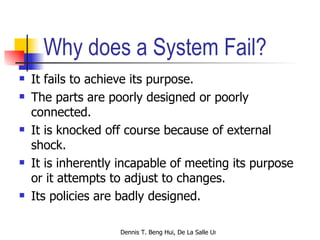
Why does a System Fail? It fails to achieve its purpose. The parts are poorly designed or poorly connected. It is knocked off course because of external shock. It is inherently incapable of meeting its purpose or it attempts to adjust to changes. Its policies are badly designed.
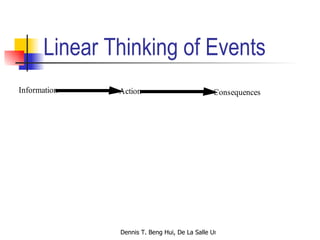
Linear Thinking of Events
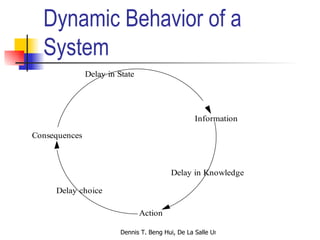
Dynamic Behavior of a System
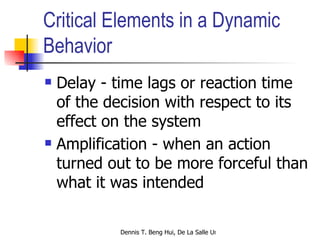
Critical Elements in a Dynamic Behavior Delay - time lags or reaction time of the decision with respect to its effect on the system Amplification - when an action turned out to be more forceful than what it was intended
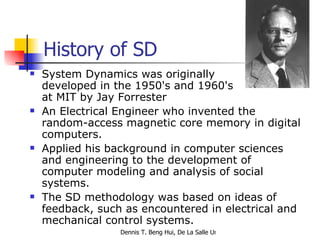
History of SD System Dynamics was originally  developed in the 1950's and 1960's  at MIT by Jay Forrester  An Electrical Engineer who invented the random-access magnetic core memory in digital computers. Applied his background in computer sciences and engineering to the development of computer modeling and analysis of social systems.  The SD methodology was based on ideas of feedback, such as encountered in electrical and mechanical control systems.
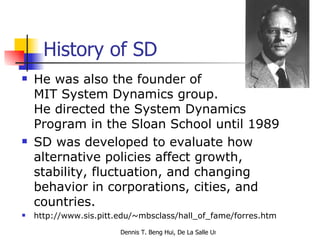
History of SD He was also the founder of  MIT System Dynamics group.  He directed the System Dynamics  Program in the Sloan School until 1989 SD was developed to evaluate how alternative policies affect growth, stability, fluctuation, and changing behavior in corporations, cities, and countries. http://www.sis.pitt.edu/~mbsclass/hall_of_fame/forres.htm
What is System Dynamics It is the investigation of information-feedback characteristics of managed systems.  The use of models for the design of improved organizational form and guiding policy.  - Jay Forrester (Founder of SD)
What is System Dynamics (SD)? Deals with the time-dependent behavior of managed systems. Aims to describe the system and understand it. (Focuses on patterns of behavior not on events). Apply qualitative and quantitative models on how information feedback govern its behavior. Designing robust information feedback structures and control policies through simulation and optimization.
SD Approach by R.G. Coyle Problem recognition Problem understanding and system description Qualitative analysis Simulation modeling and testing Policy design and testing
SD Approach by Richardson and Pugh Problem identification and definition System conceptualization Model formulation Analysis of model behavior Model evaluation Policy analysis Model use or implementation
Characteristics of a Messy Problems (Or why are problems messy?) Dynamic – “all is change” Tightly coupled – “you can’t do just one thing” Governed by feedback – “our decisions alter the state of the world” Nonlinear – “effects are rarely proportional” History-dependent – “you cannot unscramble you eggs”
Characteristics of a Messy Problems (Or why are problems messy) Self organizing – “dynamics arise from internal structure” Adaptive – “people change over time” Counterintuitive – “too focused on symptoms of difficulty rather than the underlying cause” Policy resistant – “many obvious solutions fail or worsen the situation” Characterized by trade-off – “high leverage policies cause worst to better behavior, while low leverage policies result to temporary improvement before getting worse”
Elements of a Dynamic Problem  Dynamic behavior of important variables – identify and graph those variables in the system that are the symptoms of the problems we wish to study. Time horizon – period of time over which the problem plays itself out.
Elements of a Dynamic Problem  The reference behavior mode – patterns over time that will be referred to again and again. Thinking in terms of graphs over time – looking for long-term dynamic consequences. Use graphs to describe, define, and analyze a problem.
Example of a problem statement There is a an exponential growth of people in Metro Manila from 1900 – 2000 which can lead to urban decay. There is a recurring pattern on the occurrence of Dengue Fever among young children (1 to 10 years old) in Tondo between 1990 to 2000 which led to child deaths.
Barriers to Learning Dynamic complexity Limited information Confounding variables and ambiguity Bounded rationality and the misperceptions of feedback Flawed cognitive map Erroneous inferences about dynamics Unjustified reasoning (judgmental errors and bias) Defensive routines and interpersonal impediments to to learning Implementation failure
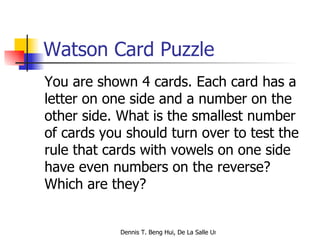
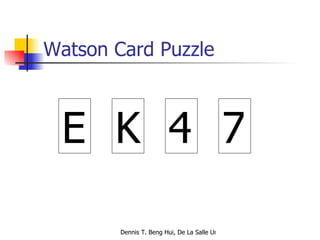
Watson Card Puzzle You are shown 4 cards. Each card has a letter on one side and a number on the other side. What is the smallest number of cards you should turn over to test the rule that cards with vowels on one side have even numbers on the reverse? Which are they?
Watson Card Puzzle E 4 7 K
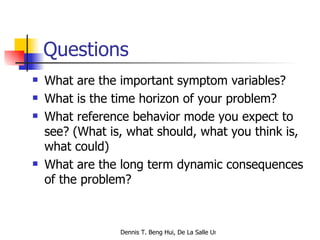
Questions What are the important symptom variables? What is the time horizon of your problem? What reference behavior mode you expect to see? (What is, what should, what you think is, what could) What are the long term dynamic consequences of the problem?
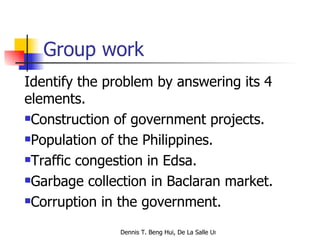
Group work Identify the problem by answering its 4 elements. Construction of government projects. Population of the Philippines. Traffic congestion in Edsa. Garbage collection in Baclaran market. Corruption in the government.
Group work Identify the problem by answering its 4 elements. Dieting Addiction Population of the World Use of Credit Card Salary/Wage Increase
Individual Work Electricity Cum GPA National Population Imported product

Introduction to System Dynamics

  • 1.
    System Dynamics Understandingsystem behavior by identifying system structure
  • 2.
    Some Phrases toPonder.. Experience is an expensive school – Benjamin Franklin Experience is something you get after you need it – anon
  • 3.
    What is aSystem? A collection of parts organized for a purpose .
  • 4.
    Why does aSystem Fail? It fails to achieve its purpose. The parts are poorly designed or poorly connected. It is knocked off course because of external shock. It is inherently incapable of meeting its purpose or it attempts to adjust to changes. Its policies are badly designed.
  • 5.
  • 6.
  • 7.
    Critical Elements ina Dynamic Behavior Delay - time lags or reaction time of the decision with respect to its effect on the system Amplification - when an action turned out to be more forceful than what it was intended
  • 8.
    History of SDSystem Dynamics was originally developed in the 1950's and 1960's at MIT by Jay Forrester An Electrical Engineer who invented the random-access magnetic core memory in digital computers. Applied his background in computer sciences and engineering to the development of computer modeling and analysis of social systems. The SD methodology was based on ideas of feedback, such as encountered in electrical and mechanical control systems.
  • 9.
    History of SDHe was also the founder of MIT System Dynamics group. He directed the System Dynamics Program in the Sloan School until 1989 SD was developed to evaluate how alternative policies affect growth, stability, fluctuation, and changing behavior in corporations, cities, and countries. http://www.sis.pitt.edu/~mbsclass/hall_of_fame/forres.htm
  • 10.
    What is SystemDynamics It is the investigation of information-feedback characteristics of managed systems. The use of models for the design of improved organizational form and guiding policy. - Jay Forrester (Founder of SD)
  • 11.
    What is SystemDynamics (SD)? Deals with the time-dependent behavior of managed systems. Aims to describe the system and understand it. (Focuses on patterns of behavior not on events). Apply qualitative and quantitative models on how information feedback govern its behavior. Designing robust information feedback structures and control policies through simulation and optimization.
  • 12.
    SD Approach byR.G. Coyle Problem recognition Problem understanding and system description Qualitative analysis Simulation modeling and testing Policy design and testing
  • 13.
    SD Approach byRichardson and Pugh Problem identification and definition System conceptualization Model formulation Analysis of model behavior Model evaluation Policy analysis Model use or implementation
  • 14.
    Characteristics of aMessy Problems (Or why are problems messy?) Dynamic – “all is change” Tightly coupled – “you can’t do just one thing” Governed by feedback – “our decisions alter the state of the world” Nonlinear – “effects are rarely proportional” History-dependent – “you cannot unscramble you eggs”
  • 15.
    Characteristics of aMessy Problems (Or why are problems messy) Self organizing – “dynamics arise from internal structure” Adaptive – “people change over time” Counterintuitive – “too focused on symptoms of difficulty rather than the underlying cause” Policy resistant – “many obvious solutions fail or worsen the situation” Characterized by trade-off – “high leverage policies cause worst to better behavior, while low leverage policies result to temporary improvement before getting worse”
  • 16.
    Elements of aDynamic Problem Dynamic behavior of important variables – identify and graph those variables in the system that are the symptoms of the problems we wish to study. Time horizon – period of time over which the problem plays itself out.
  • 17.
    Elements of aDynamic Problem The reference behavior mode – patterns over time that will be referred to again and again. Thinking in terms of graphs over time – looking for long-term dynamic consequences. Use graphs to describe, define, and analyze a problem.
  • 18.
    Example of aproblem statement There is a an exponential growth of people in Metro Manila from 1900 – 2000 which can lead to urban decay. There is a recurring pattern on the occurrence of Dengue Fever among young children (1 to 10 years old) in Tondo between 1990 to 2000 which led to child deaths.
  • 19.
    Barriers to LearningDynamic complexity Limited information Confounding variables and ambiguity Bounded rationality and the misperceptions of feedback Flawed cognitive map Erroneous inferences about dynamics Unjustified reasoning (judgmental errors and bias) Defensive routines and interpersonal impediments to to learning Implementation failure
  • 20.
    Watson Card PuzzleYou are shown 4 cards. Each card has a letter on one side and a number on the other side. What is the smallest number of cards you should turn over to test the rule that cards with vowels on one side have even numbers on the reverse? Which are they?
  • 21.
  • 22.
    Questions What arethe important symptom variables? What is the time horizon of your problem? What reference behavior mode you expect to see? (What is, what should, what you think is, what could) What are the long term dynamic consequences of the problem?
  • 23.
    Group work Identifythe problem by answering its 4 elements. Construction of government projects. Population of the Philippines. Traffic congestion in Edsa. Garbage collection in Baclaran market. Corruption in the government.
  • 24.
    Group work Identifythe problem by answering its 4 elements. Dieting Addiction Population of the World Use of Credit Card Salary/Wage Increase
  • 25.
    Individual Work ElectricityCum GPA National Population Imported product