1
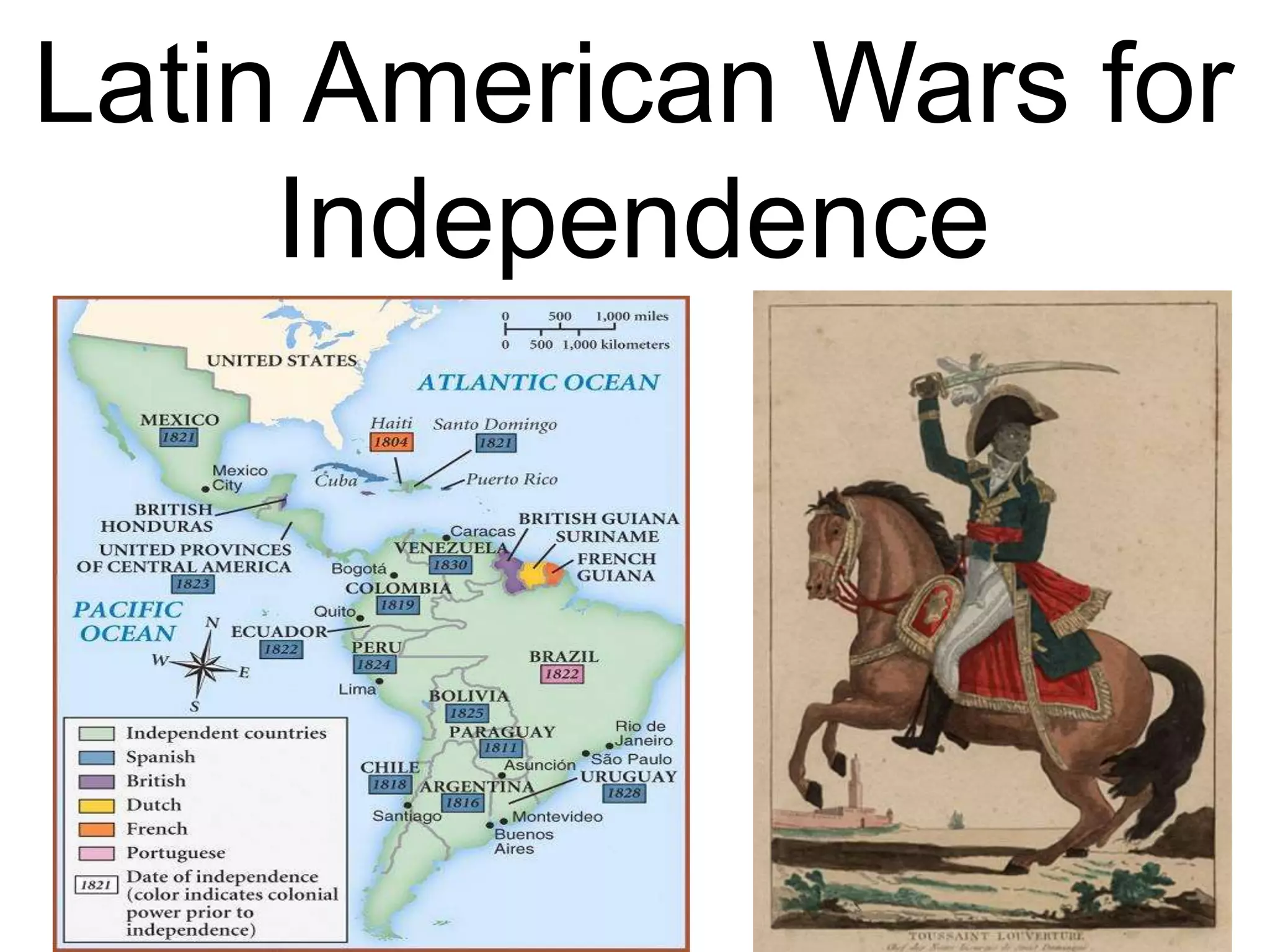
Latin American Wars for
Independence
2
Haiti
Ruling Country:Cause/Inspiration to Revolt:
Revolutionary Leader:
Effects/Dates:
Spain & France
- French Revolution
- Competition over sugar economy;
- whites vs. free blacks
- slaves revolt
Toussaint L’Ouverture
“I was born a slave, but nature gave me a soul of a free man….”
Liberated slaves on French & Spanish
sides; Napoleon sent troops; L’Ouverture
was captured; 1804 - French go home
1804 = Haitian Independence
3
Venezuela, Bolivia, Colombia, Ecuador
Ruling Country:Cause/Inspiration to Revolt:
Revolutionary Leader:
Effects/Dates:
Spain
- Enlightenment
- Injustice of Spanish rule
- Fight for all rights
Simon Bolivar – “The Liberator”
-1819-1825; controlled NW S. Amer.:
Venezuela, Colombia, Bolivia, Ecuador & Peru
= Gran Colombia
Dream of Unified S. Amer. failed
- Joined with San Martin
4
Bolivar’s Gran Colombia
The Fragmentation of
Bolivar’s Gran Colombia
Weakness of “Regionalism”
5
Argentina, Chile, Uruguay, Paraguay
Ruling Country:Cause/Inspiration to Revolt:
Revolutionary Leader:
Effects/Dates:
Spain
General turned revolutionary
Freedom from Spanish
Join efforts with Bolivar
Jose de San Martin
- 1820: Freed Argentina, Chile, Uruguay,
Paraguay
- Liberated Southern South America
6
Brazil
Ruling Country:Cause/Inspiration to Revolt:
Revolutionary Leader:
Effects/Dates:
Portugal
-Independence movement
-Portuguese Prince declares
Independence
Prince Pedro; Pedro I
-1822: Prince Pedro became Pedro I – 1st ruler
of the Empire of Brazil
-Constitutional monarchy established
“…if Brazil starts to demand independence, make sure you are
the one to proclaim it.” – King John VI of Portugal -1820
7
Mexico
Ruling Country:Cause/Inspiration to Revolt:
Revolutionary Leader:
Effects/Dates:
Spain
-Independence movement begun by a
catholic priest: Miguel Hidalgo
-Social justice for Indians, Mestizos, slaves
-Constitutional rule
-He is killed by conservative Creoles
Miguel Hidalgo “Father of Mexico”
-1810 – Hidalgo started movement that would
bring independence to Mexico
-1821 - Independence comes under Creole
dictator
- 1823 – Mexican Republic declared
Common Patterns to
Latin American Wars for Independence
Led by upper-
class colonial
elites = Creoles
(except Haiti-
slave revolt)
Benefitted from
Napoleon’s
conquest of Spain
& Portugal
Inspired by
French and
American
Revolutions
Leaders educated
in Enlightenment
ideas
Independence
was successful…
nation building
was not
Review tip: Review
analytically; ask yourself why?
Or how? Or Impact of?
10
Common Patterns to Latin American Wars for Independence
Revolution in- class project
• 1. Create a poster highlighting a revolution.
– Heading
– Catchy slogan
– Background and region
– Driving ideologies/goals
– Key player/s and groups
– Results
• 2. Create a 1-2 minute skit highlighting the key
concepts of the particular revolution.
– 1-2 minutes
– Need written script
– Need to clearly reference/address specific content
– Needs to be clearly informative
Critical Intro:
• The Monroe Doctrine: Imperialism or
Isolationism? Explain.
12
Critical Intro:
• Describe “regionalism” and the
impacts of it, in the context of the
Latin American revolutions.
13
14
15
16
17
Cuba
I. 1868 – Cuba fights for independence in a 10 year war against Spain
a. Islands in ruin, Cuba gave up
b. Many Cubans forced into concentration camps
c. Americans join fight for Cuba
II. Spanish American War
a. Lasted four months, Spain gave up easily
b. Between Spain and Untied States/Mexico/Islands
c. 1901 Cuba became an independent country (by name)
i. However, the U.S. set up a government in Cuba
d. Spain also turned over Puerto Rico, Guam, and the
Philippines to the U.S.
III. Panama Canal – built over 10 years by U.S.
The United States
 After revolution – will have Civil War, which will
accelerate industrialization in U.S.
◦ Will attract immigrants
 Continental Railroad – move west
Canada
 Did not experience a war for independence
 Remained a British colony until 1867 –
independence came slowly through series of
agreements with Britain
◦ Dominion of Canada – self governing political system officially tied to
Great Britain
 Disagreements between French and English
settlers
Latin America
 Latin American countries fragmented and had
problems establishing the legitimacy of their
central governments
 Dissolved into numerous independent states
◦ Regionalism = identity with a particular region rather
than large area
 Leaders emerged – Creole elites
◦ Those that disagreed with decisions were met with
violence
◦ Leaders who gathered large armies became known as
caudillos
◦ Juan Manual de Rosas, Benito Juarez and Porfirio Diaz
Latin America cont.
 Lack of political institutions led to instability in
Latin American governments
◦ Limited economic development – dependent on other
countries for manufactured goods
 Foreign investment in 19th century
◦ Led to some advancements
23
24
Greek Independence from Ottoman Empire

Latin American Revolution Movements

  • 1.
    1 Latin American Warsfor Independence
  • 2.
    2 Haiti Ruling Country:Cause/Inspiration toRevolt: Revolutionary Leader: Effects/Dates: Spain & France - French Revolution - Competition over sugar economy; - whites vs. free blacks - slaves revolt Toussaint L’Ouverture “I was born a slave, but nature gave me a soul of a free man….” Liberated slaves on French & Spanish sides; Napoleon sent troops; L’Ouverture was captured; 1804 - French go home 1804 = Haitian Independence
  • 3.
    3 Venezuela, Bolivia, Colombia,Ecuador Ruling Country:Cause/Inspiration to Revolt: Revolutionary Leader: Effects/Dates: Spain - Enlightenment - Injustice of Spanish rule - Fight for all rights Simon Bolivar – “The Liberator” -1819-1825; controlled NW S. Amer.: Venezuela, Colombia, Bolivia, Ecuador & Peru = Gran Colombia Dream of Unified S. Amer. failed - Joined with San Martin
  • 4.
    4 Bolivar’s Gran Colombia TheFragmentation of Bolivar’s Gran Colombia Weakness of “Regionalism”
  • 5.
    5 Argentina, Chile, Uruguay,Paraguay Ruling Country:Cause/Inspiration to Revolt: Revolutionary Leader: Effects/Dates: Spain General turned revolutionary Freedom from Spanish Join efforts with Bolivar Jose de San Martin - 1820: Freed Argentina, Chile, Uruguay, Paraguay - Liberated Southern South America
  • 6.
    6 Brazil Ruling Country:Cause/Inspiration toRevolt: Revolutionary Leader: Effects/Dates: Portugal -Independence movement -Portuguese Prince declares Independence Prince Pedro; Pedro I -1822: Prince Pedro became Pedro I – 1st ruler of the Empire of Brazil -Constitutional monarchy established “…if Brazil starts to demand independence, make sure you are the one to proclaim it.” – King John VI of Portugal -1820
  • 7.
    7 Mexico Ruling Country:Cause/Inspiration toRevolt: Revolutionary Leader: Effects/Dates: Spain -Independence movement begun by a catholic priest: Miguel Hidalgo -Social justice for Indians, Mestizos, slaves -Constitutional rule -He is killed by conservative Creoles Miguel Hidalgo “Father of Mexico” -1810 – Hidalgo started movement that would bring independence to Mexico -1821 - Independence comes under Creole dictator - 1823 – Mexican Republic declared
  • 8.
    Common Patterns to LatinAmerican Wars for Independence Led by upper- class colonial elites = Creoles (except Haiti- slave revolt) Benefitted from Napoleon’s conquest of Spain & Portugal Inspired by French and American Revolutions Leaders educated in Enlightenment ideas Independence was successful… nation building was not Review tip: Review analytically; ask yourself why? Or how? Or Impact of?
  • 10.
    10 Common Patterns toLatin American Wars for Independence
  • 11.
    Revolution in- classproject • 1. Create a poster highlighting a revolution. – Heading – Catchy slogan – Background and region – Driving ideologies/goals – Key player/s and groups – Results • 2. Create a 1-2 minute skit highlighting the key concepts of the particular revolution. – 1-2 minutes – Need written script – Need to clearly reference/address specific content – Needs to be clearly informative
  • 12.
    Critical Intro: • TheMonroe Doctrine: Imperialism or Isolationism? Explain. 12
  • 13.
    Critical Intro: • Describe“regionalism” and the impacts of it, in the context of the Latin American revolutions. 13
  • 14.
  • 15.
  • 16.
  • 17.
  • 18.
    Cuba I. 1868 –Cuba fights for independence in a 10 year war against Spain a. Islands in ruin, Cuba gave up b. Many Cubans forced into concentration camps c. Americans join fight for Cuba II. Spanish American War a. Lasted four months, Spain gave up easily b. Between Spain and Untied States/Mexico/Islands c. 1901 Cuba became an independent country (by name) i. However, the U.S. set up a government in Cuba d. Spain also turned over Puerto Rico, Guam, and the Philippines to the U.S. III. Panama Canal – built over 10 years by U.S.
  • 19.
    The United States After revolution – will have Civil War, which will accelerate industrialization in U.S. ◦ Will attract immigrants  Continental Railroad – move west
  • 20.
    Canada  Did notexperience a war for independence  Remained a British colony until 1867 – independence came slowly through series of agreements with Britain ◦ Dominion of Canada – self governing political system officially tied to Great Britain  Disagreements between French and English settlers
  • 21.
    Latin America  LatinAmerican countries fragmented and had problems establishing the legitimacy of their central governments  Dissolved into numerous independent states ◦ Regionalism = identity with a particular region rather than large area  Leaders emerged – Creole elites ◦ Those that disagreed with decisions were met with violence ◦ Leaders who gathered large armies became known as caudillos ◦ Juan Manual de Rosas, Benito Juarez and Porfirio Diaz
  • 22.
    Latin America cont. Lack of political institutions led to instability in Latin American governments ◦ Limited economic development – dependent on other countries for manufactured goods  Foreign investment in 19th century ◦ Led to some advancements
  • 23.
  • 24.