Shoulder Examination
Prepared by:
Sunil Baniya
Student, NAIHS-COM
sanobharayang, ktm
1Shoulder examination/ Sunil Baniya
Chief complaints:
 Pain
 Swelling
 Deformity
 Stiffness
 Instability
 Weakness
 Loss of function
2Shoulder examination/ Sunil Baniya
 Examination is done either in sitting or standing position with sufficient
exposure.
1. Look :
Front
 Head, neck alignment
 Shoulder symmetry
 Prominent AC joint/ swelling
 Fullness of supra-clavicular area
 Wasting of deltoid
3Shoulder examination/ Sunil Baniya
 Axillary area
 Any sinus, scars, swelling
 Arm position
 Small muscles of hand
Side
 Wasting of supraspinatus & infraspinatus
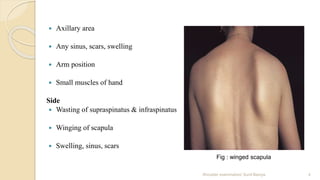
 Winging of scapula
 Swelling, sinus, scars
Shoulder examination/ Sunil Baniya 4
Fig : winged scapula
Back
 Wasting of deltoid
 Drooping of shoulder
2. Feel :
a. Temperature:
- Periphery to centre or proximal to distal
b. Tenderness:
 For tenderness palpate over
- Sterno-clavicular joint
- Along clavicle
5Shoulder examination/ Sunil Baniya
- Acromio-clavicular joint
- Spine of scapula
- Borders
- Shoulder joint line
- Coracoid process
- Biceps tendon in bicipital groove (arm flexion, elbow flexion at 90°, then
internally/ externally rotate & palpate)
- In axilla palpate humeral head
- Fullness of inferior recess in shoulder effusion
6Shoulder examination/ Sunil Baniya
3. Movement:
 Active movement (passive movement need not to be done)
- Flexion : 0- 160/ 180°
- Extension : 0- 180°
- Adduction : 0-15° (cross arm)
- Abduction : 0-180°
*First 15° = supraspinatus
*15-90° = deltoid
*>90° = serratous anterior
7Shoulder examination/ Sunil Baniya
- Internal rotation : 15° (touches inferior border of opposite scapula or thumb
touches upto T5 spine)
- External rotation : 60°
(Rotational movement at various position)
4. Special Tests:
a. Impingement tests:
i) Painful arc test
ii) Neer’s impingement test
iii) Hawkin’s / Hawkin Kennedy test
iv) Jobe’s test/ Empty can test
8Shoulder examination/ Sunil Baniya
b. For Rotator cuff tendon tear:
i) Drop arm test
ii) Lift off test/ Gerber’s test
c. For Rotator cuff instability:
i) Apprehension test
ii) Jobe’s relocation test
iii) Sulcus test
9Shoulder examination/ Sunil Baniya
Painful arc test:
 for painful arc syndrome
 shoulder pain occurring at 60-120° of arc
 Described when arm is abducted from the side
to fully raised position
 +ve in supraspinatus tendinitis
10Shoulder examination/ Sunil Baniya
During active abduction, the scapulohumeral rhythm is disturbed on the right and
the patient starts to experience pain at about 60 degrees (a). As the arm passes
beyond 120 degrees (b) the pain eases and the patient is able to abduct and elevate
up to the full 180 degrees
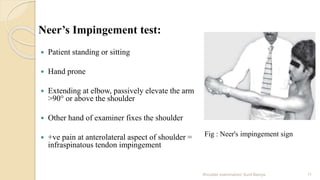
Neer’s Impingement test:
 Patient standing or sitting
 Hand prone
 Extending at elbow, passively elevate the arm
>90° or above the shoulder
 Other hand of examiner fixes the shoulder
 +ve pain at anterolateral aspect of shoulder =
infraspinatous tendon impingement
Shoulder examination/ Sunil Baniya 11
Fig : Neer's impingement sign
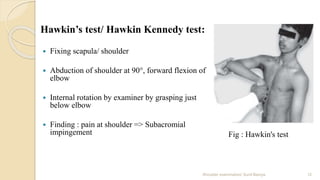
Hawkin’s test/ Hawkin Kennedy test:
 Fixing scapula/ shoulder
 Abduction of shoulder at 90°, forward flexion of
elbow
 Internal rotation by examiner by grasping just
below elbow
 Finding : pain at shoulder => Subacromial
impingement
12Shoulder examination/ Sunil Baniya
Fig : Hawkin's test
Jobe’s test/ Empty Can test:
 Patient standing
 Arm forwardly flexed at the level of shoulder
 Fully pronate arm into empty can position
 Ask patient to resist downward force applied
 Finding : pain or weakness => Supraspinatus tendon lesion
Shoulder examination/ Sunil Baniya 13
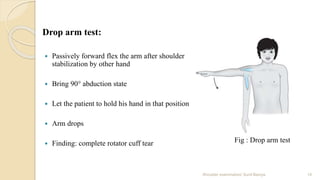
Drop arm test:
 Passively forward flex the arm after shoulder
stabilization by other hand
 Bring 90° abduction state
 Let the patient to hold his hand in that position
 Arm drops
 Finding: complete rotator cuff tear
14Shoulder examination/ Sunil Baniya
Fig : Drop arm test
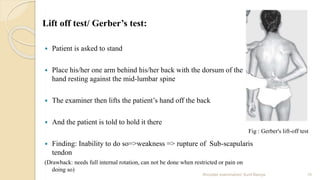
Lift off test/ Gerber’s test:
 Patient is asked to stand
 Place his/her one arm behind his/her back with the dorsum of the
hand resting against the mid-lumbar spine
 The examiner then lifts the patient’s hand off the back
 And the patient is told to hold it there
 Finding: Inability to do so=>weakness => rupture of Sub-scapularis
tendon
(Drawback: needs full internal rotation, can not be done when restricted or pain on
doing so)
Shoulder examination/ Sunil Baniya 15
Fig : Gerber's lift-off test
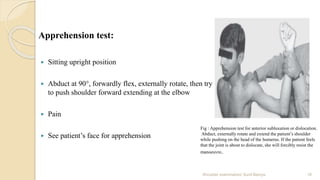
Apprehension test:
 Sitting upright position
 Abduct at 90°, forwardly flex, externally rotate, then try
to push shoulder forward extending at the elbow
 Pain
 See patient’s face for apprehension
16Shoulder examination/ Sunil Baniya
Fig : Apprehension test for anterior subluxation or dislocation.
Abduct, externally rotate and extend the patient’s shoulder
while pushing on the head of the humerus. If the patient feels
that the joint is about to dislocate, she will forcibly resist the
manoeuvre.
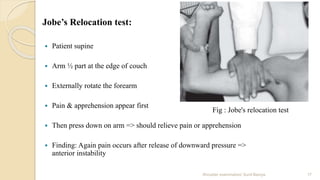
Jobe’s Relocation test:
 Patient supine
 Arm ½ part at the edge of couch
 Externally rotate the forearm
 Pain & apprehension appear first
 Then press down on arm => should relieve pain or apprehension
 Finding: Again pain occurs after release of downward pressure =>
anterior instability
17Shoulder examination/ Sunil Baniya
Fig : Jobe's relocation test
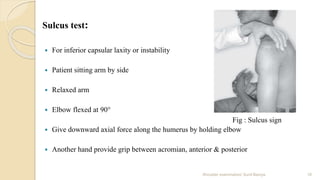
Sulcus test:
 For inferior capsular laxity or instability
 Patient sitting arm by side
 Relaxed arm
 Elbow flexed at 90°
 Give downward axial force along the humerus by holding elbow
 Another hand provide grip between acromian, anterior & posterior
18Shoulder examination/ Sunil Baniya
Fig : Sulcus sign
OR,
 Arm forward flexion at 90°
 Elbow bent at 90° & internally rotated
 Finding: sulcus appear between acromial arch and humeral head => test the degree
of inferior capsular laxity
Shoulder examination/ Sunil Baniya 19
5. Measurement:
 Take only either of two bony points as reference for girth/bulk of humerus i.e;
acromian or lateral epicondyle of humerus
6. Axillary lymph nodes
7. Cervical spines
8. Distal Neurovascular Status (DNVS)
 Radial pulse
 Sensory examination (autonomous zone of radial, median & ulnar nerve)
 Motor examination (5 groups = C5, C6, C7, C8, T1)
20Shoulder examination/ Sunil Baniya
 C5 = elbow flexion
 C6 = wrist extension
 C7= wrist flexion, finger extension
 C8 = finger flexion
 T1 = finger abduction
21Shoulder examination/ Sunil Baniya
Thank You
22Shoulder examination/ Sunil Baniya

Shoulder examination

  • 1.
    Shoulder Examination Prepared by: SunilBaniya Student, NAIHS-COM sanobharayang, ktm 1Shoulder examination/ Sunil Baniya
  • 2.
    Chief complaints:  Pain Swelling  Deformity  Stiffness  Instability  Weakness  Loss of function 2Shoulder examination/ Sunil Baniya
  • 3.
     Examination isdone either in sitting or standing position with sufficient exposure. 1. Look : Front  Head, neck alignment  Shoulder symmetry  Prominent AC joint/ swelling  Fullness of supra-clavicular area  Wasting of deltoid 3Shoulder examination/ Sunil Baniya
  • 4.
     Axillary area Any sinus, scars, swelling  Arm position  Small muscles of hand Side  Wasting of supraspinatus & infraspinatus  Winging of scapula  Swelling, sinus, scars Shoulder examination/ Sunil Baniya 4 Fig : winged scapula
  • 5.
    Back  Wasting ofdeltoid  Drooping of shoulder 2. Feel : a. Temperature: - Periphery to centre or proximal to distal b. Tenderness:  For tenderness palpate over - Sterno-clavicular joint - Along clavicle 5Shoulder examination/ Sunil Baniya
  • 6.
    - Acromio-clavicular joint -Spine of scapula - Borders - Shoulder joint line - Coracoid process - Biceps tendon in bicipital groove (arm flexion, elbow flexion at 90°, then internally/ externally rotate & palpate) - In axilla palpate humeral head - Fullness of inferior recess in shoulder effusion 6Shoulder examination/ Sunil Baniya
  • 7.
    3. Movement:  Activemovement (passive movement need not to be done) - Flexion : 0- 160/ 180° - Extension : 0- 180° - Adduction : 0-15° (cross arm) - Abduction : 0-180° *First 15° = supraspinatus *15-90° = deltoid *>90° = serratous anterior 7Shoulder examination/ Sunil Baniya
  • 8.
    - Internal rotation: 15° (touches inferior border of opposite scapula or thumb touches upto T5 spine) - External rotation : 60° (Rotational movement at various position) 4. Special Tests: a. Impingement tests: i) Painful arc test ii) Neer’s impingement test iii) Hawkin’s / Hawkin Kennedy test iv) Jobe’s test/ Empty can test 8Shoulder examination/ Sunil Baniya
  • 9.
    b. For Rotatorcuff tendon tear: i) Drop arm test ii) Lift off test/ Gerber’s test c. For Rotator cuff instability: i) Apprehension test ii) Jobe’s relocation test iii) Sulcus test 9Shoulder examination/ Sunil Baniya
  • 10.
    Painful arc test: for painful arc syndrome  shoulder pain occurring at 60-120° of arc  Described when arm is abducted from the side to fully raised position  +ve in supraspinatus tendinitis 10Shoulder examination/ Sunil Baniya During active abduction, the scapulohumeral rhythm is disturbed on the right and the patient starts to experience pain at about 60 degrees (a). As the arm passes beyond 120 degrees (b) the pain eases and the patient is able to abduct and elevate up to the full 180 degrees
  • 11.
    Neer’s Impingement test: Patient standing or sitting  Hand prone  Extending at elbow, passively elevate the arm >90° or above the shoulder  Other hand of examiner fixes the shoulder  +ve pain at anterolateral aspect of shoulder = infraspinatous tendon impingement Shoulder examination/ Sunil Baniya 11 Fig : Neer's impingement sign
  • 12.
    Hawkin’s test/ HawkinKennedy test:  Fixing scapula/ shoulder  Abduction of shoulder at 90°, forward flexion of elbow  Internal rotation by examiner by grasping just below elbow  Finding : pain at shoulder => Subacromial impingement 12Shoulder examination/ Sunil Baniya Fig : Hawkin's test
  • 13.
    Jobe’s test/ EmptyCan test:  Patient standing  Arm forwardly flexed at the level of shoulder  Fully pronate arm into empty can position  Ask patient to resist downward force applied  Finding : pain or weakness => Supraspinatus tendon lesion Shoulder examination/ Sunil Baniya 13
  • 14.
    Drop arm test: Passively forward flex the arm after shoulder stabilization by other hand  Bring 90° abduction state  Let the patient to hold his hand in that position  Arm drops  Finding: complete rotator cuff tear 14Shoulder examination/ Sunil Baniya Fig : Drop arm test
  • 15.
    Lift off test/Gerber’s test:  Patient is asked to stand  Place his/her one arm behind his/her back with the dorsum of the hand resting against the mid-lumbar spine  The examiner then lifts the patient’s hand off the back  And the patient is told to hold it there  Finding: Inability to do so=>weakness => rupture of Sub-scapularis tendon (Drawback: needs full internal rotation, can not be done when restricted or pain on doing so) Shoulder examination/ Sunil Baniya 15 Fig : Gerber's lift-off test
  • 16.
    Apprehension test:  Sittingupright position  Abduct at 90°, forwardly flex, externally rotate, then try to push shoulder forward extending at the elbow  Pain  See patient’s face for apprehension 16Shoulder examination/ Sunil Baniya Fig : Apprehension test for anterior subluxation or dislocation. Abduct, externally rotate and extend the patient’s shoulder while pushing on the head of the humerus. If the patient feels that the joint is about to dislocate, she will forcibly resist the manoeuvre.
  • 17.
    Jobe’s Relocation test: Patient supine  Arm ½ part at the edge of couch  Externally rotate the forearm  Pain & apprehension appear first  Then press down on arm => should relieve pain or apprehension  Finding: Again pain occurs after release of downward pressure => anterior instability 17Shoulder examination/ Sunil Baniya Fig : Jobe's relocation test
  • 18.
    Sulcus test:  Forinferior capsular laxity or instability  Patient sitting arm by side  Relaxed arm  Elbow flexed at 90°  Give downward axial force along the humerus by holding elbow  Another hand provide grip between acromian, anterior & posterior 18Shoulder examination/ Sunil Baniya Fig : Sulcus sign
  • 19.
    OR,  Arm forwardflexion at 90°  Elbow bent at 90° & internally rotated  Finding: sulcus appear between acromial arch and humeral head => test the degree of inferior capsular laxity Shoulder examination/ Sunil Baniya 19
  • 20.
    5. Measurement:  Takeonly either of two bony points as reference for girth/bulk of humerus i.e; acromian or lateral epicondyle of humerus 6. Axillary lymph nodes 7. Cervical spines 8. Distal Neurovascular Status (DNVS)  Radial pulse  Sensory examination (autonomous zone of radial, median & ulnar nerve)  Motor examination (5 groups = C5, C6, C7, C8, T1) 20Shoulder examination/ Sunil Baniya
  • 21.
     C5 =elbow flexion  C6 = wrist extension  C7= wrist flexion, finger extension  C8 = finger flexion  T1 = finger abduction 21Shoulder examination/ Sunil Baniya
  • 22.