Incidence and Prevalence Measures of Disease Frequency Ayman Abou Mehrem, MD, CABP Neonatology Academic Day March 24, 2010
Objectives Importance of Measures of Disease Frequency Prevalence Incidence Relationship Between Prevalence and Incidence Stratification of Disease Frequency by Person, Place, and Time
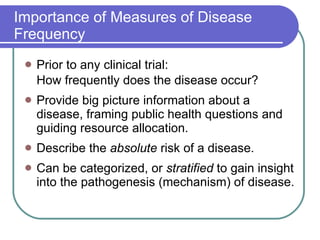
Importance of Measures of Disease Frequency Prior to any clinical trial: How frequently does the disease occur? Provide big picture information about a disease, framing public health questions and guiding resource allocation. Describe the  absolute  risk of a disease. Can be categorized, or  stratified  to gain insight into the pathogenesis (mechanism) of disease.
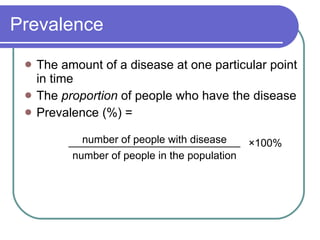
Prevalence The amount of a disease at one particular point in time The  proportion  of people who have the disease Prevalence (%) = Ă—100% number of people with disease _____________________________ number of people in the population
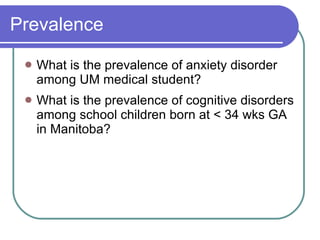
Prevalence What is the prevalence of anxiety disorder among UM medical student? What is the prevalence of cognitive disorders among school children born at < 34 wks GA in Manitoba?
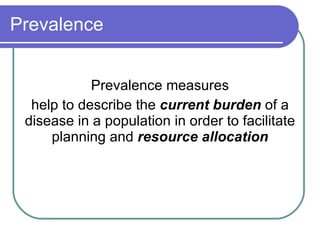
Prevalence Prevalence measures help to describe the  current burden  of a disease in a population in order to facilitate planning and  resource allocation
Incidence The number of  new  cases of disease that develop over time
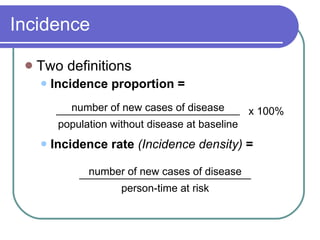
Incidence Two definitions Incidence proportion = x 100% Incidence rate   (Incidence density)   = number of new cases of disease _______________________________ population without disease at baseline number of new cases of disease _____________________________ person-time at risk
Incidence What is the incidence of influenza infection among UM medical students (500 students) during a 3-month period from January through March 2009? Time-at-Risk concept
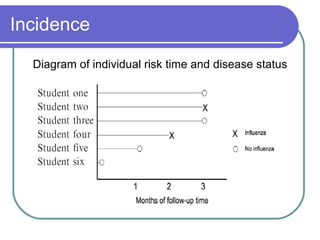
Incidence Diagram of individual risk time and disease status
Incidence Incidence measures help to provide clues as to the  cause  or  development  of a disease
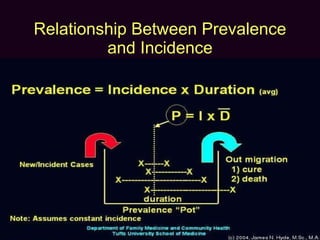
Relationship Between Prevalence and Incidence
Stratification Refers to the process of separating analysis by subgroups. Stratification can be by: Personal Characteristics:  age, race/ethnicity, sex Geography Time periods
Reference Epidemiology and Biostatistics: An Introduction to Clinical Research Bryan Kestenbaum; editors, K. Adeney, N. Weiss ; contributing author, Abigail B. Shoben Springer Science+Business Media, LLC 2009

Incidence And Prevalence

  • 1.
    Incidence and PrevalenceMeasures of Disease Frequency Ayman Abou Mehrem, MD, CABP Neonatology Academic Day March 24, 2010
  • 2.
    Objectives Importance ofMeasures of Disease Frequency Prevalence Incidence Relationship Between Prevalence and Incidence Stratification of Disease Frequency by Person, Place, and Time
  • 3.
    Importance of Measuresof Disease Frequency Prior to any clinical trial: How frequently does the disease occur? Provide big picture information about a disease, framing public health questions and guiding resource allocation. Describe the absolute risk of a disease. Can be categorized, or stratified to gain insight into the pathogenesis (mechanism) of disease.
  • 4.
    Prevalence The amountof a disease at one particular point in time The proportion of people who have the disease Prevalence (%) = Ă—100% number of people with disease _____________________________ number of people in the population
  • 5.
    Prevalence What isthe prevalence of anxiety disorder among UM medical student? What is the prevalence of cognitive disorders among school children born at < 34 wks GA in Manitoba?
  • 6.
    Prevalence Prevalence measureshelp to describe the current burden of a disease in a population in order to facilitate planning and resource allocation
  • 7.
    Incidence The numberof new cases of disease that develop over time
  • 8.
    Incidence Two definitionsIncidence proportion = x 100% Incidence rate (Incidence density) = number of new cases of disease _______________________________ population without disease at baseline number of new cases of disease _____________________________ person-time at risk
  • 9.
    Incidence What isthe incidence of influenza infection among UM medical students (500 students) during a 3-month period from January through March 2009? Time-at-Risk concept
  • 10.
    Incidence Diagram ofindividual risk time and disease status
  • 11.
    Incidence Incidence measureshelp to provide clues as to the cause or development of a disease
  • 12.
  • 13.
    Stratification Refers tothe process of separating analysis by subgroups. Stratification can be by: Personal Characteristics: age, race/ethnicity, sex Geography Time periods
  • 14.
    Reference Epidemiology andBiostatistics: An Introduction to Clinical Research Bryan Kestenbaum; editors, K. Adeney, N. Weiss ; contributing author, Abigail B. Shoben Springer Science+Business Media, LLC 2009