PRESENT SIMPLE
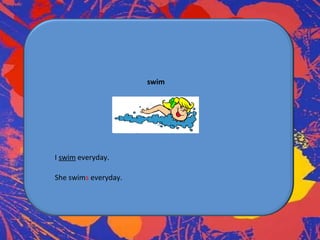
swim

I swim everyday.
She swims everyday.
Now, it’s your turn :
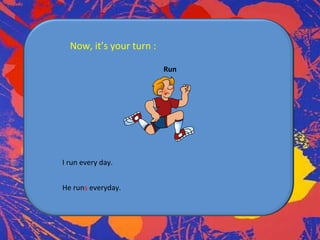
Run

I run every day.
He runs everyday.
Verb : play the piano on Mondays
AFFIRMATIVE
I play the piano on Mondays.

FORM :

You play the piano on Mondays.

Subject +Verb

He plays the piano on Mondays.
We play the piano on Mondays.
You play the piano on Mondays.
They play the piano on Mondays.

He /she /it + Verb + S
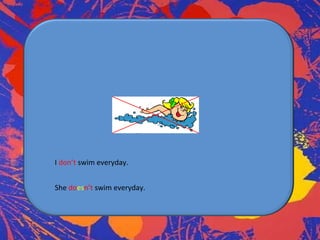
I don’t swim everyday.
She doesn’t swim everyday.
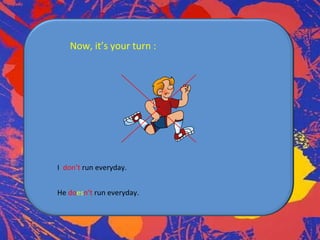
Now, it’s your turn :

I don’t run everyday.
He doesn’t run everyday.
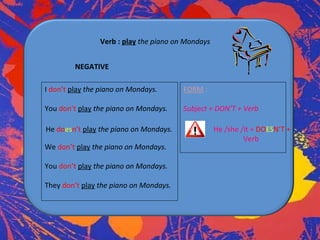
Verb : play the piano on Mondays
NEGATIVE
I don’t play the piano on Mondays.

FORM :

You don’t play the piano on Mondays.

Subject + DON’T + Verb

He doesn’t play the piano on Mondays.
We don’t play the piano on Mondays.
You don’t play the piano on Mondays.
They don’t play the piano on Mondays.

He /she /it + DOESN’T +
Verb
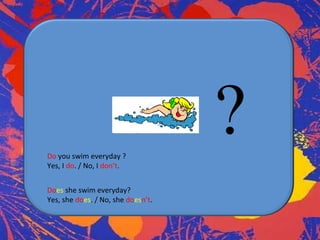
Do you swim everyday ?
Yes, I do. / No, I don’t.
Does she swim everyday?
Yes, she does. / No, she doesn’t.
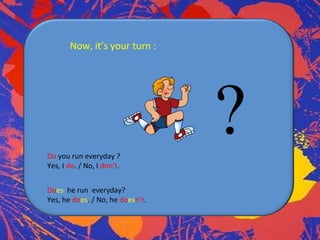
Now, it’s your turn :

Do you run everyday ?
Yes, I do. / No, I don’t.
Does he run everyday?
Yes, he does. / No, he doesn’t.
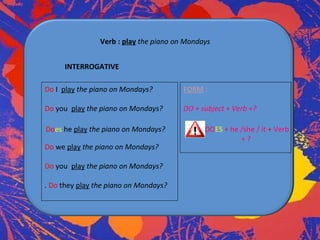
Verb : play the piano on Mondays
INTERROGATIVE
Do I play the piano on Mondays?

FORM :

Do you play the piano on Mondays?

DO + subject + Verb +?

Does he play the piano on Mondays?
Do we play the piano on Mondays?
Do you play the piano on Mondays?
. Do they play the piano on Mondays?

DOES + he /she / it + Verb
+?
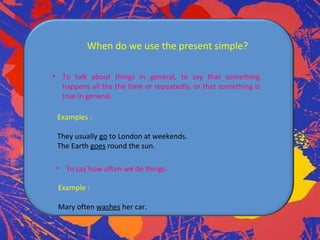
When do we use the present simple?
• To talk about things in general, to say that something
happens all the the time or repeatedly, or that something is
true in general.
Examples :
They usually go to London at weekends.
The Earth goes round the sun.
• To say how often we do things.
Example :
Mary often washes her car.
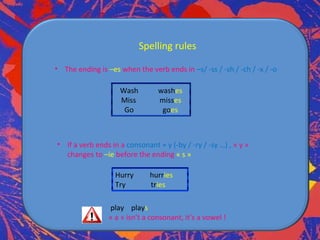
Spelling rules
• The ending is –es when the verb ends in –s/ -ss / -sh / -ch / -x / -o
Wash
Miss
Go

washes
misses
goes

• If a verb ends in a consonant + y (-by / -ry / -sy …) , « y »
changes to –ie before the ending « s »
Hurry
Try

hurries
tries

play plays
« a » isn’t a consonant, it’s a vowel !

Present simple-powerpoint-presentation

  • 1.
  • 2.
  • 3.
    Now, it’s yourturn : Run I run every day. He runs everyday.
  • 4.
    Verb : playthe piano on Mondays AFFIRMATIVE I play the piano on Mondays. FORM : You play the piano on Mondays. Subject +Verb He plays the piano on Mondays. We play the piano on Mondays. You play the piano on Mondays. They play the piano on Mondays. He /she /it + Verb + S
  • 5.
    I don’t swimeveryday. She doesn’t swim everyday.
  • 6.
    Now, it’s yourturn : I don’t run everyday. He doesn’t run everyday.
  • 7.
    Verb : playthe piano on Mondays NEGATIVE I don’t play the piano on Mondays. FORM : You don’t play the piano on Mondays. Subject + DON’T + Verb He doesn’t play the piano on Mondays. We don’t play the piano on Mondays. You don’t play the piano on Mondays. They don’t play the piano on Mondays. He /she /it + DOESN’T + Verb
  • 8.
    Do you swimeveryday ? Yes, I do. / No, I don’t. Does she swim everyday? Yes, she does. / No, she doesn’t.
  • 9.
    Now, it’s yourturn : Do you run everyday ? Yes, I do. / No, I don’t. Does he run everyday? Yes, he does. / No, he doesn’t.
  • 10.
    Verb : playthe piano on Mondays INTERROGATIVE Do I play the piano on Mondays? FORM : Do you play the piano on Mondays? DO + subject + Verb +? Does he play the piano on Mondays? Do we play the piano on Mondays? Do you play the piano on Mondays? . Do they play the piano on Mondays? DOES + he /she / it + Verb +?
  • 11.
    When do weuse the present simple? • To talk about things in general, to say that something happens all the the time or repeatedly, or that something is true in general. Examples : They usually go to London at weekends. The Earth goes round the sun. • To say how often we do things. Example : Mary often washes her car.
  • 12.
    Spelling rules • Theending is –es when the verb ends in –s/ -ss / -sh / -ch / -x / -o Wash Miss Go washes misses goes • If a verb ends in a consonant + y (-by / -ry / -sy …) , « y » changes to –ie before the ending « s » Hurry Try hurries tries play plays « a » isn’t a consonant, it’s a vowel !