Presenter Dr Anurag Yadav
Post-graduate, biochemistry
Father Muller Medical college
Dr Anurag yadav,Bio-FMMC1
ELECTROPHORESIS
Capillary electrophoresis
Dr Anurag yadav,Bio-FMMC2
Technique first described by- Jorgensen and
Lukacs (1980’s)
 Also referred as
 High performance capillary electrophoresis(HPCE)
 Capillary zone electrophoresis (CZE)
 Free solution capillary electrophoresis (FSCE)
 Capillary electrophoresis (CE)
Dr Anurag yadav,Bio-FMMC3
 The sensitivity has made it as one of the choice
for many biomedical and clinical analyses.
Application : used to separate
Amino
acids
Peptides Proteins
DNA
fragments
Nucleic
acid
Drugs /
even
metals.
Dr Anurag yadav,Bio-FMMC4
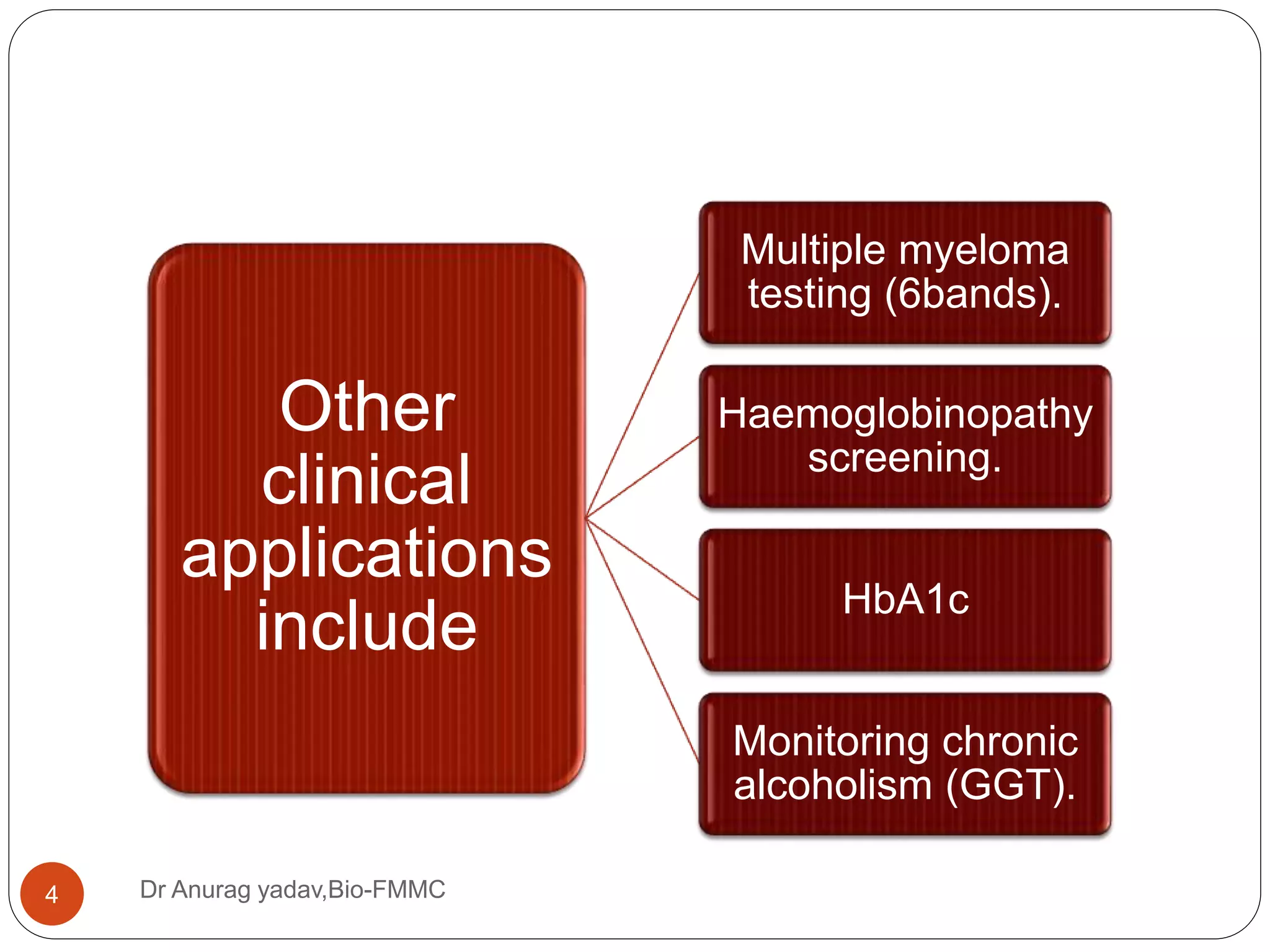
Other
clinical
applications
include
Multiple myeloma
testing (6bands).
Haemoglobinopathy
screening.
HbA1c
Monitoring chronic
alcoholism (GGT).
Components :
Dr Anurag yadav,Bio-FMMC5
Dr Anurag yadav,Bio-FMMC6
Small amount of
sample is required
(5-30 μm3)
Introduced into the
capillary with
appropriate buffer
at anode end.
High voltage injection Pressure injection
Dr Anurag yadav,Bio-FMMC7
 The buffer reservoir is
replaced by the
sample reservoirthe
high voltage is applied
(+ electrode)
buffer reservoir is
placed again and
voltage applied for the
separation.
 Anodic end of
capillary is removed
from buffer and
placed in air tight
sample sol with
pressure sample is
pushed into capillary
kept back in the
buffer sample and
voltage is applied.
Sample application is done by either of one method
High voltage
injection
Pressure
injection
Dr Anurag yadav,Bio-FMMC8
50μm – ID.
300 μm – ED.
Length – 50-100cm.
Fused silica capillary tube.
Polyimide coating external.
Packed with the buffer in use.
 As the name suggest, the separation is carried in
a narrow bore Capillary
Dr Anurag yadav,Bio-FMMC9
 High voltage is applied (up to 50 kV)
 The components migrate at different rate along
the length.
 Although separated by the electrophoretic
migration, all the sample is drawn towards
cathode by electroendosmosis.
Since this flow is strong, the rate of
electroendosmotic flow is greater than the
Dr Anurag yadav,Bio-FMMC10
Positively charged molecule reach the cathode first
(electrophoretic migration + electroosmotic flow).
Dr Anurag yadav,Bio-FMMC11
DETECTION:
near to cathode
end, viewing
window
- Detected by the
ultraviolet
monitor, transmit
signal and
integrated by
computer.
- Refractive index
- Fluorescence
- CE-MS
Dr Anurag yadav,Bio-FMMC12
Troubleshooting :
 Adsorption of protein to the wall of capillary – leading
to smearing of protein – viewed as peak broadening –
or complete loss of protein.
- Use of neutral coating group to the inner surface of
the capillary.
Dr Anurag yadav,Bio-FMMC13
Advantage over slab type:
 Reduce the problem of heating
effect.
 Large surface to volume ratio.
 Less diffusion of the separated
bands.
Dr Anurag yadav,Bio-FMMC14
 Variations in technique:
 Add of surfactant to buffer i.e., SDS (for Neutral
molecules).
 Micellar formation In MECC- electrophoresis +
chromatography.
Different modes of
operation
Dr Anurag yadav,Bio-FMMC15
 Capillary zone electrophoresis :
- Separation principle based on charge to mass
ratio of molecule.
- Separation is faster.
- Due to High EOF, the molecules regardless of the
charge, they are moved to cathode.
Different modes of operation
Dr Anurag yadav,Bio-FMMC16
 Micellar electrokinetic chromatography:
- It is an hybrid.
- Used for separation of the neutral and charged
solutes.
- The separation is accomplished by micelles
formation. (8-9mmol/L for SDS)
- During migration, micelle interact with analyte
as chromatographic manner and the separation
is brought about.
Dr Anurag yadav,Bio-FMMC17
Different modes of
operation
Dr Anurag yadav,Bio-FMMC18
 Capillary gel electrophoresis:
- Identical to the slab.
- Separation based on the sieving.
- The capillary is filled with “sieving matrix” or
“soluble polymer network”.
- Low viscosity, self entangling for formation of pore
size.
- Variety of polymeric matrices are available for DNA
and Protein.
- Cross linked polyacrylamide- choice of polymer.
Dr Anurag yadav,Bio-FMMC19
Advantage over
conventional
• Online detection.
• Improved quantification.
• Almost complete
automation.
• Reduced analysis time.
• Wider choice of gel
matrices.
• Linear polyacrylamide,
derivative of cellulose,
galactomannan, glucomannan,
polyvinyl alcohol,
polyethyleneoxide, agarose,
dextran, polymethylacrylamide,
and polyacryloylethoxyethenol.
Different modes of
operation
Dr Anurag yadav,Bio-FMMC20
 Capillary isoelectric Focussing
Electrophoresis:
- Is comparable to tube IEF.
- Carried out in the capillary.
- The focused zone migrate to the detector with the
separated sample.
- cIEF is completed in ~15 min.
Different modes of
operation
Dr Anurag yadav,Bio-FMMC21
 Capillary Isotachophoresis:
- Same feature as ITP.
- Except condition of pure ITP not achieved.
- Typically used for online sample
preconcentration.
- CZE, MEKC, CGE.
Dr Anurag yadav,Bio-FMMC22
a. Capillary Isotachophoresis
b. Capillary gel electrophoresis
c. Capillary isoelectric
Focussing Electrophoresis
d. Micellar electrokinetic
chromatography
summa
ry
Capillary Electrophoresis (CE) versus High
Performance Liquid Chromatography (HPLC)
Dr Anurag yadav,Bio-FMMC23
CE has flat flow, compared to pumped parabolic flow of HPLC.
Flat flow will have narrower peaks & better resolution.
CE has greater peak capacity.
Dr Anurag yadav,Bio-FMMC24
HPLC is more thoroughly developed.
HPLC is more complex than CE.
HPLC has wider variety of column length and packing
Both techniques uses similar modes of detection.
Can be used complementary to one another.
Dr Anurag yadav,Bio-FMMC25
Microchip electrophoresis
Dr Anurag yadav,Bio-FMMC26
 Current advanced method.
 Development in technique include
 Integrated microchip design
 Advanced detection system
 New application
 Protein and DNA separation can be done
Instrumentation
Dr Anurag yadav,Bio-FMMC27
Similar to the capillary
electrophoresis.
 Separation channel
 Sample injection (50-100pL)
 Reservoirs
 Voltage (1-4kV)
 sample preparation
 Precolumn or postcolumn
reactors.
 Classical Cross-T design.
 Time period of 50-200sec.
Dr Anurag yadav,Bio-FMMC28
Detector :
Laser induced
fluorescence
Electrochemical detectors
Pulsed amperometric
detector
Sinusoidal voltametry
Application
Dr Anurag yadav,Bio-FMMC29
An alternative for the DNA analysis.
 Herpes simplex virus DNA in CSF for diagnosing
encephalitis.
 Gene rearrangement correlative with
lymphoproliferative disorders.
 Polymorphisms in gene.
 Tetranucleotide associated with
hypercholesterolemia.
 Diagnosing fragile X syndrome.
 Muscular dystrophy.
 Anthracis specific PCR product.
Dr Anurag yadav,Bio-FMMC30
References
Dr Anurag yadav,Bio-FMMC31
 Keith Wilson- Principles and techniques of
biochemistry and molecular biology.
 Upadhyay- biophysical chemistry.
 Tietz- Text book of clinical chemistry.
 Kaplan- clinical chemistry.
 YouTube and Google images.

Capillary electrophoresis and application by Dr. Anurag Yadav

  • 1.
    Presenter Dr AnuragYadav Post-graduate, biochemistry Father Muller Medical college Dr Anurag yadav,Bio-FMMC1 ELECTROPHORESIS
  • 2.
    Capillary electrophoresis Dr Anuragyadav,Bio-FMMC2 Technique first described by- Jorgensen and Lukacs (1980’s)  Also referred as  High performance capillary electrophoresis(HPCE)  Capillary zone electrophoresis (CZE)  Free solution capillary electrophoresis (FSCE)  Capillary electrophoresis (CE)
  • 3.
    Dr Anurag yadav,Bio-FMMC3 The sensitivity has made it as one of the choice for many biomedical and clinical analyses. Application : used to separate Amino acids Peptides Proteins DNA fragments Nucleic acid Drugs / even metals.
  • 4.
    Dr Anurag yadav,Bio-FMMC4 Other clinical applications include Multiplemyeloma testing (6bands). Haemoglobinopathy screening. HbA1c Monitoring chronic alcoholism (GGT).
  • 5.
    Components : Dr Anuragyadav,Bio-FMMC5
  • 6.
    Dr Anurag yadav,Bio-FMMC6 Smallamount of sample is required (5-30 μm3) Introduced into the capillary with appropriate buffer at anode end.
  • 7.
    High voltage injectionPressure injection Dr Anurag yadav,Bio-FMMC7  The buffer reservoir is replaced by the sample reservoirthe high voltage is applied (+ electrode) buffer reservoir is placed again and voltage applied for the separation.  Anodic end of capillary is removed from buffer and placed in air tight sample sol with pressure sample is pushed into capillary kept back in the buffer sample and voltage is applied. Sample application is done by either of one method High voltage injection Pressure injection
  • 8.
    Dr Anurag yadav,Bio-FMMC8 50μm– ID. 300 μm – ED. Length – 50-100cm. Fused silica capillary tube. Polyimide coating external. Packed with the buffer in use.  As the name suggest, the separation is carried in a narrow bore Capillary
  • 9.
    Dr Anurag yadav,Bio-FMMC9 High voltage is applied (up to 50 kV)  The components migrate at different rate along the length.  Although separated by the electrophoretic migration, all the sample is drawn towards cathode by electroendosmosis. Since this flow is strong, the rate of electroendosmotic flow is greater than the
  • 10.
    Dr Anurag yadav,Bio-FMMC10 Positivelycharged molecule reach the cathode first (electrophoretic migration + electroosmotic flow).
  • 11.
    Dr Anurag yadav,Bio-FMMC11 DETECTION: nearto cathode end, viewing window - Detected by the ultraviolet monitor, transmit signal and integrated by computer. - Refractive index - Fluorescence - CE-MS
  • 12.
    Dr Anurag yadav,Bio-FMMC12 Troubleshooting:  Adsorption of protein to the wall of capillary – leading to smearing of protein – viewed as peak broadening – or complete loss of protein. - Use of neutral coating group to the inner surface of the capillary.
  • 13.
    Dr Anurag yadav,Bio-FMMC13 Advantageover slab type:  Reduce the problem of heating effect.  Large surface to volume ratio.  Less diffusion of the separated bands.
  • 14.
    Dr Anurag yadav,Bio-FMMC14 Variations in technique:  Add of surfactant to buffer i.e., SDS (for Neutral molecules).  Micellar formation In MECC- electrophoresis + chromatography.
  • 15.
    Different modes of operation DrAnurag yadav,Bio-FMMC15  Capillary zone electrophoresis : - Separation principle based on charge to mass ratio of molecule. - Separation is faster. - Due to High EOF, the molecules regardless of the charge, they are moved to cathode.
  • 16.
    Different modes ofoperation Dr Anurag yadav,Bio-FMMC16  Micellar electrokinetic chromatography: - It is an hybrid. - Used for separation of the neutral and charged solutes. - The separation is accomplished by micelles formation. (8-9mmol/L for SDS) - During migration, micelle interact with analyte as chromatographic manner and the separation is brought about.
  • 17.
  • 18.
    Different modes of operation DrAnurag yadav,Bio-FMMC18  Capillary gel electrophoresis: - Identical to the slab. - Separation based on the sieving. - The capillary is filled with “sieving matrix” or “soluble polymer network”. - Low viscosity, self entangling for formation of pore size. - Variety of polymeric matrices are available for DNA and Protein. - Cross linked polyacrylamide- choice of polymer.
  • 19.
    Dr Anurag yadav,Bio-FMMC19 Advantageover conventional • Online detection. • Improved quantification. • Almost complete automation. • Reduced analysis time. • Wider choice of gel matrices. • Linear polyacrylamide, derivative of cellulose, galactomannan, glucomannan, polyvinyl alcohol, polyethyleneoxide, agarose, dextran, polymethylacrylamide, and polyacryloylethoxyethenol.
  • 20.
    Different modes of operation DrAnurag yadav,Bio-FMMC20  Capillary isoelectric Focussing Electrophoresis: - Is comparable to tube IEF. - Carried out in the capillary. - The focused zone migrate to the detector with the separated sample. - cIEF is completed in ~15 min.
  • 21.
    Different modes of operation DrAnurag yadav,Bio-FMMC21  Capillary Isotachophoresis: - Same feature as ITP. - Except condition of pure ITP not achieved. - Typically used for online sample preconcentration. - CZE, MEKC, CGE.
  • 22.
    Dr Anurag yadav,Bio-FMMC22 a.Capillary Isotachophoresis b. Capillary gel electrophoresis c. Capillary isoelectric Focussing Electrophoresis d. Micellar electrokinetic chromatography summa ry
  • 23.
    Capillary Electrophoresis (CE)versus High Performance Liquid Chromatography (HPLC) Dr Anurag yadav,Bio-FMMC23 CE has flat flow, compared to pumped parabolic flow of HPLC. Flat flow will have narrower peaks & better resolution. CE has greater peak capacity.
  • 24.
    Dr Anurag yadav,Bio-FMMC24 HPLCis more thoroughly developed. HPLC is more complex than CE. HPLC has wider variety of column length and packing Both techniques uses similar modes of detection. Can be used complementary to one another.
  • 25.
  • 26.
    Microchip electrophoresis Dr Anuragyadav,Bio-FMMC26  Current advanced method.  Development in technique include  Integrated microchip design  Advanced detection system  New application  Protein and DNA separation can be done
  • 27.
    Instrumentation Dr Anurag yadav,Bio-FMMC27 Similarto the capillary electrophoresis.  Separation channel  Sample injection (50-100pL)  Reservoirs  Voltage (1-4kV)  sample preparation  Precolumn or postcolumn reactors.  Classical Cross-T design.  Time period of 50-200sec.
  • 28.
    Dr Anurag yadav,Bio-FMMC28 Detector: Laser induced fluorescence Electrochemical detectors Pulsed amperometric detector Sinusoidal voltametry
  • 29.
    Application Dr Anurag yadav,Bio-FMMC29 Analternative for the DNA analysis.  Herpes simplex virus DNA in CSF for diagnosing encephalitis.  Gene rearrangement correlative with lymphoproliferative disorders.  Polymorphisms in gene.  Tetranucleotide associated with hypercholesterolemia.  Diagnosing fragile X syndrome.  Muscular dystrophy.  Anthracis specific PCR product.
  • 30.
  • 31.
    References Dr Anurag yadav,Bio-FMMC31 Keith Wilson- Principles and techniques of biochemistry and molecular biology.  Upadhyay- biophysical chemistry.  Tietz- Text book of clinical chemistry.  Kaplan- clinical chemistry.  YouTube and Google images.

Editor's Notes

  • #3 Upadhyay book
  • #4 Clinical application: estimation of 1. urine protein. 2. serum protein. 3. HbA1c estimation