Submitted to: Submitted by:
Dr. Deepika Upadhyaya Anjali Sharma
Department of Management Studies
Maharshi Dayanand Saraswati University, Ajmer
Content
 Introduction of Survey
 Example of Survey
 Survey methods
 Questionnaire
 Type of questions
 Personal Interview
 Telephone Interview
Survey
Definition: Survey is a technique of descriptive research
that is used to determine the opinions of a specified
population.
Basically Surveys are method of data collection in
which information is gathered through oral or written
questioning.
Examples:
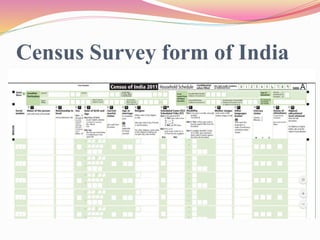
• The 15th Indian Census which was conducted on 1st
April 2010 by Government of India.
• Various Polls at the time of Elections.
Census Survey form of India
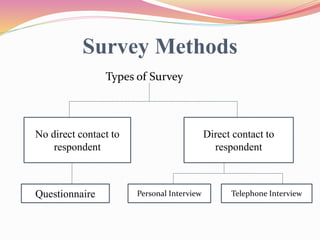
Survey Methods
Types of Survey
No direct contact to
respondent
Direct contact to
respondent
Questionnaire Personal Interview Telephone Interview
Questionnaire
This type of descriptive research uses the questions as
research tool for data collection.
Basically Questionnaire is usually a paper & pencil tool in
which various type of questions are asked to respondent
by the researcher .
In this, results are simply dependent
up on what people say, do, believe, like,
dislike etc.
It is most frequently used in this type of
research.
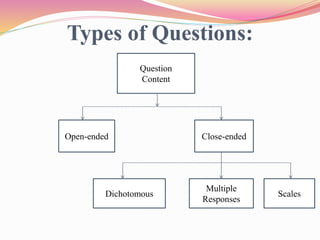
Types of Questions:
Question
Content
Open-ended Close-ended
Dichotomous
Multiple
Responses
Scales
Open Ended Questions
An open-ended question is designed to encourage a full,
meaningful answer using the respondent's own knowledge
or feelings.
Open-ended questions are also known as unstructured
questions or free-response or free-answer questions.
Open-ended questions typically begin with words such as
"Why" and "How", or phrases such as "Tell me
about...". Often they are not technically a question, but a
statement which asks for a response.
Close-ended Questions
This type of questions often takes the form of
ranking, scaled items or categorical responses.
In this format Multiple choice questions are
given, where respondents are restricted to
choose among any of the given multiple choice
answers.
This is further divided in three types of
questions.
Dichotomous Questions: These questions have restrictive
alternatives and provide the respondents only with two
answers. These could be ‘yes’ or ‘no’, ‘like’ or ‘dislike’,
‘similar’ or ‘different’, ‘married’ or ‘unmarried’ etc.
Multiple-choice Questions: In this type of questions
respondent is given a number of response alternatives.
He might be asked to choose the one that is most
applicable.
Scale Questions: These type of questions are classify in
terms of their level of measurement. In this the respondents
are asked to rank order their preferences by using
an ordinal question.
Example of open ended questions:
How would you evaluate the work done by the present government?
What is your reaction to this new custard powder?
 I like Nescafe because _______________________.
Example of Dichotomous questions:
Are you diabetic Yes/No
What kind of cola do you drink? Normal/Diet
 Your working hours in the
organization are Fixed/Flexible
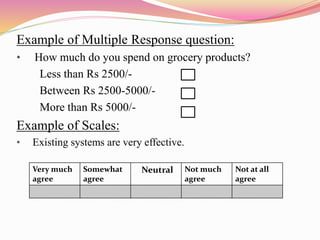
Example of Multiple Response question:
• How much do you spend on grocery products?
Less than Rs 2500/-
Between Rs 2500-5000/-
More than Rs 5000/-
Example of Scales:
• Existing systems are very effective.
Very much
agree
Somewhat
agree
Neutral Not much
agree
Not at all
agree
Personal Interview
It is same as the questionnaire but all the questioning is
done orally instead of writing.
In this case response rate is higher than questionnaire but
sample which is used is smaller than questionnaire.
Easier to explain questions.
It is very time consuming and expensive.
Telephone Interview
Telephone interview have the same structural
characteristics as normal interviewing technique, except
that it is conducted by telephone.
It is less time consuming with moderate cost.
It has higher response rate than personal interview.
It has the risk of “Broken-off” interviews.
Descriptive research : Survey

Descriptive research : Survey

  • 1.
    Submitted to: Submittedby: Dr. Deepika Upadhyaya Anjali Sharma Department of Management Studies Maharshi Dayanand Saraswati University, Ajmer
  • 2.
    Content  Introduction ofSurvey  Example of Survey  Survey methods  Questionnaire  Type of questions  Personal Interview  Telephone Interview
  • 3.
    Survey Definition: Survey isa technique of descriptive research that is used to determine the opinions of a specified population. Basically Surveys are method of data collection in which information is gathered through oral or written questioning. Examples: • The 15th Indian Census which was conducted on 1st April 2010 by Government of India. • Various Polls at the time of Elections.
  • 4.
  • 5.
    Survey Methods Types ofSurvey No direct contact to respondent Direct contact to respondent Questionnaire Personal Interview Telephone Interview
  • 6.
    Questionnaire This type ofdescriptive research uses the questions as research tool for data collection. Basically Questionnaire is usually a paper & pencil tool in which various type of questions are asked to respondent by the researcher . In this, results are simply dependent up on what people say, do, believe, like, dislike etc. It is most frequently used in this type of research.
  • 7.
    Types of Questions: Question Content Open-endedClose-ended Dichotomous Multiple Responses Scales
  • 8.
    Open Ended Questions Anopen-ended question is designed to encourage a full, meaningful answer using the respondent's own knowledge or feelings. Open-ended questions are also known as unstructured questions or free-response or free-answer questions. Open-ended questions typically begin with words such as "Why" and "How", or phrases such as "Tell me about...". Often they are not technically a question, but a statement which asks for a response.
  • 9.
    Close-ended Questions This typeof questions often takes the form of ranking, scaled items or categorical responses. In this format Multiple choice questions are given, where respondents are restricted to choose among any of the given multiple choice answers. This is further divided in three types of questions.
  • 10.
    Dichotomous Questions: Thesequestions have restrictive alternatives and provide the respondents only with two answers. These could be ‘yes’ or ‘no’, ‘like’ or ‘dislike’, ‘similar’ or ‘different’, ‘married’ or ‘unmarried’ etc. Multiple-choice Questions: In this type of questions respondent is given a number of response alternatives. He might be asked to choose the one that is most applicable. Scale Questions: These type of questions are classify in terms of their level of measurement. In this the respondents are asked to rank order their preferences by using an ordinal question.
  • 11.
    Example of openended questions: How would you evaluate the work done by the present government? What is your reaction to this new custard powder?  I like Nescafe because _______________________. Example of Dichotomous questions: Are you diabetic Yes/No What kind of cola do you drink? Normal/Diet  Your working hours in the organization are Fixed/Flexible
  • 12.
    Example of MultipleResponse question: • How much do you spend on grocery products? Less than Rs 2500/- Between Rs 2500-5000/- More than Rs 5000/- Example of Scales: • Existing systems are very effective. Very much agree Somewhat agree Neutral Not much agree Not at all agree
  • 13.
    Personal Interview It issame as the questionnaire but all the questioning is done orally instead of writing. In this case response rate is higher than questionnaire but sample which is used is smaller than questionnaire. Easier to explain questions. It is very time consuming and expensive.
  • 14.
    Telephone Interview Telephone interviewhave the same structural characteristics as normal interviewing technique, except that it is conducted by telephone. It is less time consuming with moderate cost. It has higher response rate than personal interview. It has the risk of “Broken-off” interviews.