HUMAN AGEING
INTRODUCTION
Ageing (British English) or aging (American English) is
the accumulation of changes in a person over time.
Ageing in humans refers to a multidimensional process
of physical, psychological, and social change. Some
dimensions of ageing grow and expand over
time, while others decline.
AIMS AND OBJECTIVES
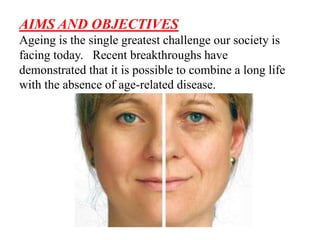
Ageing is the single greatest challenge our society is
facing today. Recent breakthroughs have
demonstrated that it is possible to combine a long life
with the absence of age-related disease.
THEORIES OF AGEING


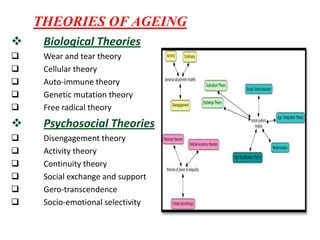
Biological Theories







Wear and tear theory
Cellular theory
Auto-immune theory
Genetic mutation theory
Free radical theory



Psychosocial Theories








Disengagement theory
Activity theory
Continuity theory
Social exchange and support
Gero-transcendence
Socio-emotional selectivity
SUCESSFUL AGEING
The concept of successful ageing can be traced back to
the 1950s, and was popularised in the 1980s.
Successful ageing consists of three components.
1.Low probability of disease or disability.
2.High cognitive and physical function capacity.
3.Active engagement with life.
NORMAL CHANGES DURING AGEING
PREMATURE AGEING DISEASE: PROGERIA
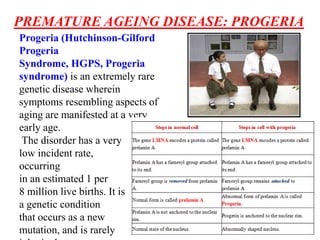
Progeria (Hutchinson-Gilford
Progeria
Syndrome, HGPS, Progeria
syndrome) is an extremely rare
genetic disease wherein
symptoms resembling aspects of
aging are manifested at a very
early age.
The disorder has a very
low incident rate,
occurring
in an estimated 1 per
8 million live births. It is
a genetic condition
that occurs as a new
mutation, and is rarely
MOLECULAR ASPECTS OF AGEING
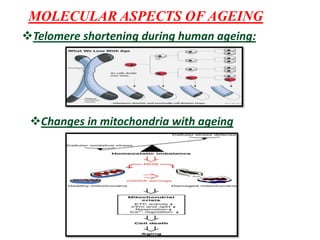
Telomere shortening during human ageing:

Changes in mitochondria with ageing
CAUSES OF AGEING
CONTROL OF AGEING
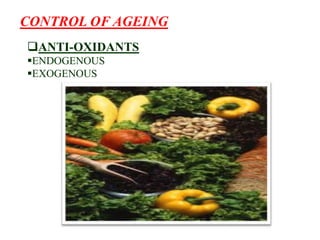
ANTI-OXIDANTS
ENDOGENOUS
EXOGENOUS
COSMETIC UV-PROTECTION
CONCLUSION







From these above discussions we can conclude
that:
We all change physically, as we grow older.
Steps can be taken to help prevent illness and
injury, and which help maximize the older
person's independence, if problems do occur.
There is no need for most people to fear getting
older.
ACKNOWLEDGEMENT
We would like to thank our professors for their innovative
suggestions and their help with the given project.
REFERENCES
•
•
•

http://en.wikipedia.org/wiki/Ageing
“An introduction to biological aging theory”- Theodore C.
Goldsmith
“Telomere shortening and ageing”-H. Jiang, Z. Ju, K.L.
Rudolph
Human ageing process

Human ageing process

  • 1.
  • 2.
    INTRODUCTION Ageing (British English)or aging (American English) is the accumulation of changes in a person over time. Ageing in humans refers to a multidimensional process of physical, psychological, and social change. Some dimensions of ageing grow and expand over time, while others decline.
  • 3.
    AIMS AND OBJECTIVES Ageingis the single greatest challenge our society is facing today. Recent breakthroughs have demonstrated that it is possible to combine a long life with the absence of age-related disease.
  • 4.
    THEORIES OF AGEING  BiologicalTheories      Wear and tear theory Cellular theory Auto-immune theory Genetic mutation theory Free radical theory  Psychosocial Theories       Disengagement theory Activity theory Continuity theory Social exchange and support Gero-transcendence Socio-emotional selectivity
  • 5.
    SUCESSFUL AGEING The conceptof successful ageing can be traced back to the 1950s, and was popularised in the 1980s. Successful ageing consists of three components. 1.Low probability of disease or disability. 2.High cognitive and physical function capacity. 3.Active engagement with life.
  • 6.
  • 7.
    PREMATURE AGEING DISEASE:PROGERIA Progeria (Hutchinson-Gilford Progeria Syndrome, HGPS, Progeria syndrome) is an extremely rare genetic disease wherein symptoms resembling aspects of aging are manifested at a very early age. The disorder has a very low incident rate, occurring in an estimated 1 per 8 million live births. It is a genetic condition that occurs as a new mutation, and is rarely
  • 8.
    MOLECULAR ASPECTS OFAGEING Telomere shortening during human ageing: Changes in mitochondria with ageing
  • 9.
  • 10.
  • 11.
  • 12.
    CONCLUSION     From these abovediscussions we can conclude that: We all change physically, as we grow older. Steps can be taken to help prevent illness and injury, and which help maximize the older person's independence, if problems do occur. There is no need for most people to fear getting older.
  • 13.
    ACKNOWLEDGEMENT We would liketo thank our professors for their innovative suggestions and their help with the given project.
  • 14.
    REFERENCES • • • http://en.wikipedia.org/wiki/Ageing “An introduction tobiological aging theory”- Theodore C. Goldsmith “Telomere shortening and ageing”-H. Jiang, Z. Ju, K.L. Rudolph