The ScratchThe Scratch
OutlineOutline
A “road map” toA “road map” to
your final essay.your final essay.
The Purpose of an OutlineThe Purpose of an Outline
Creating an outline is designed to help youCreating an outline is designed to help you focusfocus
your research andyour research and organizeorganize your ideas.your ideas.
Contrary to most students’ perceptions, its purposeContrary to most students’ perceptions, its purpose
is to make itis to make it easiereasier for you to produce your finalfor you to produce your final
paper.paper.
An outline allows you to “preview” your paperAn outline allows you to “preview” your paper
before you write it, ensuring logical organizationbefore you write it, ensuring logical organization
and sufficient and relevant support.and sufficient and relevant support.
What an Outline IncludesWhat an Outline Includes
An outline begins with aAn outline begins with a complete thesiscomplete thesis
statementstatement (subject + focus + reasons)
..
ThreeThree of the outline’s major sections will beginof the outline’s major sections will begin
withwith topic sentences takentopic sentences taken directlydirectly fromfrom
the thesis statement.the thesis statement.
Your outline will includeYour outline will include a fourth major section:a fourth major section:
refutation.refutation.
The Structure of the OutlineThe Structure of the Outline
THESIS: Subject, opinion, reasons 1, 2 and 3THESIS: Subject, opinion, reasons 1, 2 and 3
I. First topic sentence (expanded from specific language 1.)I. First topic sentence (expanded from specific language 1.)
A. First point/proof (type of evidence + specific evidence)A. First point/proof (type of evidence + specific evidence)
B. Second point/proofB. Second point/proof
C. Third point/proofC. Third point/proof
II. Second topic sentence (expanded from specific language 2.)II. Second topic sentence (expanded from specific language 2.)
A. First point/proofA. First point/proof
B. Second point/proofB. Second point/proof
C. Third point/proofC. Third point/proof
III. Third topic sentence (expanded from specific language 3.)III. Third topic sentence (expanded from specific language 3.)
A. First point/proofA. First point/proof
B. Second point/proofB. Second point/proof
C. Third point/proofC. Third point/proof
IV. Refutation (if not refuted at II)IV. Refutation (if not refuted at II)
A First point/proofA First point/proof
B Second point/proofB Second point/proof
C. Third point/proofC. Third point/proof
V. Conclusion: RESTATED THESISV. Conclusion: RESTATED THESIS
A. Summary of section I evidenceA. Summary of section I evidence
B. Summary of section II evidenceB. Summary of section II evidence
C. Summary of section III evidenceC. Summary of section III evidence
D. Final clincherD. Final clincher
The Contents of Each SectionThe Contents of Each Section
Thesis:Thesis: Stating the thesis takes the place of outlining yourStating the thesis takes the place of outlining your
introduction. Because the parts of an introduction are unchangingintroduction. Because the parts of an introduction are unchanging
(grabber, background information, thesis), there is no need to(grabber, background information, thesis), there is no need to
outline the introduction. Just place your thesis at the top.outline the introduction. Just place your thesis at the top.
Roman Numerals I, II, etc.:Roman Numerals I, II, etc.: Each of these numerals
represents a major section of your essay and begins with a
sentence. The topic sentence comes directly from the thesis
statement and includes your opinion AND one reason.
Capital Letters A, B, C:Capital Letters A, B, C: Each of these letters represents
one major piece of evidence you will use to support your ideas.
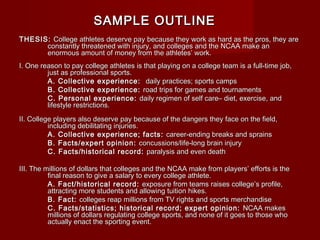
THESIS:THESIS: College athletes deserve pay because they work as hard as the pros, they areCollege athletes deserve pay because they work as hard as the pros, they are
constantly threatened with injury, and colleges and the NCAA make anconstantly threatened with injury, and colleges and the NCAA make an
enormous amount of money from the athletes’ work.enormous amount of money from the athletes’ work.
I. One reason to pay college athletes is that playing on a college team is a full-time job,I. One reason to pay college athletes is that playing on a college team is a full-time job,
just as professional sports.just as professional sports.
A. Collective experience:A. Collective experience: daily practices; sports campsdaily practices; sports camps
B. Collective experience:B. Collective experience: road trips for games and tournamentsroad trips for games and tournaments
C. Personal experience:C. Personal experience: daily regimen of self care– diet, exercise, anddaily regimen of self care– diet, exercise, and
lifestyle restrictions.lifestyle restrictions.
II. College players also deserve pay because of the dangers they face on the field,II. College players also deserve pay because of the dangers they face on the field,
including debilitating injuries.including debilitating injuries.
A. Collective experience; facts:A. Collective experience; facts: career-ending breaks and sprainscareer-ending breaks and sprains
B. Facts/expert opinion:B. Facts/expert opinion: concussions/life-long brain injuryconcussions/life-long brain injury
C. Facts/historical record:C. Facts/historical record: paralysis and even deathparalysis and even death
III. The millions of dollars that colleges and the NCAA make from players’ efforts is theIII. The millions of dollars that colleges and the NCAA make from players’ efforts is the
final reason to give a salary to every college athlete.final reason to give a salary to every college athlete.
A. Fact/historical record:A. Fact/historical record: exposure from teams raises college’s profile,exposure from teams raises college’s profile,
attracting more students and allowing tuition hikes.attracting more students and allowing tuition hikes.
B. Fact:B. Fact: colleges reap millions from TV rights and sports merchandisecolleges reap millions from TV rights and sports merchandise
C. Facts/statistics; historical record; expert opinion:C. Facts/statistics; historical record; expert opinion: NCAA makesNCAA makes
millions of dollars regulating college sports, and none of it goes to those whomillions of dollars regulating college sports, and none of it goes to those who
actually enact the sporting event.actually enact the sporting event.
SAMPLE OUTLINESAMPLE OUTLINE
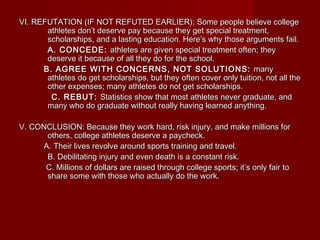
VI. REFUTATION (IF NOT REFUTED EARLIER): Some people believe collegeVI. REFUTATION (IF NOT REFUTED EARLIER): Some people believe college
athletes don’t deserve pay because they get special treatment,athletes don’t deserve pay because they get special treatment,
scholarships, and a lasting education. Here’s why those arguments fail.scholarships, and a lasting education. Here’s why those arguments fail.
A. CONCEDE:A. CONCEDE: athletes are given special treatment often; theyathletes are given special treatment often; they
deserve it because of all they do for the school.deserve it because of all they do for the school.
B. AGREE WITH CONCERNS, NOT SOLUTIONS:B. AGREE WITH CONCERNS, NOT SOLUTIONS: manymany
athletes do get scholarships, but they often cover only tuition, not all theathletes do get scholarships, but they often cover only tuition, not all the
other expenses; many athletes do not get scholarships.other expenses; many athletes do not get scholarships.
C. REBUT:C. REBUT: Statistics show that most athletes never graduate, andStatistics show that most athletes never graduate, and
many who do graduate without really having learned anything.many who do graduate without really having learned anything.
V. CONCLUSION: Because they work hard, risk injury, and make millions forV. CONCLUSION: Because they work hard, risk injury, and make millions for
others, college athletes deserve a paycheck.others, college athletes deserve a paycheck.
A. Their lives revolve around sports training and travel.A. Their lives revolve around sports training and travel.
B. Debilitating injury and even death is a constant risk.B. Debilitating injury and even death is a constant risk.
C. Millions of dollars are raised through college sports; it’s only fair toC. Millions of dollars are raised through college sports; it’s only fair to
share some with those who actually do the work.share some with those who actually do the work.
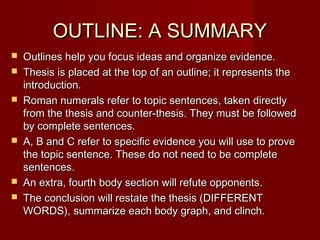
OUTLINE: A SUMMARYOUTLINE: A SUMMARY
 Outlines help you focus ideas and organize evidence.Outlines help you focus ideas and organize evidence.
 Thesis is placed at the top of an outline; it represents theThesis is placed at the top of an outline; it represents the
introduction.introduction.
 Roman numerals refer to topic sentences, taken directlyRoman numerals refer to topic sentences, taken directly
from the thesis and counter-thesis. They must be followedfrom the thesis and counter-thesis. They must be followed
by complete sentences.by complete sentences.
 A, B and C refer to specific evidence you will use to proveA, B and C refer to specific evidence you will use to prove
the topic sentence. These do not need to be completethe topic sentence. These do not need to be complete
sentences.sentences.
 An extra, fourth body section will refute opponents.An extra, fourth body section will refute opponents.
 The conclusion will restate the thesis (DIFFERENTThe conclusion will restate the thesis (DIFFERENT
WORDS), summarize each body graph, and clinch.WORDS), summarize each body graph, and clinch.

Scratch outline

  • 1.
    The ScratchThe Scratch OutlineOutline A“road map” toA “road map” to your final essay.your final essay.
  • 2.
    The Purpose ofan OutlineThe Purpose of an Outline Creating an outline is designed to help youCreating an outline is designed to help you focusfocus your research andyour research and organizeorganize your ideas.your ideas. Contrary to most students’ perceptions, its purposeContrary to most students’ perceptions, its purpose is to make itis to make it easiereasier for you to produce your finalfor you to produce your final paper.paper. An outline allows you to “preview” your paperAn outline allows you to “preview” your paper before you write it, ensuring logical organizationbefore you write it, ensuring logical organization and sufficient and relevant support.and sufficient and relevant support.
  • 3.
    What an OutlineIncludesWhat an Outline Includes An outline begins with aAn outline begins with a complete thesiscomplete thesis statementstatement (subject + focus + reasons) .. ThreeThree of the outline’s major sections will beginof the outline’s major sections will begin withwith topic sentences takentopic sentences taken directlydirectly fromfrom the thesis statement.the thesis statement. Your outline will includeYour outline will include a fourth major section:a fourth major section: refutation.refutation.
  • 4.
    The Structure ofthe OutlineThe Structure of the Outline THESIS: Subject, opinion, reasons 1, 2 and 3THESIS: Subject, opinion, reasons 1, 2 and 3 I. First topic sentence (expanded from specific language 1.)I. First topic sentence (expanded from specific language 1.) A. First point/proof (type of evidence + specific evidence)A. First point/proof (type of evidence + specific evidence) B. Second point/proofB. Second point/proof C. Third point/proofC. Third point/proof II. Second topic sentence (expanded from specific language 2.)II. Second topic sentence (expanded from specific language 2.) A. First point/proofA. First point/proof B. Second point/proofB. Second point/proof C. Third point/proofC. Third point/proof III. Third topic sentence (expanded from specific language 3.)III. Third topic sentence (expanded from specific language 3.) A. First point/proofA. First point/proof B. Second point/proofB. Second point/proof C. Third point/proofC. Third point/proof IV. Refutation (if not refuted at II)IV. Refutation (if not refuted at II) A First point/proofA First point/proof B Second point/proofB Second point/proof C. Third point/proofC. Third point/proof V. Conclusion: RESTATED THESISV. Conclusion: RESTATED THESIS A. Summary of section I evidenceA. Summary of section I evidence B. Summary of section II evidenceB. Summary of section II evidence C. Summary of section III evidenceC. Summary of section III evidence D. Final clincherD. Final clincher
  • 5.
    The Contents ofEach SectionThe Contents of Each Section Thesis:Thesis: Stating the thesis takes the place of outlining yourStating the thesis takes the place of outlining your introduction. Because the parts of an introduction are unchangingintroduction. Because the parts of an introduction are unchanging (grabber, background information, thesis), there is no need to(grabber, background information, thesis), there is no need to outline the introduction. Just place your thesis at the top.outline the introduction. Just place your thesis at the top. Roman Numerals I, II, etc.:Roman Numerals I, II, etc.: Each of these numerals represents a major section of your essay and begins with a sentence. The topic sentence comes directly from the thesis statement and includes your opinion AND one reason. Capital Letters A, B, C:Capital Letters A, B, C: Each of these letters represents one major piece of evidence you will use to support your ideas.
  • 6.
    THESIS:THESIS: College athletesdeserve pay because they work as hard as the pros, they areCollege athletes deserve pay because they work as hard as the pros, they are constantly threatened with injury, and colleges and the NCAA make anconstantly threatened with injury, and colleges and the NCAA make an enormous amount of money from the athletes’ work.enormous amount of money from the athletes’ work. I. One reason to pay college athletes is that playing on a college team is a full-time job,I. One reason to pay college athletes is that playing on a college team is a full-time job, just as professional sports.just as professional sports. A. Collective experience:A. Collective experience: daily practices; sports campsdaily practices; sports camps B. Collective experience:B. Collective experience: road trips for games and tournamentsroad trips for games and tournaments C. Personal experience:C. Personal experience: daily regimen of self care– diet, exercise, anddaily regimen of self care– diet, exercise, and lifestyle restrictions.lifestyle restrictions. II. College players also deserve pay because of the dangers they face on the field,II. College players also deserve pay because of the dangers they face on the field, including debilitating injuries.including debilitating injuries. A. Collective experience; facts:A. Collective experience; facts: career-ending breaks and sprainscareer-ending breaks and sprains B. Facts/expert opinion:B. Facts/expert opinion: concussions/life-long brain injuryconcussions/life-long brain injury C. Facts/historical record:C. Facts/historical record: paralysis and even deathparalysis and even death III. The millions of dollars that colleges and the NCAA make from players’ efforts is theIII. The millions of dollars that colleges and the NCAA make from players’ efforts is the final reason to give a salary to every college athlete.final reason to give a salary to every college athlete. A. Fact/historical record:A. Fact/historical record: exposure from teams raises college’s profile,exposure from teams raises college’s profile, attracting more students and allowing tuition hikes.attracting more students and allowing tuition hikes. B. Fact:B. Fact: colleges reap millions from TV rights and sports merchandisecolleges reap millions from TV rights and sports merchandise C. Facts/statistics; historical record; expert opinion:C. Facts/statistics; historical record; expert opinion: NCAA makesNCAA makes millions of dollars regulating college sports, and none of it goes to those whomillions of dollars regulating college sports, and none of it goes to those who actually enact the sporting event.actually enact the sporting event. SAMPLE OUTLINESAMPLE OUTLINE
  • 7.
    VI. REFUTATION (IFNOT REFUTED EARLIER): Some people believe collegeVI. REFUTATION (IF NOT REFUTED EARLIER): Some people believe college athletes don’t deserve pay because they get special treatment,athletes don’t deserve pay because they get special treatment, scholarships, and a lasting education. Here’s why those arguments fail.scholarships, and a lasting education. Here’s why those arguments fail. A. CONCEDE:A. CONCEDE: athletes are given special treatment often; theyathletes are given special treatment often; they deserve it because of all they do for the school.deserve it because of all they do for the school. B. AGREE WITH CONCERNS, NOT SOLUTIONS:B. AGREE WITH CONCERNS, NOT SOLUTIONS: manymany athletes do get scholarships, but they often cover only tuition, not all theathletes do get scholarships, but they often cover only tuition, not all the other expenses; many athletes do not get scholarships.other expenses; many athletes do not get scholarships. C. REBUT:C. REBUT: Statistics show that most athletes never graduate, andStatistics show that most athletes never graduate, and many who do graduate without really having learned anything.many who do graduate without really having learned anything. V. CONCLUSION: Because they work hard, risk injury, and make millions forV. CONCLUSION: Because they work hard, risk injury, and make millions for others, college athletes deserve a paycheck.others, college athletes deserve a paycheck. A. Their lives revolve around sports training and travel.A. Their lives revolve around sports training and travel. B. Debilitating injury and even death is a constant risk.B. Debilitating injury and even death is a constant risk. C. Millions of dollars are raised through college sports; it’s only fair toC. Millions of dollars are raised through college sports; it’s only fair to share some with those who actually do the work.share some with those who actually do the work.
  • 8.
    OUTLINE: A SUMMARYOUTLINE:A SUMMARY  Outlines help you focus ideas and organize evidence.Outlines help you focus ideas and organize evidence.  Thesis is placed at the top of an outline; it represents theThesis is placed at the top of an outline; it represents the introduction.introduction.  Roman numerals refer to topic sentences, taken directlyRoman numerals refer to topic sentences, taken directly from the thesis and counter-thesis. They must be followedfrom the thesis and counter-thesis. They must be followed by complete sentences.by complete sentences.  A, B and C refer to specific evidence you will use to proveA, B and C refer to specific evidence you will use to prove the topic sentence. These do not need to be completethe topic sentence. These do not need to be complete sentences.sentences.  An extra, fourth body section will refute opponents.An extra, fourth body section will refute opponents.  The conclusion will restate the thesis (DIFFERENTThe conclusion will restate the thesis (DIFFERENT WORDS), summarize each body graph, and clinch.WORDS), summarize each body graph, and clinch.