Grade 10!
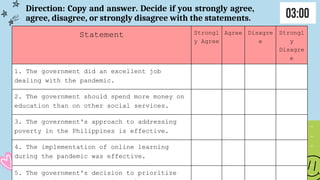
Statement Strongl
y Agree
Agree Disagre
e
Strongl
y
Disagre
e
1. The government did an excellent job
dealing with the pandemic.
2. The government should spend more money on
education than on other social services.
3. The government's approach to addressing
poverty in the Philippines is effective.
4. The implementation of online learning
during the pandemic was effective.
5. The government's decision to prioritize
Direction: Copy and answer. Decide if you strongly agree,
agree, disagree, or strongly disagree with the statements.
Components of an
Argumentative
Essay
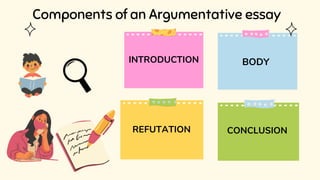
Components of an Argumentative essay
INTRODUCTION
CONCLUSION
BODY
REFUTATION
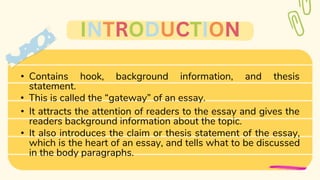
• Contains hook, background information, and thesis
statement.
• This is called the “gateway” of an essay.
• It attracts the attention of readers to the essay and gives the
readers background information about the topic.
• It also introduces the claim or thesis statement of the essay,
which is the heart of an essay, and tells what to be discussed
in the body paragraphs.
INTRODUCTION
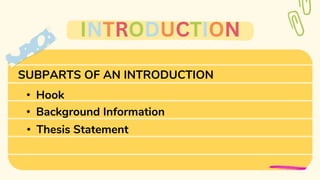
• Thesis Statement
• Background Information
• Hook
SUBPARTS OF AN INTRODUCTION
INTRODUCTION
>> Also known as the attention grabber, is an
important part of your essay's introduction. It's what
catches the reader's attention and gets them interested
in reading more. It's like the part of a story that makes
you curious or excited about what happens next.
HOOK
INTRODUCTION
BACKGROUND INFORMATION
>> This is where you create a context that makes the main
topic more understandable and meaningful to the
audience.
It typically includes:
• relevant historical context,
• key facts, definitions,
• and any other information necessary for the audience
to comprehend the main discussion or thesis.
INTRODUCTION
THESIS STATEMENT
>> A concise and focused sentence that clearly presents
the main point, argument, or claim of an essay, research
paper, or any other piece of academic writing. It serves
as the roadmap for the entire work, providing readers
with a preview of the writer's stance on the topic and the
main points that will be discussed.
INTRODUCTION
A well-crafted thesis statement typically:
• States the main idea: Clearly expresses the central point of
the essay.
• Takes a position or makes a claim: Presents the writer's
stance on the issue.
• Provides a roadmap: Outlines the key points or arguments
that will be explored in the essay.
INTRODUCTION
Example:
Topic: Should school uniforms be mandatory in schools?
H ave you ever thought about why some schools make students wear
uniforms? Lots of schools around the world have a rule that says students
must wear uniforms. Some people say it's good because it helps everyone
look the same, while others think it's not fair because it takes away their
choice. This essay will argue in favor of making school uniforms required. It
will talk about how they help keep things organized, make everyone feel
like they belong, and make sure nobody feels left out because of what they
wear.
INTRODUCTION
>> Presents the evidence, or the reasons, facts,
statistics, examples, or statements from
experts, studies, or other sources to support the
claim.
BODY
Example:
Uniforms help create a strong school community and make
it easier to identify which students belong to which school.
Research shows that uniforms improve behavior, attendance, and
grades by reducing distractions caused by different clothing. Plus,
uniforms make sure everyone is treated fairly, no matter their
financial situation, so nobody feels left out or embarrassed about
their clothes.
BODY
• Presents counterargument, or opposing or contrary view
that challenges or contradicts the claim.
• Presents rebuttal, or the statement of arguments that
negate or disprove the counterclaim.
REFUTATIO
N
Example:
Some argue that wearing uniforms inhibits students
from expressing their true identities, but wearing a uniform
doesn't stop you from being yourself; it just means you
show who you are through your actions and what you
achieve, not by what you wear.
REFUTATIO
N
>> The conclusion summarizes the main points
of the essay to stir and leave ideas, thoughts,
or feelings for the reader to think about.
CONCLUSION
Example:
In conclusion, school uniforms are a good idea because
they help keep things organized, make everyone feel like
they're part of the same group, and make sure nobody feels
left out because of what they wear. Making uniforms
mandatory in schools helps create a fair and inclusive
environment where everyone can focus on learning and being
themselves.
CONCLUSION
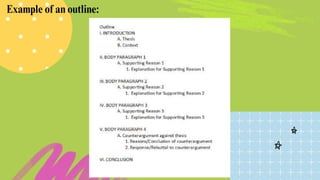
Example of an outline:
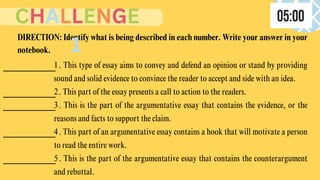
1. This type of essay aims to convey and defend an opinion or stand by providing
sound and solid evidence to convince the reader to accept and side with an idea.
2. This part of the essay presents a call to action to the readers.
3. This is the part of the argumentative essay that contains the evidence, or the
reasons and facts to support the claim.
4. This part of an argumentative essay contains a hook that will motivate a person
to read the entire work.
5. This is the part of the argumentative essay that contains the counterargument
and rebuttal.
DIRECTION: Identify what is being described in each number. Write your answer in your
notebook.
CHALLENGE
1
1. This type of essay aims to convey and defend an opinion or stand by providing
sound and solid evidence to convince the reader to accept and side with an idea.
2. This part of the essay presents a call to action to the readers.
3. This is the part of the argumentative essay that contains the evidence, or the
reasons and facts to support the claim.
4. This part of an argumentative essay contains a hook that will motivate a person
to read the entire work.
5. This is the part of the argumentative essay that contains the counterargument
and rebuttal.
DIRECTION: Identify what is being described in each number. Write your answer in your
notebook.
CHALLENGE
1
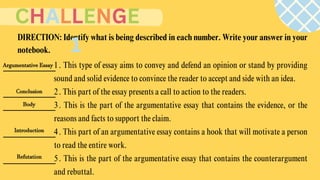
Argumentative Essay
Conclusion
Body
Introduction
Refutation
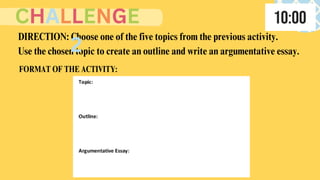
DIRECTION: Choose one of the five topics from the previous activity.
Use the chosen topic to create an outline and write an argumentative essay.
FORMAT OF THE ACTIVITY:
CHALLENGE
2
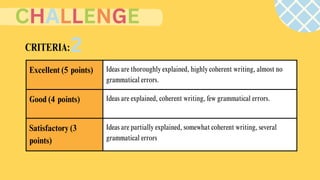
Excellent (5 points) Ideas are thoroughly explained, highly coherent writing, almost no
grammatical errors.
Good (4 points) Ideas are explained, coherent writing, few grammatical errors.
Satisfactory (3
points)
Ideas are partially explained, somewhat coherent writing, several
grammatical errors
CRITERIA:
CHALLENGE
2
Thank you for
listening!

QUARTER-3-MELC-1-Lesson-2 relevance.pptx

  • 1.
  • 2.
    Statement Strongl y Agree AgreeDisagre e Strongl y Disagre e 1. The government did an excellent job dealing with the pandemic. 2. The government should spend more money on education than on other social services. 3. The government's approach to addressing poverty in the Philippines is effective. 4. The implementation of online learning during the pandemic was effective. 5. The government's decision to prioritize Direction: Copy and answer. Decide if you strongly agree, agree, disagree, or strongly disagree with the statements.
  • 3.
  • 4.
    Components of anArgumentative essay INTRODUCTION CONCLUSION BODY REFUTATION
  • 5.
    • Contains hook,background information, and thesis statement. • This is called the “gateway” of an essay. • It attracts the attention of readers to the essay and gives the readers background information about the topic. • It also introduces the claim or thesis statement of the essay, which is the heart of an essay, and tells what to be discussed in the body paragraphs. INTRODUCTION
  • 6.
    • Thesis Statement •Background Information • Hook SUBPARTS OF AN INTRODUCTION INTRODUCTION
  • 7.
    >> Also knownas the attention grabber, is an important part of your essay's introduction. It's what catches the reader's attention and gets them interested in reading more. It's like the part of a story that makes you curious or excited about what happens next. HOOK INTRODUCTION
  • 8.
    BACKGROUND INFORMATION >> Thisis where you create a context that makes the main topic more understandable and meaningful to the audience. It typically includes: • relevant historical context, • key facts, definitions, • and any other information necessary for the audience to comprehend the main discussion or thesis. INTRODUCTION
  • 9.
    THESIS STATEMENT >> Aconcise and focused sentence that clearly presents the main point, argument, or claim of an essay, research paper, or any other piece of academic writing. It serves as the roadmap for the entire work, providing readers with a preview of the writer's stance on the topic and the main points that will be discussed. INTRODUCTION
  • 10.
    A well-crafted thesisstatement typically: • States the main idea: Clearly expresses the central point of the essay. • Takes a position or makes a claim: Presents the writer's stance on the issue. • Provides a roadmap: Outlines the key points or arguments that will be explored in the essay. INTRODUCTION
  • 11.
    Example: Topic: Should schooluniforms be mandatory in schools? H ave you ever thought about why some schools make students wear uniforms? Lots of schools around the world have a rule that says students must wear uniforms. Some people say it's good because it helps everyone look the same, while others think it's not fair because it takes away their choice. This essay will argue in favor of making school uniforms required. It will talk about how they help keep things organized, make everyone feel like they belong, and make sure nobody feels left out because of what they wear. INTRODUCTION
  • 12.
    >> Presents theevidence, or the reasons, facts, statistics, examples, or statements from experts, studies, or other sources to support the claim. BODY
  • 13.
    Example: Uniforms help createa strong school community and make it easier to identify which students belong to which school. Research shows that uniforms improve behavior, attendance, and grades by reducing distractions caused by different clothing. Plus, uniforms make sure everyone is treated fairly, no matter their financial situation, so nobody feels left out or embarrassed about their clothes. BODY
  • 14.
    • Presents counterargument,or opposing or contrary view that challenges or contradicts the claim. • Presents rebuttal, or the statement of arguments that negate or disprove the counterclaim. REFUTATIO N
  • 15.
    Example: Some argue thatwearing uniforms inhibits students from expressing their true identities, but wearing a uniform doesn't stop you from being yourself; it just means you show who you are through your actions and what you achieve, not by what you wear. REFUTATIO N
  • 16.
    >> The conclusionsummarizes the main points of the essay to stir and leave ideas, thoughts, or feelings for the reader to think about. CONCLUSION
  • 17.
    Example: In conclusion, schooluniforms are a good idea because they help keep things organized, make everyone feel like they're part of the same group, and make sure nobody feels left out because of what they wear. Making uniforms mandatory in schools helps create a fair and inclusive environment where everyone can focus on learning and being themselves. CONCLUSION
  • 18.
    Example of anoutline:
  • 19.
    1. This typeof essay aims to convey and defend an opinion or stand by providing sound and solid evidence to convince the reader to accept and side with an idea. 2. This part of the essay presents a call to action to the readers. 3. This is the part of the argumentative essay that contains the evidence, or the reasons and facts to support the claim. 4. This part of an argumentative essay contains a hook that will motivate a person to read the entire work. 5. This is the part of the argumentative essay that contains the counterargument and rebuttal. DIRECTION: Identify what is being described in each number. Write your answer in your notebook. CHALLENGE 1
  • 20.
    1. This typeof essay aims to convey and defend an opinion or stand by providing sound and solid evidence to convince the reader to accept and side with an idea. 2. This part of the essay presents a call to action to the readers. 3. This is the part of the argumentative essay that contains the evidence, or the reasons and facts to support the claim. 4. This part of an argumentative essay contains a hook that will motivate a person to read the entire work. 5. This is the part of the argumentative essay that contains the counterargument and rebuttal. DIRECTION: Identify what is being described in each number. Write your answer in your notebook. CHALLENGE 1 Argumentative Essay Conclusion Body Introduction Refutation
  • 21.
    DIRECTION: Choose oneof the five topics from the previous activity. Use the chosen topic to create an outline and write an argumentative essay. FORMAT OF THE ACTIVITY: CHALLENGE 2
  • 22.
    Excellent (5 points)Ideas are thoroughly explained, highly coherent writing, almost no grammatical errors. Good (4 points) Ideas are explained, coherent writing, few grammatical errors. Satisfactory (3 points) Ideas are partially explained, somewhat coherent writing, several grammatical errors CRITERIA: CHALLENGE 2
  • 23.