Anchal
B.Tech Food Technology
Sec A
Roll no. 18
Bioactive
Compounds
Carotenoids (The E-number E 160a)
 Organic pigments
 Found in chloroplasts and chromoplasts
of plants and some other photosynthetic organisms
like algae, bacteria, and fungi.
 Over 600 carotenoids known.
 In humans, 4 carotenoids (beta-carotene, alpha-
carotene, gamma-carotene, and beta-crypoxanthin)
have vitamin A activity.
 Basic Structure : tetraterpenoids
 Carotenoids belong to the category of tetraterpenoids (i.e. they contain 40
carbon atoms, being built from four terpene units each containing 10 carbon
atoms). Structurally, carotenoids take the form of a polyene hydrocarbon chain
which is sometimes terminated by rings, and may or may not have additional
oxygen atoms attached.
Carotenoids
xanthophylls
Bixin
Crocetin
Astaxanthin
Lutein
carotenes
Beta-
carotene
Lycopene
Phytofluene
Phytoene
Compound Characteristics Use Health Benefits Source
Bixin •Polyunsaturated
•Exist in two forms
bixin, Soluble in fats and
norbixin, soluble in
water.
•More stable in trans
form
•Red coloured dye
•As food
colour
•Fat soluble
bixin –
cheese, baked
products,
snack foods
etc.
•Water
soluble –
tomato sauce,
buttermilk,
casings, pet
foods etc.
•Antioxidant
•Reduces level of
melanoaldehyde
•Protects DNA from
oxidative damage
•Inhibits superoxide
and reactive oxygen
•Anti-flammatory
•Anti-histamine
•Prevents
mutagenicity in
human lymphocytes
Annatto
Side
effects
Can cause
eczema ,
headache.
tired
feeling in
excessive
intake.
Structure
Compound Characterstics use Health bebefits Source
Crocetin • solube in water
•It is hydrolysed
from crocin, crocin
is not absorbed by
intestine
•Deep red in colour
• as
colourant in
many food
products like
in sweets,
etc
•Anti-proliferative
•Anti-oxidant
•Learning and
memory enhancer
•Effective in
treating : brain
neurodegenrative
disorder , sperm
cryoconservation.
And alzheimer
disorder.
Crocus sativa
Fruits of
gardenia
No side effects
known
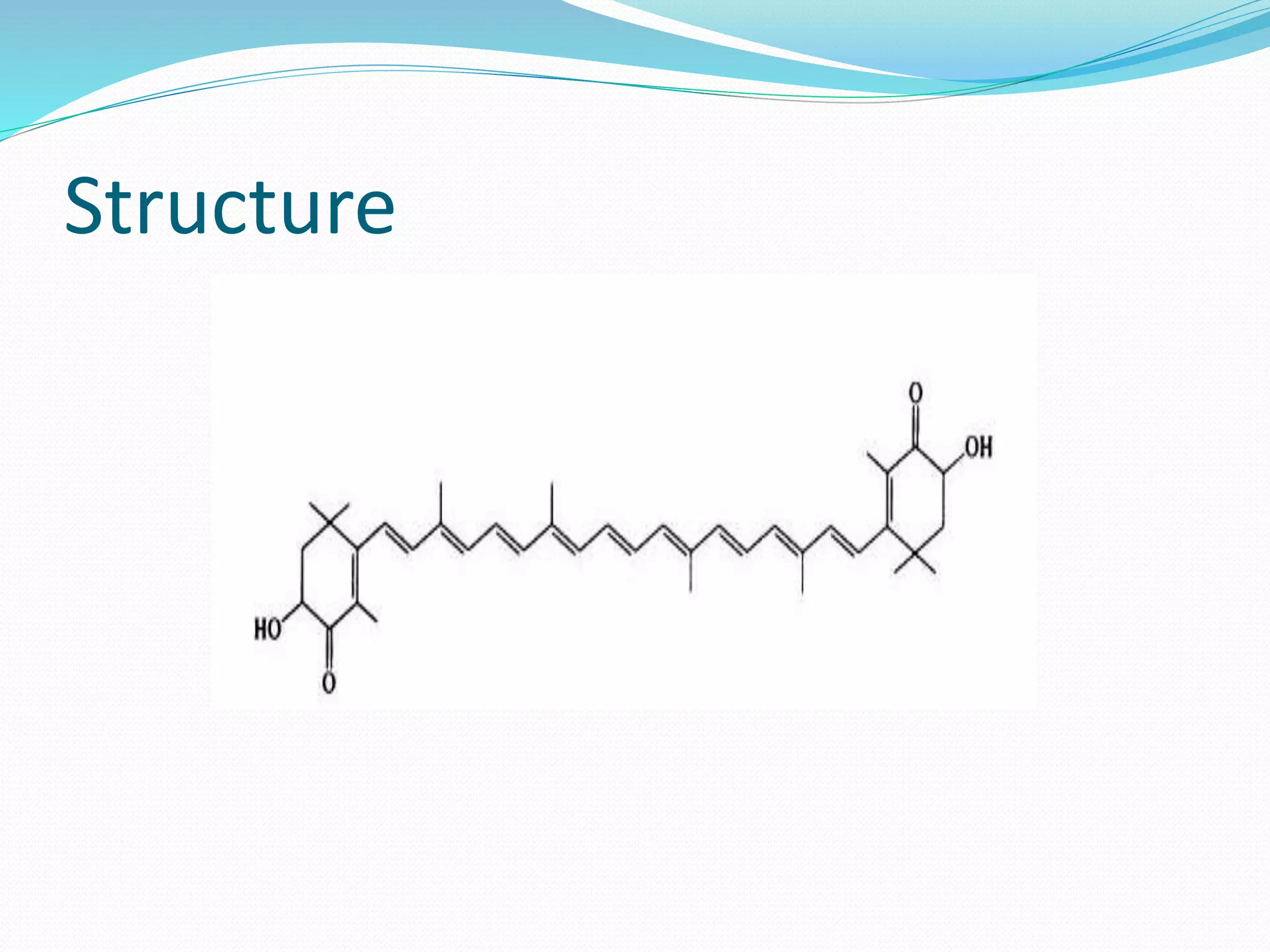
Structure
Compound Characteristics Usae Health benefits Source
Astaxanthin •Red in colour
•Structure similar to
beta-carotene
•Antioxidant
properties stronger
than beta-carotene
(40x) and vit. E
(1000x)
•It can penetrate the
blood brain and
retina barriers , helps
in protecting the
brain and nervous
system from
neurodegenerative
disorder
In vitamin
supplements
• quinching ability
for singlet oxygen
•Reduces free
radicals
•Anti-infalmmatory
•Inhibition of lipid
peroxidation
•Inhibition of
atherosclerosis
Crustacians –
shrimps
,crabs and
lobsters
Salmon
Microalgae
Side effects
Considered
as GRAS ,but
some
individuals
may be
allergice to
Structure
Compound
dises
Characteristics Uses Health benefits source
Lutein • yellow in colour
• Water soluble
•Occurs along with
zeaxanthin ,
zeaxanthin is present
in the centre of
macula, lutein
occupies the sides.
• do not convert into
vit. A
•Absorbs UV light
from the sun, thus
protects the eyes
Supplement in
eye diseases
medicines
• protection
against
- diseases of eyes
- cataract
- some form of
cancers
- cardiovascular
diseases
algae
Bacteria
Higher plants
corn
spinach
blueberries
plums
lettuce
beans
apples
etc.
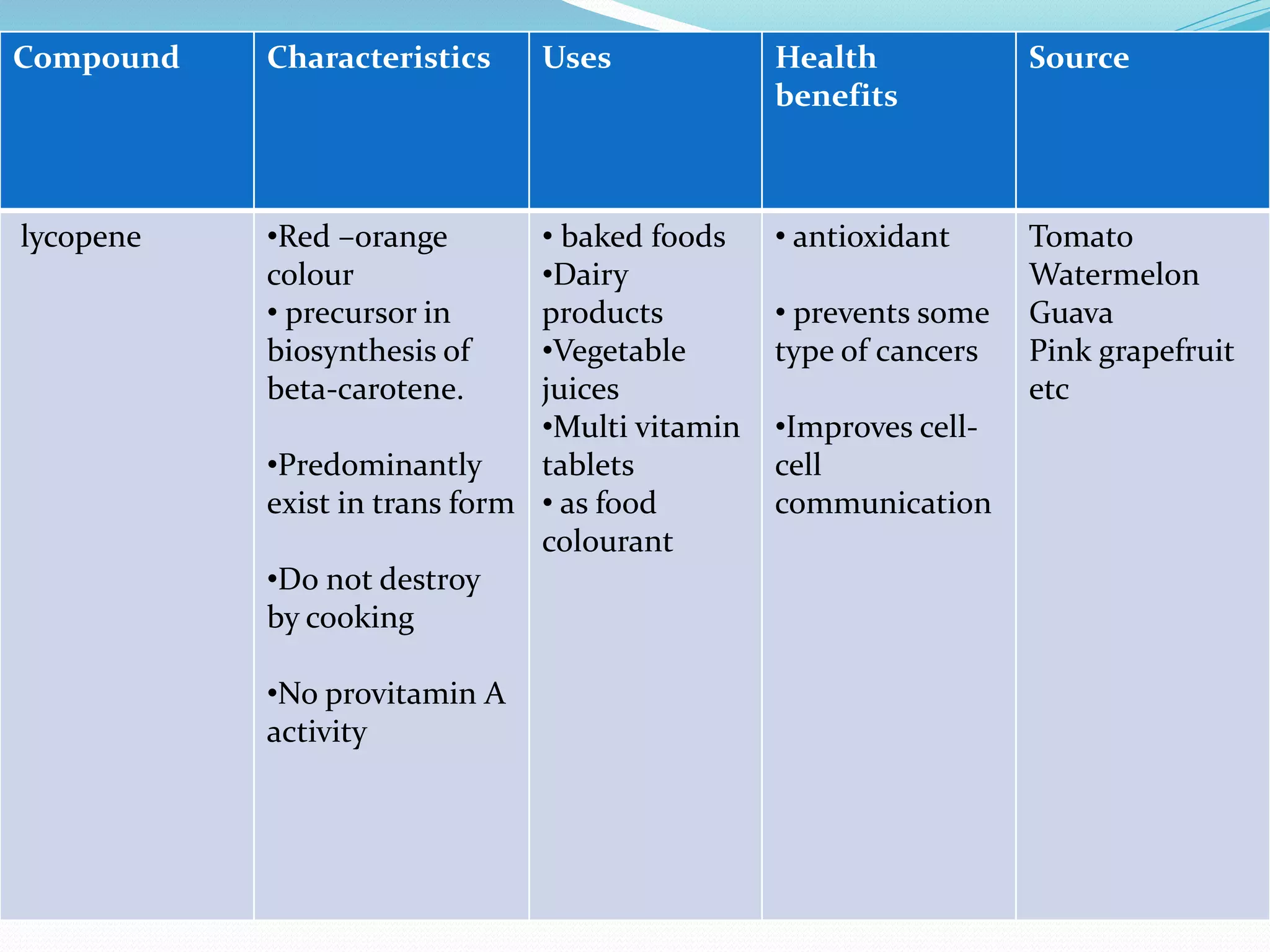
Structure
Compound Characteristics Uses Health
benefits
Source
lycopene •Red –orange
colour
• precursor in
biosynthesis of
beta-carotene.
•Predominantly
exist in trans form
•Do not destroy
by cooking
•No provitamin A
activity
• baked foods
•Dairy
products
•Vegetable
juices
•Multi vitamin
tablets
• as food
colourant
• antioxidant
• prevents some
type of cancers
•Improves cell-
cell
communication
Tomato
Watermelon
Guava
Pink grapefruit
etc
Structure
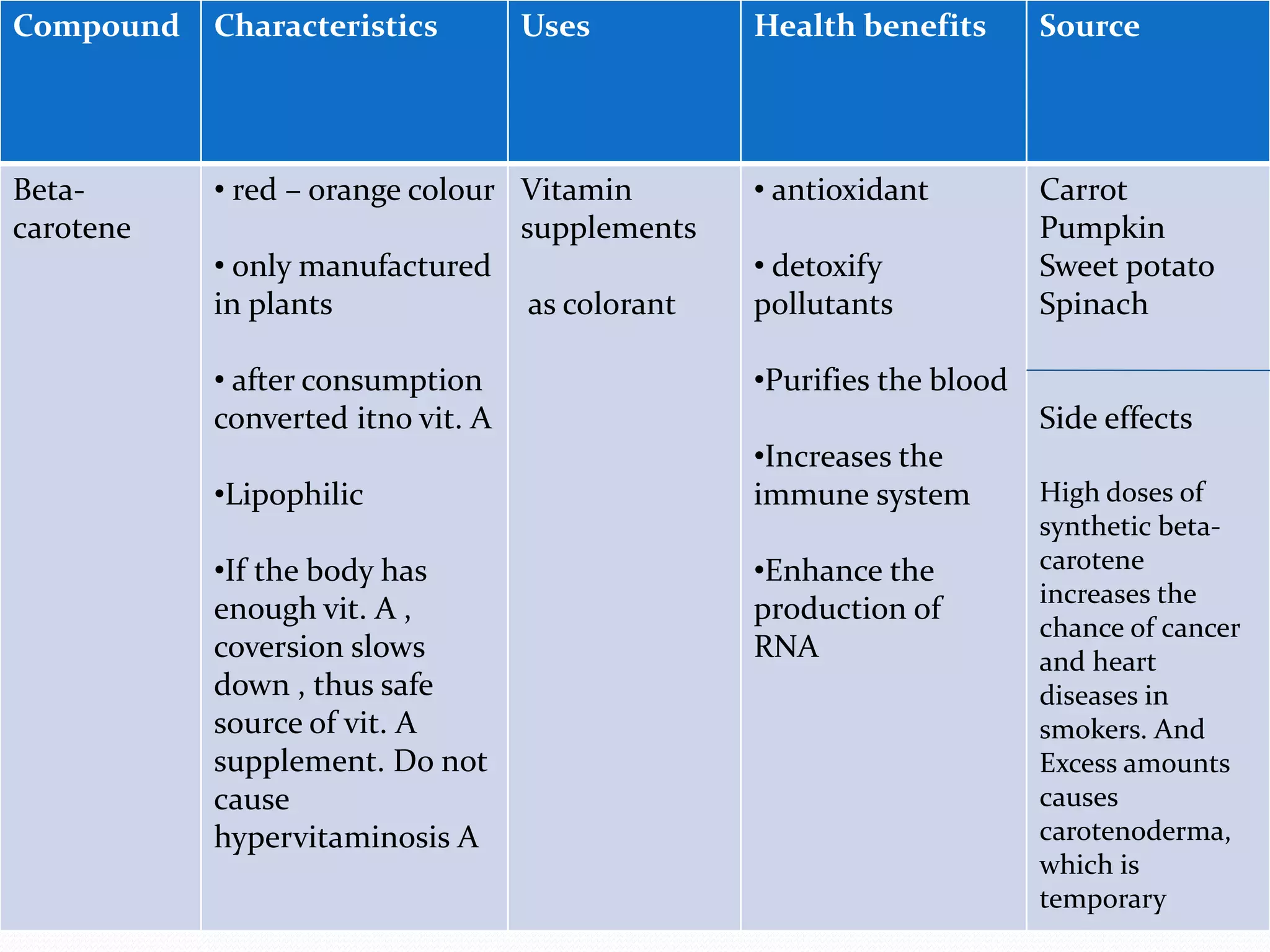
Compound Characteristics Uses Health benefits Source
Beta-
carotene
• red – orange colour
• only manufactured
in plants
• after consumption
converted itno vit. A
•Lipophilic
•If the body has
enough vit. A ,
coversion slows
down , thus safe
source of vit. A
supplement. Do not
cause
hypervitaminosis A
Vitamin
supplements
as colorant
• antioxidant
• detoxify
pollutants
•Purifies the blood
•Increases the
immune system
•Enhance the
production of
RNA
Carrot
Pumpkin
Sweet potato
Spinach
Side effects
High doses of
synthetic beta-
carotene
increases the
chance of cancer
and heart
diseases in
smokers. And
Excess amounts
causes
carotenoderma,
which is
temporary
Structure
Phytofluene and phytoene
 Colorless compounds
 Precursor of all carotenoids
 Phytofluene formed from phytoene.
 Protects LDL from oxidation
 accumulation of theses Carotenoids in the skin protects skin by acting
as U.V absorber, as antioxidants and anti-flammatory agents.
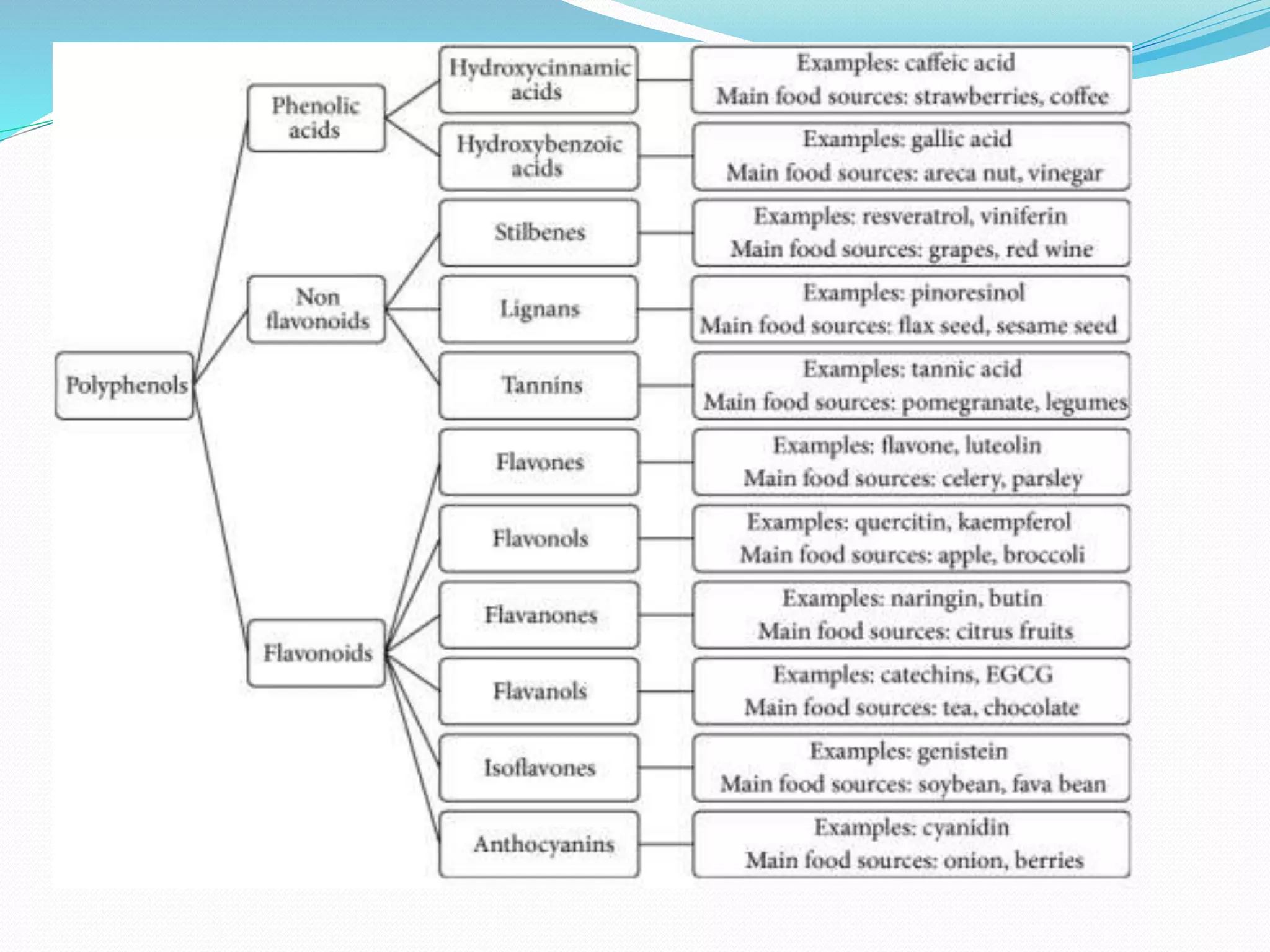
Polyphenols
Polyphenols
 Diverse group of plant substances that conatain one or
more benzene ring and varying number of hydroxy,
carbonyl and carboxylic groups.
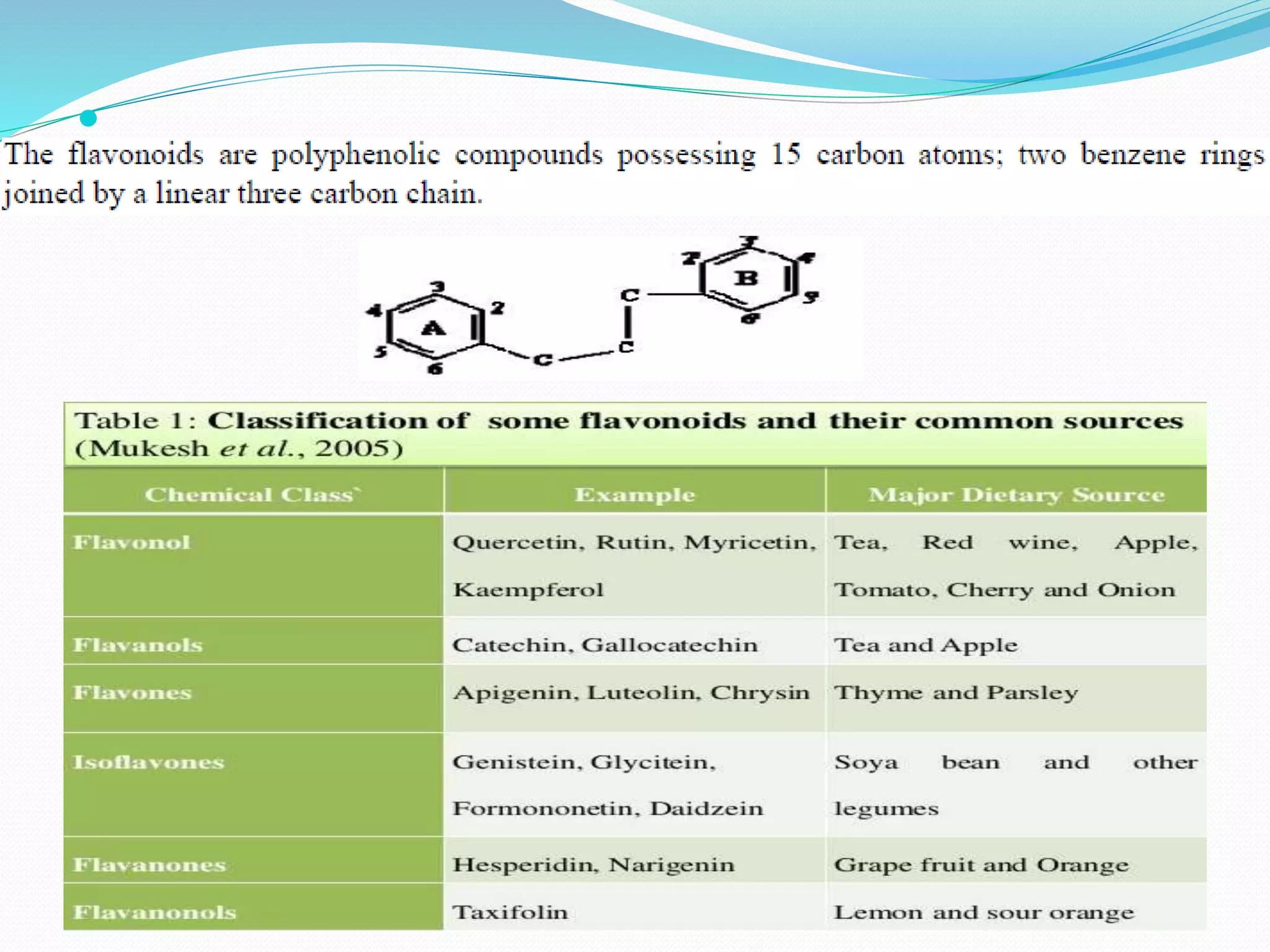
Flavanoids
 Largest group of naturally occuring phenolic compounds
 Can occur in free state or as glycerides
 Water soluble
 Accumulate in cell vacoule
 Flavonoids (or bioflavonoids) (from the Latin word
flavus meaning yellow, their colour in nature) are a class of
plant secondary metabolites.
 In higher plants, Flavonoids are involved in UV filtration,
symbiotic nitrogen fixation and floral pigmentation
CLASSIFICATION
According to the IUPAC nomenclature, they can be
classified into:
 • flavones, derived from 2-phenylchromen-4-one (2-
phenyl-1,4-benzopyrone) structure (examples:
quercetin, rutin).
 • isoflavonoids, derived from 3-phenylchromen-4-one
(3-phenyl-1,4-benzopyrone) structure
 • neoflavonoids, derived from 4-phenylcoumarine (4-
phenyl-1,2-benzopyrone) structure

Compound Characteristics
1. Anthocyanidins
2. Flavanols or flavon-3-ols or or catechins
3. Flavanols
• Most abundant
• Colour: blue and purple
• Helps in Preventing CVD and diabetic diseases
• Source: grapes, blackberries etc
• Found in tea,cocoa,apples,red wine
• Dimers ( found in black tea) associated with lowering
cholesterol
• Includes quercitin
• Anti-histamine, anti-flamatory and antioxidant
• Source: onions brussels sprouts, tea etc
Compounds Characteristics
4. Flavones
5. Flavonones
6. Isoflavones
• Source : celery, hot peppers and various herbs
• Acts an an antioxidants
• Found in citrus fruits
• Helps in maintaining the cardiovascular diseases,
relaxation
• Anti-oxidant and anti-inflammatory
• Highly concentrated in soybeans and soy products ,
legumes
• Lowers the risk of harmonal cancers such as prostrate,
breast and helps in treating the menoapuse
Compound Characteristics Uses Health benefits Source
Tannins (
non-
flavonoids)
•Dark brown
•Puckering taste
•Soluble in water ,
acetone and
alcohols.
•Tannins have the
ability to bind
anything that is
added to it
•Dyes
•Oils
•Flavoring
agent
• antiseptic
•Inhibition of
lipid peroxidation
•Prevents cancer
by preventing
cellular damage
Tree bark
Coffee
Grains
FnV
Side effects
Prolong use
in excess can
cause cancer
References
 Carotenoids and other pigments as natural colorants*Alan Mortensen
 Natural Antioxidant for Neuro-protection, Vision Enhancement & Skin
Rejuvenation ( pdf)
 Alan Mortensen Chr. Hansen A/S, Color Research, Development and Application, Bøge
Allé 10-12, DK-2970 Hørsholm, Denmark
 Nancy J. Engelmann,3 Steven K. Clinton,5 and John W. Erdman Jr3,4* 3Division of
Nutritional Sciences and 4Department of Food Science and Human Nutrition, University
of Illinois-Urbana/Champaign, Urbana, IL 61801; and 5The Ohio State University
Comprehensive Cancer Center, The Ohio State University, Columbus, OH 43210
 Prepared at the 29th JECFA (1985), published in FNP 34 (1986) and in FNP 52 (1992).
Metals and arsenic specifications revised at the 59th JECFA (2002). Regarded as food
ingredient rather than food additive at 29th JECFA (1985

Bioactive compounds

  • 1.
    Anchal B.Tech Food Technology SecA Roll no. 18 Bioactive Compounds
  • 2.
    Carotenoids (The E-numberE 160a)  Organic pigments  Found in chloroplasts and chromoplasts of plants and some other photosynthetic organisms like algae, bacteria, and fungi.  Over 600 carotenoids known.  In humans, 4 carotenoids (beta-carotene, alpha- carotene, gamma-carotene, and beta-crypoxanthin) have vitamin A activity.  Basic Structure : tetraterpenoids
  • 3.
     Carotenoids belongto the category of tetraterpenoids (i.e. they contain 40 carbon atoms, being built from four terpene units each containing 10 carbon atoms). Structurally, carotenoids take the form of a polyene hydrocarbon chain which is sometimes terminated by rings, and may or may not have additional oxygen atoms attached.
  • 4.
  • 5.
    Compound Characteristics UseHealth Benefits Source Bixin •Polyunsaturated •Exist in two forms bixin, Soluble in fats and norbixin, soluble in water. •More stable in trans form •Red coloured dye •As food colour •Fat soluble bixin – cheese, baked products, snack foods etc. •Water soluble – tomato sauce, buttermilk, casings, pet foods etc. •Antioxidant •Reduces level of melanoaldehyde •Protects DNA from oxidative damage •Inhibits superoxide and reactive oxygen •Anti-flammatory •Anti-histamine •Prevents mutagenicity in human lymphocytes Annatto Side effects Can cause eczema , headache. tired feeling in excessive intake.
  • 6.
  • 7.
    Compound Characterstics useHealth bebefits Source Crocetin • solube in water •It is hydrolysed from crocin, crocin is not absorbed by intestine •Deep red in colour • as colourant in many food products like in sweets, etc •Anti-proliferative •Anti-oxidant •Learning and memory enhancer •Effective in treating : brain neurodegenrative disorder , sperm cryoconservation. And alzheimer disorder. Crocus sativa Fruits of gardenia No side effects known
  • 8.
  • 9.
    Compound Characteristics UsaeHealth benefits Source Astaxanthin •Red in colour •Structure similar to beta-carotene •Antioxidant properties stronger than beta-carotene (40x) and vit. E (1000x) •It can penetrate the blood brain and retina barriers , helps in protecting the brain and nervous system from neurodegenerative disorder In vitamin supplements • quinching ability for singlet oxygen •Reduces free radicals •Anti-infalmmatory •Inhibition of lipid peroxidation •Inhibition of atherosclerosis Crustacians – shrimps ,crabs and lobsters Salmon Microalgae Side effects Considered as GRAS ,but some individuals may be allergice to
  • 10.
  • 11.
    Compound dises Characteristics Uses Healthbenefits source Lutein • yellow in colour • Water soluble •Occurs along with zeaxanthin , zeaxanthin is present in the centre of macula, lutein occupies the sides. • do not convert into vit. A •Absorbs UV light from the sun, thus protects the eyes Supplement in eye diseases medicines • protection against - diseases of eyes - cataract - some form of cancers - cardiovascular diseases algae Bacteria Higher plants corn spinach blueberries plums lettuce beans apples etc.
  • 13.
  • 14.
    Compound Characteristics UsesHealth benefits Source lycopene •Red –orange colour • precursor in biosynthesis of beta-carotene. •Predominantly exist in trans form •Do not destroy by cooking •No provitamin A activity • baked foods •Dairy products •Vegetable juices •Multi vitamin tablets • as food colourant • antioxidant • prevents some type of cancers •Improves cell- cell communication Tomato Watermelon Guava Pink grapefruit etc
  • 15.
  • 16.
    Compound Characteristics UsesHealth benefits Source Beta- carotene • red – orange colour • only manufactured in plants • after consumption converted itno vit. A •Lipophilic •If the body has enough vit. A , coversion slows down , thus safe source of vit. A supplement. Do not cause hypervitaminosis A Vitamin supplements as colorant • antioxidant • detoxify pollutants •Purifies the blood •Increases the immune system •Enhance the production of RNA Carrot Pumpkin Sweet potato Spinach Side effects High doses of synthetic beta- carotene increases the chance of cancer and heart diseases in smokers. And Excess amounts causes carotenoderma, which is temporary
  • 17.
  • 18.
    Phytofluene and phytoene Colorless compounds  Precursor of all carotenoids  Phytofluene formed from phytoene.  Protects LDL from oxidation  accumulation of theses Carotenoids in the skin protects skin by acting as U.V absorber, as antioxidants and anti-flammatory agents.
  • 19.
  • 20.
    Polyphenols  Diverse groupof plant substances that conatain one or more benzene ring and varying number of hydroxy, carbonyl and carboxylic groups.
  • 22.
    Flavanoids  Largest groupof naturally occuring phenolic compounds  Can occur in free state or as glycerides  Water soluble  Accumulate in cell vacoule  Flavonoids (or bioflavonoids) (from the Latin word flavus meaning yellow, their colour in nature) are a class of plant secondary metabolites.  In higher plants, Flavonoids are involved in UV filtration, symbiotic nitrogen fixation and floral pigmentation
  • 23.
    CLASSIFICATION According to theIUPAC nomenclature, they can be classified into:  • flavones, derived from 2-phenylchromen-4-one (2- phenyl-1,4-benzopyrone) structure (examples: quercetin, rutin).  • isoflavonoids, derived from 3-phenylchromen-4-one (3-phenyl-1,4-benzopyrone) structure  • neoflavonoids, derived from 4-phenylcoumarine (4- phenyl-1,2-benzopyrone) structure
  • 24.
  • 25.
    Compound Characteristics 1. Anthocyanidins 2.Flavanols or flavon-3-ols or or catechins 3. Flavanols • Most abundant • Colour: blue and purple • Helps in Preventing CVD and diabetic diseases • Source: grapes, blackberries etc • Found in tea,cocoa,apples,red wine • Dimers ( found in black tea) associated with lowering cholesterol • Includes quercitin • Anti-histamine, anti-flamatory and antioxidant • Source: onions brussels sprouts, tea etc
  • 26.
    Compounds Characteristics 4. Flavones 5.Flavonones 6. Isoflavones • Source : celery, hot peppers and various herbs • Acts an an antioxidants • Found in citrus fruits • Helps in maintaining the cardiovascular diseases, relaxation • Anti-oxidant and anti-inflammatory • Highly concentrated in soybeans and soy products , legumes • Lowers the risk of harmonal cancers such as prostrate, breast and helps in treating the menoapuse
  • 27.
    Compound Characteristics UsesHealth benefits Source Tannins ( non- flavonoids) •Dark brown •Puckering taste •Soluble in water , acetone and alcohols. •Tannins have the ability to bind anything that is added to it •Dyes •Oils •Flavoring agent • antiseptic •Inhibition of lipid peroxidation •Prevents cancer by preventing cellular damage Tree bark Coffee Grains FnV Side effects Prolong use in excess can cause cancer
  • 28.
    References  Carotenoids andother pigments as natural colorants*Alan Mortensen  Natural Antioxidant for Neuro-protection, Vision Enhancement & Skin Rejuvenation ( pdf)  Alan Mortensen Chr. Hansen A/S, Color Research, Development and Application, Bøge Allé 10-12, DK-2970 Hørsholm, Denmark  Nancy J. Engelmann,3 Steven K. Clinton,5 and John W. Erdman Jr3,4* 3Division of Nutritional Sciences and 4Department of Food Science and Human Nutrition, University of Illinois-Urbana/Champaign, Urbana, IL 61801; and 5The Ohio State University Comprehensive Cancer Center, The Ohio State University, Columbus, OH 43210  Prepared at the 29th JECFA (1985), published in FNP 34 (1986) and in FNP 52 (1992). Metals and arsenic specifications revised at the 59th JECFA (2002). Regarded as food ingredient rather than food additive at 29th JECFA (1985