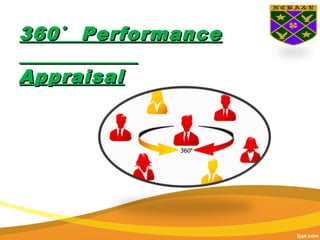


360 Performance̊360 Performance̊
AppraisalAppraisal
MuhammaD ImraN
SAQIB YOUSAF
AZHAR ABBASAZHAR ABBAS
AGENDAAGENDA
 Performance Appraisal System.
 What is 360 ?̊
 Process of 360 Appraisal.̊
 Advantages and Disadvantages.
 what is 720 ?̊
 Leading Questions and Suggestions.
Muhammad ImraN
 Performance Appraisal
 Various Methods Used
 What is 360 Degree Appraisal?
 What the process involves
 How to Implement 360 Degree?
 How is Feedback obtained?
 QUESTIONNAIRE
Performance AppraisalPerformance Appraisal
 Reviews each individual's performance against
objectives and standards for the trading year,
agreed at the previous appraisal meeting.
 Essential for career and succession planning.
 Provide a formal, recorded, regular review of an
individual's performance, and a plan for future
development.
Important for staff motivation, attitude and
behavior development, communicating and
aligning individual and organizational aims, and
fostering positive relationships between
management and staff.
Performance Appraisal…….Performance Appraisal…….
Various Methods UsedVarious Methods Used
Performance AppraisalPerformance Appraisal
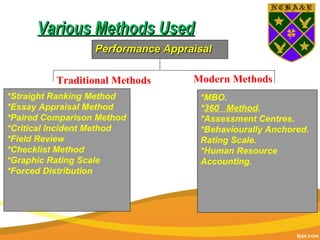
*Straight Ranking Method
*Essay Appraisal Method
*Paired Comparison Method
*Critical Incident Method
*Field Review
*Checklist Method
*Graphic Rating Scale
*Forced Distribution
*MBO.
*360 Method̊ .
*Assessment Centres.
*Behaviourally Anchored.
Rating Scale.
*Human Resource
Accounting.
Traditional Methods Modern Methods
What is 360 Degree Appraisal?What is 360 Degree Appraisal?
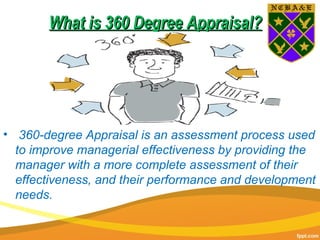
• 360-degree Appraisal is an assessment process used
to improve managerial effectiveness by providing the
manager with a more complete assessment of their
effectiveness, and their performance and development
needs.
What the process involvesWhat the process involves
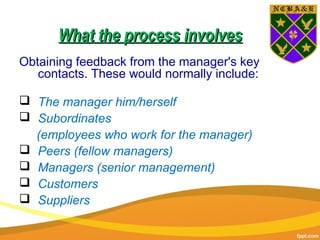
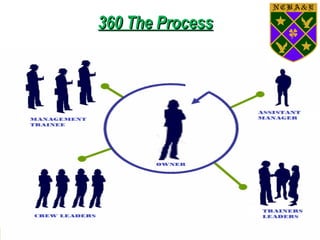
Obtaining feedback from the manager's key
contacts. These would normally include:
 The manager him/herself
 Subordinates
(employees who work for the manager)
 Peers (fellow managers)
 Managers (senior management)
 Customers
 Suppliers
360 The Process360 The Process
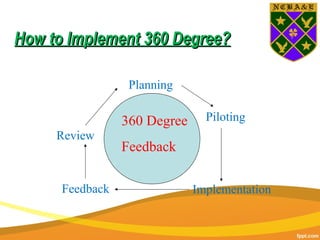
How to Implement 360 Degree?How to Implement 360 Degree?
360 Degree
Feedback
Planning
Piloting
ImplementationFeedback
Review
How is Feedback obtained?How is Feedback obtained?
By using a questionnaire which asks participants to rate the
individual according to observed behaviors - usually
managerial or business-specific competencies.
This process will not suit all companies. One should assess
how well it would fit with the current culture before
launching a scheme and a pilot scheme is worth building
into the programme
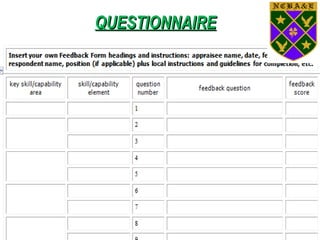
QUESTIONNAIREQUESTIONNAIRE
SAQIB
YOUSAF
 QUESTIONNAIRE DETAILS
 What does 360 measure ?̊
QUESTIONNAIRE DETAILSQUESTIONNAIRE DETAILS
• Part APart A :: To be filled by the appraisee before the
Interview and sent to Appraiser.
• A1 : Appraissee to fill up his understanding of
his duties and responsibilities.
• A2 :Discussion Points:-
– Has the past year been good/bad/satisfactory
or otherwise for you, and why?
– What do you consider to be your most
important achievements of the past year ?
QUESTIONNAIRE DETAILSQUESTIONNAIRE DETAILS
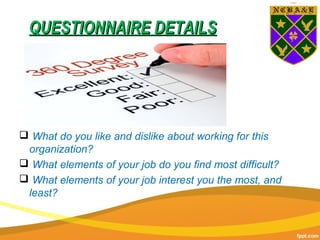
 What do you like and dislike about working for this
organization?
 What elements of your job do you find most difficult?
 What elements of your job interest you the most, and
least?
 What do you consider to be your most important tasks in
the Next year?
 What action could be taken to improve your performance in
your current position by you, and your boss?
 What kind of work or job would you like to be doing in
one/two/five years time?
 What sort of training/experience would benefit you in the
next year?
QUESTIONNAIRE DETAILS…..QUESTIONNAIRE DETAILS…..
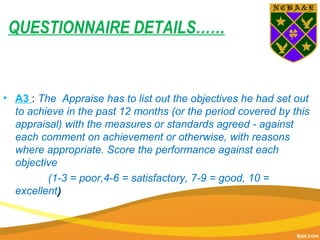
QUESTIONNAIRE DETAILS……
• A3 : The Appraise has to list out the objectives he had set out
to achieve in the past 12 months (or the period covered by this
appraisal) with the measures or standards agreed - against
each comment on achievement or otherwise, with reasons
where appropriate. Score the performance against each
objective
(1-3 = poor,4-6 = satisfactory, 7-9 = good, 10 =
excellent))
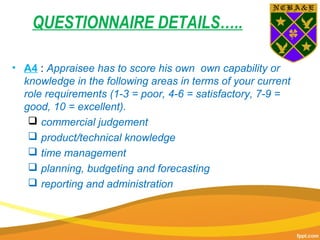
QUESTIONNAIRE DETAILS…..
• A4 : Appraisee has to score his own own capability or
knowledge in the following areas in terms of your current
role requirements (1-3 = poor, 4-6 = satisfactory, 7-9 =
good, 10 = excellent).
 commercial judgement
 product/technical knowledge
 time management
 planning, budgeting and forecasting
 reporting and administration
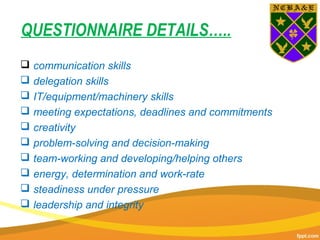
QUESTIONNAIRE DETAILS…..
 communication skills
 delegation skills
 IT/equipment/machinery skills
 meeting expectations, deadlines and commitments
 creativity
 problem-solving and decision-making
 team-working and developing/helping others
 energy, determination and work-rate
 steadiness under pressure
 leadership and integrity
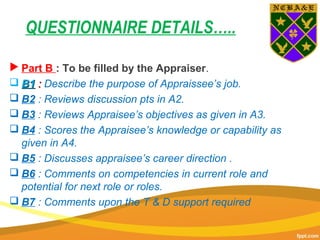
QUESTIONNAIRE DETAILS…..
 Part B : To be filled by the Appraiser.
 B1B1 :: Describe the purpose of Appraissee’s job.
 B2 : Reviews discussion pts in A2.
 B3 : Reviews Appraisee’s objectives as given in A3.
 B4 : Scores the Appraisee’s knowledge or capability as
given in A4.
 B5 : Discusses appraisee’s career direction .
 B6 : Comments on competencies in current role and
potential for next role or roles.
 B7 : Comments upon the T & D support required
What does 360 measure ?̊What does 360 measure ?̊
 360 degree measures behaviors and competencies.
 360 degree addresses skills such as listening, planning,
and goal-setting.
 360 degree focuses on subjective areas such as
teamwork, character, and leadership effectiveness.
 360 degree provide feedback on how others perceive an
employee.
 ADVANTAGES & DISADVANTAGES
 Why 360 degree Appraisal Programs Fail?Why 360 degree Appraisal Programs Fail?
 Pertinent Questions ???Pertinent Questions ???
 Training AppraisersTraining Appraisers
 Effective appraisal programs . . .Effective appraisal programs . . .
 Conducting the Appraisal InterviewConducting the Appraisal Interview
AZHAR ABBAS
Advantages
 Method of collecting information from as many sources
in an employees environment.
 Honest assessment as viewed by a variety of
constituents.
 Confidential input from many people of how an
employee fares in his job.
 Helps employees in seeing themselves as others see
them.
 It provides information which neither employee nor
his/her superior may be aware.
Advantages…..Advantages…..
 Confidentiality an important aspect.
 Employees find this method to be fair.
 Gives an indication of performance enhancing or
distracting work situation.
 Allows to improve the system creating greater harmony
and overall improvement.
 Help employees identify strenght and address skill
gaps.
 Lends to continuous learning , growing self confidence
and improved productivity.
Advantages to the Supervisor
• The system is helpful to the supervisor as :
 Accurate assessment.
 Eliminate accusations of favouritism.
 Provides greater Objectivity.
 360 performance rating system is not a validated or
corroborated technique for Performance appraisal
With the increase in the number of raters from one to five
(commonly), it become difficult to separate, calculate and
eliminate personal biasness and differences.
Why 360 degree AppraisalWhy 360 degree Appraisal
Programs Fail?Programs Fail?
Why 360 degree AppraisalWhy 360 degree Appraisal
Programs Fail?Programs Fail?
 The 360 degree appraisal mechanism can have a adversely
effect on the motivation and the performance of the
employees.
 360 degree feedback – as a process requires commitment of
top management and the HR, resources(time, financial
resources etc), planned implementation and follow up.
Often, the process suffers because of the lack of knowledgeOften, the process suffers because of the lack of knowledge
on the part of the participants or the raterson the part of the participants or the raters
 360 degree feedback can be adversely affected by the
customers perception of the organisation and their incomplete
knowledge about the process and the clarity of the process.
..
 It is often time consuming and difficult to analyze the
information gathered.
The results can be manipulated by the employees towards their
desired ratings with the help
Why 360 degree AppraisalWhy 360 degree Appraisal
Programs Fail?Programs Fail?
Pertinent Questions ???Pertinent Questions ???
 Is your organization committed to continuous learning?
 Does your organization see the value of developing
leaders in-house?
 Are you willing to make the changes necessary to do
this?
 What is the level of trust in your organization? Will your
culture support honest feedback?
 Is upper level management willing to lead the way and
volunteer for 360-degree evaluation?
Training AppraisersTraining Appraisers
Train appraisers to eliminate rater error
 Error of central tendencyError of central tendency
 Leniency or strictness errorLeniency or strictness error
 Recency errorRecency error
 Contrast errorContrast error
 Similar to me errorSimilar to me error
Effective appraisal programs . . .Effective appraisal programs . . .
Comply with the law
To ensure that the performance appraisal system does not
violate principles of fair employment practices:
- Job related performance standards
- Provide employees with a written copy of the standards
before the appraisal
- Standards must be based on observable or measurable
behaviour
- Train the raters
- Provide feedback
- Implement an appeal system to settle disagreements
Conducting the Appraisal InterviewConducting the Appraisal Interview
 Ask for self assessment
 Invite participation
 Express appreciation
 Minimize criticism
 Change behaviour, not the person
 Focus on solving problems
 Be supportive
 Establish goals
 Follow up day-to-day
720720oo
Performance AppraisalPerformance Appraisal
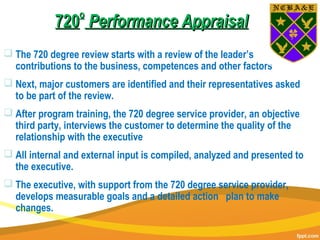
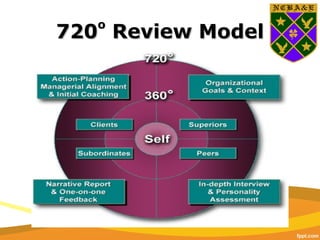
 The 720 degree review starts with a review of the leader’s
contributions to the business, competences and other factors
 Next, major customers are identified and their representatives asked
to be part of the review. 
 After program training, the 720 degree service provider, an objective
third party, interviews the customer to determine the quality of the
relationship with the executive
 All internal and external input is compiled, analyzed and presented to
the executive.
 The executive, with support from the 720 degree service provider,
develops measurable goals and a detailed action  plan to make
changes. 
720720oo
Review ModelReview Model
RESOURCESRESOURCES
• Buckingham, Marcus and Donald O. Clifton, Ph.D., NOW, Discover
Your Strengths, The Free Press, 2001
• Collins, Michelle LeDuff, Ph.D. The Thin Book of 360 Feedback: A
Manager's Guide, Thin Book Publishing Co., 2000
• Edwards, Mark R. and Ann J. Ewen, 360 Degree Feedback: The Powerful
New Model for Employee Assessment & Performance Improvement,
amacom – American Management Association, 1996
• Jones, John E., Ph.D. and William L. Bearley, Ed.D., 360° Feedback :
Strategies, Tactics, and Techniques for Developing Leaders, HRD Press &
Lakewood Publications, 1996
• Peiperl, Maury A., Getting 360-Degree Feedback Right, Harvard
Business Review, January 2001
360 performance appraisal

360 performance appraisal

  • 1.
  • 2.
  • 3.
    AGENDAAGENDA  Performance AppraisalSystem.  What is 360 ?̊  Process of 360 Appraisal.̊  Advantages and Disadvantages.  what is 720 ?̊  Leading Questions and Suggestions.
  • 4.
    Muhammad ImraN  PerformanceAppraisal  Various Methods Used  What is 360 Degree Appraisal?  What the process involves  How to Implement 360 Degree?  How is Feedback obtained?  QUESTIONNAIRE
  • 5.
    Performance AppraisalPerformance Appraisal Reviews each individual's performance against objectives and standards for the trading year, agreed at the previous appraisal meeting.  Essential for career and succession planning.  Provide a formal, recorded, regular review of an individual's performance, and a plan for future development.
  • 6.
    Important for staffmotivation, attitude and behavior development, communicating and aligning individual and organizational aims, and fostering positive relationships between management and staff. Performance Appraisal…….Performance Appraisal…….
  • 7.
    Various Methods UsedVariousMethods Used Performance AppraisalPerformance Appraisal *Straight Ranking Method *Essay Appraisal Method *Paired Comparison Method *Critical Incident Method *Field Review *Checklist Method *Graphic Rating Scale *Forced Distribution *MBO. *360 Method̊ . *Assessment Centres. *Behaviourally Anchored. Rating Scale. *Human Resource Accounting. Traditional Methods Modern Methods
  • 8.
    What is 360Degree Appraisal?What is 360 Degree Appraisal? • 360-degree Appraisal is an assessment process used to improve managerial effectiveness by providing the manager with a more complete assessment of their effectiveness, and their performance and development needs.
  • 9.
    What the processinvolvesWhat the process involves Obtaining feedback from the manager's key contacts. These would normally include:  The manager him/herself  Subordinates (employees who work for the manager)  Peers (fellow managers)  Managers (senior management)  Customers  Suppliers
  • 10.
    360 The Process360The Process
  • 11.
    How to Implement360 Degree?How to Implement 360 Degree? 360 Degree Feedback Planning Piloting ImplementationFeedback Review
  • 12.
    How is Feedbackobtained?How is Feedback obtained? By using a questionnaire which asks participants to rate the individual according to observed behaviors - usually managerial or business-specific competencies. This process will not suit all companies. One should assess how well it would fit with the current culture before launching a scheme and a pilot scheme is worth building into the programme
  • 13.
  • 14.
  • 15.
    QUESTIONNAIRE DETAILSQUESTIONNAIRE DETAILS •Part APart A :: To be filled by the appraisee before the Interview and sent to Appraiser. • A1 : Appraissee to fill up his understanding of his duties and responsibilities. • A2 :Discussion Points:- – Has the past year been good/bad/satisfactory or otherwise for you, and why? – What do you consider to be your most important achievements of the past year ?
  • 16.
    QUESTIONNAIRE DETAILSQUESTIONNAIRE DETAILS What do you like and dislike about working for this organization?  What elements of your job do you find most difficult?  What elements of your job interest you the most, and least?
  • 17.
     What doyou consider to be your most important tasks in the Next year?  What action could be taken to improve your performance in your current position by you, and your boss?  What kind of work or job would you like to be doing in one/two/five years time?  What sort of training/experience would benefit you in the next year? QUESTIONNAIRE DETAILS…..QUESTIONNAIRE DETAILS…..
  • 18.
    QUESTIONNAIRE DETAILS…… • A3: The Appraise has to list out the objectives he had set out to achieve in the past 12 months (or the period covered by this appraisal) with the measures or standards agreed - against each comment on achievement or otherwise, with reasons where appropriate. Score the performance against each objective (1-3 = poor,4-6 = satisfactory, 7-9 = good, 10 = excellent))
  • 19.
    QUESTIONNAIRE DETAILS….. • A4: Appraisee has to score his own own capability or knowledge in the following areas in terms of your current role requirements (1-3 = poor, 4-6 = satisfactory, 7-9 = good, 10 = excellent).  commercial judgement  product/technical knowledge  time management  planning, budgeting and forecasting  reporting and administration
  • 20.
    QUESTIONNAIRE DETAILS…..  communicationskills  delegation skills  IT/equipment/machinery skills  meeting expectations, deadlines and commitments  creativity  problem-solving and decision-making  team-working and developing/helping others  energy, determination and work-rate  steadiness under pressure  leadership and integrity
  • 21.
    QUESTIONNAIRE DETAILS…..  PartB : To be filled by the Appraiser.  B1B1 :: Describe the purpose of Appraissee’s job.  B2 : Reviews discussion pts in A2.  B3 : Reviews Appraisee’s objectives as given in A3.  B4 : Scores the Appraisee’s knowledge or capability as given in A4.  B5 : Discusses appraisee’s career direction .  B6 : Comments on competencies in current role and potential for next role or roles.  B7 : Comments upon the T & D support required
  • 22.
    What does 360measure ?̊What does 360 measure ?̊  360 degree measures behaviors and competencies.  360 degree addresses skills such as listening, planning, and goal-setting.  360 degree focuses on subjective areas such as teamwork, character, and leadership effectiveness.  360 degree provide feedback on how others perceive an employee.
  • 23.
     ADVANTAGES &DISADVANTAGES  Why 360 degree Appraisal Programs Fail?Why 360 degree Appraisal Programs Fail?  Pertinent Questions ???Pertinent Questions ???  Training AppraisersTraining Appraisers  Effective appraisal programs . . .Effective appraisal programs . . .  Conducting the Appraisal InterviewConducting the Appraisal Interview AZHAR ABBAS
  • 24.
    Advantages  Method ofcollecting information from as many sources in an employees environment.  Honest assessment as viewed by a variety of constituents.  Confidential input from many people of how an employee fares in his job.  Helps employees in seeing themselves as others see them.  It provides information which neither employee nor his/her superior may be aware.
  • 25.
    Advantages…..Advantages…..  Confidentiality animportant aspect.  Employees find this method to be fair.  Gives an indication of performance enhancing or distracting work situation.  Allows to improve the system creating greater harmony and overall improvement.  Help employees identify strenght and address skill gaps.  Lends to continuous learning , growing self confidence and improved productivity.
  • 26.
    Advantages to theSupervisor • The system is helpful to the supervisor as :  Accurate assessment.  Eliminate accusations of favouritism.  Provides greater Objectivity.
  • 27.
     360 performancerating system is not a validated or corroborated technique for Performance appraisal With the increase in the number of raters from one to five (commonly), it become difficult to separate, calculate and eliminate personal biasness and differences. Why 360 degree AppraisalWhy 360 degree Appraisal Programs Fail?Programs Fail?
  • 28.
    Why 360 degreeAppraisalWhy 360 degree Appraisal Programs Fail?Programs Fail?  The 360 degree appraisal mechanism can have a adversely effect on the motivation and the performance of the employees.  360 degree feedback – as a process requires commitment of top management and the HR, resources(time, financial resources etc), planned implementation and follow up. Often, the process suffers because of the lack of knowledgeOften, the process suffers because of the lack of knowledge on the part of the participants or the raterson the part of the participants or the raters
  • 29.
     360 degreefeedback can be adversely affected by the customers perception of the organisation and their incomplete knowledge about the process and the clarity of the process. ..  It is often time consuming and difficult to analyze the information gathered. The results can be manipulated by the employees towards their desired ratings with the help Why 360 degree AppraisalWhy 360 degree Appraisal Programs Fail?Programs Fail?
  • 30.
    Pertinent Questions ???PertinentQuestions ???  Is your organization committed to continuous learning?  Does your organization see the value of developing leaders in-house?  Are you willing to make the changes necessary to do this?  What is the level of trust in your organization? Will your culture support honest feedback?  Is upper level management willing to lead the way and volunteer for 360-degree evaluation?
  • 31.
    Training AppraisersTraining Appraisers Trainappraisers to eliminate rater error  Error of central tendencyError of central tendency  Leniency or strictness errorLeniency or strictness error  Recency errorRecency error  Contrast errorContrast error  Similar to me errorSimilar to me error
  • 32.
    Effective appraisal programs. . .Effective appraisal programs . . . Comply with the law To ensure that the performance appraisal system does not violate principles of fair employment practices: - Job related performance standards - Provide employees with a written copy of the standards before the appraisal - Standards must be based on observable or measurable behaviour - Train the raters - Provide feedback - Implement an appeal system to settle disagreements
  • 33.
    Conducting the AppraisalInterviewConducting the Appraisal Interview  Ask for self assessment  Invite participation  Express appreciation  Minimize criticism  Change behaviour, not the person  Focus on solving problems  Be supportive  Establish goals  Follow up day-to-day
  • 34.
    720720oo Performance AppraisalPerformance Appraisal The 720 degree review starts with a review of the leader’s contributions to the business, competences and other factors  Next, major customers are identified and their representatives asked to be part of the review.   After program training, the 720 degree service provider, an objective third party, interviews the customer to determine the quality of the relationship with the executive  All internal and external input is compiled, analyzed and presented to the executive.  The executive, with support from the 720 degree service provider, develops measurable goals and a detailed action  plan to make changes. 
  • 35.
  • 36.
    RESOURCESRESOURCES • Buckingham, Marcusand Donald O. Clifton, Ph.D., NOW, Discover Your Strengths, The Free Press, 2001 • Collins, Michelle LeDuff, Ph.D. The Thin Book of 360 Feedback: A Manager's Guide, Thin Book Publishing Co., 2000 • Edwards, Mark R. and Ann J. Ewen, 360 Degree Feedback: The Powerful New Model for Employee Assessment & Performance Improvement, amacom – American Management Association, 1996 • Jones, John E., Ph.D. and William L. Bearley, Ed.D., 360° Feedback : Strategies, Tactics, and Techniques for Developing Leaders, HRD Press & Lakewood Publications, 1996 • Peiperl, Maury A., Getting 360-Degree Feedback Right, Harvard Business Review, January 2001

Editor's Notes

  • #2 We have all seen cartoons depicting the owl that can turn his head 180 degrees to the left and 180 degrees to the right. But in reality, an owl can only turn his head 270 degrees — not in a full circle. Full circle or not, it's still a good range of vision. I'm sure you're wondering what this has to do with your business. But consider this. An owl lives in a very competitive environment. If he is to be successful in his world, he must constantly be looking for opportunities and threats. He must gather information from all directions to get a complete read on his environment and what he must to do to survive. In business terms, this translates to gathering input on our performance from all points to ensure we are doing the job we want to do.