Factoring Trinomials and Making Lists
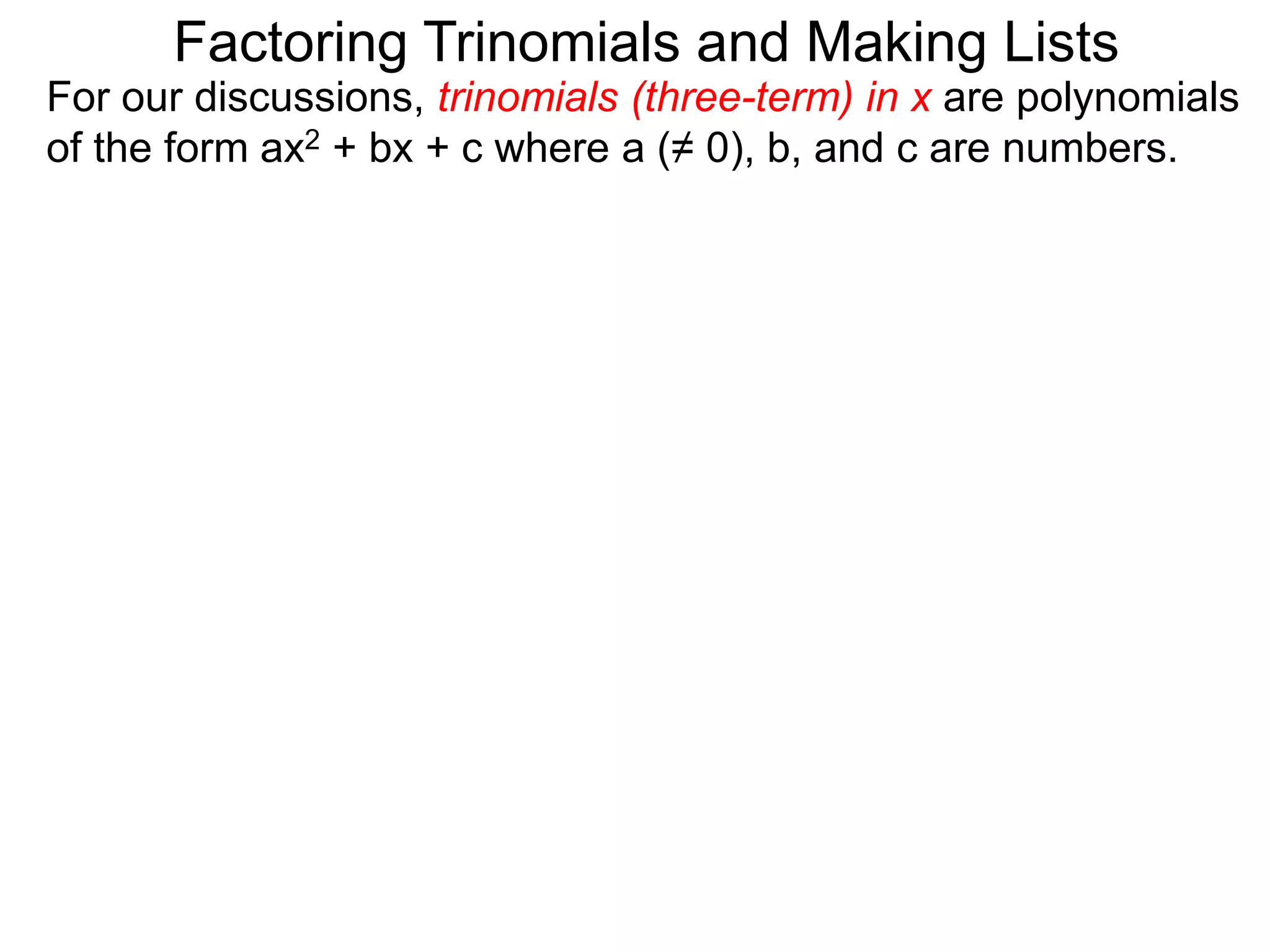
For our discussions, trinomials (three-term) in x are polynomials
of the form ax2 + bx + c where a (≠ 0), b, and c are numbers.
Factoring Trinomials and Making Lists
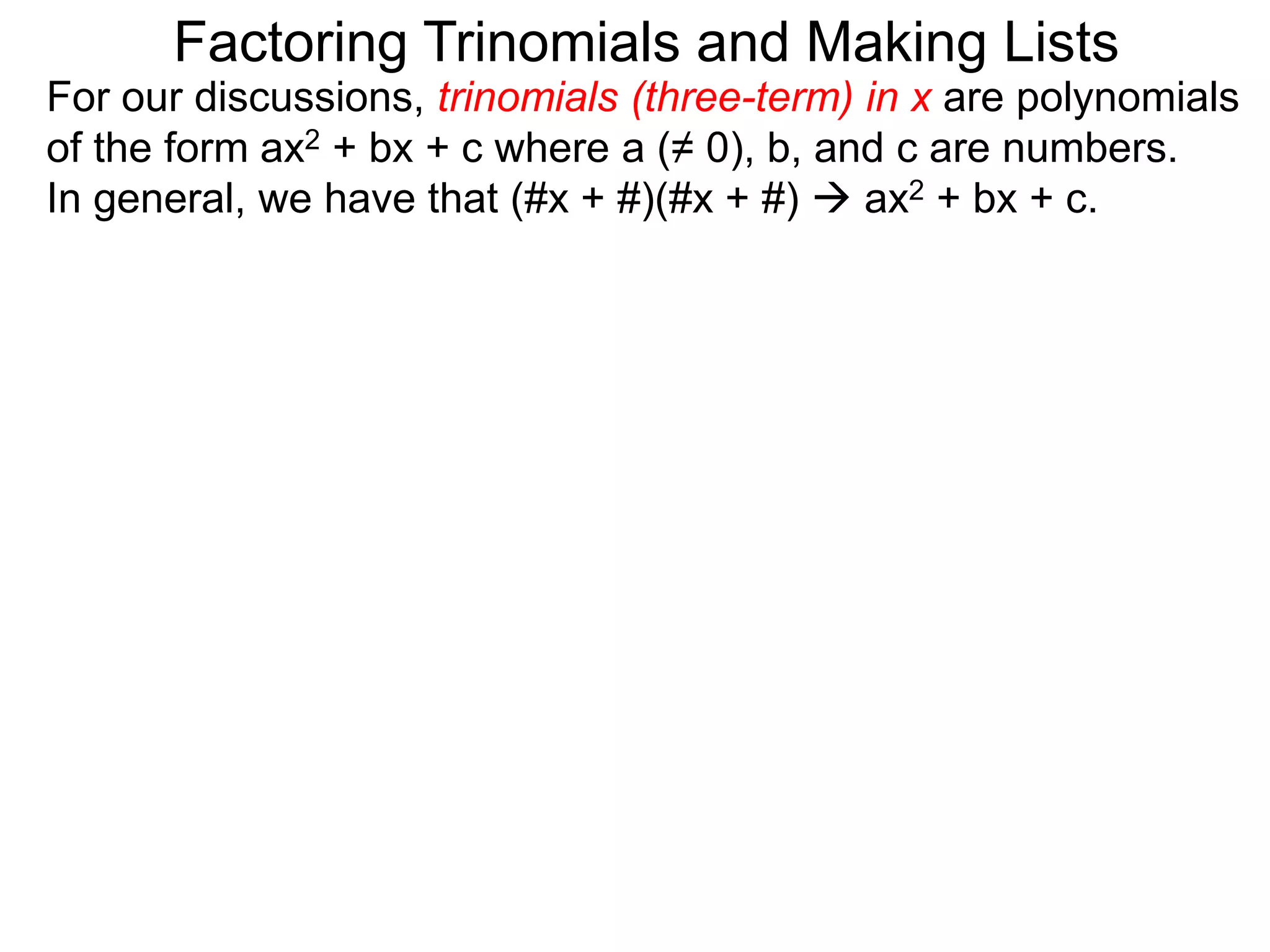
For our discussions, trinomials (three-term) in x are polynomials
of the form ax2 + bx + c where a (≠ 0), b, and c are numbers.
In general, we have that (#x + #)(#x + #)  ax2 + bx + c.
Factoring Trinomials and Making Lists
For our discussions, trinomials (three-term) in x are polynomials
of the form ax2 + bx + c where a (≠ 0), b, and c are numbers.
In general, we have that (#x + #)(#x + #)  ax2 + bx + c.
For example,
(x + 2)(x + 1)  x2 + 3x + 2 with a = 1, b = 3, and c = 2.
Factoring Trinomials and Making Lists
For our discussions, trinomials (three-term) in x are polynomials
of the form ax2 + bx + c where a (≠ 0), b, and c are numbers.
In general, we have that (#x + #)(#x + #)  ax2 + bx + c.
For example,
(x + 2)(x + 1)  x2 + 3x + 2 with a = 1, b = 3, and c = 2.
Hence, "to factor a trinomial" means to write the trinomial as a
product of two binomials, that is, to convert
ax2 + bx + c  (#x + #)(#x + #)
Factoring Trinomials and Making Lists
For our discussions, trinomials (three-term) in x are polynomials
of the form ax2 + bx + c where a (≠ 0), b, and c are numbers.
In general, we have that (#x + #)(#x + #)  ax2 + bx + c.
For example,
(x + 2)(x + 1)  x2 + 3x + 2 with a = 1, b = 3, and c = 2.
Hence, "to factor a trinomial" means to write the trinomial as a
product of two binomials, that is, to convert
ax2 + bx + c  (#x + #)(#x + #)
Factoring Trinomials and Making Lists
The Basic Fact About Factoring Trinomials:
For our discussions, trinomials (three-term) in x are polynomials
of the form ax2 + bx + c where a (≠ 0), b, and c are numbers.
In general, we have that (#x + #)(#x + #)  ax2 + bx + c.
For example,
(x + 2)(x + 1)  x2 + 3x + 2 with a = 1, b = 3, and c = 2.
Hence, "to factor a trinomial" means to write the trinomial as a
product of two binomials, that is, to convert
ax2 + bx + c  (#x + #)(#x + #)
Factoring Trinomials and Making Lists
The Basic Fact About Factoring Trinomials:
There are two types of trinomials,
l. the ones that are factorable such as
x2 + 3x + 2  (x + 2)(x + 1)
For our discussions, trinomials (three-term) in x are polynomials
of the form ax2 + bx + c where a (≠ 0), b, and c are numbers.
In general, we have that (#x + #)(#x + #)  ax2 + bx + c.
For example,
(x + 2)(x + 1)  x2 + 3x + 2 with a = 1, b = 3, and c = 2.
Hence, "to factor a trinomial" means to write the trinomial as a
product of two binomials, that is, to convert
ax2 + bx + c  (#x + #)(#x + #)
Factoring Trinomials and Making Lists
The Basic Fact About Factoring Trinomials:
There are two types of trinomials,
l. the ones that are factorable such as
x2 + 3x + 2  (x + 2)(x + 1)
ll. the ones that are prime or no factorable, such as
x2 + 2x + 3  (#x + #)(#x + #) (Not possible!)
For our discussions, trinomials (three-term) in x are polynomials
of the form ax2 + bx + c where a (≠ 0), b, and c are numbers.
In general, we have that (#x + #)(#x + #)  ax2 + bx + c.
For example,
(x + 2)(x + 1)  x2 + 3x + 2 with a = 1, b = 3, and c = 2.
Hence, "to factor a trinomial" means to write the trinomial as a
product of two binomials, that is, to convert
ax2 + bx + c  (#x + #)(#x + #)
Factoring Trinomials and Making Lists
The Basic Fact About Factoring Trinomials:
There are two types of trinomials,
l. the ones that are factorable such as
x2 + 3x + 2  (x + 2)(x + 1)
ll. the ones that are prime or no factorable, such as
x2 + 2x + 3  (#x + #)(#x + #)
Our jobs are to determine which trinomials:
1. are factorable and factor them,
(Not possible!)
For our discussions, trinomials (three-term) in x are polynomials
of the form ax2 + bx + c where a (≠ 0), b, and c are numbers.
In general, we have that (#x + #)(#x + #)  ax2 + bx + c.
For example,
(x + 2)(x + 1)  x2 + 3x + 2 with a = 1, b = 3, and c = 2.
Hence, "to factor a trinomial" means to write the trinomial as a
product of two binomials, that is, to convert
ax2 + bx + c  (#x + #)(#x + #)
Factoring Trinomials and Making Lists
The Basic Fact About Factoring Trinomials:
There are two types of trinomials,
l. the ones that are factorable such as
x2 + 3x + 2  (x + 2)(x + 1)
ll. the ones that are prime or no factorable, such as
x2 + 2x + 3  (#x + #)(#x + #)
Our jobs are to determine which trinomials:
1. are factorable and factor them,
2. are prime so we won’t waste time on trying to factor them.
(Not possible!)
Factoring Trinomials and Making Lists
One method to determine which is which is by making lists.
Factoring Trinomials and Making Lists
One method to determine which is which is by making lists.
A list is a record of all the possibilities according to some criteria
such as the list of “all the cousins that one has”.
Factoring Trinomials and Making Lists
One method to determine which is which is by making lists.
A list is a record of all the possibilities according to some criteria
such as the list of “all the cousins that one has”.
The lists we will make are lists of numbers.
Example A.
Using the given tables,
list all the u and v such that:
Factoring Trinomials and Making Lists
One method to determine which is which is by making lists.
A list is a record of all the possibilities according to some criteria
such as the list of “all the cousins that one has”.
The lists we will make are lists of numbers.
12 12
I
i. uv is the top number
II
Example A.
Using the given tables,
list all the u and v such that:
Factoring Trinomials and Making Lists
One method to determine which is which is by making lists.
A list is a record of all the possibilities according to some criteria
such as the list of “all the cousins that one has”.
The lists we will make are lists of numbers.
12
7
12
9
I
ii. and if possible,
u + v is the bottom number.
i. uv is the top number
II
Example A.
Using the given tables,
list all the u and v such that:
Factoring Trinomials and Making Lists
One method to determine which is which is by making lists.
A list is a record of all the possibilities according to some criteria
such as the list of “all the cousins that one has”.
The lists we will make are lists of numbers.
12
7
We list all the possible ways
to factor 12 as u*v as shown. 12
9
I
1 12
6
3 4
2
1 12
6
3 4
2
ii. and if possible,
u + v is the bottom number.
i. uv is the top number
II
Example A.
Using the given tables,
list all the u and v such that:
Factoring Trinomials and Making Lists
One method to determine which is which is by making lists.
A list is a record of all the possibilities according to some criteria
such as the list of “all the cousins that one has”.
The lists we will make are lists of numbers.
12
7
We list all the possible ways
to factor 12 as u*v as shown.
For l, the solution are 3 and 4.
12
9
I
1 12
6
3 4
2
1 12
6
3 4
2
ii. and if possible,
u + v is the bottom number.
i. uv is the top number
II
Example A.
Using the given tables,
list all the u and v such that:
Factoring Trinomials and Making Lists
One method to determine which is which is by making lists.
A list is a record of all the possibilities according to some criteria
such as the list of “all the cousins that one has”.
The lists we will make are lists of numbers.
12
7
We list all the possible ways
to factor 12 as u*v as shown.
For l, the solution are 3 and 4.
For ll, based on the list of all
the possible u and v,
there are no u and v
where u + v = 9,
so the task is impossible.
12
9
I
1 12
6
3 4
2
1 12
6
3 4
2
ii. and if possible,
u + v is the bottom number.
i. uv is the top number
II
The ac-Method
A table like the ones above can be made from a given trinomial
and the ac–method uses the table to check if the given
trinomial is factorable or prime.
I. If we find the u and v that fit the table then it is factorable,
and we may use the grouping method, with the found u and v,
to factor the trinomial.
Factoring Trinomials and Making Lists
The ac-Method
A table like the ones above can be made from a given trinomial
and the ac–method uses the table to check if the given
trinomial is factorable or prime.
I. If we find the u and v that fit the table then it is factorable,
and we may use the grouping method, with the found u and v,
to factor the trinomial.
Example B. Factor x2 – x – 6 by grouping.
Here is an example of factoring a trinomial by grouping.
Factoring Trinomials and Making Lists
The ac-Method
A table like the ones above can be made from a given trinomial
and the ac–method uses the table to check if the given
trinomial is factorable or prime.
I. If we find the u and v that fit the table then it is factorable,
and we may use the grouping method, with the found u and v,
to factor the trinomial.
Example B. Factor x2 – x – 6 by grouping.
x2 – x – 6 write –x as –3x + 2x
= x2 – 3x + 2x – 6
Here is an example of factoring a trinomial by grouping.
Factoring Trinomials and Making Lists
The ac-Method
A table like the ones above can be made from a given trinomial
and the ac–method uses the table to check if the given
trinomial is factorable or prime.
I. If we find the u and v that fit the table then it is factorable,
and we may use the grouping method, with the found u and v,
to factor the trinomial.
Example B. Factor x2 – x – 6 by grouping.
x2 – x – 6 write –x as –3x + 2x
= x2 – 3x + 2x – 6 put the four terms into two pairs
= (x2 – 3x) + (2x – 6)
Here is an example of factoring a trinomial by grouping.
Factoring Trinomials and Making Lists
The ac-Method
A table like the ones above can be made from a given trinomial
and the ac–method uses the table to check if the given
trinomial is factorable or prime.
I. If we find the u and v that fit the table then it is factorable,
and we may use the grouping method, with the found u and v,
to factor the trinomial.
Example B. Factor x2 – x – 6 by grouping.
x2 – x – 6 write –x as –3x + 2x
= x2 – 3x + 2x – 6 put the four terms into two pairs
= (x2 – 3x) + (2x – 6) take out the GCF of each pair
= x(x – 3) + 2(x – 3)
Here is an example of factoring a trinomial by grouping.
Factoring Trinomials and Making Lists
The ac-Method
A table like the ones above can be made from a given trinomial
and the ac–method uses the table to check if the given
trinomial is factorable or prime.
I. If we find the u and v that fit the table then it is factorable,
and we may use the grouping method, with the found u and v,
to factor the trinomial.
Example B. Factor x2 – x – 6 by grouping.
x2 – x – 6 write –x as –3x + 2x
= x2 – 3x + 2x – 6 put the four terms into two pairs
= (x2 – 3x) + (2x – 6) take out the GCF of each pair
= x(x – 3) + 2(x – 3) take out the common (x – 3)
= (x – 3)(x + 2)
Here is an example of factoring a trinomial by grouping.
Factoring Trinomials and Making Lists
The ac-Method
A table like the ones above can be made from a given trinomial
and the ac–method uses the table to check if the given
trinomial is factorable or prime.
I. If we find the u and v that fit the table then it is factorable,
and we may use the grouping method, with the found u and v,
to factor the trinomial.
II. If the table is impossible to do, then the trinomial is prime.
Example B. Factor x2 – x – 6 by grouping.
x2 – x – 6 write –x as –3x + 2x
= x2 – 3x + 2x – 6 put the four terms into two pairs
= (x2 – 3x) + (2x – 6) take out the GCF of each pair
= x(x – 3) + 2(x – 3) take out the common (x – 3)
= (x – 3)(x + 2)
Here is an example of factoring a trinomial by grouping.
Factoring Trinomials and Making Lists
The ac-Method
A table like the ones above can be made from a given trinomial
and the ac–method uses the table to check if the given
trinomial is factorable or prime.
I. If we find the u and v that fit the table then it is factorable,
and we may use the grouping method, with the found u and v,
to factor the trinomial.
II. If the table is impossible to do, then the trinomial is prime.
Example B. Factor x2 – x – 6 by grouping.
x2 – x – 6 write –x as –3x + 2x
= x2 – 3x + 2x – 6 put the four terms into two pairs
= (x2 – 3x) + (2x – 6) take out the GCF of each pair
= x(x – 3) + 2(x – 3) take out the common (x – 3)
= (x – 3)(x + 2)
Here is an example of factoring a trinomial by grouping.
Let’s see how the X–table is made from a trinomial.
Factoring Trinomials and Making Lists
ac-Method: Given the trinomial ax2 + bx + c
with no common factor, it’s ac–table is: ac
b
Factoring Trinomials and Making Lists
ac-Method: Given the trinomial ax2 + bx + c
with no common factor, it’s ac–table is:
i.e. ac at the top, and b at the bottom,
and we are to find u and v such that
uv = ac
u + v = b
ac
b
# #
# #
# #
Factoring Trinomials and Making Lists
ac-Method: Given the trinomial ax2 + bx + c
with no common factor, it’s ac–table is:
i.e. ac at the top, and b at the bottom,
and we are to find u and v such that
uv = ac
u + v = b
I. If u and v are found (so u + v = b),
write ax2 + bx + c as ax2 + ux + vx + c,
ac
b
# #
# #
# #
Factoring Trinomials and Making Lists
ac-Method: Given the trinomial ax2 + bx + c
with no common factor, it’s ac–table is:
i.e. ac at the top, and b at the bottom,
and we are to find u and v such that
uv = ac
u + v = b
I. If u and v are found (so u + v = b),
write ax2 + bx + c as ax2 + ux + vx + c,
then factor (ax2 + ux) + (vx + c) by the grouping method.
ac
b
# #
# #
# #
Factoring Trinomials and Making Lists
ac-Method: Given the trinomial ax2 + bx + c
with no common factor, it’s ac–table is:
i.e. ac at the top, and b at the bottom,
and we are to find u and v such that
–6
–1
uv = ac
u + v = b
I. If u and v are found (so u + v = b),
write ax2 + bx + c as ax2 + ux + vx + c,
then factor (ax2 + ux) + (vx + c) by the grouping method.
In example B, the ac-table for 1x2 – x – 6 is:
ac
b
# #
# #
# #
Factoring Trinomials and Making Lists
ac-Method: Given the trinomial ax2 + bx + c
with no common factor, it’s ac–table is:
i.e. ac at the top, and b at the bottom,
and we are to find u and v such that
–6
–1
–3 2
uv = ac
u + v = b
I. If u and v are found (so u + v = b),
write ax2 + bx + c as ax2 + ux + vx + c,
then factor (ax2 + ux) + (vx + c) by the grouping method.
In example B, the ac-table for 1x2 – x – 6 is:
We found –3, 2 fit the table, so we write
x2 – x – 6 as x2 – 3x + 2x – 6
ac
b
# #
# #
# #
Factoring Trinomials and Making Lists
ac-Method: Given the trinomial ax2 + bx + c
with no common factor, it’s ac–table is:
i.e. ac at the top, and b at the bottom,
and we are to find u and v such that
–6
–1
–3 2
uv = ac
u + v = b
I. If u and v are found (so u + v = b),
write ax2 + bx + c as ax2 + ux + vx + c,
then factor (ax2 + ux) + (vx + c) by the grouping method.
In example B, the ac-table for 1x2 – x – 6 is:
We found –3, 2 fit the table, so we write
x2 – x – 6 as x2 – 3x + 2x – 6 and by grouping
= (x2 – 3x) + (2x – 6)
ac
b
# #
# #
# #
Factoring Trinomials and Making Lists
ac-Method: Given the trinomial ax2 + bx + c
with no common factor, it’s ac–table is:
i.e. ac at the top, and b at the bottom,
and we are to find u and v such that
–6
–1
–3 2
uv = ac
u + v = b
I. If u and v are found (so u + v = b),
write ax2 + bx + c as ax2 + ux + vx + c,
then factor (ax2 + ux) + (vx + c) by the grouping method.
In example B, the ac-table for 1x2 – x – 6 is:
We found –3, 2 fit the table, so we write
x2 – x – 6 as x2 – 3x + 2x – 6 and by grouping
= (x2 – 3x) + (2x – 6)
= x(x – 3) + 2(x – 3)
= (x – 3)(x + 2)
ac
b
# #
# #
# #
Factoring Trinomials and Making Lists
ac-Method: Given the trinomial ax2 + bx + c
with no common factor, it’s ac–table is:
i.e. ac at the top, and b at the bottom,
and we are to find u and v such that
–6
–1
–3 2
uv = ac
u + v = b
I. If u and v are found (so u + v = b),
write ax2 + bx + c as ax2 + ux + vx + c,
then factor (ax2 + ux) + (vx + c) by the grouping method.
In example B, the ac-table for 1x2 – x – 6 is:
We found –3, 2 fit the table, so we write
x2 – x – 6 as x2 – 3x + 2x – 6 and by grouping
= (x2 – 3x) + (2x – 6)
= x(x – 3) + 2(x – 3)
= (x – 3)(x + 2)
ac
b
# #
# #
# #
II. If u and v do not exist, then the trinomial is prime.
Factoring Trinomials and Making Lists
Example C. Factor 3x2 – 4x – 20 using the ac-method.
Factoring Trinomials and Making Lists
Example C. Factor 3x2 – 4x – 20 using the ac-method.
We have that a = 3, c = –20 so ac = 3(–20) = –60,
Factoring Trinomials and Making Lists
Example C. Factor 3x2 – 4x – 20 using the ac-method.
We have that a = 3, c = –20 so ac = 3(–20) = –60,
b = –4 and the ac–table is:
–60
–4
Factoring Trinomials and Making Lists
Example C. Factor 3x2 – 4x – 20 using the ac-method.
We have that a = 3, c = –20 so ac = 3(–20) = –60,
b = –4 and the ac–table is:
We need two numbers u and v such that
uv = –60 and u + v = –4.
–60
–4
Factoring Trinomials and Making Lists
Example C. Factor 3x2 – 4x – 20 using the ac-method.
We have that a = 3, c = –20 so ac = 3(–20) = –60,
b = –4 and the ac–table is:
We need two numbers u and v such that
uv = –60 and u + v = –4.
By trial and error we see that 6 and –10 is the
solution so we may factor the trinomial by grouping.
–60
–4
–10 6
Factoring Trinomials and Making Lists
Example C. Factor 3x2 – 4x – 20 using the ac-method.
We have that a = 3, c = –20 so ac = 3(–20) = –60,
b = –4 and the ac–table is:
We need two numbers u and v such that
uv = –60 and u + v = –4.
By trial and error we see that 6 and –10 is the
solution so we may factor the trinomial by grouping.
–60
–4
–10 6
Factoring Trinomials and Making Lists
Using 6 and –10, write 3x2 – 4x – 20 as 3x2 + 6x –10x – 20
Example C. Factor 3x2 – 4x – 20 using the ac-method.
We have that a = 3, c = –20 so ac = 3(–20) = –60,
b = –4 and the ac–table is:
We need two numbers u and v such that
uv = –60 and u + v = –4.
By trial and error we see that 6 and –10 is the
solution so we may factor the trinomial by grouping.
–60
–4
–10 6
Factoring Trinomials and Making Lists
Using 6 and –10, write 3x2 – 4x – 20 as 3x2 + 6x –10x – 20
= (3x2 + 6x ) + (–10x – 20) put in two groups
Example C. Factor 3x2 – 4x – 20 using the ac-method.
We have that a = 3, c = –20 so ac = 3(–20) = –60,
b = –4 and the ac–table is:
We need two numbers u and v such that
uv = –60 and u + v = –4.
By trial and error we see that 6 and –10 is the
solution so we may factor the trinomial by grouping.
–60
–4
–10 6
Factoring Trinomials and Making Lists
Using 6 and –10, write 3x2 – 4x – 20 as 3x2 + 6x –10x – 20
= (3x2 + 6x ) + (–10x – 20) put in two groups
= 3x(x + 2) – 10 (x + 2) pull out common factor
Example C. Factor 3x2 – 4x – 20 using the ac-method.
We have that a = 3, c = –20 so ac = 3(–20) = –60,
b = –4 and the ac–table is:
We need two numbers u and v such that
uv = –60 and u + v = –4.
By trial and error we see that 6 and –10 is the
solution so we may factor the trinomial by grouping.
–60
–4
–10 6
Factoring Trinomials and Making Lists
Using 6 and –10, write 3x2 – 4x – 20 as 3x2 + 6x –10x – 20
= (3x2 + 6x ) + (–10x – 20) put in two groups
= 3x(x + 2) – 10 (x + 2) pull out common factor
= (3x – 10)(x + 2) pull out common factor
Hence 3x2 – 4x – 20 = (3x – 10)(x + 2)
Example C. Factor 3x2 – 4x – 20 using the ac-method.
If the trinomial is prime then we have to justify it’s prime by
showing that no such u and v exist
We have that a = 3, c = –20 so ac = 3(–20) = –60,
b = –4 and the ac–table is:
We need two numbers u and v such that
uv = –60 and u + v = –4.
By trial and error we see that 6 and –10 is the
solution so we may factor the trinomial by grouping.
–60
–4
–10 6
Factoring Trinomials and Making Lists
Using 6 and –10, write 3x2 – 4x – 20 as 3x2 + 6x –10x – 20
= (3x2 + 6x ) + (–10x – 20) put in two groups
= 3x(x + 2) – 10 (x + 2) pull out common factor
= (3x – 10)(x + 2) pull out common factor
Hence 3x2 – 4x – 20 = (3x – 10)(x + 2)
Example C. Factor 3x2 – 4x – 20 using the ac-method.
If the trinomial is prime then we have to justify it’s prime by
showing that no such u and v exist by listing all the possible
u’s and v’s such that uv = ac in the table to demonstrate that
none of them fits the condition u + v = b.
We have that a = 3, c = –20 so ac = 3(–20) = –60,
b = –4 and the ac–table is:
We need two numbers u and v such that
uv = –60 and u + v = –4.
By trial and error we see that 6 and –10 is the
solution so we may factor the trinomial by grouping.
–60
–4
–10 6
Factoring Trinomials and Making Lists
Using 6 and –10, write 3x2 – 4x – 20 as 3x2 + 6x –10x – 20
= (3x2 + 6x ) + (–10x – 20) put in two groups
= 3x(x + 2) – 10 (x + 2) pull out common factor
= (3x – 10)(x + 2) pull out common factor
Hence 3x2 – 4x – 20 = (3x – 10)(x + 2)
Example D. Factor 3x2 – 6x – 20 if possible.
If it’s prime, justify that.
Factoring Trinomials and Making Lists
Example D. Factor 3x2 – 6x – 20 if possible.
If it’s prime, justify that.
a = 3, c = –20, hence ac = 3(–20) = –60,
with b = –6, we have the ac–table:
Factoring Trinomials and Making Lists
–60
–6
Example D. Factor 3x2 – 6x – 20 if possible.
If it’s prime, justify that.
a = 3, c = –20, hence ac = 3(–20) = –60,
with b = –6, we have the ac–table:
We want two numbers u and v such that
uv = –60 and u + v = –6.
Factoring Trinomials and Making Lists
–60
–6
Example D. Factor 3x2 – 6x – 20 if possible.
If it’s prime, justify that.
a = 3, c = –20, hence ac = 3(–20) = –60,
with b = –6, we have the ac–table:
We want two numbers u and v such that
uv = –60 and u + v = –6.
After failing to guess two such numbers,
we check to see if it's prime by listing in order
all positive u’s and v’s where uv = 60 as shown.
Factoring Trinomials and Making Lists
–60
–6
Example D. Factor 3x2 – 6x – 20 if possible.
If it’s prime, justify that.
a = 3, c = –20, hence ac = 3(–20) = –60,
with b = –6, we have the ac–table:
We want two numbers u and v such that
uv = –60 and u + v = –6.
After failing to guess two such numbers,
we check to see if it's prime by listing in order
all positive u’s and v’s where uv = 60 as shown.
Factoring Trinomials and Making Lists
–60
–6
601
302
203
154
125
106
Always make a
list in an orderly
manner to ensure
the accuracy of
the list.
Example D. Factor 3x2 – 6x – 20 if possible.
If it’s prime, justify that.
a = 3, c = –20, hence ac = 3(–20) = –60,
with b = –6, we have the ac–table:
We want two numbers u and v such that
uv = –60 and u + v = –6.
After failing to guess two such numbers,
we check to see if it's prime by listing in order
all positive u’s and v’s where uv = 60 as shown.
By the table, we see that there are no u and v
such that ±u and ±v combine to be –6.
Hence 3x2 – 6x – 20 is prime.
Factoring Trinomials and Making Lists
–60
–6
601
302
203
154
125
106
Always make a
list in an orderly
manner to ensure
the accuracy of
the list.
Example D. Factor 3x2 – 6x – 20 if possible.
If it’s prime, justify that.
a = 3, c = –20, hence ac = 3(–20) = –60,
with b = –6, we have the ac–table:
We want two numbers u and v such that
uv = –60 and u + v = –6.
After failing to guess two such numbers,
we check to see if it's prime by listing in order
all positive u’s and v’s where uv = 60 as shown.
By the table, we see that there are no u and v
such that ±u and ±v combine to be –6.
Hence 3x2 – 6x – 20 is prime.
Factoring Trinomials and Making Lists
–60
–6
601
302
203
154
125
106
Always make a
list in an orderly
manner to ensure
the accuracy of
the list.
Finally for some trinomials, such as when a = 1 or x2 + bx + c,
it’s easier to guess directly because it must factor into the form
(x ± u) (x ± v) if it’s factorable.
Example E.
a. Factor x2 + 5x + 6
Factoring Trinomials and Making Lists
Example E.
a. Factor x2 + 5x + 6
We want (x + u)(x + v) = x2 + 5x + 6, so we need u and v
where uv = 6
Factoring Trinomials and Making Lists
Example E.
a. Factor x2 + 5x + 6
We want (x + u)(x + v) = x2 + 5x + 6, so we need u and v
where uv = 6 and u + v = 5.
Factoring Trinomials and Making Lists
Example E.
a. Factor x2 + 5x + 6
We want (x + u)(x + v) = x2 + 5x + 6, so we need u and v
where uv = 6 and u + v = 5.
Since 6 = (1)(6) = (2)(3) = (-1)(-6) = (-2)(-3)
Factoring Trinomials and Making Lists
Example E.
a. Factor x2 + 5x + 6
We want (x + u)(x + v) = x2 + 5x + 6, so we need u and v
where uv = 6 and u + v = 5.
Since 6 = (1)(6) = (2)(3) = (-1)(-6) = (-2)(-3) and 2x + 3x
Factoring Trinomials and Making Lists
Example E.
a. Factor x2 + 5x + 6
We want (x + u)(x + v) = x2 + 5x + 6, so we need u and v
where uv = 6 and u + v = 5.
Since 6 = (1)(6) = (2)(3) = (-1)(-6) = (-2)(-3) and 2x + 3x = 5x,
Factoring Trinomials and Making Lists
Example E.
a. Factor x2 + 5x + 6
We want (x + u)(x + v) = x2 + 5x + 6, so we need u and v
where uv = 6 and u + v = 5.
Since 6 = (1)(6) = (2)(3) = (-1)(-6) = (-2)(-3) and 2x + 3x = 5x,
so x2 + 5x + 6 = (x + 2)(x + 3)
Factoring Trinomials and Making Lists
b. Factor x2 – 5x + 6
Example E.
a. Factor x2 + 5x + 6
We want (x + u)(x + v) = x2 + 5x + 6, so we need u and v
where uv = 6 and u + v = 5.
Since 6 = (1)(6) = (2)(3) = (-1)(-6) = (-2)(-3) and 2x + 3x = 5x,
so x2 + 5x + 6 = (x + 2)(x + 3)
Factoring Trinomials and Making Lists
b. Factor x2 – 5x + 6
We want (x + u)(x + v) = x2 – 5x + 6,
Example E.
a. Factor x2 + 5x + 6
We want (x + u)(x + v) = x2 + 5x + 6, so we need u and v
where uv = 6 and u + v = 5.
Since 6 = (1)(6) = (2)(3) = (-1)(-6) = (-2)(-3) and 2x + 3x = 5x,
so x2 + 5x + 6 = (x + 2)(x + 3)
Factoring Trinomials and Making Lists
b. Factor x2 – 5x + 6
We want (x + u)(x + v) = x2 – 5x + 6, so we need u and v
where uv = 6
Example E.
a. Factor x2 + 5x + 6
We want (x + u)(x + v) = x2 + 5x + 6, so we need u and v
where uv = 6 and u + v = 5.
Since 6 = (1)(6) = (2)(3) = (-1)(-6) = (-2)(-3) and 2x + 3x = 5x,
so x2 + 5x + 6 = (x + 2)(x + 3)
Factoring Trinomials and Making Lists
b. Factor x2 – 5x + 6
We want (x + u)(x + v) = x2 – 5x + 6, so we need u and v
where uv = 6 and u + v = –5.
Example E.
a. Factor x2 + 5x + 6
We want (x + u)(x + v) = x2 + 5x + 6, so we need u and v
where uv = 6 and u + v = 5.
Since 6 = (1)(6) = (2)(3) = (-1)(-6) = (-2)(-3) and 2x + 3x = 5x,
so x2 + 5x + 6 = (x + 2)(x + 3)
Factoring Trinomials and Making Lists
b. Factor x2 – 5x + 6
We want (x + u)(x + v) = x2 – 5x + 6, so we need u and v
where uv = 6 and u + v = –5.
Since 6 = (1)(6) = (2)(3) = (-1)(-6) = (-2)(-3)
Example E.
a. Factor x2 + 5x + 6
We want (x + u)(x + v) = x2 + 5x + 6, so we need u and v
where uv = 6 and u + v = 5.
Since 6 = (1)(6) = (2)(3) = (-1)(-6) = (-2)(-3) and 2x + 3x = 5x,
so x2 + 5x + 6 = (x + 2)(x + 3)
Factoring Trinomials and Making Lists
b. Factor x2 – 5x + 6
We want (x + u)(x + v) = x2 – 5x + 6, so we need u and v
where uv = 6 and u + v = –5.
Since 6 = (1)(6) = (2)(3) = (-1)(-6) = (-2)(-3) and –2 – 3 = –5,
Example E.
a. Factor x2 + 5x + 6
We want (x + u)(x + v) = x2 + 5x + 6, so we need u and v
where uv = 6 and u + v = 5.
Since 6 = (1)(6) = (2)(3) = (-1)(-6) = (-2)(-3) and 2x + 3x = 5x,
so x2 + 5x + 6 = (x + 2)(x + 3)
Factoring Trinomials and Making Lists
b. Factor x2 – 5x + 6
We want (x + u)(x + v) = x2 – 5x + 6, so we need u and v
where uv = 6 and u + v = –5.
Since 6 = (1)(6) = (2)(3) = (-1)(-6) = (-2)(-3) and –2 – 3 = –5,
so x2 – 5x + 6 = (x – 2)(x – 3).
Example E.
a. Factor x2 + 5x + 6
We want (x + u)(x + v) = x2 + 5x + 6, so we need u and v
where uv = 6 and u + v = 5.
Since 6 = (1)(6) = (2)(3) = (-1)(-6) = (-2)(-3) and 2x + 3x = 5x,
so x2 + 5x + 6 = (x + 2)(x + 3)
Factoring Trinomials and Making Lists
c. Factor x2 + 5x – 6
b. Factor x2 – 5x + 6
We want (x + u)(x + v) = x2 – 5x + 6, so we need u and v
where uv = 6 and u + v = –5.
Since 6 = (1)(6) = (2)(3) = (-1)(-6) = (-2)(-3) and –2 – 3 = –5,
so x2 – 5x + 6 = (x – 2)(x – 3).
Example E.
a. Factor x2 + 5x + 6
We want (x + u)(x + v) = x2 + 5x + 6, so we need u and v
where uv = 6 and u + v = 5.
Since 6 = (1)(6) = (2)(3) = (-1)(-6) = (-2)(-3) and 2x + 3x = 5x,
so x2 + 5x + 6 = (x + 2)(x + 3)
Factoring Trinomials and Making Lists
c. Factor x2 + 5x – 6
We want (x + u)(x + v) = x2 + 5x – 6, so we need uv = –6
b. Factor x2 – 5x + 6
We want (x + u)(x + v) = x2 – 5x + 6, so we need u and v
where uv = 6 and u + v = –5.
Since 6 = (1)(6) = (2)(3) = (-1)(-6) = (-2)(-3) and –2 – 3 = –5,
so x2 – 5x + 6 = (x – 2)(x – 3).
Example E.
a. Factor x2 + 5x + 6
We want (x + u)(x + v) = x2 + 5x + 6, so we need u and v
where uv = 6 and u + v = 5.
Since 6 = (1)(6) = (2)(3) = (-1)(-6) = (-2)(-3) and 2x + 3x = 5x,
so x2 + 5x + 6 = (x + 2)(x + 3)
Factoring Trinomials and Making Lists
c. Factor x2 + 5x – 6
We want (x + u)(x + v) = x2 + 5x – 6, so we need uv = –6 and
u + v = 5.
b. Factor x2 – 5x + 6
We want (x + u)(x + v) = x2 – 5x + 6, so we need u and v
where uv = 6 and u + v = –5.
Since 6 = (1)(6) = (2)(3) = (-1)(-6) = (-2)(-3) and –2 – 3 = –5,
so x2 – 5x + 6 = (x – 2)(x – 3).
Example E.
a. Factor x2 + 5x + 6
We want (x + u)(x + v) = x2 + 5x + 6, so we need u and v
where uv = 6 and u + v = 5.
Since 6 = (1)(6) = (2)(3) = (-1)(-6) = (-2)(-3) and 2x + 3x = 5x,
so x2 + 5x + 6 = (x + 2)(x + 3)
Factoring Trinomials and Making Lists
c. Factor x2 + 5x – 6
We want (x + u)(x + v) = x2 + 5x – 6, so we need uv = –6 and
u + v = 5.
Since -6 = (–1)(6) = (1)(–6) = (–2)(3) =(2)(–3)
b. Factor x2 – 5x + 6
We want (x + u)(x + v) = x2 – 5x + 6, so we need u and v
where uv = 6 and u + v = –5.
Since 6 = (1)(6) = (2)(3) = (-1)(-6) = (-2)(-3) and –2 – 3 = –5,
so x2 – 5x + 6 = (x – 2)(x – 3).
Example E.
a. Factor x2 + 5x + 6
We want (x + u)(x + v) = x2 + 5x + 6, so we need u and v
where uv = 6 and u + v = 5.
Since 6 = (1)(6) = (2)(3) = (-1)(-6) = (-2)(-3) and 2x + 3x = 5x,
so x2 + 5x + 6 = (x + 2)(x + 3)
Factoring Trinomials and Making Lists
c. Factor x2 + 5x – 6
We want (x + u)(x + v) = x2 + 5x – 6, so we need uv = –6 and
u + v = 5.
Since -6 = (–1)(6) = (1)(–6) = (–2)(3) =(2)(–3) and –1 + 6 = 5,
b. Factor x2 – 5x + 6
We want (x + u)(x + v) = x2 – 5x + 6, so we need u and v
where uv = 6 and u + v = –5.
Since 6 = (1)(6) = (2)(3) = (-1)(-6) = (-2)(-3) and –2 – 3 = –5,
so x2 – 5x + 6 = (x – 2)(x – 3).
Example E.
a. Factor x2 + 5x + 6
We want (x + u)(x + v) = x2 + 5x + 6, so we need u and v
where uv = 6 and u + v = 5.
Since 6 = (1)(6) = (2)(3) = (-1)(-6) = (-2)(-3) and 2x + 3x = 5x,
so x2 + 5x + 6 = (x + 2)(x + 3)
Factoring Trinomials and Making Lists
c. Factor x2 + 5x – 6
We want (x + u)(x + v) = x2 + 5x – 6, so we need uv = –6 and
u + v = 5.
Since -6 = (–1)(6) = (1)(–6) = (–2)(3) =(2)(–3) and –1 + 6 = 5,
so x2 + 5x – 6 = (x – 1)(x + 6).
b. Factor x2 – 5x + 6
We want (x + u)(x + v) = x2 – 5x + 6, so we need u and v
where uv = 6 and u + v = –5.
Since 6 = (1)(6) = (2)(3) = (-1)(-6) = (-2)(-3) and –2 – 3 = –5,
so x2 – 5x + 6 = (x – 2)(x – 3).
Example E.
a. Factor x2 + 5x + 6
We want (x + u)(x + v) = x2 + 5x + 6, so we need u and v
where uv = 6 and u + v = 5.
Since 6 = (1)(6) = (2)(3) = (-1)(-6) = (-2)(-3) and 2x + 3x = 5x,
so x2 + 5x + 6 = (x + 2)(x + 3)
Factoring Trinomials and Making Lists
Observations About Signs
Factoring Trinomials and Making Lists
Observations About Signs
Given that x2 + bx + c = (x + u)(x + v) so that uv = c,
we observe the following.
Factoring Trinomials and Making Lists
Observations About Signs
Given that x2 + bx + c = (x + u)(x + v) so that uv = c,
we observe the following.
1. If c is positive, then u and v have same sign.
In particular,
if b is also positive, then both are positive.
Factoring Trinomials and Making Lists
Observations About Signs
Given that x2 + bx + c = (x + u)(x + v) so that uv = c,
we observe the following.
1. If c is positive, then u and v have same sign.
In particular,
if b is also positive, then both are positive.
From the examples above
x2 + 5x + 6 = (x + 2)(x + 3)
Factoring Trinomials and Making Lists
Observations About Signs
Given that x2 + bx + c = (x + u)(x + v) so that uv = c,
we observe the following.
1. If c is positive, then u and v have same sign.
In particular,
if b is also positive, then both are positive.
if b is negative, then both are negative.
From the examples above
x2 + 5x + 6 = (x + 2)(x + 3)
Factoring Trinomials and Making Lists
{
Observations About Signs
Given that x2 + bx + c = (x + u)(x + v) so that uv = c,
we observe the following.
1. If c is positive, then u and v have same sign.
In particular,
if b is also positive, then both are positive.
if b is negative, then both are negative.
From the examples above
x2 + 5x + 6 = (x + 2)(x + 3)
x2 – 5x + 6 = (x – 2)(x – 3)
Factoring Trinomials and Making Lists
{
Observations About Signs
Given that x2 + bx + c = (x + u)(x + v) so that uv = c,
we observe the following.
1. If c is positive, then u and v have same sign.
In particular,
if b is also positive, then both are positive.
if b is negative, then both are negative.
From the examples above
x2 + 5x + 6 = (x + 2)(x + 3)
x2 – 5x + 6 = (x – 2)(x – 3)
2. If c is negative, then u and v have opposite signs.
Factoring Trinomials and Making Lists
{
Observations About Signs
Given that x2 + bx + c = (x + u)(x + v) so that uv = c,
we observe the following.
1. If c is positive, then u and v have same sign.
In particular,
if b is also positive, then both are positive.
if b is negative, then both are negative.
From the examples above
x2 + 5x + 6 = (x + 2)(x + 3)
x2 – 5x + 6 = (x – 2)(x – 3)
2. If c is negative, then u and v have opposite signs. The
one with larger absolute value has the same sign as b.
Factoring Trinomials and Making Lists
{
Observations About Signs
Given that x2 + bx + c = (x + u)(x + v) so that uv = c,
we observe the following.
1. If c is positive, then u and v have same sign.
In particular,
if b is also positive, then both are positive.
if b is negative, then both are negative.
From the examples above
x2 + 5x + 6 = (x + 2)(x + 3)
x2 – 5x + 6 = (x – 2)(x – 3)
2. If c is negative, then u and v have opposite signs. The
one with larger absolute value has the same sign as b.
From the example above
x2 – 5x – 6 = (x – 6)(x + 1)
Factoring Trinomials and Making Lists
1. 3x2 – x – 2 2. 3x2 + x – 2 3. 3x2 – 2x – 1
4. 3x2 + 2x – 1 5. 2x2 – 3x + 1 6. 2x2 + 3x – 1
8. 2x2 – 3x – 27. 2x2 + 3x – 2
15. 6x2 + 5x – 6
10. 5x2 + 9x – 2
B. Factor. Factor out the GCF, the “–”, and arrange the
terms in order first.
9. 5x2 – 3x – 2
12. 3x2 – 5x + 211. 3x2 + 5x + 2
14. 6x2 – 5x – 613. 3x2 – 5x + 2
16. 6x2 – x – 2 17. 6x2 – 13x + 2 18. 6x2 – 13x + 2
19. 6x2 + 7x + 2 20. 6x2 – 7x + 2 21. 6x2 – 13x + 6
22. 6x2 + 13x + 6 23. 6x2 – 5x – 4 24. 6x2 – 13x + 8
25. 6x2 – 13x – 8 25. 4x2 – 9 26. 4x2 – 49
27. 25x2 – 4 28. 4x2 + 9 29. 25x2 + 9
30. – 6x2 – 5xy + 6y2 31. – 3x2 + 2x3– 2x 32. –6x3 – x2 + 2x
33. –15x3 – 25x2 – 10x 34. 12x3y2 –14x2y2 + 4xy2
Exercise A. Use the ac–method, factor the trinomial or
demonstrate that it’s not factorable.
Factoring Trinomials and Making Lists
35. –3x3 – 30x2 – 48x34. –yx2 + 4yx + 5y
36. –2x3 + 20x2 – 24x
40. 4x2 – 44xy + 96y2
37. –x2 + 11xy + 24y2
38. x4 – 6x3 + 36x2 39. –x2 + 9xy + 36y2
C. Factor. Factor out the GCF, the “–”, and arrange the
terms in order first.
D. Factor. If not possible, state so.
41. x2 + 1 42. x2 + 4 43. x2 + 9 43. 4x2 + 25
44. What can you conclude from 41–43?
Factoring Trinomials and Making Lists

49 factoring trinomials the ac method and making lists

  • 1.
  • 2.
    For our discussions,trinomials (three-term) in x are polynomials of the form ax2 + bx + c where a (≠ 0), b, and c are numbers. Factoring Trinomials and Making Lists
  • 3.
    For our discussions,trinomials (three-term) in x are polynomials of the form ax2 + bx + c where a (≠ 0), b, and c are numbers. In general, we have that (#x + #)(#x + #)  ax2 + bx + c. Factoring Trinomials and Making Lists
  • 4.
    For our discussions,trinomials (three-term) in x are polynomials of the form ax2 + bx + c where a (≠ 0), b, and c are numbers. In general, we have that (#x + #)(#x + #)  ax2 + bx + c. For example, (x + 2)(x + 1)  x2 + 3x + 2 with a = 1, b = 3, and c = 2. Factoring Trinomials and Making Lists
  • 5.
    For our discussions,trinomials (three-term) in x are polynomials of the form ax2 + bx + c where a (≠ 0), b, and c are numbers. In general, we have that (#x + #)(#x + #)  ax2 + bx + c. For example, (x + 2)(x + 1)  x2 + 3x + 2 with a = 1, b = 3, and c = 2. Hence, "to factor a trinomial" means to write the trinomial as a product of two binomials, that is, to convert ax2 + bx + c  (#x + #)(#x + #) Factoring Trinomials and Making Lists
  • 6.
    For our discussions,trinomials (three-term) in x are polynomials of the form ax2 + bx + c where a (≠ 0), b, and c are numbers. In general, we have that (#x + #)(#x + #)  ax2 + bx + c. For example, (x + 2)(x + 1)  x2 + 3x + 2 with a = 1, b = 3, and c = 2. Hence, "to factor a trinomial" means to write the trinomial as a product of two binomials, that is, to convert ax2 + bx + c  (#x + #)(#x + #) Factoring Trinomials and Making Lists The Basic Fact About Factoring Trinomials:
  • 7.
    For our discussions,trinomials (three-term) in x are polynomials of the form ax2 + bx + c where a (≠ 0), b, and c are numbers. In general, we have that (#x + #)(#x + #)  ax2 + bx + c. For example, (x + 2)(x + 1)  x2 + 3x + 2 with a = 1, b = 3, and c = 2. Hence, "to factor a trinomial" means to write the trinomial as a product of two binomials, that is, to convert ax2 + bx + c  (#x + #)(#x + #) Factoring Trinomials and Making Lists The Basic Fact About Factoring Trinomials: There are two types of trinomials, l. the ones that are factorable such as x2 + 3x + 2  (x + 2)(x + 1)
  • 8.
    For our discussions,trinomials (three-term) in x are polynomials of the form ax2 + bx + c where a (≠ 0), b, and c are numbers. In general, we have that (#x + #)(#x + #)  ax2 + bx + c. For example, (x + 2)(x + 1)  x2 + 3x + 2 with a = 1, b = 3, and c = 2. Hence, "to factor a trinomial" means to write the trinomial as a product of two binomials, that is, to convert ax2 + bx + c  (#x + #)(#x + #) Factoring Trinomials and Making Lists The Basic Fact About Factoring Trinomials: There are two types of trinomials, l. the ones that are factorable such as x2 + 3x + 2  (x + 2)(x + 1) ll. the ones that are prime or no factorable, such as x2 + 2x + 3  (#x + #)(#x + #) (Not possible!)
  • 9.
    For our discussions,trinomials (three-term) in x are polynomials of the form ax2 + bx + c where a (≠ 0), b, and c are numbers. In general, we have that (#x + #)(#x + #)  ax2 + bx + c. For example, (x + 2)(x + 1)  x2 + 3x + 2 with a = 1, b = 3, and c = 2. Hence, "to factor a trinomial" means to write the trinomial as a product of two binomials, that is, to convert ax2 + bx + c  (#x + #)(#x + #) Factoring Trinomials and Making Lists The Basic Fact About Factoring Trinomials: There are two types of trinomials, l. the ones that are factorable such as x2 + 3x + 2  (x + 2)(x + 1) ll. the ones that are prime or no factorable, such as x2 + 2x + 3  (#x + #)(#x + #) Our jobs are to determine which trinomials: 1. are factorable and factor them, (Not possible!)
  • 10.
    For our discussions,trinomials (three-term) in x are polynomials of the form ax2 + bx + c where a (≠ 0), b, and c are numbers. In general, we have that (#x + #)(#x + #)  ax2 + bx + c. For example, (x + 2)(x + 1)  x2 + 3x + 2 with a = 1, b = 3, and c = 2. Hence, "to factor a trinomial" means to write the trinomial as a product of two binomials, that is, to convert ax2 + bx + c  (#x + #)(#x + #) Factoring Trinomials and Making Lists The Basic Fact About Factoring Trinomials: There are two types of trinomials, l. the ones that are factorable such as x2 + 3x + 2  (x + 2)(x + 1) ll. the ones that are prime or no factorable, such as x2 + 2x + 3  (#x + #)(#x + #) Our jobs are to determine which trinomials: 1. are factorable and factor them, 2. are prime so we won’t waste time on trying to factor them. (Not possible!)
  • 11.
    Factoring Trinomials andMaking Lists One method to determine which is which is by making lists.
  • 12.
    Factoring Trinomials andMaking Lists One method to determine which is which is by making lists. A list is a record of all the possibilities according to some criteria such as the list of “all the cousins that one has”.
  • 13.
    Factoring Trinomials andMaking Lists One method to determine which is which is by making lists. A list is a record of all the possibilities according to some criteria such as the list of “all the cousins that one has”. The lists we will make are lists of numbers.
  • 14.
    Example A. Using thegiven tables, list all the u and v such that: Factoring Trinomials and Making Lists One method to determine which is which is by making lists. A list is a record of all the possibilities according to some criteria such as the list of “all the cousins that one has”. The lists we will make are lists of numbers. 12 12 I i. uv is the top number II
  • 15.
    Example A. Using thegiven tables, list all the u and v such that: Factoring Trinomials and Making Lists One method to determine which is which is by making lists. A list is a record of all the possibilities according to some criteria such as the list of “all the cousins that one has”. The lists we will make are lists of numbers. 12 7 12 9 I ii. and if possible, u + v is the bottom number. i. uv is the top number II
  • 16.
    Example A. Using thegiven tables, list all the u and v such that: Factoring Trinomials and Making Lists One method to determine which is which is by making lists. A list is a record of all the possibilities according to some criteria such as the list of “all the cousins that one has”. The lists we will make are lists of numbers. 12 7 We list all the possible ways to factor 12 as u*v as shown. 12 9 I 1 12 6 3 4 2 1 12 6 3 4 2 ii. and if possible, u + v is the bottom number. i. uv is the top number II
  • 17.
    Example A. Using thegiven tables, list all the u and v such that: Factoring Trinomials and Making Lists One method to determine which is which is by making lists. A list is a record of all the possibilities according to some criteria such as the list of “all the cousins that one has”. The lists we will make are lists of numbers. 12 7 We list all the possible ways to factor 12 as u*v as shown. For l, the solution are 3 and 4. 12 9 I 1 12 6 3 4 2 1 12 6 3 4 2 ii. and if possible, u + v is the bottom number. i. uv is the top number II
  • 18.
    Example A. Using thegiven tables, list all the u and v such that: Factoring Trinomials and Making Lists One method to determine which is which is by making lists. A list is a record of all the possibilities according to some criteria such as the list of “all the cousins that one has”. The lists we will make are lists of numbers. 12 7 We list all the possible ways to factor 12 as u*v as shown. For l, the solution are 3 and 4. For ll, based on the list of all the possible u and v, there are no u and v where u + v = 9, so the task is impossible. 12 9 I 1 12 6 3 4 2 1 12 6 3 4 2 ii. and if possible, u + v is the bottom number. i. uv is the top number II
  • 19.
    The ac-Method A tablelike the ones above can be made from a given trinomial and the ac–method uses the table to check if the given trinomial is factorable or prime. I. If we find the u and v that fit the table then it is factorable, and we may use the grouping method, with the found u and v, to factor the trinomial. Factoring Trinomials and Making Lists
  • 20.
    The ac-Method A tablelike the ones above can be made from a given trinomial and the ac–method uses the table to check if the given trinomial is factorable or prime. I. If we find the u and v that fit the table then it is factorable, and we may use the grouping method, with the found u and v, to factor the trinomial. Example B. Factor x2 – x – 6 by grouping. Here is an example of factoring a trinomial by grouping. Factoring Trinomials and Making Lists
  • 21.
    The ac-Method A tablelike the ones above can be made from a given trinomial and the ac–method uses the table to check if the given trinomial is factorable or prime. I. If we find the u and v that fit the table then it is factorable, and we may use the grouping method, with the found u and v, to factor the trinomial. Example B. Factor x2 – x – 6 by grouping. x2 – x – 6 write –x as –3x + 2x = x2 – 3x + 2x – 6 Here is an example of factoring a trinomial by grouping. Factoring Trinomials and Making Lists
  • 22.
    The ac-Method A tablelike the ones above can be made from a given trinomial and the ac–method uses the table to check if the given trinomial is factorable or prime. I. If we find the u and v that fit the table then it is factorable, and we may use the grouping method, with the found u and v, to factor the trinomial. Example B. Factor x2 – x – 6 by grouping. x2 – x – 6 write –x as –3x + 2x = x2 – 3x + 2x – 6 put the four terms into two pairs = (x2 – 3x) + (2x – 6) Here is an example of factoring a trinomial by grouping. Factoring Trinomials and Making Lists
  • 23.
    The ac-Method A tablelike the ones above can be made from a given trinomial and the ac–method uses the table to check if the given trinomial is factorable or prime. I. If we find the u and v that fit the table then it is factorable, and we may use the grouping method, with the found u and v, to factor the trinomial. Example B. Factor x2 – x – 6 by grouping. x2 – x – 6 write –x as –3x + 2x = x2 – 3x + 2x – 6 put the four terms into two pairs = (x2 – 3x) + (2x – 6) take out the GCF of each pair = x(x – 3) + 2(x – 3) Here is an example of factoring a trinomial by grouping. Factoring Trinomials and Making Lists
  • 24.
    The ac-Method A tablelike the ones above can be made from a given trinomial and the ac–method uses the table to check if the given trinomial is factorable or prime. I. If we find the u and v that fit the table then it is factorable, and we may use the grouping method, with the found u and v, to factor the trinomial. Example B. Factor x2 – x – 6 by grouping. x2 – x – 6 write –x as –3x + 2x = x2 – 3x + 2x – 6 put the four terms into two pairs = (x2 – 3x) + (2x – 6) take out the GCF of each pair = x(x – 3) + 2(x – 3) take out the common (x – 3) = (x – 3)(x + 2) Here is an example of factoring a trinomial by grouping. Factoring Trinomials and Making Lists
  • 25.
    The ac-Method A tablelike the ones above can be made from a given trinomial and the ac–method uses the table to check if the given trinomial is factorable or prime. I. If we find the u and v that fit the table then it is factorable, and we may use the grouping method, with the found u and v, to factor the trinomial. II. If the table is impossible to do, then the trinomial is prime. Example B. Factor x2 – x – 6 by grouping. x2 – x – 6 write –x as –3x + 2x = x2 – 3x + 2x – 6 put the four terms into two pairs = (x2 – 3x) + (2x – 6) take out the GCF of each pair = x(x – 3) + 2(x – 3) take out the common (x – 3) = (x – 3)(x + 2) Here is an example of factoring a trinomial by grouping. Factoring Trinomials and Making Lists
  • 26.
    The ac-Method A tablelike the ones above can be made from a given trinomial and the ac–method uses the table to check if the given trinomial is factorable or prime. I. If we find the u and v that fit the table then it is factorable, and we may use the grouping method, with the found u and v, to factor the trinomial. II. If the table is impossible to do, then the trinomial is prime. Example B. Factor x2 – x – 6 by grouping. x2 – x – 6 write –x as –3x + 2x = x2 – 3x + 2x – 6 put the four terms into two pairs = (x2 – 3x) + (2x – 6) take out the GCF of each pair = x(x – 3) + 2(x – 3) take out the common (x – 3) = (x – 3)(x + 2) Here is an example of factoring a trinomial by grouping. Let’s see how the X–table is made from a trinomial. Factoring Trinomials and Making Lists
  • 27.
    ac-Method: Given thetrinomial ax2 + bx + c with no common factor, it’s ac–table is: ac b Factoring Trinomials and Making Lists
  • 28.
    ac-Method: Given thetrinomial ax2 + bx + c with no common factor, it’s ac–table is: i.e. ac at the top, and b at the bottom, and we are to find u and v such that uv = ac u + v = b ac b # # # # # # Factoring Trinomials and Making Lists
  • 29.
    ac-Method: Given thetrinomial ax2 + bx + c with no common factor, it’s ac–table is: i.e. ac at the top, and b at the bottom, and we are to find u and v such that uv = ac u + v = b I. If u and v are found (so u + v = b), write ax2 + bx + c as ax2 + ux + vx + c, ac b # # # # # # Factoring Trinomials and Making Lists
  • 30.
    ac-Method: Given thetrinomial ax2 + bx + c with no common factor, it’s ac–table is: i.e. ac at the top, and b at the bottom, and we are to find u and v such that uv = ac u + v = b I. If u and v are found (so u + v = b), write ax2 + bx + c as ax2 + ux + vx + c, then factor (ax2 + ux) + (vx + c) by the grouping method. ac b # # # # # # Factoring Trinomials and Making Lists
  • 31.
    ac-Method: Given thetrinomial ax2 + bx + c with no common factor, it’s ac–table is: i.e. ac at the top, and b at the bottom, and we are to find u and v such that –6 –1 uv = ac u + v = b I. If u and v are found (so u + v = b), write ax2 + bx + c as ax2 + ux + vx + c, then factor (ax2 + ux) + (vx + c) by the grouping method. In example B, the ac-table for 1x2 – x – 6 is: ac b # # # # # # Factoring Trinomials and Making Lists
  • 32.
    ac-Method: Given thetrinomial ax2 + bx + c with no common factor, it’s ac–table is: i.e. ac at the top, and b at the bottom, and we are to find u and v such that –6 –1 –3 2 uv = ac u + v = b I. If u and v are found (so u + v = b), write ax2 + bx + c as ax2 + ux + vx + c, then factor (ax2 + ux) + (vx + c) by the grouping method. In example B, the ac-table for 1x2 – x – 6 is: We found –3, 2 fit the table, so we write x2 – x – 6 as x2 – 3x + 2x – 6 ac b # # # # # # Factoring Trinomials and Making Lists
  • 33.
    ac-Method: Given thetrinomial ax2 + bx + c with no common factor, it’s ac–table is: i.e. ac at the top, and b at the bottom, and we are to find u and v such that –6 –1 –3 2 uv = ac u + v = b I. If u and v are found (so u + v = b), write ax2 + bx + c as ax2 + ux + vx + c, then factor (ax2 + ux) + (vx + c) by the grouping method. In example B, the ac-table for 1x2 – x – 6 is: We found –3, 2 fit the table, so we write x2 – x – 6 as x2 – 3x + 2x – 6 and by grouping = (x2 – 3x) + (2x – 6) ac b # # # # # # Factoring Trinomials and Making Lists
  • 34.
    ac-Method: Given thetrinomial ax2 + bx + c with no common factor, it’s ac–table is: i.e. ac at the top, and b at the bottom, and we are to find u and v such that –6 –1 –3 2 uv = ac u + v = b I. If u and v are found (so u + v = b), write ax2 + bx + c as ax2 + ux + vx + c, then factor (ax2 + ux) + (vx + c) by the grouping method. In example B, the ac-table for 1x2 – x – 6 is: We found –3, 2 fit the table, so we write x2 – x – 6 as x2 – 3x + 2x – 6 and by grouping = (x2 – 3x) + (2x – 6) = x(x – 3) + 2(x – 3) = (x – 3)(x + 2) ac b # # # # # # Factoring Trinomials and Making Lists
  • 35.
    ac-Method: Given thetrinomial ax2 + bx + c with no common factor, it’s ac–table is: i.e. ac at the top, and b at the bottom, and we are to find u and v such that –6 –1 –3 2 uv = ac u + v = b I. If u and v are found (so u + v = b), write ax2 + bx + c as ax2 + ux + vx + c, then factor (ax2 + ux) + (vx + c) by the grouping method. In example B, the ac-table for 1x2 – x – 6 is: We found –3, 2 fit the table, so we write x2 – x – 6 as x2 – 3x + 2x – 6 and by grouping = (x2 – 3x) + (2x – 6) = x(x – 3) + 2(x – 3) = (x – 3)(x + 2) ac b # # # # # # II. If u and v do not exist, then the trinomial is prime. Factoring Trinomials and Making Lists
  • 36.
    Example C. Factor3x2 – 4x – 20 using the ac-method. Factoring Trinomials and Making Lists
  • 37.
    Example C. Factor3x2 – 4x – 20 using the ac-method. We have that a = 3, c = –20 so ac = 3(–20) = –60, Factoring Trinomials and Making Lists
  • 38.
    Example C. Factor3x2 – 4x – 20 using the ac-method. We have that a = 3, c = –20 so ac = 3(–20) = –60, b = –4 and the ac–table is: –60 –4 Factoring Trinomials and Making Lists
  • 39.
    Example C. Factor3x2 – 4x – 20 using the ac-method. We have that a = 3, c = –20 so ac = 3(–20) = –60, b = –4 and the ac–table is: We need two numbers u and v such that uv = –60 and u + v = –4. –60 –4 Factoring Trinomials and Making Lists
  • 40.
    Example C. Factor3x2 – 4x – 20 using the ac-method. We have that a = 3, c = –20 so ac = 3(–20) = –60, b = –4 and the ac–table is: We need two numbers u and v such that uv = –60 and u + v = –4. By trial and error we see that 6 and –10 is the solution so we may factor the trinomial by grouping. –60 –4 –10 6 Factoring Trinomials and Making Lists
  • 41.
    Example C. Factor3x2 – 4x – 20 using the ac-method. We have that a = 3, c = –20 so ac = 3(–20) = –60, b = –4 and the ac–table is: We need two numbers u and v such that uv = –60 and u + v = –4. By trial and error we see that 6 and –10 is the solution so we may factor the trinomial by grouping. –60 –4 –10 6 Factoring Trinomials and Making Lists Using 6 and –10, write 3x2 – 4x – 20 as 3x2 + 6x –10x – 20
  • 42.
    Example C. Factor3x2 – 4x – 20 using the ac-method. We have that a = 3, c = –20 so ac = 3(–20) = –60, b = –4 and the ac–table is: We need two numbers u and v such that uv = –60 and u + v = –4. By trial and error we see that 6 and –10 is the solution so we may factor the trinomial by grouping. –60 –4 –10 6 Factoring Trinomials and Making Lists Using 6 and –10, write 3x2 – 4x – 20 as 3x2 + 6x –10x – 20 = (3x2 + 6x ) + (–10x – 20) put in two groups
  • 43.
    Example C. Factor3x2 – 4x – 20 using the ac-method. We have that a = 3, c = –20 so ac = 3(–20) = –60, b = –4 and the ac–table is: We need two numbers u and v such that uv = –60 and u + v = –4. By trial and error we see that 6 and –10 is the solution so we may factor the trinomial by grouping. –60 –4 –10 6 Factoring Trinomials and Making Lists Using 6 and –10, write 3x2 – 4x – 20 as 3x2 + 6x –10x – 20 = (3x2 + 6x ) + (–10x – 20) put in two groups = 3x(x + 2) – 10 (x + 2) pull out common factor
  • 44.
    Example C. Factor3x2 – 4x – 20 using the ac-method. We have that a = 3, c = –20 so ac = 3(–20) = –60, b = –4 and the ac–table is: We need two numbers u and v such that uv = –60 and u + v = –4. By trial and error we see that 6 and –10 is the solution so we may factor the trinomial by grouping. –60 –4 –10 6 Factoring Trinomials and Making Lists Using 6 and –10, write 3x2 – 4x – 20 as 3x2 + 6x –10x – 20 = (3x2 + 6x ) + (–10x – 20) put in two groups = 3x(x + 2) – 10 (x + 2) pull out common factor = (3x – 10)(x + 2) pull out common factor Hence 3x2 – 4x – 20 = (3x – 10)(x + 2)
  • 45.
    Example C. Factor3x2 – 4x – 20 using the ac-method. If the trinomial is prime then we have to justify it’s prime by showing that no such u and v exist We have that a = 3, c = –20 so ac = 3(–20) = –60, b = –4 and the ac–table is: We need two numbers u and v such that uv = –60 and u + v = –4. By trial and error we see that 6 and –10 is the solution so we may factor the trinomial by grouping. –60 –4 –10 6 Factoring Trinomials and Making Lists Using 6 and –10, write 3x2 – 4x – 20 as 3x2 + 6x –10x – 20 = (3x2 + 6x ) + (–10x – 20) put in two groups = 3x(x + 2) – 10 (x + 2) pull out common factor = (3x – 10)(x + 2) pull out common factor Hence 3x2 – 4x – 20 = (3x – 10)(x + 2)
  • 46.
    Example C. Factor3x2 – 4x – 20 using the ac-method. If the trinomial is prime then we have to justify it’s prime by showing that no such u and v exist by listing all the possible u’s and v’s such that uv = ac in the table to demonstrate that none of them fits the condition u + v = b. We have that a = 3, c = –20 so ac = 3(–20) = –60, b = –4 and the ac–table is: We need two numbers u and v such that uv = –60 and u + v = –4. By trial and error we see that 6 and –10 is the solution so we may factor the trinomial by grouping. –60 –4 –10 6 Factoring Trinomials and Making Lists Using 6 and –10, write 3x2 – 4x – 20 as 3x2 + 6x –10x – 20 = (3x2 + 6x ) + (–10x – 20) put in two groups = 3x(x + 2) – 10 (x + 2) pull out common factor = (3x – 10)(x + 2) pull out common factor Hence 3x2 – 4x – 20 = (3x – 10)(x + 2)
  • 47.
    Example D. Factor3x2 – 6x – 20 if possible. If it’s prime, justify that. Factoring Trinomials and Making Lists
  • 48.
    Example D. Factor3x2 – 6x – 20 if possible. If it’s prime, justify that. a = 3, c = –20, hence ac = 3(–20) = –60, with b = –6, we have the ac–table: Factoring Trinomials and Making Lists –60 –6
  • 49.
    Example D. Factor3x2 – 6x – 20 if possible. If it’s prime, justify that. a = 3, c = –20, hence ac = 3(–20) = –60, with b = –6, we have the ac–table: We want two numbers u and v such that uv = –60 and u + v = –6. Factoring Trinomials and Making Lists –60 –6
  • 50.
    Example D. Factor3x2 – 6x – 20 if possible. If it’s prime, justify that. a = 3, c = –20, hence ac = 3(–20) = –60, with b = –6, we have the ac–table: We want two numbers u and v such that uv = –60 and u + v = –6. After failing to guess two such numbers, we check to see if it's prime by listing in order all positive u’s and v’s where uv = 60 as shown. Factoring Trinomials and Making Lists –60 –6
  • 51.
    Example D. Factor3x2 – 6x – 20 if possible. If it’s prime, justify that. a = 3, c = –20, hence ac = 3(–20) = –60, with b = –6, we have the ac–table: We want two numbers u and v such that uv = –60 and u + v = –6. After failing to guess two such numbers, we check to see if it's prime by listing in order all positive u’s and v’s where uv = 60 as shown. Factoring Trinomials and Making Lists –60 –6 601 302 203 154 125 106 Always make a list in an orderly manner to ensure the accuracy of the list.
  • 52.
    Example D. Factor3x2 – 6x – 20 if possible. If it’s prime, justify that. a = 3, c = –20, hence ac = 3(–20) = –60, with b = –6, we have the ac–table: We want two numbers u and v such that uv = –60 and u + v = –6. After failing to guess two such numbers, we check to see if it's prime by listing in order all positive u’s and v’s where uv = 60 as shown. By the table, we see that there are no u and v such that ±u and ±v combine to be –6. Hence 3x2 – 6x – 20 is prime. Factoring Trinomials and Making Lists –60 –6 601 302 203 154 125 106 Always make a list in an orderly manner to ensure the accuracy of the list.
  • 53.
    Example D. Factor3x2 – 6x – 20 if possible. If it’s prime, justify that. a = 3, c = –20, hence ac = 3(–20) = –60, with b = –6, we have the ac–table: We want two numbers u and v such that uv = –60 and u + v = –6. After failing to guess two such numbers, we check to see if it's prime by listing in order all positive u’s and v’s where uv = 60 as shown. By the table, we see that there are no u and v such that ±u and ±v combine to be –6. Hence 3x2 – 6x – 20 is prime. Factoring Trinomials and Making Lists –60 –6 601 302 203 154 125 106 Always make a list in an orderly manner to ensure the accuracy of the list. Finally for some trinomials, such as when a = 1 or x2 + bx + c, it’s easier to guess directly because it must factor into the form (x ± u) (x ± v) if it’s factorable.
  • 54.
    Example E. a. Factorx2 + 5x + 6 Factoring Trinomials and Making Lists
  • 55.
    Example E. a. Factorx2 + 5x + 6 We want (x + u)(x + v) = x2 + 5x + 6, so we need u and v where uv = 6 Factoring Trinomials and Making Lists
  • 56.
    Example E. a. Factorx2 + 5x + 6 We want (x + u)(x + v) = x2 + 5x + 6, so we need u and v where uv = 6 and u + v = 5. Factoring Trinomials and Making Lists
  • 57.
    Example E. a. Factorx2 + 5x + 6 We want (x + u)(x + v) = x2 + 5x + 6, so we need u and v where uv = 6 and u + v = 5. Since 6 = (1)(6) = (2)(3) = (-1)(-6) = (-2)(-3) Factoring Trinomials and Making Lists
  • 58.
    Example E. a. Factorx2 + 5x + 6 We want (x + u)(x + v) = x2 + 5x + 6, so we need u and v where uv = 6 and u + v = 5. Since 6 = (1)(6) = (2)(3) = (-1)(-6) = (-2)(-3) and 2x + 3x Factoring Trinomials and Making Lists
  • 59.
    Example E. a. Factorx2 + 5x + 6 We want (x + u)(x + v) = x2 + 5x + 6, so we need u and v where uv = 6 and u + v = 5. Since 6 = (1)(6) = (2)(3) = (-1)(-6) = (-2)(-3) and 2x + 3x = 5x, Factoring Trinomials and Making Lists
  • 60.
    Example E. a. Factorx2 + 5x + 6 We want (x + u)(x + v) = x2 + 5x + 6, so we need u and v where uv = 6 and u + v = 5. Since 6 = (1)(6) = (2)(3) = (-1)(-6) = (-2)(-3) and 2x + 3x = 5x, so x2 + 5x + 6 = (x + 2)(x + 3) Factoring Trinomials and Making Lists
  • 61.
    b. Factor x2– 5x + 6 Example E. a. Factor x2 + 5x + 6 We want (x + u)(x + v) = x2 + 5x + 6, so we need u and v where uv = 6 and u + v = 5. Since 6 = (1)(6) = (2)(3) = (-1)(-6) = (-2)(-3) and 2x + 3x = 5x, so x2 + 5x + 6 = (x + 2)(x + 3) Factoring Trinomials and Making Lists
  • 62.
    b. Factor x2– 5x + 6 We want (x + u)(x + v) = x2 – 5x + 6, Example E. a. Factor x2 + 5x + 6 We want (x + u)(x + v) = x2 + 5x + 6, so we need u and v where uv = 6 and u + v = 5. Since 6 = (1)(6) = (2)(3) = (-1)(-6) = (-2)(-3) and 2x + 3x = 5x, so x2 + 5x + 6 = (x + 2)(x + 3) Factoring Trinomials and Making Lists
  • 63.
    b. Factor x2– 5x + 6 We want (x + u)(x + v) = x2 – 5x + 6, so we need u and v where uv = 6 Example E. a. Factor x2 + 5x + 6 We want (x + u)(x + v) = x2 + 5x + 6, so we need u and v where uv = 6 and u + v = 5. Since 6 = (1)(6) = (2)(3) = (-1)(-6) = (-2)(-3) and 2x + 3x = 5x, so x2 + 5x + 6 = (x + 2)(x + 3) Factoring Trinomials and Making Lists
  • 64.
    b. Factor x2– 5x + 6 We want (x + u)(x + v) = x2 – 5x + 6, so we need u and v where uv = 6 and u + v = –5. Example E. a. Factor x2 + 5x + 6 We want (x + u)(x + v) = x2 + 5x + 6, so we need u and v where uv = 6 and u + v = 5. Since 6 = (1)(6) = (2)(3) = (-1)(-6) = (-2)(-3) and 2x + 3x = 5x, so x2 + 5x + 6 = (x + 2)(x + 3) Factoring Trinomials and Making Lists
  • 65.
    b. Factor x2– 5x + 6 We want (x + u)(x + v) = x2 – 5x + 6, so we need u and v where uv = 6 and u + v = –5. Since 6 = (1)(6) = (2)(3) = (-1)(-6) = (-2)(-3) Example E. a. Factor x2 + 5x + 6 We want (x + u)(x + v) = x2 + 5x + 6, so we need u and v where uv = 6 and u + v = 5. Since 6 = (1)(6) = (2)(3) = (-1)(-6) = (-2)(-3) and 2x + 3x = 5x, so x2 + 5x + 6 = (x + 2)(x + 3) Factoring Trinomials and Making Lists
  • 66.
    b. Factor x2– 5x + 6 We want (x + u)(x + v) = x2 – 5x + 6, so we need u and v where uv = 6 and u + v = –5. Since 6 = (1)(6) = (2)(3) = (-1)(-6) = (-2)(-3) and –2 – 3 = –5, Example E. a. Factor x2 + 5x + 6 We want (x + u)(x + v) = x2 + 5x + 6, so we need u and v where uv = 6 and u + v = 5. Since 6 = (1)(6) = (2)(3) = (-1)(-6) = (-2)(-3) and 2x + 3x = 5x, so x2 + 5x + 6 = (x + 2)(x + 3) Factoring Trinomials and Making Lists
  • 67.
    b. Factor x2– 5x + 6 We want (x + u)(x + v) = x2 – 5x + 6, so we need u and v where uv = 6 and u + v = –5. Since 6 = (1)(6) = (2)(3) = (-1)(-6) = (-2)(-3) and –2 – 3 = –5, so x2 – 5x + 6 = (x – 2)(x – 3). Example E. a. Factor x2 + 5x + 6 We want (x + u)(x + v) = x2 + 5x + 6, so we need u and v where uv = 6 and u + v = 5. Since 6 = (1)(6) = (2)(3) = (-1)(-6) = (-2)(-3) and 2x + 3x = 5x, so x2 + 5x + 6 = (x + 2)(x + 3) Factoring Trinomials and Making Lists
  • 68.
    c. Factor x2+ 5x – 6 b. Factor x2 – 5x + 6 We want (x + u)(x + v) = x2 – 5x + 6, so we need u and v where uv = 6 and u + v = –5. Since 6 = (1)(6) = (2)(3) = (-1)(-6) = (-2)(-3) and –2 – 3 = –5, so x2 – 5x + 6 = (x – 2)(x – 3). Example E. a. Factor x2 + 5x + 6 We want (x + u)(x + v) = x2 + 5x + 6, so we need u and v where uv = 6 and u + v = 5. Since 6 = (1)(6) = (2)(3) = (-1)(-6) = (-2)(-3) and 2x + 3x = 5x, so x2 + 5x + 6 = (x + 2)(x + 3) Factoring Trinomials and Making Lists
  • 69.
    c. Factor x2+ 5x – 6 We want (x + u)(x + v) = x2 + 5x – 6, so we need uv = –6 b. Factor x2 – 5x + 6 We want (x + u)(x + v) = x2 – 5x + 6, so we need u and v where uv = 6 and u + v = –5. Since 6 = (1)(6) = (2)(3) = (-1)(-6) = (-2)(-3) and –2 – 3 = –5, so x2 – 5x + 6 = (x – 2)(x – 3). Example E. a. Factor x2 + 5x + 6 We want (x + u)(x + v) = x2 + 5x + 6, so we need u and v where uv = 6 and u + v = 5. Since 6 = (1)(6) = (2)(3) = (-1)(-6) = (-2)(-3) and 2x + 3x = 5x, so x2 + 5x + 6 = (x + 2)(x + 3) Factoring Trinomials and Making Lists
  • 70.
    c. Factor x2+ 5x – 6 We want (x + u)(x + v) = x2 + 5x – 6, so we need uv = –6 and u + v = 5. b. Factor x2 – 5x + 6 We want (x + u)(x + v) = x2 – 5x + 6, so we need u and v where uv = 6 and u + v = –5. Since 6 = (1)(6) = (2)(3) = (-1)(-6) = (-2)(-3) and –2 – 3 = –5, so x2 – 5x + 6 = (x – 2)(x – 3). Example E. a. Factor x2 + 5x + 6 We want (x + u)(x + v) = x2 + 5x + 6, so we need u and v where uv = 6 and u + v = 5. Since 6 = (1)(6) = (2)(3) = (-1)(-6) = (-2)(-3) and 2x + 3x = 5x, so x2 + 5x + 6 = (x + 2)(x + 3) Factoring Trinomials and Making Lists
  • 71.
    c. Factor x2+ 5x – 6 We want (x + u)(x + v) = x2 + 5x – 6, so we need uv = –6 and u + v = 5. Since -6 = (–1)(6) = (1)(–6) = (–2)(3) =(2)(–3) b. Factor x2 – 5x + 6 We want (x + u)(x + v) = x2 – 5x + 6, so we need u and v where uv = 6 and u + v = –5. Since 6 = (1)(6) = (2)(3) = (-1)(-6) = (-2)(-3) and –2 – 3 = –5, so x2 – 5x + 6 = (x – 2)(x – 3). Example E. a. Factor x2 + 5x + 6 We want (x + u)(x + v) = x2 + 5x + 6, so we need u and v where uv = 6 and u + v = 5. Since 6 = (1)(6) = (2)(3) = (-1)(-6) = (-2)(-3) and 2x + 3x = 5x, so x2 + 5x + 6 = (x + 2)(x + 3) Factoring Trinomials and Making Lists
  • 72.
    c. Factor x2+ 5x – 6 We want (x + u)(x + v) = x2 + 5x – 6, so we need uv = –6 and u + v = 5. Since -6 = (–1)(6) = (1)(–6) = (–2)(3) =(2)(–3) and –1 + 6 = 5, b. Factor x2 – 5x + 6 We want (x + u)(x + v) = x2 – 5x + 6, so we need u and v where uv = 6 and u + v = –5. Since 6 = (1)(6) = (2)(3) = (-1)(-6) = (-2)(-3) and –2 – 3 = –5, so x2 – 5x + 6 = (x – 2)(x – 3). Example E. a. Factor x2 + 5x + 6 We want (x + u)(x + v) = x2 + 5x + 6, so we need u and v where uv = 6 and u + v = 5. Since 6 = (1)(6) = (2)(3) = (-1)(-6) = (-2)(-3) and 2x + 3x = 5x, so x2 + 5x + 6 = (x + 2)(x + 3) Factoring Trinomials and Making Lists
  • 73.
    c. Factor x2+ 5x – 6 We want (x + u)(x + v) = x2 + 5x – 6, so we need uv = –6 and u + v = 5. Since -6 = (–1)(6) = (1)(–6) = (–2)(3) =(2)(–3) and –1 + 6 = 5, so x2 + 5x – 6 = (x – 1)(x + 6). b. Factor x2 – 5x + 6 We want (x + u)(x + v) = x2 – 5x + 6, so we need u and v where uv = 6 and u + v = –5. Since 6 = (1)(6) = (2)(3) = (-1)(-6) = (-2)(-3) and –2 – 3 = –5, so x2 – 5x + 6 = (x – 2)(x – 3). Example E. a. Factor x2 + 5x + 6 We want (x + u)(x + v) = x2 + 5x + 6, so we need u and v where uv = 6 and u + v = 5. Since 6 = (1)(6) = (2)(3) = (-1)(-6) = (-2)(-3) and 2x + 3x = 5x, so x2 + 5x + 6 = (x + 2)(x + 3) Factoring Trinomials and Making Lists
  • 74.
    Observations About Signs FactoringTrinomials and Making Lists
  • 75.
    Observations About Signs Giventhat x2 + bx + c = (x + u)(x + v) so that uv = c, we observe the following. Factoring Trinomials and Making Lists
  • 76.
    Observations About Signs Giventhat x2 + bx + c = (x + u)(x + v) so that uv = c, we observe the following. 1. If c is positive, then u and v have same sign. In particular, if b is also positive, then both are positive. Factoring Trinomials and Making Lists
  • 77.
    Observations About Signs Giventhat x2 + bx + c = (x + u)(x + v) so that uv = c, we observe the following. 1. If c is positive, then u and v have same sign. In particular, if b is also positive, then both are positive. From the examples above x2 + 5x + 6 = (x + 2)(x + 3) Factoring Trinomials and Making Lists
  • 78.
    Observations About Signs Giventhat x2 + bx + c = (x + u)(x + v) so that uv = c, we observe the following. 1. If c is positive, then u and v have same sign. In particular, if b is also positive, then both are positive. if b is negative, then both are negative. From the examples above x2 + 5x + 6 = (x + 2)(x + 3) Factoring Trinomials and Making Lists
  • 79.
    { Observations About Signs Giventhat x2 + bx + c = (x + u)(x + v) so that uv = c, we observe the following. 1. If c is positive, then u and v have same sign. In particular, if b is also positive, then both are positive. if b is negative, then both are negative. From the examples above x2 + 5x + 6 = (x + 2)(x + 3) x2 – 5x + 6 = (x – 2)(x – 3) Factoring Trinomials and Making Lists
  • 80.
    { Observations About Signs Giventhat x2 + bx + c = (x + u)(x + v) so that uv = c, we observe the following. 1. If c is positive, then u and v have same sign. In particular, if b is also positive, then both are positive. if b is negative, then both are negative. From the examples above x2 + 5x + 6 = (x + 2)(x + 3) x2 – 5x + 6 = (x – 2)(x – 3) 2. If c is negative, then u and v have opposite signs. Factoring Trinomials and Making Lists
  • 81.
    { Observations About Signs Giventhat x2 + bx + c = (x + u)(x + v) so that uv = c, we observe the following. 1. If c is positive, then u and v have same sign. In particular, if b is also positive, then both are positive. if b is negative, then both are negative. From the examples above x2 + 5x + 6 = (x + 2)(x + 3) x2 – 5x + 6 = (x – 2)(x – 3) 2. If c is negative, then u and v have opposite signs. The one with larger absolute value has the same sign as b. Factoring Trinomials and Making Lists
  • 82.
    { Observations About Signs Giventhat x2 + bx + c = (x + u)(x + v) so that uv = c, we observe the following. 1. If c is positive, then u and v have same sign. In particular, if b is also positive, then both are positive. if b is negative, then both are negative. From the examples above x2 + 5x + 6 = (x + 2)(x + 3) x2 – 5x + 6 = (x – 2)(x – 3) 2. If c is negative, then u and v have opposite signs. The one with larger absolute value has the same sign as b. From the example above x2 – 5x – 6 = (x – 6)(x + 1) Factoring Trinomials and Making Lists
  • 83.
    1. 3x2 –x – 2 2. 3x2 + x – 2 3. 3x2 – 2x – 1 4. 3x2 + 2x – 1 5. 2x2 – 3x + 1 6. 2x2 + 3x – 1 8. 2x2 – 3x – 27. 2x2 + 3x – 2 15. 6x2 + 5x – 6 10. 5x2 + 9x – 2 B. Factor. Factor out the GCF, the “–”, and arrange the terms in order first. 9. 5x2 – 3x – 2 12. 3x2 – 5x + 211. 3x2 + 5x + 2 14. 6x2 – 5x – 613. 3x2 – 5x + 2 16. 6x2 – x – 2 17. 6x2 – 13x + 2 18. 6x2 – 13x + 2 19. 6x2 + 7x + 2 20. 6x2 – 7x + 2 21. 6x2 – 13x + 6 22. 6x2 + 13x + 6 23. 6x2 – 5x – 4 24. 6x2 – 13x + 8 25. 6x2 – 13x – 8 25. 4x2 – 9 26. 4x2 – 49 27. 25x2 – 4 28. 4x2 + 9 29. 25x2 + 9 30. – 6x2 – 5xy + 6y2 31. – 3x2 + 2x3– 2x 32. –6x3 – x2 + 2x 33. –15x3 – 25x2 – 10x 34. 12x3y2 –14x2y2 + 4xy2 Exercise A. Use the ac–method, factor the trinomial or demonstrate that it’s not factorable. Factoring Trinomials and Making Lists
  • 84.
    35. –3x3 –30x2 – 48x34. –yx2 + 4yx + 5y 36. –2x3 + 20x2 – 24x 40. 4x2 – 44xy + 96y2 37. –x2 + 11xy + 24y2 38. x4 – 6x3 + 36x2 39. –x2 + 9xy + 36y2 C. Factor. Factor out the GCF, the “–”, and arrange the terms in order first. D. Factor. If not possible, state so. 41. x2 + 1 42. x2 + 4 43. x2 + 9 43. 4x2 + 25 44. What can you conclude from 41–43? Factoring Trinomials and Making Lists