Linear Word-Problems
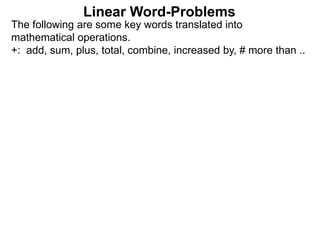
The following are some key words translated into
mathematical operations.
Linear Word-Problems
The following are some key words translated into
mathematical operations.
+: add, sum, plus, total, combine, increased by, # more than ..
Linear Word-Problems
The following are some key words translated into
mathematical operations.
+: add, sum, plus, total, combine, increased by, # more than ..
–: subtract, difference, minus, decreased by, # less than ..
Linear Word-Problems
The following are some key words translated into
mathematical operations.
+: add, sum, plus, total, combine, increased by, # more than ..
–: subtract, difference, minus, decreased by, # less than ..
*: multiply, product, times, “fractions or %” of the amount ..
Linear Word-Problems
The following are some key words translated into
mathematical operations.
+: add, sum, plus, total, combine, increased by, # more than ..
–: subtract, difference, minus, decreased by, # less than ..
*: multiply, product, times, “fractions or %” of the amount ..
Linear Word-Problems
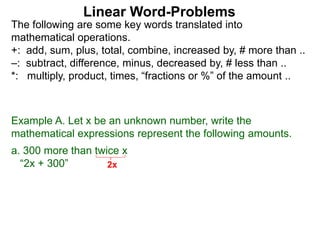
Example A. Let x be an unknown number, write the
mathematical expressions represent the following amounts.
a. 300 more than twice x
The following are some key words translated into
mathematical operations.
+: add, sum, plus, total, combine, increased by, # more than ..
–: subtract, difference, minus, decreased by, # less than ..
*: multiply, product, times, “fractions or %” of the amount ..
Linear Word-Problems
Example A. Let x be an unknown number, write the
mathematical expressions represent the following amounts.
a. 300 more than twice x
2x
The following are some key words translated into
mathematical operations.
+: add, sum, plus, total, combine, increased by, # more than ..
–: subtract, difference, minus, decreased by, # less than ..
*: multiply, product, times, “fractions or %” of the amount ..
Linear Word-Problems
Example A. Let x be an unknown number, write the
mathematical expressions represent the following amounts.
a. 300 more than twice x
“2x + 300” 2x
The following are some key words translated into
mathematical operations.
+: add, sum, plus, total, combine, increased by, # more than ..
–: subtract, difference, minus, decreased by, # less than ..
*: multiply, product, times, “fractions or %” of the amount ..
Linear Word-Problems
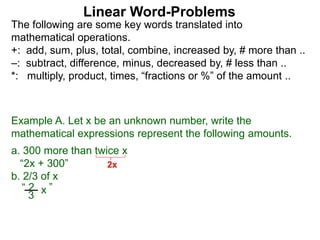
Example A. Let x be an unknown number, write the
mathematical expressions represent the following amounts.
a. 300 more than twice x
“2x + 300”
b. 2/3 of x
2x
The following are some key words translated into
mathematical operations.
+: add, sum, plus, total, combine, increased by, # more than ..
–: subtract, difference, minus, decreased by, # less than ..
*: multiply, product, times, “fractions or %” of the amount ..
Linear Word-Problems
Example A. Let x be an unknown number, write the
mathematical expressions represent the following amounts.
a. 300 more than twice x
“2x + 300”
b. 2/3 of x
3
“ 2 ”x
2x
The following are some key words translated into
mathematical operations.
+: add, sum, plus, total, combine, increased by, # more than ..
–: subtract, difference, minus, decreased by, # less than ..
*: multiply, product, times, “fractions or %” of the amount ..
Linear Word-Problems
Example A. Let x be an unknown number, write the
mathematical expressions represent the following amounts.
a. 300 more than twice x
“2x + 300”
b. 2/3 of x
c. 40% of the sum of x and 100
3
“ 2 ”x
2x
The following are some key words translated into
mathematical operations.
+: add, sum, plus, total, combine, increased by, # more than ..
–: subtract, difference, minus, decreased by, # less than ..
*: multiply, product, times, “fractions or %” of the amount ..
Linear Word-Problems
Example A. Let x be an unknown number, write the
mathematical expressions represent the following amounts.
a. 300 more than twice x
“2x + 300”
b. 2/3 of x
c. 40% of the sum of x and 100
3
“ 2 ”x
100
“ 40 ”(x+100)
2x
The following are some key words translated into
mathematical operations.
+: add, sum, plus, total, combine, increased by, # more than ..
–: subtract, difference, minus, decreased by, # less than ..
*: multiply, product, times, “fractions or %” of the amount ..
/: divide, quotient, shared equally, ratio ..
Linear Word-Problems
Example A. Let x be an unknown number, write the
mathematical expressions represent the following amounts.
a. 300 more than twice x
“2x + 300”
b. 2/3 of x
c. 40% of the sum of x and 100
3
“ 2 ”x
100
“ 40 ”(x+100)
2x
The following are some key words translated into
mathematical operations.
+: add, sum, plus, total, combine, increased by, # more than ..
–: subtract, difference, minus, decreased by, # less than ..
*: multiply, product, times, “fractions or %” of the amount ..
/: divide, quotient, shared equally, ratio ..
Twice = Double = 2* (amount) Square = (amount)2
Linear Word-Problems
Example A. Let x be an unknown number, write the
mathematical expressions represent the following amounts.
a. 300 more than twice x
“2x + 300”
b. 2/3 of x
c. 40% of the sum of x and 100
3
“ 2 ”x
100
“ 40 ”(x+100)
2x
The following are some key words translated into
mathematical operations.
+: add, sum, plus, total, combine, increased by, # more than ..
–: subtract, difference, minus, decreased by, # less than ..
*: multiply, product, times, “fractions or %” of the amount ..
/: divide, quotient, shared equally, ratio ..
Twice = Double = 2* (amount) Square = (amount)2
Linear Word-Problems
Example A. Let x be an unknown number, write the
mathematical expressions represent the following amounts.
a. 300 more than twice x
“2x + 300”
b. 2/3 of x
c. 40% of the sum of x and 100
3
“ 2 ”x
100
“ 40 ”(x+100)
e. Divide the difference between
x-square and y-square, by 100.2x
The following are some key words translated into
mathematical operations.
+: add, sum, plus, total, combine, increased by, # more than ..
–: subtract, difference, minus, decreased by, # less than ..
*: multiply, product, times, “fractions or %” of the amount ..
/: divide, quotient, shared equally, ratio ..
Twice = Double = 2* (amount) Square = (amount)2
Linear Word-Problems
Example A. Let x be an unknown number, write the
mathematical expressions represent the following amounts.
a. 300 more than twice x
“2x + 300”
b. 2/3 of x
c. 40% of the sum of x and 100
3
“ 2 ”x
100
“ 40 ”(x+100)
e. Divide the difference between
x-square and y-square, by 100.
x2 y2
2x
The following are some key words translated into
mathematical operations.
+: add, sum, plus, total, combine, increased by, # more than ..
–: subtract, difference, minus, decreased by, # less than ..
*: multiply, product, times, “fractions or %” of the amount ..
/: divide, quotient, shared equally, ratio ..
Twice = Double = 2* (amount) Square = (amount)2
Linear Word-Problems
Example A. Let x be an unknown number, write the
mathematical expressions represent the following amounts.
a. 300 more than twice x
“2x + 300”
b. 2/3 of x
c. 40% of the sum of x and 100
3
“ 2 ”x
100
“ 40 ”(x+100)
100
(x2 – y2)
e. Divide the difference between
x-square and y-square, by 100.
“ ”
x2 y2
The word "difference“ has two versions:
x–y or y–x. One needs to clarify which
version it’s in question before proceeding.
2x
Linear Word-Problems
Example B. Mary and Joe share $10,
Mary gets $9 more than Joe. How much does each get?
Following are the steps to solve word problems.
Linear Word-Problems
Example B. Mary and Joe share $10,
Mary gets $9 more than Joe. How much does each get?
Following are the steps to solve word problems.
• Read the whole problem and identify the unknown numbers.
Linear Word-Problems
Example B. Mary and Joe share $10,
Mary gets $9 more than Joe. How much does each get?
Following are the steps to solve word problems.
• Read the whole problem and identify the unknown numbers.
There are two unknown numbers.
How much does Mary get?
How much does Joe get?
Linear Word-Problems
Example B. Mary and Joe share $10,
Mary gets $9 more than Joe. How much does each get?
Following are the steps to solve word problems.
• Read the whole problem and identify the unknown numbers.
• Select x to represent the unknown number where the other
unknown numbers, if any, are stated in relation to it.
There are two unknown numbers.
How much does Mary get?
How much does Joe get?
Following are the steps to solve word problems.
• Read the whole problem and identify the unknown numbers.
• Select x to represent the unknown number where the other
unknown numbers, if any, are stated in relation to it.
Linear Word-Problems
Example B. Mary and Joe share $10,
Mary gets $9 more than Joe. How much does each get?
There are two unknown numbers.
How much does Mary get?
How much does Joe get?
Following are the steps to solve word problems.
• Read the whole problem and identify the unknown numbers.
• Select x to represent the unknown number where the other
unknown numbers, if any, are stated in relation to it.
Linear Word-Problems
Example B. Mary and Joe share $10,
Mary gets $9 more than Joe. How much does each get?
There are two unknown numbers.
How much does Mary get?
How much does Joe get?
Mary’s share is given in
term of Jos’s share.
So Joe’s share is x.
Following are the steps to solve word problems.
• Read the whole problem and identify the unknown numbers.
• Select x to represent the unknown number where the other
unknown numbers, if any, are stated in relation to it.
Linear Word-Problems
Example B. Mary and Joe share $10,
Mary gets $9 more than Joe. How much does each get?
Let x = $ Joe gets,
There are two unknown numbers.
How much does Mary get?
How much does Joe get?
Mary’s share is given in
term of Jos’s share.
So Joe’s share is x.
Following are the steps to solve word problems.
• Read the whole problem and identify the unknown numbers.
• Select x to represent the unknown number where the other
unknown numbers, if any, are stated in relation to it.
• Express the other unknowns in terms of the chosen x.
Linear Word-Problems
Example B. Mary and Joe share $10,
Mary gets $9 more than Joe. How much does each get?
Let x = $ Joe gets,
There are two unknown numbers.
How much does Mary get?
How much does Joe get?
Mary’s share is given in
term of Jos’s share.
So Joe’s share is x.
Following are the steps to solve word problems.
• Read the whole problem and identify the unknown numbers.
• Select x to represent the unknown number where the other
unknown numbers, if any, are stated in relation to it.
• Express the other unknowns in terms of the chosen x.
Linear Word-Problems
Example B. Mary and Joe share $10,
Mary gets $9 more than Joe. How much does each get?
Let x = $ Joe gets, so Mary gets (x + 9).
There are two unknown numbers.
How much does Mary get?
How much does Joe get?
Mary’s share is given in
term of Jos’s share.
So Joe’s share is x.
Following are the steps to solve word problems.
• Read the whole problem and identify the unknown numbers.
• Select x to represent the unknown number where the other
unknown numbers, if any, are stated in relation to it.
• Express the other unknowns in terms of the chosen x.
• Convert the numerical conclusion stated in the problem,
into an equation-using the above expressions in x’s,
then solve the equation for x .
Linear Word-Problems
Example B. Mary and Joe share $10,
Mary gets $9 more than Joe. How much does each get?
Let x = $ Joe gets, so Mary gets (x + 9).
There are two unknown numbers.
How much does Mary get?
How much does Joe get?
Mary’s share is given in
term of Jos’s share.
So Joe’s share is x.
Following are the steps to solve word problems.
• Read the whole problem and identify the unknown numbers.
• Select x to represent the unknown number where the other
unknown numbers, if any, are stated in relation to it.
• Express the other unknowns in terms of the chosen x.
• Convert the numerical conclusion stated in the problem,
into an equation-using the above expressions in x’s,
then solve the equation for x .
Linear Word-Problems
Example B. Mary and Joe share $10,
Mary gets $9 more than Joe. How much does each get?
Let x = $ Joe gets, so Mary gets (x + 9). They’ve $10 in total.
There are two unknown numbers.
How much does Mary get?
How much does Joe get?
Mary’s share is given in
term of Jos’s share.
So Joe’s share is x.
Following are the steps to solve word problems.
• Read the whole problem and identify the unknown numbers.
• Select x to represent the unknown number where the other
unknown numbers, if any, are stated in relation to it.
• Express the other unknowns in terms of the chosen x.
• Convert the numerical conclusion stated in the problem,
into an equation-using the above expressions in x’s,
then solve the equation for x .
Linear Word-Problems
Example B. Mary and Joe share $10,
Mary gets $9 more than Joe. How much does each get?
Let x = $ Joe gets, so Mary gets (x + 9). They’ve $10 in total.
x + (x + 9) = 10 There are two unknown numbers.
How much does Mary get?
How much does Joe get?
Mary’s share is given in
term of Jos’s share.
So Joe’s share is x.
Following are the steps to solve word problems.
• Read the whole problem and identify the unknown numbers.
• Select x to represent the unknown number where the other
unknown numbers, if any, are stated in relation to it.
• Express the other unknowns in terms of the chosen x.
• Convert the numerical conclusion stated in the problem,
into an equation-using the above expressions in x’s,
then solve the equation for x .
Linear Word-Problems
Example B. Mary and Joe share $10,
Mary gets $9 more than Joe. How much does each get?
Let x = $ Joe gets, so Mary gets (x + 9). They’ve $10 in total.
x + (x + 9) = 10
2x + 9 = 10
2x = 10 – 9
2x = 1
There are two unknown numbers.
How much does Mary get?
How much does Joe get?
Mary’s share is given in
term of Jos’s share.
So Joe’s share is x.
Following are the steps to solve word problems.
• Read the whole problem and identify the unknown numbers.
• Select x to represent the unknown number where the other
unknown numbers, if any, are stated in relation to it.
• Express the other unknowns in terms of the chosen x.
• Convert the numerical conclusion stated in the problem,
into an equation-using the above expressions in x’s,
then solve the equation for x .
Linear Word-Problems
Example B. Mary and Joe share $10,
Mary gets $9 more than Joe. How much does each get?
Let x = $ Joe gets, so Mary gets (x + 9). They’ve $10 in total.
x + (x + 9) = 10
2x + 9 = 10
2x = 10 – 9
2x = 1 → x = ½ $ (for Joe)
There are two unknown numbers.
How much does Mary get?
How much does Joe get?
Mary’s share is given in
term of Jos’s share.
So Joe’s share is x.
Following are the steps to solve word problems.
• Read the whole problem and identify the unknown numbers.
• Select x to represent the unknown number where the other
unknown numbers, if any, are stated in relation to it.
• Express the other unknowns in terms of the chosen x.
• Convert the numerical conclusion stated in the problem,
into an equation-using the above expressions in x’s,
then solve the equation for x .
Linear Word-Problems
Example B. Mary and Joe share $10,
Mary gets $9 more than Joe. How much does each get?
Let x = $ Joe gets, so Mary gets (x + 9). They’ve $10 in total.
x + (x + 9) = 10
2x + 9 = 10
2x = 10 – 9
2x = 1 → x = ½ $ (for Joe)
and 9 + ½ = 9½ $ (for Mary)
There are two unknown numbers.
How much does Mary get?
How much does Joe get?
Mary’s share is given in
term of Jos’s share.
So Joe’s share is x.
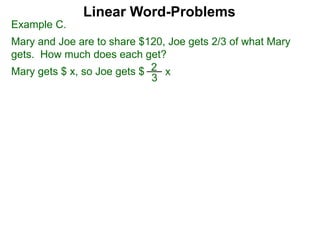
Example C.
Mary and Joe are to share $120, Joe gets 2/3 of what Mary
gets. How much does each get?
Linear Word-Problems
Example C.
Mary and Joe are to share $120, Joe gets 2/3 of what Mary
gets. How much does each get?
Mary gets $ x,
Linear Word-Problems
Example C.
Mary and Joe are to share $120, Joe gets 2/3 of what Mary
gets. How much does each get?
Mary gets $ x, so Joe gets $
3
2 x
Linear Word-Problems
Example C.
Mary and Joe are to share $120, Joe gets 2/3 of what Mary
gets. How much does each get?
Mary gets $ x, so Joe gets $
3
2 x
3
2 x + x = 120
Linear Word-Problems
Together they have $120, so
Example C.
Mary and Joe are to share $120, Joe gets 2/3 of what Mary
gets. How much does each get?
Mary gets $ x, so Joe gets $
3
2 x
3
2 x + x = 120 multiply both sides by 3
3
2 x + x = 120( ) * 3
Linear Word-Problems
Together they have $120, so
Example C.
Mary and Joe are to share $120, Joe gets 2/3 of what Mary
gets. How much does each get?
Mary gets $ x, so Joe gets $
3
2 x
3
2 x + x = 120 multiply both sides by 3
3
2 x + x = 120( ) * 3
Linear Word-Problems
Together they have $120, so
Example C.
Mary and Joe are to share $120, Joe gets 2/3 of what Mary
gets. How much does each get?
Mary gets $ x, so Joe gets $
3
2 x
3
2 x + x = 120 multiply both sides by 3
3
2 x + x = 120( ) * 3
3 3
Linear Word-Problems
Together they have $120, so
Example C.
Mary and Joe are to share $120, Joe gets 2/3 of what Mary
gets. How much does each get?
Mary gets $ x, so Joe gets $
3
2 x
3
2 x + x = 120 multiply both sides by 3
3
2 x + x = 120( ) * 3
3 3
2x + 3x = 360
Linear Word-Problems
Together they have $120, so
Example C.
Mary and Joe are to share $120, Joe gets 2/3 of what Mary
gets. How much does each get?
Mary gets $ x, so Joe gets $
3
2 x
3
2 x + x = 120 multiply both sides by 3
3
2 x + x = 120( ) * 3
3 3
2x + 3x = 360
5x = 360
Linear Word-Problems
Together they have $120, so
Example C.
Mary and Joe are to share $120, Joe gets 2/3 of what Mary
gets. How much does each get?
Mary gets $ x, so Joe gets $
3
2 x
3
2 x + x = 120 multiply both sides by 3
3
2 x + x = 120( ) * 3
3 3
2x + 3x = 360
5x = 360
x = 360/5
x = 72
Linear Word-Problems
Together they have $120, so
Example C.
Mary and Joe are to share $120, Joe gets 2/3 of what Mary
gets. How much does each get?
Mary gets $ x, so Joe gets $
3
2 x
3
2 x + x = 120 multiply both sides by 3
3
2 x + x = 120( ) * 3
3 3
2x + 3x = 360
5x = 360
x = 360/5
x = 72
Therefore Mary gets $72 and the rest 120 – 72 = $48 is the
amount for Joe.
Linear Word-Problems
Together they have $120, so
Making Tables
Linear Word-Problems
If a problem provides the same types of information
for multiple entities, organize the information into a table.
Making Tables
Linear Word-Problems
If a problem provides the same types of information
for multiple entities, organize the information into a table.
Example D. Put the following
information into a table.
a. Abe has 20 cats, 30 dogs
and Bob has 25 dogs, 15 cats,
Making Tables
Linear Word-Problems
If a problem provides the same types of information
for multiple entities, organize the information into a table.
Example D. Put the following
information into a table.
a. Abe has 20 cats, 30 dogs
and Bob has 25 dogs, 15 cats,
No. of cats No. of dogs
Abe
Bob
Making Tables
Linear Word-Problems
If a problem provides the same types of information
for multiple entities, organize the information into a table.
Example D. Put the following
information into a table.
a. Abe has 20 cats, 30 dogs
and Bob has 25 dogs, 15 cats,
No. of cats No. of dogs
Abe 20 30
Bob
Making Tables
Linear Word-Problems
If a problem provides the same types of information
for multiple entities, organize the information into a table.
Example D. Put the following
information into a table.
a. Abe has 20 cats, 30 dogs
and Bob has 25 dogs, 15 cats,
No. of cats No. of dogs
Abe 20 30
Bob 15 25
Making Tables
Linear Word-Problems
If a problem provides the same types of information
for multiple entities, organize the information into a table.
Example D. Put the following
information into a table.
a. Abe has 20 cats, 30 dogs
and Bob has 25 dogs, 15 cats,
No. of cats No. of dogs
Abe 20 30
Bob 15 25
b. Maria’s grocery list:
6 apples, 4 bananas, 3 cakes.
Don's grocery list:
10 cakes, 2 apples, 6 bananas.
Making Tables
Linear Word-Problems
If a problem provides the same types of information
for multiple entities, organize the information into a table.
Example D. Put the following
information into a table.
a. Abe has 20 cats, 30 dogs
and Bob has 25 dogs, 15 cats,
No. of cats No. of dogs
Abe 20 30
Bob 15 25
b. Maria’s grocery list:
6 apples, 4 bananas, 3 cakes.
Don's grocery list:
10 cakes, 2 apples, 6 bananas.
Apple Banana Cake
Maria
Don
Making Tables
Linear Word-Problems
If a problem provides the same types of information
for multiple entities, organize the information into a table.
Example D. Put the following
information into a table.
a. Abe has 20 cats, 30 dogs
and Bob has 25 dogs, 15 cats,
No. of cats No. of dogs
Abe 20 30
Bob 15 25
b. Maria’s grocery list:
6 apples, 4 bananas, 3 cakes.
Don's grocery list:
10 cakes, 2 apples, 6 bananas.
Apple Banana Cake
Maria 6 4 3
Don 2 6 10
Making Tables
Linear Word-Problems
If a problem provides the same types of information
for multiple entities, organize the information into a table.
Example D. Put the following
information into a table.
a. Abe has 20 cats, 30 dogs
and Bob has 25 dogs, 15 cats,
No. of cats No. of dogs
Abe 20 30
Bob 15 25
b. Maria’s grocery list:
6 apples, 4 bananas, 3 cakes.
Don's grocery list:
10 cakes, 2 apples, 6 bananas.
Apple Banana Cake
Maria 6 4 3
Don 2 6 10
By observing the above, one can easily appreciates the tables
which make the numerical information easier to grasp.
Making Tables
Linear Word-Problems
If a problem provides the same types of information
for multiple entities, organize the information into a table.
Example D. Put the following
information into a table.
a. Abe has 20 cats, 30 dogs
and Bob has 25 dogs, 15 cats,
No. of cats No. of dogs
Abe 20 30
Bob 15 25
b. Maria’s grocery list:
6 apples, 4 bananas, 3 cakes.
Don's grocery list:
10 cakes, 2 apples, 6 bananas.
Apple Banana Cake
Maria 6 4 3
Don 2 6 10
By observing the above, one can easily appreciates the tables
which make the numerical information easier to grasp.
Following examples utilize math–formulas of the form A* B = C,
and use tables in the construction of their solutions.
Cost Formula
The cost of purchasing multiple units of an item is given here, if
p = price per unit
q = quantity–in number of units
C = Cost of the purchase
Linear Word-Problems
then p*q = C
Cost Formula
The cost of purchasing multiple units of an item is given here, if
p = price per unit
q = quantity–in number of units
C = Cost of the purchase
Linear Word-Problems
Example E. a. Peanuts cost $5/lb and cashews cost $7/lb.
We’ve 6 lbs of cashews and 8 lbs of peanuts. Put the data into
a table which
includes the cost
of each item and
the total cost.
then p*q = C
Cost Formula
The cost of purchasing multiple units of an item is given here, if
p = price per unit
q = quantity–in number of units
C = Cost of the purchase
Linear Word-Problems
Example E. a. Peanuts cost $5/lb and cashews cost $7/lb.
We’ve 6 lbs of cashews and 8 lbs of peanuts. Put the data into
a table which
includes the cost
of each item and
the total cost.
then p*q = C
price/unit $ quantity of units p*q = Cost $
Peanuts
Cashews
Cost Formula
The cost of purchasing multiple units of an item is given here, if
p = price per unit
q = quantity–in number of units
C = Cost of the purchase
Linear Word-Problems
Example E. a. Peanuts cost $5/lb and cashews cost $7/lb.
We’ve 6 lbs of cashews and 8 lbs of peanuts. Put the data into
a table which
includes the cost
of each item and
the total cost.
then p*q = C
price/unit $ quantity of units p*q = Cost $
Peanuts 5 8
Cashews 7 6
Cost Formula
The cost of purchasing multiple units of an item is given here, if
p = price per unit
q = quantity–in number of units
C = Cost of the purchase
Linear Word-Problems
Example E. a. Peanuts cost $5/lb and cashews cost $7/lb.
We’ve 6 lbs of cashews and 8 lbs of peanuts. Put the data into
a table which
includes the cost
of each item and
the total cost.
then p*q = C
price/unit $ quantity of units p*q = Cost $
Peanuts 5 8 5*8 = 40
Cashews 7 6 7*6 = 42
Cost Formula
The cost of purchasing multiple units of an item is given here, if
p = price per unit
q = quantity–in number of units
C = Cost of the purchase
Linear Word-Problems
Example E. a. Peanuts cost $5/lb and cashews cost $7/lb.
We’ve 6 lbs of cashews and 8 lbs of peanuts. Put the data into
a table which
includes the cost
of each item and
the total cost.
then p*q = C
price/unit $ quantity of units p*q = Cost $
Peanuts 5 8 5*8 = 40
Cashews 7 6 7*6 = 42
TOTAL: 82$
Cost Formula
The cost of purchasing multiple units of an item is given here, if
p = price per unit
q = quantity–in number of units
C = Cost of the purchase
Linear Word-Problems
Example E. a. Peanuts cost $5/lb and cashews cost $7/lb.
We’ve 6 lbs of cashews and 8 lbs of peanuts. Put the data into
a table which
includes the cost
of each item and
the total cost.
price/unit $ quantity of units p*q = Cost $
Peanuts 5 8 5*8 = 40
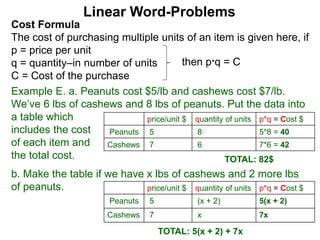
Cashews 7 6 7*6 = 42
b. Make the table if we have x lbs of cashews and 2 more lbs
of peanuts.
TOTAL: 82$
then p*q = C
Cost Formula
The cost of purchasing multiple units of an item is given here, if
p = price per unit
q = quantity–in number of units
C = Cost of the purchase
Linear Word-Problems
Example E. a. Peanuts cost $5/lb and cashews cost $7/lb.
We’ve 6 lbs of cashews and 8 lbs of peanuts. Put the data into
a table which
includes the cost
of each item and
the total cost.
price/unit $ quantity of units p*q = Cost $
Peanuts 5 8 5*8 = 40
Cashews 7 6 7*6 = 42
b. Make the table if we have x lbs of cashews and 2 more lbs
of peanuts.
TOTAL: 82$
price/unit $ quantity of units p*q = Cost $
Peanuts
Cashews
then p*q = C
Cost Formula
The cost of purchasing multiple units of an item is given here, if
p = price per unit
q = quantity–in number of units
C = Cost of the purchase
Linear Word-Problems
Example E. a. Peanuts cost $5/lb and cashews cost $7/lb.
We’ve 6 lbs of cashews and 8 lbs of peanuts. Put the data into
a table which
includes the cost
of each item and
the total cost.
price/unit $ quantity of units p*q = Cost $
Peanuts 5 8 5*8 = 40
Cashews 7 6 7*6 = 42
b. Make the table if we have x lbs of cashews and 2 more lbs
of peanuts.
TOTAL: 82$
price/unit $ quantity of units p*q = Cost $
Peanuts 5
Cashews 7 x
then p*q = C
Cost Formula
The cost of purchasing multiple units of an item is given here, if
p = price per unit
q = quantity–in number of units
C = Cost of the purchase
Linear Word-Problems
Example E. a. Peanuts cost $5/lb and cashews cost $7/lb.
We’ve 6 lbs of cashews and 8 lbs of peanuts. Put the data into
a table which
includes the cost
of each item and
the total cost.
price/unit $ quantity of units p*q = Cost $
Peanuts 5 8 5*8 = 40
Cashews 7 6 7*6 = 42
b. Make the table if we have x lbs of cashews and 2 more lbs
of peanuts.
TOTAL: 82$
price/unit $ quantity of units p*q = Cost $
Peanuts 5 (x + 2)
Cashews 7 x
then p*q = C
Cost Formula
The cost of purchasing multiple units of an item is given here, if
p = price per unit
q = quantity–in number of units
C = Cost of the purchase
Linear Word-Problems
Example E. a. Peanuts cost $5/lb and cashews cost $7/lb.
We’ve 6 lbs of cashews and 8 lbs of peanuts. Put the data into
a table which
includes the cost
of each item and
the total cost.
price/unit $ quantity of units p*q = Cost $
Peanuts 5 8 5*8 = 40
Cashews 7 6 7*6 = 42
b. Make the table if we have x lbs of cashews and 2 more lbs
of peanuts.
TOTAL: 82$
price/unit $ quantity of units p*q = Cost $
Peanuts 5 (x + 2) 5(x + 2)
Cashews 7 x 7x
then p*q = C
Cost Formula
The cost of purchasing multiple units of an item is given here, if
p = price per unit
q = quantity–in number of units
C = Cost of the purchase
Linear Word-Problems
Example E. a. Peanuts cost $5/lb and cashews cost $7/lb.
We’ve 6 lbs of cashews and 8 lbs of peanuts. Put the data into
a table which
includes the cost
of each item and
the total cost.
price/unit $ quantity of units p*q = Cost $
Peanuts 5 8 5*8 = 40
Cashews 7 6 7*6 = 42
b. Make the table if we have x lbs of cashews and 2 more lbs
of peanuts.
TOTAL: 82$
price/unit $ quantity of units p*q = Cost $
Peanuts 5 (x + 2) 5(x + 2)
Cashews 7 x 7x
TOTAL: 5(x + 2) + 7x
then p*q = C
Cost Formula
The cost of purchasing multiple units of an item is given here, if
p = price per unit
q = quantity–in number of units
C = Cost of the purchase
Linear Word-Problems
Example E. a. Peanuts cost $5/lb and cashews cost $7/lb.
We’ve 6 lbs of cashews and 8 lbs of peanuts. Put the data into
a table which
includes the cost
of each item and
the total cost.
price/unit $ quantity of units p*q = Cost $
Peanuts 5 8 5*8 = 40
Cashews 7 6 7*6 = 42
b. Make the table if we have x lbs of cashews and 2 more lbs
of peanuts.
TOTAL: 82$
price/unit $ quantity of units p*q = Cost $
Peanuts 5 (x + 2) 5(x + 2)
Cashews 7 x 7x
TOTAL: 5(x + 2) + 7x → 12x + 10
then p*q = C
Linear Word-Problems
Example F. a. Peanuts cost $5/lb and cashews cost $7/lb.
We bought 2 more of lbs of peanuts than cashews
and paid $82 in total. How many lbs of each did we buy?
Now let’s turn the above into a problem.
Linear Word-Problems
Example F. a. Peanuts cost $5/lb and cashews cost $7/lb.
We bought 2 more of lbs of peanuts than cashews
and paid $82 in total. How many lbs of each did we buy?
Now let’s turn the above into a problem.
Let x = # of lbs of cashews, then (x + 2) = # of lbs of peanuts.
Linear Word-Problems
Example F. a. Peanuts cost $5/lb and cashews cost $7/lb.
We bought 2 more of lbs of peanuts than cashews
and paid $82 in total. How many lbs of each did we buy?
Now let’s turn the above into a problem.
Let x = # of lbs of cashews, then (x + 2) = # of lbs of peanuts.
Organize the information into a table.
Linear Word-Problems
Example F. a. Peanuts cost $5/lb and cashews cost $7/lb.
We bought 2 more of lbs of peanuts than cashews
and paid $82 in total. How many lbs of each did we buy?
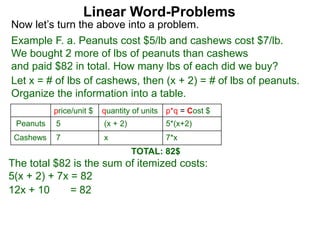
price/unit $ quantity of units p*q = Cost $
Peanuts 5 (x + 2) 5*(x+2)
Cashews 7 x 7*x
Now let’s turn the above into a problem.
TOTAL: 82$
Let x = # of lbs of cashews, then (x + 2) = # of lbs of peanuts.
Organize the information into a table.
Linear Word-Problems
Example F. a. Peanuts cost $5/lb and cashews cost $7/lb.
We bought 2 more of lbs of peanuts than cashews
and paid $82 in total. How many lbs of each did we buy?
price/unit $ quantity of units p*q = Cost $
Peanuts 5 (x + 2) 5*(x+2)
Cashews 7 x 7*x
Now let’s turn the above into a problem.
TOTAL: 82$
Let x = # of lbs of cashews, then (x + 2) = # of lbs of peanuts.
Organize the information into a table.
The total $82 is the sum of itemized costs:
5(x + 2) + 7x = 82
Linear Word-Problems
Example F. a. Peanuts cost $5/lb and cashews cost $7/lb.
We bought 2 more of lbs of peanuts than cashews
and paid $82 in total. How many lbs of each did we buy?
price/unit $ quantity of units p*q = Cost $
Peanuts 5 (x + 2) 5*(x+2)
Cashews 7 x 7*x
Now let’s turn the above into a problem.
TOTAL: 82$
Let x = # of lbs of cashews, then (x + 2) = # of lbs of peanuts.
Organize the information into a table.
The total $82 is the sum of itemized costs:
5(x + 2) + 7x = 82
12x + 10 = 82
Linear Word-Problems
Example F. a. Peanuts cost $5/lb and cashews cost $7/lb.
We bought 2 more of lbs of peanuts than cashews
and paid $82 in total. How many lbs of each did we buy?
price/unit $ quantity of units p*q = Cost $
Peanuts 5 (x + 2) 5*(x+2)
Cashews 7 x 7*x
Now let’s turn the above into a problem.
TOTAL: 82$
Let x = # of lbs of cashews, then (x + 2) = # of lbs of peanuts.
Organize the information into a table.
The total $82 is the sum of itemized costs:
5(x + 2) + 7x = 82
12x + 10 = 82
12x = 82 – 10
Linear Word-Problems
Example F. a. Peanuts cost $5/lb and cashews cost $7/lb.
We bought 2 more of lbs of peanuts than cashews
and paid $82 in total. How many lbs of each did we buy?
price/unit $ quantity of units p*q = Cost $
Peanuts 5 (x + 2) 5*(x+2)
Cashews 7 x 7*x
Now let’s turn the above into a problem.
TOTAL: 82$
Let x = # of lbs of cashews, then (x + 2) = # of lbs of peanuts.
Organize the information into a table.
The total $82 is the sum of itemized costs:
5(x + 2) + 7x = 82
12x + 10 = 82
12x = 82 – 10
12x = 72
x = 72/12 = 6
So there are 6 lb of cashews
and 8 lb of peanuts.
Concentration Formula
The concentration of a chemical in a solution is usually
given in %. Let
r = concentration (in %)
Linear Word-Problems
Concentration Formula
The concentration of a chemical in a solution is usually
given in %. Let
r = concentration (in %)
S = amount of solution
Linear Word-Problems
Concentration Formula
The concentration of a chemical in a solution is usually
given in %. Let
r = concentration (in %)
S = amount of solution
C = amount of chemical
Linear Word-Problems
Concentration Formula
The concentration of a chemical in a solution is usually
given in %. Let
r = concentration (in %)
S = amount of solution
C = amount of chemical
Then r*S = C
Linear Word-Problems
Concentration Formula
The concentration of a chemical in a solution is usually
given in %. Let
r = concentration (in %)
S = amount of solution
C = amount of chemical
Then r*S = C
Linear Word-Problems
Example G. We have 60 gallons brine (salt water) of 25%
concentration. How much salt is there?
Concentration Formula
The concentration of a chemical in a solution is usually
given in %. Let
r = concentration (in %)
S = amount of solution
C = amount of chemical
Then r*S = C
Linear Word-Problems
Example G. We have 60 gallons brine (salt water) of 25%
concentration. How much salt is there?
r = concentration = 25% =
100
25
Concentration Formula
The concentration of a chemical in a solution is usually
given in %. Let
r = concentration (in %)
S = amount of solution
C = amount of chemical
Then r*S = C
Linear Word-Problems
Example G. We have 60 gallons brine (salt water) of 25%
concentration. How much salt is there?
r = concentration = 25% =
S = amount of brine = 60 gal
100
25
Concentration Formula
The concentration of a chemical in a solution is usually
given in %. Let
r = concentration (in %)
S = amount of solution
C = amount of chemical
Then r*S = C
Linear Word-Problems
Example G. We have 60 gallons brine (salt water) of 25%
concentration. How much salt is there?
r = concentration = 25% =
S = amount of brine = 60 gal
C = amount of salt = ?
100
25
Concentration Formula
The concentration of a chemical in a solution is usually
given in %. Let
r = concentration (in %)
S = amount of solution
C = amount of chemical
Then r*S = C
100
25
* 60
Linear Word-Problems
Example G. We have 60 gallons brine (salt water) of 25%
concentration. How much salt is there?
r = concentration = 25% =
S = amount of brine = 60 gal
C = amount of salt = ?
100
25
Using rS =
Concentration Formula
The concentration of a chemical in a solution is usually
given in %. Let
r = concentration (in %)
S = amount of solution
C = amount of chemical
Then r*S = C
100
25
* 60
Linear Word-Problems
Example G. We have 60 gallons brine (salt water) of 25%
concentration. How much salt is there?
r = concentration = 25% =
S = amount of brine = 60 gal
C = amount of salt = ?
100
25
Using rS =
= * 60
4
1
Concentration Formula
The concentration of a chemical in a solution is usually
given in %. Let
r = concentration (in %)
S = amount of solution
C = amount of chemical
Then r*S = C
100
25
* 60
Linear Word-Problems
Example G. We have 60 gallons brine (salt water) of 25%
concentration. How much salt is there?
r = concentration = 25% =
S = amount of brine = 60 gal
C = amount of salt = ?
100
25
Using rS =
= * 60 =
4
1 15
15 gallons of salt.
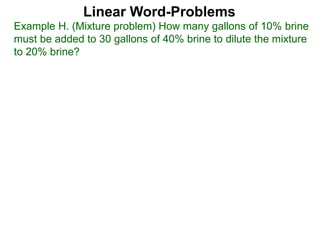
Example H. (Mixture problem) How many gallons of 10% brine
must be added to 30 gallons of 40% brine to dilute the mixture
to 20% brine?
Linear Word-Problems
Example H. (Mixture problem) How many gallons of 10% brine
must be added to 30 gallons of 40% brine to dilute the mixture
to 20% brine?
Make the standard table for mixture problems
concentration # of gallons salt (r*S)
Linear Word-Problems
Example H. (Mixture problem) How many gallons of 10% brine
must be added to 30 gallons of 40% brine to dilute the mixture
to 20% brine?
Make the standard table for mixture problems
concentration # of gallons salt (r*S)
10%
40%
20%
Linear Word-Problems
Example H. (Mixture problem) How many gallons of 10% brine
must be added to 30 gallons of 40% brine to dilute the mixture
to 20% brine?
Make the standard table for mixture problems
concentration # of gallons salt (r*S)
10% x
40%
20%
Linear Word-Problems
Example H. (Mixture problem) How many gallons of 10% brine
must be added to 30 gallons of 40% brine to dilute the mixture
to 20% brine?
Make the standard table for mixture problems
concentration # of gallons salt (r*S)
10% x
40% 30
20%
Linear Word-Problems
Example H. (Mixture problem) How many gallons of 10% brine
must be added to 30 gallons of 40% brine to dilute the mixture
to 20% brine?
Make the standard table for mixture problems
concentration # of gallons salt (r*S)
10% x
40% 30
20% (x+30)
Linear Word-Problems
Example H. (Mixture problem) How many gallons of 10% brine
must be added to 30 gallons of 40% brine to dilute the mixture
to 20% brine?
Make the standard table for mixture problems
concentration # of gallons salt (r*S)
10% x
40% 30
20% (x+30)
10
100 x
Linear Word-Problems
Example H. (Mixture problem) How many gallons of 10% brine
must be added to 30 gallons of 40% brine to dilute the mixture
to 20% brine?
Make the standard table for mixture problems
concentration # of gallons salt (r*S)
10% x
40% 30
20% (x+30)
10
100 x
40
100 * 30
Linear Word-Problems
Example H. (Mixture problem) How many gallons of 10% brine
must be added to 30 gallons of 40% brine to dilute the mixture
to 20% brine?
Make the standard table for mixture problems
concentration # of gallons salt (r*S)
10% x
40% 30
20% (x+30)
10
100 x
40
100 * 30
20
100
(x+30)
Total amount
of salt in the final
mixture
Linear Word-Problems
Example H. (Mixture problem) How many gallons of 10% brine
must be added to 30 gallons of 40% brine to dilute the mixture
to 20% brine?
Make the standard table for mixture problems
concentration # of gallons salt (r*S)
10% x
40% 30
20% (x+30)
10
100 x
40
100 * 30
20
100
(x+30)
Total amount
of salt in the final
mixture
Hence
10
100x +
40
100* 30 =
20
100 (x + 30)
Linear Word-Problems
Example H. (Mixture problem) How many gallons of 10% brine
must be added to 30 gallons of 40% brine to dilute the mixture
to 20% brine?
Make the standard table for mixture problems
concentration # of gallons salt (r*S)
10% x
40% 30
20% (x+30)
10
100 x
40
100 * 30
20
100
(x+30)
Total amount
of salt in the final
mixture
Hence
10
100x +
40
100* 30 =
20
100 (x + 30)
10
100x + 40
100* 30 = 20
100(x + 30)[ ] multiply by 100 to
clear denominator.
* 100
Linear Word-Problems
Example H. (Mixture problem) How many gallons of 10% brine
must be added to 30 gallons of 40% brine to dilute the mixture
to 20% brine?
Make the standard table for mixture problems
concentration # of gallons salt (r*S)
10% x
40% 30
20% (x+30)
10
100 x
40
100 * 30
20
100
(x+30)
Total amount
of salt in the final
mixture
Hence
10
100x +
40
100* 30 =
20
100 (x + 30)
10
100x + 40
100* 30 = 20
100(x + 30)[ ] multiply by 100 to
clear denominator.
* 100
Linear Word-Problems
Example H. (Mixture problem) How many gallons of 10% brine
must be added to 30 gallons of 40% brine to dilute the mixture
to 20% brine?
Make the standard table for mixture problems
concentration # of gallons salt (r*S)
10% x
40% 30
20% (x+30)
10
100 x
40
100 * 30
20
100
(x+30)
Total amount
of salt in the final
mixture
Hence
10
100x +
40
100* 30 =
20
100 (x + 30)
10
100x + 40
100* 30 = 20
100(x + 30)[ ] multiply by 100 to
clear denominator.
* 100
10x + 1200 = 20(x+30)
Linear Word-Problems
Example H. (Mixture problem) How many gallons of 10% brine
must be added to 30 gallons of 40% brine to dilute the mixture
to 20% brine?
Make the standard table for mixture problems
concentration # of gallons salt (r*S)
10% x
40% 30
20% (x+30)
10
100 x
40
100 * 30
20
100
(x+30)
Total amount
of salt in the final
mixture
Hence
10
100x +
40
100* 30 =
20
100 (x + 30)
10
100x + 40
100* 30 = 20
100(x + 30)[ ] multiply by 100 to
clear denominator.
* 100
10x + 1200 = 20(x+30)
10x + 1200 = 20x + 600
Linear Word-Problems
Example H. (Mixture problem) How many gallons of 10% brine
must be added to 30 gallons of 40% brine to dilute the mixture
to 20% brine?
Make the standard table for mixture problems
concentration # of gallons salt (r*S)
10% x
40% 30
20% (x+30)
10
100 x
40
100 * 30
20
100
(x+30)
Total amount
of salt in the final
mixture
Hence
10
100x +
40
100* 30 =
20
100 (x + 30)
10
100x + 40
100* 30 = 20
100(x + 30)[ ] multiply by 100 to
clear denominator.
* 100
10x + 1200 = 20(x+30)
10x + 1200 = 20x + 600
–600 + 1200 = 20x –10x
Linear Word-Problems
Example H. (Mixture problem) How many gallons of 10% brine
must be added to 30 gallons of 40% brine to dilute the mixture
to 20% brine?
Make the standard table for mixture problems
concentration # of gallons salt (r*S)
10% x
40% 30
20% (x+30)
10
100 x
40
100 * 30
20
100
(x+30)
Total amount
of salt in the final
mixture
Hence
10
100x +
40
100* 30 =
20
100 (x + 30)
10
100x + 40
100* 30 = 20
100(x + 30)[ ] multiply by 100 to
clear denominator.
* 100
10x + 1200 = 20(x+30)
10x + 1200 = 20x + 600
–600 + 1200 = 20x –10x
600 = 10x
Linear Word-Problems
Example H. (Mixture problem) How many gallons of 10% brine
must be added to 30 gallons of 40% brine to dilute the mixture
to 20% brine?
Make the standard table for mixture problems
concentration # of gallons salt (r*S)
10% x
40% 30
20% (x+30)
10
100 x
40
100 * 30
20
100
(x+30)
Total amount
of salt in the final
mixture
Hence
10
100x +
40
100* 30 =
20
100 (x + 30)
10
100x + 40
100* 30 = 20
100(x + 30)[ ] multiply by 100 to
clear denominator.
* 100
10x + 1200 = 20(x+30)
10x + 1200 = 20x + 600
–600 + 1200 = 20x –10x
600 = 10x  60 = x
Linear Word-Problems
Ans: 60 gallons
of 10% brine
Simple Interest Formula
Linear Word-Problems
Simple Interest Formula
The interest rate of an investment is usually given in %.
Linear Word-Problems
Simple Interest Formula
The interest rate of an investment is usually given in %. Let
r = interest rate (in %)
Linear Word-Problems
Simple Interest Formula
The interest rate of an investment is usually given in %. Let
r = interest rate (in %)
P = principal
Linear Word-Problems
Simple Interest Formula
The interest rate of an investment is usually given in %. Let
r = interest rate (in %)
P = principal
I = amount of interest for one year
Linear Word-Problems
Simple Interest Formula
The interest rate of an investment is usually given in %. Let
r = interest rate (in %)
P = principal
I = amount of interest for one year
then r*P = I.
Linear Word-Problems
Simple Interest Formula
The interest rate of an investment is usually given in %. Let
r = interest rate (in %)
P = principal
I = amount of interest for one year
then r*P = I.
Linear Word-Problems
Example I. We have $3000 in a saving account that gives 6%
annual interest. How much interest will be there after one year?
Simple Interest Formula
The interest rate of an investment is usually given in %. Let
r = interest rate (in %)
P = principal
I = amount of interest for one year
then r*P = I.
Linear Word-Problems
Example I. We have $3000 in a saving account that gives 6%
annual interest. How much interest will be there after one year?
r = interest rate =
100
6
Simple Interest Formula
The interest rate of an investment is usually given in %. Let
r = interest rate (in %)
P = principal
I = amount of interest for one year
then r*P = I.
Linear Word-Problems
Example I. We have $3000 in a saving account that gives 6%
annual interest. How much interest will be there after one year?
r = interest rate =
P = principal
100
6
Simple Interest Formula
The interest rate of an investment is usually given in %. Let
r = interest rate (in %)
P = principal
I = amount of interest for one year
then r*P = I.
Linear Word-Problems
Example I. We have $3000 in a saving account that gives 6%
annual interest. How much interest will be there after one year?
r = interest rate =
P = principal
I = amount of interest
100
6
Simple Interest Formula
The interest rate of an investment is usually given in %. Let
r = interest rate (in %)
P = principal
I = amount of interest for one year
then r*P = I.
100
6
* 3000
Linear Word-Problems
Example I. We have $3000 in a saving account that gives 6%
annual interest. How much interest will be there after one year?
r = interest rate =
P = principal
I = amount of interest
100
6
Hence r*P =
Simple Interest Formula
The interest rate of an investment is usually given in %. Let
r = interest rate (in %)
P = principal
I = amount of interest for one year
then r*P = I.
100
6
* 3000
30
Linear Word-Problems
Example I. We have $3000 in a saving account that gives 6%
annual interest. How much interest will be there after one year?
r = interest rate =
P = principal
I = amount of interest
100
6
Hence r*P =
Simple Interest Formula
The interest rate of an investment is usually given in %. Let
r = interest rate (in %)
P = principal
I = amount of interest for one year
then r*P = I.
100
6
* 3000 = 6(30) = $180 = interest.
30
Linear Word-Problems
Example I. We have $3000 in a saving account that gives 6%
annual interest. How much interest will be there after one year?
r = interest rate =
P = principal
I = amount of interest
100
6
Hence r*P =
Simple Interest Formula
The interest rate of an investment is usually given in %. Let
r = interest rate (in %)
P = principal
I = amount of interest for one year
then r*P = I.
100
6
* 3000 = 6(30) = $180 = interest.
30
Linear Word-Problems
Example I. We have $3000 in a saving account that gives 6%
annual interest. How much interest will be there after one year?
r = interest rate =
P = principal
I = amount of interest
100
6
Hence r*P =
Remark: The general formula for simple interest is P*r*t = I
where t is the number of years.
Simple Interest Formula
The interest rate of an investment is usually given in %. Let
r = interest rate (in %)
P = principal
I = amount of interest for one year
then r*P = I.
100
6
* 3000 = 6(30) = $180 = interest.
30
Linear Word-Problems
Example I. We have $3000 in a saving account that gives 6%
annual interest. How much interest will be there after one year?
r = interest rate =
P = principal
I = amount of interest
100
6
Hence r*P =
Remark: The general formula for simple interest is P*r*t = I
where t is the number of years. Note the similarity to the
concentration formula.
Example J. (Mixed investments) We have $2000 more in a 6%
account than in a 5% account. In one year, their combined
interest is $560. How much is in each account?
Linear Word-Problems
Example J. (Mixed investments) We have $2000 more in a 6%
account than in a 5% account. In one year, their combined
interest is $560. How much is in each account?
We make a table.
Linear Word-Problems
rate principal interest
Example J. (Mixed investments) We have $2000 more in a 6%
account than in a 5% account. In one year, their combined
interest is $560. How much is in each account?
We make a table.
Linear Word-Problems
rate principal interest
6%
5%
Example J. (Mixed investments) We have $2000 more in a 6%
account than in a 5% account. In one year, their combined
interest is $560. How much is in each account?
We make a table. Let x = amount in the 5% account.
Linear Word-Problems
rate principal interest
6%
5% x
Example J. (Mixed investments) We have $2000 more in a 6%
account than in a 5% account. In one year, their combined
interest is $560. How much is in each account?
We make a table. Let x = amount in the 5% account.
Linear Word-Problems
rate principal interest
6% (x + 2000)
5% x
Example J. (Mixed investments) We have $2000 more in a 6%
account than in a 5% account. In one year, their combined
interest is $560. How much is in each account?
We make a table. Let x = amount in the 5% account.
Linear Word-Problems
rate principal interest
6% (x + 2000)
5% x
6
100(x+2000)
5
100 x
Example J. (Mixed investments) We have $2000 more in a 6%
account than in a 5% account. In one year, their combined
interest is $560. How much is in each account?
We make a table. Let x = amount in the 5% account.
Linear Word-Problems
rate principal interest
6% (x + 2000)
5% x
6
100(x+2000)
5
100 x
Total amount
of interest is
$560
}
Example J. (Mixed investments) We have $2000 more in a 6%
account than in a 5% account. In one year, their combined
interest is $560. How much is in each account?
We make a table. Let x = amount in the 5% account.
Linear Word-Problems
rate principal interest
6% (x + 2000)
5% x
6
100(x+2000)
5
100 x
Total amount
of interest is
$560
Hence:
6
100(x + 2000) + 5
100x = 560
}
Example J. (Mixed investments) We have $2000 more in a 6%
account than in a 5% account. In one year, their combined
interest is $560. How much is in each account?
We make a table. Let x = amount in the 5% account.
Linear Word-Problems
rate principal interest
6% (x + 2000)
5% x
6
100(x+2000)
5
100 x
Total amount
of interest is
$560
Hence:
6
100(x + 2000) + 5
100x = 560
[ ] * 1006
100(x + 2000) +
5
100x = 560
}
Example J. (Mixed investments) We have $2000 more in a 6%
account than in a 5% account. In one year, their combined
interest is $560. How much is in each account?
We make a table. Let x = amount in the 5% account.
Linear Word-Problems
rate principal interest
6% (x + 2000)
5% x
6
100(x+2000)
5
100 x
Total amount
of interest is
$560
Hence:
6
100(x + 2000) + 5
100x = 560
[ ] * 1006
100(x + 2000) +
5
100x = 560
10011
}
Example J. (Mixed investments) We have $2000 more in a 6%
account than in a 5% account. In one year, their combined
interest is $560. How much is in each account?
We make a table. Let x = amount in the 5% account.
Linear Word-Problems
rate principal interest
6% (x + 2000)
5% x
6
100(x+2000)
5
100 x
Total amount
of interest is
$560
Hence:
6
100(x + 2000) + 5
100x = 560
[ ] * 1006
100(x + 2000) +
5
100x = 560
10011
6(x + 2000) + 5x = 56000
}
Example J. (Mixed investments) We have $2000 more in a 6%
account than in a 5% account. In one year, their combined
interest is $560. How much is in each account?
We make a table. Let x = amount in the 5% account.
Linear Word-Problems
rate principal interest
6% (x + 2000)
5% x
6
100(x+2000)
5
100 x
Total amount
of interest is
$560
Hence:
6
100(x + 2000) + 5
100x = 560
[ ] * 1006
100(x + 2000) +
5
100x = 560
10011
6(x + 2000) + 5x = 56000
6x + 12000 + 5x = 56000
}
Example J. (Mixed investments) We have $2000 more in a 6%
account than in a 5% account. In one year, their combined
interest is $560. How much is in each account?
We make a table. Let x = amount in the 5% account.
Linear Word-Problems
rate principal interest
6% (x + 2000)
5% x
6
100(x+2000)
5
100 x
Total amount
of interest is
$560
Hence:
6
100(x + 2000) + 5
100x = 560
[ ] * 1006
100(x + 2000) +
5
100x = 560
10011
6(x + 2000) + 5x = 56000
6x + 12000 + 5x = 56000
11x = 56000 – 12000
}
Example J. (Mixed investments) We have $2000 more in a 6%
account than in a 5% account. In one year, their combined
interest is $560. How much is in each account?
We make a table. Let x = amount in the 5% account.
Linear Word-Problems
rate principal interest
6% (x + 2000)
5% x
6
100(x+2000)
5
100 x
Total amount
of interest is
$560
Hence:
6
100(x + 2000) + 5
100x = 560
[ ] * 1006
100(x + 2000) +
5
100x = 560
10011
6(x + 2000) + 5x = 56000
6x + 12000 + 5x = 56000
11x = 56000 – 12000 = 44000
}
Example J. (Mixed investments) We have $2000 more in a 6%
account than in a 5% account. In one year, their combined
interest is $560. How much is in each account?
We make a table. Let x = amount in the 5% account.
Linear Word-Problems
rate principal interest
6% (x + 2000)
5% x
6
100(x+2000)
5
100 x
Total amount
of interest is
$560
Hence:
6
100(x + 2000) + 5
100x = 560
[ ] * 1006
100(x + 2000) +
5
100x = 560
10011
6(x + 2000) + 5x = 56000
6x + 12000 + 5x = 56000
11x = 56000 – 12000 = 44000
x = 44000/11
}
Example J. (Mixed investments) We have $2000 more in a 6%
account than in a 5% account. In one year, their combined
interest is $560. How much is in each account?
We make a table. Let x = amount in the 5% account.
Linear Word-Problems
rate principal interest
6% (x + 2000)
5% x
6
100(x+2000)
5
100 x
Total amount
of interest is
$560
Hence:
6
100(x + 2000) + 5
100x = 560
[ ] * 1006
100(x + 2000) +
5
100x = 560
10011
6(x + 2000) + 5x = 56000
6x + 12000 + 5x = 56000
11x = 56000 – 12000 = 44000
x = 44000/11 = $4000
}
Example J. (Mixed investments) We have $2000 more in a 6%
account than in a 5% account. In one year, their combined
interest is $560. How much is in each account?
We make a table. Let x = amount in the 5% account.
Linear Word-Problems
rate principal interest
6% (x + 2000)
5% x
6
100(x+2000)
5
100 x
Total amount
of interest is
$560
Hence:
6
100(x + 2000) + 5
100x = 560
[ ] * 1006
100(x + 2000) +
5
100x = 560
10011
6(x + 2000) + 5x = 56000
6x + 12000 + 5x = 56000
11x = 56000 – 12000 = 44000
x = 44000/11 = $4000
}
So we've $4000 in the 5% accnt.
Example J. (Mixed investments) We have $2000 more in a 6%
account than in a 5% account. In one year, their combined
interest is $560. How much is in each account?
We make a table. Let x = amount in the 5% account.
Linear Word-Problems
rate principal interest
6% (x + 2000)
5% x
6
100(x+2000)
5
100 x
Total amount
of interest is
$560
Hence:
6
100(x + 2000) + 5
100x = 560
[ ] * 1006
100(x + 2000) +
5
100x = 560
10011
6(x + 2000) + 5x = 56000
6x + 12000 + 5x = 56000
11x = 56000 – 12000 = 44000
x = 44000/11 = $4000
}
So we've $4000 in the 5% accnt. and $6000 in the 6% accnt.
Exercise A. Express each expression in terms of the given x.
Linear Word-Problems
Let x = $ that Joe has.
1. Mary has $10 less than what Joe has, how much does Mary have?
2. Mary has $10 more than twice what Joe has, how much does Mary have?
3. Mary has twice the amount that’s $10 more than what Joe has, how much does
Mary have?
4. Together Mary and Joe have $100, how much does Mary have?
5. Mary has $100 less than what Joe has, what is twice what Joe and Mary have
together? Simplify your answer.
6. Mary has $100 more than Joe, what is half of what Joe and Mary have together?
Simplify your answer.
B. Peanuts cost $3/lb, cashews cost $8/lb. We have x lbs of peanuts.
Translate each quantity described below in terms of x.
7. What is the cost for the peanuts?
8. We have 4 more lbs of cashews as peanuts, what is the cost for the cashews?
9. Refer to problem 7 and 8, what is the total cost for all the nuts?
Simplify answer.
10. We have twice as many of cashews as peanuts in weight, what is the total cost
of the nuts? Simplify your answer.
11. We have a total of 50 lb of peanuts and cashews, how many lbs of cashews do
we have? What is the total cost for all the nuts? Simplify you answers.
C. Money Sharing Problems. Select the x. Set up an equation then solve.
1. A and B are to share $120. A gets $30 more than B, how much does each get?
2. A and B are to share $120. A gets $30 more than twice what B gets, how much
does each get?
3. A and B are to share $120. A gets $16 less than three times of what B gets, how
much does each get?
4. A, B and C are to share $120. A gets $40 more than what B gets, C gets $10 less
than what B gets, how much does each get?
5. A, B and C are to share $120. A gets $20 more than what twice of B gets, C gets
$10 more than what A gets, how much does each get?
6. A and B are to share $120. A gets 2/3 of what B gets, how much does each get?
7. A, B and C are to share $120. A gets 1/3 of what B gets, C gets ¾ of what B
gets, how much does each get?
D. Wet Mixtures Problems (Make a table for each problem 8 – 19)
8. How many gallons of 20% brine must be added to 30 gallons of 40% brine to
dilute the mixture to a 25% brine?
9. How many gallons of pure water must be added to 40 gallons of 30% brine to
dilute the mixture to a 20% brine?
10. How many gallons of 10% brine must be added with 40% brine to make 30
gallons of 20% brine?
11. How many gallons of 50% brine must be added with pure water to make 30
gallons of 20% brine?
12. We have $3000 more saved in an account that gives 5% interest rate than in an
account that gives 4% interest rate. In one year, their combined interest is $600.
How much is in each account?
13. We have saved at a 6% account $2000 less than twice than in a 4% account. In
one year, their combined interest is $1680. How much is in each account?
14. The combined saving in two accounts is $12,000. One account gives 5%
interest rate, the other gives 4% interest rate. The combined interest is %570 in one
year. How much is in each account?
15. The combined saving in two accounts is $15,000. One account gives 6%
interest rate, the other gives 3% interest rate. The combined interest is $750 in one
year. How much is in each account?
Linear Word-Problems
F. Dry Mixture Problem – These are similar to the wet–mixture problems.
16. Peanuts cost $3/lb, cashews cost $6/lb. How many lbs of peanuts are needed
to mix with12 lbs cashews to make a peanut–cashews–mixture that costs $4/lb?
17. Peanuts cost $3/lb, cashews cost $6/lb. How many lbs of each are needed to
make 12 lbs of peanut–cashews–mixture that costs $4/lb?
18. Peanuts cost $2/lb, cashews cost $8/lb. How many lbs of cashews are needed
to mix with 15 lbs of peanuts to get a peanut–cashews–mixture that costs $6/lb?
19. Peanuts cost $2/lb, cashews cost $8/lb. How many lbs of each are needed to
make 50 lbs of peanut–cashews–mixture that cost $3/lb?
E. Mixed Investment Problems.

2 4linear word problems

  • 1.
  • 2.
    The following aresome key words translated into mathematical operations. Linear Word-Problems
  • 3.
    The following aresome key words translated into mathematical operations. +: add, sum, plus, total, combine, increased by, # more than .. Linear Word-Problems
  • 4.
    The following aresome key words translated into mathematical operations. +: add, sum, plus, total, combine, increased by, # more than .. –: subtract, difference, minus, decreased by, # less than .. Linear Word-Problems
  • 5.
    The following aresome key words translated into mathematical operations. +: add, sum, plus, total, combine, increased by, # more than .. –: subtract, difference, minus, decreased by, # less than .. *: multiply, product, times, “fractions or %” of the amount .. Linear Word-Problems
  • 6.
    The following aresome key words translated into mathematical operations. +: add, sum, plus, total, combine, increased by, # more than .. –: subtract, difference, minus, decreased by, # less than .. *: multiply, product, times, “fractions or %” of the amount .. Linear Word-Problems Example A. Let x be an unknown number, write the mathematical expressions represent the following amounts. a. 300 more than twice x
  • 7.
    The following aresome key words translated into mathematical operations. +: add, sum, plus, total, combine, increased by, # more than .. –: subtract, difference, minus, decreased by, # less than .. *: multiply, product, times, “fractions or %” of the amount .. Linear Word-Problems Example A. Let x be an unknown number, write the mathematical expressions represent the following amounts. a. 300 more than twice x 2x
  • 8.
    The following aresome key words translated into mathematical operations. +: add, sum, plus, total, combine, increased by, # more than .. –: subtract, difference, minus, decreased by, # less than .. *: multiply, product, times, “fractions or %” of the amount .. Linear Word-Problems Example A. Let x be an unknown number, write the mathematical expressions represent the following amounts. a. 300 more than twice x “2x + 300” 2x
  • 9.
    The following aresome key words translated into mathematical operations. +: add, sum, plus, total, combine, increased by, # more than .. –: subtract, difference, minus, decreased by, # less than .. *: multiply, product, times, “fractions or %” of the amount .. Linear Word-Problems Example A. Let x be an unknown number, write the mathematical expressions represent the following amounts. a. 300 more than twice x “2x + 300” b. 2/3 of x 2x
  • 10.
    The following aresome key words translated into mathematical operations. +: add, sum, plus, total, combine, increased by, # more than .. –: subtract, difference, minus, decreased by, # less than .. *: multiply, product, times, “fractions or %” of the amount .. Linear Word-Problems Example A. Let x be an unknown number, write the mathematical expressions represent the following amounts. a. 300 more than twice x “2x + 300” b. 2/3 of x 3 “ 2 ”x 2x
  • 11.
    The following aresome key words translated into mathematical operations. +: add, sum, plus, total, combine, increased by, # more than .. –: subtract, difference, minus, decreased by, # less than .. *: multiply, product, times, “fractions or %” of the amount .. Linear Word-Problems Example A. Let x be an unknown number, write the mathematical expressions represent the following amounts. a. 300 more than twice x “2x + 300” b. 2/3 of x c. 40% of the sum of x and 100 3 “ 2 ”x 2x
  • 12.
    The following aresome key words translated into mathematical operations. +: add, sum, plus, total, combine, increased by, # more than .. –: subtract, difference, minus, decreased by, # less than .. *: multiply, product, times, “fractions or %” of the amount .. Linear Word-Problems Example A. Let x be an unknown number, write the mathematical expressions represent the following amounts. a. 300 more than twice x “2x + 300” b. 2/3 of x c. 40% of the sum of x and 100 3 “ 2 ”x 100 “ 40 ”(x+100) 2x
  • 13.
    The following aresome key words translated into mathematical operations. +: add, sum, plus, total, combine, increased by, # more than .. –: subtract, difference, minus, decreased by, # less than .. *: multiply, product, times, “fractions or %” of the amount .. /: divide, quotient, shared equally, ratio .. Linear Word-Problems Example A. Let x be an unknown number, write the mathematical expressions represent the following amounts. a. 300 more than twice x “2x + 300” b. 2/3 of x c. 40% of the sum of x and 100 3 “ 2 ”x 100 “ 40 ”(x+100) 2x
  • 14.
    The following aresome key words translated into mathematical operations. +: add, sum, plus, total, combine, increased by, # more than .. –: subtract, difference, minus, decreased by, # less than .. *: multiply, product, times, “fractions or %” of the amount .. /: divide, quotient, shared equally, ratio .. Twice = Double = 2* (amount) Square = (amount)2 Linear Word-Problems Example A. Let x be an unknown number, write the mathematical expressions represent the following amounts. a. 300 more than twice x “2x + 300” b. 2/3 of x c. 40% of the sum of x and 100 3 “ 2 ”x 100 “ 40 ”(x+100) 2x
  • 15.
    The following aresome key words translated into mathematical operations. +: add, sum, plus, total, combine, increased by, # more than .. –: subtract, difference, minus, decreased by, # less than .. *: multiply, product, times, “fractions or %” of the amount .. /: divide, quotient, shared equally, ratio .. Twice = Double = 2* (amount) Square = (amount)2 Linear Word-Problems Example A. Let x be an unknown number, write the mathematical expressions represent the following amounts. a. 300 more than twice x “2x + 300” b. 2/3 of x c. 40% of the sum of x and 100 3 “ 2 ”x 100 “ 40 ”(x+100) e. Divide the difference between x-square and y-square, by 100.2x
  • 16.
    The following aresome key words translated into mathematical operations. +: add, sum, plus, total, combine, increased by, # more than .. –: subtract, difference, minus, decreased by, # less than .. *: multiply, product, times, “fractions or %” of the amount .. /: divide, quotient, shared equally, ratio .. Twice = Double = 2* (amount) Square = (amount)2 Linear Word-Problems Example A. Let x be an unknown number, write the mathematical expressions represent the following amounts. a. 300 more than twice x “2x + 300” b. 2/3 of x c. 40% of the sum of x and 100 3 “ 2 ”x 100 “ 40 ”(x+100) e. Divide the difference between x-square and y-square, by 100. x2 y2 2x
  • 17.
    The following aresome key words translated into mathematical operations. +: add, sum, plus, total, combine, increased by, # more than .. –: subtract, difference, minus, decreased by, # less than .. *: multiply, product, times, “fractions or %” of the amount .. /: divide, quotient, shared equally, ratio .. Twice = Double = 2* (amount) Square = (amount)2 Linear Word-Problems Example A. Let x be an unknown number, write the mathematical expressions represent the following amounts. a. 300 more than twice x “2x + 300” b. 2/3 of x c. 40% of the sum of x and 100 3 “ 2 ”x 100 “ 40 ”(x+100) 100 (x2 – y2) e. Divide the difference between x-square and y-square, by 100. “ ” x2 y2 The word "difference“ has two versions: x–y or y–x. One needs to clarify which version it’s in question before proceeding. 2x
  • 18.
    Linear Word-Problems Example B.Mary and Joe share $10, Mary gets $9 more than Joe. How much does each get? Following are the steps to solve word problems.
  • 19.
    Linear Word-Problems Example B.Mary and Joe share $10, Mary gets $9 more than Joe. How much does each get? Following are the steps to solve word problems. • Read the whole problem and identify the unknown numbers.
  • 20.
    Linear Word-Problems Example B.Mary and Joe share $10, Mary gets $9 more than Joe. How much does each get? Following are the steps to solve word problems. • Read the whole problem and identify the unknown numbers. There are two unknown numbers. How much does Mary get? How much does Joe get?
  • 21.
    Linear Word-Problems Example B.Mary and Joe share $10, Mary gets $9 more than Joe. How much does each get? Following are the steps to solve word problems. • Read the whole problem and identify the unknown numbers. • Select x to represent the unknown number where the other unknown numbers, if any, are stated in relation to it. There are two unknown numbers. How much does Mary get? How much does Joe get?
  • 22.
    Following are thesteps to solve word problems. • Read the whole problem and identify the unknown numbers. • Select x to represent the unknown number where the other unknown numbers, if any, are stated in relation to it. Linear Word-Problems Example B. Mary and Joe share $10, Mary gets $9 more than Joe. How much does each get? There are two unknown numbers. How much does Mary get? How much does Joe get?
  • 23.
    Following are thesteps to solve word problems. • Read the whole problem and identify the unknown numbers. • Select x to represent the unknown number where the other unknown numbers, if any, are stated in relation to it. Linear Word-Problems Example B. Mary and Joe share $10, Mary gets $9 more than Joe. How much does each get? There are two unknown numbers. How much does Mary get? How much does Joe get? Mary’s share is given in term of Jos’s share. So Joe’s share is x.
  • 24.
    Following are thesteps to solve word problems. • Read the whole problem and identify the unknown numbers. • Select x to represent the unknown number where the other unknown numbers, if any, are stated in relation to it. Linear Word-Problems Example B. Mary and Joe share $10, Mary gets $9 more than Joe. How much does each get? Let x = $ Joe gets, There are two unknown numbers. How much does Mary get? How much does Joe get? Mary’s share is given in term of Jos’s share. So Joe’s share is x.
  • 25.
    Following are thesteps to solve word problems. • Read the whole problem and identify the unknown numbers. • Select x to represent the unknown number where the other unknown numbers, if any, are stated in relation to it. • Express the other unknowns in terms of the chosen x. Linear Word-Problems Example B. Mary and Joe share $10, Mary gets $9 more than Joe. How much does each get? Let x = $ Joe gets, There are two unknown numbers. How much does Mary get? How much does Joe get? Mary’s share is given in term of Jos’s share. So Joe’s share is x.
  • 26.
    Following are thesteps to solve word problems. • Read the whole problem and identify the unknown numbers. • Select x to represent the unknown number where the other unknown numbers, if any, are stated in relation to it. • Express the other unknowns in terms of the chosen x. Linear Word-Problems Example B. Mary and Joe share $10, Mary gets $9 more than Joe. How much does each get? Let x = $ Joe gets, so Mary gets (x + 9). There are two unknown numbers. How much does Mary get? How much does Joe get? Mary’s share is given in term of Jos’s share. So Joe’s share is x.
  • 27.
    Following are thesteps to solve word problems. • Read the whole problem and identify the unknown numbers. • Select x to represent the unknown number where the other unknown numbers, if any, are stated in relation to it. • Express the other unknowns in terms of the chosen x. • Convert the numerical conclusion stated in the problem, into an equation-using the above expressions in x’s, then solve the equation for x . Linear Word-Problems Example B. Mary and Joe share $10, Mary gets $9 more than Joe. How much does each get? Let x = $ Joe gets, so Mary gets (x + 9). There are two unknown numbers. How much does Mary get? How much does Joe get? Mary’s share is given in term of Jos’s share. So Joe’s share is x.
  • 28.
    Following are thesteps to solve word problems. • Read the whole problem and identify the unknown numbers. • Select x to represent the unknown number where the other unknown numbers, if any, are stated in relation to it. • Express the other unknowns in terms of the chosen x. • Convert the numerical conclusion stated in the problem, into an equation-using the above expressions in x’s, then solve the equation for x . Linear Word-Problems Example B. Mary and Joe share $10, Mary gets $9 more than Joe. How much does each get? Let x = $ Joe gets, so Mary gets (x + 9). They’ve $10 in total. There are two unknown numbers. How much does Mary get? How much does Joe get? Mary’s share is given in term of Jos’s share. So Joe’s share is x.
  • 29.
    Following are thesteps to solve word problems. • Read the whole problem and identify the unknown numbers. • Select x to represent the unknown number where the other unknown numbers, if any, are stated in relation to it. • Express the other unknowns in terms of the chosen x. • Convert the numerical conclusion stated in the problem, into an equation-using the above expressions in x’s, then solve the equation for x . Linear Word-Problems Example B. Mary and Joe share $10, Mary gets $9 more than Joe. How much does each get? Let x = $ Joe gets, so Mary gets (x + 9). They’ve $10 in total. x + (x + 9) = 10 There are two unknown numbers. How much does Mary get? How much does Joe get? Mary’s share is given in term of Jos’s share. So Joe’s share is x.
  • 30.
    Following are thesteps to solve word problems. • Read the whole problem and identify the unknown numbers. • Select x to represent the unknown number where the other unknown numbers, if any, are stated in relation to it. • Express the other unknowns in terms of the chosen x. • Convert the numerical conclusion stated in the problem, into an equation-using the above expressions in x’s, then solve the equation for x . Linear Word-Problems Example B. Mary and Joe share $10, Mary gets $9 more than Joe. How much does each get? Let x = $ Joe gets, so Mary gets (x + 9). They’ve $10 in total. x + (x + 9) = 10 2x + 9 = 10 2x = 10 – 9 2x = 1 There are two unknown numbers. How much does Mary get? How much does Joe get? Mary’s share is given in term of Jos’s share. So Joe’s share is x.
  • 31.
    Following are thesteps to solve word problems. • Read the whole problem and identify the unknown numbers. • Select x to represent the unknown number where the other unknown numbers, if any, are stated in relation to it. • Express the other unknowns in terms of the chosen x. • Convert the numerical conclusion stated in the problem, into an equation-using the above expressions in x’s, then solve the equation for x . Linear Word-Problems Example B. Mary and Joe share $10, Mary gets $9 more than Joe. How much does each get? Let x = $ Joe gets, so Mary gets (x + 9). They’ve $10 in total. x + (x + 9) = 10 2x + 9 = 10 2x = 10 – 9 2x = 1 → x = ½ $ (for Joe) There are two unknown numbers. How much does Mary get? How much does Joe get? Mary’s share is given in term of Jos’s share. So Joe’s share is x.
  • 32.
    Following are thesteps to solve word problems. • Read the whole problem and identify the unknown numbers. • Select x to represent the unknown number where the other unknown numbers, if any, are stated in relation to it. • Express the other unknowns in terms of the chosen x. • Convert the numerical conclusion stated in the problem, into an equation-using the above expressions in x’s, then solve the equation for x . Linear Word-Problems Example B. Mary and Joe share $10, Mary gets $9 more than Joe. How much does each get? Let x = $ Joe gets, so Mary gets (x + 9). They’ve $10 in total. x + (x + 9) = 10 2x + 9 = 10 2x = 10 – 9 2x = 1 → x = ½ $ (for Joe) and 9 + ½ = 9½ $ (for Mary) There are two unknown numbers. How much does Mary get? How much does Joe get? Mary’s share is given in term of Jos’s share. So Joe’s share is x.
  • 33.
    Example C. Mary andJoe are to share $120, Joe gets 2/3 of what Mary gets. How much does each get? Linear Word-Problems
  • 34.
    Example C. Mary andJoe are to share $120, Joe gets 2/3 of what Mary gets. How much does each get? Mary gets $ x, Linear Word-Problems
  • 35.
    Example C. Mary andJoe are to share $120, Joe gets 2/3 of what Mary gets. How much does each get? Mary gets $ x, so Joe gets $ 3 2 x Linear Word-Problems
  • 36.
    Example C. Mary andJoe are to share $120, Joe gets 2/3 of what Mary gets. How much does each get? Mary gets $ x, so Joe gets $ 3 2 x 3 2 x + x = 120 Linear Word-Problems Together they have $120, so
  • 37.
    Example C. Mary andJoe are to share $120, Joe gets 2/3 of what Mary gets. How much does each get? Mary gets $ x, so Joe gets $ 3 2 x 3 2 x + x = 120 multiply both sides by 3 3 2 x + x = 120( ) * 3 Linear Word-Problems Together they have $120, so
  • 38.
    Example C. Mary andJoe are to share $120, Joe gets 2/3 of what Mary gets. How much does each get? Mary gets $ x, so Joe gets $ 3 2 x 3 2 x + x = 120 multiply both sides by 3 3 2 x + x = 120( ) * 3 Linear Word-Problems Together they have $120, so
  • 39.
    Example C. Mary andJoe are to share $120, Joe gets 2/3 of what Mary gets. How much does each get? Mary gets $ x, so Joe gets $ 3 2 x 3 2 x + x = 120 multiply both sides by 3 3 2 x + x = 120( ) * 3 3 3 Linear Word-Problems Together they have $120, so
  • 40.
    Example C. Mary andJoe are to share $120, Joe gets 2/3 of what Mary gets. How much does each get? Mary gets $ x, so Joe gets $ 3 2 x 3 2 x + x = 120 multiply both sides by 3 3 2 x + x = 120( ) * 3 3 3 2x + 3x = 360 Linear Word-Problems Together they have $120, so
  • 41.
    Example C. Mary andJoe are to share $120, Joe gets 2/3 of what Mary gets. How much does each get? Mary gets $ x, so Joe gets $ 3 2 x 3 2 x + x = 120 multiply both sides by 3 3 2 x + x = 120( ) * 3 3 3 2x + 3x = 360 5x = 360 Linear Word-Problems Together they have $120, so
  • 42.
    Example C. Mary andJoe are to share $120, Joe gets 2/3 of what Mary gets. How much does each get? Mary gets $ x, so Joe gets $ 3 2 x 3 2 x + x = 120 multiply both sides by 3 3 2 x + x = 120( ) * 3 3 3 2x + 3x = 360 5x = 360 x = 360/5 x = 72 Linear Word-Problems Together they have $120, so
  • 43.
    Example C. Mary andJoe are to share $120, Joe gets 2/3 of what Mary gets. How much does each get? Mary gets $ x, so Joe gets $ 3 2 x 3 2 x + x = 120 multiply both sides by 3 3 2 x + x = 120( ) * 3 3 3 2x + 3x = 360 5x = 360 x = 360/5 x = 72 Therefore Mary gets $72 and the rest 120 – 72 = $48 is the amount for Joe. Linear Word-Problems Together they have $120, so
  • 44.
    Making Tables Linear Word-Problems Ifa problem provides the same types of information for multiple entities, organize the information into a table.
  • 45.
    Making Tables Linear Word-Problems Ifa problem provides the same types of information for multiple entities, organize the information into a table. Example D. Put the following information into a table. a. Abe has 20 cats, 30 dogs and Bob has 25 dogs, 15 cats,
  • 46.
    Making Tables Linear Word-Problems Ifa problem provides the same types of information for multiple entities, organize the information into a table. Example D. Put the following information into a table. a. Abe has 20 cats, 30 dogs and Bob has 25 dogs, 15 cats, No. of cats No. of dogs Abe Bob
  • 47.
    Making Tables Linear Word-Problems Ifa problem provides the same types of information for multiple entities, organize the information into a table. Example D. Put the following information into a table. a. Abe has 20 cats, 30 dogs and Bob has 25 dogs, 15 cats, No. of cats No. of dogs Abe 20 30 Bob
  • 48.
    Making Tables Linear Word-Problems Ifa problem provides the same types of information for multiple entities, organize the information into a table. Example D. Put the following information into a table. a. Abe has 20 cats, 30 dogs and Bob has 25 dogs, 15 cats, No. of cats No. of dogs Abe 20 30 Bob 15 25
  • 49.
    Making Tables Linear Word-Problems Ifa problem provides the same types of information for multiple entities, organize the information into a table. Example D. Put the following information into a table. a. Abe has 20 cats, 30 dogs and Bob has 25 dogs, 15 cats, No. of cats No. of dogs Abe 20 30 Bob 15 25 b. Maria’s grocery list: 6 apples, 4 bananas, 3 cakes. Don's grocery list: 10 cakes, 2 apples, 6 bananas.
  • 50.
    Making Tables Linear Word-Problems Ifa problem provides the same types of information for multiple entities, organize the information into a table. Example D. Put the following information into a table. a. Abe has 20 cats, 30 dogs and Bob has 25 dogs, 15 cats, No. of cats No. of dogs Abe 20 30 Bob 15 25 b. Maria’s grocery list: 6 apples, 4 bananas, 3 cakes. Don's grocery list: 10 cakes, 2 apples, 6 bananas. Apple Banana Cake Maria Don
  • 51.
    Making Tables Linear Word-Problems Ifa problem provides the same types of information for multiple entities, organize the information into a table. Example D. Put the following information into a table. a. Abe has 20 cats, 30 dogs and Bob has 25 dogs, 15 cats, No. of cats No. of dogs Abe 20 30 Bob 15 25 b. Maria’s grocery list: 6 apples, 4 bananas, 3 cakes. Don's grocery list: 10 cakes, 2 apples, 6 bananas. Apple Banana Cake Maria 6 4 3 Don 2 6 10
  • 52.
    Making Tables Linear Word-Problems Ifa problem provides the same types of information for multiple entities, organize the information into a table. Example D. Put the following information into a table. a. Abe has 20 cats, 30 dogs and Bob has 25 dogs, 15 cats, No. of cats No. of dogs Abe 20 30 Bob 15 25 b. Maria’s grocery list: 6 apples, 4 bananas, 3 cakes. Don's grocery list: 10 cakes, 2 apples, 6 bananas. Apple Banana Cake Maria 6 4 3 Don 2 6 10 By observing the above, one can easily appreciates the tables which make the numerical information easier to grasp.
  • 53.
    Making Tables Linear Word-Problems Ifa problem provides the same types of information for multiple entities, organize the information into a table. Example D. Put the following information into a table. a. Abe has 20 cats, 30 dogs and Bob has 25 dogs, 15 cats, No. of cats No. of dogs Abe 20 30 Bob 15 25 b. Maria’s grocery list: 6 apples, 4 bananas, 3 cakes. Don's grocery list: 10 cakes, 2 apples, 6 bananas. Apple Banana Cake Maria 6 4 3 Don 2 6 10 By observing the above, one can easily appreciates the tables which make the numerical information easier to grasp. Following examples utilize math–formulas of the form A* B = C, and use tables in the construction of their solutions.
  • 54.
    Cost Formula The costof purchasing multiple units of an item is given here, if p = price per unit q = quantity–in number of units C = Cost of the purchase Linear Word-Problems then p*q = C
  • 55.
    Cost Formula The costof purchasing multiple units of an item is given here, if p = price per unit q = quantity–in number of units C = Cost of the purchase Linear Word-Problems Example E. a. Peanuts cost $5/lb and cashews cost $7/lb. We’ve 6 lbs of cashews and 8 lbs of peanuts. Put the data into a table which includes the cost of each item and the total cost. then p*q = C
  • 56.
    Cost Formula The costof purchasing multiple units of an item is given here, if p = price per unit q = quantity–in number of units C = Cost of the purchase Linear Word-Problems Example E. a. Peanuts cost $5/lb and cashews cost $7/lb. We’ve 6 lbs of cashews and 8 lbs of peanuts. Put the data into a table which includes the cost of each item and the total cost. then p*q = C price/unit $ quantity of units p*q = Cost $ Peanuts Cashews
  • 57.
    Cost Formula The costof purchasing multiple units of an item is given here, if p = price per unit q = quantity–in number of units C = Cost of the purchase Linear Word-Problems Example E. a. Peanuts cost $5/lb and cashews cost $7/lb. We’ve 6 lbs of cashews and 8 lbs of peanuts. Put the data into a table which includes the cost of each item and the total cost. then p*q = C price/unit $ quantity of units p*q = Cost $ Peanuts 5 8 Cashews 7 6
  • 58.
    Cost Formula The costof purchasing multiple units of an item is given here, if p = price per unit q = quantity–in number of units C = Cost of the purchase Linear Word-Problems Example E. a. Peanuts cost $5/lb and cashews cost $7/lb. We’ve 6 lbs of cashews and 8 lbs of peanuts. Put the data into a table which includes the cost of each item and the total cost. then p*q = C price/unit $ quantity of units p*q = Cost $ Peanuts 5 8 5*8 = 40 Cashews 7 6 7*6 = 42
  • 59.
    Cost Formula The costof purchasing multiple units of an item is given here, if p = price per unit q = quantity–in number of units C = Cost of the purchase Linear Word-Problems Example E. a. Peanuts cost $5/lb and cashews cost $7/lb. We’ve 6 lbs of cashews and 8 lbs of peanuts. Put the data into a table which includes the cost of each item and the total cost. then p*q = C price/unit $ quantity of units p*q = Cost $ Peanuts 5 8 5*8 = 40 Cashews 7 6 7*6 = 42 TOTAL: 82$
  • 60.
    Cost Formula The costof purchasing multiple units of an item is given here, if p = price per unit q = quantity–in number of units C = Cost of the purchase Linear Word-Problems Example E. a. Peanuts cost $5/lb and cashews cost $7/lb. We’ve 6 lbs of cashews and 8 lbs of peanuts. Put the data into a table which includes the cost of each item and the total cost. price/unit $ quantity of units p*q = Cost $ Peanuts 5 8 5*8 = 40 Cashews 7 6 7*6 = 42 b. Make the table if we have x lbs of cashews and 2 more lbs of peanuts. TOTAL: 82$ then p*q = C
  • 61.
    Cost Formula The costof purchasing multiple units of an item is given here, if p = price per unit q = quantity–in number of units C = Cost of the purchase Linear Word-Problems Example E. a. Peanuts cost $5/lb and cashews cost $7/lb. We’ve 6 lbs of cashews and 8 lbs of peanuts. Put the data into a table which includes the cost of each item and the total cost. price/unit $ quantity of units p*q = Cost $ Peanuts 5 8 5*8 = 40 Cashews 7 6 7*6 = 42 b. Make the table if we have x lbs of cashews and 2 more lbs of peanuts. TOTAL: 82$ price/unit $ quantity of units p*q = Cost $ Peanuts Cashews then p*q = C
  • 62.
    Cost Formula The costof purchasing multiple units of an item is given here, if p = price per unit q = quantity–in number of units C = Cost of the purchase Linear Word-Problems Example E. a. Peanuts cost $5/lb and cashews cost $7/lb. We’ve 6 lbs of cashews and 8 lbs of peanuts. Put the data into a table which includes the cost of each item and the total cost. price/unit $ quantity of units p*q = Cost $ Peanuts 5 8 5*8 = 40 Cashews 7 6 7*6 = 42 b. Make the table if we have x lbs of cashews and 2 more lbs of peanuts. TOTAL: 82$ price/unit $ quantity of units p*q = Cost $ Peanuts 5 Cashews 7 x then p*q = C
  • 63.
    Cost Formula The costof purchasing multiple units of an item is given here, if p = price per unit q = quantity–in number of units C = Cost of the purchase Linear Word-Problems Example E. a. Peanuts cost $5/lb and cashews cost $7/lb. We’ve 6 lbs of cashews and 8 lbs of peanuts. Put the data into a table which includes the cost of each item and the total cost. price/unit $ quantity of units p*q = Cost $ Peanuts 5 8 5*8 = 40 Cashews 7 6 7*6 = 42 b. Make the table if we have x lbs of cashews and 2 more lbs of peanuts. TOTAL: 82$ price/unit $ quantity of units p*q = Cost $ Peanuts 5 (x + 2) Cashews 7 x then p*q = C
  • 64.
    Cost Formula The costof purchasing multiple units of an item is given here, if p = price per unit q = quantity–in number of units C = Cost of the purchase Linear Word-Problems Example E. a. Peanuts cost $5/lb and cashews cost $7/lb. We’ve 6 lbs of cashews and 8 lbs of peanuts. Put the data into a table which includes the cost of each item and the total cost. price/unit $ quantity of units p*q = Cost $ Peanuts 5 8 5*8 = 40 Cashews 7 6 7*6 = 42 b. Make the table if we have x lbs of cashews and 2 more lbs of peanuts. TOTAL: 82$ price/unit $ quantity of units p*q = Cost $ Peanuts 5 (x + 2) 5(x + 2) Cashews 7 x 7x then p*q = C
  • 65.
    Cost Formula The costof purchasing multiple units of an item is given here, if p = price per unit q = quantity–in number of units C = Cost of the purchase Linear Word-Problems Example E. a. Peanuts cost $5/lb and cashews cost $7/lb. We’ve 6 lbs of cashews and 8 lbs of peanuts. Put the data into a table which includes the cost of each item and the total cost. price/unit $ quantity of units p*q = Cost $ Peanuts 5 8 5*8 = 40 Cashews 7 6 7*6 = 42 b. Make the table if we have x lbs of cashews and 2 more lbs of peanuts. TOTAL: 82$ price/unit $ quantity of units p*q = Cost $ Peanuts 5 (x + 2) 5(x + 2) Cashews 7 x 7x TOTAL: 5(x + 2) + 7x then p*q = C
  • 66.
    Cost Formula The costof purchasing multiple units of an item is given here, if p = price per unit q = quantity–in number of units C = Cost of the purchase Linear Word-Problems Example E. a. Peanuts cost $5/lb and cashews cost $7/lb. We’ve 6 lbs of cashews and 8 lbs of peanuts. Put the data into a table which includes the cost of each item and the total cost. price/unit $ quantity of units p*q = Cost $ Peanuts 5 8 5*8 = 40 Cashews 7 6 7*6 = 42 b. Make the table if we have x lbs of cashews and 2 more lbs of peanuts. TOTAL: 82$ price/unit $ quantity of units p*q = Cost $ Peanuts 5 (x + 2) 5(x + 2) Cashews 7 x 7x TOTAL: 5(x + 2) + 7x → 12x + 10 then p*q = C
  • 67.
    Linear Word-Problems Example F.a. Peanuts cost $5/lb and cashews cost $7/lb. We bought 2 more of lbs of peanuts than cashews and paid $82 in total. How many lbs of each did we buy? Now let’s turn the above into a problem.
  • 68.
    Linear Word-Problems Example F.a. Peanuts cost $5/lb and cashews cost $7/lb. We bought 2 more of lbs of peanuts than cashews and paid $82 in total. How many lbs of each did we buy? Now let’s turn the above into a problem. Let x = # of lbs of cashews, then (x + 2) = # of lbs of peanuts.
  • 69.
    Linear Word-Problems Example F.a. Peanuts cost $5/lb and cashews cost $7/lb. We bought 2 more of lbs of peanuts than cashews and paid $82 in total. How many lbs of each did we buy? Now let’s turn the above into a problem. Let x = # of lbs of cashews, then (x + 2) = # of lbs of peanuts. Organize the information into a table.
  • 70.
    Linear Word-Problems Example F.a. Peanuts cost $5/lb and cashews cost $7/lb. We bought 2 more of lbs of peanuts than cashews and paid $82 in total. How many lbs of each did we buy? price/unit $ quantity of units p*q = Cost $ Peanuts 5 (x + 2) 5*(x+2) Cashews 7 x 7*x Now let’s turn the above into a problem. TOTAL: 82$ Let x = # of lbs of cashews, then (x + 2) = # of lbs of peanuts. Organize the information into a table.
  • 71.
    Linear Word-Problems Example F.a. Peanuts cost $5/lb and cashews cost $7/lb. We bought 2 more of lbs of peanuts than cashews and paid $82 in total. How many lbs of each did we buy? price/unit $ quantity of units p*q = Cost $ Peanuts 5 (x + 2) 5*(x+2) Cashews 7 x 7*x Now let’s turn the above into a problem. TOTAL: 82$ Let x = # of lbs of cashews, then (x + 2) = # of lbs of peanuts. Organize the information into a table. The total $82 is the sum of itemized costs: 5(x + 2) + 7x = 82
  • 72.
    Linear Word-Problems Example F.a. Peanuts cost $5/lb and cashews cost $7/lb. We bought 2 more of lbs of peanuts than cashews and paid $82 in total. How many lbs of each did we buy? price/unit $ quantity of units p*q = Cost $ Peanuts 5 (x + 2) 5*(x+2) Cashews 7 x 7*x Now let’s turn the above into a problem. TOTAL: 82$ Let x = # of lbs of cashews, then (x + 2) = # of lbs of peanuts. Organize the information into a table. The total $82 is the sum of itemized costs: 5(x + 2) + 7x = 82 12x + 10 = 82
  • 73.
    Linear Word-Problems Example F.a. Peanuts cost $5/lb and cashews cost $7/lb. We bought 2 more of lbs of peanuts than cashews and paid $82 in total. How many lbs of each did we buy? price/unit $ quantity of units p*q = Cost $ Peanuts 5 (x + 2) 5*(x+2) Cashews 7 x 7*x Now let’s turn the above into a problem. TOTAL: 82$ Let x = # of lbs of cashews, then (x + 2) = # of lbs of peanuts. Organize the information into a table. The total $82 is the sum of itemized costs: 5(x + 2) + 7x = 82 12x + 10 = 82 12x = 82 – 10
  • 74.
    Linear Word-Problems Example F.a. Peanuts cost $5/lb and cashews cost $7/lb. We bought 2 more of lbs of peanuts than cashews and paid $82 in total. How many lbs of each did we buy? price/unit $ quantity of units p*q = Cost $ Peanuts 5 (x + 2) 5*(x+2) Cashews 7 x 7*x Now let’s turn the above into a problem. TOTAL: 82$ Let x = # of lbs of cashews, then (x + 2) = # of lbs of peanuts. Organize the information into a table. The total $82 is the sum of itemized costs: 5(x + 2) + 7x = 82 12x + 10 = 82 12x = 82 – 10 12x = 72 x = 72/12 = 6 So there are 6 lb of cashews and 8 lb of peanuts.
  • 75.
    Concentration Formula The concentrationof a chemical in a solution is usually given in %. Let r = concentration (in %) Linear Word-Problems
  • 76.
    Concentration Formula The concentrationof a chemical in a solution is usually given in %. Let r = concentration (in %) S = amount of solution Linear Word-Problems
  • 77.
    Concentration Formula The concentrationof a chemical in a solution is usually given in %. Let r = concentration (in %) S = amount of solution C = amount of chemical Linear Word-Problems
  • 78.
    Concentration Formula The concentrationof a chemical in a solution is usually given in %. Let r = concentration (in %) S = amount of solution C = amount of chemical Then r*S = C Linear Word-Problems
  • 79.
    Concentration Formula The concentrationof a chemical in a solution is usually given in %. Let r = concentration (in %) S = amount of solution C = amount of chemical Then r*S = C Linear Word-Problems Example G. We have 60 gallons brine (salt water) of 25% concentration. How much salt is there?
  • 80.
    Concentration Formula The concentrationof a chemical in a solution is usually given in %. Let r = concentration (in %) S = amount of solution C = amount of chemical Then r*S = C Linear Word-Problems Example G. We have 60 gallons brine (salt water) of 25% concentration. How much salt is there? r = concentration = 25% = 100 25
  • 81.
    Concentration Formula The concentrationof a chemical in a solution is usually given in %. Let r = concentration (in %) S = amount of solution C = amount of chemical Then r*S = C Linear Word-Problems Example G. We have 60 gallons brine (salt water) of 25% concentration. How much salt is there? r = concentration = 25% = S = amount of brine = 60 gal 100 25
  • 82.
    Concentration Formula The concentrationof a chemical in a solution is usually given in %. Let r = concentration (in %) S = amount of solution C = amount of chemical Then r*S = C Linear Word-Problems Example G. We have 60 gallons brine (salt water) of 25% concentration. How much salt is there? r = concentration = 25% = S = amount of brine = 60 gal C = amount of salt = ? 100 25
  • 83.
    Concentration Formula The concentrationof a chemical in a solution is usually given in %. Let r = concentration (in %) S = amount of solution C = amount of chemical Then r*S = C 100 25 * 60 Linear Word-Problems Example G. We have 60 gallons brine (salt water) of 25% concentration. How much salt is there? r = concentration = 25% = S = amount of brine = 60 gal C = amount of salt = ? 100 25 Using rS =
  • 84.
    Concentration Formula The concentrationof a chemical in a solution is usually given in %. Let r = concentration (in %) S = amount of solution C = amount of chemical Then r*S = C 100 25 * 60 Linear Word-Problems Example G. We have 60 gallons brine (salt water) of 25% concentration. How much salt is there? r = concentration = 25% = S = amount of brine = 60 gal C = amount of salt = ? 100 25 Using rS = = * 60 4 1
  • 85.
    Concentration Formula The concentrationof a chemical in a solution is usually given in %. Let r = concentration (in %) S = amount of solution C = amount of chemical Then r*S = C 100 25 * 60 Linear Word-Problems Example G. We have 60 gallons brine (salt water) of 25% concentration. How much salt is there? r = concentration = 25% = S = amount of brine = 60 gal C = amount of salt = ? 100 25 Using rS = = * 60 = 4 1 15 15 gallons of salt.
  • 86.
    Example H. (Mixtureproblem) How many gallons of 10% brine must be added to 30 gallons of 40% brine to dilute the mixture to 20% brine? Linear Word-Problems
  • 87.
    Example H. (Mixtureproblem) How many gallons of 10% brine must be added to 30 gallons of 40% brine to dilute the mixture to 20% brine? Make the standard table for mixture problems concentration # of gallons salt (r*S) Linear Word-Problems
  • 88.
    Example H. (Mixtureproblem) How many gallons of 10% brine must be added to 30 gallons of 40% brine to dilute the mixture to 20% brine? Make the standard table for mixture problems concentration # of gallons salt (r*S) 10% 40% 20% Linear Word-Problems
  • 89.
    Example H. (Mixtureproblem) How many gallons of 10% brine must be added to 30 gallons of 40% brine to dilute the mixture to 20% brine? Make the standard table for mixture problems concentration # of gallons salt (r*S) 10% x 40% 20% Linear Word-Problems
  • 90.
    Example H. (Mixtureproblem) How many gallons of 10% brine must be added to 30 gallons of 40% brine to dilute the mixture to 20% brine? Make the standard table for mixture problems concentration # of gallons salt (r*S) 10% x 40% 30 20% Linear Word-Problems
  • 91.
    Example H. (Mixtureproblem) How many gallons of 10% brine must be added to 30 gallons of 40% brine to dilute the mixture to 20% brine? Make the standard table for mixture problems concentration # of gallons salt (r*S) 10% x 40% 30 20% (x+30) Linear Word-Problems
  • 92.
    Example H. (Mixtureproblem) How many gallons of 10% brine must be added to 30 gallons of 40% brine to dilute the mixture to 20% brine? Make the standard table for mixture problems concentration # of gallons salt (r*S) 10% x 40% 30 20% (x+30) 10 100 x Linear Word-Problems
  • 93.
    Example H. (Mixtureproblem) How many gallons of 10% brine must be added to 30 gallons of 40% brine to dilute the mixture to 20% brine? Make the standard table for mixture problems concentration # of gallons salt (r*S) 10% x 40% 30 20% (x+30) 10 100 x 40 100 * 30 Linear Word-Problems
  • 94.
    Example H. (Mixtureproblem) How many gallons of 10% brine must be added to 30 gallons of 40% brine to dilute the mixture to 20% brine? Make the standard table for mixture problems concentration # of gallons salt (r*S) 10% x 40% 30 20% (x+30) 10 100 x 40 100 * 30 20 100 (x+30) Total amount of salt in the final mixture Linear Word-Problems
  • 95.
    Example H. (Mixtureproblem) How many gallons of 10% brine must be added to 30 gallons of 40% brine to dilute the mixture to 20% brine? Make the standard table for mixture problems concentration # of gallons salt (r*S) 10% x 40% 30 20% (x+30) 10 100 x 40 100 * 30 20 100 (x+30) Total amount of salt in the final mixture Hence 10 100x + 40 100* 30 = 20 100 (x + 30) Linear Word-Problems
  • 96.
    Example H. (Mixtureproblem) How many gallons of 10% brine must be added to 30 gallons of 40% brine to dilute the mixture to 20% brine? Make the standard table for mixture problems concentration # of gallons salt (r*S) 10% x 40% 30 20% (x+30) 10 100 x 40 100 * 30 20 100 (x+30) Total amount of salt in the final mixture Hence 10 100x + 40 100* 30 = 20 100 (x + 30) 10 100x + 40 100* 30 = 20 100(x + 30)[ ] multiply by 100 to clear denominator. * 100 Linear Word-Problems
  • 97.
    Example H. (Mixtureproblem) How many gallons of 10% brine must be added to 30 gallons of 40% brine to dilute the mixture to 20% brine? Make the standard table for mixture problems concentration # of gallons salt (r*S) 10% x 40% 30 20% (x+30) 10 100 x 40 100 * 30 20 100 (x+30) Total amount of salt in the final mixture Hence 10 100x + 40 100* 30 = 20 100 (x + 30) 10 100x + 40 100* 30 = 20 100(x + 30)[ ] multiply by 100 to clear denominator. * 100 Linear Word-Problems
  • 98.
    Example H. (Mixtureproblem) How many gallons of 10% brine must be added to 30 gallons of 40% brine to dilute the mixture to 20% brine? Make the standard table for mixture problems concentration # of gallons salt (r*S) 10% x 40% 30 20% (x+30) 10 100 x 40 100 * 30 20 100 (x+30) Total amount of salt in the final mixture Hence 10 100x + 40 100* 30 = 20 100 (x + 30) 10 100x + 40 100* 30 = 20 100(x + 30)[ ] multiply by 100 to clear denominator. * 100 10x + 1200 = 20(x+30) Linear Word-Problems
  • 99.
    Example H. (Mixtureproblem) How many gallons of 10% brine must be added to 30 gallons of 40% brine to dilute the mixture to 20% brine? Make the standard table for mixture problems concentration # of gallons salt (r*S) 10% x 40% 30 20% (x+30) 10 100 x 40 100 * 30 20 100 (x+30) Total amount of salt in the final mixture Hence 10 100x + 40 100* 30 = 20 100 (x + 30) 10 100x + 40 100* 30 = 20 100(x + 30)[ ] multiply by 100 to clear denominator. * 100 10x + 1200 = 20(x+30) 10x + 1200 = 20x + 600 Linear Word-Problems
  • 100.
    Example H. (Mixtureproblem) How many gallons of 10% brine must be added to 30 gallons of 40% brine to dilute the mixture to 20% brine? Make the standard table for mixture problems concentration # of gallons salt (r*S) 10% x 40% 30 20% (x+30) 10 100 x 40 100 * 30 20 100 (x+30) Total amount of salt in the final mixture Hence 10 100x + 40 100* 30 = 20 100 (x + 30) 10 100x + 40 100* 30 = 20 100(x + 30)[ ] multiply by 100 to clear denominator. * 100 10x + 1200 = 20(x+30) 10x + 1200 = 20x + 600 –600 + 1200 = 20x –10x Linear Word-Problems
  • 101.
    Example H. (Mixtureproblem) How many gallons of 10% brine must be added to 30 gallons of 40% brine to dilute the mixture to 20% brine? Make the standard table for mixture problems concentration # of gallons salt (r*S) 10% x 40% 30 20% (x+30) 10 100 x 40 100 * 30 20 100 (x+30) Total amount of salt in the final mixture Hence 10 100x + 40 100* 30 = 20 100 (x + 30) 10 100x + 40 100* 30 = 20 100(x + 30)[ ] multiply by 100 to clear denominator. * 100 10x + 1200 = 20(x+30) 10x + 1200 = 20x + 600 –600 + 1200 = 20x –10x 600 = 10x Linear Word-Problems
  • 102.
    Example H. (Mixtureproblem) How many gallons of 10% brine must be added to 30 gallons of 40% brine to dilute the mixture to 20% brine? Make the standard table for mixture problems concentration # of gallons salt (r*S) 10% x 40% 30 20% (x+30) 10 100 x 40 100 * 30 20 100 (x+30) Total amount of salt in the final mixture Hence 10 100x + 40 100* 30 = 20 100 (x + 30) 10 100x + 40 100* 30 = 20 100(x + 30)[ ] multiply by 100 to clear denominator. * 100 10x + 1200 = 20(x+30) 10x + 1200 = 20x + 600 –600 + 1200 = 20x –10x 600 = 10x  60 = x Linear Word-Problems Ans: 60 gallons of 10% brine
  • 103.
  • 104.
    Simple Interest Formula Theinterest rate of an investment is usually given in %. Linear Word-Problems
  • 105.
    Simple Interest Formula Theinterest rate of an investment is usually given in %. Let r = interest rate (in %) Linear Word-Problems
  • 106.
    Simple Interest Formula Theinterest rate of an investment is usually given in %. Let r = interest rate (in %) P = principal Linear Word-Problems
  • 107.
    Simple Interest Formula Theinterest rate of an investment is usually given in %. Let r = interest rate (in %) P = principal I = amount of interest for one year Linear Word-Problems
  • 108.
    Simple Interest Formula Theinterest rate of an investment is usually given in %. Let r = interest rate (in %) P = principal I = amount of interest for one year then r*P = I. Linear Word-Problems
  • 109.
    Simple Interest Formula Theinterest rate of an investment is usually given in %. Let r = interest rate (in %) P = principal I = amount of interest for one year then r*P = I. Linear Word-Problems Example I. We have $3000 in a saving account that gives 6% annual interest. How much interest will be there after one year?
  • 110.
    Simple Interest Formula Theinterest rate of an investment is usually given in %. Let r = interest rate (in %) P = principal I = amount of interest for one year then r*P = I. Linear Word-Problems Example I. We have $3000 in a saving account that gives 6% annual interest. How much interest will be there after one year? r = interest rate = 100 6
  • 111.
    Simple Interest Formula Theinterest rate of an investment is usually given in %. Let r = interest rate (in %) P = principal I = amount of interest for one year then r*P = I. Linear Word-Problems Example I. We have $3000 in a saving account that gives 6% annual interest. How much interest will be there after one year? r = interest rate = P = principal 100 6
  • 112.
    Simple Interest Formula Theinterest rate of an investment is usually given in %. Let r = interest rate (in %) P = principal I = amount of interest for one year then r*P = I. Linear Word-Problems Example I. We have $3000 in a saving account that gives 6% annual interest. How much interest will be there after one year? r = interest rate = P = principal I = amount of interest 100 6
  • 113.
    Simple Interest Formula Theinterest rate of an investment is usually given in %. Let r = interest rate (in %) P = principal I = amount of interest for one year then r*P = I. 100 6 * 3000 Linear Word-Problems Example I. We have $3000 in a saving account that gives 6% annual interest. How much interest will be there after one year? r = interest rate = P = principal I = amount of interest 100 6 Hence r*P =
  • 114.
    Simple Interest Formula Theinterest rate of an investment is usually given in %. Let r = interest rate (in %) P = principal I = amount of interest for one year then r*P = I. 100 6 * 3000 30 Linear Word-Problems Example I. We have $3000 in a saving account that gives 6% annual interest. How much interest will be there after one year? r = interest rate = P = principal I = amount of interest 100 6 Hence r*P =
  • 115.
    Simple Interest Formula Theinterest rate of an investment is usually given in %. Let r = interest rate (in %) P = principal I = amount of interest for one year then r*P = I. 100 6 * 3000 = 6(30) = $180 = interest. 30 Linear Word-Problems Example I. We have $3000 in a saving account that gives 6% annual interest. How much interest will be there after one year? r = interest rate = P = principal I = amount of interest 100 6 Hence r*P =
  • 116.
    Simple Interest Formula Theinterest rate of an investment is usually given in %. Let r = interest rate (in %) P = principal I = amount of interest for one year then r*P = I. 100 6 * 3000 = 6(30) = $180 = interest. 30 Linear Word-Problems Example I. We have $3000 in a saving account that gives 6% annual interest. How much interest will be there after one year? r = interest rate = P = principal I = amount of interest 100 6 Hence r*P = Remark: The general formula for simple interest is P*r*t = I where t is the number of years.
  • 117.
    Simple Interest Formula Theinterest rate of an investment is usually given in %. Let r = interest rate (in %) P = principal I = amount of interest for one year then r*P = I. 100 6 * 3000 = 6(30) = $180 = interest. 30 Linear Word-Problems Example I. We have $3000 in a saving account that gives 6% annual interest. How much interest will be there after one year? r = interest rate = P = principal I = amount of interest 100 6 Hence r*P = Remark: The general formula for simple interest is P*r*t = I where t is the number of years. Note the similarity to the concentration formula.
  • 118.
    Example J. (Mixedinvestments) We have $2000 more in a 6% account than in a 5% account. In one year, their combined interest is $560. How much is in each account? Linear Word-Problems
  • 119.
    Example J. (Mixedinvestments) We have $2000 more in a 6% account than in a 5% account. In one year, their combined interest is $560. How much is in each account? We make a table. Linear Word-Problems rate principal interest
  • 120.
    Example J. (Mixedinvestments) We have $2000 more in a 6% account than in a 5% account. In one year, their combined interest is $560. How much is in each account? We make a table. Linear Word-Problems rate principal interest 6% 5%
  • 121.
    Example J. (Mixedinvestments) We have $2000 more in a 6% account than in a 5% account. In one year, their combined interest is $560. How much is in each account? We make a table. Let x = amount in the 5% account. Linear Word-Problems rate principal interest 6% 5% x
  • 122.
    Example J. (Mixedinvestments) We have $2000 more in a 6% account than in a 5% account. In one year, their combined interest is $560. How much is in each account? We make a table. Let x = amount in the 5% account. Linear Word-Problems rate principal interest 6% (x + 2000) 5% x
  • 123.
    Example J. (Mixedinvestments) We have $2000 more in a 6% account than in a 5% account. In one year, their combined interest is $560. How much is in each account? We make a table. Let x = amount in the 5% account. Linear Word-Problems rate principal interest 6% (x + 2000) 5% x 6 100(x+2000) 5 100 x
  • 124.
    Example J. (Mixedinvestments) We have $2000 more in a 6% account than in a 5% account. In one year, their combined interest is $560. How much is in each account? We make a table. Let x = amount in the 5% account. Linear Word-Problems rate principal interest 6% (x + 2000) 5% x 6 100(x+2000) 5 100 x Total amount of interest is $560 }
  • 125.
    Example J. (Mixedinvestments) We have $2000 more in a 6% account than in a 5% account. In one year, their combined interest is $560. How much is in each account? We make a table. Let x = amount in the 5% account. Linear Word-Problems rate principal interest 6% (x + 2000) 5% x 6 100(x+2000) 5 100 x Total amount of interest is $560 Hence: 6 100(x + 2000) + 5 100x = 560 }
  • 126.
    Example J. (Mixedinvestments) We have $2000 more in a 6% account than in a 5% account. In one year, their combined interest is $560. How much is in each account? We make a table. Let x = amount in the 5% account. Linear Word-Problems rate principal interest 6% (x + 2000) 5% x 6 100(x+2000) 5 100 x Total amount of interest is $560 Hence: 6 100(x + 2000) + 5 100x = 560 [ ] * 1006 100(x + 2000) + 5 100x = 560 }
  • 127.
    Example J. (Mixedinvestments) We have $2000 more in a 6% account than in a 5% account. In one year, their combined interest is $560. How much is in each account? We make a table. Let x = amount in the 5% account. Linear Word-Problems rate principal interest 6% (x + 2000) 5% x 6 100(x+2000) 5 100 x Total amount of interest is $560 Hence: 6 100(x + 2000) + 5 100x = 560 [ ] * 1006 100(x + 2000) + 5 100x = 560 10011 }
  • 128.
    Example J. (Mixedinvestments) We have $2000 more in a 6% account than in a 5% account. In one year, their combined interest is $560. How much is in each account? We make a table. Let x = amount in the 5% account. Linear Word-Problems rate principal interest 6% (x + 2000) 5% x 6 100(x+2000) 5 100 x Total amount of interest is $560 Hence: 6 100(x + 2000) + 5 100x = 560 [ ] * 1006 100(x + 2000) + 5 100x = 560 10011 6(x + 2000) + 5x = 56000 }
  • 129.
    Example J. (Mixedinvestments) We have $2000 more in a 6% account than in a 5% account. In one year, their combined interest is $560. How much is in each account? We make a table. Let x = amount in the 5% account. Linear Word-Problems rate principal interest 6% (x + 2000) 5% x 6 100(x+2000) 5 100 x Total amount of interest is $560 Hence: 6 100(x + 2000) + 5 100x = 560 [ ] * 1006 100(x + 2000) + 5 100x = 560 10011 6(x + 2000) + 5x = 56000 6x + 12000 + 5x = 56000 }
  • 130.
    Example J. (Mixedinvestments) We have $2000 more in a 6% account than in a 5% account. In one year, their combined interest is $560. How much is in each account? We make a table. Let x = amount in the 5% account. Linear Word-Problems rate principal interest 6% (x + 2000) 5% x 6 100(x+2000) 5 100 x Total amount of interest is $560 Hence: 6 100(x + 2000) + 5 100x = 560 [ ] * 1006 100(x + 2000) + 5 100x = 560 10011 6(x + 2000) + 5x = 56000 6x + 12000 + 5x = 56000 11x = 56000 – 12000 }
  • 131.
    Example J. (Mixedinvestments) We have $2000 more in a 6% account than in a 5% account. In one year, their combined interest is $560. How much is in each account? We make a table. Let x = amount in the 5% account. Linear Word-Problems rate principal interest 6% (x + 2000) 5% x 6 100(x+2000) 5 100 x Total amount of interest is $560 Hence: 6 100(x + 2000) + 5 100x = 560 [ ] * 1006 100(x + 2000) + 5 100x = 560 10011 6(x + 2000) + 5x = 56000 6x + 12000 + 5x = 56000 11x = 56000 – 12000 = 44000 }
  • 132.
    Example J. (Mixedinvestments) We have $2000 more in a 6% account than in a 5% account. In one year, their combined interest is $560. How much is in each account? We make a table. Let x = amount in the 5% account. Linear Word-Problems rate principal interest 6% (x + 2000) 5% x 6 100(x+2000) 5 100 x Total amount of interest is $560 Hence: 6 100(x + 2000) + 5 100x = 560 [ ] * 1006 100(x + 2000) + 5 100x = 560 10011 6(x + 2000) + 5x = 56000 6x + 12000 + 5x = 56000 11x = 56000 – 12000 = 44000 x = 44000/11 }
  • 133.
    Example J. (Mixedinvestments) We have $2000 more in a 6% account than in a 5% account. In one year, their combined interest is $560. How much is in each account? We make a table. Let x = amount in the 5% account. Linear Word-Problems rate principal interest 6% (x + 2000) 5% x 6 100(x+2000) 5 100 x Total amount of interest is $560 Hence: 6 100(x + 2000) + 5 100x = 560 [ ] * 1006 100(x + 2000) + 5 100x = 560 10011 6(x + 2000) + 5x = 56000 6x + 12000 + 5x = 56000 11x = 56000 – 12000 = 44000 x = 44000/11 = $4000 }
  • 134.
    Example J. (Mixedinvestments) We have $2000 more in a 6% account than in a 5% account. In one year, their combined interest is $560. How much is in each account? We make a table. Let x = amount in the 5% account. Linear Word-Problems rate principal interest 6% (x + 2000) 5% x 6 100(x+2000) 5 100 x Total amount of interest is $560 Hence: 6 100(x + 2000) + 5 100x = 560 [ ] * 1006 100(x + 2000) + 5 100x = 560 10011 6(x + 2000) + 5x = 56000 6x + 12000 + 5x = 56000 11x = 56000 – 12000 = 44000 x = 44000/11 = $4000 } So we've $4000 in the 5% accnt.
  • 135.
    Example J. (Mixedinvestments) We have $2000 more in a 6% account than in a 5% account. In one year, their combined interest is $560. How much is in each account? We make a table. Let x = amount in the 5% account. Linear Word-Problems rate principal interest 6% (x + 2000) 5% x 6 100(x+2000) 5 100 x Total amount of interest is $560 Hence: 6 100(x + 2000) + 5 100x = 560 [ ] * 1006 100(x + 2000) + 5 100x = 560 10011 6(x + 2000) + 5x = 56000 6x + 12000 + 5x = 56000 11x = 56000 – 12000 = 44000 x = 44000/11 = $4000 } So we've $4000 in the 5% accnt. and $6000 in the 6% accnt.
  • 136.
    Exercise A. Expresseach expression in terms of the given x. Linear Word-Problems Let x = $ that Joe has. 1. Mary has $10 less than what Joe has, how much does Mary have? 2. Mary has $10 more than twice what Joe has, how much does Mary have? 3. Mary has twice the amount that’s $10 more than what Joe has, how much does Mary have? 4. Together Mary and Joe have $100, how much does Mary have? 5. Mary has $100 less than what Joe has, what is twice what Joe and Mary have together? Simplify your answer. 6. Mary has $100 more than Joe, what is half of what Joe and Mary have together? Simplify your answer. B. Peanuts cost $3/lb, cashews cost $8/lb. We have x lbs of peanuts. Translate each quantity described below in terms of x. 7. What is the cost for the peanuts? 8. We have 4 more lbs of cashews as peanuts, what is the cost for the cashews? 9. Refer to problem 7 and 8, what is the total cost for all the nuts? Simplify answer. 10. We have twice as many of cashews as peanuts in weight, what is the total cost of the nuts? Simplify your answer. 11. We have a total of 50 lb of peanuts and cashews, how many lbs of cashews do we have? What is the total cost for all the nuts? Simplify you answers.
  • 137.
    C. Money SharingProblems. Select the x. Set up an equation then solve. 1. A and B are to share $120. A gets $30 more than B, how much does each get? 2. A and B are to share $120. A gets $30 more than twice what B gets, how much does each get? 3. A and B are to share $120. A gets $16 less than three times of what B gets, how much does each get? 4. A, B and C are to share $120. A gets $40 more than what B gets, C gets $10 less than what B gets, how much does each get? 5. A, B and C are to share $120. A gets $20 more than what twice of B gets, C gets $10 more than what A gets, how much does each get? 6. A and B are to share $120. A gets 2/3 of what B gets, how much does each get? 7. A, B and C are to share $120. A gets 1/3 of what B gets, C gets ¾ of what B gets, how much does each get? D. Wet Mixtures Problems (Make a table for each problem 8 – 19) 8. How many gallons of 20% brine must be added to 30 gallons of 40% brine to dilute the mixture to a 25% brine? 9. How many gallons of pure water must be added to 40 gallons of 30% brine to dilute the mixture to a 20% brine? 10. How many gallons of 10% brine must be added with 40% brine to make 30 gallons of 20% brine? 11. How many gallons of 50% brine must be added with pure water to make 30 gallons of 20% brine?
  • 138.
    12. We have$3000 more saved in an account that gives 5% interest rate than in an account that gives 4% interest rate. In one year, their combined interest is $600. How much is in each account? 13. We have saved at a 6% account $2000 less than twice than in a 4% account. In one year, their combined interest is $1680. How much is in each account? 14. The combined saving in two accounts is $12,000. One account gives 5% interest rate, the other gives 4% interest rate. The combined interest is %570 in one year. How much is in each account? 15. The combined saving in two accounts is $15,000. One account gives 6% interest rate, the other gives 3% interest rate. The combined interest is $750 in one year. How much is in each account? Linear Word-Problems F. Dry Mixture Problem – These are similar to the wet–mixture problems. 16. Peanuts cost $3/lb, cashews cost $6/lb. How many lbs of peanuts are needed to mix with12 lbs cashews to make a peanut–cashews–mixture that costs $4/lb? 17. Peanuts cost $3/lb, cashews cost $6/lb. How many lbs of each are needed to make 12 lbs of peanut–cashews–mixture that costs $4/lb? 18. Peanuts cost $2/lb, cashews cost $8/lb. How many lbs of cashews are needed to mix with 15 lbs of peanuts to get a peanut–cashews–mixture that costs $6/lb? 19. Peanuts cost $2/lb, cashews cost $8/lb. How many lbs of each are needed to make 50 lbs of peanut–cashews–mixture that cost $3/lb? E. Mixed Investment Problems.