Fire Extinguishers: Tips
Promo version
find more at
Key4Mate.com
Fire & Safety Equipment Series
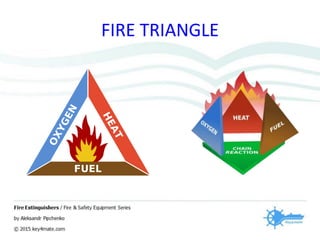
FIRE TRIANGLE
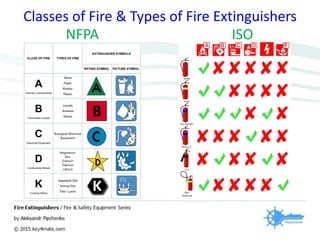
Classes of Fire & Types of Fire Extinguishers
NFPA ISO
Requirements on FE’s carriage and storage
SOLAS Ch. II-2, Part C, Regulation 10.3 – Portable fire extinguishers
3.1 Type and design
Portable fire extinguishers shall comply with the requirements of the Fire Safety Systems
Code.
3.2 Arrangement of fire extinguishers
3.2.1 Accommodation spaces, service spaces and control stations shall be provided with portable
fire extinguishers of appropriate types and in sufficient number to the satisfaction of the
Administration. Ships of 1,000 gross tonnage and upwards shall carry at least five portable fire
extinguishers.
3.2.2 One of the portable fire extinguishers intended for use in any space shall be stowed near
the entrance to that space.
Requirements on FE’s carriage and storage
SOLAS Ch. II-2, Part C, Regulation 10.3 – Portable fire extinguishers
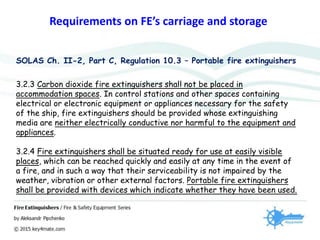
3.2.3 Carbon dioxide fire extinguishers shall not be placed in
accommodation spaces. In control stations and other spaces containing
electrical or electronic equipment or appliances necessary for the safety
of the ship, fire extinguishers should be provided whose extinguishing
media are neither electrically conductive nor harmful to the equipment and
appliances.
3.2.4 Fire extinguishers shall be situated ready for use at easily visible
places, which can be reached quickly and easily at any time in the event of
a fire, and in such a way that their serviceability is not impaired by the
weather, vibration or other external factors. Portable fire extinguishers
shall be provided with devices which indicate whether they have been used.
Requirements on FE’s carriage and storage
SOLAS Ch. II-2, Part C, Regulation 10.3 – Portable fire extinguishers
3.3 Spare charges
3.3.1 Spare charges shall be provided for 100% of the first 10
extinguishers and 50% of the remaining fire extinguishers capable of
being recharged on board. Not more than 60 total spare charges are
required. Instructions for recharging shall be carried on board.
3.3.2 For fire extinguishers which cannot be recharged onboard, additional
portable fire extinguishers of the same quantity, type, capacity and
number as determined in paragraph 3.3.1 above shall be provided in lieu of
spare charges.
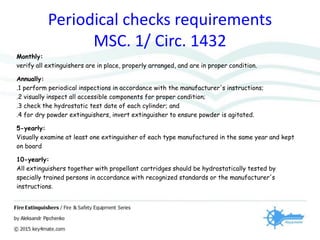
Periodical checks requirements
MSC. 1/ Circ. 1432
Monthly:
verify all extinguishers are in place, properly arranged, and are in proper condition.
Annually:
.1 perform periodical inspections in accordance with the manufacturer's instructions;
.2 visually inspect all accessible components for proper condition;
.3 check the hydrostatic test date of each cylinder; and
.4 for dry powder extinguishers, invert extinguisher to ensure powder is agitated.
5-yearly:
Visually examine at least one extinguisher of each type manufactured in the same year and kept
on board
10-yearly:
All extinguishers together with propellant cartridges should be hydrostatically tested by
specially trained persons in accordance with recognized standards or the manufacturer's
instructions.
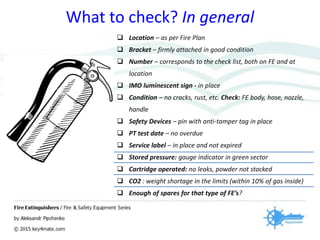
What to check? In general
 Location – as per Fire Plan
 Bracket – firmly attached in good condition
 Number – corresponds to the check list, both on FE and at
location
 IMO luminescent sign - in place
 Condition – no cracks, rust, etc. Check: FE body, hose, nozzle,
handle
 Safety Devices – pin with anti-tamper tag in place
 PT test date – no overdue
 Service label – in place and not expired
 Stored pressure: gauge indicator in green sector
 Cartridge operated: no leaks, powder not stacked
 CO2 : weight shortage in the limits (within 10% of gas inside)
 Enough of spares for that type of FE’s?
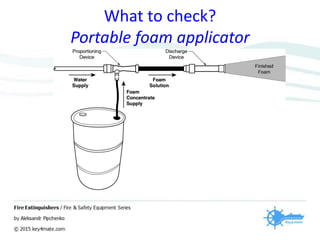
What to check?
Portable foam applicator
What to check?
Portable foam applicator
.1 verify all portable foam applicators are set to the correct proportioning ratio
for the foam concentrate supplied and the equipment is in proper order;
.2 verify all portable containers or portable tanks containing foam concentrate
remain factory sealed, and the manufacturer's recommended service life
interval has not been exceeded;
What to check?
Portable foam applicator
.3 portable containers or portable tanks containing foam concentrate,
excluding protein based concentrates, less than 10 years old, that remain
factory sealed can normally be accepted without the periodical foam control
tests required in MSC.1/Circ.1312 being carried out;
.4 protein based foam concentrate portable containers and portable tanks
should be thoroughly checked and, if more than five years old, the foam
concentrate should be subjected to the periodical foam control tests required in
MSC.1/Circ.1312, or renewed; and
.5 the foam concentrates of any non-sealed portable containers and portable
tanks, and portable containers and portable tanks where production data is not
documented, should be subjected to the periodical foam control tests required
in MSC.1/Circ.1312.

Fire Extinguishers Inspection

  • 1.
    Fire Extinguishers: Tips Promoversion find more at Key4Mate.com Fire & Safety Equipment Series
  • 2.
  • 3.
    Classes of Fire& Types of Fire Extinguishers NFPA ISO
  • 4.
    Requirements on FE’scarriage and storage SOLAS Ch. II-2, Part C, Regulation 10.3 – Portable fire extinguishers 3.1 Type and design Portable fire extinguishers shall comply with the requirements of the Fire Safety Systems Code. 3.2 Arrangement of fire extinguishers 3.2.1 Accommodation spaces, service spaces and control stations shall be provided with portable fire extinguishers of appropriate types and in sufficient number to the satisfaction of the Administration. Ships of 1,000 gross tonnage and upwards shall carry at least five portable fire extinguishers. 3.2.2 One of the portable fire extinguishers intended for use in any space shall be stowed near the entrance to that space.
  • 5.
    Requirements on FE’scarriage and storage SOLAS Ch. II-2, Part C, Regulation 10.3 – Portable fire extinguishers 3.2.3 Carbon dioxide fire extinguishers shall not be placed in accommodation spaces. In control stations and other spaces containing electrical or electronic equipment or appliances necessary for the safety of the ship, fire extinguishers should be provided whose extinguishing media are neither electrically conductive nor harmful to the equipment and appliances. 3.2.4 Fire extinguishers shall be situated ready for use at easily visible places, which can be reached quickly and easily at any time in the event of a fire, and in such a way that their serviceability is not impaired by the weather, vibration or other external factors. Portable fire extinguishers shall be provided with devices which indicate whether they have been used.
  • 6.
    Requirements on FE’scarriage and storage SOLAS Ch. II-2, Part C, Regulation 10.3 – Portable fire extinguishers 3.3 Spare charges 3.3.1 Spare charges shall be provided for 100% of the first 10 extinguishers and 50% of the remaining fire extinguishers capable of being recharged on board. Not more than 60 total spare charges are required. Instructions for recharging shall be carried on board. 3.3.2 For fire extinguishers which cannot be recharged onboard, additional portable fire extinguishers of the same quantity, type, capacity and number as determined in paragraph 3.3.1 above shall be provided in lieu of spare charges.
  • 7.
    Periodical checks requirements MSC.1/ Circ. 1432 Monthly: verify all extinguishers are in place, properly arranged, and are in proper condition. Annually: .1 perform periodical inspections in accordance with the manufacturer's instructions; .2 visually inspect all accessible components for proper condition; .3 check the hydrostatic test date of each cylinder; and .4 for dry powder extinguishers, invert extinguisher to ensure powder is agitated. 5-yearly: Visually examine at least one extinguisher of each type manufactured in the same year and kept on board 10-yearly: All extinguishers together with propellant cartridges should be hydrostatically tested by specially trained persons in accordance with recognized standards or the manufacturer's instructions.
  • 8.
    What to check?In general  Location – as per Fire Plan  Bracket – firmly attached in good condition  Number – corresponds to the check list, both on FE and at location  IMO luminescent sign - in place  Condition – no cracks, rust, etc. Check: FE body, hose, nozzle, handle  Safety Devices – pin with anti-tamper tag in place  PT test date – no overdue  Service label – in place and not expired  Stored pressure: gauge indicator in green sector  Cartridge operated: no leaks, powder not stacked  CO2 : weight shortage in the limits (within 10% of gas inside)  Enough of spares for that type of FE’s?
  • 9.
    What to check? Portablefoam applicator
  • 10.
    What to check? Portablefoam applicator .1 verify all portable foam applicators are set to the correct proportioning ratio for the foam concentrate supplied and the equipment is in proper order; .2 verify all portable containers or portable tanks containing foam concentrate remain factory sealed, and the manufacturer's recommended service life interval has not been exceeded;
  • 11.
    What to check? Portablefoam applicator .3 portable containers or portable tanks containing foam concentrate, excluding protein based concentrates, less than 10 years old, that remain factory sealed can normally be accepted without the periodical foam control tests required in MSC.1/Circ.1312 being carried out; .4 protein based foam concentrate portable containers and portable tanks should be thoroughly checked and, if more than five years old, the foam concentrate should be subjected to the periodical foam control tests required in MSC.1/Circ.1312, or renewed; and .5 the foam concentrates of any non-sealed portable containers and portable tanks, and portable containers and portable tanks where production data is not documented, should be subjected to the periodical foam control tests required in MSC.1/Circ.1312.