IELTS Preparatory Crash course
a guide to Writing Task 2 of IELTS
Aldyansyah, S.S
ELT Practitioner
Writing
• Number of tasks: 2
• Time: 60 minutes
– Task 1 (20 minutes): writing at least 150 words of
a summary from a graph, chart, diagram or table.
– Task 2 (40 minutes): writing at least 250 words of
a discussion on a given opinion, problem or issue.
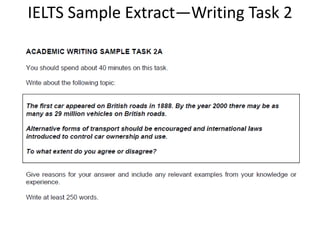
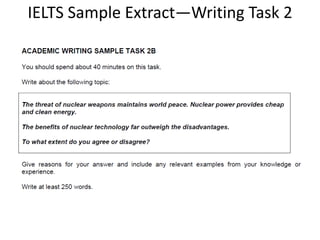
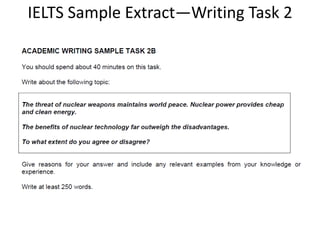
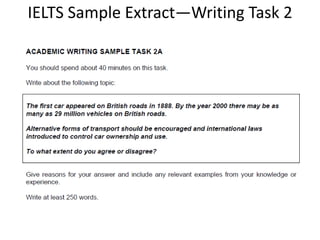
IELTS Sample Extract—Writing Task 2
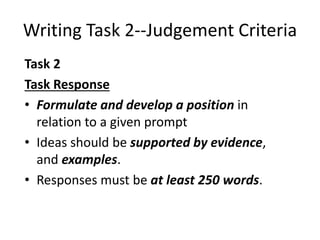
Writing Task 2--Judgement Criteria
Task 2
Task Response
• Formulate and develop a position in
relation to a given prompt
• Ideas should be supported by evidence,
and examples.
• Responses must be at least 250 words.
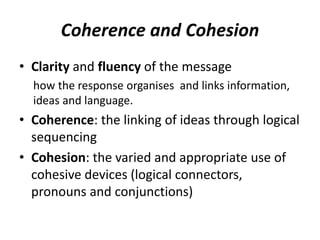
Coherence and Cohesion
• Clarity and fluency of the message
how the response organises and links information,
ideas and language.
• Coherence: the linking of ideas through logical
sequencing
• Cohesion: the varied and appropriate use of
cohesive devices (logical connectors,
pronouns and conjunctions)
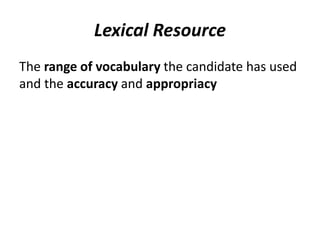
Lexical Resource
The range of vocabulary the candidate has used
and the accuracy and appropriacy
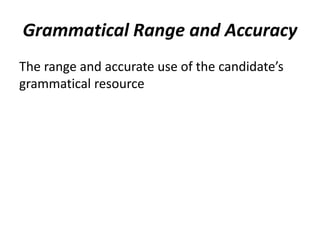
Grammatical Range and Accuracy
The range and accurate use of the candidate’s
grammatical resource
The criteria
• Task Achievement—Does it contain the information instructed?
• Coherence and Cohesion—is the information presented
clearly and understandably?
• Lexical Resource—is it not repetitive?
• Grammatical Range and Accuracy—does it employ
various grammar forms correctly?
Thriving on The criteria
• Task Achievement—Does it contain the information instructed?
– Plan your paragraphs using the guideline in the instruction
• Coherence and Cohesion—is the information presented
clearly and understandably?
– Brainstorm the appropriate cohesive devices
• Lexical Resource—is it not repetitive?
– Brainstorm numerous paraphrases
• Grammatical Range and Accuracy—does it employ
various grammar forms correctly?
– Brainstorm various applicable structures
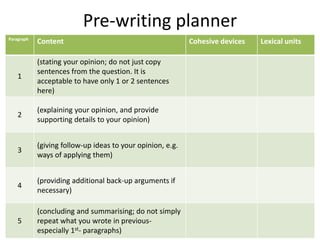
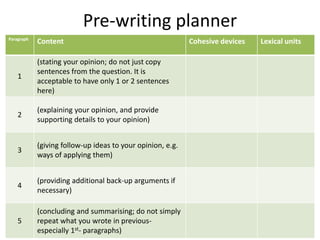
Pre-writing planner
Paragraph
Content Cohesive devices Lexical units
1
(stating your opinion; do not just copy
sentences from the question. It is
acceptable to have only 1 or 2 sentences
here)
2
(explaining your opinion, and provide
supporting details to your opinion)
3
(giving follow-up ideas to your opinion, e.g.
ways of applying them)
4
(providing additional back-up arguments if
necessary)
5
(concluding and summarising; do not simply
repeat what you wrote in previous-
especially 1st- paragraphs)
Pop Cohesive Devices
1. Conjunctions
2. Clause Connectors
3. Sentence connectors
4. Descriptive punctuations
5. Pronouns
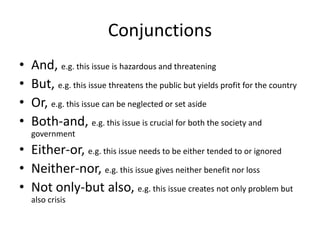
Conjunctions
• And, e.g. this issue is hazardous and threatening
• But, e.g. this issue threatens the public but yields profit for the country
• Or, e.g. this issue can be neglected or set aside
• Both-and, e.g. this issue is crucial for both the society and
government
• Either-or, e.g. this issue needs to be either tended to or ignored
• Neither-nor, e.g. this issue gives neither benefit nor loss
• Not only-but also, e.g. this issue creates not only problem but
also crisis
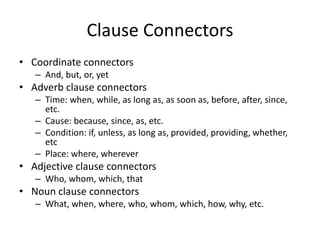
Clause Connectors
• Coordinate connectors
– And, but, or, yet
• Adverb clause connectors
– Time: when, while, as long as, as soon as, before, after, since,
etc.
– Cause: because, since, as, etc.
– Condition: if, unless, as long as, provided, providing, whether,
etc
– Place: where, wherever
• Adjective clause connectors
– Who, whom, which, that
• Noun clause connectors
– What, when, where, who, whom, which, how, why, etc.
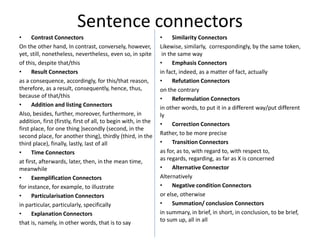
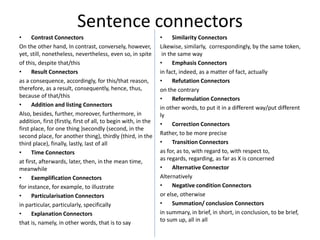
Sentence connectors
• Contrast Connectors
On the other hand, In contrast, conversely, however,
yet, still, nonetheless, nevertheless, even so, in spite
of this, despite that/this
• Result Connectors
as a consequence, accordingly, for this/that reason,
therefore, as a result, consequently, hence, thus,
because of that/this
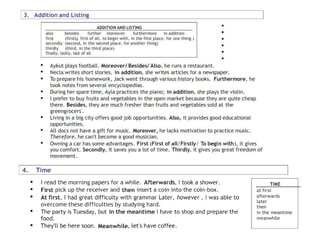
• Addition and listing Connectors
Also, besides, further, moreover, furthermore, in
addition, first (firstly, first of all, to begin with, in the
first place, for one thing )secondly (second, in the
second place, for another thing), thirdly (third, in the
third place), finally, lastly, last of all
• Time Connectors
at first, afterwards, later, then, in the mean time,
meanwhile
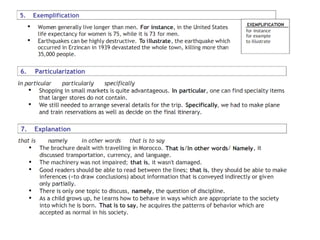
• Exemplification Connectors
for instance, for example, to illustrate
• Particularisation Connectors
in particular, particularly, specifically
• Explanation Connectors
that is, namely, in other words, that is to say
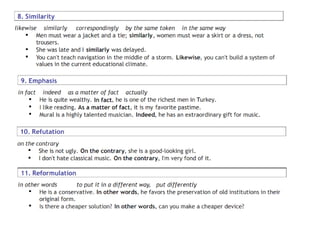
• Similarity Connectors
Likewise, similarly, correspondingly, by the same token,
in the same way
• Emphasis Connectors
in fact, indeed, as a matter of fact, actually
• Refutation Connectors
on the contrary
• Reformulation Connectors
in other words, to put it in a different way/put different
ly
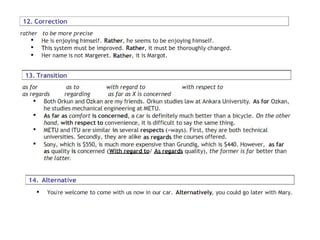
• Correction Connectors
Rather, to be more precise
• Transition Connectors
as for, as to, with regard to, with respect to,
as regards, regarding, as far as X is concerned
• Alternative Connector
Alternatively
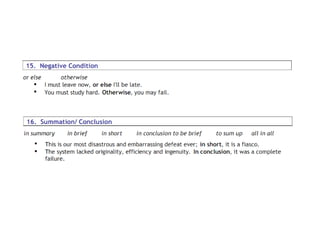
• Negative condition Connectors
or else, otherwise
• Summation/ conclusion Connectors
in summary, in brief, in short, in conclusion, to be brief,
to sum up, all in all
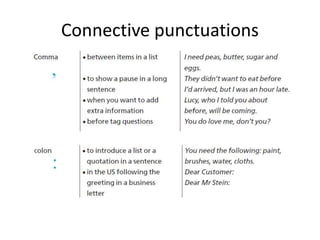
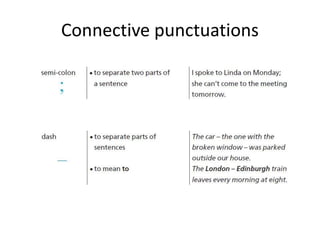
Connective punctuations
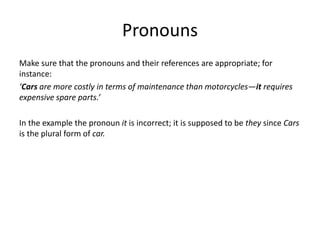
Pronouns
Make sure that the pronouns and their references are appropriate; for
instance:
‘Cars are more costly in terms of maintenance than motorcycles—it requires
expensive spare parts.’
In the example the pronoun it is incorrect; it is supposed to be they since Cars
is the plural form of car.
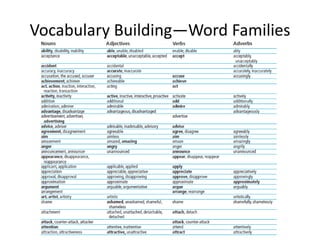
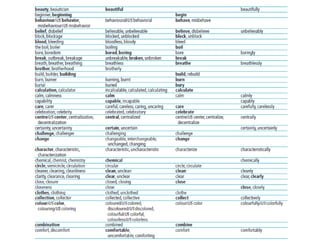
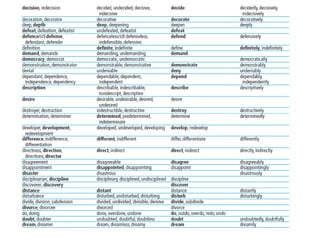
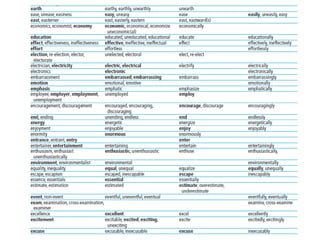
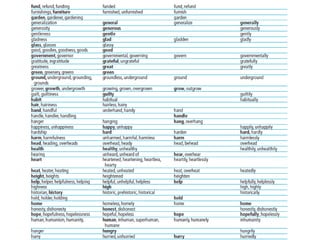
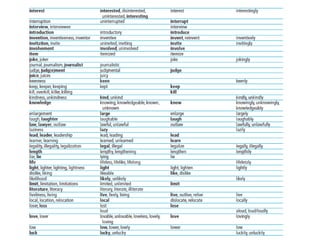
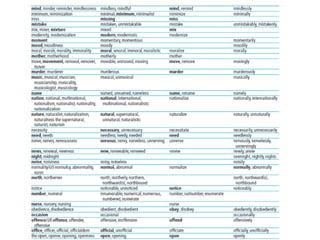
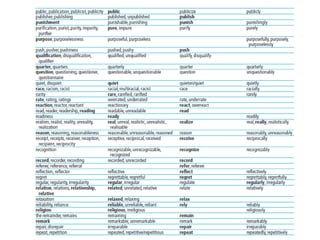
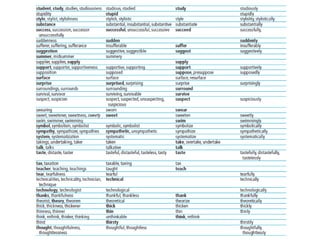
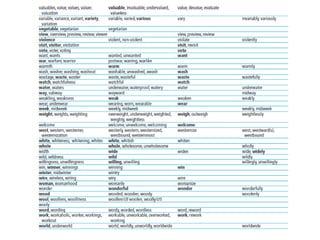
Vocabulary Building—Word Families
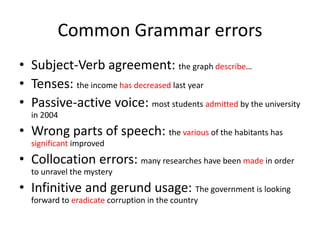
Common Grammar errors
• Subject-Verb agreement: the graph describe…
• Tenses: the income has decreased last year
• Passive-active voice: most students admitted by the university
in 2004
• Wrong parts of speech: the various of the habitants has
significant improved
• Collocation errors: many researches have been made in order
to unravel the mystery
• Infinitive and gerund usage: The government is looking
forward to eradicate corruption in the country
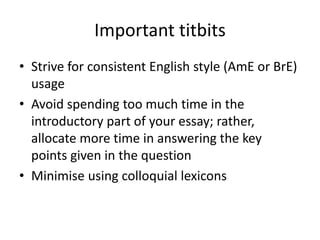
Important titbits
• Strive for consistent English style (AmE or BrE)
usage
• Avoid spending too much time in the
introductory part of your essay; rather,
allocate more time in answering the key
points given in the question
• Minimise using colloquial lexicons
IELTS Sample Extract—Writing Task 2
Sample Essays
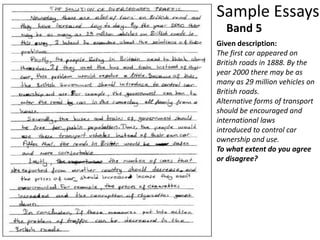
Given description:
The first car appeared on
British roads in 1888. By the
year 2000 there may be as
many as 29 million vehicles on
British roads.
Alternative forms of transport
should be encouraged and
international laws
introduced to control car
ownership and use.
To what extent do you agree
or disagree?
Band 5
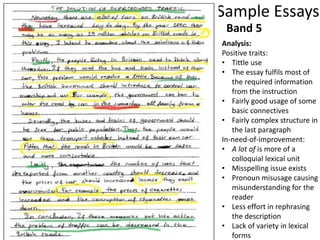
Sample Essays
Analysis:
Positive traits:
• Tittle use
• The essay fulfils most of
the required information
from the instruction
• Fairly good usage of some
basic connectives
• Fairly complex structure in
the last paragraph
In-need-of-improvement:
• A lot of is more of a
colloquial lexical unit
• Misspelling issue exists
• Pronoun misusage causing
misunderstanding for the
reader
• Less effort in rephrasing
the description
• Lack of variety in lexical
forms
Band 5
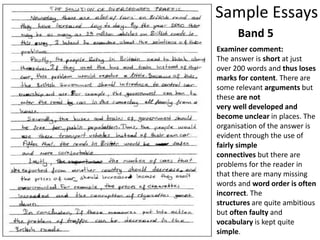
Sample Essays
Examiner comment:
The answer is short at just
over 200 words and thus loses
marks for content. There are
some relevant arguments but
these are not
very well developed and
become unclear in places. The
organisation of the answer is
evident through the use of
fairly simple
connectives but there are
problems for the reader in
that there are many missing
words and word order is often
incorrect. The
structures are quite ambitious
but often faulty and
vocabulary is kept quite
simple.
Band 5
Sample Essays
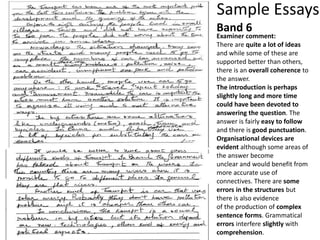
Examiner comment:
There are quite a lot of ideas
and while some of these are
supported better than others,
there is an overall coherence to
the answer.
The introduction is perhaps
slightly long and more time
could have been devoted to
answering the question. The
answer is fairly easy to follow
and there is good punctuation.
Organisational devices are
evident although some areas of
the answer become
unclear and would benefit from
more accurate use of
connectives. There are some
errors in the structures but
there is also evidence
of the production of complex
sentence forms. Grammatical
errors interfere slightly with
comprehension.
Band 6
IELTS Sample Extract—Writing Task 2
Sample Essays
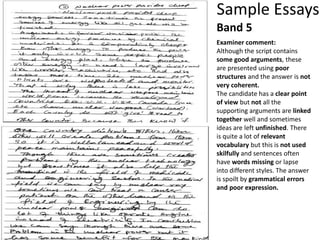
Examiner comment:
Although the script contains
some good arguments, these
are presented using poor
structures and the answer is not
very coherent.
The candidate has a clear point
of view but not all the
supporting arguments are linked
together well and sometimes
ideas are left unfinished. There
is quite a lot of relevant
vocabulary but this is not used
skilfully and sentences often
have words missing or lapse
into different styles. The answer
is spoilt by grammatical errors
and poor expression.
Band 5
Sample Essays
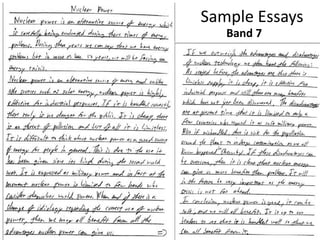
Band 7
Sample Essays
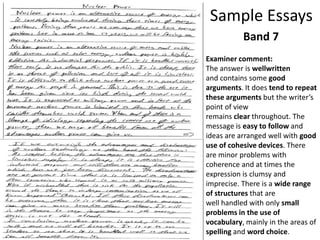
Band 7
Examiner comment:
The answer is wellwritten
and contains some good
arguments. It does tend to repeat
these arguments but the writer’s
point of view
remains clear throughout. The
message is easy to follow and
ideas are arranged well with good
use of cohesive devices. There
are minor problems with
coherence and at times the
expression is clumsy and
imprecise. There is a wide range
of structures that are
well handled with only small
problems in the use of
vocabulary, mainly in the areas of
spelling and word choice.
Application Session
Apply the theories and hindsight: dive into your
writing realm
Pre-writing planner
Paragraph
Content Cohesive devices Lexical units
1
(stating your opinion; do not just copy
sentences from the question. It is
acceptable to have only 1 or 2 sentences
here)
2
(explaining your opinion, and provide
supporting details to your opinion)
3
(giving follow-up ideas to your opinion, e.g.
ways of applying them)
4
(providing additional back-up arguments if
necessary)
5
(concluding and summarising; do not simply
repeat what you wrote in previous-
especially 1st- paragraphs)
Sentence connectors
• Contrast Connectors
On the other hand, In contrast, conversely, however,
yet, still, nonetheless, nevertheless, even so, in spite
of this, despite that/this
• Result Connectors
as a consequence, accordingly, for this/that reason,
therefore, as a result, consequently, hence, thus,
because of that/this
• Addition and listing Connectors
Also, besides, further, moreover, furthermore, in
addition, first (firstly, first of all, to begin with, in the
first place, for one thing )secondly (second, in the
second place, for another thing), thirdly (third, in the
third place), finally, lastly, last of all
• Time Connectors
at first, afterwards, later, then, in the mean time,
meanwhile
• Exemplification Connectors
for instance, for example, to illustrate
• Particularisation Connectors
in particular, particularly, specifically
• Explanation Connectors
that is, namely, in other words, that is to say
• Similarity Connectors
Likewise, similarly, correspondingly, by the same token,
in the same way
• Emphasis Connectors
in fact, indeed, as a matter of fact, actually
• Refutation Connectors
on the contrary
• Reformulation Connectors
in other words, to put it in a different way/put different
ly
• Correction Connectors
Rather, to be more precise
• Transition Connectors
as for, as to, with regard to, with respect to,
as regards, regarding, as far as X is concerned
• Alternative Connector
Alternatively
• Negative condition Connectors
or else, otherwise
• Summation/ conclusion Connectors
in summary, in brief, in short, in conclusion, to be brief,
to sum up, all in all
All in all, in task 2 writing:
1. Plan
2. Fulfil
3. Connect
4. Vary
5. Check
Happy practicing at home

Ielts writing task 2

  • 1.
    IELTS Preparatory Crashcourse a guide to Writing Task 2 of IELTS Aldyansyah, S.S ELT Practitioner
  • 2.
    Writing • Number oftasks: 2 • Time: 60 minutes – Task 1 (20 minutes): writing at least 150 words of a summary from a graph, chart, diagram or table. – Task 2 (40 minutes): writing at least 250 words of a discussion on a given opinion, problem or issue.
  • 3.
  • 4.
  • 5.
    Writing Task 2--JudgementCriteria Task 2 Task Response • Formulate and develop a position in relation to a given prompt • Ideas should be supported by evidence, and examples. • Responses must be at least 250 words.
  • 6.
    Coherence and Cohesion •Clarity and fluency of the message how the response organises and links information, ideas and language. • Coherence: the linking of ideas through logical sequencing • Cohesion: the varied and appropriate use of cohesive devices (logical connectors, pronouns and conjunctions)
  • 7.
    Lexical Resource The rangeof vocabulary the candidate has used and the accuracy and appropriacy
  • 8.
    Grammatical Range andAccuracy The range and accurate use of the candidate’s grammatical resource
  • 9.
    The criteria • TaskAchievement—Does it contain the information instructed? • Coherence and Cohesion—is the information presented clearly and understandably? • Lexical Resource—is it not repetitive? • Grammatical Range and Accuracy—does it employ various grammar forms correctly?
  • 10.
    Thriving on Thecriteria • Task Achievement—Does it contain the information instructed? – Plan your paragraphs using the guideline in the instruction • Coherence and Cohesion—is the information presented clearly and understandably? – Brainstorm the appropriate cohesive devices • Lexical Resource—is it not repetitive? – Brainstorm numerous paraphrases • Grammatical Range and Accuracy—does it employ various grammar forms correctly? – Brainstorm various applicable structures
  • 11.
    Pre-writing planner Paragraph Content Cohesivedevices Lexical units 1 (stating your opinion; do not just copy sentences from the question. It is acceptable to have only 1 or 2 sentences here) 2 (explaining your opinion, and provide supporting details to your opinion) 3 (giving follow-up ideas to your opinion, e.g. ways of applying them) 4 (providing additional back-up arguments if necessary) 5 (concluding and summarising; do not simply repeat what you wrote in previous- especially 1st- paragraphs)
  • 12.
    Pop Cohesive Devices 1.Conjunctions 2. Clause Connectors 3. Sentence connectors 4. Descriptive punctuations 5. Pronouns
  • 13.
    Conjunctions • And, e.g.this issue is hazardous and threatening • But, e.g. this issue threatens the public but yields profit for the country • Or, e.g. this issue can be neglected or set aside • Both-and, e.g. this issue is crucial for both the society and government • Either-or, e.g. this issue needs to be either tended to or ignored • Neither-nor, e.g. this issue gives neither benefit nor loss • Not only-but also, e.g. this issue creates not only problem but also crisis
  • 14.
    Clause Connectors • Coordinateconnectors – And, but, or, yet • Adverb clause connectors – Time: when, while, as long as, as soon as, before, after, since, etc. – Cause: because, since, as, etc. – Condition: if, unless, as long as, provided, providing, whether, etc – Place: where, wherever • Adjective clause connectors – Who, whom, which, that • Noun clause connectors – What, when, where, who, whom, which, how, why, etc.
  • 15.
    Sentence connectors • ContrastConnectors On the other hand, In contrast, conversely, however, yet, still, nonetheless, nevertheless, even so, in spite of this, despite that/this • Result Connectors as a consequence, accordingly, for this/that reason, therefore, as a result, consequently, hence, thus, because of that/this • Addition and listing Connectors Also, besides, further, moreover, furthermore, in addition, first (firstly, first of all, to begin with, in the first place, for one thing )secondly (second, in the second place, for another thing), thirdly (third, in the third place), finally, lastly, last of all • Time Connectors at first, afterwards, later, then, in the mean time, meanwhile • Exemplification Connectors for instance, for example, to illustrate • Particularisation Connectors in particular, particularly, specifically • Explanation Connectors that is, namely, in other words, that is to say • Similarity Connectors Likewise, similarly, correspondingly, by the same token, in the same way • Emphasis Connectors in fact, indeed, as a matter of fact, actually • Refutation Connectors on the contrary • Reformulation Connectors in other words, to put it in a different way/put different ly • Correction Connectors Rather, to be more precise • Transition Connectors as for, as to, with regard to, with respect to, as regards, regarding, as far as X is concerned • Alternative Connector Alternatively • Negative condition Connectors or else, otherwise • Summation/ conclusion Connectors in summary, in brief, in short, in conclusion, to be brief, to sum up, all in all
  • 22.
  • 23.
  • 24.
    Pronouns Make sure thatthe pronouns and their references are appropriate; for instance: ‘Cars are more costly in terms of maintenance than motorcycles—it requires expensive spare parts.’ In the example the pronoun it is incorrect; it is supposed to be they since Cars is the plural form of car.
  • 25.
  • 35.
    Common Grammar errors •Subject-Verb agreement: the graph describe… • Tenses: the income has decreased last year • Passive-active voice: most students admitted by the university in 2004 • Wrong parts of speech: the various of the habitants has significant improved • Collocation errors: many researches have been made in order to unravel the mystery • Infinitive and gerund usage: The government is looking forward to eradicate corruption in the country
  • 36.
    Important titbits • Strivefor consistent English style (AmE or BrE) usage • Avoid spending too much time in the introductory part of your essay; rather, allocate more time in answering the key points given in the question • Minimise using colloquial lexicons
  • 37.
  • 38.
    Sample Essays Given description: Thefirst car appeared on British roads in 1888. By the year 2000 there may be as many as 29 million vehicles on British roads. Alternative forms of transport should be encouraged and international laws introduced to control car ownership and use. To what extent do you agree or disagree? Band 5
  • 39.
    Sample Essays Analysis: Positive traits: •Tittle use • The essay fulfils most of the required information from the instruction • Fairly good usage of some basic connectives • Fairly complex structure in the last paragraph In-need-of-improvement: • A lot of is more of a colloquial lexical unit • Misspelling issue exists • Pronoun misusage causing misunderstanding for the reader • Less effort in rephrasing the description • Lack of variety in lexical forms Band 5
  • 40.
    Sample Essays Examiner comment: Theanswer is short at just over 200 words and thus loses marks for content. There are some relevant arguments but these are not very well developed and become unclear in places. The organisation of the answer is evident through the use of fairly simple connectives but there are problems for the reader in that there are many missing words and word order is often incorrect. The structures are quite ambitious but often faulty and vocabulary is kept quite simple. Band 5
  • 41.
    Sample Essays Examiner comment: Thereare quite a lot of ideas and while some of these are supported better than others, there is an overall coherence to the answer. The introduction is perhaps slightly long and more time could have been devoted to answering the question. The answer is fairly easy to follow and there is good punctuation. Organisational devices are evident although some areas of the answer become unclear and would benefit from more accurate use of connectives. There are some errors in the structures but there is also evidence of the production of complex sentence forms. Grammatical errors interfere slightly with comprehension. Band 6
  • 42.
  • 43.
    Sample Essays Examiner comment: Althoughthe script contains some good arguments, these are presented using poor structures and the answer is not very coherent. The candidate has a clear point of view but not all the supporting arguments are linked together well and sometimes ideas are left unfinished. There is quite a lot of relevant vocabulary but this is not used skilfully and sentences often have words missing or lapse into different styles. The answer is spoilt by grammatical errors and poor expression. Band 5
  • 44.
  • 45.
    Sample Essays Band 7 Examinercomment: The answer is wellwritten and contains some good arguments. It does tend to repeat these arguments but the writer’s point of view remains clear throughout. The message is easy to follow and ideas are arranged well with good use of cohesive devices. There are minor problems with coherence and at times the expression is clumsy and imprecise. There is a wide range of structures that are well handled with only small problems in the use of vocabulary, mainly in the areas of spelling and word choice.
  • 46.
    Application Session Apply thetheories and hindsight: dive into your writing realm
  • 47.
    Pre-writing planner Paragraph Content Cohesivedevices Lexical units 1 (stating your opinion; do not just copy sentences from the question. It is acceptable to have only 1 or 2 sentences here) 2 (explaining your opinion, and provide supporting details to your opinion) 3 (giving follow-up ideas to your opinion, e.g. ways of applying them) 4 (providing additional back-up arguments if necessary) 5 (concluding and summarising; do not simply repeat what you wrote in previous- especially 1st- paragraphs)
  • 48.
    Sentence connectors • ContrastConnectors On the other hand, In contrast, conversely, however, yet, still, nonetheless, nevertheless, even so, in spite of this, despite that/this • Result Connectors as a consequence, accordingly, for this/that reason, therefore, as a result, consequently, hence, thus, because of that/this • Addition and listing Connectors Also, besides, further, moreover, furthermore, in addition, first (firstly, first of all, to begin with, in the first place, for one thing )secondly (second, in the second place, for another thing), thirdly (third, in the third place), finally, lastly, last of all • Time Connectors at first, afterwards, later, then, in the mean time, meanwhile • Exemplification Connectors for instance, for example, to illustrate • Particularisation Connectors in particular, particularly, specifically • Explanation Connectors that is, namely, in other words, that is to say • Similarity Connectors Likewise, similarly, correspondingly, by the same token, in the same way • Emphasis Connectors in fact, indeed, as a matter of fact, actually • Refutation Connectors on the contrary • Reformulation Connectors in other words, to put it in a different way/put different ly • Correction Connectors Rather, to be more precise • Transition Connectors as for, as to, with regard to, with respect to, as regards, regarding, as far as X is concerned • Alternative Connector Alternatively • Negative condition Connectors or else, otherwise • Summation/ conclusion Connectors in summary, in brief, in short, in conclusion, to be brief, to sum up, all in all
  • 49.
    All in all,in task 2 writing: 1. Plan 2. Fulfil 3. Connect 4. Vary 5. Check Happy practicing at home