Technical English II
/21OA12
MODULE II
COHESION
&
COHERENCE
IN READING
PREPARED BY:
COHESION
&
COHERENCE
IN READING
What is “Coherence and Cohesion”?
• Coherence and cohesion are paired together in paragraphs to structure well
and establish logical flow.
• They actually refer to the structure and flow of your essay and its
paragraphs.
• Structure means how your essay and paragraphs are organized.
• Flow means that your ideas are connected logically and skillfully.
Coherence
• Coherence means “structure” (paragraph
and essay structure).
• To get a high score in Coherence and
Cohesion, your essay and paragraphs should
follow the structure below:
Introduction Structure
Paragraph Structure
Conclusion Structure
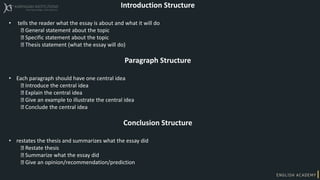
Introduction Structure
• tells the reader what the essay is about and what it will do
General statement about the topic
Specific statement about the topic
Thesis statement (what the essay will do)
Paragraph Structure
• Each paragraph should have one central idea
Introduce the central idea
Explain the central idea
Give an example to illustrate the central idea
Conclude the central idea
Conclusion Structure
• restates the thesis and summarizes what the essay did
Restate thesis
Summarize what the essay did
Give an opinion/recommendation/prediction
The central idea of each body paragraph should be
linked back to the thesis
statement in your introduction and should be
reiterated in your conclusion.
• Cohesion means flow - how well your ideas follow from one to the next with
seamless and logical transition.
• As you develop your paragraph, your ideas must be related to each other and
they should be logically linked with referencing and linking words.
• Referencing - pronouns, like this, these, it, etc. (use these to link an idea in one
sentence to an idea in the previous sentence)
• Another way to connect ideas is to use linking words (like however, on the
other hand, for example, therefore, etc.)
• But be careful to use these sparingly.
• The best way to develop your writing skills and to enhance the coherence and
cohesion of your essay is through feedback.
Cohesion
COHERENCE: LINKING WORDS ANDPHRASES
• To make your work more readable and meaningful,
ideas and paragraphs must be linked.
• Linking words are essential in developing coherent
logical arguments and discussion in your assignments.
• They show the relationships between the ideas and are
the glue that holds your assignment together.
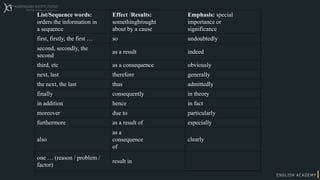
• The table below provides an overview of commonly-
used linking words.
List/Sequence words:
orders the information in
a sequence
Effect /Results:
somethingbrought
about by a cause
Emphasis: special
importance or
significance
first, firstly, the first … so undoubtedly
second, secondly, the
second
as a result indeed
third, etc as a consequence obviously
next, last therefore generally
the next, the last thus admittedly
finally consequently in theory
in addition hence in fact
moreover due to particularly
furthermore as a result of especially
also
as a
consequence
of
clearly
one … (reason / problem /
factor)
result in
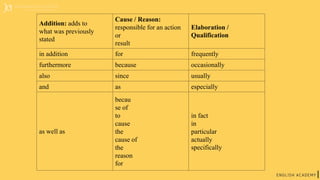
Addition: adds to
what was previously
stated
Cause / Reason:
responsible for an action
or
result
Elaboration /
Qualification
in addition for frequently
furthermore because occasionally
also since usually
and as especially
as well as
becau
se of
to
cause
the
cause of
the
reason
for
in fact
in
particular
actually
specifically
Addition: adds to
what was previously
stated
Cause / Reason:
responsible for an action
or
result
Elaboration /
Qualification
in addition for frequently
furthermore because occasionally
also since usually
and as especially
as well as
becau
se of
to
cause
the
cause of
the
reason
for
in fact
in
particular
actually
specifically
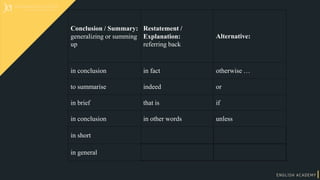
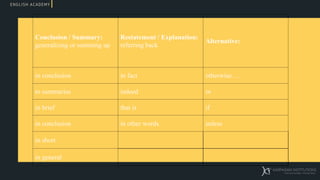
Conclusion / Summary:
generalizing or summing
up
Restatement /
Explanation:
referring back
Alternative:
in conclusion in fact otherwise …
to summarise indeed or
in brief that is if
in conclusion in other words unless
in short
in general
Conclusion / Summary:
generalizing or summing up
Restatement / Explanation:
referring back
Alternative:
in conclusion in fact otherwise …
to summarise indeed or
in brief that is if
in conclusion in other words unless
in short
in general
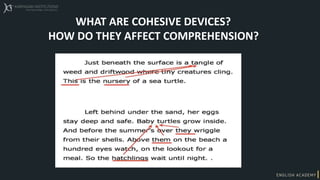
WHAT ARE COHESIVE DEVICES?
HOW DO THEY AFFECT COMPREHENSION?
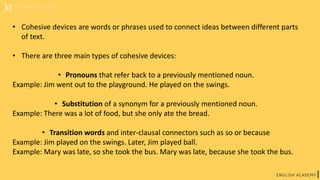
• Cohesive devices are words or phrases used to connect ideas between different parts
of text.
• There are three main types of cohesive devices:
• Pronouns that refer back to a previously mentioned noun.
Example: Jim went out to the playground. He played on the swings.
• Substitution of a synonym for a previously mentioned noun.
Example: There was a lot of food, but she only ate the bread.
• Transition words and inter-clausal connectors such as so or because
Example: Jim played on the swings. Later, Jim played ball.
Example: Mary was late, so she took the bus. Mary was late, because she took the bus.
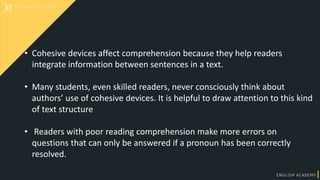
• Cohesive devices affect comprehension because they help readers
integrate information between sentences in a text.
• Many students, even skilled readers, never consciously think about
authors’ use of cohesive devices. It is helpful to draw attention to this kind
of text structure
• Readers with poor reading comprehension make more errors on
questions that can only be answered if a pronoun has been correctly
resolved.
Coherence-and-Cohesion ppt.pptx

Coherence-and-Cohesion ppt.pptx

  • 1.
    Technical English II /21OA12 MODULEII COHESION & COHERENCE IN READING PREPARED BY:
  • 2.
  • 3.
    What is “Coherenceand Cohesion”? • Coherence and cohesion are paired together in paragraphs to structure well and establish logical flow. • They actually refer to the structure and flow of your essay and its paragraphs. • Structure means how your essay and paragraphs are organized. • Flow means that your ideas are connected logically and skillfully.
  • 4.
    Coherence • Coherence means“structure” (paragraph and essay structure). • To get a high score in Coherence and Cohesion, your essay and paragraphs should follow the structure below: Introduction Structure Paragraph Structure Conclusion Structure
  • 5.
    Introduction Structure • tellsthe reader what the essay is about and what it will do General statement about the topic Specific statement about the topic Thesis statement (what the essay will do) Paragraph Structure • Each paragraph should have one central idea Introduce the central idea Explain the central idea Give an example to illustrate the central idea Conclude the central idea Conclusion Structure • restates the thesis and summarizes what the essay did Restate thesis Summarize what the essay did Give an opinion/recommendation/prediction
  • 6.
    The central ideaof each body paragraph should be linked back to the thesis statement in your introduction and should be reiterated in your conclusion.
  • 7.
    • Cohesion meansflow - how well your ideas follow from one to the next with seamless and logical transition. • As you develop your paragraph, your ideas must be related to each other and they should be logically linked with referencing and linking words. • Referencing - pronouns, like this, these, it, etc. (use these to link an idea in one sentence to an idea in the previous sentence) • Another way to connect ideas is to use linking words (like however, on the other hand, for example, therefore, etc.) • But be careful to use these sparingly. • The best way to develop your writing skills and to enhance the coherence and cohesion of your essay is through feedback. Cohesion
  • 8.
    COHERENCE: LINKING WORDSANDPHRASES • To make your work more readable and meaningful, ideas and paragraphs must be linked. • Linking words are essential in developing coherent logical arguments and discussion in your assignments. • They show the relationships between the ideas and are the glue that holds your assignment together. • The table below provides an overview of commonly- used linking words.
  • 9.
    List/Sequence words: orders theinformation in a sequence Effect /Results: somethingbrought about by a cause Emphasis: special importance or significance first, firstly, the first … so undoubtedly second, secondly, the second as a result indeed third, etc as a consequence obviously next, last therefore generally the next, the last thus admittedly finally consequently in theory in addition hence in fact moreover due to particularly furthermore as a result of especially also as a consequence of clearly one … (reason / problem / factor) result in
  • 10.
    Addition: adds to whatwas previously stated Cause / Reason: responsible for an action or result Elaboration / Qualification in addition for frequently furthermore because occasionally also since usually and as especially as well as becau se of to cause the cause of the reason for in fact in particular actually specifically
  • 11.
    Addition: adds to whatwas previously stated Cause / Reason: responsible for an action or result Elaboration / Qualification in addition for frequently furthermore because occasionally also since usually and as especially as well as becau se of to cause the cause of the reason for in fact in particular actually specifically
  • 12.
    Conclusion / Summary: generalizingor summing up Restatement / Explanation: referring back Alternative: in conclusion in fact otherwise … to summarise indeed or in brief that is if in conclusion in other words unless in short in general
  • 13.
    Conclusion / Summary: generalizingor summing up Restatement / Explanation: referring back Alternative: in conclusion in fact otherwise … to summarise indeed or in brief that is if in conclusion in other words unless in short in general
  • 14.
    WHAT ARE COHESIVEDEVICES? HOW DO THEY AFFECT COMPREHENSION?
  • 15.
    • Cohesive devicesare words or phrases used to connect ideas between different parts of text. • There are three main types of cohesive devices: • Pronouns that refer back to a previously mentioned noun. Example: Jim went out to the playground. He played on the swings. • Substitution of a synonym for a previously mentioned noun. Example: There was a lot of food, but she only ate the bread. • Transition words and inter-clausal connectors such as so or because Example: Jim played on the swings. Later, Jim played ball. Example: Mary was late, so she took the bus. Mary was late, because she took the bus.
  • 16.
    • Cohesive devicesaffect comprehension because they help readers integrate information between sentences in a text. • Many students, even skilled readers, never consciously think about authors’ use of cohesive devices. It is helpful to draw attention to this kind of text structure • Readers with poor reading comprehension make more errors on questions that can only be answered if a pronoun has been correctly resolved.