DEFINITION OF PULPITIS
 It is the inflammation of pulp resulting due to :-
1) Trauma
2) Thermal shock during cavity preparation
3) Excessive dehydration of cavity
4) Placing of fresh amalgam in contact with pulp
5) Chemical stimulus from any food-stuff
TYPES OF PULPITIS
1. Reversible pulpitis
a) Symptomatic(acute)
b) Asymptomatic(chronic)
2. Irreversible pulpitis
a) Acute
 Abnormally responsive to cold
 Abnormally responsive to heat
b) Chronic
 Asymptomatic with pulp exposure
 Hyperplastic pulpitis
 Internal resorption
REVERSIBLE PULPITIS
 It is a mild to
moderate condition
of the pulp caused
by noxious stimuli in
which the pulp is
capable of returning
to uninflamed state
following removal of
stimuli.
HISTOPATHOLOGY
 It may range from hyperemia to mild to moderate
inflammatory changes limited to area of involved
dentinal tubules such as dental caries.
 Microscopically,one can see reparative
dentin,disruption of odontoblast layer,dilated blood
vessels,extravasation of edema fluid,presence of
immunologically competent chronic inflammatory
cells.
SYMPTOMS
 Symptomatic reversible pulpitis is characterized by
sharp pain lasting for a moment.
 It is more often brought on by cold than hot food or
beverages and by cold air.
 Clinically,the difference between reversible &
irreversible pulpitis is quantitative,the pain of
irreversible pulpitis is more severe & lasts longer.
TREATMENT
 The best treatment for reversible pulpitis is
prevention.
 Periodic care to prevent the development of
caries,early insertion of a filling if a cavity has
developed.
 Desensitization of necks of teeth where gingival
recession is marked.
 Use of cavity varnish or cement base before insertion
of filling & care in cavity preparation & polishing are
recommended to prevent pulpitis.
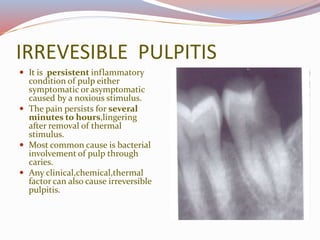
IRREVESIBLE PULPITIS
 It is persistent inflammatory
condition of pulp either
symptomatic or asymptomatic
caused by a noxious stimulus.
 The pain persists for several
minutes to hours,lingering
after removal of thermal
stimulus.
 Most common cause is bacterial
involvement of pulp through
caries.
 Any clinical,chemical,thermal
factor can also cause irreversible
pulpitis.
HISTOPATHOLOGY
 Irreversible pulpitis may be caused by a long-
standing noxious stimulus such as caries.
 As it penetrates the dentin,caries cause a chronic
inflammatory response.
 If the caries is not removed,the inflammatory changes
in pulp will increase in severity as the caries
approaches the pulp.
 The post-capillary venules become congested & affect
the circulation within the pulp,causing necrosis.
 These necrotic areas attract polymorphonuclear
leukocytes by chemotaxis & start an acute
inflammatory reaction.
 The lysosomal enzymes lyse some of pulp stroma &
form a purulent exudate.
 The inflammatory reaction produces micro-abscesses.
 If the carious process continues to advance &
penetrates the pulp,an area of ulceration is formed
which drains the carious exposure into oral cavity &
reduces the intra-pulpal pressure & therefore,the pain.
SYMPTOMS
 In early stages,a paroxysm of pain is caused by sudden
temperature changes particularly cold.
 The pain often continues when cause has been
removed.
 The patient may describe the pain as sharp,piercing or
shooting & it is generally severe.
 It may be intermittent or continuous depending on the
degree of involvement of pulp.
 The patient may also have pain referred to adjacent
teeth,sinuses or to the temple when upper posterior
teeth are involved.
 In later stages,the pain is more severe & is generally
described as boring,gnawing or throbbing.
 The pain need not to be macroscopically exposed but a
slight exposure is generally present.
 Pain is increased by heat & is sometimes relieved by
cold.
 After exposure & drainage of pulp,pain may be slight
manifesting itself as a dull consciousness or it may be
entirely absent.
TREATMENT
 Treatment consists of complete removal of pulp or
pulpectomy.
 In posterior teeth,in which time is a factor,the removal
of coronal pulp or pulpectomy should be performed in
emergency procedure.
 Surgical removal should be considered if tooth is not
restorable.
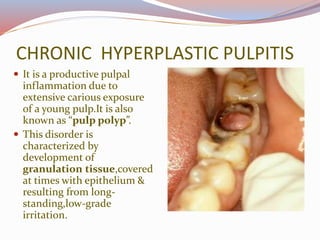
CHRONIC HYPERPLASTIC PULPITIS
 It is a productive pulpal
inflammation due to
extensive carious exposure
of a young pulp.It is also
known as “pulp polyp”.
 This disorder is
characterized by
development of
granulation tissue,covered
at times with epithelium &
resulting from long-
standing,low-grade
irritation.
HISTOPATHOLOGY
 The surface of pulp polyp is usually covered by stratified
squamous epithelium.
 The pulp tissue is chronically inflamed
 The pulp polyps of deciduous teeth are more likely to be
covered with stratified squamous epithelium than those of
permanent teeth.
 The epithelium may be derived from gingiva or from freshly
desquamated epithelial cells of mucosa or tongue.
 The tissue in pulp chamber is often transformed into
granulation tissue,which projects from pulp into carious
lesion.
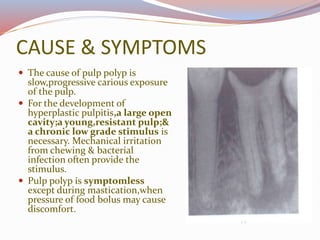
CAUSE & SYMPTOMS
 The cause of pulp polyp is
slow,progressive carious exposure
of the pulp.
 For the development of
hyperplastic pulpitis,a large open
cavity;a young,resistant pulp;&
a chronic low grade stimulus is
necessary. Mechanical irritation
from chewing & bacterial
infection often provide the
stimulus.
 Pulp polyp is symptomless
except during mastication,when
pressure of food bolus may cause
discomfort.
TREATMENT
 The treatment should be directed towards elimination
of polypoid tissue followed by extirpation of
pulp,provided the tooth can be restored.
 When the hyperplastic pulp mass has been removed
with periodontal curette or spoon excavator,the
bleeding can be controlled with pressure
 The pulp tissue of chamber is completely removed & a
temporary dressing is sealed in contact with radicular
pulp tissue.
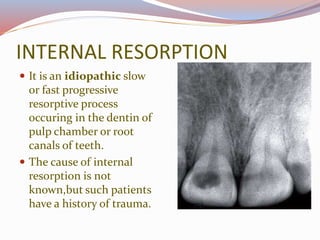
INTERNAL RESORPTION
 It is an idiopathic slow
or fast progressive
resorptive process
occuring in the dentin of
pulp chamber or root
canals of teeth.
 The cause of internal
resorption is not
known,but such patients
have a history of trauma.
HISTOPATHOLOGY
 The internal resorption is the result of osteoclast
activity.
 The resorptive process is characterized by
lacunae,which may be filled with osteoid tissue.The
osteoid tissue may be regarded as an attempt at repair.
 Multi-nucleated giant cells or dentinoclasts are
present.
 The pulp is chronically inflamed.
 Metaplasia of the pulp i.e. transformation to another
type of tissue such as bone or cementum.
SYMPTOMS
 In internal resorption,the
root of the tooth is
asymptomatic .
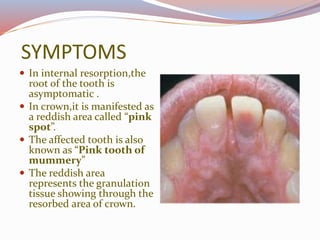
 In crown,it is manifested as
a reddish area called “pink
spot”.
 The affected tooth is also
known as “Pink tooth of
mummery”
 The reddish area
represents the granulation
tissue showing through the
resorbed area of crown.
TREATMENT
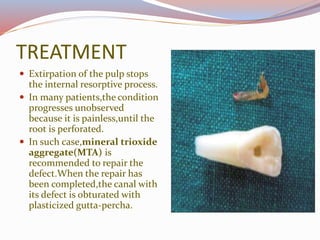
 Extirpation of the pulp stops
the internal resorptive process.
 In many patients,the condition
progresses unobserved
because it is painless,until the
root is perforated.
 In such case,mineral trioxide
aggregate(MTA) is
recommended to repair the
defect.When the repair has
been completed,the canal with
its defect is obturated with
plasticized gutta-percha.
THANK
YOU
Presented by :-
Amanjot Singh
Roll No. - 5

Pulpitis

  • 2.
    DEFINITION OF PULPITIS It is the inflammation of pulp resulting due to :- 1) Trauma 2) Thermal shock during cavity preparation 3) Excessive dehydration of cavity 4) Placing of fresh amalgam in contact with pulp 5) Chemical stimulus from any food-stuff
  • 3.
    TYPES OF PULPITIS 1.Reversible pulpitis a) Symptomatic(acute) b) Asymptomatic(chronic) 2. Irreversible pulpitis a) Acute  Abnormally responsive to cold  Abnormally responsive to heat b) Chronic  Asymptomatic with pulp exposure  Hyperplastic pulpitis  Internal resorption
  • 4.
    REVERSIBLE PULPITIS  Itis a mild to moderate condition of the pulp caused by noxious stimuli in which the pulp is capable of returning to uninflamed state following removal of stimuli.
  • 5.
    HISTOPATHOLOGY  It mayrange from hyperemia to mild to moderate inflammatory changes limited to area of involved dentinal tubules such as dental caries.  Microscopically,one can see reparative dentin,disruption of odontoblast layer,dilated blood vessels,extravasation of edema fluid,presence of immunologically competent chronic inflammatory cells.
  • 6.
    SYMPTOMS  Symptomatic reversiblepulpitis is characterized by sharp pain lasting for a moment.  It is more often brought on by cold than hot food or beverages and by cold air.  Clinically,the difference between reversible & irreversible pulpitis is quantitative,the pain of irreversible pulpitis is more severe & lasts longer.
  • 7.
    TREATMENT  The besttreatment for reversible pulpitis is prevention.  Periodic care to prevent the development of caries,early insertion of a filling if a cavity has developed.  Desensitization of necks of teeth where gingival recession is marked.  Use of cavity varnish or cement base before insertion of filling & care in cavity preparation & polishing are recommended to prevent pulpitis.
  • 8.
    IRREVESIBLE PULPITIS  Itis persistent inflammatory condition of pulp either symptomatic or asymptomatic caused by a noxious stimulus.  The pain persists for several minutes to hours,lingering after removal of thermal stimulus.  Most common cause is bacterial involvement of pulp through caries.  Any clinical,chemical,thermal factor can also cause irreversible pulpitis.
  • 10.
    HISTOPATHOLOGY  Irreversible pulpitismay be caused by a long- standing noxious stimulus such as caries.  As it penetrates the dentin,caries cause a chronic inflammatory response.  If the caries is not removed,the inflammatory changes in pulp will increase in severity as the caries approaches the pulp.  The post-capillary venules become congested & affect the circulation within the pulp,causing necrosis.
  • 11.
     These necroticareas attract polymorphonuclear leukocytes by chemotaxis & start an acute inflammatory reaction.  The lysosomal enzymes lyse some of pulp stroma & form a purulent exudate.  The inflammatory reaction produces micro-abscesses.  If the carious process continues to advance & penetrates the pulp,an area of ulceration is formed which drains the carious exposure into oral cavity & reduces the intra-pulpal pressure & therefore,the pain.
  • 12.
    SYMPTOMS  In earlystages,a paroxysm of pain is caused by sudden temperature changes particularly cold.  The pain often continues when cause has been removed.  The patient may describe the pain as sharp,piercing or shooting & it is generally severe.  It may be intermittent or continuous depending on the degree of involvement of pulp.  The patient may also have pain referred to adjacent teeth,sinuses or to the temple when upper posterior teeth are involved.
  • 13.
     In laterstages,the pain is more severe & is generally described as boring,gnawing or throbbing.  The pain need not to be macroscopically exposed but a slight exposure is generally present.  Pain is increased by heat & is sometimes relieved by cold.  After exposure & drainage of pulp,pain may be slight manifesting itself as a dull consciousness or it may be entirely absent.
  • 14.
    TREATMENT  Treatment consistsof complete removal of pulp or pulpectomy.  In posterior teeth,in which time is a factor,the removal of coronal pulp or pulpectomy should be performed in emergency procedure.  Surgical removal should be considered if tooth is not restorable.
  • 15.
    CHRONIC HYPERPLASTIC PULPITIS It is a productive pulpal inflammation due to extensive carious exposure of a young pulp.It is also known as “pulp polyp”.  This disorder is characterized by development of granulation tissue,covered at times with epithelium & resulting from long- standing,low-grade irritation.
  • 16.
    HISTOPATHOLOGY  The surfaceof pulp polyp is usually covered by stratified squamous epithelium.  The pulp tissue is chronically inflamed  The pulp polyps of deciduous teeth are more likely to be covered with stratified squamous epithelium than those of permanent teeth.  The epithelium may be derived from gingiva or from freshly desquamated epithelial cells of mucosa or tongue.  The tissue in pulp chamber is often transformed into granulation tissue,which projects from pulp into carious lesion.
  • 17.
    CAUSE & SYMPTOMS The cause of pulp polyp is slow,progressive carious exposure of the pulp.  For the development of hyperplastic pulpitis,a large open cavity;a young,resistant pulp;& a chronic low grade stimulus is necessary. Mechanical irritation from chewing & bacterial infection often provide the stimulus.  Pulp polyp is symptomless except during mastication,when pressure of food bolus may cause discomfort.
  • 18.
    TREATMENT  The treatmentshould be directed towards elimination of polypoid tissue followed by extirpation of pulp,provided the tooth can be restored.  When the hyperplastic pulp mass has been removed with periodontal curette or spoon excavator,the bleeding can be controlled with pressure  The pulp tissue of chamber is completely removed & a temporary dressing is sealed in contact with radicular pulp tissue.
  • 19.
    INTERNAL RESORPTION  Itis an idiopathic slow or fast progressive resorptive process occuring in the dentin of pulp chamber or root canals of teeth.  The cause of internal resorption is not known,but such patients have a history of trauma.
  • 20.
    HISTOPATHOLOGY  The internalresorption is the result of osteoclast activity.  The resorptive process is characterized by lacunae,which may be filled with osteoid tissue.The osteoid tissue may be regarded as an attempt at repair.  Multi-nucleated giant cells or dentinoclasts are present.  The pulp is chronically inflamed.  Metaplasia of the pulp i.e. transformation to another type of tissue such as bone or cementum.
  • 21.
    SYMPTOMS  In internalresorption,the root of the tooth is asymptomatic .  In crown,it is manifested as a reddish area called “pink spot”.  The affected tooth is also known as “Pink tooth of mummery”  The reddish area represents the granulation tissue showing through the resorbed area of crown.
  • 22.
    TREATMENT  Extirpation ofthe pulp stops the internal resorptive process.  In many patients,the condition progresses unobserved because it is painless,until the root is perforated.  In such case,mineral trioxide aggregate(MTA) is recommended to repair the defect.When the repair has been completed,the canal with its defect is obturated with plasticized gutta-percha.
  • 23.