Region III Central Luzon
Prepared by: April Joy E. Tamayo
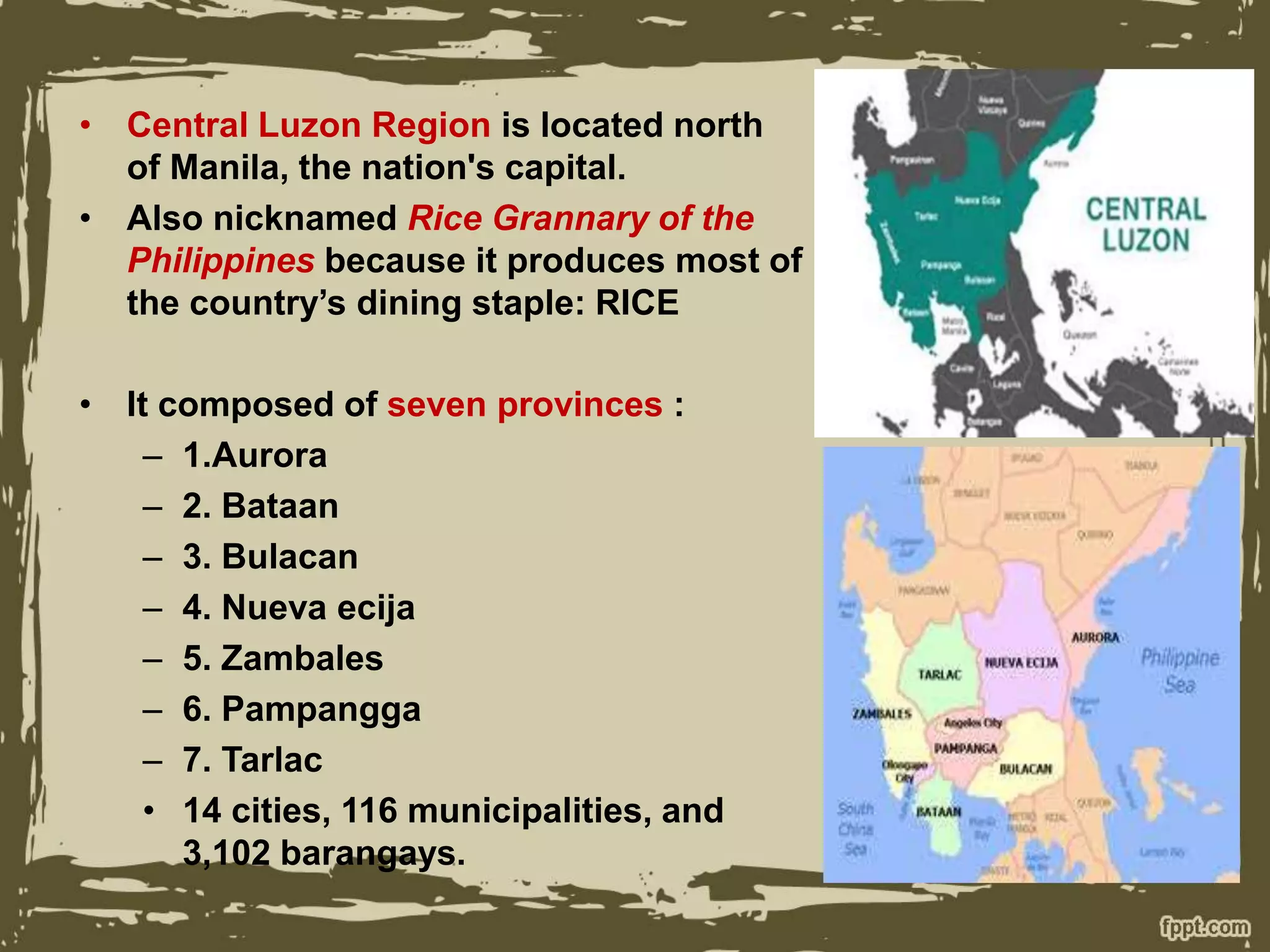
• Central Luzon Region is located north
of Manila, the nation's capital.
• Also nicknamed Rice Grannary of the
Philippines because it produces most of
the country’s dining staple: RICE
• It composed of seven provinces :
– 1.Aurora
– 2. Bataan
– 3. Bulacan
– 4. Nueva ecija
– 5. Zambales
– 6. Pampangga
– 7. Tarlac
• 14 cities, 116 municipalities, and
3,102 barangays.
• Dialects
1. Tagalog
2. Iloko
3.Kapampangan
4.Zambaleno
• The City of San
Fernando, in
Pampanga, is the
regional center.
Aurora
• Nickname(s) "Land of the Golden
Sunrise” and "Gate way to the
Pacific”
• A province of the Philippines located
in the eastern part of Central Luzon
region, facing the Philippine Sea.
• Its capital is Baler
• Before 1979, Aurora was part of the
province of Quezon. Aurora was, in
fact, named after Aurora Aragon, the
wife of Pres. Manuel L. Quezon, the
president of the Philippine
Commonwealth, after whom the
mother province was named.
Aurora
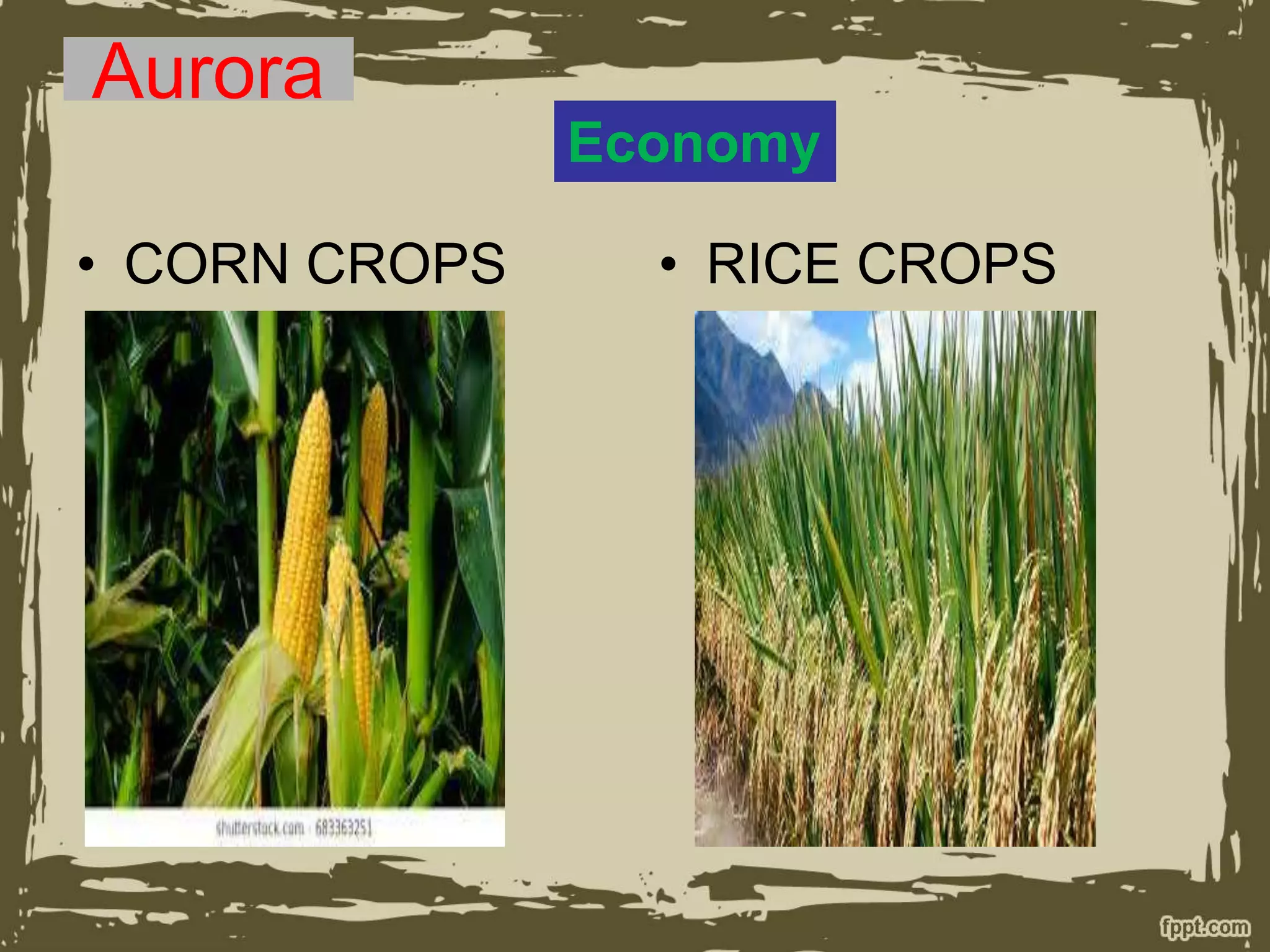
• CORN CROPS • RICE CROPS
Economy
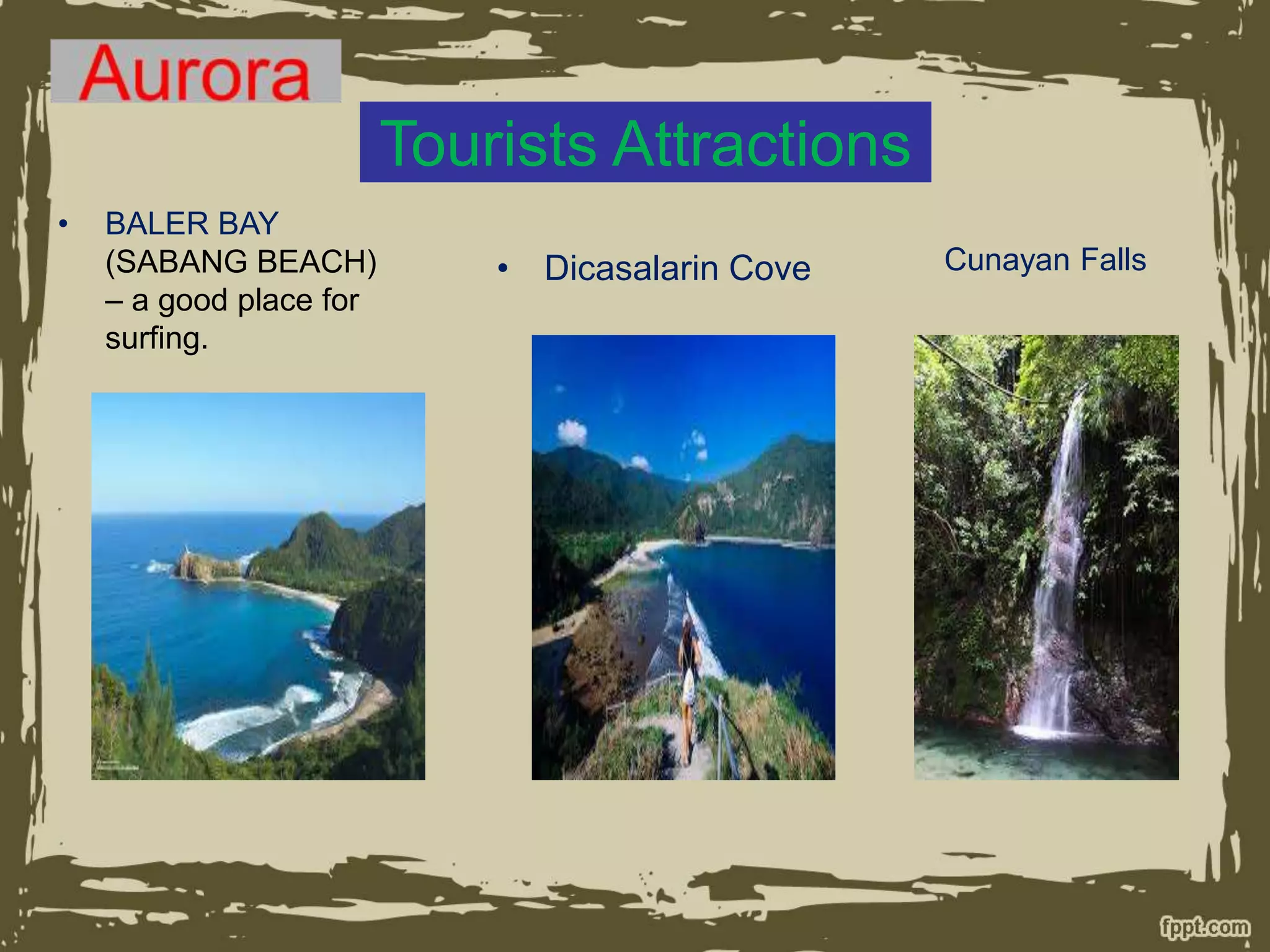
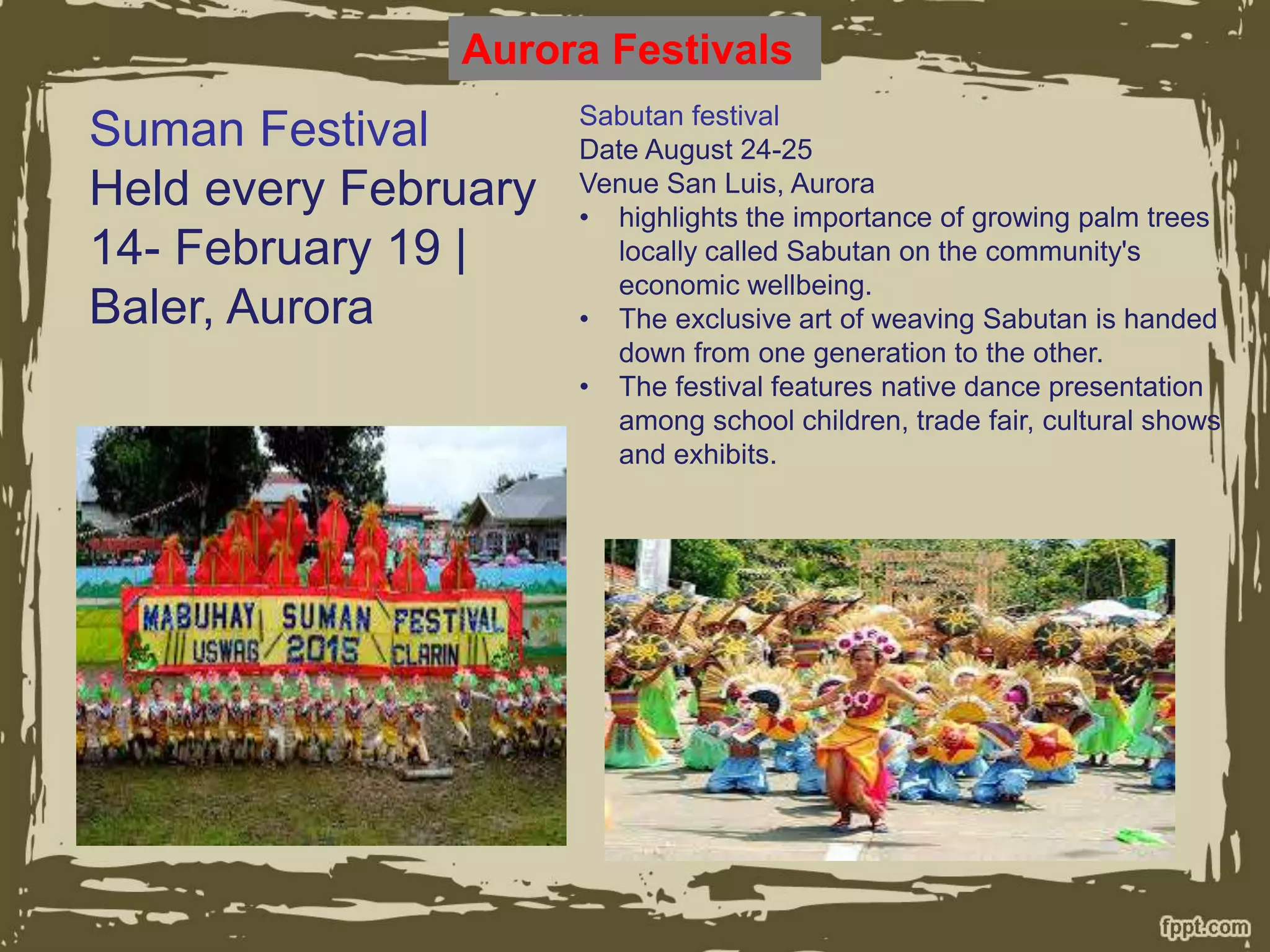
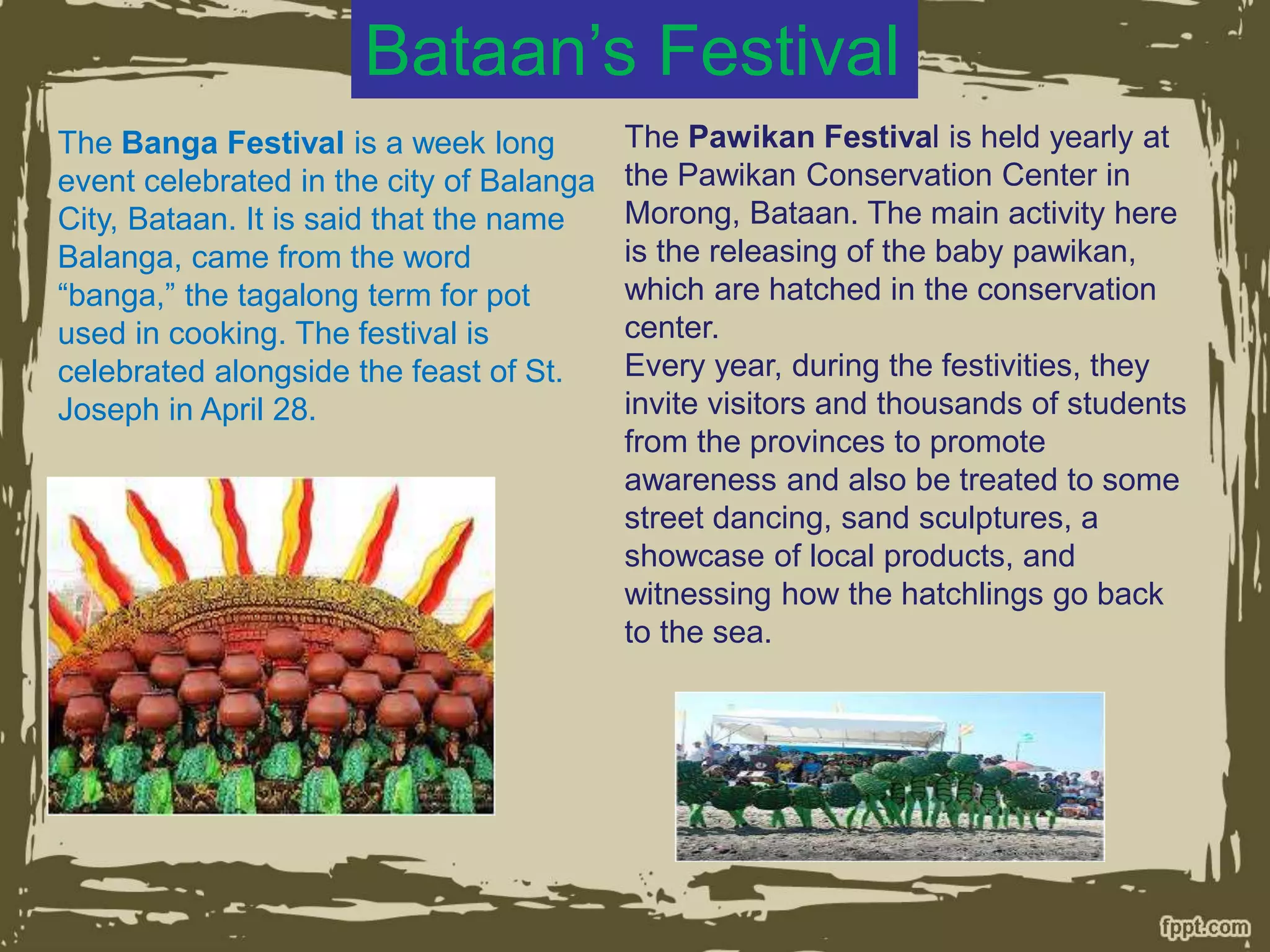
Tourists Attractions
• BALER BAY
(SABANG BEACH)
– a good place for
surfing.
• Dicasalarin Cove Cunayan Falls
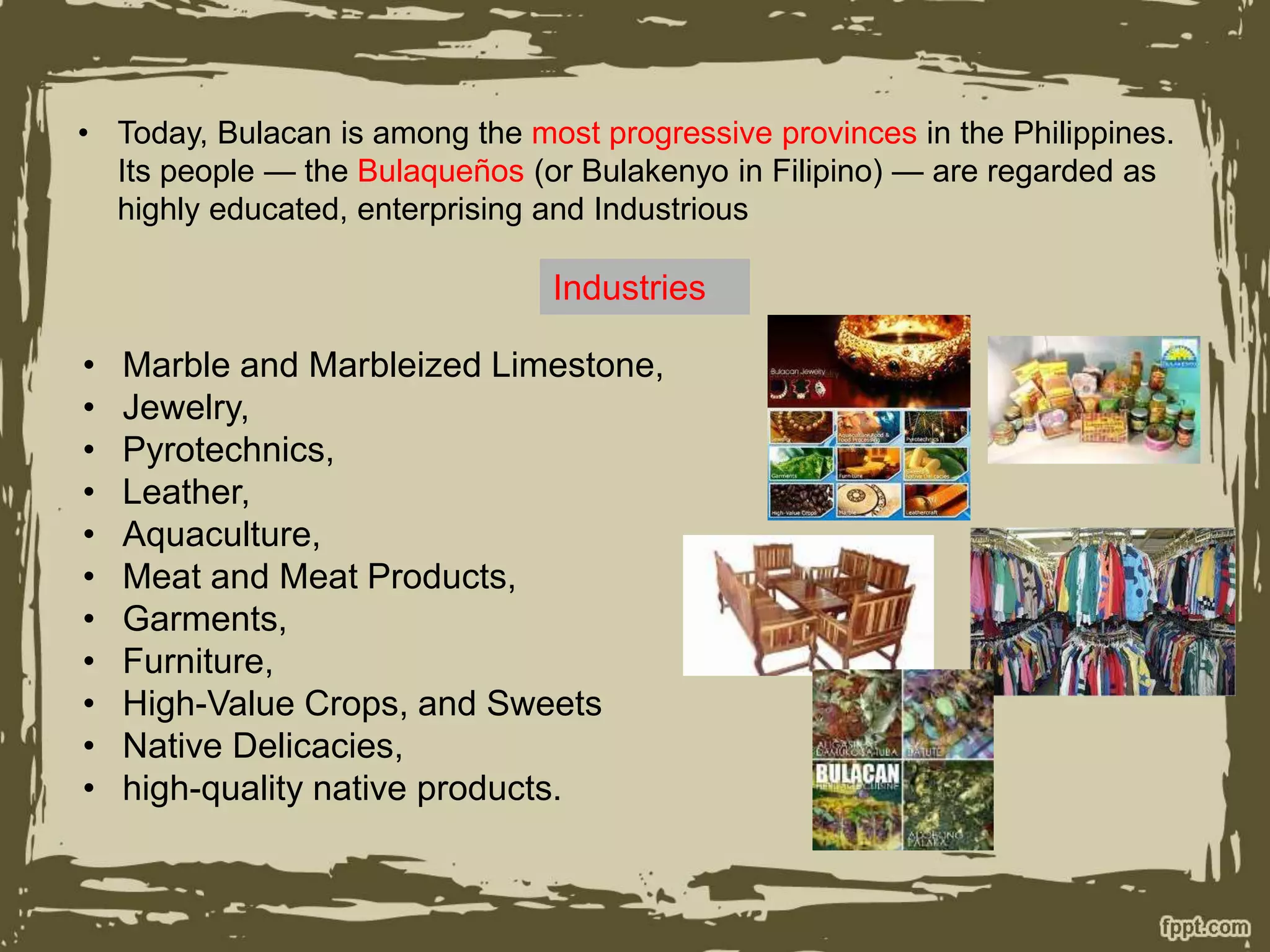
Aurora Festivals
Suman Festival
Held every February
14- February 19 |
Baler, Aurora
Sabutan festival
Date August 24-25
Venue San Luis, Aurora
• highlights the importance of growing palm trees
locally called Sabutan on the community's
economic wellbeing.
• The exclusive art of weaving Sabutan is handed
down from one generation to the other.
• The festival features native dance presentation
among school children, trade fair, cultural shows
and exhibits.
Bataan
• A province of the Philippines
occupying the whole portion of
Bataan Peninsula on Luzon.
• The Battle of Bataan is famous in
history as one of the last stands of
American and Filipino soldiers
before they were overwhelmed by
the Japanese forces in World War II.
• The Bataan Death March was
named for this province, where the
infamous march started. This is also
the location of the Bataan Nuclear
Power Plant located in the
Municipality of Morong.
Bataan’s tourists Attraction
FIRST ABUCAY CATHOLIC CHURCH
MOUNT SAMAT
ZERO KILOMETRE
DEATH
MARCH MARKER
AMBON-AMBON/LIMUTAN FALLS
Bataan’s Festival
The Banga Festival is a week long
event celebrated in the city of Balanga
City, Bataan. It is said that the name
Balanga, came from the word
“banga,” the tagalong term for pot
used in cooking. The festival is
celebrated alongside the feast of St.
Joseph in April 28.
The Pawikan Festival is held yearly at
the Pawikan Conservation Center in
Morong, Bataan. The main activity here
is the releasing of the baby pawikan,
which are hatched in the conservation
center.
Every year, during the festivities, they
invite visitors and thousands of students
from the provinces to promote
awareness and also be treated to some
street dancing, sand sculptures, a
showcase of local products, and
witnessing how the hatchlings go back
to the sea.
Bulacan
• "The Gateway to the Northern Philippines“
• Bulacan prides itself on its rich history. The
province figures prominently in Philippine
history. Many national heroes and political
figures were born in Bulacan.
• The province is honored as one of the 8
rays of the sun in the national flag. It is the
home of the "Three Republics."
• These are the
• Republic of Real de Kakarong de Sili
(1896) in Pandi,
• Republic of Biak-na-Bato (1897) and
• First Philippine Republic in Malolos
(1899–1901).
• Today, Bulacan is among the most progressive provinces in the Philippines.
Its people — the Bulaqueños (or Bulakenyo in Filipino) — are regarded as
highly educated, enterprising and Industrious
Industries
• Marble and Marbleized Limestone,
• Jewelry,
• Pyrotechnics,
• Leather,
• Aquaculture,
• Meat and Meat Products,
• Garments,
• Furniture,
• High-Value Crops, and Sweets
• Native Delicacies,
• high-quality native products.
Bulacan’s Festivals
OBANDO TOWN FIESTA
People participate in the annual
Obando Fertility Dance Festival in
Bulacan Province, the Philippines,
on May 18, 2018. Obando Fertility
Dance Festival is held to honor the
town's patron Saint Clare, and a
chance for newly-wed couples to
pray for fertility through dances on
streets.
PULILAN CARABAO FESTIVAL
Pulilan Carabao Festival is celebrated in May,
and is held in honour of the water buffalos.
These animals are a prized possession in
Philippines.
The water buffalos, locally known as carabao, is
the national animal in the country. Some locals
refer to this animal as the ‘kalabaw’, so do not
be perturbed when you notice variations in the
name of the water buffalo.
Bulacan’s Tourists Attraction
BARASOAIN CHURCH OBANDO CHURCH BIAK-NA-BATO
NATIONAL PARK
Nueva Ecija
• Rice Bowl of the Philippines
• The province is the largest in
Central Luzon.
• Its capital is Palayan City.
• Cry of Nueva Ecija is the
1896 revolutionary battle led
by General Mariano Llanera
Festivals
TAONG PUTIK FESTIVAL
Taong Putik Festival is not just a
merrymaking celebration. It is a religious
ritual called “pag-sa-San Juan” held
every 24th day of June in the town of
Aliaga, Nueva Ecija. It is celebrated to
honor their patron, Saint John the
Baptist.
Nueva Ecija has fulfilled their religious
ritual at Taong Putik Festival 2013. This
year's celebration was another year for
repentance and thanksgiving for the
townsfolk.
KARITON FESTIVAL
celebrated during the annual
celebration of the founding
anniversary of Licab town on March
28
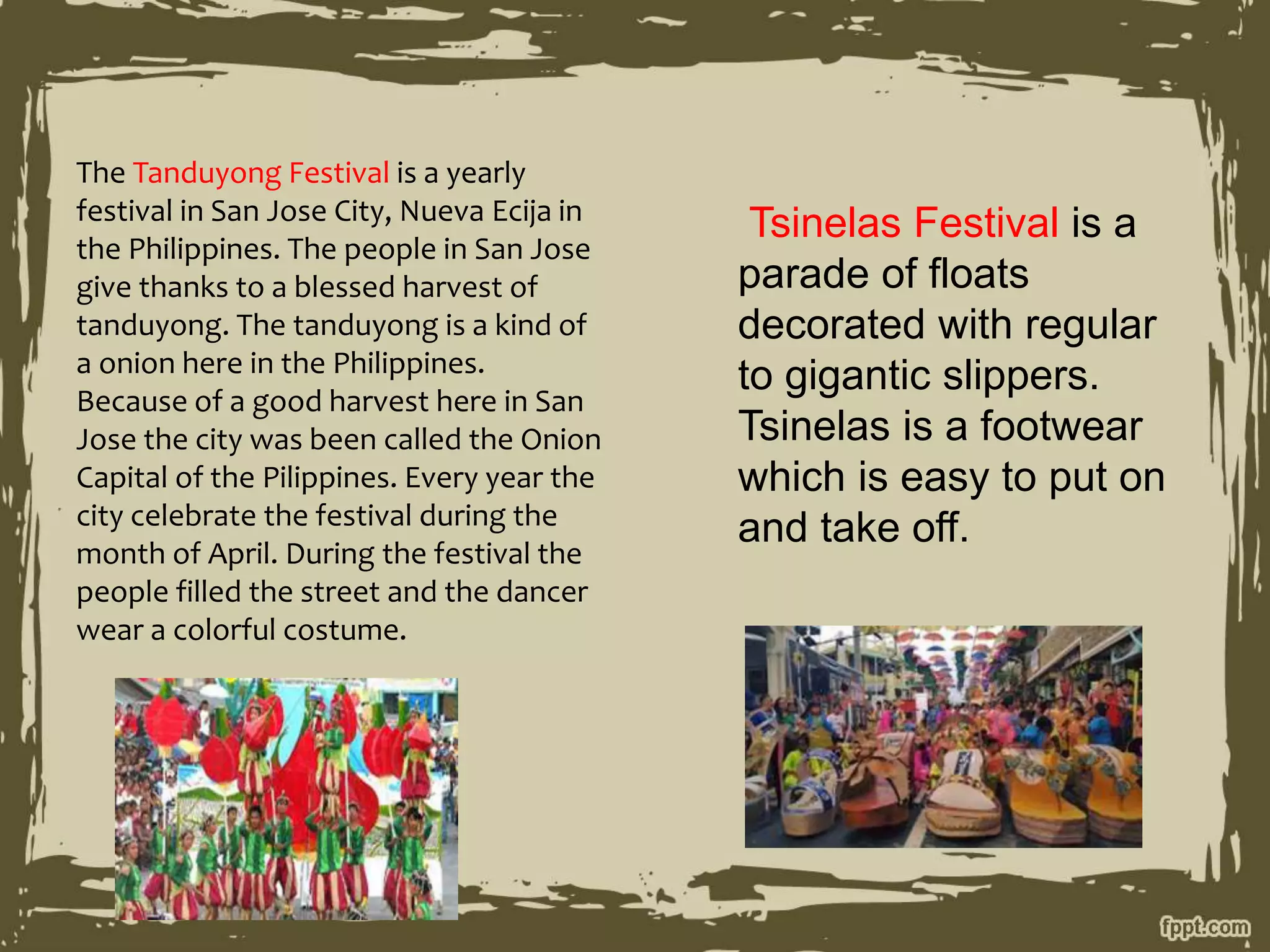
The Tanduyong Festival is a yearly
festival in San Jose City, Nueva Ecija in
the Philippines. The people in San Jose
give thanks to a blessed harvest of
tanduyong. The tanduyong is a kind of
a onion here in the Philippines.
Because of a good harvest here in San
Jose the city was been called the Onion
Capital of the Pilippines. Every year the
city celebrate the festival during the
month of April. During the festival the
people filled the street and the dancer
wear a colorful costume.
Tsinelas Festival is a
parade of floats
decorated with regular
to gigantic slippers.
Tsinelas is a footwear
which is easy to put on
and take off.
Pampanga
• “Culinary Capital of the
Philippines”
. Its capital is the City of San
Fernando.
•The word pampang, from which the
province's name originates, means
river bank.
The province is home to two
Philippine Air Force air bases,
Basa Air Base in Floridabalanca,
Clark Air Base.
FORT STOTSENBURG
Pampanga’s Tourists Attractions
MT. PINATUBO CRATER SKY RANCH
Festivals in Pampanga
Cutud Lenten Rites Giant Lantern FestivalHot Air Balloon Festival
Sisig Betute and Camaru Buro or Balo-Balo
Murcon
Tocino
Pancit Palabok
Tarlac
• “Melting Pot Of Central Luzon”
and “Sugar Capital of Luzon”
• The province is situated at the
center of the central plains of
Luzon, landlocked by four
provinces:
• Pampanga on the south,
• Nueva Ecija on the east,
• Pangasinan on the north, and
• Zambales on the west.
Malatarlak Festival,
The Malatarlak Festival takes its
name from the a variety of grass
that is native to the Luzon area.
Zambales
• Zambales is the second largest
among the seven provinces of
Central Luzon. The province is
noted for its mangoes, which are
abundant from January to April
•Zambales is served by the Subic
Bay International Airport
• The province's name came from
the word zambal, which is a
Hispanized term for Sambali.
• Zambales Day is celebrated every
August 30.
Beliefs and Practices of Region III
Birth Practices. In one of the
barrios of Guagua, Pampanga,
close relatives of a woman who is
about to deliver a child, together
with their neighbor, make noise like
shouting, beating tin cans and
exploding firecrackers in order to
help expel the fetus faster.
Baptismal Rites
Practices. In many
Kapampangan houses, the
baby’s baptismal dress
serves as a souvenir and
decoration for the sala. It
is put on a frame and hung
in the sala like a picture.
Courtship and Marriage. The only
prevalent form of courtship now is
the pamanhikan. At
present, pamanhikan is being
practiced when the parents of the boy
confer with their balae (parent of the
bride-to-be) regarding marriage plans
of the children.
Death and Burial. The wake
(makipaglame) lasts for at least
three days and two nights after
which everybody participates in
the libing (interment).
Region III Central Luzon

Region III Central Luzon

  • 1.
    Region III CentralLuzon Prepared by: April Joy E. Tamayo
  • 2.
    • Central LuzonRegion is located north of Manila, the nation's capital. • Also nicknamed Rice Grannary of the Philippines because it produces most of the country’s dining staple: RICE • It composed of seven provinces : – 1.Aurora – 2. Bataan – 3. Bulacan – 4. Nueva ecija – 5. Zambales – 6. Pampangga – 7. Tarlac • 14 cities, 116 municipalities, and 3,102 barangays.
  • 3.
    • Dialects 1. Tagalog 2.Iloko 3.Kapampangan 4.Zambaleno • The City of San Fernando, in Pampanga, is the regional center.
  • 4.
    Aurora • Nickname(s) "Landof the Golden Sunrise” and "Gate way to the Pacific” • A province of the Philippines located in the eastern part of Central Luzon region, facing the Philippine Sea. • Its capital is Baler • Before 1979, Aurora was part of the province of Quezon. Aurora was, in fact, named after Aurora Aragon, the wife of Pres. Manuel L. Quezon, the president of the Philippine Commonwealth, after whom the mother province was named.
  • 5.
    Aurora • CORN CROPS• RICE CROPS Economy
  • 6.
    Tourists Attractions • BALERBAY (SABANG BEACH) – a good place for surfing. • Dicasalarin Cove Cunayan Falls
  • 7.
    Aurora Festivals Suman Festival Heldevery February 14- February 19 | Baler, Aurora Sabutan festival Date August 24-25 Venue San Luis, Aurora • highlights the importance of growing palm trees locally called Sabutan on the community's economic wellbeing. • The exclusive art of weaving Sabutan is handed down from one generation to the other. • The festival features native dance presentation among school children, trade fair, cultural shows and exhibits.
  • 8.
    Bataan • A provinceof the Philippines occupying the whole portion of Bataan Peninsula on Luzon. • The Battle of Bataan is famous in history as one of the last stands of American and Filipino soldiers before they were overwhelmed by the Japanese forces in World War II. • The Bataan Death March was named for this province, where the infamous march started. This is also the location of the Bataan Nuclear Power Plant located in the Municipality of Morong.
  • 9.
    Bataan’s tourists Attraction FIRSTABUCAY CATHOLIC CHURCH MOUNT SAMAT ZERO KILOMETRE DEATH MARCH MARKER AMBON-AMBON/LIMUTAN FALLS
  • 10.
    Bataan’s Festival The BangaFestival is a week long event celebrated in the city of Balanga City, Bataan. It is said that the name Balanga, came from the word “banga,” the tagalong term for pot used in cooking. The festival is celebrated alongside the feast of St. Joseph in April 28. The Pawikan Festival is held yearly at the Pawikan Conservation Center in Morong, Bataan. The main activity here is the releasing of the baby pawikan, which are hatched in the conservation center. Every year, during the festivities, they invite visitors and thousands of students from the provinces to promote awareness and also be treated to some street dancing, sand sculptures, a showcase of local products, and witnessing how the hatchlings go back to the sea.
  • 11.
    Bulacan • "The Gatewayto the Northern Philippines“ • Bulacan prides itself on its rich history. The province figures prominently in Philippine history. Many national heroes and political figures were born in Bulacan. • The province is honored as one of the 8 rays of the sun in the national flag. It is the home of the "Three Republics." • These are the • Republic of Real de Kakarong de Sili (1896) in Pandi, • Republic of Biak-na-Bato (1897) and • First Philippine Republic in Malolos (1899–1901).
  • 12.
    • Today, Bulacanis among the most progressive provinces in the Philippines. Its people — the Bulaqueños (or Bulakenyo in Filipino) — are regarded as highly educated, enterprising and Industrious Industries • Marble and Marbleized Limestone, • Jewelry, • Pyrotechnics, • Leather, • Aquaculture, • Meat and Meat Products, • Garments, • Furniture, • High-Value Crops, and Sweets • Native Delicacies, • high-quality native products.
  • 13.
    Bulacan’s Festivals OBANDO TOWNFIESTA People participate in the annual Obando Fertility Dance Festival in Bulacan Province, the Philippines, on May 18, 2018. Obando Fertility Dance Festival is held to honor the town's patron Saint Clare, and a chance for newly-wed couples to pray for fertility through dances on streets. PULILAN CARABAO FESTIVAL Pulilan Carabao Festival is celebrated in May, and is held in honour of the water buffalos. These animals are a prized possession in Philippines. The water buffalos, locally known as carabao, is the national animal in the country. Some locals refer to this animal as the ‘kalabaw’, so do not be perturbed when you notice variations in the name of the water buffalo.
  • 14.
    Bulacan’s Tourists Attraction BARASOAINCHURCH OBANDO CHURCH BIAK-NA-BATO NATIONAL PARK
  • 15.
    Nueva Ecija • RiceBowl of the Philippines • The province is the largest in Central Luzon. • Its capital is Palayan City. • Cry of Nueva Ecija is the 1896 revolutionary battle led by General Mariano Llanera
  • 16.
    Festivals TAONG PUTIK FESTIVAL TaongPutik Festival is not just a merrymaking celebration. It is a religious ritual called “pag-sa-San Juan” held every 24th day of June in the town of Aliaga, Nueva Ecija. It is celebrated to honor their patron, Saint John the Baptist. Nueva Ecija has fulfilled their religious ritual at Taong Putik Festival 2013. This year's celebration was another year for repentance and thanksgiving for the townsfolk. KARITON FESTIVAL celebrated during the annual celebration of the founding anniversary of Licab town on March 28
  • 17.
    The Tanduyong Festivalis a yearly festival in San Jose City, Nueva Ecija in the Philippines. The people in San Jose give thanks to a blessed harvest of tanduyong. The tanduyong is a kind of a onion here in the Philippines. Because of a good harvest here in San Jose the city was been called the Onion Capital of the Pilippines. Every year the city celebrate the festival during the month of April. During the festival the people filled the street and the dancer wear a colorful costume. Tsinelas Festival is a parade of floats decorated with regular to gigantic slippers. Tsinelas is a footwear which is easy to put on and take off.
  • 18.
    Pampanga • “Culinary Capitalof the Philippines” . Its capital is the City of San Fernando. •The word pampang, from which the province's name originates, means river bank. The province is home to two Philippine Air Force air bases, Basa Air Base in Floridabalanca, Clark Air Base.
  • 19.
    FORT STOTSENBURG Pampanga’s TouristsAttractions MT. PINATUBO CRATER SKY RANCH
  • 20.
    Festivals in Pampanga CutudLenten Rites Giant Lantern FestivalHot Air Balloon Festival
  • 21.
    Sisig Betute andCamaru Buro or Balo-Balo Murcon Tocino Pancit Palabok
  • 22.
    Tarlac • “Melting PotOf Central Luzon” and “Sugar Capital of Luzon” • The province is situated at the center of the central plains of Luzon, landlocked by four provinces: • Pampanga on the south, • Nueva Ecija on the east, • Pangasinan on the north, and • Zambales on the west.
  • 23.
    Malatarlak Festival, The MalatarlakFestival takes its name from the a variety of grass that is native to the Luzon area.
  • 24.
    Zambales • Zambales isthe second largest among the seven provinces of Central Luzon. The province is noted for its mangoes, which are abundant from January to April •Zambales is served by the Subic Bay International Airport • The province's name came from the word zambal, which is a Hispanized term for Sambali. • Zambales Day is celebrated every August 30.
  • 25.
    Beliefs and Practicesof Region III Birth Practices. In one of the barrios of Guagua, Pampanga, close relatives of a woman who is about to deliver a child, together with their neighbor, make noise like shouting, beating tin cans and exploding firecrackers in order to help expel the fetus faster. Baptismal Rites Practices. In many Kapampangan houses, the baby’s baptismal dress serves as a souvenir and decoration for the sala. It is put on a frame and hung in the sala like a picture. Courtship and Marriage. The only prevalent form of courtship now is the pamanhikan. At present, pamanhikan is being practiced when the parents of the boy confer with their balae (parent of the bride-to-be) regarding marriage plans of the children. Death and Burial. The wake (makipaglame) lasts for at least three days and two nights after which everybody participates in the libing (interment).