Regio III – Central Luzon
Group 6
Introduction
Known as the:
• FERTILE CENTRAL PLAINS
• RICE BASKET OF THE
PHILIPPINES
It is called as such
because it produces most of the
country’s dining staple: rice. The
abundance of rice and vegetables
make their cuisines, delectable and
superb, from the Kapangpangan
biringhe and sisig to Bulacan
sweets.
History
• One of the earliest areas converted to Christianity through
conqueror, Hernando Magallanes for 50 years after he stepped on
the Philippine soil.
• The region produced the most noble fighters and heroes in the
history of the Philippines, who fought for freedom against the
oppressors.
• The presence of medieval churches made the region a witness of a
dramatic history:
• BALER (a 17th
century building) - the LAST Spanish bastion
in the Philippines
• Barasoain Church in Bulacan – made from adobe and
lime; it witnessed the signing of the Fist Philippine Republic
and the first democratic constitution in Asia.
Barasoai
n Church
Baler
A filipino movie
casted by Anne
Curtis, (a Filipina)
and Jericho
Rosales, (a
Spanish soldier
who fell in love
with a Filipina)
• Culture here is number one and there are incredible fiestas that
reflect each town’s distinct culture, from the Giant Lantern
Parade in San Fernando, Pampanga, to the Fertility Rites in
Obando, Bulacan.
• For stunning nature, the province of Aurora has a stunning
328-kilometer coastline where beach and surf rule. In San
Jose, Tarlac, right before the Monastario de Tarlac,
experience whitewater kayaking in Bulsa river! Mt.
Pinatubo, which straddles Pampanga, Zambales, and Tarlac is
quite a sight, especially when you get to the neon-blue caldera
lake via Sta. Juliana, Capas, Tarlac.
Whatever you’re looking for, whether it’s a
one-day food trip or several days of
adventure, head for Central Luzon. It’s
closer than you think!
NaturalNatural
ResourcesResources
NaturalNatural
ResourcesResources
It produces
one third
of the
country’s rice
supply
Forty one percent of the region’s total
land area is devoted to agricultural
purposes with rice as the major crop.
Other products
produced by the
region
Forestland comprises 23% of
its land area.
• Central Luzon is rich in both timber
and mineral resources.
• Both metallic and non- metallic
resources are found in the region.
Aurora is
known for its
timber
Zambales
for its
refractory
chromite,
copper and
nickel
deposits
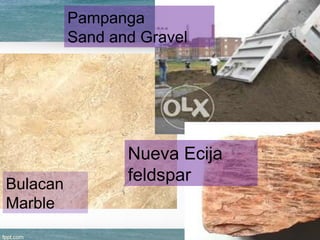
Bulacan
Marble
Pampanga
Sand and Gravel
Nueva Ecija
feldspar
Tarlac - Manganese
Melon
patches
and
fishponds
can also
be found
along
rivers and
tributaries.
It has rich
marine
resources
and accounts
for the third
largest
aquaculture
production in
the
Philippines.
Mount Pinatubo is a 1485 meters high volcano localized at the
borders of 3 provinces: Pampanga, Tarlac, and Zambales.
The last eruption of the volcano happened in 1991.
To visit it’s turquoise crater lake you will have to trek 3 hours to
reach it. It’s also possible to a sky tour if you prefer to see the
volcano from the air.
Anawangin is a pristine beach cove in the Zambales
province.The best option is to spend an overnight there.
Camping is allowed.
Subic is a famous diving spot for wrecks. Subic
was a former US naval base and is easily
accessible from Manila by Public transportation.
Zoobic is a park in Subic where you can
watch exotic wildlife, as tigers, or crocodiles.
If you’re into surfing don’t miss Baler. This spot
has some huge waves especially during the
monsoon.
Mount Samat in the province of Bataan is a popular trek for
veterans as it has a shrine on its summit to remember the
soldiers who died died during the second world war.
Capones Island can be reached from Pundaquit Zambales.
You need two days to complete this adventure.
This festival happens every December in San
fernando, Pampanga . People will parade
some giant lanterns all over the town . A great
event for photographers.
Bulacan prpovince has several interesting
caves including Biak na Bato, the most famous.
Each February , Clark hosts the hot air Balloons
Festival.

REGION 3 - ANNE

  • 1.
    Regio III –Central Luzon Group 6
  • 3.
    Introduction Known as the: •FERTILE CENTRAL PLAINS • RICE BASKET OF THE PHILIPPINES It is called as such because it produces most of the country’s dining staple: rice. The abundance of rice and vegetables make their cuisines, delectable and superb, from the Kapangpangan biringhe and sisig to Bulacan sweets.
  • 5.
    History • One ofthe earliest areas converted to Christianity through conqueror, Hernando Magallanes for 50 years after he stepped on the Philippine soil. • The region produced the most noble fighters and heroes in the history of the Philippines, who fought for freedom against the oppressors. • The presence of medieval churches made the region a witness of a dramatic history: • BALER (a 17th century building) - the LAST Spanish bastion in the Philippines • Barasoain Church in Bulacan – made from adobe and lime; it witnessed the signing of the Fist Philippine Republic and the first democratic constitution in Asia.
  • 6.
    Barasoai n Church Baler A filipinomovie casted by Anne Curtis, (a Filipina) and Jericho Rosales, (a Spanish soldier who fell in love with a Filipina)
  • 7.
    • Culture hereis number one and there are incredible fiestas that reflect each town’s distinct culture, from the Giant Lantern Parade in San Fernando, Pampanga, to the Fertility Rites in Obando, Bulacan. • For stunning nature, the province of Aurora has a stunning 328-kilometer coastline where beach and surf rule. In San Jose, Tarlac, right before the Monastario de Tarlac, experience whitewater kayaking in Bulsa river! Mt. Pinatubo, which straddles Pampanga, Zambales, and Tarlac is quite a sight, especially when you get to the neon-blue caldera lake via Sta. Juliana, Capas, Tarlac.
  • 8.
    Whatever you’re lookingfor, whether it’s a one-day food trip or several days of adventure, head for Central Luzon. It’s closer than you think!
  • 12.
  • 13.
    It produces one third ofthe country’s rice supply Forty one percent of the region’s total land area is devoted to agricultural purposes with rice as the major crop.
  • 14.
  • 15.
    Forestland comprises 23%of its land area. • Central Luzon is rich in both timber and mineral resources. • Both metallic and non- metallic resources are found in the region.
  • 16.
  • 17.
  • 18.
  • 19.
  • 20.
  • 21.
    It has rich marine resources andaccounts for the third largest aquaculture production in the Philippines.
  • 23.
    Mount Pinatubo isa 1485 meters high volcano localized at the borders of 3 provinces: Pampanga, Tarlac, and Zambales. The last eruption of the volcano happened in 1991. To visit it’s turquoise crater lake you will have to trek 3 hours to reach it. It’s also possible to a sky tour if you prefer to see the volcano from the air.
  • 24.
    Anawangin is apristine beach cove in the Zambales province.The best option is to spend an overnight there. Camping is allowed.
  • 25.
    Subic is afamous diving spot for wrecks. Subic was a former US naval base and is easily accessible from Manila by Public transportation.
  • 26.
    Zoobic is apark in Subic where you can watch exotic wildlife, as tigers, or crocodiles.
  • 27.
    If you’re intosurfing don’t miss Baler. This spot has some huge waves especially during the monsoon.
  • 28.
    Mount Samat inthe province of Bataan is a popular trek for veterans as it has a shrine on its summit to remember the soldiers who died died during the second world war.
  • 29.
    Capones Island canbe reached from Pundaquit Zambales. You need two days to complete this adventure.
  • 30.
    This festival happensevery December in San fernando, Pampanga . People will parade some giant lanterns all over the town . A great event for photographers.
  • 31.
    Bulacan prpovince hasseveral interesting caves including Biak na Bato, the most famous.
  • 32.
    Each February ,Clark hosts the hot air Balloons Festival.