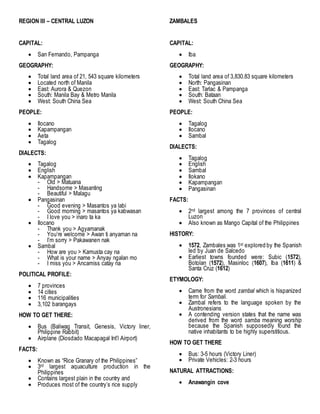

REGION III – CENTRAL LUZON
CAPITAL:
 San Fernando, Pampanga
GEOGRAPHY:
 Total land area of 21, 543 square kilometers
 Located north of Manila
 East: Aurora & Quezon
 South: Manila Bay & Metro Manila
 West: South China Sea
PEOPLE:
 Ilocano
 Kapampangan
 Aeta
 Tagalog
DIALECTS:
 Tagalog
 English
 Kapampangan
- Old > Matuana
- Handsome > Masanting
- Beautiful > Malagu
 Pangasinan
- Good evening > Masantos ya labi
- Good morning > masantos ya kabwasan
- I love you > inaro ta ka
 Ilocano
- Thank you > Agyamanak
- You’re welcome > Awan ti anyaman na
- I’m sorry > Pakawanen nak
 Sambal
- How are you > Kamusta cay na
- What is your name > Anyay ngalan mo
- I miss you > Ancamiss catay na
POLITICAL PROFILE:
 7 provinces
 14 cities
 116 municipalities
 3,102 barangays
HOW TO GET THERE:
 Bus (Baliwag Transit, Genesis, Victory liner,
Philippine Rabbit)
 Airplane (Diosdado Macapagal Int’l Airport)
FACTS:
 Known as “Rice Granary of the Philippines”
 3rd largest aquaculture production in the
Philippines
 Contains largest plain in the country and
 Produces most of the country’s rice supply
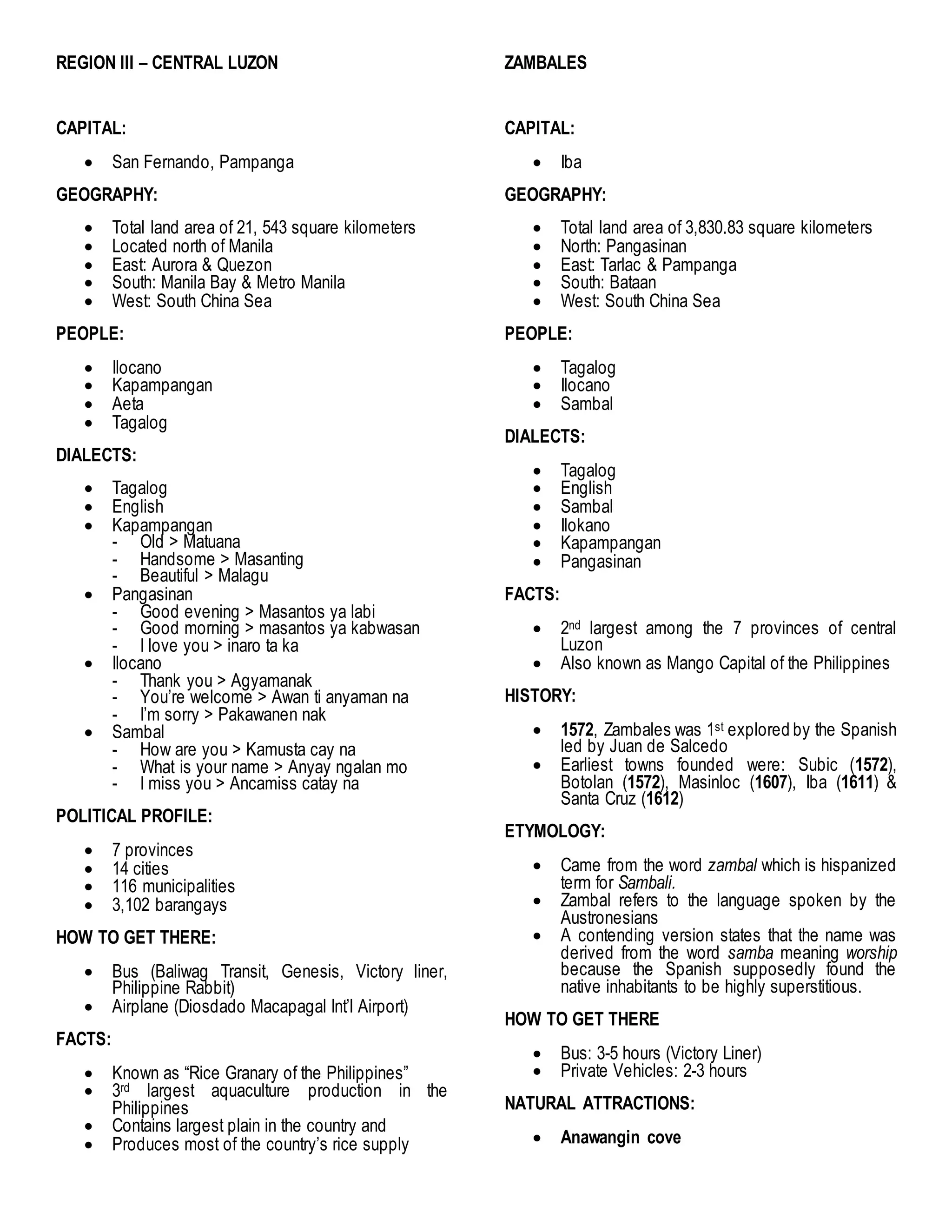
ZAMBALES
CAPITAL:
 Iba
GEOGRAPHY:
 Total land area of 3,830.83 square kilometers
 North: Pangasinan
 East: Tarlac & Pampanga
 South: Bataan
 West: South China Sea
PEOPLE:
 Tagalog
 Ilocano
 Sambal
DIALECTS:
 Tagalog
 English
 Sambal
 Ilokano
 Kapampangan
 Pangasinan
FACTS:
 2nd largest among the 7 provinces of central
Luzon
 Also known as Mango Capital of the Philippines
HISTORY:
 1572, Zambales was 1st explored by the Spanish
led by Juan de Salcedo
 Earliest towns founded were: Subic (1572),
Botolan (1572), Masinloc (1607), Iba (1611) &
Santa Cruz (1612)
ETYMOLOGY:
 Came from the word zambal which is hispanized
term for Sambali.
 Zambal refers to the language spoken by the
Austronesians
 A contending version states that the name was
derived from the word samba meaning worship
because the Spanish supposedly found the
native inhabitants to be highly superstitious.
HOW TO GET THERE
 Bus: 3-5 hours (Victory Liner)
 Private Vehicles: 2-3 hours
NATURAL ATTRACTIONS:
 Anawangin cove
- Cresented shaped cove with a pristine white
sand beach
- What make the place unique are the unusual
tall pine trees.
- The most surprising phenomenon which has
occurred in the past years was the growth of
the pine trees.
- The seed were brought there by the
memorable eruption of Mount Pinatubo
together with the ash fall.
 Potipot Island
- Located on Candelaria, Zambales
- Potipot Island literally mean “small white
island”
- The gentle breeze and warm placid waters of
the South China Sea welcome travelers to
this charming and peaceful little tropical
island.
- If the weather is just right, dolphins will honor
you with their presence.
- It is the nearest island from mainland
Zambales.
 Mt. Pinatubo
- Located in Botolan, Zambales
- Is an active stratovolcano
- Before the eruption in 1991, it was 5,725
ft. and now the current height is 4,875 ft.
- June 15, 1991 the eruption of Mt.
Pinatubo was the 2nd largest volcanic
eruption of the 20th century and by far
the largest eruption to affect densely
populated area.
- The eruption produced high-speed
avalanches of hot ash and gas, giant
mud-flows and a cloud of volcanic ash
hundreds of miles across.
MAN-MADE ATTRACTIONS:
 Capones Light House
- Located in San Antonio, Zambales
- Also known as Faro de Punta Capone’s
- Lighthouse guides ships entering or
leaving port of manila as well as the
Military station at Subic Bay.
- It functions as the main navigation guide
for ships heading towards the China Sea.
 Philippine Merchant Marine Academy
- Located in San Narciso, Zambales
- It is globally known for quality and good
performance with standards of
management and training.
- It is reputed to be the best marine
teaching institution not only from its
military-style leadership training but also
from its stringent application process
which cuts down thousands of applicant
to just 250 students every year.
 San Agustin Church
- Located in Iba, Zambales
- It is one of the cultural heritage churches
in the country because of a polychrome
portal leading to the choir loft.
- Oldest parish church in the province
- It is approximately 400 years old.
- The church was built with coral stones
by Augustinian Recollects.
FESTIVALS:
 Paynauen ‘Duyan’ Festival
- April 25 to May 1
- Provincial capital’s founding anniversary
 Zambales Mango Festival
- April
- Celebrating of a bountiful harvest of
mangoes and other agricultural products
which the province is so known for.
 Binabayani
- Held every November 30
- Zambales version of ati-atihan
- War dance between Christians and
Aetas.
- Performed on the feast day of San
Andres, patron of the town of Masinloc
CUISINES:
 Ginipang
- Native delicacy of the northernmost town
of Zambales.
- Made of dried rice grains with a unique
sweet taste
 Linga
- Sesame candies
 Pastillas
- Made from fresh carabao milk
ACTIVITIES:
 Trekking
 Island hopping
 Surfing at crystal beach resort
 Hike
 Scuba diving
FLORA & FAUNA:
 Tristaniopsis Decorticata
- Endemic in the Philippines
- Considered as critically endangered
 Flame-breasted fruit dove
- Also endemic in the country
- Its natural habitats are subtropical or
tropical moist forest
- Endangered specie
 Philippine Eagle-owl
- Locally known as “kuwago” or “bukao”
- Length of 16-20 inches and wing length
of about 35 cm
- It is the largest owl in the Philippines
- Lays one egg
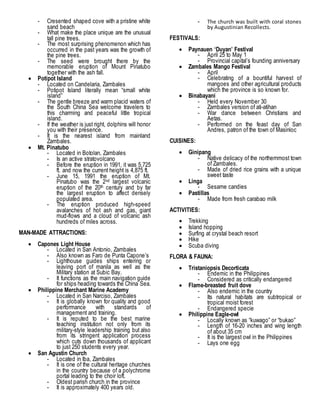
AURORA
CAPITAL:
 Baler
GEOGRAPHY:
 Total land area of 3,147.32 square kilometers
 South: Quezon
 Southwest: Bulacan
 West: Nueva Ecija
 East: Philippine Sea
 North: Isabela & Quirino
 Northwest: Nueva Viscaya
PEOPLE:
 Tagalog
 Ilocano
 Kapampangan
 Bicolano
 Kasigurahin
 Kankanaey
 Dumagats or Negritos
DIALECT:
 Tagalog
 English
 Ilocano
 Pangasinan
 Kapampangan
FACTS:
 Known as “Gateway to the Pacific”
 Baler is the oldestmunicipality
 Aurora is the only Philippine province named
after a first lady
 Baler bay is the bestsurfing place with 9 ft high
waves
HISTORY:
 1572 the Spanish explorer, Juan de Salcedo
became the first European to visitthe region
 1579 the first Franciscan to reach the eastern
coastal region ofthe Sierra Madre was Fray
Ortiz.
 1609 the earliestmissionaries in the province
were the Franciscan, who had established
missions in Casiguran and Baler.
 1658 due to lack of available personel, the region
was given to the jurisdiction of the Agustinians
and Recollects
 1703 it was returned to the Friars Minor
 1719 mission of Dipaculao was established
 1753 mission of Casiguran
 1951 Aurora became sub-province of Quezon
 August 13, 1979 Aurora with its capital Baler
was founded by Ferdinand Marcos.
ETYMOLOGY:
 The province was named in honor of Aurora
Quezon, wife of former president Manuel
Quezon.
 Aurora itself is the latin word for dawn.
HOW TO GET THERE
 By bus: 6 hours (Genesis)
NATURAL ATTRACTIONS:
 Discalarin Cove
- Located in Discalarin, San Luis
- One of Baler’s hidden attraction
- The secluded white sand beach where
the foothills of Sierra Madre meets the
wave of Pacific Ocean.
- The cove is actually privately-owned by
Sen. Angara
- It has a mini pool located at the left side
of the cove
 Dinadiawan Beach
- Located along Dicadi highway
- One of the most beautiful beaches in
Aurora with a fabulous view of the Pacific
Ocean, diverse forest of the Sierra
Madre Mountain Range.
- It is a resort-free.
 Ditumabo Falls
- Located in Barangay Ditumabo, San Luis
- Approximately 140 ft.
- The crystal clear water of Ditumabo falls
gushes endlessly, flowing and twisting
among countless rocks and boulders.
MAN-MADE ATTRACTIONS:
 Ermita Hill
- Located in Casiguran
- Provides an enchanting view ofthe entire
Poblacion, the dark blue coast of
Casiguran Bay and the barrios nearby.
- Ermita Hill is known as a sacred haven
for religious activities by devotees of
Miraculous Mother Mary
 Baler Catholic Church
- An old church with a simple façade.
- Located in Poblacion, Baler
- This is where the La Campana de Baler,
an ancient bell, was used and later
stored as a relic
 Quezon House
- It was once vacation home of MLQ
- Located in Barangay Cemento, Baler
- Today, only the foundation and a cement
staircase remain.
- The house was destroyed by a typhoon.
FESTIVALS:
 Aurora Foundation Day
- Held every February 14-19
- The most awaited event during the
celebration is the so-called Karansa, a
street dancing competition where the
concept of cooperation.
 Sabutan Festival
- Celebrated every August 24-25
- Its highlight is the importance of growing
palm trees locally called sabutan on the
community’s economic well-being
 Suman Festival
- Celebrated every February 19
- The biggest and grandest of all feasts in
Aurora.
- Main streets and homes are decked with
suman
CUISINES:
 Baler Suman
- As big as a finger but a little bit longer
- It cost 5 pesos per piece
- It comes into 2 versions – the basic white
and the ube-colored
 Ensaladang Pako
- Main ingredients are fiddlehead fern or
pako, tomatoes and salted egg
ACTIVITIES:
 Surfing
 Watching sunrise
 Swimming
 Go inside the 600 year old balete tree
TARLAC
CAPITAL:
 Tarlac City
GEOGRAPHY:
 Total land area of 3,053.60 square kilometers
 South: Pampanga
 East: Nueva Ecija
 North: Pangasinan
 West: Zambales
PEOPLE:
 Ilocano
 Kapampangan
 Tagalog
DIALECTS:
 Ilocano
 English
 Tagalog
 Kapampangan
 Pangasinan
FACTS:
 Known as “Melting Pot of Central Luzon” and
“Sugar Capital of Luzon”
 Most multicultural of the central Luzon
 Known for its fine foods, vast sugar and rice
plantations
HISTORY:
 1896 Tarlac was among the first eight provinces
to rise against Spain.
 March 1899 it became the new seat of the first
Philippine Republic when Gen. Emilio Jacinto
abandoned the former capital, Malolos, Bulacan.
 November 1899 Tarlac was captured by
American forces.
 1901 a civil government was established in the
province.
 April 9, 1942 during WWII, Camp O’Donnell in
Capas became the terminal point of the infamous
Bataan death march of Filipino and American
soldiers who surrendered at Bataan.
 1942-1946 the general headquarters of the
Philippine Commonwealth Army was established.
 Early 1950s Tarlac became a hotbed for the
hukbalahap, a local communist movement
headed by Benigno Aquino Sr., father of the late
Ninoy Aquino.
ETYMOLOGY:
 Hispanicized rendering of tarlak, Aeta term for a
certain grass related to talahib and tanglar
(Zamabal for lemongrass).
 The area around the current capital city, after
which the province was named, was described
as matarlak, an adjective meaning “abundant
with tarlak grass.”
HOW TO GET THERE:
 By bus: 2-5 hours (Five Star, Victory Liner,
Baliwag Transit & Genesis)
MAN-MADE ATTRACTIONS:
 Capas National Shrine
- it was once a concentration camp
subsequently serving as the burial
grounds for thousands of Filipino and
American soldiers who perished during
WWII.
- The site was the ultimate destination
point of the infamous death march
involving Filipino and American soldiers
who surrendered in Bataan on April 9,
1942.
 Capas Death March Monument
- Serves as a marker of the legendary
concentration camp where nearly 30,000
Filipino and American soldiers who
participated in the death march.
 Hacienda Luisita
- The Cojuangco-owned hacienda in
Tarlac city houses the Tarlac Industrial
Park where a growing list of international
export producing companies is located.
- It boasts ofan 18-hole championship golf
course, shopping malls, world-class
restaurants, hotels, a Beverly-hill – type
of residential estate and a vast sugar
plantation.
- Also located in the complex is the Aquino
Center and Museum.
 Maria Clara Museum
- Also known as Leonor Rivera-Kipping
house
- Located in Camiling, Tarlac
- Preserved and displayed in this museum
are the priceless momentus of Leonor
Rivera, the sweetheart of Jose Rizal
- Leonor Rivera is immortalized as the
heroin Maria Clara in the novel of Rizal.
 Bamban Park
- The park was carved along the hilly area
near the national highway in Tarlac and
is quite visible from the road with its
imposing grotto of Virgin Mary.
- It is a 100-step stairway before reaching
the grotto.
FESTIVALS:
 Belenismo Festival
- It is a belen making contest which is
participated by establishments and
residents in Tarlac.
- Giant versions of the belen with different
themes are displayed in front of the
establishments and roads of Tarlac for
the rest of Christmas season.
 Melting Pot Festival
- Former title “Balik Sigla Festival”
- Held every January 19-20
- A festival featuring street party, float
parade, beauty pageant, singing
competition, boxing competition and
grand ballroom
 Anao Town Festival
- Celebrates every March 14-16
- Founding anniversary of the town of
Anao
CUISINES:
 Iniruban
- Or nilubyan
- Famous Tarlac delicacy originating from
the town of Camiling.
- Type of rice cake made with burned
young sticky rice, coconut milk and
sweetener.
 Tupig
- Famous local delicacy of Tarlac and
Pangasinan.
- Consist of coconut milk, glutinous rice
flour, coconut milk and sweetener.
- What gives tupig a distinct flavor is the
bnana wrapper and the way which it’s
cooked.
- Grilled over the charcoal or clay oven
kugon
 Chicharon Camiling
- Popularly known as bagnet, is a deep
fried pork belly.
- Combination of a locally made fish sauce
called bagoong.
ACTIVITIES:
 Hiking
 Camping
 Trekking
 Golf
BATAAN
CAPITAL:
 Balanga City
GEOGRAPHY:
 Total land area of 1,372.98 square kilometers
 North: Pampanga & Zambales
 East & South: Manila Bay
 West: South China Sea
PEOPLE:
 Tagalong
 Kapampangan
 Ilocano
DIALECT:
 Tagalong
 English
 Kapampangan
 Ilocano
FACTS:
 Where large turnips or singkamas are found
 They export cashew to Antipolo
 They have unusual flavors of ice cream like: gabi,
caimito, aratilis and chesa.
 Also known as historical hub of central Luzon
HISTORY:
 1572 Bataan was explored by Juan de Salcedo
 1754 the province was established by Gov.-Gen.
Pedro Manuel Arianda from 8 towns of
Pampanga and 3 towns from the Corregimiento
of Maragadoni in Cavite.
 December 1, 1896 Bataan joined the revolution
 April 9, 1942 Death March
- From Mariveles, Bataan to San
Fernando, Pampanga, from San San
Fernando prisoners were loaded in a
train and brought in Camp O’Donnell in
Capas, Tarlac
- 60,000 to 80,000 Filipino and American
soldiers
ETYMOLOGY:
 The current name “Bataán” (spoken with
emphasis on the last syllable) was first used
upon the establishment of the province in 1754
 “Batáan” (with emphasis on the second syllable)
itself can mean “servant” or “place of suffering”.
In tagalog, from the verb batâ meaning “to
tolerate” or “to suffer”
HOW TO GET THERE
 By bus: 3 hours (Genesis, Victory Liner and
Bataan Transit)
 By private car: 2 hours
 By ferry: 45 minutes to 1 hour (Diosdado
Macapagal Ferry to Orion Point)
NATURAL ATTRACTIONS:
 West nuk Beach Resort
- Located in Morong, Bataan
- Beach resort owned by Philippine
National Power Corporation
- Spanning 2 to 3 km of a U-shaped
coastline
 Mt. Natib
- Is a dormant and caldera complex
- 5 hot springs can be found here: Asin,
Mamot, Tigulangin, Uyong and Paipi.
- The hot springs have temperatures
ranging from 30-56°C
 Camaya Coast
- Located in Mariveles
- The beach resort has a coastal length of
around 3.2 km which includes 2 coves
- It is being promoted by the developers as
the Little Boracay of Bataan
MAN-MADE ATTRACTIONS:
 Las Casas Filipinas de Acuzar
- Located in Bagac
- It is an open-air museum and heritage
park
- Literally meaning “The Philippine houses
of Acuzar” contains 30 heritage houses
 Sto. Domingo Abucay Church
- Constructed in 1587
- It is 421 year old church
- The church is one of the oldest in the
Philippines
 Philippine-Japanese Friendship Tower
- 1975 the Philippine-Japanese friendship
tower was inaugurated as a testament to
the spirit of reconciliation between the 2
countries.
- It symbolizes the renewed friendship
between Japan and Philippines after the
event of WWII
- It is 89 ft high tower consist of 3 pillars
interconnected by several multi-layer
rings.
FESTIVALS:
 Pawikan Festival
- November 29-30 (Movable)
- The festival was organized to intensify
the information campaign and generate
public awareness on the importance of
endangered baby Olive Ridley Turtles.
 Alimango Sugpo Festival
- Celebrated every 2nd Sunday of October
- This festival is to honor the miraculous
Virgin Mary of the Rosary
CUISINES:
 Tinapa
 Tidtad
- Also known as dinuguan
- Tidtad is not that black compare to
dinuguan
 Cashew Butter
ACTIVITIES:
 Biking
 Mountain climbing
 Swimming
BULACAN
CAPITAL:
 Malolos
GEOGRAPHY:
 Total land area of 2,796.10 square kilometers
 North: Nueva Ecija
 Northeast: Aurora
 East: Quezon
 Southeast: Rizal
 South: Metro Manila
 Southwest: Manila Bay
 West: Pampanga
PEOPLE:
 Tagalog
 Bisaya
 Bicolano
 Ilocano
DIALECT:
 Tagalog
 Waray
 Ilocano
 Bicolano
 Kapampangan
FACTS:
 Also known as land of the heroes
HISTORY:
 1571 during the conquest of Luzon by
Adelantado Miguel Legazpi, Bulacan was
reported to be well populated and rich
 1575 the first pueblo was established in Bulacan
was the town of Calumpit, founded by Agustinian
Friars.
 1578 the Franciscan friars Juan Plasencia and
Fray Diego de Oropesa founded Meycauayan.
 1899-1900 Malolos became the headquarters of
the Military Governor of the Philippines Malolos
at Casa Real in Malolos.
 February 27, 1901 the Philippine Commission
officially transferred the seat of government to
Malolos and the Casa Real de Malolos was the
seat of the provincial Governor.
 1942 at the height of WWII, the Japanese
Imperial Army occupied Bulacan and made Casa
Real it’s headquarter.
 1945 combined Filipino and American forces and
local guerillas attacked the Japanese Imperial
Forces and liberated Bulacan.
ETYMOLOGY:
 Hispanicized form of the word burakan, tagalong
or kapampangan for “muddy place”
 Hispanicized rendering of bulakan tagalong for
“place with cotton”
HOW TO GET THERE
 By bus: 30 minutes to 1 hour (Baliwag Transit)
NATURAL ATTRACTIONS:
 Biak na Bato
- Located in San Miguel
- Total area of 2,117 hectares
- It was declared as a National Park in
1937 by Manuel Quezon
- It was the hideout of the revolutionary
forces during the Spanish regime and the
place where the Malolos Constitution
was signed by Emilio Aguinaldo and
Padre Paterno.
 Puning Cave
- Located in Dona Remedios Trinidad
- The cave’s physical features are mostly
intact with some presence of dripstone
and flowstone forms and stalactites
- An estimated population of 4,000 fruit
bats and insect bats are found inside the
cave.
 Tilandong Falls
- Located in San Miguel
- A natural fall which is now tapped as a
source of electric power as well as for
irrigation processes.
MAN-MADE ATTRACTION:
 National Shrine of Divine Mercy
- Located in Marilao
- The 1st mass was held on February 2,
1992
- At the back of the church is a model of
Calvary with life-sized statues of the
Station of the Cross.
 Barasoain Church
- Located in Malolos
- It was built in 1630
- The original church was burned during
the outbreak of the Philippine Revolution
however it was renovated.
- The church was proclaimed as national
shrine by Ferdinand Marcos on August1,
1973
 San Agustin Parish Church
- Commonly known as Baliuag Church
- Established by the Agustinians in 1733
- The Good Friday procession of the
church is one ofthe largestin the country
with more than 90 religious floats of
saints statues and Lenten scenes
parade.
FESTIVALS:
 Pagoda Festival
- Held every 1st Sunday of July.
- It is celebrated in honor of the Holy
Cross of Wawa
- The main attraction of the celebration is
the fluvial parade.
- Pagoda tragedy – more or less than 300
people drowned on July 2, 1933 when
the Pagoda sank.
 Pastillas Festival
- Held every month of May
- The festival is a tribute to one of the
town’s famous sweet
 Pulilan Carabao Festival
- Celebrates every May 14-15
- An annual festival featuring hundreds of
water buffaloes parading along the
streets followed by colorful floats.
CUISINES:
 Apahap de Paterno
- Steamed fish topped with vegetables
 Bringheng Malolos
- Bulcan version of Arroz Valenciana
- Coconut milk and chicken liver is used.
 Morcon Plaridel
- A beef roll that is stuffed with hard-boiled
eggs, cheese, carrots and sausages.
ACTIVITIES:
 Church hopping
 Swimming
 Golf in Royal Northwoods
 Hiking
FLORA:
 Teak
- It is 131 ft tall with gray to grayish brown
branches
- It has small fragrant white flowers and
papery leaves that are often hairy on the
lower surface.
NUEVA ECIJA
CAPITAL:
 Palayan City
GEOGRAPHY:
 Total land area of 5,751.33 square kilometers
 North: Nueva Viscaya
 South: Bulacan
 East: Aurora
 West: Tarlac
 Southwest: Pampanga
 Northwest: Pangasinan
PEOPLE:
 Tagalong
 Ilocano
 Kapampangan
DIALECT:
 Tagalong
 English
 Kapampangan
 Pangasinan
 Ilocano
FACTS:
 Largest province in Central Luzon
 Biggest rice producer of Central Luzon, referred
as the “Rice Bowl of the Philippines”
HISTORY:
 1777 Nueva Ecija was created as a military
commandacia by Governor General Claveria,
with the capital Josean at Baler, now part of
Aurora.
 1942 During WWII the Imperial Japanese Army
entered the province and Nueva Ecija was taken.
 March 29, 1942 under the leadership of Luis
Taruc the Hukbalahap was organized in Sitio
Bawit, Barrio San Juan in the town of Cabiao.
 1945 combined American and Filipino soldiers
liberated Nueva Ecija with the recognized
guerillas continuing to harass the Japanese at
every opportunity.
 January 30, 1945 American Army Rangers,
Alamo scouts and Filipino guerillas conducted a
raid to liberate Allied civilians and prisoners of
war in Cabanatuan, this was successful with over
516 rescued.
 1896 Nueva Ecija became one of the first
provinces to revolt against Spanish rule
 1898 declared its independence.
ETYMOLOGY:
 Nueva Ecija, Spanish for “New Ecija” in honor of
the hometown of province’s first Spanish
governor, Governor Acuyar.
HOW TO GET THERE
 By bus: 2 hours and 12 minutes (Baliwag Transit)
NATURAL ATTRACTIONS:
 Minalungao Park
- Declared as national park
- It features a breath talking view of the
narrow but deep Penaranda River.
- On both sides of the river bank are 16
meter high limestone wall.
 Gabaldon falls
- Located in Sabani Estate, Gabaldon
- The river is surrounded by green foliage
and huge rock formation.
- Its rippling ice-cold water from 10 ft high
water falls is the main attraction of the
area
 Binbin falls
- Located in Brgy. Binbin, Carrangalan
- The site has 3 waterfalls that are
surrounded by lush virgin vegetation.
- Going there is already an adventure
because the site is located amidst
cultivated farms and forest.
MAN-MADE ATTRACTIONS:
 Gen. Luna Statue and Marker
- Located in Cabanatuan city
- A statue of Philippine hero Gen. Antonio
Luna astride a horse stands at the plaza
in front ofthe cathedral on the exact spot
where the brave general assassinated in
1899.
 Camp Pangatian
- Located in Cabanatuan city
- Began as a military training camp for 2o
years until converted into a concentration
camp for allied prisoners of war during
the Japanese occupation.
 Pantabangan Dam
- Built in 1974 along the Pampanga river
to serve as reinforcement against flood,
and provide irrigation, additional
electricity in the entire Luzon Island.
- The dam was built by Filipino engineers
under the supervision of the National
Irrigation Administration
- This dam is now one of the most visited
tourist spot in the province.
FESTIVALS:
 Pandawan Festival
- Held every April 28
- Pantabangan boastas one ofthe biggest
fish producing area in Asia.
- “Pandaw” means ensuring that there will
be fresh water catch each time you fish
in the lake.
 Longganisa Festival
- Celebrates every February 2
- The festival is part of the week-long
celebration of the city’s founding
anniversary.
- Highlight of the festival were the cooking
contest and the variety of preparations
for longganisa.
 Taong Putik Festival
- Held every June 24
- A religious event where town folks wear
vines, banana leaves or dried coconut
leaves on their mud-covered bodies as
St. John the Baptist was said to have
done in his lifetime.
CUISINES:
 Ar-arosip
- A traditional Ilocano delicacy
- It is a kind ofedible seaweed and is best
as an appetizer
 Itlog ti Aboos
- It is an exotic food found in Cuyapo
- It is an egg of red ants
- The farmer used to get these eggs
during the season of hatching eggs of
the ants
- Sometimes it is mixed with tomato to be
more delicious.
 Barbaradyut
- Is a kind of moss found in the farm of
Cuyapo
- Usually in moist rocks and on hills
ACTIVITIES:
 Sight-seeing
 Swimming
 Mountain climbing
PAMPANGA
CAPITAL:
 San Fernando City
GEOGRAPHY:
 Total land area of 2,062.47 square kilometers
 North: Tarlac & Nueva Ecija
 East: Bulacan
 South: Bataan
 West Zambales
PEOPLE:
 Kapampangan
 Tagalong
 Ilocano
 Bicolano
DIALECT:
 Kapampangan
 Tagalog
 English
FACTS:
 Known as “Culinary Capital of the Philippines”
 Porac has the largest land mass followed by
Florida Blanca and the smallest is San Antonio
 It is famous for Christmas lantern
HISTORY:
 It was the first province in the island of Luzon
inaugurated by the Spaniards.
 It was founded on December 11, 1571 in the
same year the city of Manila was established by
Miguel Lopez de Leagzpi as the seat of the
national government.
 1848 the old Pampanga towns of Aliaga, Cabiao,
Gapan, San Antonio and San Isidro were ceded
to the province of Nueva Ecija during the term of
Spanish governor-general Narciso Claviera y
Zaldua.
 November 11, 1849 Claviera issued a decree to
systematize the selection and registration of
names of the Filipino people.
ETYMOLOGY:
 Hispanicized form of pampang or pangpang,
kapampangan for “river bank” referring to the
densely populated area on the northern shores of
Manila Bay, the settlements of which stood on
the banks of the delta of what is now called the
Pampanga River.
HOW TO GET THERE
 By bus: 1 hour to 2 hours (Victory Liner, Genesis,
Baliwag Transit)
NATURAL ATTRACTIONS:
 Mt. Arayat
- It is 3,366 ft
- There is no recorded eruption of the
volcano.
- The southern half of the mountain lies
within the municipality of Arayat while the
north half and the mountain summit lies
within Magalang.
 Candaba Swamp
- Total area of 32,000 hectares
- Made of freshwater ponds and swamp
surrounded by seasonally flooded
grasslands.
- The entire area becomes submerged
underwater during the wet season and it
dries outduring the months ofNovember
to April
- It also acts as a natural flood retention
basin during the rainy season
MAN-MADE ATTRACTIONS:
 San Guillermo Parish Church
- Located in Bacolor
- The church was originally constructed by
the Augustinian friars in 1576
- The church was ruined by lahar on
October 1, 1995 inspite of the 1991
eruption of Mt. Pinatubo
- It has gotten almost 12 meter of the
church buried.
 Betis Church
- A baroque church located in Guagua
- The church was established in 1607
- Declared as national cultural treasure by
the National Museum on November 5,
2001
- The main attraction of the church is the
original ceiling mural done by the famous
painter Simon Flores
 Nayong Pilipino
- Total area of 180,000 meter squared
- It is an open-air museum featuring
miniature attractions of the Philippines
and its culture
- Located in Clark
FESTIVALS:
 Ibon Ebon Festival
- Held every February 8-10
- It is dedicated to the Candaba Swamp
which serves as a temporary home of
thousands of migratory birds from
different parts of the world.
 Apung Iro Fluvial Festival
- Held every June 27-29
- The feast day of St. Peter and Paul is
observed with a fluvial parade with gaily
decorated motorboats and colorful
bancas roving up and down the
Pampanga River.
 Philippine International Hot-Air Balloon
Festival
- 2nd Thursday to Sunday of February
- The annual festival features air-sporting
events like hot-air balloon competition,
aircraft rally, sky diving.
CUISINES:
 Adobong balut
- An exotic Filipino dish
- Some said that the duck egg help to
increase the stamina
 Deep Fried Camaru
 Burong Hipon
- Popular pampango sauce for fish, egg
plant, ampalaya, okra and many more.
- It is a fermented rice and shrimp
- After being fermented it is cooked with
chopped garlic and tomatoes.
ACTIVITIES:
 Trekking
 Bird watching
 Ride a hot-air balloon
 Horseback riding in At El Kabayo
 Golf in Clearwater Resort
 Swimming
REGION III – CENTRAL LUZON
SUBMITTED BY:
BUNDA, Kate Allen
MONGAYA, Angelica
MIGUEL, Janmarie
CRUZ, Amabelle
CABRERA, Ronarica Allana
SUBMITTED TO:
MS. MA. ROWENA DIOCARES

REGION III (CENTRAL LUZON)

  • 1.
    REGION III –CENTRAL LUZON CAPITAL:  San Fernando, Pampanga GEOGRAPHY:  Total land area of 21, 543 square kilometers  Located north of Manila  East: Aurora & Quezon  South: Manila Bay & Metro Manila  West: South China Sea PEOPLE:  Ilocano  Kapampangan  Aeta  Tagalog DIALECTS:  Tagalog  English  Kapampangan - Old > Matuana - Handsome > Masanting - Beautiful > Malagu  Pangasinan - Good evening > Masantos ya labi - Good morning > masantos ya kabwasan - I love you > inaro ta ka  Ilocano - Thank you > Agyamanak - You’re welcome > Awan ti anyaman na - I’m sorry > Pakawanen nak  Sambal - How are you > Kamusta cay na - What is your name > Anyay ngalan mo - I miss you > Ancamiss catay na POLITICAL PROFILE:  7 provinces  14 cities  116 municipalities  3,102 barangays HOW TO GET THERE:  Bus (Baliwag Transit, Genesis, Victory liner, Philippine Rabbit)  Airplane (Diosdado Macapagal Int’l Airport) FACTS:  Known as “Rice Granary of the Philippines”  3rd largest aquaculture production in the Philippines  Contains largest plain in the country and  Produces most of the country’s rice supply ZAMBALES CAPITAL:  Iba GEOGRAPHY:  Total land area of 3,830.83 square kilometers  North: Pangasinan  East: Tarlac & Pampanga  South: Bataan  West: South China Sea PEOPLE:  Tagalog  Ilocano  Sambal DIALECTS:  Tagalog  English  Sambal  Ilokano  Kapampangan  Pangasinan FACTS:  2nd largest among the 7 provinces of central Luzon  Also known as Mango Capital of the Philippines HISTORY:  1572, Zambales was 1st explored by the Spanish led by Juan de Salcedo  Earliest towns founded were: Subic (1572), Botolan (1572), Masinloc (1607), Iba (1611) & Santa Cruz (1612) ETYMOLOGY:  Came from the word zambal which is hispanized term for Sambali.  Zambal refers to the language spoken by the Austronesians  A contending version states that the name was derived from the word samba meaning worship because the Spanish supposedly found the native inhabitants to be highly superstitious. HOW TO GET THERE  Bus: 3-5 hours (Victory Liner)  Private Vehicles: 2-3 hours NATURAL ATTRACTIONS:  Anawangin cove
  • 2.
    - Cresented shapedcove with a pristine white sand beach - What make the place unique are the unusual tall pine trees. - The most surprising phenomenon which has occurred in the past years was the growth of the pine trees. - The seed were brought there by the memorable eruption of Mount Pinatubo together with the ash fall.  Potipot Island - Located on Candelaria, Zambales - Potipot Island literally mean “small white island” - The gentle breeze and warm placid waters of the South China Sea welcome travelers to this charming and peaceful little tropical island. - If the weather is just right, dolphins will honor you with their presence. - It is the nearest island from mainland Zambales.  Mt. Pinatubo - Located in Botolan, Zambales - Is an active stratovolcano - Before the eruption in 1991, it was 5,725 ft. and now the current height is 4,875 ft. - June 15, 1991 the eruption of Mt. Pinatubo was the 2nd largest volcanic eruption of the 20th century and by far the largest eruption to affect densely populated area. - The eruption produced high-speed avalanches of hot ash and gas, giant mud-flows and a cloud of volcanic ash hundreds of miles across. MAN-MADE ATTRACTIONS:  Capones Light House - Located in San Antonio, Zambales - Also known as Faro de Punta Capone’s - Lighthouse guides ships entering or leaving port of manila as well as the Military station at Subic Bay. - It functions as the main navigation guide for ships heading towards the China Sea.  Philippine Merchant Marine Academy - Located in San Narciso, Zambales - It is globally known for quality and good performance with standards of management and training. - It is reputed to be the best marine teaching institution not only from its military-style leadership training but also from its stringent application process which cuts down thousands of applicant to just 250 students every year.  San Agustin Church - Located in Iba, Zambales - It is one of the cultural heritage churches in the country because of a polychrome portal leading to the choir loft. - Oldest parish church in the province - It is approximately 400 years old. - The church was built with coral stones by Augustinian Recollects. FESTIVALS:  Paynauen ‘Duyan’ Festival - April 25 to May 1 - Provincial capital’s founding anniversary  Zambales Mango Festival - April - Celebrating of a bountiful harvest of mangoes and other agricultural products which the province is so known for.  Binabayani - Held every November 30 - Zambales version of ati-atihan - War dance between Christians and Aetas. - Performed on the feast day of San Andres, patron of the town of Masinloc CUISINES:  Ginipang - Native delicacy of the northernmost town of Zambales. - Made of dried rice grains with a unique sweet taste  Linga - Sesame candies  Pastillas - Made from fresh carabao milk ACTIVITIES:  Trekking  Island hopping  Surfing at crystal beach resort  Hike  Scuba diving FLORA & FAUNA:  Tristaniopsis Decorticata - Endemic in the Philippines - Considered as critically endangered  Flame-breasted fruit dove - Also endemic in the country - Its natural habitats are subtropical or tropical moist forest - Endangered specie  Philippine Eagle-owl - Locally known as “kuwago” or “bukao” - Length of 16-20 inches and wing length of about 35 cm - It is the largest owl in the Philippines - Lays one egg
  • 3.
    AURORA CAPITAL:  Baler GEOGRAPHY:  Totalland area of 3,147.32 square kilometers  South: Quezon  Southwest: Bulacan  West: Nueva Ecija  East: Philippine Sea  North: Isabela & Quirino  Northwest: Nueva Viscaya PEOPLE:  Tagalog  Ilocano  Kapampangan  Bicolano  Kasigurahin  Kankanaey  Dumagats or Negritos DIALECT:  Tagalog  English  Ilocano  Pangasinan  Kapampangan FACTS:  Known as “Gateway to the Pacific”  Baler is the oldestmunicipality  Aurora is the only Philippine province named after a first lady  Baler bay is the bestsurfing place with 9 ft high waves HISTORY:  1572 the Spanish explorer, Juan de Salcedo became the first European to visitthe region  1579 the first Franciscan to reach the eastern coastal region ofthe Sierra Madre was Fray Ortiz.  1609 the earliestmissionaries in the province were the Franciscan, who had established missions in Casiguran and Baler.  1658 due to lack of available personel, the region was given to the jurisdiction of the Agustinians and Recollects  1703 it was returned to the Friars Minor  1719 mission of Dipaculao was established  1753 mission of Casiguran  1951 Aurora became sub-province of Quezon  August 13, 1979 Aurora with its capital Baler was founded by Ferdinand Marcos. ETYMOLOGY:  The province was named in honor of Aurora Quezon, wife of former president Manuel Quezon.  Aurora itself is the latin word for dawn. HOW TO GET THERE  By bus: 6 hours (Genesis) NATURAL ATTRACTIONS:  Discalarin Cove - Located in Discalarin, San Luis - One of Baler’s hidden attraction - The secluded white sand beach where the foothills of Sierra Madre meets the wave of Pacific Ocean. - The cove is actually privately-owned by Sen. Angara - It has a mini pool located at the left side of the cove  Dinadiawan Beach - Located along Dicadi highway - One of the most beautiful beaches in Aurora with a fabulous view of the Pacific Ocean, diverse forest of the Sierra Madre Mountain Range. - It is a resort-free.  Ditumabo Falls - Located in Barangay Ditumabo, San Luis - Approximately 140 ft. - The crystal clear water of Ditumabo falls gushes endlessly, flowing and twisting among countless rocks and boulders. MAN-MADE ATTRACTIONS:  Ermita Hill - Located in Casiguran - Provides an enchanting view ofthe entire Poblacion, the dark blue coast of Casiguran Bay and the barrios nearby.
  • 4.
    - Ermita Hillis known as a sacred haven for religious activities by devotees of Miraculous Mother Mary  Baler Catholic Church - An old church with a simple façade. - Located in Poblacion, Baler - This is where the La Campana de Baler, an ancient bell, was used and later stored as a relic  Quezon House - It was once vacation home of MLQ - Located in Barangay Cemento, Baler - Today, only the foundation and a cement staircase remain. - The house was destroyed by a typhoon. FESTIVALS:  Aurora Foundation Day - Held every February 14-19 - The most awaited event during the celebration is the so-called Karansa, a street dancing competition where the concept of cooperation.  Sabutan Festival - Celebrated every August 24-25 - Its highlight is the importance of growing palm trees locally called sabutan on the community’s economic well-being  Suman Festival - Celebrated every February 19 - The biggest and grandest of all feasts in Aurora. - Main streets and homes are decked with suman CUISINES:  Baler Suman - As big as a finger but a little bit longer - It cost 5 pesos per piece - It comes into 2 versions – the basic white and the ube-colored  Ensaladang Pako - Main ingredients are fiddlehead fern or pako, tomatoes and salted egg ACTIVITIES:  Surfing  Watching sunrise  Swimming  Go inside the 600 year old balete tree TARLAC CAPITAL:  Tarlac City GEOGRAPHY:  Total land area of 3,053.60 square kilometers  South: Pampanga  East: Nueva Ecija  North: Pangasinan  West: Zambales PEOPLE:  Ilocano  Kapampangan  Tagalog DIALECTS:  Ilocano  English  Tagalog  Kapampangan  Pangasinan FACTS:  Known as “Melting Pot of Central Luzon” and “Sugar Capital of Luzon”  Most multicultural of the central Luzon  Known for its fine foods, vast sugar and rice plantations HISTORY:  1896 Tarlac was among the first eight provinces to rise against Spain.  March 1899 it became the new seat of the first Philippine Republic when Gen. Emilio Jacinto abandoned the former capital, Malolos, Bulacan.  November 1899 Tarlac was captured by American forces.  1901 a civil government was established in the province.  April 9, 1942 during WWII, Camp O’Donnell in Capas became the terminal point of the infamous Bataan death march of Filipino and American soldiers who surrendered at Bataan.  1942-1946 the general headquarters of the Philippine Commonwealth Army was established.  Early 1950s Tarlac became a hotbed for the hukbalahap, a local communist movement headed by Benigno Aquino Sr., father of the late Ninoy Aquino. ETYMOLOGY:  Hispanicized rendering of tarlak, Aeta term for a certain grass related to talahib and tanglar (Zamabal for lemongrass).
  • 5.
     The areaaround the current capital city, after which the province was named, was described as matarlak, an adjective meaning “abundant with tarlak grass.” HOW TO GET THERE:  By bus: 2-5 hours (Five Star, Victory Liner, Baliwag Transit & Genesis) MAN-MADE ATTRACTIONS:  Capas National Shrine - it was once a concentration camp subsequently serving as the burial grounds for thousands of Filipino and American soldiers who perished during WWII. - The site was the ultimate destination point of the infamous death march involving Filipino and American soldiers who surrendered in Bataan on April 9, 1942.  Capas Death March Monument - Serves as a marker of the legendary concentration camp where nearly 30,000 Filipino and American soldiers who participated in the death march.  Hacienda Luisita - The Cojuangco-owned hacienda in Tarlac city houses the Tarlac Industrial Park where a growing list of international export producing companies is located. - It boasts ofan 18-hole championship golf course, shopping malls, world-class restaurants, hotels, a Beverly-hill – type of residential estate and a vast sugar plantation. - Also located in the complex is the Aquino Center and Museum.  Maria Clara Museum - Also known as Leonor Rivera-Kipping house - Located in Camiling, Tarlac - Preserved and displayed in this museum are the priceless momentus of Leonor Rivera, the sweetheart of Jose Rizal - Leonor Rivera is immortalized as the heroin Maria Clara in the novel of Rizal.  Bamban Park - The park was carved along the hilly area near the national highway in Tarlac and is quite visible from the road with its imposing grotto of Virgin Mary. - It is a 100-step stairway before reaching the grotto. FESTIVALS:  Belenismo Festival - It is a belen making contest which is participated by establishments and residents in Tarlac. - Giant versions of the belen with different themes are displayed in front of the establishments and roads of Tarlac for the rest of Christmas season.  Melting Pot Festival - Former title “Balik Sigla Festival” - Held every January 19-20 - A festival featuring street party, float parade, beauty pageant, singing competition, boxing competition and grand ballroom  Anao Town Festival - Celebrates every March 14-16 - Founding anniversary of the town of Anao CUISINES:  Iniruban - Or nilubyan - Famous Tarlac delicacy originating from the town of Camiling. - Type of rice cake made with burned young sticky rice, coconut milk and sweetener.  Tupig - Famous local delicacy of Tarlac and Pangasinan. - Consist of coconut milk, glutinous rice flour, coconut milk and sweetener. - What gives tupig a distinct flavor is the bnana wrapper and the way which it’s cooked. - Grilled over the charcoal or clay oven kugon  Chicharon Camiling - Popularly known as bagnet, is a deep fried pork belly. - Combination of a locally made fish sauce called bagoong. ACTIVITIES:  Hiking  Camping  Trekking  Golf
  • 6.
    BATAAN CAPITAL:  Balanga City GEOGRAPHY: Total land area of 1,372.98 square kilometers  North: Pampanga & Zambales  East & South: Manila Bay  West: South China Sea PEOPLE:  Tagalong  Kapampangan  Ilocano DIALECT:  Tagalong  English  Kapampangan  Ilocano FACTS:  Where large turnips or singkamas are found  They export cashew to Antipolo  They have unusual flavors of ice cream like: gabi, caimito, aratilis and chesa.  Also known as historical hub of central Luzon HISTORY:  1572 Bataan was explored by Juan de Salcedo  1754 the province was established by Gov.-Gen. Pedro Manuel Arianda from 8 towns of Pampanga and 3 towns from the Corregimiento of Maragadoni in Cavite.  December 1, 1896 Bataan joined the revolution  April 9, 1942 Death March - From Mariveles, Bataan to San Fernando, Pampanga, from San San Fernando prisoners were loaded in a train and brought in Camp O’Donnell in Capas, Tarlac - 60,000 to 80,000 Filipino and American soldiers ETYMOLOGY:  The current name “Bataán” (spoken with emphasis on the last syllable) was first used upon the establishment of the province in 1754  “Batáan” (with emphasis on the second syllable) itself can mean “servant” or “place of suffering”. In tagalog, from the verb batâ meaning “to tolerate” or “to suffer” HOW TO GET THERE  By bus: 3 hours (Genesis, Victory Liner and Bataan Transit)  By private car: 2 hours  By ferry: 45 minutes to 1 hour (Diosdado Macapagal Ferry to Orion Point) NATURAL ATTRACTIONS:  West nuk Beach Resort - Located in Morong, Bataan - Beach resort owned by Philippine National Power Corporation - Spanning 2 to 3 km of a U-shaped coastline  Mt. Natib - Is a dormant and caldera complex - 5 hot springs can be found here: Asin, Mamot, Tigulangin, Uyong and Paipi. - The hot springs have temperatures ranging from 30-56°C  Camaya Coast - Located in Mariveles - The beach resort has a coastal length of around 3.2 km which includes 2 coves - It is being promoted by the developers as the Little Boracay of Bataan MAN-MADE ATTRACTIONS:  Las Casas Filipinas de Acuzar - Located in Bagac - It is an open-air museum and heritage park - Literally meaning “The Philippine houses of Acuzar” contains 30 heritage houses  Sto. Domingo Abucay Church - Constructed in 1587 - It is 421 year old church - The church is one of the oldest in the Philippines  Philippine-Japanese Friendship Tower - 1975 the Philippine-Japanese friendship tower was inaugurated as a testament to the spirit of reconciliation between the 2 countries. - It symbolizes the renewed friendship between Japan and Philippines after the event of WWII - It is 89 ft high tower consist of 3 pillars interconnected by several multi-layer rings. FESTIVALS:  Pawikan Festival - November 29-30 (Movable) - The festival was organized to intensify the information campaign and generate public awareness on the importance of endangered baby Olive Ridley Turtles.  Alimango Sugpo Festival - Celebrated every 2nd Sunday of October - This festival is to honor the miraculous Virgin Mary of the Rosary
  • 7.
    CUISINES:  Tinapa  Tidtad -Also known as dinuguan - Tidtad is not that black compare to dinuguan  Cashew Butter ACTIVITIES:  Biking  Mountain climbing  Swimming BULACAN CAPITAL:  Malolos GEOGRAPHY:  Total land area of 2,796.10 square kilometers  North: Nueva Ecija  Northeast: Aurora  East: Quezon  Southeast: Rizal  South: Metro Manila  Southwest: Manila Bay  West: Pampanga PEOPLE:  Tagalog  Bisaya  Bicolano  Ilocano DIALECT:  Tagalog  Waray  Ilocano  Bicolano  Kapampangan FACTS:  Also known as land of the heroes HISTORY:  1571 during the conquest of Luzon by Adelantado Miguel Legazpi, Bulacan was reported to be well populated and rich  1575 the first pueblo was established in Bulacan was the town of Calumpit, founded by Agustinian Friars.  1578 the Franciscan friars Juan Plasencia and Fray Diego de Oropesa founded Meycauayan.  1899-1900 Malolos became the headquarters of the Military Governor of the Philippines Malolos at Casa Real in Malolos.  February 27, 1901 the Philippine Commission officially transferred the seat of government to Malolos and the Casa Real de Malolos was the seat of the provincial Governor.  1942 at the height of WWII, the Japanese Imperial Army occupied Bulacan and made Casa Real it’s headquarter.  1945 combined Filipino and American forces and local guerillas attacked the Japanese Imperial Forces and liberated Bulacan. ETYMOLOGY:
  • 8.
     Hispanicized formof the word burakan, tagalong or kapampangan for “muddy place”  Hispanicized rendering of bulakan tagalong for “place with cotton” HOW TO GET THERE  By bus: 30 minutes to 1 hour (Baliwag Transit) NATURAL ATTRACTIONS:  Biak na Bato - Located in San Miguel - Total area of 2,117 hectares - It was declared as a National Park in 1937 by Manuel Quezon - It was the hideout of the revolutionary forces during the Spanish regime and the place where the Malolos Constitution was signed by Emilio Aguinaldo and Padre Paterno.  Puning Cave - Located in Dona Remedios Trinidad - The cave’s physical features are mostly intact with some presence of dripstone and flowstone forms and stalactites - An estimated population of 4,000 fruit bats and insect bats are found inside the cave.  Tilandong Falls - Located in San Miguel - A natural fall which is now tapped as a source of electric power as well as for irrigation processes. MAN-MADE ATTRACTION:  National Shrine of Divine Mercy - Located in Marilao - The 1st mass was held on February 2, 1992 - At the back of the church is a model of Calvary with life-sized statues of the Station of the Cross.  Barasoain Church - Located in Malolos - It was built in 1630 - The original church was burned during the outbreak of the Philippine Revolution however it was renovated. - The church was proclaimed as national shrine by Ferdinand Marcos on August1, 1973  San Agustin Parish Church - Commonly known as Baliuag Church - Established by the Agustinians in 1733 - The Good Friday procession of the church is one ofthe largestin the country with more than 90 religious floats of saints statues and Lenten scenes parade. FESTIVALS:  Pagoda Festival - Held every 1st Sunday of July. - It is celebrated in honor of the Holy Cross of Wawa - The main attraction of the celebration is the fluvial parade. - Pagoda tragedy – more or less than 300 people drowned on July 2, 1933 when the Pagoda sank.  Pastillas Festival - Held every month of May - The festival is a tribute to one of the town’s famous sweet  Pulilan Carabao Festival - Celebrates every May 14-15 - An annual festival featuring hundreds of water buffaloes parading along the streets followed by colorful floats. CUISINES:  Apahap de Paterno - Steamed fish topped with vegetables  Bringheng Malolos - Bulcan version of Arroz Valenciana - Coconut milk and chicken liver is used.  Morcon Plaridel - A beef roll that is stuffed with hard-boiled eggs, cheese, carrots and sausages. ACTIVITIES:  Church hopping  Swimming  Golf in Royal Northwoods  Hiking FLORA:  Teak - It is 131 ft tall with gray to grayish brown branches - It has small fragrant white flowers and papery leaves that are often hairy on the lower surface.
  • 9.
    NUEVA ECIJA CAPITAL:  PalayanCity GEOGRAPHY:  Total land area of 5,751.33 square kilometers  North: Nueva Viscaya  South: Bulacan  East: Aurora  West: Tarlac  Southwest: Pampanga  Northwest: Pangasinan PEOPLE:  Tagalong  Ilocano  Kapampangan DIALECT:  Tagalong  English  Kapampangan  Pangasinan  Ilocano FACTS:  Largest province in Central Luzon  Biggest rice producer of Central Luzon, referred as the “Rice Bowl of the Philippines” HISTORY:  1777 Nueva Ecija was created as a military commandacia by Governor General Claveria, with the capital Josean at Baler, now part of Aurora.  1942 During WWII the Imperial Japanese Army entered the province and Nueva Ecija was taken.  March 29, 1942 under the leadership of Luis Taruc the Hukbalahap was organized in Sitio Bawit, Barrio San Juan in the town of Cabiao.  1945 combined American and Filipino soldiers liberated Nueva Ecija with the recognized guerillas continuing to harass the Japanese at every opportunity.  January 30, 1945 American Army Rangers, Alamo scouts and Filipino guerillas conducted a raid to liberate Allied civilians and prisoners of war in Cabanatuan, this was successful with over 516 rescued.  1896 Nueva Ecija became one of the first provinces to revolt against Spanish rule  1898 declared its independence. ETYMOLOGY:  Nueva Ecija, Spanish for “New Ecija” in honor of the hometown of province’s first Spanish governor, Governor Acuyar. HOW TO GET THERE  By bus: 2 hours and 12 minutes (Baliwag Transit) NATURAL ATTRACTIONS:  Minalungao Park - Declared as national park - It features a breath talking view of the narrow but deep Penaranda River. - On both sides of the river bank are 16 meter high limestone wall.  Gabaldon falls - Located in Sabani Estate, Gabaldon - The river is surrounded by green foliage and huge rock formation. - Its rippling ice-cold water from 10 ft high water falls is the main attraction of the area  Binbin falls - Located in Brgy. Binbin, Carrangalan - The site has 3 waterfalls that are surrounded by lush virgin vegetation. - Going there is already an adventure because the site is located amidst cultivated farms and forest. MAN-MADE ATTRACTIONS:  Gen. Luna Statue and Marker - Located in Cabanatuan city - A statue of Philippine hero Gen. Antonio Luna astride a horse stands at the plaza in front ofthe cathedral on the exact spot where the brave general assassinated in 1899.  Camp Pangatian - Located in Cabanatuan city - Began as a military training camp for 2o years until converted into a concentration camp for allied prisoners of war during the Japanese occupation.  Pantabangan Dam - Built in 1974 along the Pampanga river to serve as reinforcement against flood, and provide irrigation, additional electricity in the entire Luzon Island. - The dam was built by Filipino engineers under the supervision of the National Irrigation Administration - This dam is now one of the most visited tourist spot in the province. FESTIVALS:  Pandawan Festival - Held every April 28 - Pantabangan boastas one ofthe biggest fish producing area in Asia. - “Pandaw” means ensuring that there will be fresh water catch each time you fish in the lake.
  • 10.
     Longganisa Festival -Celebrates every February 2 - The festival is part of the week-long celebration of the city’s founding anniversary. - Highlight of the festival were the cooking contest and the variety of preparations for longganisa.  Taong Putik Festival - Held every June 24 - A religious event where town folks wear vines, banana leaves or dried coconut leaves on their mud-covered bodies as St. John the Baptist was said to have done in his lifetime. CUISINES:  Ar-arosip - A traditional Ilocano delicacy - It is a kind ofedible seaweed and is best as an appetizer  Itlog ti Aboos - It is an exotic food found in Cuyapo - It is an egg of red ants - The farmer used to get these eggs during the season of hatching eggs of the ants - Sometimes it is mixed with tomato to be more delicious.  Barbaradyut - Is a kind of moss found in the farm of Cuyapo - Usually in moist rocks and on hills ACTIVITIES:  Sight-seeing  Swimming  Mountain climbing PAMPANGA CAPITAL:  San Fernando City GEOGRAPHY:  Total land area of 2,062.47 square kilometers  North: Tarlac & Nueva Ecija  East: Bulacan  South: Bataan  West Zambales PEOPLE:  Kapampangan  Tagalong  Ilocano  Bicolano DIALECT:  Kapampangan  Tagalog  English FACTS:  Known as “Culinary Capital of the Philippines”  Porac has the largest land mass followed by Florida Blanca and the smallest is San Antonio  It is famous for Christmas lantern HISTORY:  It was the first province in the island of Luzon inaugurated by the Spaniards.  It was founded on December 11, 1571 in the same year the city of Manila was established by Miguel Lopez de Leagzpi as the seat of the national government.  1848 the old Pampanga towns of Aliaga, Cabiao, Gapan, San Antonio and San Isidro were ceded to the province of Nueva Ecija during the term of Spanish governor-general Narciso Claviera y Zaldua.  November 11, 1849 Claviera issued a decree to systematize the selection and registration of names of the Filipino people. ETYMOLOGY:  Hispanicized form of pampang or pangpang, kapampangan for “river bank” referring to the densely populated area on the northern shores of Manila Bay, the settlements of which stood on the banks of the delta of what is now called the Pampanga River. HOW TO GET THERE
  • 11.
     By bus:1 hour to 2 hours (Victory Liner, Genesis, Baliwag Transit) NATURAL ATTRACTIONS:  Mt. Arayat - It is 3,366 ft - There is no recorded eruption of the volcano. - The southern half of the mountain lies within the municipality of Arayat while the north half and the mountain summit lies within Magalang.  Candaba Swamp - Total area of 32,000 hectares - Made of freshwater ponds and swamp surrounded by seasonally flooded grasslands. - The entire area becomes submerged underwater during the wet season and it dries outduring the months ofNovember to April - It also acts as a natural flood retention basin during the rainy season MAN-MADE ATTRACTIONS:  San Guillermo Parish Church - Located in Bacolor - The church was originally constructed by the Augustinian friars in 1576 - The church was ruined by lahar on October 1, 1995 inspite of the 1991 eruption of Mt. Pinatubo - It has gotten almost 12 meter of the church buried.  Betis Church - A baroque church located in Guagua - The church was established in 1607 - Declared as national cultural treasure by the National Museum on November 5, 2001 - The main attraction of the church is the original ceiling mural done by the famous painter Simon Flores  Nayong Pilipino - Total area of 180,000 meter squared - It is an open-air museum featuring miniature attractions of the Philippines and its culture - Located in Clark FESTIVALS:  Ibon Ebon Festival - Held every February 8-10 - It is dedicated to the Candaba Swamp which serves as a temporary home of thousands of migratory birds from different parts of the world.  Apung Iro Fluvial Festival - Held every June 27-29 - The feast day of St. Peter and Paul is observed with a fluvial parade with gaily decorated motorboats and colorful bancas roving up and down the Pampanga River.  Philippine International Hot-Air Balloon Festival - 2nd Thursday to Sunday of February - The annual festival features air-sporting events like hot-air balloon competition, aircraft rally, sky diving. CUISINES:  Adobong balut - An exotic Filipino dish - Some said that the duck egg help to increase the stamina  Deep Fried Camaru  Burong Hipon - Popular pampango sauce for fish, egg plant, ampalaya, okra and many more. - It is a fermented rice and shrimp - After being fermented it is cooked with chopped garlic and tomatoes. ACTIVITIES:  Trekking  Bird watching  Ride a hot-air balloon  Horseback riding in At El Kabayo  Golf in Clearwater Resort  Swimming
  • 12.
    REGION III –CENTRAL LUZON SUBMITTED BY: BUNDA, Kate Allen MONGAYA, Angelica MIGUEL, Janmarie CRUZ, Amabelle CABRERA, Ronarica Allana SUBMITTED TO: MS. MA. ROWENA DIOCARES