THE NEXT GENERATION OF LIBRARY ORIENTATION.
DISCUSSION ONTHE APPLICATION OF
VIRTUAL AND IMMERSIVE REALITY, 360 DEGREE
MOVIES ,ETC.
Dr. Plamen Miltenoff & Dr. Mark Gill
Minnesota eLearning Summit
Normandale Community College
August 2−3, 2017
Bloomington, Minnesota
#mnsummit2017 #vrlib
https://www.slideshare.net/aidemoreto/vr-library
short link: https://tinyurl.com/MNsummit2017
Contact info and take outs from today’s
session
• Plamen Miltenoff, Ph.D., Professor, pmiltenoff@stcloudstate.edu
• Mark Gill, Ph.D., DirectorVisualization Lab mcgill@stcloudstate.edu
• learn about the opportunities offered by each of these technologies:VR reality,
Augmented reality and 360 media
• learn to operate the various forms of these technologies
• contemplate, discuss and propose new applications of these technologies in library and
academic settings
Plan
• Intro to the idea ofVR/360 media and gamification in the library
• VR /Video 360 for library orientation
• Gamification for library instruction
• Video 360 Library Orientation – case study
• VR /Video 360 – how to
• Video 360 Library Orientation – survey results
• Gamification for Library Instruction – case study
11 EdTechTrends toWatch in 2017
http://pdf.101com.com/CampusTech/2017/701921020/CAM_1702DG.pdf
15TechTool Favorites From ISTE 2016
https://ww2.kqed.org/mindshift/2016/07/05/15-tech-tool-favorites-from-iste-2016/
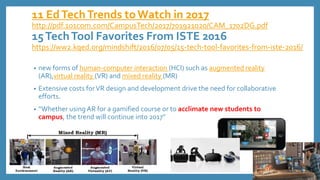
• new forms of human-computer interaction (HCI) such as augmented reality
(AR),virtual reality (VR) and mixed reality (MR)
• Extensive costs forVR design and development drive the need for collaborative
efforts.
• “Whether using AR for a gamified course or to acclimate new students to
campus, the trend will continue into 2017”
…acclimate new students to campus…
http://pdf.101com.com/CampusTech/2017/701921020/CAM_1702DG.pdf
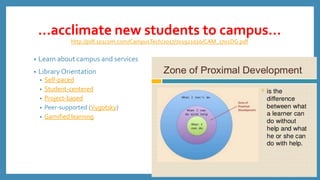
• Learn about campus and services
• Library Orientation
• Self-paced
• Student-centered
• Project-based
• Peer-supported (Vygotsky)
• Gamified learning
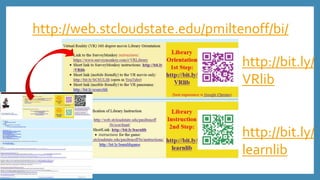
http://web.stcloudstate.edu/pmiltenoff/bi/
http://bit.ly/
VRlib
http://bit.ly/
learnlib
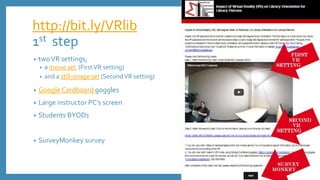
http://bit.ly/VRlib
1st step
• twoVR settings;
• a movie set (FirstVR setting)
• and a still-image set (SecondVR setting)
• Google Cardboard goggles
• Large instructor PC’s screen
• Students BYODs
• SurveyMonkey survey
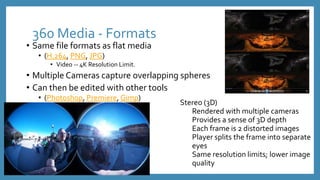
360 Media - Formats
• Same file formats as flat media
• (H.264, PNG, JPG)
• Video -- 4K Resolution Limit.
• Multiple Cameras capture overlapping spheres
• Can then be edited with other tools
• (Photoshop, Premiere, Gimp)
Stereo (3D)
Rendered with multiple cameras
Provides a sense of 3D depth
Each frame is 2 distorted images
Player splits the frame into separate
eyes
Same resolution limits; lower image
quality
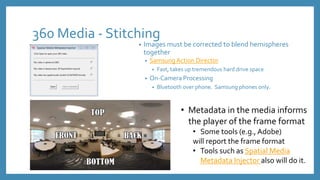
360 Media - Stitching
• Images must be corrected to blend hemispheres
together
• SamsungAction Director
• Fast, takes up tremendous hard drive space
• On-Camera Processing
• Bluetooth over phone. Samsung phones only.
• Metadata in the media informs
the player of the frame format
• Some tools (e.g., Adobe)
will report the frame format
• Tools such as Spatial Media
Metadata Injector also will do it.
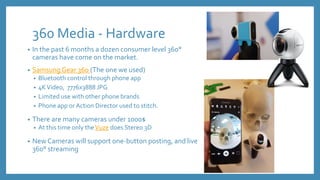
360 Media - Hardware
• In the past 6 months a dozen consumer level 360°
cameras have come on the market.
• Samsung Gear 360 (The one we used)
• Bluetooth control through phone app
• 4KVideo, 7776x3888 JPG
• Limited use with other phone brands
• Phone app orAction Director used to stitch.
• There are many cameras under 1000$
• At this time only theVuze does Stereo 3D
• New Cameras will support one-button posting, and live
360° streaming
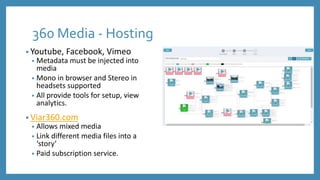
360 Media - Hosting
• Youtube, Facebook, Vimeo
• Metadata must be injected into media
• Mono in browser and Stereo in
headsets supported
• All provide tools for setup, view
analytics.
• Viar360.com
• Allows mixed media
• Link different media files into a ‘story’
• Paid subscription service (discontinued)
Forje.JS – Open source JS Framework
• For home-built 360
presentations
• Supports video, stills, and spatial
audio
• Browser or Cardboard support
• Open-source with responsive
community
• Narrative structure stored in JSON
• Currently requires low-level
programming knowledge to use
effectively.
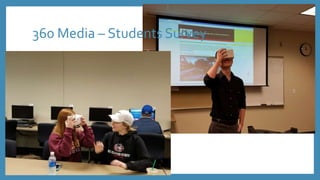
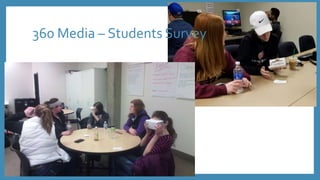
360 Media – Students Survey
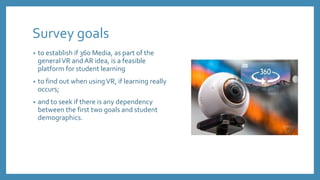
Survey goals
• to establish if 360 Media, as part of the
generalVR and AR idea, is a feasible
platform for student learning
• to find out when usingVR, if learning really
occurs;
• and to seek if there is any dependency
between the first two goals and student
demographics.
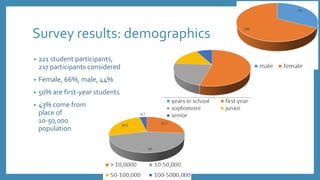
Survey results: demographics
• 221 student participants,
217 participants considered
• Female, 66%, male, 44%
• 50% are first-year students
• 43% come from
place of
10-50,000
population
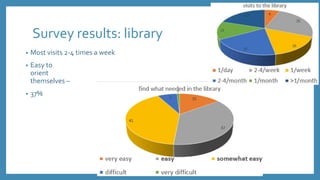
Survey results: library
• Most visits 2-4 times a week
• Easy to
orient
themselves –
• 37%
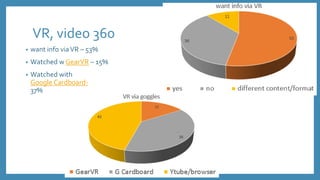
VR, video 360
• want info viaVR – 53%
• Watched w GearVR – 15%
• Watched with
Google Cardboard-
37%
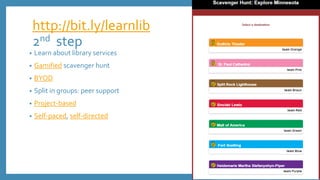
http://bit.ly/learnlib
2nd step
• Learn about library services
• Gamified scavenger hunt
• BYOD
• Split in groups: peer support
• Project-based
• Self-paced, self-directed
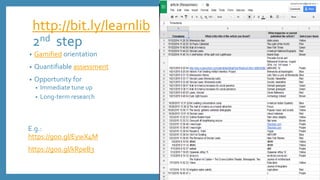
http://bit.ly/learnlib
2nd step
• Gamified orientation
• Quantifiable assessment
• Opportunity for
• Immediate tune up
• Long-term research
E.g.:
https://goo.gl/EywX4M
https://goo.gl/kRpeB3
@SCSUtechinstruc #mnsummit2017 #vrlib
https://www.facebook.com/SCSUVizLab
https://www.facebook.com/InforMediaServices/
Contact Info:
• Plamen Miltenoff, Ph.D. Professor
pmiltenoff@stcloudstate.edu
http://web.stcloudstate.edu/pmiltenoff/faculty/
http://blog.stcloudstate.edu/ims
https://www.facebook.com/InforMediaServices/
• Mark Gill, Ph.D., DirectorVisualization Lab
mcgill@stcloudstate.edu
https://www.facebook.com/SCSUVizLab
@SCSUtechinstruc
https://www.slideshare.net/aidemoreto/vr-library
short link: https://tinyurl.com/MNsummit2017

Vr library

  • 1.
    THE NEXT GENERATIONOF LIBRARY ORIENTATION. DISCUSSION ONTHE APPLICATION OF VIRTUAL AND IMMERSIVE REALITY, 360 DEGREE MOVIES ,ETC. Dr. Plamen Miltenoff & Dr. Mark Gill Minnesota eLearning Summit Normandale Community College August 2−3, 2017 Bloomington, Minnesota #mnsummit2017 #vrlib https://www.slideshare.net/aidemoreto/vr-library short link: https://tinyurl.com/MNsummit2017
  • 2.
    Contact info andtake outs from today’s session • Plamen Miltenoff, Ph.D., Professor, pmiltenoff@stcloudstate.edu • Mark Gill, Ph.D., DirectorVisualization Lab mcgill@stcloudstate.edu • learn about the opportunities offered by each of these technologies:VR reality, Augmented reality and 360 media • learn to operate the various forms of these technologies • contemplate, discuss and propose new applications of these technologies in library and academic settings
  • 3.
    Plan • Intro tothe idea ofVR/360 media and gamification in the library • VR /Video 360 for library orientation • Gamification for library instruction • Video 360 Library Orientation – case study • VR /Video 360 – how to • Video 360 Library Orientation – survey results • Gamification for Library Instruction – case study
  • 4.
    11 EdTechTrends toWatchin 2017 http://pdf.101com.com/CampusTech/2017/701921020/CAM_1702DG.pdf 15TechTool Favorites From ISTE 2016 https://ww2.kqed.org/mindshift/2016/07/05/15-tech-tool-favorites-from-iste-2016/ • new forms of human-computer interaction (HCI) such as augmented reality (AR),virtual reality (VR) and mixed reality (MR) • Extensive costs forVR design and development drive the need for collaborative efforts. • “Whether using AR for a gamified course or to acclimate new students to campus, the trend will continue into 2017”
  • 5.
    …acclimate new studentsto campus… http://pdf.101com.com/CampusTech/2017/701921020/CAM_1702DG.pdf • Learn about campus and services • Library Orientation • Self-paced • Student-centered • Project-based • Peer-supported (Vygotsky) • Gamified learning
  • 6.
  • 7.
    http://bit.ly/VRlib 1st step • twoVRsettings; • a movie set (FirstVR setting) • and a still-image set (SecondVR setting) • Google Cardboard goggles • Large instructor PC’s screen • Students BYODs • SurveyMonkey survey
  • 8.
    360 Media -Formats • Same file formats as flat media • (H.264, PNG, JPG) • Video -- 4K Resolution Limit. • Multiple Cameras capture overlapping spheres • Can then be edited with other tools • (Photoshop, Premiere, Gimp) Stereo (3D) Rendered with multiple cameras Provides a sense of 3D depth Each frame is 2 distorted images Player splits the frame into separate eyes Same resolution limits; lower image quality
  • 9.
    360 Media -Stitching • Images must be corrected to blend hemispheres together • SamsungAction Director • Fast, takes up tremendous hard drive space • On-Camera Processing • Bluetooth over phone. Samsung phones only. • Metadata in the media informs the player of the frame format • Some tools (e.g., Adobe) will report the frame format • Tools such as Spatial Media Metadata Injector also will do it.
  • 10.
    360 Media -Hardware • In the past 6 months a dozen consumer level 360° cameras have come on the market. • Samsung Gear 360 (The one we used) • Bluetooth control through phone app • 4KVideo, 7776x3888 JPG • Limited use with other phone brands • Phone app orAction Director used to stitch. • There are many cameras under 1000$ • At this time only theVuze does Stereo 3D • New Cameras will support one-button posting, and live 360° streaming
  • 11.
    360 Media -Hosting • Youtube, Facebook, Vimeo • Metadata must be injected into media • Mono in browser and Stereo in headsets supported • All provide tools for setup, view analytics. • Viar360.com • Allows mixed media • Link different media files into a ‘story’ • Paid subscription service (discontinued)
  • 12.
    Forje.JS – Opensource JS Framework • For home-built 360 presentations • Supports video, stills, and spatial audio • Browser or Cardboard support • Open-source with responsive community • Narrative structure stored in JSON • Currently requires low-level programming knowledge to use effectively.
  • 13.
    360 Media –Students Survey
  • 14.
    360 Media –Students Survey
  • 15.
    Survey goals • toestablish if 360 Media, as part of the generalVR and AR idea, is a feasible platform for student learning • to find out when usingVR, if learning really occurs; • and to seek if there is any dependency between the first two goals and student demographics.
  • 16.
    Survey results: demographics •221 student participants, 217 participants considered • Female, 66%, male, 44% • 50% are first-year students • 43% come from place of 10-50,000 population
  • 17.
    Survey results: library •Most visits 2-4 times a week • Easy to orient themselves – • 37%
  • 18.
    VR, video 360 •want info viaVR – 53% • Watched w GearVR – 15% • Watched with Google Cardboard- 37%
  • 19.
    http://bit.ly/learnlib 2nd step • Learnabout library services • Gamified scavenger hunt • BYOD • Split in groups: peer support • Project-based • Self-paced, self-directed
  • 20.
    http://bit.ly/learnlib 2nd step • Gamifiedorientation • Quantifiable assessment • Opportunity for • Immediate tune up • Long-term research E.g.: https://goo.gl/EywX4M https://goo.gl/kRpeB3
  • 21.
  • 22.
    Contact Info: • PlamenMiltenoff, Ph.D. Professor pmiltenoff@stcloudstate.edu http://web.stcloudstate.edu/pmiltenoff/faculty/ http://blog.stcloudstate.edu/ims https://www.facebook.com/InforMediaServices/ • Mark Gill, Ph.D., DirectorVisualization Lab mcgill@stcloudstate.edu https://www.facebook.com/SCSUVizLab @SCSUtechinstruc https://www.slideshare.net/aidemoreto/vr-library short link: https://tinyurl.com/MNsummit2017