VIRTUAL REALITY FOR SCIENCE & EDUCATION
LECTURE 1: 11 SEP 2015
Virtual Reality
History & State of the Art
HELLO WORLD
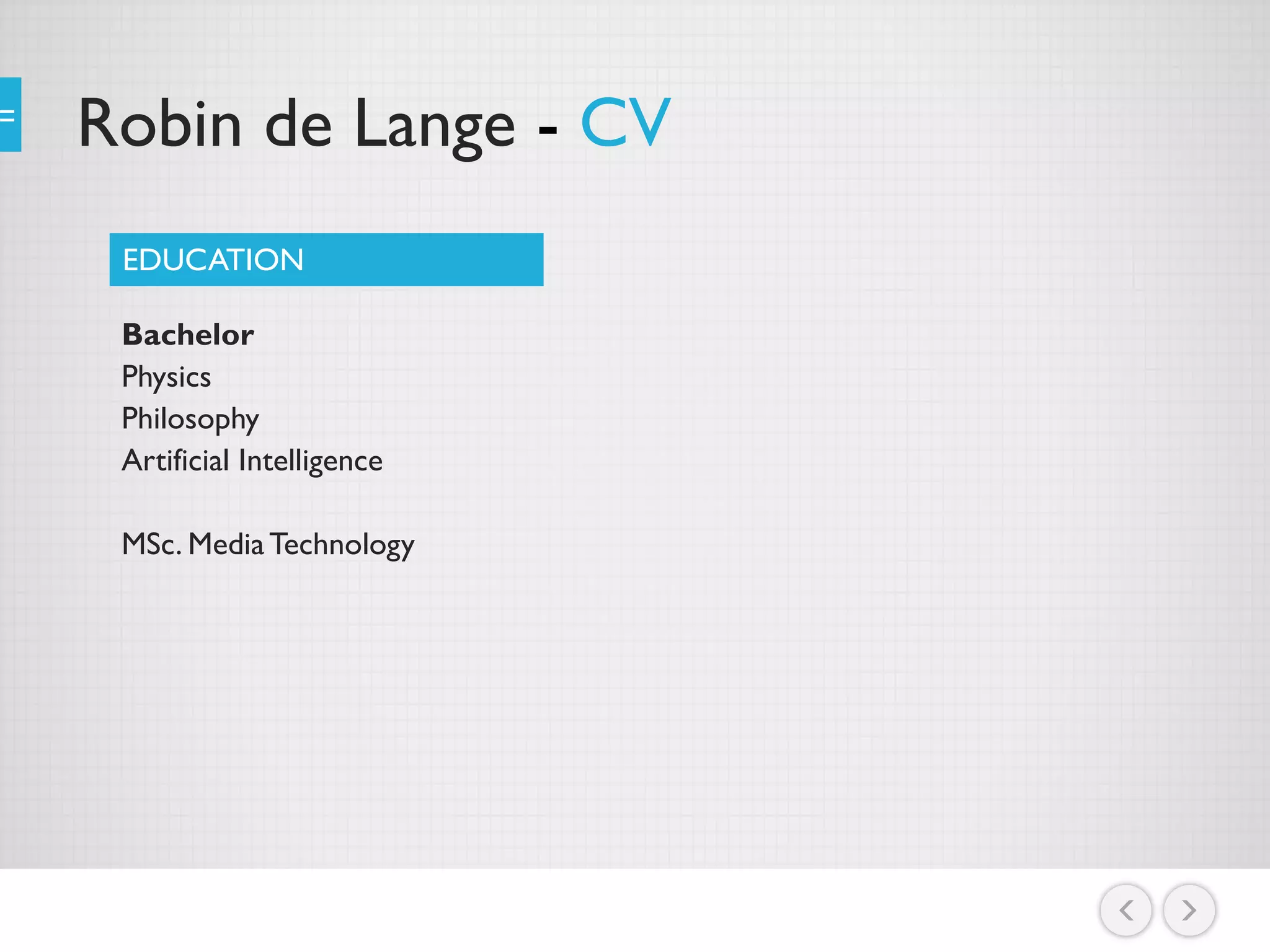
Robin de Lange - CV
Bachelor
Physics
Philosophy
Artificial Intelligence
MSc. MediaTechnology
EDUCATION
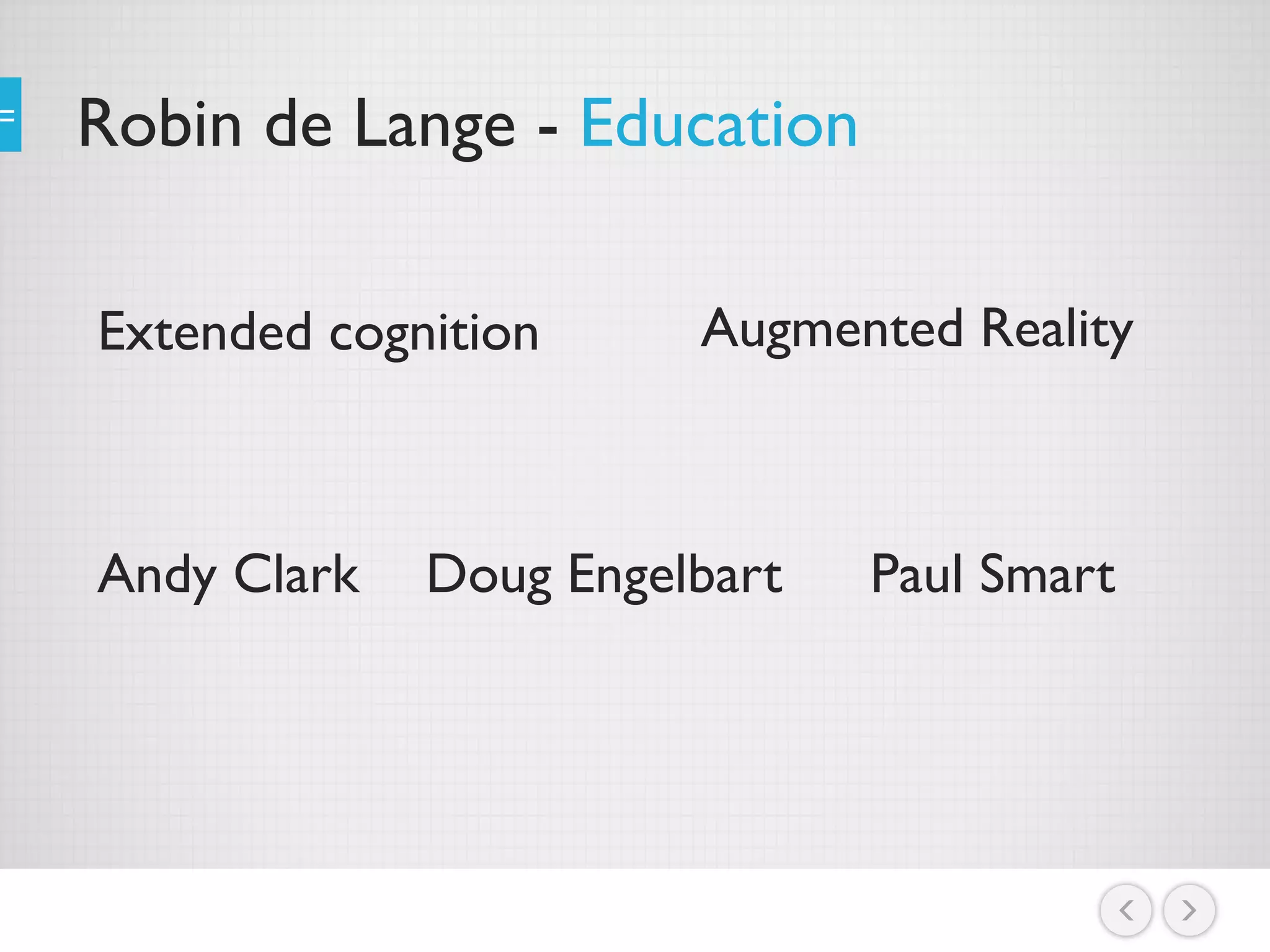
Robin de Lange - Education
Extended cognition Augmented Reality
Andy Clark Doug Engelbart Paul Smart
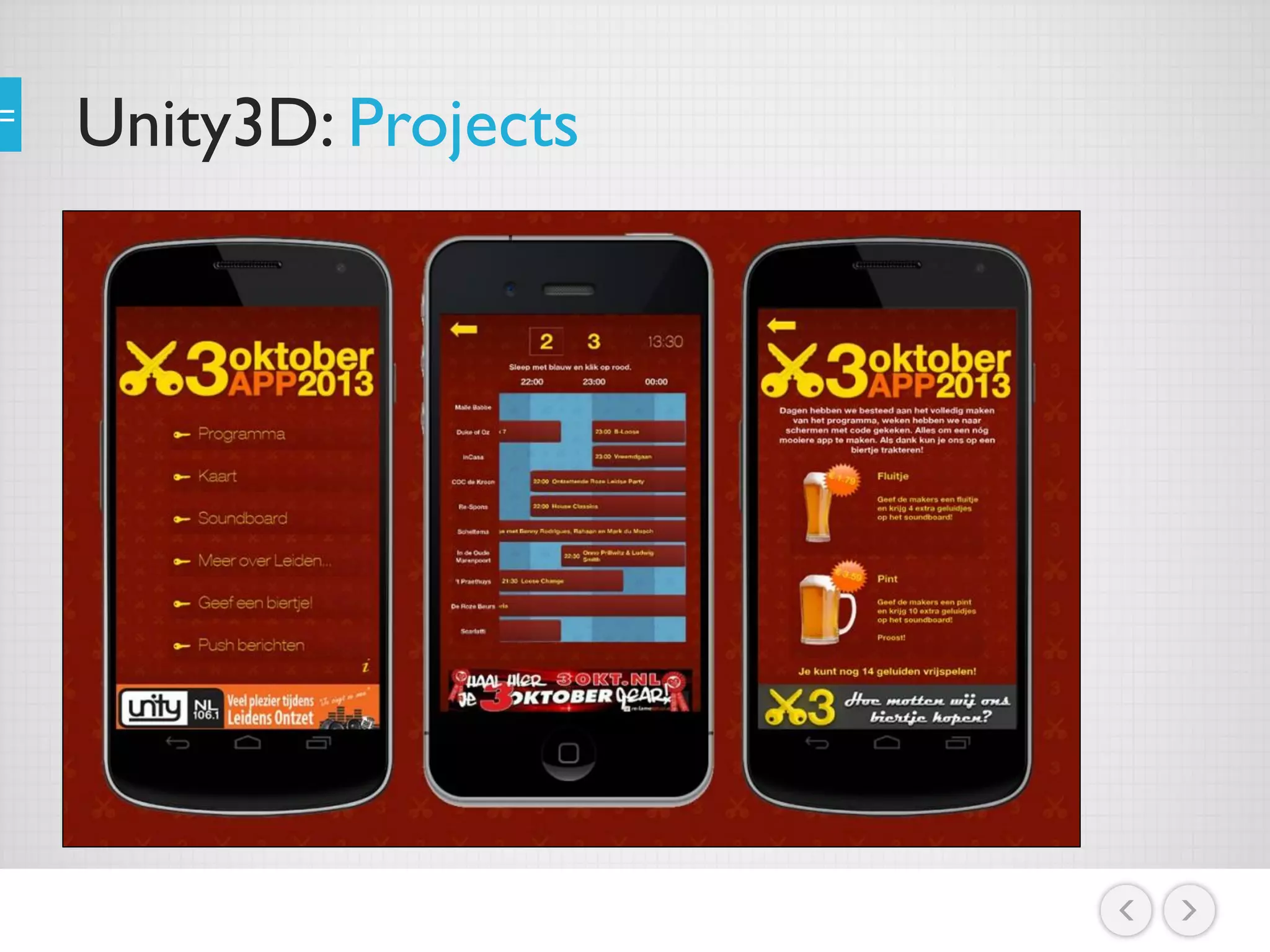
Unity3D: Projects
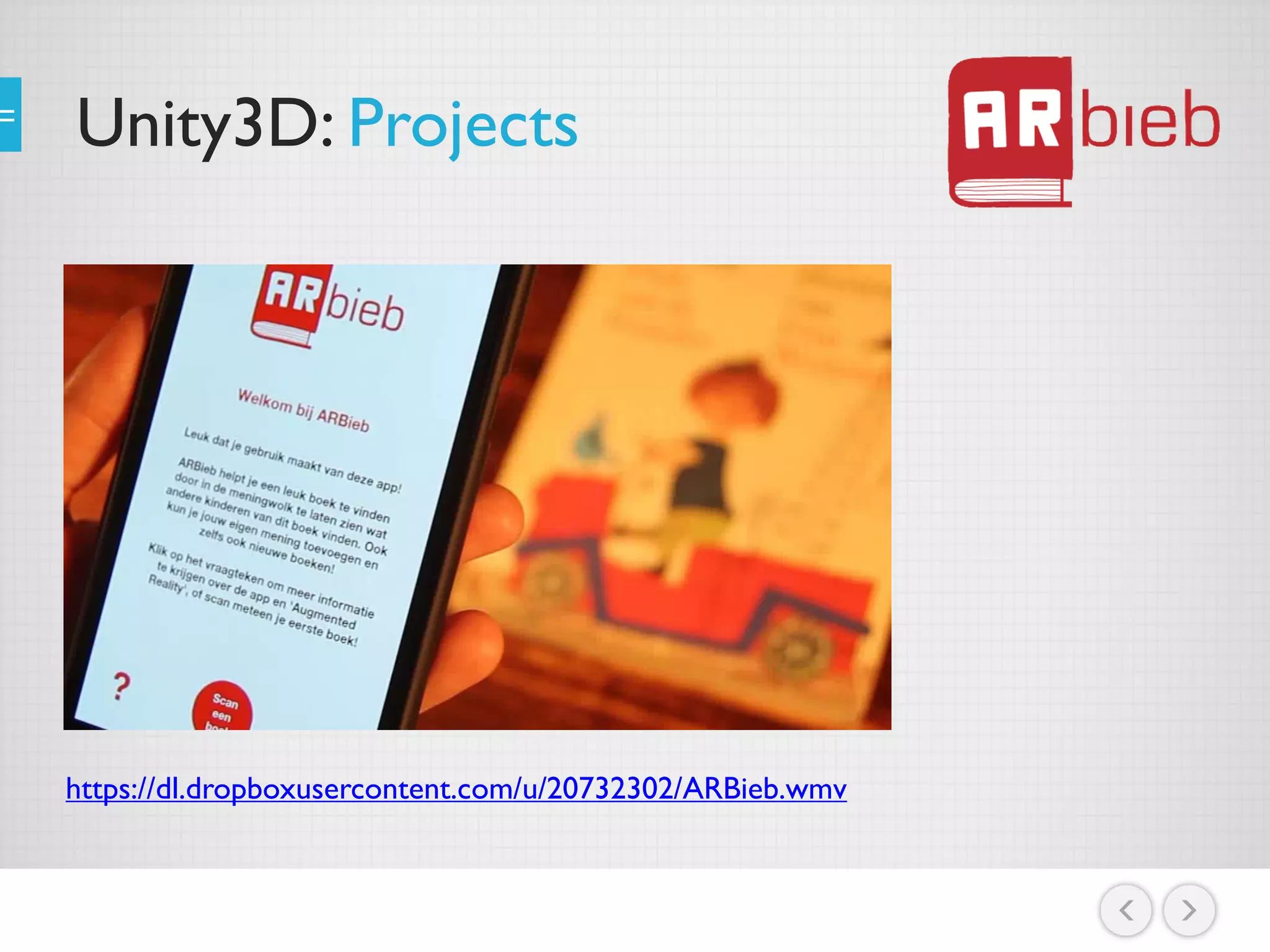
Unity3D: Projects
https://dl.dropboxusercontent.com/u/20732302/ARBieb.wmv
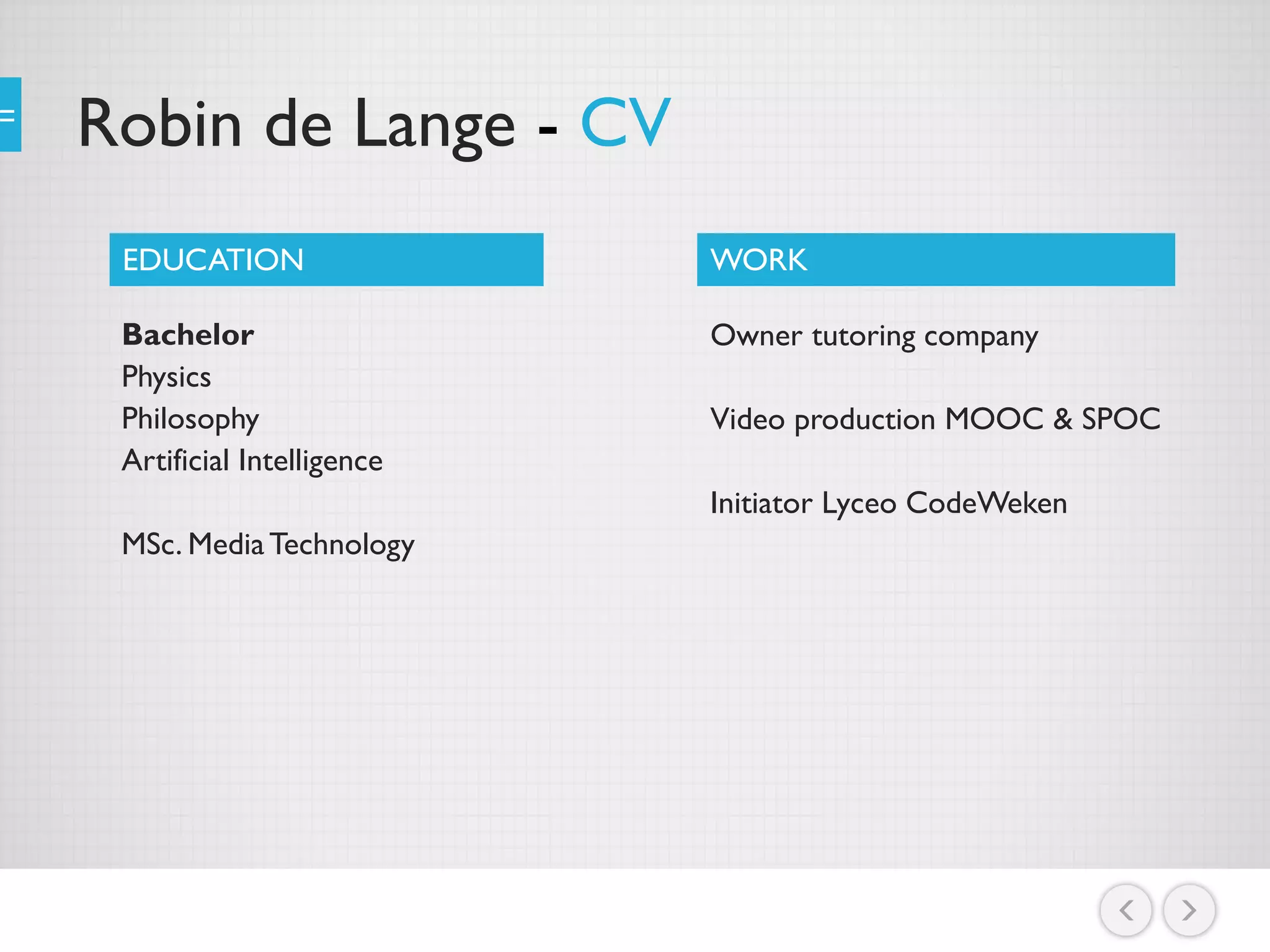
Robin de Lange - CV
Bachelor
Physics
Philosophy
Artificial Intelligence
MSc. MediaTechnology
EDUCATION WORK
Owner tutoring company
Video production MOOC & SPOC
Initiator Lyceo CodeWeken
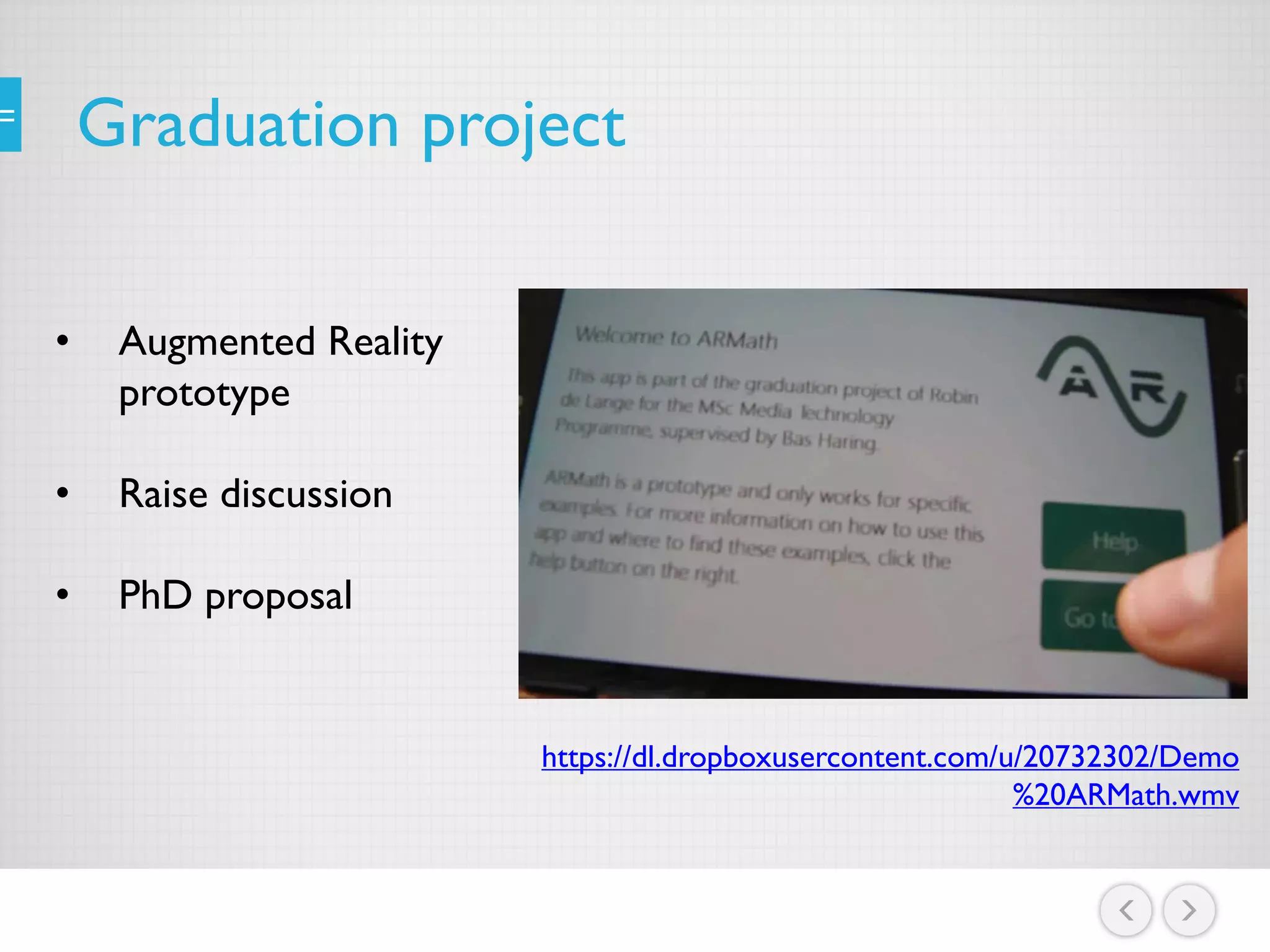
Graduation project
• Augmented Reality
prototype
• Raise discussion
• PhD proposal
https://dl.dropboxusercontent.com/u/20732302/Demo
%20ARMath.wmv
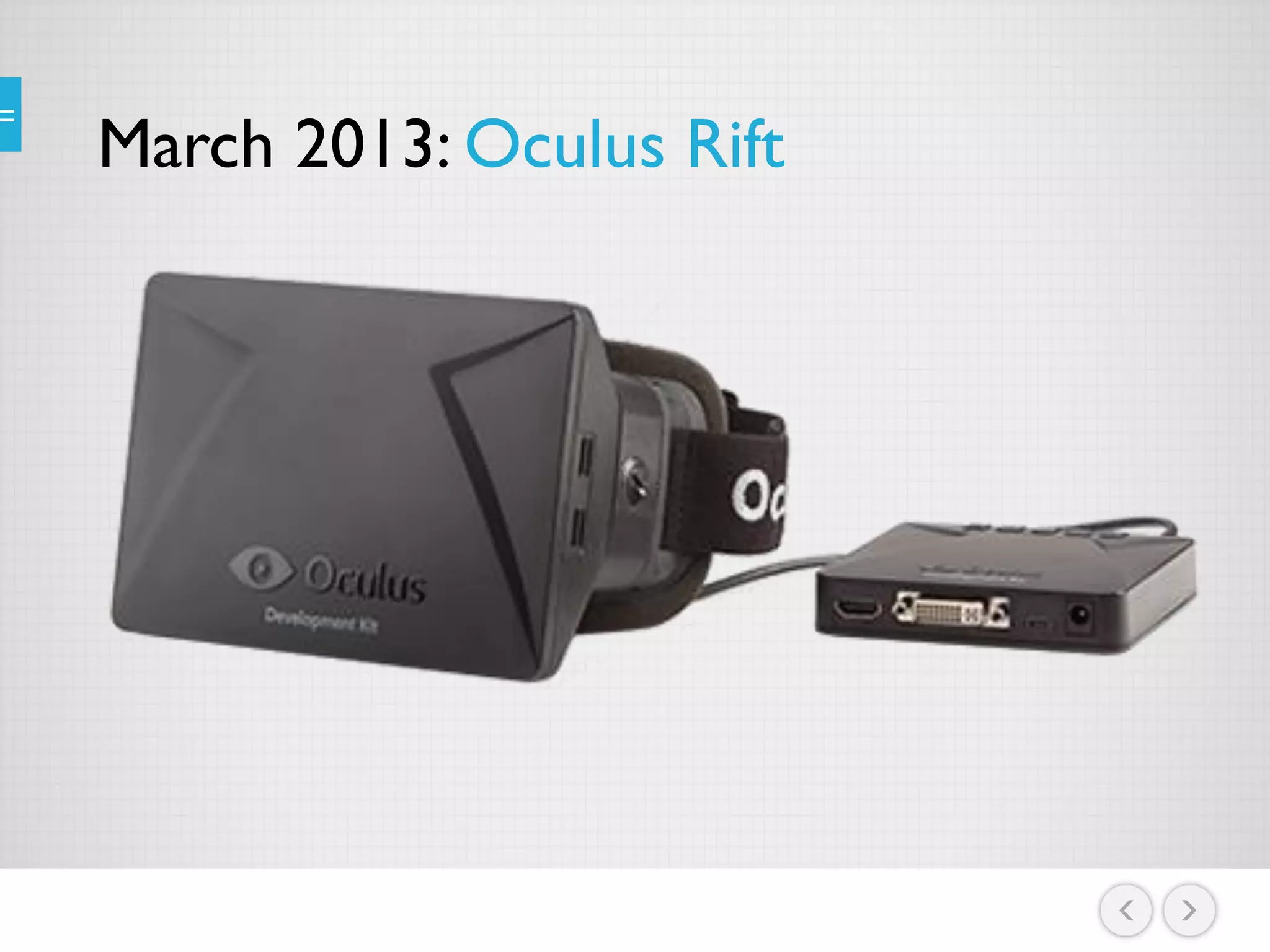
March 2013: Oculus Rift
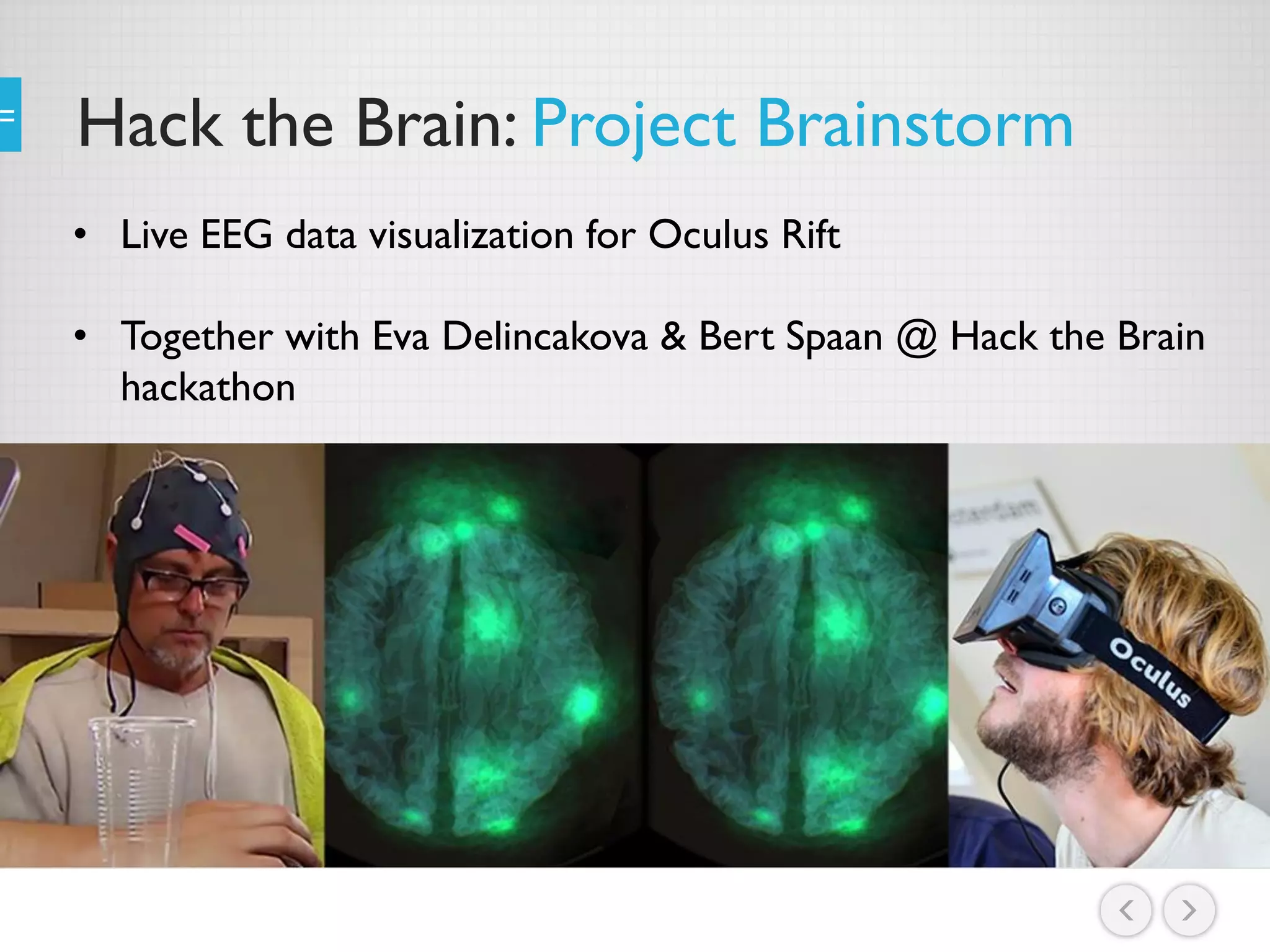
Hack the Brain: Project Brainstorm
• Live EEG data visualization for Oculus Rift
• Together with Eva Delincakova & Bert Spaan @ Hack the Brain
hackathon
Focus of research
• In what ways can we useVR to explain
complex problems?
• What are the obstacles and opportunities of
VR in the field of education?
Virtual Reality for Science & Education
• Elective course as part of research project
• Received LUF – Gratama grant for this
project
#introduceyourself
A Brief History ofVR
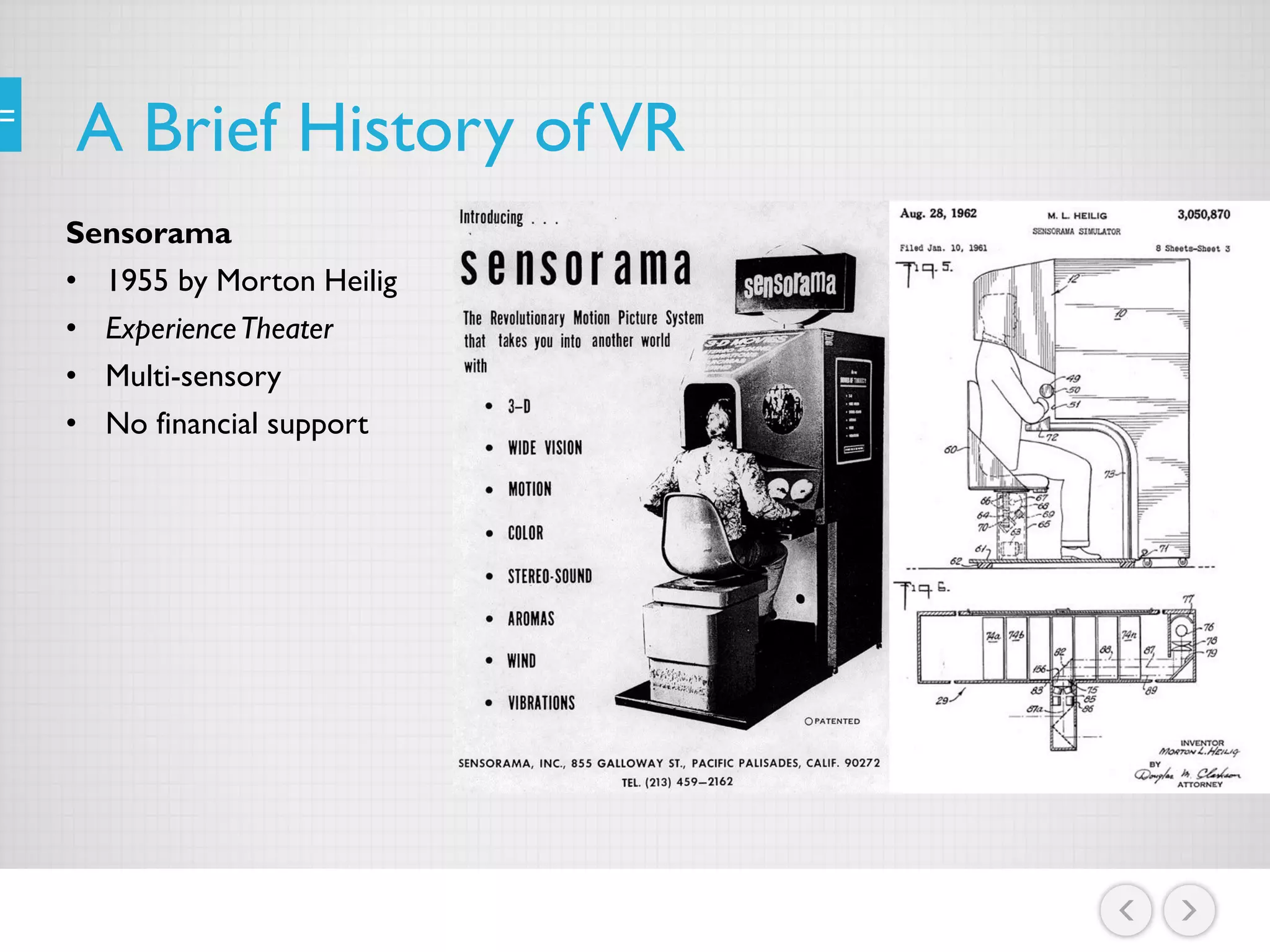
Sensorama
• 1955 by Morton Heilig
• ExperienceTheater
• Multi-sensory
• No financial support
A Brief History ofVR
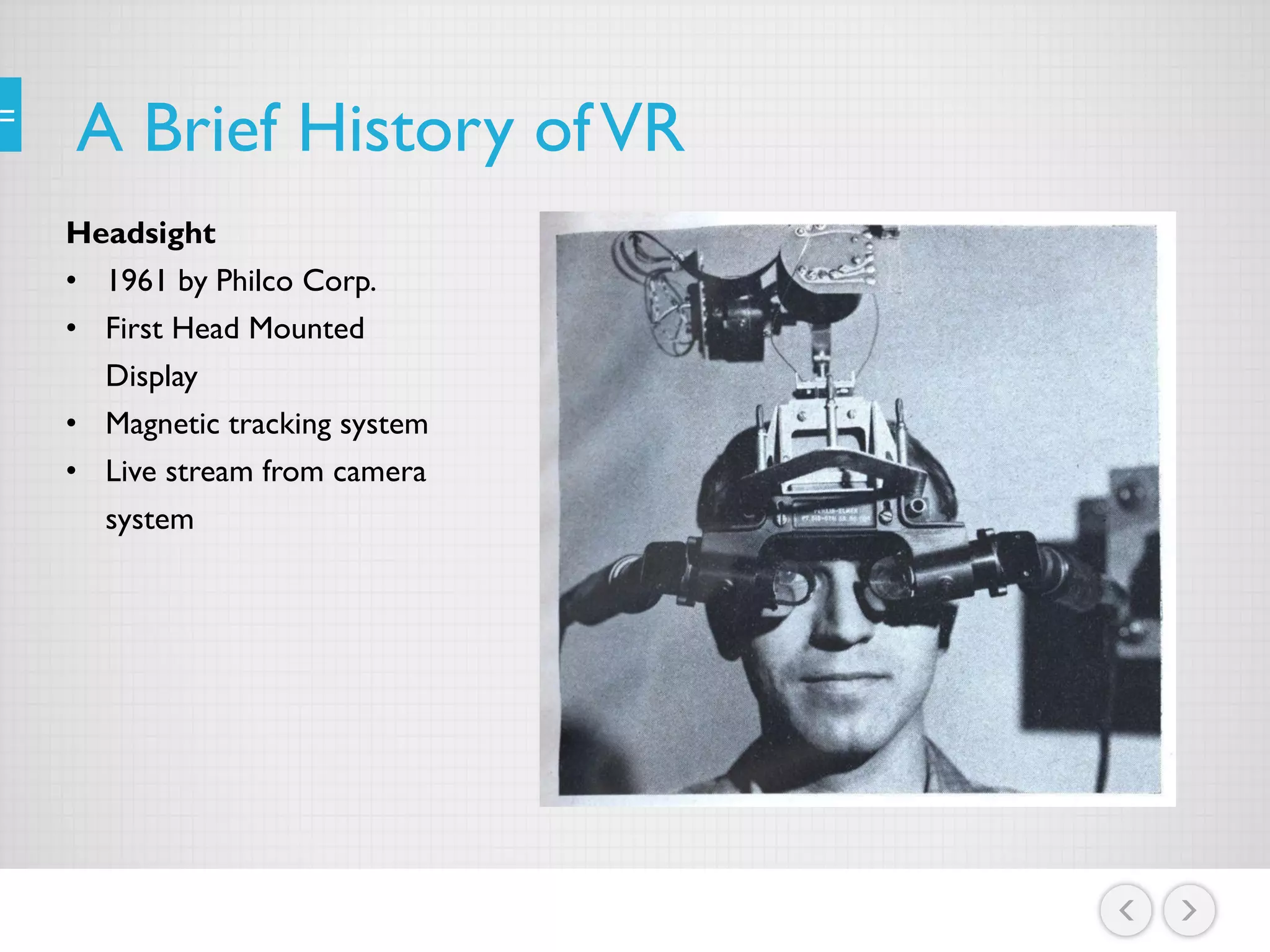
Headsight
• 1961 by Philco Corp.
• First Head Mounted
Display
• Magnetic tracking system
• Live stream from camera
system
A Brief History ofVR
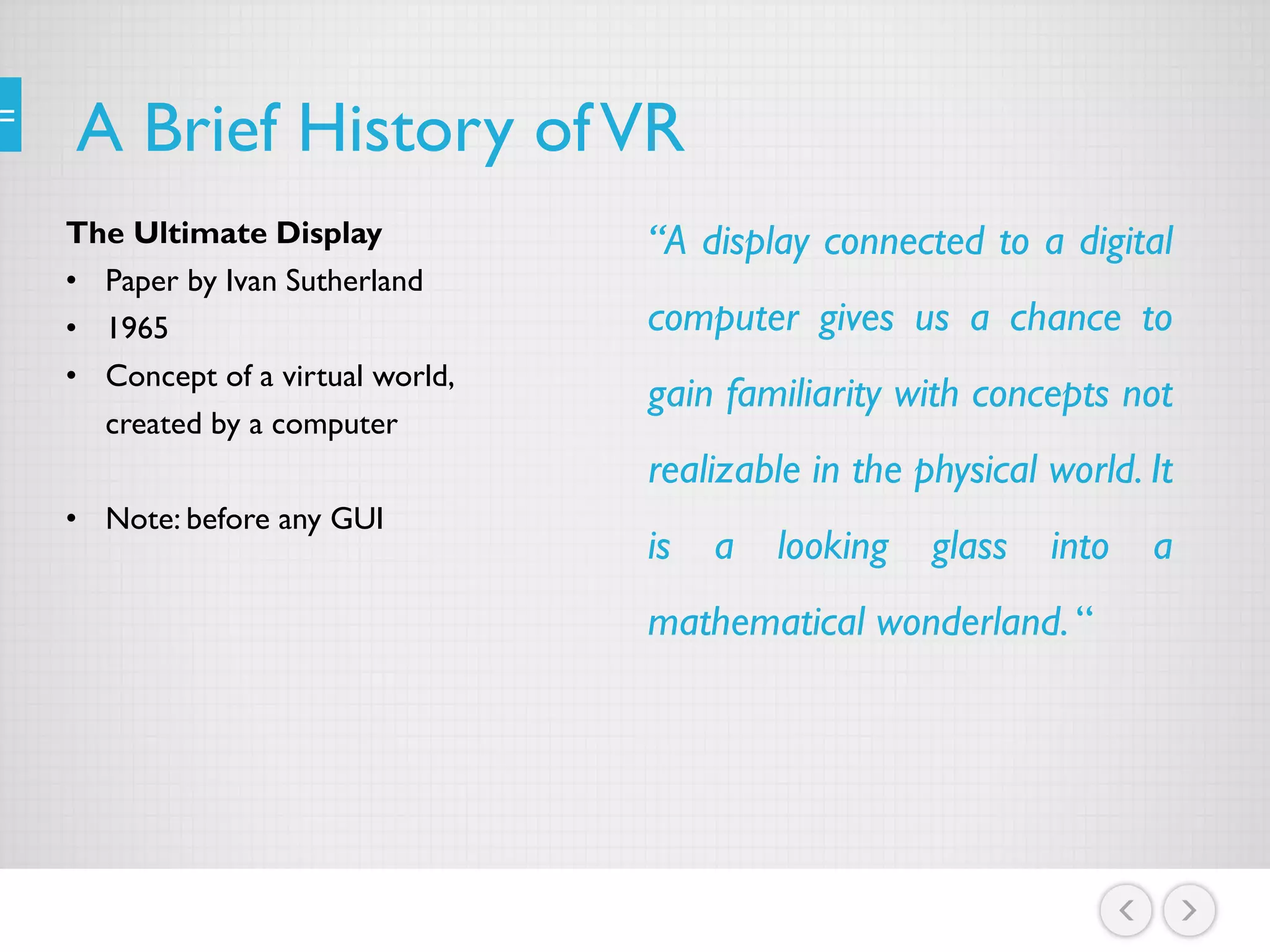
The Ultimate Display
• Paper by Ivan Sutherland
• 1965
• Concept of a virtual world,
created by a computer
• Note: before any GUI
“A display connected to a digital
computer gives us a chance to
gain familiarity with concepts not
realizable in the physical world. It
is a looking glass into a
mathematical wonderland. “
A Brief History ofVR
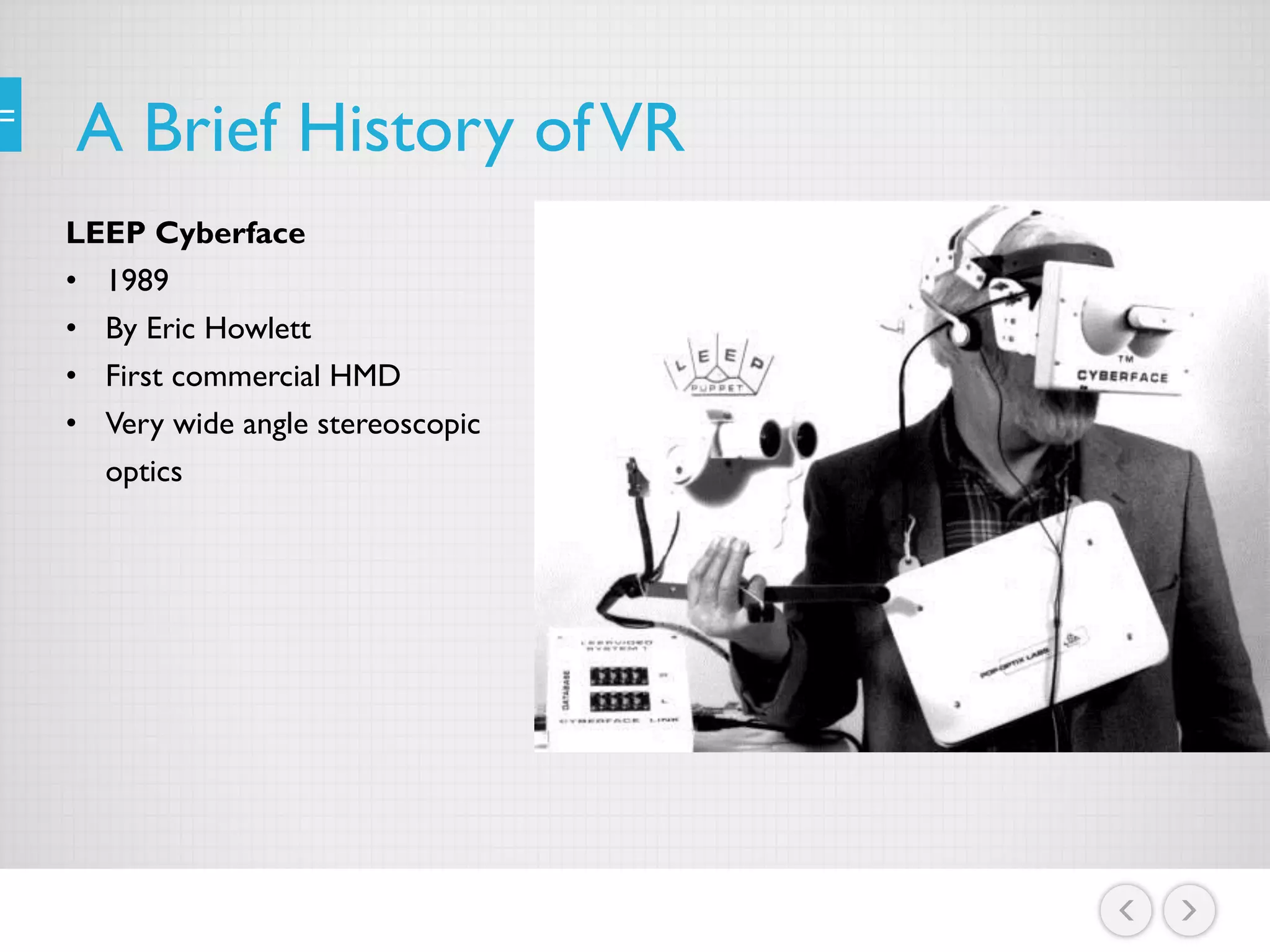
LEEP Cyberface
• 1989
• By Eric Howlett
• First commercial HMD
• Very wide angle stereoscopic
optics
A Brief History ofVR
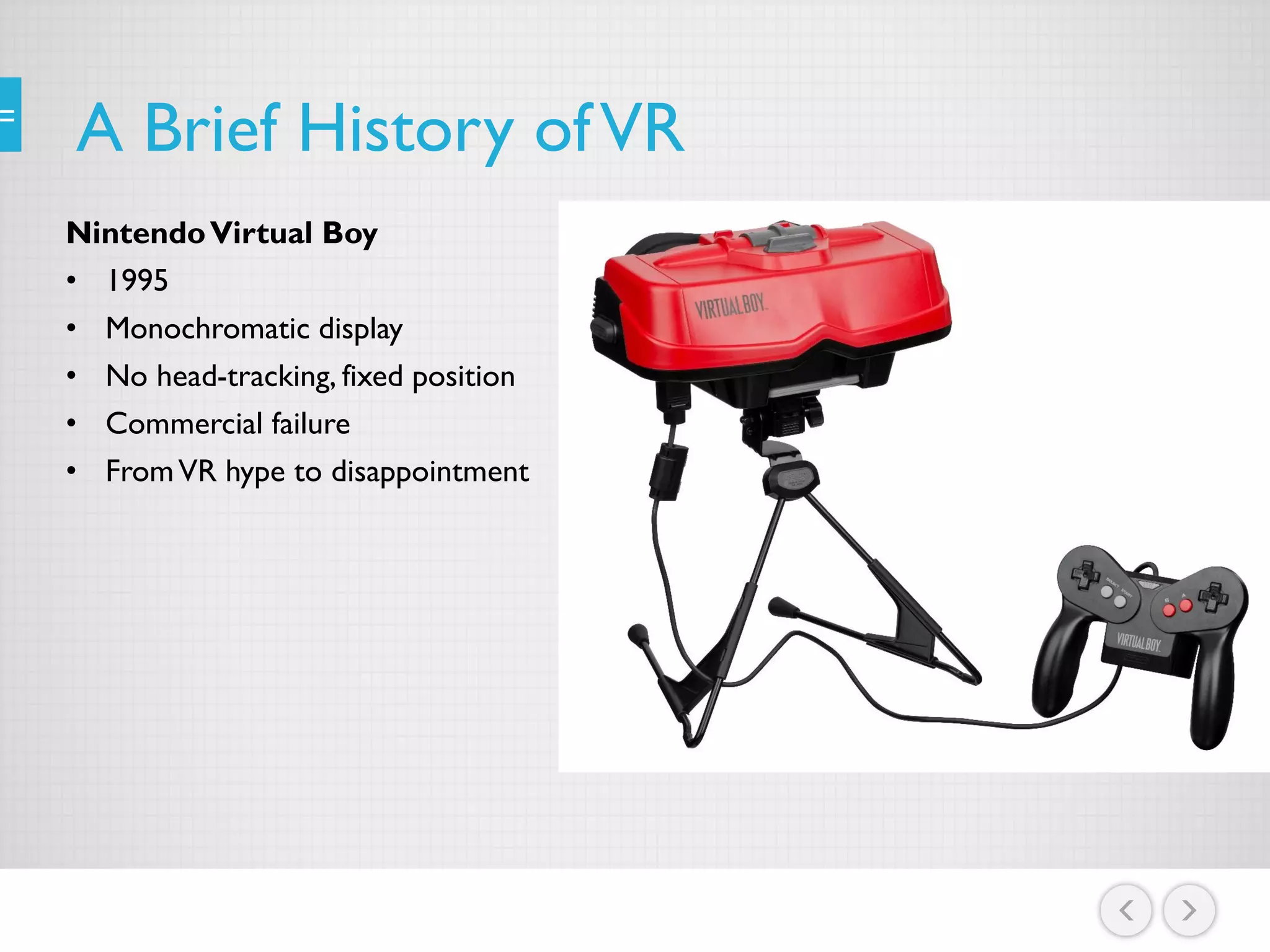
NintendoVirtual Boy
• 1995
• Monochromatic display
• No head-tracking, fixed position
• Commercial failure
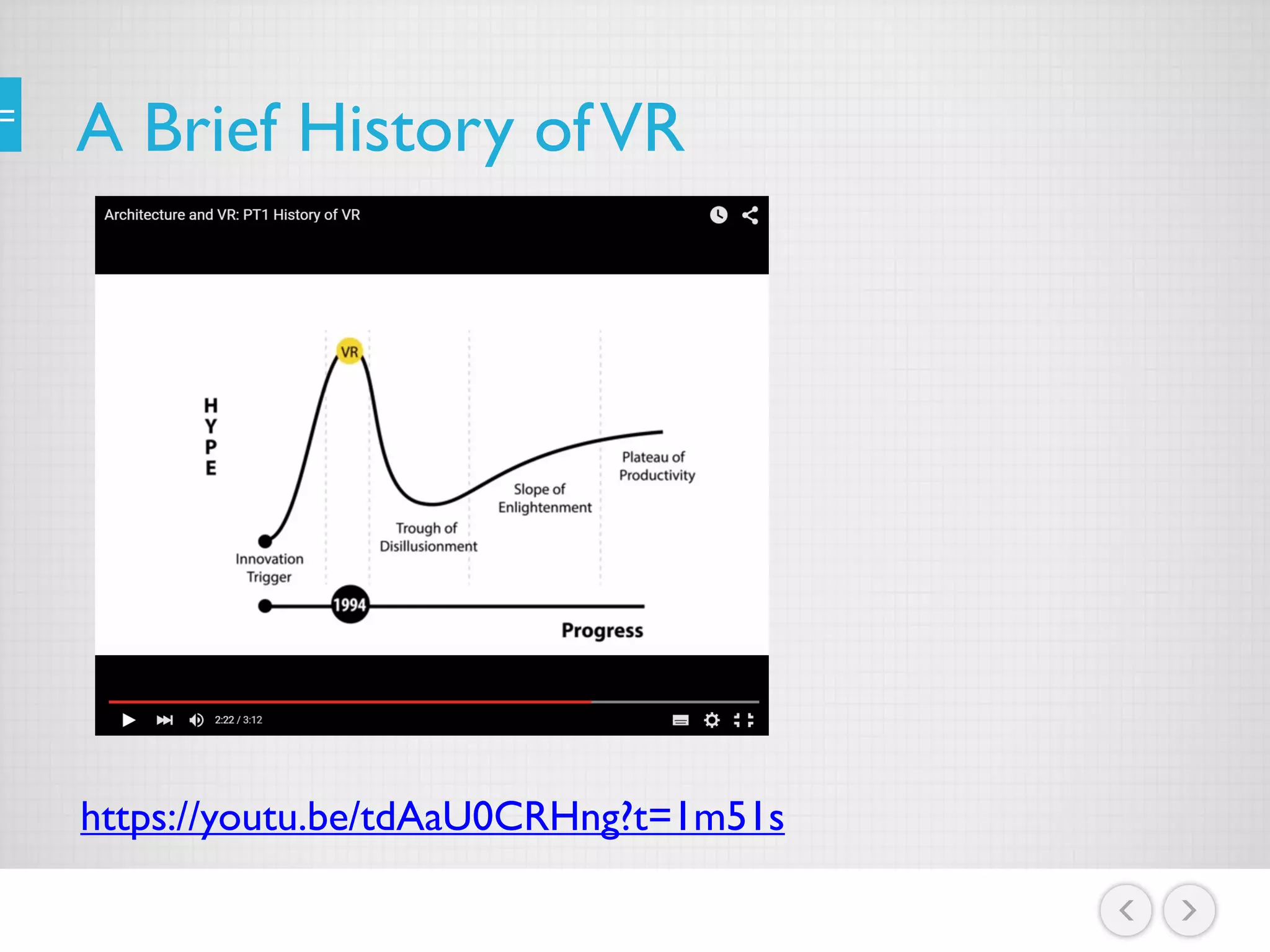
• FromVR hype to disappointment
A Brief History ofVR
https://youtu.be/tdAaU0CRHng?t=1m51s
A Brief History ofVR
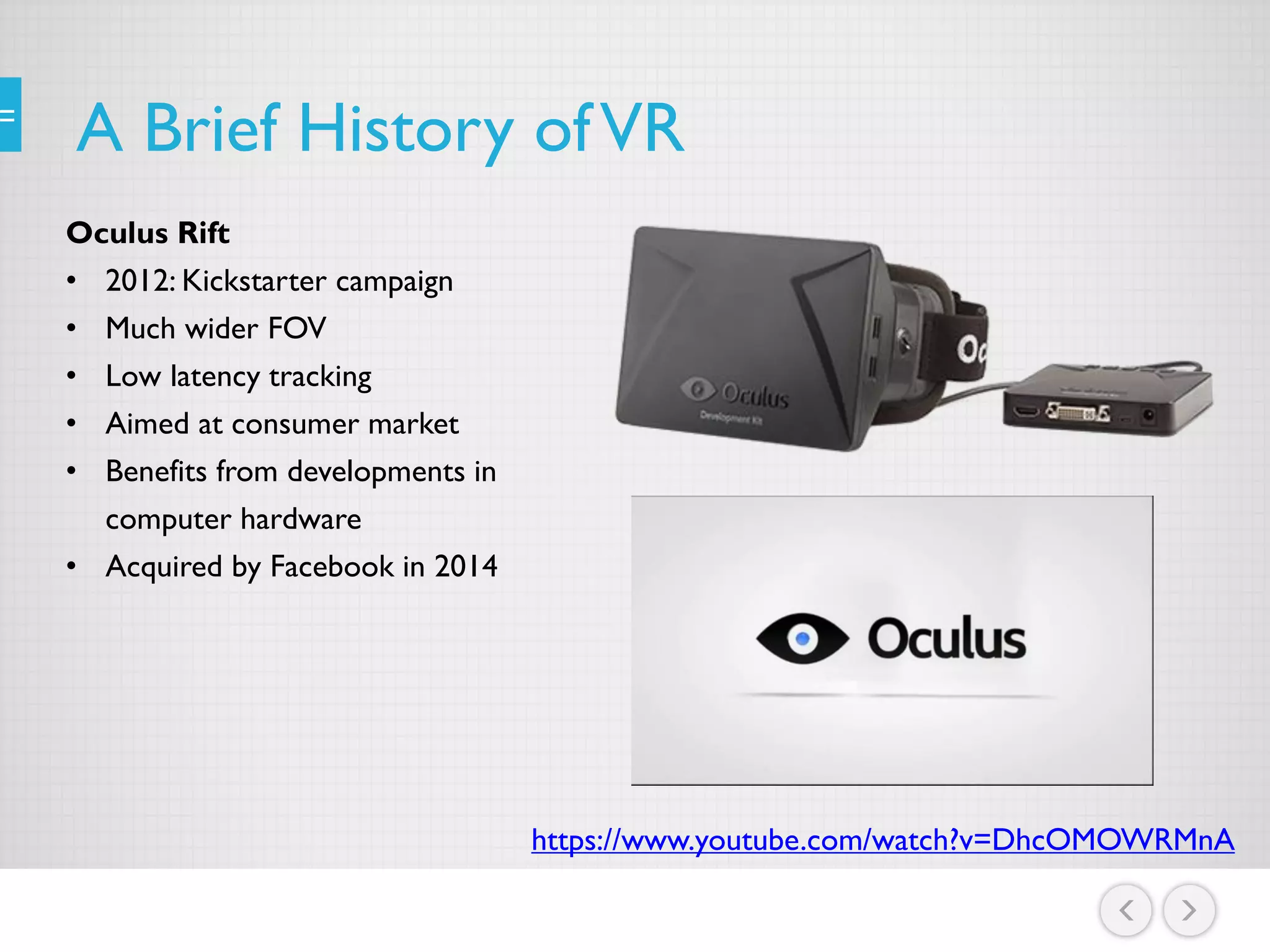
Oculus Rift
• 2012: Kickstarter campaign
• Much wider FOV
• Low latency tracking
• Aimed at consumer market
• Benefits from developments in
computer hardware
• Acquired by Facebook in 2014
https://www.youtube.com/watch?v=DhcOMOWRMnA
A Brief History ofVR
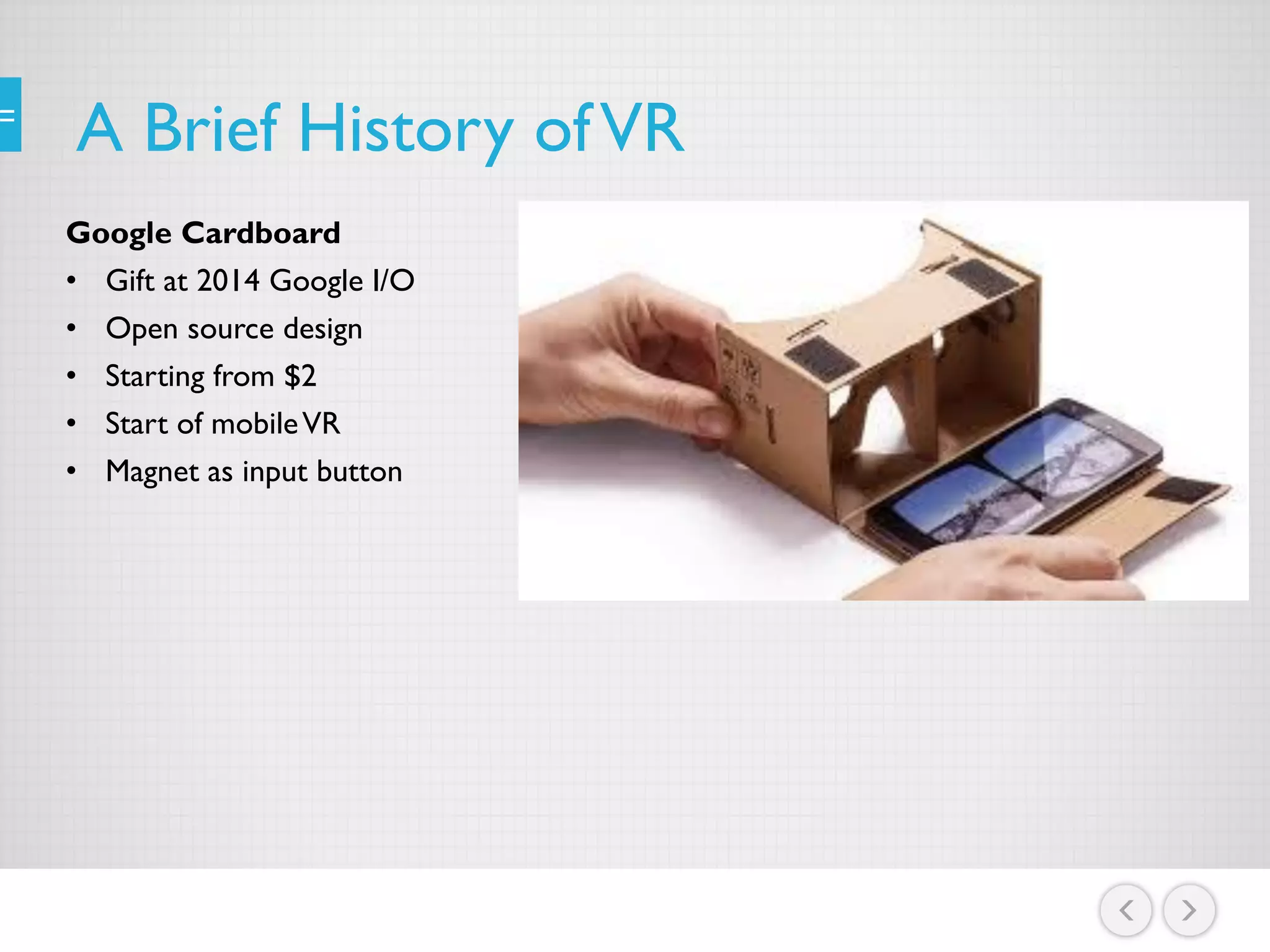
Google Cardboard
• Gift at 2014 Google I/O
• Open source design
• Starting from $2
• Start of mobileVR
• Magnet as input button
A Brief History of VR
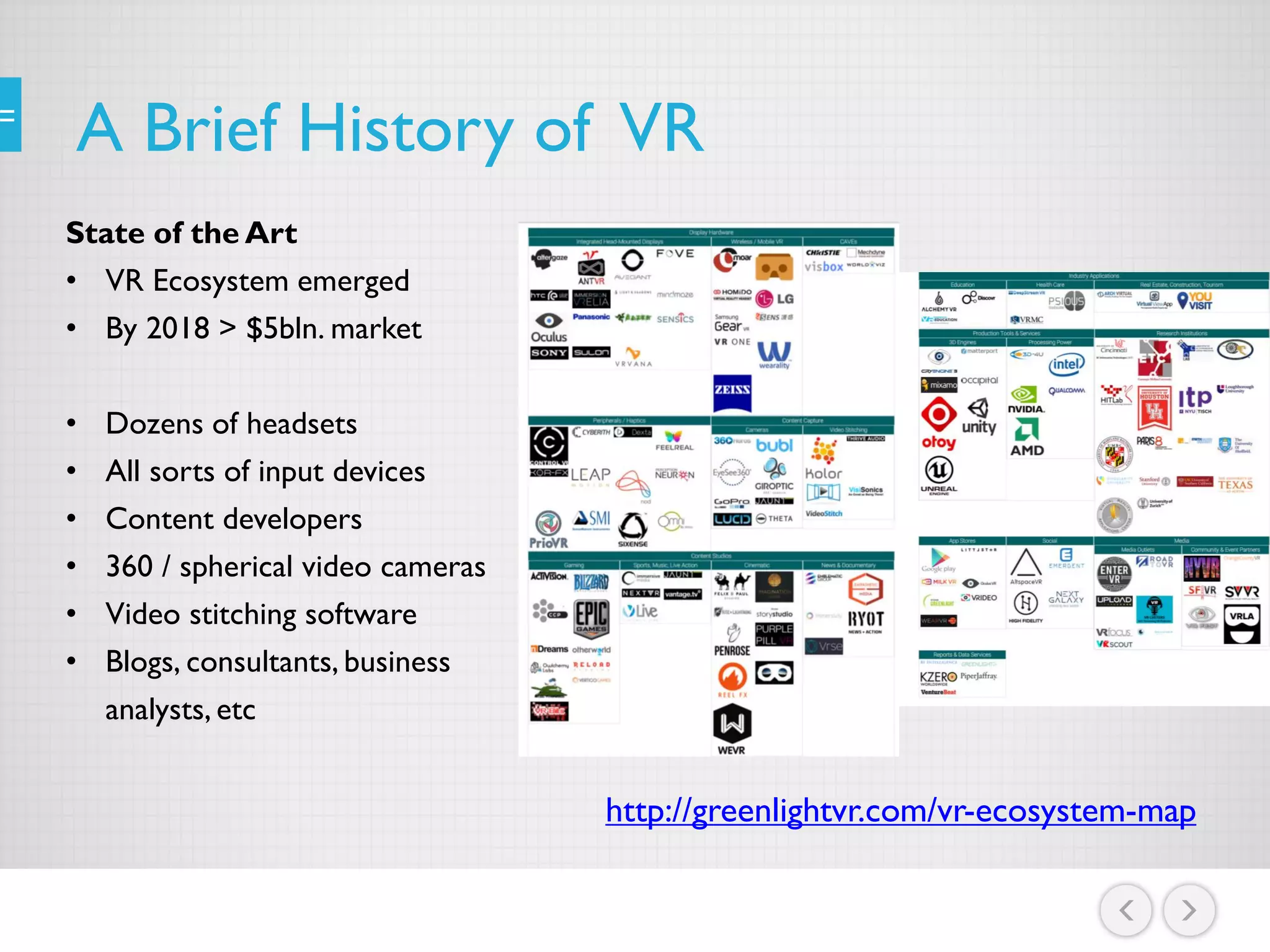
State of the Art
• VR Ecosystem emerged
• By 2018 > $5bln. market
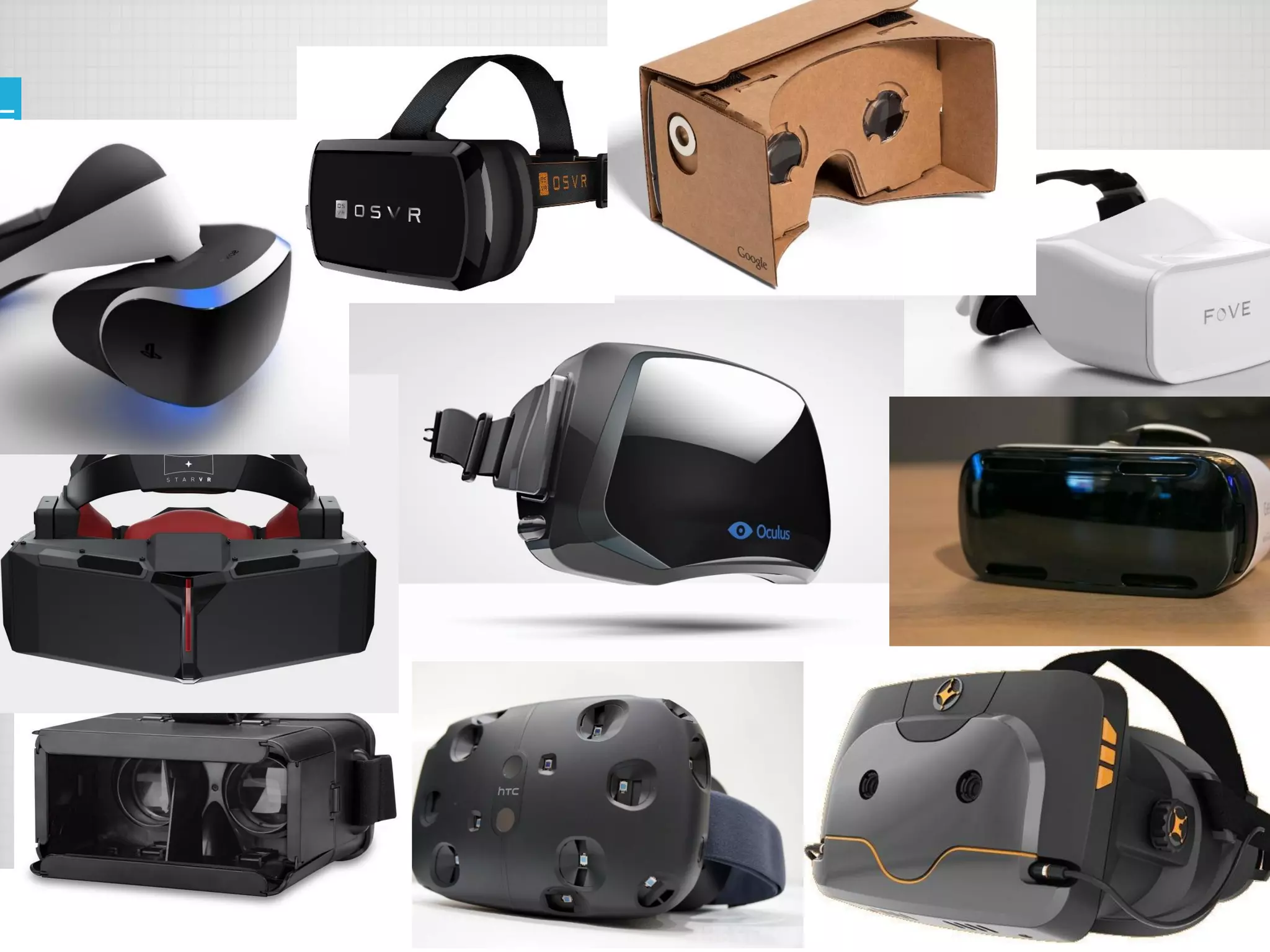
• Dozens of headsets
• All sorts of input devices
• Content developers
• 360 / spherical video cameras
• Video stitching software
• Blogs, consultants, business
analysts, etc
http://greenlightvr.com/vr-ecosystem-map
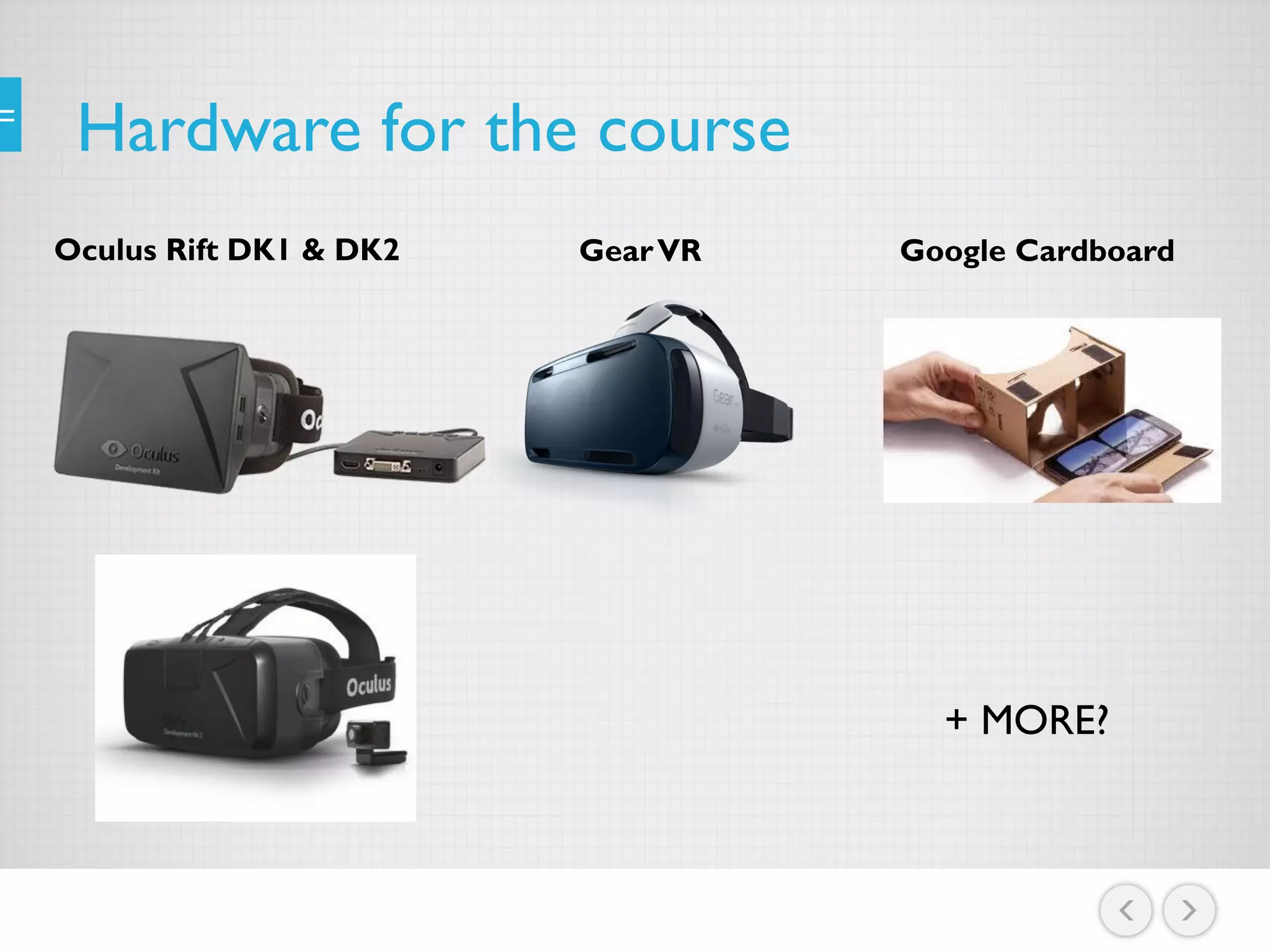
Hardware for the course
Oculus Rift DK1 & DK2 GearVR Google Cardboard
+ MORE?
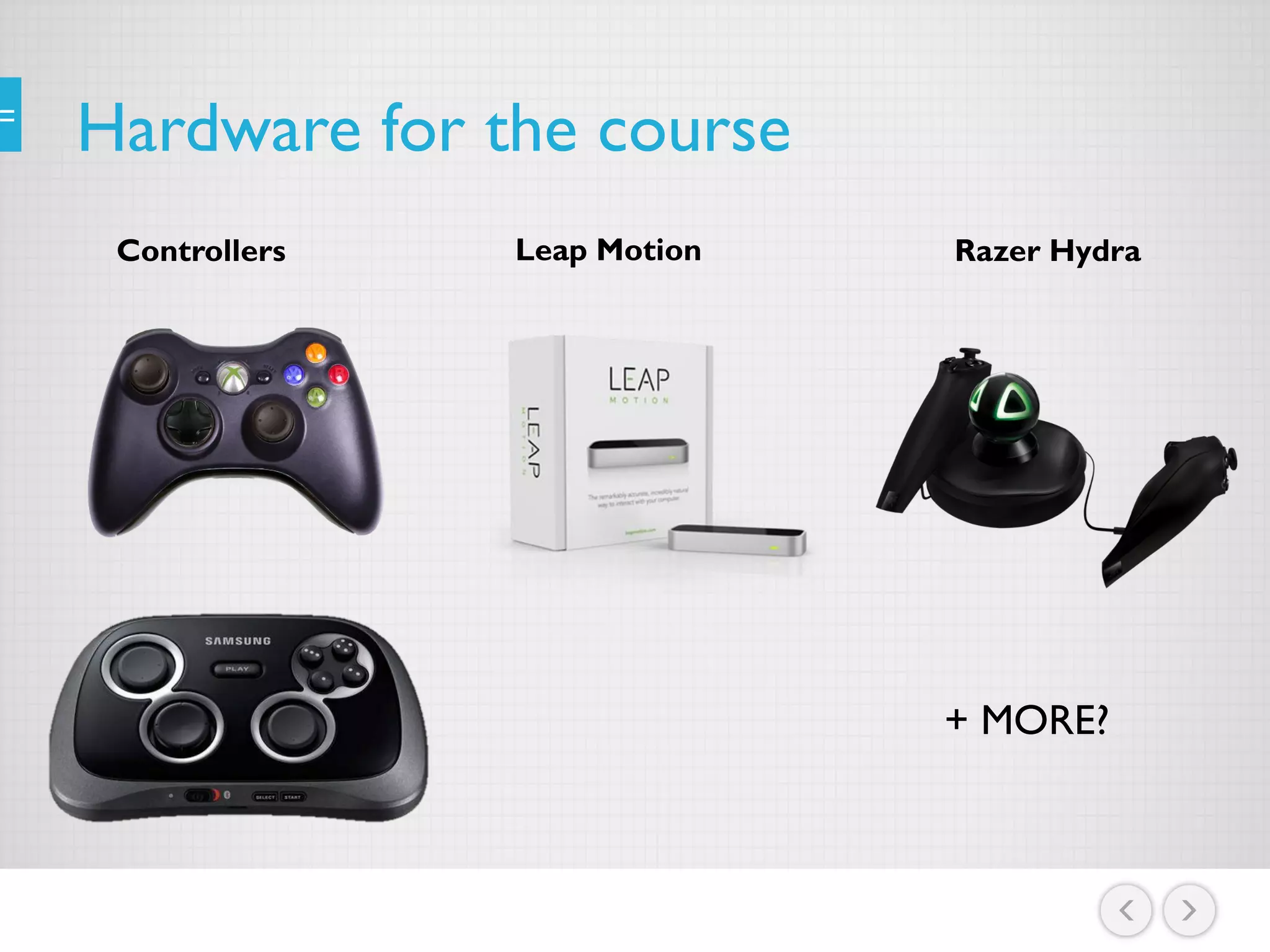
Hardware for the course
Razer HydraLeap MotionControllers
+ MORE?
DEMO
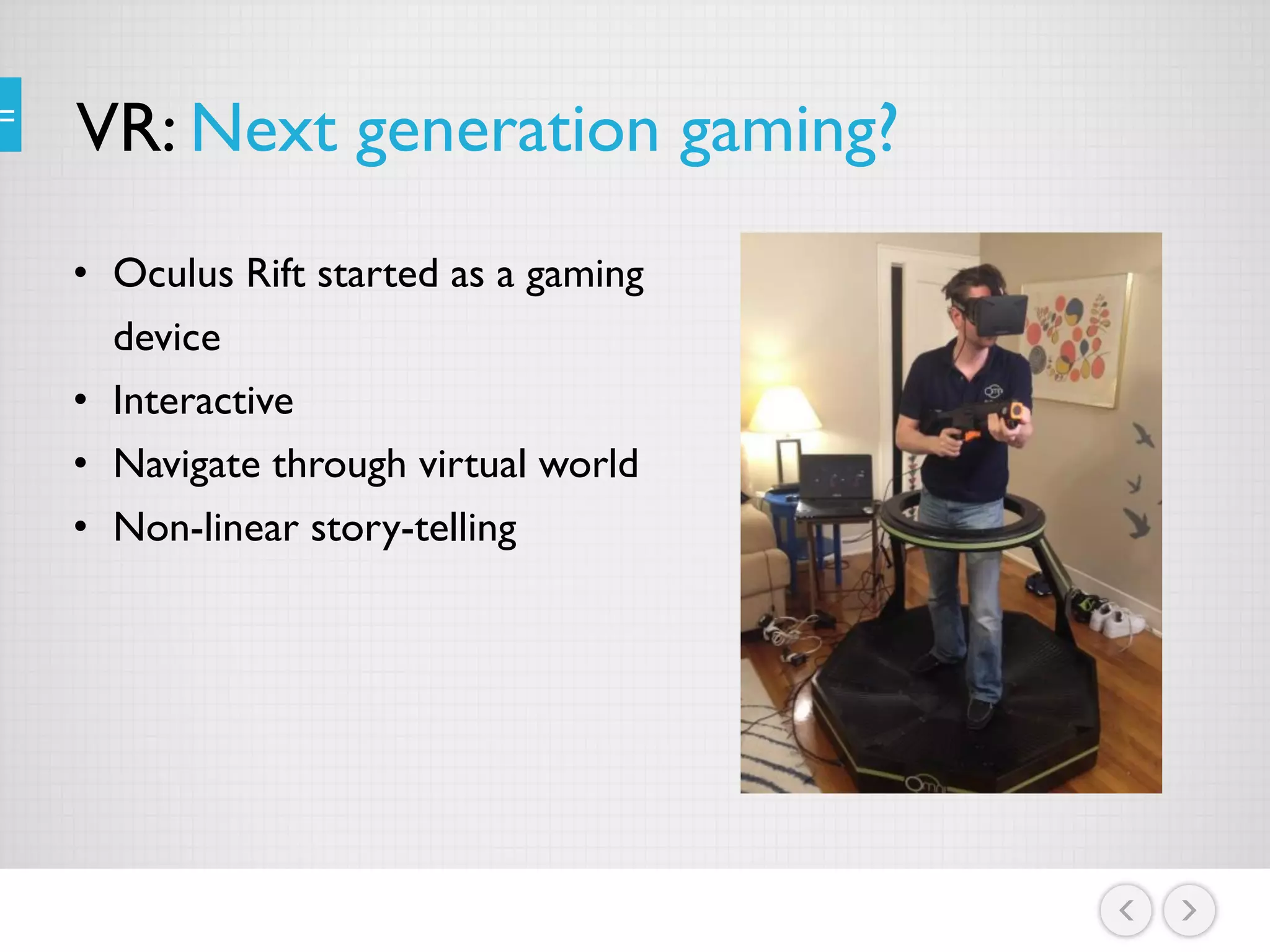
VR: Next generation gaming?
• Oculus Rift started as a gaming
device
• Interactive
• Navigate through virtual world
• Non-linear story-telling
VR: Immersive Cinema?
Development of spherical cameras
 Enormous increase in content
• EmbodiedVision 2015: relation between cinema andVR
• How is editing different in spherical video?
• How to draw focus to certain parts of the scene?
• Where to hide the crew?
• Experiments with cinematic effects inVR: green screens, stop-motion,
split-screens, the dolly zoom and timelapses
• Interactive cinema with gaze detection
VR: Future of Theatre?
VR: Interactive story-telling?
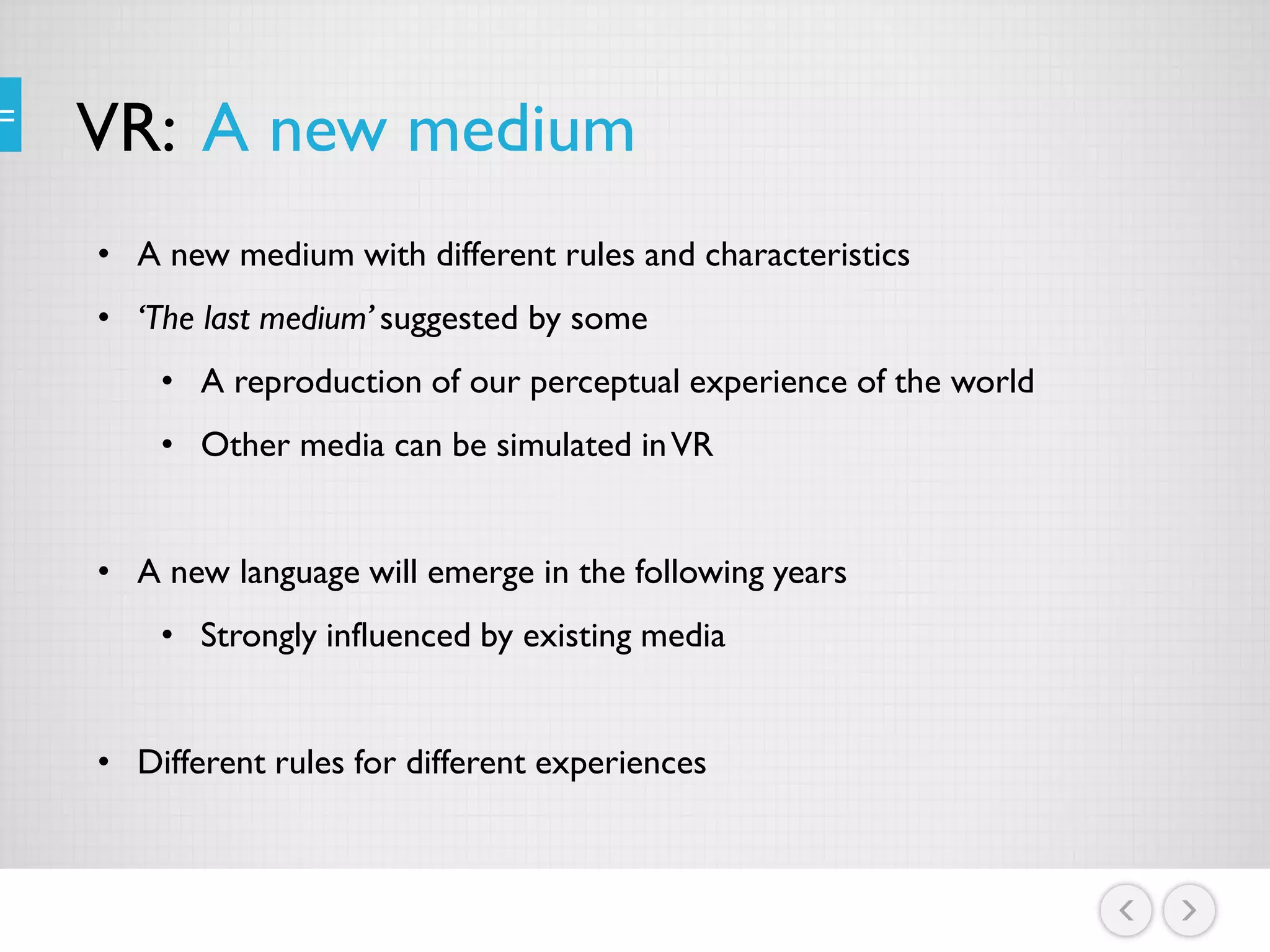
VR: A new medium
• A new medium with different rules and characteristics
• ‘The last medium’ suggested by some
• A reproduction of our perceptual experience of the world
• Other media can be simulated inVR
• A new language will emerge in the following years
• Strongly influenced by existing media
• Different rules for different experiences
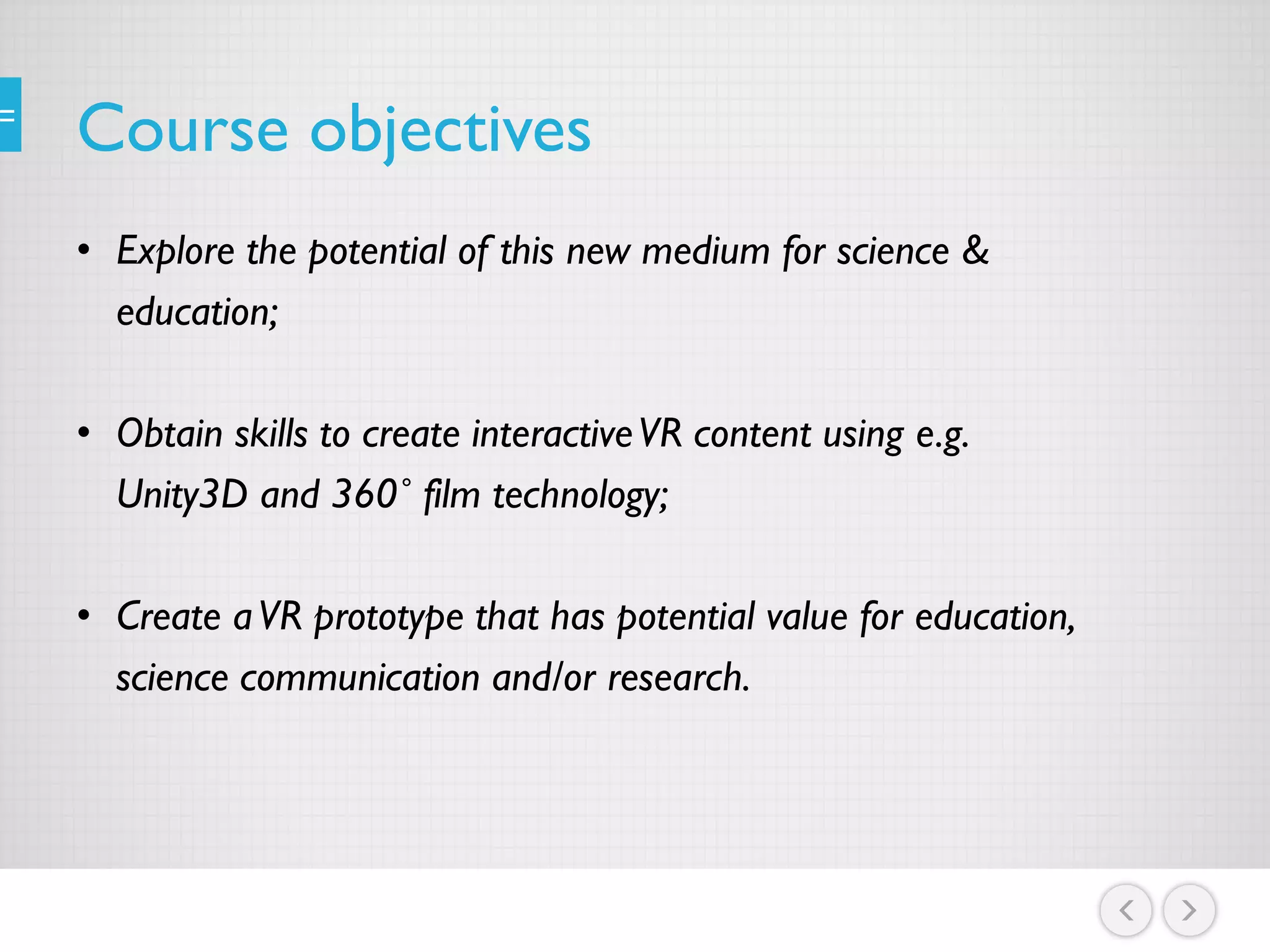
Course objectives
• Explore the potential of this new medium for science &
education;
• Obtain skills to create interactiveVR content using e.g.
Unity3D and 360˚ film technology;
• Create aVR prototype that has potential value for education,
science communication and/or research.
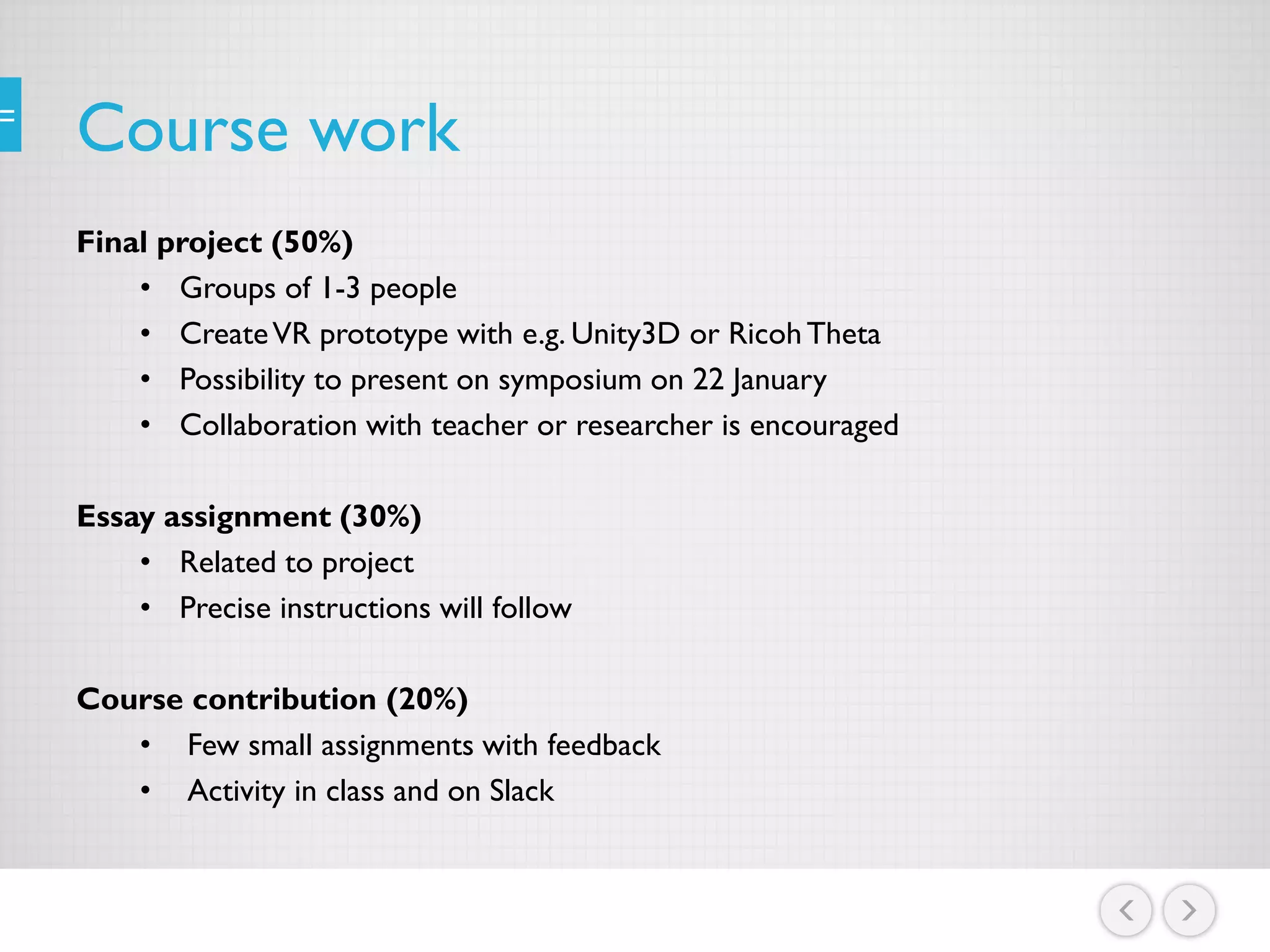
Course work
Final project (50%)
• Groups of 1-3 people
• CreateVR prototype with e.g. Unity3D or RicohTheta
• Possibility to present on symposium on 22 January
• Collaboration with teacher or researcher is encouraged
Essay assignment (30%)
• Related to project
• Precise instructions will follow
Course contribution (20%)
• Few small assignments with feedback
• Activity in class and on Slack
Slack
• Channel overview
• Posts and comments
• Dropbox, Google Drive, etc.
• Liking posts
• Direct messaging & Private channels
• Mobile app
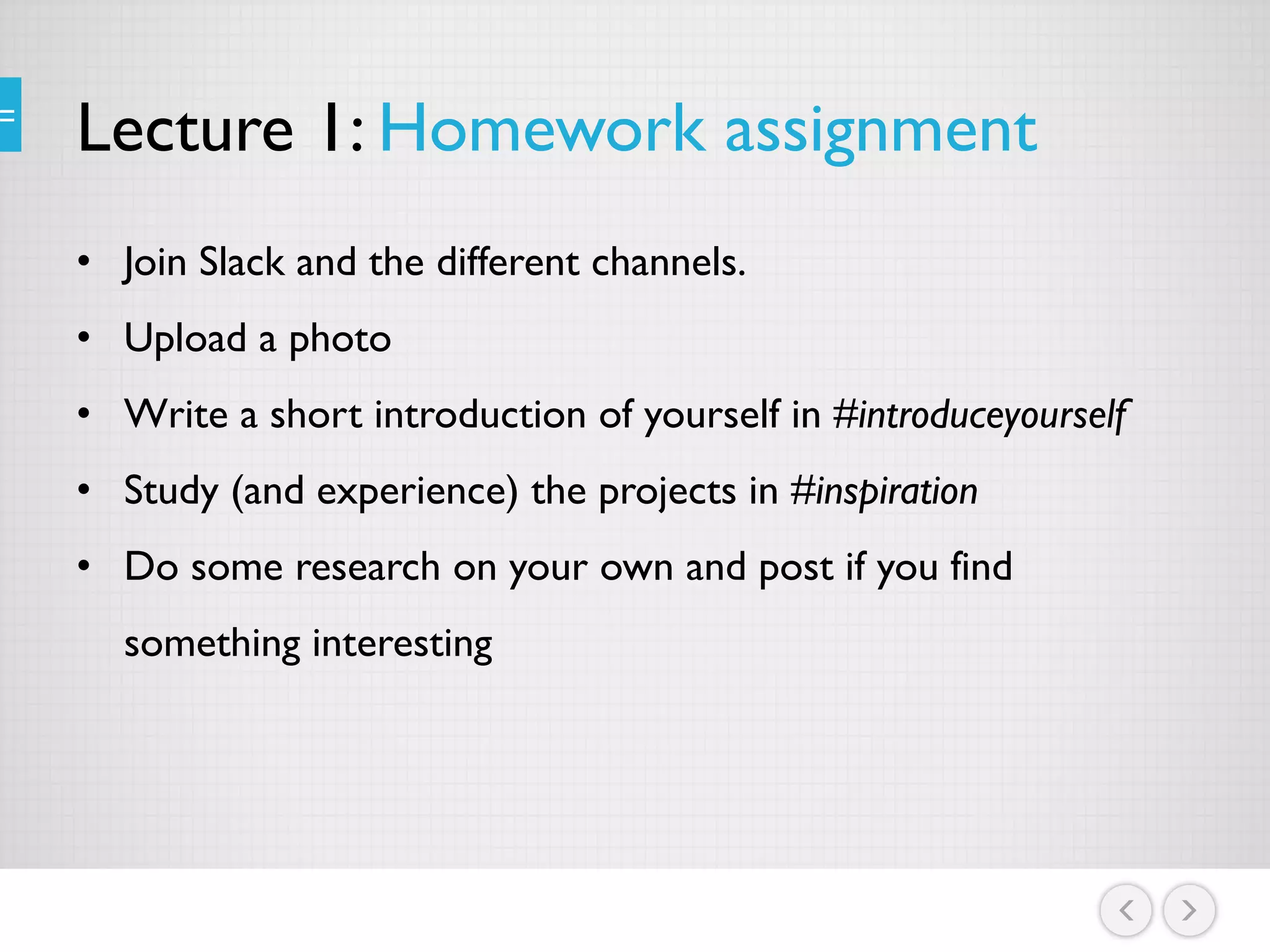
Lecture 1: Homework assignment
• Join Slack and the different channels.
• Upload a photo
• Write a short introduction of yourself in #introduceyourself
• Study (and experience) the projects in #inspiration
• Do some research on your own and post if you find
something interesting
HARDWARE USE

Virtual Reality: History & State of the Art

  • 1.
    VIRTUAL REALITY FORSCIENCE & EDUCATION LECTURE 1: 11 SEP 2015 Virtual Reality History & State of the Art
  • 2.
  • 3.
    Robin de Lange- CV Bachelor Physics Philosophy Artificial Intelligence MSc. MediaTechnology EDUCATION
  • 4.
    Robin de Lange- Education Extended cognition Augmented Reality Andy Clark Doug Engelbart Paul Smart
  • 5.
  • 6.
  • 7.
    Robin de Lange- CV Bachelor Physics Philosophy Artificial Intelligence MSc. MediaTechnology EDUCATION WORK Owner tutoring company Video production MOOC & SPOC Initiator Lyceo CodeWeken
  • 8.
    Graduation project • AugmentedReality prototype • Raise discussion • PhD proposal https://dl.dropboxusercontent.com/u/20732302/Demo %20ARMath.wmv
  • 9.
  • 10.
    Hack the Brain:Project Brainstorm • Live EEG data visualization for Oculus Rift • Together with Eva Delincakova & Bert Spaan @ Hack the Brain hackathon
  • 11.
    Focus of research •In what ways can we useVR to explain complex problems? • What are the obstacles and opportunities of VR in the field of education?
  • 12.
    Virtual Reality forScience & Education • Elective course as part of research project • Received LUF – Gratama grant for this project
  • 13.
  • 14.
    A Brief HistoryofVR Sensorama • 1955 by Morton Heilig • ExperienceTheater • Multi-sensory • No financial support
  • 15.
    A Brief HistoryofVR Headsight • 1961 by Philco Corp. • First Head Mounted Display • Magnetic tracking system • Live stream from camera system
  • 16.
    A Brief HistoryofVR The Ultimate Display • Paper by Ivan Sutherland • 1965 • Concept of a virtual world, created by a computer • Note: before any GUI “A display connected to a digital computer gives us a chance to gain familiarity with concepts not realizable in the physical world. It is a looking glass into a mathematical wonderland. “
  • 17.
    A Brief HistoryofVR LEEP Cyberface • 1989 • By Eric Howlett • First commercial HMD • Very wide angle stereoscopic optics
  • 18.
    A Brief HistoryofVR NintendoVirtual Boy • 1995 • Monochromatic display • No head-tracking, fixed position • Commercial failure • FromVR hype to disappointment
  • 19.
    A Brief HistoryofVR https://youtu.be/tdAaU0CRHng?t=1m51s
  • 20.
    A Brief HistoryofVR Oculus Rift • 2012: Kickstarter campaign • Much wider FOV • Low latency tracking • Aimed at consumer market • Benefits from developments in computer hardware • Acquired by Facebook in 2014 https://www.youtube.com/watch?v=DhcOMOWRMnA
  • 21.
    A Brief HistoryofVR Google Cardboard • Gift at 2014 Google I/O • Open source design • Starting from $2 • Start of mobileVR • Magnet as input button
  • 23.
    A Brief Historyof VR State of the Art • VR Ecosystem emerged • By 2018 > $5bln. market • Dozens of headsets • All sorts of input devices • Content developers • 360 / spherical video cameras • Video stitching software • Blogs, consultants, business analysts, etc http://greenlightvr.com/vr-ecosystem-map
  • 24.
    Hardware for thecourse Oculus Rift DK1 & DK2 GearVR Google Cardboard + MORE?
  • 25.
    Hardware for thecourse Razer HydraLeap MotionControllers + MORE?
  • 26.
  • 27.
    VR: Next generationgaming? • Oculus Rift started as a gaming device • Interactive • Navigate through virtual world • Non-linear story-telling
  • 28.
    VR: Immersive Cinema? Developmentof spherical cameras  Enormous increase in content • EmbodiedVision 2015: relation between cinema andVR • How is editing different in spherical video? • How to draw focus to certain parts of the scene? • Where to hide the crew? • Experiments with cinematic effects inVR: green screens, stop-motion, split-screens, the dolly zoom and timelapses • Interactive cinema with gaze detection
  • 29.
    VR: Future ofTheatre?
  • 30.
  • 31.
    VR: A newmedium • A new medium with different rules and characteristics • ‘The last medium’ suggested by some • A reproduction of our perceptual experience of the world • Other media can be simulated inVR • A new language will emerge in the following years • Strongly influenced by existing media • Different rules for different experiences
  • 32.
    Course objectives • Explorethe potential of this new medium for science & education; • Obtain skills to create interactiveVR content using e.g. Unity3D and 360˚ film technology; • Create aVR prototype that has potential value for education, science communication and/or research.
  • 33.
    Course work Final project(50%) • Groups of 1-3 people • CreateVR prototype with e.g. Unity3D or RicohTheta • Possibility to present on symposium on 22 January • Collaboration with teacher or researcher is encouraged Essay assignment (30%) • Related to project • Precise instructions will follow Course contribution (20%) • Few small assignments with feedback • Activity in class and on Slack
  • 34.
    Slack • Channel overview •Posts and comments • Dropbox, Google Drive, etc. • Liking posts • Direct messaging & Private channels • Mobile app
  • 35.
    Lecture 1: Homeworkassignment • Join Slack and the different channels. • Upload a photo • Write a short introduction of yourself in #introduceyourself • Study (and experience) the projects in #inspiration • Do some research on your own and post if you find something interesting
  • 36.