Virtual Reality Technology
Dr. A.C. SANTHA SHEELA
Associate Professor – Department of CSE
Sathyabama Institute of Science and Technology
29-JUN-2022
Agenda
 What is Virtual Reality (VR)
 Why We Use VR
 VR Tools in Education
 Who Uses VR
 Trends Related to VR
 Jobs in the VR industry
 AR VR Developer Salaries
 Find Job in VR
What is Virtual Reality (VR)?
• VR is completely a 3D environment
created from a combination of
software and compatible hardware
• This completely immerses the user
into the 3D environment, giving
them the ability to interact with the
virtual world in a seemingly real
way
• The virtual world is created by
software developers and then
rendered in a way that users can
interact with the objects created by
developers.
What is Virtual Reality (VR) ?
Headsets help provide users the illusion of being
completely immersed in the 3D environment. These
3D objects tend to respond to changes in the user’s
movement, and the interactions mimic those in the
real world.
Certain additional hardware components, such as
gloves or other accessories around the room, can
also simulate additional senses, such as touch.
Why We Use Virtual Reality (VR)?
• Virtually test out a product — For businesses that sell a product, VR
technology allows users to visualize what owning a product would be like.
Consumers can take a product for a "virtual test drive" before they commit
to a purchase.
• Expand Education — VR can take hands-on learning to the next level.
Instead of observing a teacher perform a task, a student or trainee can
visualize themselves performing it.
• Go one step past 3D modeling — Some VR tools allow users to develop,
sculpt, model, paint, and create tangible objects in a VR environment.
Users can interact with 3D models from any angle with tools like these.
VR Tools in Education
• Zspace
• 3D Bear
• Thyng
• Cospaces
• VR world TiltBrush
VR Tools in Education Cont..
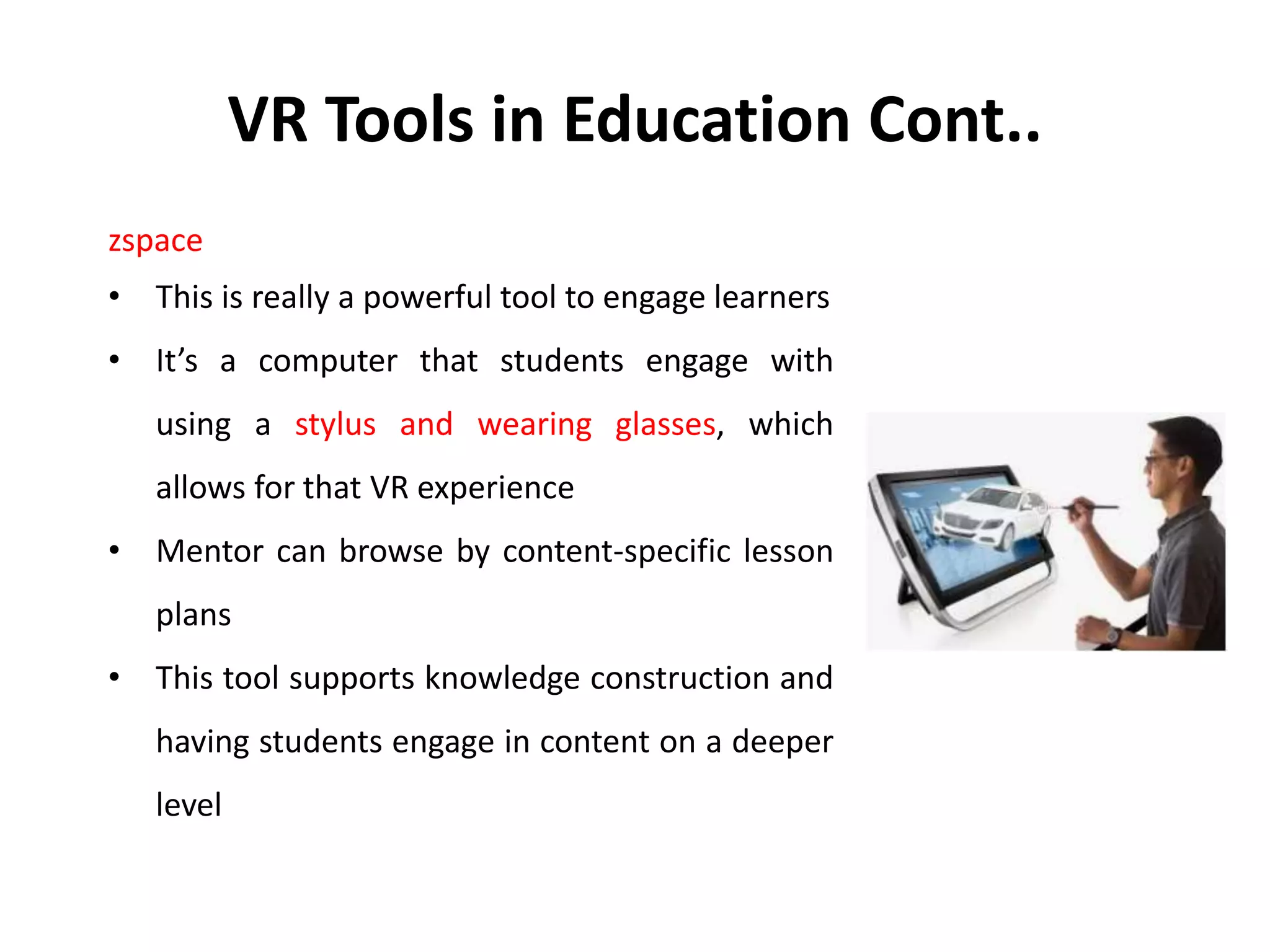
zspace
• This is really a powerful tool to engage learners
• It’s a computer that students engage with
using a stylus and wearing glasses, which
allows for that VR experience
• Mentor can browse by content-specific lesson
plans
• This tool supports knowledge construction and
having students engage in content on a deeper
level
VR Tools in Education Cont..
• 3D Bear: This tool offers
another opportunity to
create scenes.
• Instead of doing a
traditional storyboard
or comic strip, students
can recreate the scenes
to represent their
learning.
VR Tools in Education Cont..
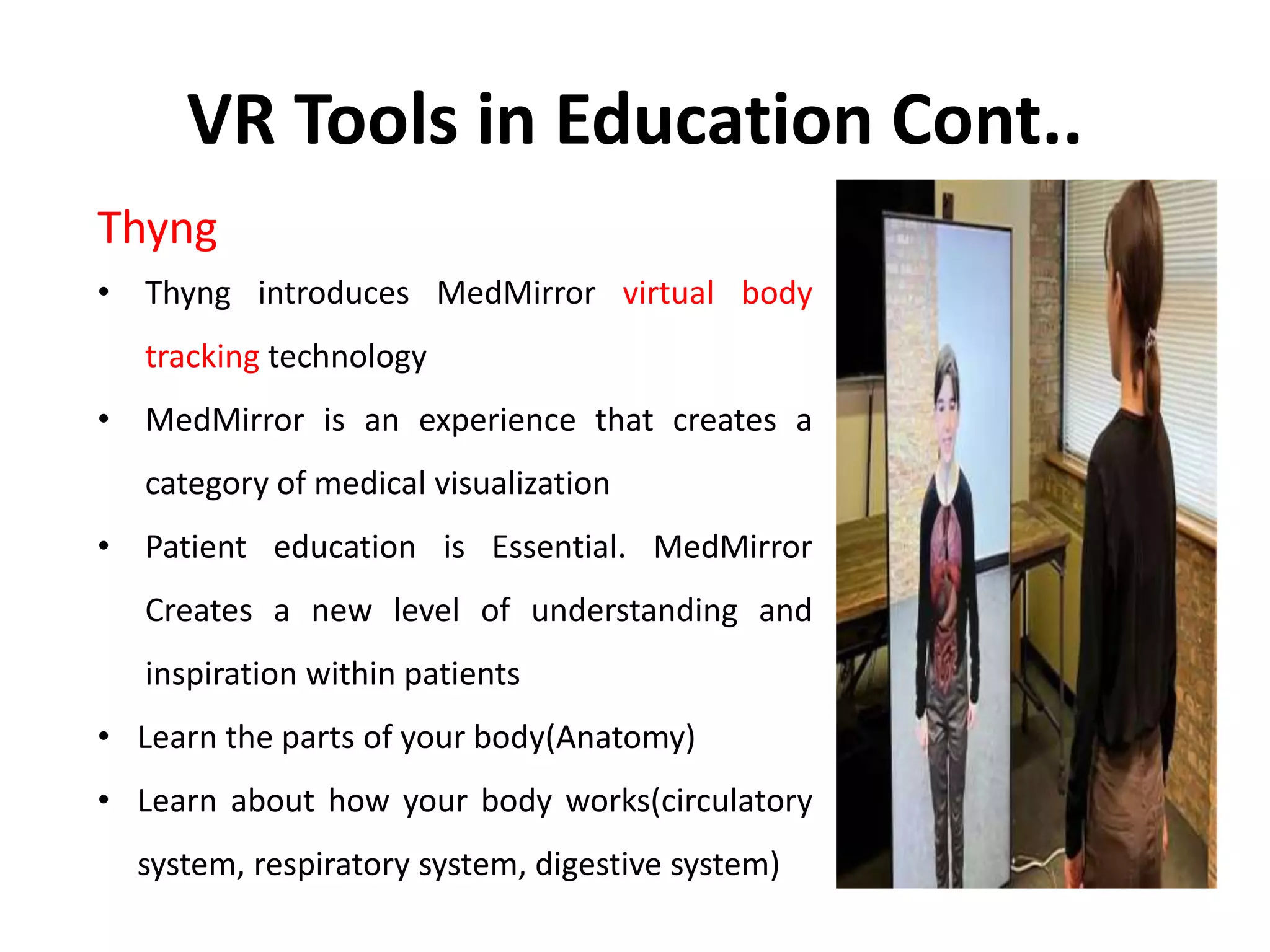
Thyng
• Thyng introduces MedMirror virtual body
tracking technology
• MedMirror is an experience that creates a
category of medical visualization
• Patient education is Essential. MedMirror
Creates a new level of understanding and
inspiration within patients
• Learn the parts of your body(Anatomy)
• Learn about how your body works(circulatory
system, respiratory system, digestive system)
Who Uses Virtual Reality (VR)?
• Architects and Engineers
• Game Developers
• Military Sport
• Mental Health
• Medical Training
• Education
• Fashion
• And more!
Who Uses Virtual Reality (VR)? Cont..
• Game developers — VR is becoming a
massively popular medium within game
development.
• Developers can use VR tools to create a
completely immersive user experience for
gamers
• Those playing the game can fully interact
with the created characters as if they are
part of the universe
• Users can typically access these games
through headsets or mobile devices
VR Tools for Game Developers Cont..
Who Uses Virtual Reality (VR)? Cont..
• Architects and Engineers — 3D design is becoming more common within
architecture and engineering, as this type of design enables users to
manipulate the objects they are designing from every angle
• By designing in VR, users can be completely immersed in the environment
as they create
• These tools have expanded on the 3D capabilities offered by CAD
software, allowing users to design, manipulate, and collaborate on
projects in a virtual environment
VR Tools for Architect’s Cont..
• Fuzor instantly transforms Revit
or SketchUp models into virtual
reality experiences
• This is a tool for construction,
because it greatly speeds up the
process to get designs into VR —
allowing users to iterate and
improve on their designs
VR Tools for Architect's Cont..
• Enscape is a Revit plug-in that
creates a VR walk-through with
one click based on your BIM data
• No need to download or learn
how to operate additional
software
• All materials, geometry and
entourage come from your Revit
project and can be changed
during the VR simulation
Trends Related to VR
• 360-degree video — These are videos where a certain view is
shown from every perspective, which deliver a completely
immersive VR experience.
• Studies have shown that user engagement with 360-degree videos
is quickly growing, proving that there will be an increased adoption
of 360-degree videos on a larger scale.
• https://youtu.be/kK_MuPEm2kQ
Trends Related to VR Cont..
• Increased availability — Large
names in VR, such as Oculus and
HTC, have been publicly working
to decrease the price of their
headsets. As prices are made
more affordable, we will likely see
a larger mass adoption of VR
tools.
• Omdia research reveals 12.5
million consumer VR headsets
sold in 2021 with content spend
exceeding $2bn.
• 148% increase on 2021.
• 2.4 headsets per hundred
households in 2021.
Trends Related to VR Cont..
• More jobs in the VR field — VR is still
growing as a technology, and the
technology needs skilled developers to
help bring VR to its full potential
• As the software and integrating
hardware becomes more in demand by
the general public, there will be a greater
need for more VR developers
• Expect to see more posting in the VR
space on job boards in the next few years
Jobs in the VR industry?
 Software engineer
 Virtual reality content writer
 UI (user interface) and UX (user experience) designer
 Mixed reality artist
 Virtual reality game engineer
 Technical 3D artist
 Product management
 Virtual reality sound effects specialist
 Quality assurance
 Content producer
 Software developer
 Virtual reality maintenance and support
 Distribution manager
 And more!
AR VR Developer Salaries
How can you find a job in virtual
reality?
• It’s essential to stay up to date on any advancements and
never stop learning
• Be adaptable and open to the changing software, tools, and
processes and seek out upskilling opportunities whenever
you can
Thank You

Virtual Reality Technology - By Dr. A.C Santha Sheela.pptx

  • 1.
    Virtual Reality Technology Dr.A.C. SANTHA SHEELA Associate Professor – Department of CSE Sathyabama Institute of Science and Technology 29-JUN-2022
  • 2.
    Agenda  What isVirtual Reality (VR)  Why We Use VR  VR Tools in Education  Who Uses VR  Trends Related to VR  Jobs in the VR industry  AR VR Developer Salaries  Find Job in VR
  • 3.
    What is VirtualReality (VR)? • VR is completely a 3D environment created from a combination of software and compatible hardware • This completely immerses the user into the 3D environment, giving them the ability to interact with the virtual world in a seemingly real way • The virtual world is created by software developers and then rendered in a way that users can interact with the objects created by developers.
  • 4.
    What is VirtualReality (VR) ? Headsets help provide users the illusion of being completely immersed in the 3D environment. These 3D objects tend to respond to changes in the user’s movement, and the interactions mimic those in the real world. Certain additional hardware components, such as gloves or other accessories around the room, can also simulate additional senses, such as touch.
  • 5.
    Why We UseVirtual Reality (VR)? • Virtually test out a product — For businesses that sell a product, VR technology allows users to visualize what owning a product would be like. Consumers can take a product for a "virtual test drive" before they commit to a purchase. • Expand Education — VR can take hands-on learning to the next level. Instead of observing a teacher perform a task, a student or trainee can visualize themselves performing it. • Go one step past 3D modeling — Some VR tools allow users to develop, sculpt, model, paint, and create tangible objects in a VR environment. Users can interact with 3D models from any angle with tools like these.
  • 6.
    VR Tools inEducation • Zspace • 3D Bear • Thyng • Cospaces • VR world TiltBrush
  • 7.
    VR Tools inEducation Cont.. zspace • This is really a powerful tool to engage learners • It’s a computer that students engage with using a stylus and wearing glasses, which allows for that VR experience • Mentor can browse by content-specific lesson plans • This tool supports knowledge construction and having students engage in content on a deeper level
  • 8.
    VR Tools inEducation Cont.. • 3D Bear: This tool offers another opportunity to create scenes. • Instead of doing a traditional storyboard or comic strip, students can recreate the scenes to represent their learning.
  • 9.
    VR Tools inEducation Cont.. Thyng • Thyng introduces MedMirror virtual body tracking technology • MedMirror is an experience that creates a category of medical visualization • Patient education is Essential. MedMirror Creates a new level of understanding and inspiration within patients • Learn the parts of your body(Anatomy) • Learn about how your body works(circulatory system, respiratory system, digestive system)
  • 10.
    Who Uses VirtualReality (VR)? • Architects and Engineers • Game Developers • Military Sport • Mental Health • Medical Training • Education • Fashion • And more!
  • 11.
    Who Uses VirtualReality (VR)? Cont.. • Game developers — VR is becoming a massively popular medium within game development. • Developers can use VR tools to create a completely immersive user experience for gamers • Those playing the game can fully interact with the created characters as if they are part of the universe • Users can typically access these games through headsets or mobile devices
  • 12.
    VR Tools forGame Developers Cont..
  • 13.
    Who Uses VirtualReality (VR)? Cont.. • Architects and Engineers — 3D design is becoming more common within architecture and engineering, as this type of design enables users to manipulate the objects they are designing from every angle • By designing in VR, users can be completely immersed in the environment as they create • These tools have expanded on the 3D capabilities offered by CAD software, allowing users to design, manipulate, and collaborate on projects in a virtual environment
  • 14.
    VR Tools forArchitect’s Cont.. • Fuzor instantly transforms Revit or SketchUp models into virtual reality experiences • This is a tool for construction, because it greatly speeds up the process to get designs into VR — allowing users to iterate and improve on their designs
  • 15.
    VR Tools forArchitect's Cont.. • Enscape is a Revit plug-in that creates a VR walk-through with one click based on your BIM data • No need to download or learn how to operate additional software • All materials, geometry and entourage come from your Revit project and can be changed during the VR simulation
  • 16.
    Trends Related toVR • 360-degree video — These are videos where a certain view is shown from every perspective, which deliver a completely immersive VR experience. • Studies have shown that user engagement with 360-degree videos is quickly growing, proving that there will be an increased adoption of 360-degree videos on a larger scale. • https://youtu.be/kK_MuPEm2kQ
  • 17.
    Trends Related toVR Cont.. • Increased availability — Large names in VR, such as Oculus and HTC, have been publicly working to decrease the price of their headsets. As prices are made more affordable, we will likely see a larger mass adoption of VR tools. • Omdia research reveals 12.5 million consumer VR headsets sold in 2021 with content spend exceeding $2bn. • 148% increase on 2021. • 2.4 headsets per hundred households in 2021.
  • 18.
    Trends Related toVR Cont.. • More jobs in the VR field — VR is still growing as a technology, and the technology needs skilled developers to help bring VR to its full potential • As the software and integrating hardware becomes more in demand by the general public, there will be a greater need for more VR developers • Expect to see more posting in the VR space on job boards in the next few years
  • 19.
    Jobs in theVR industry?  Software engineer  Virtual reality content writer  UI (user interface) and UX (user experience) designer  Mixed reality artist  Virtual reality game engineer  Technical 3D artist  Product management  Virtual reality sound effects specialist  Quality assurance  Content producer  Software developer  Virtual reality maintenance and support  Distribution manager  And more!
  • 20.
  • 21.
    How can youfind a job in virtual reality? • It’s essential to stay up to date on any advancements and never stop learning • Be adaptable and open to the changing software, tools, and processes and seek out upskilling opportunities whenever you can
  • 22.