




1
Potential Health Impacts of Natural Gas
Extraction Using High Volume, Slickwater
Hydraulic Fracturing from Long Laterals
(Fracking)
Jerome A. Paulson, MD, FAAP
Professor of Pediatrics &
Professor of Environmental & Occupational Health
George Washington University
Medical Director for National & Global Affairs,
Child Health Advocacy Institute &
Director, Mid-Atlantic Center for Children’s Health & the Environment
Children’s National Health System
2
• This material was developed by the Mid-Atlantic Center
for Children’s Health & the Environment and funded
under the cooperative agreement award number
1U61TS000118-03 from the Agency for Toxic Substances
and Disease Registry (ATSDR).
• Acknowledgement: The U.S. Environmental Protection
Agency (EPA) supports the PEHSU by providing funds to
ATSDR under Inter-Agency Agreement number DW-75-
92301301-0. Neither EPA nor ATSDR endorse the
purchase of any commercial products or services
mentioned in PEHSU publications.
- - - - - - - - - - - - - - - - - - - - - - - - - - - - - - - - - - - - - - - - - - - - - - -
• Dr Paulson has provided factual information to lawyers
regarding the potential health impact of natural gas
extraction with hydraulic fracturing.
Sources of Funding
Potential Conflict of Interest
3
• The listener should be able to
– Describe difference between children and adults
relevant to unconventional gas extraction
– Describe the process of Natural Gas Extraction
Using High Volume, Slickwater Hydraulic
Fracturing from Long Laterals from Clustered
Multi-Well Pads (AKA Unconventional Gas
Extraction)
– Describe some of the toxicants associated with
unconventional gas extraction.
– List the potential health hazards associated with
natural gas extraction with hydraulic fracturing
Objectives
4
CHILDREN
5
• Have longer “shelf life”
– Vulnerable periods of development
• Eat more, drink more, breath more per unit
body weight than adult
• Different metabolism than adults
Children Are Not Little Adults
6
• Preconception  Embryo Fetus  Infant
 Toddler  School age child 
Adolescent
Growth & Development
7
• Exposures preconception and in utero 
birth defects or later problems
• Timing of exposure also important when
occurs after birth
– Lead poisoning – outcome, in part, function of
age at exposure
– Some carcinogens – pesticides, ionizing
radiation, UV light
• Very little research on critical periods during
adolescence in spite of many changes
during that time frame
Growth & Development
8
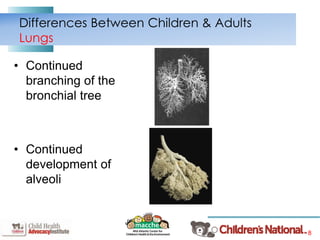
Differences Between Children & Adults
Lungs
• Continued
branching of the
bronchial tree
• Continued
development of
alveoli
9
Differences Between Children & Adults
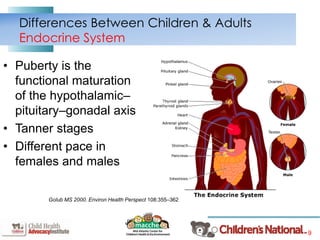
Endocrine System
• Puberty is the
functional maturation
of the hypothalamic–
pituitary–gonadal axis
• Tanner stages
• Different pace in
females and males
Golub MS 2000. Environ Health Perspect 108:355–362
10
Unconventional Gas Extraction
11
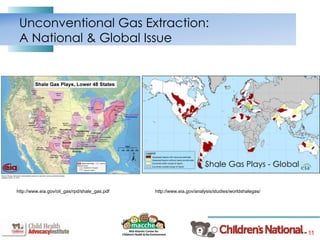
Unconventional Gas Extraction:
A National & Global Issue
Shale Gas Plays - Global
http://www.eia.gov/analysis/studies/worldshalegas/http://www.eia.gov/oil_gas/rpd/shale_gas.pdf
12
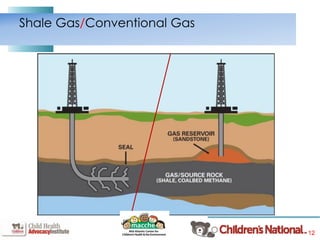
Shale Gas/Conventional Gas
13
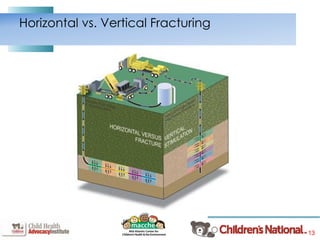
Horizontal vs. Vertical Fracturing
14
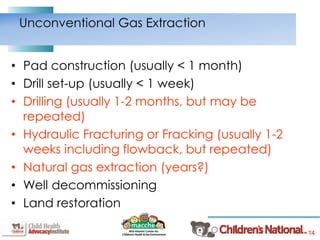
• Pad construction (usually < 1 month)
• Drill set-up (usually < 1 week)
• Drilling (usually 1-2 months, but may be
repeated)
• Hydraulic Fracturing or Fracking (usually 1-2
weeks including flowback, but repeated)
• Natural gas extraction (years?)
• Well decommissioning
• Land restoration
Unconventional Gas Extraction
15
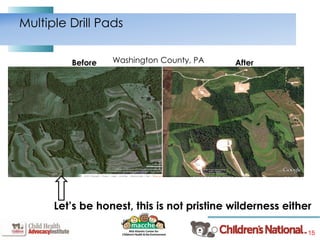
Multiple Drill Pads
Before Washington County, PA After
Let’s be honest, this is not pristine wilderness either
16
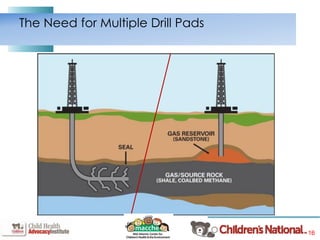
The Need for Multiple Drill Pads
17
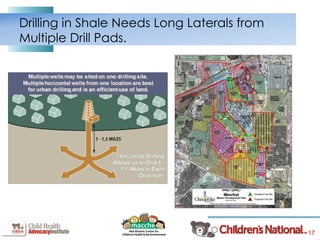
Drilling in Shale Needs Long Laterals from
Multiple Drill Pads.
18
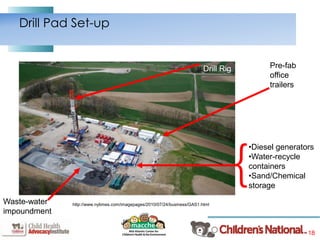
Drill Pad Set-up
Drill Rig
Waste-water
impoundment
Pre-fab
office
trailers
•Diesel generators
•Water-recycle
containers
•Sand/Chemical
storage
http://www.nytimes.com/imagepages/2010/07/24/business/GAS1.html
{
19
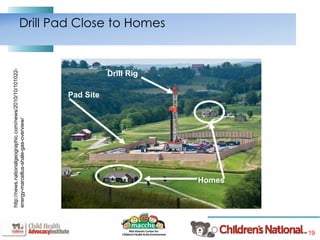
Drill Pad Close to Homes
http://news.nationalgeographic.com/news/2010/10/101022-
energy-marcellus-shale-gas-overview/
Homes
Pad Site
Drill Rig
20
Overall Process
21
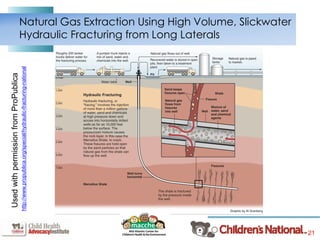
Natural Gas Extraction Using High Volume, Slickwater
Hydraulic Fracturing from Long Laterals
UsedwithpermissionfromProPublica
http://www.propublica.org/special/hydraulic-fracturing-national
22
Air pollution
23
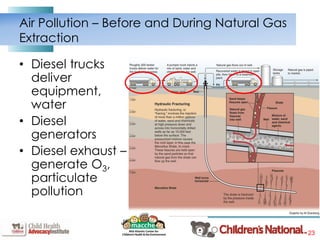
Air Pollution – Before and During Natural Gas
Extraction
• Diesel trucks
deliver
equipment,
water
• Diesel
generators
• Diesel exhaust –
generate O3,
particulate
pollution
24
• Trucked-in water: 5,000,000 gal@ 3,000
gal/trk = 1667 truckloads
• Trucked-in proppant: 1,500,000 lbs @ 2000
lbs/trk = 750 truckloads
• X 1 to 10 frack episodes per well
Diesel Trucks
Estimate from EPA ORD
http://yosemite.epa.gov/sab/sabproduct.nsf/5DEE6115FCA43661852576FD006B8460/$File/EPA+Presentation+Materials+4-6-
10+for+EEC+Apr+7-8+2010+Meeting.pdf
25
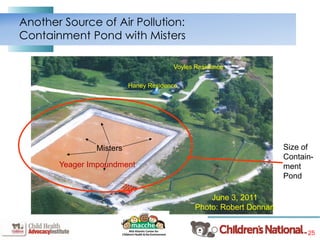
Another Source of Air Pollution:
Containment Pond with Misters
Misters Size of
Contain-
ment
Pond
Voyles Residence
Haney Residence
Yeager Impoundment
June 3, 2011
Photo: Robert Donnan
26
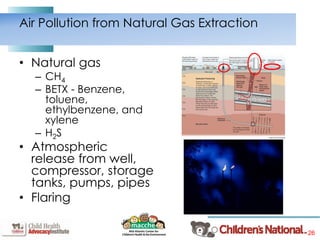
Air Pollution from Natural Gas Extraction
• Natural gas
– CH4
– BETX - Benzene,
toluene,
ethylbenzene, and
xylene
– H2S
• Atmospheric
release from well,
compressor, storage
tanks, pumps, pipes
• Flaring
27
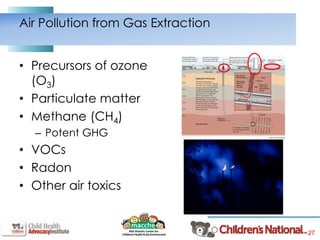
Air Pollution from Gas Extraction
• Precursors of ozone
(O3)
• Particulate matter
• Methane (CH4)
– Potent GHG
• VOCs
• Radon
• Other air toxics
28
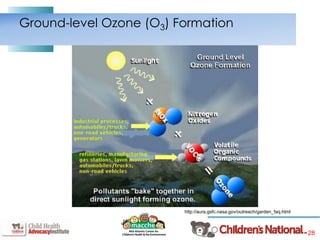
Ground-level Ozone (O3) Formation
http://aura.gsfc.nasa.gov/outreach/garden_faq.html
29
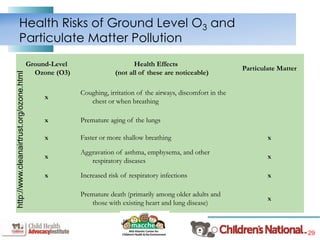
Ground-Level
Ozone (O3)
Health Effects
(not all of these are noticeable)
Particulate Matter
x
Coughing, irritation of the airways, discomfort in the
chest or when breathing
x Premature aging of the lungs
x Faster or more shallow breathing x
x
Aggravation of asthma, emphysema, and other
respiratory diseases
x
x Increased risk of respiratory infections x
Premature death (primarily among older adults and
those with existing heart and lung disease)
x
Health Risks of Ground Level O3 and
Particulate Matter Pollution
http://www.cleanairtrust.org/ozone.html
30
• Neural tube defects
– Lupo et al.. 2011. Maternal Exposure to Ambient
Levels of Benzene and Neural Tube Defects among
Offspring: Texas, 1999–2004. Environ Health Perspect
119:397-402
• Decreased birth parameters
– Slama R, et al. 2009. Maternal Personal Exposure to
Airborne Benzene and Intrauterine Growth. Environ
Health Perspect 117:1313-1321
• Childhood leukemia
– Whitworth KW, et al. 2008. Childhood
Lymphohematopoietic Cancer Incidence and
Hazardous Air Pollutants in Southeast Texas, 1995–
2004. Environ Health Perspect 116:1576-1580.
Associations with Prenatal Exposure to
Airborne Benzene
31
• Hill’s Study
– Compare birth outcomes among women living
near wells drill and sites permitted but not drilled
– Babies born to mothers living closer to wells
drilled more likely to be SGA
Association with Living Close to
Unconventional Gas Extraction Sites
Hill EL Unconventional Natural Gas
Development and Infant Health – Evidence
from Pennsylvania Cornell Univ. Working
Paper 2012-12 07-2012
32
• McKenzie Study
– Birth Outcomes
– Concerns
• Toluene and xylene teratogen
• Benzene mutagen and carcinogen
– Look at the association of the pregnant woman’s proximity to well and birth
certificate and birth defects surveillance
• 125,000 infants born 96-09
• Rural only
• Exposed – any well w/in 10 mile
• Index of exposure by looking at distance of wells w/in the 10 mi limit
– Divide into 3 groups
• Unexposed – no wells w/in 10 mi
– OR for heart defects 1.3 for high exposure with dose-response from low to high
– OR for neural tube defect 2.0 for high exposure with no dose response
– OR for oral cleft – not relationship
– OR for preterm birth – nonsignificant but slight trend for improved outcome
with more exposure
– OR for LBW – not significant
Association with Living Close to
Unconventional Gas Extraction Sites
McKenzie LM, et al. (2014) Birth Outcomes and Maternal
Residential Proximity to Natural Gas Development in Rural
Colorado. Environmental Health Perspectives, 122(4): 412-417.
33
Water pollution
34
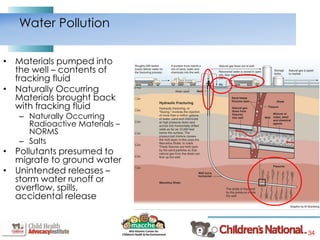
Water Pollution
• Materials pumped into
the well – contents of
fracking fluid
• Naturally Occurring
Materials brought back
with fracking fluid
– Naturally Occurring
Radioactive Materials –
NORMS
– Salts
• Pollutants presumed to
migrate to ground water
• Unintended releases –
storm water runoff or
overflow, spills,
accidental release
35
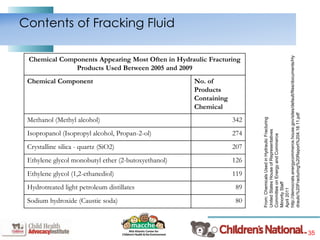
Contents of Fracking Fluid
Chemical Components Appearing Most Often in Hydraulic Fracturing
Products Used Between 2005 and 2009
Chemical Component No. of
Products
Containing
Chemical
Methanol (Methyl alcohol) 342
Isopropanol (Isopropyl alcohol, Propan-2-ol) 274
Crystalline silica - quartz (SiO2) 207
Ethylene glycol monobutyl ether (2-butoxyethanol) 126
Ethylene glycol (1,2-ethanediol) 119
Hydrotreated light petroleum distillates 89
Sodium hydroxide (Caustic soda) 80
From:ChemicalsUsedinHydraulicFracturing
UnitedStatesHouseofRepresentatives
CommitteeonEnergyandCommerce
MinorityStaff
April2011
http://democrats.energycommerce.house.gov/sites/default/files/documents/Hy
draulic%20Fracturing%20Report%204.18.11.pdf
36
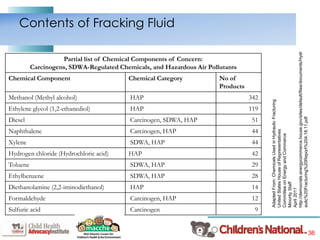
Contents of Fracking Fluid
AdaptedFrom:ChemicalsUsedinHydraulicFracturing
UnitedStatesHouseofRepresentatives
CommitteeonEnergyandCommerce
MinorityStaff
April2011
http://democrats.energycommerce.house.gov/sites/default/files/documents/Hydr
aulic%20Fracturing%20Report%204.18.11.pdf
Partial list of Chemical Components of Concern:
Carcinogens, SDWA-Regulated Chemicals, and Hazardous Air Pollutants
Chemical Component Chemical Category No of
Products
Methanol (Methyl alcohol) HAP 342
Ethylene glycol (1,2-ethanediol) HAP 119
Diesel Carcinogen, SDWA, HAP 51
Naphthalene Carcinogen, HAP 44
Xylene SDWA, HAP 44
Hydrogen chloride (Hydrochloric acid) HAP 42
Toluene SDWA, HAP 29
Ethylbenzene SDWA, HAP 28
Diethanolamine (2,2-iminodiethanol) HAP 14
Formaldehyde Carcinogen, HAP 12
Sulfuric acid Carcinogen 9
37
• Tap water in Dimock, PA documented to
contain methane
• Tap water in Parker County, TX documented
to contain methane
Migration of Pollutants to Groundwater
38
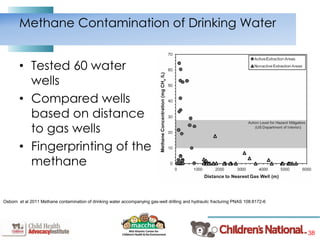
Methane Contamination of Drinking Water
Osborn et al 2011 Methane contamination of drinking water accompanying gas-well drilling and hydraulic fracturing PNAS 108:8172-6
• Tested 60 water
wells
• Compared wells
based on distance
to gas wells
• Fingerprinting of the
methane
39
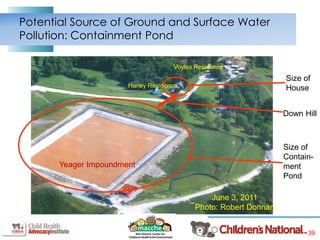
Potential Source of Ground and Surface Water
Pollution: Containment Pond
Size of
House
Size of
Contain-
ment
Pond
Down Hill
Voyles Residence
Haney Residence
Yeager Impoundment
June 3, 2011
Photo: Robert Donnan
40
Climate Change
41
• Methane Is a Much More Potent
Greenhouse Gas than Carbon Dioxide
• It Is Vented and Leaked….
– During initial frack fluid flow-back period (several
million ft3/day X several days)
– Routinely and continuously at the well site
– During liquid unloading
– During gas processing
– During transmission, storage, and distribution
Climate Change
A. R. Ingraffea, Ph.D., P.E.
Cornell University and Physicians, Scientists, and Engineers for Sustainable and Healthy Energy, Inc.
42
STRESS
43
• During drilling and fracking – 24/7 industrial
operation with noise and lights
• Noise from trucks and diesel-powered
equipment
• Noise from flaring
• Odors
• Community disruption
Noise & Light Pollution
44
• Know that sleep disruption effects
concentration, school performance, safety
on the job and on the road
• Growing body of evidence that stress
adversely affects the cardiovascular,
immune and other systems
Outcomes from Stress
45
CONCLUSIONS
47
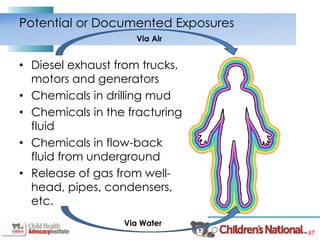
Potential or Documented Exposures
• Diesel exhaust from trucks,
motors and generators
• Chemicals in drilling mud
• Chemicals in the fracturing
fluid
• Chemicals in flow-back
fluid from underground
• Release of gas from well-
head, pipes, condensers,
etc.
Via Air
Via Water
48
• No data to document that there are
widespread, adverse human health
consequences occurring as a result of Natural
Gas Extraction Using High Volume, Slickwater
Hydraulic Fracturing from Long Laterals from
Clustered Multi-Well Pads .
• A number of hazardous chemicals used in and
produced by Unconventional Gas Extraction.
• A number of very plausible and in some cases
documented, routes of human exposure.
Conclusions
49
• Drilling and energy companies must demonstrate that
the drilling and gas recovery can be done in a way that
minimizes the threat to human and ecosystem health.
• Should establish independent foundation to fund
research.
– Health Effects Institute
– Western Interprovincial Scientific Studies Association (WISSA)
• Their responsibility to reveal the full description of all
chemicals used and the quantities of those chemicals
used to the public.
• Should not be the responsibility of the public to fund
research to determine whether hydraulic fracturing and
natural gas recovery from shale is dangerous after the
fact.
Recommendations
50
PEDIATRIC ENVIRONMENTAL HEALTH SPECIALTY
UNITS (PEHSUs)
51
• A resource for pediatricians, public health
officials, school personnel, parents and
others to get questions answered about
children’s health and the environment
What is a PEHSU?
52
• Lead poisoning
• Pesticide exposures
• Sick building problems
• Water pollution
• Air pollution
• Job related exposures
in adolescents
• Volatile Organic
Compounds
What Kinds of Problems do PEHSUs Deal With?
• Exposure to
hazardous waste sites
• Environmentally
related asthma
• Agricultural pollutants
• Solvents
• Carbon monoxide
• Arsenic
• Mercury
53
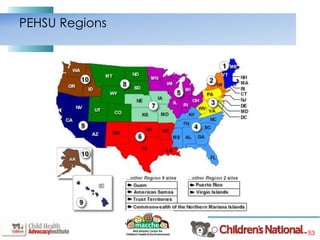
PEHSU Regions
54
• www.pehsu.net
Additional Information About PEHSUs
55
QUESTIONS?
Mid-Atlantic Center
for Children’s Health & the Environment
202-471-4829
1-866-622-2431
macche@childrensnational.org

Session 2: How Unconventional Natural Gas Extraction Effects Children

  • 1.
    1 Potential Health Impactsof Natural Gas Extraction Using High Volume, Slickwater Hydraulic Fracturing from Long Laterals (Fracking) Jerome A. Paulson, MD, FAAP Professor of Pediatrics & Professor of Environmental & Occupational Health George Washington University Medical Director for National & Global Affairs, Child Health Advocacy Institute & Director, Mid-Atlantic Center for Children’s Health & the Environment Children’s National Health System
  • 2.
    2 • This materialwas developed by the Mid-Atlantic Center for Children’s Health & the Environment and funded under the cooperative agreement award number 1U61TS000118-03 from the Agency for Toxic Substances and Disease Registry (ATSDR). • Acknowledgement: The U.S. Environmental Protection Agency (EPA) supports the PEHSU by providing funds to ATSDR under Inter-Agency Agreement number DW-75- 92301301-0. Neither EPA nor ATSDR endorse the purchase of any commercial products or services mentioned in PEHSU publications. - - - - - - - - - - - - - - - - - - - - - - - - - - - - - - - - - - - - - - - - - - - - - - - • Dr Paulson has provided factual information to lawyers regarding the potential health impact of natural gas extraction with hydraulic fracturing. Sources of Funding Potential Conflict of Interest
  • 3.
    3 • The listenershould be able to – Describe difference between children and adults relevant to unconventional gas extraction – Describe the process of Natural Gas Extraction Using High Volume, Slickwater Hydraulic Fracturing from Long Laterals from Clustered Multi-Well Pads (AKA Unconventional Gas Extraction) – Describe some of the toxicants associated with unconventional gas extraction. – List the potential health hazards associated with natural gas extraction with hydraulic fracturing Objectives
  • 4.
  • 5.
    5 • Have longer“shelf life” – Vulnerable periods of development • Eat more, drink more, breath more per unit body weight than adult • Different metabolism than adults Children Are Not Little Adults
  • 6.
    6 • Preconception Embryo Fetus  Infant  Toddler  School age child  Adolescent Growth & Development
  • 7.
    7 • Exposures preconceptionand in utero  birth defects or later problems • Timing of exposure also important when occurs after birth – Lead poisoning – outcome, in part, function of age at exposure – Some carcinogens – pesticides, ionizing radiation, UV light • Very little research on critical periods during adolescence in spite of many changes during that time frame Growth & Development
  • 8.
    8 Differences Between Children& Adults Lungs • Continued branching of the bronchial tree • Continued development of alveoli
  • 9.
    9 Differences Between Children& Adults Endocrine System • Puberty is the functional maturation of the hypothalamic– pituitary–gonadal axis • Tanner stages • Different pace in females and males Golub MS 2000. Environ Health Perspect 108:355–362
  • 10.
  • 11.
    11 Unconventional Gas Extraction: ANational & Global Issue Shale Gas Plays - Global http://www.eia.gov/analysis/studies/worldshalegas/http://www.eia.gov/oil_gas/rpd/shale_gas.pdf
  • 12.
  • 13.
  • 14.
    14 • Pad construction(usually < 1 month) • Drill set-up (usually < 1 week) • Drilling (usually 1-2 months, but may be repeated) • Hydraulic Fracturing or Fracking (usually 1-2 weeks including flowback, but repeated) • Natural gas extraction (years?) • Well decommissioning • Land restoration Unconventional Gas Extraction
  • 15.
    15 Multiple Drill Pads BeforeWashington County, PA After Let’s be honest, this is not pristine wilderness either
  • 16.
    16 The Need forMultiple Drill Pads
  • 17.
    17 Drilling in ShaleNeeds Long Laterals from Multiple Drill Pads.
  • 18.
    18 Drill Pad Set-up DrillRig Waste-water impoundment Pre-fab office trailers •Diesel generators •Water-recycle containers •Sand/Chemical storage http://www.nytimes.com/imagepages/2010/07/24/business/GAS1.html {
  • 19.
    19 Drill Pad Closeto Homes http://news.nationalgeographic.com/news/2010/10/101022- energy-marcellus-shale-gas-overview/ Homes Pad Site Drill Rig
  • 20.
  • 21.
    21 Natural Gas ExtractionUsing High Volume, Slickwater Hydraulic Fracturing from Long Laterals UsedwithpermissionfromProPublica http://www.propublica.org/special/hydraulic-fracturing-national
  • 22.
  • 23.
    23 Air Pollution –Before and During Natural Gas Extraction • Diesel trucks deliver equipment, water • Diesel generators • Diesel exhaust – generate O3, particulate pollution
  • 24.
    24 • Trucked-in water:5,000,000 gal@ 3,000 gal/trk = 1667 truckloads • Trucked-in proppant: 1,500,000 lbs @ 2000 lbs/trk = 750 truckloads • X 1 to 10 frack episodes per well Diesel Trucks Estimate from EPA ORD http://yosemite.epa.gov/sab/sabproduct.nsf/5DEE6115FCA43661852576FD006B8460/$File/EPA+Presentation+Materials+4-6- 10+for+EEC+Apr+7-8+2010+Meeting.pdf
  • 25.
    25 Another Source ofAir Pollution: Containment Pond with Misters Misters Size of Contain- ment Pond Voyles Residence Haney Residence Yeager Impoundment June 3, 2011 Photo: Robert Donnan
  • 26.
    26 Air Pollution fromNatural Gas Extraction • Natural gas – CH4 – BETX - Benzene, toluene, ethylbenzene, and xylene – H2S • Atmospheric release from well, compressor, storage tanks, pumps, pipes • Flaring
  • 27.
    27 Air Pollution fromGas Extraction • Precursors of ozone (O3) • Particulate matter • Methane (CH4) – Potent GHG • VOCs • Radon • Other air toxics
  • 28.
    28 Ground-level Ozone (O3)Formation http://aura.gsfc.nasa.gov/outreach/garden_faq.html
  • 29.
    29 Ground-Level Ozone (O3) Health Effects (notall of these are noticeable) Particulate Matter x Coughing, irritation of the airways, discomfort in the chest or when breathing x Premature aging of the lungs x Faster or more shallow breathing x x Aggravation of asthma, emphysema, and other respiratory diseases x x Increased risk of respiratory infections x Premature death (primarily among older adults and those with existing heart and lung disease) x Health Risks of Ground Level O3 and Particulate Matter Pollution http://www.cleanairtrust.org/ozone.html
  • 30.
    30 • Neural tubedefects – Lupo et al.. 2011. Maternal Exposure to Ambient Levels of Benzene and Neural Tube Defects among Offspring: Texas, 1999–2004. Environ Health Perspect 119:397-402 • Decreased birth parameters – Slama R, et al. 2009. Maternal Personal Exposure to Airborne Benzene and Intrauterine Growth. Environ Health Perspect 117:1313-1321 • Childhood leukemia – Whitworth KW, et al. 2008. Childhood Lymphohematopoietic Cancer Incidence and Hazardous Air Pollutants in Southeast Texas, 1995– 2004. Environ Health Perspect 116:1576-1580. Associations with Prenatal Exposure to Airborne Benzene
  • 31.
    31 • Hill’s Study –Compare birth outcomes among women living near wells drill and sites permitted but not drilled – Babies born to mothers living closer to wells drilled more likely to be SGA Association with Living Close to Unconventional Gas Extraction Sites Hill EL Unconventional Natural Gas Development and Infant Health – Evidence from Pennsylvania Cornell Univ. Working Paper 2012-12 07-2012
  • 32.
    32 • McKenzie Study –Birth Outcomes – Concerns • Toluene and xylene teratogen • Benzene mutagen and carcinogen – Look at the association of the pregnant woman’s proximity to well and birth certificate and birth defects surveillance • 125,000 infants born 96-09 • Rural only • Exposed – any well w/in 10 mile • Index of exposure by looking at distance of wells w/in the 10 mi limit – Divide into 3 groups • Unexposed – no wells w/in 10 mi – OR for heart defects 1.3 for high exposure with dose-response from low to high – OR for neural tube defect 2.0 for high exposure with no dose response – OR for oral cleft – not relationship – OR for preterm birth – nonsignificant but slight trend for improved outcome with more exposure – OR for LBW – not significant Association with Living Close to Unconventional Gas Extraction Sites McKenzie LM, et al. (2014) Birth Outcomes and Maternal Residential Proximity to Natural Gas Development in Rural Colorado. Environmental Health Perspectives, 122(4): 412-417.
  • 33.
  • 34.
    34 Water Pollution • Materialspumped into the well – contents of fracking fluid • Naturally Occurring Materials brought back with fracking fluid – Naturally Occurring Radioactive Materials – NORMS – Salts • Pollutants presumed to migrate to ground water • Unintended releases – storm water runoff or overflow, spills, accidental release
  • 35.
    35 Contents of FrackingFluid Chemical Components Appearing Most Often in Hydraulic Fracturing Products Used Between 2005 and 2009 Chemical Component No. of Products Containing Chemical Methanol (Methyl alcohol) 342 Isopropanol (Isopropyl alcohol, Propan-2-ol) 274 Crystalline silica - quartz (SiO2) 207 Ethylene glycol monobutyl ether (2-butoxyethanol) 126 Ethylene glycol (1,2-ethanediol) 119 Hydrotreated light petroleum distillates 89 Sodium hydroxide (Caustic soda) 80 From:ChemicalsUsedinHydraulicFracturing UnitedStatesHouseofRepresentatives CommitteeonEnergyandCommerce MinorityStaff April2011 http://democrats.energycommerce.house.gov/sites/default/files/documents/Hy draulic%20Fracturing%20Report%204.18.11.pdf
  • 36.
    36 Contents of FrackingFluid AdaptedFrom:ChemicalsUsedinHydraulicFracturing UnitedStatesHouseofRepresentatives CommitteeonEnergyandCommerce MinorityStaff April2011 http://democrats.energycommerce.house.gov/sites/default/files/documents/Hydr aulic%20Fracturing%20Report%204.18.11.pdf Partial list of Chemical Components of Concern: Carcinogens, SDWA-Regulated Chemicals, and Hazardous Air Pollutants Chemical Component Chemical Category No of Products Methanol (Methyl alcohol) HAP 342 Ethylene glycol (1,2-ethanediol) HAP 119 Diesel Carcinogen, SDWA, HAP 51 Naphthalene Carcinogen, HAP 44 Xylene SDWA, HAP 44 Hydrogen chloride (Hydrochloric acid) HAP 42 Toluene SDWA, HAP 29 Ethylbenzene SDWA, HAP 28 Diethanolamine (2,2-iminodiethanol) HAP 14 Formaldehyde Carcinogen, HAP 12 Sulfuric acid Carcinogen 9
  • 37.
    37 • Tap waterin Dimock, PA documented to contain methane • Tap water in Parker County, TX documented to contain methane Migration of Pollutants to Groundwater
  • 38.
    38 Methane Contamination ofDrinking Water Osborn et al 2011 Methane contamination of drinking water accompanying gas-well drilling and hydraulic fracturing PNAS 108:8172-6 • Tested 60 water wells • Compared wells based on distance to gas wells • Fingerprinting of the methane
  • 39.
    39 Potential Source ofGround and Surface Water Pollution: Containment Pond Size of House Size of Contain- ment Pond Down Hill Voyles Residence Haney Residence Yeager Impoundment June 3, 2011 Photo: Robert Donnan
  • 40.
  • 41.
    41 • Methane Isa Much More Potent Greenhouse Gas than Carbon Dioxide • It Is Vented and Leaked…. – During initial frack fluid flow-back period (several million ft3/day X several days) – Routinely and continuously at the well site – During liquid unloading – During gas processing – During transmission, storage, and distribution Climate Change A. R. Ingraffea, Ph.D., P.E. Cornell University and Physicians, Scientists, and Engineers for Sustainable and Healthy Energy, Inc.
  • 42.
  • 43.
    43 • During drillingand fracking – 24/7 industrial operation with noise and lights • Noise from trucks and diesel-powered equipment • Noise from flaring • Odors • Community disruption Noise & Light Pollution
  • 44.
    44 • Know thatsleep disruption effects concentration, school performance, safety on the job and on the road • Growing body of evidence that stress adversely affects the cardiovascular, immune and other systems Outcomes from Stress
  • 45.
  • 46.
    47 Potential or DocumentedExposures • Diesel exhaust from trucks, motors and generators • Chemicals in drilling mud • Chemicals in the fracturing fluid • Chemicals in flow-back fluid from underground • Release of gas from well- head, pipes, condensers, etc. Via Air Via Water
  • 47.
    48 • No datato document that there are widespread, adverse human health consequences occurring as a result of Natural Gas Extraction Using High Volume, Slickwater Hydraulic Fracturing from Long Laterals from Clustered Multi-Well Pads . • A number of hazardous chemicals used in and produced by Unconventional Gas Extraction. • A number of very plausible and in some cases documented, routes of human exposure. Conclusions
  • 48.
    49 • Drilling andenergy companies must demonstrate that the drilling and gas recovery can be done in a way that minimizes the threat to human and ecosystem health. • Should establish independent foundation to fund research. – Health Effects Institute – Western Interprovincial Scientific Studies Association (WISSA) • Their responsibility to reveal the full description of all chemicals used and the quantities of those chemicals used to the public. • Should not be the responsibility of the public to fund research to determine whether hydraulic fracturing and natural gas recovery from shale is dangerous after the fact. Recommendations
  • 49.
    50 PEDIATRIC ENVIRONMENTAL HEALTHSPECIALTY UNITS (PEHSUs)
  • 50.
    51 • A resourcefor pediatricians, public health officials, school personnel, parents and others to get questions answered about children’s health and the environment What is a PEHSU?
  • 51.
    52 • Lead poisoning •Pesticide exposures • Sick building problems • Water pollution • Air pollution • Job related exposures in adolescents • Volatile Organic Compounds What Kinds of Problems do PEHSUs Deal With? • Exposure to hazardous waste sites • Environmentally related asthma • Agricultural pollutants • Solvents • Carbon monoxide • Arsenic • Mercury
  • 52.
  • 53.
  • 54.
    55 QUESTIONS? Mid-Atlantic Center for Children’sHealth & the Environment 202-471-4829 1-866-622-2431 macche@childrensnational.org