
Conceptual Framework
Achyut Raj Pandey
Research Officer
Nepal Health Research Council
What is a conceptual framework?
A written or visual presentation that:
-explains either graphically, or in narrative
form, the main things to be studied – the
key factors, concepts or variables
-and the presumed relationship among them.
Conceptual framework represents way of
thinking about a problem or a study or way of
representing how complex things are.
Bordage, 2009
• Its like lighthouse
The conceptual framework “sets the stage” for
the presentation of the particular research
question that drives the investigation being
reported based on the problem statement.
McGaghie et al. (2001)
The conceptualization part of the
research process might well be called
the thinking part of the research while the
factual part of the research process is
more related to the doing aspect.
Conceptual framework should cover
• Establishment of the tentative relationships
between the dependent and independent
variables included in the study.
• Visualizing conceptual causal threads to form
a representation of inter-relatedness among
the identified issues or variables.
Conceptual framework should cover
• What are the assumptions? What are the
relationships?
• Identification of possible answers to the
research questions? How are the possible
answers to the question explained and
defended?
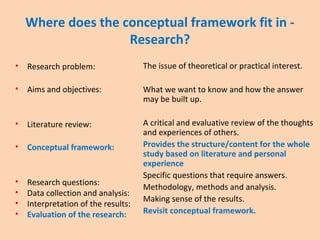
Where does the conceptual framework fit in -
Research?
• Research problem:
• Aims and objectives:
• Literature review:
• Conceptual framework:
• Research questions:
• Data collection and analysis:
• Interpretation of the results:
• Evaluation of the research:
The issue of theoretical or practical interest.
What we want to know and how the answer
may be built up.
A critical and evaluative review of the thoughts
and experiences of others.
Provides the structure/content for the whole
study based on literature and personal
experience
Specific questions that require answers.
Methodology, methods and analysis.
Making sense of the results.
Revisit conceptual framework.
Purpose
• Identify relevant variables
• Define variables
• Have an idea of analysis
5 purposes
Prof. Roger Vaughan, 2008
• The ability to move beyond description to
explanation of why and how
• A means of setting out an explanation set that might
be used to define and make sense of the data flow
• Filtering tool for selecting appropriate research
question and related data collection methods
• A reference point /structure for discussion of
literature , methodology and results
• Identifying boundaries of work
Concepts and theories
A theory is used in the broad sense to refer to
an abstraction which summarizes and
explains phenomena.
Concepts are mental images or ideas relating to
phenomena or objects that share common
properties.
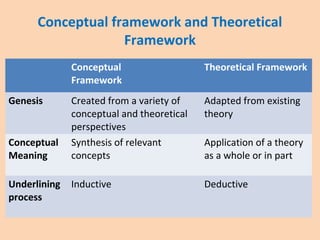
Conceptual framework and Theoretical
Framework
Conceptual
Framework
Theoretical Framework
Genesis Created from a variety of
conceptual and theoretical
perspectives
Adapted from existing
theory
Conceptual
Meaning
Synthesis of relevant
concepts
Application of a theory
as a whole or in part
Underlining
process
Inductive Deductive
How to draw a conceptual framework?
• If you drew a picture of your statistical model,
this would be a conceptual framework
because it visualizes the variables and how
they are related.
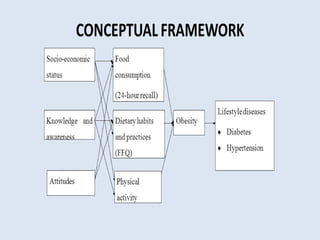
• Generally Framework may include one
outcome and multiple hypothesized
associated factors
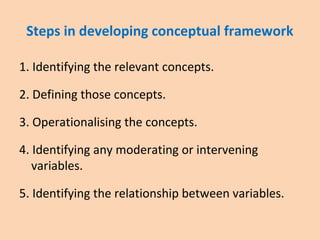
Steps in developing conceptual framework
1. Identifying the relevant concepts.
2. Defining those concepts.
3. Operationalising the concepts.
4. Identifying any moderating or intervening
variables.
5. Identifying the relationship between variables.
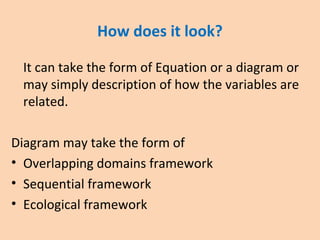
How does it look?
It can take the form of Equation or a diagram or
may simply description of how the variables are
related.
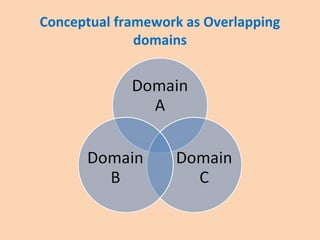
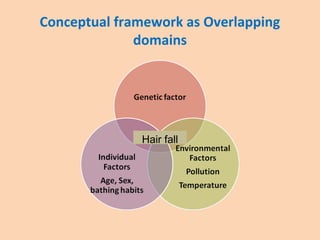
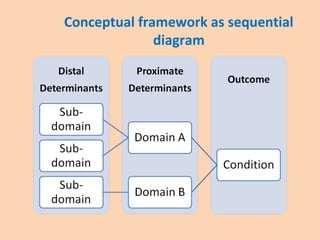
Diagram may take the form of
• Overlapping domains framework
• Sequential framework
• Ecological framework
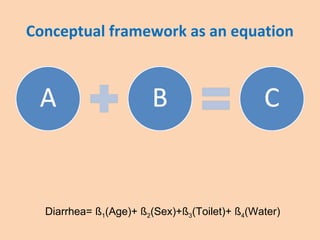
Conceptual framework as an equation
Diarrhea= ß1(Age)+ ß2(Sex)+ß3(Toilet)+ ß4(Water)
Conceptual framework as Overlapping
domains
Conceptual framework as Overlapping
domains
Hair fall
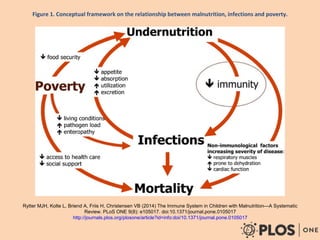
Conceptual framework as sequential
diagram
Figure 1. Conceptual framework on the relationship between malnutrition, infections and poverty.
Rytter MJH, Kolte L, Briend A, Friis H, Christensen VB (2014) The Immune System in Children with Malnutrition—A Systematic
Review. PLoS ONE 9(8): e105017. doi:10.1371/journal.pone.0105017
http://journals.plos.org/plosone/article?id=info:doi/10.1371/journal.pone.0105017
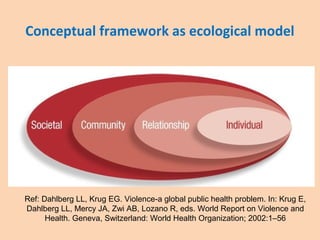
Conceptual framework as ecological model
• Dahlberg LL, Krug EG. Violence-a global public
health problem. In: Krug E, Dahlberg LL, Mercy JA,
Zwi AB, Lozano R, eds. World Report on Violence
and Health. Geneva, Switzerland: World Health
Organization; 2002:1–56
Ref: Dahlberg LL, Krug EG. Violence-a global public health problem. In: Krug E,
Dahlberg LL, Mercy JA, Zwi AB, Lozano R, eds. World Report on Violence and
Health. Geneva, Switzerland: World Health Organization; 2002:1–56
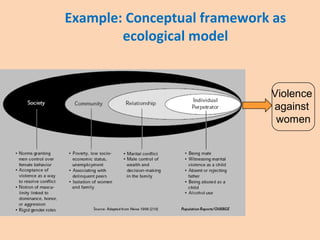
Example: Conceptual framework as
ecological model
Violence
against
women
Development of conceptual framework is an
iterative process, develop once and keep
revising as you move on
Thank You

Conceptual framework

  • 1.
    Conceptual Framework Achyut RajPandey Research Officer Nepal Health Research Council
  • 2.
    What is aconceptual framework? A written or visual presentation that: -explains either graphically, or in narrative form, the main things to be studied – the key factors, concepts or variables -and the presumed relationship among them.
  • 3.
    Conceptual framework representsway of thinking about a problem or a study or way of representing how complex things are. Bordage, 2009 • Its like lighthouse
  • 4.
    The conceptual framework“sets the stage” for the presentation of the particular research question that drives the investigation being reported based on the problem statement. McGaghie et al. (2001)
  • 5.
    The conceptualization partof the research process might well be called the thinking part of the research while the factual part of the research process is more related to the doing aspect.
  • 6.
    Conceptual framework shouldcover • Establishment of the tentative relationships between the dependent and independent variables included in the study. • Visualizing conceptual causal threads to form a representation of inter-relatedness among the identified issues or variables.
  • 7.
    Conceptual framework shouldcover • What are the assumptions? What are the relationships? • Identification of possible answers to the research questions? How are the possible answers to the question explained and defended?
  • 8.
    Where does theconceptual framework fit in - Research? • Research problem: • Aims and objectives: • Literature review: • Conceptual framework: • Research questions: • Data collection and analysis: • Interpretation of the results: • Evaluation of the research: The issue of theoretical or practical interest. What we want to know and how the answer may be built up. A critical and evaluative review of the thoughts and experiences of others. Provides the structure/content for the whole study based on literature and personal experience Specific questions that require answers. Methodology, methods and analysis. Making sense of the results. Revisit conceptual framework.
  • 9.
    Purpose • Identify relevantvariables • Define variables • Have an idea of analysis
  • 10.
    5 purposes Prof. RogerVaughan, 2008 • The ability to move beyond description to explanation of why and how • A means of setting out an explanation set that might be used to define and make sense of the data flow • Filtering tool for selecting appropriate research question and related data collection methods • A reference point /structure for discussion of literature , methodology and results • Identifying boundaries of work
  • 11.
    Concepts and theories Atheory is used in the broad sense to refer to an abstraction which summarizes and explains phenomena. Concepts are mental images or ideas relating to phenomena or objects that share common properties.
  • 12.
    Conceptual framework andTheoretical Framework Conceptual Framework Theoretical Framework Genesis Created from a variety of conceptual and theoretical perspectives Adapted from existing theory Conceptual Meaning Synthesis of relevant concepts Application of a theory as a whole or in part Underlining process Inductive Deductive
  • 13.
    How to drawa conceptual framework? • If you drew a picture of your statistical model, this would be a conceptual framework because it visualizes the variables and how they are related. • Generally Framework may include one outcome and multiple hypothesized associated factors
  • 14.
    Steps in developingconceptual framework 1. Identifying the relevant concepts. 2. Defining those concepts. 3. Operationalising the concepts. 4. Identifying any moderating or intervening variables. 5. Identifying the relationship between variables.
  • 15.
    How does itlook? It can take the form of Equation or a diagram or may simply description of how the variables are related. Diagram may take the form of • Overlapping domains framework • Sequential framework • Ecological framework
  • 16.
    Conceptual framework asan equation Diarrhea= ß1(Age)+ ß2(Sex)+ß3(Toilet)+ ß4(Water)
  • 17.
    Conceptual framework asOverlapping domains
  • 18.
    Conceptual framework asOverlapping domains Hair fall
  • 19.
    Conceptual framework assequential diagram
  • 21.
    Figure 1. Conceptualframework on the relationship between malnutrition, infections and poverty. Rytter MJH, Kolte L, Briend A, Friis H, Christensen VB (2014) The Immune System in Children with Malnutrition—A Systematic Review. PLoS ONE 9(8): e105017. doi:10.1371/journal.pone.0105017 http://journals.plos.org/plosone/article?id=info:doi/10.1371/journal.pone.0105017
  • 22.
    Conceptual framework asecological model • Dahlberg LL, Krug EG. Violence-a global public health problem. In: Krug E, Dahlberg LL, Mercy JA, Zwi AB, Lozano R, eds. World Report on Violence and Health. Geneva, Switzerland: World Health Organization; 2002:1–56 Ref: Dahlberg LL, Krug EG. Violence-a global public health problem. In: Krug E, Dahlberg LL, Mercy JA, Zwi AB, Lozano R, eds. World Report on Violence and Health. Geneva, Switzerland: World Health Organization; 2002:1–56
  • 23.
    Example: Conceptual frameworkas ecological model Violence against women
  • 24.
    Development of conceptualframework is an iterative process, develop once and keep revising as you move on
  • 25.

Editor's Notes

  • #17 ∑(TC/N)= ∑(DMC/N) +∑(NDMC/N) +∑(IMC/N) or Diarrhea= ß(Age)+ ß(Sex)+ß(Toilet)+ ß(Water)