INTERNATIONAL SPACE
STATION
Submitted By,
Achuthan.k
CIVIL.B
71102
YCET
Guided By,
Aparna.U.M
Assist.Professor
Civil.Dept
YCET
G
1
CONTENTS
•INTRODUCTION
•SIZE OF ISS
•INTERNATIONAL PARTERS
•PURPOSE OF ISS
•STATION SYSTEMS
•STRUCTURE OF ISS
•CONCLUSION
•REFERENCE
2
INTRODUCTION
• large spacecraft in orbit around Earth.
• Building the ISS began in 1998
• conduct experiments in biology, physics, astronomy,
meteorology, and other fields
3
ISS IN SPACE
4
PURPOSE OF ISS
• Scientific Research
serves as a microgravity and space environment
research laboratory
• Education and Cultural Approach
by running student-developed experiments, allows
making of educational demonstrations
• Exploration
5
SIZE OF ISS
• The space station has the volume of a five-bedroom
house
• It is able to support a crew of six people, plus visitors.
• On Earth, the space station would weigh almost 450
Tonnes.
6
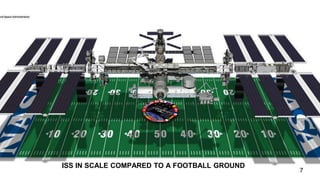
ISS IN SCALE COMPARED TO A FOOTBALL GROUND
7
INTERNATIONAL PARTNERS
• involving the U.S., Russia, Canada, Japan, and the
participating countries of the European Space Agency
• one of the most ambitious international collaborations
ever attempted.
• has been visited by astronauts from 18 countries—and
counting.
8
STATION SYSTEM
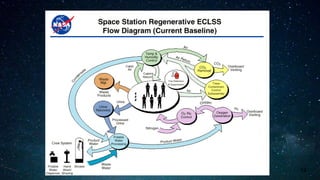
❖ Life support
The critical systems are
• Water Recovery system
• Air Revitalisation System
• Oxygen Generating System
(Elektron)
❖ Power and thermal Control
❖ Communication and Computer Systems
9
Water Recovery System
The ISS has two water recovery systems.
•Zvezda contains a water recovery system that processes
waste water from showers, sinks, and other crew systems
•The Urine Processor Assembly uses a low pressure
vacuum distillation process to compensate for the lack of
gravity and thus aid in separating liquids and gasses.
10
Air Revitalisation System
•Carbon dioxide and trace contaminants are removed by the
Air Revitalisation System.
Oxygen Generating System(Elektron)
•designed to electrolyze water from the Water Recovery
System to produce oxygen and hydrogen.
•oxygen is delivered to the cabin atmosphere and the
hydrogen is vented overboard. 11
Power and Thermal Control
•Double-sided solar, or Photovoltaic arrays, provide electrical
power for the ISS.
•These bifacial cells are more efficient and operate at a
lower temperature than single-sided
•collects sunlight on one side and light reflected off the Earth
on the other.
12
Communication and Computer Systems
•Radio communications provide telemetry and scientific data
links between the station and Mission Control Centers.
•Radio links are also used
 during rendezvous and docking procedures
 for audio and video communication between
crewmembers, flight controllers and family members.
13
14
STRUCTURE OF ISS
❖ ISS was taken into space piece-by-piece and assembled
in Orbit.
❖ It consist of modules and connecting nodes that contain
living quarters and laboratories
15
16
Structural Components of ISS
Integrated
Truss
Structure Pressurized
Structures
Primary
Structure
Ring Frames
Longerons
Shell Panels
Integrated
Trunnions
Windows
Secondary
Structure
Grappling
Fixtures
Hand rails Hatches
Solar Panels
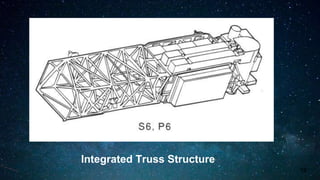
❖ Integrated Truss Structure
• The Integrated Truss Structure acts as a backbone for the
International Space Station.
• The trusses are used to support the solar arrays and
Pressurized Modules.
• the Integrated Truss Structure will contain 10 segments
and support 16 solar array panels.
17
Integrated Truss Structure
18
Pressurised Structures
•designed to protect the crew from the environment of
space.
• provide a workable atmosphere for crewmembers and
house experiments, payloads and tools for protection. .
•Pressurized modules supply crewmembers with protected
mobility throughout the ISS
19
Primary Structures
(Provide structural integrity to ISS)
Ring frames: supplies structural support for pressurized
modules
Longerons: Supplies structural support for pressurized
modules' walls
Shell panels: Forms the outer walls of pressurized modules
and provide passive protection.
20
Integrated Trunnions: Linear mounted brackets used for
pressurized module attachment.
Windows
21
Primary Structures
22
Secondary Structures
(designed to transfer their loads to primary structures)
Grappling Fixtures: provide a secure connection for
a robotic arm
Hand Rails: to be grasped by the hand so as to provide
stability or support
Hatches: pressurized structural openings which allow
crewmembers to transfer themselves and objects between
two pressurized segments.
23
24
Assembly of ISS
CONCLUSION
•The ISS is arguably the most expensive single item ever
constructed.
•The cost was expected to be ten trillion Rupees.
•Funding runs out in 2024.
•It will probably be disassembled or be destroyed via reentry.
25
REFERENCE
• Garcia, Mark (1 October 2015). "About the Space Station: Facts and Figures". NASA. Retrieved 2 October 2015.
• "Space to Ground: Friending the ISS: 06/03/2016". YouTube.com. NASA. 3 June 2016.
• Peat, Chris (25 January 2015). "ISS - Orbit". Heavens-Above. Retrieved25 January 2015.
•Garcia, Mark (16 May 2016). "Station Reaches 100,000 Orbits, Deploys Cubesats". NASA. Retrieved 17 May 2016.
•"The ISS to Date". NASA. 9 March 2011. Retrieved 21 March 2011.
•NASA (18 February 2010). "On-Orbit Elements" (PDF). NASA. Retrieved19 June 2010.
•"STS-132 Press Kit" (PDF). NASA. 7 May 2010. Retrieved 19 June 2010.
•"STS-133 FD 04 Execute Package" (PDF). NASA. 27 February 2011. Retrieved27 February 2011.
• "Central Research Institute for Machine Building (FGUP TSNIIMASH) Control of manned and unmanned space vehicles
from Mission Control Centre Moscow" (PDF). Russian Federal Space Agency. Retrieved 26 September 2011. 26
27

International Space Station

  • 1.
    INTERNATIONAL SPACE STATION Submitted By, Achuthan.k CIVIL.B 71102 YCET GuidedBy, Aparna.U.M Assist.Professor Civil.Dept YCET G 1
  • 2.
    CONTENTS •INTRODUCTION •SIZE OF ISS •INTERNATIONALPARTERS •PURPOSE OF ISS •STATION SYSTEMS •STRUCTURE OF ISS •CONCLUSION •REFERENCE 2
  • 3.
    INTRODUCTION • large spacecraftin orbit around Earth. • Building the ISS began in 1998 • conduct experiments in biology, physics, astronomy, meteorology, and other fields 3
  • 4.
  • 5.
    PURPOSE OF ISS •Scientific Research serves as a microgravity and space environment research laboratory • Education and Cultural Approach by running student-developed experiments, allows making of educational demonstrations • Exploration 5
  • 6.
    SIZE OF ISS •The space station has the volume of a five-bedroom house • It is able to support a crew of six people, plus visitors. • On Earth, the space station would weigh almost 450 Tonnes. 6
  • 7.
    ISS IN SCALECOMPARED TO A FOOTBALL GROUND 7
  • 8.
    INTERNATIONAL PARTNERS • involvingthe U.S., Russia, Canada, Japan, and the participating countries of the European Space Agency • one of the most ambitious international collaborations ever attempted. • has been visited by astronauts from 18 countries—and counting. 8
  • 9.
    STATION SYSTEM ❖ Lifesupport The critical systems are • Water Recovery system • Air Revitalisation System • Oxygen Generating System (Elektron) ❖ Power and thermal Control ❖ Communication and Computer Systems 9
  • 10.
    Water Recovery System TheISS has two water recovery systems. •Zvezda contains a water recovery system that processes waste water from showers, sinks, and other crew systems •The Urine Processor Assembly uses a low pressure vacuum distillation process to compensate for the lack of gravity and thus aid in separating liquids and gasses. 10
  • 11.
    Air Revitalisation System •Carbondioxide and trace contaminants are removed by the Air Revitalisation System. Oxygen Generating System(Elektron) •designed to electrolyze water from the Water Recovery System to produce oxygen and hydrogen. •oxygen is delivered to the cabin atmosphere and the hydrogen is vented overboard. 11
  • 12.
    Power and ThermalControl •Double-sided solar, or Photovoltaic arrays, provide electrical power for the ISS. •These bifacial cells are more efficient and operate at a lower temperature than single-sided •collects sunlight on one side and light reflected off the Earth on the other. 12
  • 13.
    Communication and ComputerSystems •Radio communications provide telemetry and scientific data links between the station and Mission Control Centers. •Radio links are also used  during rendezvous and docking procedures  for audio and video communication between crewmembers, flight controllers and family members. 13
  • 14.
  • 15.
    STRUCTURE OF ISS ❖ISS was taken into space piece-by-piece and assembled in Orbit. ❖ It consist of modules and connecting nodes that contain living quarters and laboratories 15
  • 16.
    16 Structural Components ofISS Integrated Truss Structure Pressurized Structures Primary Structure Ring Frames Longerons Shell Panels Integrated Trunnions Windows Secondary Structure Grappling Fixtures Hand rails Hatches Solar Panels
  • 17.
    ❖ Integrated TrussStructure • The Integrated Truss Structure acts as a backbone for the International Space Station. • The trusses are used to support the solar arrays and Pressurized Modules. • the Integrated Truss Structure will contain 10 segments and support 16 solar array panels. 17
  • 18.
  • 19.
    Pressurised Structures •designed toprotect the crew from the environment of space. • provide a workable atmosphere for crewmembers and house experiments, payloads and tools for protection. . •Pressurized modules supply crewmembers with protected mobility throughout the ISS 19
  • 20.
    Primary Structures (Provide structuralintegrity to ISS) Ring frames: supplies structural support for pressurized modules Longerons: Supplies structural support for pressurized modules' walls Shell panels: Forms the outer walls of pressurized modules and provide passive protection. 20
  • 21.
    Integrated Trunnions: Linearmounted brackets used for pressurized module attachment. Windows 21
  • 22.
  • 23.
    Secondary Structures (designed totransfer their loads to primary structures) Grappling Fixtures: provide a secure connection for a robotic arm Hand Rails: to be grasped by the hand so as to provide stability or support Hatches: pressurized structural openings which allow crewmembers to transfer themselves and objects between two pressurized segments. 23
  • 24.
  • 25.
    CONCLUSION •The ISS isarguably the most expensive single item ever constructed. •The cost was expected to be ten trillion Rupees. •Funding runs out in 2024. •It will probably be disassembled or be destroyed via reentry. 25
  • 26.
    REFERENCE • Garcia, Mark(1 October 2015). "About the Space Station: Facts and Figures". NASA. Retrieved 2 October 2015. • "Space to Ground: Friending the ISS: 06/03/2016". YouTube.com. NASA. 3 June 2016. • Peat, Chris (25 January 2015). "ISS - Orbit". Heavens-Above. Retrieved25 January 2015. •Garcia, Mark (16 May 2016). "Station Reaches 100,000 Orbits, Deploys Cubesats". NASA. Retrieved 17 May 2016. •"The ISS to Date". NASA. 9 March 2011. Retrieved 21 March 2011. •NASA (18 February 2010). "On-Orbit Elements" (PDF). NASA. Retrieved19 June 2010. •"STS-132 Press Kit" (PDF). NASA. 7 May 2010. Retrieved 19 June 2010. •"STS-133 FD 04 Execute Package" (PDF). NASA. 27 February 2011. Retrieved27 February 2011. • "Central Research Institute for Machine Building (FGUP TSNIIMASH) Control of manned and unmanned space vehicles from Mission Control Centre Moscow" (PDF). Russian Federal Space Agency. Retrieved 26 September 2011. 26
  • 27.