The Future of Space
Exploration
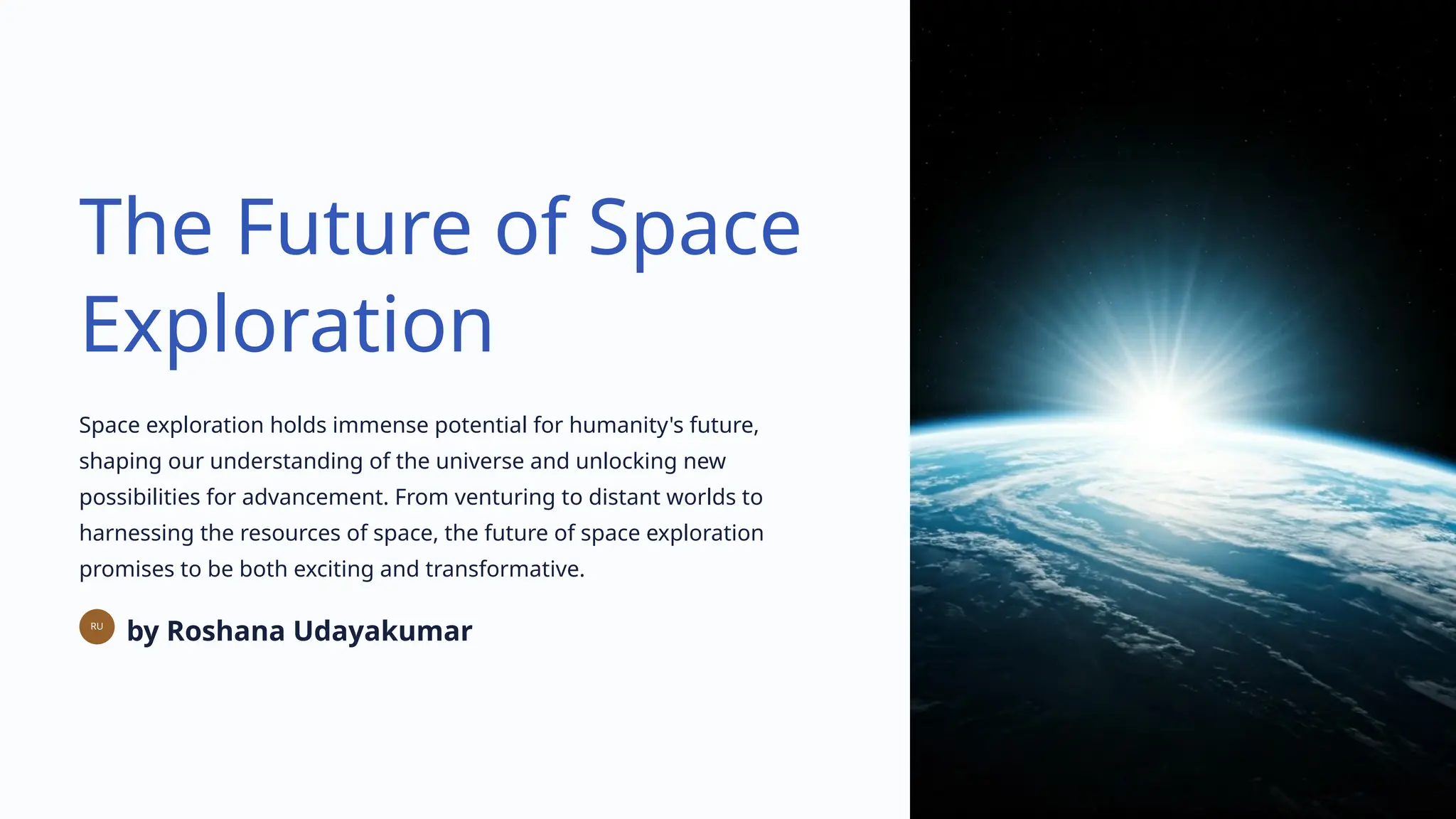
Space exploration holds immense potential for humanity's future,
shaping our understanding of the universe and unlocking new
possibilities for advancement. From venturing to distant worlds to
harnessing the resources of space, the future of space exploration
promises to be both exciting and transformative.
RU
by Roshana Udayakumar
Advancements in Rocket Technology
1 Reusable Rockets
Reusable rockets are revolutionizing space travel, reducing costs and increasing launch frequency.
2 Larger Payload Capacity
More powerful rockets are enabling the delivery of heavier payloads, opening up new avenues for scientific missions and space
infrastructure development.
3 Advanced Propulsion Systems
Innovations in propulsion systems, such as ion engines and nuclear fusion, promise faster and more efficient space travel.
Exploration of the Moon and Mars
Lunar Exploration
The Moon serves as a crucial steppingstone for future
missions, offering resources, a testbed for technology, and
opportunities for scientific discovery.
Martian Exploration
Mars is the most promising candidate for human
colonization, with its potential for supporting life and its
rich geological history.
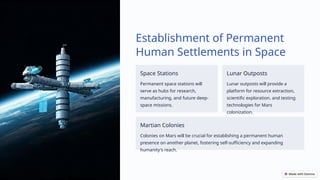
Establishment of Permanent
Human Settlements in Space
Space Stations
Permanent space stations will
serve as hubs for research,
manufacturing, and future deep-
space missions.
Lunar Outposts
Lunar outposts will provide a
platform for resource extraction,
scientific exploration, and testing
technologies for Mars
colonization.
Martian Colonies
Colonies on Mars will be crucial for establishing a permanent human
presence on another planet, fostering self-sufficiency and expanding
humanity's reach.
Utilization of Space Resources
for Energy and Manufacturing
1 Asteroid Mining
Asteroids contain vast
quantities of valuable
resources, including platinum,
iron, and water, which can be
used for fuel, construction, and
manufacturing.
2 Space-Based Solar Power
Solar power stations in space
can collect energy from the sun
continuously and transmit it
back to Earth, providing a clean
and sustainable energy source.
3 Microgravity Manufacturing
The unique conditions of microgravity offer new possibilities for
manufacturing, allowing for the production of advanced materials and
pharmaceuticals.
Interplanetary Travel and
Colonization
Interplanetary Travel
Advanced propulsion systems and spacecraft design will enable
faster and more efficient travel between planets.
Terraforming
Technologies for terraforming planets, such as modifying
atmospheres and introducing life, will be crucial for establishing
habitable environments.
Space-Based Habitats
Colonies on other planets will require self-sustaining habitats,
including food production systems, energy sources, and life
support systems.
Exploration of the Outer
Solar System and Beyond
Destination Objectives
Jupiter Studying its atmosphere,
moons, and magnetic field
Saturn Exploring its rings, moons, and
potential for life
Uranus and Neptune Investigating their unique
compositions and atmospheres
Kuiper Belt Objects Studying the formation and
evolution of the solar system
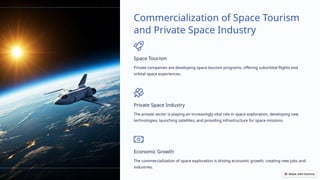
Commercialization of Space Tourism
and Private Space Industry
Space Tourism
Private companies are developing space tourism programs, offering suborbital flights and
orbital space experiences.
Private Space Industry
The private sector is playing an increasingly vital role in space exploration, developing new
technologies, launching satellites, and providing infrastructure for space missions.
Economic Growth
The commercialization of space exploration is driving economic growth, creating new jobs and
industries.
Challenges and Obstacles to
Space Exploration
1 Cost
Space exploration is an
expensive endeavor, requiring
significant investments in
technology, infrastructure, and
research.
2 Technical Challenges
Developing reliable and safe
spacecraft, propulsion systems,
and life support systems
presents significant technical
challenges.
3 Space Debris
The increasing amount of space
debris poses a significant threat
to spacecraft and astronauts,
requiring mitigation strategies
and international cooperation.
4 Radiation
Exposure to cosmic radiation is
a serious health risk for
astronauts, requiring shielding
measures and research into
radiation protection
technologies.
The Societal and Economic
Impact of Space Exploration
Scientific Advancement
Space exploration has led to
significant advancements in
science, technology, and
engineering, benefiting
various fields on Earth.
Economic Growth
The space industry creates
jobs, drives innovation, and
promotes economic growth
through spin-offs and
technological advancements.
Inspiration and Education
Space exploration inspires future generations, fostering curiosity,
creativity, and a passion for STEM fields.

The future of space exploration presentation

  • 1.
    The Future ofSpace Exploration Space exploration holds immense potential for humanity's future, shaping our understanding of the universe and unlocking new possibilities for advancement. From venturing to distant worlds to harnessing the resources of space, the future of space exploration promises to be both exciting and transformative. RU by Roshana Udayakumar
  • 2.
    Advancements in RocketTechnology 1 Reusable Rockets Reusable rockets are revolutionizing space travel, reducing costs and increasing launch frequency. 2 Larger Payload Capacity More powerful rockets are enabling the delivery of heavier payloads, opening up new avenues for scientific missions and space infrastructure development. 3 Advanced Propulsion Systems Innovations in propulsion systems, such as ion engines and nuclear fusion, promise faster and more efficient space travel.
  • 3.
    Exploration of theMoon and Mars Lunar Exploration The Moon serves as a crucial steppingstone for future missions, offering resources, a testbed for technology, and opportunities for scientific discovery. Martian Exploration Mars is the most promising candidate for human colonization, with its potential for supporting life and its rich geological history.
  • 4.
    Establishment of Permanent HumanSettlements in Space Space Stations Permanent space stations will serve as hubs for research, manufacturing, and future deep- space missions. Lunar Outposts Lunar outposts will provide a platform for resource extraction, scientific exploration, and testing technologies for Mars colonization. Martian Colonies Colonies on Mars will be crucial for establishing a permanent human presence on another planet, fostering self-sufficiency and expanding humanity's reach.
  • 5.
    Utilization of SpaceResources for Energy and Manufacturing 1 Asteroid Mining Asteroids contain vast quantities of valuable resources, including platinum, iron, and water, which can be used for fuel, construction, and manufacturing. 2 Space-Based Solar Power Solar power stations in space can collect energy from the sun continuously and transmit it back to Earth, providing a clean and sustainable energy source. 3 Microgravity Manufacturing The unique conditions of microgravity offer new possibilities for manufacturing, allowing for the production of advanced materials and pharmaceuticals.
  • 6.
    Interplanetary Travel and Colonization InterplanetaryTravel Advanced propulsion systems and spacecraft design will enable faster and more efficient travel between planets. Terraforming Technologies for terraforming planets, such as modifying atmospheres and introducing life, will be crucial for establishing habitable environments. Space-Based Habitats Colonies on other planets will require self-sustaining habitats, including food production systems, energy sources, and life support systems.
  • 7.
    Exploration of theOuter Solar System and Beyond Destination Objectives Jupiter Studying its atmosphere, moons, and magnetic field Saturn Exploring its rings, moons, and potential for life Uranus and Neptune Investigating their unique compositions and atmospheres Kuiper Belt Objects Studying the formation and evolution of the solar system
  • 8.
    Commercialization of SpaceTourism and Private Space Industry Space Tourism Private companies are developing space tourism programs, offering suborbital flights and orbital space experiences. Private Space Industry The private sector is playing an increasingly vital role in space exploration, developing new technologies, launching satellites, and providing infrastructure for space missions. Economic Growth The commercialization of space exploration is driving economic growth, creating new jobs and industries.
  • 9.
    Challenges and Obstaclesto Space Exploration 1 Cost Space exploration is an expensive endeavor, requiring significant investments in technology, infrastructure, and research. 2 Technical Challenges Developing reliable and safe spacecraft, propulsion systems, and life support systems presents significant technical challenges. 3 Space Debris The increasing amount of space debris poses a significant threat to spacecraft and astronauts, requiring mitigation strategies and international cooperation. 4 Radiation Exposure to cosmic radiation is a serious health risk for astronauts, requiring shielding measures and research into radiation protection technologies.
  • 10.
    The Societal andEconomic Impact of Space Exploration Scientific Advancement Space exploration has led to significant advancements in science, technology, and engineering, benefiting various fields on Earth. Economic Growth The space industry creates jobs, drives innovation, and promotes economic growth through spin-offs and technological advancements. Inspiration and Education Space exploration inspires future generations, fostering curiosity, creativity, and a passion for STEM fields.