INTERNATIONAL SPACE STATION; AN EMERGING OPPORTUNITY FOR 
RESEARCH DIVERSIFICATION 
M. Hariram 
I B.Sc Physics, VHNSN College (Autonomous), Virudhunagar-626001 
Mail id: hariram3737@gmail.com 
ABSTRACT 
International space station (ISS) is the largest space station ever launched. It orbits 
Earth at an altitude between 330 km (205mi) and 435 km (270 mi) at the speed of 7.71 km 
per second. It consists of pressurised modulus, external trusses and solar arrays. It is the 
platform to conduct scientific research in different fields. Since the arrival of Expedition 1 on 
2 November 2000, the station has been continuously occupied for 13 years and 316 days, the 
longest continuous human presence in space. 
Keywords: International space station, low earth orbit, Zarya module, microgravity. 
1. INTRODUCTION 
International Space Station (ISS), is a habitual artificial satellite in low orbit. The 
station is divided into two sections The Russian Orbital System (ROS) and United States 
Orbital System (USOS). ISS is the joint project of 5 space agencies such as NASA (USA), 
Roscosmos (Russia), ESA (Europe), JAXA (Japan), CSA (Canada). It is the combination of 
three projects such as NASA’s freedom, Russia’s Mir2 and European’s Columbus space 
stations. ISS is the 9th space station to be inhabited by crews, following the Russian’s Salyut, 
Almaz, Mir stations and US’s Skylab. The assembly of the ISS in orbit began on 20 Nov 
1998 by launching the Russian made module, named Zarya. William Shepherd (USA), Sergei 
K.Krikalev (RSA), Yuri Gidzenko (RSA) were the first crews to visit ISS on 2nd Nov 2000. 
2. COMPONENTS IN ISS 
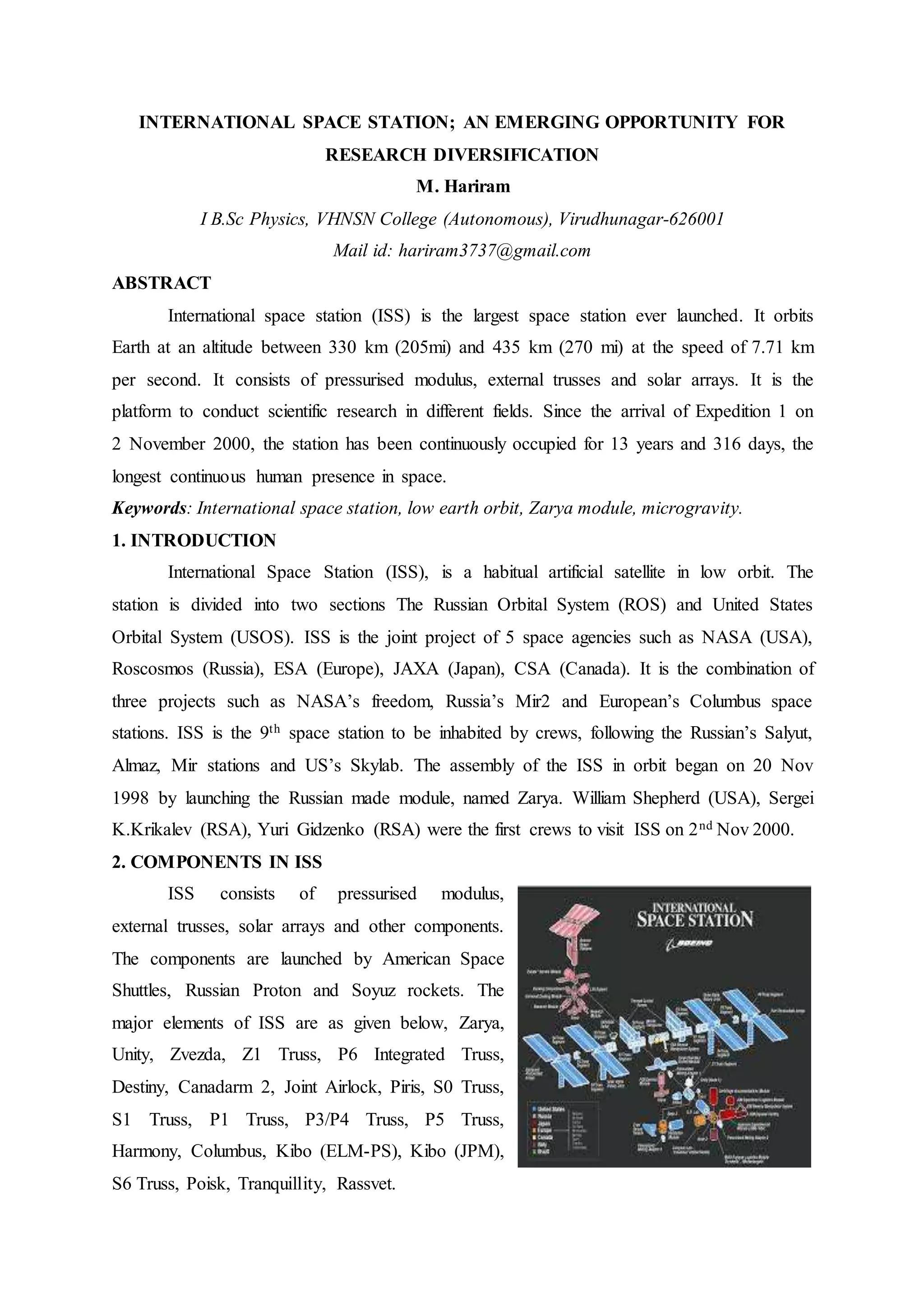
ISS consists of pressurised modulus, 
external trusses, solar arrays and other components. 
The components are launched by American Space 
Shuttles, Russian Proton and Soyuz rockets. The 
major elements of ISS are as given below, Zarya, 
Unity, Zvezda, Z1 Truss, P6 Integrated Truss, 
Destiny, Canadarm 2, Joint Airlock, Piris, S0 Truss, 
S1 Truss, P1 Truss, P3/P4 Truss, P5 Truss, 
Harmony, Columbus, Kibo (ELM-PS), Kibo (JPM), 
S6 Truss, Poisk, Tranquillity, Rassvet.
3. SCIENTIFIC RESEARCH IN ISS 
 ISS provides a platform to conduct scientific research in micro gravity. 
 It simplifies the individual experiments by eliminating the need for separate rocket 
launches and research staff. 
 It consists of labouratory modules such as Destiny, Columbus, Kibo, Poisk, Rassvet. 
 ISS consists of other scientific hardware such as, Alpha Magnetic Spectrometer (AMS), 
cupola, External Stowage Platforms (ESP), Orbital Replacement Units SPARES. 
The major research in ISS includes, 
 Biology and Bio technology, 
 Earth and Space Science, 
 Combustion science, 
 Fluid Physics, 
 Space medicine. 
3.1 Biology and Biotechnology 
Microgravity environment used to investigate the bio processing phenomenon and this 
controls on directionality and geometry of cell and tissue growth can be dramatically 
different to those on Earth. Various experiments have used the culture of cells, tissues and 
small organisms on orbit. The recent research is going on the protein crystal growth. 
3.2 Earth and Space Science 
The presence of the space station in low-Earth orbit provides a unique vantage point 
for collecting Earth and space science data.and these data are used in the preparations for a 
manned mission to Mars. It is used to test spacecraft systems that will be required for long-duration 
missions to the Moon and the Mars. 
3.3 Combustion Science 
The combustion science research program focus on understanding the important 
process of ignition, propagation and extinction during combustion in microgravity. Shape and 
size of the flame and role of shoot formation in combustion were studied. Investigations are 
also on the study of air flows and the transfer of heat and mass in fuel vapours, liquid pools, 
paper and metals. 
3.4 Fluid Physics 
The purpose of the microgravity fluids research programme is to improve the 
understanding of how the presence of gravity either limits or affects the fundamental 
behaviour of fluid dynamics. The investigation of the physics of fluids in microgravity will 
allow researchers to model the behaviour of fluids better. Because fluids can be almost
completely combined in microgravity, physicists investigate fluids that do not mix well on 
Earth. 
3.5 Human research 
The presence of the space station in low-Earth orbit provides a knowledge about the 
effects of long-term space exposure on the human body. Subjects currently under the study 
include muscle atrophy, bone loss, and fluid shift. The data will be used to determine whether 
space colonisation and lengthy human spaceflight are feasible. As of 2006, data on bone loss 
and muscular atrophy suggest that there would be a significant risk of fractures and 
movement problems if astronauts landed on a planet after a lengthy interplanetary cruise 
(such as the six-month journey time required to fly to Mars). 
4. FUTURE PLANS OF ISS 
The Obama Administration approved NASA’s request to extend the lifetime of the 
International Space Station (ISS) to at least 2024. Ultimately this will serve as a stepping 
stone to exciting deep space voyages in future decades. While the engineering and 
management challenges associated with keeping the station operational are daunting, ISS 
program manager Michael Suffredini says "We have a space station that is designed in a 
modular fashion meant for repair, So as long as you have spares for all the things that can 
break, you can last as long as the structure will let you last”. 
5. CONCLUSION 
International space station gives the platform to conduct research on low Earth orbit. 
Scientists of different fields benefits by conducting research in their specific fields. It also 
provides a unique platform for inspiring students to excel in mathematics and science. Station 
educational activities have had a positive impact on thousands of students by involving them 
in station research, Studies on the space station can test a variety of technologies, systems, 
and materials that will be needed for future long-duration exploration missions 
Acknowledgement 
Author acknowledges Dr.S.Rajasingh, (Head & Associate Professor), and other faculty 
members who help me to present this paper such as Mrs.A.Alagulakshmi, Dr.S.Prakash, 
Dr.S.Vivekanandhan, Dr.R.Jeyasekaran, Dr.V.Jeyasanthi, Mrs.N.Sumangala Devi and 
Mr.J.Pandiarajan. 
References 
[1] http://en.wikipedia.org/wiki/International_Space_Station 
[2] http://www.nasa.gov

international space station

  • 1.
    INTERNATIONAL SPACE STATION;AN EMERGING OPPORTUNITY FOR RESEARCH DIVERSIFICATION M. Hariram I B.Sc Physics, VHNSN College (Autonomous), Virudhunagar-626001 Mail id: hariram3737@gmail.com ABSTRACT International space station (ISS) is the largest space station ever launched. It orbits Earth at an altitude between 330 km (205mi) and 435 km (270 mi) at the speed of 7.71 km per second. It consists of pressurised modulus, external trusses and solar arrays. It is the platform to conduct scientific research in different fields. Since the arrival of Expedition 1 on 2 November 2000, the station has been continuously occupied for 13 years and 316 days, the longest continuous human presence in space. Keywords: International space station, low earth orbit, Zarya module, microgravity. 1. INTRODUCTION International Space Station (ISS), is a habitual artificial satellite in low orbit. The station is divided into two sections The Russian Orbital System (ROS) and United States Orbital System (USOS). ISS is the joint project of 5 space agencies such as NASA (USA), Roscosmos (Russia), ESA (Europe), JAXA (Japan), CSA (Canada). It is the combination of three projects such as NASA’s freedom, Russia’s Mir2 and European’s Columbus space stations. ISS is the 9th space station to be inhabited by crews, following the Russian’s Salyut, Almaz, Mir stations and US’s Skylab. The assembly of the ISS in orbit began on 20 Nov 1998 by launching the Russian made module, named Zarya. William Shepherd (USA), Sergei K.Krikalev (RSA), Yuri Gidzenko (RSA) were the first crews to visit ISS on 2nd Nov 2000. 2. COMPONENTS IN ISS ISS consists of pressurised modulus, external trusses, solar arrays and other components. The components are launched by American Space Shuttles, Russian Proton and Soyuz rockets. The major elements of ISS are as given below, Zarya, Unity, Zvezda, Z1 Truss, P6 Integrated Truss, Destiny, Canadarm 2, Joint Airlock, Piris, S0 Truss, S1 Truss, P1 Truss, P3/P4 Truss, P5 Truss, Harmony, Columbus, Kibo (ELM-PS), Kibo (JPM), S6 Truss, Poisk, Tranquillity, Rassvet.
  • 2.
    3. SCIENTIFIC RESEARCHIN ISS  ISS provides a platform to conduct scientific research in micro gravity.  It simplifies the individual experiments by eliminating the need for separate rocket launches and research staff.  It consists of labouratory modules such as Destiny, Columbus, Kibo, Poisk, Rassvet.  ISS consists of other scientific hardware such as, Alpha Magnetic Spectrometer (AMS), cupola, External Stowage Platforms (ESP), Orbital Replacement Units SPARES. The major research in ISS includes,  Biology and Bio technology,  Earth and Space Science,  Combustion science,  Fluid Physics,  Space medicine. 3.1 Biology and Biotechnology Microgravity environment used to investigate the bio processing phenomenon and this controls on directionality and geometry of cell and tissue growth can be dramatically different to those on Earth. Various experiments have used the culture of cells, tissues and small organisms on orbit. The recent research is going on the protein crystal growth. 3.2 Earth and Space Science The presence of the space station in low-Earth orbit provides a unique vantage point for collecting Earth and space science data.and these data are used in the preparations for a manned mission to Mars. It is used to test spacecraft systems that will be required for long-duration missions to the Moon and the Mars. 3.3 Combustion Science The combustion science research program focus on understanding the important process of ignition, propagation and extinction during combustion in microgravity. Shape and size of the flame and role of shoot formation in combustion were studied. Investigations are also on the study of air flows and the transfer of heat and mass in fuel vapours, liquid pools, paper and metals. 3.4 Fluid Physics The purpose of the microgravity fluids research programme is to improve the understanding of how the presence of gravity either limits or affects the fundamental behaviour of fluid dynamics. The investigation of the physics of fluids in microgravity will allow researchers to model the behaviour of fluids better. Because fluids can be almost
  • 3.
    completely combined inmicrogravity, physicists investigate fluids that do not mix well on Earth. 3.5 Human research The presence of the space station in low-Earth orbit provides a knowledge about the effects of long-term space exposure on the human body. Subjects currently under the study include muscle atrophy, bone loss, and fluid shift. The data will be used to determine whether space colonisation and lengthy human spaceflight are feasible. As of 2006, data on bone loss and muscular atrophy suggest that there would be a significant risk of fractures and movement problems if astronauts landed on a planet after a lengthy interplanetary cruise (such as the six-month journey time required to fly to Mars). 4. FUTURE PLANS OF ISS The Obama Administration approved NASA’s request to extend the lifetime of the International Space Station (ISS) to at least 2024. Ultimately this will serve as a stepping stone to exciting deep space voyages in future decades. While the engineering and management challenges associated with keeping the station operational are daunting, ISS program manager Michael Suffredini says "We have a space station that is designed in a modular fashion meant for repair, So as long as you have spares for all the things that can break, you can last as long as the structure will let you last”. 5. CONCLUSION International space station gives the platform to conduct research on low Earth orbit. Scientists of different fields benefits by conducting research in their specific fields. It also provides a unique platform for inspiring students to excel in mathematics and science. Station educational activities have had a positive impact on thousands of students by involving them in station research, Studies on the space station can test a variety of technologies, systems, and materials that will be needed for future long-duration exploration missions Acknowledgement Author acknowledges Dr.S.Rajasingh, (Head & Associate Professor), and other faculty members who help me to present this paper such as Mrs.A.Alagulakshmi, Dr.S.Prakash, Dr.S.Vivekanandhan, Dr.R.Jeyasekaran, Dr.V.Jeyasanthi, Mrs.N.Sumangala Devi and Mr.J.Pandiarajan. References [1] http://en.wikipedia.org/wiki/International_Space_Station [2] http://www.nasa.gov