Zheer Sabah
• Introduction
• What is hyperlipidemia
• Drugs used for hyperlipidemia
 Ezetimibe
• Mechanism of action
• Dosage form
• Pharmacokinetic
• Adverse side effect
• Overdose
• Contraindication and warning
• references
lipid-lowering therapy in patient with
hypercholesterolemia has a proven survival
benefit for both:
 Primary prevention
Patient without clinical evidence of coronary
disease
 Secondary prevention
Patent with established coronary disease
Even when serum cholesterol concentration are
NORMAL
 Hyperlipidemia a broad term, also called
hyperlipoproteinemia ,is a common disorder
in developed countries and is the major cause
of coronary heart disease
 It result from abnormalities in lipid
metabolism or plasma lipid transport or a
disorder in the synthesis and degradation of
plasma lipoprotein
• Diet
• Hypothyroidism
• Nephrotic syndrome
• Anorexia nervosa
• Obstructive liver disease
• Obesity
• Diabetes mellitus
• Pregnancy
• Obstructive liver disease
• Acute hepatitis
Drug Class Agents Effects (% change)
HMG CoA reductase
inhibitors STATINS
Lovastatin
Pravastatin
↓LDL (18-55)/↑ HDL (5-15)
↓ Triglycerides (7-30)
Cholesterol
absorption inhibitor
Ezetimibe
↓ LDL( 14-18)/↑ HDL (1-3)
↓Triglyceride (2)
Nicotinic Acid ↓LDL (15-30)/ ↑ HDL (15-35)
↓ Triglyceride (20-50)
Fibric Acids Gemfibrozil
Fenofibrate
↓LDL (5-20)/ ↑HDL (10-20)
↓Triglyceride (20-50)
Bile Acid sequestrants Cholestyramine
Colestipol
↓ LDL / ↑ HDL
No change in triglycerides
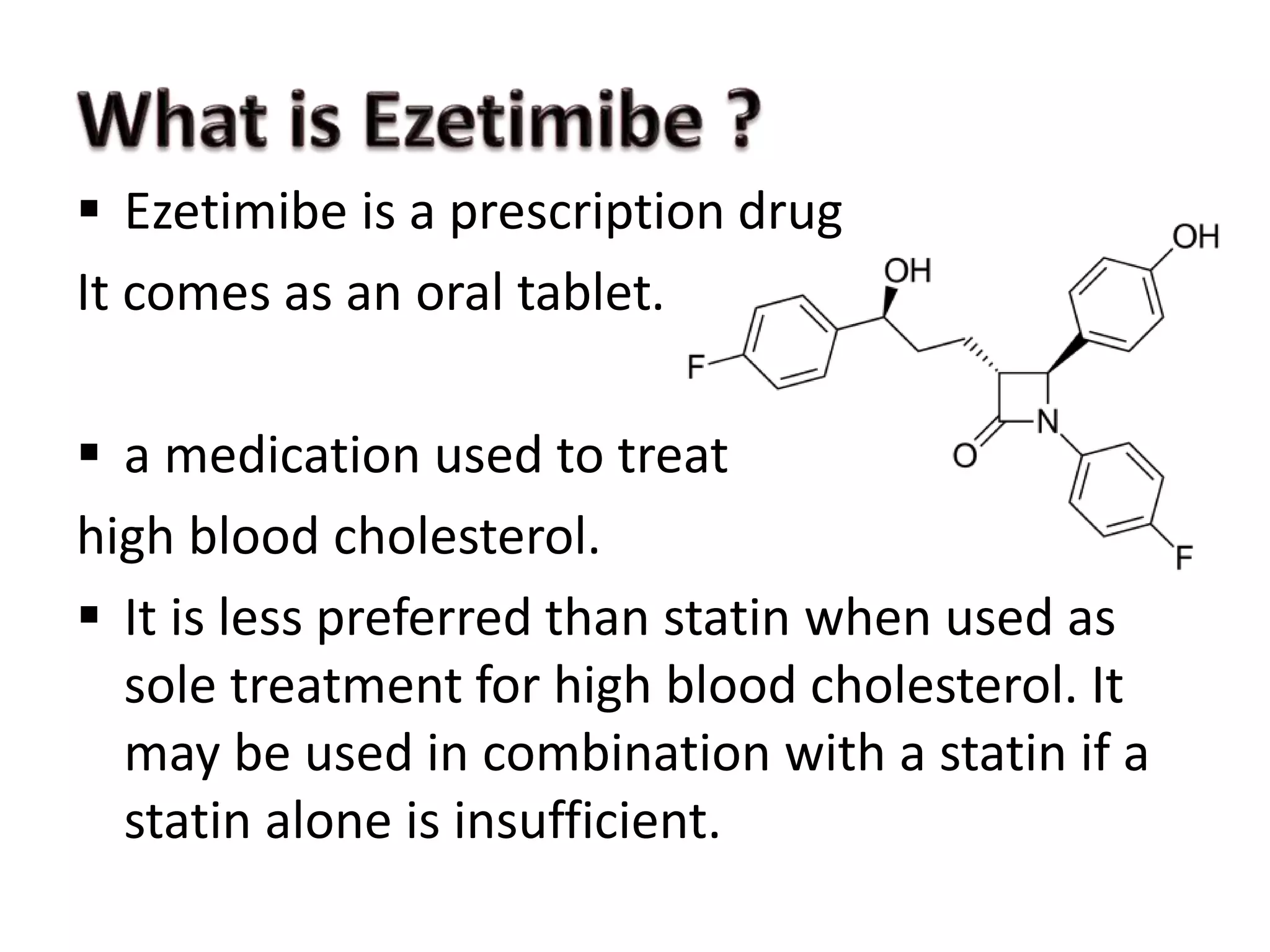
 Ezetimibe is a prescription drug
It comes as an oral tablet.
 a medication used to treat
high blood cholesterol.
 It is less preferred than statin when used as
sole treatment for high blood cholesterol. It
may be used in combination with a statin if a
statin alone is insufficient.
• Ezentia
• Ezedoc
• Ezetrol
• Zetia
This drug may be used as part of a combination
therapy. This means you may need to take it
with other cholesterol-lowering medications
Why is this medication prescribed?
Ezetimibe is in a class of medication called cholesterol
lowering medication to reduce cholesterol in people
with high cholesterol levels.
Ezetimibe is used together with lifestyle changes(diet
,weight-loss , exercise) to reduce the amount of
cholesterol
 Ezetimibe inhibits sterol transporter at brush
border and consequently intestinal absorption
of cholesterol in turn decreases delivery of
cholesterol to liver
and reduce hepatic
cholesterol stores
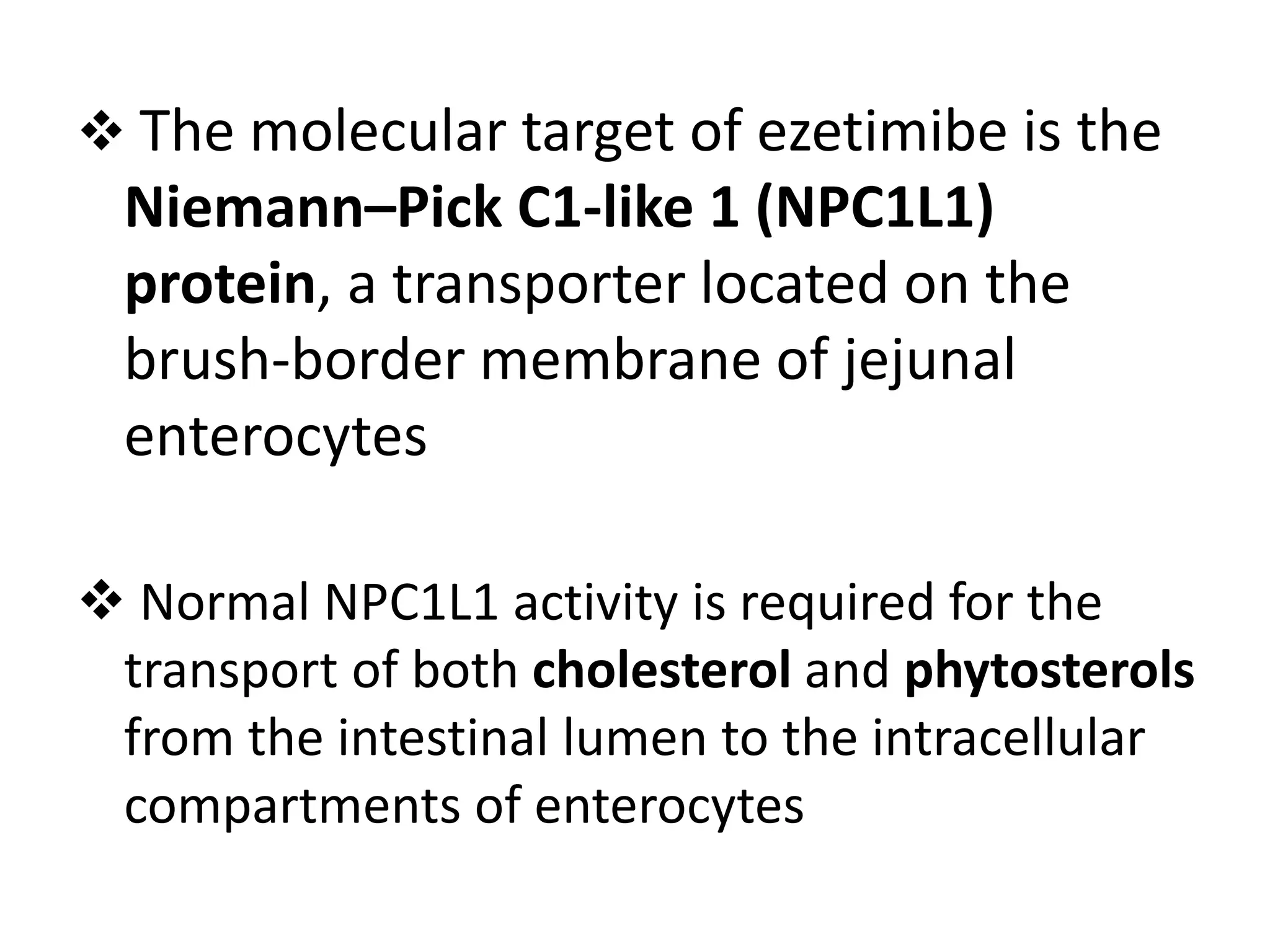
 The molecular target of ezetimibe is the
Niemann–Pick C1-like 1 (NPC1L1)
protein, a transporter located on the
brush-border membrane of jejunal
enterocytes
 Normal NPC1L1 activity is required for the
transport of both cholesterol and phytosterols
from the intestinal lumen to the intracellular
compartments of enterocytes
1. Reduction of hepatic cholesterol
2. Increase the LDL expression receptor
3. Increase the plasma C LDL clearance
Your dosage, drug form, and how often you take
the drug will depend on:
 your age
 the condition being treated
 how severe your condition is
 other medical conditions you have
 how you react to the first dose
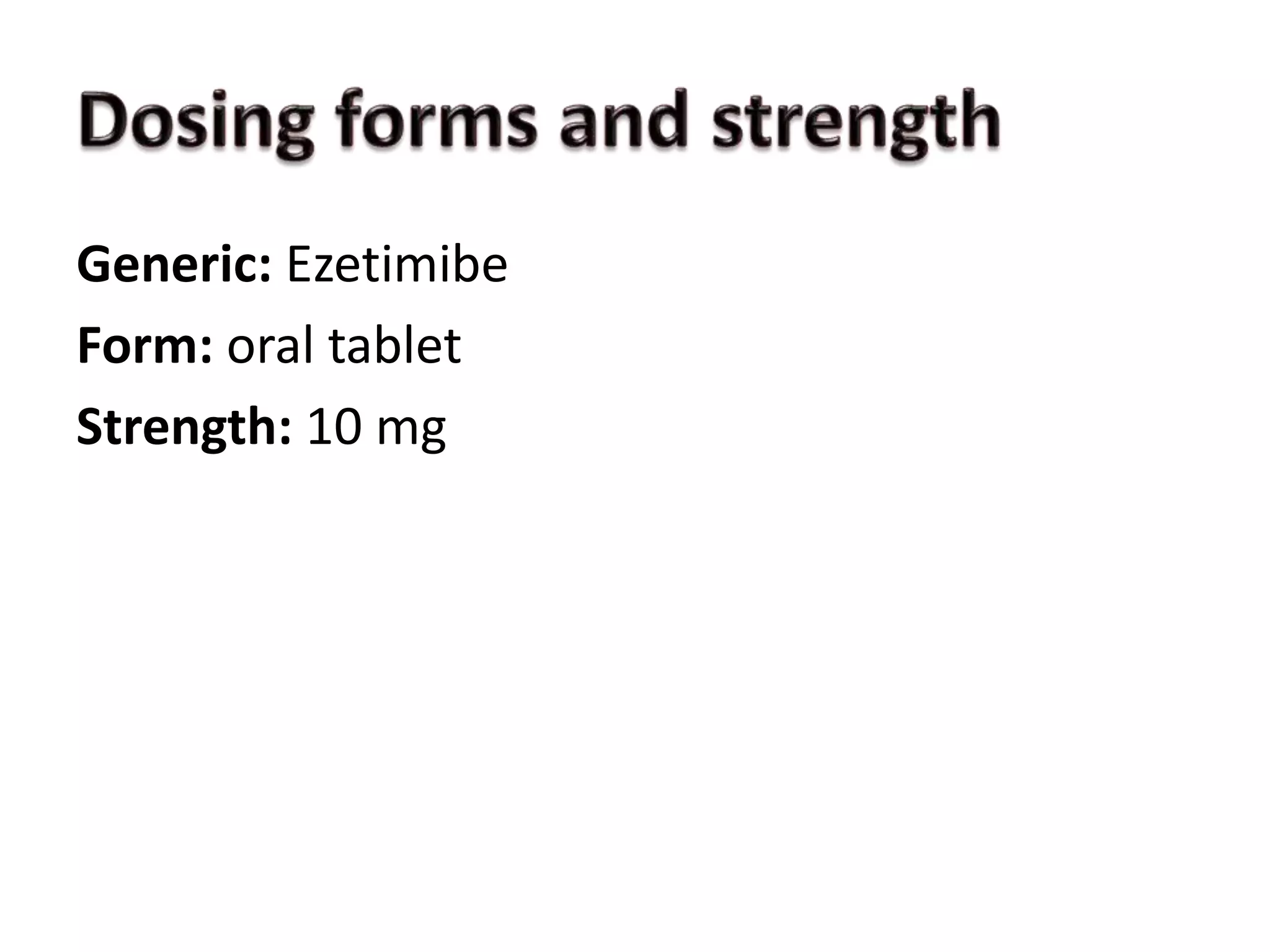
Generic: Ezetimibe
Form: oral tablet
Strength: 10 mg
 Dosage for high cholesterol
Adult dosage (ages 18–64 years)
 Typical dosage: 10 mg taken once per day.
Child dosage (ages 10–17 years)
 Typical dosage: 10 mg taken once per day.
Child dosage (ages 0–9 years)
This medication hasn’t been studied in children
younger than 10 years. It shouldn’t be used in
children of this age group.
 Senior dosage (ages 65 years and older)
The kidneys of older adults may not work
as well as they used to. This can cause
your body to process drugs more slowly.
As a result, higher levels of a drug stay in
your body for a longer time. This
increases your risk of side effects.
 Ezetimibe and its active glucuronide metabolite
impair the intestinal reabsorption of both dietary
and hepatically excreted biliary cholesterol
through inhibition of a membrane transporter
 Absorption of ezetimibe is rapid and not altered
by food content following oral administration
 Ezetimibe and its active metabolites are highly
bound to human plasma proteins (90%)
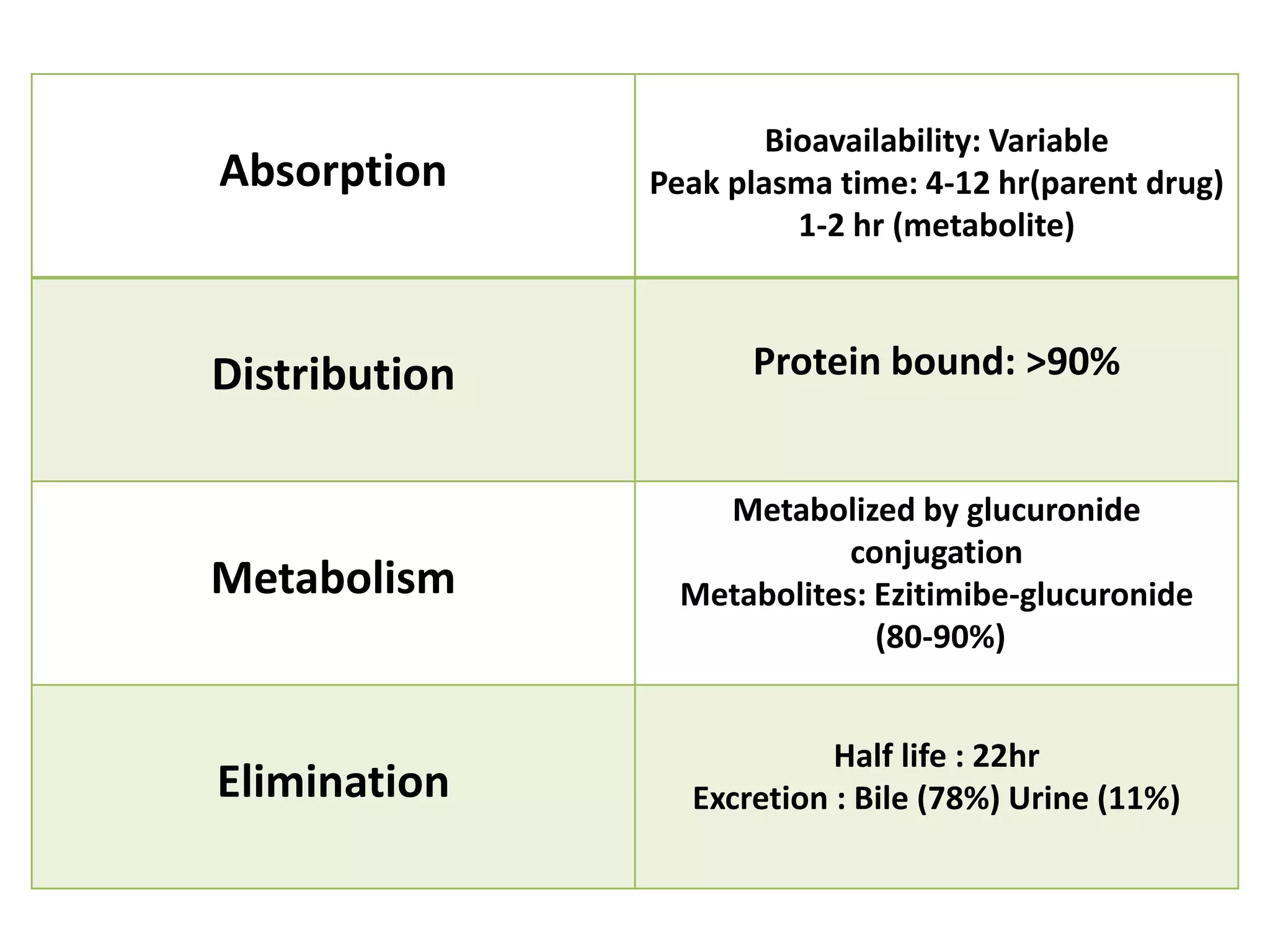
Absorption
Bioavailability: Variable
Peak plasma time: 4-12 hr(parent drug)
1-2 hr (metabolite)
Distribution Protein bound: >90%
Metabolism
Metabolized by glucuronide
conjugation
Metabolites: Ezitimibe-glucuronide
(80-90%)
Elimination
Half life : 22hr
Excretion : Bile (78%) Urine (11%)
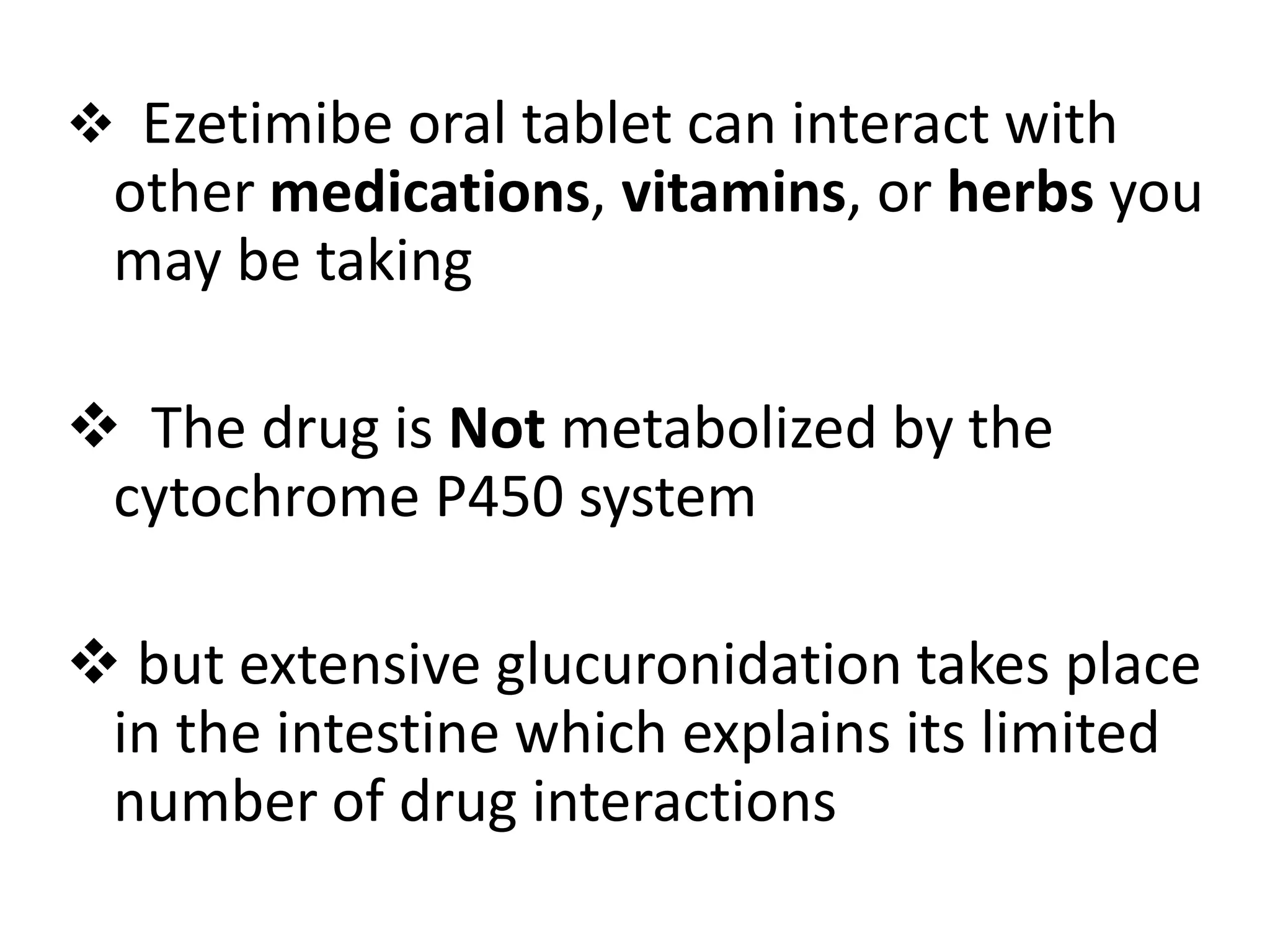
 Ezetimibe oral tablet can interact with
other medications, vitamins, or herbs you
may be taking
 The drug is Not metabolized by the
cytochrome P450 system
 but extensive glucuronidation takes place
in the intestine which explains its limited
number of drug interactions
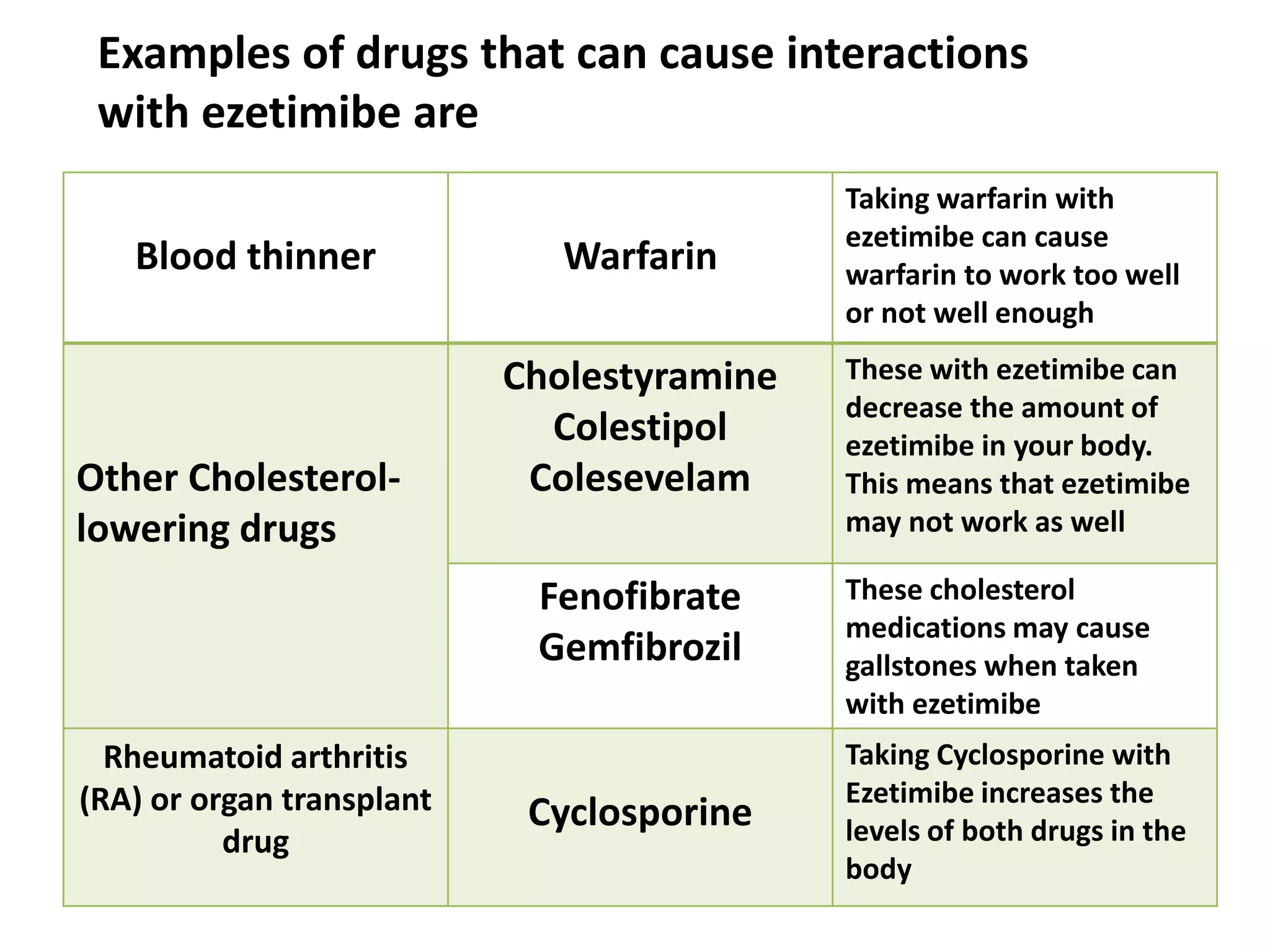
Examples of drugs that can cause interactions
with ezetimibe are
Blood thinner Warfarin
Taking warfarin with
ezetimibe can cause
warfarin to work too well
or not well enough
Other Cholesterol-
lowering drugs
Cholestyramine
Colestipol
Colesevelam
These with ezetimibe can
decrease the amount of
ezetimibe in your body.
This means that ezetimibe
may not work as well
Fenofibrate
Gemfibrozil
These cholesterol
medications may cause
gallstones when taken
with ezetimibe
Rheumatoid arthritis
(RA) or organ transplant
drug
Cyclosporine
Taking Cyclosporine with
Ezetimibe increases the
levels of both drugs in the
body
 Ezetimibe side effects
Ezetimibe oral tablet can cause drowsiness. It can also cause
other side effects include :
More common side effects
more common side effects that can occur include:
 diarrhea
 stuffy nose
 viral infection of your nose, throat, and airways
 joint pain
 These effects are mild, they may go away within a
few days or a couple of weeks
Serious side effects
include the following:
 Liver problems. Symptoms can include:
– pain in your abdomen
– yellowing of your skin and sclera
 Severe muscle problems
Including Rhabdomyolysis
 The incidence of overdose with ezetimibe is
rare
 an acute overdose of ezetimibe is expected to
produce an exaggeration of its usual effects,
leading to
 loose stools
 abdominal pain
 fatigue
 The contraindications to taking ezetimibe are a
previous allergic reaction to it
 This drug can cause a severe allergic reaction.
Symptoms can include:
swelling of the face, lips, tongue, or
throat( angioedema )(anaphylaxis)
trouble breathing or swallowing
skin rash
hives
 For people with liver disease
moderate or severe liver problems
 For pregnant women
This drug is a category C pregnancy drug
 For women who are breastfeeding
 For seniors
 For children (under 10 years)
 lippincott illustrated reviews pharmacology
sixth edition
 katzung and trevor's pharmacology 11th
edition
 https://www.medscape.com
 https://www.healthline.com
 https://www.webmd.com
Ezetimibe

Ezetimibe

  • 1.
  • 2.
    • Introduction • Whatis hyperlipidemia • Drugs used for hyperlipidemia  Ezetimibe • Mechanism of action • Dosage form • Pharmacokinetic • Adverse side effect • Overdose • Contraindication and warning • references
  • 3.
    lipid-lowering therapy inpatient with hypercholesterolemia has a proven survival benefit for both:  Primary prevention Patient without clinical evidence of coronary disease  Secondary prevention Patent with established coronary disease Even when serum cholesterol concentration are NORMAL
  • 4.
     Hyperlipidemia abroad term, also called hyperlipoproteinemia ,is a common disorder in developed countries and is the major cause of coronary heart disease  It result from abnormalities in lipid metabolism or plasma lipid transport or a disorder in the synthesis and degradation of plasma lipoprotein
  • 6.
    • Diet • Hypothyroidism •Nephrotic syndrome • Anorexia nervosa • Obstructive liver disease • Obesity • Diabetes mellitus • Pregnancy • Obstructive liver disease • Acute hepatitis
  • 7.
    Drug Class AgentsEffects (% change) HMG CoA reductase inhibitors STATINS Lovastatin Pravastatin ↓LDL (18-55)/↑ HDL (5-15) ↓ Triglycerides (7-30) Cholesterol absorption inhibitor Ezetimibe ↓ LDL( 14-18)/↑ HDL (1-3) ↓Triglyceride (2) Nicotinic Acid ↓LDL (15-30)/ ↑ HDL (15-35) ↓ Triglyceride (20-50) Fibric Acids Gemfibrozil Fenofibrate ↓LDL (5-20)/ ↑HDL (10-20) ↓Triglyceride (20-50) Bile Acid sequestrants Cholestyramine Colestipol ↓ LDL / ↑ HDL No change in triglycerides
  • 8.
     Ezetimibe isa prescription drug It comes as an oral tablet.  a medication used to treat high blood cholesterol.  It is less preferred than statin when used as sole treatment for high blood cholesterol. It may be used in combination with a statin if a statin alone is insufficient.
  • 9.
    • Ezentia • Ezedoc •Ezetrol • Zetia
  • 10.
    This drug maybe used as part of a combination therapy. This means you may need to take it with other cholesterol-lowering medications Why is this medication prescribed? Ezetimibe is in a class of medication called cholesterol lowering medication to reduce cholesterol in people with high cholesterol levels. Ezetimibe is used together with lifestyle changes(diet ,weight-loss , exercise) to reduce the amount of cholesterol
  • 11.
     Ezetimibe inhibitssterol transporter at brush border and consequently intestinal absorption of cholesterol in turn decreases delivery of cholesterol to liver and reduce hepatic cholesterol stores
  • 12.
     The moleculartarget of ezetimibe is the Niemann–Pick C1-like 1 (NPC1L1) protein, a transporter located on the brush-border membrane of jejunal enterocytes  Normal NPC1L1 activity is required for the transport of both cholesterol and phytosterols from the intestinal lumen to the intracellular compartments of enterocytes
  • 13.
    1. Reduction ofhepatic cholesterol 2. Increase the LDL expression receptor 3. Increase the plasma C LDL clearance
  • 14.
    Your dosage, drugform, and how often you take the drug will depend on:  your age  the condition being treated  how severe your condition is  other medical conditions you have  how you react to the first dose
  • 15.
    Generic: Ezetimibe Form: oraltablet Strength: 10 mg
  • 16.
     Dosage forhigh cholesterol Adult dosage (ages 18–64 years)  Typical dosage: 10 mg taken once per day. Child dosage (ages 10–17 years)  Typical dosage: 10 mg taken once per day. Child dosage (ages 0–9 years) This medication hasn’t been studied in children younger than 10 years. It shouldn’t be used in children of this age group.
  • 17.
     Senior dosage(ages 65 years and older) The kidneys of older adults may not work as well as they used to. This can cause your body to process drugs more slowly. As a result, higher levels of a drug stay in your body for a longer time. This increases your risk of side effects.
  • 18.
     Ezetimibe andits active glucuronide metabolite impair the intestinal reabsorption of both dietary and hepatically excreted biliary cholesterol through inhibition of a membrane transporter  Absorption of ezetimibe is rapid and not altered by food content following oral administration  Ezetimibe and its active metabolites are highly bound to human plasma proteins (90%)
  • 19.
    Absorption Bioavailability: Variable Peak plasmatime: 4-12 hr(parent drug) 1-2 hr (metabolite) Distribution Protein bound: >90% Metabolism Metabolized by glucuronide conjugation Metabolites: Ezitimibe-glucuronide (80-90%) Elimination Half life : 22hr Excretion : Bile (78%) Urine (11%)
  • 20.
     Ezetimibe oraltablet can interact with other medications, vitamins, or herbs you may be taking  The drug is Not metabolized by the cytochrome P450 system  but extensive glucuronidation takes place in the intestine which explains its limited number of drug interactions
  • 21.
    Examples of drugsthat can cause interactions with ezetimibe are Blood thinner Warfarin Taking warfarin with ezetimibe can cause warfarin to work too well or not well enough Other Cholesterol- lowering drugs Cholestyramine Colestipol Colesevelam These with ezetimibe can decrease the amount of ezetimibe in your body. This means that ezetimibe may not work as well Fenofibrate Gemfibrozil These cholesterol medications may cause gallstones when taken with ezetimibe Rheumatoid arthritis (RA) or organ transplant drug Cyclosporine Taking Cyclosporine with Ezetimibe increases the levels of both drugs in the body
  • 22.
     Ezetimibe sideeffects Ezetimibe oral tablet can cause drowsiness. It can also cause other side effects include : More common side effects more common side effects that can occur include:  diarrhea  stuffy nose  viral infection of your nose, throat, and airways  joint pain  These effects are mild, they may go away within a few days or a couple of weeks
  • 23.
    Serious side effects includethe following:  Liver problems. Symptoms can include: – pain in your abdomen – yellowing of your skin and sclera  Severe muscle problems Including Rhabdomyolysis
  • 24.
     The incidenceof overdose with ezetimibe is rare  an acute overdose of ezetimibe is expected to produce an exaggeration of its usual effects, leading to  loose stools  abdominal pain  fatigue
  • 25.
     The contraindicationsto taking ezetimibe are a previous allergic reaction to it  This drug can cause a severe allergic reaction. Symptoms can include: swelling of the face, lips, tongue, or throat( angioedema )(anaphylaxis) trouble breathing or swallowing skin rash hives
  • 26.
     For peoplewith liver disease moderate or severe liver problems  For pregnant women This drug is a category C pregnancy drug  For women who are breastfeeding  For seniors  For children (under 10 years)
  • 27.
     lippincott illustratedreviews pharmacology sixth edition  katzung and trevor's pharmacology 11th edition  https://www.medscape.com  https://www.healthline.com  https://www.webmd.com