Welcome
Tracking Single-Use & Scale-Up Best Practices
[Webinar Series]
Webinar #2: An Overview of Biologics Manufacturing Processes and Things to
Consider from Development to Commercial Scale
An Overview of Biologics Manufacturing
Processes and Things to Consider from
Development to Commercial Scale
Kevin Lauziere
About Your Presenter – Kevin Lauziere
• Degree in Biochemistry from Boston College, and has worked for a
number of companies in the Boston area including Genzyme, BASF
Bioresearch Center, Abbott Bioresearch Center and Bristol-Myers
Squibb.
• Worked in the process development area early in career designing
methods for purifying proteins to be scaled up to the
manufacturing level.
• Currently a consultant with over 27 years in the industry currently
working with The Quantic Group, Ltd.
• Over the years he has contributed to the design, start-up and
validation of two commercial manufacturing facilities working with
both internal and external engineering resources.
Outline
• Overview of a typical biologics manufacturing process
that uses mammalians cells for protein expression
• Discuss the importance of process development and the
influence this has on commercial scale equipment design
and operations
• Discuss how automation can be used for running some
process operations and the pros and cons of using it
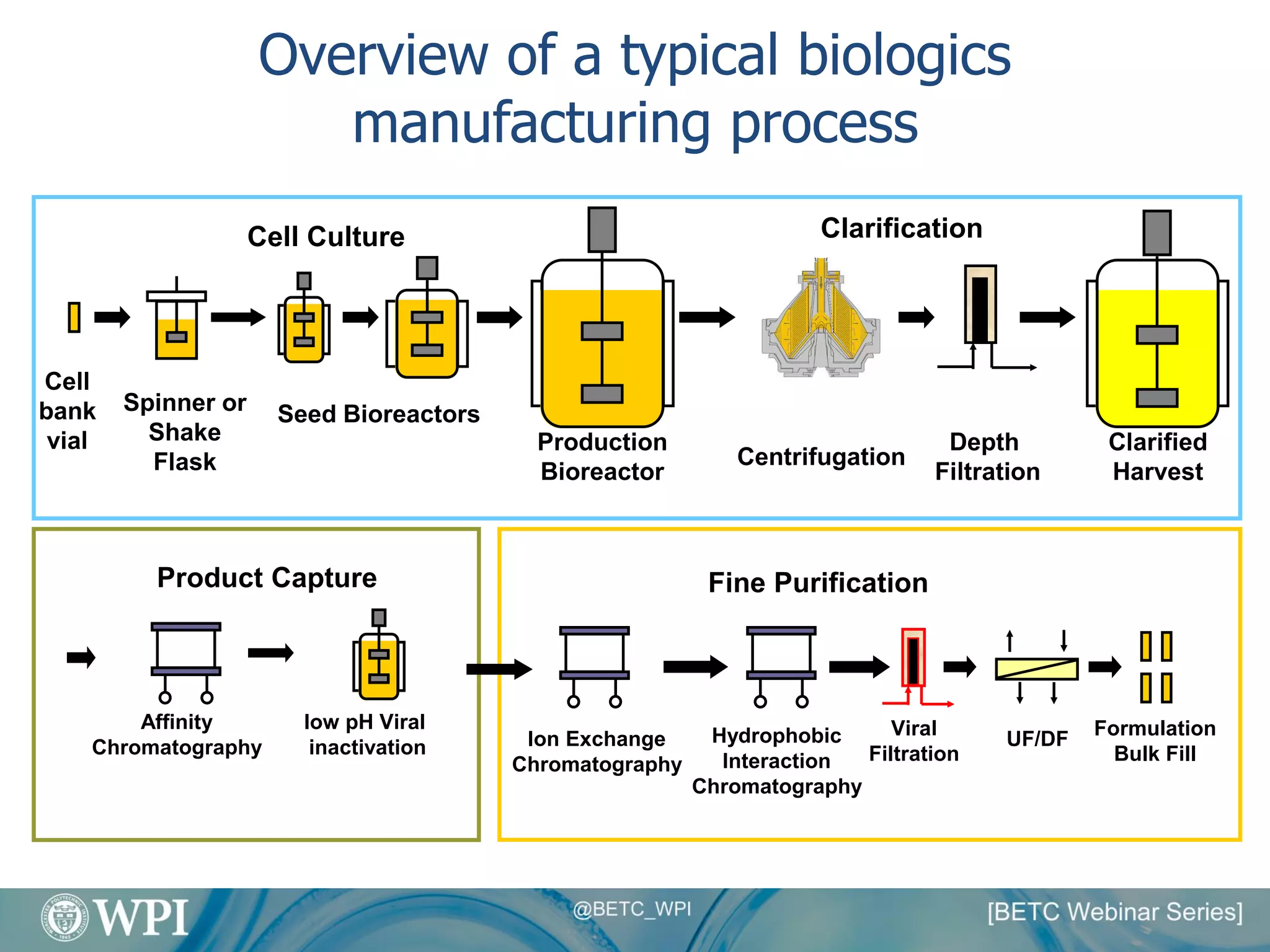
Overview of a typical biologics
manufacturing process
Ion Exchange
Chromatography
Hydrophobic
Interaction
Chromatography
Viral
Filtration
UF/DF
Fine Purification
Formulation
Bulk Fill
Affinity
Chromatography
Product Capture
low pH Viral
inactivation
Spinner or
Shake
Flask
Cell
bank
vial
Seed Bioreactors
Production
Bioreactor
Depth
Filtration
Cell Culture
Clarified
Harvest
Centrifugation
Clarification
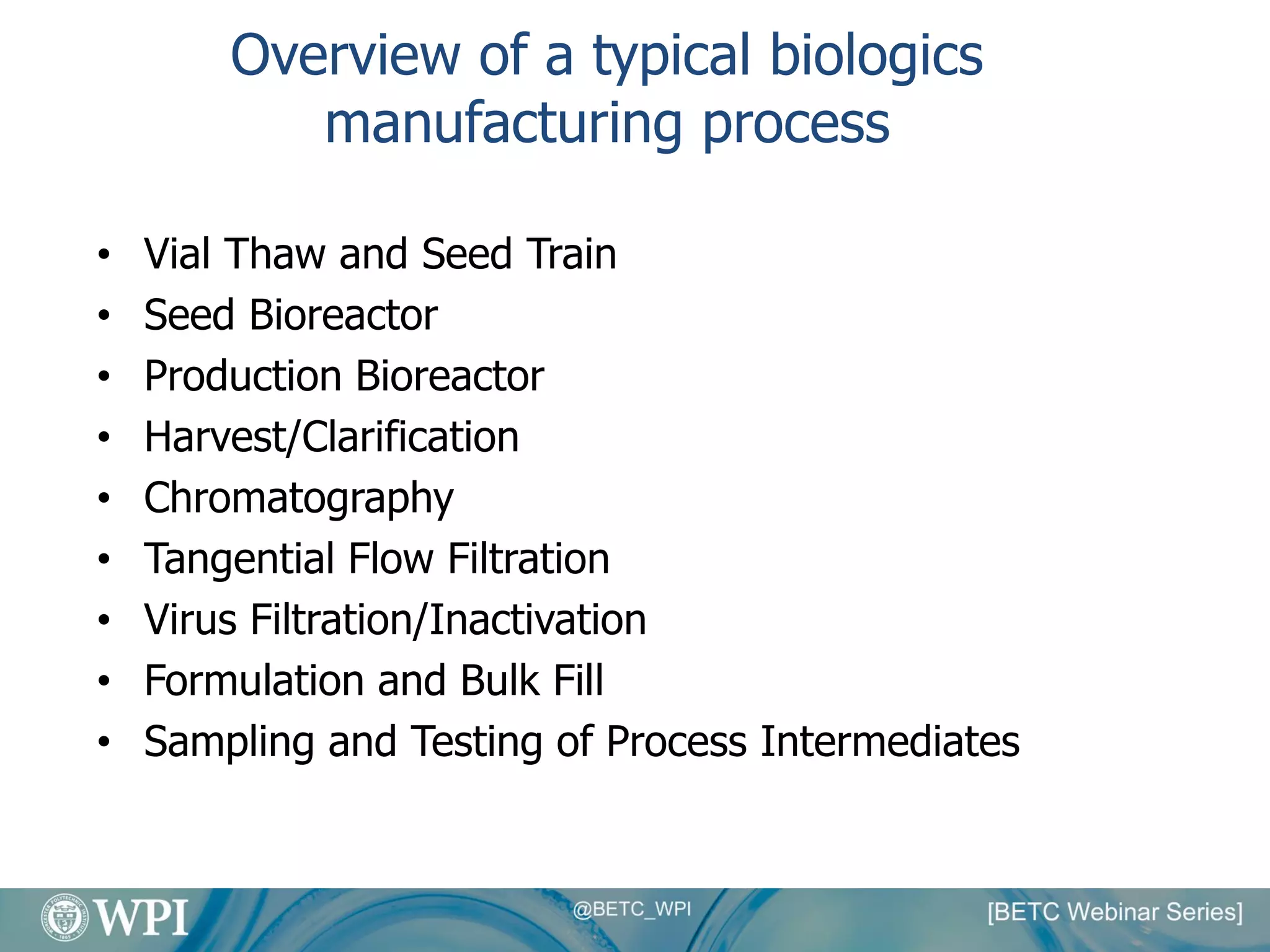
Overview of a typical biologics
manufacturing process
• Vial Thaw and Seed Train
• Seed Bioreactor
• Production Bioreactor
• Harvest/Clarification
• Chromatography
• Tangential Flow Filtration
• Virus Filtration/Inactivation
• Formulation and Bulk Fill
• Sampling and Testing of Process Intermediates
Vial Thaw and Seed Train
• Typically a single vial of cryogenically preserved cells is
thawed to start the seed train for a mammalian cell
culture process. Vial thaw can be accomplished:
• At room temperature
• In a water bath
• In a heating block
• In an incubator
– Resuspension process
• Typically use an enriched medium to dilute any cryopreservatives
• Transfer thawed cells into different volumes to target a specific
range for initial cell density
• Viability ranges vary with each process
Vial Thaw and Seed Train
• The number of stages in a seed train vary with every
process
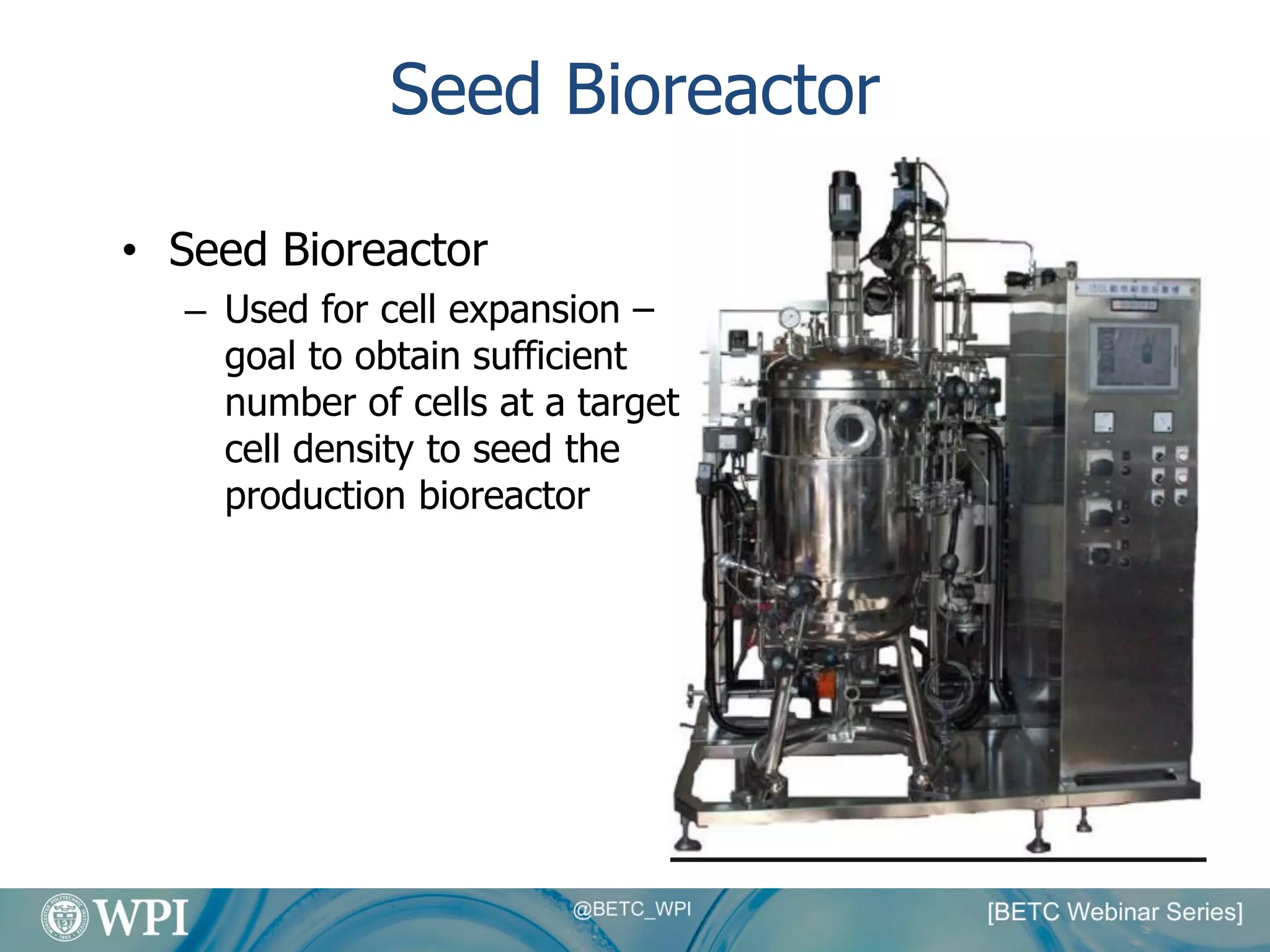
– It may utilize T-flasks, shake flasks, spinners and or wave bags
– Volume of the culture varies and this puts demands on the
design and footprint of the manufacturing area
• Considerations include:
– Number of containers at each stage
– Are there multiple trains running in parallel
– Equipment needed (biosafety cabinets, incubators)
– Utilities
– Classification of the rooms
– Open or closed processing
Seed Bioreactor
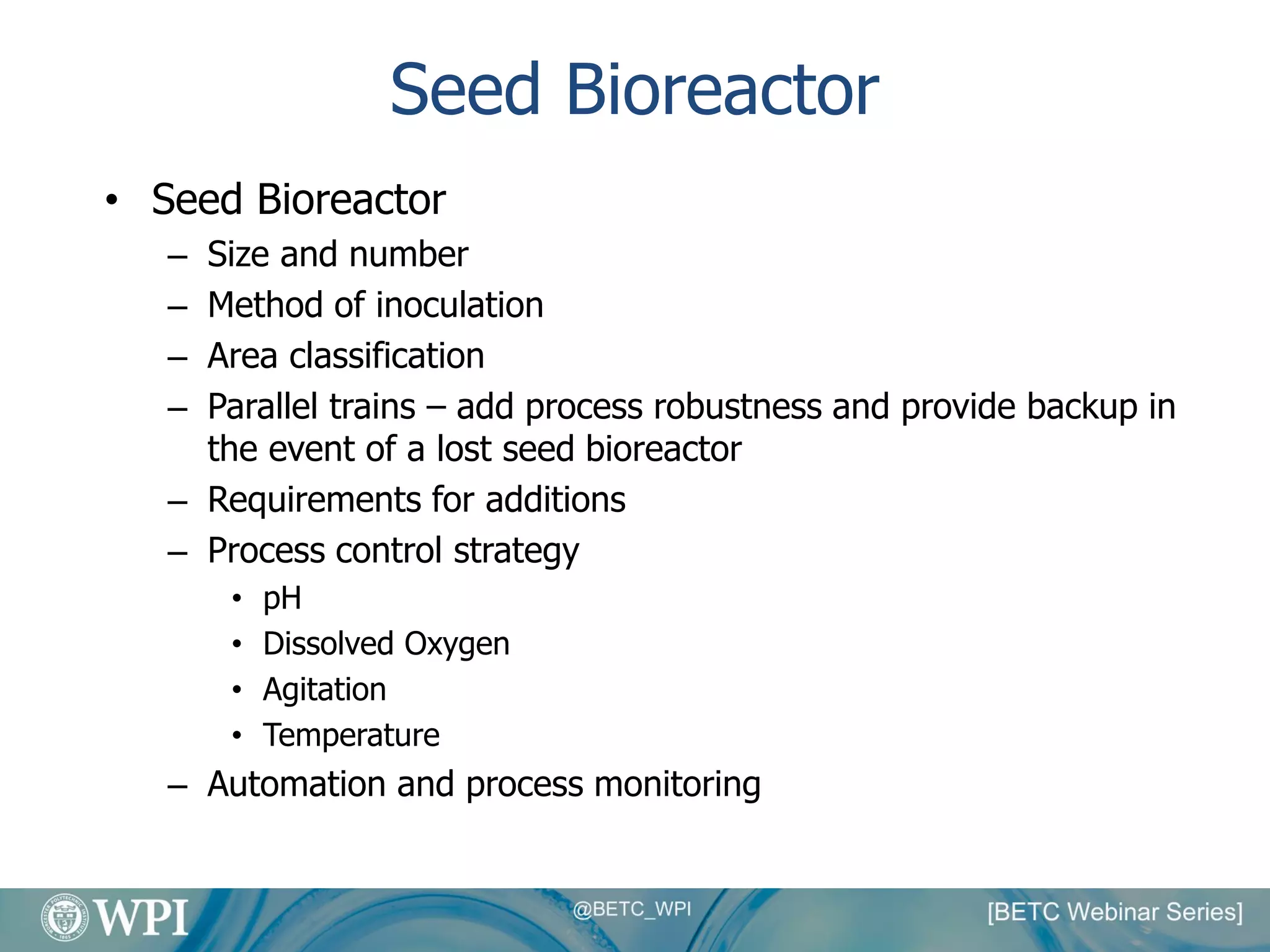
• Seed Bioreactor
– Used for cell expansion –
goal to obtain sufficient
number of cells at a target
cell density to seed the
production bioreactor
Seed Bioreactor
• Seed Bioreactor
– Size and number
– Method of inoculation
– Area classification
– Parallel trains – add process robustness and provide backup in
the event of a lost seed bioreactor
– Requirements for additions
– Process control strategy
• pH
• Dissolved Oxygen
• Agitation
• Temperature
– Automation and process monitoring
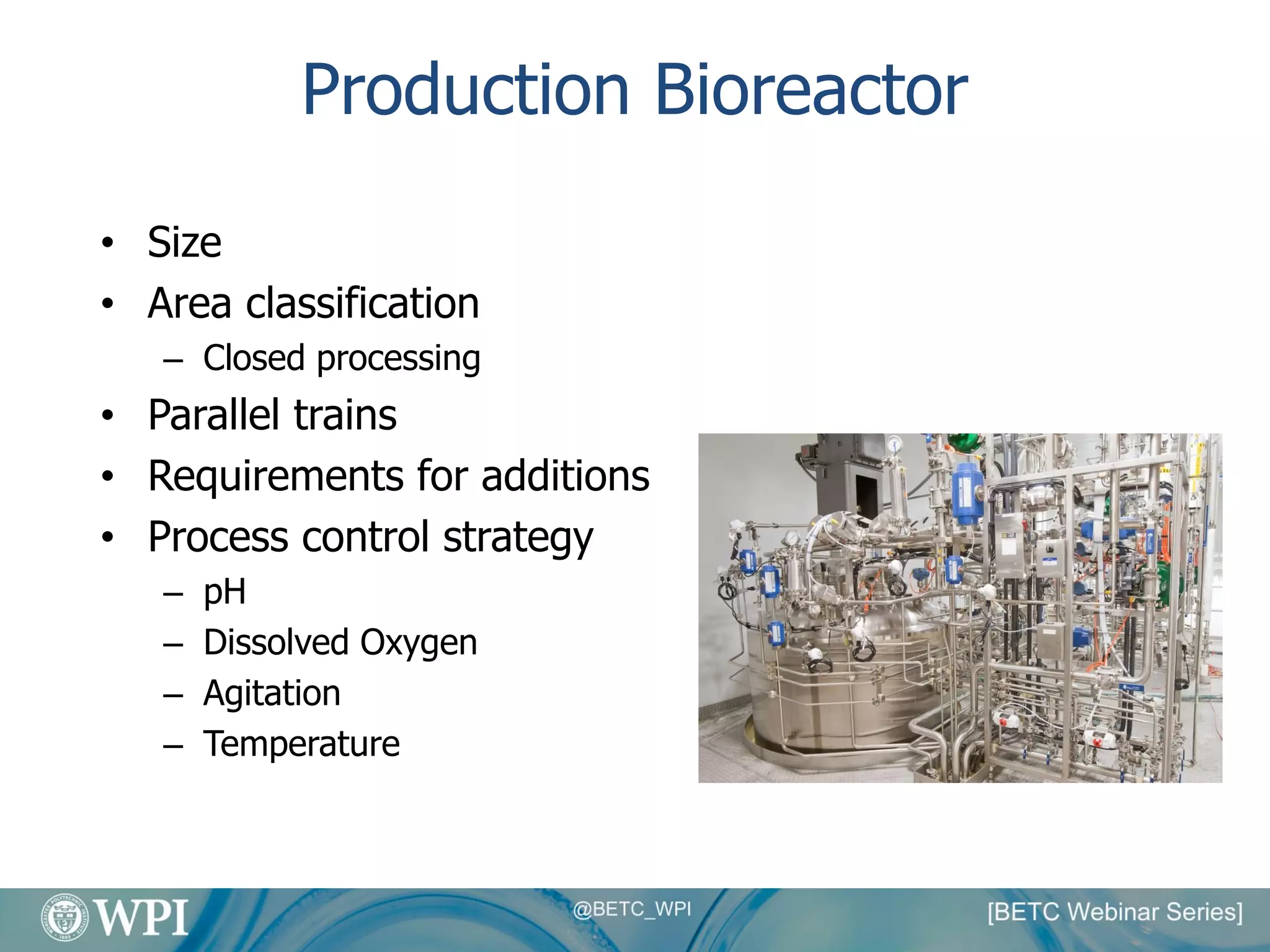
Production Bioreactor
• Size
• Area classification
– Closed processing
• Parallel trains
• Requirements for additions
• Process control strategy
– pH
– Dissolved Oxygen
– Agitation
– Temperature
Production Bioreactor
• Harvest criteria
– Viability
– Titer
– Duration
• Automation and process monitoring
– Glucose
– Lactate
– pCO2
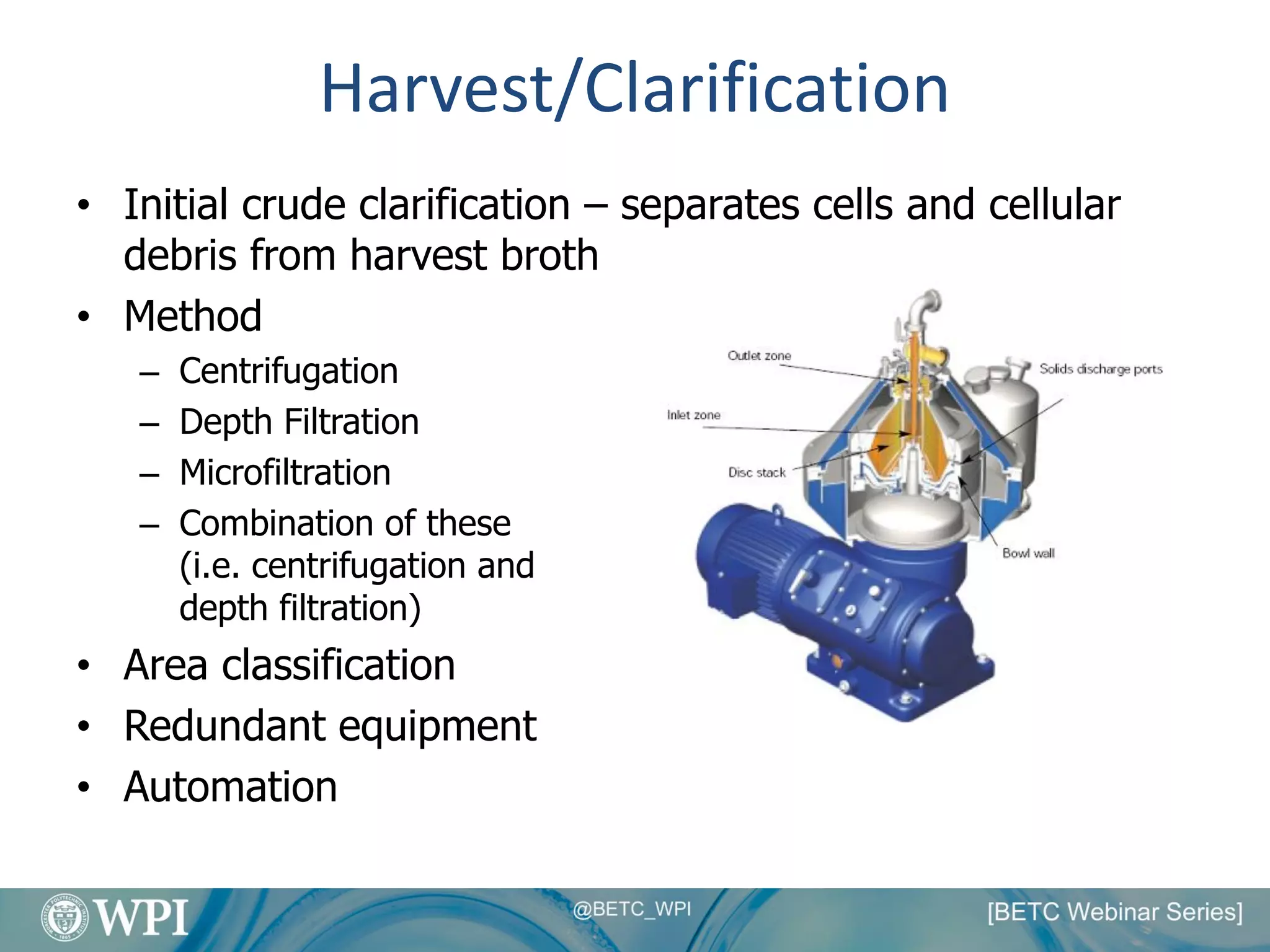
Harvest/Clarification
• Initial crude clarification – separates cells and cellular
debris from harvest broth
• Method
– Centrifugation
– Depth Filtration
– Microfiltration
– Combination of these
(i.e. centrifugation and
depth filtration)
• Area classification
• Redundant equipment
• Automation
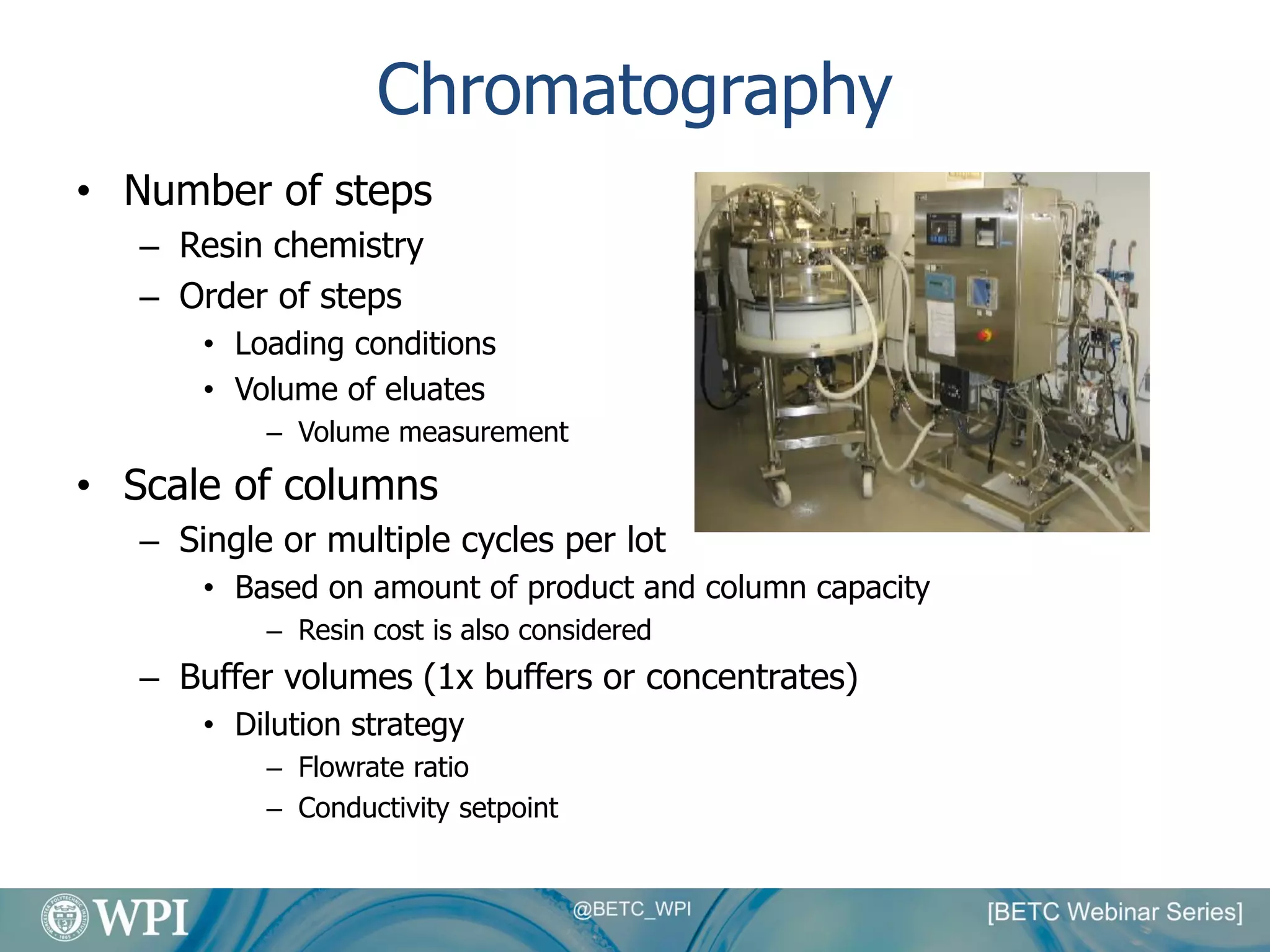
Chromatography
• Number of steps
– Resin chemistry
– Order of steps
• Loading conditions
• Volume of eluates
– Volume measurement
• Scale of columns
– Single or multiple cycles per lot
• Based on amount of product and column capacity
– Resin cost is also considered
– Buffer volumes (1x buffers or concentrates)
• Dilution strategy
– Flowrate ratio
– Conductivity setpoint
Chromatography
• Eluate vessel size and capability
– Process sampling
– Mixing
– Temperature control
– Process intermediate manipulations
– Filtration (In-line or post processing)
• Area classification
• Processing temperature
– Column operation temperature versus hold temperature for
process intermediates
• Redundant equipment
• Automation
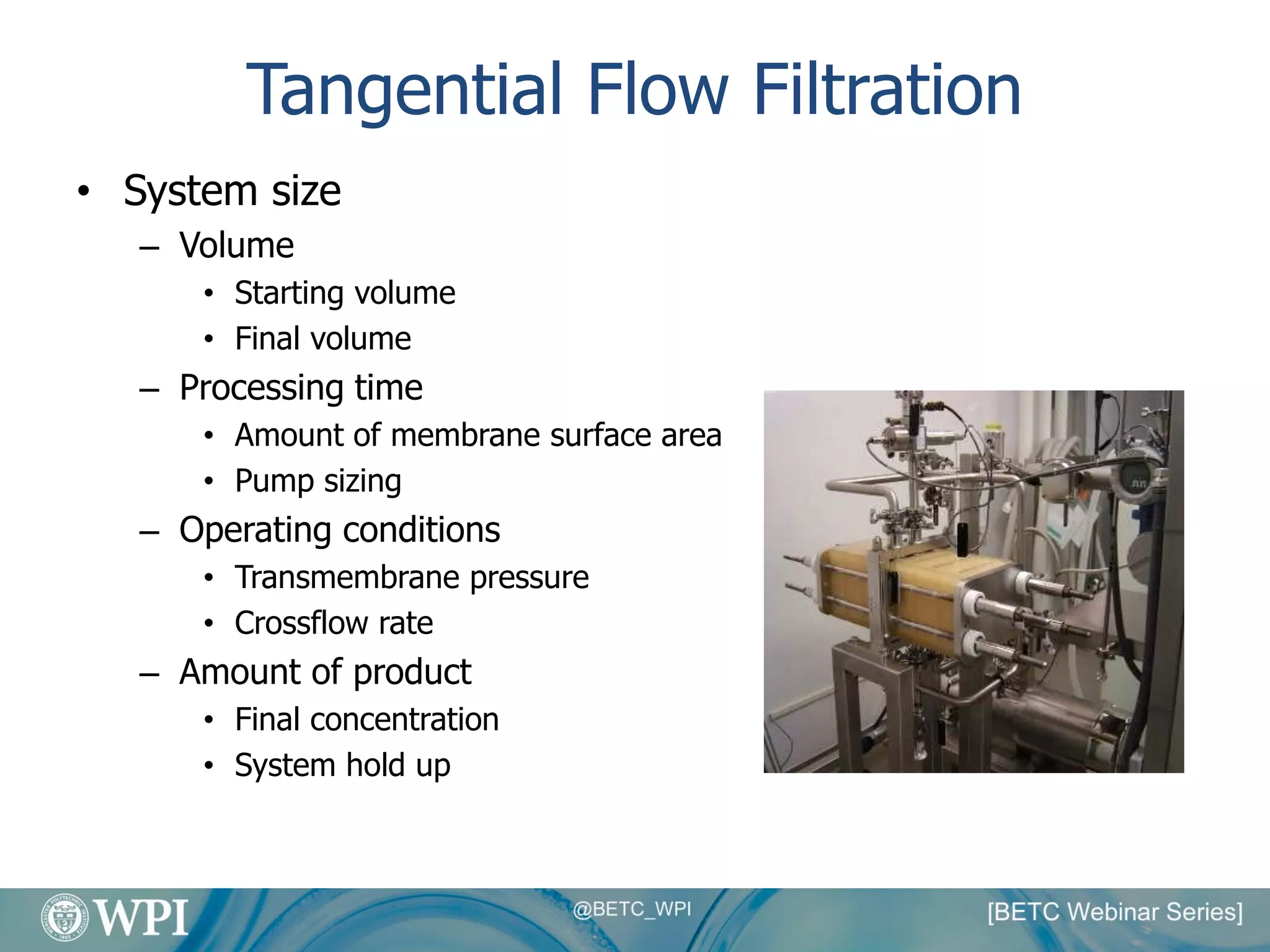
Tangential Flow Filtration
• System size
– Volume
• Starting volume
• Final volume
– Processing time
• Amount of membrane surface area
• Pump sizing
– Operating conditions
• Transmembrane pressure
• Crossflow rate
– Amount of product
• Final concentration
• System hold up
Tangential Flow Filtration
• Diafiltration
– Number of volumes exchanged (5X, 8X, 10X)
– Concentration at which diafiltration is performed
– Solubility (Isoelectric point)
• Area classification
• Processing temperature
• Automation
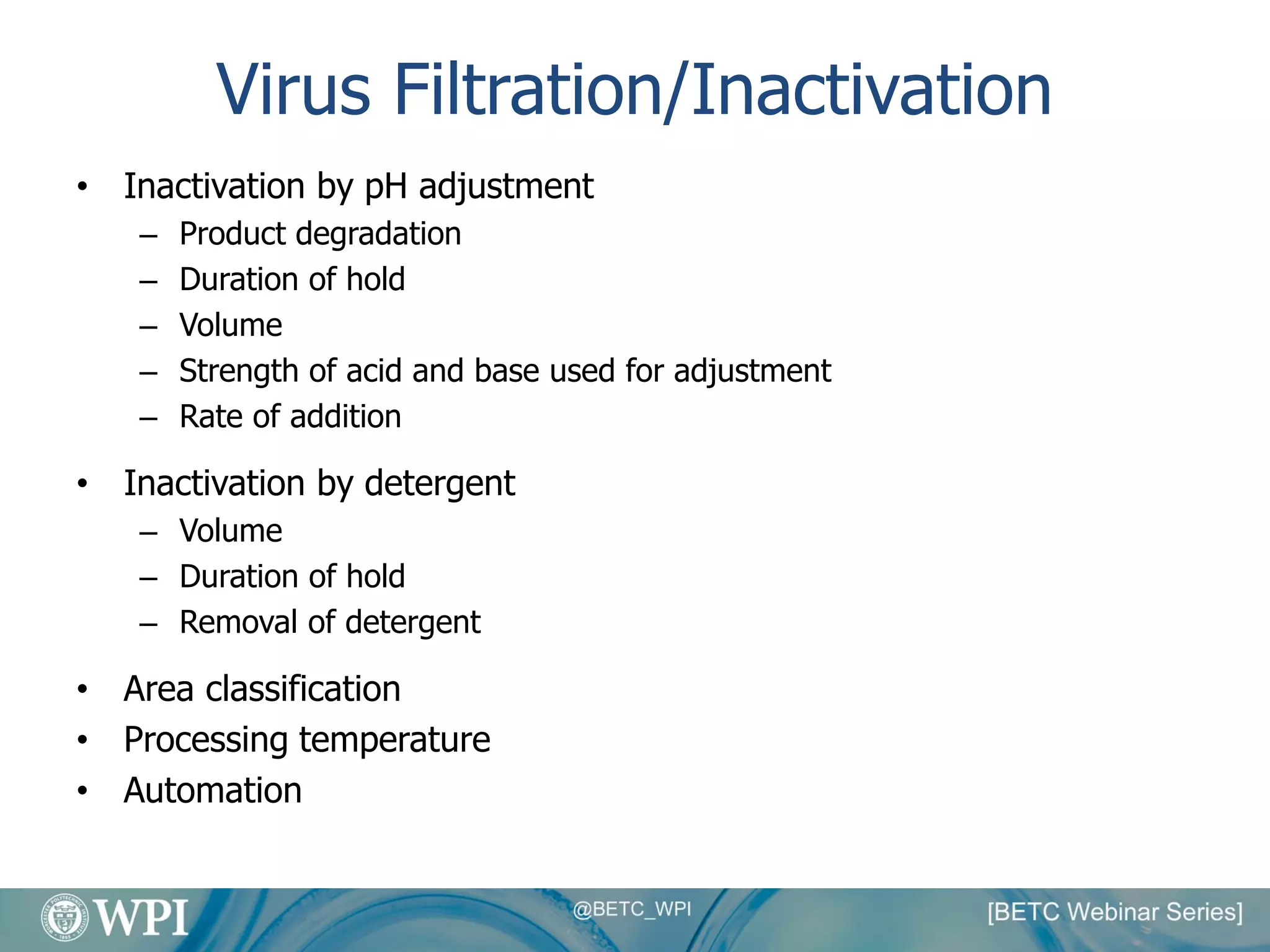
Virus Filtration/Inactivation
• Filtration
– Membrane surface area
– Pore size
– Filter material compatibility
– Physical room change during the process
– Volume
– Processing time
• Product concentration
Virus Filtration/Inactivation
• Inactivation by pH adjustment
– Product degradation
– Duration of hold
– Volume
– Strength of acid and base used for adjustment
– Rate of addition
• Inactivation by detergent
– Volume
– Duration of hold
– Removal of detergent
• Area classification
• Processing temperature
• Automation
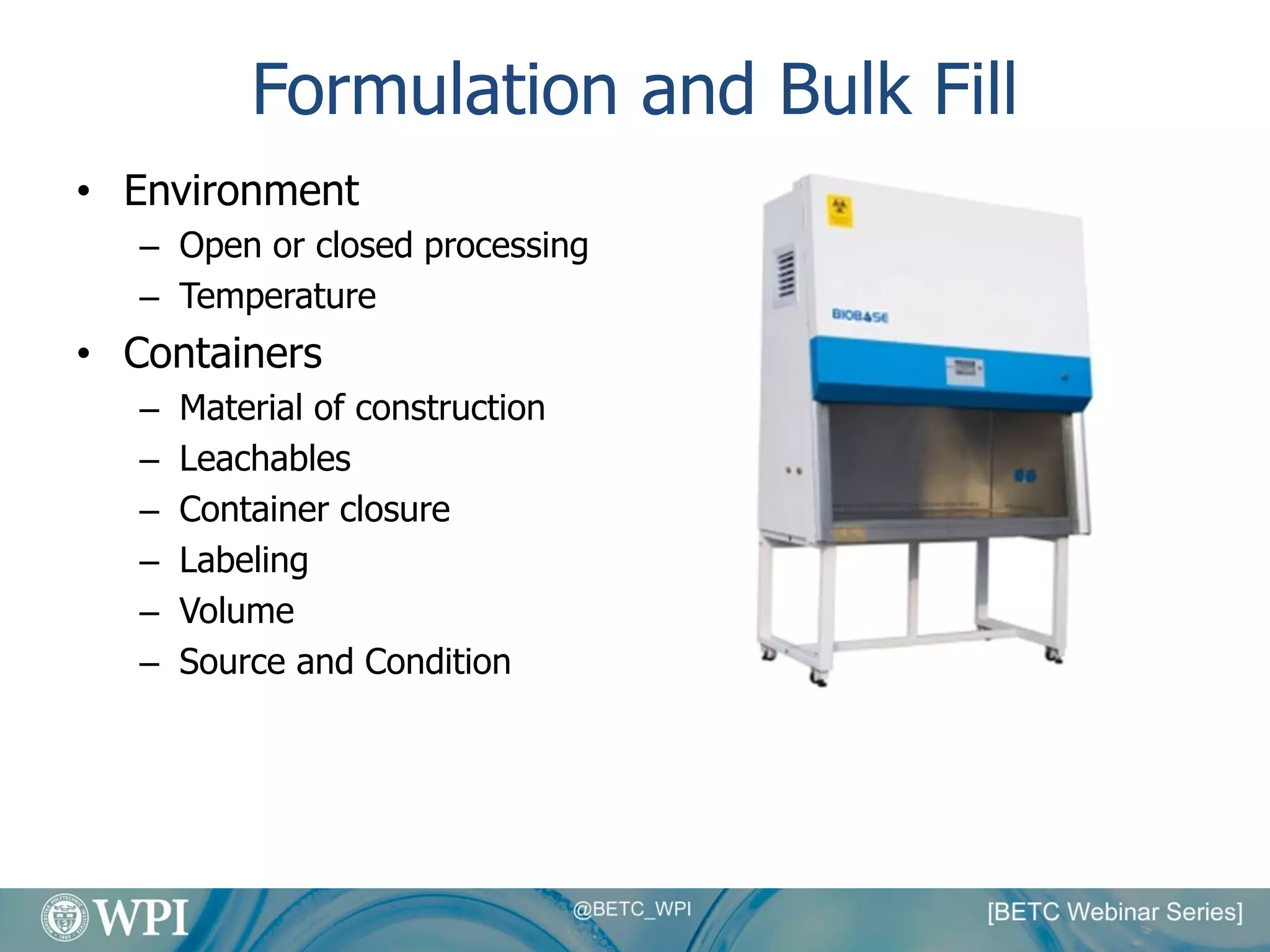
Formulation and Bulk Fill
• Environment
– Open or closed processing
– Temperature
• Containers
– Material of construction
– Leachables
– Container closure
– Labeling
– Volume
– Source and Condition
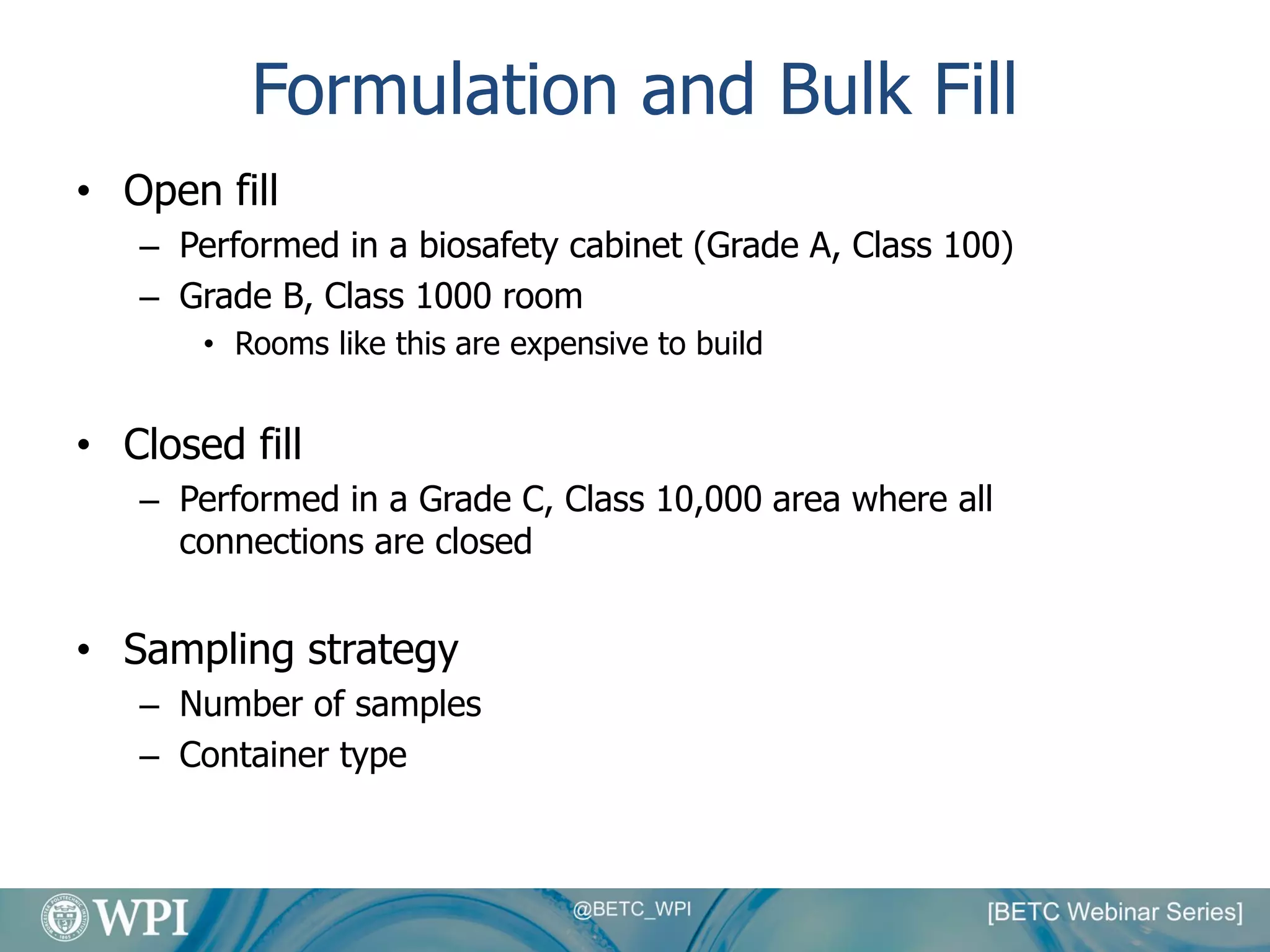
Formulation and Bulk Fill
• Open fill
– Performed in a biosafety cabinet (Grade A, Class 100)
– Grade B, Class 1000 room
• Rooms like this are expensive to build
• Closed fill
– Performed in a Grade C, Class 10,000 area where all
connections are closed
• Sampling strategy
– Number of samples
– Container type
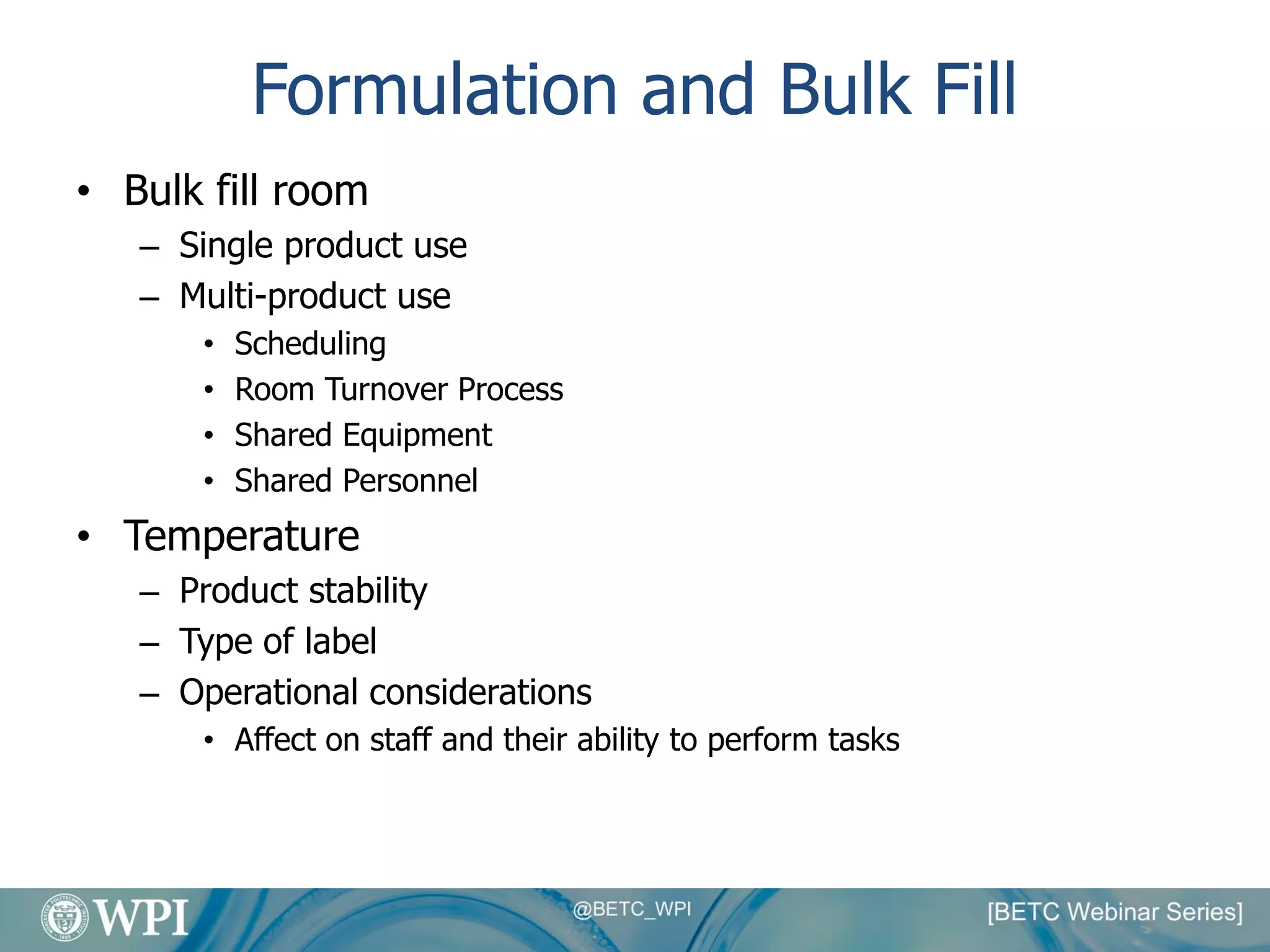
Formulation and Bulk Fill
• Bulk fill room
– Single product use
– Multi-product use
• Scheduling
• Room Turnover Process
• Shared Equipment
• Shared Personnel
• Temperature
– Product stability
– Type of label
– Operational considerations
• Affect on staff and their ability to perform tasks
Thank You
Questions?
#1 Tracking Single-Use : An Introduction to Single-Use Manufacturing Systems
Including a Survey of Technology, New Developments and Economic and Operational
Issues
Tuesday, January 19, 2016 / 1pm-2pm (ET)
Presenter: Geoff Hodge
Next Up: High Level Recombinant Protein Production in Insect Cell Culture
Tuesday, January 26, 2016 / 1-2pm (ET)
Presenter: Dr. Kamal Rashid
#2 An Overview of Biologics Manufacturing Processes and Things to Consider from
Development to Commercial Scale
Monday, January 25, 2016 / 1-2pm (ET)
Presenter: Kevin Lauziere

An Overview of Biologics Manufacturing Processes and Things to Consider from Development to Commercial Scale

  • 1.
    Welcome Tracking Single-Use &Scale-Up Best Practices [Webinar Series] Webinar #2: An Overview of Biologics Manufacturing Processes and Things to Consider from Development to Commercial Scale
  • 2.
    An Overview ofBiologics Manufacturing Processes and Things to Consider from Development to Commercial Scale Kevin Lauziere
  • 3.
    About Your Presenter– Kevin Lauziere • Degree in Biochemistry from Boston College, and has worked for a number of companies in the Boston area including Genzyme, BASF Bioresearch Center, Abbott Bioresearch Center and Bristol-Myers Squibb. • Worked in the process development area early in career designing methods for purifying proteins to be scaled up to the manufacturing level. • Currently a consultant with over 27 years in the industry currently working with The Quantic Group, Ltd. • Over the years he has contributed to the design, start-up and validation of two commercial manufacturing facilities working with both internal and external engineering resources.
  • 4.
    Outline • Overview ofa typical biologics manufacturing process that uses mammalians cells for protein expression • Discuss the importance of process development and the influence this has on commercial scale equipment design and operations • Discuss how automation can be used for running some process operations and the pros and cons of using it
  • 5.
    Overview of atypical biologics manufacturing process Ion Exchange Chromatography Hydrophobic Interaction Chromatography Viral Filtration UF/DF Fine Purification Formulation Bulk Fill Affinity Chromatography Product Capture low pH Viral inactivation Spinner or Shake Flask Cell bank vial Seed Bioreactors Production Bioreactor Depth Filtration Cell Culture Clarified Harvest Centrifugation Clarification
  • 6.
    Overview of atypical biologics manufacturing process • Vial Thaw and Seed Train • Seed Bioreactor • Production Bioreactor • Harvest/Clarification • Chromatography • Tangential Flow Filtration • Virus Filtration/Inactivation • Formulation and Bulk Fill • Sampling and Testing of Process Intermediates
  • 7.
    Vial Thaw andSeed Train • Typically a single vial of cryogenically preserved cells is thawed to start the seed train for a mammalian cell culture process. Vial thaw can be accomplished: • At room temperature • In a water bath • In a heating block • In an incubator – Resuspension process • Typically use an enriched medium to dilute any cryopreservatives • Transfer thawed cells into different volumes to target a specific range for initial cell density • Viability ranges vary with each process
  • 8.
    Vial Thaw andSeed Train • The number of stages in a seed train vary with every process – It may utilize T-flasks, shake flasks, spinners and or wave bags – Volume of the culture varies and this puts demands on the design and footprint of the manufacturing area • Considerations include: – Number of containers at each stage – Are there multiple trains running in parallel – Equipment needed (biosafety cabinets, incubators) – Utilities – Classification of the rooms – Open or closed processing
  • 9.
    Seed Bioreactor • SeedBioreactor – Used for cell expansion – goal to obtain sufficient number of cells at a target cell density to seed the production bioreactor
  • 10.
    Seed Bioreactor • SeedBioreactor – Size and number – Method of inoculation – Area classification – Parallel trains – add process robustness and provide backup in the event of a lost seed bioreactor – Requirements for additions – Process control strategy • pH • Dissolved Oxygen • Agitation • Temperature – Automation and process monitoring
  • 11.
    Production Bioreactor • Size •Area classification – Closed processing • Parallel trains • Requirements for additions • Process control strategy – pH – Dissolved Oxygen – Agitation – Temperature
  • 12.
    Production Bioreactor • Harvestcriteria – Viability – Titer – Duration • Automation and process monitoring – Glucose – Lactate – pCO2
  • 13.
    Harvest/Clarification • Initial crudeclarification – separates cells and cellular debris from harvest broth • Method – Centrifugation – Depth Filtration – Microfiltration – Combination of these (i.e. centrifugation and depth filtration) • Area classification • Redundant equipment • Automation
  • 14.
    Chromatography • Number ofsteps – Resin chemistry – Order of steps • Loading conditions • Volume of eluates – Volume measurement • Scale of columns – Single or multiple cycles per lot • Based on amount of product and column capacity – Resin cost is also considered – Buffer volumes (1x buffers or concentrates) • Dilution strategy – Flowrate ratio – Conductivity setpoint
  • 15.
    Chromatography • Eluate vesselsize and capability – Process sampling – Mixing – Temperature control – Process intermediate manipulations – Filtration (In-line or post processing) • Area classification • Processing temperature – Column operation temperature versus hold temperature for process intermediates • Redundant equipment • Automation
  • 16.
    Tangential Flow Filtration •System size – Volume • Starting volume • Final volume – Processing time • Amount of membrane surface area • Pump sizing – Operating conditions • Transmembrane pressure • Crossflow rate – Amount of product • Final concentration • System hold up
  • 17.
    Tangential Flow Filtration •Diafiltration – Number of volumes exchanged (5X, 8X, 10X) – Concentration at which diafiltration is performed – Solubility (Isoelectric point) • Area classification • Processing temperature • Automation
  • 18.
    Virus Filtration/Inactivation • Filtration –Membrane surface area – Pore size – Filter material compatibility – Physical room change during the process – Volume – Processing time • Product concentration
  • 19.
    Virus Filtration/Inactivation • Inactivationby pH adjustment – Product degradation – Duration of hold – Volume – Strength of acid and base used for adjustment – Rate of addition • Inactivation by detergent – Volume – Duration of hold – Removal of detergent • Area classification • Processing temperature • Automation
  • 20.
    Formulation and BulkFill • Environment – Open or closed processing – Temperature • Containers – Material of construction – Leachables – Container closure – Labeling – Volume – Source and Condition
  • 21.
    Formulation and BulkFill • Open fill – Performed in a biosafety cabinet (Grade A, Class 100) – Grade B, Class 1000 room • Rooms like this are expensive to build • Closed fill – Performed in a Grade C, Class 10,000 area where all connections are closed • Sampling strategy – Number of samples – Container type
  • 22.
    Formulation and BulkFill • Bulk fill room – Single product use – Multi-product use • Scheduling • Room Turnover Process • Shared Equipment • Shared Personnel • Temperature – Product stability – Type of label – Operational considerations • Affect on staff and their ability to perform tasks
  • 23.
  • 24.
    #1 Tracking Single-Use: An Introduction to Single-Use Manufacturing Systems Including a Survey of Technology, New Developments and Economic and Operational Issues Tuesday, January 19, 2016 / 1pm-2pm (ET) Presenter: Geoff Hodge Next Up: High Level Recombinant Protein Production in Insect Cell Culture Tuesday, January 26, 2016 / 1-2pm (ET) Presenter: Dr. Kamal Rashid #2 An Overview of Biologics Manufacturing Processes and Things to Consider from Development to Commercial Scale Monday, January 25, 2016 / 1-2pm (ET) Presenter: Kevin Lauziere