Your Guide to Upstream Processing Solutions
From Research to Production
2
Upstream Process Overview
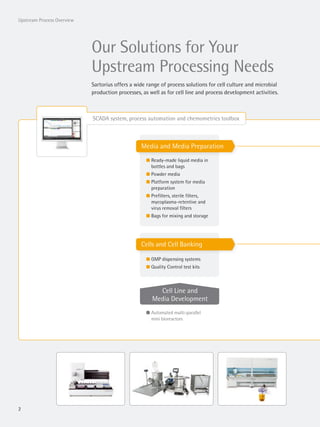
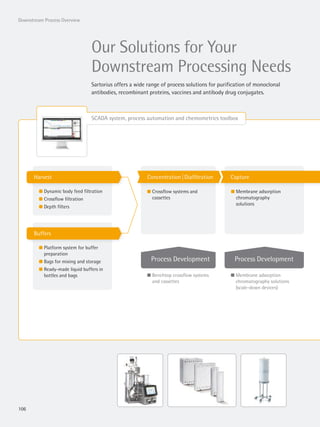
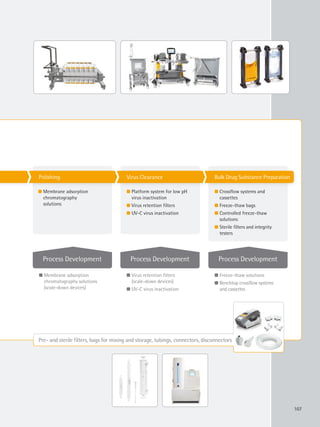
Our Solutions for Your
Upstream Processing Needs
Sartorius offers a wide range of process solutions for cell culture and microbial
production processes, as well as for cell line and process development activities.
l Ready-made liquid media in
bottles and bags
l Powder media
l Platform system for media
preparation
l Prefilters, sterile filters,
mycoplasma-retentive and
virus removal filters
l Bags for mixing and storage
l GMP dispensing systems
l Quality Control test kits
l Automated multi-parallel
mini bioreactors
Cell Line and
Media Development
Cells and Cell Banking
Media and Media Preparation
SCADA system, process automation and chemometrics toolbox
3
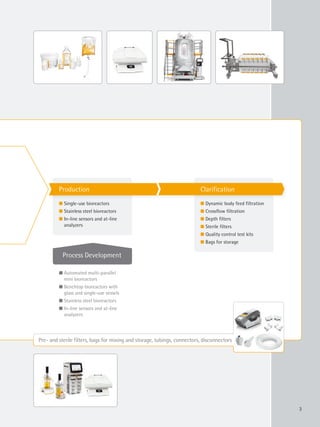
Production Clarification
l Single-use bioreactors
l Stainless steel bioreactors
l In-line sensors and at-line
analyzers
l Dynamic body feed filtration
l Crossflow filtration
l Depth filters
l Sterile filters
l Quality control test kits
l Bags for storage
Process Development
l Automated multi-parallel
mini bioreactors
l Benchtop bioreactors with
glass and single-use vessels
l Stainless steel bioreactors
l In-line sensors and at-line
analyzers
Pre- and sterile filters, bags for mixing and storage, tubings, connectors, disconnectors
4
Introduction
Your Guide to Upstream
Processing Solutions
From Research to Production
Our integrated solutions for upstream and
downstream processing have been supporting
the biologics industry around the world for
decades. Based on our expertise, we have been
able to develop completely single-use process
solutions that meet the requirements of
future biomanufacturing.
Whether you just need a bioreactor or
a single-use bag for media storage or are
looking for a partner to build your completely
single-use manufacturing facility, we will
provide you with all the options, services and
support you need.
Regardless of your preferences, we support
you with a fully scalable and interchangeable
range of single-use or glass and stainless steel
bioreactor solutions. We understand that
not every customer has the same needs, and
your requirements can change over time.
Our array of automated multi-parallel mini
bioreactors and classic benchtop bioreactors
supports fast and reliable development and
characterization of your processes throughout
all phases.
Seamless transfer to pilot and production
scale bioreactors is ensured by our thorough
understanding of bioreactor design and
scale-up principles, well-thought-out
automation concepts and harmonized control
strategies for oxygen, pH, temperature and
feed addition.
Dr. Christel Fenge
Vice President Marketing and Product
Management Fermentation Technologies
Dr. Christel Fenge
Vice President Marketing and P
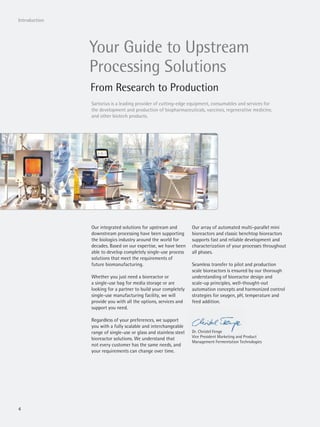
Sartorius is a leading provider of cutting-edge equipment, consumables and services for
the development and production of biopharmaceuticals, vaccines, regenerative medicine,
and other biotech products.
5
Watch Video:
http://www.sartorius.com/video-integrated-solutions
Moving your biopharmaceutical
process towards production
6
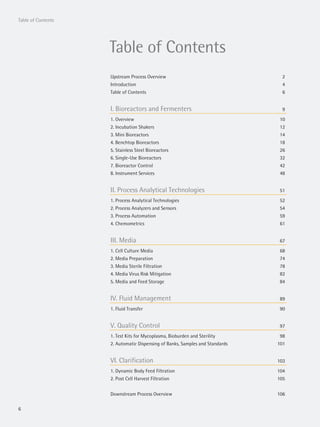
Table of Contents
Table of Contents
Upstream Process Overview 2
Introduction 4
Table of Contents 6
I. Bioreactors and Fermenters 9
1. Overview 10
2. Incubation Shakers 12
3. Mini Bioreactors 14
4. Benchtop Bioreactors 18
5. Stainless Steel Bioreactors 26
6. Single-Use Bioreactors 32
7. Bioreactor Control 42
8. Instrument Services 48
II. Process Analytical Technologies 51
1. Process Analytical Technologies 52
2. Process Analyzers and Sensors 54
3. Process Automation 59
4. Chemometrics 61
III. Media 67
1. Cell Culture Media 68
2. Media Preparation 74
3. Media Sterile Filtration 78
4. Media Virus Risk Mitigation 82
5. Media and Feed Storage 84
IV. Fluid Management 89
1. Fluid Transfer 90
V. Quality Control 97
1. Test Kits for Mycoplasma, Bioburden and Sterility 98
2. Automatic Dispensing of Banks, Samples and Standards 101
VI. Clarification 103
1. Dynamic Body Feed Filtration 104
2. Post Cell Harvest Filtration 105
Downstream Process Overview 106
7
8
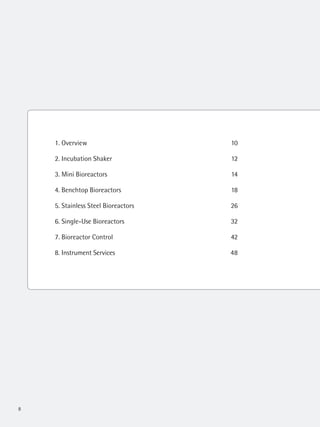
1. Overview 10
2. Incubation Shaker 12
3. Mini Bioreactors 14
4. Benchtop Bioreactors 18
5. Stainless Steel Bioreactors 26
6. Single-Use Bioreactors 32
7. Bioreactor Control 42
8. Instrument Services 48
9
I. Bioreactors
and
Fermenters
10
I. Bioreactors and Fermenters 1. Overview
Biostat®
ACERTOMAT®
CTplusambr®
250ambr®
15 Biostat®
B
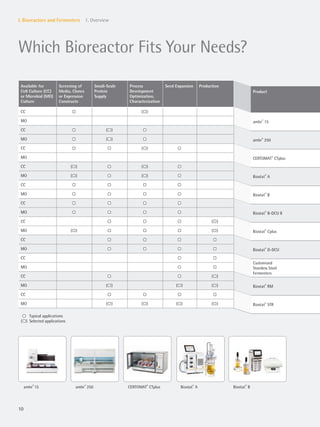
Which Bioreactor Fits Your Needs?
Typical applications
( ) Selected applications
Product
ambr®
15
ambr®
250
CERTOMAT®
CTplus
Biostat®
A
Biostat®
B
Biostat®
B-DCU II
Biostat®
Cplus
Biostat®
D-DCU
Customized
Stainless Steel
Fermenters
Biostat®
RM
Biostat®
STR
Available for
Cell Culture (CC)
or Microbial (MO)
Culture
Screening of
Media, Clones
or Expression
Constructs
Small-Scale
Protein
Supply
Process
Development
Optimization,
Characterization
Seed Expansion Production
CC ( )
MO
CC ( )
MO ( )
CC ( )
MO
CC ( ) ( )
MO ( ) ( )
CC
MO
CC
MO
CC ( )
MO ( ) ( )
CC
MO
CC
MO
CC ( )
MO ( ) ( ) ( )
CC
MO ( ) ( ) ( ) ( )
11
Biostat®
STRBiostat®
B-DCU II Biostat®
Cplus Biostat®
D-DCU Biostat®
RMCustomized Stainless
Steel Fermenters
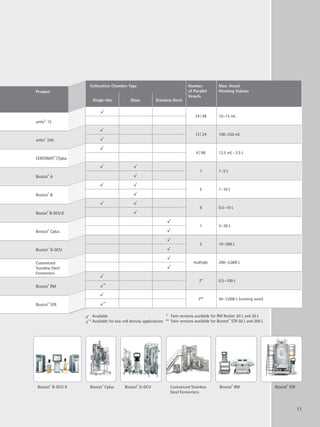
h	 Available
h *	Available for low cell density applications
*	 Twin versions available for RM Rocker 20 L and 50 L
** 	Twin versions available for Biostat®
STR 50 L and 200 L
Product
ambr®
15
ambr®
250
CERTOMAT ®
CTplus
Biostat®
A
Biostat®
B
Biostat®
B-DCU II
Biostat®
Cplus
Biostat®
D-DCU
Customized
Stainless Steel
Fermenters
Biostat®
RM
Biostat®
STR
Cultivation Chamber Type Number
of Parallel
Vessels
Max. Vessel
Working Volume
Single-Use Glass Stainless Steel
h
24 | 48 10 –15 mL
h
12 | 24 100 –250 mL
h
h
6 | 98 12.5 mL – 2.5 L
h h
1 1– 5 L
h
h h
2 1– 10 L
h
h h
6 0.5 –10 L
h
h
1 5 – 30 L
h
h
2 10 – 200 L
h
h
multiple 200 – 2,000 L
h
h
2* 0.5 –100 L
    h *
h
2** 50 – 2,000 L (coming soon)
    h *
12
I. Bioreactors and Fermenters 2. Incubation Shakers
The incubation chamber, mechanical drive
and control unit are strictly isolated from one
another. This prevents corrosion of the drive
unit and other parts due to formation of
carbonic acid in the incubation chamber.
Separate heating systems for the air, for the
doors and humidification pan effectively
prevent condensation in the incubation
chamber. Tight seals reduce CO2 consumption
and ensure control of humidity to even
allow the use of multiwell plates.
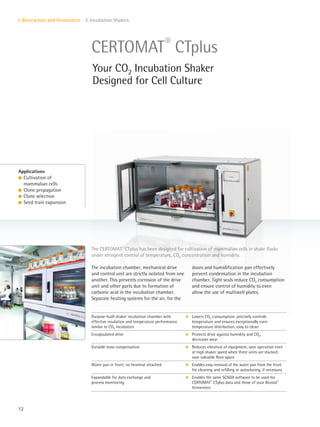
The CERTOMAT®
CTplus has been designed for cultivation of mammalian cells in shake flasks
under stringent control of temperature, CO2 concentration and humidity.
Applications
l Cultivation of
mammalian cells
l Clone propagation
l Clone selection
l Seed train expansion
CERTOMAT®
CTplus
Your CO2 Incubation Shaker
Designed for Cell Culture
Purpose-built shaker incubation chamber with
effective insulation and temperature performance
similar to CO2 incubators
k Lowers CO2 consumption; precisely controls
temperature and ensures exceptionally even
temperature distribution; easy to clean
Encapsulated drive k Protects drive against humidity and CO2,
decreases wear
Variable mass compensation k Reduces vibration of equipment; save operation even
at high shaker speed when three units are stacked;
save valuable floor space
Water pan in front; no heatmat attached k Enables easy removal of the water pan from the front
for cleaning and refilling or autoclaving, if necessary
Expandable for data exchange and
process monitoring
k Enables the same SCADA software to be used for
CERTOMAT®
CTplus data and those of your Biostat®
fermenters
14
I. Bioreactors and Fermenters 3. Mini Bioreactors
The system is used by most leading biopharma-
ceutical companies and has enabled large
bioreactor DoE studies and integration of cell
line screening and early process scouting.
ambr®
15 has been proven by industry leaders
to provide better scalability than a shake flask
and has transformed cell line development in
many leading biopharma companies worldwide.
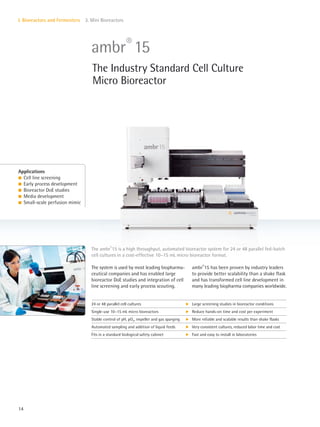
The ambr®
15 is a high throughput, automated bioreactor system for 24 or 48 parallel fed-batch
cell cultures in a cost-effective 10–15 mL micro bioreactor format.
Applications
l Cell line screening
l Early process development
l Bioreactor DoE studies
l Media development
l Small-scale perfusion mimic
ambr®
15
The Industry Standard Cell Culture
Micro Bioreactor
24 or 48 parallel cell cultures k Large screening studies in bioreactor conditions
Single-use 10–15 mL micro bioreactors k Reduce hands-on time and cost per experiment
Stable control of pH, pO2, impeller and gas sparging k More reliable and scalable results than shake flasks
Automated sampling and addition of liquid feeds k Very consistent cultures, reduced labor time and cost
Fits in a standard biological safety cabinet k Fast and easy to install in laboratories
15
I. Bioreactors and Fermenters 3. Mini Bioreactors
The ambr®
15 micro bioreactor vessel mimics
the characteristics of classic lab-scale
bioreactors, providing more predictive and
scalable results compared to shaken culture
systems.
The ambr®
15 vessel has been widely proven
to deliver highly scalable results and is now
the industry standard micro bioreactor for
biopharmaceutical cell culture applications.
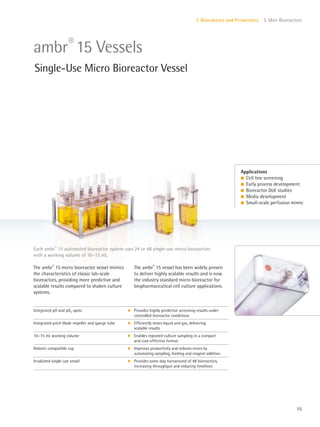
Each ambr®
15 automated bioreactor system uses 24 or 48 single-use micro bioreactors
with a working volume of 10–15 mL.
Applications
l Cell line screening
l Early process development
l Bioreactor DoE studies
l Media development
l Small-scale perfusion mimic
ambr®
15 Vessels
Single-Use Micro Bioreactor Vessel
Integrated pH and pO2 spots k Provides highly predictive screening results under
controlled bioreactor conditions
Integrated pitch blade impeller and sparge tube k Efficiently mixes liquid and gas, delivering
scalable results
10–15 mL working volume k Enables repeated culture sampling in a compact
and cost-effective format
Robotic compatible cap k Improves productivity and reduces errors by
automating sampling, feeding and reagent addition
Irradiated single-use vessel k Provides same-day turnaround of 48 bioreactors,
increasing throughput and reducing timelines
16
I. Bioreactors and Fermenters 3. Mini Bioreactors
This is a completely integrated high through-
put system with Easy Connect bioreactors and
flexible software that enables scientists to
manage many more experiments at the same
time while reducing the costs per experiment.
The ambr®
250 is ideal for scaling down
processes based on its fully featured
bioreactor design and provides a step change
improvement in lab productivity.
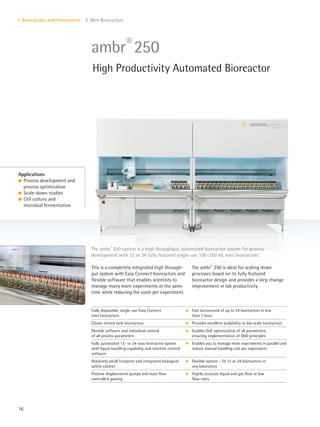
The ambr®
250 system is a high throughput, automated bioreactor system for process
development with 12 or 24 fully featured single-use 100–250 mL mini bioreactors.
Applications
l Process development and
process optimization
l Scale-down studies
l Cell culture and
microbial fermentation
ambr®
250
High Productivity Automated Bioreactor
Fully disposable, single-use Easy Connect
mini bioreactors
k Fast turnaround of up to 24 bioreactors in less
than 1 hour
Classic stirred tank bioreactors k Provides excellent scalability to lab-scale bioreactors
Flexible software and individual control
of all process parameters
k Enables DoE optimization of all parameters,
ensuring implementation of QbD principles
Fully automated 12- or 24-way bioreactor system
with liquid handling capability and intuitive control
software
k Enables you to manage more experiments in parallel and
reduce manual handling cost per experiment
Relatively small footprint and integrated biological
safety cabinet
k Flexible system – fit 12 or 24 bioreactors in
any laboratory
Positive displacement pumps and mass flow
controlled gassing
k Highly accurate liquid and gas flow at low
flow rates
17
I. Bioreactors and Fermenters 3. Mini Bioreactors
The fully featured vessel design incorporates
an integrated single-use pH electrode and
pO2 spot sensor. Each system is irradiated for
supply as presterilized units.
You can choose between mammalian cell
culture vessels with pitch blade impellers or
microbial fermentation vessels with Rushton
impellers.
A simple three-step Easy Connect process
enables you to quickly hook up all the gas,
liquid and sensor lines to each vessel and
thus significantly reduce the time needed to
set up multiple bioreactor experiments.
Each ambr®
250 automated bioreactor system uses 12 or 24 single-use mini bioreactors
with a working volume ranging from 100–250 mL.
Applications
l Process development
and process optimization
l Scale-down studies
l Cell culture and microbial
fermentation
ambr®
250 Vessels
Fully Featured Single-Use
Mini Bioreactor Vessels
Fully featured, classic stirred tank vessel k Applicable as a scale-down model
Integrated Easy Connect gas and liquid in-line filters k Simplifies the process of system set-up and results in
fast turnaround between experiments
100–250 mL working volume with baffles k Reduces reagent costs and supports enhanced
off-line analysis
Polycarbonate vessel construction and integrated
pH electrode and pO2 spot
k Fully disposable so no need to clean between runs
or refurbish probes
Robotic compatible cap for sampling k Improves productivity and reduces errors by enabling
automated inoculation, feeding and sampling
Gassing Strategies: page 44
18
I. Bioreactors and Fermenters 4. Benchtop Bioreactors
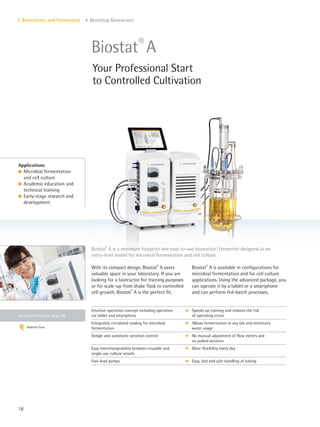
Biostat®
A is available in configurations for
microbial fermentation and for cell culture
applications. Using the advanced package, you
can operate it by a tablet or a smartphone
and can perform fed-batch processes.
With its compact design, Biostat®
A saves
valuable space in your laboratory. If you are
looking for a bioreactor for training purposes
or for scale-up from shake flask to controlled
cell growth, Biostat®
A is the perfect fit.
Biostat®
A is a minimum footprint and easy-to-use bioreactor|fermenter designed as an
entry-level model for microbial fermentation and cell culture.
Applications
l Microbial fermentation
and cell culture
l Academic education and
technical training
l Early-stage research and
development
Biostat®
A
Your Professional Start
to Controlled Cultivation
Intuitive operation concept including operation
via tablet and smartphone
k Speeds up training and reduces the risk
of operating errors
Integrated, circulated cooling for microbial
fermentation
k Allows fermentation in any lab and minimizes
water usage
Simple and automatic aeration control k No manual adjustment of flow meters and
no pulsed aeration
Easy interchangeability between reusable and
single-use culture vessels
k More flexibility every day
Fast-load pumps k Easy, fast and safe handling of tubing
Additive Flow
1–200 L total volume
BioPAT ®
sensor options:
ViaMass
Viable biomass measurement
(page 55)
19
I. Bioreactors and Fermenters 4. Benchtop Bioreactors
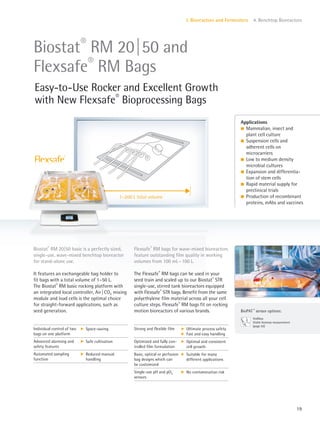
It features an exchangeable bag holder to
fit bags with a total volume of 1–50 L.
The Biostat®
RM basic rocking platform with
an integrated local controller, Air|CO2 mixing
module and load cells is the optimal choice
for straight-forward applications, such as
seed generation.
Biostat®
RM 20|50 basic is a perfectly sized,
single-use, wave-mixed benchtop bioreactor
for stand-alone use.
Applications
l Mammalian, insect and
plant cell culture
l Suspension cells and
adherent cells on
microcarriers
l Low to medium density
microbial cultures
l Expansion and differentia-
tion of stem cells
l Rapid material supply for
preclinical trials
l Production of recombinant
proteins, mAbs and vaccines
Biostat®
RM 20|50 and
Flexsafe®
RM Bags
Easy-to-Use Rocker and Excellent Growth
with New Flexsafe®
Bioprocessing Bags
Individual control of two
bags on one platform
k Space-saving
Advanced alarming and
safety features
k Safe cultivation
Automated sampling
function
k Reduced manual
handling
Strong and flexible film k Ultimate process safety
k Fast and easy handling
Optimized and fully con-
trolled film formulation
k Optimal and consistent
cell growth
Basic, optical or perfusion
bag designs which can
be customized
k Suitable for many
different applications
Single-use pH and pO2
sensors
k No contamination risk
The Flexsafe®
RM bags can be used in your
seed train and scaled up to our Biostat®
STR
single-use, stirred tank bioreactors equipped
with Flexsafe®
STR bags. Benefit from the same
polyethylene film material across all your cell
culture steps. Flexsafe®
RM bags fit on rocking
motion bioreactors of various brands.
Flexsafe®
RM bags for wave-mixed bioreactors
feature outstanding film quality in working
volumes from 100 mL–100 L.
Gassing Strategies: page 44
BioPAT ®
sensor options:
Fundalux
Turbidity measurement
(page 56)
Trace
Glucose|Lactate measurement
(page 54)
ViaMass
Viable biomass measurement
(page 55)
Xgas
Off-gas analysis
(page 57)
20
I. Bioreactors and Fermenters 4. Benchtop Bioreactors
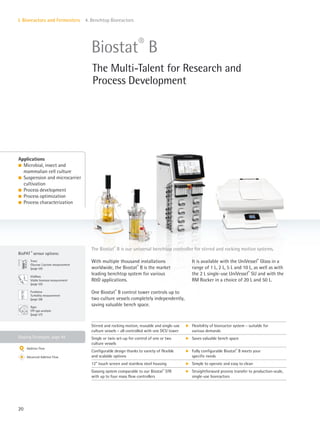
The Biostat®
B is our universal benchtop controller for stirred and rocking motion systems.
With multiple thousand installations
worldwide, the Biostat®
B is the market
leading benchtop system for various
R&D applications.
One Biostat®
B control tower controls up to
two culture vessels completely independently,
saving valuable bench space.
It is available with the UniVessel®
Glass in a
range of 1 L, 2 L, 5 L and 10 L, as well as with
the 2 L single-use UniVessel®
SU and with the
RM Rocker in a choice of 20 L and 50 L.
Applications
l Microbial, insect and
mammalian cell culture
l Suspension and microcarrier
cultivation
l Process development
l Process optimization
l Process characterization
Biostat®
B
The Multi-Talent for Research and
Process Development
Stirred and rocking motion, reusable and single-use
culture vessels – all controlled with one DCU tower
k Flexibility of bioreactor system – suitable for
various demands
Single or twin set-up for control of one or two
culture vessels
k Saves valuable bench space
Configurable design thanks to variety of flexible
and scalable options
k Fully configurable Biostat®
B meets your
specific needs
12” touch screen and stainless steel housing k Simple to operate and easy to clean
Gassing system comparable to our Biostat®
STR
with up to four mass flow controllers
k Straightforward process transfer to production-scale,
single-use bioreactors
Additive Flow
Advanced Additive Flow
Gassing Strategies: page 44
BioPAT ®
sensor options:
Fundalux
Turbidity measurement
(page 56)
Trace
Glucose|Lactate measurement
(page 54)
Xgas
Off-gas analysis
(page 57)
21
I. Bioreactors and Fermenters 4. Benchtop Bioreactors
The Biostat®
B-DCU II provides enhanced
functionality and an unrivalled level of
options to flexibly design process control
strategies. It is the ideal scale-down and
scale-up bioreactor system for all kind of
microbial and cell culture processes.
The unique, space-saving tower design enables
the operation of up to six culture vessels, which
take up less than three meters of bench space.
The Biostat®
B-DCU II can be combined
with glass culture vessels, ranging from 0.5 L,
1 L, 2 L and 5 L to 10 L, as well as with the 2 L
single-use UniVessel®
SU.
Used together with our MFCS and chemo-
metrics tool box, the Biostat®
B-DCU II is
the ideal tool for process optimization and
characterization studies.
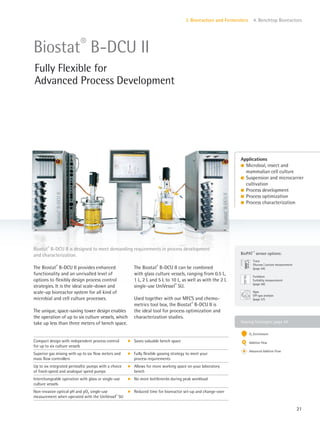
Biostat®
B-DCU II is designed to meet demanding requirements in process development
and characterization.
Applications
l Microbial, insect and
mammalian cell culture
l Suspension and microcarrier
cultivation
l Process development
l Process optimization
l Process characterization
Biostat®
B-DCU II
Fully Flexible for
Advanced Process Development
Compact design with independent process control
for up to six culture vessels
k Saves valuable bench space
Superior gas mixing with up to six flow meters and
mass flow controllers
k Fully flexible gassing strategy to meet your
process requirements
Up to six integrated peristaltic pumps with a choice
of fixed-speed and analogue speed pumps
k Allows for more working space on your laboratory
bench
Interchangeable operation with glass or single-use
culture vessels
k No more bottlenecks during peak workload
Non-invasive optical pH and pO2 single-use
measurement when operated with the UniVessel®
SU
k Reduced time for bioreactor set-up and change-over
O2 Enrichment
Additive Flow
Advanced Additive Flow
22
I. Bioreactors and Fermenters 4. Benchtop Bioreactors
The autoclavable UniVessel®
Glass can be
configured according to your individual
needs. Over 40 years of experience in designing
scalable bioreactors have gone into the
making of UniVessel®
Glass, and numerous
scientific articles on its scalability and repro-
ducibility have meanwhile been published.
Configuration Examples
For microbial culture, with double-wall
vessel, Rushton impellers, baffles, inoculation
port and ring sparger
For cell culture, with single-walled vessel,
3-blade segment and Rushton impellers,
micro-sparger and dip tube for gentle
inoculation
For continuous culture with integrated
spinfilters for cell retention in perfusion
applications
UniVessel®
Glass culture vessels are specially tailored to the needs of biopharmaceutical process
development applications, such as monoclonal antibodies, recombinant proteins and vaccines.
Applications
l Microbial fermentation
(bacteria, yeast, fungi)
l Animal cell culture
(mammalian, insect)
l Adherent cell culture on
microcarriers
l Process development and
optimization
l Scale-up and scale-down
studies
l Seed production
UniVessel®
Glass
Multi-Purpose Glass Culture Vessel
Configuration examples
Proven sterile design and robustness k Ensures process reliability
Classic stirred-tank design and characterization
data available
k Easy and fast scale-up
Fits into small autoclaves k Saves investing in new autoclave
Choice of 0.5 L, 1 L, 2 L, 5 L, 10 L working volumes k Flexible interchangeability between vessel sizes
without extra investments in a controller
Fits to all Biostat®
benchtop systems k Lowers your investment budget for new controllers as
you can use your available UniVessel®
Glass
23
I. Bioreactors and Fermenters 4. Benchtop Bioreactors
Applications
l Mammalian and insect
cell culture
l Suspension and microcarrier
cultures
l Process development and
optimization
l Seed expansion
It combines the proven, scalable design
of glass bioreactors and the fast turnaround
of single-use systems. UniVessel®
SU can be
easily integrated into both new and existing
bioreactor controllers in your lab.
It can be used interchangeably with glass
vessels to help you efficiently manage peak
workloads despite challenging timelines. Since
you discard the complete vessel after one use,
you no longer have to bother with the hassle
of cleaning, autoclaving and reinstallation.
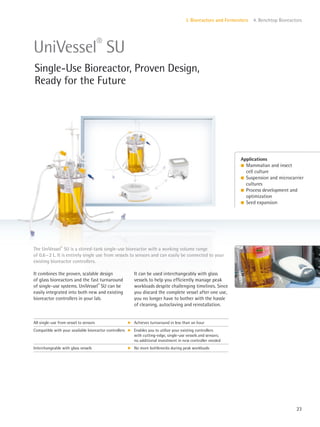
The UniVessel®
SU is a stirred-tank single-use bioreactor with a working volume range
of 0.6–2 L. It is entirely single use from vessels to sensors and can easily be connected to your
existing bioreactor controllers.
UniVessel®
SU
Single-Use Bioreactor, Proven Design,
Ready for the Future
All single-use from vessel to sensors k Achieves turnaround in less than an hour
Compatible with your available bioreactor controllers k Enables you to utilize your existing controllers
with cutting-edge, single-use vessels and sensors;
no additional investment in new controller needed
Interchangeable with glass vessels k No more bottlenecks during peak workloads
24
I. Bioreactors and Fermenters 4. Benchtop Bioreactors
Anti-foam Disk
In fermentation applications, high oxygen transfer rates are achieved by high aeration
and agitation rates. This often results in excessive foaming in the culture.
Our foam disk, a mechanical foam destroyer, solves problems with foaming where they
start – directly at the liquid surface. The foam disk is installed on the stirrer shaft.
This makes retrofitting fast and easy. It is a two-layer disk with four sections. Its lower layer
has downward-positioned slots and paddles for foam skimming. The foam disk is available
for all autoclavable glass culture vessels.
k Prevents problems with foaming
k Reduces the need for anti-foam agent
k Easy to retrofit
Benchtop Accessories
Flexible Adapter for Exhaust Cooler
Typically, the exhaust cooler and its fittings are at the highest point of the culture vessel.
They have to be arranged vertically to enable condensate to flow back into the vessel.
However, in the case of small autoclaves, the height of the fully equipped UniVessel®
can
be challenging.
Using a flexible adapter reduces height requirements in an autoclave. The adapter is installed
between the exhaust cooler and its top plate port at the culture vessel.
k Reduces the height of your UniVessel®
k Makes your UniVessel®
fit into smaller, space-saving autoclaves
k No need to invest in a larger autoclave
STT Connector
STT quick-connect couplings enable fast and secure tube connections to link the culture vessel
with medium and feed flasks, external cell retention devices, harvest containers and the like.
They consist of a female connector with a slotted membrane and a male connector – both with
blind plugs for autoclaving. STT connectors enable you to aseptically connect tubing with inner
diameters of 1.6–2 mm and 3.2–5 mm.
k Fast and aseptic connection of tubing
25
I. Bioreactors and Fermenters 4. Benchtop Bioreactors
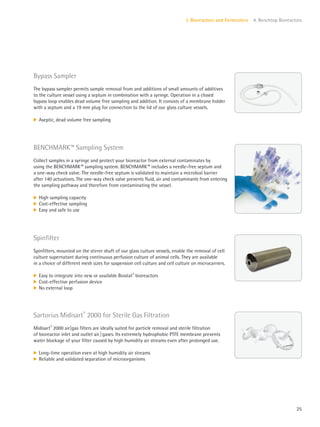
Bypass Sampler
The bypass sampler permits sample removal from and additions of small amounts of additives
to the culture vessel using a septum in combination with a syringe. Operation in a closed
bypass loop enables dead volume free sampling and addition. It consists of a membrane holder
with a septum and a 19 mm plug for connection to the lid of our glass culture vessels.
k Aseptic, dead volume free sampling
Spinfilter
Spinfilters, mounted on the stirrer shaft of our glass culture vessels, enable the removal of cell
culture supernatant during continuous perfusion culture of animal cells. They are available
in a choice of different mesh sizes for suspension cell culture and cell culture on microcarriers.
k Easy to integrate into new or available Biostat®
bioreactors
k Cost-effective perfusion device
k No external loop
BENCHMARK™ Sampling System
Collect samples in a syringe and protect your bioreactor from external contaminates by
using the BENCHMARK™ sampling system. BENCHMARK™ includes a needle-free septum and
a one-way check valve. The needle-free septum is validated to maintain a microbial barrier
after 140 actuations. The one-way check valve prevents fluid, air and contaminants from entering
the sampling pathway and therefore from contaminating the vessel.
k High sampling capacity
k Cost-effective sampling
k Easy and safe to use
Sartorius Midisart®
2000 for Sterile Gas Filtration
Midisart®
2000 air|gas filters are ideally suited for particle removal and sterile filtration
of bioreactor inlet and outlet air|gases. Its extremely hydrophobic PTFE membrane prevents
water blockage of your filter caused by high humidity air streams even after prolonged use.
k Long-time operation even at high humidity air streams
k Reliable and validated separation of microorganisms
Gassing Strategies: page 44
BioPAT ®
sensor options:
Fundalux
Turbidity measurement
(page 56)
Spectro
Multi-variant bioprocess monitoring
(page 58)
Trace
Glucose|Lactate measurement
(page 54)
Xgas
Off-gas analysis
(page 57)
26
I. Bioreactors and Fermenters 5. Stainless Steel Bioreactors
The system can be flexibly integrated into an
existing laboratory infrastructure. The culture
vessel can be sterilized by electro or steam
heating. The casters under the supply unit of
the bioreactor enable it to be easily moved to
another location. The Biostat®
Cplus is a floor
standing version, available with a selection of
culture vessels with working volumes of 10 L,
15 L, 20 L and 30 L.
A benchtop version is available with a 5 L
working volume culture vessel. Extended
functionality and ease of use is provided by
a wide choice of in-line sensors and anaylzers
with an integrated display of process values
on the DCU screen. For enhanced system
performance, powerful SCADA software
BioPAT®
MFCS is available with an optional
S88 recipe control module.
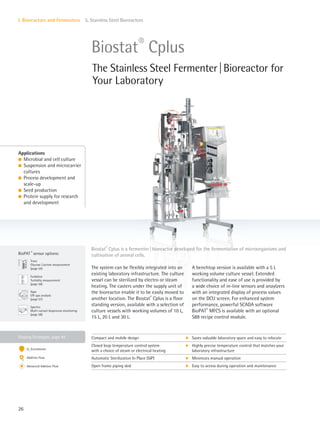
Biostat®
Cplus is a fermenter|bioreactor developed for the fermentation of microorganisms and
cultivation of animal cells.
Applications
l Microbial and cell culture
l Suspension and microcarrier
cultures
l Process development and
scale-up
l Seed production
l Protein supply for research
and development
Biostat®
Cplus
The Stainless Steel Fermenter|Bioreactor for
Your Laboratory
Compact and mobile design k Saves valuable laboratory space and easy to relocate
Closed loop temperature control system
with a choice of steam or electrical heating
k Highly precise temperature control that matches your
laboratory infrastructure
Automatic Sterilization In Place (SIP) k Minimizes manual operation
Open frame piping skid k Easy to access during operation and maintenance
O2 Enrichment
Additive Flow
Advanced Additive Flow
Gassing Strategies: page 44
BioPAT ®
sensor options:
Fundalux
Turbidity measurement
(page 56)
Spectro
Multi-variant bioprocess monitoring
(page 58)
Trace
Glucose|Lactate measurement
(page 54)
Xgas
Off-gas analysis
(page 57)
27
I. Bioreactors and Fermenters 5. Stainless Steel Bioreactors
It is designed to interface single-use storage
bags for media addition and harvesting,
as well as the TAKEONE®
single-use aseptic
sampling systems. Further enhanced
functionality and ease of use are provided
by a wide selection of in-line sensors and
analyzers and by integrated display of process
values on the DCU screen.
Due to the bioreactor’s modular design,
various configurations are available – from
basic to fully featured.
The system offers an excellent solution for
any budget and every need. Working volumes
are available in a choice of 10 L, 20 L, 30 L,
50 L, 100 L and 200 L.
Scalable BioPAT®
MFCS S88 recipes provide
a significant increase in process safety
and reliability and result in improved batch-
to-batch consistency.
Biostat®
D-DCU incorporates many advanced features and preferred options to meet virtually
any requirements for leading-edge bioprocess applications.
Applications
l Microbial and cell culture
l Suspension and microcarrier
cultures
l Process development and
scale-up
l Seed production
l Production
Biostat®
D-DCU
Your “Fast Lane” to Production
Single or twin configuration k Saves valuable space
Automatic Sterilization In Place (SIP) and
Cleaning In Place (CIP) sequences
k Minimizes manual operation for laboratory
resources
Powerful industrial DCU control system k Reliable and flexible to grow with your needs
Fully configurable from basic batch set-up
to sophisticated configurations supporting advanced
gassing and feeding strategies
k Fits nearly any budget and meets virtually
all process requirements
Gear–free, low-noise agitation system k For silent operation even at a high agitation speed
O2 Enrichment
Additive Flow
Advanced Additive Flow
28
I. Bioreactors and Fermenters 5. Stainless Steel Bioreactors
The large scale stainless steel fermenter|
bioreactor platform of Sartorius is based on
decades of engineering experience and
detailed understanding of biopharmaceutical
manufacturing processes and specific
customer requirements. This platform virtually
eliminates time-consuming engineering
efforts that are normally required for
establishing P&IDs, 3D designs and imple-
mentation of control software.
This results in shorter project execution
timelines combined with better control of
costs and timelines right from the beginning.
Moreover, high operational safety is ensured
by using industrially proven and reliable
components, designs and a PLC software
library. Design platforms are available in
incremental sizes of working volumes from
200 L to 2,000 L.
Sartorius offers process-scale stainless steel bioreactors and fermenters
based on an engineering platform approach.
Applications
l Microbial, insect and
mammalian cell culture
l Suspension and
microcarrier culture
l Pilot-scale production
l Production
Customized Stainless Steel
Fermenters|Bioreactors
Fit for Purpose Process Solutions
Standardized designs, components and
PLC software library
k Backed by 50 years of experience
Proven hardware designs and control software k Fully functional right after commissioning
Fully flexible and modular design k Cost-effective Fit for Purpose process solutions
Standardized components k Minimal downtime during preventive and
corrective maintenance
30
I. Bioreactors and Fermenters 5. Stainless Steel Bioreactors
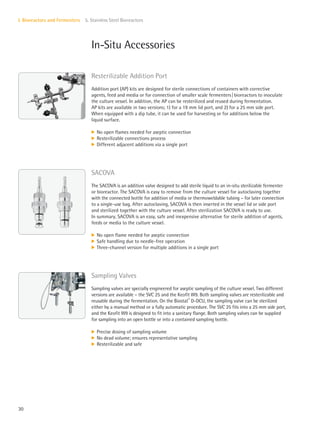
In-Situ Accessories
Resterilizable Addition Port
Addition port (AP) kits are designed for sterile connections of containers with corrective
agents, feed and media or for connection of smaller scale fermenters|bioreactors to inoculate
the culture vessel. In addition, the AP can be resterilized and reused during fermentation.
AP kits are available in two versions; 1) for a 19 mm lid port, and 2) for a 25 mm side port.
When equipped with a dip tube, it can be used for harvesting or for additions below the
liquid surface.
k No open flames needed for aseptic connection
k Resterilizable connections process
k Different adjacent additions via a single port
SACOVA
The SACOVA is an addition valve designed to add sterile liquid to an in-situ sterilizable fermenter
or bioreactor. The SACOVA is easy to remove from the culture vessel for autoclaving together
with the connected bottle for addition of media or thermoweldable tubing – for later connection
to a single-use bag. After autoclaving, SACOVA is then inserted in the vessel lid or side port
and sterilized together with the culture vessel. After sterilization SACOVA is ready to use.
In summary, SACOVA is an easy, safe and inexpensive alternative for sterile addition of agents,
feeds or media to the culture vessel.
k No open flame needed for aseptic connection
k Safe handling due to needle-free operation
k Three-channel version for multiple additions in a single port
Sampling Valves
Sampling valves are specially engineered for aseptic sampling of the culture vessel. Two different
versions are available – the SVC 25 and the Keofit W9. Both sampling valves are resterilizable and
reusable during the fermentation. On the Biostat®
D-DCU, the sampling valve can be sterilized
either by a manual method or a fully automatic procedure. The SVC 25 fits into a 25 mm side port,
and the Keofit W9 is designed to fit into a sanitary flange. Both sampling valves can be supplied
for sampling into an open bottle or into a contained sampling bottle.
k Precise dosing of sampling volume
k No dead volume; ensures representative sampling
k Resterilizable and safe
31
I. Bioreactors and Fermenters 5. Stainless Steel Bioreactors
Internal Spinfilters
Spinfilters, mounted on the stirrer shaft of the culture vessels, enable the removal of
cell culture supernatant during continuous perfusion cultivation of animal cells.
They are available in a choice of different mesh sizes for suspension cell culture as well as
cell culture on microcarriers.
k Easy to integrate into new or available Biostat®
bioreactors
k Cost-effective perfusion device
k No external loop
Containment Sampling Kit
Used in combination with the SVC 25 or Keofit W9, the containment sampling kit is ideal
for removing an aseptic and aerosol–free sample from the culture vessel. It consists of
an autoclavable silicone–jacketed glass bottle, a stainless steel lid with a vent filter and
a diaphragm valve, as well as a condensate line. On the Biostat®
D-DCU, the containment
sampling kit can be sterilized either by a manual method or by a fully automatic procedure.
This kit is excellently suited for use in typical applications requiring operator protection
according to biosafety regulations and those in which the sample will be used for further
processing under aspetic conditions.
k Aseptic sampling
k Aerosol-free sampling for operator protection
k Safe silicone-jacketed sampling bottle
Sartofluor®
Mini Cartridges for Sterile Gas Filtration
Sartofluor®
mini cartridges rated to 0.2 μm are sterilizing-grade filter elements for air and gases
in the pharma|biotech industry. Their unique hydrophobic PTFE membrane is ideally suited for
particle removal and sterile filtration. The membrane also prevents water blockage of your filter
caused by high humidity air streams even after prolonged use.
k Long-time operation even at high humidity air streams
k High-steam cycle lifetimes
k Reliable and validated separation of microorganisms
TAKEONE®
Single-Use Sampling System
The TAKEONE®
aseptic sampling system is single use so you can immediately start sampling
“right out of the box”. While traditional sampling devices require cleaning, preparation and
sterilization after each use, TAKEONE®
eliminates these steps, saving valuable time. The system’s
QUICKSEAL®
aseptic tube sealing unit enables safe and reliable disconnection of the sampling
bag – without the need for any utilities.
k Fully single-use; eliminates cleaning, preparation and sterilization
k Reliable performance as all sampling lines are 100% integrity tested at the factory
k Easy and safe aseptic sampling bag disconnection
COMING SOON
BioPAT ®
sensor options:
Xgas
Off-gas analysis
(page 57)
32
I. Bioreactors and Fermenters 6. Single-Use Bioreactors
Simplify your scale-up and scale-down,
minimize the risk of your process transfers
and easily switch between stainless steel
and single-use bioreactors.
Biostat®
STR makes all this possible thanks
to its classic stirred-tank design, comparable
mixing and gassing strategies and reliable
single-use sensor platform.
Get the best solution for high cell density
continuous cultures and microcarrier cultures.
You can choose from working volumes of 50 L,
200 L, 500 L, 1,000 L and 2,000 L (coming soon).
The design of the entirely single-use Biostat ®
STR is based on the gold standard
of conventional stirred-tank bioreactors.
Biostat®
STR
True Scalability in Single-Use
Applications
l Process development and
scale-up
l Seed expansion
l Vaccine, recombinant
protein and mAb production
l High cell density continuous
culture
l Adherent cell culture
on microcarriers
Two impellers on central shaft k Homogeneous mixing in a minimum of time
Innovative sparger element k Excellent oxygen transfer and CO2 removal at
minimized foaming
Single-use pH and pO2 sensors k Low contamination risk; easy and quick handling
Single-use exhaust cooler k Prevents exhaust filter blockage
Gassing Strategies: page 44
O2 Enrichment
Additive Flow
Advanced Additive Flow
50–2,000 L*
33
I. Bioreactors and Fermenters 6. Single-Use Bioreactors
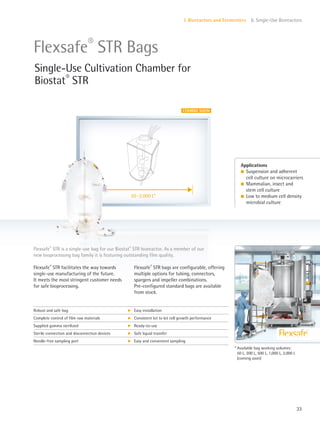
Flexsafe®
STR is a single-use bag for our Biostat®
STR bioreactor. As a member of our
new bioprocessing bag family it is featuring outstanding film quality.
Flexsafe®
STR facilitates the way towards
single-use manufacturing of the future.
It meets the most stringent customer needs
for safe bioprocessing.
Flexsafe®
STR bags are configurable, offering
multiple options for tubing, connectors,
spargers and impeller combinations.
Pre-configured standard bags are available
from stock.
Applications
l Suspension and adherent
cell culture on microcarriers
l Mammalian, insect and
stem cell culture
l Low to medium cell density
microbial culture
Flexsafe®
STR Bags
Single-Use Cultivation Chamber for
Biostat®
STR
* Available bag working volumes:
50 L, 200 L, 500 L, 1,000 L, 2,000 L
(coming soon)
Robust and safe bag k Easy installation
Complete control of film raw materials k Consistent lot to lot cell growth performance
Supplied gamma sterilized k Ready-to-use
Sterile connection and disconnection devices k Safe liquid transfer
Needle-free sampling port k Easy and convenient sampling
COMING SOON
34
I. Bioreactors and Fermenters 6. Single-Use Bioreactors
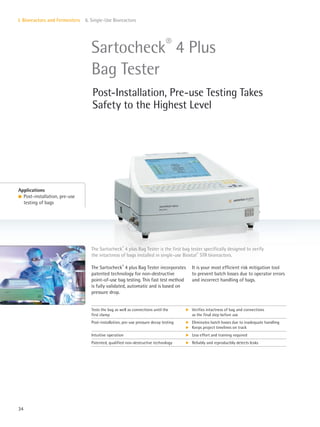
The Sartocheck®
4 plus Bag Tester incorporates
patented technology for non-destructive
point-of-use bag testing. This fast test method
is fully validated, automatic and is based on
pressure drop.
It is your most efficient risk mitigation tool
to prevent batch losses due to operator errors
and incorrect handling of bags.
The Sartocheck®
4 plus Bag Tester is the first bag tester specifically designed to verify
the intactness of bags installed in single-use Biostat®
STR bioreactors.
Applications
l Post-installation, pre-use
testing of bags
Sartocheck®
4 Plus
Bag Tester
Post-Installation, Pre-use Testing Takes
Safety to the Highest Level
Tests the bag as well as connections until the
first clamp
k Verifies intactness of bag and connections
as the final step before use
Post-installation, pre-use pressure decay testing k
k
Eliminates batch losses due to inadequate handling
Keeps project timelines on track
Intuitive operation k Less effort and training required
Patented, qualified non-destructive technology k Reliably and reproducibly detects leaks
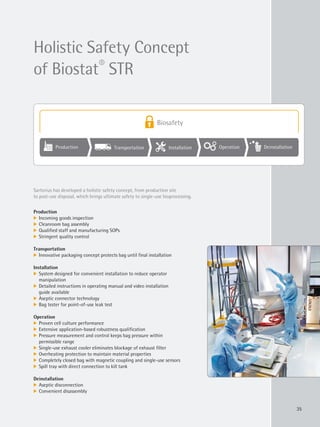
Production Transportation Installation Operation Deinstallation
Biosafety
35
Production
k Incoming goods inspection
k Cleanroom bag assembly
k Qualified staff and manufacturing SOPs
k Stringent quality control
Transportation
k Innovative packaging concept protects bag until final installation
Installation
k System designed for convenient installation to reduce operator
manipulation
k Detailed instructions in operating manual and video installation
guide available
k Aseptic connector technology
k Bag tester for point-of-use leak test
Operation
k Proven cell culture performance
k Extensive application-based robustness qualification
k Pressure measurement and control keeps bag pressure within
permissible range
k Single-use exhaust cooler eliminates blockage of exhaust filter
k Overheating protection to maintain material properties
k Completely closed bag with magnetic coupling and single-use sensors
k Spill tray with direct connection to kill tank
Deinstallation
k Aseptic disconnection
k Convenient disassembly
Sartorius has developed a holistic safety concept, from production site
to post-use disposal, which brings ultimate safety to single-use bioprocessing.
Holistic Safety Concept
of Biostat®
STR
36
I. Bioreactors and Fermenters 6. Single-Use Bioreactors
Single-Use Accessories
Single-Use Exhaust Cooler for Biostat®
STR
The exhaust cooler is a single-use device for the Biostat®
STR. It is installed between the
bag and the exhaust gas filter and thus within the sterile barrier. This exhaust cooler enables
high cell density culture at high gas flow rates.
k Increases process safety
k Reduces aerosol load in off-gas
k Protects the exhaust filter from blockage
Exhaust Filter Line for Biostat®
STR
The 0.2 μm sterilizing-grade exhaust gas filters come in a ready-to-use sterilized tube
assembly with Opta®
SFT quick connectors (see page 94) for easy and safe connection
to the exhaust line of our CultiBag®
STR and Flexsafe®
STR bags. They are designed to control
the typical flow rates of high density cell culture processes. A heating element in the filter
line prevents the filter from wetting out. The filters can be used in a back-up exhaust line
to mitigate risk.
k Ready-to-use and easy to connect to STR bags
k Back-up exhaust filter line for risk mitigation
37
I. Bioreactors and Fermenters 6. Single-Use Bioreactors
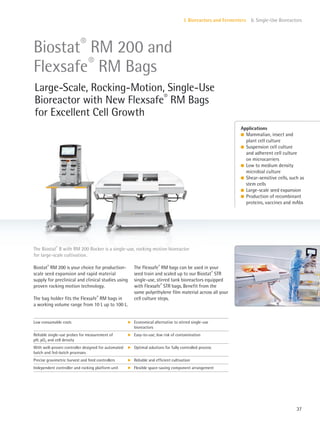
The Flexsafe®
RM bags can be used in your
seed train and scaled up to our Biostat®
STR
single-use, stirred tank bioreactors equipped
with Flexsafe®
STR bags. Benefit from the
same polyethylene film material across all your
cell culture steps.
Biostat®
RM 200 is your choice for production-
scale seed expansion and rapid material
supply for preclinical and clinical studies using
proven rocking motion technology.
The bag holder fits the Flexsafe®
RM bags in
a working volume range from 10 L up to 100 L.
The Biostat®
B with RM 200 Rocker is a single-use, rocking motion bioreactor
for large-scale cultivation.
Applications
l Mammalian, insect and
plant cell culture
l Suspension cell culture
and adherent cell culture
on microcarriers
l Low to medium density
microbial culture
l Shear-sensitive cells, such as
stem cells
l Large-scale seed expansion
l Production of recombinant
proteins, vaccines and mAbs
Biostat®
RM 200 and
Flexsafe®
RM Bags
Large-Scale, Rocking-Motion, Single-Use
Bioreactor with New Flexsafe®
RM Bags
for Excellent Cell Growth
Low consumable costs k Economical alternative to stirred single-use
bioreactors
Reliable single-use probes for measurement of
pH, pO2 and cell density
k Easy-to-use; low risk of contamination
With well-proven controller designed for automated
batch and fed-batch processes
k Optimal solutions for fully controlled process
Precise gravimetric harvest and feed controllers k Reliable and efficient cultivation
Independent controller and rocking platform unit k Flexible space-saving component arrangement
CellDensity
Time
Flexsafe®
Bags
Reference: Borosilicate Glass
Standard Bags
38
I. Bioreactors and Fermenters 6. Single-Use Bioreactors
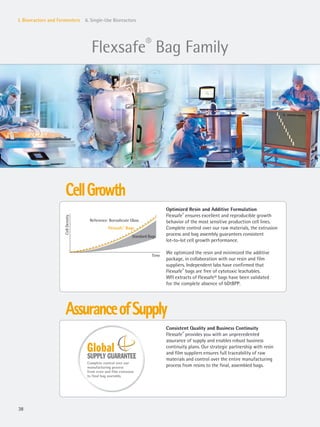
CellGrowth
Flexsafe®
Bag Family
Consistent Quality and Business Continuity
Flexsafe®
provides you with an unprecedented
assurance of supply and enables robust business
continuity plans. Our strategic partnership with resin
and film suppliers ensures full traceability of raw
materials and control over the entire manufacturing
process from resins to the final, assembled bags.
Optimized Resin and Additive Formulation
Flexsafe®
ensures excellent and reproducible growth
behavior of the most sensitive production cell lines.
Complete control over our raw materials, the extrusion
process and bag assembly guarantees consistent
lot-to-lot cell growth performance.
We optimized the resin and minimized the additive
package, in collaboration with our resin and film
suppliers. Independent labs have confirmed that
Flexsafe®
bags are free of cytotoxic leachables.
WFI extracts of Flexsafe® bags have been validated
for the complete absence of bDtBPP.
AssuranceofSupply
Complete control over our
manufacturing process
from resin and film extrusion
to final bag assembly
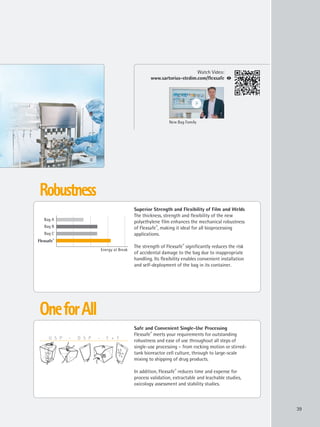
Flexsafe®
Bag A
Bag B
Bag C
Energy at Break
U S P - D S P - F + F
39
Superior Strength and Flexibility of Film and Welds
The thickness, strength and flexibility of the new
polyethylene film enhances the mechanical robustness
of Flexsafe®
, making it ideal for all bioprocessing
applications.
The strength of Flexsafe®
significantly reduces the risk
of accidental damage to the bag due to inappropriate
handling. Its flexibility enables convenient installation
and self-deployment of the bag in its container.
New Bag Family
Watch Video:
www.sartorius-stedim.com/flexsafe
Robustness
Safe and Convenient Single-Use Processing
Flexsafe®
meets your requirements for outstanding
robustness and ease of use throughout all steps of
single-use processing – from rocking motion or stirred-
tank bioreactor cell culture, through to large-scale
mixing to shipping of drug products.
In addition, Flexsafe®
reduces time and expense for
process validation, extractable and leachable studies,
oxicology assessment and stability studies.
OneforAll
40
I. Bioreactors and Fermenters 6. Single-Use Bioreactors
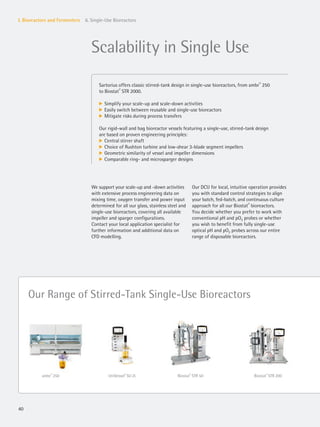
Sartorius offers classic stirred-tank design in single-use bioreactors, from ambr®
250
to Biostat®
STR 2000.
k Simplify your scale-up and scale-down activities
k Easily switch between reusable and single-use bioreactors
k Mitigate risks during process transfers
Our rigid-wall and bag bioreactor vessels featuring a single-use, stirred-tank design
are based on proven engineering principles:
k Central stirrer shaft
k Choice of Rushton turbine and low-shear 3-blade segment impellers
k Geometric similarity of vessel and impeller dimensions
k Comparable ring- and microsparger designs
We support your scale-up and -down activities
with extensive process engineering data on
mixing time, oxygen transfer and power input
determined for all our glass, stainless steel and
single-use bioreactors, covering all available
impeller and sparger configurations.
Contact your local application specialist for
further information and additional data on
CFD modelling.
Scalability in Single Use
Our Range of Stirred-Tank Single-Use Bioreactors
ambr®
250 UniVessel®
SU 2L Biostat®
STR 50 Biostat®
STR 200
Our DCU for local, intuitive operation provides
you with standard control strategies to align
your batch, fed-batch, and continuous culture
approach for all our Biostat®
bioreactors.
You decide whether you prefer to work with
conventional pH and pO2 probes or whether
you wish to benefit from fully single-use
optical pH and pO2 probes across our entire
range of disposable bioreactors.
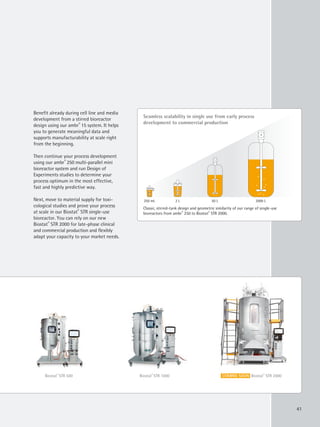
50 L 2000 L2 L250 mL
Classic, stirred-tank design and geometric similarity of our range of single-use
bioreactors from ambr®
250 to Biostat®
STR 2000.
Seamless scalability in single use from early process
development to commercial production
41
Benefit already during cell line and media
development from a stirred bioreactor
design using our ambr®
15 system. It helps
you to generate meaningful data and
supports manufacturability at scale right
from the beginning.
Then continue your process development
using our ambr®
250 multi-parallel mini
bioreactor system and run Design of
Experiments studies to determine your
process optimum in the most effective,
fast and highly predictive way.
Next, move to material supply for toxi-
cological studies and prove your process
at scale in our Biostat®
STR single-use
bioreactor. You can rely on our new
Biostat®
STR 2000 for late-phase clinical
and commercial production and flexibly
adapt your capacity to your market needs.
Biostat®
STR 500 Biostat®
STR 1000 COMING SOON Biostat®
STR 2000
42
I. Bioreactors and Fermenters 7. Bioreactor Control
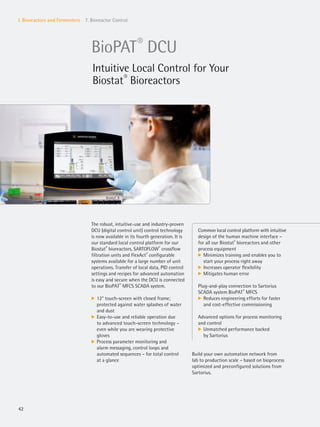
The robust, intuitive-use and industry-proven
DCU (digital control unit) control technology
is now available in its fourth generation. It is
our standard local control platform for our
Biostat®
bioreactors, SARTOFLOW®
crossflow
filtration units and FlexAct®
configurable
systems available for a large number of unit
operations. Transfer of local data, PID control
settings and recipes for advanced automation
is easy and secure when the DCU is connected
to our BioPAT®
MFCS SCADA system.
k 12” touch-screen with closed frame;
protected against water splashes of water
and dust
k Easy-to-use and reliable operation due
to advanced touch-screen technology –
even while you are wearing protective
gloves
k Process parameter monitoring and
alarm messaging, control loops and
automated sequences – for total control
at a glance
BioPAT®
DCU
Intuitive Local Control for Your
Biostat®
Bioreactors
Common local control platform with intuitive
design of the human machine interface –
for all our Biostat®
bioreactors and other
process equipment
k Minimizes training and enables you to
start your process right away
k Increases operator flexibility
k Mitigates human error
Plug-and-play connection to Sartorius
SCADA system BioPAT®
MFCS
k Reduces engineering efforts for faster
and cost-effective commissioning
Advanced options for process monitoring
and control
k Unmatched performance backed
by Sartorius
Build your own automation network from
lab to production scale – based on bioprocess
optimized and preconfigured solutions from
Sartorius.
43
Biostat®
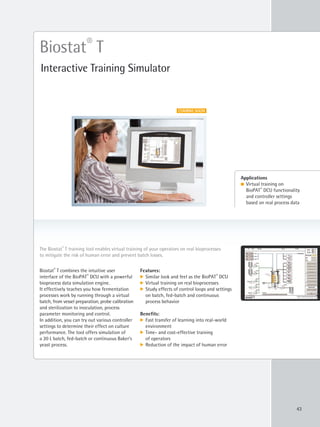
T combines the intuitive user
interface of the BioPAT®
DCU with a powerful
bioprocess data simulation engine.
It effectively teaches you how fermentation
processes work by running through a virtual
batch, from vessel preparation, probe calibration
and sterilization to inoculation, process
parameter monitoring and control.
In addition, you can try out various controller
settings to determine their effect on culture
performance. The tool offers simulation of
a 20 L batch, fed-batch or continuous Baker’s
yeast process.
The Biostat®
T training tool enables virtual training of your operators on real bioprocesses
to mitigate the risk of human error and prevent batch losses.
Biostat®
T
Interactive Training Simulator
Applications
l Virtual training on
BioPAT®
DCU functionality
and controller settings
based on real process data
Features:
k Similar look and feel as the BioPAT®
DCU
k Virtual training on real bioprocesses
k Study effects of control loops and settings
on batch, fed-batch and continuous
process behavior
Benefits:
k Fast transfer of learning into real-world
environment
k Time- and cost-effective training
of operators
k Reduction of the impact of human error
COMING SOON
SpargerAir
O2
O2 Enrichment*
Additive Flow*
Sparger
Air
O2
Advanced Additive Flow*
SpargerAir
O2
N2
CO2
Overlay
Flow controller
Optional gas switch
Dosing shutoff valve
Optional dosing shutoff valve
3|2-way solenoid valve
Mass flow controller
Optional mass flow controller
Optional gas flow path
44
I. Bioreactors and Fermenters 7. Bioreactor Control
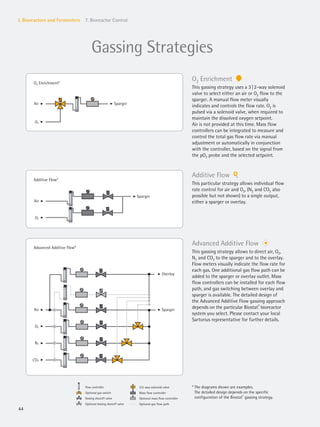
O2 Enrichment
This gassing strategy uses a 3|2-way solenoid
valve to select either an air or O2 flow to the
sparger. A manual flow meter visually
indicates and controls the flow rate. O2 is
pulsed via a solenoid valve, when required to
maintain the dissolved oxygen setpoint.
Air is not provided at this time. Mass flow
controllers can be integrated to measure and
control the total gas flow rate via manual
adjustment or automatically in conjunction
with the controller, based on the signal from
the pO2 probe and the selected setpoint.
Additive Flow
This particular strategy allows individual flow
rate control for air and O2, (N2 and CO2 also
possible but not shown) to a single output,
either a sparger or overlay.
Advanced Additive Flow
This gassing strategy allows to direct air, O2,
N2 and CO2 to the sparger and to the overlay.
Flow meters visually indicate the flow rate for
each gas. One additional gas flow path can be
added to the sparger or overlay outlet. Mass
flow controllers can be installed for each flow
path, and gas switching between overlay and
sparger is available. The detailed design of
the Advanced Additive Flow gassing approach
depends on the particular Biostat®
bioreactor
system you select. Please contact your local
Sartorius representative for further details.
Gassing Strategies
* The diagrams shown are examples.
The detailed design depends on the specific
configuration of the Biostat®
gassing strategy.
Oxygen Demand
Stirrer
rpm
Air
lpm
O2
lpm
5 5 5
5 5 5 10 20
20 20
20
10
40 40 40
80 80
95
5 5 5
20 20
10
Oxygen Demand
Stirrer
rpm
Air
lpm
O2
lpm
40 40 40 40 40 40
5 5 5
20 20
10
Oxygen Demand
Stirrer
rpm
Air
lpm
O2
lpm
20 20 20
10
2 2
0 0 0
10
18 18
40 40 40 40 40 40
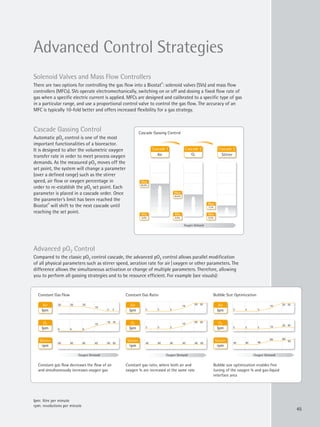
Constant gas flow decreases the flow of air
and simultaneously increases oxygen gas
Constant gas ratio, where both air and
oxygen % are increased at the same rate
Bubble size optimization enables fine
tuning of the oxygen % and gas-liquid
interface area
Constant Gas Flow Constant Gas Ratio Bubble Size Optimization
Cascade 1
Air
Cascade 2
O2
Cascade 3
Stirrer
Max
60.0%
Min
5.0%
Max
30.0%
Min
0.0%
Max
7.5%
Min
0.5%
Oxygen Demand
Cascade Gassing Control
lpm: litre per minute
rpm: revolutions per minute
45
Advanced Control Strategies
Advanced pO2 Control
Compared to the classic pO2 control cascade, the advanced pO2 control allows parallel modification
of all physical parameters such as stirrer speed, aeration rate for air|oxygen or other parameters. The
difference allows the simultaneous activation or change of multiple parameters. Therefore, allowing
you to perform all gassing strategies and to be resource efficient. For example (see visuals):
Solenoid Valves and Mass Flow Controllers
There are two options for controlling the gas flow into a Biostat®
: solenoid valves (SVs) and mass flow
controllers (MFCs). SVs operate electromechanically, switching on or off and dosing a fixed flow rate of
gas when a specific electric current is applied. MFCs are designed and calibrated to a specific type of gas
in a particular range, and use a proportional control valve to control the gas flow. The accuracy of an
MFC is typically 10-fold better and offers increased flexibility for a gas strategy.
Cascade Gassing Control
Automatic pO2 control is one of the most
important functionalities of a bioreactor.
It is designed to alter the volumetric oxygen
transfer rate in order to meet process oxygen
demands. As the measured pO2 moves off the
set point, the system will change a parameter
(over a defined range) such as the stirrer
speed, air flow or oxygen percentage in
order to re-establish the pO2 set point. Each
parameter is placed in a cascade order. Once
the parameter’s limit has been reached the
Biostat®
will shift to the next cascade until
reaching the set point.
46
I. Bioreactors and Fermenters 7. Bioreactor Control
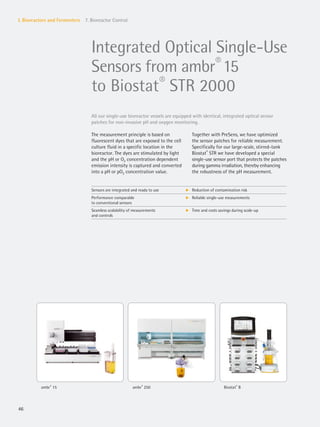
Integrated Optical Single-Use
Sensors from ambr®
15
to Biostat®
STR 2000
Sensors are integrated and ready to use k Reduction of contamination risk
Performance comparable
to conventional sensors
k Reliable single-use measurements
Seamless scalability of measurements
and controls
k Time and costs savings during scale-up
All our single-use bioreactor vessels are equipped with identical, integrated optical sensor
patches for non-invasive pH and oxygen monitoring.
Together with PreSens, we have optimized
the sensor patches for reliable measurement.
Specifically for our large-scale, stirred-tank
Biostat®
STR we have developed a special
single-use sensor port that protects the patches
during gamma irradiation, thereby enhancing
the robustness of the pH measurement.
The measurement principle is based on
fluorescent dyes that are exposed to the cell
culture fluid in a specific location in the
bioreactor. The dyes are stimulated by light
and the pH or O2 concentration dependent
emission intensity is captured and converted
into a pH or pO2 concentration value.
ambr®
15 ambr®
250 Biostat®
B
47
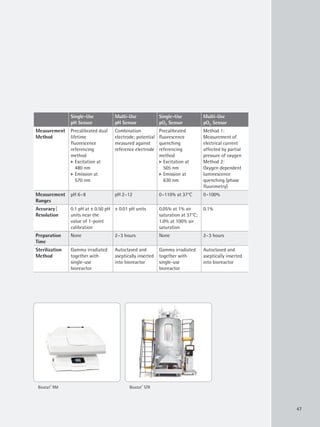
Single-Use
pH Sensor
Multi-Use
pH Sensor
Single-Use
pO2 Sensor
Multi-Use
pO2 Sensor
Measurement
Method
Precalibrated dual
lifetime
fluorescence
referencing
method
k Excitation at
480 nm
k Emission at
570 nm
Combination
electrode; potential
measured against
reference electrode
Precalibrated
fluorescence
quenching
referencing
method
k Excitation at
505 nm
k Emission at
630 nm
Method 1:
Measurement of
electrical current
affected by partial
pressure of oxygen
Method 2:
Oxygen dependent
luminescence
quenching (phase
fluorimetry)
Measurement
Ranges
pH 6–8 pH 2–12 0–110% at 37°C 0–100%
Accuracy|
Resolution
0.1 pH at ± 0.50 pH
units near the
value of 1-point
calibration
± 0.01 pH units 0.05% at 1% air
saturation at 37°C;
1.0% at 100% air
saturation
0.1%
Preparation
Time
None 2–3 hours None 2–3 hours
Sterilization
Method
Gamma irradiated
together with
single-use
bioreactor
Autoclaved and
aseptically inserted
into bioreactor
Gamma irradiated
together with
single-use
bioreactor
Autoclaved and
aseptically inserted
into bioreactor
Biostat®
RM Biostat®
STR
48
I. Bioreactors and Fermenters 8. Instrument Services
Instrument Services
Your Productivity. Our Mission.
Get the Most from Your Equipment with EXTEND|Instrument Services
Our full-scale Instrument Services will help you to unlock the full potential of your investment,
ensuring maximum reliability, uptime, service life and confidence in your results. Benefit from
our global network of highly experienced service engineers with in-depth knowledge of
the biopharmaceuticals industry: Count on Sartorius and its Instrument Services Department.
Installation
The reliability and service life of your
equipment significantly depend on its proper
installation and configuration. Installation
and commissioning by our service professionals
will ensure perfect system operation right
from the start. Taking advantage of Sartorius
Services is not only a choice for making the
most out of your investment but also for
meeting highest quality standards. Get in
contact with us today and let us convince
you by our proven customer care and
commitment to excellent service.
Your benefits:
k Perfectly up and running equipment
k Individual configuration and on-site
adaptation
k Extensively trained operators
k Complete documentation
Qualification
The qualification services of IQ|OQ and SAT
that we provide ensure that your systems will
operate fully in compliance with GMP and
GLP. Our team of trained specialists is pre-
pared to perform all necessary test procedures
for successful on-site qualification.
In addition, our extensive and customer-
specific documentation can easily be integrated
into your existing quality management systems.
Your benefits:
k GMP|GLP-compliant system operation
k Sartorius testing standards
k Complete, 100% traceable documentation
Extended Warranty Packages
Ease your mind with our Extended Warranty
program for accurate budget planning and
constant system availability. Twelve additional
months of full factory warranty coverage
provide an optimal equipment protection.
We also offer additional preventive
maintenance services to ensure continuous
and precise operation of your instruments.
Your benefits:
k Reliable budget planning
k Optimal equipment protection
k Maximum peace of mind
49
Preventive Maintenance and
Service Agreements
We take pride in the quality and reliability of
our products. Nevertheless, we are aware that
like all precision equipment, our instruments
require regular professional maintenance to
continue delivering the accurate results you
expect. For maximum productivity and peace
of mind, select one of our worry-free service
agreements. Just contact your local Sartorius
Services unit to gain a first-hand impression
of our proven customer care and commitment
to excellent service.
Your benefits:
k Optimized system performance
k Confidence in reliability of results
k Increased cost-effectiveness
k Full regulatory compliance
Consumable Kits|Emergency Kits
Consumable and emergency kits combine all
spare parts that are particularly time-critical
for your production process or need to be
replaced on a regular basis. With these kits at
hand, you will be prepared for any emergency
so you can exchange the respective parts on
your own immediately or have them ready for
replacement by a Sartorius technician. This
will reduce manufacturing losses as a result of
waiting to reorder parts.
Your benefits:
k Immediate on-site availability
k Maximum safety regarding reliable
system performance
k Minimum risk of equipment failure and
repair costs
k Individual kits available for all bioreactor
types
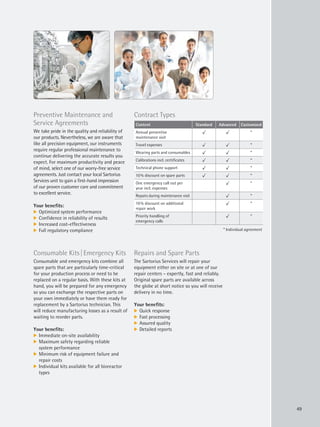
Contract Types
Content Standard Advanced Customized
Annual preventive
maintenance visit
h h *
Travel expenses h h *
Wearing parts and consumables h h *
Calibrations incl. certificates h h *
Technical phone support h h *
10% discount on spare parts h h *
One emergency call out per
year incl. expenses
h *
Repairs during maintenance visit h *
10% discount on additional
repair work
h *
Priority handling of
emergency calls
h *
* Individual agreement
Repairs and Spare Parts
The Sartorius Services will repair your
equipment either on site or at one of our
repair centers – expertly, fast and reliably.
Original spare parts are available across
the globe at short notice so you will receive
delivery in no time.
Your benefits:
k Quick response
k Fast processing
k Assured quality
k Detailed reports
50
1. Process Analytical Technologies 52
2. Process Analyzers and Sensors 54
3. Process Automation 59
4. Chemometrics 61
51
II. Process
Analytical
Technologies
52
II. Process Analytical Technologies 1. Process Analytical Technologies
Risk is Inverse to Process
Understanding
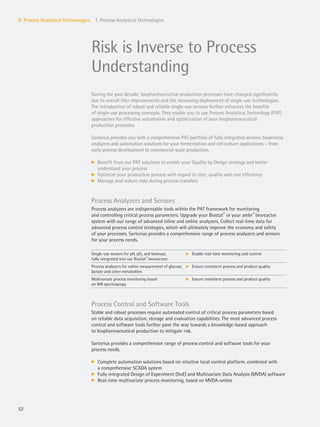
During the past decade, biopharmaceutical production processes have changed significantly
due to overall titer improvements and the increasing deployment of single-use technologies.
The introduction of robust and reliable single-use sensors further enhances the benefits
of single-use processing concepts. They enable you to use Process Analytical Technology (PAT)
approaches for effective automation and optimization of your biopharmaceutical
production processes.
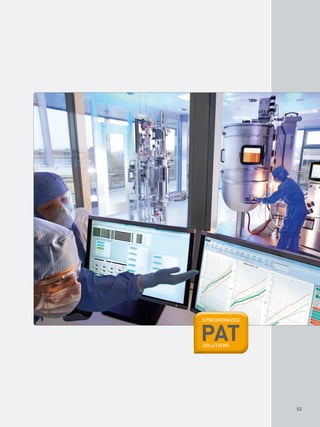
Sartorius provides you with a comprehensive PAT portfolio of fully integrated sensors, bioprocess
analyzers and automation solutions for your fermentation and cell culture applications – from
early process development to commercial-scale production.
k Benefit from our PAT solutions to enable your Quality by Design strategy and better
understand your process
k Optimize your production process with regard to titer, quality and cost efficiency
k Manage and reduce risks during process transfers
Process Analyzers and Sensors
Process analyzers are indispensable tools within the PAT framework for monitoring
and controlling critical process parameters. Upgrade your Biostat®
or your ambr®
bioreactor
system with our range of advanced inline and online analyzers. Collect real-time data for
advanced process control strategies, which will ultimately improve the economy and safety
of your processes. Sartorius provides a comprehensive range of process analyzers and sensors
for your process needs.
Single-use sensors for pH, pO2 and biomass;
fully integrated into our Biostat®
bioreactors
k Enable real-time monitoring and control
Process analyzers for online measurement of glucose,
lactate and other metabolites
k Ensure consistent process and product quality
Multivariate process monitoring based
on NIR spectroscopy
k Ensure consistent process and product quality
Process Control and Software Tools
Stable and robust processes require automated control of critical process parameters based
on reliable data acquisition, storage and evaluation capabilities. The most advanced process
control and software tools further pave the way towards a knowledge-based approach
to biopharmaceutical production to mitigate risk.
Sartorius provides a comprehensive range of process control and software tools for your
process needs.
k Complete automation solutions based on intuitive local control platform, combined with
a comprehensive SCADA system
k Fully integrated Design of Experiment (DoE) and Multivariate Data Analysis (MVDA) software
k Real-time multivariate process monitoring, based on MVDA-online
SYNCHRONIZED
PATSOLUTIONS
53
BioPAT ®
sensor:
Trace
Glucose|Lactate measurement
54
II. Process Analytical Technologies 2. Process Analyzers and Sensors
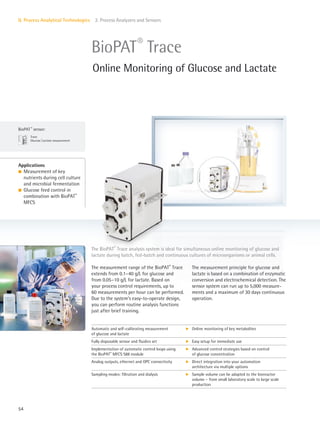
The measurement range of the BioPAT®
Trace
extends from 0.1–40 g/L for glucose and
from 0.05–10 g/L for lactate. Based on
your process control requirements, up to
60 measurements per hour can be performed.
Due to the system’s easy-to-operate design,
you can perform routine analysis functions
just after brief training.
The measurement principle for glucose and
lactate is based on a combination of enzymatic
conversion and electrochemical detection. The
sensor system can run up to 5,000 measure-
ments and a maximum of 30 days continuous
operation.
The BioPAT®
Trace analysis system is ideal for simultaneous online monitoring of glucose and
lactate during batch, fed-batch and continuous cultures of microorganisms or animal cells.
Applications
l Measurement of key
nutrients during cell culture
and microbial fermentation
l Glucose feed control in
combination with BioPAT®
MFCS
BioPAT®
Trace
Online Monitoring of Glucose and Lactate
Automatic and self-calibrating measurement
of glucose and lactate
k Online monitoring of key metabolites
Fully disposable sensor and fluidics set k Easy setup for immediate use
Implementation of automatic control loops using
the BioPAT®
MFCS S88 module
k Advanced control strategies based on control
of glucose concentration
Analog outputs, ethernet and OPC connectivity k Direct integration into your automation
architecture via multiple options
Sampling modes: filtration and dialysis k Sample volume can be adapted to the bioreactor
volume – from small laboratory scale to large scale
production
COMING SOON
ViaMass
Viable biomass measurement
BioPAT ®
sensor:
55
II. Process Analytical Technologies 2. Process Analyzers and Sensors
BioPAT®
ViaMass reduces the operator-to-
operator variability in cell counts and increases
batch-to-batch consistency, for example,
with regard to reproducible determination of
point of infection, induction or harvest. In
continuous cell culture processes, it enables
the automatic cell bleed control to maintain
a constant growth rate and cell density.
The integrated single-use sensor patch
permits non-invasive measurement of viable
biomass inside our bioreactor bags. To enable
reliable and accurate determination of viable
biomass in our Biostat®
RM bioreactor,
we have developed a special algorithm dealing
with the rocking motion of the cell suspension.
BioPAT®
ViaMass is the first fully single-use probe to monitor viable biomass in single-use
bioreactors. It is based on the proven principle of capacitance measurement and available for
our Biostat®
RM and soon also STR bioreactors.
Applications
l Non-invasive viable biomass
monitoring for suspension
and adherent cell culture on
microcarriers
l For vaccine, mAb, rProtein
and cell therapy applications
l Available for stainless steel,
glass and single-use bags
BioPAT®
ViaMass
Inline Monitoring of Viable Biomass
Single-use viable biomass sensor integrated into
Sartorius Flexsafe®
RM and soon also STR bags
k Operator indenpendent and continuous monitoring
of viable biomass
Biomass measurement values shown on BioPAT®
DCU k Easy implementation of control loops based on
viable biomass, e.g. addition of nutrients or control
of cell bleed
Reduced manual sampling k Lower contamination risk
BioPAT ®
sensor:
Fundalux
Turbidity measurement
56
II. Process Analytical Technologies 2. Process Analyzers and Sensors
The BioPAT®
Fundalux amplifier comes
integrated into our BioPAT®
DCU. To have
strain-specific data converted automatically
to any optical density measurement, just
use BioPAT®
Fundalux with BioPAT®
MFCS
software.
Especially in microbial culture, manual
sampling can be highly time-consuming and
inconsistent. The BioPAT®
Fundalux probe
continuously monitors cell growth in your
culture by measuring the turbidity in a
defined optical path based on near infrared
light. This inline turbidity measurement tool
lets you conveniently control nutrient feeds,
gas flow and other critical process parameters
to optimize yield.
Applications
l Inline monitoring of total
biomass based on turbidity
e.g., in microbial cultures
l For stainless steel and glass
vessels
The BioPAT®
Fundalux system is based on an integrated absorption-based probe using near infrared
light for turbidity measurement. You can use it in all glass and stainless steel bioreactors.
BioPAT®
Fundalux
Inline Monitoring of Total Biomass
Biostat®
bioreactor integration k All-in-one BioPAT®
DCU, data collection and control
12 and 25 mm probe connection k Flexible entry into your fermenter
Range of optical path lengths (1, 5 and 10 mm) k Optimal total biomass coverage for your bioreactor
Robust LED light source k Up to 10-year lamp lifetime
Product contact materials and surfaces are
certified and traceable
k
k
Just like your pH and pO2 probe
Biocompatibility and quality assured
BioPAT ®
sensor:
Xgas
Off-gas analysis
57
II. Process Analytical Technologies 2. Process Analyzers and Sensors
This enables you to apply reliable, advanced
gassing or feeding strategies to improve
production rates and reduce cultivation time.
The precise measurement of input and output
metabolic gases by mass flow controllers
and spectroscopic analysis yields insights
into critical metabolic changes during your
cultivation process.
The compact BioPAT®
Xgas precisely tracks changes in respiratory gas emission from a
cultivation vessel. You can integrate it as an option into all Biostat®
bioreactors for real-time
calculation of metabolic data, such as oxygen uptake and carbon dioxide emission rate.
Applications
l Batch record of O2 |CO2 %
off-gas
l Automatic calculation of
metabolic data
l Optimization of microbial
and high cell density cell
culture processes
l Measure critical process
parameters for scale-up
l Early warning of pO2 probe
error
BioPAT®
Xgas
Online Off-Gas Analysis of O2 and CO2
Standardized integration into all our
Biostat®
bioreactors
k All-in-one BioPAT®
DCU, data collection and control
Parallel measurement of O2 and CO2 by one sensor k Reduces footprint and exhaust piping requirements
Wide detection range k Analyzes O2 enrichment and CO2 headspace gassing
Automatic moisture and pressure compensation k The highest accuracy and precision ensured
Compact, mountable design k Safe, ergonomic and space-saving in lab and
production areas
Fast and easy 1-point calibration to air k Less time needed for initialization and setup
BioPAT ®
sensor:
Spectro
Multi-variant bioprocess monitoring
58
II. Process Analytical Technologies 2. Process Analyzers and Sensors
The monitored spectrum is converted into
a real-time process trajectory and overlaid
with previous golden batches. Any unexpected
parameter shift is detected instantly, enabling
you to take guided corrective action within
a window of operation. This will save you the
inconvenience of process deviations, subse-
quent root cause analysis and assessment of
impact on product quality and safety.
Through a standard Ingold port, the BioPAT®
Spectro scans the visible and near infrared
spectrum, tracking changes in absorption and
linking them to parameter concentrations. In
combination with the BioPAT®
SIMCA online
software tool, the BioPAT®
Spectro data are
transformed into meaningful process data,
minimizing your need for offline sampling.
Applications
l Golden batch comparison
in late phase clinical trials
and commercial production
l Multiple parameter
monitoring, e.g., nutrients,
metabolites, cell parameters,
titers
l Media quality fingerprinting
BioPAT®
Spectro conveniently integrates into your stainless steel bioreactor|fermenter
to provide real-time feedback on the status of your process.
BioPAT®
Spectro
Online Multivariate Bioprocess Monitoring
Seamless data transfer to our MVDA tool
BioPAT®
SIMCA-online
k Cost savings thanks to less offline analytics and
reduced manual effort
Integration into Biostat®
Cplus and Biostat®
D-DCU
through standard Ingold port
k No bioreactor adaptation required
Intuitive visual software; sophisticated filtering
of air bubble effects
k Reduced need for operator training
Batch recording of process stages based on process
trajectories
k Early error detection prevents loss of expensive batches
Automated GMP-compliant documentation via
BioPAT®
MFCS
k Easy access to all batch related information
Supervisory Control
And Data Acquisition
SCADA
59
II. Process Analytical Technologies 3. Process Automation
The advanced 21 CFR Part 11 compliant
BioPAT®
MFCS suite is a feature-rich, GAMP
category 4 software package capable of
supporting the most demanding research or
production environment. Besides the core
functionality of a full-fledged SCADA system,
BioPAT®
MFCS in combination with the
BioPAT®
DCU is the most cost-effective
and flexible platform specifically tailored
for bioprocessing applications.
BioPAT®
MFCS provides configurable modules
and customization options to meet your
particular requirements. Designed as a “plug-
and-play” tool, it is ideally suited for capturing,
storing and visualizing process data of our
Biostat®
and ambr®
bioreactors and other
process equipment including 3rd
party units.
This software enhances your ability to build
your own SCADA network using our precon-
figured and bioprocess optimized solution.
BioPAT®
MFCS is the central platform for your online and offline process and analytical data,
from cell line and process development to production scale.
Applications
l Reliable data acquisition,
monitoring and control
l For upstream and
downstream unit operations,
e.g., Biostat®
bioreactors,
and FlexAct®
systems
l Across all scales from early
process development to
commercial manufacturing
l Incorporating Sartorius and
3rd
party systems
BioPAT®
MFCS
SCADA Software for Reliable Data
Acquisition, Monitoring and Control
Scalable software for nearly all bioprocess
applications
k Reduced training efforts and improved data consistency
Fully user configurable and upgradable with specific
modules
k Unique customization level and flexible investment
costs
Proven track record of over 25 years in software
development
k Reliable and robust system performance
Installation, configuration, validation and
engineering services
k Technologically and economically optimized solutions
Central platform for real-time and historical analysis
of process, analytical and sampling data
k Full transparency and accessibility for advanced
process control and understanding
Microsoft®
and Windows®
are registered trademarks of
Microsoft Corporation, USA.
l l l
l ll l l
l l l
l ll l l
l l
l l l
Expression system
development
Pilot Production
Process
Development
Clinical Production
Scale-up
Process Validation
Process
Optimization
Commercial
Production
Process
Characterization
l Early Process Development l Late Process Development l Production
Drug development process
60
II. Process Analytical Technologies 3. Process Automation
Software Modules
BioPAT®
MFCS
Your Choice for Advanced Features
Connectivity
BioPAT®
MFCS provides flexible connectivity to
Sartorius devices and true interoperability with
major third-party products. “Plug-and-play”
communication to analytical instruments
enables 24|7 monitoring of measurement
data and facilitates feedback control loops.
Network
BioPAT®
MFCS can be easily integrated
into your existing IT architecture by
distributed operator workstations with access
authorization. If required, the SCADA
environment can also be isolated from your
company‘s network.
Automation
BioPAT®
MFCS allows you to mirror each
step of your process by selection of recipes
complying with the ANSI/ISA-88.01 standard
for computerized batch control.
Validation
BioPAT®
MFCS supports all requirements to
achieve full compliance with 21 CFR Part 11.
Your process can be evaluated, reviewed,
approved and archived without a single sheet
of paper – and without the risk of interference
with process data and electronic signatures.
Optimization
The BioPAT®
MFCS DoE module will ease your
start into Design of Experiments, supported
by user-friendly wizard guidance. Automatic
transfer of the experimental design into a
specific recipe allows for reliable and seamless
integration into existing control strategies.
Analysis
The BioPAT®
MFCS MVDA module supports
easy and fast multivariate data analysis –
saving you cumbersome and error-prone
transfer of your process data to stand-alone
software tools for statistical analysis.
Training
Sartorius provides different levels of training
sessions designed to ensure that each partici-
pant acquires the necessary, practical skills.
On-site training courses can be adapted to
your special needs so that you will get the
most of your new BioPAT®
MFCS.
Service & Support
Benefit from our team of experienced service
engineers who have successfully delivered
on a large number of projects worldwide,
which include computer system validation
as well as qualification of automated process
equipment.
Specialized for bioprocesses, BioPAT®
MFCS provides preconfigured modules enabling plug-and-
play setup of advanced SCADA functionalities, saving you in-house resources for engineering,
maintenance and training. BioPAT®
MFCS and its advanced modules were strictly developed
according to a sustainable software lifecycle design. As a result, you will receive high-quality soft-
ware for safe and worry-free operation – every time, all the time. These software modules are
compatible with the latest off-the-shelf hardware and software technology, such as multi-core
processors for fast data processing and Windows®
8 operating systems.
61
BioPAT®
Chemometrics Toolbox
New Opportunities for Efficient
Bioprocess Development and Manufacturing
SCADA
BioPAT®
MFCS
MVDA
BioPAT®
SIMCA
Compare batches and
scales, identify key trends,
correlations, patterns and
relationships
Multivariate
Data Analysis
MVDA
MVDA Module
MVDA-online
BioPAT®
SIMCA-online
Monitor the design space
online and save batches by
early fault detection
Online Multivariate
Data Analysis
MVDA
OPC Module
DoE
BioPAT®
MODDE
Identify critical process
parameters and their optimal
ranges and estimate a design
space
DoE Module
Design of
Experiments
DoE
Take advantage of the BioPAT®
Chemo-
metrics Toolbox and integrate the
capabilities of advanced multivariate
methods into your existing process
control software BioPAT®
MFCS|win.
Design of
Experiments
DoE
62
II. Process Analytical Technologies 4. Chemometrics
Use the BioPAT®
MODDE software to speed
up your development work, to increase
productivity and elucidate primary effects
and interactions of potential critical process
parameters and critical quality attributes.
BioPAT®
MODDE enables rapid process
optimization with a reduced number of
experiments. Forget time-consuming,
traditional trial- and error optimization.
You will benefit from unique design space
tools to visualize the most reliable operating
range for the investigated parameters
considering risk analysis specifications.
Applications
l Optimization of cell and
microbial culture media
composition and feed
strategies
l Screening and optimization
of process parameters
l Design Space Estimation
(DSE) and validation
BioPAT®
MODDE is a state-of-the-art Design of Experiments software package that will help
you understand complex processes and products.
BioPAT®
MODDE
DoE – The Efficient Way of
Bioprocess Optimization
Visual user guidance with a multitude of
automated functions
k Tool for beginners and experienced users alike
User-friendly design and analysis wizard k Easy setup and reliable data evaluation
of experiments
Graphic-rich presentation of results and reports k Decision-making based on statistically verified
statements
Unique connection to BioPAT®
MFCS k Reliable and seamless integration of DoE procedures
into existing control strategies
Multivariate
Data Analysis
MVDA
63
II. Process Analytical Technologies 4. Chemometrics
The unique BioPAT®
MFCS MVDA module
is specifically matched to communicate with
and deliver data to BioPAT®
SIMCA in order
to reduce effort associated with data
management and comparison of current
and historical batches.
For many years, BioPAT®
SIMCA has been
the standard tool for scientists and engineers,
enabling them to manage considerable
amounts of data. BioPAT®
SIMCA enables you
to effectively explore your data, analyze your
process and interpret the results. Use BioPAT®
SIMCA to transform data into information,
allowing you to make the right decisions –
quickly and confidently.
Multivariate Data Analysis (MVDA) with BioPAT®
SIMCA supports and unlocks process
understanding to ultimately improve the quality, safety and efficacy of your drug product.
Applications
l Classification of batches and
process predictions
l Scale and batch-to-batch
comparisons
l Identification of key trends,
correlations, patterns,
and relationships in your
process data
BioPAT®
SIMCA
MVDA – Discover Hidden Process Information
Easy interpretation and analysis of large process
data sets
k Improved process performance resulting in yield
improvements and impurity reduction, among other
benefits
Scale and batch-to-batch comparisons k Generates process understanding to ultimately
improve the quality, safety and efficacy of your
drug product
Summary of all types of process information,
all in one data model
k Control and assurance of overall process and
product quality
Unique connection to BioPAT®
MFCS k Reduces the effort of data management and transfer
Online Multivariate
Data Analysis
MVDA
64
II. Process Analytical Technologies 4. Chemometrics
BioPAT®
SIMCA-online uncovers hidden
information in your processes. It is a highly
efficient software tool for real-time process
monitoring and control. Predictive analytics
and soft sensor models can be applied based
on process parameters and spectral data.
Supplied with data from BioPAT®
MFCS,
this software permits identification of
inconsistencies before they result in a process
deviation and provides user guidance to
identify potential root causes. This results
in enhanced control and assurance of your
overall process and product quality.
Applications
l Early fault detection
l Golden batch comparison
l Real-time multivariate
statistical process monitoring
BioPAT®
SIMCA-online software performs real-time multivariate monitoring of your processes
and provides effective tools for early fault detection and diagnosis.
BioPAT®
SIMCA-online
Real-time Design Space Monitoring
Early detection of process deviations with
guidance to identify potential root causes
k Faster troubleshooting
Process trajectories for real-time fermentation
monitoring
k Enhanced process reliability due to
easy-to-understand graphics
Standard interface to BioPAT®
MFCS via OPC k Easy implementation into existing IT infrastructures
66
1. Cell Culture Media 68
2. Media Preparation 74
3. Media Sterile Filtration 78
4. Media Virus Risk Mitigation 82
5. Media and Feed Storage 84
67
III. Media
68
III. Media 1. Cell Culture Media
Grow with Us
Sartorius Cell Culture Media
The development of powerful cell culture media and feed strategies has dramatically changed
our way of producing antibodies, recombinant proteins and vaccines. Today, antibody titers of
up to 10 g/L and beyond can be achieved in intensified cultures using serum- and protein-free
or even chemically defined media and feeds.
In collaboration with Lonza, Sartorius offers a broad range of powerful cell culture media for
the most common cell lines used for protein and virus production including CHO, PerC6, MDCK,
Vero and insect cells.
As selection and optimization is cell line dependent and a critical aspect of process develop-
ment, we provide qualified application support and development services to our customers.
Our cell culture platform media offering includes
k Serum-free media
k Protein-free media
k Animal-origin-free media
k Chemically defined media
k No virus or prion concerns
k Simplified downstream processing
k Maximized yields
Experience and Quality
Benefit from more than 50 years of experience
with development and regulatory compliant
manufacture of cell culture media. Rely on
a partner who understands the criticality of
an appropriate quality system, raw material
sourcing, quality control and assurance of
supply.
k Two redundant manufacturing sites
in Europe and the U.S.
k ISO 9001|13485 certified
k Registered cGMP 21 CFR 820
All raw materials are selected to comply with
European and U.S. Pharmacopeia standards.
If available, they are from a certified non
animal origin source.
Powder media are produced in a controlled
area at low humidity to prevent hydration.
All liquid media are made from water for
injection for the best microbiological quality.
Flexibility and Customization
Are you looking for a partner that can
manufacture your own cell culture media
formulation? We can support you!
k Liquid media in containers ranging from
1 L bottles to 1,000 L bags; up to 1,000 L
per batch
k Powder media in package sizes of up
to 20 kg per unit; up to 7 tons per batch
Do you want to optimize your cell culture
medium? You have come to the right place.
k Expert support for your media optimization
k Lonza media optimization services
The Sartorius Media Team is looking forward
to supporting you in making your projects
a success!
Long-term Collaboration
69
Our Range of Cell Culture Media
A broad range of off-the-shelf media are available in liquid and powder format to provide you
with maximum flexibility during early development.
We offer special kits for cell line and media development as liquid (1–20 L) and as powder
versions (up to 5 kg).
Cells Medium Culture NAO Protein-
free
Peptide-
free
CD Format Primary
application
CHO
(e.g., DG44, CHO-S, CHO K1,
DHFR–
)
UltraCHO Suspension
and adherent
No No No No Liquid Proteins
ProCHO®
-5 Suspension Yes Yes No No Liquid and powder Proteins
PowerCHO®
-2 Yes Yes No Yes Liquid and powder Proteins
PowerCHO®
-3 Yes Yes No Yes Liquid Proteins
ProCHO®
-AT Adherent Yes Yes No Yes Liquid Proteins
CHOK1SV (GS platform) PowerCHO®
-GS Suspension Yes Yes Yes Yes Liquid and powder Proteins
Lonza GS V8 Media
and feeds*
Yes Yes Yes Yes Liquid and powder Proteins
Hybridoma HL-1 Suspension No No No Yes Liquid Proteins
ProDoma-3 Yes Yes No No Liquid Proteins
UltraDoma Yes No No Yes Liquid Proteins
UltraDoma PF No Yes Yes Yes Liquid Proteins
NS0 ProNS0 2 Suspension Yes Yes No Yes Liquid Proteins
Insect cells (e.g., Sf9, Hi 5) Insect Xpress No Yes No No Liquid Proteins|
Vaccines
Vero ProVero-1 Adherent Yes Yes No No Liquid Vaccines
PC-1 No No No No Liquid Vaccines
MDCK UltraMDCK Adherent No No No Yes Liquid Vaccines
ProVero-1 Yes Yes No No Liquid Vaccines
HEK 293 Pro293a Adherent Yes Yes No Yes Liquid Vaccines
Pro293s Suspension Yes Yes No Yes Liquid Vaccines
PerC6* Permexcis* Yes Yes No Yes Liquid Vaccines
PerC6
(and retinoblastoma cell lines)
ProPER1 Suspension Yes Yes No No Liquid Vaccines
Hematopoietic cells
(e.g., T, NK, DC)
X-Vivo 10 Suspension No No No Yes Liquid Cell therapy
X-Vivo 15 No No No Yes Liquid Cell therapy
X-Vivo 20 No No No Yes Liquid Cell therapy
HL-1 No No No Yes Liquid Cell therapy
Mesenchymal stem cells MSCGM CD Adherent No No No Yes Liquid Cell therapy
Adult dermal fibroblasts FGM CD Adherent No Yes No Yes Liquid Cell therapy
Adult and neonatal primary
keratinocytes
KGM CD Adherent No No No Yes Liquid Cell therapy
NAO: Non-animal origin
CD: Chemically defined
* License required
70
III. Media 1. Cell Culture Media
Today, CHO cell lines are commonly used for
production of recombinant proteins and
monoclonal antibodies. Sartorius’ chemically
defined platform medium for this type of
application is PowerCHO®
-2.
In combination with PowerFeed A or Xtreme
Feed, you can maximize your cell densities and
yields in fed-batch cultures.
PowerCHO®
-2 and feeds are available in liquid
and powder format:
– 1 L bottles, 10 L and 20 L pre-filled bags
– 10 L, 50 L, 100 L and 500 L powder kits
PowerCHO®
-2 medium and feeds are our powerful serum-free, chemically defined media
platform specifically optimized for recombinant protein and monoclonal antibody production
in CHO cells.
Applications
l Therapeutic protein
production in CHO cells
l CHO cell culture in
perfusion (medium only)
or in fed-batch (medium
with feeds)
l From development
to clinical and commercial
production
PowerCHO®
-2
Basal Medium and Feeds
The Medium and Feeds Combination for
High Titer CHO Fed-batch Cultures
Chemically defined medium and feeds for CHO
fed-batch culture
k Maximize your titers
Contains only fully traceable, non-animal origin
raw materials
k Regulatory-friendly, suitable for clinical trials
and commercial manufacturing
Available in liquid and powder formats k Comparable performance provides flexibility
in development and production
71
III. Media 1. Cell Culture Media
Media Supply for GMP Production
Our media production facilities are
ISO 9001|2008 and 13485:2012 compliant
following cGMP 21CFR820 guidelines.
Media Optimization Services and Support
Our media specialists will develop or optimize
customer specific media formulations designed
for your unique cell culture requirements.
Media Supply for Process Development
An expedited production option for those that
require high quality cell culture media for
process development and non-GMP production.
Beside off-the-shelf media formulations, we support our customers with the manufacture
of their own proprietary media formulation, either in liquid or powder format.
Our team of experienced media specialists can also assist with the development and
optimization of cell line specific medium and feed formulations. Let us support you from
cell line and process development to clinical and commercial production.
Applications
l Vaccine production
l Therapeutic protein
production
l Cell therapy
Custom Media Formulations
We Help You with Your Requirements
Homogeneous particle size of powder formulations k
k
Reduces regulatory burden
Facilitated dissolution
Two redundant manufacturing sites k Global supply
Wide range of batch sizes and packaging formats
– Up to 10,000 L for liquid formulations
– Up to seven tons for powder formulations
k Excellent partner for scale-up, matching needs
from preclinical to commercial phase
Similar offering for buffers k Your partner also for downstream processing
72
III. Media 1. Cell Culture Media
k Leading position in single-use
applications that include fluid
management, filtration and
process analytical technology
Inndustry LLeadderr
with
50 years of cell ccuulltture
experriieennccee
k Pioneer in state-of-the-art
micronization high-quality powder
production processes
k Risk minimization approach
applied to powder|liquid solutions
k ISO certification with successful audit
track record following Current Good
Manufacturing Practices 21CFR820
k Long-term relationships with dual-
sourced raw material suppliers
guarantees supply and quality
k Excellent regulatory dossier support
Experience and Flexibility for
Your Cell Culture Needs
Experience
Highly experienced media specialists will
provide guidance on the selection of standard
media formulations, as well as development
and optimization of custom media. This
service includes product specific packaging,
documentation and full regulatory support.
Flexibility
Working in collaboration, Lonza and Sartorius
offer a wide array of liquid and powder media
products along with the expertise to help
scale-up your project from clinical trials up
to commercialization. Offered products and
services include specially engineered media
and buffers for dedicated cell lines and
Upstream|Downstream|Fill and Finish unit
operations.
Long-term Collaboration
73
Complete Solution
All liquid media filtered through Sartorius filters;
full media qualification package and support
k Optimized media filtration and guaranteed successful
scale-up and transfer into commercial production
Preweighed buffer and media powder
in ready-to-use dispensing bags
k Simple and straightforward media and buffer
preparation with Sartorius FlexAct®
MP or mixing
solutions
Advanced feeding and control strategies using
Sartorius ambr®
and Biostat®
bioreactors,
sensors, MFCS supervisory control system and
chemometrics tool box
k Fast track to optimized culture conditions and yields
Sartorius one-stop shop for integrated and optimized
solutions for cell line, media and process development
and production of cell culture derived products
k Full process support allows you to focus on your
core tasks and targets
Industry leader in batch scalability k Liquid: 1–10,000 L
Powder: 7–7,000 kg
Dual manufacturing sites k Assurance of supply
Wide range of primary and secondary packaging k Excellet fit of your needs
Off-the-shelf to fully customized solutions k Titer maximization and assistance throughout your
products’ complete life cycle
Formulation options include animal origin|
non-animal origin serum-free and protein-free
media that are fully traceable
k Regulatory-friendly solutions
Adherent or suspension cultures k Solutions for any type of process
Automated
Media
Preparation
Cell
culture
media
Sterilizing-
Grade Filters
Mycoplasma-
Retentive
Filters
Virus
Removal
Filters
UV Virus
Inactivation
Mixing Bags
Storage Bags
74
III. Media 2. Media Preparation
Solutions for
Media Preparation
Cell culture media are produced in large volumes and aseptically transferred into bioreactors.
Key process steps involved in media preparation are the mixing of the powder media with water
for injection (WFI), sterilizing-grade and mycoplasma-retentive filtration and media storage
before use.
Continuous cost pressure, increased titers and reduced production volumes have led to the
adoption of single-use technologies – both for bioreactors and media preparation. Sartorius has
therefore developed the fully automated, easy-to-use FlexAct®
MP system that helps reduce
labor-intensive steps to ensure higher productivity.
As your leading partner for upstream processing, Sartorius provides you with integrated
solutions that comprise cell culture media, bags, sterilizing grade filters, mycoplasma retentive
filters and virus risk mitigation tools.
Media Filtration Solutions
The choice of an appropriate filtration
solution for media preparation highly depends
on the composition of your cell culture medium.
Often, 0.2 μm-rated sterilizing-grade filters
are used for media preparation. However,
reports of mycoplasma contamination of cell
culture processes have put 0.1 μm-rated
mycoplasma-retentive filters into the spotlight,
again. Typical sources for mycoplasma
contamination are animal-derived materials,
such as trypsin or serum; plant-derived
culture media supplements, such as soy-based
supplements; and contamination caused
by the operators themselves. Producers of cell
culture media have to assess their potential
risk for mycoplasma contamination in order
to decide which filtration method to use.
Sartorius media filtration solutions range
from prefilters to sterilizing-grade and
mycoplasma-retentive filters – tailored to the
specific filtration needs of the various types
of cell culture media.
Sartorius offers:
k Broad portfolio of filters
for various media types,
including chemically defined
or protein, serum or
hydrolyzate-supplemented
k Safe solutions for
mycoplasma risk mitigation;
combining high retention
efficiency with optimal
throughput for cost-
effective processing
k Prefilter portfolio with
optimal protection of final
filters to further reduce
filtration costs
k All media filtration solutions
available both for single-
use processing and media
production in stainless steel
equipment
k Highest total throughput
and economic filtration
system design in the
industry
Powder media Mixing StorageFiltration
75
Single-Use Media Preparation
Today, single-use systems for media preparation
are available up to 3,000 L. While users initially
converted individual production components
to single use, the industry is now moving
toward completely integrated systems for
media preparation.
The Sartorius FlexAct®
MP media preparation
platform is a highly automated, fully closed
system: It starts with powder dissolution in
a single-use mixing system, which is followed
by sterile filtration and the transfer of the
ready-to-use media into a storage bag. To
avoid errors, the entire media preparation
process is supervised by a multi-functional
central control unit. It monitors and records
all relevant process data, such as operating
pressure, pH, pump speed and fluid level.
Sartorius filters and single-use bags are
supported by an industry-leading documenta-
tion package, which includes validation and
extractables guides. Our validation experts
will support you throughout qualification of
your single-use systems for biopharmaceutical
production.
k Complete range of single-use bags for
media preparation, mixing and storage
from 50 L up to 3,000 L
k Magnetic mixing technology with universal
mobile drive unit
k Fully integrated FlexAct®
MP media
preparation platform
k Comprehensive validation support
for extractables|leachables by our
dedicated CONFIDENCE®
validation team
Virus Risk Mitigation in
Media Preparation
Virus risk mitigation in cell culture media
preparation is a hot topic. Almost all product
contamination over the past several years has
been caused by small, non-enveloped viruses
derived from raw materials.
Technologies such as high-temperature,
short-time treatment, UV-C inactivation and
virus removal filtration have been employed
for virus risk mitigation in cell culture media
preparation. UV-C inactivation is also used
for virus inactivation of serum and serum-
containing media. Virosart filters have been
successfully utilized at low flow rates
for chemically defined media filtration in
continuous perfusion processes.
k Broad range of virus removal filters for
different media filtration applications
k Safe virus inactivation in serum and serum-
containing media by UV-C inactivation
k Orthogonal and robust technologies
prevent contaminations
76
III. Media 2. Media Preparation
The system is based on magnetic coupling,
e.g., no shaft-through or dynamic seal is used,
providing a completely closed mixing assembly.
Agitation rates of up to 300 rpm can be
reached, allowing highly efficient mixing from
50–3,000 L scale.
Flexel®
for Magnetic Mixer®1
with its strong
magnetic coupling is the ideal solution for:
− Powerful dissolution of powder media with
high torque and high rotation speed
− Effective mixing of highly viscous solutions,
such as media and hydrolysate mixtures
− Large volumes (up to 3,000 L)
Flexel®
for Magnetic Mixer®1
is a compact and non-invasive single-use mixing system
for manual media dissolution and mixing.
Applications
l Media|feed preparation
l Buffer preparation
Flexel®
for Mixing
Single-Use Media Mixing Solution
Cubical shape with front access system and large
8” diameter top port
k Bag installation, filling, powder transfer and
draining steps easy to perform
Baffle-like effect with strong top to bottom flow
pattern thanks to the centered impeller in combination
with the cubical design
k High performance proven from 50–3,000 L
Pre-assembled and presterilized single-use sensors
for pH, conductivity and temperature
k In-line monitoring and control of critical process
parameters
Palletank®
for mixing with heat exchange jacket
and integrated weighing functions
k Product temperature and volume control
Dust-free powder addition via closed addition bag k Protection of operators, meeting current health
and safety regulations
1
This product uses Pall patented Magnetic Mixer technology.
All information on patents can be found at Pall.com/patents.
77
III. Media 2. Media Preparation
The FlexAct®
MP is a standardized configurable system for convenient media preparation
in biopharmaceutical processes.
The FlexAct®
central operation module
enables you to control and monitor all relevant
process parameters during media preparation.
Integrated weighing capabilities permit precise
media dissolution using our Magnetic Mixer®1
technology. A fully automated, temperature-
controlled pH adjustment is performed
via a jacketed Palletank®
for mixing and
a temperature control unit (TCU).
During fluid transfer and sterile filtration,
pressure and flow are monitored
and controlled to ensure safe operation.
Applications
l Automatic, contained media
preparation
FlexAct®
MP
Configurable Single-Use Solution
for Media Preparation
Multi-functional central operating module k Operator-friendly
Tailored bag configurations k Flexible media supply
50–3,000 L working volume k Fully scalable
Quick system set-up k Increased efficiency
Integrated disposable sensors
(pH, conductivity, temperature)
k Reliable monitoring of important parameters
Bi-directional operation k Highly flexible
1
Magnetic Mixer®
is a trademark of Pall Corporation and this product uses Pall patented Magnetic Mixer®
technology. All information on patents can be found at Pall.com/patents.
78
III. Media 3. Media Sterile Filtration
Sartoguard PES contains a PES double layer,
available in both 0.1 and 0.2 μm nominal
pore size configurations. They are designed
for cost-effective prefiltration of chemically
defined media.
Sartoguard NF is a gamma-irradiatable prefilter
which contains a PES double layer covered
with a modern PES nanofleece material.
Sartoguard GF contains a PES double layer
covered with a glass fiber fleece. It effectively
protects the filter from clogging, especially
when you need to filter serum and hydrolysate
supplemented cell culture media.
Heterogeneous PES membrane double layer
with or without fleece material
− provides optimal prefiltration for all types
of cell culture media
− protects subsequent sterile filters and
extend filtration capacity
The Sartoguard family consisting of PES, GF and NF versions are all designed to extend the
lifetime of Sartopore®
2 XL final filters by a factor of 3 to 4 – for cost-effective cell culture
media prefiltration. Sartoguard filters provide the most cost-effective solutions to ensure
your final filter achieves the highest throughput.
Applications
l Prefiltration of cell culture
media
l Protection of Sartopore®
2 XL
final filters
Sartoguard Prefilter Family
Optimal Protection for
Sartopore®
2 XL Filter Elements
Sartoguard prefilter family k Protects subsequent sterile filters and extend
filtration capacity
Sartoguard PES k For prefiltration of chemically defined media
Sartoguard NF k For prefiltration of serum-free media with higher
tendency of clogging final filter
Sartoguard GF k For prefiltration of complex media containing
serum or hydrolysates
79
III. Media 3. Media Sterile Filtration
Applications
l Sterilizing-grade filtration
and mycoplasma-retentive
filtration of cell culture
media
l Sartopore®
2 XLG
(0.35|0.2 μm) designed
for complex, serum or
hydrolyzate supplemented
media
l Sartopore®
2 XLI
(0.8|0.2 μm) designed for
chemically defined media
l Sartorpore®
2 XLM
(0.2|0.1 μm) designed
for mycoplasma retention
(0.1 μm)
The unique range of PES double-layer
membrane combinations perfectly serves the
different cell culture media requirements.
Sartopore®
2 XLM filters use double-layer
PES membranes with pore size combination of
0.2|0.1 μm for reliable mycoplasma retention
with an LRV of 7/cm2
filtration area.
They have additionally been validated
for sterilizing grade filtration according to
ASTM F 838-05. Sartopore®
2 XL ensures
unmatched filtration performance along
with the highest microbial safety.
The Sartopore®
2 XL filter family is the best choice for sterilizing-grade filtration and
mycoplasma-retentive filtration of cell culture media.
Sartopore®
2 XL Filter Family
Best Filtration Solutions for Cell Culture Media
Unique combination of different pre- and final filter
membranes
k Ensures highly economic filter sizing and minimum
filtration costs for all kinds of media
Low unspecific protein binding k Excellent and reproducible cell growth
Reliable retention of mycoplasma by
Sartopore®
2 XLM 0.1 μm
k Prevents mycoplasma contamination of your
cell culture process
Available in a broad range of sizes and formats
to provide linear scale-up from development
to commercial-scale production
k Identical filtration performance at all scale-up levels of
your media preparation process
80
III. Media 3. Media Sterile Filtration
Which Filter Solution Best Fits
Your Needs?
Todays industrial cell culture media formulations can be very different, from serum and
hydrolyzate supplemented to chemically defined media. Based on our long standing experience
in media filtration, we can recommend the best filter solution for your needs.
Our international team of application specialists help you optimize your specific filtration
process – just contact us today.
Serum, soy or
yeast hydrolyzate-
supplemented
cell culture media
Chemically
defined
cell culture
media
Serum or
hydrolyzate-
supplemented
media
Sartoguard GF
Glass fiber fleece|
0.2 μm
Sartoguard NF
Nanofleece |
0.2 μm
Sartoguard GF
Glass fiber fleece|
0.2 μm
Sartopore®
2 XLG
0.8 μm|0.2 μm
Sartopore®
2 XLI
0.35 μm|0.2 μm
Sartopore®
2 XLM
0.2 μm|0.1 μm
Characteristics
Media Type
Complex additives with a
a broad molecular weight
distribution and potential
kolloid and particle load
Might contain recombinant
protein additives, such as
insulin, transferin or other
growth factors
Potential mycoplasma
contamination risk
Final Filter Options
Prefilter Options
81
III. Media 3. Media Sterile Filtration
The Sartocheck®
filter integrity tester reliably identifies whether your sterilizing-grade filters
used in processes are actually intact – both before and after use.
Applications
l Filter integrity testing
Sartocheck®
4 Plus
Filter Tester
The Best-Selling Integrity Tester Worldwide
Sartocheck®
automated filter integrity tests
are quick and easy to perform. A barcode
scanner ensures user-friendly and error-proof
selection of the appropriate pre-programmed
filter test sequences. You can choose to
print out test results or export test data for
GMP-compliant documentation.
Automatic detection of operator mistakes,
such as incorrect test set-up, ensures
error-proof performance of filter integrity
testing.
Automatic detection of incorrect set-ups k Mitigates operator mistakes
Easy program selection with barcode scanner k Prevents operator errors
Optimized backflow prevention via external valve k Avoids cross-contamination
Patented cleaning function k Allows decontamination of internal pneumatics
Robust technology k Minimizes downtime
82
III. Media 4. Media Virus Risk Mitigation
Sartorius’ robust virus removal technology
has been proven throughout the industry as
providing the highest safety for your cell
culture without impacting their performance.
All Sartorius virus-retentive filters reliably
and robustly provide > 4 LRV for small
non-enveloped viruses over the entire flow
decay profile.
Virus-retentive filtration is a highly efficient method for viral risk mitigation of cell culture
media as these filters target both non-enveloped viruses, such as MVM and PPV, and large
enveloped viruses, such as MLV.
Virosart®
Viral Risk Mitigation of Cell Culture Media
Applications
l Viral risk mitigation of
chemically defined media
l Viral risk mitigation
of perfusion media feeds
l Sterile media
Robust performance over a wide range of flow rates
and process conditions
k The highest possible safety
High-performance PES membranes k
k
Capacity to 10,000 L/m2
achieved for in-line
virus-retentive filtration in perfusion cultures
No impact on cell culture performance
Integrity testing with Sartocheck®
4 Plus Filter Tester
(based on diffusion)
k Easy, safe, fast, cost-effective
83
III. Media 4. Media Virus Risk Mitigation
Applications
l Serum virus inactivation
l Virus inactivation of serum-
containing media
l Virus inactivation of heat-
sensitive components
Difficult-to-filter and heat-instable media
components like serum can be safely inacti-
vated by UV-C (254 nm) without impacting
cell growth or cell viability.
Even highly turbid media or serum can
be easily exposed to the UV source without
any risk of blocking the flow path. Small,
non-enveloped viruses like MVM show good
clearance of 6 LRV already at low doses
of around 100–150 J/m2
while maintaining
cell growth performance.
Virus inactivation by UV-C irradiation is a highly efficient technology that specifically targets
small, non-enveloped viruses (e.g., PPV, MVM) at low doses.
UVivatec®
Virus Inactivation Based on UV-C Irradiation
Inactivation based on UV-C (254 nm) irradiation k Especially effective for small, non-enveloped viruses
(e.g., MVM)
Novel helical module with optimized
hydrodynamic design
k
k
k
Uniform irradiation through efficient radial mixing
based on Dean vortices
Narrow residence time distribution
Effective inactivation at low doses
Single-use module concept k
k
Quick and easy to install and maintain
Easy to scale
84
III. Media 5. Media and Feed Storage
Multiple configurations, with a broad
range of tubing including thermoweldable
TPE tubing, are provided to give you
maximum process flexibility.
Flexboy®
bags are available in bag chamber
volumes between 5 mL and 50 L. They are
supplied sterilized and are ready-to-use.
Flexboy®
bags are designed for preparation, storage and transport of media, feed and
additives, intermediates and final bulk. They provide a single-use alternative to conventional
glass, stainless steel and rigid plastic carboys in a large variety of applications.
Applications
l Media and feed container
l Bulk harvest
l Sample collection
l Buffer, supplement and
additive container
Flexboy®
Bags
The Original Single-Use Bioprocessing Bag
Multiple manufacturing sites k High assurance of supply
100% integrity testing of bag and intermediate
connections
k Process safety and integrity
All connections extensively qualified k Safe and robust
Full compliance with ISO11137 k The highest sterility assurance level
Standardized designs k Most designs available from stock
85
III. Media 5. Media and Feed Storage
The tray and rack systems are available
in a choice of ten times 5 L to 20 L and five
times 50 L.
These systems provide you with an easy and
safe solution for dispensing and aliquotation
of media and bulk harvest.
The Flexboy®
tray and rack systems are designed to facilitate handling of both individual
and manifold Flexboy®
single-use bioprocessing bags (5–50 L) within biopharmaceutical
manufacturing processes.
Applications
l Buffer and media dispensing
and storage
l Bulk harvest dispensing and
storage
Flexboy®
Tray and Rack System
Easy and Safe Dispensing of Media and
Feed Solutions
Integrated wheels k Facilitate maneuverability
Modular rack accommodates up to 20 trays k Flexible
Dedicated area for storage k Easy-to-use
86
III. Media 5. Media and Feed Storage
These aseptic bags are made of S40 film,
supplied pre-assembled with tubes, clamps,
filters, sensors and connectors, and are
presterilized and ready-to-use in standard,
configurable and customized configurations.
Flexel®
3D bioprocessing bag range offers
robust, reliable and sterile single-use solutions
for processing, storage and transportation
of large-volume biopharmaceutical fluids.
They provide you with a safe, cost-effective
alternative to conventional stainless steel
vessels.
Flexel®
3D bioprocessing bags ranging from 5–3,000 L are three-dimensional single-use bags.
Applications
l Buffer storage
l Media storage
l Bulk harvest storage
Flexel®
Bags
3D Bioprocessing Bags for Palletank®
Multi-layer film k Strong structure with low gas permeability,
high chemical resistance and high cleanliness
Identical film material used for all volumes k Scale up from 5–3,000 L
Extensive standard range available off the shelf k Short delivery timelines
Multiple design options available in our Configurator k Instant quote, flexible design and fast delivery time
Integrity testing available up to 200 L k Enhanced quality assurance for critical applications
Flexel®
validation guide and extractables guide k Facilitated validation and regulatory approval
87
III. Media 5. Media and Feed Storage
Our range of movable and stationary Palletank®
is perfectly matched to accommodate
our array of Flexel®
3D bags.
Palletank®
and Flexel®
3D bags for in-process
fluid handling are available in 200 L, 500 L,
1,000 L, 1,500 L, 2,000 L, 2,500 L and
3,000 L volumes.
Applications
l In-process intermediate
and bulk product hold
l Storage and distribution
of media and buffers
l Solution distribution in
Flexel®
3D bag manifold
l Waste collection
l Feed and harvest from
bioreactor
Palletank®
for Flexel®
3D Bags
In-Process Fluid Handling
Continuous processing without movement
of the containers
k Easy operation
Double-hinged front door with safety latches k Easy access
Lifting system for large-size containers k Optimal bag unfolding and filling
The Flexel®
3D bags are manufactured
according to a patented design that precisely
fits the Palletank®
.
88
1. Fluid Transfer 90
89
IV. Fluid
Management
90
IV. Fluid Management 1. Fluid Transfer
Sartorius single-use transfer sets are gamma-
irradiated and ready-to-use. They are widely
utilized to securely connect different single-
use and reusable containers to give you
the flexibility you need: opt for using quick
connectors or TPE tubing and tube welding.
These transfer sets can be easily designed to
adapt and connect media bags to bioreactors,
as well as bioreactors to bags for collection
of harvested cells – whichever you prefer.
Further enhance your single-use transfer
options by using our transfer sets equipped
with different types of filters and single-use
sensors, e.g., for flow and pressure.
Create your process-specific transfer line
for particle removal, bioburden reduction or
sterile filtration.
Applications
l Transfer of inoculum
from Flexboy®
bags to RM or
STR bags
l Transfer between single-use
and stainless steel systems
using a steam-through
connector
l Liquid transfer and simulta-
neous particle reduction or
sterile filtration
l Liquid transfer under
flow- or pressure-controlled
conditions
Single-use transfer sets can be configured for any liquid transfer application in upstream
using silicone or TPE tubing to provide maximum flexibility.
Transfer Sets, Filter Lines
and Sensor Lines
Fluid Transfer Solutions
Gamma sterilized k Ready-to-use
Connection assembly qualified k Robust connection
Large variety of components qualified
Available with different types of filters and
single-use sensors
k Highly flexible design to match process requirements
91
IV. Fluid Management 1. Fluid Transfer
Applications
l Media and buffer transfer
l Creation of filtration
assemblies
l Bioreactor fluid transfer
TuFlux®
SIL is available today in seven
different dimensions from 8” (3.2 mm)
to 3” (19.1 mm) inner diameter and
a wall thickness from 1.6 to 4.8 mm.
TuFlux®
SIL is a highly resistant platinum-
cured silicone tubing manufactured by
Raumedic.
TuFlux®
SIL is designed for fluid transfer in biopharmaceutical manufacturing processes.
TuFlux®
SIL Silicone Tubing
High-Purity, Platinum-Cured Silicone Tubing
Platinum-cured silicone k Compatible with weak acids and bases;
extraordinarily resistant to heat and cold
Translucent k Visibility of fluid inside
Shore hardness A 60 k Excellent rupture strength in peristaltic pumps
and reduced kink effect
Inner and outer diameter dimensions printed
on the tubing
k Facilitates tubing identification
“Low-tack” significantly reduced surface friction k Easy to handle when you are wearing gloves
Coils wrapped in double PE-bags k Tubing protected and easy to introduce in
cleanrooms
Low extractable profile and unique validation guide
for TuFlux®
SIL available
k Fast validation of TuFlux®
SIL in your process
92
IV. Fluid Management 1. Fluid Transfer
The innovative technology allows flexible,
leakfree connection of bioreactor bags
with media or feed bags or any other
connection of disposable bags in a sterile
welding operation outside a class A or B
environment.
Featuring a new, compact design, this
device makes it easy for you to make sterile
connections of liquid-filled tubing with up
to 1-inch outer diameters. BioWelder®
TC is
now also available for small diameter tubing
down to 4-inch outer diameter.
Applications
l Automated sterile connection
of single-use assemblies
l Connection of media bag
to bioreactor for feeding
applications
l Sequential weldings are
possible on the same TPE
tubing section
l Sampling from media bag
or bioreactor
The BioWelder®
TC is a fully automated device
for connecting thermoplastic tubing in a contained
way outside a laminar airflow hood.
BioWelder®
TC
Automated Connection of TPE Tubing
Liquid-filled tubing from 4” to 1” outer diameters
(8” to 3” inner diameters)
k Flexible device and robust technology
Fully automated device k Easy-to-use, reliable process
Standard programs k Ready-to-use for other tubing
Extensively qualified k Safe and robust connections
Short welding time k Fast connections
93
IV. Fluid Management 1. Fluid Transfer
There is no need of any laminar flow cabinet
or similar environment to disconnect tubes
aseptically from disposable bag assemblies.
The BioSealer®
is a fully automated device
designed to produce permanent and consistent,
leak-free seals on thermoplastic tubing.
Applications
l Sterile disconnection using
TPE tubing
l Sterile disconnection of
media and feed bags
l Sterile disconnection of
Flexsafe®
RM bags after
inoculum transfer
l Any type of sterile
disconnection,
e.g., of sample
BioSealer®
Automated Disconnection of TPE Tubing
Seals tubing between 4–3” outer diameters k Automated and reproducible disconnection
Sealing times between 1 and 4 minutes k Ready to start immediately
Programmable for several thermoplastic tubing k Easy adaption to various space requirements due
to removable sealing head
94
IV. Fluid Management 1. Fluid Transfer
Opta®
SFT sterile connectors are validated
to connect gamma-irradiated bags, such as
Flexsafe®
STR bags, to autoclaved assemblies,
such as venting lines.
Opta®
SFT sterile connectors are quick and
easy-to-use. They are backed by extensive
validation and 100% in-house integrity
testing.
You can purchase Opta®
SFT sterile connectors
either individually to assemble your own set
or as pre-installed units on any Sartorius
single-use assembly (media bag or Flexsafe®
RM
and Flexsafe®
STR bags).
Applications
l Sterile connection of media
bag to bioreactors
l Sterile connection of
venting line to Cultibag®
or
Flexsafe®
STR bags
l Sterile connection of
inoculum to Flexsafe®
RM
bags
Opta®
SFT sterile connectors create a sterile fluid path between two pre-sterilized components
in both classified and non-classified production environments.
Opta®
SFT
Mechanical Connection
of Silicone Tubing
Male and female connector couplings sealed
with sterilizing-grade membrane
k Sterile fluid transfer in non-classified
and classified environments
Sterilizable by gamma irradiation and autoclave k Flexible implementation of hybrid single-use
and reusable equipment
100% integrity tested k The highest security
Three-step operation k Easy, robust, repeatable operations
Hose barb connections intensively qualified k Safe and secure tubing connections
95
IV. Fluid Management 1. Fluid Transfer
Safe and quick, the Clipster®
disconnector
is a hand-held tool that ensures easy and
aseptic disconnection in any environment.
The Clipster®
aseptic disconnector is available
as a stand-alone product or pre-assembled
on single-use assemblies, such as media bags
and transfer sets.
The Clipster®
aseptic disconnector is a single-use device designed to perform
aseptic disconnections of tubing.
Applications
l Sterile disconnection
of media bag after feeding
l Sterile disconnection of
RM bags after inoculum
transfer
l Sterile disconnection of
sample bag or containers
Clipster®
Aseptic Disconnectors
Mechanical Disconnection of Silicone Tubing
Mechanical disconnection, can be performed on
silicon tubing and TPE tubing
k Flexible disconnection approach
Error-proof design and hand-held tool for safe
disconnection, four-step operation
k Easy, quick, robust and reliable
Extensively qualified k Safe and robust
Available for Flexboy®
, Flexel®
, transfer sets|lines
and as an option on Flexsafe®
STR bags
k Flexible application
Three Clipster®
sizes k Compatible with five tubing diameter sizes
(from 8” to 1” inner diameter tubing as standard)
96
1. Test Kits for Mycoplasma, Bioburden and Sterility 98
2. Automatic Dispensing of Banks, Samples and Standards 101
97
V. Quality
Control
98
V. Quality Control 1. Test Kits for Mycoplasma, Bioburden and Sterility
If you perform a prior enrichment step using
the Sartorius Vivaspin®
6 or Vivaspin®
20
ultrafiltration devices, you can be flexible about
choosing a testing volume for DNA extraction.
With this concentration step you have the
option of analyzing a testing volume from
200 μL to 18 mL, which will provide you
with highest sensitivity. The kit contains all
essential components and is validated
according to EP 2.6.7.
The earlier you detect mycoplasma conta-
mination, the higher your long-term savings.
Early detection means more time to react,
saving you valuable time and considerable
expense.
The Microsart®
AMP Mycoplasma test kit
offers a fast and easy-to-use solution for
early detection at all stages of your process,
whether you are screening in the lab
or testing in your GMP production plant.
Applications
l Mycoplasma contamination
control for in-process or lot
release testing
l Detection of mollicutes
in cell culture, cell culture
media components and
derived biologicals
Microsart®
AMP Mycoplasma detection kits reduce your testing time from weeks
to just three hours.
Microsart®
AMP Mycoplasma
Rapid Real-time PCR
Mycoplasma Detection Kit
Flexible sample volume from 200 μL to 18 mL k The level of security can be adapted to your needs
Microsart®
AMP mycoplasma is based on real-time
PCR technology
k Easy-to-use and fast: results within hours –
not days!
Microsart®
AMP mycoplasma is validated according
to EP guidelines
k Easy implementation for regulated in-process
and lot release testing
99
V. Quality Control 1. Test Kits for Mycoplasma, Bioburden and Sterility
For this purpose, the pumps can either
be operated in a clean bench or installed
countersunk in the working surface
of isolators. Closed and ready-to-use
Sterisart NF consumables minimize the risk
of false-positive results. For (re)-validation,
stasis testing, dilution and analysis of microbes,
special septum versions are available.
The Sterisart universal pumps are specially
designed for media and liquid transfer in
cleanroom environments A, B and C and can
also be used for transfer to the Flexboy®
bags.
Two pump versions are available: one basic
version and one upgraded with display and an
integrated barcode scanner for convenient
traceability of the equipment you use.
In combination with Sterisart NF consumables,
sterility testing can be performed according
to international pharmacopeia requirements
(USP<71> and Eu. Ph. 2.6.1).
Sterisart universal pump and consumables help ensure full compliance with international
GMP guidelines in your microbial monitoring and batch release procedures for intermediates
and drug substance.
Applications
l Sample and media transfer
to Sterisart NF consumables
for sterility testing
l Reliable media and buffer
transfer into Flexboy®
bags
Sterisart
For Sterility Testing in Pharma|Biotech
No ventilation and no particle release k The highest safety and reliability
Foot switch available k Convenient operation
Integrated barcode scanner k Easy traceability of every batch
More than 20 different Sterisart NF consumables k High flexibility
Unique septum for aseptic sampling k Minimized risk of getting a secondary contamination
100
V. Quality Control 1. Test Kits for Mycoplasma, Bioburden and Sterility
The innovative active lid of Microsart®
@media allows touch-free membrane transfer
from the base of Microsart®
@filter filtration
unit and thus reduces the risk of secondary
contamination to an absolute minimum.
The media dishes together with the filtration
units introduce are a brand-new membrane
transfer and agar concept for microbial
limit testing. The method is based on the
concentration of organisms on the surface
of a membrane filter and their subsequent
cultivation on nutrient agar media.
Applications
l Innovative membrane
transfer concept for
microbial enumeration
l Enhance the safety of
microbiological quality
control
l For microbial limit testing
according to USP
(Chapter <61>) and EP
(Chapter 2.6.12)
l For final quality control
and release of non-sterile
products
Microsart®
@media are dishes pre-filled with different types of agar media, sterile-packaged
and ready-to-use together with the single-use filtration unit Microsart®
@filter.
Microsart®
@media
Touch-free Membrane Transfer Concept
for Microbial Enumeration
Touch-free membrane transfer k Minimizes the risk of secondary contamination;
outstanding recovery rates and reliable results
Easy, fast and reliable transfer of the membrane filter
onto the agar dish
k Cost and time savings; accurate results
Ready-to-use k Preparation- and sterilization-free procedure
accelerates workflow
Liftable lid inside exterior lid eliminates the need
to open the complete dish
k Easy access to colonies for further analysis with
minimum risk of secondary contamination
101
V. Quality Control 2. Automatic Dispensing of Banks, Samples and Standards
or other downstream activities. It is a proven
system designed for easy installation on
a laboratory bench or in a standard biosafety
cabinet.
The system works with racks of branded
0.5–5.0 mL cryovials in 24-way, 48-way and
96-way formats.
The Fill-it system decaps all cryovials
simultaneously and then dispenses cells,
strains or liquids into the cryovials before
recapping, ready for transfer to freezers
Fill-it is an automated benchtop system for creating high-quality cell and strain banks
in cryovials.
Applications
l GMP cell banking
l Cell banking for discovery
purposes
l Strain banking under GMP
and non-GMP requirements
l GMP liquid aliquotation
Fill-it
Automated Cell and Strain Banking System
High-throughput system unlike slow manual
processing
k Permits processing of relatively large batches,
significantly reducing QC costs and increasing
productivity
Automated dispense module with peristaltic pump
and an aseptic single-use tube set certified for
compliance with GMP
k High-throughput aseptic transfer of cell, strains and
liquids improves product consistency and reduces the
risk of contamination
Validatable IQ|OQ processes for GMP k Supports clinical development, regulatory approval
and manufacture of biologics
System has a simple three-button user interface
and fits on a laboratory bench or in a standard
biosafety cabinet
k Easy-to-use flexible system with small footprint
designed to fit in any laboratory
Automated decap|recap module k Reduces risk of repetitive strain injury compared
with manual processing
102
1. Dynamic Body Feed Filtration 104
2. Post Cell Harvest Filtration 105
103
VI. Clarification
104
VI. Clarification 1. Dynamic Body Feed Filtration
Sartoclear Dynamics®
is based on the
principles of body feed filtration and uses
highly purified diatomaceous earth as
a filter aid. The addition of the porous
diatomaceous earth keeps the filter cake
on the filters permeable for fluids.
This enables a continued filtration until
the Sartoclear Dynamics®
cassettes are com-
pletely full. The result is a highly efficient
and constant clarification performance in
a single step.
Sartoclear Dynamics®
is a new single-use technology developed for the clarification
of high cell density animal cell culture. Robustness, ease of use and scalability are key
characteristics of this technology.
Applications
l Clarification of high cell
density fed-batch cultures
Sartoclear Dynamics®
Single-Use Clarification
of High Cell Density Cultures
Single-use technologies for high cell densities k Avoids high investment costs for centrifuges
Insensitive to viability changes k Prevents oversizing of filtration area and makes
process development predictable
Amazingly fast k Saves time and reduces the exposure time
to proteases
105
VI. Clarification 2. Post Cell Harvest Filtration
Sartopure®
Sartopure®
utilizes unique polypropylene
fleeces or highly adsorptive glass fiber filter
materials to provide the highest particle
removal capacity and superior turbidity
reduction.
Sartoguard
Sartoguard prefilters can significantly
downsize your process and reduce your total
filtration costs. You will benefit from high
performance asymmetric double layer PES
membranes offering optimal protection
of sterile filters and validated bioburden
reduction.
Sartopore®
Sartopore®
2 provides the broadest range
of membrane combinations. Match one
of our Sartopore®
2 filters to your solution
to get the highest possible capacity.
Complete your cell removal process. Any remaining debris is effectively removed by subsequent
filtration steps. Different membrane and fleece filters or combinations are available.
Applications
Filtration post-cell removal:
l Particle removal
l Bioburden reduction
l Sterile filtration
Sartopure®
|Sartoguard|
Sartopore®
Most Economic Solutions for Post-Cell
Removal Filtration
106
Downstream Process Overview
Our Solutions for Your
Downstream Processing Needs
Sartorius offers a wide range of process solutions for purification of monoclonal
antibodies, recombinant proteins, vaccines and antibody drug conjugates.
SCADA system, process automation and chemometrics toolbox
Concentration|Diafiltration
l Crossflow systems and
cassettes
Capture
l Membrane adsorption
chromatography
solutions
Harvest
Process Development Process Development
l Benchtop crossflow systems
and cassettes
l Membrane adsorption
chromatography solutions
(scale-down devices)
l Dynamic body feed filtration
l Crossflow filtration
l Depth filters
Buffers
l Platform system for buffer
preparation
l Bags for mixing and storage
l Ready-made liquid buffers in
bottles and bags
107
Polishing
l Membrane adsorption
chromatography
solutions
l Platform system for low pH
virus inactivation
l Virus retention filters
l UV-C virus inactivation
Virus Clearance Bulk Drug Substance Preparation
l Crossflow systems and
cassettes
l Freeze-thaw bags
l Controlled freeze-thaw
solutions
l Sterile filters and integrity
testers
Process Development
l Membrane adsorption
chromatography solutions
(scale-down devices)
Process Development
l Virus retention filters
(scale-down devices)
l UV-C virus inactivation
Process Development
l Freeze-thaw solutions
l Benchtop crossflow systems
and cassettes
Pre- and sterile filters, bags for mixing and storage, tubings, connectors, disconnectors
Sales and Service Contacts
For further contacts, visit www.sartorius-stedim.com
Europe
Germany
Sartorius Stedim Biotech GmbH
August-Spindler-Strasse 11
37079 Goettingen
Phone +49.551.308.0
Fax +49.551.308.3289
Sartorius Stedim Systems GmbH
Robert-Bosch-Strasse 5–7
34302 Guxhagen
Phone +49.5665.407.0
Fax +49.5665.407.2200
France
Sartorius Stedim FMT S.A.S.
ZI des Paluds
Avenue de Jouques – CS 91051
13781 Aubagne Cedex
Phone +33.442.845600
Fax +33.442.845619
Sartorius Stedim France SAS
ZI des Paluds
Avenue de Jouques – CS 71058
13781 Aubagne Cedex
Phone +33.442.845600
Fax +33.442.846545
Austria
Sartorius Stedim Austria GmbH
Modecenterstrasse 22
1030 Vienna
Phone +43.1.7965763.18
Fax +43.1.796576344
Belgium
Sartorius Stedim Belgium N.V.
Leuvensesteenweg, 248/B
1800 Vilvoorde
Phone +32.2.756.06.80
Fax +32.2.756.06.81
Hungary
Sartorius Stedim Hungária Kft.
Kagyló u. 5
2092 Budakeszi
Phone +36.23.457.227
Fax +36.23.457.147
Italy
Sartorius Stedim Italy S.p.A.
Via dell’Antella, 76/A
50012 Antella-Bagno a Ripoli (FI)
Phone +39.055.63.40.41
Fax +39.055.63.40.526
Netherlands
Sartorius Stedim Netherlands B.V.
Phone +31.30.60.25.080
Fax +31.30.60.25.099
filtratie.nederland@sartorius-stedim.com
Poland
Sartorius Stedim Poland Sp. z o.o.
ul. Wrzesinska 70
62-025 Kostrzyn
Phone +48.61.647.38.40
Fax +48.61.879.25.04
Russian Federation
LLC “Sartorius ICR”and LLC “Biohit”
Uralskaya str. 4, Lit. B
199155, Saint-Petersburg
Phone +7.812.327.5.327
Fax +7.812.327.5.323
Spain
Sartorius Stedim Spain, S.A.U.
Avda. de la Industria, 32
Edificio PAYMA
28108 Alcobendas (Madrid)
Phone +34.902.110.935
Fax +34.91.358.96.23
Switzerland
Sartorius Stedim Switzerland AG
Ringstrasse 24 a
8317 Tagelswangen
Phone +41.52.354.36.36
Fax +41.52.354.36.46
U.K.
Sartorius Stedim UK Ltd.
Longmead Business Centre
Blenheim Road, Epsom
Surrey KT19 9 QQ
Phone +44.1372.737159
Fax +44.1372.726171
Ukraine
LLC “Biohit”
Post Box 440 “B”
01001 Kiev, Ukraine
Phone +380.44.411.4918
Fax +380.50.623.3162
America
USA
Sartorius Stedim North America Inc.
5 Orville Drive, Suite 200
Bohemia, NY 11716
Toll-Free +1.800.368.7178
Fax +1.631.254.4253
Argentina
Sartorius Argentina S.A.
Int. A. Ávalos 4251
B1605ECS Munro
Buenos Aires
Phone +54.11.4721.0505
Fax +54.11.4762.2333
Brazil
Sartorius do Brasil Ltda
Avenida Senador Vergueiro 2962
São Bernardo do Campo
CEP 09600-000 - SP- Brasil
Phone +55.11.4362.8900
Fax + 55.11.4362.8901
Mexico
Sartorius de México S.A. de C.V.
Circuito Circunvalación Poniente
No. 149
Ciudad Satélite
53100, Estado de México
México
Phone +52.5555.62.1102
Fax +52.5555.62.2942
Asia|Pacific
Australia
Sartorius Stedim Australia Pty. Ltd.
Unit 5, 7-11 Rodeo Drive
Dandenong South Vic 3175
Phone +61.3.8762.1800
Fax +61.3.8762.1828
China
Sartorius Stedim Biotech (Beijing) Co. Ltd.
No. 33 Yu’an Road
Airport Industrial Park Zone B
Shunyi District, Beijing 101300
Phone +86.10.80426516
Fax +86.10.80426580
Sartorius Stedim (Shanghai)
Trading Co. Ltd
3rd Floor, North Wing, Tower 1
No. 4560 Jinke Road
Zhangjiang Hi-Tech Park
Pudong District
Shanghai 201210, China
Phone +86.21.68782300
Fax +86.21.68782332|68782882
Sartorius Stedim Biotech (Beijing) Co. Ltd.
Guangzhou Representative Office
Unit K, Building 23
Huihua Commerce & Trade Building
No. 80 Xianlie Middle Road
Guangzhou 510070
Phone +86.20.37618687|37618651
Fax +86.20.37619051
India
Sartorius Stedim India Pvt. Ltd.
#69/2-69/3, NH 48, Jakkasandra
Nelamangala Tq
562 123 Bangalore, India
Phone +91.80.4350.5250
Fax +91.80.4350.5253
Japan
Sartorius Stedim Japan K.K.
4th Fl., Daiwa Shinagawa North Bldg.
8-11, Kita-Shinagawa 1-chome
Shinagawa-ku, Tokyo, 140-0001 Japan
Phone +81.3.4331.4300
Fax +81.3.4331.4301
Malaysia
Sartorius Stedim Malaysia Sdn. Bhd.
Lot L3-E-3B, Enterprise 4
Technology Park Malaysia
Bukit Jalil
57000 Kuala Lumpur, Malaysia
Phone +60.3.8996.0622
Fax +60.3.8996.0755
Singapore
Sartorius Stedim Singapore Pte. Ltd.
1 Science Park Road,
The Capricorn, #05-08A,
Singapore Science Park II
Singapore 117528
Phone +65.6872.3966
Fax +65.6778.2494
South Korea
Sartorius Korea Biotech Co., Ltd.
8th Floor, Solid Space B/D,
PanGyoYeok-Ro 220, BunDang-Gu
SeongNam-Si, GyeongGi-Do, 463-400
Phone +82.31.622.5700
Fax +82.31.622.5799
www.sartorius-stedim.com
Specificationssubjecttochangewithoutnotice.PrintedintheEUonpaperbleachedwithoutchlorine.|W
PublicationNo.:S--1526-e150501·OrderNo.:85037-541-65·Ver.05|2015

Cata_Upstream_S--1526-e

  • 1.
    Your Guide toUpstream Processing Solutions From Research to Production
  • 2.
    2 Upstream Process Overview OurSolutions for Your Upstream Processing Needs Sartorius offers a wide range of process solutions for cell culture and microbial production processes, as well as for cell line and process development activities. l Ready-made liquid media in bottles and bags l Powder media l Platform system for media preparation l Prefilters, sterile filters, mycoplasma-retentive and virus removal filters l Bags for mixing and storage l GMP dispensing systems l Quality Control test kits l Automated multi-parallel mini bioreactors Cell Line and Media Development Cells and Cell Banking Media and Media Preparation SCADA system, process automation and chemometrics toolbox
  • 3.
    3 Production Clarification l Single-usebioreactors l Stainless steel bioreactors l In-line sensors and at-line analyzers l Dynamic body feed filtration l Crossflow filtration l Depth filters l Sterile filters l Quality control test kits l Bags for storage Process Development l Automated multi-parallel mini bioreactors l Benchtop bioreactors with glass and single-use vessels l Stainless steel bioreactors l In-line sensors and at-line analyzers Pre- and sterile filters, bags for mixing and storage, tubings, connectors, disconnectors
  • 4.
    4 Introduction Your Guide toUpstream Processing Solutions From Research to Production Our integrated solutions for upstream and downstream processing have been supporting the biologics industry around the world for decades. Based on our expertise, we have been able to develop completely single-use process solutions that meet the requirements of future biomanufacturing. Whether you just need a bioreactor or a single-use bag for media storage or are looking for a partner to build your completely single-use manufacturing facility, we will provide you with all the options, services and support you need. Regardless of your preferences, we support you with a fully scalable and interchangeable range of single-use or glass and stainless steel bioreactor solutions. We understand that not every customer has the same needs, and your requirements can change over time. Our array of automated multi-parallel mini bioreactors and classic benchtop bioreactors supports fast and reliable development and characterization of your processes throughout all phases. Seamless transfer to pilot and production scale bioreactors is ensured by our thorough understanding of bioreactor design and scale-up principles, well-thought-out automation concepts and harmonized control strategies for oxygen, pH, temperature and feed addition. Dr. Christel Fenge Vice President Marketing and Product Management Fermentation Technologies Dr. Christel Fenge Vice President Marketing and P Sartorius is a leading provider of cutting-edge equipment, consumables and services for the development and production of biopharmaceuticals, vaccines, regenerative medicine, and other biotech products.
  • 5.
  • 6.
    6 Table of Contents Tableof Contents Upstream Process Overview 2 Introduction 4 Table of Contents 6 I. Bioreactors and Fermenters 9 1. Overview 10 2. Incubation Shakers 12 3. Mini Bioreactors 14 4. Benchtop Bioreactors 18 5. Stainless Steel Bioreactors 26 6. Single-Use Bioreactors 32 7. Bioreactor Control 42 8. Instrument Services 48 II. Process Analytical Technologies 51 1. Process Analytical Technologies 52 2. Process Analyzers and Sensors 54 3. Process Automation 59 4. Chemometrics 61 III. Media 67 1. Cell Culture Media 68 2. Media Preparation 74 3. Media Sterile Filtration 78 4. Media Virus Risk Mitigation 82 5. Media and Feed Storage 84 IV. Fluid Management 89 1. Fluid Transfer 90 V. Quality Control 97 1. Test Kits for Mycoplasma, Bioburden and Sterility 98 2. Automatic Dispensing of Banks, Samples and Standards 101 VI. Clarification 103 1. Dynamic Body Feed Filtration 104 2. Post Cell Harvest Filtration 105 Downstream Process Overview 106
  • 7.
  • 8.
    8 1. Overview 10 2.Incubation Shaker 12 3. Mini Bioreactors 14 4. Benchtop Bioreactors 18 5. Stainless Steel Bioreactors 26 6. Single-Use Bioreactors 32 7. Bioreactor Control 42 8. Instrument Services 48
  • 9.
  • 10.
    10 I. Bioreactors andFermenters 1. Overview Biostat® ACERTOMAT® CTplusambr® 250ambr® 15 Biostat® B Which Bioreactor Fits Your Needs? Typical applications ( ) Selected applications Product ambr® 15 ambr® 250 CERTOMAT® CTplus Biostat® A Biostat® B Biostat® B-DCU II Biostat® Cplus Biostat® D-DCU Customized Stainless Steel Fermenters Biostat® RM Biostat® STR Available for Cell Culture (CC) or Microbial (MO) Culture Screening of Media, Clones or Expression Constructs Small-Scale Protein Supply Process Development Optimization, Characterization Seed Expansion Production CC ( ) MO CC ( ) MO ( ) CC ( ) MO CC ( ) ( ) MO ( ) ( ) CC MO CC MO CC ( ) MO ( ) ( ) CC MO CC MO CC ( ) MO ( ) ( ) ( ) CC MO ( ) ( ) ( ) ( )
  • 11.
    11 Biostat® STRBiostat® B-DCU II Biostat® CplusBiostat® D-DCU Biostat® RMCustomized Stainless Steel Fermenters h Available h * Available for low cell density applications * Twin versions available for RM Rocker 20 L and 50 L **  Twin versions available for Biostat® STR 50 L and 200 L Product ambr® 15 ambr® 250 CERTOMAT ® CTplus Biostat® A Biostat® B Biostat® B-DCU II Biostat® Cplus Biostat® D-DCU Customized Stainless Steel Fermenters Biostat® RM Biostat® STR Cultivation Chamber Type Number of Parallel Vessels Max. Vessel Working Volume Single-Use Glass Stainless Steel h 24 | 48 10 –15 mL h 12 | 24 100 –250 mL h h 6 | 98 12.5 mL – 2.5 L h h 1 1– 5 L h h h 2 1– 10 L h h h 6 0.5 –10 L h h 1 5 – 30 L h h 2 10 – 200 L h h multiple 200 – 2,000 L h h 2* 0.5 –100 L     h * h 2** 50 – 2,000 L (coming soon)     h *
  • 12.
    12 I. Bioreactors andFermenters 2. Incubation Shakers The incubation chamber, mechanical drive and control unit are strictly isolated from one another. This prevents corrosion of the drive unit and other parts due to formation of carbonic acid in the incubation chamber. Separate heating systems for the air, for the doors and humidification pan effectively prevent condensation in the incubation chamber. Tight seals reduce CO2 consumption and ensure control of humidity to even allow the use of multiwell plates. The CERTOMAT® CTplus has been designed for cultivation of mammalian cells in shake flasks under stringent control of temperature, CO2 concentration and humidity. Applications l Cultivation of mammalian cells l Clone propagation l Clone selection l Seed train expansion CERTOMAT® CTplus Your CO2 Incubation Shaker Designed for Cell Culture Purpose-built shaker incubation chamber with effective insulation and temperature performance similar to CO2 incubators k Lowers CO2 consumption; precisely controls temperature and ensures exceptionally even temperature distribution; easy to clean Encapsulated drive k Protects drive against humidity and CO2, decreases wear Variable mass compensation k Reduces vibration of equipment; save operation even at high shaker speed when three units are stacked; save valuable floor space Water pan in front; no heatmat attached k Enables easy removal of the water pan from the front for cleaning and refilling or autoclaving, if necessary Expandable for data exchange and process monitoring k Enables the same SCADA software to be used for CERTOMAT® CTplus data and those of your Biostat® fermenters
  • 14.
    14 I. Bioreactors andFermenters 3. Mini Bioreactors The system is used by most leading biopharma- ceutical companies and has enabled large bioreactor DoE studies and integration of cell line screening and early process scouting. ambr® 15 has been proven by industry leaders to provide better scalability than a shake flask and has transformed cell line development in many leading biopharma companies worldwide. The ambr® 15 is a high throughput, automated bioreactor system for 24 or 48 parallel fed-batch cell cultures in a cost-effective 10–15 mL micro bioreactor format. Applications l Cell line screening l Early process development l Bioreactor DoE studies l Media development l Small-scale perfusion mimic ambr® 15 The Industry Standard Cell Culture Micro Bioreactor 24 or 48 parallel cell cultures k Large screening studies in bioreactor conditions Single-use 10–15 mL micro bioreactors k Reduce hands-on time and cost per experiment Stable control of pH, pO2, impeller and gas sparging k More reliable and scalable results than shake flasks Automated sampling and addition of liquid feeds k Very consistent cultures, reduced labor time and cost Fits in a standard biological safety cabinet k Fast and easy to install in laboratories
  • 15.
    15 I. Bioreactors andFermenters 3. Mini Bioreactors The ambr® 15 micro bioreactor vessel mimics the characteristics of classic lab-scale bioreactors, providing more predictive and scalable results compared to shaken culture systems. The ambr® 15 vessel has been widely proven to deliver highly scalable results and is now the industry standard micro bioreactor for biopharmaceutical cell culture applications. Each ambr® 15 automated bioreactor system uses 24 or 48 single-use micro bioreactors with a working volume of 10–15 mL. Applications l Cell line screening l Early process development l Bioreactor DoE studies l Media development l Small-scale perfusion mimic ambr® 15 Vessels Single-Use Micro Bioreactor Vessel Integrated pH and pO2 spots k Provides highly predictive screening results under controlled bioreactor conditions Integrated pitch blade impeller and sparge tube k Efficiently mixes liquid and gas, delivering scalable results 10–15 mL working volume k Enables repeated culture sampling in a compact and cost-effective format Robotic compatible cap k Improves productivity and reduces errors by automating sampling, feeding and reagent addition Irradiated single-use vessel k Provides same-day turnaround of 48 bioreactors, increasing throughput and reducing timelines
  • 16.
    16 I. Bioreactors andFermenters 3. Mini Bioreactors This is a completely integrated high through- put system with Easy Connect bioreactors and flexible software that enables scientists to manage many more experiments at the same time while reducing the costs per experiment. The ambr® 250 is ideal for scaling down processes based on its fully featured bioreactor design and provides a step change improvement in lab productivity. The ambr® 250 system is a high throughput, automated bioreactor system for process development with 12 or 24 fully featured single-use 100–250 mL mini bioreactors. Applications l Process development and process optimization l Scale-down studies l Cell culture and microbial fermentation ambr® 250 High Productivity Automated Bioreactor Fully disposable, single-use Easy Connect mini bioreactors k Fast turnaround of up to 24 bioreactors in less than 1 hour Classic stirred tank bioreactors k Provides excellent scalability to lab-scale bioreactors Flexible software and individual control of all process parameters k Enables DoE optimization of all parameters, ensuring implementation of QbD principles Fully automated 12- or 24-way bioreactor system with liquid handling capability and intuitive control software k Enables you to manage more experiments in parallel and reduce manual handling cost per experiment Relatively small footprint and integrated biological safety cabinet k Flexible system – fit 12 or 24 bioreactors in any laboratory Positive displacement pumps and mass flow controlled gassing k Highly accurate liquid and gas flow at low flow rates
  • 17.
    17 I. Bioreactors andFermenters 3. Mini Bioreactors The fully featured vessel design incorporates an integrated single-use pH electrode and pO2 spot sensor. Each system is irradiated for supply as presterilized units. You can choose between mammalian cell culture vessels with pitch blade impellers or microbial fermentation vessels with Rushton impellers. A simple three-step Easy Connect process enables you to quickly hook up all the gas, liquid and sensor lines to each vessel and thus significantly reduce the time needed to set up multiple bioreactor experiments. Each ambr® 250 automated bioreactor system uses 12 or 24 single-use mini bioreactors with a working volume ranging from 100–250 mL. Applications l Process development and process optimization l Scale-down studies l Cell culture and microbial fermentation ambr® 250 Vessels Fully Featured Single-Use Mini Bioreactor Vessels Fully featured, classic stirred tank vessel k Applicable as a scale-down model Integrated Easy Connect gas and liquid in-line filters k Simplifies the process of system set-up and results in fast turnaround between experiments 100–250 mL working volume with baffles k Reduces reagent costs and supports enhanced off-line analysis Polycarbonate vessel construction and integrated pH electrode and pO2 spot k Fully disposable so no need to clean between runs or refurbish probes Robotic compatible cap for sampling k Improves productivity and reduces errors by enabling automated inoculation, feeding and sampling
  • 18.
    Gassing Strategies: page44 18 I. Bioreactors and Fermenters 4. Benchtop Bioreactors Biostat® A is available in configurations for microbial fermentation and for cell culture applications. Using the advanced package, you can operate it by a tablet or a smartphone and can perform fed-batch processes. With its compact design, Biostat® A saves valuable space in your laboratory. If you are looking for a bioreactor for training purposes or for scale-up from shake flask to controlled cell growth, Biostat® A is the perfect fit. Biostat® A is a minimum footprint and easy-to-use bioreactor|fermenter designed as an entry-level model for microbial fermentation and cell culture. Applications l Microbial fermentation and cell culture l Academic education and technical training l Early-stage research and development Biostat® A Your Professional Start to Controlled Cultivation Intuitive operation concept including operation via tablet and smartphone k Speeds up training and reduces the risk of operating errors Integrated, circulated cooling for microbial fermentation k Allows fermentation in any lab and minimizes water usage Simple and automatic aeration control k No manual adjustment of flow meters and no pulsed aeration Easy interchangeability between reusable and single-use culture vessels k More flexibility every day Fast-load pumps k Easy, fast and safe handling of tubing Additive Flow
  • 19.
    1–200 L totalvolume BioPAT ® sensor options: ViaMass Viable biomass measurement (page 55) 19 I. Bioreactors and Fermenters 4. Benchtop Bioreactors It features an exchangeable bag holder to fit bags with a total volume of 1–50 L. The Biostat® RM basic rocking platform with an integrated local controller, Air|CO2 mixing module and load cells is the optimal choice for straight-forward applications, such as seed generation. Biostat® RM 20|50 basic is a perfectly sized, single-use, wave-mixed benchtop bioreactor for stand-alone use. Applications l Mammalian, insect and plant cell culture l Suspension cells and adherent cells on microcarriers l Low to medium density microbial cultures l Expansion and differentia- tion of stem cells l Rapid material supply for preclinical trials l Production of recombinant proteins, mAbs and vaccines Biostat® RM 20|50 and Flexsafe® RM Bags Easy-to-Use Rocker and Excellent Growth with New Flexsafe® Bioprocessing Bags Individual control of two bags on one platform k Space-saving Advanced alarming and safety features k Safe cultivation Automated sampling function k Reduced manual handling Strong and flexible film k Ultimate process safety k Fast and easy handling Optimized and fully con- trolled film formulation k Optimal and consistent cell growth Basic, optical or perfusion bag designs which can be customized k Suitable for many different applications Single-use pH and pO2 sensors k No contamination risk The Flexsafe® RM bags can be used in your seed train and scaled up to our Biostat® STR single-use, stirred tank bioreactors equipped with Flexsafe® STR bags. Benefit from the same polyethylene film material across all your cell culture steps. Flexsafe® RM bags fit on rocking motion bioreactors of various brands. Flexsafe® RM bags for wave-mixed bioreactors feature outstanding film quality in working volumes from 100 mL–100 L.
  • 20.
    Gassing Strategies: page44 BioPAT ® sensor options: Fundalux Turbidity measurement (page 56) Trace Glucose|Lactate measurement (page 54) ViaMass Viable biomass measurement (page 55) Xgas Off-gas analysis (page 57) 20 I. Bioreactors and Fermenters 4. Benchtop Bioreactors The Biostat® B is our universal benchtop controller for stirred and rocking motion systems. With multiple thousand installations worldwide, the Biostat® B is the market leading benchtop system for various R&D applications. One Biostat® B control tower controls up to two culture vessels completely independently, saving valuable bench space. It is available with the UniVessel® Glass in a range of 1 L, 2 L, 5 L and 10 L, as well as with the 2 L single-use UniVessel® SU and with the RM Rocker in a choice of 20 L and 50 L. Applications l Microbial, insect and mammalian cell culture l Suspension and microcarrier cultivation l Process development l Process optimization l Process characterization Biostat® B The Multi-Talent for Research and Process Development Stirred and rocking motion, reusable and single-use culture vessels – all controlled with one DCU tower k Flexibility of bioreactor system – suitable for various demands Single or twin set-up for control of one or two culture vessels k Saves valuable bench space Configurable design thanks to variety of flexible and scalable options k Fully configurable Biostat® B meets your specific needs 12” touch screen and stainless steel housing k Simple to operate and easy to clean Gassing system comparable to our Biostat® STR with up to four mass flow controllers k Straightforward process transfer to production-scale, single-use bioreactors Additive Flow Advanced Additive Flow
  • 21.
    Gassing Strategies: page44 BioPAT ® sensor options: Fundalux Turbidity measurement (page 56) Trace Glucose|Lactate measurement (page 54) Xgas Off-gas analysis (page 57) 21 I. Bioreactors and Fermenters 4. Benchtop Bioreactors The Biostat® B-DCU II provides enhanced functionality and an unrivalled level of options to flexibly design process control strategies. It is the ideal scale-down and scale-up bioreactor system for all kind of microbial and cell culture processes. The unique, space-saving tower design enables the operation of up to six culture vessels, which take up less than three meters of bench space. The Biostat® B-DCU II can be combined with glass culture vessels, ranging from 0.5 L, 1 L, 2 L and 5 L to 10 L, as well as with the 2 L single-use UniVessel® SU. Used together with our MFCS and chemo- metrics tool box, the Biostat® B-DCU II is the ideal tool for process optimization and characterization studies. Biostat® B-DCU II is designed to meet demanding requirements in process development and characterization. Applications l Microbial, insect and mammalian cell culture l Suspension and microcarrier cultivation l Process development l Process optimization l Process characterization Biostat® B-DCU II Fully Flexible for Advanced Process Development Compact design with independent process control for up to six culture vessels k Saves valuable bench space Superior gas mixing with up to six flow meters and mass flow controllers k Fully flexible gassing strategy to meet your process requirements Up to six integrated peristaltic pumps with a choice of fixed-speed and analogue speed pumps k Allows for more working space on your laboratory bench Interchangeable operation with glass or single-use culture vessels k No more bottlenecks during peak workload Non-invasive optical pH and pO2 single-use measurement when operated with the UniVessel® SU k Reduced time for bioreactor set-up and change-over O2 Enrichment Additive Flow Advanced Additive Flow
  • 22.
    22 I. Bioreactors andFermenters 4. Benchtop Bioreactors The autoclavable UniVessel® Glass can be configured according to your individual needs. Over 40 years of experience in designing scalable bioreactors have gone into the making of UniVessel® Glass, and numerous scientific articles on its scalability and repro- ducibility have meanwhile been published. Configuration Examples For microbial culture, with double-wall vessel, Rushton impellers, baffles, inoculation port and ring sparger For cell culture, with single-walled vessel, 3-blade segment and Rushton impellers, micro-sparger and dip tube for gentle inoculation For continuous culture with integrated spinfilters for cell retention in perfusion applications UniVessel® Glass culture vessels are specially tailored to the needs of biopharmaceutical process development applications, such as monoclonal antibodies, recombinant proteins and vaccines. Applications l Microbial fermentation (bacteria, yeast, fungi) l Animal cell culture (mammalian, insect) l Adherent cell culture on microcarriers l Process development and optimization l Scale-up and scale-down studies l Seed production UniVessel® Glass Multi-Purpose Glass Culture Vessel Configuration examples Proven sterile design and robustness k Ensures process reliability Classic stirred-tank design and characterization data available k Easy and fast scale-up Fits into small autoclaves k Saves investing in new autoclave Choice of 0.5 L, 1 L, 2 L, 5 L, 10 L working volumes k Flexible interchangeability between vessel sizes without extra investments in a controller Fits to all Biostat® benchtop systems k Lowers your investment budget for new controllers as you can use your available UniVessel® Glass
  • 23.
    23 I. Bioreactors andFermenters 4. Benchtop Bioreactors Applications l Mammalian and insect cell culture l Suspension and microcarrier cultures l Process development and optimization l Seed expansion It combines the proven, scalable design of glass bioreactors and the fast turnaround of single-use systems. UniVessel® SU can be easily integrated into both new and existing bioreactor controllers in your lab. It can be used interchangeably with glass vessels to help you efficiently manage peak workloads despite challenging timelines. Since you discard the complete vessel after one use, you no longer have to bother with the hassle of cleaning, autoclaving and reinstallation. The UniVessel® SU is a stirred-tank single-use bioreactor with a working volume range of 0.6–2 L. It is entirely single use from vessels to sensors and can easily be connected to your existing bioreactor controllers. UniVessel® SU Single-Use Bioreactor, Proven Design, Ready for the Future All single-use from vessel to sensors k Achieves turnaround in less than an hour Compatible with your available bioreactor controllers k Enables you to utilize your existing controllers with cutting-edge, single-use vessels and sensors; no additional investment in new controller needed Interchangeable with glass vessels k No more bottlenecks during peak workloads
  • 24.
    24 I. Bioreactors andFermenters 4. Benchtop Bioreactors Anti-foam Disk In fermentation applications, high oxygen transfer rates are achieved by high aeration and agitation rates. This often results in excessive foaming in the culture. Our foam disk, a mechanical foam destroyer, solves problems with foaming where they start – directly at the liquid surface. The foam disk is installed on the stirrer shaft. This makes retrofitting fast and easy. It is a two-layer disk with four sections. Its lower layer has downward-positioned slots and paddles for foam skimming. The foam disk is available for all autoclavable glass culture vessels. k Prevents problems with foaming k Reduces the need for anti-foam agent k Easy to retrofit Benchtop Accessories Flexible Adapter for Exhaust Cooler Typically, the exhaust cooler and its fittings are at the highest point of the culture vessel. They have to be arranged vertically to enable condensate to flow back into the vessel. However, in the case of small autoclaves, the height of the fully equipped UniVessel® can be challenging. Using a flexible adapter reduces height requirements in an autoclave. The adapter is installed between the exhaust cooler and its top plate port at the culture vessel. k Reduces the height of your UniVessel® k Makes your UniVessel® fit into smaller, space-saving autoclaves k No need to invest in a larger autoclave STT Connector STT quick-connect couplings enable fast and secure tube connections to link the culture vessel with medium and feed flasks, external cell retention devices, harvest containers and the like. They consist of a female connector with a slotted membrane and a male connector – both with blind plugs for autoclaving. STT connectors enable you to aseptically connect tubing with inner diameters of 1.6–2 mm and 3.2–5 mm. k Fast and aseptic connection of tubing
  • 25.
    25 I. Bioreactors andFermenters 4. Benchtop Bioreactors Bypass Sampler The bypass sampler permits sample removal from and additions of small amounts of additives to the culture vessel using a septum in combination with a syringe. Operation in a closed bypass loop enables dead volume free sampling and addition. It consists of a membrane holder with a septum and a 19 mm plug for connection to the lid of our glass culture vessels. k Aseptic, dead volume free sampling Spinfilter Spinfilters, mounted on the stirrer shaft of our glass culture vessels, enable the removal of cell culture supernatant during continuous perfusion culture of animal cells. They are available in a choice of different mesh sizes for suspension cell culture and cell culture on microcarriers. k Easy to integrate into new or available Biostat® bioreactors k Cost-effective perfusion device k No external loop BENCHMARK™ Sampling System Collect samples in a syringe and protect your bioreactor from external contaminates by using the BENCHMARK™ sampling system. BENCHMARK™ includes a needle-free septum and a one-way check valve. The needle-free septum is validated to maintain a microbial barrier after 140 actuations. The one-way check valve prevents fluid, air and contaminants from entering the sampling pathway and therefore from contaminating the vessel. k High sampling capacity k Cost-effective sampling k Easy and safe to use Sartorius Midisart® 2000 for Sterile Gas Filtration Midisart® 2000 air|gas filters are ideally suited for particle removal and sterile filtration of bioreactor inlet and outlet air|gases. Its extremely hydrophobic PTFE membrane prevents water blockage of your filter caused by high humidity air streams even after prolonged use. k Long-time operation even at high humidity air streams k Reliable and validated separation of microorganisms
  • 26.
    Gassing Strategies: page44 BioPAT ® sensor options: Fundalux Turbidity measurement (page 56) Spectro Multi-variant bioprocess monitoring (page 58) Trace Glucose|Lactate measurement (page 54) Xgas Off-gas analysis (page 57) 26 I. Bioreactors and Fermenters 5. Stainless Steel Bioreactors The system can be flexibly integrated into an existing laboratory infrastructure. The culture vessel can be sterilized by electro or steam heating. The casters under the supply unit of the bioreactor enable it to be easily moved to another location. The Biostat® Cplus is a floor standing version, available with a selection of culture vessels with working volumes of 10 L, 15 L, 20 L and 30 L. A benchtop version is available with a 5 L working volume culture vessel. Extended functionality and ease of use is provided by a wide choice of in-line sensors and anaylzers with an integrated display of process values on the DCU screen. For enhanced system performance, powerful SCADA software BioPAT® MFCS is available with an optional S88 recipe control module. Biostat® Cplus is a fermenter|bioreactor developed for the fermentation of microorganisms and cultivation of animal cells. Applications l Microbial and cell culture l Suspension and microcarrier cultures l Process development and scale-up l Seed production l Protein supply for research and development Biostat® Cplus The Stainless Steel Fermenter|Bioreactor for Your Laboratory Compact and mobile design k Saves valuable laboratory space and easy to relocate Closed loop temperature control system with a choice of steam or electrical heating k Highly precise temperature control that matches your laboratory infrastructure Automatic Sterilization In Place (SIP) k Minimizes manual operation Open frame piping skid k Easy to access during operation and maintenance O2 Enrichment Additive Flow Advanced Additive Flow
  • 27.
    Gassing Strategies: page44 BioPAT ® sensor options: Fundalux Turbidity measurement (page 56) Spectro Multi-variant bioprocess monitoring (page 58) Trace Glucose|Lactate measurement (page 54) Xgas Off-gas analysis (page 57) 27 I. Bioreactors and Fermenters 5. Stainless Steel Bioreactors It is designed to interface single-use storage bags for media addition and harvesting, as well as the TAKEONE® single-use aseptic sampling systems. Further enhanced functionality and ease of use are provided by a wide selection of in-line sensors and analyzers and by integrated display of process values on the DCU screen. Due to the bioreactor’s modular design, various configurations are available – from basic to fully featured. The system offers an excellent solution for any budget and every need. Working volumes are available in a choice of 10 L, 20 L, 30 L, 50 L, 100 L and 200 L. Scalable BioPAT® MFCS S88 recipes provide a significant increase in process safety and reliability and result in improved batch- to-batch consistency. Biostat® D-DCU incorporates many advanced features and preferred options to meet virtually any requirements for leading-edge bioprocess applications. Applications l Microbial and cell culture l Suspension and microcarrier cultures l Process development and scale-up l Seed production l Production Biostat® D-DCU Your “Fast Lane” to Production Single or twin configuration k Saves valuable space Automatic Sterilization In Place (SIP) and Cleaning In Place (CIP) sequences k Minimizes manual operation for laboratory resources Powerful industrial DCU control system k Reliable and flexible to grow with your needs Fully configurable from basic batch set-up to sophisticated configurations supporting advanced gassing and feeding strategies k Fits nearly any budget and meets virtually all process requirements Gear–free, low-noise agitation system k For silent operation even at a high agitation speed O2 Enrichment Additive Flow Advanced Additive Flow
  • 28.
    28 I. Bioreactors andFermenters 5. Stainless Steel Bioreactors The large scale stainless steel fermenter| bioreactor platform of Sartorius is based on decades of engineering experience and detailed understanding of biopharmaceutical manufacturing processes and specific customer requirements. This platform virtually eliminates time-consuming engineering efforts that are normally required for establishing P&IDs, 3D designs and imple- mentation of control software. This results in shorter project execution timelines combined with better control of costs and timelines right from the beginning. Moreover, high operational safety is ensured by using industrially proven and reliable components, designs and a PLC software library. Design platforms are available in incremental sizes of working volumes from 200 L to 2,000 L. Sartorius offers process-scale stainless steel bioreactors and fermenters based on an engineering platform approach. Applications l Microbial, insect and mammalian cell culture l Suspension and microcarrier culture l Pilot-scale production l Production Customized Stainless Steel Fermenters|Bioreactors Fit for Purpose Process Solutions Standardized designs, components and PLC software library k Backed by 50 years of experience Proven hardware designs and control software k Fully functional right after commissioning Fully flexible and modular design k Cost-effective Fit for Purpose process solutions Standardized components k Minimal downtime during preventive and corrective maintenance
  • 30.
    30 I. Bioreactors andFermenters 5. Stainless Steel Bioreactors In-Situ Accessories Resterilizable Addition Port Addition port (AP) kits are designed for sterile connections of containers with corrective agents, feed and media or for connection of smaller scale fermenters|bioreactors to inoculate the culture vessel. In addition, the AP can be resterilized and reused during fermentation. AP kits are available in two versions; 1) for a 19 mm lid port, and 2) for a 25 mm side port. When equipped with a dip tube, it can be used for harvesting or for additions below the liquid surface. k No open flames needed for aseptic connection k Resterilizable connections process k Different adjacent additions via a single port SACOVA The SACOVA is an addition valve designed to add sterile liquid to an in-situ sterilizable fermenter or bioreactor. The SACOVA is easy to remove from the culture vessel for autoclaving together with the connected bottle for addition of media or thermoweldable tubing – for later connection to a single-use bag. After autoclaving, SACOVA is then inserted in the vessel lid or side port and sterilized together with the culture vessel. After sterilization SACOVA is ready to use. In summary, SACOVA is an easy, safe and inexpensive alternative for sterile addition of agents, feeds or media to the culture vessel. k No open flame needed for aseptic connection k Safe handling due to needle-free operation k Three-channel version for multiple additions in a single port Sampling Valves Sampling valves are specially engineered for aseptic sampling of the culture vessel. Two different versions are available – the SVC 25 and the Keofit W9. Both sampling valves are resterilizable and reusable during the fermentation. On the Biostat® D-DCU, the sampling valve can be sterilized either by a manual method or a fully automatic procedure. The SVC 25 fits into a 25 mm side port, and the Keofit W9 is designed to fit into a sanitary flange. Both sampling valves can be supplied for sampling into an open bottle or into a contained sampling bottle. k Precise dosing of sampling volume k No dead volume; ensures representative sampling k Resterilizable and safe
  • 31.
    31 I. Bioreactors andFermenters 5. Stainless Steel Bioreactors Internal Spinfilters Spinfilters, mounted on the stirrer shaft of the culture vessels, enable the removal of cell culture supernatant during continuous perfusion cultivation of animal cells. They are available in a choice of different mesh sizes for suspension cell culture as well as cell culture on microcarriers. k Easy to integrate into new or available Biostat® bioreactors k Cost-effective perfusion device k No external loop Containment Sampling Kit Used in combination with the SVC 25 or Keofit W9, the containment sampling kit is ideal for removing an aseptic and aerosol–free sample from the culture vessel. It consists of an autoclavable silicone–jacketed glass bottle, a stainless steel lid with a vent filter and a diaphragm valve, as well as a condensate line. On the Biostat® D-DCU, the containment sampling kit can be sterilized either by a manual method or by a fully automatic procedure. This kit is excellently suited for use in typical applications requiring operator protection according to biosafety regulations and those in which the sample will be used for further processing under aspetic conditions. k Aseptic sampling k Aerosol-free sampling for operator protection k Safe silicone-jacketed sampling bottle Sartofluor® Mini Cartridges for Sterile Gas Filtration Sartofluor® mini cartridges rated to 0.2 μm are sterilizing-grade filter elements for air and gases in the pharma|biotech industry. Their unique hydrophobic PTFE membrane is ideally suited for particle removal and sterile filtration. The membrane also prevents water blockage of your filter caused by high humidity air streams even after prolonged use. k Long-time operation even at high humidity air streams k High-steam cycle lifetimes k Reliable and validated separation of microorganisms TAKEONE® Single-Use Sampling System The TAKEONE® aseptic sampling system is single use so you can immediately start sampling “right out of the box”. While traditional sampling devices require cleaning, preparation and sterilization after each use, TAKEONE® eliminates these steps, saving valuable time. The system’s QUICKSEAL® aseptic tube sealing unit enables safe and reliable disconnection of the sampling bag – without the need for any utilities. k Fully single-use; eliminates cleaning, preparation and sterilization k Reliable performance as all sampling lines are 100% integrity tested at the factory k Easy and safe aseptic sampling bag disconnection
  • 32.
    COMING SOON BioPAT ® sensoroptions: Xgas Off-gas analysis (page 57) 32 I. Bioreactors and Fermenters 6. Single-Use Bioreactors Simplify your scale-up and scale-down, minimize the risk of your process transfers and easily switch between stainless steel and single-use bioreactors. Biostat® STR makes all this possible thanks to its classic stirred-tank design, comparable mixing and gassing strategies and reliable single-use sensor platform. Get the best solution for high cell density continuous cultures and microcarrier cultures. You can choose from working volumes of 50 L, 200 L, 500 L, 1,000 L and 2,000 L (coming soon). The design of the entirely single-use Biostat ® STR is based on the gold standard of conventional stirred-tank bioreactors. Biostat® STR True Scalability in Single-Use Applications l Process development and scale-up l Seed expansion l Vaccine, recombinant protein and mAb production l High cell density continuous culture l Adherent cell culture on microcarriers Two impellers on central shaft k Homogeneous mixing in a minimum of time Innovative sparger element k Excellent oxygen transfer and CO2 removal at minimized foaming Single-use pH and pO2 sensors k Low contamination risk; easy and quick handling Single-use exhaust cooler k Prevents exhaust filter blockage Gassing Strategies: page 44 O2 Enrichment Additive Flow Advanced Additive Flow
  • 33.
    50–2,000 L* 33 I. Bioreactorsand Fermenters 6. Single-Use Bioreactors Flexsafe® STR is a single-use bag for our Biostat® STR bioreactor. As a member of our new bioprocessing bag family it is featuring outstanding film quality. Flexsafe® STR facilitates the way towards single-use manufacturing of the future. It meets the most stringent customer needs for safe bioprocessing. Flexsafe® STR bags are configurable, offering multiple options for tubing, connectors, spargers and impeller combinations. Pre-configured standard bags are available from stock. Applications l Suspension and adherent cell culture on microcarriers l Mammalian, insect and stem cell culture l Low to medium cell density microbial culture Flexsafe® STR Bags Single-Use Cultivation Chamber for Biostat® STR * Available bag working volumes: 50 L, 200 L, 500 L, 1,000 L, 2,000 L (coming soon) Robust and safe bag k Easy installation Complete control of film raw materials k Consistent lot to lot cell growth performance Supplied gamma sterilized k Ready-to-use Sterile connection and disconnection devices k Safe liquid transfer Needle-free sampling port k Easy and convenient sampling COMING SOON
  • 34.
    34 I. Bioreactors andFermenters 6. Single-Use Bioreactors The Sartocheck® 4 plus Bag Tester incorporates patented technology for non-destructive point-of-use bag testing. This fast test method is fully validated, automatic and is based on pressure drop. It is your most efficient risk mitigation tool to prevent batch losses due to operator errors and incorrect handling of bags. The Sartocheck® 4 plus Bag Tester is the first bag tester specifically designed to verify the intactness of bags installed in single-use Biostat® STR bioreactors. Applications l Post-installation, pre-use testing of bags Sartocheck® 4 Plus Bag Tester Post-Installation, Pre-use Testing Takes Safety to the Highest Level Tests the bag as well as connections until the first clamp k Verifies intactness of bag and connections as the final step before use Post-installation, pre-use pressure decay testing k k Eliminates batch losses due to inadequate handling Keeps project timelines on track Intuitive operation k Less effort and training required Patented, qualified non-destructive technology k Reliably and reproducibly detects leaks
  • 35.
    Production Transportation InstallationOperation Deinstallation Biosafety 35 Production k Incoming goods inspection k Cleanroom bag assembly k Qualified staff and manufacturing SOPs k Stringent quality control Transportation k Innovative packaging concept protects bag until final installation Installation k System designed for convenient installation to reduce operator manipulation k Detailed instructions in operating manual and video installation guide available k Aseptic connector technology k Bag tester for point-of-use leak test Operation k Proven cell culture performance k Extensive application-based robustness qualification k Pressure measurement and control keeps bag pressure within permissible range k Single-use exhaust cooler eliminates blockage of exhaust filter k Overheating protection to maintain material properties k Completely closed bag with magnetic coupling and single-use sensors k Spill tray with direct connection to kill tank Deinstallation k Aseptic disconnection k Convenient disassembly Sartorius has developed a holistic safety concept, from production site to post-use disposal, which brings ultimate safety to single-use bioprocessing. Holistic Safety Concept of Biostat® STR
  • 36.
    36 I. Bioreactors andFermenters 6. Single-Use Bioreactors Single-Use Accessories Single-Use Exhaust Cooler for Biostat® STR The exhaust cooler is a single-use device for the Biostat® STR. It is installed between the bag and the exhaust gas filter and thus within the sterile barrier. This exhaust cooler enables high cell density culture at high gas flow rates. k Increases process safety k Reduces aerosol load in off-gas k Protects the exhaust filter from blockage Exhaust Filter Line for Biostat® STR The 0.2 μm sterilizing-grade exhaust gas filters come in a ready-to-use sterilized tube assembly with Opta® SFT quick connectors (see page 94) for easy and safe connection to the exhaust line of our CultiBag® STR and Flexsafe® STR bags. They are designed to control the typical flow rates of high density cell culture processes. A heating element in the filter line prevents the filter from wetting out. The filters can be used in a back-up exhaust line to mitigate risk. k Ready-to-use and easy to connect to STR bags k Back-up exhaust filter line for risk mitigation
  • 37.
    37 I. Bioreactors andFermenters 6. Single-Use Bioreactors The Flexsafe® RM bags can be used in your seed train and scaled up to our Biostat® STR single-use, stirred tank bioreactors equipped with Flexsafe® STR bags. Benefit from the same polyethylene film material across all your cell culture steps. Biostat® RM 200 is your choice for production- scale seed expansion and rapid material supply for preclinical and clinical studies using proven rocking motion technology. The bag holder fits the Flexsafe® RM bags in a working volume range from 10 L up to 100 L. The Biostat® B with RM 200 Rocker is a single-use, rocking motion bioreactor for large-scale cultivation. Applications l Mammalian, insect and plant cell culture l Suspension cell culture and adherent cell culture on microcarriers l Low to medium density microbial culture l Shear-sensitive cells, such as stem cells l Large-scale seed expansion l Production of recombinant proteins, vaccines and mAbs Biostat® RM 200 and Flexsafe® RM Bags Large-Scale, Rocking-Motion, Single-Use Bioreactor with New Flexsafe® RM Bags for Excellent Cell Growth Low consumable costs k Economical alternative to stirred single-use bioreactors Reliable single-use probes for measurement of pH, pO2 and cell density k Easy-to-use; low risk of contamination With well-proven controller designed for automated batch and fed-batch processes k Optimal solutions for fully controlled process Precise gravimetric harvest and feed controllers k Reliable and efficient cultivation Independent controller and rocking platform unit k Flexible space-saving component arrangement
  • 38.
    CellDensity Time Flexsafe® Bags Reference: Borosilicate Glass StandardBags 38 I. Bioreactors and Fermenters 6. Single-Use Bioreactors CellGrowth Flexsafe® Bag Family Consistent Quality and Business Continuity Flexsafe® provides you with an unprecedented assurance of supply and enables robust business continuity plans. Our strategic partnership with resin and film suppliers ensures full traceability of raw materials and control over the entire manufacturing process from resins to the final, assembled bags. Optimized Resin and Additive Formulation Flexsafe® ensures excellent and reproducible growth behavior of the most sensitive production cell lines. Complete control over our raw materials, the extrusion process and bag assembly guarantees consistent lot-to-lot cell growth performance. We optimized the resin and minimized the additive package, in collaboration with our resin and film suppliers. Independent labs have confirmed that Flexsafe® bags are free of cytotoxic leachables. WFI extracts of Flexsafe® bags have been validated for the complete absence of bDtBPP. AssuranceofSupply Complete control over our manufacturing process from resin and film extrusion to final bag assembly
  • 39.
    Flexsafe® Bag A Bag B BagC Energy at Break U S P - D S P - F + F 39 Superior Strength and Flexibility of Film and Welds The thickness, strength and flexibility of the new polyethylene film enhances the mechanical robustness of Flexsafe® , making it ideal for all bioprocessing applications. The strength of Flexsafe® significantly reduces the risk of accidental damage to the bag due to inappropriate handling. Its flexibility enables convenient installation and self-deployment of the bag in its container. New Bag Family Watch Video: www.sartorius-stedim.com/flexsafe Robustness Safe and Convenient Single-Use Processing Flexsafe® meets your requirements for outstanding robustness and ease of use throughout all steps of single-use processing – from rocking motion or stirred- tank bioreactor cell culture, through to large-scale mixing to shipping of drug products. In addition, Flexsafe® reduces time and expense for process validation, extractable and leachable studies, oxicology assessment and stability studies. OneforAll
  • 40.
    40 I. Bioreactors andFermenters 6. Single-Use Bioreactors Sartorius offers classic stirred-tank design in single-use bioreactors, from ambr® 250 to Biostat® STR 2000. k Simplify your scale-up and scale-down activities k Easily switch between reusable and single-use bioreactors k Mitigate risks during process transfers Our rigid-wall and bag bioreactor vessels featuring a single-use, stirred-tank design are based on proven engineering principles: k Central stirrer shaft k Choice of Rushton turbine and low-shear 3-blade segment impellers k Geometric similarity of vessel and impeller dimensions k Comparable ring- and microsparger designs We support your scale-up and -down activities with extensive process engineering data on mixing time, oxygen transfer and power input determined for all our glass, stainless steel and single-use bioreactors, covering all available impeller and sparger configurations. Contact your local application specialist for further information and additional data on CFD modelling. Scalability in Single Use Our Range of Stirred-Tank Single-Use Bioreactors ambr® 250 UniVessel® SU 2L Biostat® STR 50 Biostat® STR 200 Our DCU for local, intuitive operation provides you with standard control strategies to align your batch, fed-batch, and continuous culture approach for all our Biostat® bioreactors. You decide whether you prefer to work with conventional pH and pO2 probes or whether you wish to benefit from fully single-use optical pH and pO2 probes across our entire range of disposable bioreactors.
  • 41.
    50 L 2000L2 L250 mL Classic, stirred-tank design and geometric similarity of our range of single-use bioreactors from ambr® 250 to Biostat® STR 2000. Seamless scalability in single use from early process development to commercial production 41 Benefit already during cell line and media development from a stirred bioreactor design using our ambr® 15 system. It helps you to generate meaningful data and supports manufacturability at scale right from the beginning. Then continue your process development using our ambr® 250 multi-parallel mini bioreactor system and run Design of Experiments studies to determine your process optimum in the most effective, fast and highly predictive way. Next, move to material supply for toxi- cological studies and prove your process at scale in our Biostat® STR single-use bioreactor. You can rely on our new Biostat® STR 2000 for late-phase clinical and commercial production and flexibly adapt your capacity to your market needs. Biostat® STR 500 Biostat® STR 1000 COMING SOON Biostat® STR 2000
  • 42.
    42 I. Bioreactors andFermenters 7. Bioreactor Control The robust, intuitive-use and industry-proven DCU (digital control unit) control technology is now available in its fourth generation. It is our standard local control platform for our Biostat® bioreactors, SARTOFLOW® crossflow filtration units and FlexAct® configurable systems available for a large number of unit operations. Transfer of local data, PID control settings and recipes for advanced automation is easy and secure when the DCU is connected to our BioPAT® MFCS SCADA system. k 12” touch-screen with closed frame; protected against water splashes of water and dust k Easy-to-use and reliable operation due to advanced touch-screen technology – even while you are wearing protective gloves k Process parameter monitoring and alarm messaging, control loops and automated sequences – for total control at a glance BioPAT® DCU Intuitive Local Control for Your Biostat® Bioreactors Common local control platform with intuitive design of the human machine interface – for all our Biostat® bioreactors and other process equipment k Minimizes training and enables you to start your process right away k Increases operator flexibility k Mitigates human error Plug-and-play connection to Sartorius SCADA system BioPAT® MFCS k Reduces engineering efforts for faster and cost-effective commissioning Advanced options for process monitoring and control k Unmatched performance backed by Sartorius Build your own automation network from lab to production scale – based on bioprocess optimized and preconfigured solutions from Sartorius.
  • 43.
    43 Biostat® T combines theintuitive user interface of the BioPAT® DCU with a powerful bioprocess data simulation engine. It effectively teaches you how fermentation processes work by running through a virtual batch, from vessel preparation, probe calibration and sterilization to inoculation, process parameter monitoring and control. In addition, you can try out various controller settings to determine their effect on culture performance. The tool offers simulation of a 20 L batch, fed-batch or continuous Baker’s yeast process. The Biostat® T training tool enables virtual training of your operators on real bioprocesses to mitigate the risk of human error and prevent batch losses. Biostat® T Interactive Training Simulator Applications l Virtual training on BioPAT® DCU functionality and controller settings based on real process data Features: k Similar look and feel as the BioPAT® DCU k Virtual training on real bioprocesses k Study effects of control loops and settings on batch, fed-batch and continuous process behavior Benefits: k Fast transfer of learning into real-world environment k Time- and cost-effective training of operators k Reduction of the impact of human error COMING SOON
  • 44.
    SpargerAir O2 O2 Enrichment* Additive Flow* Sparger Air O2 AdvancedAdditive Flow* SpargerAir O2 N2 CO2 Overlay Flow controller Optional gas switch Dosing shutoff valve Optional dosing shutoff valve 3|2-way solenoid valve Mass flow controller Optional mass flow controller Optional gas flow path 44 I. Bioreactors and Fermenters 7. Bioreactor Control O2 Enrichment This gassing strategy uses a 3|2-way solenoid valve to select either an air or O2 flow to the sparger. A manual flow meter visually indicates and controls the flow rate. O2 is pulsed via a solenoid valve, when required to maintain the dissolved oxygen setpoint. Air is not provided at this time. Mass flow controllers can be integrated to measure and control the total gas flow rate via manual adjustment or automatically in conjunction with the controller, based on the signal from the pO2 probe and the selected setpoint. Additive Flow This particular strategy allows individual flow rate control for air and O2, (N2 and CO2 also possible but not shown) to a single output, either a sparger or overlay. Advanced Additive Flow This gassing strategy allows to direct air, O2, N2 and CO2 to the sparger and to the overlay. Flow meters visually indicate the flow rate for each gas. One additional gas flow path can be added to the sparger or overlay outlet. Mass flow controllers can be installed for each flow path, and gas switching between overlay and sparger is available. The detailed design of the Advanced Additive Flow gassing approach depends on the particular Biostat® bioreactor system you select. Please contact your local Sartorius representative for further details. Gassing Strategies * The diagrams shown are examples. The detailed design depends on the specific configuration of the Biostat® gassing strategy.
  • 45.
    Oxygen Demand Stirrer rpm Air lpm O2 lpm 5 55 5 5 5 10 20 20 20 20 10 40 40 40 80 80 95 5 5 5 20 20 10 Oxygen Demand Stirrer rpm Air lpm O2 lpm 40 40 40 40 40 40 5 5 5 20 20 10 Oxygen Demand Stirrer rpm Air lpm O2 lpm 20 20 20 10 2 2 0 0 0 10 18 18 40 40 40 40 40 40 Constant gas flow decreases the flow of air and simultaneously increases oxygen gas Constant gas ratio, where both air and oxygen % are increased at the same rate Bubble size optimization enables fine tuning of the oxygen % and gas-liquid interface area Constant Gas Flow Constant Gas Ratio Bubble Size Optimization Cascade 1 Air Cascade 2 O2 Cascade 3 Stirrer Max 60.0% Min 5.0% Max 30.0% Min 0.0% Max 7.5% Min 0.5% Oxygen Demand Cascade Gassing Control lpm: litre per minute rpm: revolutions per minute 45 Advanced Control Strategies Advanced pO2 Control Compared to the classic pO2 control cascade, the advanced pO2 control allows parallel modification of all physical parameters such as stirrer speed, aeration rate for air|oxygen or other parameters. The difference allows the simultaneous activation or change of multiple parameters. Therefore, allowing you to perform all gassing strategies and to be resource efficient. For example (see visuals): Solenoid Valves and Mass Flow Controllers There are two options for controlling the gas flow into a Biostat® : solenoid valves (SVs) and mass flow controllers (MFCs). SVs operate electromechanically, switching on or off and dosing a fixed flow rate of gas when a specific electric current is applied. MFCs are designed and calibrated to a specific type of gas in a particular range, and use a proportional control valve to control the gas flow. The accuracy of an MFC is typically 10-fold better and offers increased flexibility for a gas strategy. Cascade Gassing Control Automatic pO2 control is one of the most important functionalities of a bioreactor. It is designed to alter the volumetric oxygen transfer rate in order to meet process oxygen demands. As the measured pO2 moves off the set point, the system will change a parameter (over a defined range) such as the stirrer speed, air flow or oxygen percentage in order to re-establish the pO2 set point. Each parameter is placed in a cascade order. Once the parameter’s limit has been reached the Biostat® will shift to the next cascade until reaching the set point.
  • 46.
    46 I. Bioreactors andFermenters 7. Bioreactor Control Integrated Optical Single-Use Sensors from ambr® 15 to Biostat® STR 2000 Sensors are integrated and ready to use k Reduction of contamination risk Performance comparable to conventional sensors k Reliable single-use measurements Seamless scalability of measurements and controls k Time and costs savings during scale-up All our single-use bioreactor vessels are equipped with identical, integrated optical sensor patches for non-invasive pH and oxygen monitoring. Together with PreSens, we have optimized the sensor patches for reliable measurement. Specifically for our large-scale, stirred-tank Biostat® STR we have developed a special single-use sensor port that protects the patches during gamma irradiation, thereby enhancing the robustness of the pH measurement. The measurement principle is based on fluorescent dyes that are exposed to the cell culture fluid in a specific location in the bioreactor. The dyes are stimulated by light and the pH or O2 concentration dependent emission intensity is captured and converted into a pH or pO2 concentration value. ambr® 15 ambr® 250 Biostat® B
  • 47.
    47 Single-Use pH Sensor Multi-Use pH Sensor Single-Use pO2Sensor Multi-Use pO2 Sensor Measurement Method Precalibrated dual lifetime fluorescence referencing method k Excitation at 480 nm k Emission at 570 nm Combination electrode; potential measured against reference electrode Precalibrated fluorescence quenching referencing method k Excitation at 505 nm k Emission at 630 nm Method 1: Measurement of electrical current affected by partial pressure of oxygen Method 2: Oxygen dependent luminescence quenching (phase fluorimetry) Measurement Ranges pH 6–8 pH 2–12 0–110% at 37°C 0–100% Accuracy| Resolution 0.1 pH at ± 0.50 pH units near the value of 1-point calibration ± 0.01 pH units 0.05% at 1% air saturation at 37°C; 1.0% at 100% air saturation 0.1% Preparation Time None 2–3 hours None 2–3 hours Sterilization Method Gamma irradiated together with single-use bioreactor Autoclaved and aseptically inserted into bioreactor Gamma irradiated together with single-use bioreactor Autoclaved and aseptically inserted into bioreactor Biostat® RM Biostat® STR
  • 48.
    48 I. Bioreactors andFermenters 8. Instrument Services Instrument Services Your Productivity. Our Mission. Get the Most from Your Equipment with EXTEND|Instrument Services Our full-scale Instrument Services will help you to unlock the full potential of your investment, ensuring maximum reliability, uptime, service life and confidence in your results. Benefit from our global network of highly experienced service engineers with in-depth knowledge of the biopharmaceuticals industry: Count on Sartorius and its Instrument Services Department. Installation The reliability and service life of your equipment significantly depend on its proper installation and configuration. Installation and commissioning by our service professionals will ensure perfect system operation right from the start. Taking advantage of Sartorius Services is not only a choice for making the most out of your investment but also for meeting highest quality standards. Get in contact with us today and let us convince you by our proven customer care and commitment to excellent service. Your benefits: k Perfectly up and running equipment k Individual configuration and on-site adaptation k Extensively trained operators k Complete documentation Qualification The qualification services of IQ|OQ and SAT that we provide ensure that your systems will operate fully in compliance with GMP and GLP. Our team of trained specialists is pre- pared to perform all necessary test procedures for successful on-site qualification. In addition, our extensive and customer- specific documentation can easily be integrated into your existing quality management systems. Your benefits: k GMP|GLP-compliant system operation k Sartorius testing standards k Complete, 100% traceable documentation Extended Warranty Packages Ease your mind with our Extended Warranty program for accurate budget planning and constant system availability. Twelve additional months of full factory warranty coverage provide an optimal equipment protection. We also offer additional preventive maintenance services to ensure continuous and precise operation of your instruments. Your benefits: k Reliable budget planning k Optimal equipment protection k Maximum peace of mind
  • 49.
    49 Preventive Maintenance and ServiceAgreements We take pride in the quality and reliability of our products. Nevertheless, we are aware that like all precision equipment, our instruments require regular professional maintenance to continue delivering the accurate results you expect. For maximum productivity and peace of mind, select one of our worry-free service agreements. Just contact your local Sartorius Services unit to gain a first-hand impression of our proven customer care and commitment to excellent service. Your benefits: k Optimized system performance k Confidence in reliability of results k Increased cost-effectiveness k Full regulatory compliance Consumable Kits|Emergency Kits Consumable and emergency kits combine all spare parts that are particularly time-critical for your production process or need to be replaced on a regular basis. With these kits at hand, you will be prepared for any emergency so you can exchange the respective parts on your own immediately or have them ready for replacement by a Sartorius technician. This will reduce manufacturing losses as a result of waiting to reorder parts. Your benefits: k Immediate on-site availability k Maximum safety regarding reliable system performance k Minimum risk of equipment failure and repair costs k Individual kits available for all bioreactor types Contract Types Content Standard Advanced Customized Annual preventive maintenance visit h h * Travel expenses h h * Wearing parts and consumables h h * Calibrations incl. certificates h h * Technical phone support h h * 10% discount on spare parts h h * One emergency call out per year incl. expenses h * Repairs during maintenance visit h * 10% discount on additional repair work h * Priority handling of emergency calls h * * Individual agreement Repairs and Spare Parts The Sartorius Services will repair your equipment either on site or at one of our repair centers – expertly, fast and reliably. Original spare parts are available across the globe at short notice so you will receive delivery in no time. Your benefits: k Quick response k Fast processing k Assured quality k Detailed reports
  • 50.
    50 1. Process AnalyticalTechnologies 52 2. Process Analyzers and Sensors 54 3. Process Automation 59 4. Chemometrics 61
  • 51.
  • 52.
    52 II. Process AnalyticalTechnologies 1. Process Analytical Technologies Risk is Inverse to Process Understanding During the past decade, biopharmaceutical production processes have changed significantly due to overall titer improvements and the increasing deployment of single-use technologies. The introduction of robust and reliable single-use sensors further enhances the benefits of single-use processing concepts. They enable you to use Process Analytical Technology (PAT) approaches for effective automation and optimization of your biopharmaceutical production processes. Sartorius provides you with a comprehensive PAT portfolio of fully integrated sensors, bioprocess analyzers and automation solutions for your fermentation and cell culture applications – from early process development to commercial-scale production. k Benefit from our PAT solutions to enable your Quality by Design strategy and better understand your process k Optimize your production process with regard to titer, quality and cost efficiency k Manage and reduce risks during process transfers Process Analyzers and Sensors Process analyzers are indispensable tools within the PAT framework for monitoring and controlling critical process parameters. Upgrade your Biostat® or your ambr® bioreactor system with our range of advanced inline and online analyzers. Collect real-time data for advanced process control strategies, which will ultimately improve the economy and safety of your processes. Sartorius provides a comprehensive range of process analyzers and sensors for your process needs. Single-use sensors for pH, pO2 and biomass; fully integrated into our Biostat® bioreactors k Enable real-time monitoring and control Process analyzers for online measurement of glucose, lactate and other metabolites k Ensure consistent process and product quality Multivariate process monitoring based on NIR spectroscopy k Ensure consistent process and product quality Process Control and Software Tools Stable and robust processes require automated control of critical process parameters based on reliable data acquisition, storage and evaluation capabilities. The most advanced process control and software tools further pave the way towards a knowledge-based approach to biopharmaceutical production to mitigate risk. Sartorius provides a comprehensive range of process control and software tools for your process needs. k Complete automation solutions based on intuitive local control platform, combined with a comprehensive SCADA system k Fully integrated Design of Experiment (DoE) and Multivariate Data Analysis (MVDA) software k Real-time multivariate process monitoring, based on MVDA-online
  • 53.
  • 54.
    BioPAT ® sensor: Trace Glucose|Lactate measurement 54 II.Process Analytical Technologies 2. Process Analyzers and Sensors The measurement range of the BioPAT® Trace extends from 0.1–40 g/L for glucose and from 0.05–10 g/L for lactate. Based on your process control requirements, up to 60 measurements per hour can be performed. Due to the system’s easy-to-operate design, you can perform routine analysis functions just after brief training. The measurement principle for glucose and lactate is based on a combination of enzymatic conversion and electrochemical detection. The sensor system can run up to 5,000 measure- ments and a maximum of 30 days continuous operation. The BioPAT® Trace analysis system is ideal for simultaneous online monitoring of glucose and lactate during batch, fed-batch and continuous cultures of microorganisms or animal cells. Applications l Measurement of key nutrients during cell culture and microbial fermentation l Glucose feed control in combination with BioPAT® MFCS BioPAT® Trace Online Monitoring of Glucose and Lactate Automatic and self-calibrating measurement of glucose and lactate k Online monitoring of key metabolites Fully disposable sensor and fluidics set k Easy setup for immediate use Implementation of automatic control loops using the BioPAT® MFCS S88 module k Advanced control strategies based on control of glucose concentration Analog outputs, ethernet and OPC connectivity k Direct integration into your automation architecture via multiple options Sampling modes: filtration and dialysis k Sample volume can be adapted to the bioreactor volume – from small laboratory scale to large scale production
  • 55.
    COMING SOON ViaMass Viable biomassmeasurement BioPAT ® sensor: 55 II. Process Analytical Technologies 2. Process Analyzers and Sensors BioPAT® ViaMass reduces the operator-to- operator variability in cell counts and increases batch-to-batch consistency, for example, with regard to reproducible determination of point of infection, induction or harvest. In continuous cell culture processes, it enables the automatic cell bleed control to maintain a constant growth rate and cell density. The integrated single-use sensor patch permits non-invasive measurement of viable biomass inside our bioreactor bags. To enable reliable and accurate determination of viable biomass in our Biostat® RM bioreactor, we have developed a special algorithm dealing with the rocking motion of the cell suspension. BioPAT® ViaMass is the first fully single-use probe to monitor viable biomass in single-use bioreactors. It is based on the proven principle of capacitance measurement and available for our Biostat® RM and soon also STR bioreactors. Applications l Non-invasive viable biomass monitoring for suspension and adherent cell culture on microcarriers l For vaccine, mAb, rProtein and cell therapy applications l Available for stainless steel, glass and single-use bags BioPAT® ViaMass Inline Monitoring of Viable Biomass Single-use viable biomass sensor integrated into Sartorius Flexsafe® RM and soon also STR bags k Operator indenpendent and continuous monitoring of viable biomass Biomass measurement values shown on BioPAT® DCU k Easy implementation of control loops based on viable biomass, e.g. addition of nutrients or control of cell bleed Reduced manual sampling k Lower contamination risk
  • 56.
    BioPAT ® sensor: Fundalux Turbidity measurement 56 II.Process Analytical Technologies 2. Process Analyzers and Sensors The BioPAT® Fundalux amplifier comes integrated into our BioPAT® DCU. To have strain-specific data converted automatically to any optical density measurement, just use BioPAT® Fundalux with BioPAT® MFCS software. Especially in microbial culture, manual sampling can be highly time-consuming and inconsistent. The BioPAT® Fundalux probe continuously monitors cell growth in your culture by measuring the turbidity in a defined optical path based on near infrared light. This inline turbidity measurement tool lets you conveniently control nutrient feeds, gas flow and other critical process parameters to optimize yield. Applications l Inline monitoring of total biomass based on turbidity e.g., in microbial cultures l For stainless steel and glass vessels The BioPAT® Fundalux system is based on an integrated absorption-based probe using near infrared light for turbidity measurement. You can use it in all glass and stainless steel bioreactors. BioPAT® Fundalux Inline Monitoring of Total Biomass Biostat® bioreactor integration k All-in-one BioPAT® DCU, data collection and control 12 and 25 mm probe connection k Flexible entry into your fermenter Range of optical path lengths (1, 5 and 10 mm) k Optimal total biomass coverage for your bioreactor Robust LED light source k Up to 10-year lamp lifetime Product contact materials and surfaces are certified and traceable k k Just like your pH and pO2 probe Biocompatibility and quality assured
  • 57.
    BioPAT ® sensor: Xgas Off-gas analysis 57 II.Process Analytical Technologies 2. Process Analyzers and Sensors This enables you to apply reliable, advanced gassing or feeding strategies to improve production rates and reduce cultivation time. The precise measurement of input and output metabolic gases by mass flow controllers and spectroscopic analysis yields insights into critical metabolic changes during your cultivation process. The compact BioPAT® Xgas precisely tracks changes in respiratory gas emission from a cultivation vessel. You can integrate it as an option into all Biostat® bioreactors for real-time calculation of metabolic data, such as oxygen uptake and carbon dioxide emission rate. Applications l Batch record of O2 |CO2 % off-gas l Automatic calculation of metabolic data l Optimization of microbial and high cell density cell culture processes l Measure critical process parameters for scale-up l Early warning of pO2 probe error BioPAT® Xgas Online Off-Gas Analysis of O2 and CO2 Standardized integration into all our Biostat® bioreactors k All-in-one BioPAT® DCU, data collection and control Parallel measurement of O2 and CO2 by one sensor k Reduces footprint and exhaust piping requirements Wide detection range k Analyzes O2 enrichment and CO2 headspace gassing Automatic moisture and pressure compensation k The highest accuracy and precision ensured Compact, mountable design k Safe, ergonomic and space-saving in lab and production areas Fast and easy 1-point calibration to air k Less time needed for initialization and setup
  • 58.
    BioPAT ® sensor: Spectro Multi-variant bioprocessmonitoring 58 II. Process Analytical Technologies 2. Process Analyzers and Sensors The monitored spectrum is converted into a real-time process trajectory and overlaid with previous golden batches. Any unexpected parameter shift is detected instantly, enabling you to take guided corrective action within a window of operation. This will save you the inconvenience of process deviations, subse- quent root cause analysis and assessment of impact on product quality and safety. Through a standard Ingold port, the BioPAT® Spectro scans the visible and near infrared spectrum, tracking changes in absorption and linking them to parameter concentrations. In combination with the BioPAT® SIMCA online software tool, the BioPAT® Spectro data are transformed into meaningful process data, minimizing your need for offline sampling. Applications l Golden batch comparison in late phase clinical trials and commercial production l Multiple parameter monitoring, e.g., nutrients, metabolites, cell parameters, titers l Media quality fingerprinting BioPAT® Spectro conveniently integrates into your stainless steel bioreactor|fermenter to provide real-time feedback on the status of your process. BioPAT® Spectro Online Multivariate Bioprocess Monitoring Seamless data transfer to our MVDA tool BioPAT® SIMCA-online k Cost savings thanks to less offline analytics and reduced manual effort Integration into Biostat® Cplus and Biostat® D-DCU through standard Ingold port k No bioreactor adaptation required Intuitive visual software; sophisticated filtering of air bubble effects k Reduced need for operator training Batch recording of process stages based on process trajectories k Early error detection prevents loss of expensive batches Automated GMP-compliant documentation via BioPAT® MFCS k Easy access to all batch related information
  • 59.
    Supervisory Control And DataAcquisition SCADA 59 II. Process Analytical Technologies 3. Process Automation The advanced 21 CFR Part 11 compliant BioPAT® MFCS suite is a feature-rich, GAMP category 4 software package capable of supporting the most demanding research or production environment. Besides the core functionality of a full-fledged SCADA system, BioPAT® MFCS in combination with the BioPAT® DCU is the most cost-effective and flexible platform specifically tailored for bioprocessing applications. BioPAT® MFCS provides configurable modules and customization options to meet your particular requirements. Designed as a “plug- and-play” tool, it is ideally suited for capturing, storing and visualizing process data of our Biostat® and ambr® bioreactors and other process equipment including 3rd party units. This software enhances your ability to build your own SCADA network using our precon- figured and bioprocess optimized solution. BioPAT® MFCS is the central platform for your online and offline process and analytical data, from cell line and process development to production scale. Applications l Reliable data acquisition, monitoring and control l For upstream and downstream unit operations, e.g., Biostat® bioreactors, and FlexAct® systems l Across all scales from early process development to commercial manufacturing l Incorporating Sartorius and 3rd party systems BioPAT® MFCS SCADA Software for Reliable Data Acquisition, Monitoring and Control Scalable software for nearly all bioprocess applications k Reduced training efforts and improved data consistency Fully user configurable and upgradable with specific modules k Unique customization level and flexible investment costs Proven track record of over 25 years in software development k Reliable and robust system performance Installation, configuration, validation and engineering services k Technologically and economically optimized solutions Central platform for real-time and historical analysis of process, analytical and sampling data k Full transparency and accessibility for advanced process control and understanding Microsoft® and Windows® are registered trademarks of Microsoft Corporation, USA.
  • 60.
    l l l lll l l l l l l ll l l l l l l l Expression system development Pilot Production Process Development Clinical Production Scale-up Process Validation Process Optimization Commercial Production Process Characterization l Early Process Development l Late Process Development l Production Drug development process 60 II. Process Analytical Technologies 3. Process Automation Software Modules BioPAT® MFCS Your Choice for Advanced Features Connectivity BioPAT® MFCS provides flexible connectivity to Sartorius devices and true interoperability with major third-party products. “Plug-and-play” communication to analytical instruments enables 24|7 monitoring of measurement data and facilitates feedback control loops. Network BioPAT® MFCS can be easily integrated into your existing IT architecture by distributed operator workstations with access authorization. If required, the SCADA environment can also be isolated from your company‘s network. Automation BioPAT® MFCS allows you to mirror each step of your process by selection of recipes complying with the ANSI/ISA-88.01 standard for computerized batch control. Validation BioPAT® MFCS supports all requirements to achieve full compliance with 21 CFR Part 11. Your process can be evaluated, reviewed, approved and archived without a single sheet of paper – and without the risk of interference with process data and electronic signatures. Optimization The BioPAT® MFCS DoE module will ease your start into Design of Experiments, supported by user-friendly wizard guidance. Automatic transfer of the experimental design into a specific recipe allows for reliable and seamless integration into existing control strategies. Analysis The BioPAT® MFCS MVDA module supports easy and fast multivariate data analysis – saving you cumbersome and error-prone transfer of your process data to stand-alone software tools for statistical analysis. Training Sartorius provides different levels of training sessions designed to ensure that each partici- pant acquires the necessary, practical skills. On-site training courses can be adapted to your special needs so that you will get the most of your new BioPAT® MFCS. Service & Support Benefit from our team of experienced service engineers who have successfully delivered on a large number of projects worldwide, which include computer system validation as well as qualification of automated process equipment. Specialized for bioprocesses, BioPAT® MFCS provides preconfigured modules enabling plug-and- play setup of advanced SCADA functionalities, saving you in-house resources for engineering, maintenance and training. BioPAT® MFCS and its advanced modules were strictly developed according to a sustainable software lifecycle design. As a result, you will receive high-quality soft- ware for safe and worry-free operation – every time, all the time. These software modules are compatible with the latest off-the-shelf hardware and software technology, such as multi-core processors for fast data processing and Windows® 8 operating systems.
  • 61.
    61 BioPAT® Chemometrics Toolbox New Opportunitiesfor Efficient Bioprocess Development and Manufacturing SCADA BioPAT® MFCS MVDA BioPAT® SIMCA Compare batches and scales, identify key trends, correlations, patterns and relationships Multivariate Data Analysis MVDA MVDA Module MVDA-online BioPAT® SIMCA-online Monitor the design space online and save batches by early fault detection Online Multivariate Data Analysis MVDA OPC Module DoE BioPAT® MODDE Identify critical process parameters and their optimal ranges and estimate a design space DoE Module Design of Experiments DoE Take advantage of the BioPAT® Chemo- metrics Toolbox and integrate the capabilities of advanced multivariate methods into your existing process control software BioPAT® MFCS|win.
  • 62.
    Design of Experiments DoE 62 II. ProcessAnalytical Technologies 4. Chemometrics Use the BioPAT® MODDE software to speed up your development work, to increase productivity and elucidate primary effects and interactions of potential critical process parameters and critical quality attributes. BioPAT® MODDE enables rapid process optimization with a reduced number of experiments. Forget time-consuming, traditional trial- and error optimization. You will benefit from unique design space tools to visualize the most reliable operating range for the investigated parameters considering risk analysis specifications. Applications l Optimization of cell and microbial culture media composition and feed strategies l Screening and optimization of process parameters l Design Space Estimation (DSE) and validation BioPAT® MODDE is a state-of-the-art Design of Experiments software package that will help you understand complex processes and products. BioPAT® MODDE DoE – The Efficient Way of Bioprocess Optimization Visual user guidance with a multitude of automated functions k Tool for beginners and experienced users alike User-friendly design and analysis wizard k Easy setup and reliable data evaluation of experiments Graphic-rich presentation of results and reports k Decision-making based on statistically verified statements Unique connection to BioPAT® MFCS k Reliable and seamless integration of DoE procedures into existing control strategies
  • 63.
    Multivariate Data Analysis MVDA 63 II. ProcessAnalytical Technologies 4. Chemometrics The unique BioPAT® MFCS MVDA module is specifically matched to communicate with and deliver data to BioPAT® SIMCA in order to reduce effort associated with data management and comparison of current and historical batches. For many years, BioPAT® SIMCA has been the standard tool for scientists and engineers, enabling them to manage considerable amounts of data. BioPAT® SIMCA enables you to effectively explore your data, analyze your process and interpret the results. Use BioPAT® SIMCA to transform data into information, allowing you to make the right decisions – quickly and confidently. Multivariate Data Analysis (MVDA) with BioPAT® SIMCA supports and unlocks process understanding to ultimately improve the quality, safety and efficacy of your drug product. Applications l Classification of batches and process predictions l Scale and batch-to-batch comparisons l Identification of key trends, correlations, patterns, and relationships in your process data BioPAT® SIMCA MVDA – Discover Hidden Process Information Easy interpretation and analysis of large process data sets k Improved process performance resulting in yield improvements and impurity reduction, among other benefits Scale and batch-to-batch comparisons k Generates process understanding to ultimately improve the quality, safety and efficacy of your drug product Summary of all types of process information, all in one data model k Control and assurance of overall process and product quality Unique connection to BioPAT® MFCS k Reduces the effort of data management and transfer
  • 64.
    Online Multivariate Data Analysis MVDA 64 II.Process Analytical Technologies 4. Chemometrics BioPAT® SIMCA-online uncovers hidden information in your processes. It is a highly efficient software tool for real-time process monitoring and control. Predictive analytics and soft sensor models can be applied based on process parameters and spectral data. Supplied with data from BioPAT® MFCS, this software permits identification of inconsistencies before they result in a process deviation and provides user guidance to identify potential root causes. This results in enhanced control and assurance of your overall process and product quality. Applications l Early fault detection l Golden batch comparison l Real-time multivariate statistical process monitoring BioPAT® SIMCA-online software performs real-time multivariate monitoring of your processes and provides effective tools for early fault detection and diagnosis. BioPAT® SIMCA-online Real-time Design Space Monitoring Early detection of process deviations with guidance to identify potential root causes k Faster troubleshooting Process trajectories for real-time fermentation monitoring k Enhanced process reliability due to easy-to-understand graphics Standard interface to BioPAT® MFCS via OPC k Easy implementation into existing IT infrastructures
  • 66.
    66 1. Cell CultureMedia 68 2. Media Preparation 74 3. Media Sterile Filtration 78 4. Media Virus Risk Mitigation 82 5. Media and Feed Storage 84
  • 67.
  • 68.
    68 III. Media 1.Cell Culture Media Grow with Us Sartorius Cell Culture Media The development of powerful cell culture media and feed strategies has dramatically changed our way of producing antibodies, recombinant proteins and vaccines. Today, antibody titers of up to 10 g/L and beyond can be achieved in intensified cultures using serum- and protein-free or even chemically defined media and feeds. In collaboration with Lonza, Sartorius offers a broad range of powerful cell culture media for the most common cell lines used for protein and virus production including CHO, PerC6, MDCK, Vero and insect cells. As selection and optimization is cell line dependent and a critical aspect of process develop- ment, we provide qualified application support and development services to our customers. Our cell culture platform media offering includes k Serum-free media k Protein-free media k Animal-origin-free media k Chemically defined media k No virus or prion concerns k Simplified downstream processing k Maximized yields Experience and Quality Benefit from more than 50 years of experience with development and regulatory compliant manufacture of cell culture media. Rely on a partner who understands the criticality of an appropriate quality system, raw material sourcing, quality control and assurance of supply. k Two redundant manufacturing sites in Europe and the U.S. k ISO 9001|13485 certified k Registered cGMP 21 CFR 820 All raw materials are selected to comply with European and U.S. Pharmacopeia standards. If available, they are from a certified non animal origin source. Powder media are produced in a controlled area at low humidity to prevent hydration. All liquid media are made from water for injection for the best microbiological quality. Flexibility and Customization Are you looking for a partner that can manufacture your own cell culture media formulation? We can support you! k Liquid media in containers ranging from 1 L bottles to 1,000 L bags; up to 1,000 L per batch k Powder media in package sizes of up to 20 kg per unit; up to 7 tons per batch Do you want to optimize your cell culture medium? You have come to the right place. k Expert support for your media optimization k Lonza media optimization services The Sartorius Media Team is looking forward to supporting you in making your projects a success!
  • 69.
    Long-term Collaboration 69 Our Rangeof Cell Culture Media A broad range of off-the-shelf media are available in liquid and powder format to provide you with maximum flexibility during early development. We offer special kits for cell line and media development as liquid (1–20 L) and as powder versions (up to 5 kg). Cells Medium Culture NAO Protein- free Peptide- free CD Format Primary application CHO (e.g., DG44, CHO-S, CHO K1, DHFR– ) UltraCHO Suspension and adherent No No No No Liquid Proteins ProCHO® -5 Suspension Yes Yes No No Liquid and powder Proteins PowerCHO® -2 Yes Yes No Yes Liquid and powder Proteins PowerCHO® -3 Yes Yes No Yes Liquid Proteins ProCHO® -AT Adherent Yes Yes No Yes Liquid Proteins CHOK1SV (GS platform) PowerCHO® -GS Suspension Yes Yes Yes Yes Liquid and powder Proteins Lonza GS V8 Media and feeds* Yes Yes Yes Yes Liquid and powder Proteins Hybridoma HL-1 Suspension No No No Yes Liquid Proteins ProDoma-3 Yes Yes No No Liquid Proteins UltraDoma Yes No No Yes Liquid Proteins UltraDoma PF No Yes Yes Yes Liquid Proteins NS0 ProNS0 2 Suspension Yes Yes No Yes Liquid Proteins Insect cells (e.g., Sf9, Hi 5) Insect Xpress No Yes No No Liquid Proteins| Vaccines Vero ProVero-1 Adherent Yes Yes No No Liquid Vaccines PC-1 No No No No Liquid Vaccines MDCK UltraMDCK Adherent No No No Yes Liquid Vaccines ProVero-1 Yes Yes No No Liquid Vaccines HEK 293 Pro293a Adherent Yes Yes No Yes Liquid Vaccines Pro293s Suspension Yes Yes No Yes Liquid Vaccines PerC6* Permexcis* Yes Yes No Yes Liquid Vaccines PerC6 (and retinoblastoma cell lines) ProPER1 Suspension Yes Yes No No Liquid Vaccines Hematopoietic cells (e.g., T, NK, DC) X-Vivo 10 Suspension No No No Yes Liquid Cell therapy X-Vivo 15 No No No Yes Liquid Cell therapy X-Vivo 20 No No No Yes Liquid Cell therapy HL-1 No No No Yes Liquid Cell therapy Mesenchymal stem cells MSCGM CD Adherent No No No Yes Liquid Cell therapy Adult dermal fibroblasts FGM CD Adherent No Yes No Yes Liquid Cell therapy Adult and neonatal primary keratinocytes KGM CD Adherent No No No Yes Liquid Cell therapy NAO: Non-animal origin CD: Chemically defined * License required
  • 70.
    70 III. Media 1.Cell Culture Media Today, CHO cell lines are commonly used for production of recombinant proteins and monoclonal antibodies. Sartorius’ chemically defined platform medium for this type of application is PowerCHO® -2. In combination with PowerFeed A or Xtreme Feed, you can maximize your cell densities and yields in fed-batch cultures. PowerCHO® -2 and feeds are available in liquid and powder format: – 1 L bottles, 10 L and 20 L pre-filled bags – 10 L, 50 L, 100 L and 500 L powder kits PowerCHO® -2 medium and feeds are our powerful serum-free, chemically defined media platform specifically optimized for recombinant protein and monoclonal antibody production in CHO cells. Applications l Therapeutic protein production in CHO cells l CHO cell culture in perfusion (medium only) or in fed-batch (medium with feeds) l From development to clinical and commercial production PowerCHO® -2 Basal Medium and Feeds The Medium and Feeds Combination for High Titer CHO Fed-batch Cultures Chemically defined medium and feeds for CHO fed-batch culture k Maximize your titers Contains only fully traceable, non-animal origin raw materials k Regulatory-friendly, suitable for clinical trials and commercial manufacturing Available in liquid and powder formats k Comparable performance provides flexibility in development and production
  • 71.
    71 III. Media 1.Cell Culture Media Media Supply for GMP Production Our media production facilities are ISO 9001|2008 and 13485:2012 compliant following cGMP 21CFR820 guidelines. Media Optimization Services and Support Our media specialists will develop or optimize customer specific media formulations designed for your unique cell culture requirements. Media Supply for Process Development An expedited production option for those that require high quality cell culture media for process development and non-GMP production. Beside off-the-shelf media formulations, we support our customers with the manufacture of their own proprietary media formulation, either in liquid or powder format. Our team of experienced media specialists can also assist with the development and optimization of cell line specific medium and feed formulations. Let us support you from cell line and process development to clinical and commercial production. Applications l Vaccine production l Therapeutic protein production l Cell therapy Custom Media Formulations We Help You with Your Requirements Homogeneous particle size of powder formulations k k Reduces regulatory burden Facilitated dissolution Two redundant manufacturing sites k Global supply Wide range of batch sizes and packaging formats – Up to 10,000 L for liquid formulations – Up to seven tons for powder formulations k Excellent partner for scale-up, matching needs from preclinical to commercial phase Similar offering for buffers k Your partner also for downstream processing
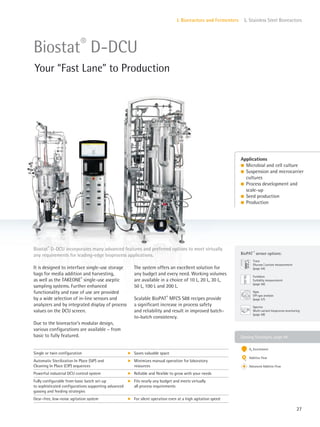
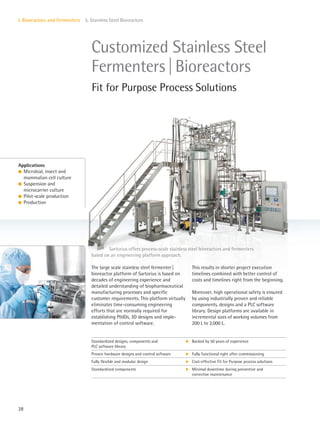
  • 72.
    72 III. Media 1.Cell Culture Media k Leading position in single-use applications that include fluid management, filtration and process analytical technology Inndustry LLeadderr with 50 years of cell ccuulltture experriieennccee k Pioneer in state-of-the-art micronization high-quality powder production processes k Risk minimization approach applied to powder|liquid solutions k ISO certification with successful audit track record following Current Good Manufacturing Practices 21CFR820 k Long-term relationships with dual- sourced raw material suppliers guarantees supply and quality k Excellent regulatory dossier support Experience and Flexibility for Your Cell Culture Needs Experience Highly experienced media specialists will provide guidance on the selection of standard media formulations, as well as development and optimization of custom media. This service includes product specific packaging, documentation and full regulatory support. Flexibility Working in collaboration, Lonza and Sartorius offer a wide array of liquid and powder media products along with the expertise to help scale-up your project from clinical trials up to commercialization. Offered products and services include specially engineered media and buffers for dedicated cell lines and Upstream|Downstream|Fill and Finish unit operations.
  • 73.
    Long-term Collaboration 73 Complete Solution Allliquid media filtered through Sartorius filters; full media qualification package and support k Optimized media filtration and guaranteed successful scale-up and transfer into commercial production Preweighed buffer and media powder in ready-to-use dispensing bags k Simple and straightforward media and buffer preparation with Sartorius FlexAct® MP or mixing solutions Advanced feeding and control strategies using Sartorius ambr® and Biostat® bioreactors, sensors, MFCS supervisory control system and chemometrics tool box k Fast track to optimized culture conditions and yields Sartorius one-stop shop for integrated and optimized solutions for cell line, media and process development and production of cell culture derived products k Full process support allows you to focus on your core tasks and targets Industry leader in batch scalability k Liquid: 1–10,000 L Powder: 7–7,000 kg Dual manufacturing sites k Assurance of supply Wide range of primary and secondary packaging k Excellet fit of your needs Off-the-shelf to fully customized solutions k Titer maximization and assistance throughout your products’ complete life cycle Formulation options include animal origin| non-animal origin serum-free and protein-free media that are fully traceable k Regulatory-friendly solutions Adherent or suspension cultures k Solutions for any type of process
  • 74.
    Automated Media Preparation Cell culture media Sterilizing- Grade Filters Mycoplasma- Retentive Filters Virus Removal Filters UV Virus Inactivation MixingBags Storage Bags 74 III. Media 2. Media Preparation Solutions for Media Preparation Cell culture media are produced in large volumes and aseptically transferred into bioreactors. Key process steps involved in media preparation are the mixing of the powder media with water for injection (WFI), sterilizing-grade and mycoplasma-retentive filtration and media storage before use. Continuous cost pressure, increased titers and reduced production volumes have led to the adoption of single-use technologies – both for bioreactors and media preparation. Sartorius has therefore developed the fully automated, easy-to-use FlexAct® MP system that helps reduce labor-intensive steps to ensure higher productivity. As your leading partner for upstream processing, Sartorius provides you with integrated solutions that comprise cell culture media, bags, sterilizing grade filters, mycoplasma retentive filters and virus risk mitigation tools. Media Filtration Solutions The choice of an appropriate filtration solution for media preparation highly depends on the composition of your cell culture medium. Often, 0.2 μm-rated sterilizing-grade filters are used for media preparation. However, reports of mycoplasma contamination of cell culture processes have put 0.1 μm-rated mycoplasma-retentive filters into the spotlight, again. Typical sources for mycoplasma contamination are animal-derived materials, such as trypsin or serum; plant-derived culture media supplements, such as soy-based supplements; and contamination caused by the operators themselves. Producers of cell culture media have to assess their potential risk for mycoplasma contamination in order to decide which filtration method to use. Sartorius media filtration solutions range from prefilters to sterilizing-grade and mycoplasma-retentive filters – tailored to the specific filtration needs of the various types of cell culture media. Sartorius offers: k Broad portfolio of filters for various media types, including chemically defined or protein, serum or hydrolyzate-supplemented k Safe solutions for mycoplasma risk mitigation; combining high retention efficiency with optimal throughput for cost- effective processing k Prefilter portfolio with optimal protection of final filters to further reduce filtration costs k All media filtration solutions available both for single- use processing and media production in stainless steel equipment k Highest total throughput and economic filtration system design in the industry
  • 75.
    Powder media MixingStorageFiltration 75 Single-Use Media Preparation Today, single-use systems for media preparation are available up to 3,000 L. While users initially converted individual production components to single use, the industry is now moving toward completely integrated systems for media preparation. The Sartorius FlexAct® MP media preparation platform is a highly automated, fully closed system: It starts with powder dissolution in a single-use mixing system, which is followed by sterile filtration and the transfer of the ready-to-use media into a storage bag. To avoid errors, the entire media preparation process is supervised by a multi-functional central control unit. It monitors and records all relevant process data, such as operating pressure, pH, pump speed and fluid level. Sartorius filters and single-use bags are supported by an industry-leading documenta- tion package, which includes validation and extractables guides. Our validation experts will support you throughout qualification of your single-use systems for biopharmaceutical production. k Complete range of single-use bags for media preparation, mixing and storage from 50 L up to 3,000 L k Magnetic mixing technology with universal mobile drive unit k Fully integrated FlexAct® MP media preparation platform k Comprehensive validation support for extractables|leachables by our dedicated CONFIDENCE® validation team Virus Risk Mitigation in Media Preparation Virus risk mitigation in cell culture media preparation is a hot topic. Almost all product contamination over the past several years has been caused by small, non-enveloped viruses derived from raw materials. Technologies such as high-temperature, short-time treatment, UV-C inactivation and virus removal filtration have been employed for virus risk mitigation in cell culture media preparation. UV-C inactivation is also used for virus inactivation of serum and serum- containing media. Virosart filters have been successfully utilized at low flow rates for chemically defined media filtration in continuous perfusion processes. k Broad range of virus removal filters for different media filtration applications k Safe virus inactivation in serum and serum- containing media by UV-C inactivation k Orthogonal and robust technologies prevent contaminations
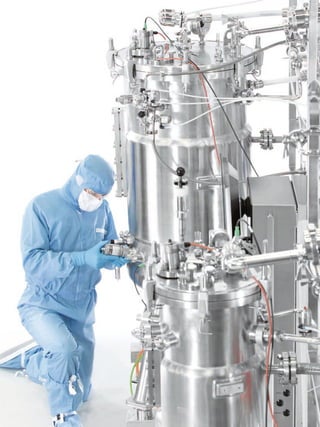
  • 76.
    76 III. Media 2.Media Preparation The system is based on magnetic coupling, e.g., no shaft-through or dynamic seal is used, providing a completely closed mixing assembly. Agitation rates of up to 300 rpm can be reached, allowing highly efficient mixing from 50–3,000 L scale. Flexel® for Magnetic Mixer®1 with its strong magnetic coupling is the ideal solution for: − Powerful dissolution of powder media with high torque and high rotation speed − Effective mixing of highly viscous solutions, such as media and hydrolysate mixtures − Large volumes (up to 3,000 L) Flexel® for Magnetic Mixer®1 is a compact and non-invasive single-use mixing system for manual media dissolution and mixing. Applications l Media|feed preparation l Buffer preparation Flexel® for Mixing Single-Use Media Mixing Solution Cubical shape with front access system and large 8” diameter top port k Bag installation, filling, powder transfer and draining steps easy to perform Baffle-like effect with strong top to bottom flow pattern thanks to the centered impeller in combination with the cubical design k High performance proven from 50–3,000 L Pre-assembled and presterilized single-use sensors for pH, conductivity and temperature k In-line monitoring and control of critical process parameters Palletank® for mixing with heat exchange jacket and integrated weighing functions k Product temperature and volume control Dust-free powder addition via closed addition bag k Protection of operators, meeting current health and safety regulations 1 This product uses Pall patented Magnetic Mixer technology. All information on patents can be found at Pall.com/patents.
  • 77.
    77 III. Media 2.Media Preparation The FlexAct® MP is a standardized configurable system for convenient media preparation in biopharmaceutical processes. The FlexAct® central operation module enables you to control and monitor all relevant process parameters during media preparation. Integrated weighing capabilities permit precise media dissolution using our Magnetic Mixer®1 technology. A fully automated, temperature- controlled pH adjustment is performed via a jacketed Palletank® for mixing and a temperature control unit (TCU). During fluid transfer and sterile filtration, pressure and flow are monitored and controlled to ensure safe operation. Applications l Automatic, contained media preparation FlexAct® MP Configurable Single-Use Solution for Media Preparation Multi-functional central operating module k Operator-friendly Tailored bag configurations k Flexible media supply 50–3,000 L working volume k Fully scalable Quick system set-up k Increased efficiency Integrated disposable sensors (pH, conductivity, temperature) k Reliable monitoring of important parameters Bi-directional operation k Highly flexible 1 Magnetic Mixer® is a trademark of Pall Corporation and this product uses Pall patented Magnetic Mixer® technology. All information on patents can be found at Pall.com/patents.
  • 78.
    78 III. Media 3.Media Sterile Filtration Sartoguard PES contains a PES double layer, available in both 0.1 and 0.2 μm nominal pore size configurations. They are designed for cost-effective prefiltration of chemically defined media. Sartoguard NF is a gamma-irradiatable prefilter which contains a PES double layer covered with a modern PES nanofleece material. Sartoguard GF contains a PES double layer covered with a glass fiber fleece. It effectively protects the filter from clogging, especially when you need to filter serum and hydrolysate supplemented cell culture media. Heterogeneous PES membrane double layer with or without fleece material − provides optimal prefiltration for all types of cell culture media − protects subsequent sterile filters and extend filtration capacity The Sartoguard family consisting of PES, GF and NF versions are all designed to extend the lifetime of Sartopore® 2 XL final filters by a factor of 3 to 4 – for cost-effective cell culture media prefiltration. Sartoguard filters provide the most cost-effective solutions to ensure your final filter achieves the highest throughput. Applications l Prefiltration of cell culture media l Protection of Sartopore® 2 XL final filters Sartoguard Prefilter Family Optimal Protection for Sartopore® 2 XL Filter Elements Sartoguard prefilter family k Protects subsequent sterile filters and extend filtration capacity Sartoguard PES k For prefiltration of chemically defined media Sartoguard NF k For prefiltration of serum-free media with higher tendency of clogging final filter Sartoguard GF k For prefiltration of complex media containing serum or hydrolysates
  • 79.
    79 III. Media 3.Media Sterile Filtration Applications l Sterilizing-grade filtration and mycoplasma-retentive filtration of cell culture media l Sartopore® 2 XLG (0.35|0.2 μm) designed for complex, serum or hydrolyzate supplemented media l Sartopore® 2 XLI (0.8|0.2 μm) designed for chemically defined media l Sartorpore® 2 XLM (0.2|0.1 μm) designed for mycoplasma retention (0.1 μm) The unique range of PES double-layer membrane combinations perfectly serves the different cell culture media requirements. Sartopore® 2 XLM filters use double-layer PES membranes with pore size combination of 0.2|0.1 μm for reliable mycoplasma retention with an LRV of 7/cm2 filtration area. They have additionally been validated for sterilizing grade filtration according to ASTM F 838-05. Sartopore® 2 XL ensures unmatched filtration performance along with the highest microbial safety. The Sartopore® 2 XL filter family is the best choice for sterilizing-grade filtration and mycoplasma-retentive filtration of cell culture media. Sartopore® 2 XL Filter Family Best Filtration Solutions for Cell Culture Media Unique combination of different pre- and final filter membranes k Ensures highly economic filter sizing and minimum filtration costs for all kinds of media Low unspecific protein binding k Excellent and reproducible cell growth Reliable retention of mycoplasma by Sartopore® 2 XLM 0.1 μm k Prevents mycoplasma contamination of your cell culture process Available in a broad range of sizes and formats to provide linear scale-up from development to commercial-scale production k Identical filtration performance at all scale-up levels of your media preparation process
  • 80.
    80 III. Media 3.Media Sterile Filtration Which Filter Solution Best Fits Your Needs? Todays industrial cell culture media formulations can be very different, from serum and hydrolyzate supplemented to chemically defined media. Based on our long standing experience in media filtration, we can recommend the best filter solution for your needs. Our international team of application specialists help you optimize your specific filtration process – just contact us today. Serum, soy or yeast hydrolyzate- supplemented cell culture media Chemically defined cell culture media Serum or hydrolyzate- supplemented media Sartoguard GF Glass fiber fleece| 0.2 μm Sartoguard NF Nanofleece | 0.2 μm Sartoguard GF Glass fiber fleece| 0.2 μm Sartopore® 2 XLG 0.8 μm|0.2 μm Sartopore® 2 XLI 0.35 μm|0.2 μm Sartopore® 2 XLM 0.2 μm|0.1 μm Characteristics Media Type Complex additives with a a broad molecular weight distribution and potential kolloid and particle load Might contain recombinant protein additives, such as insulin, transferin or other growth factors Potential mycoplasma contamination risk Final Filter Options Prefilter Options
  • 81.
    81 III. Media 3.Media Sterile Filtration The Sartocheck® filter integrity tester reliably identifies whether your sterilizing-grade filters used in processes are actually intact – both before and after use. Applications l Filter integrity testing Sartocheck® 4 Plus Filter Tester The Best-Selling Integrity Tester Worldwide Sartocheck® automated filter integrity tests are quick and easy to perform. A barcode scanner ensures user-friendly and error-proof selection of the appropriate pre-programmed filter test sequences. You can choose to print out test results or export test data for GMP-compliant documentation. Automatic detection of operator mistakes, such as incorrect test set-up, ensures error-proof performance of filter integrity testing. Automatic detection of incorrect set-ups k Mitigates operator mistakes Easy program selection with barcode scanner k Prevents operator errors Optimized backflow prevention via external valve k Avoids cross-contamination Patented cleaning function k Allows decontamination of internal pneumatics Robust technology k Minimizes downtime
  • 82.
    82 III. Media 4.Media Virus Risk Mitigation Sartorius’ robust virus removal technology has been proven throughout the industry as providing the highest safety for your cell culture without impacting their performance. All Sartorius virus-retentive filters reliably and robustly provide > 4 LRV for small non-enveloped viruses over the entire flow decay profile. Virus-retentive filtration is a highly efficient method for viral risk mitigation of cell culture media as these filters target both non-enveloped viruses, such as MVM and PPV, and large enveloped viruses, such as MLV. Virosart® Viral Risk Mitigation of Cell Culture Media Applications l Viral risk mitigation of chemically defined media l Viral risk mitigation of perfusion media feeds l Sterile media Robust performance over a wide range of flow rates and process conditions k The highest possible safety High-performance PES membranes k k Capacity to 10,000 L/m2 achieved for in-line virus-retentive filtration in perfusion cultures No impact on cell culture performance Integrity testing with Sartocheck® 4 Plus Filter Tester (based on diffusion) k Easy, safe, fast, cost-effective
  • 83.
    83 III. Media 4.Media Virus Risk Mitigation Applications l Serum virus inactivation l Virus inactivation of serum- containing media l Virus inactivation of heat- sensitive components Difficult-to-filter and heat-instable media components like serum can be safely inacti- vated by UV-C (254 nm) without impacting cell growth or cell viability. Even highly turbid media or serum can be easily exposed to the UV source without any risk of blocking the flow path. Small, non-enveloped viruses like MVM show good clearance of 6 LRV already at low doses of around 100–150 J/m2 while maintaining cell growth performance. Virus inactivation by UV-C irradiation is a highly efficient technology that specifically targets small, non-enveloped viruses (e.g., PPV, MVM) at low doses. UVivatec® Virus Inactivation Based on UV-C Irradiation Inactivation based on UV-C (254 nm) irradiation k Especially effective for small, non-enveloped viruses (e.g., MVM) Novel helical module with optimized hydrodynamic design k k k Uniform irradiation through efficient radial mixing based on Dean vortices Narrow residence time distribution Effective inactivation at low doses Single-use module concept k k Quick and easy to install and maintain Easy to scale
  • 84.
    84 III. Media 5.Media and Feed Storage Multiple configurations, with a broad range of tubing including thermoweldable TPE tubing, are provided to give you maximum process flexibility. Flexboy® bags are available in bag chamber volumes between 5 mL and 50 L. They are supplied sterilized and are ready-to-use. Flexboy® bags are designed for preparation, storage and transport of media, feed and additives, intermediates and final bulk. They provide a single-use alternative to conventional glass, stainless steel and rigid plastic carboys in a large variety of applications. Applications l Media and feed container l Bulk harvest l Sample collection l Buffer, supplement and additive container Flexboy® Bags The Original Single-Use Bioprocessing Bag Multiple manufacturing sites k High assurance of supply 100% integrity testing of bag and intermediate connections k Process safety and integrity All connections extensively qualified k Safe and robust Full compliance with ISO11137 k The highest sterility assurance level Standardized designs k Most designs available from stock
  • 85.
    85 III. Media 5.Media and Feed Storage The tray and rack systems are available in a choice of ten times 5 L to 20 L and five times 50 L. These systems provide you with an easy and safe solution for dispensing and aliquotation of media and bulk harvest. The Flexboy® tray and rack systems are designed to facilitate handling of both individual and manifold Flexboy® single-use bioprocessing bags (5–50 L) within biopharmaceutical manufacturing processes. Applications l Buffer and media dispensing and storage l Bulk harvest dispensing and storage Flexboy® Tray and Rack System Easy and Safe Dispensing of Media and Feed Solutions Integrated wheels k Facilitate maneuverability Modular rack accommodates up to 20 trays k Flexible Dedicated area for storage k Easy-to-use
  • 86.
    86 III. Media 5.Media and Feed Storage These aseptic bags are made of S40 film, supplied pre-assembled with tubes, clamps, filters, sensors and connectors, and are presterilized and ready-to-use in standard, configurable and customized configurations. Flexel® 3D bioprocessing bag range offers robust, reliable and sterile single-use solutions for processing, storage and transportation of large-volume biopharmaceutical fluids. They provide you with a safe, cost-effective alternative to conventional stainless steel vessels. Flexel® 3D bioprocessing bags ranging from 5–3,000 L are three-dimensional single-use bags. Applications l Buffer storage l Media storage l Bulk harvest storage Flexel® Bags 3D Bioprocessing Bags for Palletank® Multi-layer film k Strong structure with low gas permeability, high chemical resistance and high cleanliness Identical film material used for all volumes k Scale up from 5–3,000 L Extensive standard range available off the shelf k Short delivery timelines Multiple design options available in our Configurator k Instant quote, flexible design and fast delivery time Integrity testing available up to 200 L k Enhanced quality assurance for critical applications Flexel® validation guide and extractables guide k Facilitated validation and regulatory approval
  • 87.
    87 III. Media 5.Media and Feed Storage Our range of movable and stationary Palletank® is perfectly matched to accommodate our array of Flexel® 3D bags. Palletank® and Flexel® 3D bags for in-process fluid handling are available in 200 L, 500 L, 1,000 L, 1,500 L, 2,000 L, 2,500 L and 3,000 L volumes. Applications l In-process intermediate and bulk product hold l Storage and distribution of media and buffers l Solution distribution in Flexel® 3D bag manifold l Waste collection l Feed and harvest from bioreactor Palletank® for Flexel® 3D Bags In-Process Fluid Handling Continuous processing without movement of the containers k Easy operation Double-hinged front door with safety latches k Easy access Lifting system for large-size containers k Optimal bag unfolding and filling The Flexel® 3D bags are manufactured according to a patented design that precisely fits the Palletank® .
  • 88.
  • 89.
  • 90.
    90 IV. Fluid Management1. Fluid Transfer Sartorius single-use transfer sets are gamma- irradiated and ready-to-use. They are widely utilized to securely connect different single- use and reusable containers to give you the flexibility you need: opt for using quick connectors or TPE tubing and tube welding. These transfer sets can be easily designed to adapt and connect media bags to bioreactors, as well as bioreactors to bags for collection of harvested cells – whichever you prefer. Further enhance your single-use transfer options by using our transfer sets equipped with different types of filters and single-use sensors, e.g., for flow and pressure. Create your process-specific transfer line for particle removal, bioburden reduction or sterile filtration. Applications l Transfer of inoculum from Flexboy® bags to RM or STR bags l Transfer between single-use and stainless steel systems using a steam-through connector l Liquid transfer and simulta- neous particle reduction or sterile filtration l Liquid transfer under flow- or pressure-controlled conditions Single-use transfer sets can be configured for any liquid transfer application in upstream using silicone or TPE tubing to provide maximum flexibility. Transfer Sets, Filter Lines and Sensor Lines Fluid Transfer Solutions Gamma sterilized k Ready-to-use Connection assembly qualified k Robust connection Large variety of components qualified Available with different types of filters and single-use sensors k Highly flexible design to match process requirements
  • 91.
    91 IV. Fluid Management1. Fluid Transfer Applications l Media and buffer transfer l Creation of filtration assemblies l Bioreactor fluid transfer TuFlux® SIL is available today in seven different dimensions from 8” (3.2 mm) to 3” (19.1 mm) inner diameter and a wall thickness from 1.6 to 4.8 mm. TuFlux® SIL is a highly resistant platinum- cured silicone tubing manufactured by Raumedic. TuFlux® SIL is designed for fluid transfer in biopharmaceutical manufacturing processes. TuFlux® SIL Silicone Tubing High-Purity, Platinum-Cured Silicone Tubing Platinum-cured silicone k Compatible with weak acids and bases; extraordinarily resistant to heat and cold Translucent k Visibility of fluid inside Shore hardness A 60 k Excellent rupture strength in peristaltic pumps and reduced kink effect Inner and outer diameter dimensions printed on the tubing k Facilitates tubing identification “Low-tack” significantly reduced surface friction k Easy to handle when you are wearing gloves Coils wrapped in double PE-bags k Tubing protected and easy to introduce in cleanrooms Low extractable profile and unique validation guide for TuFlux® SIL available k Fast validation of TuFlux® SIL in your process
  • 92.
    92 IV. Fluid Management1. Fluid Transfer The innovative technology allows flexible, leakfree connection of bioreactor bags with media or feed bags or any other connection of disposable bags in a sterile welding operation outside a class A or B environment. Featuring a new, compact design, this device makes it easy for you to make sterile connections of liquid-filled tubing with up to 1-inch outer diameters. BioWelder® TC is now also available for small diameter tubing down to 4-inch outer diameter. Applications l Automated sterile connection of single-use assemblies l Connection of media bag to bioreactor for feeding applications l Sequential weldings are possible on the same TPE tubing section l Sampling from media bag or bioreactor The BioWelder® TC is a fully automated device for connecting thermoplastic tubing in a contained way outside a laminar airflow hood. BioWelder® TC Automated Connection of TPE Tubing Liquid-filled tubing from 4” to 1” outer diameters (8” to 3” inner diameters) k Flexible device and robust technology Fully automated device k Easy-to-use, reliable process Standard programs k Ready-to-use for other tubing Extensively qualified k Safe and robust connections Short welding time k Fast connections
  • 93.
    93 IV. Fluid Management1. Fluid Transfer There is no need of any laminar flow cabinet or similar environment to disconnect tubes aseptically from disposable bag assemblies. The BioSealer® is a fully automated device designed to produce permanent and consistent, leak-free seals on thermoplastic tubing. Applications l Sterile disconnection using TPE tubing l Sterile disconnection of media and feed bags l Sterile disconnection of Flexsafe® RM bags after inoculum transfer l Any type of sterile disconnection, e.g., of sample BioSealer® Automated Disconnection of TPE Tubing Seals tubing between 4–3” outer diameters k Automated and reproducible disconnection Sealing times between 1 and 4 minutes k Ready to start immediately Programmable for several thermoplastic tubing k Easy adaption to various space requirements due to removable sealing head
  • 94.
    94 IV. Fluid Management1. Fluid Transfer Opta® SFT sterile connectors are validated to connect gamma-irradiated bags, such as Flexsafe® STR bags, to autoclaved assemblies, such as venting lines. Opta® SFT sterile connectors are quick and easy-to-use. They are backed by extensive validation and 100% in-house integrity testing. You can purchase Opta® SFT sterile connectors either individually to assemble your own set or as pre-installed units on any Sartorius single-use assembly (media bag or Flexsafe® RM and Flexsafe® STR bags). Applications l Sterile connection of media bag to bioreactors l Sterile connection of venting line to Cultibag® or Flexsafe® STR bags l Sterile connection of inoculum to Flexsafe® RM bags Opta® SFT sterile connectors create a sterile fluid path between two pre-sterilized components in both classified and non-classified production environments. Opta® SFT Mechanical Connection of Silicone Tubing Male and female connector couplings sealed with sterilizing-grade membrane k Sterile fluid transfer in non-classified and classified environments Sterilizable by gamma irradiation and autoclave k Flexible implementation of hybrid single-use and reusable equipment 100% integrity tested k The highest security Three-step operation k Easy, robust, repeatable operations Hose barb connections intensively qualified k Safe and secure tubing connections
  • 95.
    95 IV. Fluid Management1. Fluid Transfer Safe and quick, the Clipster® disconnector is a hand-held tool that ensures easy and aseptic disconnection in any environment. The Clipster® aseptic disconnector is available as a stand-alone product or pre-assembled on single-use assemblies, such as media bags and transfer sets. The Clipster® aseptic disconnector is a single-use device designed to perform aseptic disconnections of tubing. Applications l Sterile disconnection of media bag after feeding l Sterile disconnection of RM bags after inoculum transfer l Sterile disconnection of sample bag or containers Clipster® Aseptic Disconnectors Mechanical Disconnection of Silicone Tubing Mechanical disconnection, can be performed on silicon tubing and TPE tubing k Flexible disconnection approach Error-proof design and hand-held tool for safe disconnection, four-step operation k Easy, quick, robust and reliable Extensively qualified k Safe and robust Available for Flexboy® , Flexel® , transfer sets|lines and as an option on Flexsafe® STR bags k Flexible application Three Clipster® sizes k Compatible with five tubing diameter sizes (from 8” to 1” inner diameter tubing as standard)
  • 96.
    96 1. Test Kitsfor Mycoplasma, Bioburden and Sterility 98 2. Automatic Dispensing of Banks, Samples and Standards 101
  • 97.
  • 98.
    98 V. Quality Control1. Test Kits for Mycoplasma, Bioburden and Sterility If you perform a prior enrichment step using the Sartorius Vivaspin® 6 or Vivaspin® 20 ultrafiltration devices, you can be flexible about choosing a testing volume for DNA extraction. With this concentration step you have the option of analyzing a testing volume from 200 μL to 18 mL, which will provide you with highest sensitivity. The kit contains all essential components and is validated according to EP 2.6.7. The earlier you detect mycoplasma conta- mination, the higher your long-term savings. Early detection means more time to react, saving you valuable time and considerable expense. The Microsart® AMP Mycoplasma test kit offers a fast and easy-to-use solution for early detection at all stages of your process, whether you are screening in the lab or testing in your GMP production plant. Applications l Mycoplasma contamination control for in-process or lot release testing l Detection of mollicutes in cell culture, cell culture media components and derived biologicals Microsart® AMP Mycoplasma detection kits reduce your testing time from weeks to just three hours. Microsart® AMP Mycoplasma Rapid Real-time PCR Mycoplasma Detection Kit Flexible sample volume from 200 μL to 18 mL k The level of security can be adapted to your needs Microsart® AMP mycoplasma is based on real-time PCR technology k Easy-to-use and fast: results within hours – not days! Microsart® AMP mycoplasma is validated according to EP guidelines k Easy implementation for regulated in-process and lot release testing
  • 99.
    99 V. Quality Control1. Test Kits for Mycoplasma, Bioburden and Sterility For this purpose, the pumps can either be operated in a clean bench or installed countersunk in the working surface of isolators. Closed and ready-to-use Sterisart NF consumables minimize the risk of false-positive results. For (re)-validation, stasis testing, dilution and analysis of microbes, special septum versions are available. The Sterisart universal pumps are specially designed for media and liquid transfer in cleanroom environments A, B and C and can also be used for transfer to the Flexboy® bags. Two pump versions are available: one basic version and one upgraded with display and an integrated barcode scanner for convenient traceability of the equipment you use. In combination with Sterisart NF consumables, sterility testing can be performed according to international pharmacopeia requirements (USP<71> and Eu. Ph. 2.6.1). Sterisart universal pump and consumables help ensure full compliance with international GMP guidelines in your microbial monitoring and batch release procedures for intermediates and drug substance. Applications l Sample and media transfer to Sterisart NF consumables for sterility testing l Reliable media and buffer transfer into Flexboy® bags Sterisart For Sterility Testing in Pharma|Biotech No ventilation and no particle release k The highest safety and reliability Foot switch available k Convenient operation Integrated barcode scanner k Easy traceability of every batch More than 20 different Sterisart NF consumables k High flexibility Unique septum for aseptic sampling k Minimized risk of getting a secondary contamination
  • 100.
    100 V. Quality Control1. Test Kits for Mycoplasma, Bioburden and Sterility The innovative active lid of Microsart® @media allows touch-free membrane transfer from the base of Microsart® @filter filtration unit and thus reduces the risk of secondary contamination to an absolute minimum. The media dishes together with the filtration units introduce are a brand-new membrane transfer and agar concept for microbial limit testing. The method is based on the concentration of organisms on the surface of a membrane filter and their subsequent cultivation on nutrient agar media. Applications l Innovative membrane transfer concept for microbial enumeration l Enhance the safety of microbiological quality control l For microbial limit testing according to USP (Chapter <61>) and EP (Chapter 2.6.12) l For final quality control and release of non-sterile products Microsart® @media are dishes pre-filled with different types of agar media, sterile-packaged and ready-to-use together with the single-use filtration unit Microsart® @filter. Microsart® @media Touch-free Membrane Transfer Concept for Microbial Enumeration Touch-free membrane transfer k Minimizes the risk of secondary contamination; outstanding recovery rates and reliable results Easy, fast and reliable transfer of the membrane filter onto the agar dish k Cost and time savings; accurate results Ready-to-use k Preparation- and sterilization-free procedure accelerates workflow Liftable lid inside exterior lid eliminates the need to open the complete dish k Easy access to colonies for further analysis with minimum risk of secondary contamination
  • 101.
    101 V. Quality Control2. Automatic Dispensing of Banks, Samples and Standards or other downstream activities. It is a proven system designed for easy installation on a laboratory bench or in a standard biosafety cabinet. The system works with racks of branded 0.5–5.0 mL cryovials in 24-way, 48-way and 96-way formats. The Fill-it system decaps all cryovials simultaneously and then dispenses cells, strains or liquids into the cryovials before recapping, ready for transfer to freezers Fill-it is an automated benchtop system for creating high-quality cell and strain banks in cryovials. Applications l GMP cell banking l Cell banking for discovery purposes l Strain banking under GMP and non-GMP requirements l GMP liquid aliquotation Fill-it Automated Cell and Strain Banking System High-throughput system unlike slow manual processing k Permits processing of relatively large batches, significantly reducing QC costs and increasing productivity Automated dispense module with peristaltic pump and an aseptic single-use tube set certified for compliance with GMP k High-throughput aseptic transfer of cell, strains and liquids improves product consistency and reduces the risk of contamination Validatable IQ|OQ processes for GMP k Supports clinical development, regulatory approval and manufacture of biologics System has a simple three-button user interface and fits on a laboratory bench or in a standard biosafety cabinet k Easy-to-use flexible system with small footprint designed to fit in any laboratory Automated decap|recap module k Reduces risk of repetitive strain injury compared with manual processing
  • 102.
    102 1. Dynamic BodyFeed Filtration 104 2. Post Cell Harvest Filtration 105
  • 103.
  • 104.
    104 VI. Clarification 1.Dynamic Body Feed Filtration Sartoclear Dynamics® is based on the principles of body feed filtration and uses highly purified diatomaceous earth as a filter aid. The addition of the porous diatomaceous earth keeps the filter cake on the filters permeable for fluids. This enables a continued filtration until the Sartoclear Dynamics® cassettes are com- pletely full. The result is a highly efficient and constant clarification performance in a single step. Sartoclear Dynamics® is a new single-use technology developed for the clarification of high cell density animal cell culture. Robustness, ease of use and scalability are key characteristics of this technology. Applications l Clarification of high cell density fed-batch cultures Sartoclear Dynamics® Single-Use Clarification of High Cell Density Cultures Single-use technologies for high cell densities k Avoids high investment costs for centrifuges Insensitive to viability changes k Prevents oversizing of filtration area and makes process development predictable Amazingly fast k Saves time and reduces the exposure time to proteases
  • 105.
    105 VI. Clarification 2.Post Cell Harvest Filtration Sartopure® Sartopure® utilizes unique polypropylene fleeces or highly adsorptive glass fiber filter materials to provide the highest particle removal capacity and superior turbidity reduction. Sartoguard Sartoguard prefilters can significantly downsize your process and reduce your total filtration costs. You will benefit from high performance asymmetric double layer PES membranes offering optimal protection of sterile filters and validated bioburden reduction. Sartopore® Sartopore® 2 provides the broadest range of membrane combinations. Match one of our Sartopore® 2 filters to your solution to get the highest possible capacity. Complete your cell removal process. Any remaining debris is effectively removed by subsequent filtration steps. Different membrane and fleece filters or combinations are available. Applications Filtration post-cell removal: l Particle removal l Bioburden reduction l Sterile filtration Sartopure® |Sartoguard| Sartopore® Most Economic Solutions for Post-Cell Removal Filtration
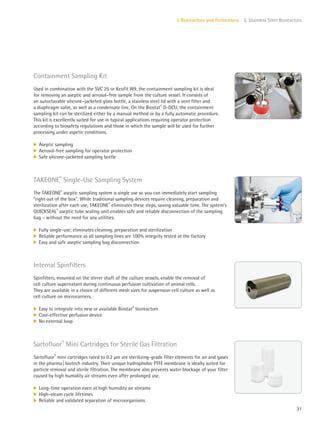
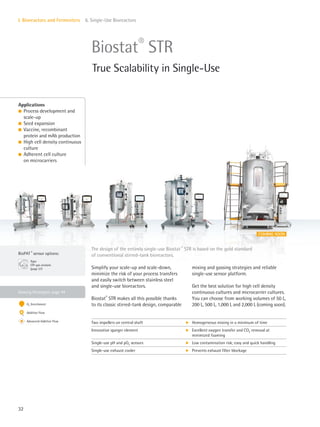
  • 106.
    106 Downstream Process Overview OurSolutions for Your Downstream Processing Needs Sartorius offers a wide range of process solutions for purification of monoclonal antibodies, recombinant proteins, vaccines and antibody drug conjugates. SCADA system, process automation and chemometrics toolbox Concentration|Diafiltration l Crossflow systems and cassettes Capture l Membrane adsorption chromatography solutions Harvest Process Development Process Development l Benchtop crossflow systems and cassettes l Membrane adsorption chromatography solutions (scale-down devices) l Dynamic body feed filtration l Crossflow filtration l Depth filters Buffers l Platform system for buffer preparation l Bags for mixing and storage l Ready-made liquid buffers in bottles and bags
  • 107.
    107 Polishing l Membrane adsorption chromatography solutions lPlatform system for low pH virus inactivation l Virus retention filters l UV-C virus inactivation Virus Clearance Bulk Drug Substance Preparation l Crossflow systems and cassettes l Freeze-thaw bags l Controlled freeze-thaw solutions l Sterile filters and integrity testers Process Development l Membrane adsorption chromatography solutions (scale-down devices) Process Development l Virus retention filters (scale-down devices) l UV-C virus inactivation Process Development l Freeze-thaw solutions l Benchtop crossflow systems and cassettes Pre- and sterile filters, bags for mixing and storage, tubings, connectors, disconnectors
  • 108.
    Sales and ServiceContacts For further contacts, visit www.sartorius-stedim.com Europe Germany Sartorius Stedim Biotech GmbH August-Spindler-Strasse 11 37079 Goettingen Phone +49.551.308.0 Fax +49.551.308.3289 Sartorius Stedim Systems GmbH Robert-Bosch-Strasse 5–7 34302 Guxhagen Phone +49.5665.407.0 Fax +49.5665.407.2200 France Sartorius Stedim FMT S.A.S. ZI des Paluds Avenue de Jouques – CS 91051 13781 Aubagne Cedex Phone +33.442.845600 Fax +33.442.845619 Sartorius Stedim France SAS ZI des Paluds Avenue de Jouques – CS 71058 13781 Aubagne Cedex Phone +33.442.845600 Fax +33.442.846545 Austria Sartorius Stedim Austria GmbH Modecenterstrasse 22 1030 Vienna Phone +43.1.7965763.18 Fax +43.1.796576344 Belgium Sartorius Stedim Belgium N.V. Leuvensesteenweg, 248/B 1800 Vilvoorde Phone +32.2.756.06.80 Fax +32.2.756.06.81 Hungary Sartorius Stedim Hungária Kft. Kagyló u. 5 2092 Budakeszi Phone +36.23.457.227 Fax +36.23.457.147 Italy Sartorius Stedim Italy S.p.A. Via dell’Antella, 76/A 50012 Antella-Bagno a Ripoli (FI) Phone +39.055.63.40.41 Fax +39.055.63.40.526 Netherlands Sartorius Stedim Netherlands B.V. Phone +31.30.60.25.080 Fax +31.30.60.25.099 filtratie.nederland@sartorius-stedim.com Poland Sartorius Stedim Poland Sp. z o.o. ul. Wrzesinska 70 62-025 Kostrzyn Phone +48.61.647.38.40 Fax +48.61.879.25.04 Russian Federation LLC “Sartorius ICR”and LLC “Biohit” Uralskaya str. 4, Lit. B 199155, Saint-Petersburg Phone +7.812.327.5.327 Fax +7.812.327.5.323 Spain Sartorius Stedim Spain, S.A.U. Avda. de la Industria, 32 Edificio PAYMA 28108 Alcobendas (Madrid) Phone +34.902.110.935 Fax +34.91.358.96.23 Switzerland Sartorius Stedim Switzerland AG Ringstrasse 24 a 8317 Tagelswangen Phone +41.52.354.36.36 Fax +41.52.354.36.46 U.K. Sartorius Stedim UK Ltd. Longmead Business Centre Blenheim Road, Epsom Surrey KT19 9 QQ Phone +44.1372.737159 Fax +44.1372.726171 Ukraine LLC “Biohit” Post Box 440 “B” 01001 Kiev, Ukraine Phone +380.44.411.4918 Fax +380.50.623.3162 America USA Sartorius Stedim North America Inc. 5 Orville Drive, Suite 200 Bohemia, NY 11716 Toll-Free +1.800.368.7178 Fax +1.631.254.4253 Argentina Sartorius Argentina S.A. Int. A. Ávalos 4251 B1605ECS Munro Buenos Aires Phone +54.11.4721.0505 Fax +54.11.4762.2333 Brazil Sartorius do Brasil Ltda Avenida Senador Vergueiro 2962 São Bernardo do Campo CEP 09600-000 - SP- Brasil Phone +55.11.4362.8900 Fax + 55.11.4362.8901 Mexico Sartorius de México S.A. de C.V. Circuito Circunvalación Poniente No. 149 Ciudad Satélite 53100, Estado de México México Phone +52.5555.62.1102 Fax +52.5555.62.2942 Asia|Pacific Australia Sartorius Stedim Australia Pty. Ltd. Unit 5, 7-11 Rodeo Drive Dandenong South Vic 3175 Phone +61.3.8762.1800 Fax +61.3.8762.1828 China Sartorius Stedim Biotech (Beijing) Co. Ltd. No. 33 Yu’an Road Airport Industrial Park Zone B Shunyi District, Beijing 101300 Phone +86.10.80426516 Fax +86.10.80426580 Sartorius Stedim (Shanghai) Trading Co. Ltd 3rd Floor, North Wing, Tower 1 No. 4560 Jinke Road Zhangjiang Hi-Tech Park Pudong District Shanghai 201210, China Phone +86.21.68782300 Fax +86.21.68782332|68782882 Sartorius Stedim Biotech (Beijing) Co. Ltd. Guangzhou Representative Office Unit K, Building 23 Huihua Commerce & Trade Building No. 80 Xianlie Middle Road Guangzhou 510070 Phone +86.20.37618687|37618651 Fax +86.20.37619051 India Sartorius Stedim India Pvt. Ltd. #69/2-69/3, NH 48, Jakkasandra Nelamangala Tq 562 123 Bangalore, India Phone +91.80.4350.5250 Fax +91.80.4350.5253 Japan Sartorius Stedim Japan K.K. 4th Fl., Daiwa Shinagawa North Bldg. 8-11, Kita-Shinagawa 1-chome Shinagawa-ku, Tokyo, 140-0001 Japan Phone +81.3.4331.4300 Fax +81.3.4331.4301 Malaysia Sartorius Stedim Malaysia Sdn. Bhd. Lot L3-E-3B, Enterprise 4 Technology Park Malaysia Bukit Jalil 57000 Kuala Lumpur, Malaysia Phone +60.3.8996.0622 Fax +60.3.8996.0755 Singapore Sartorius Stedim Singapore Pte. Ltd. 1 Science Park Road, The Capricorn, #05-08A, Singapore Science Park II Singapore 117528 Phone +65.6872.3966 Fax +65.6778.2494 South Korea Sartorius Korea Biotech Co., Ltd. 8th Floor, Solid Space B/D, PanGyoYeok-Ro 220, BunDang-Gu SeongNam-Si, GyeongGi-Do, 463-400 Phone +82.31.622.5700 Fax +82.31.622.5799 www.sartorius-stedim.com Specificationssubjecttochangewithoutnotice.PrintedintheEUonpaperbleachedwithoutchlorine.|W PublicationNo.:S--1526-e150501·OrderNo.:85037-541-65·Ver.05|2015