Presented by
Vulavala Venkatesh
(2KE14EE050)
Under the Guidance of
Prof. Shivayogi S.S
Department of Electrical & Electronics Engineering.
K. L. E. Society’s
K. L. E. Institute of Technology, Hubballi-30
A
SEMINAR ON
ELECTRIC AND HYBRID VEHICLE ARCHITECTURE
1DEPT. OF EEE, KLEIT, HUBBALLI
CONTENTS
• INTRODUCTION
• BASIC COMPONENTS
• ARCHITECTURE
• A COMPARITIVE STUDY
• ADVANTAGES AND CHALLENGES
• CONCLUSION
• REFERENCES
DEPT. OF EEE, KLEIT, HUBBALLI 2
•WHAT ARE EV’s?
•WHAT ARE HEV’s?
•NECESSITIES
INTRODUCTION LITERATURE SURVEY
•Modern Electric Vehicle
Technology
•Power Electronics and Motor
Drives in Electric, Hybrid Electric,
and Plug-In Hybrid Electric Vehicles
•A Comparison of Electric Vehicles
and Conventional Automobiles:
Costs and Quality Perspective
DEPT. OF EEE, KLEIT, HUBBALLI 3
BASIC COMPONENTS
•BATTERY PACK
•ELECTRIC MOTORS [EM]
Fig.1 Battery Management System (BMS)
Fig. 2 Permanent Magnet Synchronous Motor UsingDEPT. OF EEE, KLEIT, HUBBALLI 4
BASIC COMPONENTS
•ELECTRIC POWERTRAIN
•INFORMATION SYSTEMS
Fig.3 A basic electric powertrain of a full electric vehicle
DEPT. OF EEE, KLEIT, HUBBALLI 5
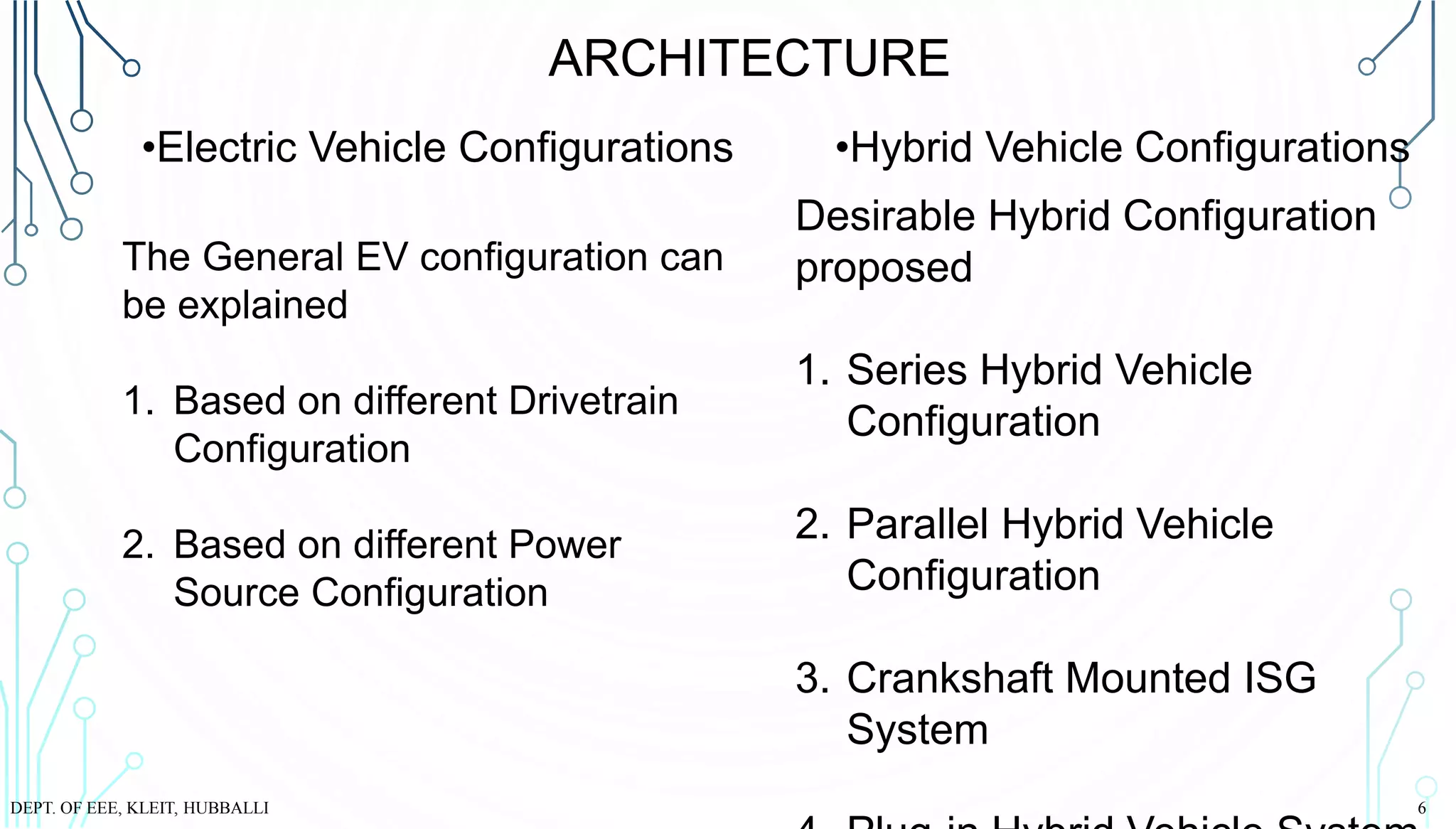
ARCHITECTURE
•Electric Vehicle Configurations •Hybrid Vehicle Configurations
The General EV configuration can
be explained
1. Based on different Drivetrain
Configuration
2. Based on different Power
Source Configuration
Desirable Hybrid Configuration
proposed
1. Series Hybrid Vehicle
Configuration
2. Parallel Hybrid Vehicle
Configuration
3. Crankshaft Mounted ISG
System
DEPT. OF EEE, KLEIT, HUBBALLI 6
CONFIGURATION OF A ELECTRIC VEHICLE
Fig.4 General Configuration Of Electric Motors
DEPT. OF EEE, KLEIT, HUBBALLI 7
EV Drivetrain Alternatives Based on Drivetrain
Configuration
1 2
3 4
5 6
Fig.5 Based on Drivetrain ConfigurationDEPT. OF EEE, KLEIT, HUBBALLI 8
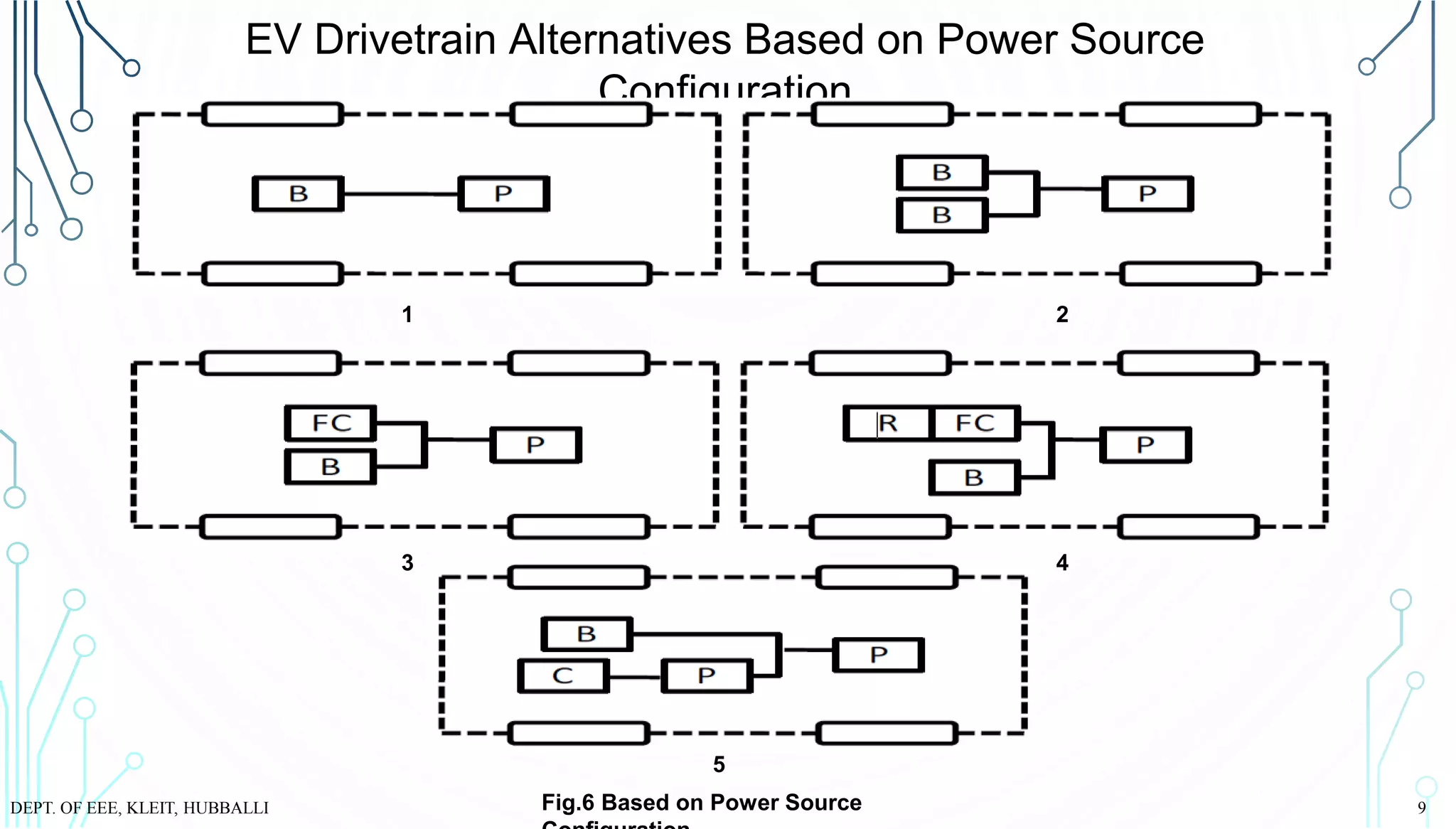
EV Drivetrain Alternatives Based on Power Source
Configuration
1 2
3 4
5
Fig.6 Based on Power SourceDEPT. OF EEE, KLEIT, HUBBALLI 9
HYBRID VEHICLE ARCHITECTURES
Architecture of Series Hybrid Vehicles
Fig.10 Series hybrid vehicle propulsion system
DEPT. OF EEE, KLEIT, HUBBALLI 10
Architecture of Parallel Hybrid Vehicles
Fig.11 Parallel hybrid vehicle propulsion system
DEPT. OF EEE, KLEIT, HUBBALLI 11
•Crankshaft-Mounted ISG System
Architecture of Plug-in Hybrid Electric Vehicle
Fig.12 Plug-in hybrid electric vehicle (parallel configuration).
DEPT. OF EEE, KLEIT, HUBBALLI 12
Battery Electric
EVs
(Ford Focus Electric)
Plug-In Hybrid
EVs
(Audi A3 e-tron)
ICE vehicles
(Volkswagen Golf GTI)
Purchase costs German MSRP
2017
34,900 EUR
(2802908.17 Indian Rupee)
German MSRP
2017
36,900 EUR
(2963533.28 Indian
Rupee)
German MSRP
2017
33,800 EUR
(2714564.36 Indian
Rupee)
Fuel costs Consumption of Gas -
Consumption of Electricity- 15-4 kWh/100km
Yearly fuel
expenditure in
Germany
323.40 EUR
(25973.08 Indian
Rupee)
Consumption of Gas –
1.7 l/100km
Consumption of Electricity- 11.5 kWh/100km
Yearly fuel
expenditure in
Germany
354.45 EUR+ 241.50 EUR
= 595.95 EUR
(47862.27 Indian
Rupee)
Consumption of Gas –
6-4 l/100km
Consumption of Electricity-
Yearly fuel
expenditure in
Germany
1334.40 EUR
(107169.07 Indian
Rupee)
Quality and materials
rating 2 (average) 3 (above average) 3 (above average)
Pleasure of ride 1 (under average) 2 (average) 3 (above average)
Everyday-usage
experience 1 (under average) 3 (above average) 2 (average)
Final rating 2.00(average) 3.00(above average) 2.67(average)
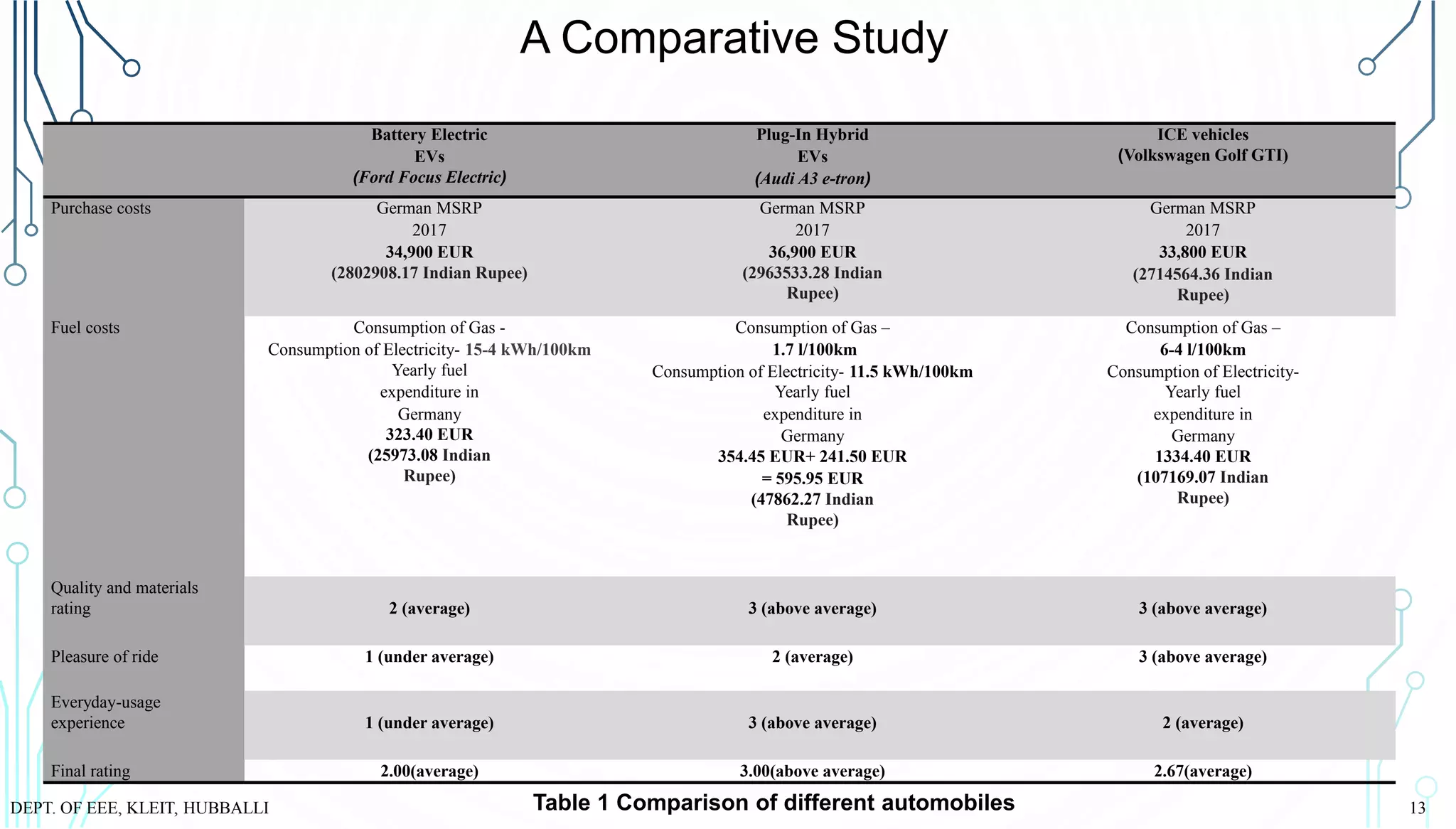
A Comparative Study
Table 1 Comparison of different automobilesDEPT. OF EEE, KLEIT, HUBBALLI 13
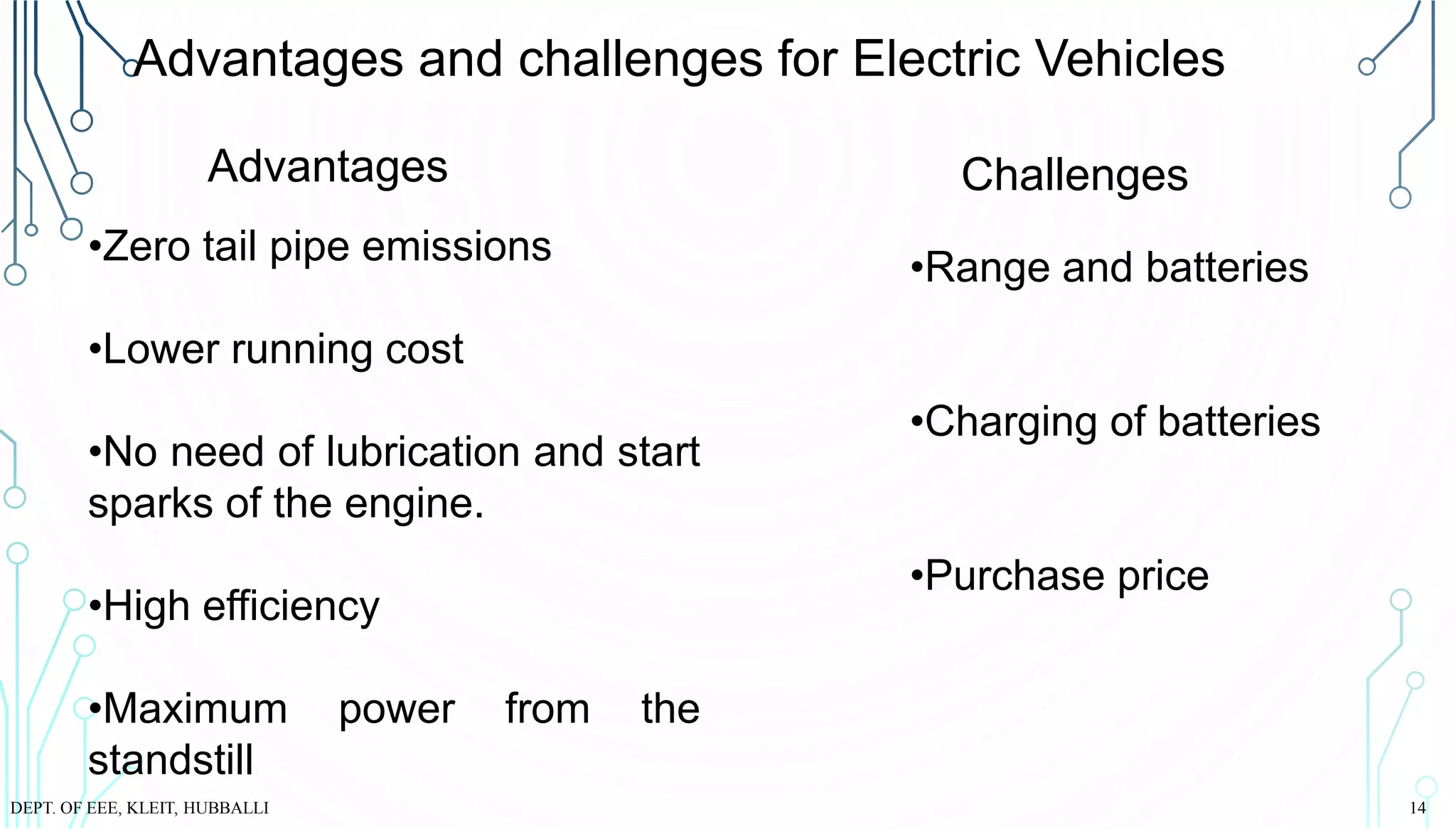
Advantages and challenges for Electric Vehicles
Advantages Challenges
•Zero tail pipe emissions
•Lower running cost
•No need of lubrication and start
sparks of the engine.
•High efficiency
•Maximum power from the
standstill
•Range and batteries
•Charging of batteries
•Purchase price
DEPT. OF EEE, KLEIT, HUBBALLI 14
CONCLUSION
•Several technologies are in the horizon to be implemented in the
next generations of automobiles.
•Hybridization of cars results in better efficiency
•Effective alternatives.
DEPT. OF EEE, KLEIT, HUBBALLI 15
REFERENCES
[I] Nan Qin, "Electric Vehicle Architecture," 2016 EV and Technology Workshop, Oct 17 2016.
[II] Dan Lauber. “Electric Vehicles An Introduction,” EV101, Massachusetts Institute Of Technology,
Nov 13 2009.
[III] C. C. Chan and K. T. Chan “Modern Electric Vehicle Technology,” Oxford Science Publication,
2001.
[IV] Ali Emadi, Young Joo Lee, Kaushik Rajashekara, “Power Electronics and Motor Drives in Electric,
Hybrid Electric, and Plug-In Hybrid Electric Vehicles”, IEEE TRANSACTIONS ON INDUSTRIAL
ELECTRONICS, VOL. 55, NO. 6, JUNE 2008.
[V] Marek Palinski, “A Comparison of Electric Vehicles and Conventional Automobiles: Costs and
Quality Perspective”, Survey Report 7th April 2017.
[VI] C.C. Chan, “The State of the Art of Electric and Hybrid Vehicles,” Proc. of the IEEE, Vol. 90, No.
2, pp. 247-275, Feb. 2002.
[VII] Purnendu Sinha, Vinod Agrawal, “Evaluation of Electric-Vehicle Architecture Alternatives”, IEEEDEPT. OF EEE, KLEIT, HUBBALLI 16
“No single technology development or alternative fuel can solve the problem
growing transportation fuel use and GHG emissions.”
– John Heywood
DEPT. OF EEE, KLEIT, HUBBALLI 17

Architecture of EV and HEV

  • 1.
    Presented by Vulavala Venkatesh (2KE14EE050) Underthe Guidance of Prof. Shivayogi S.S Department of Electrical & Electronics Engineering. K. L. E. Society’s K. L. E. Institute of Technology, Hubballi-30 A SEMINAR ON ELECTRIC AND HYBRID VEHICLE ARCHITECTURE 1DEPT. OF EEE, KLEIT, HUBBALLI
  • 2.
    CONTENTS • INTRODUCTION • BASICCOMPONENTS • ARCHITECTURE • A COMPARITIVE STUDY • ADVANTAGES AND CHALLENGES • CONCLUSION • REFERENCES DEPT. OF EEE, KLEIT, HUBBALLI 2
  • 3.
    •WHAT ARE EV’s? •WHATARE HEV’s? •NECESSITIES INTRODUCTION LITERATURE SURVEY •Modern Electric Vehicle Technology •Power Electronics and Motor Drives in Electric, Hybrid Electric, and Plug-In Hybrid Electric Vehicles •A Comparison of Electric Vehicles and Conventional Automobiles: Costs and Quality Perspective DEPT. OF EEE, KLEIT, HUBBALLI 3
  • 4.
    BASIC COMPONENTS •BATTERY PACK •ELECTRICMOTORS [EM] Fig.1 Battery Management System (BMS) Fig. 2 Permanent Magnet Synchronous Motor UsingDEPT. OF EEE, KLEIT, HUBBALLI 4
  • 5.
    BASIC COMPONENTS •ELECTRIC POWERTRAIN •INFORMATIONSYSTEMS Fig.3 A basic electric powertrain of a full electric vehicle DEPT. OF EEE, KLEIT, HUBBALLI 5
  • 6.
    ARCHITECTURE •Electric Vehicle Configurations•Hybrid Vehicle Configurations The General EV configuration can be explained 1. Based on different Drivetrain Configuration 2. Based on different Power Source Configuration Desirable Hybrid Configuration proposed 1. Series Hybrid Vehicle Configuration 2. Parallel Hybrid Vehicle Configuration 3. Crankshaft Mounted ISG System DEPT. OF EEE, KLEIT, HUBBALLI 6
  • 7.
    CONFIGURATION OF AELECTRIC VEHICLE Fig.4 General Configuration Of Electric Motors DEPT. OF EEE, KLEIT, HUBBALLI 7
  • 8.
    EV Drivetrain AlternativesBased on Drivetrain Configuration 1 2 3 4 5 6 Fig.5 Based on Drivetrain ConfigurationDEPT. OF EEE, KLEIT, HUBBALLI 8
  • 9.
    EV Drivetrain AlternativesBased on Power Source Configuration 1 2 3 4 5 Fig.6 Based on Power SourceDEPT. OF EEE, KLEIT, HUBBALLI 9
  • 10.
    HYBRID VEHICLE ARCHITECTURES Architectureof Series Hybrid Vehicles Fig.10 Series hybrid vehicle propulsion system DEPT. OF EEE, KLEIT, HUBBALLI 10
  • 11.
    Architecture of ParallelHybrid Vehicles Fig.11 Parallel hybrid vehicle propulsion system DEPT. OF EEE, KLEIT, HUBBALLI 11 •Crankshaft-Mounted ISG System
  • 12.
    Architecture of Plug-inHybrid Electric Vehicle Fig.12 Plug-in hybrid electric vehicle (parallel configuration). DEPT. OF EEE, KLEIT, HUBBALLI 12
  • 13.
    Battery Electric EVs (Ford FocusElectric) Plug-In Hybrid EVs (Audi A3 e-tron) ICE vehicles (Volkswagen Golf GTI) Purchase costs German MSRP 2017 34,900 EUR (2802908.17 Indian Rupee) German MSRP 2017 36,900 EUR (2963533.28 Indian Rupee) German MSRP 2017 33,800 EUR (2714564.36 Indian Rupee) Fuel costs Consumption of Gas - Consumption of Electricity- 15-4 kWh/100km Yearly fuel expenditure in Germany 323.40 EUR (25973.08 Indian Rupee) Consumption of Gas – 1.7 l/100km Consumption of Electricity- 11.5 kWh/100km Yearly fuel expenditure in Germany 354.45 EUR+ 241.50 EUR = 595.95 EUR (47862.27 Indian Rupee) Consumption of Gas – 6-4 l/100km Consumption of Electricity- Yearly fuel expenditure in Germany 1334.40 EUR (107169.07 Indian Rupee) Quality and materials rating 2 (average) 3 (above average) 3 (above average) Pleasure of ride 1 (under average) 2 (average) 3 (above average) Everyday-usage experience 1 (under average) 3 (above average) 2 (average) Final rating 2.00(average) 3.00(above average) 2.67(average) A Comparative Study Table 1 Comparison of different automobilesDEPT. OF EEE, KLEIT, HUBBALLI 13
  • 14.
    Advantages and challengesfor Electric Vehicles Advantages Challenges •Zero tail pipe emissions •Lower running cost •No need of lubrication and start sparks of the engine. •High efficiency •Maximum power from the standstill •Range and batteries •Charging of batteries •Purchase price DEPT. OF EEE, KLEIT, HUBBALLI 14
  • 15.
    CONCLUSION •Several technologies arein the horizon to be implemented in the next generations of automobiles. •Hybridization of cars results in better efficiency •Effective alternatives. DEPT. OF EEE, KLEIT, HUBBALLI 15
  • 16.
    REFERENCES [I] Nan Qin,"Electric Vehicle Architecture," 2016 EV and Technology Workshop, Oct 17 2016. [II] Dan Lauber. “Electric Vehicles An Introduction,” EV101, Massachusetts Institute Of Technology, Nov 13 2009. [III] C. C. Chan and K. T. Chan “Modern Electric Vehicle Technology,” Oxford Science Publication, 2001. [IV] Ali Emadi, Young Joo Lee, Kaushik Rajashekara, “Power Electronics and Motor Drives in Electric, Hybrid Electric, and Plug-In Hybrid Electric Vehicles”, IEEE TRANSACTIONS ON INDUSTRIAL ELECTRONICS, VOL. 55, NO. 6, JUNE 2008. [V] Marek Palinski, “A Comparison of Electric Vehicles and Conventional Automobiles: Costs and Quality Perspective”, Survey Report 7th April 2017. [VI] C.C. Chan, “The State of the Art of Electric and Hybrid Vehicles,” Proc. of the IEEE, Vol. 90, No. 2, pp. 247-275, Feb. 2002. [VII] Purnendu Sinha, Vinod Agrawal, “Evaluation of Electric-Vehicle Architecture Alternatives”, IEEEDEPT. OF EEE, KLEIT, HUBBALLI 16
  • 17.
    “No single technologydevelopment or alternative fuel can solve the problem growing transportation fuel use and GHG emissions.” – John Heywood DEPT. OF EEE, KLEIT, HUBBALLI 17